EP0500202A1 - Procédé pour la fabrication d'un objet revêtu - Google Patents
Procédé pour la fabrication d'un objet revêtu Download PDFInfo
- Publication number
- EP0500202A1 EP0500202A1 EP92250037A EP92250037A EP0500202A1 EP 0500202 A1 EP0500202 A1 EP 0500202A1 EP 92250037 A EP92250037 A EP 92250037A EP 92250037 A EP92250037 A EP 92250037A EP 0500202 A1 EP0500202 A1 EP 0500202A1
- Authority
- EP
- European Patent Office
- Prior art keywords
- lamination
- fabric
- preformed
- adhesive
- laminating
- Prior art date
- Legal status (The legal status is an assumption and is not a legal conclusion. Google has not performed a legal analysis and makes no representation as to the accuracy of the status listed.)
- Granted
Links
Images

Classifications
-
- B—PERFORMING OPERATIONS; TRANSPORTING
- B29—WORKING OF PLASTICS; WORKING OF SUBSTANCES IN A PLASTIC STATE IN GENERAL
- B29C—SHAPING OR JOINING OF PLASTICS; SHAPING OF MATERIAL IN A PLASTIC STATE, NOT OTHERWISE PROVIDED FOR; AFTER-TREATMENT OF THE SHAPED PRODUCTS, e.g. REPAIRING
- B29C63/00—Lining or sheathing, i.e. applying preformed layers or sheathings of plastics; Apparatus therefor
- B29C63/22—Lining or sheathing, i.e. applying preformed layers or sheathings of plastics; Apparatus therefor using layers or sheathings having a shape adapted to the shape of the article
-
- B—PERFORMING OPERATIONS; TRANSPORTING
- B29—WORKING OF PLASTICS; WORKING OF SUBSTANCES IN A PLASTIC STATE IN GENERAL
- B29C—SHAPING OR JOINING OF PLASTICS; SHAPING OF MATERIAL IN A PLASTIC STATE, NOT OTHERWISE PROVIDED FOR; AFTER-TREATMENT OF THE SHAPED PRODUCTS, e.g. REPAIRING
- B29C51/00—Shaping by thermoforming, i.e. shaping sheets or sheet like preforms after heating, e.g. shaping sheets in matched moulds or by deep-drawing; Apparatus therefor
- B29C51/16—Lining or labelling
-
- B—PERFORMING OPERATIONS; TRANSPORTING
- B29—WORKING OF PLASTICS; WORKING OF SUBSTANCES IN A PLASTIC STATE IN GENERAL
- B29C—SHAPING OR JOINING OF PLASTICS; SHAPING OF MATERIAL IN A PLASTIC STATE, NOT OTHERWISE PROVIDED FOR; AFTER-TREATMENT OF THE SHAPED PRODUCTS, e.g. REPAIRING
- B29C51/00—Shaping by thermoforming, i.e. shaping sheets or sheet like preforms after heating, e.g. shaping sheets in matched moulds or by deep-drawing; Apparatus therefor
- B29C51/26—Component parts, details or accessories; Auxiliary operations
- B29C51/30—Moulds
- B29C51/32—Moulds having cutting means
-
- B—PERFORMING OPERATIONS; TRANSPORTING
- B29—WORKING OF PLASTICS; WORKING OF SUBSTANCES IN A PLASTIC STATE IN GENERAL
- B29C—SHAPING OR JOINING OF PLASTICS; SHAPING OF MATERIAL IN A PLASTIC STATE, NOT OTHERWISE PROVIDED FOR; AFTER-TREATMENT OF THE SHAPED PRODUCTS, e.g. REPAIRING
- B29C69/00—Combinations of shaping techniques not provided for in a single one of main groups B29C39/00 - B29C67/00, e.g. associations of moulding and joining techniques; Apparatus therefore
- B29C69/005—Combinations of shaping techniques not provided for in a single one of main groups B29C39/00 - B29C67/00, e.g. associations of moulding and joining techniques; Apparatus therefore cutting-off or cutting-out a part of a strip-like or sheet-like material, transferring that part and fixing it to an article
- B29C69/006—Combinations of shaping techniques not provided for in a single one of main groups B29C39/00 - B29C67/00, e.g. associations of moulding and joining techniques; Apparatus therefore cutting-off or cutting-out a part of a strip-like or sheet-like material, transferring that part and fixing it to an article rotating transfer means
-
- B—PERFORMING OPERATIONS; TRANSPORTING
- B29—WORKING OF PLASTICS; WORKING OF SUBSTANCES IN A PLASTIC STATE IN GENERAL
- B29C—SHAPING OR JOINING OF PLASTICS; SHAPING OF MATERIAL IN A PLASTIC STATE, NOT OTHERWISE PROVIDED FOR; AFTER-TREATMENT OF THE SHAPED PRODUCTS, e.g. REPAIRING
- B29C2793/00—Shaping techniques involving a cutting or machining operation
-
- B—PERFORMING OPERATIONS; TRANSPORTING
- B29—WORKING OF PLASTICS; WORKING OF SUBSTANCES IN A PLASTIC STATE IN GENERAL
- B29C—SHAPING OR JOINING OF PLASTICS; SHAPING OF MATERIAL IN A PLASTIC STATE, NOT OTHERWISE PROVIDED FOR; AFTER-TREATMENT OF THE SHAPED PRODUCTS, e.g. REPAIRING
- B29C51/00—Shaping by thermoforming, i.e. shaping sheets or sheet like preforms after heating, e.g. shaping sheets in matched moulds or by deep-drawing; Apparatus therefor
- B29C51/08—Deep drawing or matched-mould forming, i.e. using mechanical means only
- B29C51/082—Deep drawing or matched-mould forming, i.e. using mechanical means only by shaping between complementary mould parts
-
- B—PERFORMING OPERATIONS; TRANSPORTING
- B29—WORKING OF PLASTICS; WORKING OF SUBSTANCES IN A PLASTIC STATE IN GENERAL
- B29K—INDEXING SCHEME ASSOCIATED WITH SUBCLASSES B29B, B29C OR B29D, RELATING TO MOULDING MATERIALS OR TO MATERIALS FOR MOULDS, REINFORCEMENTS, FILLERS OR PREFORMED PARTS, e.g. INSERTS
- B29K2033/00—Use of polymers of unsaturated acids or derivatives thereof as moulding material
- B29K2033/04—Polymers of esters
- B29K2033/08—Polymers of acrylic acid esters, e.g. PMA, i.e. polymethylacrylate
Definitions
- the invention relates to a method for laminating spatially deformed carrier parts according to the preamble of claim 1
- the carrier or molded parts of interest are parts preferably of the same wall thickness as are produced, for example, from wood fiber mats, filled or reinforced plastics or mixtures thereof or the like, starting materials. For surface finishing, they are laminated with foils, fabrics, knitted fabrics or non-woven fabrics. Such lamination processes are widely used for the interior lining of automobiles, which largely consist of such molded parts.
- the present invention is particularly based on laminating materials such as woven, knitted and non-woven fabrics, which usually cannot be laminated onto the carrier parts in a vacuum deep-drawing process, as is advantageous, for example, in the case of foils deposited with plastics or foam.
- laminating materials such as woven, knitted and non-woven fabrics
- the molded part coated with adhesive is pressed on.
- the object of the present invention is to improve the procedure described above in such a way that lamination with improved adhesive strength and adhesiveness is possible with shortened cycle times and simplified tools, partial lamination of the carrier parts also being made possible in machine production.
- laminations is intended to summarize laminating materials with a textile character, such as, for example, woven fabrics, knitted fabrics and non-woven fabrics.
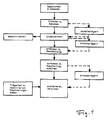
- a back with at least one coating containing thermoplastic deformable parts with the lamination adhesive to be used is at least adhesively adhesive, preformed after heating and shape stabilized by cooling in the preforming tool, the actual lamination process can be separated from the preforms of the lamination fabric using tools.
- the controlled resilience, which is subject to rejection, is not applied to the intended final shape of the lamination with the aid of vacuum. This has several advantages.
- the tool design is simplified, on the other hand, the shape-stabilized lamination fabrics can be produced "in stock", which means that shorter cycle times are possible due to parallel work.
- the main advantage of this procedure is that the lamination fabrics stabilized in this way can be precisely pre-cut in an auxiliary drawing tool, so that partial lamination with precisely defined lamination areas is possible: losses on the lamination material, as are unavoidable in the current state of the art, provided that mechanized manufacturing processes are largely striven for, since the partial lamination can be manufactured separately in a rough cut with only a small excess of material, with the finish trimming to the exact contour being able to be carried out with only a small loss of material.
- the full or partial laminations prefabricated according to the invention can then be connected to the carrier part in the usual way using a laminating adhesive, whereby the methods belonging to the prior art can be used: Both laminating with auxiliary stamps and, if appropriate, vacuum laminating are possible. The latter when the thermoplastic coating on the back of the lamination fabric is air-impermeable. In the case of partial lamination, the use of an auxiliary stamp should be the appropriate procedure.
- the usual lamination adhesives come in handy Laminating adhesive in question, which can be activated by pressure and / or temperature and which is adhesive with the back coating of the laminating material.
- a back coating of the lamination fabric is used in an advantageous manner, which is at least partially crosslinkable with the lamination adhesive used.
- This measure achieves optimal adhesion of the lamination fabric, since the adhesive joint is made of a material that is cross-linked.
- the at least partial crosslinking additionally guarantees the heat resistance of the adhesive joint.
- the long-term properties of molded parts laminated according to the invention are significantly improved compared to the prior art.
- the crosslinkable acrylic acid ester fraction remains reactive under these conditions.
- a conventional polyurethane is expediently used as the lamination adhesive, which is adjusted so that it contains an excess of isocyanate. If the carrier part and / or the polyurethane adhesive layer before Laminating heated to the reactivation temperature of the polyurethane adhesive, the preformed lamination fabric is connected to the carrier part by reaction of the excess isocyanate of the adhesive with the reactive groups of the acrylic acid ester to form a heat-resistant, at least partially crosslinked, adhesive joint.
- the necessary connection pressure is preferably applied by using an auxiliary stamp.
- the preformed, form-stabilized, rough cut of the laminating fabric is trimmed to the outline of the partial laminating before it is positioned and before it is glued to the carrier part. This is expediently carried out using a separate tool, so that damage to the carrier part by cutting knives does not occur.
- lamination fabrics that have a foam layer prefabricated between the actual fabric and its back coating, for example with an acrylic resin mixture, is advantageously possible.
- a method variant can be used well with continuous foam layers, since the entire lamination consisting of fabric layer, foam layer and back coating can then be easily prefabricated and as a layer arrangement is available for fully automated production.
- a foam is used as the foam layer, which is at least conditionally thermoplastic deformable, then there is the possibility of making additional impressions during the pressurization during lamination, which bring about corresponding cushioning effects. Such impressions can, however, also be produced during preforming and shape stabilization of the lamination fabric.
- a particularly favorable process sequence results in partial lamination if the trimming of the rough cut, the positioning of the finished cut of the partial lamination and the pressure connection of the partial lamination blank to the carrier part are carried out in a single working stroke in an aligned follow-up tool. This results in an extremely shortened cycle time with the resulting advantage of high efficiency of the process.
- Laminating fabrics are increasingly being used, which can no longer be connected as partial lamination by a high-frequency welding process, ie HF welding, to the other materials of the overall lamination. It is important to replace PVC in the vehicle interior. Although it has already been proposed in the prior art to have different lamination materials inserted into a shadow gap in order to be able to proceed with a butt joint there, it was then necessary to fix the lamination materials there with the aid of a clamping strip, optionally designed as a decorative strip. Here the present invention offers a further possibility of improving the state of the art.
- Figure 1 the assembly of the finished part after lamination is not shown. This includes, for example, edge gluing, i.e. the folding process.
- the procedure according to the invention gives the possibility of an automated, continuous production.
- storable intermediate products are created within the manufacturing process, so that internal aspects can be taken into account as well as the desired lot size when designing the process sequence. Both increase the economics of the process.
- the auxiliary tool 1 which receives the carrier part 2 positioned, is fixed in place, for example, in a press.
- the punching ring 3 is also arranged in a stationary manner below the auxiliary tool 1, with which the commercial lamination 6 made from the rough cut is cut to the finished size of the partial lamination (area A).
- the preformed fabric liner 6 is positively received by the punch 4.
- the contour of the stamping tool 4 is adapted to the portion of the carrier part to be laminated, so that it can simultaneously be used as a laminating stamp.
- the punch 4 can be moved vertically with the aid of the stamp 4. In the position shown in FIG. 2, it takes up the lamination 6 preformed from the rough cut.
- the positioning of the carrier part 2 and the preformed lamination 6 can, if necessary, by a usual aids, which are not shown in the figures, are supported. For example, an application of negative pressure would be possible.
- the punch 4 has moved upwards with the help of the press ram 5 and has largely passed through the punch ring 3.
- the protrusion 6 ′′ of the rough blank 6 shears off, and the partial lamination 6 ′ is trimmed completely.
- FIG. 4 shows the final stage of the partial lamination: the punching tool 4, in which the finished trim 6 ′ of the partial lamination is still located, has reached the auxiliary tool 1 with the positioned carrier part 2 with its adapted contour.
- the previously reactivated lamination adhesive is brought to crosslink with the reactive groups of the corresponding acrylic acid ester.
- the reactivation of the lamination adhesive presents no major difficulties. Because of the generally poor heat conduction of the carrier parts, the reactivation temperature of the adhesive layer can be maintained for a long time even when the carrier part is inserted into the auxiliary tool 1 and positioned there. This is especially true if support parts made of wood fiber materials are used. However, fiber materials of a different type as the base of the carrier parts or corresponding plastics are also not sufficiently thermally conductive to carry out the method according to the invention.
- FIGS. 2-4 show, for example, implementation of the partial lamination method, other geometries are possible.
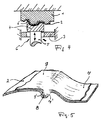
- Figure 5 shows a section of a partially laminated molded part.
- the carrier part 2 is provided with the comfortable groove 8.
- the groove follows the outline of the partial lamination.
- the fabric liner 7 has the angled part 7 'molded on and dimensionally stabilized. This bend dips into the groove 8 of the carrier part and holds the plunge edge 9 'of the remaining lamination 9 in its position. This results in a clean butt joint 10 of visually appealing design and good mechanical stability, without high-frequency welding of the partial components of the overall lamination.
- the partial lamination 7 consists of a fluffy material resilient in the thickness direction, the lamination 9 is held securely in position by means of the plunge edge 9 '.
- the immersion edges 7 'and 9' can also be fixed with lamination adhesive, since corresponding pressure forces can be exerted.
- the dimensionally stable bend 7 'of the partial lamination is helpful, it can be used as it were as a "ruler" for the plunger 9' of the remaining lamination 9. It is particularly advantageous that the back coating of the partial lamination 7, regardless of its textile character, reliably prevents fraying of the contour edges.
Landscapes
- Engineering & Computer Science (AREA)
- Mechanical Engineering (AREA)
- Manufacturing & Machinery (AREA)
- Lining Or Joining Of Plastics Or The Like (AREA)
- Laminated Bodies (AREA)
- Vehicle Interior And Exterior Ornaments, Soundproofing, And Insulation (AREA)
Applications Claiming Priority (2)
| Application Number | Priority Date | Filing Date | Title |
|---|---|---|---|
| DE4105261 | 1991-02-20 | ||
| DE4105261A DE4105261C2 (de) | 1991-02-20 | 1991-02-20 | Verfahren zum Kaschieren von räumlich verformten Trägerteilen |
Publications (2)
| Publication Number | Publication Date |
|---|---|
| EP0500202A1 true EP0500202A1 (fr) | 1992-08-26 |
| EP0500202B1 EP0500202B1 (fr) | 1995-08-02 |
Family
ID=6425477
Family Applications (1)
| Application Number | Title | Priority Date | Filing Date |
|---|---|---|---|
| EP92250037A Expired - Lifetime EP0500202B1 (fr) | 1991-02-20 | 1992-02-20 | Procédé pour la fabrication d'un objet revêtu |
Country Status (3)
| Country | Link |
|---|---|
| EP (1) | EP0500202B1 (fr) |
| DE (2) | DE4105261C2 (fr) |
| ES (1) | ES2077347T3 (fr) |
Cited By (8)
| Publication number | Priority date | Publication date | Assignee | Title |
|---|---|---|---|---|
| EP0633125A1 (fr) * | 1993-07-01 | 1995-01-11 | General Electric Company | Dispositif de serrage |
| EP0633124A1 (fr) * | 1993-07-01 | 1995-01-11 | General Electric Company | Dépôt d'une membrane mince de manière à épouser une surface de forme irrégulière |
| EP0686478A1 (fr) * | 1994-06-08 | 1995-12-13 | Gerhard Pirchl | Pièce métallique doublée et procédé pour sa fabrication |
| EP0688641A3 (fr) * | 1994-06-22 | 1996-06-12 | Fainsa Sa | Procédé pour fabriquer des articles plats pour éléments de sièges de véhicules et similaires |
| WO1996017719A1 (fr) * | 1993-08-13 | 1996-06-13 | Triag Ag Peter Sparber | Piece metallique pourvue d'un doublage et son procede de fabrication |
| EP1022370A3 (fr) * | 1999-01-25 | 2003-04-02 | Bakelite AG | Procédé de fabrication de pièces moulées en tissus non-tissés traités en surface |
| WO2003072330A1 (fr) * | 2002-02-27 | 2003-09-04 | Johann Borgers Gmbh & Co. Kg | Procede et dispositif pour produire des pieces moulees en non-tisse |
| WO2013026762A3 (fr) * | 2011-08-19 | 2013-05-02 | Johnson Controls Interiors Gmbh & Co. Kg | Procédé et dispositif pour réaliser au moins le revêtement partiel d'un élément, notamment d'une pièce de véhicule |
Families Citing this family (7)
| Publication number | Priority date | Publication date | Assignee | Title |
|---|---|---|---|---|
| DE4300943C2 (de) * | 1993-01-15 | 1997-05-28 | Lignotock Gmbh | Vorrichtung mit elastomerem Überzug zum Kaschieren von Formteilen |
| DE4305189C2 (de) * | 1993-02-19 | 1995-11-02 | Huber Anton Systemtechnik Gmbh | Verfahren und Werkzeugeinrichtung für eine Vorrichtung zum Beziehen der Innenseitenflächen von Trägerteilen |
| DE4401903C1 (de) * | 1994-01-24 | 1994-12-01 | Peguform Werke Gmbh | Verfahren und Vorrichtung zum Kaschieren eines Bauteiles |
| DE10152892A1 (de) | 2001-10-26 | 2003-05-08 | Oce Printing Systems Gmbh | Verfahren und Vorrichtung zur Reinigung von Trägerelementen in Druckern oder Kopierern unter Anwendung von Magnetfeldern |
| DE10338812B4 (de) * | 2003-08-21 | 2012-05-31 | Daimler Ag | Hintergeschäumtes Bauteil und zugehöriges Herstellungsverfahren |
| DE102009031033B4 (de) * | 2009-06-30 | 2024-01-25 | Dr. Ing. H.C. F. Porsche Aktiengesellschaft | Verfahren zur Herstellung einer Verkleidung für ein Fahrzeuginnenteil |
| DE102011086450B4 (de) | 2011-11-16 | 2019-04-04 | Lisa Dräxlmaier GmbH | Verfahren zur Herstellung eines Interieurbauteils für Fahrzeuginnenräume |
Citations (4)
| Publication number | Priority date | Publication date | Assignee | Title |
|---|---|---|---|---|
| DE1946820A1 (de) * | 1968-09-17 | 1970-05-06 | Ici Ltd | Verfahren zur Herstellung von geformten und ueberzogenen Polymergegenstaenden |
| DE3128977A1 (de) * | 1981-07-22 | 1983-02-10 | Paul Kiefel Gmbh, 8228 Freilassing | Verfahren und vorrichtung zum herstellen von verbundkoerpern |
| DE3607647A1 (de) * | 1986-03-05 | 1987-09-17 | Kiss G H | Verfahren zum kaschieren von formteilen und vorrichtung zu seiner durchfuehrung |
| DE3930603A1 (de) * | 1988-09-16 | 1990-03-22 | Roeder & Spengler Stanz | Verfahren und vorrichtung zum herstellen von verkleidungsteilen mit verschiedenen ausstattungselementen |
Family Cites Families (3)
| Publication number | Priority date | Publication date | Assignee | Title |
|---|---|---|---|---|
| DE2365203B2 (de) * | 1973-12-31 | 1977-02-03 | Dynamit Nobel Ag, 5210 Troisdorf | Herstellen von mehrschichtigen bahnen, platten, formteilen |
| DE3503192C1 (de) * | 1985-01-31 | 1986-09-18 | Johann Borgers Gmbh & Co Kg, 4290 Bocholt | Verfahren zur Herstellung eines Formteils aus einem durch Kunststoff verfestigten Faservlies und einem das Faservlies kaschierenden Bezugsstoff |
| DE3626350A1 (de) * | 1986-08-04 | 1988-02-11 | Dynamit Nobel Ag | Innenraumverkleidung fuer ein kraftfahrzeug und verfahren zu ihrer herstellung |
-
1991
- 1991-02-20 DE DE4105261A patent/DE4105261C2/de not_active Expired - Fee Related
-
1992
- 1992-02-20 EP EP92250037A patent/EP0500202B1/fr not_active Expired - Lifetime
- 1992-02-20 ES ES92250037T patent/ES2077347T3/es not_active Expired - Lifetime
- 1992-02-20 DE DE59203066T patent/DE59203066D1/de not_active Expired - Lifetime
Patent Citations (4)
| Publication number | Priority date | Publication date | Assignee | Title |
|---|---|---|---|---|
| DE1946820A1 (de) * | 1968-09-17 | 1970-05-06 | Ici Ltd | Verfahren zur Herstellung von geformten und ueberzogenen Polymergegenstaenden |
| DE3128977A1 (de) * | 1981-07-22 | 1983-02-10 | Paul Kiefel Gmbh, 8228 Freilassing | Verfahren und vorrichtung zum herstellen von verbundkoerpern |
| DE3607647A1 (de) * | 1986-03-05 | 1987-09-17 | Kiss G H | Verfahren zum kaschieren von formteilen und vorrichtung zu seiner durchfuehrung |
| DE3930603A1 (de) * | 1988-09-16 | 1990-03-22 | Roeder & Spengler Stanz | Verfahren und vorrichtung zum herstellen von verkleidungsteilen mit verschiedenen ausstattungselementen |
Non-Patent Citations (1)
| Title |
|---|
| ADHASION Bd. 32, Nr. 12, Dezember 1988, MÜNCHEN, DE Seiten 17 - 20; (HANS-JOACHIM STUDT):'SCHMELZKLEBFOLIEN ODER HOTMELTS IN BESTFORM.' * |
Cited By (13)
| Publication number | Priority date | Publication date | Assignee | Title |
|---|---|---|---|---|
| EP0633125A1 (fr) * | 1993-07-01 | 1995-01-11 | General Electric Company | Dispositif de serrage |
| EP0633124A1 (fr) * | 1993-07-01 | 1995-01-11 | General Electric Company | Dépôt d'une membrane mince de manière à épouser une surface de forme irrégulière |
| US5410791A (en) * | 1993-07-01 | 1995-05-02 | General Electric Company | Fabrication chuck |
| CN1082436C (zh) * | 1993-08-13 | 2002-04-10 | Triag彼得斯帕波股份公司 | 带有粘贴层的金属部件及其制作方法 |
| WO1996017719A1 (fr) * | 1993-08-13 | 1996-06-13 | Triag Ag Peter Sparber | Piece metallique pourvue d'un doublage et son procede de fabrication |
| EP0686478A1 (fr) * | 1994-06-08 | 1995-12-13 | Gerhard Pirchl | Pièce métallique doublée et procédé pour sa fabrication |
| ES2114387A1 (es) * | 1994-06-22 | 1998-05-16 | Fainsa Sa | Procedimiento de fabricacion de cuerpos laminares constitutivos de partes de asientos para vehiculos y similares. |
| US5783009A (en) * | 1994-06-22 | 1998-07-21 | Fabricacion Asientos Vehiculos Industriales, S.A. (Fainsa) | Manufacturing process of sheet-like bodies comprising seat parts for vehicles and the like |
| EP0688641A3 (fr) * | 1994-06-22 | 1996-06-12 | Fainsa Sa | Procédé pour fabriquer des articles plats pour éléments de sièges de véhicules et similaires |
| EP1022370A3 (fr) * | 1999-01-25 | 2003-04-02 | Bakelite AG | Procédé de fabrication de pièces moulées en tissus non-tissés traités en surface |
| WO2003072330A1 (fr) * | 2002-02-27 | 2003-09-04 | Johann Borgers Gmbh & Co. Kg | Procede et dispositif pour produire des pieces moulees en non-tisse |
| WO2013026762A3 (fr) * | 2011-08-19 | 2013-05-02 | Johnson Controls Interiors Gmbh & Co. Kg | Procédé et dispositif pour réaliser au moins le revêtement partiel d'un élément, notamment d'une pièce de véhicule |
| CN103842151A (zh) * | 2011-08-19 | 2014-06-04 | 约翰逊内控两合公司 | 局部层合尤其是机动车辆的部件的方法和设备 |
Also Published As
| Publication number | Publication date |
|---|---|
| DE4105261A1 (de) | 1992-08-27 |
| ES2077347T3 (es) | 1995-11-16 |
| DE4105261C2 (de) | 1994-03-31 |
| DE59203066D1 (de) | 1995-09-07 |
| EP0500202B1 (fr) | 1995-08-02 |
Similar Documents
| Publication | Publication Date | Title |
|---|---|---|
| EP0500202B1 (fr) | Procédé pour la fabrication d'un objet revêtu | |
| EP1646492B1 (fr) | Elements de garniture interieure pour vehicules automobiles presentant un profil de surface defini | |
| DE69029651T2 (de) | Teile im Fahrzeuginnenraum und Verfahren zu ihrer Herstellung | |
| EP2279915B1 (fr) | Composants d'équipement intérieur à plusieurs couleurs | |
| EP0410553B1 (fr) | Procédé pour fabriquer des objets formés et revêtus | |
| EP0686476B1 (fr) | Procédé et appareil pour la fabrication d'un objet revêtu | |
| DE69027334T2 (de) | Verfahren zur herstellung von motorfahrzeugtürinnenverkleidung | |
| EP0657265B1 (fr) | Procédé de fabrication d'éléments plats revêtus utilisant des préformes en forme de grille | |
| DE3537997A1 (de) | Verfahren zur herstellung eines formteiles mit stoffverkleidung | |
| EP2240311B1 (fr) | Procédé et appareil pour fabriquer un objet moulé | |
| DE19500233C2 (de) | Verkleidungsteil für den Innenausbau insbesondere von Kraftfahrzeugen und Verfahren zur Herstellung eines Verkleidungsteils | |
| DE4305189C2 (de) | Verfahren und Werkzeugeinrichtung für eine Vorrichtung zum Beziehen der Innenseitenflächen von Trägerteilen | |
| DD296636A5 (de) | Verfahren zum herstellen von kaschierten formteilen | |
| DE3301682A1 (de) | Verfahren zur herstellung von schalldaemmkoerpern | |
| EP2024164A1 (fr) | Procédé de fabrication d'une pièce moulée contrecollée | |
| WO2013026762A2 (fr) | Procédé et dispositif pour réaliser au moins le revêtement partiel d'un élément, notamment d'une pièce de véhicule | |
| DE3508125C2 (de) | Verfahren zum Herstellen eines mit Flächengebilden kaschierten Formkörpers aus Schaumstoffen | |
| DE3033494A1 (de) | Verfahren zum herstellen von formteilen und vorrichtung zur durchfuehrung des verfahrens | |
| DE3507893C2 (de) | Verfahren zum Herstellen von partiell und konturtreu unterpolsterten kaschierten Verkleidungsplatten | |
| DE102018131722A1 (de) | Formwerkzeug zum Fügen von Verkleidungsteilen mit flächigen Dekormaterialien und ein entsprechendes Verfahren | |
| DE202018006057U1 (de) | Formwerkzeug zum Fügen von Verkleidungsteilen mit flächigen Dekormaterialien | |
| DE10033926A1 (de) | Verfahren zur Herstellung eines mehrschichtigen Verkleidungselementes | |
| DE19634840A1 (de) | Verfahren und Vorrichtung zur flächenhaften Aufbringung von Dekormaterial zur Verkleidung eines Formteils | |
| DE102023200002A1 (de) | Verfahren sowie Vorrichtung zur Herstellung eines Formteils | |
| EP0309601A1 (fr) | Procédé et appareil de fabrication de pièces moulées revêtues |
Legal Events
| Date | Code | Title | Description |
|---|---|---|---|
| PUAI | Public reference made under article 153(3) epc to a published international application that has entered the european phase |
Free format text: ORIGINAL CODE: 0009012 |
|
| AK | Designated contracting states |
Kind code of ref document: A1 Designated state(s): DE ES FR GB IT |
|
| 17P | Request for examination filed |
Effective date: 19921020 |
|
| 17Q | First examination report despatched |
Effective date: 19940425 |
|
| GRAA | (expected) grant |
Free format text: ORIGINAL CODE: 0009210 |
|
| AK | Designated contracting states |
Kind code of ref document: B1 Designated state(s): DE ES FR GB IT |
|
| REF | Corresponds to: |
Ref document number: 59203066 Country of ref document: DE Date of ref document: 19950907 |
|
| GBT | Gb: translation of ep patent filed (gb section 77(6)(a)/1977) |
Effective date: 19950913 |
|
| ITF | It: translation for a ep patent filed | ||
| REG | Reference to a national code |
Ref country code: ES Ref legal event code: FG2A Ref document number: 2077347 Country of ref document: ES Kind code of ref document: T3 |
|
| ET | Fr: translation filed | ||
| PLBE | No opposition filed within time limit |
Free format text: ORIGINAL CODE: 0009261 |
|
| 26N | No opposition filed | ||
| REG | Reference to a national code |
Ref country code: GB Ref legal event code: IF02 |
|
| PGFP | Annual fee paid to national office [announced via postgrant information from national office to epo] |
Ref country code: GB Payment date: 20050307 Year of fee payment: 14 |
|
| PGFP | Annual fee paid to national office [announced via postgrant information from national office to epo] |
Ref country code: FR Payment date: 20050309 Year of fee payment: 14 |
|
| PGFP | Annual fee paid to national office [announced via postgrant information from national office to epo] |
Ref country code: ES Payment date: 20050316 Year of fee payment: 14 |
|
| PG25 | Lapsed in a contracting state [announced via postgrant information from national office to epo] |
Ref country code: GB Free format text: LAPSE BECAUSE OF NON-PAYMENT OF DUE FEES Effective date: 20060220 |
|
| PG25 | Lapsed in a contracting state [announced via postgrant information from national office to epo] |
Ref country code: ES Free format text: LAPSE BECAUSE OF NON-PAYMENT OF DUE FEES Effective date: 20060221 |
|
| PGFP | Annual fee paid to national office [announced via postgrant information from national office to epo] |
Ref country code: IT Payment date: 20060228 Year of fee payment: 15 |
|
| GBPC | Gb: european patent ceased through non-payment of renewal fee |
Effective date: 20060220 |
|
| REG | Reference to a national code |
Ref country code: FR Ref legal event code: ST Effective date: 20061031 |
|
| REG | Reference to a national code |
Ref country code: ES Ref legal event code: FD2A Effective date: 20060221 |
|
| PG25 | Lapsed in a contracting state [announced via postgrant information from national office to epo] |
Ref country code: FR Free format text: LAPSE BECAUSE OF NON-PAYMENT OF DUE FEES Effective date: 20060228 |
|
| PG25 | Lapsed in a contracting state [announced via postgrant information from national office to epo] |
Ref country code: IT Free format text: LAPSE BECAUSE OF NON-PAYMENT OF DUE FEES Effective date: 20070220 |
|
| PGFP | Annual fee paid to national office [announced via postgrant information from national office to epo] |
Ref country code: DE Payment date: 20110315 Year of fee payment: 20 |
|
| REG | Reference to a national code |
Ref country code: DE Ref legal event code: R071 Ref document number: 59203066 Country of ref document: DE |
|
| REG | Reference to a national code |
Ref country code: DE Ref legal event code: R071 Ref document number: 59203066 Country of ref document: DE |
|
| PG25 | Lapsed in a contracting state [announced via postgrant information from national office to epo] |
Ref country code: DE Free format text: LAPSE BECAUSE OF EXPIRATION OF PROTECTION Effective date: 20120221 |