EP0309609A1 - Aushärtungsfähige Auskleidungszusammensetzung - Google Patents
Aushärtungsfähige Auskleidungszusammensetzung Download PDFInfo
- Publication number
- EP0309609A1 EP0309609A1 EP87114375A EP87114375A EP0309609A1 EP 0309609 A1 EP0309609 A1 EP 0309609A1 EP 87114375 A EP87114375 A EP 87114375A EP 87114375 A EP87114375 A EP 87114375A EP 0309609 A1 EP0309609 A1 EP 0309609A1
- Authority
- EP
- European Patent Office
- Prior art keywords
- composition
- micron
- weight
- cement
- epoxy resin
- Prior art date
- Legal status (The legal status is an assumption and is not a legal conclusion. Google has not performed a legal analysis and makes no representation as to the accuracy of the status listed.)
- Withdrawn
Links
- 239000000203 mixture Substances 0.000 title claims abstract description 75
- 239000003822 epoxy resin Substances 0.000 claims abstract description 32
- 229920000647 polyepoxide Polymers 0.000 claims abstract description 32
- 239000004568 cement Substances 0.000 claims abstract description 26
- XLYOFNOQVPJJNP-UHFFFAOYSA-N water Substances O XLYOFNOQVPJJNP-UHFFFAOYSA-N 0.000 claims abstract description 24
- 239000000945 filler Substances 0.000 claims abstract description 20
- 239000004848 polyfunctional curative Substances 0.000 claims abstract description 18
- 239000011256 inorganic filler Substances 0.000 claims abstract description 15
- 229910003475 inorganic filler Inorganic materials 0.000 claims abstract description 15
- LNEPOXFFQSENCJ-UHFFFAOYSA-N haloperidol Chemical compound C1CC(O)(C=2C=CC(Cl)=CC=2)CCN1CCCC(=O)C1=CC=C(F)C=C1 LNEPOXFFQSENCJ-UHFFFAOYSA-N 0.000 claims abstract description 8
- 239000011396 hydraulic cement Substances 0.000 claims abstract description 6
- 239000004850 liquid epoxy resins (LERs) Substances 0.000 claims abstract description 3
- 239000002245 particle Substances 0.000 claims description 15
- VYPSYNLAJGMNEJ-UHFFFAOYSA-N silicon dioxide Inorganic materials O=[Si]=O VYPSYNLAJGMNEJ-UHFFFAOYSA-N 0.000 claims description 9
- 239000004576 sand Substances 0.000 claims description 6
- 238000000034 method Methods 0.000 claims description 5
- OKTJSMMVPCPJKN-UHFFFAOYSA-N Carbon Chemical compound [C] OKTJSMMVPCPJKN-UHFFFAOYSA-N 0.000 claims description 3
- 229910052799 carbon Inorganic materials 0.000 claims description 3
- 239000010453 quartz Substances 0.000 claims description 3
- 229910000323 aluminium silicate Inorganic materials 0.000 claims description 2
- HNPSIPDUKPIQMN-UHFFFAOYSA-N dioxosilane;oxo(oxoalumanyloxy)alumane Chemical compound O=[Si]=O.O=[Al]O[Al]=O HNPSIPDUKPIQMN-UHFFFAOYSA-N 0.000 claims description 2
- 239000010881 fly ash Substances 0.000 claims description 2
- 239000000843 powder Substances 0.000 claims description 2
- 229910021487 silica fume Inorganic materials 0.000 claims description 2
- 239000000454 talc Substances 0.000 claims description 2
- 229910052623 talc Inorganic materials 0.000 claims description 2
- 238000000576 coating method Methods 0.000 description 7
- 239000003349 gelling agent Substances 0.000 description 7
- CURLTUGMZLYLDI-UHFFFAOYSA-N Carbon dioxide Chemical compound O=C=O CURLTUGMZLYLDI-UHFFFAOYSA-N 0.000 description 6
- 239000011248 coating agent Substances 0.000 description 6
- 239000004094 surface-active agent Substances 0.000 description 6
- 239000011398 Portland cement Substances 0.000 description 5
- 150000002118 epoxides Chemical class 0.000 description 5
- -1 for example Chemical class 0.000 description 5
- 229920000642 polymer Polymers 0.000 description 5
- 239000011414 polymer cement Substances 0.000 description 5
- KAKZBPTYRLMSJV-UHFFFAOYSA-N Butadiene Chemical compound C=CC=C KAKZBPTYRLMSJV-UHFFFAOYSA-N 0.000 description 4
- 239000004952 Polyamide Substances 0.000 description 4
- PNEYBMLMFCGWSK-UHFFFAOYSA-N aluminium oxide Inorganic materials [O-2].[O-2].[O-2].[Al+3].[Al+3] PNEYBMLMFCGWSK-UHFFFAOYSA-N 0.000 description 4
- 239000004615 ingredient Substances 0.000 description 4
- 239000007788 liquid Substances 0.000 description 4
- 239000000463 material Substances 0.000 description 4
- 229920002647 polyamide Polymers 0.000 description 4
- 239000000126 substance Substances 0.000 description 4
- 239000010425 asbestos Substances 0.000 description 3
- 239000001569 carbon dioxide Substances 0.000 description 3
- 229910002092 carbon dioxide Inorganic materials 0.000 description 3
- 238000006243 chemical reaction Methods 0.000 description 3
- 150000001875 compounds Chemical class 0.000 description 3
- 239000000049 pigment Substances 0.000 description 3
- 229910052895 riebeckite Inorganic materials 0.000 description 3
- 235000020354 squash Nutrition 0.000 description 3
- 239000004593 Epoxy Substances 0.000 description 2
- QIGBRXMKCJKVMJ-UHFFFAOYSA-N Hydroquinone Chemical compound OC1=CC=C(O)C=C1 QIGBRXMKCJKVMJ-UHFFFAOYSA-N 0.000 description 2
- UQSXHKLRYXJYBZ-UHFFFAOYSA-N Iron oxide Chemical compound [Fe]=O UQSXHKLRYXJYBZ-UHFFFAOYSA-N 0.000 description 2
- RRHGJUQNOFWUDK-UHFFFAOYSA-N Isoprene Chemical compound CC(=C)C=C RRHGJUQNOFWUDK-UHFFFAOYSA-N 0.000 description 2
- PPBRXRYQALVLMV-UHFFFAOYSA-N Styrene Chemical compound C=CC1=CC=CC=C1 PPBRXRYQALVLMV-UHFFFAOYSA-N 0.000 description 2
- QAOWNCQODCNURD-UHFFFAOYSA-L Sulfate Chemical compound [O-]S([O-])(=O)=O QAOWNCQODCNURD-UHFFFAOYSA-L 0.000 description 2
- GWEVSGVZZGPLCZ-UHFFFAOYSA-N Titan oxide Chemical compound O=[Ti]=O GWEVSGVZZGPLCZ-UHFFFAOYSA-N 0.000 description 2
- 230000002378 acidificating effect Effects 0.000 description 2
- WTEOIRVLGSZEPR-UHFFFAOYSA-N boron trifluoride Chemical compound FB(F)F WTEOIRVLGSZEPR-UHFFFAOYSA-N 0.000 description 2
- 125000004432 carbon atom Chemical group C* 0.000 description 2
- YCIMNLLNPGFGHC-UHFFFAOYSA-N catechol Chemical compound OC1=CC=CC=C1O YCIMNLLNPGFGHC-UHFFFAOYSA-N 0.000 description 2
- 229920002678 cellulose Polymers 0.000 description 2
- 239000003795 chemical substances by application Substances 0.000 description 2
- 230000008878 coupling Effects 0.000 description 2
- 238000010168 coupling process Methods 0.000 description 2
- 238000005859 coupling reaction Methods 0.000 description 2
- ZSWFCLXCOIISFI-UHFFFAOYSA-N cyclopentadiene Chemical compound C1C=CC=C1 ZSWFCLXCOIISFI-UHFFFAOYSA-N 0.000 description 2
- 150000001993 dienes Chemical class 0.000 description 2
- 235000014113 dietary fatty acids Nutrition 0.000 description 2
- GYZLOYUZLJXAJU-UHFFFAOYSA-N diglycidyl ether Chemical compound C1OC1COCC1CO1 GYZLOYUZLJXAJU-UHFFFAOYSA-N 0.000 description 2
- 239000000194 fatty acid Substances 0.000 description 2
- 229930195729 fatty acid Natural products 0.000 description 2
- 238000009472 formulation Methods 0.000 description 2
- 239000003673 groundwater Substances 0.000 description 2
- 229910052500 inorganic mineral Inorganic materials 0.000 description 2
- 239000011707 mineral Substances 0.000 description 2
- 235000019198 oils Nutrition 0.000 description 2
- 229920000768 polyamine Polymers 0.000 description 2
- 229920005862 polyol Polymers 0.000 description 2
- 150000003077 polyols Chemical class 0.000 description 2
- 229920002635 polyurethane Polymers 0.000 description 2
- 239000004814 polyurethane Substances 0.000 description 2
- 230000003014 reinforcing effect Effects 0.000 description 2
- GHMLBKRAJCXXBS-UHFFFAOYSA-N resorcinol Chemical compound OC1=CC=CC(O)=C1 GHMLBKRAJCXXBS-UHFFFAOYSA-N 0.000 description 2
- 238000007665 sagging Methods 0.000 description 2
- 238000003860 storage Methods 0.000 description 2
- 229910021653 sulphate ion Inorganic materials 0.000 description 2
- DNIAPMSPPWPWGF-GSVOUGTGSA-N (R)-(-)-Propylene glycol Chemical class C[C@@H](O)CO DNIAPMSPPWPWGF-GSVOUGTGSA-N 0.000 description 1
- LCVCUJWKJNFDMY-UHFFFAOYSA-N 2,2-diphenylpropane-1,1-diol Chemical compound C=1C=CC=CC=1C(C(O)O)(C)C1=CC=CC=C1 LCVCUJWKJNFDMY-UHFFFAOYSA-N 0.000 description 1
- VPWNQTHUCYMVMZ-UHFFFAOYSA-N 4,4'-sulfonyldiphenol Chemical compound C1=CC(O)=CC=C1S(=O)(=O)C1=CC=C(O)C=C1 VPWNQTHUCYMVMZ-UHFFFAOYSA-N 0.000 description 1
- OECTYKWYRCHAKR-UHFFFAOYSA-N 4-vinylcyclohexene dioxide Chemical compound C1OC1C1CC2OC2CC1 OECTYKWYRCHAKR-UHFFFAOYSA-N 0.000 description 1
- NHJIDZUQMHKGRE-UHFFFAOYSA-N 7-oxabicyclo[4.1.0]heptan-4-yl 2-(7-oxabicyclo[4.1.0]heptan-4-yl)acetate Chemical compound C1CC2OC2CC1OC(=O)CC1CC2OC2CC1 NHJIDZUQMHKGRE-UHFFFAOYSA-N 0.000 description 1
- NLHHRLWOUZZQLW-UHFFFAOYSA-N Acrylonitrile Chemical compound C=CC#N NLHHRLWOUZZQLW-UHFFFAOYSA-N 0.000 description 1
- 229910015900 BF3 Inorganic materials 0.000 description 1
- 229930185605 Bisphenol Natural products 0.000 description 1
- 229920002134 Carboxymethyl cellulose Polymers 0.000 description 1
- VYZAMTAEIAYCRO-UHFFFAOYSA-N Chromium Chemical compound [Cr] VYZAMTAEIAYCRO-UHFFFAOYSA-N 0.000 description 1
- 229920000742 Cotton Polymers 0.000 description 1
- BRLQWZUYTZBJKN-UHFFFAOYSA-N Epichlorohydrin Chemical compound ClCC1CO1 BRLQWZUYTZBJKN-UHFFFAOYSA-N 0.000 description 1
- 229920002907 Guar gum Polymers 0.000 description 1
- 239000002841 Lewis acid Substances 0.000 description 1
- 240000006240 Linum usitatissimum Species 0.000 description 1
- 235000004431 Linum usitatissimum Nutrition 0.000 description 1
- 229920000914 Metallic fiber Polymers 0.000 description 1
- 229910019142 PO4 Inorganic materials 0.000 description 1
- 239000004743 Polypropylene Substances 0.000 description 1
- 229910000831 Steel Inorganic materials 0.000 description 1
- NIXOWILDQLNWCW-UHFFFAOYSA-N acrylic acid group Chemical group C(C=C)(=O)O NIXOWILDQLNWCW-UHFFFAOYSA-N 0.000 description 1
- 230000001464 adherent effect Effects 0.000 description 1
- 239000002318 adhesion promoter Substances 0.000 description 1
- 125000001931 aliphatic group Chemical group 0.000 description 1
- 125000000217 alkyl group Chemical group 0.000 description 1
- XYLMUPLGERFSHI-UHFFFAOYSA-N alpha-Methylstyrene Chemical compound CC(=C)C1=CC=CC=C1 XYLMUPLGERFSHI-UHFFFAOYSA-N 0.000 description 1
- 150000008064 anhydrides Chemical class 0.000 description 1
- 239000003945 anionic surfactant Substances 0.000 description 1
- JXLHNMVSKXFWAO-UHFFFAOYSA-N azane;7-fluoro-2,1,3-benzoxadiazole-4-sulfonic acid Chemical compound N.OS(=O)(=O)C1=CC=C(F)C2=NON=C12 JXLHNMVSKXFWAO-UHFFFAOYSA-N 0.000 description 1
- 239000004305 biphenyl Substances 0.000 description 1
- 235000010290 biphenyl Nutrition 0.000 description 1
- 125000006267 biphenyl group Chemical group 0.000 description 1
- IDSLNGDJQFVDPQ-UHFFFAOYSA-N bis(7-oxabicyclo[4.1.0]heptan-4-yl) hexanedioate Chemical compound C1CC2OC2CC1OC(=O)CCCCC(=O)OC1CC2OC2CC1 IDSLNGDJQFVDPQ-UHFFFAOYSA-N 0.000 description 1
- IISBACLAFKSPIT-UHFFFAOYSA-N bisphenol A Chemical compound C=1C=C(O)C=CC=1C(C)(C)C1=CC=C(O)C=C1 IISBACLAFKSPIT-UHFFFAOYSA-N 0.000 description 1
- 239000011449 brick Substances 0.000 description 1
- 239000000378 calcium silicate Substances 0.000 description 1
- 229910052918 calcium silicate Inorganic materials 0.000 description 1
- OYACROKNLOSFPA-UHFFFAOYSA-N calcium;dioxido(oxo)silane Chemical compound [Ca+2].[O-][Si]([O-])=O OYACROKNLOSFPA-UHFFFAOYSA-N 0.000 description 1
- 150000001733 carboxylic acid esters Chemical class 0.000 description 1
- 239000003054 catalyst Substances 0.000 description 1
- 230000003197 catalytic effect Effects 0.000 description 1
- 239000003093 cationic surfactant Substances 0.000 description 1
- 239000001913 cellulose Substances 0.000 description 1
- 239000011083 cement mortar Substances 0.000 description 1
- 239000000919 ceramic Substances 0.000 description 1
- 230000000052 comparative effect Effects 0.000 description 1
- 239000004567 concrete Substances 0.000 description 1
- 238000010276 construction Methods 0.000 description 1
- 229920001577 copolymer Polymers 0.000 description 1
- 238000005336 cracking Methods 0.000 description 1
- 230000006866 deterioration Effects 0.000 description 1
- 238000011161 development Methods 0.000 description 1
- 230000018109 developmental process Effects 0.000 description 1
- 150000002009 diols Chemical class 0.000 description 1
- 230000000694 effects Effects 0.000 description 1
- 238000005516 engineering process Methods 0.000 description 1
- 229920006333 epoxy cement Polymers 0.000 description 1
- 150000002170 ethers Chemical class 0.000 description 1
- 238000002474 experimental method Methods 0.000 description 1
- 150000004665 fatty acids Chemical class 0.000 description 1
- 239000000835 fiber Substances 0.000 description 1
- 239000010419 fine particle Substances 0.000 description 1
- 238000009408 flooring Methods 0.000 description 1
- 238000005187 foaming Methods 0.000 description 1
- 239000003365 glass fiber Substances 0.000 description 1
- 239000000665 guar gum Substances 0.000 description 1
- 229960002154 guar gum Drugs 0.000 description 1
- 235000010417 guar gum Nutrition 0.000 description 1
- 230000036571 hydration Effects 0.000 description 1
- 238000006703 hydration reaction Methods 0.000 description 1
- 230000002706 hydrostatic effect Effects 0.000 description 1
- 238000011065 in-situ storage Methods 0.000 description 1
- 229910010272 inorganic material Inorganic materials 0.000 description 1
- 239000011147 inorganic material Substances 0.000 description 1
- 238000003780 insertion Methods 0.000 description 1
- 230000037431 insertion Effects 0.000 description 1
- 239000012948 isocyanate Substances 0.000 description 1
- 150000002513 isocyanates Chemical class 0.000 description 1
- 150000007517 lewis acids Chemical class 0.000 description 1
- 230000007774 longterm Effects 0.000 description 1
- 229910052751 metal Inorganic materials 0.000 description 1
- 239000002184 metal Substances 0.000 description 1
- 229910044991 metal oxide Inorganic materials 0.000 description 1
- 150000004706 metal oxides Chemical class 0.000 description 1
- 125000005395 methacrylic acid group Chemical group 0.000 description 1
- VNWKTOKETHGBQD-UHFFFAOYSA-N methane Natural products C VNWKTOKETHGBQD-UHFFFAOYSA-N 0.000 description 1
- 239000000178 monomer Substances 0.000 description 1
- PCILLCXFKWDRMK-UHFFFAOYSA-N naphthalene-1,4-diol Chemical compound C1=CC=C2C(O)=CC=C(O)C2=C1 PCILLCXFKWDRMK-UHFFFAOYSA-N 0.000 description 1
- 229920001206 natural gum Polymers 0.000 description 1
- 239000000025 natural resin Substances 0.000 description 1
- 239000002736 nonionic surfactant Substances 0.000 description 1
- 238000012856 packing Methods 0.000 description 1
- 150000004965 peroxy acids Chemical class 0.000 description 1
- 150000002989 phenols Chemical class 0.000 description 1
- ZUOUZKKEUPVFJK-UHFFFAOYSA-N phenylbenzene Natural products C1=CC=CC=C1C1=CC=CC=C1 ZUOUZKKEUPVFJK-UHFFFAOYSA-N 0.000 description 1
- 239000010452 phosphate Substances 0.000 description 1
- 239000004014 plasticizer Substances 0.000 description 1
- 229920002239 polyacrylonitrile Polymers 0.000 description 1
- 229920000728 polyester Polymers 0.000 description 1
- 150000008442 polyphenolic compounds Chemical class 0.000 description 1
- 235000013824 polyphenols Nutrition 0.000 description 1
- 229920001155 polypropylene Polymers 0.000 description 1
- 229920005749 polyurethane resin Polymers 0.000 description 1
- 230000002028 premature Effects 0.000 description 1
- HJWLCRVIBGQPNF-UHFFFAOYSA-N prop-2-enylbenzene Chemical compound C=CCC1=CC=CC=C1 HJWLCRVIBGQPNF-UHFFFAOYSA-N 0.000 description 1
- 239000011253 protective coating Substances 0.000 description 1
- 150000003242 quaternary ammonium salts Chemical class 0.000 description 1
- 230000002787 reinforcement Effects 0.000 description 1
- 229920005989 resin Polymers 0.000 description 1
- 239000011347 resin Substances 0.000 description 1
- 239000010865 sewage Substances 0.000 description 1
- 239000002904 solvent Substances 0.000 description 1
- 235000012424 soybean oil Nutrition 0.000 description 1
- 239000010959 steel Substances 0.000 description 1
- 125000001424 substituent group Chemical group 0.000 description 1
- 229920002994 synthetic fiber Polymers 0.000 description 1
- 150000003512 tertiary amines Chemical class 0.000 description 1
- 238000012360 testing method Methods 0.000 description 1
- 239000004408 titanium dioxide Substances 0.000 description 1
- IMFACGCPASFAPR-UHFFFAOYSA-N tributylamine Chemical compound CCCCN(CCCC)CCCC IMFACGCPASFAPR-UHFFFAOYSA-N 0.000 description 1
- 239000011800 void material Substances 0.000 description 1
- 238000004078 waterproofing Methods 0.000 description 1
- 210000002268 wool Anatomy 0.000 description 1
Images

Classifications
-
- C—CHEMISTRY; METALLURGY
- C04—CEMENTS; CONCRETE; ARTIFICIAL STONE; CERAMICS; REFRACTORIES
- C04B—LIME, MAGNESIA; SLAG; CEMENTS; COMPOSITIONS THEREOF, e.g. MORTARS, CONCRETE OR LIKE BUILDING MATERIALS; ARTIFICIAL STONE; CERAMICS; REFRACTORIES; TREATMENT OF NATURAL STONE
- C04B28/00—Compositions of mortars, concrete or artificial stone, containing inorganic binders or the reaction product of an inorganic and an organic binder, e.g. polycarboxylate cements
- C04B28/02—Compositions of mortars, concrete or artificial stone, containing inorganic binders or the reaction product of an inorganic and an organic binder, e.g. polycarboxylate cements containing hydraulic cements other than calcium sulfates
-
- C—CHEMISTRY; METALLURGY
- C04—CEMENTS; CONCRETE; ARTIFICIAL STONE; CERAMICS; REFRACTORIES
- C04B—LIME, MAGNESIA; SLAG; CEMENTS; COMPOSITIONS THEREOF, e.g. MORTARS, CONCRETE OR LIKE BUILDING MATERIALS; ARTIFICIAL STONE; CERAMICS; REFRACTORIES; TREATMENT OF NATURAL STONE
- C04B24/00—Use of organic materials as active ingredients for mortars, concrete or artificial stone, e.g. plasticisers
- C04B24/24—Macromolecular compounds
- C04B24/28—Macromolecular compounds obtained otherwise than by reactions only involving carbon-to-carbon unsaturated bonds
- C04B24/281—Polyepoxides
-
- C—CHEMISTRY; METALLURGY
- C04—CEMENTS; CONCRETE; ARTIFICIAL STONE; CERAMICS; REFRACTORIES
- C04B—LIME, MAGNESIA; SLAG; CEMENTS; COMPOSITIONS THEREOF, e.g. MORTARS, CONCRETE OR LIKE BUILDING MATERIALS; ARTIFICIAL STONE; CERAMICS; REFRACTORIES; TREATMENT OF NATURAL STONE
- C04B2111/00—Mortars, concrete or artificial stone or mixtures to prepare them, characterised by specific function, property or use
- C04B2111/00474—Uses not provided for elsewhere in C04B2111/00
- C04B2111/00482—Coating or impregnation materials
Definitions
- This invention relates to a settable composition suitable for lining the interior surfaces of pipes such as, for example, sewer pipes or water mains pipes or lining any other surface subject to deterioration and moist conditions.
- pipes such as, for example, sewer pipes or water mains pipes or lining any other surface subject to deterioration and moist conditions.
- Such surfaces may, for example, be of brick, ceramic, concrete or metallic construction.
- compositions suitable for forming such a lining are particularly stringent in that it must be capable of application by remotely controlled machinery operating within runs of piping or sewer which are often of a bore too small for the entry of operator personnel, it preferably adheres firmly to the often moist surface it is intended to coat at a thickness of, often, over 1cm, it preferably sets without sagging and it preferably provides a coating having a considerable flexural strength.
- cement mortars that is compositions based on a hydraulic cement and an inorganic filler settable by the addition of water, have failed to meet the above requirements on a number of counts and developments have centred on polymer loaded cements in the hope of attaining the required properties.
- hydroaulic cement describes an inorganic material which is in a partially or fully dehydrated state and which hardens by binding water. Examples of such cements are Portland Cement, alumina cement and calcium silicate cement.
- the present invention more particularly relates to the provision of a lining composition suitable for use in the lining of sewer or water mains or the like said composition being a polymer cement composition in which the polymer comprises one or more epoxy resins.
- Epoxy resin-containing polymer cements have been disclosed but not with reference to the particular application envisaged herein.
- One such composition is disclosed in Belgian Patent Specification No. 638157 and comprises 50 parts of Portland Cement, 12.45 parts of a liquid epoxy resin, 7.7 parts of liquid polyamide and water. The composition contains no inorganic filling material.
- a further such composition is disclosed in British Patent No. 1158592 of C.A. Redfarn, which comprises 80 parts of Portland Cement, 15 parts of epoxy resin, 2.1 parts of a polyamine together with 80 parts of sand, 5 parts of asbestos fibre, a small quantity of a brominated epoxy compound for flame resistance, a small quantity of a cellulose derivative as a water retention agent and 34 parts of water.
- the two epoxy cement compositions mentioned above are primarily cement compositions, since cement is the major structural material therein, modified by the inclusion of a relatively minor amount of epoxy resin. Such compositions have a high rigidity and a low flexural strength due to the emphasis on cement amongst the ingredients, which would render them unsatisfactory for the particular application envisaged herein.
- the flexural modulus and strength of linings produced by using the compositions provided by the present invention are important features. If the flexural modulus is too high an undesirably rigid lining, subject to cracking when subjected for example to earth movement or traffic vibration, may result. If the flexural modulus and flexural strengths are too low the lining may be unable to support a badly corroded or damaged pipe.
- the present invention provides a composition suitable for lining a pipe or sewer comprising one or more epoxy resins together with one or more hardeners therefor, hydraulic cement together with water to combine therewith and one or more particulate inorganic fillers characterised by a content in total of epoxy resin and hardener of from 20% to 50% by weight, of cement in from 2% to less than 20% by weight and of particulate inorganic filler in from 50% to 60% by weight.
- the said composition is characterised by the presence of cement in a quantity less than that of the combined epoxy resin and hardener, by the presence of particulate inorganic filler in a greater quantity than that of the cement which features are major keys to the problem of providing suitable flexural characteristics in pipe linings, and by the further aspects or features thereof described hereafter.
- the epoxy resin used in accordance with the present invention may very suitably be a diglycidylether.
- Such ethers may be produced by the reaction under alkaline conditions and usually at a temperature of from about 75°C to 175°C between an epihalohydrin, preferably epichlorohydrin, and a polyol, preferably a diol.
- the polyol is a polyphenol such as, for example, resorcinol, pyrocatechol, hydroquinone, 1,4-dihydroxy naphthalene, bis-(4-hydroxyphenyl) tolyl methane, 4,4 ⁇ dihydroxy diphenyl, bis- (4-hydroxyphenyl) sulphone or, particularly preferably, 4,4 ⁇ dihydroxy diphenyl dimethylmethane (Bisphenol "A").
- resorcinol pyrocatechol
- hydroquinone 1,4-dihydroxy naphthalene
- bis-(4-hydroxyphenyl) tolyl methane 4,4 ⁇ dihydroxy diphenyl, bis- (4-hydroxyphenyl) sulphone or, particularly preferably, 4,4 ⁇ dihydroxy diphenyl dimethylmethane (Bisphenol "A").
- the cycloaliphatic epoxide may be based on cyclopentadiene or derivatives thereof.
- a further group of epoxy resins which may suitably be used according to the present invention are the epoxidised polydienes. We mean by polydienes, polymers derived from monomeric dienes.
- the diene may have a main chain of 4 to 8 carbon atoms comprising for example, butadiene or isoprene or substituted derivatives thereof such as 2-methyl 1.4 butadiene.
- Each substituent group may suitably be an alkyl group and contain not more than 5 carbon atoms.
- the polydiene may suitably be a copolymer with an unsaturated monomer such as styrene, vinyl toluene, alpha-methyl styrene, acrylonitrile, or acrylic or methacrylic esters.
- Polydiene epoxides may be obtained commercially or may be produced by techniques known in the art by the action of a peracid on the polydiene in a suitable solvent system.
- Yet a further group of epoxy resins which may suitably be used according to the present invention are the unsaturated natural oil epoxides for example epoxides of soya oil.
- the epoxy resin is preferably a normally liquid water dilutable epoxy resin.
- Water dilutable epoxy resins are chemically modified in known manner to prevent reaction with the water until the modified resin is brought into reactive contact with a hardener.
- the epoxy resin has a molecular weight of not more than about 600, preferably of from 350 to 500 and an epoxy equivalent weight of at least 0.3 equivalents/100 g, preferably of from 0.35 to 0.55 equivalents/100 g.
- a suitable water dilutable epoxy resin is available under the trade name Europox 776 from Schering. The presence of a water-dilutable epoxy resin plays a particular part in preventing premature hardening of the composition which would otherwise occur through hydration of the cement and enhances the adhesiveness of the composition on wet surfaces typical in, for example, sewers.
- the hardener for the epoxy resin may suitably be a coupling type of hardener which may suitably be selected from one or more of aliphatic polyamine hardeners, polyamide hardeners, for example fatty acid polyamide products or polycarboxylic anhydride hardeners capable of acting under the ambient temperature conditions.
- the hardening agent may comprise a suitable acidic or basic polymerisation catalyst such as a Lewis acid or a tertiary amine for example boron trifluoride or tributylamine.
- the quantity of hardener of the coupling type may suitably be from 10% to 75% of the epoxy resin. If a catalytic type of hardener is used it may suitably be in a much smaller proportion for example from 0.5% to 10% by weight of the epoxy resin.
- the present invention is particularly preferably further characterised by the particulate inorganic filler being of a wide particle size distribution, preferably comprising fractions in the sub-micron and/or in the 1 micron to 50 micron and in the 50 micron to 500, preferably 50 micron to 250 micron, ranges.
- the sub-micron fraction of inorganic particulate filler is present as particles substantially in the 0.1 to 1.0 microns size range and/or is in a weight proportion of the filler of from 2% to 35% particularly preferably from 10% to 30%.
- the 1 to 50 micron fraction of inorganic particulate filler is present in a weight proportion of the filler of from 30% to 80% particularly preferably from 40% to 75%.
- the 50 to 250 micron fraction of the particulate inorganic filler is presentin a weight proportion of the filler of from 5% to 40% particularly preferably from 10% to 40%.
- the sub 1 micron fraction of the filler is very suitably provided by a finely divided siliceous material for example a microsilica sand currently available from the ELKEM company.
- the 1 to 50 micron fraction of the filler is preferably provided by quartz powder, fly ash or talc, alone or in combination and may also comprise a spherical aluminosilicate or other void filler.
- the 50 to 250 size fraction of the filler is preferably provided by a sand, for example Chelford (Trademark) sand or by quartz grit.
- the inclusion of a range of fillers of different particle sizes enables close packing of the particles and contributes substantially to a relatively dense and strong lining.
- the total quantity of particulate inorganic fillers is from 35% to 55% by weight of the composition.
- the present invention is particularly preferably further characterised in that the cement is a fine particle cement, preferably mainly comprising or consisting of particles in the 0.1 to 25 micron size range such as "Densit" (Trademark) cement, available from Densit AS, i.e. is a microfine cement.
- the selection of such a cement optimises the binding of the wide range of particle size fillers included in the composition contributing to the advantageous properties of the lining produced.
- the quantity of water required to combine with a given quantity of cement is readily determinable. Such a quantity is preferably used although variations therefrom are permissible within the scope of the present invention.
- the composition may very suitably have included therewith fibres to provide reinforcment to the lining produced.
- the fibres may be any commercially available reinforcing fibres and may suitably be selected from one or more natural fibres such as cotton, wool or flax fibres, or one or more synthetic fibres such as glass fibres, polyamide fibres, polyester fibres, polypropylene fibres, polyacrylonitrile fibres, one or more mineral fibres such as asbestos fibres or one or more metallic fibres such as steel fibres or metal oxide fibres, but are preferably fibres having tensile strengths of from 150,000 MPa to about 400,000 MPa for example carbon fibres.
- the fibres may be present in from about 0.25% preferably from about 0.5% to about 4% by weight of the composition subject to an undue increase in viscosity not being caused for which last purpose it may be preferred for the fibres to be present in less than 2% wt.
- the fibres are included in random orientation for which purpose they may be subjected to shear if they are initially in aligned bundles.
- the surface active agent may suitably be an anionic surfactant, for example, a fatty acid carboxylate, a sulphonate, a sulphate or a sulphate product such as a sulphated natural fat or oil, or a phosphate ester, or may suitably be a nonionic surfactant for example an ethoxylated phenol, an ethoxylated aliphatic alcohol, or a carboxylic ester or may suitably be a cationic surfactant, for example a quaternary ammonium salt.
- anionic surfactant for example, a fatty acid carboxylate, a sulphonate, a sulphate or a sulphate product such as a sulphated natural fat or oil, or a phosphate ester
- a nonionic surfactant for example an ethoxylated phenol, an ethoxylated aliphatic alcohol, or a carboxylic ester
- the one or more gelling agents which may be included in the composition may suitably be one or more organic gelling agents for example a water-soluble cellulose ester such as carboxylmethyl cellulose, one or more natural gums for example guar gum or a natural resin or one or more mineral gelling agents.
- organic gelling agents for example a water-soluble cellulose ester such as carboxylmethyl cellulose, one or more natural gums for example guar gum or a natural resin or one or more mineral gelling agents.
- the gelling agent is included in the composition in from 2.5% to 10% by weight of the composition with the surfactant being included in a weight ratio of from 1:7 to 1:2, particularly preferably from 1:6 to 1:3, relative to the quantity of gelling agent.
- Preferred weight % ranges of the ingredients of the main composition and of the total further ingredients as disclosed above are as follows :- Epoxy resin/hardener 25%-45% Cement 4%-15% Particulate inorganic filler 35%-55% Water 2%- 8% Other ingredients 5%-15%
- compositions of this invention may very suitably be included in the compositions of this invention for example one or more plasticisers for example one or more normally liquid chlorinated paraffins available from Imperial Chemical Industries under the Trade Name Cerechlor, to improve the flow properties of the composition during transport to the point of application or during application, or one or more adhesion promoters such as a suitable surfactant or one or more pigments for example titanium dioxide, iron oxide or chrome pigments.
- plasticisers for example one or more normally liquid chlorinated paraffins available from Imperial Chemical Industries under the Trade Name Cerechlor
- adhesion promoters such as a suitable surfactant or one or more pigments for example titanium dioxide, iron oxide or chrome pigments.
- compositions provided by the present invention may be prepared by mixing, preferably in a high power mixer such as a Z-blade mixer.
- the composition may be divided into storage stable components as known to those skilled in the art of epoxy resin usage each component prepared by mixing as above described and the components themselves mixed just prior to application to the surface to be lined.
- the components are applied to a sewer or water main pipe, or to other conduit requiring lining, by means of a remote controlled pipe-lining apparatus.
- Said apparatus may very suitably comprise storage means for the components of the composition in the form of hoses which are laid along the pipe, the apparatus being adapted to be advanced through the pipe and comprising a centrifugal lining machine having inlet means for the settable lining composition, delivery tube means connected, at one end, to the inlet means and adapted, at the other end, for insertion into the hose means filled with the settable lining composition, and hose-slitting means at or adjacent the other end of the delivery tube means for axially slitting the hose means as the delivery tube means is urged into the hose means, whereby the settable lining composition can flow from the hose means into the delivery tube means and thence to the centrifugal lining maching as described more fully in patent specification No.PCT/GB86/00486 of Tate Pipe Lining Processes Limited.
- compositions provided by the present invention may be applied in relatively thick layers to the interior of a pipe or sewer, for example in excess of 0.25 cm or 0.5 cm in thickness, for example from 0.35 cm to 1.5cm in thickness and even on the upper portions of horizontal pipes or sewers are relatively non-sagging.
- they are trowelled on as described in the last above referred to patent specification. Curing may take place at ambient temperature.
- compositions of this invention may be used in diverse other applications such as the provision of water resistant protective coatings on the exterior of pipes, for example off-shore oil or gas pipelines, the provision of a water-proofing coating for tanks or baths, or indeed for wall, floor or roof coatings.
- Example 1 representing a particularly preferred embodiment
- Examples 2 and 4 are not according to the invention but are comparative therewith.
- a number of polymer-cement compositions differing in a specific feature thereof were prepared, were allowed to cure over 7 days in air in formers to produce blocks having the dimensions 10mm ⁇ 15mm ⁇ 20cm which blocks were subjected to physical tests to determine the Instantaneous Flexural Modulus of and the Flexural Strength according to BSS 2782.
- Each polymer-cement composition comprised a water-dilutable glycidylether epoxy resin and hardener therefor (37% wt), hydraulic cement Microfine (Trade Mark) available from Densit (7% wt) together with sufficient water to combine therewith and inorganic particulate fillers (43% wt) together with minor quantities of surface active agent, gelling agent, fibrous reinforcement comprising dealigned carbon fibres and pigment as taught herein.
- compositions differed solely in the identity of the particulate inorganic fillers which was as follows. The identity of the specific components are as described in Example 1 unless stated otherwise.
- microfine cement was replaced by Portland cement (particle size about 10-250 microns).
- the modulus of elasticity and the Flexural strength of the cured composition containing the Portland cement were found to be significantly lower than of that containing the microfine cement.
- Example 5 It is observed that the Flexural modulus produced according to Example 5 is lower than would be expected although the Flexural Strength is good.
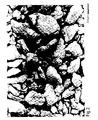
- the above 50 microns filler fraction used in Example 5 was a sand which had been eroded by sea action to produce smooth particles while the equivalent fractions used in Examples 1 and 3 comprised angular typically gritty particles hereafter called "grit". Samples of these particles are shown in magnification in Figures 1 and 2 respectively. It is therefore preferred to use an above 50 micron filler fraction comprising angular or non-eroded particles although if the instantaneous flexural modulus of the particular lining composition does not reduce unduly in use with time a usable composition may still be produced using smooth or eroded particles.
Landscapes
- Chemical & Material Sciences (AREA)
- Engineering & Computer Science (AREA)
- Ceramic Engineering (AREA)
- Chemical Kinetics & Catalysis (AREA)
- Materials Engineering (AREA)
- Structural Engineering (AREA)
- Organic Chemistry (AREA)
- Inorganic Chemistry (AREA)
- Paints Or Removers (AREA)
- Compositions Of Macromolecular Compounds (AREA)
Priority Applications (3)
| Application Number | Priority Date | Filing Date | Title |
|---|---|---|---|
| EP87114375A EP0309609A1 (de) | 1987-10-02 | 1987-10-02 | Aushärtungsfähige Auskleidungszusammensetzung |
| FR8714768A FR2622200A1 (fr) | 1987-10-02 | 1987-10-26 | Composition de revetement apte a la prise |
| BE8701218A BE1001171A5 (fr) | 1987-10-02 | 1987-10-26 | Composition de revetement apte a la prise. |
Applications Claiming Priority (1)
| Application Number | Priority Date | Filing Date | Title |
|---|---|---|---|
| EP87114375A EP0309609A1 (de) | 1987-10-02 | 1987-10-02 | Aushärtungsfähige Auskleidungszusammensetzung |
Publications (1)
| Publication Number | Publication Date |
|---|---|
| EP0309609A1 true EP0309609A1 (de) | 1989-04-05 |
Family
ID=8197331
Family Applications (1)
| Application Number | Title | Priority Date | Filing Date |
|---|---|---|---|
| EP87114375A Withdrawn EP0309609A1 (de) | 1987-10-02 | 1987-10-02 | Aushärtungsfähige Auskleidungszusammensetzung |
Country Status (3)
| Country | Link |
|---|---|
| EP (1) | EP0309609A1 (de) |
| BE (1) | BE1001171A5 (de) |
| FR (1) | FR2622200A1 (de) |
Cited By (3)
| Publication number | Priority date | Publication date | Assignee | Title |
|---|---|---|---|---|
| FR2651492A1 (fr) * | 1989-09-06 | 1991-03-08 | Saint Gobain Rech | Procede et produits obtenus par melange de ciment et de fiibres de renfort. |
| JP2014181137A (ja) * | 2013-03-18 | 2014-09-29 | Aica Kogyo Co Ltd | 塗材組成物及びその床施工方法並びにそれによる床構造 |
| EP3502207A1 (de) * | 2017-12-19 | 2019-06-26 | CSI Technologies LLC | Emulsion von wasserbasiertem schlamm in harz als bohrlochdichtmittel |
Citations (5)
| Publication number | Priority date | Publication date | Assignee | Title |
|---|---|---|---|---|
| BE638157A (de) * | 1961-11-13 | 1900-01-01 | ||
| DE1198267B (de) * | 1960-09-12 | 1965-08-05 | Raybestos Manhattan Inc | Verfahren zur Herstellung eines insbesondere fuer die Bauindustrie geeigneten kunststoffhaltigen Bindemittels |
| AU419973B2 (en) * | 1965-08-02 | 1971-12-20 | Howard Donnelly James | Inorganic cement compositions containing epoxy resin and activated pozzolan |
| FR2140414A1 (en) * | 1971-06-11 | 1973-01-19 | Plastocoat Sas C Botta | Epoxide resin protective coating - for metal, cements and other materials |
| FR2413341A1 (fr) * | 1977-12-28 | 1979-07-27 | Lassailly Reunis | Composition de mortier |
-
1987
- 1987-10-02 EP EP87114375A patent/EP0309609A1/de not_active Withdrawn
- 1987-10-26 FR FR8714768A patent/FR2622200A1/fr active Pending
- 1987-10-26 BE BE8701218A patent/BE1001171A5/fr not_active IP Right Cessation
Patent Citations (5)
| Publication number | Priority date | Publication date | Assignee | Title |
|---|---|---|---|---|
| DE1198267B (de) * | 1960-09-12 | 1965-08-05 | Raybestos Manhattan Inc | Verfahren zur Herstellung eines insbesondere fuer die Bauindustrie geeigneten kunststoffhaltigen Bindemittels |
| BE638157A (de) * | 1961-11-13 | 1900-01-01 | ||
| AU419973B2 (en) * | 1965-08-02 | 1971-12-20 | Howard Donnelly James | Inorganic cement compositions containing epoxy resin and activated pozzolan |
| FR2140414A1 (en) * | 1971-06-11 | 1973-01-19 | Plastocoat Sas C Botta | Epoxide resin protective coating - for metal, cements and other materials |
| FR2413341A1 (fr) * | 1977-12-28 | 1979-07-27 | Lassailly Reunis | Composition de mortier |
Cited By (4)
| Publication number | Priority date | Publication date | Assignee | Title |
|---|---|---|---|---|
| FR2651492A1 (fr) * | 1989-09-06 | 1991-03-08 | Saint Gobain Rech | Procede et produits obtenus par melange de ciment et de fiibres de renfort. |
| EP0418108A1 (de) * | 1989-09-06 | 1991-03-20 | Saint-Gobain Recherche | Verfahren zum Mischen von Zement und Verstärkungsfasern und damit hergestellte Produkte |
| JP2014181137A (ja) * | 2013-03-18 | 2014-09-29 | Aica Kogyo Co Ltd | 塗材組成物及びその床施工方法並びにそれによる床構造 |
| EP3502207A1 (de) * | 2017-12-19 | 2019-06-26 | CSI Technologies LLC | Emulsion von wasserbasiertem schlamm in harz als bohrlochdichtmittel |
Also Published As
| Publication number | Publication date |
|---|---|
| BE1001171A5 (fr) | 1989-08-08 |
| FR2622200A1 (fr) | 1989-04-28 |
Similar Documents
| Publication | Publication Date | Title |
|---|---|---|
| US5674929A (en) | Cementitious compositions for layered applications | |
| US3798191A (en) | Inorganic cement compositions containing epoxy resin and pozzolan | |
| IL99004A (en) | Method for modifying concrete properties | |
| JP2009263893A (ja) | コンクリート改修層構造 | |
| JP5064172B2 (ja) | 耐磨耗性材料及びそれを用いた補修工法 | |
| US5725906A (en) | Protective barrier using polymer concrete | |
| EP0549815B1 (de) | Betonstruktur und Verfahren zu deren Herstellung | |
| KR101977905B1 (ko) | 비산먼지가 억제된 항열 방청 모르타르 조성물과 이를 이용한 콘크리트 구조물 보수보강공법 | |
| JPH09263467A (ja) | 水処理施設のコンクリート構造物用防食上塗り組成物 | |
| GB2210882A (en) | Settable composition suitable for lining pipes and sewers | |
| JP4647767B2 (ja) | 水硬性組成物及びそのペースト、モルタル、コンクリート | |
| KR100536471B1 (ko) | 통기성이 개선된 콘크리트 박막 보수 및 보강용 에폭시모르타르 조성물 | |
| US4738994A (en) | Epoxy resin-polyammonium salt emulsion and process for its production | |
| JP4356477B2 (ja) | 下地調整材用水硬性組成物、及びこの下地調整材 | |
| GB2288393A (en) | Cementitious coatings | |
| KR101077858B1 (ko) | 배관 코팅방법 | |
| JPH0867542A (ja) | モルタル組成物 | |
| JP4759588B2 (ja) | 打ち継ぎ用接着剤組成物及びコンクリート改修方法 | |
| JPH01123870A (ja) | 硬化可能なライニング組成物 | |
| BE1001171A5 (fr) | Composition de revetement apte a la prise. | |
| JP5162313B2 (ja) | 打ち継ぎ用接着剤組成物及びコンクリート改修方法 | |
| AU2020270478B2 (en) | Water repellent spray applied fire resistive materials | |
| AU2006275688B2 (en) | Cement-containing composition for use with alkali-resistant fiberglass and poles made therefrom | |
| JP4441355B2 (ja) | 耐酸性コンクリート製品 | |
| JP7723783B1 (ja) | ポリマーセメントモルタル組成物及びポリマーセメントモルタル |
Legal Events
| Date | Code | Title | Description |
|---|---|---|---|
| PUAI | Public reference made under article 153(3) epc to a published international application that has entered the european phase |
Free format text: ORIGINAL CODE: 0009012 |
|
| AK | Designated contracting states |
Kind code of ref document: A1 Designated state(s): AT CH DE ES LI NL SE |
|
| 17P | Request for examination filed |
Effective date: 19890814 |
|
| 17Q | First examination report despatched |
Effective date: 19910204 |
|
| STAA | Information on the status of an ep patent application or granted ep patent |
Free format text: STATUS: THE APPLICATION IS DEEMED TO BE WITHDRAWN |
|
| 18D | Application deemed to be withdrawn |
Effective date: 19910615 |
|
| RIN1 | Information on inventor provided before grant (corrected) |
Inventor name: CLARKE, NEIL Inventor name: LANE, JOHN RAOUL GRENDON Inventor name: BURTON, MICHAEL |