EP0309632A1 - Synthesizersteuerungsvorrichtung mit einem Streichinstrument - Google Patents
Synthesizersteuerungsvorrichtung mit einem Streichinstrument Download PDFInfo
- Publication number
- EP0309632A1 EP0309632A1 EP87420260A EP87420260A EP0309632A1 EP 0309632 A1 EP0309632 A1 EP 0309632A1 EP 87420260 A EP87420260 A EP 87420260A EP 87420260 A EP87420260 A EP 87420260A EP 0309632 A1 EP0309632 A1 EP 0309632A1
- Authority
- EP
- European Patent Office
- Prior art keywords
- bow
- strings
- instrument
- played
- violin
- Prior art date
- Legal status (The legal status is an assumption and is not a legal conclusion. Google has not performed a legal analysis and makes no representation as to the accuracy of the status listed.)
- Granted
Links
- OKTJSMMVPCPJKN-UHFFFAOYSA-N Carbon Chemical compound [C] OKTJSMMVPCPJKN-UHFFFAOYSA-N 0.000 description 5
- 229910052799 carbon Inorganic materials 0.000 description 5
- 210000004209 hair Anatomy 0.000 description 3
- 239000000463 material Substances 0.000 description 3
- 239000002184 metal Substances 0.000 description 2
- RSWGJHLUYNHPMX-UHFFFAOYSA-N Abietic-Saeure Natural products C12CCC(C(C)C)=CC2=CCC2C1(C)CCCC2(C)C(O)=O RSWGJHLUYNHPMX-UHFFFAOYSA-N 0.000 description 1
- 241000270728 Alligator Species 0.000 description 1
- KHPCPRHQVVSZAH-HUOMCSJISA-N Rosin Natural products O(C/C=C/c1ccccc1)[C@H]1[C@H](O)[C@@H](O)[C@@H](O)[C@@H](CO)O1 KHPCPRHQVVSZAH-HUOMCSJISA-N 0.000 description 1
- QAWIHIJWNYOLBE-OKKQSCSOSA-N acivicin Chemical compound OC(=O)[C@@H](N)[C@@H]1CC(Cl)=NO1 QAWIHIJWNYOLBE-OKKQSCSOSA-N 0.000 description 1
- 239000004020 conductor Substances 0.000 description 1
- 238000010586 diagram Methods 0.000 description 1
- 230000010365 information processing Effects 0.000 description 1
- 238000012423 maintenance Methods 0.000 description 1
- 238000005259 measurement Methods 0.000 description 1
- 238000010422 painting Methods 0.000 description 1
- 230000002093 peripheral effect Effects 0.000 description 1
- 230000000630 rising effect Effects 0.000 description 1
- HBMJWWWQQXIZIP-UHFFFAOYSA-N silicon carbide Chemical compound [Si+]#[C-] HBMJWWWQQXIZIP-UHFFFAOYSA-N 0.000 description 1
- 229910010271 silicon carbide Inorganic materials 0.000 description 1
- KHPCPRHQVVSZAH-UHFFFAOYSA-N trans-cinnamyl beta-D-glucopyranoside Natural products OC1C(O)C(O)C(CO)OC1OCC=CC1=CC=CC=C1 KHPCPRHQVVSZAH-UHFFFAOYSA-N 0.000 description 1
- 238000011144 upstream manufacturing Methods 0.000 description 1
Images

Classifications
-
- G—PHYSICS
- G10—MUSICAL INSTRUMENTS; ACOUSTICS
- G10H—ELECTROPHONIC MUSICAL INSTRUMENTS; INSTRUMENTS IN WHICH THE TONES ARE GENERATED BY ELECTROMECHANICAL MEANS OR ELECTRONIC GENERATORS, OR IN WHICH THE TONES ARE SYNTHESISED FROM A DATA STORE
- G10H1/00—Details of electrophonic musical instruments
- G10H1/32—Constructional details
- G10H1/34—Switch arrangements, e.g. keyboards or mechanical switches specially adapted for electrophonic musical instruments
- G10H1/342—Switch arrangements, e.g. keyboards or mechanical switches specially adapted for electrophonic musical instruments for guitar-like instruments with or without strings and with a neck on which switches or string-fret contacts are used to detect the notes being played
-
- G—PHYSICS
- G10—MUSICAL INSTRUMENTS; ACOUSTICS
- G10H—ELECTROPHONIC MUSICAL INSTRUMENTS; INSTRUMENTS IN WHICH THE TONES ARE GENERATED BY ELECTROMECHANICAL MEANS OR ELECTRONIC GENERATORS, OR IN WHICH THE TONES ARE SYNTHESISED FROM A DATA STORE
- G10H1/00—Details of electrophonic musical instruments
- G10H1/02—Means for controlling the tone frequencies, e.g. attack or decay; Means for producing special musical effects, e.g. vibratos or glissandos
- G10H1/04—Means for controlling the tone frequencies, e.g. attack or decay; Means for producing special musical effects, e.g. vibratos or glissandos by additional modulation
- G10H1/053—Means for controlling the tone frequencies, e.g. attack or decay; Means for producing special musical effects, e.g. vibratos or glissandos by additional modulation during execution only
- G10H1/055—Means for controlling the tone frequencies, e.g. attack or decay; Means for producing special musical effects, e.g. vibratos or glissandos by additional modulation during execution only by switches with variable impedance elements
- G10H1/0556—Means for controlling the tone frequencies, e.g. attack or decay; Means for producing special musical effects, e.g. vibratos or glissandos by additional modulation during execution only by switches with variable impedance elements using piezoelectric means
-
- G—PHYSICS
- G10—MUSICAL INSTRUMENTS; ACOUSTICS
- G10H—ELECTROPHONIC MUSICAL INSTRUMENTS; INSTRUMENTS IN WHICH THE TONES ARE GENERATED BY ELECTROMECHANICAL MEANS OR ELECTRONIC GENERATORS, OR IN WHICH THE TONES ARE SYNTHESISED FROM A DATA STORE
- G10H2220/00—Input/output interfacing specifically adapted for electrophonic musical tools or instruments
- G10H2220/155—User input interfaces for electrophonic musical instruments
- G10H2220/365—Bow control in general, i.e. sensors or transducers on a bow; Input interface or controlling process for emulating a bow, bowing action or generating bowing parameters, e.g. for appropriately controlling a specialised sound synthesiser
Definitions
- the present invention relates to a device for controlling a frequency synthesizer from a bowed musical instrument, such as a violin.
- the devices currently known generally consist of a microphone which is fixed on the bridge and which picks up mechanical vibrations.
- the sound picked up by the microphone is filtered, so as to isolate the fundamental component, and the signal obtained is applied to the synthesizer, which itself provides sound as an output according to the characteristics which have been programmed.
- Such a device is rather suitable for monophonic instruments, but not really for the violin, of which it cannot reproduce the "glissando" mode, nor generally the sounds rich in harmonics, obtained among other things when playing several notes simultaneously.
- the present invention relates to a device for adapting a violin, or other bowed string instrument, to a frequency synthesizer, which does not have this type of drawback. It is characterized in that it is equipped with means for detecting the position of the fingers on the key of the instrument, means for detecting the instantaneous characteristics of the movement of the bow, and means for detecting the string or strings which are played.
- these means consist of a means of capturing the pressure of the bow on the strings played, a means of capturing the speed of the bow on the strings played, means with an electrical contact tablet to determine the position of the fingers on the fingerboard, and means by electrical contact between the bow and the strings to determine the strings which are played.
- the analog electrical signals at the output of these different means are digitized and applied to a programmed logic processing unit, the output of which is then applied to the frequency synthesizer.
- the game can be acoustically silent, the bow being “smooth”, which makes it possible to play “in silence”, the sound being heard on headphones by the artist alone, through the synth tutor.
- the device also makes it possible, after analysis, to opt for a "glissando” or discontinuous mode, and this at will, which, by making it possible to correct errors in positioning of the fingers by the beginner, considerably facilitates learning the violin.
- the device of the invention can be mounted directly on a traditional violin without altering the acoustic qualities, the bow however being different from the simple bow normally used for this violin.
- a traditional violin thus equipped becomes normally sound again at will by using its original bow normally coated with rosin.
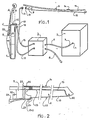
- Block 3 is a frequency synthesizer, of a commercially available model, equipped with a signal input socket 4 with MIDI standard, and block 5 comprises the power supply circuit and the logic processing board.
- information coming from the violin 1 and the bow 2 the output of block 5 being effected, by a cable and a MIDI connector 7, towards input 4 of block 3, and its DC voltage supply at 5 volts carried out from the outside by a cable 8.
- a multi-socket base 10 On the rod 13 of the bow is fixed, about two thirds of its length from the rise, a strain gauge 14 intended to measure the pressure of the bow on the played string, or on the played strings.
- the usual horsehair wick is replaced by a bundle 15 of conduc torsors of high electrical resistance, such as a set of fifty silicon carbide wires of 1000 ohms of resistance per centimeter of wire, the DC voltage of 5 volts being applied between the two ends of the horsehair wick 15, as is will describe in more detail below.
- the heel 16 of the violin is equipped, at the rear part of the violin, therefore on the back of said heel, with a multispindle base 17, on the side of which a multiple socket 18 is plugged in, conveying towards the block 5 and by a common cable 19 ten signals, including eight analog signals and the continuous supply at 5 volts. These signals come from above the key 20, using a connecting cable 21, as will be detailed below.
- the bow 2 is represented, with its strain gauge 14 and its bundle of resistive horsehairs 15.
- the downstream end 22 of the drill bit 15 is connected to the positive terminal of the voltage d 'supply by a first wire 23 running along the rod 13 of the bow, while its upstream end 24 is brought to its negative terminal by a second wire 25.
- the strain gauge 14 has its supply terminal connected by a wire 26 at the positive terminal, and its output terminal connected to one of the pins of the socket 10 by a wire 27.
- a first electrical information is emitted at 29 by the strain gauge 14, giving the value of the pressure on the cord, and the cord 28, which serves as a cursor for the potentiometer constituted by the bundle of horsehair 15, makes it possible to take an electric voltage representative of the instantaneous value of the position of the bow relative to the string 28, and also representative of the fact that the string 28 is played.
- the logic analysis block 5 therefore already receives: - information representative of the pressure of the bow on the string, - information indicating the string or strings that are being played, - information representative of the instantaneous position of the bundle of conductors 15 on the string or strings played: two pieces of information of this type recorded in two defined successive times will, for example, allow block 5 to calculate the speed of movement of the bow on the string 28.
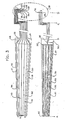
- the reference 30 designates a thin strip of plastic material the part of which between A and B is intended to be glued to the fingerboard, A being at the level of the violin neck and B at the level of the the cantilevered end of the key, as indicated elsewhere in FIG. 1.
- the thin strip 30 On the thin strip 30 are deposited four tracks 31-34 of a resistive conductive element, such as carbon, these four tracks being longitudinal and placed exactly respectively under each of the four strings of the violin, directly above them.
- the four carbon tracks 31-34 are short-circuited at their two ends by transverse strips 35,36 of conductive ink, the strip 35 being connected by the conductive connection 37 to a terminal 38 receiving the positive polarity of the supply. continuous of the assembly, and the strip 36 being connected by the conductive connection 39 to a terminal 40 receiving the negative polarity.
- the part of the plastic strip 30 between B and C is glued on the underside of the key going up to the handle, that is to say on the face of the key opposite to that receiving the part AB, and the part between C and D is glued to the side of the heel 16 of the violin (see FIG. 1), the terminals 40 and 38 forming part of the multi-pin outlet socket 17, and the conducting wires 37 and 39 forming part of the connection cable 21 shown in Figure 1.
- the carbon tracks 31-34 form the input elements of an electrical contact tablet intended to determine the position of the fingers on the strings.
- a contact pad if it is new in the application to the present invention, is not new in itself in principle, and there have been many examples on the market for a long time, in particular applied to paintings. indicators of bus networks, commuter trains, or the like.
- the outputs of this contact pad consist of four conductive lines 41-44 which are positioned above each of the four corresponding tracks 31-34, with a spacing of a few tenths of a millimeter.
- these four lines 41-44 are deposited on the underside of a strip 45 in material semi-rigid plastic, therefore having a certain flexibility, and this sheet is placed on the part AB of the key and on the strip 30.
- An intermediate strip 46 disposed between the plastic strips 30 and 45, hollowed out facing the tracks of carbon 31 to 34, allows the maintenance of the spacing mentioned above.
- the output socket 17 therefore has ten useful pins: - the two supply terminals 38 and 40 at five volts DC, - eight terminals 53-60 providing four potentiometric information coming from the hair bundle 15 of the bow, representative of the instantaneous position of the bow relative to the strings played, as well as four other pieces of information giving, by potentiometric measurement of tension, the position of the fingers pressing on the strings.
- FIG. 4 gives a nonlimiting example of a device for analyzing and processing the information provided by the violin 1 and its bow 2, and appearing at the output sockets 10 and 17, from which they are conveyed by cables 12 and 19 to box 5 containing the logic board according to this figure 4.
- the reference 61 designates a microprocessor processing the information in accordance with the programmed operating data included in a memory 62, of the read-only type, known as R.O.M.
- the eight data coming from terminals 53 to 60 enter on the card at 63, on an analog multiplexer 64, whose analog multiplexed output is applied, by connection 65, to an analog-digital converter 66 leaving the beds correspondents in parallel through connections 67 to an input of a peripheral interface adapter, or PIA, 68.
- the PIA 68 receives, via the bus 69, on its input 70, data coming from the microprocessor 61, and it sends on its output 71, by the wires 72 and 73 respectively, counting and reset pulses to the two inputs corresponding to a counter 74 providing on its three outputs 75, 76 and 77, three address beds to the analog multiplexer 64.
- the information coming from the strain gauge 14 arrives via the wire 29 (FIG. 2) on the input terminal 78 of the card shown in FIG. 4.
- This information is applied, via a connection 79 to an analog-digital converter 80, from which it leaves digitized on the data bus 69 connected to the microprocessor 61, as shown in the drawing.
- the DC supply voltage which supplies the various circuits of the card and is found at 83 and 84 to supply the terminals d end 22 and 24 (FIG. 2) of the bundle of hairs 15 of the bow 2.
- the output information of the microprocessor 61 is applied, via the bus 85 to an asynchronous communication interface, or ACIA, from which it leaves in series on the wire 6 (see also figure 1) and the socket 7 in MIDI standard, this socket being intended to be connected to the input terminal 4 of the synthesizer 3.
- ACIA asynchronous communication interface
- the invention is of course not limited to the embodiment which has just been described.
- Other similar capture means could for example be used, such as an accelerometer on the bow, and another form of tactile contact tablet on the violin key. It obviously applies to all kinds of bowed string instruments other than the violin, cited here only as an example.
- a part of the logic board, or all of it can be placed on the violin itself, advantageously under the key on the back of it, there being enough space there.
Landscapes
- Physics & Mathematics (AREA)
- Engineering & Computer Science (AREA)
- Acoustics & Sound (AREA)
- Multimedia (AREA)
- Electrophonic Musical Instruments (AREA)
- Stringed Musical Instruments (AREA)
- Toys (AREA)
- Auxiliary Devices For Music (AREA)
Applications Claiming Priority (1)
| Application Number | Priority Date | Filing Date | Title |
|---|---|---|---|
| FR8606571A FR2598017B1 (fr) | 1986-04-25 | 1986-04-25 | Dispositif de commande d'un synthetiseur de frequences par un instrument de musique a cordes frottees. |
Publications (2)
| Publication Number | Publication Date |
|---|---|
| EP0309632A1 true EP0309632A1 (de) | 1989-04-05 |
| EP0309632B1 EP0309632B1 (de) | 1992-04-15 |
Family
ID=9334996
Family Applications (1)
| Application Number | Title | Priority Date | Filing Date |
|---|---|---|---|
| EP87420260A Expired - Lifetime EP0309632B1 (de) | 1986-04-25 | 1987-09-29 | Synthesizersteuerungsvorrichtung mit einem Streichinstrument |
Country Status (8)
| Country | Link |
|---|---|
| US (1) | US4805510A (de) |
| EP (1) | EP0309632B1 (de) |
| JP (1) | JPS632095A (de) |
| AT (1) | ATE75068T1 (de) |
| DE (1) | DE3778364D1 (de) |
| ES (1) | ES2030754T3 (de) |
| FR (1) | FR2598017B1 (de) |
| GR (1) | GR3004750T3 (de) |
Families Citing this family (32)
| Publication number | Priority date | Publication date | Assignee | Title |
|---|---|---|---|---|
| JP2797112B2 (ja) * | 1988-04-25 | 1998-09-17 | カシオ計算機株式会社 | 電子弦楽器のコード判別装置 |
| US4951545A (en) * | 1988-04-26 | 1990-08-28 | Casio Computer Co., Ltd. | Electronic musical instrument |
| JP2615825B2 (ja) * | 1988-05-02 | 1997-06-04 | カシオ計算機株式会社 | 電子弦楽器 |
| JPH01172100U (de) * | 1988-05-23 | 1989-12-06 | ||
| US5286911A (en) * | 1988-09-20 | 1994-02-15 | Casio Computer Co., Ltd. | Electronic rubbed-string instrument |
| JPH0244789U (de) * | 1988-09-20 | 1990-03-28 | ||
| JP2787691B2 (ja) * | 1988-11-30 | 1998-08-20 | カシオ計算機株式会社 | 電子擦弦楽器 |
| JPH0348895A (ja) * | 1989-07-17 | 1991-03-01 | Yamaha Corp | 楽音制御装置 |
| JP2830105B2 (ja) * | 1989-07-17 | 1998-12-02 | ヤマハ株式会社 | 楽音制御装置 |
| US5661253A (en) * | 1989-11-01 | 1997-08-26 | Yamaha Corporation | Control apparatus and electronic musical instrument using the same |
| US5403970A (en) * | 1989-11-21 | 1995-04-04 | Yamaha Corporation | Electrical musical instrument using a joystick-type control apparatus |
| JPH03184095A (ja) * | 1989-12-14 | 1991-08-12 | Yamaha Corp | 電子楽器 |
| JP2626107B2 (ja) * | 1989-12-22 | 1997-07-02 | ヤマハ株式会社 | 楽音制御装置 |
| JPH03194598A (ja) * | 1989-12-25 | 1991-08-26 | Yamaha Corp | 電子楽器 |
| JP2580817B2 (ja) * | 1990-01-19 | 1997-02-12 | ヤマハ株式会社 | 楽音制御装置 |
| DE69123467T2 (de) * | 1990-01-31 | 1997-07-10 | Yamaha Corp | Verfahren zur Steuerung einer Tonquelle für ein elektronisches Musikinstrument und Musikinstrument zur Anwendung dieses Verfahrens |
| JPH07319459A (ja) * | 1995-02-21 | 1995-12-08 | Yamaha Corp | 楽音制御装置および電子楽器 |
| DE19609575A1 (de) | 1996-03-12 | 1997-09-18 | Thomson Brandt Gmbh | Gerät zum Beschreiben und/oder Lesen optischer Aufzeichnungsträger unterschiedlichen Aufbaus |
| DE60014728T2 (de) | 1999-02-26 | 2005-10-20 | Yamaha Corp., Hamamatsu | Elektronisches Musikinstrument |
| US7220912B2 (en) * | 1999-04-26 | 2007-05-22 | Gibson Guitar Corp. | Digital guitar system |
| US6888057B2 (en) * | 1999-04-26 | 2005-05-03 | Gibson Guitar Corp. | Digital guitar processing circuit |
| JP2002333885A (ja) * | 2001-05-08 | 2002-11-22 | Korg Inc | 発音操作装置及びこれを用いた電子楽器 |
| US7220913B2 (en) * | 2003-01-09 | 2007-05-22 | Gibson Guitar Corp. | Breakout box for digital guitar |
| US7166794B2 (en) * | 2003-01-09 | 2007-01-23 | Gibson Guitar Corp. | Hexaphonic pickup for digital guitar system |
| US7084341B2 (en) * | 2003-01-14 | 2006-08-01 | Barr Damon A | Sound pickup system for acoustic string instruments |
| DE102004024918B3 (de) * | 2004-05-19 | 2005-11-24 | Fraunhofer-Gesellschaft zur Förderung der angewandten Forschung e.V. | Streicherbogen für Streichinstrumente |
| US7285714B2 (en) * | 2005-09-09 | 2007-10-23 | Gibson Guitar Corp. | Pickup for digital guitar |
| US20090260508A1 (en) * | 2007-09-29 | 2009-10-22 | Elion Clifford S | Electronic fingerboard for stringed instrument |
| US8084678B2 (en) * | 2008-05-21 | 2011-12-27 | Kesumo Llc | Sensor bow for stringed instruments |
| US9183823B2 (en) | 2012-10-09 | 2015-11-10 | Kesumo, Llc | Pickup and sustainer for stringed instruments |
| US10224015B2 (en) * | 2015-10-09 | 2019-03-05 | Jeffrey James Hsu | Stringless bowed musical instrument |
| AT522790B1 (de) * | 2019-11-29 | 2021-02-15 | Baticci Alessandro | Vorrichtung zur Erfassung des Griffmusters beim Spielen eines Streichinstruments sowie Streichinstrument mit einer solchen Vorrichtung |
Citations (3)
| Publication number | Priority date | Publication date | Assignee | Title |
|---|---|---|---|---|
| US3742114A (en) * | 1971-07-22 | 1973-06-26 | R Barkan | Guitar-like electronic musical instrument using resistor strips and potentiometer means to activate tone generators |
| FR2444312A1 (fr) * | 1978-12-15 | 1980-07-11 | Zalinge Henk Van | Instrument de musique a cordes |
| US4235144A (en) * | 1979-06-06 | 1980-11-25 | Tel-Ray Electronics Manufacturing Co., Inc. | Means for controlling special musical effects |
Family Cites Families (13)
| Publication number | Priority date | Publication date | Assignee | Title |
|---|---|---|---|---|
| US1476163A (en) * | 1922-01-23 | 1923-12-04 | Charles E Matha | Bow for string instruments |
| US2933967A (en) * | 1957-10-18 | 1960-04-26 | Joseph G Riscol | Electromagnetic pickup assembly for stringed instruments |
| US3003382A (en) * | 1958-06-02 | 1961-10-10 | Clarence L Fender | Electric violin, and electromagnetic pickup therefor |
| US3291887A (en) * | 1964-01-30 | 1966-12-13 | Frank C Carman | Piezoelectric musical pickup arrangement |
| JPS5532849B2 (de) * | 1972-03-10 | 1980-08-27 | ||
| JPS51120211A (en) * | 1975-04-14 | 1976-10-21 | Kawai Musical Instr Mfg Co Ltd | Electronic musical instrument with mock string-rubbing musical instrum ent use bow |
| DE2535181A1 (de) * | 1975-08-06 | 1977-02-24 | Cmb Colonia Management | Elektronisches musikinstrument |
| JPS5283224A (en) * | 1975-12-30 | 1977-07-12 | Kawai Musical Instr Mfg Co | Electric guitar |
| US4171659A (en) * | 1976-05-04 | 1979-10-23 | Tumminaro Peter M | Electrified guitar accessory |
| US4147084A (en) * | 1977-06-30 | 1979-04-03 | Underwood Donald E | Sound pick-up attachment for stringed instrument |
| US4468999A (en) * | 1983-02-28 | 1984-09-04 | Octave-Plateau Electronics Inc. | Programmable synthesizer |
| US4580479A (en) * | 1983-02-28 | 1986-04-08 | Octave-Plateau Electronics Inc. | Guitar controller |
| US4630520A (en) * | 1984-11-08 | 1986-12-23 | Carmine Bonanno | Guitar controller for a music synthesizer |
-
1986
- 1986-04-25 FR FR8606571A patent/FR2598017B1/fr not_active Expired - Lifetime
-
1987
- 1987-04-24 JP JP62100251A patent/JPS632095A/ja active Pending
- 1987-09-29 DE DE8787420260T patent/DE3778364D1/de not_active Expired - Lifetime
- 1987-09-29 EP EP87420260A patent/EP0309632B1/de not_active Expired - Lifetime
- 1987-09-29 AT AT87420260T patent/ATE75068T1/de not_active IP Right Cessation
- 1987-09-29 ES ES198787420260T patent/ES2030754T3/es not_active Expired - Lifetime
- 1987-10-27 US US07/114,276 patent/US4805510A/en not_active Expired - Fee Related
-
1992
- 1992-05-28 GR GR920401092T patent/GR3004750T3/el unknown
Patent Citations (3)
| Publication number | Priority date | Publication date | Assignee | Title |
|---|---|---|---|---|
| US3742114A (en) * | 1971-07-22 | 1973-06-26 | R Barkan | Guitar-like electronic musical instrument using resistor strips and potentiometer means to activate tone generators |
| FR2444312A1 (fr) * | 1978-12-15 | 1980-07-11 | Zalinge Henk Van | Instrument de musique a cordes |
| US4235144A (en) * | 1979-06-06 | 1980-11-25 | Tel-Ray Electronics Manufacturing Co., Inc. | Means for controlling special musical effects |
Non-Patent Citations (1)
| Title |
|---|
| ICASSP '86 PROCEEDINGS, Tokyo, 7-11 avril 1986, vol. 2, pages 1297-1299, IEEE; G. WEINREICH et al.: "Digital and analog bows: hybrid mechanical-electrical systems" * |
Also Published As
| Publication number | Publication date |
|---|---|
| FR2598017A1 (fr) | 1987-10-30 |
| US4805510A (en) | 1989-02-21 |
| GR3004750T3 (de) | 1993-04-28 |
| DE3778364D1 (de) | 1992-05-21 |
| ES2030754T3 (es) | 1992-11-16 |
| EP0309632B1 (de) | 1992-04-15 |
| FR2598017B1 (fr) | 1990-10-05 |
| ATE75068T1 (de) | 1992-05-15 |
| JPS632095A (ja) | 1988-01-07 |
Similar Documents
| Publication | Publication Date | Title |
|---|---|---|
| EP0309632B1 (de) | Synthesizersteuerungsvorrichtung mit einem Streichinstrument | |
| US8039723B2 (en) | Music processing system including device for converting guitar sounds to MIDI commands | |
| US20100037755A1 (en) | Computer interface for polyphonic stringed instruments | |
| EP4062263A1 (de) | System zur erzeugung eines signals auf der basis eines berührungsbefehls und eines optischen befehls | |
| FR2483072A2 (fr) | Systeme de reperage a ondes elastiques de surface | |
| CA1283309C (fr) | Dispositif de commande d'un synthetiseur de frequences par un instrument de musique a cordes frottees | |
| WO2002067242A1 (fr) | Dispositif pour piloter un instrument de musique electronique du type boite a sons | |
| EP1032930B1 (de) | Methode und vorrichtung zur interpretation eines musikstückes ausgehend von der partitur | |
| EP0142390A1 (de) | Polyphonische Vorrichtung zur Analyse vom Fingersatz bei einem Meistersaiteninstrument | |
| FR2597212A1 (fr) | Ensemble pour verifier des informations comprenant un detecteur autonome et un support comportant une serie d'informations | |
| FR2738380A1 (fr) | Piano electronique pliable | |
| BE1008984A3 (fr) | Dispositif et procede d'interpretation d'une oeuvre musicale a partir de la partition. | |
| US12106739B2 (en) | Manual music generator | |
| FR2639435A3 (fr) | Transducteur de detection d'acceleration a effet capacitif | |
| WO1996021217A1 (fr) | Dispositif et procede d'interpretation d'une ×uvre musicale a partir de la partition | |
| SU1167642A1 (ru) | Струнный электромузыкальный инструмент | |
| EP4088274A1 (de) | Elektronisches klavier | |
| FR2743656A1 (fr) | Procede et dispositif de reperage de position buccale sur un objet | |
| Wallen | Music reviews | |
| EP0057335A1 (de) | Elektronisches Musikinstrument, um durch direkte Berührung mit dem Finger auf einer Partitur zu spielen | |
| EP1347437A1 (de) | Steuervorrichtung zum Erlauben der Aktivierung und der Steuerung von elektronischen, elektrischen, klingenden, visuellen und mechanischen Ereignissen durch einen bewegbaren Benutzer | |
| WO1979000363A1 (en) | Device for measuring characteristical parameters of the speed of a handwriting | |
| JP3331841B2 (ja) | 演奏操作用操作子装置 | |
| FR2826167A1 (fr) | Dispositif de commande de synthetiseur electroacoustique pour guitare | |
| WO2004095417A1 (fr) | Instrument controleur |
Legal Events
| Date | Code | Title | Description |
|---|---|---|---|
| PUAI | Public reference made under article 153(3) epc to a published international application that has entered the european phase |
Free format text: ORIGINAL CODE: 0009012 |
|
| AK | Designated contracting states |
Kind code of ref document: A1 Designated state(s): AT BE CH DE ES GB GR IT LI NL SE |
|
| 17P | Request for examination filed |
Effective date: 19890608 |
|
| 17Q | First examination report despatched |
Effective date: 19910201 |
|
| GRAA | (expected) grant |
Free format text: ORIGINAL CODE: 0009210 |
|
| AK | Designated contracting states |
Kind code of ref document: B1 Designated state(s): AT BE CH DE ES GB GR IT LI NL SE |
|
| REF | Corresponds to: |
Ref document number: 75068 Country of ref document: AT Date of ref document: 19920515 Kind code of ref document: T |
|
| ITF | It: translation for a ep patent filed | ||
| REF | Corresponds to: |
Ref document number: 3778364 Country of ref document: DE Date of ref document: 19920521 |
|
| GBT | Gb: translation of ep patent filed (gb section 77(6)(a)/1977) | ||
| REG | Reference to a national code |
Ref country code: ES Ref legal event code: FG2A Ref document number: 2030754 Country of ref document: ES Kind code of ref document: T3 |
|
| REG | Reference to a national code |
Ref country code: GR Ref legal event code: FG4A Free format text: 3004750 |
|
| PLBE | No opposition filed within time limit |
Free format text: ORIGINAL CODE: 0009261 |
|
| STAA | Information on the status of an ep patent application or granted ep patent |
Free format text: STATUS: NO OPPOSITION FILED WITHIN TIME LIMIT |
|
| 26N | No opposition filed | ||
| PGFP | Annual fee paid to national office [announced via postgrant information from national office to epo] |
Ref country code: ES Payment date: 19940923 Year of fee payment: 8 |
|
| PGFP | Annual fee paid to national office [announced via postgrant information from national office to epo] |
Ref country code: GB Payment date: 19940926 Year of fee payment: 8 |
|
| PGFP | Annual fee paid to national office [announced via postgrant information from national office to epo] |
Ref country code: SE Payment date: 19940928 Year of fee payment: 8 Ref country code: GR Payment date: 19940928 Year of fee payment: 8 Ref country code: BE Payment date: 19940928 Year of fee payment: 8 |
|
| PGFP | Annual fee paid to national office [announced via postgrant information from national office to epo] |
Ref country code: AT Payment date: 19940929 Year of fee payment: 8 |
|
| PGFP | Annual fee paid to national office [announced via postgrant information from national office to epo] |
Ref country code: NL Payment date: 19940930 Year of fee payment: 8 |
|
| PGFP | Annual fee paid to national office [announced via postgrant information from national office to epo] |
Ref country code: DE Payment date: 19941010 Year of fee payment: 8 |
|
| PGFP | Annual fee paid to national office [announced via postgrant information from national office to epo] |
Ref country code: CH Payment date: 19941011 Year of fee payment: 8 |
|
| EAL | Se: european patent in force in sweden |
Ref document number: 87420260.9 |
|
| PG25 | Lapsed in a contracting state [announced via postgrant information from national office to epo] |
Ref country code: GB Effective date: 19950929 Ref country code: AT Effective date: 19950929 |
|
| PG25 | Lapsed in a contracting state [announced via postgrant information from national office to epo] |
Ref country code: SE Effective date: 19950930 Ref country code: LI Effective date: 19950930 Ref country code: ES Free format text: LAPSE BECAUSE OF THE APPLICANT RENOUNCES Effective date: 19950930 Ref country code: CH Effective date: 19950930 Ref country code: BE Effective date: 19950930 |
|
| BERE | Be: lapsed |
Owner name: DE DIANOUS HERVE Effective date: 19950930 |
|
| PG25 | Lapsed in a contracting state [announced via postgrant information from national office to epo] |
Ref country code: GR Free format text: THE PATENT HAS BEEN ANNULLED BY A DECISION OF A NATIONAL AUTHORITY Effective date: 19960331 |
|
| PG25 | Lapsed in a contracting state [announced via postgrant information from national office to epo] |
Ref country code: NL Effective date: 19960401 |
|
| REG | Reference to a national code |
Ref country code: CH Ref legal event code: PL |
|
| GBPC | Gb: european patent ceased through non-payment of renewal fee |
Effective date: 19950929 |
|
| REG | Reference to a national code |
Ref country code: GR Ref legal event code: MM2A Free format text: 3004750 |
|
| PG25 | Lapsed in a contracting state [announced via postgrant information from national office to epo] |
Ref country code: DE Effective date: 19960601 |
|
| NLV4 | Nl: lapsed or anulled due to non-payment of the annual fee |
Effective date: 19960401 |
|
| EUG | Se: european patent has lapsed |
Ref document number: 87420260.9 |
|
| REG | Reference to a national code |
Ref country code: ES Ref legal event code: FD2A Effective date: 19991007 |
|
| PG25 | Lapsed in a contracting state [announced via postgrant information from national office to epo] |
Ref country code: IT Free format text: LAPSE BECAUSE OF NON-PAYMENT OF DUE FEES Effective date: 20050929 |