EP0310029A2 - Substrat für eine Magnetplatte und Verfahren zu seiner Herstellung - Google Patents
Substrat für eine Magnetplatte und Verfahren zu seiner Herstellung Download PDFInfo
- Publication number
- EP0310029A2 EP0310029A2 EP88115992A EP88115992A EP0310029A2 EP 0310029 A2 EP0310029 A2 EP 0310029A2 EP 88115992 A EP88115992 A EP 88115992A EP 88115992 A EP88115992 A EP 88115992A EP 0310029 A2 EP0310029 A2 EP 0310029A2
- Authority
- EP
- European Patent Office
- Prior art keywords
- substrate
- magnetic
- magnetic disk
- treatment
- roughness
- Prior art date
- Legal status (The legal status is an assumption and is not a legal conclusion. Google has not performed a legal analysis and makes no representation as to the accuracy of the status listed.)
- Withdrawn
Links
Images






Classifications
-
- G—PHYSICS
- G11—INFORMATION STORAGE
- G11B—INFORMATION STORAGE BASED ON RELATIVE MOVEMENT BETWEEN RECORD CARRIER AND TRANSDUCER
- G11B5/00—Recording by magnetisation or demagnetisation of a record carrier; Reproducing by magnetic means; Record carriers therefor
- G11B5/84—Processes or apparatus specially adapted for manufacturing record carriers
-
- G—PHYSICS
- G11—INFORMATION STORAGE
- G11B—INFORMATION STORAGE BASED ON RELATIVE MOVEMENT BETWEEN RECORD CARRIER AND TRANSDUCER
- G11B5/00—Recording by magnetisation or demagnetisation of a record carrier; Reproducing by magnetic means; Record carriers therefor
- G11B5/62—Record carriers characterised by the selection of the material
- G11B5/73—Base layers, i.e. all non-magnetic layers lying under a lowermost magnetic recording layer, e.g. including any non-magnetic layer in between a first magnetic recording layer and either an underlying substrate or a soft magnetic underlayer
- G11B5/739—Magnetic recording media substrates
- G11B5/73911—Inorganic substrates
- G11B5/73917—Metallic substrates, i.e. elemental metal or metal alloy substrates
- G11B5/73919—Aluminium or titanium elemental or alloy substrates
-
- Y—GENERAL TAGGING OF NEW TECHNOLOGICAL DEVELOPMENTS; GENERAL TAGGING OF CROSS-SECTIONAL TECHNOLOGIES SPANNING OVER SEVERAL SECTIONS OF THE IPC; TECHNICAL SUBJECTS COVERED BY FORMER USPC CROSS-REFERENCE ART COLLECTIONS [XRACs] AND DIGESTS
- Y10—TECHNICAL SUBJECTS COVERED BY FORMER USPC
- Y10S—TECHNICAL SUBJECTS COVERED BY FORMER USPC CROSS-REFERENCE ART COLLECTIONS [XRACs] AND DIGESTS
- Y10S428/00—Stock material or miscellaneous articles
- Y10S428/90—Magnetic feature
Definitions
- the present invention relates to a substrate for a magnetic disk, which is useful for a hard disk or a flexible disk, and a process for its production. More particularly, it relates to a substrate for a magnetic disk using a continuous thin film of metal, and a process for its production.
- a magnetic recording medium using a thin magnetic film of metal such as Co-Cr alloy or Co-Ni alloy is expected to be useful as a high density recording medium in view of its high saturation magnetic density and surface smoothness, and it is studied for a wide range of practical applications in various regions.
- Co-Cr having perpendicular magnetic recording properties has been developed to have a linear recording density as high as 200 KBPI.
- Co-Ni has been reported to have a linear recording density of 70 KBPI when used as a thin film horizontal magnetic recording medium having a thickness of about 500 ⁇ .
- Both of the above-mentioned magnetic recording media are far superior to the most commonly employed ⁇ -Fe2O3 coating type medium, the linear recording density of which is from 15 to 20 KBPI.
- a continuous thin film medium made of metal has a smooth surface, and it is likely to lead to magnetic head crush due to sticking of the magnetic head and the medium in the case of a hard disk and it is likely to lead to magnetic head crush due to an increase of the friction coefficient during the sliding operation because of the difficulty in maintaining the lubricant in the case of a flexible disk.
- Figure 13 is a differential interference microscopic photograph (400 magnifications) showing the surface texture of a substrate after the mechanical texture treatment
- Figure 14 is an enlarged perspective view of an area of 248 ⁇ m x 248 ⁇ m of the same surface texture by means of a laser interference-type roughness meter.
- Another object of the present invention is to provide a process for producing a substrate for a magnetic disk having the above-mentioned fine roughness on the surface.
- the present invention provides a substrate for a magnetic disk, made of anodized aluminum having pores packed with a material different from the substrate in the physicochemical properties and having been subjected to etching treatment to form a finely roughened surface due to the difference in the physicochemical properties of the substrate and the material.
- the present invention provides a process for producing a magnetic disk, which comprises packing pores of an anodized aluminum substrate with a material different from the substrate in the physicochemical properties, polishing the packed substrate to have a smooth surface and subjecting the polished substrate to etching treatment to form a finely roughened surface.
- the substrate for a magnetic disk according to the present invention is the one obtained by subjecting an anodized aluminum substrate having pores packed with a material different from the substrate in the physicochemical properties to etching treatment to form a finely roughened surface due to the difference in the physicochemical properties of the substrate and the material.
- the diameter and the distance of the protrusions or recesses constituting the surface roughness correspond to the diameter and the distance of the pores of the anodized aluminum, and their distribution is very uniform.
- a material different from the substrate in the physicochemical properties such as Cu, Sn, Ni, Zn, NiO, a resin or Ni-Sn
- a material different from the substrate in the physicochemical properties such as Cu, Sn, Ni, Zn, NiO, a resin or Ni-Sn
- the packing may not necessarily reach to the bottoms of pores.
- any optional material may be chosen.
- reducing treatment may be applied after coating to precipitate metal (IBM Technical Disclosure Bulletin, Vol. 11, No. 3, August 1968).
- the pore diameter and the pore distance can optionally be controlled within ranges of from 100 to 400 ⁇ and from 400 to 2,000 ⁇ , respectively, by adjusting the voltage for the treatment of the anodized aluminum and the condition for pore widening treatment.
- the substrate is polished to have a smooth surface, followed by etching treatment.
- the etching treatment is preferably conducted by chemical etching. However, a physical method such as sputtering may also be employed.
- a texture comprising regular two dementional fine roughness corresponding to the pore distribution is formed on the substrate surface. Since the surface is uniform as opposed to irregular roughness formed by mechanical texture treatment, the noise level of the magnetic material can be reduced to about 1/2.
- the surface may sometimes be soft.
- the surface may be hardened by coating a hard layer thereon by electroless plating or sputtering. The hard layer grows following the surface roughness so that the two dementional texture is maintained.
- a magnetic recording medium can be obtained by depositing a magnetic material on the surface of the substrate thus prepared, by sputtering or plating and coating a protective layer thereon.
- a liquid lubricant may be applied to the roughened surface.
- the roughness is formed by the difference in the etching rates by utilizing the difference in the physicochemical properties between the substrate and the material packed in the pores of the anodized aluminum, whereby the uniformity of the distribution of the protrusions or recesses of the roughness can readily be attained, and mass production of disk substrates having uniform quality is possible. Further, by depositing magnetic material on the surface of this substrate, it is possible to avoid a problem of bit errors due to the conventional texture treatment.
- an aluminum coating layer having a thickness of 1 ⁇ m was formed by vapor deposition.
- This substrate was subjected to anodic oxidation treatment in a 3% oxalic acid bath at an applied voltage of 48V to form an anodized aluminum coating layer having a pore diameter of 250 ⁇ and a pore distance of 1,100 ⁇ .
- this substrate was subjected to electroplating treatment in a CuSO4 bath to precipitate and pack Cu in the pores.
- the surface of this substrate was polished for 5 minutes by means of alumina powder having a particle size of 0.8 ⁇ m to make the surface smooth and to bring the thickness of the anodized aluminum layer to 0.5 ⁇ m.
- the polished substrate was subjected to etching treatment.
- One substrate was subjected to chemical etching treatment in a 4% NaOH aqueous solution so that the etching rate of the anodized aluminum is larger than the etching rate of Cu, whereby two dementional roughness was formed on the substrate surface with columnar Cu protruding from the anodized aluminum surface as shown by the surface structure in Figure 1(a).
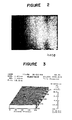
- Figure 2 is a diffraction interference microscopic photograph (400 magnifications) showing the surface texture of the substrate after the etching treatment.
- Figure 3 is an enlarged perspective view of an area of 248 ⁇ m x 248 ⁇ m of the same surface texture by means of a laser interference type roughness meter. When they are compared with Figures 13 and 14, the difference in roughnesss is evident, and it should be understood that the roughness of the substrate of the present invention is very uniform.
- Another substrate was subjected to sputter etching treatment with Ar as sputtering gas under a vacuum of 10 ⁇ 3 Torr at an applied voltage of 600V so that the etching rate of Cu is larger than that of the anodized aluminum, whereby similarly uniform two dementional roughness was formed on the substrate surface with the upper end of columnar Cu being recessed from the anodized aluminum surface as shown by the surface structure in Figure 1(b).
- the results are shown in Figure 4.
- the load of the magnetic head used for the measurement was 15 g, and the running speed was 0.2 m/sec.
- symbol ⁇ represents a substrate with the depth of roughness being 200 ⁇
- symbol ⁇ represents a substrate with the depth of the roughness being 300 ⁇
- symbol ⁇ represents a substrate with the depth of roughness being 500 ⁇ .
- a substrate having a depth of roughness of 100 ⁇ was substantially the same as the substrate with the depth of roughness being 200 ⁇ .
- a substrate to which no etching treatment was applied i.e. a substrate having no surface roughness
- symbol ⁇ represents a substrate with the depth of roughness being 200 ⁇ and having a liquid lubricant applied to its surface.
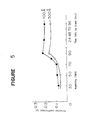
- the changes of the friction coefficients due to the changes of the environmental conditions were measured by a high humidity test and a high temperature running test.
- the high temperature running test was conducted at a temperature of 80°C at a rotational speed of 3,600 rpm by using a magnetic disk with the depth of roughness being 200 ⁇ and provided with a carbon coating of 200 ⁇ .
- the test results are shown in Figure 6. It is evident that irrespective of the number of days left to stand, the friction coefficient is very stable at a low level.
- EXAMPLE II - Packing material is Ni.
- an aluminum coating layer having a thickness of 1 ⁇ m was formed by vapor deposition.
- This substrate was subjected to anodic oxidation treatment in a 3% oxalic acid bath at an applied voltage of 48V to form an anodized aluminum coating layer having a thickness of 0.5 ⁇ m, a pore diameter of 250 ⁇ and a pore distance of 1,100 ⁇ .
- this substrate was subjected to electrodeposition treatment in a bath of a solution containing 30 g/l of NiSO4 to pack Ni in the pores.
- the surface of this substrate was polished by means of alumina powder having a particle size of 0.3 ⁇ m to make the surface smooth and to bring the thickness of the anodized aluminum coating layer to 0.3 ⁇ m.
- the polished substrate was subjected to chemical etching treatment in a 10% phosphoric acid-chromic acid mixture solution. In this manner two dimensional roughness having a depth of 100 ⁇ , 200 ⁇ , 300 ⁇ or 500 ⁇ was formed.
- Figure 7 is an electron microscopic photograph (inclination angle of 70°) showing the surface texture of the substrate after packing pores with Ni, followed by the chemical etching
- Figure 8 is an electron microscopic photograph (inclination angle of 70°) showing the same substrate after sputtering the magnetic material and coating the carbon protective layer thereto.
- EXAMPLE III - Packing material is Sn.
- An Al-4%Mg alloy was used as a substrate.
- This substrate was subjected to anodic oxidation treatment in a 3% oxalic acid bath at an applied voltage of 48V to form an anodized aluminum coating layer having a thickness of 10 ⁇ m, a pore diameter of 250 ⁇ and a pore distance of 1,100 ⁇ .
- this substrate was subjected to electrodeposition treatment in a solution containing 30 g/l of SnSO4 until Sn overflowed from pores, to pack Sn in the pores.
- the surface of this substrate was polished with alumina powder having a particle size of 0.3 ⁇ m until the thickness of the coating layer became 7 ⁇ m as the first polishing and then polished with silica powder having a particle size of 0.1 ⁇ m until the thickness of the coating layer became from 7 to 6 ⁇ m as the second polishing, to make the surface smooth.
- the polished substrate was subjected to chemical etching treatment in a 10% phosphoric acid-chromic acid mixture solution.
- two dimentional roughness having a depth of 100 ⁇ , 200 ⁇ , 300 ⁇ or 500 ⁇ was formed depending upon the dipping time.
- Figure 9 is an electron microscopic photograph (inclination angle of 70°) of the substrate after the magnetic material was sputtered and the carbon protective layer was coated.
- EXAMPLE IV - Packing material is teflon.
- An Al-4%Mg alloy substrate was subjected to anodic oxidation treatment in a 3% oxalic acid bath at an applied voltage of 48V to form an anodized aluminum coating layer having a thickness of 10 ⁇ m, a pore diameter of 250 ⁇ and a pore distance of 1,100 ⁇ . Then, this substrate was dipped in a 1% H3PO4 solution for 10 minutes for pore enlarging treatment to form pores having a pore diameter of 600 ⁇ and a pore distance of 1,100 ⁇ . This substrate was dipped in molten teflon at 350°C, and teflon was packed in the pores by heat impregnation treatment. After this teflon coating, the surface of this substrate was polished with alumina powder having a particle size of 0.3 ⁇ m until the thickness of the coating layer became 0.5 ⁇ m, to make the surface smooth.
- the polished substrate was subjected to chemical etching treatment in a 3% phosphoric acid-chromic acid mixture solution.
- two dimentional roughness having a depth of 100 ⁇ , 200 ⁇ , 300 ⁇ or 500 ⁇ was formed on the substrate surface in the same manner as in Example II.
- a magnetic material was sputtered onto the substrate under the same conditions as in the preceeding Examples.
- EXAMPLE V - Packing material is an acrylate resin.
- An Al-4%Mg alloy substrate was subjected to anodic oxidation treatment in a 3% oxalic acid bath at an applied voltage of 48V to form an anodized aluminum coating layer having a thickness of 9 ⁇ m, a pore diameter of 250 ⁇ and a pore distance of 1,100 ⁇ . Then, this substrate was dipped in a 1% H3PO4 solution for 10 minutes to form pores having a pore diameter of 600 ⁇ and a pore distance of 1,100 ⁇ . Then, the substrate was dipped in a water-soluble acrylate resin having 20% of solid content for 1 minutes and withdrawn and held for 3 minutes to complete dip coating. Then, the substrate was baked at 180°C for 10 minutes. Then, the surface of this substrate was polished with alumina powder having a particle size of 0.3 ⁇ m until the thickness of the coating layer became 8 ⁇ m.
- a magnetic material was sputtered onto the substrate under the same conditions as in Example III.
- the substrate temperature was 130°C.
- An Al-4%Mg alloy substrate was subjected to anodic oxidation treatment in a 3% oxalic acid bath at an applied voltage 48V to form an anodized aluminum coating layer having a thickness of 10 ⁇ m, a pore diameter of 250 ⁇ and a pore distance of 1,100 ⁇ . Then, this substrate was dipped in a 1% H3PO4 solution for 10 minutes to form pores having a pore diameter of 850 ⁇ and a pore distance of 1,100 ⁇ . To this substrate, a coating material comprising 600 g of NiCl2, 1000 cc of H2O and 30 g of dextrin was coated, and then heat reducing treatment was conducted in H2 at 450°C for 10 minutes. Then, the surface of this substrate was polished with alumina powder having a particle size of 0.1 ⁇ m until the thickness of the coating layer became 9 ⁇ m.
- the polished substrate was subjected to chemical etching treatment in a 10% phosphoric acid-chromic acid mixture (5:5) solution.
- a 10% phosphoric acid-chromic acid mixture 5:5 solution.
- Figures 10A to 10C show the results of measurement wherein the magnetic disk in Example II (packing material: Ni, magnetic material: horizontally magnetized layer of Co-Ni) was tested by using a Mn-Zn monosilic type magnetic head (product number M556, manufactured by Matsushita Electric Industrial Company Limited) (head gap: 0.5 ⁇ m, track width: 15 ⁇ m, flying height: 0.1 ⁇ m).
- Mn-Zn monosilic type magnetic head product number M556, manufactured by Matsushita Electric Industrial Company Limited
- Figure 10A is a graph o record reproduction characteristics showing the relation between the electric current applied to the magnetic head at the time of recording on the above magnetic medium at 2.5 MHz and 5 MHz, respectively, and the output voltage obtained at the magnetic head at the time of the reproduction of the magnetic medium, and the attenuation of output at the time of overwriting.
- a constant head output is obtainable irrespective of the recording current.
- Figure 10B is a graph of the output wave form showing the changes of the maximum value and the minimum value of the head output.
- Figure 10C is a graph of the frequency characteristics showing the relation of the head output to the recording frequency.
- the output value is substantially constant form 100 KHz to 2 MHz, and about 20 mV is obtainable even at 5 MHz.
- the numerals for the recording density represent the recording densities corresponding to the frequencies given thereabove, respectively.
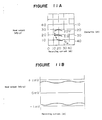
- Figures 11A to 11C correspond to Figures 10A to 10C, respectively, in a case where the magnetic disk in Example III (packing material: Sn, magnetic material: Co-Ni) is tested under the same measuring conditions by using a magnetic head of product number M515.
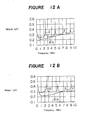
- Figure 12A shows the test results of the magnetic disk of the present invention
- Figure 12B shows the test results of the conventional product.
- line BN indicates the background noise of the testing apparatus
- line S is the signal
- the area between BN and S shows the noise level.
Landscapes
- Engineering & Computer Science (AREA)
- Metallurgy (AREA)
- Chemical & Material Sciences (AREA)
- Inorganic Chemistry (AREA)
- Manufacturing Of Magnetic Record Carriers (AREA)
- Magnetic Record Carriers (AREA)
Applications Claiming Priority (2)
| Application Number | Priority Date | Filing Date | Title |
|---|---|---|---|
| JP24307487 | 1987-09-28 | ||
| JP243074/87 | 1987-09-28 |
Publications (2)
| Publication Number | Publication Date |
|---|---|
| EP0310029A2 true EP0310029A2 (de) | 1989-04-05 |
| EP0310029A3 EP0310029A3 (de) | 1990-06-27 |
Family
ID=17098397
Family Applications (1)
| Application Number | Title | Priority Date | Filing Date |
|---|---|---|---|
| EP88115992A Withdrawn EP0310029A3 (de) | 1987-09-28 | 1988-09-28 | Substrat für eine Magnetplatte und Verfahren zu seiner Herstellung |
Country Status (2)
| Country | Link |
|---|---|
| US (1) | US5047274A (de) |
| EP (1) | EP0310029A3 (de) |
Cited By (3)
| Publication number | Priority date | Publication date | Assignee | Title |
|---|---|---|---|---|
| US5131977A (en) * | 1989-10-02 | 1992-07-21 | C. Itoh & Co., Ltd. | Base plate for recording disc and a method for its manufacture |
| EP0483363A4 (en) * | 1990-04-17 | 1993-03-17 | Mitsui Petrochemical Industries, Ltd. | Production method of magnetooptical recording medium and magnetooptical recording medium |
| WO2007144590A1 (en) * | 2006-06-12 | 2007-12-21 | The Queen's University Of Belfast | Nanostructured systems and a method of manufacture of the same |
Families Citing this family (19)
| Publication number | Priority date | Publication date | Assignee | Title |
|---|---|---|---|---|
| US5202810A (en) * | 1989-04-27 | 1993-04-13 | Hitachi, Ltd. | Magnetic disk having an improved surface configuration |
| JP2547651B2 (ja) * | 1989-05-22 | 1996-10-23 | 日本板硝子株式会社 | 磁気記録媒体 |
| US5504646A (en) * | 1989-10-13 | 1996-04-02 | Hitachi, Ltd. | Magnetic disk including protective layer having surface with protusions and magnetic disk apparatus including the magnetic disk |
| EP0422640B1 (de) * | 1989-10-13 | 1996-03-27 | Hitachi, Ltd. | Magnetplattengerät und Magnetplatte |
| US5470636A (en) * | 1991-03-15 | 1995-11-28 | Yamaha Corporation | Magnetic recording medium and method of producing it |
| JPH0777019B2 (ja) * | 1991-04-22 | 1995-08-16 | 昇 津屋 | 磁気記録媒体用基板及びその製造方法 |
| US5768075A (en) * | 1991-12-17 | 1998-06-16 | Baradun R&D Ltd. | Disk medium w/magnetically filled features aligned in rows and columns |
| WO1993012520A1 (en) * | 1991-12-17 | 1993-06-24 | Certus Magnetics | Magnetic disk medium with designed textured surfaces and controlled surface roughness and method of providing same |
| US5302434A (en) * | 1992-08-07 | 1994-04-12 | International Business Machines Corporation | Magnetic recording disk for contact recording |
| US5307223A (en) * | 1992-08-07 | 1994-04-26 | International Business Machines Corporation | Magnetic recording disk file for contact recording |
| US5993937A (en) * | 1993-11-30 | 1999-11-30 | Matsushita Electric Industrial Co., Ltd. | Magneto-optic recording medium and method of fabricating the same |
| US6146740A (en) * | 1994-11-28 | 2000-11-14 | Matsushita Electric Industrial Co., Ltd. | Magnetic recording medium and method of fabricating the same |
| JPH08221734A (ja) * | 1995-02-20 | 1996-08-30 | Fujitsu Ltd | 磁気記録媒体及び磁気記録装置 |
| US5923511A (en) * | 1995-05-26 | 1999-07-13 | International Business Machines Corporation | Directly contactable disk for vertical magnetic data storage |
| US5506017A (en) * | 1995-06-07 | 1996-04-09 | Komag Incorporated | Method for texturing magnetic media |
| US6264848B1 (en) * | 1998-04-09 | 2001-07-24 | Seagate Technology Llc | Method for providing track position and identification information for data storage devices |
| WO2000048172A2 (en) | 1999-02-12 | 2000-08-17 | General Electric Company | Data storage media |
| US7179551B2 (en) | 1999-02-12 | 2007-02-20 | General Electric Company | Poly(arylene ether) data storage media |
| RU2497167C1 (ru) * | 2012-05-03 | 2013-10-27 | Государственное образовательное учреждение высшего профессионального образования Московский государственный областной университет | Способ получения ориентированного слоя жидкого кристалла |
Family Cites Families (11)
| Publication number | Priority date | Publication date | Assignee | Title |
|---|---|---|---|---|
| US3886052A (en) * | 1970-07-20 | 1975-05-27 | Digital Equipment Corp | Method of making a magnetic recording disc |
| US4109287A (en) * | 1972-04-14 | 1978-08-22 | Pilot Man-Nun-Hitsu Kabushiki Kaisha | Process for recording information or sound and process for preparation of recording materials used therefor |
| US4650708A (en) * | 1983-05-28 | 1987-03-17 | Toshiro Takahashi | Magnetic recording material and a method for producing the same |
| US4548682A (en) * | 1983-06-10 | 1985-10-22 | Nippon Light Metal Company Limited | Process of producing magnetic recording media |
| JPS6063731A (ja) * | 1983-09-19 | 1985-04-12 | Pilot Pen Co Ltd:The | 磁気記録材料の製造方法 |
| US4525759A (en) * | 1984-04-02 | 1985-06-25 | Shipley Company Inc. | Aluminum storage disc |
| EP0179934B1 (de) * | 1984-10-31 | 1988-04-27 | Ibm Deutschland Gmbh | Magnetplatte und Verfahren zu ihrer Herstellung |
| JPS61120350A (ja) * | 1984-11-16 | 1986-06-07 | Toshiro Takahashi | 磁気記録媒体の製造方法 |
| US4698251A (en) * | 1985-01-22 | 1987-10-06 | Victor Company Of Japan, Limited | Magnetic recording medium and method of producing the same |
| JPH0727663B2 (ja) * | 1985-04-03 | 1995-03-29 | ヤマハ株式会社 | 光磁気記録媒体およびその製法 |
| JP2763145B2 (ja) * | 1989-07-31 | 1998-06-11 | 株式会社東芝 | 画像形成装置 |
-
1988
- 1988-07-13 US US07/218,202 patent/US5047274A/en not_active Expired - Fee Related
- 1988-09-28 EP EP88115992A patent/EP0310029A3/de not_active Withdrawn
Cited By (3)
| Publication number | Priority date | Publication date | Assignee | Title |
|---|---|---|---|---|
| US5131977A (en) * | 1989-10-02 | 1992-07-21 | C. Itoh & Co., Ltd. | Base plate for recording disc and a method for its manufacture |
| EP0483363A4 (en) * | 1990-04-17 | 1993-03-17 | Mitsui Petrochemical Industries, Ltd. | Production method of magnetooptical recording medium and magnetooptical recording medium |
| WO2007144590A1 (en) * | 2006-06-12 | 2007-12-21 | The Queen's University Of Belfast | Nanostructured systems and a method of manufacture of the same |
Also Published As
| Publication number | Publication date |
|---|---|
| EP0310029A3 (de) | 1990-06-27 |
| US5047274A (en) | 1991-09-10 |
Similar Documents
| Publication | Publication Date | Title |
|---|---|---|
| US5047274A (en) | Annodized aluminum substrate for a magnetic recording disk in which pores are filled with a non magnetic material and the surface polished and etched | |
| US5045165A (en) | Method for sputtering a hydrogen-doped carbon protective film on a magnetic disk | |
| JP4769376B2 (ja) | 磁気記録媒体を製造する方法 | |
| EP0182367B1 (de) | Magnetischer Aufzeichnungsträger und Herstellung derselben | |
| US4925738A (en) | Substrate for a magnetic disk and process for its production | |
| KR910006150B1 (ko) | 자기 기록매체 및 그 제조방법 | |
| US5496632A (en) | Magnetic recording medium and manufacturing method thereof | |
| US5091225A (en) | Magnetic disc member and process for manufacturing the same | |
| US4900397A (en) | Production of magnetic recording media | |
| EP0100054A2 (de) | Magnetischer Aufzeichnungsträger | |
| US5108812A (en) | Substrate for a magnetic disk and process for its production | |
| US5549954A (en) | Magnetic disc | |
| JPS61242323A (ja) | 磁気記録媒体 | |
| US5316617A (en) | Thin film magnetic head and method of manufacturing the same | |
| EP0216079B1 (de) | Herstellung eines Kohlenstoffüberzuges und dessen Verwendung | |
| JPH0756692B2 (ja) | 磁気ディスク基板とその製造方法 | |
| KR100629034B1 (ko) | 패턴화된 기판을 가진 자기 기록 매체 | |
| JPS61107529A (ja) | 磁気記録媒体 | |
| JPS62236116A (ja) | 磁気記録媒体 | |
| EP0422547B1 (de) | Magnetischer Aufzeichnungsträger | |
| EP0320241A2 (de) | Magnetischer Aufzeichnungsträger und Verfahren zu seiner Herstellung | |
| JP2785276B2 (ja) | 磁気記録媒体 | |
| JPS6292227A (ja) | 磁気記録媒体 | |
| JP2001189007A (ja) | 磁気ディスクおよびフロッピーディスクを用いた磁気記録方式 | |
| JPH0770050B2 (ja) | 磁気記録媒体 |
Legal Events
| Date | Code | Title | Description |
|---|---|---|---|
| PUAI | Public reference made under article 153(3) epc to a published international application that has entered the european phase |
Free format text: ORIGINAL CODE: 0009012 |
|
| AK | Designated contracting states |
Kind code of ref document: A2 Designated state(s): DE FR GB NL |
|
| PUAL | Search report despatched |
Free format text: ORIGINAL CODE: 0009013 |
|
| AK | Designated contracting states |
Kind code of ref document: A3 Designated state(s): DE FR GB NL |
|
| 17P | Request for examination filed |
Effective date: 19901218 |
|
| 17Q | First examination report despatched |
Effective date: 19930426 |
|
| STAA | Information on the status of an ep patent application or granted ep patent |
Free format text: STATUS: THE APPLICATION IS DEEMED TO BE WITHDRAWN |
|
| 18D | Application deemed to be withdrawn |
Effective date: 19930909 |