EP0310191A2 - Procédé et réacteur pour la production de nitrite d'alkyle - Google Patents
Procédé et réacteur pour la production de nitrite d'alkyle Download PDFInfo
- Publication number
- EP0310191A2 EP0310191A2 EP88202116A EP88202116A EP0310191A2 EP 0310191 A2 EP0310191 A2 EP 0310191A2 EP 88202116 A EP88202116 A EP 88202116A EP 88202116 A EP88202116 A EP 88202116A EP 0310191 A2 EP0310191 A2 EP 0310191A2
- Authority
- EP
- European Patent Office
- Prior art keywords
- section
- liquid
- alkyl nitrite
- oxygen
- nitric oxide
- Prior art date
- Legal status (The legal status is an assumption and is not a legal conclusion. Google has not performed a legal analysis and makes no representation as to the accuracy of the status listed.)
- Granted
Links
- 238000006243 chemical reaction Methods 0.000 title claims abstract description 108
- -1 alkyl nitrite Chemical compound 0.000 title claims abstract description 74
- 238000000034 method Methods 0.000 title claims abstract description 25
- 230000008569 process Effects 0.000 title claims abstract description 24
- 238000004519 manufacturing process Methods 0.000 title claims description 15
- MWUXSHHQAYIFBG-UHFFFAOYSA-N Nitric oxide Chemical compound O=[N] MWUXSHHQAYIFBG-UHFFFAOYSA-N 0.000 claims abstract description 115
- 239000007788 liquid Substances 0.000 claims abstract description 59
- 229910052760 oxygen Inorganic materials 0.000 claims abstract description 47
- 239000001301 oxygen Substances 0.000 claims abstract description 47
- QVGXLLKOCUKJST-UHFFFAOYSA-N atomic oxygen Chemical compound [O] QVGXLLKOCUKJST-UHFFFAOYSA-N 0.000 claims abstract description 46
- GRYLNZFGIOXLOG-UHFFFAOYSA-N Nitric acid Chemical compound O[N+]([O-])=O GRYLNZFGIOXLOG-UHFFFAOYSA-N 0.000 claims abstract description 29
- 229910017604 nitric acid Inorganic materials 0.000 claims abstract description 28
- XLYOFNOQVPJJNP-UHFFFAOYSA-N water Substances O XLYOFNOQVPJJNP-UHFFFAOYSA-N 0.000 claims abstract description 26
- LFQSCWFLJHTTHZ-UHFFFAOYSA-N Ethanol Chemical compound CCO LFQSCWFLJHTTHZ-UHFFFAOYSA-N 0.000 claims abstract description 25
- 239000003795 chemical substances by application Substances 0.000 claims abstract description 23
- 238000005201 scrubbing Methods 0.000 claims abstract description 23
- OKKJLVBELUTLKV-UHFFFAOYSA-N Methanol Chemical compound OC OKKJLVBELUTLKV-UHFFFAOYSA-N 0.000 claims description 75
- BLLFVUPNHCTMSV-UHFFFAOYSA-N methyl nitrite Chemical group CON=O BLLFVUPNHCTMSV-UHFFFAOYSA-N 0.000 claims description 24
- 238000012856 packing Methods 0.000 claims description 9
- 239000007795 chemical reaction product Substances 0.000 claims description 7
- 238000001816 cooling Methods 0.000 claims description 7
- 238000004821 distillation Methods 0.000 claims description 7
- QQZWEECEMNQSTG-UHFFFAOYSA-N Ethyl nitrite Chemical group CCON=O QQZWEECEMNQSTG-UHFFFAOYSA-N 0.000 claims description 2
- 229960003753 nitric oxide Drugs 0.000 description 43
- LZDSILRDTDCIQT-UHFFFAOYSA-N dinitrogen trioxide Chemical compound [O-][N+](=O)N=O LZDSILRDTDCIQT-UHFFFAOYSA-N 0.000 description 30
- 238000005810 carbonylation reaction Methods 0.000 description 21
- 239000000047 product Substances 0.000 description 19
- WFPZPJSADLPSON-UHFFFAOYSA-N dinitrogen tetraoxide Chemical compound [O-][N+](=O)[N+]([O-])=O WFPZPJSADLPSON-UHFFFAOYSA-N 0.000 description 15
- MUBZPKHOEPUJKR-UHFFFAOYSA-N Oxalic acid Chemical compound OC(=O)C(O)=O MUBZPKHOEPUJKR-UHFFFAOYSA-N 0.000 description 14
- 230000015572 biosynthetic process Effects 0.000 description 14
- 229940039748 oxalate Drugs 0.000 description 14
- 239000003054 catalyst Substances 0.000 description 9
- 239000007792 gaseous phase Substances 0.000 description 9
- 239000000463 material Substances 0.000 description 9
- UGFAIRIUMAVXCW-UHFFFAOYSA-N Carbon monoxide Chemical compound [O+]#[C-] UGFAIRIUMAVXCW-UHFFFAOYSA-N 0.000 description 8
- 229910002091 carbon monoxide Inorganic materials 0.000 description 8
- 239000000376 reactant Substances 0.000 description 8
- IJGRMHOSHXDMSA-UHFFFAOYSA-N Atomic nitrogen Chemical compound N#N IJGRMHOSHXDMSA-UHFFFAOYSA-N 0.000 description 7
- IOVCWXUNBOPUCH-UHFFFAOYSA-N Nitrous acid Chemical compound ON=O IOVCWXUNBOPUCH-UHFFFAOYSA-N 0.000 description 7
- 239000007789 gas Substances 0.000 description 7
- JCXJVPUVTGWSNB-UHFFFAOYSA-N nitrogen dioxide Inorganic materials O=[N]=O JCXJVPUVTGWSNB-UHFFFAOYSA-N 0.000 description 7
- LYCAIKOWRPUZTN-UHFFFAOYSA-N Ethylene glycol Chemical compound OCCO LYCAIKOWRPUZTN-UHFFFAOYSA-N 0.000 description 6
- 239000007791 liquid phase Substances 0.000 description 6
- 239000003085 diluting agent Substances 0.000 description 5
- BASFCYQUMIYNBI-UHFFFAOYSA-N platinum Chemical group [Pt] BASFCYQUMIYNBI-UHFFFAOYSA-N 0.000 description 5
- 239000012808 vapor phase Substances 0.000 description 5
- CURLTUGMZLYLDI-UHFFFAOYSA-N Carbon dioxide Chemical compound O=C=O CURLTUGMZLYLDI-UHFFFAOYSA-N 0.000 description 4
- LOMVENUNSWAXEN-UHFFFAOYSA-N Methyl oxalate Chemical compound COC(=O)C(=O)OC LOMVENUNSWAXEN-UHFFFAOYSA-N 0.000 description 4
- KDLHZDBZIXYQEI-UHFFFAOYSA-N Palladium Chemical compound [Pd] KDLHZDBZIXYQEI-UHFFFAOYSA-N 0.000 description 4
- 125000002496 methyl group Chemical group [H]C([H])([H])* 0.000 description 4
- 238000002156 mixing Methods 0.000 description 4
- 238000000926 separation method Methods 0.000 description 4
- VYPSYNLAJGMNEJ-UHFFFAOYSA-N Silicium dioxide Chemical compound O=[Si]=O VYPSYNLAJGMNEJ-UHFFFAOYSA-N 0.000 description 3
- 125000000217 alkyl group Chemical group 0.000 description 3
- 150000001875 compounds Chemical class 0.000 description 3
- 229910052751 metal Inorganic materials 0.000 description 3
- 239000002184 metal Substances 0.000 description 3
- 229910052757 nitrogen Inorganic materials 0.000 description 3
- UEFIGQHPQSVHQI-UHFFFAOYSA-N nitrous acid;oxalic acid Chemical compound ON=O.OC(=O)C(O)=O UEFIGQHPQSVHQI-UHFFFAOYSA-N 0.000 description 3
- 239000012071 phase Substances 0.000 description 3
- 239000011949 solid catalyst Substances 0.000 description 3
- CPLXHLVBOLITMK-UHFFFAOYSA-N Magnesium oxide Chemical compound [Mg]=O CPLXHLVBOLITMK-UHFFFAOYSA-N 0.000 description 2
- IOVCWXUNBOPUCH-UHFFFAOYSA-M Nitrite anion Chemical compound [O-]N=O IOVCWXUNBOPUCH-UHFFFAOYSA-M 0.000 description 2
- 230000002411 adverse Effects 0.000 description 2
- PNEYBMLMFCGWSK-UHFFFAOYSA-N aluminium oxide Inorganic materials [O-2].[O-2].[O-2].[Al+3].[Al+3] PNEYBMLMFCGWSK-UHFFFAOYSA-N 0.000 description 2
- 239000001569 carbon dioxide Substances 0.000 description 2
- 229910002092 carbon dioxide Inorganic materials 0.000 description 2
- 239000003153 chemical reaction reagent Substances 0.000 description 2
- 238000010276 construction Methods 0.000 description 2
- 150000005690 diesters Chemical class 0.000 description 2
- 125000001495 ethyl group Chemical group [H]C([H])([H])C([H])([H])* 0.000 description 2
- 239000012530 fluid Substances 0.000 description 2
- 150000003901 oxalic acid esters Chemical class 0.000 description 2
- 230000036284 oxygen consumption Effects 0.000 description 2
- 229910052763 palladium Inorganic materials 0.000 description 2
- 238000002360 preparation method Methods 0.000 description 2
- 238000007086 side reaction Methods 0.000 description 2
- 239000007858 starting material Substances 0.000 description 2
- 239000000126 substance Substances 0.000 description 2
- OKTJSMMVPCPJKN-UHFFFAOYSA-N Carbon Chemical compound [C] OKTJSMMVPCPJKN-UHFFFAOYSA-N 0.000 description 1
- UFHFLCQGNIYNRP-UHFFFAOYSA-N Hydrogen Chemical compound [H][H] UFHFLCQGNIYNRP-UHFFFAOYSA-N 0.000 description 1
- 239000005909 Kieselgur Substances 0.000 description 1
- 229910019142 PO4 Inorganic materials 0.000 description 1
- KJTLSVCANCCWHF-UHFFFAOYSA-N Ruthenium Chemical compound [Ru] KJTLSVCANCCWHF-UHFFFAOYSA-N 0.000 description 1
- 229910021536 Zeolite Inorganic materials 0.000 description 1
- 150000001242 acetic acid derivatives Chemical class 0.000 description 1
- 239000000654 additive Substances 0.000 description 1
- 150000001298 alcohols Chemical class 0.000 description 1
- 229920000180 alkyd Polymers 0.000 description 1
- 230000002528 anti-freeze Effects 0.000 description 1
- 150000001558 benzoic acid derivatives Chemical class 0.000 description 1
- 239000006227 byproduct Substances 0.000 description 1
- 229910052799 carbon Inorganic materials 0.000 description 1
- 230000006315 carbonylation Effects 0.000 description 1
- 230000008859 change Effects 0.000 description 1
- 239000000812 cholinergic antagonist Substances 0.000 description 1
- 238000005094 computer simulation Methods 0.000 description 1
- 230000002596 correlated effect Effects 0.000 description 1
- 125000004122 cyclic group Chemical group 0.000 description 1
- 230000009849 deactivation Effects 0.000 description 1
- 230000002939 deleterious effect Effects 0.000 description 1
- 238000006193 diazotization reaction Methods 0.000 description 1
- HNPSIPDUKPIQMN-UHFFFAOYSA-N dioxosilane;oxo(oxoalumanyloxy)alumane Chemical compound O=[Si]=O.O=[Al]O[Al]=O HNPSIPDUKPIQMN-UHFFFAOYSA-N 0.000 description 1
- 238000009826 distribution Methods 0.000 description 1
- 239000003814 drug Substances 0.000 description 1
- 239000000975 dye Substances 0.000 description 1
- 230000000694 effects Effects 0.000 description 1
- 150000002148 esters Chemical class 0.000 description 1
- 238000000605 extraction Methods 0.000 description 1
- 239000000835 fiber Substances 0.000 description 1
- 239000000446 fuel Substances 0.000 description 1
- 150000004820 halides Chemical class 0.000 description 1
- 239000001257 hydrogen Substances 0.000 description 1
- 229910052739 hydrogen Inorganic materials 0.000 description 1
- 238000005984 hydrogenation reaction Methods 0.000 description 1
- 239000003701 inert diluent Substances 0.000 description 1
- 239000000543 intermediate Substances 0.000 description 1
- 229910052741 iridium Inorganic materials 0.000 description 1
- GKOZUEZYRPOHIO-UHFFFAOYSA-N iridium atom Chemical compound [Ir] GKOZUEZYRPOHIO-UHFFFAOYSA-N 0.000 description 1
- 239000000395 magnesium oxide Substances 0.000 description 1
- 235000012245 magnesium oxide Nutrition 0.000 description 1
- 230000007246 mechanism Effects 0.000 description 1
- 150000002739 metals Chemical class 0.000 description 1
- 229940057952 methanol Drugs 0.000 description 1
- 239000000203 mixture Substances 0.000 description 1
- 230000004048 modification Effects 0.000 description 1
- 238000012986 modification Methods 0.000 description 1
- 150000002823 nitrates Chemical class 0.000 description 1
- GQPLMRYTRLFLPF-UHFFFAOYSA-N nitrous oxide Inorganic materials [O-][N+]#N GQPLMRYTRLFLPF-UHFFFAOYSA-N 0.000 description 1
- 238000005457 optimization Methods 0.000 description 1
- 230000003647 oxidation Effects 0.000 description 1
- 238000007254 oxidation reaction Methods 0.000 description 1
- 150000002926 oxygen Chemical class 0.000 description 1
- 235000021317 phosphate Nutrition 0.000 description 1
- 150000003013 phosphoric acid derivatives Chemical class 0.000 description 1
- 229910052697 platinum Inorganic materials 0.000 description 1
- 229920000728 polyester Polymers 0.000 description 1
- 239000002243 precursor Substances 0.000 description 1
- 239000008262 pumice Substances 0.000 description 1
- 239000011541 reaction mixture Substances 0.000 description 1
- 230000003134 recirculating effect Effects 0.000 description 1
- 230000008929 regeneration Effects 0.000 description 1
- 238000011069 regeneration method Methods 0.000 description 1
- 229910052703 rhodium Inorganic materials 0.000 description 1
- 239000010948 rhodium Substances 0.000 description 1
- MHOVAHRLVXNVSD-UHFFFAOYSA-N rhodium atom Chemical compound [Rh] MHOVAHRLVXNVSD-UHFFFAOYSA-N 0.000 description 1
- 229910052707 ruthenium Inorganic materials 0.000 description 1
- 150000003839 salts Chemical class 0.000 description 1
- 239000000377 silicon dioxide Substances 0.000 description 1
- 238000004088 simulation Methods 0.000 description 1
- 239000002904 solvent Substances 0.000 description 1
- 239000007921 spray Substances 0.000 description 1
- 239000003381 stabilizer Substances 0.000 description 1
- 229910001220 stainless steel Inorganic materials 0.000 description 1
- 239000010935 stainless steel Substances 0.000 description 1
- 150000003467 sulfuric acid derivatives Chemical class 0.000 description 1
- 238000003786 synthesis reaction Methods 0.000 description 1
- 125000000391 vinyl group Chemical group [H]C([*])=C([H])[H] 0.000 description 1
- 239000010457 zeolite Substances 0.000 description 1
Images
Classifications
-
- B—PERFORMING OPERATIONS; TRANSPORTING
- B01—PHYSICAL OR CHEMICAL PROCESSES OR APPARATUS IN GENERAL
- B01D—SEPARATION
- B01D3/00—Distillation or related exchange processes in which liquids are contacted with gaseous media, e.g. stripping
- B01D3/009—Distillation or related exchange processes in which liquids are contacted with gaseous media, e.g. stripping in combination with chemical reactions
-
- C—CHEMISTRY; METALLURGY
- C07—ORGANIC CHEMISTRY
- C07C—ACYCLIC OR CARBOCYCLIC COMPOUNDS
- C07C201/00—Preparation of esters of nitric or nitrous acid or of compounds containing nitro or nitroso groups bound to a carbon skeleton
- C07C201/04—Preparation of esters of nitrous acid
-
- Y—GENERAL TAGGING OF NEW TECHNOLOGICAL DEVELOPMENTS; GENERAL TAGGING OF CROSS-SECTIONAL TECHNOLOGIES SPANNING OVER SEVERAL SECTIONS OF THE IPC; TECHNICAL SUBJECTS COVERED BY FORMER USPC CROSS-REFERENCE ART COLLECTIONS [XRACs] AND DIGESTS
- Y02—TECHNOLOGIES OR APPLICATIONS FOR MITIGATION OR ADAPTATION AGAINST CLIMATE CHANGE
- Y02P—CLIMATE CHANGE MITIGATION TECHNOLOGIES IN THE PRODUCTION OR PROCESSING OF GOODS
- Y02P20/00—Technologies relating to chemical industry
- Y02P20/10—Process efficiency
Definitions
- the subject invention is directed to a process for preparing alkyl nitrites, particularly methyl nitrite, and a reaction vessel for carrying out the process.
- Alkyl nitrites i.e. esters of nitrous acid
- Processes for preparing alkyl nitrites can be found, inter alia , in U.S. Patents 4,229,591; 4,353,843 and 4,629,806 and in Japanese Application No. 53-8268.
- the process for forming alkyl nitrites may be understood more fully by reference to the following equations: (1) 2NO + O2 ⁇ 2NO2 (2) NO2 + NO ⁇ N2O3 (3) ROH + N2O3 ⁇ RONO + HONO (4) ROH + HONO ⁇ RONO + H2O (5) N2O3 + H2O ⁇ 2HONO (6) 2NO2 ⁇ N2O4 (7) ROH + N2O4 ⁇ RONO + HNO3 (8) N2O4 + H2O ⁇ HONO + HNO3 wherein R represents a methyl or ethyl group.
- Reaction (5) takes place because the water formed in Reaction (4) can react with dinitrogen trioxide (N2O3). Reaction (5) can be tolerated provided enough alcohol is supplied to react with substantially all of the nitrous acid formed in Reaction (5) according to Reaction (4) yielding alkyl nitrite and additional water.
- N2O3 dinitrogen trioxide
- Reactions (6) through (8) are undesired since they lead to the formation of nitric acid, a compound which subsequently must be separated from product alkyl nitrite. Further, these reactions consume nitric oxide in forming undesired nitric acid.
- N2O4 dinitrogen tetroxide
- the gas phase concentration of NO2 should be minimized relative to that of NO. In this way N2O3 is preferentially formed instead of N2O4.
- a relatively high NO to NO2 can be maintained by initially supplying a molar excess of NO relative to O2, as indicated by the stoichiometry of Reaction (I), i.e., greater than 4 moles NO per mole O2.
- alkyl nitrites such as methyl nitrite or ethyl nitrite
- Vapor state formation of alkyl nitrite (nitrite process) by the general procedure described above preferably is coupled and correlated with vapor state formation of dialkyl oxalate from alkyl nitrite and carbon monoxide (oxalate process) in an integrated production cycle so as to provide an overall vapor state process (nitrite-oxalate process) that is cyclic in operation, e.g., see U.S. Patent 4,629,806.
- Such a process is advantageous with regard to limiting the formation of by-products, ease of operation and production efficiency.
- Vapor state formation of dialkyl oxalate is conducted by contacting carbon monoxide and alkyl nitrite in a carbonylation reaction zone in the presence of a solid catalyst. The main reaction is illustrated by the following equation: wherein R represents a methyl or ethyl group.
- dialkyl oxalates are of particular interest to the chemical industry because of the varied uses of these compounds.
- diesters may serve as starting materials for the preparation of alkylene glycols such as ethylene glycol, a valuable commercial chemical which finds application in deicing fluids, antifreeze, hydraulic fluids and in the manufacture of alkyd resins, solvents, and polyester fibers.
- alkylene glycols such as ethylene glycol
- diesters also are useful as intermediates in preparing dyes, pharmaceuticals, and the like.
- Dialkyl oxalate produced in the carbonylation reaction zone can be purified and recovered as product or further reacted, for example, by contacting it with hydrogen in a hydrogenation reaction zone to produce ethylene glycol.
- oxygen conversion preferably should be as close to 100 percent as is possible (i.e. ⁇ the amount of oxygen exiting the alkyl nitrite reactor preferably is minimized) without significantly adversely affecting other reactor performance characteristics. It also is preferred that substantially all higher nitrogen oxides, i.e., oxides of nitrogen other than nitric oxide, be consumed in alkyl nitrite reactor.
- the efficiency of converting nitric oxide to alkyl nitrite i.e., the percentage of nitric oxide converted to alkyl nitrite, the desired product, is maximized in the alkyl nitrite reactor while formation of undesired products such as nitric acid is minimized.
- substantially all water and nitric acid produced in the alkyl nitrite reactor be removed in a liquid tails stream by providing a scrubbing agent which scrubs water and nitric acid from the gaseous product stream.
- the amounts of water and nitric acid present in the gaseous product stream from the alkyl nitrite reactor thus are minimized.
- the amount of alkyl nitrite, the preferred product, present in the liquid tails stream from the alkyl nitrite reactor similarly is minimized.
- the amount of scrubbing agent required to provide the separation necessary to satisfy the above discussed requirements preferably is minimized since the use of excess scrubbing agent material is uneconomical.
- Reaction I is highly exothermic, and it is necessary to remove heat from the alkyl nitrite reactor.
- the present invention is directed to an alkyl nitrite manufacturing process, including a reaction vessel, which substantially meets the above-noted performance criteria comprising:
- the present invention also is directed to a preferred reaction vessel for producing alkyl nitrite by contacting nitric oxide ⁇ a lower alcohol and oxygen.
- the reaction vessel comprises (a) a lower packed bed section, (b) an upper rectification section, (c) means for supplying a liquid scrubbing agent to the upper rectification section, (d) means for withdrawing a gaseous stream from the upper rectification section, and (e) means for withdrawing a liquid bottoms stream from the lower packed bed section.
- the lower packed bed section provides intimate vapor-liquid contact sufficient to enhance the conversion of nitric oxide to alkyl nitrite
- the upper rectification section provides sufficient vapor residence time to enhance conversion of oxygen and sufficient rectification capabilities to reduce the amounts of water and nitric acid in the gaseous reaction product stream and the amount of alkyl nitrite in the liquid bottoms stream.
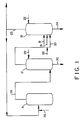
- alkyl nitrite is produced in an alkyl nitrite reactor or alkyl nitrite regeneration column 10 (ANRC) by contacting nitric oxide and oxygen in the presence of a lower alcohol.
- the lower alcohol includes C1 to C4 alcohols and preferably is selected from methanol, ethanol and mixtures thereof. Methanol is most preferred and thus the present invention will be described using methanol as the lower alcohol and methyl nitrites as the product.
- Recycle nitric oxide typically supplemented by makeup nitric oxide (solid line 31 and/or dotted line 32), is fed into the ANRC via line 20.
- Oxygen is supplied to the ANRC via line 21.
- the nitric oxide and oxygen streams preferably are supplied to the bottom of the ANRC.
- Liquid methanol is supplied to the top of the ANRC via line 22.
- the mole ratio of nitric oxide to oxygen in the ANRC preferably is greater than 4:1, typically ranging from slightly greater than 4:1 to 5:1.
- the actual flow rates of the various reactants into the ANRC can vary widely according to the ANRC design and size.
- the mole ratio of methanol to oxygen typically is in the range of from about 4:1 to about 12:1 or higher.
- Methyl nitrite production preferably is carried out in a continous manner at temperatures sufficiently high to maintain substantially all of the nitrogen oxide and methyl nitrite and only a portion of the methanol in the vapor state.
- the temperature in the ANRC typically is in the range of from about 10 to about 150°C, preferably from about 20 to about 130°C, and most preferably from about 30 to about 110°C.
- the pressure within the ANRC is typically in the range of from about atmospheric to about 100 psia, preferably from about 20 to about 60 psia. Subatmospheric pressures, i.e., pressures less than 14.7 psia may be employed, if desired.
- the gas hourly space velocity in the ANRC generally ranges from about 120 to about 36,000 hr ⁇ 1, preferably from about 1800 to about 36,000 hr ⁇ 1. Smaller or larger space velocities may be employed depending on the temperature, pressure, reactant molar ratios, gaseous diluent, and feed rate employed, so long as sufficient time for reaction is provided. In addition, the reactor design and geometry may have an effect on the preferred space velocity.
- the methyl nitrite formation process does not require the use of a catalyst.
- a suitable catalyst and/or catalyst support may be employed.
- Mixing of the various feedstreams supplied to the reaction zone generally is achieved through the turbulent conditions present at their points of introduction, although mixing may be induced by other means as well.
- the reactants supplied to the ANRC preferably are reacted according to Reaction (I): (I) 2NO + 1/2O2 + 2ROH ⁇ 2RONO + H2O wherein R is methyl.
- the material leaving the ANRC typically comprises nitric oxide, carbon monoxide, oxygen and methyl nitrite together with a small amount of nitric acid, water and methanol.
- the nitric oxide, unreacted oxygen and methyl nitrite product exiting the ANRC are withdrawn from the top of the ANRC in the gaseous phase via line 23.
- a portion of the methanol supplied to the ANRC comprises a reactant, while a portion of it remains in the liquid phase as a scrubbing agent to scrub substantially all of the nitric acid and water in the ANRC.
- substantially all of the nitric acid and water exiting the ANRC is removed in a liquid methanol-containing stream 24 which preferably is withdrawn from the bottom of the ANRC. Any water that does not exit the ANRC via the methanol-containing stream 24 is withdrawn from the top of the ANRC in the gaseous phase via line 23. A small portion of the methanol exiting the ANRC also is withdrawn from the top of the ANRC in the gaseous phase via line 23.
- the liquid stream withdrawn from the ANRC via line 24 may be refined by distillation, extraction or the like to reduce its water and nitric acid content.
- the refined product then may be recycled as the lower alcohol, i.e., methanol.
- a carbonylation reaction zone or oxalate reactor 11 Preferably all the materials entering oxalate reactor are substantially completely in the gaseous phase.
- methyl nitrite is contacted with carbon monoxide in the presence of a catalyst to form dimethyl oxalate and nitric oxide according to Reaction (II): wherein R is the lower alkyl, e.g., methyl for the purposes of this description.
- gaseous diluent such as nitrogen or carbon dioxide.
- nitrogen or carbon dioxide is preferred since it provides a higher heat capacity in comparison with nitrogen.
- gaseous diluent may comprise from about 0 to about 99 percent by volume of the gaseous feed.
- concentration of gaseous diluent ranges from about 1 to about 90 percent by volume.
- Suitable concentrations of carbon monoxide in the reaction mixture depend on the alkyl nitrite employed and its concentration, the catalyst used, the concentration of inert gaseous diluent, if diluent is employed, and the selected process conditions. In general, the higher the concentration of the alkyl nitrite, the more rapid the carbonylation reaction.
- the ratio of alkyl nitrite to carbon monoxide, by volume typically is in the range of from about 0.05 to about 3.0, preferably from about 0.2 to about 1.0. A molar excess of carbon monoxide normally will be used.
- the carbonylation reactions is carried out under conditions which essentially avoid the formation of a liquid phase in the carbonylation reaction zone 11. These conditions may vary depending upon the particular alkyl nitrite and its concentration.
- the carbonylation reaction generally is carried out at a temperature of from about 50 to about 200°C, preferably from about 75 to about 160°C, most preferably from about 120 to about 150°C.
- the carbonylation reaction pressure generally is from about atmospheric to about 220 psia, more preferably from about atmospheric to about 100 psia, and most preferably from about 15 psia to about 60 psia. Sub-atmospheric pressure may be employed, if desired.
- the gas hourly space velocity for the carbonylation reactor generally is greater than about 120 hr ⁇ 1, preferably from about 360 hr ⁇ 1 to about 72,000 hr ⁇ 1.
- the carbonylation reaction zone 11 preferably does not contain water. While a very minor amount of water may be tolerated in the reaction zone, preferably substantially all of the water formed in the ANRC is removed prior to introducing the ANRC product stream into carbonylation reaction zone 11.
- the amount of water in the oxalate-forming reaction zone preferably is less than about 0.5 percent by volume.
- the carbonylation reaction preferably is carried out in a continuous manner in a series of elongated tubular zones although alternative zone geometries and designs may be employed.
- the materials of construction should be such that they are inert to the reactants and products and are able to withstand reaction temperatures and pressures.
- carbonylation reaction zone 11 may be fitted with internal or external heat exchange unit(s) to control temperature. Mixing in carbonylation reaction zone 11 generally is achieved through turbulence at the points of introduction for the various gaseous components. Other mixing mechanisms may be employed as well.
- Carbonylation reaction zone 11 preferably is packed with a solid catalyst of the platinum group metal series.
- the preferred platinum group catalyst material is palladium.
- platinum, rhodium, ruthenium, and iridium also are useful.
- salts of these metals such as nitrates, sulfates, phosphates, halides, acetates, oxalates, or benzoates may be used.
- These materials may be supported on a carrier such as active carbon, alumina, silica, silica-alumina, diatomaceous earth, pumice, magnesia, or zeolite.
- the amount of platinum group metal generally ranges from about 0.01 to about 10 percent by weight, preferably from about 0.2 to about 2 percent by weight, relative to the carrier.
- the solid catalyst generally may be supplied as a fixed bed or as a fluidized bed.
- nitrous and nitric acids tend to accelerate the rate of deactivation of the catalyst. It is therefore preferable that substantially all of the nitrous acid produced in or supplied to the ANRC be consumed in the ANRC. Further technically, since oxygen has similar deleterious effects on such catalysts, it is important to minimize the amount of unconsumed oxygen in the methyl nitrite product recovered from the ANRC.
- Carbonylation reaction effluent 28, comprising dimethyl oxalate and nitric oxide is withdrawn from the carbonylation reaction zone 11 substantially completely in the vapor phase and preferably is supplied to an oxalate scrubber 12.
- a liquid scrubbing agent supplied to oxalate scrubber 12 via line 29 scrubs substantially all of the dimethyl oxalate from the carbonylation reaction effluent.
- the scrubbing agent is the same material used as a scrubbing agent in the ANRC, i.e., methanol.
- a liquid bottoms stream 30 comprising the scrubbing agent and dimethyl oxalate, is withdrawn from the bottom of oxalate scrubber 12.
- nitric oxide contained in the carbonylation reaction effluent 28, i.e., 95 percent or more, preferably 99 percent or more, is withdrawn from oxalate scrubber 12 in a gaseous overhead stream 20 and preferably is recycled to the ANRC, thereby completing the nitrite-oxalate cycle. Since some nitric oxide is consumed via side reactions in the ANRC, e.g., via the production of unwanted nitric acid, nitric oxide recovered from oxalate scrubber typically must be supplemented by makeup nitric oxide fed to the ANRC as a separate stream via line 31 or introduced into the recycle nitric oxide stream 20 via dotted line 32.
- the ANRC in accordance with the present invention may conveniently comprise an elongated tubular reaction zone, preferably a column, although alternative zone geometries may be employed, which includes at least two sections, an upper rectification section and a lower reactor section.
- the lower reactor section preferably comprises a packed bed, while the upper rectification section preferably comprises a series of spaced distillation trays.
- the material of construction should be such that they are inert to the reactants and products at reaction conditions and are able to withstand the temperatures and pressures encountered, stainless steel is suitable.
- Nitric oxide and oxygen are supplied to the lower reactor section of the ANRC, preferably below the packing. Consumption of oxygen occurs via the oxidation of nitric oxide (Reaction (1) discussed above): (1) 2NO + O2 ⁇ 2NO2
- vapor pockets within the ANRC.
- the vapor pockets principally consist of bubbles located in and generally moving upward through the continuous liquid phase in the packed bed.
- the vapor pockets principally consist of the vapor space between trays, i.e., the space located above the liquid froth on one tray and below the tray above.
- Reaction of the N2O3 formed in Reaction (2) with methanol according to Reaction (3) is very fast and is believed to proceed in the liquid phase in what are referred to as liquid pockets within the ANRC.
- liquid pockets primarily comprise the essentially continuous liquid phase located in and generally moving downwardly through the packed bed.
- the liquid pockets primarily comprise the liquid froth on each distillation tray.
- N2O3 formed in Reaction (2) also is capable of reacting with oxygen in the gaseous phase. Such further reaction of N2O3 produces a nitric acid precursor (N2O5 + H2O ⁇ 2HNO3) and thus reduces the system's efficiency of converting nitric oxide to alkyl nitrite. Thus, to enhance the efficiency of the nitric oxide to alkyl nitrite conversion, it is preferred that N2O3 formed in Reaction (2) be forced to react relatively soon after formation with lower alcohol in accordance with Reaction (3). The reaction of N2O3 with lower alcohol is believed to occur predominantly where vapor and liquid come into contact.
- Reaction (6) also reduced the system's efficiency of converting nitric oxide to alkyl nitrite and generally results in the formation of undesired nitric acid via Reactions (7) and (8).
- Reaction (6) is believed to occur in the gaseous phase.
- NO2 formed by Reaction (1) preferably is caused to react soon after formation with NO according to Reaction (2) followed immediately by reaction in the liquid phase with lower alcohol, e.g., methanol to yield alkyl nitrite, i.e., methyl nitrite. It has been found that these considerations can be satisfied by a reactor section that provides intimate vapor-liquid contact and relatively low gas hold-up, such as a packed bed reactor.
- reaction section also might be provided as a spray section.
- Nitric oxide and oxygen are fed to the bottom of the ANRC in a mole ratio such that the nitric oxide is present in a stoichiometric excess, i.e. ⁇ the mole ratio of NO:O2 is greater than 4:1.
- the oxygen concentration will be higher in the bottom of the ANRC relative to the rest of the ANRC where oxygen has been at least partially depleted by reaction with nitric oxide.
- the nitric oxide/oxygen mole ratio generally will be lower in the bottom of the ANRC than anywhere else in the ANRC.
- the rate of Reaction (1) will, in general, be higher in the bottom of the ANRC than anywhere else in the ANRC.
- the rate of Reaction (2) also will be greater at the bottom of the ANRC relative to the rest of the column.
- relatively extensive vapor phase residence time should be provided with relatively low vapor-liquid contact necessary in the upper rectification section of the column to complete the consumption of oxygen without seriously adversely affecting the overall efficiency of the conversion of nitric oxide to methyl nitrite in the ANRC.
- relatively long vapor phase residence time in the upper rectification section of the ANRC substantially all of the oxygen, typically 99 percent or more, entering the upper rectification section can be consumed.
- Sufficient vapor phase residence time readily can be provided in the upper rectification section which comprises a trayed distillation section.
- the amount of water and nitric acid contained in the vapor product of the ANRC and the amount of methyl nitrite in the liquid bottoms stream of the ANRC preferably are minimized. Temperatures and pressures are maintained within the ANRC such that adequate separation of the compounds is effected within the ANRC.
- a scrubbing agent is introduced into the upper portion of the rectification section, preferably above the top tray, to assist the seperation.
- methanol supplied as a reactant also serves as the scrubbing agent.
- the more scrubbing agent employed the better the rectification.
- the amount of scrubbing agent required to obtain a certain separation can be reduced by providing more trays in the ANRC. Ther is thus an economic optimization between using greater amounts of scrubbing agent and providing more trays in the ANRC.
- substantially all of the oxygen fed to the ANRC i.e., 99 percent or more, and substantially all of the oxides of nitrogen other than nitric oxide, i.e., 99 percent or more, will be consumed in the ANRC.
- the heat of reaction must be removed efficiently from the ANRC.
- greater than about 90 percent, and typically 95 percent or more, of the total heat generated within the ANRC occurs in the lower packed bed section.
- Heat removal is preferably accomplished by recirculating a side stream of the liquid from the lower reactor section through a heat exchanger.
- Heat removal also may be desirable in the lower portion of the upper rectification section of the ANRC. This also may be accomplished by providing additional heat exchange means, similar to that described above. For example, liquid may be withdrawn from one tray, passed through a cooler, and returned to the ANRC at a higher tray.
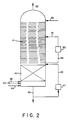
- a lower packed bed reactor section 40 may comprise about 20 vertical feet of packing.
- the upper rectification section 41 comprises about 36 trays with a tray spacing of about 2 feet. Packing also might be employed in the upper rectification section 41, although there might be a problem with adequate liquid distribution needed to ensure efficient rectification. Even without such a problem, however, the added cost of packing is not justified since a sizeable gas hold-up is not problematic, and actually desired to complete oxygen consumption. Thus, trays are preferred.
- the lower reactor section and the upper rectification section are provided in a single, subdivided column shell.
- means are provided to pass gas/vapor from the packed bed reactor section directly into the upper rectification section and to conduct liquid from the rectification directly into the packed bed reactor section.
- Recycle nitric oxide, makeup nitric oxide and oxygen are fed to the bottom of the ANRC, in the lower portion of the reactor section below the packing, via lines 42, 43 and 44, respectively.
- Liquid methanol is supplied via line 45 to a location above the uppermost tray in the upper portion of the rectification section.
- Liquid stream 46 comprising methanol, nitric acid and water, is withdrawn from the lower portion of the reactor section below the packing. A portion of liquid stream 46 is cooled in heat exchanger 47 and returned to the ANRC at location just above the packed section via line 48.
- liquid stream 49 withdrawn from the bottom tray in the ANRC is passed through a second heat exchanger 50 ⁇ and returned to the ANRC on about the 23rd tray from the bottom of the upper rectification section via line 51.
- Overhead stream 52 comprising product methyl nitrite, is withdrawn from the top of the ANRC.
- methyl nitrite can be produced in an efficient manner with (1) substantially complete conversion of oxygen, i.e., at least 95 percent, preferably 99 percent or higher, most preferably 99.5 percent or higher, (2) substantially complete conversion of higher nitrogen oxides, and (3) a high efficiency of conversion of nitric oxide to methyl nitrite, i.e., at least 95 percent, preferably 99 percent or higher. Additionally, substantially all the nitric acid and water formed in the ANRC are removed via a liquid tails stream while the gaseous overhead stream comprising methyl nitrite is substantially free of these materials.
- this example presents the results of a computer simulation study of a preferred ANRC designed in accordance with the present invention.
- the ANRC was patterned after the Figure 2 design and included a lower packed bed reactor section having 20 vertical feet of packing, and an upper rectification section (69 feet high) that contained eight theoretical equilibrium separation stages.
- the lower 43 feet of the upper rectification section contributed only a single equilibrium stage to the rectification since a side cooling loop, as shown in Figure 2, bracketed this portion of the ANRC.
- the ANRC was operated at approximately 5 atmospheres pressure and 50°C. NO and O2 were fed to the bottom of the packed bed section in a mol ratio of about 5:1, while substantially pure methanol was introduced into the top of the rectification section. With this arrangement over 99% of the NO fed to the ANRC was converted to methyl nitrite producing an overhead product containing less than 10 ppm of HNO3 and only about 20 ppm of water and 50 ppm of oxygen. This represents an oxygen conversion in the ANRC of about 99.7%.
- the liquid stream withdrawn from the lower portion of the reactor section contained about 13 mol percent methanol, about 1 mol percent HNO3 and only about 0.1 mol percent methyl nitrite with the balance being water.
Landscapes
- Chemical & Material Sciences (AREA)
- Organic Chemistry (AREA)
- Chemical Kinetics & Catalysis (AREA)
- Organic Low-Molecular-Weight Compounds And Preparation Thereof (AREA)
Applications Claiming Priority (2)
| Application Number | Priority Date | Filing Date | Title |
|---|---|---|---|
| US102367 | 1987-09-29 | ||
| US07/102,367 US4908466A (en) | 1987-09-29 | 1987-09-29 | Process and reaction vessel for production of alkyl nitrite |
Publications (3)
| Publication Number | Publication Date |
|---|---|
| EP0310191A2 true EP0310191A2 (fr) | 1989-04-05 |
| EP0310191A3 EP0310191A3 (en) | 1990-12-12 |
| EP0310191B1 EP0310191B1 (fr) | 1994-02-16 |
Family
ID=22289469
Family Applications (1)
| Application Number | Title | Priority Date | Filing Date |
|---|---|---|---|
| EP88202116A Revoked EP0310191B1 (fr) | 1987-09-29 | 1988-09-28 | Procédé et réacteur pour la production de nitrite d'alkyle |
Country Status (6)
| Country | Link |
|---|---|
| US (1) | US4908466A (fr) |
| EP (1) | EP0310191B1 (fr) |
| JP (1) | JPH0723345B2 (fr) |
| CA (1) | CA1321399C (fr) |
| DE (1) | DE3887806T2 (fr) |
| ZA (1) | ZA887288B (fr) |
Cited By (16)
| Publication number | Priority date | Publication date | Assignee | Title |
|---|---|---|---|---|
| EP0614878A1 (fr) * | 1993-03-08 | 1994-09-14 | Bayer Ag | Procédé pour la préparation de nitrites d'alkyle en C1-C4 |
| EP0614879A1 (fr) * | 1993-03-08 | 1994-09-14 | Bayer Ag | Procédé pour la préparation de nitrites d'alkyle en C1-C4 |
| US5412147A (en) * | 1992-12-01 | 1995-05-02 | Bayer Aktiengesellschaft | Process for the continuous preparation of alkyl nitrites |
| EP0911316A3 (fr) * | 1997-10-21 | 2001-04-25 | Ube Industries, Ltd. | Procédé pour la préparation de nitrite d'alkyle |
| EP1346976A1 (fr) * | 2002-03-18 | 2003-09-24 | Ube Industries, Ltd. | Procédé pour la préparation de nitrite d'alkyle |
| EP2030964A1 (fr) * | 2007-08-06 | 2009-03-04 | Daicel Chemical Industries, Ltd. | Procédé de production d'esters de l'acide nitreux |
| CN102219692A (zh) * | 2010-04-15 | 2011-10-19 | 中国石油化工股份有限公司 | 干燥烷基亚硝酸酯的方法 |
| CN102218291A (zh) * | 2010-04-15 | 2011-10-19 | 中国石油化工股份有限公司 | 化学反应的方法 |
| CN102219696A (zh) * | 2010-04-15 | 2011-10-19 | 中国石油化工股份有限公司 | 制备c1~c4烷基亚硝酸酯的方法 |
| CN102219693A (zh) * | 2010-04-15 | 2011-10-19 | 中国石油化工股份有限公司 | 制备烷基亚硝酸酯的方法 |
| CN102219694A (zh) * | 2010-04-15 | 2011-10-19 | 中国石油化工股份有限公司 | C1~c4烷基亚硝酸酯的制备方法 |
| CN102276472A (zh) * | 2010-06-11 | 2011-12-14 | 中国石油化工股份有限公司 | 生产c1~c4烷基亚硝酸酯的方法 |
| CN102276473A (zh) * | 2010-06-11 | 2011-12-14 | 中国石油化工股份有限公司 | 制备c1~c4烷基亚硝酸酯的方法 |
| CN102924282A (zh) * | 2012-11-30 | 2013-02-13 | 西南化工研究设计院有限公司 | 一种生产亚硝酸烷基酯的工艺 |
| US8476469B2 (en) | 2010-04-15 | 2013-07-02 | China Petroleum & Chemical Corporation | Process for producing C1-C4 alkyl nitrite |
| CN105272859A (zh) * | 2014-07-03 | 2016-01-27 | 中国石油化工股份有限公司 | 亚硝酸烷基酯的生产方法 |
Families Citing this family (11)
| Publication number | Priority date | Publication date | Assignee | Title |
|---|---|---|---|---|
| US4980496A (en) * | 1989-12-05 | 1990-12-25 | Fruchey Olan S | Method for producing C1 to C5 alkyl nitrides |
| US6314956B1 (en) | 1999-09-08 | 2001-11-13 | Duke University | Pulmonary delivery of NO group-containing compound in gas form to treat respiratory, cardiac and blood disorders |
| US7045152B2 (en) * | 1999-09-08 | 2006-05-16 | Duke University | Treating pulmonary disorders with gaseous agent causing repletion of GSNO |
| DE102004007706A1 (de) * | 2004-02-16 | 2005-08-25 | Dynamit Nobel Gmbh Explosivstoff- Und Systemtechnik | Verfahren zur Herstellung von flüssigen Nitratestern |
| US7866418B2 (en) | 2008-10-03 | 2011-01-11 | Us Synthetic Corporation | Rotary drill bit including polycrystalline diamond cutting elements |
| US8722918B2 (en) * | 2010-04-15 | 2014-05-13 | China Petroleum & Chemical Corporation | Process for producing Cl-C4 alkyl nitrite |
| CN102219680B (zh) * | 2010-04-15 | 2013-09-18 | 中国石油化工股份有限公司 | 由co气相法制备草酸酯的方法 |
| CN102219691B (zh) * | 2010-04-15 | 2014-03-26 | 中国石油化工股份有限公司 | 脱除烷基亚硝酸酯中水的方法 |
| CN102276459B (zh) * | 2010-06-11 | 2013-12-18 | 中国石油化工股份有限公司 | 采用co气相法制备草酸酯的方法 |
| AU2018446483B2 (en) * | 2018-10-22 | 2021-09-23 | Pujing Chemical Industry Co., Ltd | Process and system for producing alkyl nitrites |
| CN114653170A (zh) * | 2020-12-22 | 2022-06-24 | 中国石油化工股份有限公司 | 尾气吸收塔安全运行的方法、装置及其应用 |
Family Cites Families (8)
| Publication number | Priority date | Publication date | Assignee | Title |
|---|---|---|---|---|
| US2166698A (en) * | 1937-09-17 | 1939-07-18 | Shell Dev | Process of making nitrite esters of polyhydroxy aliphatic compounds |
| US2465984A (en) * | 1946-05-21 | 1949-03-29 | Union Oil Co | Production of cycloalkyl nitrites |
| US2739166A (en) * | 1950-12-19 | 1956-03-20 | John C Treacy | Process and resulting compositions |
| US2977384A (en) * | 1953-07-10 | 1961-03-28 | Ici Ltd | Production of alkyl nitrates |
| US2831882A (en) * | 1955-09-16 | 1958-04-22 | Du Pont | Preparation of nitrite esters |
| US4629806A (en) * | 1981-01-23 | 1986-12-16 | Union Carbide Corporation | Vapor state formation of diesters of oxalic acid |
| US4353843A (en) * | 1981-01-23 | 1982-10-12 | Union Carbide Corporation | Preparation of nitrite esters |
| CA1189528A (fr) * | 1981-09-30 | 1985-06-25 | Arthur R. Doumaux, Jr. | Preparation d'esters nitrites |
-
1987
- 1987-09-29 US US07/102,367 patent/US4908466A/en not_active Expired - Fee Related
-
1988
- 1988-09-28 CA CA000578977A patent/CA1321399C/fr not_active Expired - Fee Related
- 1988-09-28 DE DE3887806T patent/DE3887806T2/de not_active Revoked
- 1988-09-28 ZA ZA887288A patent/ZA887288B/xx unknown
- 1988-09-28 EP EP88202116A patent/EP0310191B1/fr not_active Revoked
- 1988-09-29 JP JP63245866A patent/JPH0723345B2/ja not_active Expired - Lifetime
Cited By (28)
| Publication number | Priority date | Publication date | Assignee | Title |
|---|---|---|---|---|
| US5412147A (en) * | 1992-12-01 | 1995-05-02 | Bayer Aktiengesellschaft | Process for the continuous preparation of alkyl nitrites |
| EP0614878A1 (fr) * | 1993-03-08 | 1994-09-14 | Bayer Ag | Procédé pour la préparation de nitrites d'alkyle en C1-C4 |
| EP0614879A1 (fr) * | 1993-03-08 | 1994-09-14 | Bayer Ag | Procédé pour la préparation de nitrites d'alkyle en C1-C4 |
| US5649322A (en) * | 1993-03-08 | 1997-07-15 | Bayer Aktiengesellschaft | Process for the preparation of C1 -C4 -alkyl nitrites |
| CN1059666C (zh) * | 1993-03-08 | 2000-12-20 | 拜尔公司 | 制备c1-c4烷基亚硝酸酯的方法 |
| EP0911316A3 (fr) * | 1997-10-21 | 2001-04-25 | Ube Industries, Ltd. | Procédé pour la préparation de nitrite d'alkyle |
| EP1346976A1 (fr) * | 2002-03-18 | 2003-09-24 | Ube Industries, Ltd. | Procédé pour la préparation de nitrite d'alkyle |
| US6844464B2 (en) | 2002-03-18 | 2005-01-18 | Ube Industries, Ltd. | Process for producing alkyl nitrite |
| SG119175A1 (en) * | 2002-03-18 | 2006-02-28 | Ube Industries | Process for producing alkyl nitrite |
| US7714160B2 (en) | 2002-03-18 | 2010-05-11 | Ube Industries, Ltd. | Process for producing alkyl nitrite |
| EP2030964A1 (fr) * | 2007-08-06 | 2009-03-04 | Daicel Chemical Industries, Ltd. | Procédé de production d'esters de l'acide nitreux |
| CN102219693A (zh) * | 2010-04-15 | 2011-10-19 | 中国石油化工股份有限公司 | 制备烷基亚硝酸酯的方法 |
| CN102218291A (zh) * | 2010-04-15 | 2011-10-19 | 中国石油化工股份有限公司 | 化学反应的方法 |
| CN102219696A (zh) * | 2010-04-15 | 2011-10-19 | 中国石油化工股份有限公司 | 制备c1~c4烷基亚硝酸酯的方法 |
| CN102219692A (zh) * | 2010-04-15 | 2011-10-19 | 中国石油化工股份有限公司 | 干燥烷基亚硝酸酯的方法 |
| CN102219694A (zh) * | 2010-04-15 | 2011-10-19 | 中国石油化工股份有限公司 | C1~c4烷基亚硝酸酯的制备方法 |
| CN102219694B (zh) * | 2010-04-15 | 2014-01-22 | 中国石油化工股份有限公司 | C1~c4烷基亚硝酸酯的制备方法 |
| CN102219696B (zh) * | 2010-04-15 | 2014-01-22 | 中国石油化工股份有限公司 | 制备c1~c4烷基亚硝酸酯的方法 |
| CN102219693B (zh) * | 2010-04-15 | 2013-12-04 | 中国石油化工股份有限公司 | 制备烷基亚硝酸酯的方法 |
| US8476469B2 (en) | 2010-04-15 | 2013-07-02 | China Petroleum & Chemical Corporation | Process for producing C1-C4 alkyl nitrite |
| CN102276472B (zh) * | 2010-06-11 | 2013-12-04 | 中国石油化工股份有限公司 | 生产c1~c4烷基亚硝酸酯的方法 |
| CN102276473A (zh) * | 2010-06-11 | 2011-12-14 | 中国石油化工股份有限公司 | 制备c1~c4烷基亚硝酸酯的方法 |
| CN102276472A (zh) * | 2010-06-11 | 2011-12-14 | 中国石油化工股份有限公司 | 生产c1~c4烷基亚硝酸酯的方法 |
| CN102276473B (zh) * | 2010-06-11 | 2014-03-26 | 中国石油化工股份有限公司 | 制备c1~c4烷基亚硝酸酯的方法 |
| CN102924282A (zh) * | 2012-11-30 | 2013-02-13 | 西南化工研究设计院有限公司 | 一种生产亚硝酸烷基酯的工艺 |
| CN102924282B (zh) * | 2012-11-30 | 2014-03-12 | 西南化工研究设计院有限公司 | 一种生产亚硝酸烷基酯的工艺 |
| CN105272859A (zh) * | 2014-07-03 | 2016-01-27 | 中国石油化工股份有限公司 | 亚硝酸烷基酯的生产方法 |
| CN105272859B (zh) * | 2014-07-03 | 2018-01-09 | 中国石油化工股份有限公司 | 亚硝酸烷基酯的生产方法 |
Also Published As
| Publication number | Publication date |
|---|---|
| DE3887806T2 (de) | 1994-05-19 |
| JPH0723345B2 (ja) | 1995-03-15 |
| EP0310191B1 (fr) | 1994-02-16 |
| DE3887806D1 (de) | 1994-03-24 |
| CA1321399C (fr) | 1993-08-17 |
| JPH01121251A (ja) | 1989-05-12 |
| ZA887288B (en) | 1989-06-28 |
| US4908466A (en) | 1990-03-13 |
| EP0310191A3 (en) | 1990-12-12 |
Similar Documents
| Publication | Publication Date | Title |
|---|---|---|
| EP0310191B1 (fr) | Procédé et réacteur pour la production de nitrite d'alkyle | |
| US4879401A (en) | Process for removal of impurities in alkyl nitrite formation | |
| CA2326888C (fr) | Procede de preparation continue de 1,3-dioxolane-2-ones | |
| US7714160B2 (en) | Process for producing alkyl nitrite | |
| JP2931753B2 (ja) | 亜硝酸c1−c4−アルキルエステルの製造法 | |
| EP0523728B1 (fr) | Procédé continu de préparation du carbonate de diméthyle | |
| EP0046983B1 (fr) | Procédé de préparation continue d'éthylène-glycol | |
| JPH0769995A (ja) | ジメチルカーボネートの製造方法 | |
| EP0046598B1 (fr) | Procédé pour la préparation continue d'un diester de l'acide oxalique | |
| EP0891316B1 (fr) | Procedes de production de methylmercaptopropanal | |
| EP0911316B1 (fr) | Procédé pour la préparation de nitrite d'alkyle | |
| EP0742198B1 (fr) | Procédé de production continue du carbonate de diméthyle | |
| WO1997036848A9 (fr) | Procedes de production de methylmercaptopropanal | |
| EP0655433B1 (fr) | Procédé de production continue de carbonate de diméthyle | |
| CA1160250A (fr) | Methode de preparation d'un diester d'acide oxalique | |
| CA1189528A (fr) | Preparation d'esters nitrites | |
| EP0655432B1 (fr) | Procédé de production continue de carbonate de diméthyle | |
| JPH02184656A (ja) | アルキルナイトライトの製造のための方法及び反応容器 | |
| EP0057629B1 (fr) | Procédé de préparation de diesters de l'acide oxalique en phase de vapeur | |
| US4251460A (en) | Process for production of dimethylformamide | |
| JP2000302728A (ja) | 炭酸ジアルキルの製法 |
Legal Events
| Date | Code | Title | Description |
|---|---|---|---|
| PUAI | Public reference made under article 153(3) epc to a published international application that has entered the european phase |
Free format text: ORIGINAL CODE: 0009012 |
|
| AK | Designated contracting states |
Kind code of ref document: A2 Designated state(s): BE DE FR GB IT NL |
|
| PUAL | Search report despatched |
Free format text: ORIGINAL CODE: 0009013 |
|
| AK | Designated contracting states |
Kind code of ref document: A3 Designated state(s): BE DE FR GB IT NL |
|
| 17P | Request for examination filed |
Effective date: 19901219 |
|
| 17Q | First examination report despatched |
Effective date: 19920707 |
|
| GRAA | (expected) grant |
Free format text: ORIGINAL CODE: 0009210 |
|
| AK | Designated contracting states |
Kind code of ref document: B1 Designated state(s): BE DE FR GB IT NL |
|
| ITF | It: translation for a ep patent filed | ||
| REF | Corresponds to: |
Ref document number: 3887806 Country of ref document: DE Date of ref document: 19940324 |
|
| ET | Fr: translation filed | ||
| PLBI | Opposition filed |
Free format text: ORIGINAL CODE: 0009260 |
|
| 26 | Opposition filed |
Opponent name: BAYERISCHE MOTOREN WERKE AKTIENGESELLSCHAFT Effective date: 19941107 |
|
| PLAB | Opposition data, opponent's data or that of the opponent's representative modified |
Free format text: ORIGINAL CODE: 0009299OPPO |
|
| NLR1 | Nl: opposition has been filed with the epo |
Opponent name: BAYERISCHE MOTOREN WERKE AG. |
|
| R26 | Opposition filed (corrected) |
Opponent name: BAYER AG, LEVERKUSEN KONZERNVERWALTUNG RP PATENTE Effective date: 19941107 |
|
| NLXE | Nl: other communications concerning ep-patents (part 3 heading xe) |
Free format text: PAT.BUL.05/95 THE NAME OF OPPONENT 01 CORR.:BAYER AG. |
|
| PGFP | Annual fee paid to national office [announced via postgrant information from national office to epo] |
Ref country code: DE Payment date: 19950614 Year of fee payment: 8 |
|
| PGFP | Annual fee paid to national office [announced via postgrant information from national office to epo] |
Ref country code: FR Payment date: 19950621 Year of fee payment: 8 |
|
| PGFP | Annual fee paid to national office [announced via postgrant information from national office to epo] |
Ref country code: NL Payment date: 19950628 Year of fee payment: 8 Ref country code: GB Payment date: 19950628 Year of fee payment: 8 |
|
| PGFP | Annual fee paid to national office [announced via postgrant information from national office to epo] |
Ref country code: BE Payment date: 19950724 Year of fee payment: 8 |
|
| RDAG | Patent revoked |
Free format text: ORIGINAL CODE: 0009271 |
|
| STAA | Information on the status of an ep patent application or granted ep patent |
Free format text: STATUS: PATENT REVOKED |
|
| 27W | Patent revoked |
Effective date: 19960125 |
|
| GBPR | Gb: patent revoked under art. 102 of the ep convention designating the uk as contracting state |
Free format text: 960125 |
|
| NLR2 | Nl: decision of opposition |