EP0310501B2 - Substrat pour culture hors-sol à teneur en eau controlée dans son épaisseur - Google Patents
Substrat pour culture hors-sol à teneur en eau controlée dans son épaisseur Download PDFInfo
- Publication number
- EP0310501B2 EP0310501B2 EP88402448A EP88402448A EP0310501B2 EP 0310501 B2 EP0310501 B2 EP 0310501B2 EP 88402448 A EP88402448 A EP 88402448A EP 88402448 A EP88402448 A EP 88402448A EP 0310501 B2 EP0310501 B2 EP 0310501B2
- Authority
- EP
- European Patent Office
- Prior art keywords
- substrate
- water
- fibers
- thickness
- density
- Prior art date
- Legal status (The legal status is an assumption and is not a legal conclusion. Google has not performed a legal analysis and makes no representation as to the accuracy of the status listed.)
- Expired - Lifetime
Links
- 239000000758 substrate Substances 0.000 title claims abstract description 168
- 230000005484 gravity Effects 0.000 claims abstract description 21
- 230000007423 decrease Effects 0.000 claims abstract description 9
- 229910052500 inorganic mineral Inorganic materials 0.000 claims abstract description 5
- 239000011707 mineral Substances 0.000 claims abstract description 5
- XLYOFNOQVPJJNP-UHFFFAOYSA-N water Substances O XLYOFNOQVPJJNP-UHFFFAOYSA-N 0.000 claims description 77
- 239000003365 glass fiber Substances 0.000 claims description 8
- 235000015097 nutrients Nutrition 0.000 claims description 3
- 239000000835 fiber Substances 0.000 abstract description 61
- 230000000717 retained effect Effects 0.000 description 13
- 241000196324 Embryophyta Species 0.000 description 10
- 239000002557 mineral fiber Substances 0.000 description 8
- 238000000034 method Methods 0.000 description 7
- 239000000243 solution Substances 0.000 description 5
- 239000004576 sand Substances 0.000 description 4
- 230000015572 biosynthetic process Effects 0.000 description 3
- 239000011152 fibreglass Substances 0.000 description 3
- 239000011521 glass Substances 0.000 description 3
- 239000000463 material Substances 0.000 description 3
- 239000011435 rock Substances 0.000 description 3
- 210000002268 wool Anatomy 0.000 description 3
- 238000009825 accumulation Methods 0.000 description 2
- 230000006835 compression Effects 0.000 description 2
- 238000007906 compression Methods 0.000 description 2
- 230000001627 detrimental effect Effects 0.000 description 2
- 238000009826 distribution Methods 0.000 description 2
- 230000014759 maintenance of location Effects 0.000 description 2
- 238000004519 manufacturing process Methods 0.000 description 2
- 239000011490 mineral wool Substances 0.000 description 2
- 230000008635 plant growth Effects 0.000 description 2
- 239000002689 soil Substances 0.000 description 2
- 239000000080 wetting agent Substances 0.000 description 2
- SNSBQRXQYMXFJZ-MOKYGWKMSA-N (2s)-6-amino-n-[(2s,3s)-1-amino-3-methyl-1-oxopentan-2-yl]-2-[[(2s)-2-[[(2s)-2-[[(2s)-2-[[(2s)-2-[[(2s)-2-[[(2s)-2-[[(2s)-2-amino-3-phenylpropanoyl]amino]-3-hydroxypropanoyl]amino]propanoyl]amino]-3-hydroxypropanoyl]amino]propanoyl]amino]-4-methylpentanoy Chemical compound CC[C@H](C)[C@@H](C(N)=O)NC(=O)[C@H](CCCCN)NC(=O)[C@H](C)NC(=O)[C@H](CC(C)C)NC(=O)[C@H](C)NC(=O)[C@H](CO)NC(=O)[C@H](C)NC(=O)[C@H](CO)NC(=O)[C@@H](N)CC1=CC=CC=C1 SNSBQRXQYMXFJZ-MOKYGWKMSA-N 0.000 description 1
- 206010003497 Asphyxia Diseases 0.000 description 1
- 244000035744 Hura crepitans Species 0.000 description 1
- 239000007864 aqueous solution Substances 0.000 description 1
- 230000003750 conditioning effect Effects 0.000 description 1
- 230000003247 decreasing effect Effects 0.000 description 1
- 230000008021 deposition Effects 0.000 description 1
- 230000000694 effects Effects 0.000 description 1
- 239000011491 glass wool Substances 0.000 description 1
- 239000011159 matrix material Substances 0.000 description 1
- 239000000155 melt Substances 0.000 description 1
- 239000012768 molten material Substances 0.000 description 1
- 235000016709 nutrition Nutrition 0.000 description 1
- 235000008935 nutritious Nutrition 0.000 description 1
- 230000000050 nutritive effect Effects 0.000 description 1
- 239000002245 particle Substances 0.000 description 1
- 238000005325 percolation Methods 0.000 description 1
- 239000011148 porous material Substances 0.000 description 1
- 238000011084 recovery Methods 0.000 description 1
- 229920006395 saturated elastomer Polymers 0.000 description 1
- 239000002893 slag Substances 0.000 description 1
- 238000002791 soaking Methods 0.000 description 1
- 238000005507 spraying Methods 0.000 description 1
- 238000003860 storage Methods 0.000 description 1
Images

Classifications
-
- A—HUMAN NECESSITIES
- A01—AGRICULTURE; FORESTRY; ANIMAL HUSBANDRY; HUNTING; TRAPPING; FISHING
- A01G—HORTICULTURE; CULTIVATION OF VEGETABLES, FLOWERS, RICE, FRUIT, VINES, HOPS OR SEAWEED; FORESTRY; WATERING
- A01G24/00—Growth substrates; Culture media; Apparatus or methods therefor
- A01G24/10—Growth substrates; Culture media; Apparatus or methods therefor based on or containing inorganic material
- A01G24/18—Growth substrates; Culture media; Apparatus or methods therefor based on or containing inorganic material containing inorganic fibres, e.g. mineral wool
-
- Y—GENERAL TAGGING OF NEW TECHNOLOGICAL DEVELOPMENTS; GENERAL TAGGING OF CROSS-SECTIONAL TECHNOLOGIES SPANNING OVER SEVERAL SECTIONS OF THE IPC; TECHNICAL SUBJECTS COVERED BY FORMER USPC CROSS-REFERENCE ART COLLECTIONS [XRACs] AND DIGESTS
- Y02—TECHNOLOGIES OR APPLICATIONS FOR MITIGATION OR ADAPTATION AGAINST CLIMATE CHANGE
- Y02P—CLIMATE CHANGE MITIGATION TECHNOLOGIES IN THE PRODUCTION OR PROCESSING OF GOODS
- Y02P60/00—Technologies relating to agriculture, livestock or agroalimentary industries
- Y02P60/20—Reduction of greenhouse gas [GHG] emissions in agriculture, e.g. CO2
- Y02P60/21—Dinitrogen oxide [N2O], e.g. using aquaponics, hydroponics or efficiency measures
Definitions
- the present invention relates to substrates for off-soil culture, in particular substrates having a controlled water content in their thickness.
- the substrate contains air and can absorb and retain water or nutritious aqueous solutions.
- substrates based on mineral fibers such as wool of rock or glass, because these substrates have the advantage of being very porous, the fibers generally occupying not more than 5% of the total volume of the substrates. They can serve as a support for the roots, air reserve and water or nutritional solutions; on the other hand, they are light and chemically inert.
- the water retention, or hydroretension, of a substrate is an important feature for driving of plant cultivation.
- Moisture conditions may vary depending on different factors such as type of plants to cultivate, the climate, the seasons, the stage of development of the plant. Whatever the desired moisture conditions for a particular type of substrate, it is necessary for the water to be absorbed and retained to a certain extent by the substrate: it must not flow immediately, but it must however remain available for the plant. Indeed, the water or the solution too strongly bound to the substrate or flowing too fast can not be used by the plant in good conditions.
- Substrates based on mineral fibers due to their characteristics, give satisfactory results when used for above ground cultivation. However, they still have one drawback: substrates when used, are laid on impervious substrates and are usually fed in water by percolation. Water flows by gravity through the substrate. The lower part of the substrate remains in contact with water as a result of the capillarity. The lower part of the substrate therefore contains more water than the upper part and less air than the latter. The water / air distribution characteristics are not therefore not identical throughout the thickness of the substrate; the roots develop unequally in the entire substrate, which is detrimental to the plant and reduces the effectiveness of the substrate.
- EP-A-0 280 338 which can only be used under Article 54 (3) EPC for all designated countries except Luxembourg (Article 54 (4) EPC), describes a porous product that is characterized by the presence of a material having a capacity water retention higher than that of fibers minerals that form the matrix, this material can be placed at the top of the product.
- the substrate, according to the invention, for aboveground cultivation, useful for feeding plants with water or solutions nutritive, is formed of a felt of mineral fibers as defined in the claims or according to the game for Luxembourg either according to the game for the other designated countries.
- This hydroretentivity gradient compensates for the effect of gravity and provides, in the thickness of the substrate, when in use, the desired water content.
- the hydroretention of a substrate corresponds to its ability to absorb and retain water.
- hydroretention To determine the amount of water held by the substrate, called hydroretention, it is submitted, after having soaked with water, at sucking forces and determined its water content according to these forces.
- hydroretention To determine the amount of water held by the substrate, called hydroretention, it is submitted, after having soaked with water, at sucking forces and determined its water content according to these forces.
- Two values serve, in a conventional manner, as a reference for determining water retention or the hydroretention of the substrate: the volume percentage of water that is retained by the substrate under a depression 10 cm of water and the volume percentage of the water that is retained by the substrate under a depression 20 cm of water.
- the substrate has a satisfactory hydroretention when the volume of water, extracted between these two values, which corresponds to the available water, are great.
- the volume percentage of the water retained by the substrates is high and is generally weak under a depression of 20 cm of water.
- a substrate satisfactory hydroretention contains at least about 50% water, for a depression of 10 cm of water, this value may be different for a particular crop type.
- LaFIG 1 gives substrate hydroretention curves. the same average density, but containing fibers of different average diameters.
- FIG. 2 gives hydroretention curves of usual substrates containing fibers of the same diameter medium, but of different average densities.
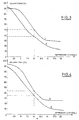
- Figs. 3, 4 and 5 give the hydroretention curves of substrates I, III and V, according to the invention, and substrates II, IV and VI of identical structure but used in conditions not in accordance with the invention.
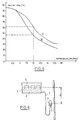
- Fig. 6 shows a device for determining the hydroretention.
- the hydroretentivity is related to the capillarity of the felt constituting the substrate.
- the capillarity depends on the diameter fibers, therefore their fineness, and the density of the felt obtained from these fibers.
- FIG. 1 gives hydroretention curves (percentage by volume of water as a function of the depression in centimeters of water) of three usual substrates A, B and C, not in accordance with the invention, consisting of a felt of 75 mm thick and 35 kg / m 3 average density.
- These substrates contain glass fibers of different average diameter: for the substrate A, the average diameter of the fibers is 4 ⁇ m, for the substrate B, it is 5.6 ⁇ m and for the substrate C, it is 8 ⁇ m . It can be seen that the substrate having the highest hydroretention is that which is formed of the finest fibers, that is to say the substrate A.
- FIG. 2 gives the hydroretention curves for substrates containing fibers of the same diameter medium, 4 ⁇ m, but the average density is different. It is found that the strongest hydroretention is obtained with the highest average density substrate.
- the invention proposes a substrate which is formed of a heterogeneous fibrous structure whose hydroretentivity decreases according to the direction of the gravity, due to the existence of a density gradient depending on the thickness of the substrate
- a substrate according to the invention may be formed of a felt of mineral fibers of the same diameter medium, but whose density decreases, depending on the thickness of the substrate, in the direction of gravity.
- Another substrate comprises a heterogeneous fibrous structure having a hydro-retentivity gradient obtained by a fineness gradient of the fibers according to the thickness of the substrate.
- Such a substrate is, for example, formed of a density mineral fiber felt determined average and whose average diameter of fibers increases in the direction of gravity.
- the density of the felts used for the substrates according to the invention can vary significantly. It is generally from 15 to 60 kg / m 3 and preferably from 20 to 30 kg / m 3 .
- the average diameter of the fibers may be any suitable value. It is generally between 2 ⁇ m and 12 ⁇ m and preferably between 4 ⁇ m and 8 ⁇ m. Fibers less than 2 ⁇ m in diameter are undesirable because one would obtain felts having a strong hydrorétent thesis; the air content would be low and would cause asphyxiation of the roots; in addition, felts made from such fine fibers would have a low resistance to mechanical forces. Fibers larger than 12 ⁇ m in diameter would form markers having low hydroretention.
- the hydroretentivity gradient as defined above, can also be obtained by gradients of density and fineness depending on the thickness of the substrate.
- the felts constituting the substrates according to the invention must have a hydroretentivity which decreases according to the direction of gravity; thus the fibers near the top surface have features that allow them to retain more water than those located at the base of the substrate.
- a culture may require the use of a particular substrate, having a specific hydroretention, which depends, as we have already said, on the plant itself, the climate, the seasons.
- a substrate suitable for each crop by suitably varying the density and fiber diameter characteristics of the felt used to make the substrate.
- the invention thus makes it possible, by creating a hydroretentivity gradient in a felt constituting a substrate, to control the water content of the substrate, which content may be constant or which may vary throughout the thickness of the substrate, depending on the use planned. Particularly good results are obtained when the hydroretentivity is very high in the upper part of the substrate. This is the case, in particular, when the upper part of the substrate contains fibers of very small average diameter, for example between 2 microns and 5 microns, or has a high density, for example between 30 and 60 kg / m 3 .
- the substrates according to the invention may have density and / or fineness gradients by varying progressively the density and / or the diameter of the fibers throughout the thickness of the substrate.
- Substrates can also be formed of several distinct layers that each have density characteristics and fineness of fibers suitable to obtain the desired result, that is to say a decreasing hydroretentivity in the sense of gravity.
- the layers may each have a different or identical basis weight, for example from 300 g to 2500 g / m 2 .
- the number of layers forming the substrate may be variable depending on the desired substrate. Substrates having from 2 to 8 layers of fibers and preferably having at least 3 layers may be used. A high number of layers makes it possible to refine the hydroretentivity gradient throughout the thickness of the substrate.
- the total thickness of the substrate may vary depending on the subsequent use. It is most often the order of 70 mm to 75 mm.
- the substrates may have lower or higher thicknesses; however, the thicknesses must be sufficient to allow a satisfactory development of the roots and a good feeding plants with water or nutrient solutions.
- the substrates according to the invention are formed of a felt of mineral fibers.
- This rock wool due to its porosity, can be used to form substrates according to the invention.
- the felt obtained comprises a fairly high percentage of unfibrated. They are particles of diameter greater than that of the fibers themselves and which participate very reduced to the formation of the capillary network and consequently to the hydroretentivity properties.
- glass wool it is also possible to use, for the substrates of the invention, glass wool.
- the properties of this wool make it particularly suitable for the formation of substrates for soil cultivation.
- the processes fiberglass for example the one in which the fibers are formed by passing through of the molten material in a centrifugal die, have the advantage of allowing the formation of structural felts homogeneous.
- Fiberglass felts have in addition to significant advantages in that they have a good capacity for compression and recovery thickness when the compression has ceased, characteristics that allow for conditioning and improved storage.
- a wetting agent can be added to the fiber felt minerals, constituting the substrate.
- This wetting agent can be introduced during the manufacture of the felt or at some later time. The addition can be carried out by any suitable method, such as spraying, soaking.
- the substrates are formed of fiber felt of glass obtained by the well-known method using the centrifugal die. According to this process, the fibers are formed by passage of the melt into the orifices of a centrifugal die; they are then stretched by an intense gaseous stream and driven by the latter to a movable and permeable conveyor belt gaseous current. When the substrate comprises several layers, they are obtained by deposition, on the carpet mobile receiver, fibers from successive centrifugal dies.
- the hydroretention of the substrates is determined by the following method (see FIG. 6): a tray 1 is used containing a porous material 2, such as sand, saturated with water.
- the bottom of the ferry communicates, by a flexible pipe 3 with a vase 4, containing water.
- the water level is kept constant thanks to a overflow system 5.
- the position of the vessel 4 can be adjusted at will on a vertical support. We adjust the "constant level" so that the water level in the sandbox is 37.5 mm from the upper level of the sand (ie half the height of the samples which is equal to 75 mm).
- a substrate I according to the invention with a density of 25 kg / m 3 containing glass fibers whose fineness, defined by the diameter of the fibers, is prepared according to the direction of gravity.
- the substrate has a total thickness of 75 mm and is formed of 3 layers each having a basis weight of 600 g / m 2 . These layers are distributed in the following order and from top to bottom, that is to say in the direction of gravity: the first layer comprises glass fibers of 4 microns in average diameter, the second layer of fibers of 5.6 microns in average diameter and the last layer of fibers of 8 microns in average diameter.
- the hydroretention of the substrate I is determined as a function of the suction forces according to the process described above. It is represented in curve I of FIG. 3. It can be seen that for a depression of 10 cm of water, the volume of water retained by the substrate represents a little more than 50% of the total volume of the substrate.
- substrate II the lower layer of the substrate
- a substrate II is thus obtained in which the fineness of the fibers decreases according to the direction of gravity.
- Curve II of FIG. 3 gives the hydroretention of substrate II.
- the volume of water retained by the substrate is less than 40%.
- the substrate (II) in which the thinnest fibers are in the lower part and the largest fibers on the surface hold less water than the substrate (I) of identical structure but inverted.
- a substrate III with a density of 25 kg / m 3 , with a total thickness of 75 mm comprises 3 layers of glass fibers distributed in the following order, from top to bottom: a first layer of 300 g / m 2 of grammage containing fibers with an average diameter of 4 ⁇ m; a second layer of 900 g / m 2 of weight comprising fibers of 5.6 ⁇ m in average diameter and a layer of 600 g / m 2 of basis weight containing fibers of 8 microns in average diameter.
- the hydroretention curve of the substrate III is given in FIG. 4 (curve III). It is found that for a depression of 10 cm of water, the volume of water retained by the substrate represents approximately 45% of the volume of the substrate.
- a substrate V made of a fiberglass felt with a density of 25 kg / m 3 is prepared.
- the total thickness of the substrate is 75 mm. It consists of 2 layers distributed as follows, from top to bottom: a layer of 600 g / m 2 of grammage containing glass fibers with a mean diameter of 4 ⁇ m and a layer of 1200 g / m 2 of fiber-containing basis weight of glass whose average diameter is 5.6 ⁇ m.
- the hydroretention curves of substrate V and substrate VI are Figure 5 shows that, for a depression of 10 cm of water, the water retained by the substrate V represents more than 60% of the volume of the substrate and the water retained by the substrate VI represents more than 45%.
- the average diameter of the fibers increases in the direction of gravity (curves I, III and V).
- the volume percentage of water retained by each layer of fibers constituting the substrate to show that one can, according to the invention, control the water content in the substrate and obtain constant hydroretention throughout its thickness, creating, in the thickness of this last, a hydroretentivity gradient.
- a 100 mm thick substrate A is prepared by superimposing four layers of glass fibers 25 mm thick and of similar density.
- the 4 layers contain fibers of the same average diameter, 8 ⁇ m.
- Substrate A is immersed in water, and water is allowed to flow through natural drainage for 10 minutes.
- a substrate B analogous to the substrate A, is prepared, but in which the first layer (layer 1) contains fibers with a mean diameter of 4 ⁇ m.
- the percentages by volume of water retained by the substrate B are indicated below: substratum Layers Diameter of the fibers Water retention (%) B 1 4 ⁇ m 99 2 8 ⁇ m 57 3 8 ⁇ m 97.6 4 8 ⁇ m 99.5
- the last three layers 2, 3 and 4 of this substrate B constitutes a part of the substrate having neither a density gradient nor a fineness gradient, and which therefore has a structure corresponding to the usual substrates. It also has the disadvantages what water accumulates by gravity in the lower layers that contain more water than the layers higher.
- the layer (1) containing finer fibers (4 ⁇ m) makes it possible to create on the surface a layer with high retention of water.
- the volume percentages of water contained in each layer of the substrate C after a natural drainage of 10 minutes are evaluated.
- the results are shown in the following table: substratum Layers Diameter of the fibers Water retention (%) C (1) 4 ⁇ m 97.7 (2) 5.6 ⁇ m 92.4 (3) 8 ⁇ m 93.5 (4) 8 ⁇ m 97.6
- the substrate C differs from the substrate B in that it comprises, in the layer (2), fibers of smaller diameter (5.6 ⁇ m instead of 8 ⁇ m in the substrate B).
- the diameter means of the fibers increases in the direction of gravity, according to the invention. It is noted that using such substrate, one obtains a hydroretention which is approximately constant throughout the thickness of the substrate.
Landscapes
- Inorganic Chemistry (AREA)
- Chemical & Material Sciences (AREA)
- Life Sciences & Earth Sciences (AREA)
- Environmental Sciences (AREA)
- Nonwoven Fabrics (AREA)
- Hydroponics (AREA)
- Cultivation Of Plants (AREA)
- Paper (AREA)
- Laminated Bodies (AREA)
- Micro-Organisms Or Cultivation Processes Thereof (AREA)
- Mushroom Cultivation (AREA)
- Apparatus Associated With Microorganisms And Enzymes (AREA)
- Nitrogen Condensed Heterocyclic Rings (AREA)
- Heterocyclic Carbon Compounds Containing A Hetero Ring Having Oxygen Or Sulfur (AREA)
Priority Applications (1)
| Application Number | Priority Date | Filing Date | Title |
|---|---|---|---|
| AT88402448T ATE74252T1 (de) | 1987-10-02 | 1988-09-28 | Substrat fuer erdlose kultur mit entlang seiner dicke kontrolliertem wassergehalt. |
Applications Claiming Priority (2)
| Application Number | Priority Date | Filing Date | Title |
|---|---|---|---|
| FR8713625A FR2621218B1 (fr) | 1987-10-02 | 1987-10-02 | Substrat pour culture hors sol a teneur en eau controlee dans son epaisseur |
| FR8713625 | 1987-10-02 |
Publications (3)
| Publication Number | Publication Date |
|---|---|
| EP0310501A1 EP0310501A1 (fr) | 1989-04-05 |
| EP0310501B1 EP0310501B1 (fr) | 1992-04-01 |
| EP0310501B2 true EP0310501B2 (fr) | 2003-10-08 |
Family
ID=9355453
Family Applications (1)
| Application Number | Title | Priority Date | Filing Date |
|---|---|---|---|
| EP88402448A Expired - Lifetime EP0310501B2 (fr) | 1987-10-02 | 1988-09-28 | Substrat pour culture hors-sol à teneur en eau controlée dans son épaisseur |
Country Status (14)
| Country | Link |
|---|---|
| US (1) | US5009030A (ja) |
| EP (1) | EP0310501B2 (ja) |
| JP (1) | JPH01108924A (ja) |
| AT (1) | ATE74252T1 (ja) |
| AU (1) | AU617363B2 (ja) |
| CA (1) | CA1327451C (ja) |
| DE (1) | DE3869716D1 (ja) |
| DK (1) | DK170034B2 (ja) |
| ES (1) | ES2032042T5 (ja) |
| FI (1) | FI87877C (ja) |
| FR (1) | FR2621218B1 (ja) |
| MA (1) | MA21388A1 (ja) |
| NO (1) | NO165782C (ja) |
| NZ (1) | NZ226330A (ja) |
Families Citing this family (21)
| Publication number | Priority date | Publication date | Assignee | Title |
|---|---|---|---|---|
| FR2644321B1 (fr) * | 1989-03-15 | 1992-04-24 | Saint Gobain Isover | Substrat pour culture hors-sol a structure macroscopiquement isotrope |
| FR2648985B1 (fr) * | 1989-07-03 | 1991-10-11 | Saint Gobain Isover | Element de culture hors-sol |
| DK619889D0 (da) * | 1989-12-08 | 1989-12-08 | Rockwool Int | Mineralfiberholdigt plantedyrkningsmedium |
| US5471786A (en) * | 1989-12-08 | 1995-12-05 | Rockwool International A/S | Plant growing medium containing mineral fibers |
| FR2709919A1 (fr) * | 1993-08-10 | 1995-03-24 | Saint Gobain Isover | Substrat de culture hors-sol. |
| JP2002506660A (ja) * | 1998-03-19 | 2002-03-05 | ロックウール・インターナショナル・アクティーゼルスカブ | 鉱物繊維ベースの成長培地を製造するための方法及び装置、植物成長培地及びその使用 |
| AU3597199A (en) † | 1998-04-06 | 1999-10-25 | Rockwool International A/S | Man-made vitreous fibre batts and their production |
| PT1038433E (pt) | 1999-03-19 | 2008-09-11 | Saint Gobain Cultilene B V | Substrato de cultura fora-solo |
| DE19935712C2 (de) * | 1999-07-29 | 2002-01-10 | Sandler C H Gmbh | Pflanzsubstrat |
| EP1880599A1 (en) | 2006-07-20 | 2008-01-23 | Rockwool International A/S | Growth substrates, their production and their use |
| EP1880597A1 (en) * | 2006-07-20 | 2008-01-23 | Rockwool International A/S | Growth substrates, their production and their use |
| EP1880598A1 (en) | 2006-07-20 | 2008-01-23 | Rockwool International A/S | Growth substrates, their production and their use |
| EP1880601A1 (en) | 2006-07-20 | 2008-01-23 | Rockwool International A/S | Growth substrates, their production and their use |
| EP1961291A1 (en) * | 2007-07-23 | 2008-08-27 | Rockwool International A/S | Mineral wool growth substrate and its use |
| EP2080431A1 (en) | 2008-01-18 | 2009-07-22 | Rockwool International A/S | Method of growing plants |
| FR2964012B1 (fr) | 2010-08-31 | 2017-07-21 | Rockwool Int | Culture de plantes dans un substrat a base de laine minerale comprenant un liant |
| SI2709440T1 (en) * | 2011-05-17 | 2018-08-31 | Rockwool International A/S | Growth substrates and their use |
| US9149005B2 (en) | 2011-12-22 | 2015-10-06 | Rockwool International A/S | Plant growth system |
| EA027658B1 (ru) | 2011-12-22 | 2017-08-31 | Роквул Интернэшнл А/С | Способ выращивания растений |
| US12104033B2 (en) * | 2015-08-26 | 2024-10-01 | Growpito International Company, Llc | Plant growth system and medium |
| FI12369U1 (fi) * | 2018-11-09 | 2019-05-15 | Suomen Puistopuutarhurit Oy | Tasapotentiaalikasvualusta |
Family Cites Families (7)
| Publication number | Priority date | Publication date | Assignee | Title |
|---|---|---|---|---|
| SU1161021A1 (ru) * | 1983-11-09 | 1985-06-15 | Институт Физической Химии Им.Л.В.Писаржевского | Субстрат дл выращивани растений |
| FR2581503B1 (fr) * | 1985-05-07 | 1988-09-16 | Saint Gobain Isover | Substrat pour culture hors-sol |
| NL8502103A (nl) * | 1985-07-22 | 1987-02-16 | Rockwool Lapinus Bv | Waterabsorberend poreus produkt voor het kweken van planten alsmede werkwijze voor het kweken van planten met behulp van een waterabsorberend produkt. |
| US4777763A (en) * | 1986-06-17 | 1988-10-18 | Owens-Corning Fiberglas Corporation | Plant growing medium |
| JPH0448689Y2 (ja) * | 1987-03-31 | 1992-11-17 | ||
| NL8701589A (nl) * | 1987-07-06 | 1989-02-01 | Rockwool Lapinus Bv | Werkwijze en inrichting voor de minerale-wol-teelt van planten met zuigspanningsregeling. |
| EP0331692A1 (en) * | 1987-08-28 | 1989-09-13 | DUNN, Kenneth, Roy | Cultivation substrates based on mineral wool |
-
1987
- 1987-10-02 FR FR8713625A patent/FR2621218B1/fr not_active Expired
-
1988
- 1988-09-26 NZ NZ226330A patent/NZ226330A/en unknown
- 1988-09-27 AU AU22858/88A patent/AU617363B2/en not_active Ceased
- 1988-09-28 AT AT88402448T patent/ATE74252T1/de not_active IP Right Cessation
- 1988-09-28 DE DE8888402448T patent/DE3869716D1/de not_active Expired - Fee Related
- 1988-09-28 ES ES88402448T patent/ES2032042T5/es not_active Expired - Lifetime
- 1988-09-28 EP EP88402448A patent/EP0310501B2/fr not_active Expired - Lifetime
- 1988-09-29 CA CA000578878A patent/CA1327451C/fr not_active Expired - Fee Related
- 1988-09-30 MA MA21633A patent/MA21388A1/fr unknown
- 1988-09-30 DK DK198805458A patent/DK170034B2/da not_active IP Right Cessation
- 1988-09-30 NO NO884352A patent/NO165782C/no not_active IP Right Cessation
- 1988-09-30 FI FI884533A patent/FI87877C/fi active IP Right Grant
- 1988-10-03 US US07/251,831 patent/US5009030A/en not_active Expired - Lifetime
- 1988-10-03 JP JP63247549A patent/JPH01108924A/ja active Pending
Also Published As
| Publication number | Publication date |
|---|---|
| ATE74252T1 (de) | 1992-04-15 |
| ES2032042T5 (es) | 2004-06-16 |
| MA21388A1 (fr) | 1989-04-01 |
| NO165782B (no) | 1991-01-02 |
| DK545888D0 (da) | 1988-09-30 |
| NO884352D0 (no) | 1988-09-30 |
| NZ226330A (en) | 1990-03-27 |
| FI884533L (fi) | 1989-04-03 |
| FR2621218A1 (fr) | 1989-04-07 |
| AU617363B2 (en) | 1991-11-28 |
| DK170034B2 (da) | 2007-01-08 |
| FI87877C (fi) | 1993-03-10 |
| DK170034B1 (da) | 1995-05-08 |
| EP0310501A1 (fr) | 1989-04-05 |
| NO884352L (no) | 1989-04-03 |
| FI884533A0 (fi) | 1988-09-30 |
| DE3869716D1 (de) | 1992-05-07 |
| EP0310501B1 (fr) | 1992-04-01 |
| ES2032042T3 (es) | 1993-01-01 |
| AU2285888A (en) | 1989-04-06 |
| FR2621218B1 (fr) | 1989-12-08 |
| NO165782C (no) | 1991-04-10 |
| JPH01108924A (ja) | 1989-04-26 |
| CA1327451C (fr) | 1994-03-08 |
| US5009030A (en) | 1991-04-23 |
| DK545888A (da) | 1989-04-03 |
| FI87877B (fi) | 1992-11-30 |
Similar Documents
| Publication | Publication Date | Title |
|---|---|---|
| EP0310501B2 (fr) | Substrat pour culture hors-sol à teneur en eau controlée dans son épaisseur | |
| EP0201426B1 (fr) | Substrat pour culture hors-sol | |
| EP0407264B9 (fr) | Elément de culture hors-sol | |
| EP0388287B1 (fr) | Substrat pour culture hors-sol | |
| CA1183352A (fr) | Tapis de gazon de placage | |
| EP0440524B1 (fr) | Technique de culture de plantes à bulbes | |
| FR2556930A1 (fr) | Nouveau milieu de culture pour plantes | |
| FR3118683A1 (fr) | Substrat de croissance vegetale- kit et toit vegetalise associes | |
| EP0520892A1 (fr) | Voile en fibres hydrophiles et utilisation du voile dans un substrat de culture hors-sol | |
| FR2877956A1 (fr) | Structure en couches, notamment pour aire de jeux pour enfants, presentant des proprietes ameliorees d'amortissement des chutes | |
| FR2695536A1 (fr) | Technique de transplantation de boutures de Posidonia oceanica. | |
| BE1022363B1 (fr) | Support de germination de vegetaux | |
| EP0774892B1 (fr) | Gobetage pour la culture de champignons, son procede de preparation et procede de culture de champignons | |
| EP0823988A1 (fr) | Substrat pour le développement des végétaux sur les toitures-terrasses | |
| EP0403346B1 (fr) | Nappe de subirrigation | |
| FR2922719A1 (fr) | Procede pour creer et/ou remettre en etat des surfaces engazonnees. | |
| FR2568905A2 (fr) | Procede pour l'amenagement d'un terrain de sport ou de jeux | |
| FR3148132A1 (fr) | Paillage biodégradable à haute résistance mécanique | |
| WO1998058107A2 (fr) | Methode pour construire des baches resistantes a l'enlevement par le vent | |
| FR2677847A1 (fr) | Procede pour la regulation hydrique d'un substrat pour plantes. | |
| FR2650148A3 (fr) | Support de semence en forme de plaque et son procede de fabrication | |
| FR3041365A1 (fr) | Sol a structure mixte gazon naturel et gazon artificiel | |
| FR2523402A1 (fr) | Materiau complexe utilisable pour la realisation de supports de culture et nouveaux types de supports de culture realises a partir d'un tel materiau |
Legal Events
| Date | Code | Title | Description |
|---|---|---|---|
| PUAI | Public reference made under article 153(3) epc to a published international application that has entered the european phase |
Free format text: ORIGINAL CODE: 0009012 |
|
| AK | Designated contracting states |
Kind code of ref document: A1 Designated state(s): AT BE CH DE ES GB IT LI LU NL SE |
|
| 17P | Request for examination filed |
Effective date: 19890918 |
|
| 17Q | First examination report despatched |
Effective date: 19910104 |
|
| GRAA | (expected) grant |
Free format text: ORIGINAL CODE: 0009210 |
|
| AK | Designated contracting states |
Kind code of ref document: B1 Designated state(s): AT BE CH DE ES GB IT LI LU NL SE |
|
| REF | Corresponds to: |
Ref document number: 74252 Country of ref document: AT Date of ref document: 19920415 Kind code of ref document: T |
|
| REF | Corresponds to: |
Ref document number: 3869716 Country of ref document: DE Date of ref document: 19920507 |
|
| ITF | It: translation for a ep patent filed | ||
| GBT | Gb: translation of ep patent filed (gb section 77(6)(a)/1977) | ||
| REG | Reference to a national code |
Ref country code: ES Ref legal event code: FG2A Ref document number: 2032042 Country of ref document: ES Kind code of ref document: T3 |
|
| PLBI | Opposition filed |
Free format text: ORIGINAL CODE: 0009260 |
|
| 26 | Opposition filed |
Opponent name: ROCKWOOL/GRODAN B.V. Effective date: 19930104 |
|
| NLR1 | Nl: opposition has been filed with the epo |
Opponent name: ROCKWOOL/GRODAN B.V. |
|
| PGFP | Annual fee paid to national office [announced via postgrant information from national office to epo] |
Ref country code: AT Payment date: 19930701 Year of fee payment: 6 |
|
| PGFP | Annual fee paid to national office [announced via postgrant information from national office to epo] |
Ref country code: LU Payment date: 19930729 Year of fee payment: 6 |
|
| EPTA | Lu: last paid annual fee | ||
| PG25 | Lapsed in a contracting state [announced via postgrant information from national office to epo] |
Ref country code: LU Free format text: LAPSE BECAUSE OF NON-PAYMENT OF DUE FEES Effective date: 19940928 Ref country code: AT Effective date: 19940928 |
|
| EAL | Se: european patent in force in sweden |
Ref document number: 88402448.0 |
|
| APAA | Appeal reference recorded |
Free format text: ORIGINAL CODE: EPIDOS REFN |
|
| APAC | Appeal dossier modified |
Free format text: ORIGINAL CODE: EPIDOS NOAPO |
|
| PGFP | Annual fee paid to national office [announced via postgrant information from national office to epo] |
Ref country code: CH Payment date: 19960926 Year of fee payment: 9 |
|
| APAC | Appeal dossier modified |
Free format text: ORIGINAL CODE: EPIDOS NOAPO |
|
| PG25 | Lapsed in a contracting state [announced via postgrant information from national office to epo] |
Ref country code: LI Free format text: LAPSE BECAUSE OF NON-PAYMENT OF DUE FEES Effective date: 19970930 Ref country code: CH Free format text: LAPSE BECAUSE OF NON-PAYMENT OF DUE FEES Effective date: 19970930 |
|
| REG | Reference to a national code |
Ref country code: CH Ref legal event code: PL |
|
| PLAW | Interlocutory decision in opposition |
Free format text: ORIGINAL CODE: EPIDOS IDOP |
|
| APAC | Appeal dossier modified |
Free format text: ORIGINAL CODE: EPIDOS NOAPO |
|
| APAE | Appeal reference modified |
Free format text: ORIGINAL CODE: EPIDOS REFNO |
|
| APAC | Appeal dossier modified |
Free format text: ORIGINAL CODE: EPIDOS NOAPO |
|
| RAP2 | Party data changed (patent owner data changed or rights of a patent transferred) |
Owner name: SAINT-GOBAIN ISOVER |
|
| NLT2 | Nl: modifications (of names), taken from the european patent patent bulletin |
Owner name: SAINT-GOBAIN ISOVER |
|
| NLT1 | Nl: modifications of names registered in virtue of documents presented to the patent office pursuant to art. 16 a, paragraph 1 |
Owner name: SAINT- GOBAIN ISOVER |
|
| REG | Reference to a national code |
Ref country code: GB Ref legal event code: IF02 |
|
| APCC | Communication from the board of appeal sent |
Free format text: ORIGINAL CODE: EPIDOS OBAPO |
|
| APCC | Communication from the board of appeal sent |
Free format text: ORIGINAL CODE: EPIDOS OBAPO |
|
| APAC | Appeal dossier modified |
Free format text: ORIGINAL CODE: EPIDOS NOAPO |
|
| PLAW | Interlocutory decision in opposition |
Free format text: ORIGINAL CODE: EPIDOS IDOP |
|
| PUAH | Patent maintained in amended form |
Free format text: ORIGINAL CODE: 0009272 |
|
| STAA | Information on the status of an ep patent application or granted ep patent |
Free format text: STATUS: PATENT MAINTAINED AS AMENDED |
|
| 27A | Patent maintained in amended form |
Effective date: 20031008 |
|
| AK | Designated contracting states |
Kind code of ref document: B2 Designated state(s): AT BE CH DE ES GB IT LI LU NL SE |
|
| NLR2 | Nl: decision of opposition |
Effective date: 20031008 |
|
| REG | Reference to a national code |
Ref country code: SE Ref legal event code: RPEO |
|
| GBTA | Gb: translation of amended ep patent filed (gb section 77(6)(b)/1977) | ||
| NLR3 | Nl: receipt of modified translations in the netherlands language after an opposition procedure | ||
| REG | Reference to a national code |
Ref country code: ES Ref legal event code: DC2A Date of ref document: 20031230 Kind code of ref document: T5 |
|
| PG25 | Lapsed in a contracting state [announced via postgrant information from national office to epo] |
Ref country code: IT Free format text: LAPSE BECAUSE OF NON-PAYMENT OF DUE FEES;WARNING: LAPSES OF ITALIAN PATENTS WITH EFFECTIVE DATE BEFORE 2007 MAY HAVE OCCURRED AT ANY TIME BEFORE 2007. THE CORRECT EFFECTIVE DATE MAY BE DIFFERENT FROM THE ONE RECORDED. Effective date: 20050928 |
|
| APAH | Appeal reference modified |
Free format text: ORIGINAL CODE: EPIDOSCREFNO |
|
| PGFP | Annual fee paid to national office [announced via postgrant information from national office to epo] |
Ref country code: GB Payment date: 20060912 Year of fee payment: 19 |
|
| PGFP | Annual fee paid to national office [announced via postgrant information from national office to epo] |
Ref country code: ES Payment date: 20060926 Year of fee payment: 19 |
|
| PGFP | Annual fee paid to national office [announced via postgrant information from national office to epo] |
Ref country code: DE Payment date: 20061002 Year of fee payment: 19 |
|
| PGFP | Annual fee paid to national office [announced via postgrant information from national office to epo] |
Ref country code: BE Payment date: 20061012 Year of fee payment: 19 |
|
| PGFP | Annual fee paid to national office [announced via postgrant information from national office to epo] |
Ref country code: SE Payment date: 20060907 Year of fee payment: 19 Ref country code: NL Payment date: 20070928 Year of fee payment: 20 |
|
| BERE | Be: lapsed |
Owner name: *SAINT-GOBAIN ISOVER Effective date: 20070930 |
|
| PG25 | Lapsed in a contracting state [announced via postgrant information from national office to epo] |
Ref country code: SE Free format text: LAPSE BECAUSE OF NON-PAYMENT OF DUE FEES Effective date: 20070929 |
|
| EUG | Se: european patent has lapsed | ||
| GBPC | Gb: european patent ceased through non-payment of renewal fee |
Effective date: 20070928 |
|
| PLAB | Opposition data, opponent's data or that of the opponent's representative modified |
Free format text: ORIGINAL CODE: 0009299OPPO |
|
| PG25 | Lapsed in a contracting state [announced via postgrant information from national office to epo] |
Ref country code: DE Free format text: LAPSE BECAUSE OF NON-PAYMENT OF DUE FEES Effective date: 20080401 |
|
| PG25 | Lapsed in a contracting state [announced via postgrant information from national office to epo] |
Ref country code: BE Free format text: LAPSE BECAUSE OF NON-PAYMENT OF DUE FEES Effective date: 20070930 |
|
| PG25 | Lapsed in a contracting state [announced via postgrant information from national office to epo] |
Ref country code: NL Free format text: LAPSE BECAUSE OF EXPIRATION OF PROTECTION Effective date: 20080928 Ref country code: GB Free format text: LAPSE BECAUSE OF NON-PAYMENT OF DUE FEES Effective date: 20070928 |
|
| NLV7 | Nl: ceased due to reaching the maximum lifetime of a patent |
Effective date: 20080928 |
|
| REG | Reference to a national code |
Ref country code: ES Ref legal event code: FD2A Effective date: 20070929 |
|
| PG25 | Lapsed in a contracting state [announced via postgrant information from national office to epo] |
Ref country code: ES Free format text: LAPSE BECAUSE OF NON-PAYMENT OF DUE FEES Effective date: 20070929 |