EP0312100B1 - Procédé pour produire une couche de polyacétylène ou polydiacétylène - Google Patents
Procédé pour produire une couche de polyacétylène ou polydiacétylène Download PDFInfo
- Publication number
- EP0312100B1 EP0312100B1 EP88117139A EP88117139A EP0312100B1 EP 0312100 B1 EP0312100 B1 EP 0312100B1 EP 88117139 A EP88117139 A EP 88117139A EP 88117139 A EP88117139 A EP 88117139A EP 0312100 B1 EP0312100 B1 EP 0312100B1
- Authority
- EP
- European Patent Office
- Prior art keywords
- group
- producing
- chain
- polyacetylene
- straight
- Prior art date
- Legal status (The legal status is an assumption and is not a legal conclusion. Google has not performed a legal analysis and makes no representation as to the accuracy of the status listed.)
- Expired - Lifetime
Links
Images

Classifications
-
- B—PERFORMING OPERATIONS; TRANSPORTING
- B05—SPRAYING OR ATOMISING IN GENERAL; APPLYING FLUENT MATERIALS TO SURFACES, IN GENERAL
- B05D—PROCESSES FOR APPLYING FLUENT MATERIALS TO SURFACES, IN GENERAL
- B05D1/00—Processes for applying liquids or other fluent materials
- B05D1/18—Processes for applying liquids or other fluent materials performed by dipping
- B05D1/185—Processes for applying liquids or other fluent materials performed by dipping applying monomolecular layers
-
- B—PERFORMING OPERATIONS; TRANSPORTING
- B82—NANOTECHNOLOGY
- B82Y—SPECIFIC USES OR APPLICATIONS OF NANOSTRUCTURES; MEASUREMENT OR ANALYSIS OF NANOSTRUCTURES; MANUFACTURE OR TREATMENT OF NANOSTRUCTURES
- B82Y10/00—Nanotechnology for information processing, storage or transmission, e.g. quantum computing or single electron logic
-
- B—PERFORMING OPERATIONS; TRANSPORTING
- B82—NANOTECHNOLOGY
- B82Y—SPECIFIC USES OR APPLICATIONS OF NANOSTRUCTURES; MEASUREMENT OR ANALYSIS OF NANOSTRUCTURES; MANUFACTURE OR TREATMENT OF NANOSTRUCTURES
- B82Y20/00—Nanooptics, e.g. quantum optics or photonic crystals
-
- B—PERFORMING OPERATIONS; TRANSPORTING
- B82—NANOTECHNOLOGY
- B82Y—SPECIFIC USES OR APPLICATIONS OF NANOSTRUCTURES; MEASUREMENT OR ANALYSIS OF NANOSTRUCTURES; MANUFACTURE OR TREATMENT OF NANOSTRUCTURES
- B82Y30/00—Nanotechnology for materials or surface science, e.g. nanocomposites
-
- B—PERFORMING OPERATIONS; TRANSPORTING
- B82—NANOTECHNOLOGY
- B82Y—SPECIFIC USES OR APPLICATIONS OF NANOSTRUCTURES; MEASUREMENT OR ANALYSIS OF NANOSTRUCTURES; MANUFACTURE OR TREATMENT OF NANOSTRUCTURES
- B82Y40/00—Manufacture or treatment of nanostructures
-
- C—CHEMISTRY; METALLURGY
- C08—ORGANIC MACROMOLECULAR COMPOUNDS; THEIR PREPARATION OR CHEMICAL WORKING-UP; COMPOSITIONS BASED THEREON
- C08F—MACROMOLECULAR COMPOUNDS OBTAINED BY REACTIONS ONLY INVOLVING CARBON-TO-CARBON UNSATURATED BONDS
- C08F138/00—Homopolymers of compounds having one or more carbon-to-carbon triple bonds
-
- G—PHYSICS
- G02—OPTICS
- G02F—OPTICAL DEVICES OR ARRANGEMENTS FOR THE CONTROL OF LIGHT BY MODIFICATION OF THE OPTICAL PROPERTIES OF THE MEDIA OF THE ELEMENTS INVOLVED THEREIN; NON-LINEAR OPTICS; FREQUENCY-CHANGING OF LIGHT; OPTICAL LOGIC ELEMENTS; OPTICAL ANALOGUE/DIGITAL CONVERTERS
- G02F1/00—Devices or arrangements for the control of the intensity, colour, phase, polarisation or direction of light arriving from an independent light source, e.g. switching, gating or modulating; Non-linear optics
- G02F1/35—Non-linear optics
- G02F1/355—Non-linear optics characterised by the materials used
- G02F1/361—Organic materials
- G02F1/3615—Organic materials containing polymers
-
- G—PHYSICS
- G02—OPTICS
- G02F—OPTICAL DEVICES OR ARRANGEMENTS FOR THE CONTROL OF LIGHT BY MODIFICATION OF THE OPTICAL PROPERTIES OF THE MEDIA OF THE ELEMENTS INVOLVED THEREIN; NON-LINEAR OPTICS; FREQUENCY-CHANGING OF LIGHT; OPTICAL LOGIC ELEMENTS; OPTICAL ANALOGUE/DIGITAL CONVERTERS
- G02F1/00—Devices or arrangements for the control of the intensity, colour, phase, polarisation or direction of light arriving from an independent light source, e.g. switching, gating or modulating; Non-linear optics
- G02F1/35—Non-linear optics
- G02F1/355—Non-linear optics characterised by the materials used
- G02F1/361—Organic materials
- G02F1/3618—Langmuir Blodgett Films
-
- H—ELECTRICITY
- H10—SEMICONDUCTOR DEVICES; ELECTRIC SOLID-STATE DEVICES NOT OTHERWISE PROVIDED FOR
- H10K—ORGANIC ELECTRIC SOLID-STATE DEVICES
- H10K85/00—Organic materials used in the body or electrodes of devices covered by this subclass
- H10K85/10—Organic polymers or oligomers
- H10K85/141—Organic polymers or oligomers comprising aliphatic or olefinic chains, e.g. poly N-vinylcarbazol, PVC or PTFE
- H10K85/143—Polyacetylene; Derivatives thereof
-
- H—ELECTRICITY
- H10—SEMICONDUCTOR DEVICES; ELECTRIC SOLID-STATE DEVICES NOT OTHERWISE PROVIDED FOR
- H10K—ORGANIC ELECTRIC SOLID-STATE DEVICES
- H10K85/00—Organic materials used in the body or electrodes of devices covered by this subclass
- H10K85/40—Organosilicon compounds, e.g. TIPS pentacene
-
- H—ELECTRICITY
- H10—SEMICONDUCTOR DEVICES; ELECTRIC SOLID-STATE DEVICES NOT OTHERWISE PROVIDED FOR
- H10K—ORGANIC ELECTRIC SOLID-STATE DEVICES
- H10K85/00—Organic materials used in the body or electrodes of devices covered by this subclass
- H10K85/701—Langmuir Blodgett films
-
- H—ELECTRICITY
- H10—SEMICONDUCTOR DEVICES; ELECTRIC SOLID-STATE DEVICES NOT OTHERWISE PROVIDED FOR
- H10P—GENERIC PROCESSES OR APPARATUS FOR THE MANUFACTURE OR TREATMENT OF DEVICES COVERED BY CLASS H10
- H10P14/00—Formation of materials, e.g. in the shape of layers or pillars
- H10P14/40—Formation of materials, e.g. in the shape of layers or pillars of conductive or resistive materials
Definitions
- Polymers of acetylene derivatives have been extensively studied as optical and electronic functional materials because they have electrical conductivity and nonlinear optical effect by virtue of the primary main chain having a ⁇ -electron conjugated system which is contained in the molecule of each polymer.
- LB Langmuir-Blodgett
- polyacetylene derivatives now known are unstable to heat, pressure, ultraviolet rays, etc. in an atmosphere containing oxygen, and therefore study of their stabilization is in progress.
- From EP 0 178 606 is known a process for producing a polyacetylene film on a substrate, comprising immersing the substrate having a hydrophilic OH-groups containing surface in a solution of a straight-chain hydrocarbon compound having a chlorosilane group on one end of the hydrocarbon chain and one or more groups being reactive to energy beams (e.g.
- acetylene or diacetylene at an optional position in the hydrocarbon chain, in a nonaqueous organic solvent, and thereby subjecting the chlorosilane group of the compound and the OH-group on the surface of the substrate to a chemical reaction, whereby a monomolecular film of the reacted compound is formed in the substrate, and polymerizing the molecules of the compound by irradiation with energy beams.
- a process for producing a polyacetylene or a polydiacetylene film comprising immersing a substrate having a hydrophilic surface in a solution of a straight-chain hydrocarbon compound having a chlorosilane group on one end of the hydrocarbon chain and one or more groups being reactive to energy beams at an optional position in the hydrocarbon chain, in a nonaqueous organic solvent, and thereby subjecting the chlorosilane group of the compound to chemical adsorption on the surface of the substrate, whereby a monomolecular film of the compound is formed on the substrate, and polymerizing the molecules of the compound by irradiation with energy beams, wherein said straight-chain hydrocarbon molecule forming a main chain has one or more side chains, and said group(s) reactive to energy beams are present in the main chain and in one or more side chains of said main chain.
- a monomolecular film is formed by using straight-chain hydrocarbon molecules having one or more side chains in optional positions of the molecules and reactive groups to impart a function in the main chain and the side chain, and then subjected to polymerization by irradiating the reactive groups with energy beams, and if necessary, the films subjected to polymerization are formed into a multilayer film, whereby there is solved the conventional problem that since the end of a straight-chain hydrocarbon molecular chain contains oxygen as shown by -Si-O-Si- and the straight-chain hydrocarbon molecule has no side chain, functional groups of the molecule are too apart to react with each other. Thus, the distance between the functional groups is reduced, so that their reactivity can be enhanced, and moreover occurrence or a structural distortion is reduced.
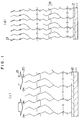
- Numeral 11 shows an optional substrate (e.g., a Si substrate) for forming a polyacetylene.
- Numeral 12 shows a hydrophilic film (e.g., a SiO2 film) formed on the optional substrate 1.
- Numeral 13 shows a silane surfactant of the formula: (wherein each of p, g, r, s and t is an optional integer), said silane surfactant constituting a monomolecular film 16 comprising straight-chain hydrocarbon molecules which have a side chain at the (r+1)th carbon atom from the Si atom, an acetylene group (-C ⁇ C-) 14 as functional group at the (q+1)th carbon atoms of the main chain from said (r+1)th carbon atom, an acetylene group 14' at the (t+1)th carbon atom of the side chain from said (r+1)th carbon atom, and a vinyl group at the end of the main chain.
- the terminal group on the Si side in the above chemical formula is a chlorosilane group (-SiCl3).
- the linkage is formed on the surface of the hydrophilic film (e.g., SiO2 film) 12 by a monomolecular film forming method such as chemical adsorption method or Langmuir-Blodgett technique, whereby the monomolecular film 16 is formed.
- This polyacetylene has electrical conductivity and nonlinear optical effect, can be utilized as a photoelectronic functional material, and can be shaped in an optional direction on the same plane.
- the film is irradiated in a water vapor atmosphere with energy beams, for example, electron beams converged to the molecular diameter order to activate the aforesaid vinyl group, whereby a hydroxyl group 20 is added thereto (Fig. 1(c)).
- energy beams for example, electron beams converged to the molecular diameter order to activate the aforesaid vinyl group, whereby a hydroxyl group 20 is added thereto (Fig. 1(c)).
- the same silane surfactant as the aforesaid surfactant 13, i.e., (wherein each of p, q, r, s and t is an optional integer) is added to the active group portion having a hydroxyl group added thereto, in the same manner as described above to form the linkage
- vinyl groups 21 are aligned on the surface of the added molecule, a higher-order multilayer molecular structure is formed, namely, polyacetylene can be formed (Fig. 1(b)).
- silane surfactant having one side chain of the formula: (wherein each p, q, r, s and t is an optional integer), the number of side chains may be increased if necessary.
- radiation such as X-rays, electron beams, etc. may be used for the polymerization.
- terminal group of the side chain is a methyl group in the first example of the present invention, it may be replaced by a vinyl group.
- diacetylene group is shown as a functional group in the first example of the present invention, other functional groups such as pyrrole group, thienylene group, phenylene group, etc. may, of course, be employed.
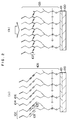
- Numeral 100 shows an optional substrate (e.g., a Si substrate) for producing a polydiacetylene.
- Numeral 101 shows a hydrophilic film (e.g., a SiO2 film) formed on the optional substrate 100.
- Numeral 102 shows a silane surfactant of the formula: (wherein each of p, q, r, s and t is an optional integer), said surfactant constituting a monomolecular film 105 comprising straight-chain hydrocarbon molecules which have a side chain at the (r+1)th carbon atom from the Si atom, a diacetylene group (-C ⁇ C-C ⁇ C-) 103 as functional group at the (q+1)th carbon atom of the main chain from said (r+1)th carbon atom, a diacetylene group 103' at the (t+1)th carbon atom of the side chain from said (r+1)th carbon atom, and a vinyl group 104 at the end of the main chain.
- the terminal group on the Si side in the above chemical formula is a chlorosilane group (-SiCl3).
- This polydiacetylene has electrical conductivity, is expected to be utilized as a molecular wiring, and can be shaped in an optional direction on the same plane.
- a polyacetylene can be produced also according to the second example.
- the difference between processes for production of a polydiacetylene and a polyacetylene is due to the density of diacetylene groups in the main chain and the side chain of a straight-chain hydrocarbon molecule and the uprightness of the straight-chain hydrocarbon molecules. That is, when the density of diacetylene groups is high and the straight-chain hydrocarbon molecules are upright, a polyacetylene is formed, and when the molecules are in a relatively inclined state, a polydiacetylene is formed (Fig. 2(b)).
- a multilayer structure of polydiacetylene can be formed by the same manner as described in the first example.
- a functional portion such as polyacetylene, polydiacetylene or the like may be combined with each layer.
Landscapes
- Chemical & Material Sciences (AREA)
- Engineering & Computer Science (AREA)
- Physics & Mathematics (AREA)
- Nanotechnology (AREA)
- Nonlinear Science (AREA)
- Materials Engineering (AREA)
- Crystallography & Structural Chemistry (AREA)
- General Physics & Mathematics (AREA)
- Optics & Photonics (AREA)
- Condensed Matter Physics & Semiconductors (AREA)
- Medicinal Chemistry (AREA)
- Polymers & Plastics (AREA)
- Organic Chemistry (AREA)
- Chemical Kinetics & Catalysis (AREA)
- Health & Medical Sciences (AREA)
- Mathematical Physics (AREA)
- Theoretical Computer Science (AREA)
- Biophysics (AREA)
- Manufacturing & Machinery (AREA)
- Composite Materials (AREA)
- Life Sciences & Earth Sciences (AREA)
- Addition Polymer Or Copolymer, Post-Treatments, Or Chemical Modifications (AREA)
- Manufacture Of Macromolecular Shaped Articles (AREA)
Claims (7)
- Procédé de formation d'un film de polyacétyléne ou de polydiacétylène, comprenant les opérations consistant- à immerger un substrat présentant une surface hydrophile dans une solution, dans un solvant organique non aqueux, d'un composé hydrocarboné à chaîne droite comportant un groupement chlorosilane à l'une des extrémités de la chaîne hydrocarbonée et un ou plusieurs groupements réactifs à des faisceaux d'énergie dans une position quelconque de la chaîne hydrocarbonée et, de la sorte, à soumettre le groupement chlorosilane du composé à une adsorption chimique sur la surface du substrat, d'où il résulte qu'un film monomoléculaire du composé est formé sur le substrat, et- à polymeriser les molécules du composé par irradiation par des faisceaux d'énergie,
caractérise en ce que- ladite molécule d'hydrocarbure à chaîne droite constituant une chaîne principale comporte une ou plusieurs chaînes latérales, et- ledit ou lesdits groupements réactifs aux faisceaux d'énergie sont présents dans la chaîne principale et dans une ou plusieurs chaînes latérales de ladite chaîne principale. - Procédé de formation d'un film de polyacétylène selon la revendication 1, dans lequel ledit ou lesdits groupementss réactifs sont des groupements acétylène ou des groupements diacétylène.
- Procédé de formation d'un film de polyacétylène selon la revendication 1 ou 2, dans lequel lesdits faisceaux d'énergie sont des rayons ultraviolets, des rayons de l'ultraviolet lointain, des faisceaux ioniques, des rayons X ou des rayons γ.
- Procédé de formation d'un film de polyacétylène selon l'une quelconque des revendications 1 à 3, dans lequel le nombre d'atomes de carbone entrant dans la constitution de ladite molécule d'hydrocarbure à chaîne droite est de 10 ou plus.
- Procédé de formation d'un film de polyacétylène selon l'une quelconque des revendications 1 à 4, dans lequel le groupement d'extrémité autre que le groupement chlorosilane d'extrémité de ladite molécule d'hydrocarbure en chaîne droite est un groupement insaturé.
- Procédé de formation d'un film de polyacétylène selon la revendication 5, dans lequel un film multicouche est formé au moyen des molécules d'hydrocarbure en chaîne droite comportant le groupement insaturé.
- Procédé de formation d'un film de polyacétylène selon la revendication 6, dans lequel ledit groupement insaturé est un groupement vinyle.
Applications Claiming Priority (4)
| Application Number | Priority Date | Filing Date | Title |
|---|---|---|---|
| JP262043/87 | 1987-10-16 | ||
| JP26204387A JPH0627139B2 (ja) | 1987-10-16 | 1987-10-16 | ポリアセチレンの製造方法 |
| JP309054/87 | 1987-12-07 | ||
| JP62309054A JPH0735413B2 (ja) | 1987-12-07 | 1987-12-07 | ポリアセチレンまたはポリジアセチレンの形成方法 |
Publications (3)
| Publication Number | Publication Date |
|---|---|
| EP0312100A2 EP0312100A2 (fr) | 1989-04-19 |
| EP0312100A3 EP0312100A3 (en) | 1989-07-26 |
| EP0312100B1 true EP0312100B1 (fr) | 1993-08-04 |
Family
ID=26545360
Family Applications (1)
| Application Number | Title | Priority Date | Filing Date |
|---|---|---|---|
| EP88117139A Expired - Lifetime EP0312100B1 (fr) | 1987-10-16 | 1988-10-14 | Procédé pour produire une couche de polyacétylène ou polydiacétylène |
Country Status (3)
| Country | Link |
|---|---|
| US (1) | US4968524A (fr) |
| EP (1) | EP0312100B1 (fr) |
| DE (1) | DE3882881T2 (fr) |
Families Citing this family (12)
| Publication number | Priority date | Publication date | Assignee | Title |
|---|---|---|---|---|
| JPH0626706B2 (ja) * | 1988-09-05 | 1994-04-13 | 日本原子力研究所 | 単分子累積膜の製造方法 |
| US5260115A (en) * | 1989-02-15 | 1993-11-09 | Matsushita Electric Industrial Co., Ltd. | Organic electro-conductive thin films and process for production thereof |
| JPH07103190B2 (ja) * | 1989-02-15 | 1995-11-08 | 松下電器産業株式会社 | 有機導電性薄膜とその製造方法 |
| US5204126A (en) * | 1990-02-06 | 1993-04-20 | Nanofilm Corporation | Mold surfaces with ultra thin release films |
| JP2649856B2 (ja) * | 1990-04-13 | 1997-09-03 | 松下電器産業株式会社 | 非線形光学材料 |
| US5256456A (en) * | 1990-09-17 | 1993-10-26 | Matsushita Electric Industrial Co., Ltd. | Liquid crystal alignment film and method of manufacturing the same |
| DE69121658T2 (de) * | 1990-09-17 | 1997-01-23 | Matsushita Electric Ind Co Ltd | Flüssigkristallorientierungsschicht und ihr Herstellungsverfahren |
| IL98753A0 (en) * | 1990-10-10 | 1992-07-15 | Yeda Res & Dev | Process for the production of composite organic-inorganic superlattices |
| EP0499977B1 (fr) * | 1991-02-19 | 1995-12-20 | Matsushita Electric Industrial Co., Ltd. | Procédé pour fabriquer un film chimiquement adsorbé |
| US5455072A (en) * | 1992-11-18 | 1995-10-03 | Bension; Rouvain M. | Initiation and bonding of diamond and other thin films |
| US5578351A (en) * | 1995-01-20 | 1996-11-26 | Geo-Centers, Inc. | Liquid crystal composition and alignment layer |
| US6518168B1 (en) * | 1995-08-18 | 2003-02-11 | President And Fellows Of Harvard College | Self-assembled monolayer directed patterning of surfaces |
Family Cites Families (5)
| Publication number | Priority date | Publication date | Assignee | Title |
|---|---|---|---|---|
| US4169904A (en) * | 1978-01-05 | 1979-10-02 | International Business Machines Corporation | Preparation of polymer monomolecular films |
| US4751171A (en) * | 1984-07-03 | 1988-06-14 | Matsushita Electric Industrial Co., Ltd. | Pattern forming method |
| JPS6194042A (ja) * | 1984-10-16 | 1986-05-12 | Matsushita Electric Ind Co Ltd | 分子構築体およびその製造方法 |
| JPS61134345A (ja) * | 1984-12-05 | 1986-06-21 | Kanegafuchi Chem Ind Co Ltd | ベンゼン環を含んだ両親媒性ジアセチレン化合物およびその膜 |
| GB8432406D0 (en) * | 1984-12-21 | 1985-02-06 | Gen Electric Co Plc | Stabilised langmuir-blodgett films |
-
1988
- 1988-10-12 US US07/256,619 patent/US4968524A/en not_active Expired - Lifetime
- 1988-10-14 DE DE88117139T patent/DE3882881T2/de not_active Expired - Fee Related
- 1988-10-14 EP EP88117139A patent/EP0312100B1/fr not_active Expired - Lifetime
Also Published As
| Publication number | Publication date |
|---|---|
| EP0312100A2 (fr) | 1989-04-19 |
| EP0312100A3 (en) | 1989-07-26 |
| US4968524A (en) | 1990-11-06 |
| DE3882881D1 (de) | 1993-09-09 |
| DE3882881T2 (de) | 1994-02-10 |
Similar Documents
| Publication | Publication Date | Title |
|---|---|---|
| US5057339A (en) | Metallized polyacetylene-type or polyacene-type ultralong conjugated polymers and process for producing the same | |
| EP0312100B1 (fr) | Procédé pour produire une couche de polyacétylène ou polydiacétylène | |
| US5008127A (en) | Process for the production of a highly-orientated ultralong conjugated polymer | |
| EP0386784A2 (fr) | Membrane à perméabilité sélective et son procédé de fabrication | |
| EP0178606B1 (fr) | Structure à molécule contrôlée et procédé pour sa fabrication | |
| US5536982A (en) | Ultra thin polymer film electret | |
| EP0552637A1 (fr) | Procédé de fabrication d'un polymère conjugué d'acetylène | |
| EP0351092B1 (fr) | Procédé pour la fabrication de films monomoléculaires d'adsorption ou de films composés de couches monomoléculaires à partir de composés de silane ayant une liaison acétylénique ou diacétylénique | |
| JP3147407B2 (ja) | 導電性高分子複合材料およびその製造方法 | |
| DE69128160T2 (de) | Verfahren zur Herstellung eines organischen monomolekularen Überzuges | |
| EP0341697B1 (fr) | Procédé pour la production de polyacétylène | |
| EP0344799B1 (fr) | Pellicule selective perméable et procédé de sa fabrication | |
| US5304583A (en) | Process for producing polyacetylene or polyacene type long conjugated polymers | |
| US5304582A (en) | Process for producing polyacetylene or polyacene type long conjugated polymers | |
| Madrid et al. | Effects of chain transfer agent on the electron beam-induced graft polymerization of glycidyl methacrylate in emulsion phase | |
| US5302416A (en) | Process for producing polyacetylene or polyacene type long conjugated polymers | |
| JPH0735413B2 (ja) | ポリアセチレンまたはポリジアセチレンの形成方法 | |
| JPH03229710A (ja) | 高配向性共役ポリマーの製造方法 | |
| JPH0777274B2 (ja) | 単分子吸着膜形成方法 | |
| Darling et al. | Ordered nanoscale domains by infiltration of block copolymers | |
| JPH0627140B2 (ja) | ポリアセチレン又はポリアセン型超長共役ポリマーの製造方法 | |
| JPH01104608A (ja) | ポリアセチレンの製造方法 | |
| JPH0667983B2 (ja) | 高配向性共役ポリマーの製造方法 | |
| JPH05168913A (ja) | 化学吸着膜の気相製造法 | |
| JPH075672B2 (ja) | 高配向性超長共役ポリマーの製造方法 |
Legal Events
| Date | Code | Title | Description |
|---|---|---|---|
| PUAI | Public reference made under article 153(3) epc to a published international application that has entered the european phase |
Free format text: ORIGINAL CODE: 0009012 |
|
| AK | Designated contracting states |
Kind code of ref document: A2 Designated state(s): DE FR GB |
|
| PUAL | Search report despatched |
Free format text: ORIGINAL CODE: 0009013 |
|
| RHK1 | Main classification (correction) |
Ipc: B05D 1/20 |
|
| AK | Designated contracting states |
Kind code of ref document: A3 Designated state(s): DE FR GB |
|
| 17P | Request for examination filed |
Effective date: 19890825 |
|
| 17Q | First examination report despatched |
Effective date: 19911016 |
|
| GRAA | (expected) grant |
Free format text: ORIGINAL CODE: 0009210 |
|
| AK | Designated contracting states |
Kind code of ref document: B1 Designated state(s): DE FR GB |
|
| REF | Corresponds to: |
Ref document number: 3882881 Country of ref document: DE Date of ref document: 19930909 |
|
| ET | Fr: translation filed | ||
| PLBE | No opposition filed within time limit |
Free format text: ORIGINAL CODE: 0009261 |
|
| STAA | Information on the status of an ep patent application or granted ep patent |
Free format text: STATUS: NO OPPOSITION FILED WITHIN TIME LIMIT |
|
| 26N | No opposition filed | ||
| REG | Reference to a national code |
Ref country code: GB Ref legal event code: IF02 |
|
| REG | Reference to a national code |
Ref country code: GB Ref legal event code: 746 Effective date: 20031002 |
|
| REG | Reference to a national code |
Ref country code: FR Ref legal event code: D6 |
|
| PGFP | Annual fee paid to national office [announced via postgrant information from national office to epo] |
Ref country code: DE Payment date: 20051006 Year of fee payment: 18 |
|
| PGFP | Annual fee paid to national office [announced via postgrant information from national office to epo] |
Ref country code: FR Payment date: 20051010 Year of fee payment: 18 |
|
| PGFP | Annual fee paid to national office [announced via postgrant information from national office to epo] |
Ref country code: GB Payment date: 20051012 Year of fee payment: 18 |
|
| PG25 | Lapsed in a contracting state [announced via postgrant information from national office to epo] |
Ref country code: DE Free format text: LAPSE BECAUSE OF NON-PAYMENT OF DUE FEES Effective date: 20070501 |
|
| GBPC | Gb: european patent ceased through non-payment of renewal fee |
Effective date: 20061014 |
|
| REG | Reference to a national code |
Ref country code: FR Ref legal event code: ST Effective date: 20070629 |
|
| PG25 | Lapsed in a contracting state [announced via postgrant information from national office to epo] |
Ref country code: GB Free format text: LAPSE BECAUSE OF NON-PAYMENT OF DUE FEES Effective date: 20061014 |
|
| PG25 | Lapsed in a contracting state [announced via postgrant information from national office to epo] |
Ref country code: FR Free format text: LAPSE BECAUSE OF NON-PAYMENT OF DUE FEES Effective date: 20061031 |