EP0312105A2 - Optischer Plattenspieler - Google Patents
Optischer Plattenspieler Download PDFInfo
- Publication number
- EP0312105A2 EP0312105A2 EP88117148A EP88117148A EP0312105A2 EP 0312105 A2 EP0312105 A2 EP 0312105A2 EP 88117148 A EP88117148 A EP 88117148A EP 88117148 A EP88117148 A EP 88117148A EP 0312105 A2 EP0312105 A2 EP 0312105A2
- Authority
- EP
- European Patent Office
- Prior art keywords
- disk
- skew
- optical
- video
- audio
- Prior art date
- Legal status (The legal status is an assumption and is not a legal conclusion. Google has not performed a legal analysis and makes no representation as to the accuracy of the status listed.)
- Withdrawn
Links
Images



Classifications
-
- G—PHYSICS
- G11—INFORMATION STORAGE
- G11B—INFORMATION STORAGE BASED ON RELATIVE MOVEMENT BETWEEN RECORD CARRIER AND TRANSDUCER
- G11B7/00—Recording or reproducing by optical means, e.g. recording using a thermal beam of optical radiation by modifying optical properties or the physical structure, reproducing using an optical beam at lower power by sensing optical properties; Record carriers therefor
- G11B7/08—Disposition or mounting of heads or light sources relatively to record carriers
- G11B7/09—Disposition or mounting of heads or light sources relatively to record carriers with provision for moving the light beam or focus plane for the purpose of maintaining alignment of the light beam relative to the record carrier during transducing operation, e.g. to compensate for surface irregularities of the latter or for track following
- G11B7/095—Disposition or mounting of heads or light sources relatively to record carriers with provision for moving the light beam or focus plane for the purpose of maintaining alignment of the light beam relative to the record carrier during transducing operation, e.g. to compensate for surface irregularities of the latter or for track following specially adapted for discs, e.g. for compensation of eccentricity or wobble
-
- G—PHYSICS
- G11—INFORMATION STORAGE
- G11B—INFORMATION STORAGE BASED ON RELATIVE MOVEMENT BETWEEN RECORD CARRIER AND TRANSDUCER
- G11B19/00—Driving, starting, stopping record carriers not specifically of filamentary or web form, or of supports therefor; Control thereof; Control of operating function ; Driving both disc and head
- G11B19/02—Control of operating function, e.g. switching from recording to reproducing
- G11B19/04—Arrangements for preventing, inhibiting, or warning against double recording on the same blank or against other recording or reproducing malfunctions
-
- G—PHYSICS
- G11—INFORMATION STORAGE
- G11B—INFORMATION STORAGE BASED ON RELATIVE MOVEMENT BETWEEN RECORD CARRIER AND TRANSDUCER
- G11B7/00—Recording or reproducing by optical means, e.g. recording using a thermal beam of optical radiation by modifying optical properties or the physical structure, reproducing using an optical beam at lower power by sensing optical properties; Record carriers therefor
- G11B7/08—Disposition or mounting of heads or light sources relatively to record carriers
- G11B7/09—Disposition or mounting of heads or light sources relatively to record carriers with provision for moving the light beam or focus plane for the purpose of maintaining alignment of the light beam relative to the record carrier during transducing operation, e.g. to compensate for surface irregularities of the latter or for track following
- G11B7/095—Disposition or mounting of heads or light sources relatively to record carriers with provision for moving the light beam or focus plane for the purpose of maintaining alignment of the light beam relative to the record carrier during transducing operation, e.g. to compensate for surface irregularities of the latter or for track following specially adapted for discs, e.g. for compensation of eccentricity or wobble
- G11B7/0956—Disposition or mounting of heads or light sources relatively to record carriers with provision for moving the light beam or focus plane for the purpose of maintaining alignment of the light beam relative to the record carrier during transducing operation, e.g. to compensate for surface irregularities of the latter or for track following specially adapted for discs, e.g. for compensation of eccentricity or wobble to compensate for tilt, skew, warp or inclination of the disc, i.e. maintain the optical axis at right angles to the disc
Definitions
- the present invention relates to an optical disk player for reproducing optical disks such as a video disk, a compact disk having a diameter different from that of the video disk for recording audio signals and a compact disk different in diameter from that of the video disk for recording audio and video signals, and more particularly to a skew servo system for an optical pickup provided therein.
- a laser beam is converged by an objective lens for a reproducing signal, wherein its resolution depends either on how much the laser beam is converged, or the beam spot diameter. Therefore, the beam spot diameter is determined by the wavelength of a light source, the ratio of the focal length to the diameter of the objective lens (generally expressed by NA (Numerical Aperture) value), and other factors.
- NA Numerical Aperture
- a helium-neon laser is used as a light source.
- the helium-neon laser causes the apparatus or the optical disk player to be large in size and expensive. Accordingly, it is a recent tendency to employ a semiconductor laser as the light source because it is economical and suitable for making the apparatus smaller.
- the semiconductor laser has a wavelength of 780 nm which is longer than that of the helium-neon laser which is 623.8 nm. For this reason, in order to obtain a beam shot diameter of the semiconductor laser which can provide the same resolution as that using the helium-neon laser as the light source, the NA value of the objective lens must be increased, for example, to approximately 0.5.
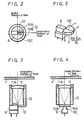
- a detected output D shown in Fig. 1A contains crosstalk from adjacent tracks T1 and T2 sufficiently small with respect to the output from a main track T0.
- the optical axis of the laser beam is not perpendicular to the recording surface of the disk 1, but is instead at an angle ⁇ (hereinafter called the skew or skew angle of the disk 1) as shown in Fig. 1B, the crosstalk from the adjacent tracks, from the track T1 in this case, is increased in the detected output D.
- the skew of the disk surface in which the disk surface is not perpendicular to the optical axis is caused by various causes such as an inclination of the spindle shaft, a distortion of the disk turntable, a skew inherent in the disk and so on.
- the principal cause among these causes is considered to be the skew inherent in the disk, and the skew angle with respect to the radial direction of the presently manufactured disk ranges from 1 ⁇ ⁇ ⁇ ⁇ 2 ⁇ .
- skew is assumed to include the skew caused by reasons other than the skew inherent in the disk) for countermeasures to the increase in crosstalk.
- Figs. 2-5 show a skew sensor employed in an optical disk reproducing apparatus for detecting the skew of an optical disk.
- Fig. 2 is a top plan view taken from the upper side of the optical disk 1 (however, the disk is not shown in the drawing)
- Fig. 3 is a view taken along the radial direction of the disk 1
- Fig. 4 is a view taken from a direction perpendicular to the radial direction of the disk 1 (These drawings illustrate the skew sensor in cross-section for ease of explanation).
- Fig. 5 is a perspective view of the skew sensor.
- a diffusion light source is used as the light source.
- the example shown in Figs. 2-5 employs a light emitting diode (LED) 9 which is arranged to diffuse the light on the light emitting surface thereof.
- the light emitting surface of the light emitting diode is formed in a rectangular shape.
- This photo detector 10 is a two-divided photo detector which has its light detecting area divided into two parts.
- the light emitting diode 8, the photo detector 10 and the lens 11 are attached to a housing member 12 formed in the shape of a cylinder.
- the lens 11 is attached to one opening end side of the housing member 12, while the light emitting diode 9 and the photo detector 10 are mounted on the housing member 12 at the other opening end on the focal plane of the lens 11 such that they are located at the left and right sides of a plane including the optical axis 11A of the lens 11.
- the housing member 12 thus provided with the light emitting diode 9, the photo detector 10 and the lens 11 is placed, as shown in, for example, Fig.
- the light emitting diode 9 and the photo detector 10 are arranged in the direction perpendicular to the radial direction of the disk 1.
- the light emitting diode 9 and the photo detector 10 are located such that the optical axis of the optical pickup is perpendicular to the recording surface of the disk 1.
- the two-divided photo detector 10 is arranged in a manner such that its dividing line 10C is located along the direction perpendicular to the skew detecting direction or the direction perpendicular to the radial direction of the disk 1 and intersects the plane that includes the optical axis 11A.
- Fig. 6 is a perspective view showing only the light emitting diode 9 and the two-divided photo detector 10.
- the optical path of the light incident on the recording surface of the disk 1 is perfectly symmetrical to that of the light reflected from the recording surface of the disk 1, as shown in Fig. 6. Therefore, the real image of the light emitting diode 9 that is placed on the left-hand side of the plane including the optical axis 11A of the lens 11 and along the radial direction of the disk 1 is focused on the focal plane of the lens 11 located at the right- hand side of the above described plane.
- the portion above the disk 1 in Fig. 6 is the portion which is reflected on the recording surface of the disk 1.
- Fig. 7 is derived wherein the real image on the light emitting diode 9 is focused exactly at the position of the photo detector 10.
- the image 13 is focused equally over divided areas 10A and 10B of the two-divided photo detector 10 by the same amount as shown in Fig. 9B, so that photo-detected outputs from the divided areas 10A and 10B are equal to each other and hence the difference therebetween is zero.
- the position of the image of the light emitting diode 9 is displaced in the direction perpendicular to the radial direction of the disk 1 as indicated at 14 in Fig. 8 due to the skew of the disk 1, so that the image 13 on the photo detector 10 is focused such that the region 10B includes a larger portion of the image 13 as shown in Fig. 9C.
- the image 13 on the photo detector 10 is focused such that the region 10A includes a larger portion of the image 13 as shown in Fig. 9A.
- the light emitting diode 9 and the light detector 10 hold the aforementioned relationship with the optical pickup and are arranged to move together with the optical pickup, as will be described later.
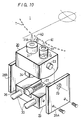
- Fig. 10 shows a movable portion (skew servo mechanism) including the optical pickup and the skew sensor.
- an optical block 20 comprises the optical system of an optical pickup 40 for detecting recorded information in the form of pits formed on the disk 1 and the optical system of a skew sensor 41. Focussing servo and tracking servo for the optical pickup 40 are effected by a two-axis optical driving section 21.
- the aforementioned housing member 12 of the skew sensor 41 is mounted on the block 20 in the longitudinal direction of a recording track T relative to the optical axis position 21A of the optical pickup 40. Therefore, the plane including the optical axis 11a of the lens 11 also includes the optical axis 21a of the optical pickup 40.
- the optical block 20 constructed as described above is supported by a shaft 23 which is placed in the direction perpendicular to the radial direction of the disk 1 in a manner such that the optical block 20 is permitted to rotate about the axis 23 to incline in the radial direction of the disk 1.
- the optical block 20 is provided with a worm gear 24 mounted on the bottom surface thereof.
- the shaft 23 is rotatably inserted into shaft apertures 29A and 29B bored through two side plates 28a and 28B in a manner such that the worm gear 24 engages with a worm 27 which is rotated by a small size motor 26 fixed on a supporting base 25.
- the worm gear is rotated by a rotating angle corresponding to the rotation of the worm 27, whereby the optical block 20 is inclined in the radial direction of the disk 1.
- optical axis 21A of the optical pickup 40 can be controlled so as to be always perpendicular to the recording surface of the disk 1 by controlling the motor 26 in response to the skew detecting output from the skew sensor 41.
- the supporting base 25 is slideable along two parallel guiding rods 30 in the radial direction of the optical disk 1 by a motor not shown.
- Fig. 11 is a block diagram showing the example of a control system for the motor 26. Detecting outputs SA and SB from the respective divided areas 10A and 10B of the two-divided photo detector 10, in proportion to the occupied areas by the optical image 13, are respectively supplied through amplifiers 31A and 31B to an operational or calculating circuit 32 which effects the following calculation:
- the output from the operational circuit 32 is supplied through a driving circuit 33 to the motor 26 as a skew error signal.
- the optical axis 21A of the optical pickup 40 is controlled to be always perpendicular to the recording surface of the disk 1.
- the surface of the light emitting diode 9, which is substantially focused on the photo detector as the image of the diffusing light source body, has a rectangular shape as shown in Fig. 12. This is because the skew detecting output of such a shape has a rectilinear characteristic with respect to the skew angle ⁇ as shown in Fig. 13. On the contrary, if the shape of the surface of the light emitting diode 9 is circular as shown in Fig. 14, the skew detecting output characteristic is curvilinear with respect to the skew angle ⁇ as shown in Fig. 15, thereby making it difficult to control the motor 26.
- the diffusion light source is not limited to the above-mentioned one which employs a light emitting diode which diffuses light on the light emitting surface thereof.
- a diffusion member masked in a rectangular shape and a lamp may be used in place thereof.
- a rectangular window may be provided through which the light emitted from the diode 9 is diffused, instead of forming the surface of the diode 9 in a rectangular shape.
- the conventional optical disk reproducing apparatus detects the skew of a disk in such a manner that a diffusion type light source emits a light which is reflected once on the recording surface of the disk through the lens so as to focus the real image of the light source on the two-divided photo detector, with the result that the apparatus can be manufactured with less number of parts and more economically than apparatus using a laser as a light source.
- the apparatus employs a diffusion light in place of a parallel light, one can substantially avoid erroneously detecting portion in which the contents of recorded information on the disk are changed as the skew of the disk.
- the skew sensor can be simply constructed.
- the optical system can be readily mounted in the single housing so that the construction thereof can be made stable.
- optical disks such as a video disk and compact disks, each having a radius different from that of the video disk, for recording an audio signal and for recording audio and video signals which are all reproduced by the optical disk reproducing apparatus.
- the video disk is generally referred to as a "laser disk (LD)" and there are two types, one having a diameter of 200 mm and the other having a diameter of 300 mm.
- the LD is used for recording a video signal including an audio signal.
- the compact disk for recording audio and video signals is referred to as a "CDV” and has a diameter of 120 mm.
- the CDV is used for recording mainly the audio signal and partially the video signal.
- the compact disk for recording the audio signal is referred to as a "CD” and there are two types, one of which has a diameter of 120 mm and the other of which has a diameter of 80 mm.
- the CD is used for recording the audio signal.
- CDV and CD respectively have a 4-bit address signal (ADR) recorded in a subcode area arranged in a lead-in track which is placed in the innermost periphery of the disks near the center.
- ADR 4-bit address signal
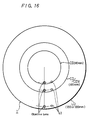
- the objective lens of the optical pickup 40 moves along one radius of the optical disk 1 while the relative position between the skew sensor 41 and the objective lens of the optical pickup 40 are determined such that both are closely positioned with a predetermined spacing therebetween at the outermost track (circular track) of the LD having a diameter of 300 mm.
- the skew sensor 41 is positioned outside the CD so that it cannot detect the skew of the CD or the inclination of the optical pickup 40 relative to the optical disk 1, whereby the skew servo does not operate correctly.
- the skew sensor 41 is located at a track far from the track at which the objective lens of the optical pickup is located. It is therefore impossible to correctly detect the skew of the optical disk 1 and consequently servo-control the optical pickup 40 in a correct manner by the present skew servo mechanism.
- the skew angle is wider as the diameter of the optical disk is larger.
- a smaller diameter disk in which video signals are recorded is more influenced by crosstalk between adjacent tracks due to its skew in comparison with a disk of the same size in which audio signals are recorded.
- an object of the present invention to provide an optical disk player for reproducing information stored on a video disk and compact disks, each having a diameter different from that of a video disk, for recording audio signals and for recording audio and video signals which is capable of effecting the skew servo operation without errors regardless of the size of optical disks being used.
- the present invention provides an optical disk player capable of reading information recorded on various types of optical disks, such as a video disk, an audio compact disk whose diameter is different from the video disk or a video/audio disk, wherein both the audio compact disk and the video/audio compact disk have lead-in tracks for storing identification signals for identifying the type of compact disk.
- the disk player comprises an optical pickup for reading stored information from a disk means for detecting the size of said disk, means for detecting said identification signal from the lead-in tracks of said disk, a skew sensor for detecting an inclination angle of the skew of the disk relative to the pickup, means for adjusting the inclination of said disk relative to said pickup, skew servo means for supplying a skew signal to the adjusting means upon detection of an inclination by the skew sensor, said skew signal being held at its value obtained when the optical pickup is at a predetermined radial track location relative to said disk, when the size detecting means detects that the disk size is a compact disk and the identification signal detecting means detects that the disk is an audio compact disk.
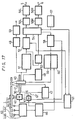
- Reference numeral 1 generally designates an optical disk which may be an LD, indicated by 1a, having a diameter of 300 mm, a different LD, indicated by 1b, having a diameter of 200 mm, and a CDV or CD, indicated by 1c, having a diameter of 120 mm.
- a CD having a diameter of 80 mm is omitted in the drawing.
- a spindle motor 43 to which a spindle 42 is connected, is rotation-servo-controlled by a rotation servo circuit 61 to rotate the optical disk 1.
- An optical pickup 40 focuses a laser beam emitted from a light source such as a laser diode or the like on the surface of the optical disk 1 through an objective lens in a manner similar to that shown in Fig. 10.
- the reflected light from the optical disk 1 is focused through the objective lens on a photo detecting element such as a photo diode or the like which generates modulated video and audio signals.
- the optical pickup 40 is provided with focus error detecting means and tracking error detecting means, though these are not shown in the drawing.
- the modulated video signal from the optical pickup 40 is supplied to a video signal demodulator 49 to be demodulated, and the demodulated output therefrom is supplied to a time base corrector (TBC) 50 which outputs the video signal.
- TBC time base corrector
- the modulated audio signal from the optical pickup 40 is supplied to an analog waveform shaping circuit 51, the waveform-shaped output of which is supplied to a synchronizing signal detecting circuit 52 and a phase locked loop (PLL) circuit 53.
- a clock signal generated from the PLL circuit 53 is fed to the synchronizing signal detecting circuit 52.
- the respective outputs from the synchronizing signal detecting circuit 52 and the PLL circuit 53 are supplied to a digital signal processing circuit 54.
- the digital signal processing circuit 54 delivers left-channel and right-channel digital audio signals which are respectively supplied through digital-to-analog (D/A) converters 55L and 55R to filters 56L and 56R which output left-channel and right-channel audio signals L and R, respectively.
- the digital signal processing circuit 54 is fed with a reference signal (clock signal) from a quartz oscillator 57.
- the optical pickup 40 is connected to a focussing servo circuit 48 and an optical pickup transporting servo circuit 60.
- a transporting mechanism such as a motor for carrying the optical pickup 40 in the radial direction of the optical disk 1 on guide 30 is omitted in Fig. 17.
- a digital signal from the digital signal processing circuit 54 is supplied to a subcode signal detecting circuit 58 for detecting a subcode signal which is supplied to a tracking servo circuit 59 and the transporting servo circuit 60.
- the subcode signal indicates whether the disk is a CDV or a CD when it is 120 mm.
- the tracking servo circuit 59 is connected to the optical pickup 40.
- the optical pickup transporting servo circuit 60 is controlled by a system controller 46.
- a skew sensor 41 specifically constructed as described above with reference to Figs. 2 - 10, generates a skew detecting signal which is supplied to a skew servo circuit 47 in a skew servo mechanism 47′.
- the skew servo mechanism 47′ and circuit 47 are specifically constructed in the same manner as described in connection with Figs. 2 - 10.
- a disk size detecting means 45 comprises a light source section (not shown), a plurality of light receiving sections 44A arranged in different positions from each other in the radial direction of the optical disk 1 and a disk size detecting circuit 44B for detecting the diametrical size of the optical disk 1 loaded in the reproducing apparatus in response to the presence or absence of the light received by the plurality of light receiving sections 44A.
- the detected output from the disk size detecting circuit 44B is supplied to the system controller 46.
- the skew sensor 41 is integrated with the optical pickup 40 as shown in Fig. 10.
- a motor 26, similar to that in Fig. 10, is provided to rotate the optical pickup 40 and the skew sensor 41 in a plane including the optical axis of the objective lens of the optical pickup 40, the optical axis of the skew sensor 41 and a radius of the optical disk 1 in a manner such that the optical axis of the objective lens of the optical pickup 40 is perpendicular to the surface of the optical disk 1.
- the motor 26 is controlled by the system controller 46, the skew servo circuit 47 and the subcode detecting circuit 58.
- the relative position between the skew sensor 41 and the optical pickup 40 are determined such that the optical pickup 40 moves along a radius of the optical disk 1, and that the skew sensor 41 and the optical pickup 40 are closely positioned at a predetermined track in the vicinity of the outermost track of the LD having a diameter of 300 mm, with a predetermined space therebetween.
- the optical disk reproducing apparatus operates as follows, depending upon which type and size optical disk is loaded in the apparatus:
- LD having a diameter of 300 mm or 200 mm.
- the size detector 45 detects that the optical disk is an LD having the diameter of 300 mm or 200 mm.
- the system controller 46 controls the motor 26 on the basis of the detection such that the optical pickup 40 is servo-controlled by the skew servo mechanism 47′ while the optical pickup 40 is transported radially from the innermost track to the outermost track (inside the outer periphery of the disk) for reproducing data signals recorded therein.
- CD having a diameter 80 mm.
- the system controller 46 and the subcode detecting circuit 58 control the motor 26 on the basis of the detected results.
- the op9tical pickup 40 is servo-controlled by the skew servo mechanism 47′ while transported radially from the innermost track of the CD to a track at a predetermined diameter (70 mm) (slightly inside the outermost track of the CD such that the skew sensor 41 is not positioned outside the CD) for reproducing data recorded therein.
- the optical pickup is held in the same skew servo control condition as it is at the predetermined track while it is transported radially outward from the track at the predetermined diameter to the outermost track, by holding the skew signal supplied from the skew servo circuit 47 to the skew motor 26 at the same value.
- the system controller 46 and the subcode detecting circuit 58 control the motor 26 on the basis of the detected results.
- the optical pickup 40 is servo-controlled by the skew servo mechanism 47′ while the optical pickup 40 reproduces the data from the innermost track to the outermost track of the CDV.
- the optical pickup 40 is servo-controlled by the skew servo mechanism 47′ while the optical pickup 40 reproduced the data from the innermost track to the track at the predetermined diameter (the above-mentioned 70 mm) which is positioned slightly inside the outermost track of the CD.
- the optical pickup 40 While being transported from the track at the predetermined diameter to the outermost track, the optical pickup 40 is held in the same skew servo condition as is positioned at the predetermined track, for example, by holding the skew signal supplied from the skew servo circuit 47 to the skew motor 26.
- the skew servo uses the same skew reading obtained when the optical pickup 40 is at the predetermined track, thereby preventing the skew servo from erroneously operating. Even though the skew servo is held in the same condition, the diameter of the CD is small, i.e. 80 mm and moreover the signal recorded thereon is an audio signal so that the skew of the optical disk 1 is small and changes little, whereby any crosstalk due to the skew is considered to be negligible.
- the optical disk player for reproducing the video disk and the compact disks each having a diameter different from that of the video disk, for recording the audio signal and for recording the audio and video signals, it is possible to effect the skew servo operation without errors regardless of the size of optical disks to be reproduced thereby.
Landscapes
- Optical Recording Or Reproduction (AREA)
Applications Claiming Priority (2)
| Application Number | Priority Date | Filing Date | Title |
|---|---|---|---|
| JP260177/87 | 1987-10-15 | ||
| JP62260177A JP2565238B2 (ja) | 1987-10-15 | 1987-10-15 | 光学式ディスク再生装置 |
Publications (2)
| Publication Number | Publication Date |
|---|---|
| EP0312105A2 true EP0312105A2 (de) | 1989-04-19 |
| EP0312105A3 EP0312105A3 (en) | 1989-07-12 |
Family
ID=17344391
Family Applications (1)
| Application Number | Title | Priority Date | Filing Date |
|---|---|---|---|
| EP88117148A Withdrawn EP0312105A3 (en) | 1987-10-15 | 1988-10-14 | Optical disk player |
Country Status (4)
| Country | Link |
|---|---|
| US (1) | US5056075A (de) |
| EP (1) | EP0312105A3 (de) |
| JP (1) | JP2565238B2 (de) |
| KR (1) | KR970010937B1 (de) |
Cited By (7)
| Publication number | Priority date | Publication date | Assignee | Title |
|---|---|---|---|---|
| DE4225391A1 (de) * | 1991-07-31 | 1993-02-04 | Samsung Electronics Co Ltd | Plattenabtastanordnung |
| NL9201295A (nl) * | 1991-07-23 | 1993-02-16 | Mitsubishi Electric Corp | Optische lees- en schrijfinrichting. |
| EP0500271A3 (en) * | 1991-02-18 | 1993-07-07 | Sony Corporation | Disc cartridge and disc recording and/or reproducing apparatus |
| EP0709834A3 (de) * | 1994-10-31 | 1997-04-16 | Matsushita Electric Industrial Co Ltd | Kippsensor, optische Platte, und Kippkompensierensverfahren zur Durchführung einer stabilen Kippkompensationsregelung, und Gerät zur Verwendung derselben |
| EP0798707A3 (de) * | 1996-03-29 | 1999-06-09 | Pioneer Electronic Corporation | Optische Platte |
| EP0806767A4 (de) * | 1995-10-26 | 1999-09-29 | Sony Corp | Antriebsvorrichtung einer optischen platte |
| EP0838810A4 (de) * | 1996-05-09 | 2000-02-02 | Sony Corp | Optische abtastvorrichtung und plattenspieler |
Families Citing this family (28)
| Publication number | Priority date | Publication date | Assignee | Title |
|---|---|---|---|---|
| US5257253A (en) * | 1989-03-07 | 1993-10-26 | Pioneer Electronic Corporation | Laser vision disc with digital sound (LDD) disc player for reproducing analog audio signals mixed with digital audio signals |
| JP2708531B2 (ja) * | 1989-03-07 | 1998-02-04 | パイオニア株式会社 | ディスクプレーヤ |
| JPH03292633A (ja) * | 1990-04-11 | 1991-12-24 | Pioneer Electron Corp | コンパチブルディスクプレーヤ |
| JPH07105128B2 (ja) * | 1990-04-17 | 1995-11-13 | パイオニア株式会社 | マルチディスクプレーヤの表示装置 |
| JP2985248B2 (ja) * | 1990-07-17 | 1999-11-29 | ソニー株式会社 | スピンドルサーボ装置 |
| US5412640A (en) * | 1990-09-10 | 1995-05-02 | Deutsche Thomson-Brandt Gmbh | Method for measuring and regulating the radial and tangential angles of a light beam |
| US5243344A (en) * | 1991-05-30 | 1993-09-07 | Koulopoulos Michael A | Digital-to-analog converter--preamplifier apparatus |
| JPH04366429A (ja) * | 1991-06-14 | 1992-12-18 | Toshiba Corp | 対物レンズ駆動装置 |
| JP3241402B2 (ja) * | 1991-08-01 | 2001-12-25 | ソニー株式会社 | 情報記録媒体 |
| US5805545A (en) * | 1991-08-14 | 1998-09-08 | Pioneer Electronic Corporation | Midi standards recorded information reproducing device with repetitive reproduction capacity |
| JPH05266484A (ja) * | 1992-03-23 | 1993-10-15 | Toshiba Corp | 情報再生装置 |
| DE4211213C2 (de) * | 1992-04-03 | 2001-03-15 | Thomson Brandt Gmbh | Regelung optischer Abtastsysteme, insbesondere in der Anlaufphase der Abspielgeräte |
| JPH06168468A (ja) * | 1992-11-30 | 1994-06-14 | Pioneer Electron Corp | トラッキング装置 |
| JP3056967B2 (ja) * | 1995-02-24 | 2000-06-26 | 株式会社朝日コーポレーション | ディスクプレーヤ |
| US5696756A (en) * | 1995-04-14 | 1997-12-09 | Kabushiki Kaishia Toshiba | Optical disk having an evaluation pattern for evaluating the optical disk |
| US5742575A (en) * | 1995-08-18 | 1998-04-21 | Sony Corporation | Method and device for identifying disc |
| JPH0991713A (ja) * | 1995-09-27 | 1997-04-04 | Canon Inc | 光学的情報記録再生装置 |
| JP2728065B2 (ja) * | 1995-12-04 | 1998-03-18 | 日本電気株式会社 | 光ディスク自動判別方法とそのシステム |
| KR0175262B1 (ko) * | 1996-02-27 | 1999-04-15 | 김광호 | 멀티디스크 플레이어의 재생기능 제어방법 |
| JP3754834B2 (ja) * | 1998-11-09 | 2006-03-15 | パイオニア株式会社 | 記録再生装置 |
| JP3807858B2 (ja) * | 1998-11-27 | 2006-08-09 | パイオニア株式会社 | ディスク再生装置 |
| JP2001093150A (ja) * | 1999-09-20 | 2001-04-06 | Yamaha Corp | Cd−rディスクの記録方法 |
| JP2002170266A (ja) * | 2000-12-01 | 2002-06-14 | Pioneer Electronic Corp | チルトサーボ制御装置及び方法 |
| TW556158B (en) * | 2001-11-23 | 2003-10-01 | Lite On It Corp | Method for determining the radius of compact disk and the compact disk data access device |
| KR100484455B1 (ko) * | 2002-03-13 | 2005-04-20 | 엘지전자 주식회사 | 광디스크 장치의 디스크 크기 판별방법 |
| US7540001B2 (en) * | 2003-10-03 | 2009-05-26 | Sony Corporation | Apparatus for and method of mounting disks having different diameters |
| JP4697012B2 (ja) * | 2006-04-04 | 2011-06-08 | ソニー株式会社 | 磁気記録再生装置及び磁気記録再生方法 |
| US9914486B2 (en) * | 2016-07-07 | 2018-03-13 | Ford Global Technologies, Llc | Hood assembly incorporating a fluid reservoir |
Family Cites Families (12)
| Publication number | Priority date | Publication date | Assignee | Title |
|---|---|---|---|---|
| JPS59168835U (ja) * | 1983-04-27 | 1984-11-12 | パイオニア株式会社 | 光学式記録情報読取装置 |
| JPS609018U (ja) * | 1983-06-24 | 1985-01-22 | パイオニア株式会社 | 光学式記録情報読取装置 |
| AU575332B2 (en) * | 1983-07-29 | 1988-07-28 | Sony Corporation | Optical disk pick-up |
| US4661942A (en) * | 1983-08-26 | 1987-04-28 | Mitsubishi Denki Kabushiki Kaisha | Control apparatus for information storage and retrieval system |
| JPS60143448A (ja) * | 1983-12-29 | 1985-07-29 | Sony Corp | スキユ−エラ−検出回路 |
| JPS60120522U (ja) * | 1984-01-23 | 1985-08-14 | パイオニア株式会社 | 光学式記録情報読取装置 |
| GB2156069B (en) * | 1984-02-03 | 1987-05-07 | Pioneer Electronic Corp | Apparatus for reproducing recorded information |
| JPS6171472A (ja) * | 1984-09-14 | 1986-04-12 | Pioneer Electronic Corp | 記録デイスク演奏装置 |
| DE3533647C2 (de) * | 1984-09-20 | 1994-09-01 | Pioneer Electronic Corp | Optisches Informationsaufzeichnungs- und Wiedergabegerät |
| JPH0660811B2 (ja) * | 1985-09-24 | 1994-08-10 | ソニー株式会社 | 反射型傾き検出素子 |
| US4761692A (en) * | 1986-04-15 | 1988-08-02 | Pioneer Electronic Corporation | Method and apparatus for data recording disc playback |
| US4885644A (en) * | 1987-01-28 | 1989-12-05 | Pioneer Electronic Corporation | Spindle servo device for data recording disk reproducing apparatus |
-
1987
- 1987-10-15 JP JP62260177A patent/JP2565238B2/ja not_active Expired - Fee Related
-
1988
- 1988-10-12 US US07/256,640 patent/US5056075A/en not_active Expired - Lifetime
- 1988-10-14 EP EP88117148A patent/EP0312105A3/en not_active Withdrawn
- 1988-10-14 KR KR1019880013389A patent/KR970010937B1/ko not_active Expired - Fee Related
Cited By (12)
| Publication number | Priority date | Publication date | Assignee | Title |
|---|---|---|---|---|
| EP0500271A3 (en) * | 1991-02-18 | 1993-07-07 | Sony Corporation | Disc cartridge and disc recording and/or reproducing apparatus |
| US5745451A (en) * | 1991-02-18 | 1998-04-28 | Sony Corporation | Disc recording and/or reproducing apparatus |
| EP0974965A1 (de) * | 1991-02-18 | 2000-01-26 | Sony Corporation | Plattenkassette und Plattenaufzeichnungs -und/oder wiedergabegerät |
| NL9201295A (nl) * | 1991-07-23 | 1993-02-16 | Mitsubishi Electric Corp | Optische lees- en schrijfinrichting. |
| DE4225391A1 (de) * | 1991-07-31 | 1993-02-04 | Samsung Electronics Co Ltd | Plattenabtastanordnung |
| DE4225391C2 (de) * | 1991-07-31 | 1999-05-12 | Samsung Electronics Co Ltd | Plattenabtastanordnung |
| EP0709834A3 (de) * | 1994-10-31 | 1997-04-16 | Matsushita Electric Industrial Co Ltd | Kippsensor, optische Platte, und Kippkompensierensverfahren zur Durchführung einer stabilen Kippkompensationsregelung, und Gerät zur Verwendung derselben |
| US5657303A (en) * | 1994-10-31 | 1997-08-12 | Matsushita Electric Industrial Co., Ltd. | Tilt sensor, optical disk, and tilt compensating method for performing a stable tilt compensating control, and apparatus utilizing the same |
| EP0806767A4 (de) * | 1995-10-26 | 1999-09-29 | Sony Corp | Antriebsvorrichtung einer optischen platte |
| EP0798707A3 (de) * | 1996-03-29 | 1999-06-09 | Pioneer Electronic Corporation | Optische Platte |
| EP0838810A4 (de) * | 1996-05-09 | 2000-02-02 | Sony Corp | Optische abtastvorrichtung und plattenspieler |
| US6097690A (en) * | 1996-05-09 | 2000-08-01 | Sony Corporation | Optical pickup and disc player |
Also Published As
| Publication number | Publication date |
|---|---|
| KR970010937B1 (ko) | 1997-07-02 |
| KR890007239A (ko) | 1989-06-19 |
| US5056075A (en) | 1991-10-08 |
| JPH01102749A (ja) | 1989-04-20 |
| EP0312105A3 (en) | 1989-07-12 |
| JP2565238B2 (ja) | 1996-12-18 |
Similar Documents
| Publication | Publication Date | Title |
|---|---|---|
| US5056075A (en) | Optical disk player with disk size and pickup location responsive skew servo control | |
| CA1271258A (en) | Device for determining a centring error of a round track-shaped information structure in an optical record carrier relative to the axis of rotation of a turntable supporting the record carrier, apparatus provided with such a device, and record carrier... | |
| US5623466A (en) | Optical pickup apparatus with skew error control and optical information recording and/or reproducing apparatus using the same | |
| US6167003A (en) | Optical disc apparatus for installing two types of optical discs | |
| KR19990037156A (ko) | 광픽업장치 및 광디스크장치 | |
| KR100497687B1 (ko) | 광픽업장치및광디스크기록및/또는재생장치 | |
| US6108139A (en) | Optical head device and method of information reproduction using the same | |
| US5301175A (en) | Optical head apparatus for maintaining a constant angle between an optical axis of an object lens and the surface of a storage medium | |
| US6198706B1 (en) | Optical format compatible recording and/or playback device | |
| US5742575A (en) | Method and device for identifying disc | |
| US4636628A (en) | Optically recorded data reading apparatus with inclination controller | |
| US7301872B2 (en) | Optical pickup and optical disc drive device | |
| EP0439876A1 (de) | Optischer Kopf mit doppeltem Strahlteiler | |
| KR100670968B1 (ko) | 광학 헤드 및 광디스크 장치 | |
| US7136332B2 (en) | Optical pickup device | |
| US6621775B1 (en) | Optical head, optical recording and/or reproducing apparatus, and tracking error signal detecting method | |
| US5787062A (en) | Disc-thickness-and-warp detecting apparatus | |
| EP0737964A1 (de) | Gerät und Verfahren zur Wiedergabe von Informationen aus unterschiedlichen optischen Platten und Aufzeichnungs-/Wiedergabegerät für optische Platten | |
| US6373811B1 (en) | Optical pick-up apparatus | |
| KR100492995B1 (ko) | 호환형광픽업장치 | |
| US5341355A (en) | Multibeam optical pickup and servo method thereof | |
| US20040120231A1 (en) | Actuator and optical pickup using the same | |
| JP2004164818A (ja) | チルト検出光学装置,チルト検出光学系および光ピックアップ装置ならびに光ディスクドライブ装置 | |
| US6747925B2 (en) | Method and system for generating a center error signal in an optical storage system | |
| EP0798707A2 (de) | Optische Platte |
Legal Events
| Date | Code | Title | Description |
|---|---|---|---|
| PUAI | Public reference made under article 153(3) epc to a published international application that has entered the european phase |
Free format text: ORIGINAL CODE: 0009012 |
|
| AK | Designated contracting states |
Kind code of ref document: A2 Designated state(s): AT DE FR GB NL |
|
| PUAL | Search report despatched |
Free format text: ORIGINAL CODE: 0009013 |
|
| AK | Designated contracting states |
Kind code of ref document: A3 Designated state(s): AT DE FR GB NL |
|
| 17P | Request for examination filed |
Effective date: 19890920 |
|
| 17Q | First examination report despatched |
Effective date: 19910320 |
|
| STAA | Information on the status of an ep patent application or granted ep patent |
Free format text: STATUS: THE APPLICATION IS DEEMED TO BE WITHDRAWN |
|
| 18D | Application deemed to be withdrawn |
Effective date: 19920917 |