EP0313559B1 - Verfahren zur herstellung von aldehyden durch hydroformylierung - Google Patents
Verfahren zur herstellung von aldehyden durch hydroformylierung Download PDFInfo
- Publication number
- EP0313559B1 EP0313559B1 EP87903733A EP87903733A EP0313559B1 EP 0313559 B1 EP0313559 B1 EP 0313559B1 EP 87903733 A EP87903733 A EP 87903733A EP 87903733 A EP87903733 A EP 87903733A EP 0313559 B1 EP0313559 B1 EP 0313559B1
- Authority
- EP
- European Patent Office
- Prior art keywords
- hydroformylation
- zone
- aldehyde
- solvent
- product
- Prior art date
- Legal status (The legal status is an assumption and is not a legal conclusion. Google has not performed a legal analysis and makes no representation as to the accuracy of the status listed.)
- Expired - Lifetime
Links
- 238000007037 hydroformylation reaction Methods 0.000 title claims abstract description 130
- 238000004519 manufacturing process Methods 0.000 title claims abstract description 9
- 150000001299 aldehydes Chemical class 0.000 title claims description 125
- 238000000034 method Methods 0.000 title claims description 64
- 230000008569 process Effects 0.000 title claims description 56
- 239000000047 product Substances 0.000 claims abstract description 69
- 239000003446 ligand Substances 0.000 claims abstract description 61
- 150000001336 alkenes Chemical class 0.000 claims abstract description 46
- 238000009835 boiling Methods 0.000 claims abstract description 42
- 238000011027 product recovery Methods 0.000 claims abstract description 41
- 230000015572 biosynthetic process Effects 0.000 claims abstract description 33
- 239000012442 inert solvent Substances 0.000 claims abstract description 20
- 125000004432 carbon atom Chemical group C* 0.000 claims abstract description 15
- 239000007859 condensation product Substances 0.000 claims abstract description 15
- 238000010924 continuous production Methods 0.000 claims abstract description 4
- 239000007788 liquid Substances 0.000 claims description 64
- 239000002904 solvent Substances 0.000 claims description 63
- 239000003054 catalyst Substances 0.000 claims description 48
- 239000006227 byproduct Substances 0.000 claims description 47
- 229910052703 rhodium Inorganic materials 0.000 claims description 42
- 239000010948 rhodium Substances 0.000 claims description 42
- MHOVAHRLVXNVSD-UHFFFAOYSA-N rhodium atom Chemical compound [Rh] MHOVAHRLVXNVSD-UHFFFAOYSA-N 0.000 claims description 42
- RIOQSEWOXXDEQQ-UHFFFAOYSA-N triphenylphosphine Chemical group C1=CC=CC=C1P(C=1C=CC=CC=1)C1=CC=CC=C1 RIOQSEWOXXDEQQ-UHFFFAOYSA-N 0.000 claims description 35
- 238000009833 condensation Methods 0.000 claims description 31
- 230000005494 condensation Effects 0.000 claims description 29
- JRZJOMJEPLMPRA-UHFFFAOYSA-N olefin Natural products CCCCCCCC=C JRZJOMJEPLMPRA-UHFFFAOYSA-N 0.000 claims description 29
- 239000000203 mixture Substances 0.000 claims description 23
- 238000011084 recovery Methods 0.000 claims description 16
- AFFLGGQVNFXPEV-UHFFFAOYSA-N 1-decene Chemical compound CCCCCCCCC=C AFFLGGQVNFXPEV-UHFFFAOYSA-N 0.000 claims description 14
- 239000000463 material Substances 0.000 claims description 14
- 238000005984 hydrogenation reaction Methods 0.000 claims description 13
- UGFAIRIUMAVXCW-UHFFFAOYSA-N Carbon monoxide Chemical compound [O+]#[C-] UGFAIRIUMAVXCW-UHFFFAOYSA-N 0.000 claims description 11
- 229910002091 carbon monoxide Inorganic materials 0.000 claims description 11
- KWKAKUADMBZCLK-UHFFFAOYSA-N 1-octene Chemical compound CCCCCCC=C KWKAKUADMBZCLK-UHFFFAOYSA-N 0.000 claims description 10
- 238000004821 distillation Methods 0.000 claims description 10
- 239000001257 hydrogen Substances 0.000 claims description 9
- 229910052739 hydrogen Inorganic materials 0.000 claims description 9
- 238000009834 vaporization Methods 0.000 claims description 9
- UFHFLCQGNIYNRP-UHFFFAOYSA-N Hydrogen Chemical compound [H][H] UFHFLCQGNIYNRP-UHFFFAOYSA-N 0.000 claims description 8
- OJMIONKXNSYLSR-UHFFFAOYSA-N phosphorous acid Chemical compound OP(O)O OJMIONKXNSYLSR-UHFFFAOYSA-N 0.000 claims description 8
- 150000002576 ketones Chemical class 0.000 claims description 7
- 125000004122 cyclic group Chemical group 0.000 claims description 6
- 150000002170 ethers Chemical class 0.000 claims description 5
- 150000002430 hydrocarbons Chemical group 0.000 claims description 5
- 229910052751 metal Inorganic materials 0.000 claims description 5
- 239000002184 metal Substances 0.000 claims description 5
- TVMXDCGIABBOFY-UHFFFAOYSA-N n-Octanol Natural products CCCCCCCC TVMXDCGIABBOFY-UHFFFAOYSA-N 0.000 claims description 5
- ZGEGCLOFRBLKSE-UHFFFAOYSA-N 1-Heptene Chemical compound CCCCCC=C ZGEGCLOFRBLKSE-UHFFFAOYSA-N 0.000 claims description 4
- VQOXUMQBYILCKR-UHFFFAOYSA-N 1-Tridecene Chemical compound CCCCCCCCCCCC=C VQOXUMQBYILCKR-UHFFFAOYSA-N 0.000 claims description 4
- CRSBERNSMYQZNG-UHFFFAOYSA-N 1-dodecene Chemical compound CCCCCCCCCCC=C CRSBERNSMYQZNG-UHFFFAOYSA-N 0.000 claims description 4
- GQEZCXVZFLOKMC-UHFFFAOYSA-N 1-hexadecene Chemical compound CCCCCCCCCCCCCCC=C GQEZCXVZFLOKMC-UHFFFAOYSA-N 0.000 claims description 4
- LIKMAJRDDDTEIG-UHFFFAOYSA-N 1-hexene Chemical compound CCCCC=C LIKMAJRDDDTEIG-UHFFFAOYSA-N 0.000 claims description 4
- HFDVRLIODXPAHB-UHFFFAOYSA-N 1-tetradecene Chemical compound CCCCCCCCCCCCC=C HFDVRLIODXPAHB-UHFFFAOYSA-N 0.000 claims description 4
- DCTOHCCUXLBQMS-UHFFFAOYSA-N 1-undecene Chemical compound CCCCCCCCCC=C DCTOHCCUXLBQMS-UHFFFAOYSA-N 0.000 claims description 4
- JMMZCWZIJXAGKW-UHFFFAOYSA-N 2-methylpent-2-ene Chemical compound CCC=C(C)C JMMZCWZIJXAGKW-UHFFFAOYSA-N 0.000 claims description 4
- WSSSPWUEQFSQQG-UHFFFAOYSA-N 4-methyl-1-pentene Chemical compound CC(C)CC=C WSSSPWUEQFSQQG-UHFFFAOYSA-N 0.000 claims description 4
- LFQSCWFLJHTTHZ-UHFFFAOYSA-N Ethanol Chemical compound CCO LFQSCWFLJHTTHZ-UHFFFAOYSA-N 0.000 claims description 4
- 230000018044 dehydration Effects 0.000 claims description 4
- 238000006297 dehydration reaction Methods 0.000 claims description 4
- 229930195733 hydrocarbon Natural products 0.000 claims description 4
- CCCMONHAUSKTEQ-UHFFFAOYSA-N octadec-1-ene Chemical compound CCCCCCCCCCCCCCCCC=C CCCMONHAUSKTEQ-UHFFFAOYSA-N 0.000 claims description 4
- 238000012545 processing Methods 0.000 claims description 4
- BEQGRRJLJLVQAQ-UHFFFAOYSA-N trans-3-methyl-2-pentene Natural products CCC(C)=CC BEQGRRJLJLVQAQ-UHFFFAOYSA-N 0.000 claims description 4
- 239000010408 film Substances 0.000 claims description 3
- BEQGRRJLJLVQAQ-GQCTYLIASA-N (e)-3-methylpent-2-ene Chemical compound CC\C(C)=C\C BEQGRRJLJLVQAQ-GQCTYLIASA-N 0.000 claims description 2
- YKNMBTZOEVIJCM-HWKANZROSA-N (e)-dec-2-ene Chemical compound CCCCCCC\C=C\C YKNMBTZOEVIJCM-HWKANZROSA-N 0.000 claims description 2
- BEQGRRJLJLVQAQ-XQRVVYSFSA-N (z)-3-methylpent-2-ene Chemical compound CC\C(C)=C/C BEQGRRJLJLVQAQ-XQRVVYSFSA-N 0.000 claims description 2
- YKNMBTZOEVIJCM-HYXAFXHYSA-N (z)-dec-2-ene Chemical compound CCCCCCC\C=C/C YKNMBTZOEVIJCM-HYXAFXHYSA-N 0.000 claims description 2
- RCSBILYQLVXLJG-UHFFFAOYSA-N 2-Propenyl hexanoate Chemical compound CCCCCC(=O)OCC=C RCSBILYQLVXLJG-UHFFFAOYSA-N 0.000 claims description 2
- WWUVJRULCWHUSA-UHFFFAOYSA-N 2-methyl-1-pentene Chemical compound CCCC(C)=C WWUVJRULCWHUSA-UHFFFAOYSA-N 0.000 claims description 2
- FHVRTMVXBVDWCK-UHFFFAOYSA-N 2-methyl-2-prop-2-enoxypropane Chemical compound CC(C)(C)OCC=C FHVRTMVXBVDWCK-UHFFFAOYSA-N 0.000 claims description 2
- RCBGGJURENJHKV-UHFFFAOYSA-N 2-methylhept-1-ene Chemical compound CCCCCC(C)=C RCBGGJURENJHKV-UHFFFAOYSA-N 0.000 claims description 2
- WEPNJTDVIIKRIK-UHFFFAOYSA-N 2-methylhept-2-ene Chemical compound CCCCC=C(C)C WEPNJTDVIIKRIK-UHFFFAOYSA-N 0.000 claims description 2
- IRUDSQHLKGNCGF-UHFFFAOYSA-N 2-methylhex-1-ene Chemical compound CCCCC(C)=C IRUDSQHLKGNCGF-UHFFFAOYSA-N 0.000 claims description 2
- JSDZSLGMRRSAHD-UHFFFAOYSA-N 3-methylbutan-2-ylcyclopropane Chemical compound CC(C)C(C)C1CC1 JSDZSLGMRRSAHD-UHFFFAOYSA-N 0.000 claims description 2
- RITONZMLZWYPHW-UHFFFAOYSA-N 3-methylhex-1-ene Chemical compound CCCC(C)C=C RITONZMLZWYPHW-UHFFFAOYSA-N 0.000 claims description 2
- LDTAOIUHUHHCMU-UHFFFAOYSA-N 3-methylpent-1-ene Chemical compound CCC(C)C=C LDTAOIUHUHHCMU-UHFFFAOYSA-N 0.000 claims description 2
- SUWJESCICIOQHO-UHFFFAOYSA-N 4-methylhex-1-ene Chemical compound CCC(C)CC=C SUWJESCICIOQHO-UHFFFAOYSA-N 0.000 claims description 2
- JIUFYGIESXPUPL-UHFFFAOYSA-N 5-methylhex-1-ene Chemical compound CC(C)CCC=C JIUFYGIESXPUPL-UHFFFAOYSA-N 0.000 claims description 2
- RMZIOVJHUJAAEY-UHFFFAOYSA-N Allyl butyrate Chemical compound CCCC(=O)OCC=C RMZIOVJHUJAAEY-UHFFFAOYSA-N 0.000 claims description 2
- 229940069096 dodecene Drugs 0.000 claims description 2
- 239000011552 falling film Substances 0.000 claims description 2
- 238000005194 fractionation Methods 0.000 claims description 2
- 238000004064 recycling Methods 0.000 claims description 2
- IICQZTQZQSBHBY-HWKANZROSA-N (e)-non-2-ene Chemical compound CCCCCC\C=C\C IICQZTQZQSBHBY-HWKANZROSA-N 0.000 claims 1
- IICQZTQZQSBHBY-HYXAFXHYSA-N (z)-non-2-ene Chemical compound CCCCCC\C=C/C IICQZTQZQSBHBY-HYXAFXHYSA-N 0.000 claims 1
- IICQZTQZQSBHBY-UHFFFAOYSA-N 2t-nonene Natural products CCCCCCC=CC IICQZTQZQSBHBY-UHFFFAOYSA-N 0.000 claims 1
- 229910052799 carbon Inorganic materials 0.000 claims 1
- 125000002485 formyl group Chemical class [H]C(*)=O 0.000 abstract description 7
- 238000009825 accumulation Methods 0.000 abstract 1
- -1 alkyl radical Chemical group 0.000 description 19
- 239000012429 reaction media Substances 0.000 description 19
- GYHFUZHODSMOHU-UHFFFAOYSA-N nonanal Chemical compound CCCCCCCCC=O GYHFUZHODSMOHU-UHFFFAOYSA-N 0.000 description 17
- 230000000052 comparative effect Effects 0.000 description 14
- 239000007789 gas Substances 0.000 description 14
- 238000006243 chemical reaction Methods 0.000 description 12
- IJGRMHOSHXDMSA-UHFFFAOYSA-N Atomic nitrogen Chemical compound N#N IJGRMHOSHXDMSA-UHFFFAOYSA-N 0.000 description 10
- HVLLSGMXQDNUAL-UHFFFAOYSA-N triphenyl phosphite Chemical compound C=1C=CC=CC=1OP(OC=1C=CC=CC=1)OC1=CC=CC=C1 HVLLSGMXQDNUAL-UHFFFAOYSA-N 0.000 description 10
- 239000013638 trimer Substances 0.000 description 9
- KMPQYAYAQWNLME-UHFFFAOYSA-N undecanal Chemical compound CCCCCCCCCCC=O KMPQYAYAQWNLME-UHFFFAOYSA-N 0.000 description 9
- USIUVYZYUHIAEV-UHFFFAOYSA-N diphenyl ether Chemical compound C=1C=CC=CC=1OC1=CC=CC=C1 USIUVYZYUHIAEV-UHFFFAOYSA-N 0.000 description 8
- 229910017052 cobalt Inorganic materials 0.000 description 7
- 239000010941 cobalt Substances 0.000 description 7
- 239000003921 oil Substances 0.000 description 7
- XYFCBTPGUUZFHI-UHFFFAOYSA-N Phosphine Chemical compound P XYFCBTPGUUZFHI-UHFFFAOYSA-N 0.000 description 6
- GUTLYIVDDKVIGB-UHFFFAOYSA-N cobalt atom Chemical compound [Co] GUTLYIVDDKVIGB-UHFFFAOYSA-N 0.000 description 6
- 230000009849 deactivation Effects 0.000 description 6
- 238000002474 experimental method Methods 0.000 description 6
- QQONPFPTGQHPMA-UHFFFAOYSA-N propylene Natural products CC=C QQONPFPTGQHPMA-UHFFFAOYSA-N 0.000 description 6
- 125000004805 propylene group Chemical group [H]C([H])([H])C([H])([*:1])C([H])([H])[*:2] 0.000 description 6
- 241000894007 species Species 0.000 description 6
- 150000001875 compounds Chemical class 0.000 description 5
- 239000000498 cooling water Substances 0.000 description 5
- 229910052757 nitrogen Inorganic materials 0.000 description 5
- 229920000151 polyglycol Polymers 0.000 description 5
- 239000010695 polyglycol Substances 0.000 description 5
- 101100030361 Neurospora crassa (strain ATCC 24698 / 74-OR23-1A / CBS 708.71 / DSM 1257 / FGSC 987) pph-3 gene Proteins 0.000 description 4
- 238000004458 analytical method Methods 0.000 description 4
- DIOQZVSQGTUSAI-UHFFFAOYSA-N decane Chemical compound CCCCCCCCCC DIOQZVSQGTUSAI-UHFFFAOYSA-N 0.000 description 4
- 238000001704 evaporation Methods 0.000 description 4
- 230000008020 evaporation Effects 0.000 description 4
- 229910000073 phosphorus hydride Inorganic materials 0.000 description 4
- LYCAIKOWRPUZTN-UHFFFAOYSA-N Ethylene glycol Chemical compound OCCO LYCAIKOWRPUZTN-UHFFFAOYSA-N 0.000 description 3
- DNIAPMSPPWPWGF-UHFFFAOYSA-N Propylene glycol Chemical compound CC(O)CO DNIAPMSPPWPWGF-UHFFFAOYSA-N 0.000 description 3
- 238000001816 cooling Methods 0.000 description 3
- MTHSVFCYNBDYFN-UHFFFAOYSA-N diethylene glycol Chemical compound OCCOCCO MTHSVFCYNBDYFN-UHFFFAOYSA-N 0.000 description 3
- 239000000539 dimer Substances 0.000 description 3
- 150000002148 esters Chemical class 0.000 description 3
- 150000002334 glycols Chemical class 0.000 description 3
- 238000012856 packing Methods 0.000 description 3
- 238000010926 purge Methods 0.000 description 3
- GGQQNYXPYWCUHG-RMTFUQJTSA-N (3e,6e)-deca-3,6-diene Chemical compound CCC\C=C\C\C=C\CC GGQQNYXPYWCUHG-RMTFUQJTSA-N 0.000 description 2
- VXNZUUAINFGPBY-UHFFFAOYSA-N 1-Butene Chemical compound CCC=C VXNZUUAINFGPBY-UHFFFAOYSA-N 0.000 description 2
- HDNRAPAFJLXKBV-UHFFFAOYSA-N 1-ethyl-4-methoxybenzene Chemical compound CCC1=CC=C(OC)C=C1 HDNRAPAFJLXKBV-UHFFFAOYSA-N 0.000 description 2
- BYGQBDHUGHBGMD-UHFFFAOYSA-N 2-methylbutanal Chemical compound CCC(C)C=O BYGQBDHUGHBGMD-UHFFFAOYSA-N 0.000 description 2
- TURIHPLQSRVWHU-UHFFFAOYSA-N 2-phenylnaphthalene Chemical compound C1=CC=CC=C1C1=CC=C(C=CC=C2)C2=C1 TURIHPLQSRVWHU-UHFFFAOYSA-N 0.000 description 2
- KWOLFJPFCHCOCG-UHFFFAOYSA-N Acetophenone Chemical compound CC(=O)C1=CC=CC=C1 KWOLFJPFCHCOCG-UHFFFAOYSA-N 0.000 description 2
- LCGLNKUTAGEVQW-UHFFFAOYSA-N Dimethyl ether Chemical compound COC LCGLNKUTAGEVQW-UHFFFAOYSA-N 0.000 description 2
- VGGSQFUCUMXWEO-UHFFFAOYSA-N Ethene Chemical compound C=C VGGSQFUCUMXWEO-UHFFFAOYSA-N 0.000 description 2
- 239000005977 Ethylene Substances 0.000 description 2
- RRHGJUQNOFWUDK-UHFFFAOYSA-N Isoprene Chemical compound CC(=C)C=C RRHGJUQNOFWUDK-UHFFFAOYSA-N 0.000 description 2
- OAICVXFJPJFONN-UHFFFAOYSA-N Phosphorus Chemical compound [P] OAICVXFJPJFONN-UHFFFAOYSA-N 0.000 description 2
- 239000002202 Polyethylene glycol Substances 0.000 description 2
- NBBJYMSMWIIQGU-UHFFFAOYSA-N Propionic aldehyde Chemical compound CCC=O NBBJYMSMWIIQGU-UHFFFAOYSA-N 0.000 description 2
- 150000001298 alcohols Chemical class 0.000 description 2
- 230000008901 benefit Effects 0.000 description 2
- GPMUMMNTAZMBEC-UHFFFAOYSA-N bis(oxomethylidene)rhodium Chemical compound [Rh].[O+]#[C-].[O+]#[C-] GPMUMMNTAZMBEC-UHFFFAOYSA-N 0.000 description 2
- 239000012159 carrier gas Substances 0.000 description 2
- 239000012018 catalyst precursor Substances 0.000 description 2
- 239000007810 chemical reaction solvent Substances 0.000 description 2
- SNRUBQQJIBEYMU-UHFFFAOYSA-N dodecane Chemical compound CCCCCCCCCCCC SNRUBQQJIBEYMU-UHFFFAOYSA-N 0.000 description 2
- 238000013213 extrapolation Methods 0.000 description 2
- 125000004051 hexyl group Chemical group [H]C([H])([H])C([H])([H])C([H])([H])C([H])([H])C([H])([H])C([H])([H])* 0.000 description 2
- 125000004435 hydrogen atom Chemical group [H]* 0.000 description 2
- RZJRJXONCZWCBN-UHFFFAOYSA-N octadecane Chemical compound CCCCCCCCCCCCCCCCCC RZJRJXONCZWCBN-UHFFFAOYSA-N 0.000 description 2
- 229910052698 phosphorus Inorganic materials 0.000 description 2
- 239000011574 phosphorus Substances 0.000 description 2
- 229920001223 polyethylene glycol Polymers 0.000 description 2
- 229920001451 polypropylene glycol Polymers 0.000 description 2
- 238000010992 reflux Methods 0.000 description 2
- BGHCVCJVXZWKCC-UHFFFAOYSA-N tetradecane Chemical compound CCCCCCCCCCCCCC BGHCVCJVXZWKCC-UHFFFAOYSA-N 0.000 description 2
- CKGKXGQVRVAKEA-UHFFFAOYSA-N (2-methylphenyl)-phenylmethanone Chemical compound CC1=CC=CC=C1C(=O)C1=CC=CC=C1 CKGKXGQVRVAKEA-UHFFFAOYSA-N 0.000 description 1
- 239000001893 (2R)-2-methylbutanal Substances 0.000 description 1
- OTTZHAVKAVGASB-HWKANZROSA-N (E)-Hept-2-ene Chemical compound CCCC\C=C\C OTTZHAVKAVGASB-HWKANZROSA-N 0.000 description 1
- SOVOPSCRHKEUNJ-VQHVLOKHSA-N (e)-dec-4-ene Chemical compound CCCCC\C=C\CCC SOVOPSCRHKEUNJ-VQHVLOKHSA-N 0.000 description 1
- KPADFPAILITQBG-VQHVLOKHSA-N (e)-non-4-ene Chemical compound CCCC\C=C\CCC KPADFPAILITQBG-VQHVLOKHSA-N 0.000 description 1
- SOVOPSCRHKEUNJ-CLFYSBASSA-N (z)-dec-4-ene Chemical compound CCCCC\C=C/CCC SOVOPSCRHKEUNJ-CLFYSBASSA-N 0.000 description 1
- KPADFPAILITQBG-CLFYSBASSA-N (z)-non-4-ene Chemical compound CCCC\C=C/CCC KPADFPAILITQBG-CLFYSBASSA-N 0.000 description 1
- NKJOXAZJBOMXID-UHFFFAOYSA-N 1,1'-Oxybisoctane Chemical compound CCCCCCCCOCCCCCCCC NKJOXAZJBOMXID-UHFFFAOYSA-N 0.000 description 1
- OIAQMFOKAXHPNH-UHFFFAOYSA-N 1,2-diphenylbenzene Chemical group C1=CC=CC=C1C1=CC=CC=C1C1=CC=CC=C1 OIAQMFOKAXHPNH-UHFFFAOYSA-N 0.000 description 1
- YJTKZCDBKVTVBY-UHFFFAOYSA-N 1,3-Diphenylbenzene Chemical group C1=CC=CC=C1C1=CC=CC(C=2C=CC=CC=2)=C1 YJTKZCDBKVTVBY-UHFFFAOYSA-N 0.000 description 1
- CGTNCTXIQDWSOL-UHFFFAOYSA-N 1-butoxydecane Chemical compound CCCCCCCCCCOCCCC CGTNCTXIQDWSOL-UHFFFAOYSA-N 0.000 description 1
- SVABCLAKDDDAJN-UHFFFAOYSA-N 1-decyl-3-methoxybenzene Chemical compound CCCCCCCCCCC1=CC=CC(OC)=C1 SVABCLAKDDDAJN-UHFFFAOYSA-N 0.000 description 1
- BPIUIOXAFBGMNB-UHFFFAOYSA-N 1-hexoxyhexane Chemical compound CCCCCCOCCCCCC BPIUIOXAFBGMNB-UHFFFAOYSA-N 0.000 description 1
- DKZRLCHWDNEKRH-UHFFFAOYSA-N 1-nonoxynonane Chemical compound CCCCCCCCCOCCCCCCCCC DKZRLCHWDNEKRH-UHFFFAOYSA-N 0.000 description 1
- LCZVSXRMYJUNFX-UHFFFAOYSA-N 2-[2-(2-hydroxypropoxy)propoxy]propan-1-ol Chemical compound CC(O)COC(C)COC(C)CO LCZVSXRMYJUNFX-UHFFFAOYSA-N 0.000 description 1
- IGRGZFDQPRQUMK-UHFFFAOYSA-N 4-ethyl-2,6,7-trioxabicyclo[2.2.2]octane Chemical compound C1OC2OCC1(CC)CO2 IGRGZFDQPRQUMK-UHFFFAOYSA-N 0.000 description 1
- PATYHUUYADUHQS-UHFFFAOYSA-N 4-methylpropiophenone Chemical compound CCC(=O)C1=CC=C(C)C=C1 PATYHUUYADUHQS-UHFFFAOYSA-N 0.000 description 1
- UXMQORVHJMUQFD-UHFFFAOYSA-N Heptanophenone Chemical compound CCCCCCC(=O)C1=CC=CC=C1 UXMQORVHJMUQFD-UHFFFAOYSA-N 0.000 description 1
- 241000272168 Laridae Species 0.000 description 1
- LGDAGYXJBDILKZ-UHFFFAOYSA-N [2-methyl-1,1-dioxo-3-(pyridin-2-ylcarbamoyl)-1$l^{6},2-benzothiazin-4-yl] 2,2-dimethylpropanoate Chemical compound CC(C)(C)C(=O)OC=1C2=CC=CC=C2S(=O)(=O)N(C)C=1C(=O)NC1=CC=CC=N1 LGDAGYXJBDILKZ-UHFFFAOYSA-N 0.000 description 1
- 150000001241 acetals Chemical class 0.000 description 1
- 125000003158 alcohol group Chemical group 0.000 description 1
- 230000001476 alcoholic effect Effects 0.000 description 1
- 150000001335 aliphatic alkanes Chemical class 0.000 description 1
- 125000001931 aliphatic group Chemical group 0.000 description 1
- 125000005036 alkoxyphenyl group Chemical group 0.000 description 1
- 150000005215 alkyl ethers Chemical class 0.000 description 1
- 125000000217 alkyl group Chemical group 0.000 description 1
- 125000005037 alkyl phenyl group Chemical group 0.000 description 1
- 238000013459 approach Methods 0.000 description 1
- 150000004945 aromatic hydrocarbons Chemical class 0.000 description 1
- 125000003118 aryl group Chemical group 0.000 description 1
- 239000011324 bead Substances 0.000 description 1
- 230000009286 beneficial effect Effects 0.000 description 1
- IAQRGUVFOMOMEM-UHFFFAOYSA-N butene Natural products CC=CC IAQRGUVFOMOMEM-UHFFFAOYSA-N 0.000 description 1
- ZTQSAGDEMFDKMZ-UHFFFAOYSA-N butyric aldehyde Natural products CCCC=O ZTQSAGDEMFDKMZ-UHFFFAOYSA-N 0.000 description 1
- IETKMTGYQIVLRF-UHFFFAOYSA-N carbon monoxide;rhodium;triphenylphosphane Chemical compound [Rh].[O+]#[C-].C1=CC=CC=C1P(C=1C=CC=CC=1)C1=CC=CC=C1.C1=CC=CC=C1P(C=1C=CC=CC=1)C1=CC=CC=C1.C1=CC=CC=C1P(C=1C=CC=CC=1)C1=CC=CC=C1 IETKMTGYQIVLRF-UHFFFAOYSA-N 0.000 description 1
- 238000003889 chemical engineering Methods 0.000 description 1
- 239000007809 chemical reaction catalyst Substances 0.000 description 1
- 239000007795 chemical reaction product Substances 0.000 description 1
- 238000007796 conventional method Methods 0.000 description 1
- 238000013461 design Methods 0.000 description 1
- 238000010586 diagram Methods 0.000 description 1
- 239000003085 diluting agent Substances 0.000 description 1
- CZZYITDELCSZES-UHFFFAOYSA-N diphenylmethane Chemical compound C=1C=CC=CC=1CC1=CC=CC=C1 CZZYITDELCSZES-UHFFFAOYSA-N 0.000 description 1
- SZXQTJUDPRGNJN-UHFFFAOYSA-N dipropylene glycol Chemical compound OCCCOCCCO SZXQTJUDPRGNJN-UHFFFAOYSA-N 0.000 description 1
- 238000006073 displacement reaction Methods 0.000 description 1
- 125000001033 ether group Chemical group 0.000 description 1
- 238000011049 filling Methods 0.000 description 1
- 239000000446 fuel Substances 0.000 description 1
- 238000004817 gas chromatography Methods 0.000 description 1
- 239000011521 glass Substances 0.000 description 1
- 238000010438 heat treatment Methods 0.000 description 1
- 239000001307 helium Substances 0.000 description 1
- 229910052734 helium Inorganic materials 0.000 description 1
- SWQJXJOGLNCZEY-UHFFFAOYSA-N helium atom Chemical compound [He] SWQJXJOGLNCZEY-UHFFFAOYSA-N 0.000 description 1
- WHNGQRQJGDUZPJ-UHFFFAOYSA-N hexyl(diphenyl)phosphane Chemical compound C=1C=CC=CC=1P(CCCCCC)C1=CC=CC=C1 WHNGQRQJGDUZPJ-UHFFFAOYSA-N 0.000 description 1
- 150000002431 hydrogen Chemical class 0.000 description 1
- 125000002887 hydroxy group Chemical group [H]O* 0.000 description 1
- CBOIHMRHGLHBPB-UHFFFAOYSA-N hydroxymethyl Chemical compound O[CH2] CBOIHMRHGLHBPB-UHFFFAOYSA-N 0.000 description 1
- 239000012535 impurity Substances 0.000 description 1
- 238000011065 in-situ storage Methods 0.000 description 1
- 239000003701 inert diluent Substances 0.000 description 1
- 239000007791 liquid phase Substances 0.000 description 1
- 239000012263 liquid product Substances 0.000 description 1
- 230000007246 mechanism Effects 0.000 description 1
- 125000002496 methyl group Chemical group [H]C([H])([H])* 0.000 description 1
- UFWIBTONFRDIAS-UHFFFAOYSA-N naphthalene-acid Natural products C1=CC=CC2=CC=CC=C21 UFWIBTONFRDIAS-UHFFFAOYSA-N 0.000 description 1
- 229940038384 octadecane Drugs 0.000 description 1
- 239000012188 paraffin wax Substances 0.000 description 1
- 239000002574 poison Substances 0.000 description 1
- 231100000614 poison Toxicity 0.000 description 1
- 229920001515 polyalkylene glycol Polymers 0.000 description 1
- 230000000750 progressive effect Effects 0.000 description 1
- KRIOVPPHQSLHCZ-UHFFFAOYSA-N propiophenone Chemical compound CCC(=O)C1=CC=CC=C1 KRIOVPPHQSLHCZ-UHFFFAOYSA-N 0.000 description 1
- 238000000746 purification Methods 0.000 description 1
- 239000011541 reaction mixture Substances 0.000 description 1
- 230000003134 recirculating effect Effects 0.000 description 1
- 230000009467 reduction Effects 0.000 description 1
- 230000001172 regenerating effect Effects 0.000 description 1
- 150000003333 secondary alcohols Chemical class 0.000 description 1
- 150000003384 small molecules Chemical class 0.000 description 1
- 125000001424 substituent group Chemical group 0.000 description 1
- CNHDIAIOKMXOLK-UHFFFAOYSA-N toluquinol Chemical compound CC1=CC(O)=CC=C1O CNHDIAIOKMXOLK-UHFFFAOYSA-N 0.000 description 1
- 231100000331 toxic Toxicity 0.000 description 1
- 230000002588 toxic effect Effects 0.000 description 1
- IAQRGUVFOMOMEM-ONEGZZNKSA-N trans-but-2-ene Chemical compound C\C=C\C IAQRGUVFOMOMEM-ONEGZZNKSA-N 0.000 description 1
- ZIBGPFATKBEMQZ-UHFFFAOYSA-N triethylene glycol Chemical compound OCCOCCOCCO ZIBGPFATKBEMQZ-UHFFFAOYSA-N 0.000 description 1
- YFNKIDBQEZZDLK-UHFFFAOYSA-N triglyme Chemical compound COCCOCCOCCOC YFNKIDBQEZZDLK-UHFFFAOYSA-N 0.000 description 1
- FIQMHBFVRAXMOP-UHFFFAOYSA-N triphenylphosphane oxide Chemical compound C=1C=CC=CC=1P(C=1C=CC=CC=1)(=O)C1=CC=CC=C1 FIQMHBFVRAXMOP-UHFFFAOYSA-N 0.000 description 1
- IQKSLJOIKWOGIZ-UHFFFAOYSA-N tris(4-chlorophenyl)phosphane Chemical compound C1=CC(Cl)=CC=C1P(C=1C=CC(Cl)=CC=1)C1=CC=C(Cl)C=C1 IQKSLJOIKWOGIZ-UHFFFAOYSA-N 0.000 description 1
- WXAZIUYTQHYBFW-UHFFFAOYSA-N tris(4-methylphenyl)phosphane Chemical compound C1=CC(C)=CC=C1P(C=1C=CC(C)=CC=1)C1=CC=C(C)C=C1 WXAZIUYTQHYBFW-UHFFFAOYSA-N 0.000 description 1
- XLYOFNOQVPJJNP-UHFFFAOYSA-N water Substances O XLYOFNOQVPJJNP-UHFFFAOYSA-N 0.000 description 1
- 239000004711 α-olefin Substances 0.000 description 1
Images


Classifications
-
- C—CHEMISTRY; METALLURGY
- C07—ORGANIC CHEMISTRY
- C07C—ACYCLIC OR CARBOCYCLIC COMPOUNDS
- C07C47/00—Compounds having —CHO groups
- C07C47/02—Saturated compounds having —CHO groups bound to acyclic carbon atoms or to hydrogen
-
- C—CHEMISTRY; METALLURGY
- C07—ORGANIC CHEMISTRY
- C07C—ACYCLIC OR CARBOCYCLIC COMPOUNDS
- C07C45/00—Preparation of compounds having >C = O groups bound only to carbon or hydrogen atoms; Preparation of chelates of such compounds
- C07C45/49—Preparation of compounds having >C = O groups bound only to carbon or hydrogen atoms; Preparation of chelates of such compounds by reaction with carbon monoxide
-
- B—PERFORMING OPERATIONS; TRANSPORTING
- B01—PHYSICAL OR CHEMICAL PROCESSES OR APPARATUS IN GENERAL
- B01J—CHEMICAL OR PHYSICAL PROCESSES, e.g. CATALYSIS OR COLLOID CHEMISTRY; THEIR RELEVANT APPARATUS
- B01J31/00—Catalysts comprising hydrides, coordination complexes or organic compounds
- B01J31/16—Catalysts comprising hydrides, coordination complexes or organic compounds containing coordination complexes
- B01J31/24—Phosphines, i.e. phosphorus bonded to only carbon atoms, or to both carbon and hydrogen atoms, including e.g. sp2-hybridised phosphorus compounds such as phosphabenzene, phosphole or anionic phospholide ligands
-
- C—CHEMISTRY; METALLURGY
- C07—ORGANIC CHEMISTRY
- C07C—ACYCLIC OR CARBOCYCLIC COMPOUNDS
- C07C45/00—Preparation of compounds having >C = O groups bound only to carbon or hydrogen atoms; Preparation of chelates of such compounds
- C07C45/49—Preparation of compounds having >C = O groups bound only to carbon or hydrogen atoms; Preparation of chelates of such compounds by reaction with carbon monoxide
- C07C45/50—Preparation of compounds having >C = O groups bound only to carbon or hydrogen atoms; Preparation of chelates of such compounds by reaction with carbon monoxide by oxo-reactions
-
- C—CHEMISTRY; METALLURGY
- C07—ORGANIC CHEMISTRY
- C07C—ACYCLIC OR CARBOCYCLIC COMPOUNDS
- C07C45/00—Preparation of compounds having >C = O groups bound only to carbon or hydrogen atoms; Preparation of chelates of such compounds
- C07C45/78—Separation; Purification; Stabilisation; Use of additives
- C07C45/81—Separation; Purification; Stabilisation; Use of additives by change in the physical state, e.g. crystallisation
- C07C45/82—Separation; Purification; Stabilisation; Use of additives by change in the physical state, e.g. crystallisation by distillation
Definitions
- This invention relates to a continuous process for the production of aldehydes by hydroformylation of olefins.
- R represents a hydrogen atom or an alkyl radical.
- the catalysts initially suggested were based on cobalt but these require use of high operating pressures and usually result in production of significantly high quantities of the corresponding alcohol of formula R ⁇ CH2 ⁇ CH2 ⁇ CH2OH, as well as by-products such as acetals, esters and the like.
- product recovery is complicated by the fact that the cobalt carbonyl catalysts are volatile and toxic, which means that the product stream from the hydroformylation zone has to the subjected to a decobalting step, a procedure which generally destroys the cobalt catalyst, before the decobalted product stream can be subjected to distillation or further treatment for recovery of aldehyde product.
- n -/ iso -aldehyde product ratio from propylene and higher olefins when using a cobalt hydroformylation catalyst, is of the order 4: 1 or so.
- the rhodium catalyst employed commercially in such a process generally comprises rhodium in complex combination with carbon monoxide and with a ligand, such as triphenylphosphine.
- n -aldehyde rather than the iso -aldehyde, for which there may be a limited commercial market; hence in many commercially operating hydroformylation plants the iso -aldehyde is burnt as a fuel since there is no ready market therefor.
- a phosphine ligand such as triphenylphosphine, has the advantage that high n -aldehyde/ iso -aldehyde molar ratios can be obtained from terminal olefins.
- the iso -aldehyde is the preferred product; for example, it has been proposed to produce isoprene from but-2-ene by hydroformylation to yield the iso -aldehyde, 2-methylbutanal, followed by dehydration by passage at elevated temperature over a suitable catalyst.
- the desired product is the iso -aldehyde it has been proposed in EP-A-0096987 to use a rhodium complex hydroformylation catalyst and a phosphite ligand, such as triphenylphosphite.
- EP-A-0096988 it has been proposed in EP-A-0096988 to produce iso -aldehydes by hydroformylation of internal olefins using a rhodium complex hydroformylation catalyst and a cyclic phosphite ligand. Hydroformylation of alpha -olefins using a similar catalyst system to produce aldehyde mixtures whose n -/ iso -aldehyde molar ratios approximate those obtained by using cobalt catalysts is described in EP-A-0096986.
- aldehyde is often used as the reaction solvent, this gradually being displaced by aldehyde condensation products until the "natural process solvent" has been generated.
- Polyglycols such as polyethylene glycol and polypropylene glycol, which have molecular weights of at least about 500, have been proposed as a solvent in US-A-4151209; according to this last-mentioned proposal progressive deactivation of the catalyst, as well as loss of the ligand species through by-product formation, are reduced by continuously stripping the liquid reaction medium to a degree such that the content of high-boiling organophosphorus by-products therein is maintained at a low level such that the ratio of phosphorus contained in said high boiling by-products to phosphorus contained in the ligand present in the reaction medium does not exceed about 0.2.
- solvent species which are of extremely low volatility, in particular compounds (or mixtures of compounds) which are less volatile than the ligand species being employed in the hydrocarbonylation reaction.
- solvents recommended for use in the process of US-A-4151209 include triphenylphosphine oxide and high-boiling esters of vapour pressure lower than that of the ligand being employed either alone or in admixture with another solvent species e.g. a polyglycol.
- a disadvantage of the use of glycols and polyglycols is that such materials can react with the aldehyde products to form cyclic or acyclic acetals. Hence glycols and polyglycols cannot be regarded as inert solvents.
- US-A-4329511 teaches a process in which a liquid which has a molecular weight of at least about 700 is used as a solvent for a rhodium complex hydroformylation catalyst. This specification teaches that:
- ... yet another parameter is of industrial significance in carrying out the product recovery at minimal cost and at optimal efficiency in, for example, the required rate of gas circulation necessary to recover the volatile products and simultaneously prevent build-up of the heavier reaction by-products.
- This additional parameter is the mole fraction of aldehyde in the liquid reaction medium contained in a hydroformylation reactor and, associated with the mole fraction, the molar concentration of product aldehyde in the liquid" (column 7, lines 40 to 51).
- hydroformylation reaction medium should contain at least about 50% of the high molecular weight diluent, computed on the product aldehyde-free basis (column 8, lines 38 to 43), whilst product aldehyde itself typically amounts to roughly 10% to 15% of the total reaction mixture (column 8, lines 66 to 68).
- the aldehyde content is controlled by controlling the intensity of the product stripping which is employed to remove the aldehyde from the reaction medium (column 9, line 35 et seq), it being recommended that stripping be so controlled as to maintain in the liquid reaction medium contained in the hydroformylation reactor an aldehyde content of about 1 to 2 gram moles per litre (column 9, lines 47 to 51).
- US-A-4329511 proposes withdrawal of a slip stream of liquid from the hydroformylation reactor, followed by distillation to recover a distillate comprising the aldehyde product, while leaving a distillation residue comprising the high molecular weight reaction solvent and catalyst, this residue then being returned to the hydroformylation reactor (column 7, lines 21 to 29).
- the withdrawn slip stream can be subjected to simple evaporation (column 7, line 29 et seq of US-A-4329511).
- US-A-4329511 proposes use of an alpha -olefinic hydrocarbons of 2 to about 20 carbon atoms, especially 2 to about 8 carbon atoms, difficulties arise due to considerations of vapour pressure at temperatures normally employed in the hydroformylation reaction systems, as discussed at column 4, line 15 et seq of US-A-4329511. Hence the process of US-A-4329511 is effectively restricted to use of olefinic hydrocarbons of 2 to about 6 carbon atoms, according to column 4, lines 21 and 22, ethylene and propylene being preferred.
- the present invention seeks to provide an improved hydroformylation process for the production of C7 and higher aldehydes from C6 and higher olefins which can be operated continuously for extended periods of time and wherein the rate of formation of by-product aldehyde condensation by-products can be minimised. It further seeks to provide an improved process for effecting hydroformylation of C6 and higher olefins in which adjustment of the volume of the circulating hydroformylation reaction medium, due to the inevitable formation of aldehyde condensation by-products, can be effected without loss of rhodium or ligand from the system.
- a continuous process for the production of optionally substituted aldehydes containing at least 7 carbon atoms by hydroformylation of an optionally substituted olefin containing from 6 to about 20 carbon atoms which process comprises:
- the invention does not lie in the discovery of any new hydroformylation reaction system, insofar as the chemistry of such systems is concerned, but resides in use of an inert solvent having certain specific properties and in controlled vaporisation thereof in the product recovery step, and in controlling the volume of the hydroformylation reaction medium by supply, if necessary, of inert solvent thereto.
- concentration of aldehyde or aldehydes is kept as low as possible in the hydroformylation zone, which in turn results in a correspondingly low rate of formation of high boiling aldehyde condensation by-products which gradually displace the inert solvent as the reaction proceeds.
- the process can be used with optionally substituted olefins containing from about 6 to about 20 carbon atoms, preferably from about 8 to about 16 carbon atoms.
- Such compounds include not only olefins but also substituted olefins containing one or more substituents whose presence is not harmful to the hydroformylation catalyst under the selected hydroformylation conditions, for example ester or ether groups.
- the optionally substituted olefins may contain one or more alpha -olefinic groups of the formula ⁇ CH: CH2, or > C: CH2 and/or may contain one or more internal olefinic groups of the formula > C: C ⁇ .
- Illustrative optionally substituted olefins include 1-hexene, cis - and trans -2- and -3-hexene, 1-heptene, cis - and trans -2-, -3-, and -4-heptene, 1-octene, cis - and trans -2-, -3-, and -4-octene, 1-nonene, cis - and trans -4-nonene, 1-decene, cis - and trans -4-decene, 1-undecene, 1-dodecene, 1-tridecene, 1-tetradecene, 1-hexadecene, 1-octadecene, 2-, 3-, 4- and 5-methyl-1-hexene, 2-methyl-1-heptene, 2-methyl-2-heptene, 2-, 3-, and 4-methyl-1-pentene, 2-methyl-2-pentene, cis - and trans -3
- the ligand is preferably a triarylphosphine, such as triphenylphosphine.
- the ligand is preferably a triarylphosphite, such as triphenylphosphite, or a cyclic phosphite, such as one of the cyclic phosphites recommended in EP-A-0096988.
- the liquid reaction medium contains a rhodium complex hydroformylation catalyst comprising rhodium in complex combination with carbon monoxide and with the ligand.
- a rhodium complex hydroformylation catalyst comprising rhodium in complex combination with carbon monoxide and with the ligand.
- Such catalysts can be preformed and then introduced into the reaction median or the active catalyst species can be prepared in situ from a suitable catalyst precursor, such as (2,4-pentane dionato) dicarbonyl rhodium (I).
- a suitable catalyst precursor such as (2,4-pentane dionato) dicarbonyl rhodium (I).
- the rhodium concentration in the reaction medium preferably ranges from about 20 ppm up to about 500 ppm or more, calculated as rhodium metal.
- the preferred rhodium concentration is from about 120 ppm up to about 300 ppm, calculated as rhodium metal.
- the reaction medium contains excess ligand.
- the ligand: rhodium molar ratio is at least about 2: 1, preferably 3: 1 or higher, up to about 100: 1 or more.
- concentration of ligand in the hydroformylation medium ranges from about 0.5% by volume, usually from at least about 1% by volume, up to about 50% by volume.
- the ligand concentration may range from about 5% by volume to about 20% by volume when the ligand is a triaryl phosphine, such as triphenylphosphine, or is an alkyl diarylphosphine, such as hexyl diphenylphosphine, while somewhat lower ligand concentrations, for example from about 0.5% by volume up to about 10% by volume, may be preferred when a phosphite ligand, such as triphenylphosphite, or a cyclic phosphite ligand, such as one of those suggested for use in EP-B-0096988, is used.
- a triaryl phosphine such as triphenylphosphine
- alkyl diarylphosphine such as hexyl diphenylphosphine
- somewhat lower ligand concentrations for example from about 0.5% by volume up to about 10% by volume, may be preferred when a phosphite ligand, such as trip
- the inert solvent can be any inert solvent that has a boiling point that is higher than any aldehyde formed by the hydroformylation reaction but lower than the boiling point of the ligand.
- the boiling point of the solvent at the pressure prevailing in the product recovery zone is at least about 10°C higher than that of any aldehyde hydroformylation product at that pressure. Desirably it is also at least about 10°C lower than the boiling point of the ligand at the pressure prevailing in the product recovery zone.
- the product recovery zone may be operated at atmospheric pressure when a C6 olefin is used in the process of the invention. However, it is preferably operated at a sub-atmospheric pressure, particularly when a C8 or higher olefin is used in the process of the invention.
- the solvent is inert, that is to say it does not react with the aldehyde product or products or with any other component present in the liquid hydroformylation medium.
- Alcohols and other materials containing alcoholic hydroxyl groups such as alkylene glycols, polyakylene glycols, and mono-ethers and mono-esters thereof, are excluded from consideration since these materials may form high boiling cyclic or acyclic acetals with the aldehyde hydroformylation products and hence contribute to the problems associated with formation of high boiling by-products.
- hydrocarbons including paraffins and cycloparaffins, such as decane, dodecane, tetradecane, octadecane, (C1- to C8- alkyl)-decalins, (C6- to C12- alkyl)-cyclohexanes, and the like.
- suitable solvents include aromatic hydrocarbons, such as (C6- to C12- alkyl)-benzenes, (C1- to C6- alkyl)-naphthalenes, (C1- to C6- alkyl)-tetralins, o -terphenyl, m -terphenyl, diphenylmethane, and aryl naphthalenes, such as 1- or 2- phenylnaphthalene.
- Ethers are further examples of suitable inert solvents, including mixed aliphatic aromatic ethers. Examples are alkyl ethers of aromatic mono-, di- and polyhydroxy compounds, such as (C1- to C16- alkyl)-anisoles (e.g.
- di- (C1- to C6-alkoxy)-benzenes e.g. 1,4-dimethoxy- and -diethoxybenzene and the like
- C1- to C6-alkyl)-dimethoxybenzenes e.g. toluhydroquinone dimethyl ether and the like
- Aliphatic and cycloaliphatic ethers are further examples of ethers which can be used as solvent in the process of the present invention.
- Typical aliphatic ethers include C12- to C18- dialkyl ethers (e.g.di- n - hexyl ether, di- n -octyl ether, di- n -nonyl ether, n -butyl n -decyl ether, and the like), and triethylene glycol dimethyl ether.
- ketones include mono- and di- (C1- to C6-alkyl) aryl ketones (e.g. acetophenone, 4- t - butylacetophenone, propiophenone, p -methylpropiophenone, n -hexyl phenyl ketone, and the like), (C1- to C4-alkyl) substituted diaryl ketones (e.g.
- 2-methylbenzophenone C10 to C18 dialkyl ketones, and the like.
- suitable solvents there can be mentioned materials derived from the product aldehydes, including dimethyl acetals, diethyl acetals, 2-alkyl-1,3-dioxolanes, and 2-alkyl-1,3-dioxanes derived from the product aldehyde or aldehydes or from an aldehyde of lower molecular weight than the product aldehyde or aldehydes.
- aldehyde condensation products formed in hydroformylation of C2 to C5 olefins for example aldehyde condensation products of the type discussed in US-A-4148830 formed by hydroformylation of propylene or of 1-butene. Mixtures of two or more solvents can be used.
- Boiling points of some typical aldehydes wich can be produced by the process of the present invention are listed below:
- Boiling points of typical ligands are as follows:
- a mixture of aldehyde condensation products produced as by-products in the hydroformylation of propylene by the process of US-A-3527809 is available from Union Carbide Corporation of Old Ridgebury Road, Danbury, Connecticut 06817, United States of America, under the trade name "Filmer 351". This mixture is suitable for use in the process of the invention. It boils at 263.5°C at 760 mm Hg (1.013 bar).
- triphenyphosphine can be used as lingand when hydroformylating terminal olefins containing up to about 12 carbon atoms, it may be desirable to use a higher molecular weight ligand when hydroformylating higher olefins, for example a tri(alkyl- or alkoxyphenyl)-phosphine, such as tri- p -tolyl phosphine or tri- p -methoxyphenylphosphine, or a tri-halophenylphosphine, such as tri-( p -chlorophenyl)-phosphine, in place of triphenylphosphine.
- a tri(alkyl- or alkoxyphenyl)-phosphine such as tri- p -tolyl phosphine or tri- p -methoxyphenylphosphine
- a tri-halophenylphosphine such as tri-( p
- phosphine ligands are mentioned, for example, in US-A-3527809.
- a phosphite ligand in the process of EP-A-0096987
- another of the phosphite mentioned therein and having a higher molecular weight than triphenylphosphite may be substituted for triphenylphosphite in the process of the present invention.
- a ligand which has, at the pressure prevailing in the product recovery zone, a boiling point at least 20°C higher than any product aldehyde produced in the hydroformylation zone and to select an inert solvent that has, at the same pressure, a boiling point that is at least 10°C higher than that of any product aldehyde but lower than that of the chosen ligand.
- the liquid hydroformylation medium will contain, in addition to the rhodium complex hydroformylation catalyst, free ligand and inert solvent, also unreacted olefin and product aldehyde or aldehydes, besides by-products, including hydrogenation products (e.g. alkanes) and "heavies", including aldehyde condensation by-products, formed by condensation of the product aldehyde or aldehydes, for example "trimer III” and “trimer IV” type products of the kind disclosed in US-A-4148830.
- the vaporous stream recovered from the product recovery zone contains, in addition to the desired optionally substituted aldehyde or aldehydes and any materials with lower boiling points than the product aldehyde or aldehydes, such as unreacted starting olefin and minor amounts of any hydrogenation by-product thereof, also a minor amount of inert solvent.
- Such solvent is usually recovered in a downstream solvent recovery zone, which may be located either immediately downstream from the product recovery zone or downstream from a subsequent process step, such as downstream from a hydrogenation step or downstream from aldolisation, dehydration, and hydrogenation steps, depending upon whether the desired end product is an alcohol having the same number of carbon atoms as the product aldehyde or aldehydes or an alcohol having twice as many carbon atoms as the product aldehyde or aldehydes.
- a downstream solvent recovery zone which may be located either immediately downstream from the product recovery zone or downstream from a subsequent process step, such as downstream from a hydrogenation step or downstream from aldolisation, dehydration, and hydrogenation steps, depending upon whether the desired end product is an alcohol having the same number of carbon atoms as the product aldehyde or aldehydes or an alcohol having twice as many carbon atoms as the product aldehyde or aldehydes.
- ketone solvent When using a ketone solvent it is preferable to locate the solvent recovery zone immediately downstream from the product recovery zone since the ketone will otherwise undergo at least partial hydrogenation in passage through an aldehyde hydrogenation zone and hence yield a secondary alcohol; in other words the ketone will be converted into a non-inert solvent.
- the rate of removal of solvent in the vaporous stream from the product recovery zone is substantially equal to the rate of formation of aldehyde condensation products. In this case no make up solvent is required in order to maintain the predetermined volume of liquid hydroformylation medium in the hydroformylation zone.
- the process such that the rate of removal of inert solvent in the vaporous stream from the product recovery zone exceeds the rate of formation of aldehyde condensation by-products.
- the volume of liquid hydroformylation medium can be maintained constant in the hydroformylation zone by supplying fresh solvent or solvent recovered in the downstream solvent recovery zone as make up solvent.
- the hydroformylation zone may comprise a single reactor. Alternatively it may comprise two or more reactors connected, for example, in series.
- the hydroformylation zone is operated under hydroformylation conditions, such hydroformylation conditions being selected in dependence upon the nature of the olefin, the ligand, the rhodium concentration and other design factors, as will be immediately apparent to the man skilled in the art.
- hydroformylation conditions such hydroformylation conditions being selected in dependence upon the nature of the olefin, the ligand, the rhodium concentration and other design factors, as will be immediately apparent to the man skilled in the art.
- hydroformylation reaction conditions reference should be made to US-A-3527809, US-A-4148830, US-A-4247486, EP-A-0096986, EP-A-0096987, EP-A-0096988 and other patent specifications describing rhodium catalysed hydroformylation reactions.
- such conditions include use of a temperature in the range of from about 40°C to about 160°C and a pressure in the range of from about 1 bar absolute to about 100 bar absolute.
- the product recovery zone is preferably operated under reduced pressure as a distillation zone or as an evaporation zone. It is preferably operated at a sub-atmospheric pressure in order to limit as far as possible the exposure of catalyst and of aldehyde to elevated temperatures in excess of the temperature in the hydroformylation zone.
- Typical operating conditions in tie product recovery zone include use of temperatures in the range of from about 60°C to about 200°C, pressures in the range of from about 0.0001 bar to about 0.5 bar, and residence times which are as short as possible, preferably in the range of from about 2 seconds to about 5 minutes, for example in the range of from about 5 seconds to about 2 minutes.
- the product recovery zone is operated at a temperature which is no higher than about 160°C and even more preferably no higher than about 150°C. Due precautions must be taken in the product recovery zone to obviate loss of catalyst solution components with the hydroformylation product and inert diluent vapours due to entrainment of droplets in the vaporous stream.
- the product recovery zone can comprise a distillation column but preferably comprises a wiped film or falling film evaporator, since such evaporators enable residence times in the product recovery zone to be minimised.
- the solvent recovery zone may follow immediately after the product recovery zone.
- the solvent recovery zone can comprise a fractionation zone, from which the product aldehydes are recovered overhead, together with unreacted olefin or olefins and hydrogenation by-products, whilst the solvent appears as a bottom product therefrom.
- FIG. 1 of the drawings is a flow diagram of a laboratory scale apparatus for studying continuous hydroformylation of olefins using a rhodium complex hydroformylation catalyst which can be used for operation of the process of the invention.
- This includes a 2-litre stainless autoclave 1 fitted with an internal cooling coil 2 and with a magnetically coupled stirrer 3 which is arranged to be driven by a motor 4.
- the stirrer 3 has a hollow shaft and is designed so as to induce gas down its hollow shaft from the head space above the liquid level within autoclave 1 and to disperse such gas into the liquid charge within autoclave 1.
- Autoclave 1 and its contents can be heated by means of a thermostatically controlled oil bath 5, whose temperature is controlled to be approximately 2°C above the temperature desired in autoclave 1. Fine control of the temperature of the liquid charge in autoclave 1 is achieved by allowing cooling water, supplied in line 6, to flow through cooling coil 2 by opening valve 7 which is controlled by a temperature controller 8.
- Liquid 1-decene is supplied to reactor 1 in line 9 and a CO/H2 mixture is fed to the apparatus in line 10.
- the olefin and the mixture of CO and hydrogen supplied to the apparatus is previously subjected to rigorous purification for the removal therefrom of sulphurous and halogenated impurities which are known to act as catalyst poisons for rhodium complex hydroformylation catalysts.
- the resulting mixture of olefin, CO and hydrogen passes on in line 11, is admixed with catalyst recycle solution in line 12, and then flows into autoclave 1 by way of line 13.
- Liquid reaction medium is recovered from autoclave 1 in line 14 and is cooled in cooler 15, which is supplied with cooling water in line 16.
- the position of the lower end of line 14 within autoclave 1 enables the volume of liquid in autoclave 1 to be set at a predetermined level during operation.
- the cooled reaction medium in line 16 then enters vapour/liquid separator 17 in which some of the dissolved gases flash off and are recovered in line 18 to exit the apparatus via pressure control valve 19.
- the substantially degassed liquid phase then passes in line 20 via pressure reduction valve 21, which is under the control of level controller 22, to line 23 and thence to evaporator 24 which is operated under sub-atmospheric pressure.
- Product aldehydes are vaporised in evaporator 24, together with a proportion of any other component present whose boiling point is lower than that of the ligand, whilst rhodium catalyst, ligand and aldehyde condensation by-products, are recovered in line 25 for recycle to line 12 with the aid of pump 26.
- the bottom of evaporator 24 can be filled with glass beads, or a similar inert filling, so as to reduce the volume of liquid therein and hence reduce the residence time of the liquid at elevated temperature in evaporator 24.
- Hot oil is supplied in line 27 at 150°C and is circulated through heating coil 28 at a rate such that the level of liquid in the bottom of evaporator 24 tends to fall.
- the reflux stream induced by condenser 30 flowing down over packing 29 ensures that substantially all materials with boiling points higher than the C11 aldehyde products, including the ligand, are condensed and returned to the bottom of evaporator 24 and that only an amount of material with a boiling point higher than the C11 aldehyde products which corresponds to the rate of formation of aldehyde condensation by-products passes overhead in the vaporous stream in line 34 with the C11 aldehyde products.
- Condenser 30 is supplied with cooling water in line 31 under the control of a valve 32 which is in turn controlled by a level controller 33. Uncondensed vapours are recovered overhead from evaporator 24 in line 34 and pass through condenser 35 which is supplied with cooling water in line 36.
- the resulting condensate is collected in a graduated product vessel 37, from which liquid condensate is removed for analysis from time to time in line 38 by means of pump 39.
- Line 40 is connected to a vacuum pump (not shown) by means of which evaporator 24 and product vessel 37 are maintained under reduced pressure.
- Condenser 41 which is supplied with chilled cooling water in line 42, serves to minimise loss of condensible materials in line 40.
- Level controller 22 is then actuated so that liquid beging to accumulate in the bottom of evaporator 24.
- Recycle pump 26 is then started to return liquid to the autoclave 1 via lines 25 and 12.
- the vacuum pump is started so as to evacuate product vessel 37 and evaporator 24 to a pressure of 10 mm Hg (0.0133 bar).
- pump 26 is adjusted until its flow rate is 400 ml/hour. Liquid is allowed to circulate while 50 litres/hour of nitrogen is supplied by way of line 10 to autoclave 1, thereby lifting liquid via line 14 to liquid/vapour separator 17.
- the pressure control valve 19 is adjusted to give a reactor pressure of 110 psig (8.58 bar) and autoclave 1 is heated to 80°C using the external oil bath 5.
- the gas supply in line 10 is then changed to 50 litres/hour of a mixture of carbon monoxide and hydrogen, whilst 400 ml/hour of 1-decene is supplied through line 9.
- the gas supply is increased progressively to approximately 84 litres/hour so that about 5 to 6 litres/hour of gas is vented through line 18.
- the temperature of oil bath 5 is then held at about 82°C while water is supplied through cooling coil 2 to maintain the temperature in autoclave 1, as detected by temperature controller 8, at 80°C.
- Hot oil is circulated at 153°C through line 27 at a rate such that the level in evaporator 24 tends to fall by reason of the material boiling.
- the condensate collecting in product vessel 37 contains the net "make" of C11 "Oxo"-aldehydes, by-product paraffin and internal olefin.
- Packing 29 serves to prevent any triphenylphosphine, entrained solution droplets and heavy by-product materials reaching product vessel 37.
- the liquid charged to autoclave 1 is a solution of 10% w/w of triphenylphosphine in 1-undecanal containing 250 ppm w/w of dissolved rhodium, the rhodium being added in the form of HRh(CO)(PPh3)3.
- the reactor is operated for 30 days under the following conditions:
- Comparative Example A The procedure of Comparative Example A is repeated except that the 1-undecanal used as solvent in the initial liquid charge is replaced by a 60: 40 undecanal: diphenyl ether v/v mixture.
- the reaction conditions are as set out above in the Comparative Example. In this case a minor amount of diphenyl ether passes overhead in line 34, at a rate corresponding to the rate of formation of aldehyde condensation by-Products, and collected in product vessel 37.
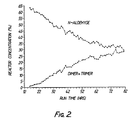
- the build-up of "heavies" in the reaction medium is monitored in a similar manner to that used in Comparative Example A with the results set out below in Table 2.
- the apparatus used in this experiment was constructed as illustrated diagrammatically in Figure 1 except that the volume of autoclave 1 was 300 cc which was charged at start up with 175 ml of a solution containing 10% w/v triphenylphosphine in n -nonanal containing 200 ppm w/w rhodium added as HRb(CO)(PPh3)3.
- the olefin was liquid 1-octene; this was fed to autoclave 1 at an initial liquid feed rate of 58 ml/hr.
- the feed gas was a mixture of H2, CO and N2.
- the reactor temperature was held at 120°C, with a total pressure of 195 psia (13.44 bar).
- the hydrogen partial pressure was 60 psia (4.13 bar), whilst that of carbon monoxide was 15 psia (1.03 bar) and that of nitrogen and the organic components was 120 psia (8.27 bar).
- the liquid recycle rate in line 12 was 90 ml/hr, whilst the temperature in evaporator 24 was maintained by supplying hot oil at a temperature of from about 110°C to about 120°C in line 27.
- the pressure in evaporator 24 was 10 mm Hg (0.0133 bar).
- n -nonanal n -nonanal
- heavies i.e. mainly C18-dimers and C27-trimers
- Comparative Example B the operating conditions used in Comparative Example B were selected so as to provide an accelerated rate of "heavies" formation such that the experiment could be completed within a reasonable time.
- operating conditions for a commercial plant could be somewhat less severe; in particular, an operating temperature appreciably lower than 120°C (e.g. about 80°C to about 105°C could be used, which would result in a correspondingly lower rate of "heavies" formation.
- Filmer 351 is a mixture of aldehyde condensation products of the type discussed in US-A-4148830, obtained as a by-product of the hydroformylation of propylene; it is mainly a mixture of C12 "trimer III” and “trimer IV” type products and has a boiling point at 10 mm Hg (0.0133 bar) of approximately 140°C.
- "Filmer” is a trade name of Union Carbide Corporation of Old Ridgebury Road Danbury Connecticut 06817, United States of America).
- n -nonanal feed - was changed to a solution of approximately 3.0% v/v Filmer 351 in n -nonanal. This concentration was sufficient to ensure that the rate of removal of Filmer 351 by vaporisation in evaporator 24 balanced its rate of introduction, along with n -nonanal, by way of line 9. In this way a substantially constant liquid composition was achieved in autoclave 1 such that the n -nonanal concentration in the liquid medium was approximately 30%, corresponding to the aldehyde concentration at the end of Comparative Example B.
- rhodium in the form of HRh(CO)(PPh3)3, was charged to autoclave 1 so as to result in a rhodium concentration of 200 ppm w/v, calculated as rhodium metal.
- the feed to the reactor was then changed to 58 ml/hr of a 3% v/v solution of Filmer 351 in 1-octene.
- the temperature of autoclave 1 was raised to 120°C and hot oil was circulated through evaporator 24, also at 120°C.
- Example 2 the conditions selected in Example 2 are more severe than the conditions preferred for industrial operation of the process, having been selected so as to be directly comparable with the conditions of Comparative Example B (which were in turn selected with the specific aim of causing a significant rate of formation of C18 and higher "heavies" in the reaction solution such that the experiment would be completed within a reasonable time).
- a temperature of, for example, about 105°C could be used, thus resulting in a correspondingly lower rate of formation of C18 and higher "heavies” than is indicated in Figure 3.
Landscapes
- Chemical & Material Sciences (AREA)
- Organic Chemistry (AREA)
- Chemical Kinetics & Catalysis (AREA)
- Crystallography & Structural Chemistry (AREA)
- Inorganic Chemistry (AREA)
- Engineering & Computer Science (AREA)
- Materials Engineering (AREA)
- Organic Low-Molecular-Weight Compounds And Preparation Thereof (AREA)
- Low-Molecular Organic Synthesis Reactions Using Catalysts (AREA)
- Catalysts (AREA)
Claims (20)
Priority Applications (1)
| Application Number | Priority Date | Filing Date | Title |
|---|---|---|---|
| AT87903733T ATE66668T1 (de) | 1986-07-01 | 1987-06-12 | Verfahren zur herstellung von aldehyden durch hydroformylierung. |
Applications Claiming Priority (6)
| Application Number | Priority Date | Filing Date | Title |
|---|---|---|---|
| GB8616038 | 1986-07-01 | ||
| GB868616038A GB8616038D0 (en) | 1986-07-01 | 1986-07-01 | Process |
| GB8705108 | 1987-03-05 | ||
| GB878705108A GB8705108D0 (en) | 1987-03-05 | 1987-03-05 | Process |
| GB8706265 | 1987-03-17 | ||
| GB878706265A GB8706265D0 (en) | 1987-03-17 | 1987-03-17 | Process |
Publications (2)
| Publication Number | Publication Date |
|---|---|
| EP0313559A1 EP0313559A1 (de) | 1989-05-03 |
| EP0313559B1 true EP0313559B1 (de) | 1991-08-28 |
Family
ID=27263082
Family Applications (1)
| Application Number | Title | Priority Date | Filing Date |
|---|---|---|---|
| EP87903733A Expired - Lifetime EP0313559B1 (de) | 1986-07-01 | 1987-06-12 | Verfahren zur herstellung von aldehyden durch hydroformylierung |
Country Status (13)
| Country | Link |
|---|---|
| US (1) | US5053551A (de) |
| EP (1) | EP0313559B1 (de) |
| JP (1) | JPH0832646B2 (de) |
| KR (1) | KR950012999B1 (de) |
| AT (1) | ATE66668T1 (de) |
| AU (1) | AU612580B2 (de) |
| BR (1) | BR8707736A (de) |
| CA (1) | CA1308118C (de) |
| DE (1) | DE3772574D1 (de) |
| DK (1) | DK85888A (de) |
| ES (1) | ES2007088A6 (de) |
| MX (1) | MX168892B (de) |
| WO (1) | WO1988000179A2 (de) |
Families Citing this family (14)
| Publication number | Priority date | Publication date | Assignee | Title |
|---|---|---|---|---|
| SG43278A1 (en) * | 1992-09-25 | 1997-10-17 | Mitsubishi Chem Corp | A method of controlling a hydroformylation reaction |
| DE4300921C1 (de) * | 1993-01-15 | 1994-04-14 | Hoechst Ag | Verfahren zur Lösungsmittel-Rückgewinnung sowie dafür geeignete Vorrichtung |
| JP3551509B2 (ja) * | 1994-12-12 | 2004-08-11 | 三菱化学株式会社 | アルデヒド類の製造方法 |
| AU725968B2 (en) * | 1996-11-26 | 2000-10-26 | Shell Internationale Research Maatschappij B.V. | Highly branched primary alcohol compositions, and biodegradable detergents made therefrom |
| US6035743A (en) * | 1998-03-18 | 2000-03-14 | Schwinn Cycling & Fitness Inc. | Multi-functional clipless pedal |
| TWI427094B (zh) * | 2010-10-25 | 2014-02-21 | Nanya Plastics Corp | 一種提高丙二酚型氫化環氧樹脂產率的氫化方法 |
| MY172695A (en) | 2012-04-12 | 2019-12-10 | Basf Se | Method for replenishing the catalyst in continuous hydroformylation |
| MX2015002936A (es) * | 2012-09-07 | 2016-01-25 | Hse Hitit Solar Enerji Anonim Sirketi | Sistema de destilacion al vacio producido por una columna barometrica. |
| KR20140042402A (ko) * | 2012-09-28 | 2014-04-07 | 주식회사 엘지화학 | 올레핀으로부터 알코올의 제조장치 및 제조방법 |
| KR102743230B1 (ko) * | 2015-11-10 | 2024-12-17 | 다우 테크놀로지 인베스트먼츠 엘엘씨. | 알데하이드를 생산하는 방법 |
| CN109499081A (zh) * | 2018-12-04 | 2019-03-22 | 江苏拓驰工程技术开发有限公司 | 一种带刮板加热功能的刮膜蒸发器 |
| CA3128859A1 (en) * | 2019-03-05 | 2020-09-10 | Basf Se | Mixture of octene hydroformylation by-product and diesel, kereosene or c8-c20 olefines as collectors |
| US11993567B2 (en) | 2020-09-17 | 2024-05-28 | Lg Chem, Ltd. | Method for preparing aldehyde and apparatus for preparing aldehyde |
| CN114773172B (zh) * | 2022-06-20 | 2022-10-18 | 中海油天津化工研究设计院有限公司 | 一种烯烃氢甲酰化制醛工艺优化方法 |
Family Cites Families (24)
| Publication number | Priority date | Publication date | Assignee | Title |
|---|---|---|---|---|
| US3527809A (en) * | 1967-08-03 | 1970-09-08 | Union Carbide Corp | Hydroformylation process |
| GB1458375A (en) * | 1973-04-09 | 1976-12-15 | Ici Ltd | Hydroformylation |
| JPS582932B2 (ja) * | 1973-09-21 | 1983-01-19 | 三菱化学株式会社 | ブチルアルデヒドの製造法 |
| US4159999A (en) * | 1974-11-22 | 1979-07-03 | Celanese Corporation | Hydroformylation of olefins |
| US4148830A (en) * | 1975-03-07 | 1979-04-10 | Union Carbide Corporation | Hydroformylation of olefins |
| US4247486A (en) * | 1977-03-11 | 1981-01-27 | Union Carbide Corporation | Cyclic hydroformylation process |
| FR2351077A1 (fr) * | 1976-05-13 | 1977-12-09 | Celanese Corp | Procede perfectionne d'hydroformylation des olefines avec un catalyseur complexe au rhodium |
| US4282100A (en) * | 1978-09-18 | 1981-08-04 | The Sanko Steamship Co., Ltd. | Apparatus for reforming fuel oil wherein ultrasonic waves are utilized |
| DE2965158D1 (en) * | 1979-03-21 | 1983-05-11 | Davy Mckee London | Hydroformylation process |
| DE2965157D1 (en) * | 1979-03-21 | 1983-05-11 | Davy Mckee London | Process for the production of aldehydes by hydroformylation of alkenes |
| CA1123859A (en) * | 1979-06-18 | 1982-05-18 | Celanese Corporation | Hydroformylation process improved by choice of reaction solvent and control of product stripping parameters |
| US4329511A (en) * | 1979-06-18 | 1982-05-11 | Celanese Corporation | Hydroformylation process improved by choice of reaction solvent and control of product stripping parameters |
| JPS5645436A (en) * | 1979-09-21 | 1981-04-25 | Mitsubishi Chem Ind Ltd | Hydroformylation of olefin |
| US4283562A (en) * | 1979-10-26 | 1981-08-11 | Union Carbide Corporation | Hydroformylation process using stable rhodium catalyst |
| US4260828A (en) * | 1980-04-16 | 1981-04-07 | Union Carbide Corporation | Hydroformylation process |
| DE3114147A1 (de) * | 1981-04-08 | 1982-10-28 | Basf Ag, 6700 Ludwigshafen | Verfahren zur gewinnung von aldehyden |
| ATE28183T1 (de) * | 1982-06-11 | 1987-07-15 | Davy Mckee London | Hydroformylierungsverfahren. |
| DE3371067D1 (en) * | 1982-06-11 | 1987-05-27 | Davy Mckee London | Hydroformylation process |
| ATE16475T1 (de) * | 1982-06-11 | 1985-11-15 | Davy Mckee London | Hydroformylierungsverfahren. |
| EP0139702A1 (de) * | 1983-03-16 | 1985-05-08 | Exxon Research And Engineering Company | Hochtemperatur hydroformylierung |
| DE3341035A1 (de) * | 1983-11-12 | 1985-05-23 | Ruhrchemie Ag, 4200 Oberhausen | Verfahren zur herstellung von aldehyden |
| GB8334359D0 (en) * | 1983-12-23 | 1984-02-01 | Davy Mckee Ltd | Process |
| US4678857A (en) * | 1986-03-31 | 1987-07-07 | Texaco Inc. | Process for separation of product resulting from hydroformylation |
| GB2192182B (en) * | 1986-07-01 | 1990-05-23 | Davy Mckee | Process for the production of aldehydes |
-
1987
- 1987-06-12 EP EP87903733A patent/EP0313559B1/de not_active Expired - Lifetime
- 1987-06-12 BR BR8707736A patent/BR8707736A/pt not_active IP Right Cessation
- 1987-06-12 KR KR1019880700224A patent/KR950012999B1/ko not_active Expired - Lifetime
- 1987-06-12 WO PCT/GB1987/000408 patent/WO1988000179A2/en not_active Ceased
- 1987-06-12 AT AT87903733T patent/ATE66668T1/de not_active IP Right Cessation
- 1987-06-12 AU AU74820/87A patent/AU612580B2/en not_active Ceased
- 1987-06-12 US US07/278,437 patent/US5053551A/en not_active Expired - Lifetime
- 1987-06-12 JP JP62503454A patent/JPH0832646B2/ja not_active Expired - Lifetime
- 1987-06-12 DE DE8787903733T patent/DE3772574D1/de not_active Expired - Lifetime
- 1987-06-30 CA CA000540943A patent/CA1308118C/en not_active Expired - Lifetime
- 1987-07-01 MX MX007175A patent/MX168892B/es unknown
- 1987-07-01 ES ES8702168A patent/ES2007088A6/es not_active Expired
-
1988
- 1988-02-19 DK DK085888A patent/DK85888A/da not_active Application Discontinuation
Also Published As
| Publication number | Publication date |
|---|---|
| EP0313559A1 (de) | 1989-05-03 |
| KR880701699A (ko) | 1988-11-04 |
| US5053551A (en) | 1991-10-01 |
| DE3772574D1 (de) | 1991-10-02 |
| BR8707736A (pt) | 1989-10-31 |
| DK85888D0 (da) | 1988-02-19 |
| WO1988000179A2 (en) | 1988-01-14 |
| WO1988000179A3 (en) | 1988-01-28 |
| CA1308118C (en) | 1992-09-29 |
| ATE66668T1 (de) | 1991-09-15 |
| MX168892B (es) | 1993-06-14 |
| DK85888A (da) | 1988-02-19 |
| ES2007088A6 (es) | 1989-06-01 |
| AU612580B2 (en) | 1991-07-18 |
| AU7482087A (en) | 1988-01-29 |
| JPH01503532A (ja) | 1989-11-30 |
| JPH0832646B2 (ja) | 1996-03-29 |
| KR950012999B1 (ko) | 1995-10-24 |
Similar Documents
| Publication | Publication Date | Title |
|---|---|---|
| EP0016285B2 (de) | Verfahren zur Herstellung von Valeraldehyden durch Hydroformylierung von Buten-1 | |
| EP0016286B1 (de) | Hydroformylierungsverfahren | |
| EP0313559B1 (de) | Verfahren zur herstellung von aldehyden durch hydroformylierung | |
| EP0484977B1 (de) | Trennung von Aldehydgemischen | |
| CA1194038A (en) | Hydroformylation process | |
| US4496768A (en) | Process for the production of aldehydes by hydroformylation of alpha-olefins | |
| KR100198688B1 (ko) | 하이드로포밀화 방법 | |
| US7935850B2 (en) | Process for hydroformylation of propylene | |
| EP0149894A2 (de) | Hydroformylierungsverfahren | |
| US4792636A (en) | Process of recovering aldehydes | |
| WO2021126421A1 (en) | Processes for preparing isoprene and mono-olefins comprising at least six carbon atoms | |
| EP4448171B1 (de) | Vorkatalysatorzusammensetzungen mit übergangsmetallkomplexhydroformylierung mit solchen verbindungen und hydroformylierungsverfahren | |
| GB1599921A (en) | Hydroformylation process | |
| RU2005714C1 (ru) | Способ непрерывного получения альдегидов c7-c17 | |
| NO169538B (no) | Fremgangsmaate for fremstilling av aldehyder ved hydroformylering | |
| CA1129439A (en) | Process | |
| KR810001392B1 (ko) | 환류 하이드로포르밀화 방법 | |
| CN87104616A (zh) | 工艺过程 |
Legal Events
| Date | Code | Title | Description |
|---|---|---|---|
| PUAI | Public reference made under article 153(3) epc to a published international application that has entered the european phase |
Free format text: ORIGINAL CODE: 0009012 |
|
| 17P | Request for examination filed |
Effective date: 19881114 |
|
| AK | Designated contracting states |
Kind code of ref document: A1 Designated state(s): AT BE CH DE FR GB IT LI LU NL SE |
|
| D17D | Deferred search report published (deleted) | ||
| 17Q | First examination report despatched |
Effective date: 19900913 |
|
| RAP1 | Party data changed (applicant data changed or rights of an application transferred) |
Owner name: DAVY MCKEE (LONDON) LIMITED |
|
| GRAA | (expected) grant |
Free format text: ORIGINAL CODE: 0009210 |
|
| AK | Designated contracting states |
Kind code of ref document: B1 Designated state(s): AT BE CH DE FR GB IT LI LU NL SE |
|
| REF | Corresponds to: |
Ref document number: 66668 Country of ref document: AT Date of ref document: 19910915 Kind code of ref document: T |
|
| ET | Fr: translation filed | ||
| REF | Corresponds to: |
Ref document number: 3772574 Country of ref document: DE Date of ref document: 19911002 |
|
| ITF | It: translation for a ep patent filed | ||
| PLBI | Opposition filed |
Free format text: ORIGINAL CODE: 0009260 |
|
| 26 | Opposition filed |
Opponent name: BASF AKTIENGESELLSCHAFT, LUDWIGSHAFEN Effective date: 19920529 |
|
| NLR1 | Nl: opposition has been filed with the epo |
Opponent name: BASF AG |
|
| PGFP | Annual fee paid to national office [announced via postgrant information from national office to epo] |
Ref country code: CH Payment date: 19930628 Year of fee payment: 7 |
|
| PGFP | Annual fee paid to national office [announced via postgrant information from national office to epo] |
Ref country code: LU Payment date: 19930719 Year of fee payment: 7 |
|
| PLBN | Opposition rejected |
Free format text: ORIGINAL CODE: 0009273 |
|
| STAA | Information on the status of an ep patent application or granted ep patent |
Free format text: STATUS: OPPOSITION REJECTED |
|
| 27O | Opposition rejected |
Effective date: 19930624 |
|
| EPTA | Lu: last paid annual fee | ||
| NLR2 | Nl: decision of opposition | ||
| PG25 | Lapsed in a contracting state [announced via postgrant information from national office to epo] |
Ref country code: LU Free format text: LAPSE BECAUSE OF NON-PAYMENT OF DUE FEES Effective date: 19940612 |
|
| PG25 | Lapsed in a contracting state [announced via postgrant information from national office to epo] |
Ref country code: LI Effective date: 19940630 Ref country code: CH Effective date: 19940630 |
|
| EAL | Se: european patent in force in sweden |
Ref document number: 87903733.1 |
|
| REG | Reference to a national code |
Ref country code: CH Ref legal event code: PL |
|
| PGFP | Annual fee paid to national office [announced via postgrant information from national office to epo] |
Ref country code: AT Payment date: 19960612 Year of fee payment: 10 |
|
| PGFP | Annual fee paid to national office [announced via postgrant information from national office to epo] |
Ref country code: NL Payment date: 19960626 Year of fee payment: 10 |
|
| PGFP | Annual fee paid to national office [announced via postgrant information from national office to epo] |
Ref country code: BE Payment date: 19960731 Year of fee payment: 10 |
|
| PG25 | Lapsed in a contracting state [announced via postgrant information from national office to epo] |
Ref country code: AT Effective date: 19970612 |
|
| PG25 | Lapsed in a contracting state [announced via postgrant information from national office to epo] |
Ref country code: BE Effective date: 19970630 |
|
| BERE | Be: lapsed |
Owner name: DAVY MCKEE (LONDON) LTD Effective date: 19970630 |
|
| PG25 | Lapsed in a contracting state [announced via postgrant information from national office to epo] |
Ref country code: NL Effective date: 19980101 |
|
| NLV4 | Nl: lapsed or anulled due to non-payment of the annual fee |
Effective date: 19980101 |
|
| REG | Reference to a national code |
Ref country code: GB Ref legal event code: IF02 |
|
| PGFP | Annual fee paid to national office [announced via postgrant information from national office to epo] |
Ref country code: SE Payment date: 20060607 Year of fee payment: 20 Ref country code: GB Payment date: 20060607 Year of fee payment: 20 |
|
| PGFP | Annual fee paid to national office [announced via postgrant information from national office to epo] |
Ref country code: FR Payment date: 20060608 Year of fee payment: 20 Ref country code: DE Payment date: 20060608 Year of fee payment: 20 |
|
| PGFP | Annual fee paid to national office [announced via postgrant information from national office to epo] |
Ref country code: IT Payment date: 20060630 Year of fee payment: 20 |
|
| REG | Reference to a national code |
Ref country code: GB Ref legal event code: PE20 |
|
| EUG | Se: european patent has lapsed | ||
| PG25 | Lapsed in a contracting state [announced via postgrant information from national office to epo] |
Ref country code: GB Free format text: LAPSE BECAUSE OF EXPIRATION OF PROTECTION Effective date: 20070611 |