EP0314100A2 - Alphatyp-Titanylphthalocyanin-Zusammensetzung, Verfahren zu ihrer Herstellung und ihre Verwendung in elektrophotographischen Materialien - Google Patents
Alphatyp-Titanylphthalocyanin-Zusammensetzung, Verfahren zu ihrer Herstellung und ihre Verwendung in elektrophotographischen Materialien Download PDFInfo
- Publication number
- EP0314100A2 EP0314100A2 EP88117838A EP88117838A EP0314100A2 EP 0314100 A2 EP0314100 A2 EP 0314100A2 EP 88117838 A EP88117838 A EP 88117838A EP 88117838 A EP88117838 A EP 88117838A EP 0314100 A2 EP0314100 A2 EP 0314100A2
- Authority
- EP
- European Patent Office
- Prior art keywords
- titanyl phthalocyanine
- type titanyl
- type
- composition
- electric charge
- Prior art date
- Legal status (The legal status is an assumption and is not a legal conclusion. Google has not performed a legal analysis and makes no representation as to the accuracy of the status listed.)
- Granted
Links
- 0 C*[C@](C)N*C(C)C Chemical compound C*[C@](C)N*C(C)C 0.000 description 3
Images

Classifications
-
- G—PHYSICS
- G03—PHOTOGRAPHY; CINEMATOGRAPHY; ANALOGOUS TECHNIQUES USING WAVES OTHER THAN OPTICAL WAVES; ELECTROGRAPHY; HOLOGRAPHY
- G03G—ELECTROGRAPHY; ELECTROPHOTOGRAPHY; MAGNETOGRAPHY
- G03G5/00—Recording-members for original recording by exposure, e.g. to light, to heat or to electrons; Manufacture thereof; Selection of materials therefor
-
- G—PHYSICS
- G03—PHOTOGRAPHY; CINEMATOGRAPHY; ANALOGOUS TECHNIQUES USING WAVES OTHER THAN OPTICAL WAVES; ELECTROGRAPHY; HOLOGRAPHY
- G03G—ELECTROGRAPHY; ELECTROPHOTOGRAPHY; MAGNETOGRAPHY
- G03G5/00—Recording-members for original recording by exposure, e.g. to light, to heat or to electrons; Manufacture thereof; Selection of materials therefor
- G03G5/02—Charge-receiving layers
- G03G5/04—Photoconductive layers; Charge-generation layers or charge-transporting layers; Additives therefor; Binders therefor
- G03G5/06—Photoconductive layers; Charge-generation layers or charge-transporting layers; Additives therefor; Binders therefor characterised by the photoconductive material being organic
- G03G5/0664—Dyes
- G03G5/0696—Phthalocyanines
-
- C—CHEMISTRY; METALLURGY
- C09—DYES; PAINTS; POLISHES; NATURAL RESINS; ADHESIVES; COMPOSITIONS NOT OTHERWISE PROVIDED FOR; APPLICATIONS OF MATERIALS NOT OTHERWISE PROVIDED FOR
- C09B—ORGANIC DYES OR CLOSELY-RELATED COMPOUNDS FOR PRODUCING DYES, e.g. PIGMENTS; MORDANTS; LAKES
- C09B47/00—Porphines; Azaporphines
- C09B47/04—Phthalocyanines abbreviation: Pc
- C09B47/045—Special non-pigmentary uses, e.g. catalyst, photosensitisers of phthalocyanine dyes or pigments
-
- C—CHEMISTRY; METALLURGY
- C09—DYES; PAINTS; POLISHES; NATURAL RESINS; ADHESIVES; COMPOSITIONS NOT OTHERWISE PROVIDED FOR; APPLICATIONS OF MATERIALS NOT OTHERWISE PROVIDED FOR
- C09B—ORGANIC DYES OR CLOSELY-RELATED COMPOUNDS FOR PRODUCING DYES, e.g. PIGMENTS; MORDANTS; LAKES
- C09B67/00—Influencing the physical, e.g. the dyeing or printing properties of dyestuffs without chemical reactions, e.g. by treating with solvents grinding or grinding assistants, coating of pigments or dyes; Process features in the making of dyestuff preparations; Dyestuff preparations of a special physical nature, e.g. tablets, films
- C09B67/0001—Post-treatment of organic pigments or dyes
- C09B67/0017—Influencing the physical properties by treatment with an acid, H2SO4
- C09B67/0019—Influencing the physical properties by treatment with an acid, H2SO4 of phthalocyanines
-
- C—CHEMISTRY; METALLURGY
- C09—DYES; PAINTS; POLISHES; NATURAL RESINS; ADHESIVES; COMPOSITIONS NOT OTHERWISE PROVIDED FOR; APPLICATIONS OF MATERIALS NOT OTHERWISE PROVIDED FOR
- C09B—ORGANIC DYES OR CLOSELY-RELATED COMPOUNDS FOR PRODUCING DYES, e.g. PIGMENTS; MORDANTS; LAKES
- C09B67/00—Influencing the physical, e.g. the dyeing or printing properties of dyestuffs without chemical reactions, e.g. by treating with solvents grinding or grinding assistants, coating of pigments or dyes; Process features in the making of dyestuff preparations; Dyestuff preparations of a special physical nature, e.g. tablets, films
- C09B67/0025—Crystal modifications; Special X-ray patterns
- C09B67/0026—Crystal modifications; Special X-ray patterns of phthalocyanine pigments
-
- C—CHEMISTRY; METALLURGY
- C09—DYES; PAINTS; POLISHES; NATURAL RESINS; ADHESIVES; COMPOSITIONS NOT OTHERWISE PROVIDED FOR; APPLICATIONS OF MATERIALS NOT OTHERWISE PROVIDED FOR
- C09B—ORGANIC DYES OR CLOSELY-RELATED COMPOUNDS FOR PRODUCING DYES, e.g. PIGMENTS; MORDANTS; LAKES
- C09B67/00—Influencing the physical, e.g. the dyeing or printing properties of dyestuffs without chemical reactions, e.g. by treating with solvents grinding or grinding assistants, coating of pigments or dyes; Process features in the making of dyestuff preparations; Dyestuff preparations of a special physical nature, e.g. tablets, films
- C09B67/0033—Blends of pigments; Mixtured crystals; Solid solutions
- C09B67/0034—Mixtures of two or more pigments or dyes of the same type
- C09B67/0035—Mixtures of phthalocyanines
-
- C—CHEMISTRY; METALLURGY
- C09—DYES; PAINTS; POLISHES; NATURAL RESINS; ADHESIVES; COMPOSITIONS NOT OTHERWISE PROVIDED FOR; APPLICATIONS OF MATERIALS NOT OTHERWISE PROVIDED FOR
- C09B—ORGANIC DYES OR CLOSELY-RELATED COMPOUNDS FOR PRODUCING DYES, e.g. PIGMENTS; MORDANTS; LAKES
- C09B67/00—Influencing the physical, e.g. the dyeing or printing properties of dyestuffs without chemical reactions, e.g. by treating with solvents grinding or grinding assistants, coating of pigments or dyes; Process features in the making of dyestuff preparations; Dyestuff preparations of a special physical nature, e.g. tablets, films
- C09B67/0096—Purification; Precipitation; Filtration
Definitions
- This invention relates to an ⁇ -type titanyl phthalocyanine composition used advantageously as a sensitive material in an image forming device such as a copying machine or a laser beam printer, to a method for the production of the composition, and to an electrophotographic sensitive material using the composition.
- the electrophotographic process using the laser beam printer quality sensitive material comprises a charging step for uniformly charging a sensitive material by corona discharge, an exposing step for exposing the charged sensitive material through the image of an original to a semiconductor laser thereby forming on the sensitive material a latent electrostatic image corresponding to the image of the original, etc. Quantity production of electrophotographic copies is attained by repeating the electrophotographic process mentioned above.
- the sensitive material is required to manifest a satisfactory charging property and suffer only from small dark attenuation.
- the exposing step it is required to exhibit high sensitivity to wavelengths approximately in the range of 780 to 820 nm, the wavelengths inherent in the semiconductor laser and suffer sparingly from residual potential after the exposure to the semiconductor laser.
- the sensitive material is also required to suffer sparingly from deterioration of the properties mentioned above during the course of repeated use.
- phthalocyanine compounds which exhibit high sensitivity to wavelengths falling in the aforementioned range of wavelengths inherent in the semiconductor laser.
- Some of the phthalocyanine compounds are metal-free phthalocyanines which are devoid of a central metal and the remainder phthalocyanine compounds are metal phthalocyanines which are possessed of a central metal. They are otherwise classified by the crystal form under ⁇ type, ⁇ type, ⁇ type, etc.
- some of the metal-free phthalocyanines excel in photoconductivity and exhibit high sensitivity to wavelengths in the aforementioned range (about 780 to 820 nm).
- the metal-free phthalocyanines possess a metastable crystal form. It is, therefore, difficult to obtain a sensitive material possessing stable properties from a metal-free phthalocyanine.
- Metal phthalocyanines such as copper phthalocyanine occur in various crystal forms such as ⁇ type, ⁇ type, ⁇ type, and ⁇ type. It has been known that the ⁇ -type copper phthalocyanine among other crystal forms possesses an absorption zone on the long wavelength side and exhibits spectral sensitivity also on the long wavelength side (Denshishashin Gakkaishi [Journal of Electrophotographic Society], Vol. 22, No. 2, page 111, 1984).
- the copper phthalocyanine is still deficient in sensitivity.
- Sensitive materials which contain in the sensitive layer thereof titanyl phthalocyanine possessing titanium as a coordination metal like a composite electrophotographic sensitive material which is provided with a sensitive layer having ⁇ -type titanyl phthalocyanine dispersed in a binder have been proposed.
- a composite electrophotographic sensitive material which possesses a sensitive layer having ⁇ -type titanyl phthalocyanine dispersed in a binding agent (Japanese Patent Application Disclosure SHO 61(1986)-239,248) and an electrophotographic sensitive material which has an electric charge transfer layer superposed on an electric charge generating layer having a specific titanyl phthalocyanine dispersed in a binding agent (Japanese Patent Application Disclosure SHO 62(1987)-67,094) may be mentioned.
- the electrophotographic sensitive materials which use as a photoconductive substance titanyl phthalocyanine of the sort described above exhibit appreciably high sensitivity to wavelengths in the aforementioned range of wavelengths inherent in the semiconductor laser and, at the same time, excel in electrical properties including the charging property.
- electrophotographic sensitive materials described above pose as a problem the deficiency in sensitivity as well as in such electrical properties as charging property, dark attenuation, and residual potential.
- An object of this invention is to provide an ⁇ -type titanyl phthalocyanine composition which excels not only in sensitivity but also in such electrical properties as charging property, dark attenuation, and residual potential, a method for the production of the composition, and an electrophotographic sensitive material using the composition.
- the first aspect of this invention concerns an ⁇ -type titanyl phthalocyanine composition which comprises an ⁇ -type titanyl phthalocyanine and a metal-free phthalocyanine.
- the ⁇ -type titanyl phthalocyanine composition enjoys stability, absorbs wavelength distributed in a wide range, and exhibits high spectral sensitivity because it contains an ⁇ -type titanyl phthalocyanine in combination with a metal-free phthalocyanine.
- the second aspect of this invention concerns a method for the production of an ⁇ -type titanyl phthalocyanine composition, which method comprises converting titanyl phthalocyanine into a pigment by the acid paste process consisting in pouring into water a concentrated sulfuric acid solution containing at least titanyl phthalocyanine thereby producing an ⁇ -type titanyl phthalocyanine composition comprising an ⁇ -type titanyl phthalocyanine and a metal-free phthalocyanine.
- an ⁇ -type titanyl phthalocyanine composition comprising an ⁇ -type titanyl phthalocyanine and a metal-free phthalocyanine can be easily produced.
- the third aspect of the present invention concerns as electrophotographic sensitive material which has superposed on an electroconductive substrate a sensitive layer comprising an ⁇ -type titanyl phthalocyanine and metal-free phthalocyanine.
- the fourth aspect of this invention concerns an electrophotographic sensitive material which has superposed on an electroconductive substrate a sensitive layer comprising an a-type titanyl phthalocyanine composition and an electric charge transfer material possessing an oxidation potential in the range of 0.45 to 0.65 eV.
- the electrophotographic sensitive material according to the third or fourth aspect of this invention not only excels in charging property and dark attenuation but also exhibits high sensitivity to wavelengths falling in the range of wavelengths inherent in the semiconductor laser and suffers sparingly from residual potential because the phthalocyanines in this sensitive material comprise an ⁇ -type titanyl phthalocyanine and a metal-free phthalocyanine.
- the ⁇ -type titanyl phthalocyanine metnioned above is represented by the following general formula. (wherein X stands for a halogen atom and n for 0 or a positive integer of the value of at least 1).
- the halogen atom is desired to be bromine or chlorine and n to be 0.
- the ⁇ -type titanyl phthalocyanine composition contains a metal-free phthalocyanine in combination with the ⁇ -type titanyl phthalocyanine.
- the ⁇ -type titanyl phthalocyanine composition is enabled to acquire enhanced stability and excel in charging property and sensitive properties, particularly in sensitivity.
- the ratio of the ⁇ -type titanyl phthalocyanine to the metal-free phthalocyanine in the ⁇ -type titanyl phthalocyanine composition is not particularly restricted but may be varied.
- the ⁇ -type titanyl phthalocyanine composition comprises 40 to 99.5% by weight, preferably 60 to 90% by weight, of an ⁇ -type titanyl phthalocyanine and 0.5 to 60% by weight, preferably 10 to 40% by weight, of a metal-free phthalocyanine.
- the ⁇ -type titanyl phthalocyanine composition of the percentage composition described above excels especially in stability. When it is used as a photoconductive substance for the electrophotographic sensitive material, it manifests outstanding charging property, small dark attenuation, high sensitivity, small residual potential, and highly satisfactory charging property and sensitive property.
- the ⁇ -type titanyl phthalocyanine composition does not easily acquire high sensitivity because the half-value amount of exposure, E 1/2 ( ⁇ J/cm2), a criterion of sensitivity, in the range of wavelengths inherent in the semiconductor laser increases.
- the ⁇ -type titanyl phthalocyanine composition possessing the percentage composition specified above exhibits such sensitivity that the half-value amount of exposure, E 1/2, relative to the semiconductor laser of a wavelength of 780 nm is not more than 0.6 ⁇ J/cm2.
- the ⁇ -type titanyl phthalocyanine composition of the aforementioned percentage composition may be produced by mixing in a prescribed ratio an ⁇ -type titanyl phthalocyanine and a metal-free phthalocyanine separately prepared in advance.
- the ⁇ -type titanyl phthalocyanine composition which shows strong diffraction peaks at the Bragg angles (2 ⁇ ⁇ 0.2°) of 6.9°, 9.6°, 15.6°, 17.6°, 21.9°, 23.6°, 24.7°, and 28.0°, the largest diffraction peak at 6.9° among others, in the X-ray diffraction spectrum especially excels in charging property and sensitive property.
- the ⁇ -type titanyl phthalocyanine composition may incorporate therein to an extent incapable of impairing sensitive property and electrical properties including charging property other phthalocyanines such as, for example, copper phthalocyanine, vanadyl phthalocyanine, chloroaluminum phthalocyanine, chloroindium phthalocyanine, chlorogallium phthalocyanine, and magnesium phthalocyanine and titanyl phthalocyanines of other crystal forms.
- phthalocyanines such as, for example, copper phthalocyanine, vanadyl phthalocyanine, chloroaluminum phthalocyanine, chloroindium phthalocyanine, chlorogallium phthalocyanine, and magnesium phthalocyanine and titanyl phthalocyanines of other crystal forms.
- the ⁇ -type titanyl phthalocyanine composition need not have been treated, it is desired to have been treated with such surface treating agents as a titanium coupling agent and a silane coupling agent, preferably with a silane coupling agent so as to be improved in stability.
- the treatment with the surface treating agent imparts to the ⁇ -type titanyl phthalocyanine composition outstanding stability to resist the impacts of aging and the composition, when used as a photoconductive substance for the sensitive layer, exhibits a stable charging property.
- the amount of the surface treating agent to be used for this treatment may be suitably selected, it is generally in the range of 0.001 to 5% by weight, preferably 0.01 to 1% by weight, based on the amount of the composition to be treated.
- the ⁇ -type titanyl phthalocyanine composition can be produced by various methods. For example, it can be produced by preparing a titanyl phthalocyanine and converting the titanyl phthalocyanine into a pigment in accordance with the acid paste process consisting in pouring into water a sulfuric acid solution containing at least the titanyl phthalocyanine and optionally incorporating therein a required amount of metal-free phthalocyanine.
- the titanyl phthalocyanine may be produced by causing 1,2-dicyanobenzene to react with a titanium halogenide such as titanium tetrachloride, titanium trichloride, or titanium tetrabromide and hydrolyzing the resultant reaction product.
- a titanium halogenide such as titanium tetrachloride, titanium trichloride, or titanium tetrabromide
- it is produced by hydrolyzing the titanyl phthalocyanine obtained by the reaction of the following formula:
- alkoxy groups of 1 to 6 carbon atoms such as methoxy, ethoxy, propoxy, isopropoxy, butoxy, iso-butoxy, tert.-butoxy, pentyloxy, and hexyloxy groups.
- the reaction mentioned above is effected by heating 1,3-diiminoisoindolenine and an organic titanium compound in an inactive solvent such as, for example, quinoline; alkylbenzene such as benzene, toluene, or xylene; or trichlorobenzene at a temperature in the range of 100° to 250°C, preferably 150° to 200°C.
- an inactive solvent such as, for example, quinoline; alkylbenzene such as benzene, toluene, or xylene; or trichlorobenzene
- the produced titanyl phthalocyanine composition is separated from the reaction mixture by filtration, washed with the reaction solvent mentioned above for removal of impurities and unaltered raw materials, and then optionally washed with alcohol or ether.
- the titanyl phthalocyanine composition thus obtained is coarse and ununiform in crystal form and particle diameter. When used as a sensitive material, it betrays deficiency in charging property and sensitive property and manifests stable properties only with difficulty.
- the titanyl phthalocyanine composition obtained by the reaction mentioned above therefore, is converted into a pigment by the acid paste process. Consequently, there is produced an ⁇ -type titanyl phthalocyanine composition comprising an ⁇ -type titanyl phthalocyanine and a metal-free phthalocyanine and excelling in charging property and sensitive property.
- the pigmentation by the acid paste process is carried out by dissolving the titanyl phthalocyanine in sulfuric acid of a suitable concentration and pouring the resultant solution into water.
- the conditions under which the pigmentation by the acid paste process is performed are not particularly restricted but may be freely set so as to suit the properties to be desired.
- the concentration of the sulfuric acid to be used for the pigmentation may be suitably selected.
- sulfuric acid of a high concentration in the range of 92 to 105% (fuming sulfuric acid), desirably 94 to 105%, or more desirably 98 to 100% is used in an amount not less than 15 times, preferably 15 to 60 times, the amount of titanyl phthalocyanine and the resultant concentrated sulfuric acid solution of titanyl phthalocyanine is heated at a temperature in the range of 0° to 40°C to effect pigmentation of the titanyl phthalocyanine, the ⁇ -type titanyl phthalocyanine composition consequently obtained excels in stability, charging property, and sensitive property in a greater measure.
- the range of concentration, 92 to 105%, fixed for the concentrated sulfuric acid is critical because the sensitive property is impaired when the concentration is less than 92% and the charging property is impaired when the concentration exceeds 105%.
- the lower limit of the amount of the concentrated sulfuric acid is fixed at 15 times the amount of titanyl phthalocyanine because the titanyl phthalocyanine cannot be easily dissolved uniformly when the amount of the concentrated sulfuric acid is less than 15 times that of the titanyl phthalocyanine.
- the operational efficiency of the pigmentation is inferior due to the inconveniences caused on the part of refrigerating device and facilities. If the temperature exceeds 40°C, the sensitivity is liable to be impaired.
- the time for retention of the concentrated sulfuric acid solution at the temperature specified above and the time for purification by the pigmentation may be suitably selected. Generally, the total time required therefor is approximately in the range of 30 minutes to 12 hours.
- the pigmentation has the possibility of entailing a reaction tending to expel metal from the reaction system and cause a change in the composition of titanyl phthalocyanine.
- the reaction of synthesis mentioned above has the possibility of giving rise to a titanyl phthalocyanine containing a metal-free phthalocyanine.
- quinoline when used as an inactive solvent, the reaction possibly produces 10 to 20% by weight of a metal-free phthalocyanine.
- tetrabutoxy titanium is used as an organic titanium compound and trichlorobenzene or an alkylbenzene is used as an inactive solvent, the reaction possibly produces 0 to 10% by weight of metal-free phthalocyanine.
- the aforementioned repeated pigmentation by the acid paste process may be carried out without requiring the addition of the metal-free phthalocyanine.
- the produced ⁇ -type titanyl phthalocyanine composition is separated by filtration, washed, and then dried.
- the solvents available for this washing include water and various organic solvents such as alcohols represented by methanol, ethanol, and isopropanol, ethers represented by diethyl ether, dioxane, and tetrahydrofuran, and acetone, dichloromethane, and dimethylformamide, for example.
- organic solvents such as alcohols represented by methanol, ethanol, and isopropanol, ethers represented by diethyl ether, dioxane, and tetrahydrofuran, and acetone, dichloromethane, and dimethylformamide, for example.
- the washing of the separated ⁇ -type titanyl phthalocyanine composition with the solvent mentioned above can be carried out in any suitable manner.
- the composition in the solvent is dispersed and washed by virtue of ultrasonic waves.
- the drying of the washed composition may be carried out under normal pressure or under a vacuum at a suitable temperature in the range of 50° to 150°C, for example.
- the ⁇ -type titanyl phthalocyanine composition produced by the acid paste process described above can be used in its unmodified form as a photoconductive substance for the sensitive material.
- the ⁇ -type titanyl phthalocyanine composition For the purpose of adjusting the crystal form, heightening the stability of the ⁇ -type titanyl phthalocyanine composition and, at the same time, imparting enhanced sensitivity to the composition, however, it is desirable to subject the ⁇ -type titanyl phthalocyanine composition to a treatment with an organic solvent. It is still more desirable for the composition to be subjected to a wet milling treatment in the presence of a chlorine type solvent.
- alcohols such as methanol, ethanol, isopropanol, and butanol
- alicyclic hydrocarbons such as n-hexane, octane, and cyclohexane
- aromatic hydrocarbons such as benzene, toluene, and xylene
- ethers such as tetrahydrofuran, dioxane, diethyl ether, ethylene glycol dimethyl ether, and ethylene glycol diethyl ether
- ketones such as acetate cellosolve, acetone, ethylmethyl ketone, and cyclohexanone, isophorone
- esters such as methyl acetate and ethyl acetate
- non-chlorine type organic solvents dimethyl sulfoxide, dimethylformamide, phenol, cresol, anisole, nitrobenzene, acetophenone, benzyl
- isophorone, dichloromethane, chloroform, trichloroethane, and chloromethyloxirane are desirable choices and, among all others enumerated, dichloromethane proves to be particularly desirable because it permits production of a sensitive material of small residual potential.
- organic solvents and the chlorine type solvents mentioned above are used either singly or in the form of a mixture of two or more members.
- the aromatic compounds are liable to cause dislocation of the crystal form of titanyl phthalocyanine to the ⁇ -type and the aliphatic hydrocarbons are liable to facilitate production of an ⁇ -type titanyl phthalocyanine deficient in dispersibility.
- the treatment with the organic solvent mentioned above is effected by immersing the ⁇ -type titanyl phtalocyanine composition in the organic solvent held at normal room temperature and heated to a suitable temperature above the room temperature or by washing the composition with the organic solvent.
- the time for the treatment with the organic solvent may be suitable selected.
- the speed of crystallization is variable with the kind of solvent.
- this treatment is carried out for a period selected in the range of 10 minutes to 10 hours, depending on the kind of organic solvent to be used.
- the wet milling treatment is required only to be capable of exerting mechanical force on the ⁇ -type titanyl phthalocyanine composition and consequently causing this composition to be mixed and dispersed. It may be carried out with an attriter or a kneader. Desirably, it is performed with a ball mill which is capable of imparting highly satisfactory sensitive property and charging properly to the produced ⁇ -type titanyl phthalocyanine composition.
- the time for the wet milling treatment is not particularly restricted, it may be freely selected to suit the properties expected of the produced composition. Generally, the wet milling treatment is continued for a period in the range of 1 to 48 hours.
- the ⁇ -type titanyl phthalocyanine composition obtained by the acid paste process shows diffraction peaks at the Bragg angles (2 ⁇ ⁇ 0.2°) of 6.9°, 23.6°, 24.7°, and 28.0°.
- the diffraction peak at 6.9° is the largest of all the peaks mentioned above.
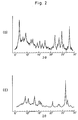
- the ⁇ -type titanyl phthalocyanine composition obtained by the acid paste process is treated with a ball mill in the presence of dichloromethane as a chlorine type solvent, it shows strong diffraction peaks at the Bragg angles of 6.9°, 10.6°, 15.6°, 17.6°, 21.9°, 23.6°, 24.7°, and 28.0°, the strongest diffraction peak at 6.9° in all the Bragg angles, as illustrated in Fig. 2 D.
- the ⁇ -type titanyl phthalocyanine composition thus produced excels in charging property and sensitive property in a greater measure.
- an ⁇ -type titanyl phthalocyanine composition excelling in charge property and sensitive property and enjoying high stability can be produced easily presumably because this treatment does not affect the crystal structure like the treatment with an organic solvent if the treatment is continued for a long time.
- ⁇ -type titanyl phthalocyanine composition obtained by the acid paste process is subjected to a ball milling treatment in the presence of toluene, diffraction peaks appear at the Bragg angles of 9.4°, 10.7°, 13.2°, 15.1°, 20.9°, 23.4°, 26.3°, and 27.2° and the strongest diffraction peak falls on the angle 26.3° characteristic of the ⁇ -type crystal, among other Bragg angles as illustrated in Fig. 2 E.
- the product of this treatment is deficient in charge property and sensitive property.
- ⁇ -type titanyl phthalocyanine composition obtained by the process mentioned above to acquire higher stability to resist the impact of aging, it is desired to be given a treatment with a surface treating agent.
- titanium coupling agents as isopropyl triisostearoyl titanate, isopropyl tridecylbenzene sulfonyl titanate, tetraisopropylbis (dioctylphosphite) titanate, and tetraoctylbis (ditridecylphosphite) titanate are available.
- the silane coupling agent to be used can be freely selected to suit the desired stability.
- vinyl silanes such as trichlorovinyl silane, trimethoxyvinyl silane, triethoxyvinyl silane, tri(2-methoxyethyoxy) vinyl silane, 3-acryloxypropyltrimethoxy silane, and 3-methacryloxypropyltrimethoxy silane; acryloxy silane and methacryloxy silane; amino silanes 3-aminopropyltrimethoxy silane, N-2-aminoethyl-3-aminopropyltrimethoxy silane, and 3-ureidopropyltriethoxy silane; chlorosilanes and mercaptosilanes such as 3-chloropropyltrimethoxy silane and trimethoxy-3-mercaptopropyl silane; and epoxy silanes such as 2-(3,4-epoxycyclo
- epoxy silane type coupling agents prove to be particularly desirable.
- the amount of the surface treating agent to be used may be freely selected to suit the purpose of the surface treatment. Generally, it is in the range of 0.001 to 5% by weight, preferably 0.01 to 1% by weight.
- the treatment with the surface treating agent mentioned above is performed by immersing the ⁇ -type titanyl phthalocyanine composition in a solution of the surface treating agent or spraying the composition with the solution of the surface treating agent and subsequently drying the wet composition.
- the electrophotographic sensitive material comprises an electroconductive substrate and a sensitive layer superposed on the electroconductive substrate.
- the sensitive material contains the ⁇ -type titanyl phthalocyanine composition.
- the sensitive layer may be a single-layer type sensitive layer composed of the ⁇ -type titanyl phthalocyanine composition as an electric charge generating substance, an electric charge transferring substance, a binding resin, and optionally "other materials.”
- the sensitive layer may be a laminated type sensitive layer which comprises an electric charge generating layer containing at least the ⁇ -type titanyl phthalocyanine composition and an electric charge transfer layer containing an electric charge transferring substance, a binding resin, etc. and superposed on the electric charge generating layer.
- the electric charge transfer layer may be superposed on the electric charge generating layer or vice versa.
- the electric charge generating layer of the laminate type sensitive layer contains an ⁇ -type titanyl phthalocyanine composition comprising an ⁇ -type titanyl phthalocyanine and metal-free phthalocyanine, particularly comprising 60 to 90% by weight of the ⁇ -type titanyl phthalocyanine and 10 to 40% by weight of the metal-free phthalocyanine
- the sensitive material using the laminate type sensitive layer exhibits small dark attenuation, high sensitivity, and small residual potential and excels in charging property and sensitive property.
- the sensitive material which uses as an electric charge generating material therefor the ⁇ -type titanyl phthalocyanine composition treated with the silane coupling agent metnioned above exhibits outstanding stability when it is used repeatedly. This sensitive material, therefore, retains the ability to form images of high quality for a very long period of time.
- the electroconductive substrate may be in the form of a sheet or a drum. It may be made of a varying material possessing electroconductivity. Simple metals such as aluminum,aluminum alloys, copper, tin, platinum, gold, silver, vanadium, molybdenum, chromium, cadmium, titanium, nickel, palladium, indium, stainless steel, and brass and plastic materials and glass materials having layers of the metals enumerated above, indium oxide, and tin oxide superposed thereon by vacuum deposition may be cited as examples.
- the ⁇ -type titanyl phthalocyanine composition functions as an electric charge generating material, use of some other electric charge generating material is not always necessary.
- the ⁇ -type titanyl phthalocyanine composition may be used in combination with other electric charge generating substance. In this case, due consideration should be paid to precluding possible impairment of the sensitive material's charging property and sensitive property.
- the electric charge generating material to be used in addition to the ⁇ -type titanyl phthalocyanine composition there may be cited selenium, selenium-tellurium, amorphous silicon, pyrylium salts, azo type compounds, disazo type compounds, trisazo type compounds, anthanthrone type compounds, dibenzypyrene quinone type compounds, other phythalocyanine type compounds, indigo type compounds, trihenylmethane type compounds, indonthrene type compounds, toluidine type compounds, pyrazoline type compounds, perylene type compounds, and quinacridone type compounds.
- These electric charge generating substances may be used either singly or in the form of a mixture of two or more members.
- the electric charge transferring material available herein include electron receiving substances possessing such electron receiving groups as nitro group, nitroso group, and cyano group, represented by such fluorenone type compounds as tetracyanoethylene and 2,4,7-trinitro-9-fluoroenone; and such nitrated compounds as dinitroanthracene and 2,4,8-trinitrothioxanthone; and electron dontating substances represented by such hydrazone type compounds as N,N-diethylaminobenzaldehyde, N,N-diphenyl hydrazone, N-methyl-3-carbazolyl aldehyde, and N,N-diphenyl hydrazone; such oxadiazole type compounds as 2,5-di(4-N,N-dimethylaminophenyl)-1,3,4-oxiadiazole and 2,5-di(4-N,N-diethylaminophenyl)-1,3,4-oxadiazole; such sty
- the electric charge transferrring substances mentioned above are used either singly or in the form of a mixture of two or more members.
- the electric charge transferring material to be used as contemplated in the fourth aspect of this invention is required to possess an oxidation potential in the range of 0.45 to 0.65 eV.
- the reason for this critical range of oxidation potential is as follows.
- the electric charge generating material is an ⁇ -type titanyl phthalocyanine composition and the electric charge transferring material to be used is of a type possessing an oxidation potential in the range of 0.45 and 0.65 eV, the combination of these two materials gives rise to the highest sensitivity in the produced sensitive material.
- oxidation potential is to be determined herein by the use of a cyclic voltammetry (reference electrode Ag/Ag + electrode).
- the binding resin various resins are available.
- the binding resin there may be cited styrene type polymers, styrene-butadiene copolymers, styrene-acrylonitrile copolymers, styrene-maleic acid copolymers, acryl type polymers, styrene-acryl type copolymers, ethylene-vinyl acetate copolymers, polyvinyl chloride, vinyl chloride-vinyl acetate copolymers, polyesters, alkyd resins, polyamides, polyurethanes, acrylmodified urethane resins, epoxy resins, polycarbonates, polyallylates, polysulfones, diallylphthalate resins, silicone resins, ketone resins, polyvinyl butyral resins, polyether resins, and phenyl resins.
- light-setting type resins as epoxy acrylates and urethane acrylates are available.
- other material such heretofore known sensitizers as terphenyl, halonaphthoquinones, and acenaphthylene; such fluorene type compounds as 9-(N,N-diphenylhydrazino)fluorene and 9-carbazolyliminofluorene; plasticizers; such degrada tionproofing agent as antioxidants and ultraviolet absorbents; and various other additives may be mentioned.
- the proportions of the ⁇ -type titanyl phthalocyanine composition, the electric charge transferring substance, and the binding resin in the single-layer type sensitive layer can be freely selected to suit the particular properties expected of the desired sensitive material.
- the ⁇ -type titanyl phthalocyanine composition is used in an amount in the range of 2 to 25 parts by weight, preferably 3 to 15 parts by weight, and the electric charge transferring substance in the range of 25 to 200 parts by weight, preferably 50 to 150 parts by weight, based on 100 parts by weight of the binding resin. If the amounts of the ⁇ -type titanyl phthalocyanine and the electric charge transferring substance are smaller than their respective lower limits mentioned above, the sensitive material suffers from insufficient sensitivity and unduly large residual potential. If these amounts exceed the upper limits mentioned above, the sensitive material is deficient in surface potential.
- the single layer type sensitive layer is desired to have a thickness in the range of 3 to 50 ⁇ m, preferably 5 to 20 ⁇ m.
- the electric charge generating layer in the laminate-type sensitive layer is formed by vacuum depositing spattering the ⁇ -type titanyl phthalocyanine composition at a temperature not exceeding 200°C while repressing dislocation of crystal structure. During the course of this formation, it is desirable to use a binding resin for the purpose of keeping the crystal structure from alteration and, moverover, heightening the productivity of the operation.
- the ratio of the ⁇ -type titanyl phthalocyanine composition to the binding resin may be suitably selected.
- the ⁇ -type titanyl phthalocyanine composition is desired to be used in an amount in the range of 5 to 5,000 parts by weight, preferably 10 to 2,500 parts by weight, based on 100 parts by weight of the binding resin. If the amount of the ⁇ -type titanyl phthalocyanine composition is less than 5 parts by weight, the electric charge generating layer is deficient in capacity for generation of electric charge.
- the electric charge generating layer is desired to have a thickness in the range of 0.01 to 30 ⁇ m, preferably 0.1 to 20 ⁇ m.
- the ratio of the electric charge transferring material to the binding resin is desired to be such that the amount of the electric charge transferring material falls in the range of 10 to 500 parts by weight, preferably 25 to 200 parts by weight, based on 100 parts by weight of the binding resin. This range is critical because the electric charge transfer layer is deficient in capacity for transferring electric charge if the amount of the electric charge transferring material is less than 10 parts by weight or the electric charge transfer layer suffers from poor mechanical strength if the amount exceeds 5,000 parts by weight.
- the electric charge transfer layer is desired to have a thickness approximately in the range of 2 to 100 ⁇ m, preferably 5 to 30 ⁇ m.
- the single-layer type sensitive layer can be formed by preparing a dispersion containing an ⁇ -type titanyl phthalocyanine composition, an electric charge transferring substance, and a binding resin, as a raw material for a sensitive layer, applying this dispersion on an electroconductive substrate, and drying the applied layer of the dispersion.
- the laminate-type sensitive layer can be formed by separately preparing a dispersion containing an ⁇ -type titanyl phthalocyanine composition and a binding resin and a coating liquid containing an electric charge transferring substance, a binding resin, etc., the dispersion as a raw material for an electric charge generating layer and the coating liquid as a raw material for an electric charge transfer layer, applying the dispersion and the coating liquid sequentially on an electroconductive substrate, and drying the applied layers.
- organic solvents selected to suit the particular kinds of binding resin, etc. are used.
- Alcohols such as methanol, ethanol, propanol, isopropanol, and butanol; aliphatic hydrocarbons such as n-hexane, octane, and cyclohexane; aromatic hydrocarbons such as benzene, toluene, an xylene; halogenated hydrocarbons such as dichloromethane, dichloroethane, carbon tetrachloride, and chlorobenzene; ethers such as dimethyl ether, diethyl ether, tetrahydrofuran, ethylene glycol dimethyl ether, and ethylene glycol diethyl ether; ketones such as acetone, methylethyl ketone, and cyclohexanone; esters such as ethyl
- organic solvents are used either singly or in the form of a mixture of two or more members.
- the dispersions may incorporate therein a surfactant and a leveling agent such as silicone oil for the purpose of improving the dispersibility of the ⁇ -type titanyl phthalocyanine composition and other components and the coating property of the dispersions.
- a surfactant and a leveling agent such as silicone oil for the purpose of improving the dispersibility of the ⁇ -type titanyl phthalocyanine composition and other components and the coating property of the dispersions.
- the dispersions can be prepared by any of the conventional methods popularly used for mixing and dispersing given materials, using a mixer, a ball mill, a paint shaker, a sand mill, an attriter, or an ultrasonic dispersion device, for example.
- the application of the dispersions is attained by any of the conventional coating methods in popular use such as, for example, dip coating, spray coating, spin coating, roller coating, blade coating, curtain coating, and bar coating methods.
- the electrophotographic sensitive material is obtained by applying the dispersion, for example, to the electroconductive substrate and subsequently drying the applied layer.
- the conditions for the drying may be fixed so as to suit the particular kinds of solvents to be used.
- the drying is generally carried out at a temperature in the range of 50° to 300°C for a period in the range of 30 minutes to 24 hours.
- an undercoating layer may be interposed therebetween.
- the undercoating layer is formed by applying on the given surface a solution of natural or synthetic macromolecular substance in an amount calculated to produce a dry layer approximately 0.01 to 1 ⁇ m in thickness.
- a surface protecting layer may be superposed on the sensitive layer.
- the surface protecting layer is formed by preparing a liquid mixture consisting of at least a binding resin, at least an agent for preventing the binding resin from degradation, and other additives and applying the mixture on a given surface in an amount calculated to produce a dry layer of a thickness generally in the range of 0.1 to 10 ⁇ m, preferably 0.2 to 5 ⁇ m.
- the electrophotographic sensitive material described above excels in sensitivity as well as in such electrical properties as charging property, dark attenuation, and residual potential because the sensitive layer thereof contains the ⁇ -type titanyl phthalocyanine composition.
- the electrophotographic sensitive material therefore, is useful as an organic sensitive material not merely in the laser beam printer but equally in such image forming devices as the copying machine and the facsimile.
- Titanyl phthalocyanine was synthesized by placing 4 mols of 1,3-diiminoisoindolenine, 1 mol of diisopropoxybis(1-acetyl-2-propoxy) titanium, and a prescribed amount of an alkylbenzene in a reaction vessel and heating them for reaction at a temperature of 170° to 180°C for five hours.
- Titanyl phthalocyanine was synthesized by placing 4 mols of 1,3-diiminoisoindolenine, 1 mol of tetrabutoxy titanium, and a prescribed amount of quinoline in a reaction vessel and heating them for reaction at a temperature of 170° to 180°C for five hours.
- the produced ⁇ -type titanyl phthalocyanine composition and a prescribed amount of dichloromethane were mixed for 20 hours, to produce an ⁇ -type titanyl phthalocyanine composition.
- the ⁇ -type titanyl phthalocyanine composition thus produced was found to contain about 82.3% by weight of ⁇ -type titanyl phthalocyanine.
- Fig. 2 A shows an X-ray diffraction spectrum of the spectrum of the ⁇ -type titanyl phthalocyanine composition obtained as described above.
- a dispersion as a raw material for an electric charge generating layer was prepared by dispersing and mixing 100 parts by weight of the ⁇ -type titanyl phthalocyanine composition obtained above, 100 parts by weight of a vinyl chloride-vinyl acetate copolymer (produced by Sekisui Chemical Co., Ltd. and marketed under trademark designation of "S-lec C"), 300 parts by weight of dichloromethane, and 200 parts by weight of tetrahydrofuran with the aid of ultrasonic waves.
- a solution as a raw material for an electric charge transfer layer was prepared from 70 parts by weight of 4-diethylaminobenzaldehyde-N,N-diphenylhydrazone, 100 parts by weight of a bisphenol Z type polycarbonate (produced by Mitsubishi Gas Chemical Industries Ltd. and marketed under product code of "Z-300"), and 500 parts by weight of benzene.
- an electric charge generating layer not more than 1 ⁇ m in thickness was formed by applying the dispersion for electric charge generating layer and drying the applied layer of the dispersion at a temperature of 100°C for one hour.
- an electric charge transfer layer about 15 ⁇ m in thickness was formed by applying thereon the solution for electric charge transfer layer and drying the applied layer of the solution at a temperature of 100°C for one hour.
- ⁇ -type titanyl phthalocyanine compositions having smaller ⁇ -type titanyl phthalocyanine contents than the composition of Synthesis 1 were produced by adding prescribed amounts of metal-free phthalocynine to the ⁇ -type titanyl phthalocyanine composition synthesized in Synthesis 1 (Examples 2 to 8).
- An ⁇ -type titanyl phthalocyanine composition containing 88.1% of an ⁇ -type titanyl phthalocyanine was produced by treating the titanyl phthalocyanine of Synthesis 2 by following the procedure of Example 1 (Example 9).
- electrophotographic sensitive materials were produced by following the procedure of Example 1.
- the electrophotographic sensitive materials were exposed to a semiconductor laser beam of a wavelength of 780 nm and left standing until their values of surface potential, V s.p., decreased to 1/2 while clocking the time of this standing to permit calculation of the half-value amount of exposure, E 1/2 ( ⁇ J/cm2).
- the surface potentials of the compositions were measured after elapse of 0.15 second following the exposure and reported as their residual potentials, Vr. p. (V).
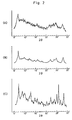
- Fig. 1 The relation between the ⁇ -type titanyl phthalocyanine content of ⁇ -type titanyl phthalocyanine composition and the half-value amount of exposure as a criterion of the sensitivity of the composition is shown in Fig. 1.
- the ⁇ -type titanyl phthalocyanine content of the ⁇ -type titanyl phthalocyanine composition indicated in this diagram was obtained from a calibration curve drawn on the basis of the absorption wave frequency (870 cm ⁇ 1) inherent in ⁇ -type titanyl phthalocyanine in the infrared absorption spectrum and the absorption wave frequency (890 cm ⁇ 1) inherent in metal-free phthalocyanine.
- the sensitive materials using ⁇ -type titanyl phthalocyanine compositions comprising an ⁇ -type titanyl phthalocyanine and a metal-free phthalocyanine excelled in charging property, manifested sparing residual potential, and enjoyed high sensitivity.
- the sensitive materials using ⁇ -type titanyl phthalocyanine compositions having ⁇ -type titanyl phthalocyanine contents in the range of 40 to 99.5% by weight exhibited high sensitivity.
- the sensitive materials using ⁇ -type titanyl phthalocyanine compositions having ⁇ -type titanyl phthalocyanine contents in the range of 60 to 90% by weight possessed exceptionally high levels of sensi tivity as evinced by their half-value amounts of exposure not exceeding 0.6 ⁇ J/cm2.
- a concentrated sulfuric acid solution of titanyl phthalocyanine was obtained by dissolving 100 parts by weight of the titanyl synthetized in Synthesis 1 in 1,500 parts by weight of concentrated sulfuric acid of a concentration of 98% and then allowing the resultant solution to stand at a temperature of 25°C for three hours.
- the aliquots of the concentrated sulfuric acid solution were severally poured into large volumes of water kept at -5°C (Example 10), 18°C (Example 11), 40°C (Example 12), and 70°C (Example 13) to induce precipitation of ⁇ -type titanyl phthalocyanine compositions.
- Example 1 For comparison, the data obtained in Example 1, i.e. an experiment in which the concentrated sulfuric acid solution containing an ⁇ -type titanyl phthalocyanine composition was poured into water at 0°C, are additionally shown in the table.
- ⁇ -type titanyl phthalocyanine compositions were produced by following the procedure of Example 1, excepting concentrated sulfuric acids of concentrations of 82% (Example 14), 90% (Example 15), 94% (Example 16), 96% (Example 17), 100% (Example 18), and 105% (Example 19) were used in the place of the concentrated sulfuric acid of a concentration of 98% and the titanyl phthalocyanine composition synthesized in Synthesis was used instead.
- electrophotographic sensitive materials were produced by following the procedure of Example 1. They were tested for charge property and sensitive property by following the procedure of Examples 1 to 9. Table 3 shows the results of the test.
- An ⁇ -type titanyl phthalocyanine composition was prepared by following the procedure of Examples 14 to 19, excepting 100 parts by weight of the titanyl phthalocyanine synthesized in Synthesis 1 was dissolved in 6,000 parts by weight of a concentrated sulfuric acid of a concentration of 98%. From this ⁇ -type titanyl phthalocyanine composition, an electrophotographic sensitive material was produced. The electrophotographic sensitive material was tested for properties by following the procedure of Example 1. Table 4 shows the results of the test. The properties of the electrophotographic sensitive materials produced in Example 1 are shown additionally in the same table.
- the ⁇ -type titanyl phthalocyanine composition obtained in Example 9 was treated with 2-(3,4-epoxycyclohexyl)ethyltrimethoxy silane, an epoxy silane type silane coupling agent, to produce an ⁇ -type titanyl phthalocyanine composition having an amount of treatment of about 0.03% by weight.
- the electrophotographic sensitive material was evaluated for properties before and after 200 cycles of charging and exposure.
- Table 5 shows the results of the test.
- An ⁇ -type titanyl phthalocyanine composition purified with sulfuric acid was prepared by adding a prescribed amount of metal-free phthalocyanine synthesized in synthesis 1, treating the resultant mixture in the same manner as in Example 1 thereby forming a concentrated sulfuric acid solution of titanyl phthalocyanine, and pouring the solution into water at a temperature of 0°C. Then, this ⁇ -type titanyl phthalocyanine was kept immersed in cyclohexanone for five hours, to produce an ⁇ -type titanyl phthalocyanine composition containing 76.3% by weight of ⁇ -type titanyl phthalocyanine.
- Example 24 Two aliquots of the ⁇ -type titanyl phthalocyanine composition obtained as purified with sulfuric acid in Example 22 were kept immersed for five hours (Example 24) and one week (Example 25) in dichloromethane, to produce ⁇ -type titanyl phthalocyanine composition.
- electrophotographic sensitive materials were produced by following the procedure of Example 1.
- the ⁇ -type titanyl phthalocyanine composition obtained as purified with sulfuric acid in Example 22 was mixed and dispersed in a ball mill for 24 hours in the presence of dichloromethane, to produce an ⁇ -type titanyl phthalocyanine composition.
- the ⁇ -type titanyl phthalocyanine obtained as purified with sulfuric acid in Example 22 was mixed and dispersed in a ball mill for 24 hours in the presence of toluene, to produce a ⁇ -type titanyl phthalocyanine composition.
- the ⁇ -type titanyl phthalocyanine composition (B) which had undergone immersion in cyclohexanone showed a sign of accelerated crystallization
- the ⁇ -type titanyl phthalocyanine composition (C) which had undergone immersion in dichloromethane showed a sign of partial inclusion of ⁇ -type titanyl phthalocyanine
- the ⁇ -type titanyl phthalocyanine composition (D) which had been treated by ball milling in the presence of dichloromethane clearly showed diffraction peaks peculiar to ⁇ -type titanyl phthalocyanine
- the ⁇ -type titanyl phthalocyanine composition (E) which had undergone treatment in a ball mill in the presence of toluene identified itself to be a ⁇ -type crystal.
- the ⁇ -type titanyl phthalocyanine composition and a prescribed amount of dichloromethane were mixed for 20 hours to produce an ⁇ -type titanyl phthalocyanine composition.
- the ⁇ -type titanyl phthalocyanine composition thus obtained was found to contain about 82.3% by weight of an ⁇ -type titanyl phthalocyanine.
- a dispersion was prepared from 8 parts by weight of the ⁇ -type titanyl phthalocyanine composition of the percentage composition mentioned above, 100 parts by weight of a bisphenol Z type polycarbonate (produced by Mitsubishi Gas Chemical Industries Ltd.), 100 parts by weight of a varying electric charge transferring material indicated in Table 7, and 1,000 parts by weight of tetrahydrofuran with the aid of an ultrasonic wave dispersing device.
- This dispersion was applied on an aluminum sheet to produce an electrophotographic sensitive material provided with a sensitive layer about 20 ⁇ m in thickness.
- the sensitive materials were exposed to a halogen light and left standing until the surface potentials decreased to 1/2 of the initial values while clocking the time of standing to permit calculation of their half-value amounts, E 1/2 ( ⁇ J/cm2). Their values of surface potential were measured after elapse of 0.15 second following the exposure and reported as residual potentials, V rp (V).
- the values of oxidation potential of the electric charge transferring materials indicated in Table 7 were obtained by the measurement with a cyclic voltametry. In this measurement, a platinum electrode was used as an operating electrode, a 0.1-mol acetonitrile Ag/Ag + electrode as a reference electrode, and a platinum electrode as an counter electrode. A dichloromethane solution containing l m.mol of a given electric charge transferring material and 0.1 mol of (n-C4H9)4NClO4 as a supporting electrolyte, after being bubbled with argon gas, was tested for oxidation potential at a scanning speed of 100 mV/sec. Table 8 given below shows the results of the test conducted on the electrophotographic sensitive materials for half-value amount of exposure and residual potential.
- the ⁇ -type titanyl phthalocyanine composition constituting the first aspect of this invention is stable, wide in range of absorption wavelengths, and large in spectral sensitivity as well because it contains an ⁇ -type titanyl phthalocyanine in addition to metal-free phthalocyanine.
- the method for the production of an ⁇ -type titanyl phthalocyanine composition which constitutes the second aspect of this invention permits easy production of an ⁇ -type titanyl phthalocyanine composition stable to withstand the impact of aging because it effects pigmentation of the composition by the acid paste process which consists in pouring a concentrated sulfuric acid solution containing at least titanyl phthalocyanine into cold water.
- the electrophotographic sensitive material constituting the third aspect of this invention not only excels in charging property and dark attenuation property but also exhibits high sensitivity and sparing residual potential because the phthalocyanines in the sensitive layer comprise ⁇ -type titanyl phthalocyanine and metal-free phthalocyanine.
- the electrophotographic sensitive material constituting the fourth aspect of this invention is high in sensitivity and low in residual potential because it uses an ⁇ -type titanyl phthalocyanine composition as an electric charge generating material and also using an electric charge transferring material exhibiting oxidation potential in the range of 0.45 to 0.65 eV.
Landscapes
- Chemical & Material Sciences (AREA)
- Chemical Kinetics & Catalysis (AREA)
- Organic Chemistry (AREA)
- Physics & Mathematics (AREA)
- General Physics & Mathematics (AREA)
- Photoreceptors In Electrophotography (AREA)
Applications Claiming Priority (4)
| Application Number | Priority Date | Filing Date | Title |
|---|---|---|---|
| JP271319/87 | 1987-10-26 | ||
| JP27131987 | 1987-10-26 | ||
| JP301707/87 | 1987-11-30 | ||
| JP62301707A JPH01142658A (ja) | 1987-11-30 | 1987-11-30 | 電子写真感光体 |
Publications (3)
| Publication Number | Publication Date |
|---|---|
| EP0314100A2 true EP0314100A2 (de) | 1989-05-03 |
| EP0314100A3 EP0314100A3 (en) | 1990-07-25 |
| EP0314100B1 EP0314100B1 (de) | 1994-09-14 |
Family
ID=26549650
Family Applications (1)
| Application Number | Title | Priority Date | Filing Date |
|---|---|---|---|
| EP88117838A Expired - Lifetime EP0314100B1 (de) | 1987-10-26 | 1988-10-26 | Alphatyp-Titanylphthalocyanin-Zusammensetzung, Verfahren zu ihrer Herstellung und ihre Verwendung in elektrophotographischen Materialien |
Country Status (4)
| Country | Link |
|---|---|
| US (2) | US4971877A (de) |
| EP (1) | EP0314100B1 (de) |
| KR (1) | KR930010867B1 (de) |
| DE (1) | DE3851500T2 (de) |
Cited By (24)
| Publication number | Priority date | Publication date | Assignee | Title |
|---|---|---|---|---|
| EP0405420A1 (de) * | 1989-06-30 | 1991-01-02 | Konica Corporation | Elektrophotographischer Photorezeptor |
| EP0433172A3 (de) * | 1989-12-13 | 1991-07-10 | Canon Kabushiki Kaisha | Elektrofotografisches lichtempfindliches Element |
| EP0461523A1 (de) * | 1990-06-14 | 1991-12-18 | Xerox Corporation | Photoleitfähiges Abbildungselement mit Titanyl-Phthalocyaninen |
| EP0462406A1 (de) * | 1990-05-22 | 1991-12-27 | Nec Corporation | Elektrophotographisches, lichtempfindliches Material |
| US5164493A (en) * | 1991-02-28 | 1992-11-17 | Xerox Corporation | Processes for the preparation of titanyl phthalocyanines type I with phthalonitrile |
| US5166339A (en) * | 1990-06-04 | 1992-11-24 | Xerox Corporation | Processes for the preparation of titanium phthalocyanines |
| US5182382A (en) * | 1991-05-28 | 1993-01-26 | Xerox Corporation | Processes for the preparation of titaniumphthalocyanine type x |
| US5189156A (en) * | 1991-04-01 | 1993-02-23 | Xerox Corporation | Processes for the preparation of titanium-phthalocyanine Type X |
| US5189155A (en) * | 1991-04-11 | 1993-02-23 | Xerox Corporation | Titanyl phthalocyanine Type I processes |
| US5206359A (en) * | 1991-04-11 | 1993-04-27 | Xerox Corporation | Processes for preparation of titanyl phthalocyanines type x |
| EP0538889A1 (de) * | 1991-10-25 | 1993-04-28 | Canon Kabushiki Kaisha | Elektrophotographisches, lichtempfindliches Element, elektrophotographisches Gerät, Vorrichtungseinheit und Faksimiliegerät unter Verwendung desselben |
| EP0548809A1 (de) * | 1991-12-20 | 1993-06-30 | Mitsubishi Chemical Corporation | Elektrophotographischer Photorezeptor |
| US5225551A (en) * | 1990-06-04 | 1993-07-06 | Xerox Corporation | Imaging member containing titanium phthalocyanines |
| US5288574A (en) * | 1992-09-14 | 1994-02-22 | Xerox Corporation | Phthalocyanine imaging members and processes |
| US5330867A (en) * | 1992-08-24 | 1994-07-19 | Xerox Corporation | Photogenerating titanyl phthalocyanine and processes thereof |
| US5334478A (en) * | 1992-09-14 | 1994-08-02 | Xerox Corporation | Oxytitanium phthalocyanine imaging members and processes thereof |
| GB2274848A (en) * | 1993-02-05 | 1994-08-10 | Citizen Watch Co Ltd | Modification of pigment and electrophotographic photoreceptor containing modified pigment |
| US5378569A (en) * | 1990-11-22 | 1995-01-03 | Fuji Xerox Co., Ltd. | Oxytitaniumphthalocyanine hydrate crystal and electrophotographic photoreceptor using said crystal |
| US5384222A (en) * | 1993-07-01 | 1995-01-24 | Xerox Corporation | Imaging member processes |
| US5420268A (en) * | 1993-05-27 | 1995-05-30 | Xerox Corporation | Oxytitanium phthalocyanine imaging members and processes thereof |
| EP0661353A3 (de) * | 1993-12-28 | 1996-01-10 | Mitsubishi Chem Corp | Verfahren zur Herstellung eines photoempfindlichen Phthalocyaninmaterials. |
| EP0679693A3 (de) * | 1994-04-26 | 1997-12-10 | Xerox Corporation | Verfahren zur Herstellung von Alkoxyüberbrückten Metallphthalocyaninendimeren |
| EP1715008A2 (de) | 2005-04-22 | 2006-10-25 | Xerox Corporation | Phthalocyanin-Cokristalle zur Verwendung in Photorezeptoren |
| EP1731575A4 (de) * | 2004-03-04 | 2009-03-04 | Mitsubishi Chem Corp | Phthalocyaninzusammensetzung und jeweils davon gebrauch machendes bzw. machende bzw. machender photoleitfähiges material, elektrophotographischer photorezeptor, kartusche für elektrophotographischen photorezeptor sowie bebilderungsvorrichtung |
Families Citing this family (20)
| Publication number | Priority date | Publication date | Assignee | Title |
|---|---|---|---|---|
| KR930010867B1 (ko) * | 1987-10-26 | 1993-11-15 | 미타 고오교 가부시끼가이샤 | α형 티타닐프탈로시아닌 조성물, 그 제조방법 및 이것을 이용한 전자 사진용 감광체 |
| JPH01319751A (ja) * | 1988-06-21 | 1989-12-26 | Fuji Electric Co Ltd | 電子写真用感光体 |
| US5153313A (en) * | 1990-06-04 | 1992-10-06 | Xerox Corporation | Processes for the preparation of phthalocyanines |
| DE69124061T2 (de) * | 1990-10-24 | 1997-05-15 | Canon Kk | Verfahren zur Herstellung von kristallinem Oxytitanphthalocyanin |
| US5308728A (en) * | 1991-08-16 | 1994-05-03 | Fuji Xerox Co., Ltd. | Dichlorotin phthalocyanine crystal, process for producing the same, and electrophotographic photoreceptor using the same |
| JP3119717B2 (ja) * | 1992-05-11 | 2000-12-25 | 三菱化学株式会社 | 電子写真感光体 |
| JP2765398B2 (ja) * | 1992-08-26 | 1998-06-11 | 富士ゼロックス株式会社 | クロロガリウムフタロシアニン結晶の製造方法 |
| JP3218770B2 (ja) * | 1993-01-14 | 2001-10-15 | 富士ゼロックス株式会社 | 電子写真感光体とそのためのフタロシアニン顔料および顔料分散液 |
| EP0660192B1 (de) * | 1993-12-27 | 1998-09-16 | Hitachi Chemical Co., Ltd. | Zusammensetzung zur Herstellung einer Ladungstransportschicht, und elektrophotographisches Element |
| US5523189A (en) * | 1994-10-27 | 1996-06-04 | Eastman Kodak Company | Electrophotographic recording elements and preparation method |
| JP3798112B2 (ja) * | 1996-04-30 | 2006-07-19 | ヒューレット・パッカード・カンパニー | 低温硬化結合剤 |
| US6485658B1 (en) | 1999-04-28 | 2002-11-26 | Mitsubishi Paper Mills, Limited | Phthalocyanine, process for producing the same and electrophotographic photoreceptor using the same |
| JP3941720B2 (ja) * | 2002-04-11 | 2007-07-04 | 富士電機デバイステクノロジー株式会社 | 電子写真用感光体およびその製造方法 |
| WO2004095144A1 (ja) * | 2003-04-24 | 2004-11-04 | Sharp Kabushiki Kaisha | 電子写真感光体、電子写真画像形成方法および電子写真装置 |
| JP3718508B2 (ja) * | 2003-06-03 | 2005-11-24 | シャープ株式会社 | 電子写真感光体およびそれを備える画像形成装置 |
| KR100528735B1 (ko) | 2003-10-08 | 2005-12-27 | (주)프탈로스 | 옥시티타늄 프탈로시아닌 전하발생물질의 제조 방법 및이를 위한 장치 |
| KR100528734B1 (ko) * | 2003-10-08 | 2006-01-10 | (주)프탈로스 | 옥시티타늄 프탈로시아닌 전하발생물질의 제조방법 및이로부터 제조된 새로운 결정형의 옥시티타늄프탈로시아닌 전하발생물질 |
| US20080079941A1 (en) * | 2004-09-07 | 2008-04-03 | Agency For Science, Technology And Research | Differential Geomety-Based Method and Apparatus for Measuring Polarization Mode Dispersion Vectors in Optical Fibers |
| CN101449211B (zh) * | 2006-05-18 | 2012-03-07 | 三菱化学株式会社 | 电子照相感光体、成像装置和电子照相盒 |
| JP5010243B2 (ja) * | 2006-11-14 | 2012-08-29 | 株式会社リコー | 電子写真感光体、画像形成装置及びプロセスカートリッジ |
Family Cites Families (9)
| Publication number | Priority date | Publication date | Assignee | Title |
|---|---|---|---|---|
| US3252991A (en) * | 1962-05-02 | 1966-05-24 | Gen Aniline & Film Corp | Conditioning of phthalocyanine pigments |
| US3816118A (en) * | 1964-06-15 | 1974-06-11 | Xerox Corp | Electrophotographic element containing phthalocyanine |
| US4106935A (en) * | 1970-08-26 | 1978-08-15 | Xerox Corporation | Xerographic plate having an phthalocyanine pigment interface barrier layer |
| IT1163161B (it) * | 1983-03-22 | 1987-04-08 | Montedison Spa | Coloranti e pigmenti compositi ftalocianinici silanici |
| JPS59232348A (ja) * | 1983-06-15 | 1984-12-27 | Mita Ind Co Ltd | 積層感光体及びその製造法 |
| JPS61171771A (ja) * | 1985-01-25 | 1986-08-02 | Mitsubishi Chem Ind Ltd | 電子写真用感光体の製造方法 |
| DE180930T1 (de) * | 1984-11-01 | 1988-06-30 | Mitsubishi Chemical Industries Ltd., Tokio/Tokyo | Kristallinisches phthalocyanin-oxytitanium und photorezeptor fuer die elektrophotographie. |
| JPS62178266A (ja) * | 1986-01-31 | 1987-08-05 | Toshiba Corp | 電子写真感光体 |
| KR930010867B1 (ko) * | 1987-10-26 | 1993-11-15 | 미타 고오교 가부시끼가이샤 | α형 티타닐프탈로시아닌 조성물, 그 제조방법 및 이것을 이용한 전자 사진용 감광체 |
-
1988
- 1988-10-25 KR KR1019880013944A patent/KR930010867B1/ko not_active Expired - Fee Related
- 1988-10-25 US US07/261,896 patent/US4971877A/en not_active Expired - Lifetime
- 1988-10-26 DE DE3851500T patent/DE3851500T2/de not_active Expired - Lifetime
- 1988-10-26 EP EP88117838A patent/EP0314100B1/de not_active Expired - Lifetime
-
1990
- 1990-08-30 US US07/574,851 patent/US5106536A/en not_active Expired - Lifetime
Cited By (32)
| Publication number | Priority date | Publication date | Assignee | Title |
|---|---|---|---|---|
| US5753395A (en) * | 1989-06-30 | 1998-05-19 | Konica Corporation | Electrophotographic photoreceptor |
| EP0405420A1 (de) * | 1989-06-30 | 1991-01-02 | Konica Corporation | Elektrophotographischer Photorezeptor |
| EP0818713A3 (de) * | 1989-06-30 | 1998-05-13 | Konica Corporation | Verfahren zur Herstellung eines elektrophotographischen Photorezeptors |
| EP0433172A3 (de) * | 1989-12-13 | 1991-07-10 | Canon Kabushiki Kaisha | Elektrofotografisches lichtempfindliches Element |
| US5187036A (en) * | 1990-05-22 | 1993-02-16 | Nec Corporation | Electrophotographic photosensitive material |
| EP0462406A1 (de) * | 1990-05-22 | 1991-12-27 | Nec Corporation | Elektrophotographisches, lichtempfindliches Material |
| US5166339A (en) * | 1990-06-04 | 1992-11-24 | Xerox Corporation | Processes for the preparation of titanium phthalocyanines |
| EP0460565A3 (en) * | 1990-06-04 | 1992-12-02 | Xerox Corporation | Titanium phthalocyanines and processes for the preparation thereof |
| US5225551A (en) * | 1990-06-04 | 1993-07-06 | Xerox Corporation | Imaging member containing titanium phthalocyanines |
| EP0461523A1 (de) * | 1990-06-14 | 1991-12-18 | Xerox Corporation | Photoleitfähiges Abbildungselement mit Titanyl-Phthalocyaninen |
| US5378569A (en) * | 1990-11-22 | 1995-01-03 | Fuji Xerox Co., Ltd. | Oxytitaniumphthalocyanine hydrate crystal and electrophotographic photoreceptor using said crystal |
| US5164493A (en) * | 1991-02-28 | 1992-11-17 | Xerox Corporation | Processes for the preparation of titanyl phthalocyanines type I with phthalonitrile |
| US5189156A (en) * | 1991-04-01 | 1993-02-23 | Xerox Corporation | Processes for the preparation of titanium-phthalocyanine Type X |
| US5189155A (en) * | 1991-04-11 | 1993-02-23 | Xerox Corporation | Titanyl phthalocyanine Type I processes |
| US5206359A (en) * | 1991-04-11 | 1993-04-27 | Xerox Corporation | Processes for preparation of titanyl phthalocyanines type x |
| US5182382A (en) * | 1991-05-28 | 1993-01-26 | Xerox Corporation | Processes for the preparation of titaniumphthalocyanine type x |
| US5558964A (en) * | 1991-10-25 | 1996-09-24 | Canon Kabushiki Kaisha | Electrophotographic photosensitive member, and electrophotographic apparatus, device unit, and facsimile machine employing the same |
| EP0538889A1 (de) * | 1991-10-25 | 1993-04-28 | Canon Kabushiki Kaisha | Elektrophotographisches, lichtempfindliches Element, elektrophotographisches Gerät, Vorrichtungseinheit und Faksimiliegerät unter Verwendung desselben |
| EP0548809A1 (de) * | 1991-12-20 | 1993-06-30 | Mitsubishi Chemical Corporation | Elektrophotographischer Photorezeptor |
| US5330867A (en) * | 1992-08-24 | 1994-07-19 | Xerox Corporation | Photogenerating titanyl phthalocyanine and processes thereof |
| US5334478A (en) * | 1992-09-14 | 1994-08-02 | Xerox Corporation | Oxytitanium phthalocyanine imaging members and processes thereof |
| US5288574A (en) * | 1992-09-14 | 1994-02-22 | Xerox Corporation | Phthalocyanine imaging members and processes |
| GB2274848A (en) * | 1993-02-05 | 1994-08-10 | Citizen Watch Co Ltd | Modification of pigment and electrophotographic photoreceptor containing modified pigment |
| US5403687A (en) * | 1993-02-05 | 1995-04-04 | Citizen Watch Co., Ltd. | Modification of pigment and electrophotographic photoreceptor with modified pigment |
| US5420268A (en) * | 1993-05-27 | 1995-05-30 | Xerox Corporation | Oxytitanium phthalocyanine imaging members and processes thereof |
| US5384222A (en) * | 1993-07-01 | 1995-01-24 | Xerox Corporation | Imaging member processes |
| EP0661353A3 (de) * | 1993-12-28 | 1996-01-10 | Mitsubishi Chem Corp | Verfahren zur Herstellung eines photoempfindlichen Phthalocyaninmaterials. |
| EP0679693A3 (de) * | 1994-04-26 | 1997-12-10 | Xerox Corporation | Verfahren zur Herstellung von Alkoxyüberbrückten Metallphthalocyaninendimeren |
| EP1731575A4 (de) * | 2004-03-04 | 2009-03-04 | Mitsubishi Chem Corp | Phthalocyaninzusammensetzung und jeweils davon gebrauch machendes bzw. machende bzw. machender photoleitfähiges material, elektrophotographischer photorezeptor, kartusche für elektrophotographischen photorezeptor sowie bebilderungsvorrichtung |
| US7981581B2 (en) | 2004-03-04 | 2011-07-19 | Mitsubishi Chemical Corporation | Phthalocyanine composition and photoconductive material, electrophotographic photoreceptor cartridge, and image-forming apparatus each employing the composition |
| EP1715008A2 (de) | 2005-04-22 | 2006-10-25 | Xerox Corporation | Phthalocyanin-Cokristalle zur Verwendung in Photorezeptoren |
| EP1715008A3 (de) * | 2005-04-22 | 2008-06-25 | Xerox Corporation | Phthalocyanin-Cokristalle zur Verwendung in Photorezeptoren |
Also Published As
| Publication number | Publication date |
|---|---|
| DE3851500T2 (de) | 1995-02-16 |
| KR930010867B1 (ko) | 1993-11-15 |
| EP0314100A3 (en) | 1990-07-25 |
| US4971877A (en) | 1990-11-20 |
| EP0314100B1 (de) | 1994-09-14 |
| KR890007125A (ko) | 1989-06-19 |
| DE3851500D1 (de) | 1994-10-20 |
| US5106536A (en) | 1992-04-21 |
Similar Documents
| Publication | Publication Date | Title |
|---|---|---|
| US4971877A (en) | α-type titanyl phthalocyanine composition, method for production thereof, and electrophotographic sensitive material using same | |
| JP3569422B2 (ja) | 結晶型オキソチタニルフタロシアニン及びそれを用いた電子写真感光体並びに画像形成方法 | |
| EP0401782A2 (de) | Titanylphthalocyanin in Kristallform, Verfahren zu seiner Herstellung und seine Verwendung für elektrofotografisches fotoempfindliches Material | |
| JPH0228265A (ja) | フタロシアニン結晶の製造方法 | |
| EP1093025B1 (de) | Titanylphthalocyanin in Kristallform, Verfahren zu seiner Herstellung und elektrophotographisches Material | |
| JPH0560863B2 (de) | ||
| JP2004145284A (ja) | チタニルフタロシアニン化合物、電子写真感光体および画像形成装置 | |
| JP3028004B2 (ja) | クロロガリウムフタロシアニンの新規な結晶の製造方法及びその結晶を用いた電子写真感光体 | |
| JPH0747698B2 (ja) | α型チタニルフタロシアニン組成物、その製造方法及びそれを用いた電子写真用感光体 | |
| JP3010768B2 (ja) | 光導電性材料および電子写真感光体 | |
| JP2861116B2 (ja) | 電子写真感光体 | |
| EP1081556B1 (de) | Elektrophotografischer Fotorezeptor | |
| JP2867045B2 (ja) | 電子写真感光体 | |
| JP2690068B2 (ja) | 電子写真感光体 | |
| JPH0560867B2 (de) | ||
| JP2020008680A (ja) | 電子写真感光体およびそれを備えた画像形成装置 | |
| CN113703295B (zh) | 电子照相感光体以及具备电子照相感光体的图像形成装置 | |
| JP2657839B2 (ja) | 電子写真感光体 | |
| JP2805896B2 (ja) | 電子写真感光体 | |
| JP3268464B2 (ja) | チタニルフタロシアニン結晶分散液 | |
| JPH0570709A (ja) | 塩素化インジウムフタロシアニン、その製造法およびそれを用いた電子写真感光体 | |
| JP3333977B2 (ja) | 電子写真感光体 | |
| EP0926557B1 (de) | Elektrophotographischer Photorezeptor, Verfahren zu dessen Herstellung und Anwendung des Photorezeptors für die Bildherstellung | |
| JP2001033999A (ja) | 電子写真感光体 | |
| JPH06256680A (ja) | バナジルフタロシアニン化合物及びそれを用いた電子写真感光体 |
Legal Events
| Date | Code | Title | Description |
|---|---|---|---|
| PUAI | Public reference made under article 153(3) epc to a published international application that has entered the european phase |
Free format text: ORIGINAL CODE: 0009012 |
|
| AK | Designated contracting states |
Kind code of ref document: A2 Designated state(s): DE FR GB NL |
|
| PUAL | Search report despatched |
Free format text: ORIGINAL CODE: 0009013 |
|
| AK | Designated contracting states |
Kind code of ref document: A3 Designated state(s): DE FR GB NL |
|
| 17P | Request for examination filed |
Effective date: 19901119 |
|
| 17Q | First examination report despatched |
Effective date: 19920217 |
|
| GRAA | (expected) grant |
Free format text: ORIGINAL CODE: 0009210 |
|
| AK | Designated contracting states |
Kind code of ref document: B1 Designated state(s): DE FR GB NL |
|
| REF | Corresponds to: |
Ref document number: 3851500 Country of ref document: DE Date of ref document: 19941020 |
|
| ET | Fr: translation filed | ||
| PLBE | No opposition filed within time limit |
Free format text: ORIGINAL CODE: 0009261 |
|
| STAA | Information on the status of an ep patent application or granted ep patent |
Free format text: STATUS: NO OPPOSITION FILED WITHIN TIME LIMIT |
|
| 26N | No opposition filed | ||
| PGFP | Annual fee paid to national office [announced via postgrant information from national office to epo] |
Ref country code: NL Payment date: 19971029 Year of fee payment: 10 |
|
| PGFP | Annual fee paid to national office [announced via postgrant information from national office to epo] |
Ref country code: FR Payment date: 19981009 Year of fee payment: 11 |
|
| PG25 | Lapsed in a contracting state [announced via postgrant information from national office to epo] |
Ref country code: NL Free format text: LAPSE BECAUSE OF NON-PAYMENT OF DUE FEES Effective date: 19990501 |
|
| NLV4 | Nl: lapsed or anulled due to non-payment of the annual fee |
Effective date: 19990501 |
|
| PG25 | Lapsed in a contracting state [announced via postgrant information from national office to epo] |
Ref country code: FR Free format text: LAPSE BECAUSE OF NON-PAYMENT OF DUE FEES Effective date: 20000630 |
|
| REG | Reference to a national code |
Ref country code: FR Ref legal event code: ST |
|
| REG | Reference to a national code |
Ref country code: GB Ref legal event code: IF02 |
|
| PGFP | Annual fee paid to national office [announced via postgrant information from national office to epo] |
Ref country code: DE Payment date: 20071018 Year of fee payment: 20 |
|
| PGFP | Annual fee paid to national office [announced via postgrant information from national office to epo] |
Ref country code: GB Payment date: 20071024 Year of fee payment: 20 |
|
| REG | Reference to a national code |
Ref country code: GB Ref legal event code: PE20 Expiry date: 20081025 |
|
| PG25 | Lapsed in a contracting state [announced via postgrant information from national office to epo] |
Ref country code: GB Free format text: LAPSE BECAUSE OF EXPIRATION OF PROTECTION Effective date: 20081025 |