EP0314341A2 - Rechnergraphikgerät zur Verarbeitung von Beleuchtungsmodellinformation - Google Patents
Rechnergraphikgerät zur Verarbeitung von Beleuchtungsmodellinformation Download PDFInfo
- Publication number
- EP0314341A2 EP0314341A2 EP88309573A EP88309573A EP0314341A2 EP 0314341 A2 EP0314341 A2 EP 0314341A2 EP 88309573 A EP88309573 A EP 88309573A EP 88309573 A EP88309573 A EP 88309573A EP 0314341 A2 EP0314341 A2 EP 0314341A2
- Authority
- EP
- European Patent Office
- Prior art keywords
- vertices
- floating point
- colour
- lighting
- processors
- Prior art date
- Legal status (The legal status is an assumption and is not a legal conclusion. Google has not performed a legal analysis and makes no representation as to the accuracy of the status listed.)
- Granted
Links
Images



Classifications
-
- G—PHYSICS
- G06—COMPUTING OR CALCULATING; COUNTING
- G06T—IMAGE DATA PROCESSING OR GENERATION, IN GENERAL
- G06T15/00—Three-dimensional [3D] image rendering
- G06T15/50—Lighting effects
- G06T15/506—Illumination models
Definitions
- the present invention relates, generally, to the field of computer graphics.
- Computer graphics display systems e.g. CAD/CAM graphics workstations, are widely used to generate and display images of objects for scientific, engineering, manufacturing and other applications.
- a polygon mesh is a collection of vertices, edges, and polygons. The vertices are connected by edges, while polygons can be thought of as sequences of edges or of vertices.
- the present invention relates to implementation of a shading function in a graphics workstation and more specifically to the computer processing and display of shaded images in which a lighting model is used. Effects which may be taken into account in such a lighting model include ambient lighting, diffuse and specular reflection effects, the number, position, intensity and hue of the light sources, parallel and perspective projections, and attenuation of the light due to the distance of different portions of an object being modeled from the viewer (depth cueing).
- the general system architecture of shading hardware for a graphics workstation is depicted, in block diagram form, in Figure 1.
- the overall shading function system 10 includes a lighting model processing system 12, a shading processing system 14, a video pixel memory 16 and a display monitor 18.
- the lighting model processing system 12 calculates the color intensities (e.g. red, green and blue components) at the vertices of each polygon for a specified lighting model.
- the shading processing system 14 uses the information from the lighting model processing system to calculate the color intensities of pixels interior to visible polygons and sends this information to the video pixel memory 16.
- the display monitor 18 displays the shaded image stored in the video pixel memory.
- calculation of the effects due to lighting is done by a number of identical floating point processing elements that are connected and operated in a pipeline fashion.
- the pipeline configuration used may be purely serial, or it may be serial with certain stages of the pipeline containing parallel arrangements of the same identical processing element.
- the lighting model processing system of the present invention consists of multiple floating point processing stages connected in series and operated in pipeline fashion. Each stage preferably comprises one or more identical floating point processors (also referred to as processing elements). Each stage is considered to be a separate processing unit which performs its particular function(s) concurrently with the other stages, thereby producing a marked increase in throughput.
- Figure 2 portrays a first embodiment of the lighting model calculation system 12 consisting of four floating point processing stages 20, 22, 24 and 26, in pipeline.
- First stage 20 and second stage 22 are used for lighting model calculations.
- Third stage 24 is employed to perform a projection transformation and to map from a viewing space to a screen space and
- fourth stage 26 is used to depth cueing, color mapping and color clipping.
- the functions of these different stages are described in more detail hereinafter. The number and order of stages, as well as the partitioning of functions among the stages, may vary from that shown in Figure 2.
- the input to lighting model processing system 12 consists of: x, y, z which represent the coordinates, in viewing space, of the vertices of a polygon; and a, b, c which represent the X, Y, and Z components of the normal at each of the vertices of the polygon.
- the output of the lighting model processing system 12 consists of: Xs, Ys, Zs which represent the screen coordinates of the vertices of the polygon; and C"R, C"G, C"B which represent the color intensity values (R denoting the red component, G denoting the green component and B denoting the blue component) to be displayed at each vertex of the polygon.
- the output screen vertex coordinates and RGB intensity values are integers, with the intensity values being in the range of the capabilities of the display system.
- the output of lighting model processing system 12 is provided to a shading processing system 14, as shown in Figure 1, wherein the intensity values at the vertices are, in effect, interpolated across the visible face of the polygon so that a realistically shaded image of the object may be displayed.
- a preprocessing step is implemented in the preceding geometry processor to ensure that all of the input polygons to the lighting model processing system are 1-sided polygons with normals pointing towards the viewer.
- the preprocessing step which can be implemented in software or hardware or a combination thereof, processes incoming polygons based on their surface normal in the following way:
- the input to the lighting model processing system has the following format:
- Each stage of the pipelined lighting model processing system of the present invention is composed of one or more identical floating point processors.
- the common usage of the same processor results in efficiencies in manufacturing, assembly, operation, programming and maintenance of the lighting model processing system.
- Processor 30 is a graphics floating point processing element which, in its presently preferred form, comprises a VLSI chip with 32-bit floating point capability.
- Processor 30 includes: a floating point multiplier 32 (preferably with 2-stages of internal pipeline and special hardware assists for calculating inverses and square roots); a floating point adder 34, also used as an accumulator for the multiplier 32; a sequencer 36; storage 38, e.g. RAM, for control programs, e.g. microcode, and control logic 40; input FIFO 42 and output FIFO 44 for interface purposes; a bank 46 of registers for storing data (e.g.
- Sequencer 36 controls the operation of the other components and in turn is under microcode control for program flow, i.e., branch, subroutine call, etc.
- the input/output data path is 33 bits wide, and consists of a 32-bit data field and a 1-bit flag which indicates whether the data field is a command or a floating point number.
- a command in the datastream instructs the graphics floating point processor how to use the floating point data that follows it; for instance, the datastream to cause a polygon to be shaded would consist of a 'shaded polygon' command followed by the floating point data (vertices and normals at the vertices) that define the polygon to be shaded.
- the data put into the input FIFO of a Floating Point Processor is produced by a front-end processor of some type or by another Floating Point Processor. In the latter case, the other Floating Point Processor's output FIFO is directly connected to the input FIFO.
- a particularly advantageous approach for interconnecting such identical floating point processors in pipeline and/or parallel arrangements is described in concurrently filed, commonly assigned application (docket No. KI986019) which description is incorporated by reference herein.
- the microcode reads the data from the input FIFO 42, and performs the following functions:
- lighting model processing system 60 consists of four separate, identical, floating point processors 62, 64, 66, and 68 arranged and operated in pipeline.
- the first and second processors 62 and 64 perform lighting model calculations;
- the third processor 66 performs a projection transformation and maps from viewing space to screen space;
- the fourth processor 68 performs depth cueing, color mapping and color clipping.
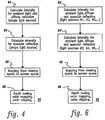
- the partitioning of the lighting model calculations between the first and second floating point processors varies depending on the number of light sources in the model. If there is a single light source as indicated, e.g. by a "Begin Shaded Polygon (Single Light Source)" datastream command, the first floating point processor 62 determines the light intensity due to the ambient and diffuse lighting effects, and the second floating point processor 64 determines the light intensity due to specular lighting effects.
- the first floating point processor 62' determines the light intensity (ambient, diffuse and specular) due to odd numbered light sources, while the second floating point processor 64' determines the light intensity (ambient, diffuse and specular) due to even numbered light sources. This is done to evenly divide the work to be performed between these two floating point processors and thereby avoid creating a bottleneck in the pipeline.
- Figure 5 depicts an alternate hardware embodiment 61 of the lighting model processing system of the present invention.
- the first and second stages of the system are each composed of three of the identical processors arranged in parallel. Each of these processors may be advantageously used to operate on a different color component.
- first stage floating point processor 62R calculates ambient and diffuse lighting effects with regard to a red light component and passes the resulting red component intensity value to a second stage floating point processor 64R which calculates the specular reflection effect on the red component and adds that to the value received from floating point processor 62R.
- first stage floating point processor 62G and second stage floating point processor 64G perform lighting model calculations on a green component
- first stage floating point processor 62B and second stage floating point processor 64B perform the lighting model calculations on a blue component.
- the remainder of the system i.e. the third and fourth stages are unchanged.
- RGB red, green, blue
- the principles of the invention are applicable to other color models as well, e.g. CMY (cyan, magenta, yellow), YIQ, HSV (hue, saturation, value), HLS (hue, lightness, saturation) etc.
- the invention is applicable not only to light sources assumed to be at infinity but also to those at a finite distance, and to spot lighting and other lighting effects.
- the Viewing Coordinate System adopted here is the right-hand system. If we considered looking at a display screen, then the x-axis points to the right, y-axis points upward, and the z-axis points toward us. Therefore, z-coordinate of data z-coordinate of viewpoint.
- the light sources in the lighting model considered here are assumed at infinity. Their positions are specified by directional vectors of unit length; the viewpoint is at infinity.
- the shading color/intensity at the vertex is given by the sum of the following three terms: (we only include the R-component, the other two, G and B, can be expressed in similar fashion)
- the lighting model calculations performed by the first and second processors are described for the following cases: single light source -- viewpoint at a finite distance; single light source -- viewpoint at an infinite distance, multiple light sources -- viewpoint at a finite distance, and multiple light sources -- viewpoint at an infinite distance.
- the mapping function performed by the third processor, and the depth cueing, color mapping and color clipping functions performed by the fourth processor are presented.
- the function of calculating the intensity of the vertex is divided among two floating point processors.
- the first floating point processor calculates the intensity of the ambient light and the diffuse term; and the second floating point processor calculates the intensity of the specular term.
- the input to the first floating point processor consists of six pieces of data: x,y,z coordinates of the vertex; and the coordinates of the normal to the surface at the vertex, i.e. a, b, c.
- the output of the first floating point processor to the second floating point processor for each vertex consists of nine words: x, y, z coordinates of the vertex; the components of the reflection direction rx, ry, rz; and the partial intensity values (ambient plus diffuse effects) for R, G, and B.
- the maximum number of light sources is assumed to be 10.
- the function of calculating the intensity for each vertex is divided among two floating point processors.
- the first floating point processor processes the color intensity due to light source #1, #3, #5, etc.
- the second floating point processor processes the color intensity due to light source #2, #4, #6, etc.
- the case where the viewpoint is at infinity differs from the case where the viewpoint is at a finite distance, only in the treatment of the reflection vector during the calculation of the light due to specular reflection.
- the viewpoint direction is given by (0, 0, 1) in the parallel projection case.
- This stage of the pipeline performs the following two steps on each polygon vertex in the order listed:
- the projection transformation is accomplished by means of the following formulae: where (Xproj, Yproj) is the projection of (x,y,z) from the 3D viewing space onto the viewing plane, and d is the distance from the viewpoint to the viewing plane.
- the projection function for z is chosen to ensure that the projection of a plane in the 3D viewing space is still a plane, and that Zproj increases as z increases.
- the projection transformation is followed by the mapping transformation, which is accomplished by means of the following formulae: Xscreen ⁇ - XVmin + Rx*(X - XCmin) Yscreen ⁇ - YVmin + Ry*(Y - YCmin)
- XVmin is the left boundary of the viewport (the area of the screen which will be used to display the image)
- XCmin is the left boundary of the clipping volume (the region of viewing space which will be mapped to the viewport)
- YVmin is the lower boundary of the viewport
- YCmin is the lower boundary of the clipping volume
- Rx and Ry are the X and Y ratios of the size of the viewport to the size of the clipping volume.
- the RGB intensities calculated by the lighting model at a vertex are blended with a specified colour value as a visual cue indicating to the workstation user which portions of the image on the screen are furthest from the viewpoint.
- Ci w*Intensi + (1-w)*Cdi
- - Intensi is the component of the input colour at the vertex
- - Cdi is the component of the colour intensity with which blending is done
- - Ci is the component of the output colour intensity at the vertex
- - Pb is the z value of the back reference plane
- - Sf is the front scale factor
- - Sb is the back scale factor
- - w the mixing function variable, is defined as a function of Zproj, the z value created by the projection and mapping stage
- the colour intensities calculated by the lighting and depth cueing processes are independent of the dynamic range of colour intensities that can be displayed by the display hardware subsequent in the system.
- this step applies a linear transformation to each individual colour component to match the dynamic colour range available in the display hardware.
- the intensities calculated by the lighting stage may range higher than the maximum intensity supported by the display hardware.
- the purpose of the colour clipping step is to make sure the colour intensities passed to the display hardware do not exceed the maximum allowed value. This removes saturation problems caused by large colour values created during the lighting caluclation stages.
- this step converts the floating point representation of the output colour intensity to the integer representation needed by the display hardware.
Landscapes
- Engineering & Computer Science (AREA)
- Computer Graphics (AREA)
- Physics & Mathematics (AREA)
- General Physics & Mathematics (AREA)
- Theoretical Computer Science (AREA)
- Image Generation (AREA)
Applications Claiming Priority (2)
| Application Number | Priority Date | Filing Date | Title |
|---|---|---|---|
| US115467 | 1987-10-30 | ||
| US07/115,467 US4866637A (en) | 1987-10-30 | 1987-10-30 | Pipelined lighting model processing system for a graphics workstation's shading function |
Publications (3)
| Publication Number | Publication Date |
|---|---|
| EP0314341A2 true EP0314341A2 (de) | 1989-05-03 |
| EP0314341A3 EP0314341A3 (de) | 1991-07-24 |
| EP0314341B1 EP0314341B1 (de) | 1995-03-15 |
Family
ID=22361599
Family Applications (1)
| Application Number | Title | Priority Date | Filing Date |
|---|---|---|---|
| EP88309573A Expired - Lifetime EP0314341B1 (de) | 1987-10-30 | 1988-10-13 | Rechnergraphikgerät zur Verarbeitung von Beleuchtungsmodellinformation |
Country Status (5)
| Country | Link |
|---|---|
| US (1) | US4866637A (de) |
| EP (1) | EP0314341B1 (de) |
| JP (1) | JPH0731741B2 (de) |
| CA (1) | CA1304824C (de) |
| DE (1) | DE3853336T2 (de) |
Cited By (8)
| Publication number | Priority date | Publication date | Assignee | Title |
|---|---|---|---|---|
| FR2670924A1 (fr) * | 1990-12-20 | 1992-06-26 | Gen Electric | Simulation de l'eclairement d'une source de lumiere dans une generation d'image par ordinateur. |
| EP0489552A3 (de) * | 1990-12-03 | 1992-12-30 | I.G.E. Medical Systems Limited | Bildverarbeitungssystem |
| GB2271257A (en) * | 1992-10-02 | 1994-04-06 | Canon Res Ct Europe Ltd | Processing image data |
| WO1995006298A1 (en) * | 1993-08-24 | 1995-03-02 | Taligent, Inc. | Object oriented shading |
| EP0837429A3 (de) * | 1996-10-15 | 1998-12-09 | Lockhead Martin Corporation | Gerät und Verfahren zum spekular Reflektionsimulieren in einem Graphik-Bildsystem |
| EP0817010A3 (de) * | 1996-07-02 | 2001-12-19 | Sun Microsystems, Inc. | Gleitkommaprozessor für einen dreidimensionalen graphischen Beschleuniger |
| EP0933729A3 (de) * | 1998-02-03 | 2002-05-08 | Sun Microsystems, Inc. | Dreidimensionaler graphischer Beschleuniger |
| US8683182B2 (en) | 1995-08-16 | 2014-03-25 | Microunity Systems Engineering, Inc. | System and apparatus for group floating-point inflate and deflate operations |
Families Citing this family (124)
| Publication number | Priority date | Publication date | Assignee | Title |
|---|---|---|---|---|
| GB9405914D0 (en) * | 1994-03-24 | 1994-05-11 | Discovision Ass | Video decompression |
| EP0576749B1 (de) * | 1992-06-30 | 1999-06-02 | Discovision Associates | Datenpipelinesystem |
| US5222203A (en) * | 1989-01-20 | 1993-06-22 | Daikin Industries, Ltd. | Method and apparatus for displaying translucent surface |
| JP2774627B2 (ja) * | 1989-12-28 | 1998-07-09 | 株式会社日立製作所 | 画像表示方法及びその装置 |
| SE464265B (sv) * | 1990-01-10 | 1991-03-25 | Stefan Blixt | Grafikprocessor |
| DE69129995T2 (de) * | 1990-01-23 | 1998-12-24 | Hewlett-Packard Co., Palo Alto, Calif. | Dezentrales Verarbeitungsgerät und Verfahren zur Anwendung in globaler Wiedergabe |
| JPH04122544A (ja) * | 1990-05-14 | 1992-04-23 | Mitsubishi Electric Corp | 施盤の切削シミュレーション方法 |
| JPH0476680A (ja) * | 1990-05-14 | 1992-03-11 | Mitsubishi Electric Corp | 回転体のグラフィック表示方法 |
| EP0459761A3 (en) * | 1990-05-31 | 1993-07-14 | Hewlett-Packard Company | Three dimensional computer graphics employing ray tracking to compute form factors in radiosity |
| US5253339A (en) * | 1990-07-26 | 1993-10-12 | Sun Microsystems, Inc. | Method and apparatus for adaptive Phong shading |
| TW225595B (de) * | 1991-09-03 | 1994-06-21 | Gen Electric | |
| US5706415A (en) * | 1991-12-20 | 1998-01-06 | Apple Computer, Inc. | Method and apparatus for distributed interpolation of pixel shading parameter values |
| US5388841A (en) * | 1992-01-30 | 1995-02-14 | A/N Inc. | External memory system having programmable graphics processor for use in a video game system or the like |
| WO1993020529A1 (en) * | 1992-03-31 | 1993-10-14 | Seiko Epson Corporation | System and method for generating 3d color images with simulated light sources |
| US7095783B1 (en) | 1992-06-30 | 2006-08-22 | Discovision Associates | Multistandard video decoder and decompression system for processing encoded bit streams including start codes and methods relating thereto |
| US6067417A (en) * | 1992-06-30 | 2000-05-23 | Discovision Associates | Picture start token |
| US6112017A (en) * | 1992-06-30 | 2000-08-29 | Discovision Associates | Pipeline processing machine having a plurality of reconfigurable processing stages interconnected by a two-wire interface bus |
| US6079009A (en) * | 1992-06-30 | 2000-06-20 | Discovision Associates | Coding standard token in a system compromising a plurality of pipeline stages |
| US6047112A (en) * | 1992-06-30 | 2000-04-04 | Discovision Associates | Technique for initiating processing of a data stream of encoded video information |
| US5784631A (en) * | 1992-06-30 | 1998-07-21 | Discovision Associates | Huffman decoder |
| US6330665B1 (en) | 1992-06-30 | 2001-12-11 | Discovision Associates | Video parser |
| US6417859B1 (en) | 1992-06-30 | 2002-07-09 | Discovision Associates | Method and apparatus for displaying video data |
| US5809270A (en) * | 1992-06-30 | 1998-09-15 | Discovision Associates | Inverse quantizer |
| US5768561A (en) * | 1992-06-30 | 1998-06-16 | Discovision Associates | Tokens-based adaptive video processing arrangement |
| US6034674A (en) * | 1992-06-30 | 2000-03-07 | Discovision Associates | Buffer manager |
| US6435737B1 (en) | 1992-06-30 | 2002-08-20 | Discovision Associates | Data pipeline system and data encoding method |
| EP0578950A3 (en) * | 1992-07-15 | 1995-11-22 | Ibm | Method and apparatus for converting floating-point pixel values to byte pixel values by table lookup |
| US5357599A (en) * | 1992-07-30 | 1994-10-18 | International Business Machines Corporation | Method and apparatus for rendering polygons |
| US5821940A (en) * | 1992-08-03 | 1998-10-13 | Ball Corporation | Computer graphics vertex index cache system for polygons |
| US5315701A (en) * | 1992-08-07 | 1994-05-24 | International Business Machines Corporation | Method and system for processing graphics data streams utilizing scalable processing nodes |
| TW241196B (de) * | 1993-01-15 | 1995-02-21 | Du Pont | |
| US5402533A (en) * | 1993-04-22 | 1995-03-28 | Apple Computer, Inc. | Method and apparatus for approximating a signed value between two endpoint values in a three-dimensional image rendering device |
| US5606650A (en) * | 1993-04-22 | 1997-02-25 | Apple Computer, Inc. | Method and apparatus for storage and retrieval of a texture map in a graphics display system |
| IL109462A0 (en) * | 1993-04-30 | 1994-07-31 | Scitex Corp Ltd | Method for generating artificial shadow |
| AU6783594A (en) * | 1993-05-10 | 1994-12-12 | Apple Computer, Inc. | Computer graphics system having high performance multiple layer z-buffer |
| US5583974A (en) * | 1993-05-10 | 1996-12-10 | Apple Computer, Inc. | Computer graphics system having high performance multiple layer Z-buffer |
| US5974189A (en) * | 1993-05-24 | 1999-10-26 | Eastman Kodak Company | Method and apparatus for modifying electronic image data |
| EP0627682B1 (de) * | 1993-06-04 | 1999-05-26 | Sun Microsystems, Inc. | Gleitkommaprozessor für einen hochleistungsfähigen dreidimensionalen Graphikbeschleuniger |
| US5805914A (en) * | 1993-06-24 | 1998-09-08 | Discovision Associates | Data pipeline system and data encoding method |
| US5835792A (en) * | 1993-06-24 | 1998-11-10 | Discovision Associates | Token-based adaptive video processing arrangement |
| US5613052A (en) * | 1993-09-02 | 1997-03-18 | International Business Machines Corporation | Method and apparatus for clipping and determining color factors for polygons |
| US5742292A (en) * | 1993-10-29 | 1998-04-21 | Kabushiki Kaisha Toshiba | System and method for realistically displaying images indicating the effects of lighting on an object in three dimensional space |
| CA2145363C (en) * | 1994-03-24 | 1999-07-13 | Anthony Mark Jones | Ram interface |
| CA2145379C (en) * | 1994-03-24 | 1999-06-08 | William P. Robbins | Method and apparatus for addressing memory |
| CA2145365C (en) * | 1994-03-24 | 1999-04-27 | Anthony M. Jones | Method for accessing banks of dram |
| US5808627A (en) * | 1994-04-22 | 1998-09-15 | Apple Computer, Inc. | Method and apparatus for increasing the speed of rendering of objects in a display system |
| GB9417138D0 (en) | 1994-08-23 | 1994-10-12 | Discovision Ass | Data rate conversion |
| US5764228A (en) * | 1995-03-24 | 1998-06-09 | 3Dlabs Inc., Ltd. | Graphics pre-processing and rendering system |
| US5835096A (en) * | 1995-03-24 | 1998-11-10 | 3D Labs | Rendering system using 3D texture-processing hardware for accelerated 2D rendering |
| US5764243A (en) * | 1995-03-24 | 1998-06-09 | 3Dlabs Inc. Ltd. | Rendering architecture with selectable processing of multi-pixel spans |
| US5798770A (en) * | 1995-03-24 | 1998-08-25 | 3Dlabs Inc. Ltd. | Graphics rendering system with reconfigurable pipeline sequence |
| US6025853A (en) * | 1995-03-24 | 2000-02-15 | 3Dlabs Inc. Ltd. | Integrated graphics subsystem with message-passing architecture |
| US5668831A (en) * | 1995-06-07 | 1997-09-16 | Discovision Associates | Signal processing apparatus and method |
| JPH096424A (ja) * | 1995-06-19 | 1997-01-10 | Mitsubishi Electric Corp | Cad/cam装置及び加工シミュレーション方法 |
| US6111584A (en) * | 1995-12-18 | 2000-08-29 | 3Dlabs Inc. Ltd. | Rendering system with mini-patch retrieval from local texture storage |
| US5739819A (en) * | 1996-02-05 | 1998-04-14 | Scitex Corporation Ltd. | Method and apparatus for generating an artificial shadow in a two dimensional color image |
| DE19606357A1 (de) * | 1996-02-12 | 1997-08-14 | Gmd Gmbh | Bildverarbeitungsverfahren zur Darstellung von spiegelnden Objekten und zugehörige Vorrichtung |
| JP3226153B2 (ja) * | 1996-03-18 | 2001-11-05 | シャープ株式会社 | マルチメディアデータ表示装置 |
| JP3387750B2 (ja) * | 1996-09-02 | 2003-03-17 | 株式会社リコー | シェーディング処理装置 |
| US6016149A (en) * | 1997-06-30 | 2000-01-18 | Sun Microsystems, Inc. | Lighting unit for a three-dimensional graphics accelerator with improved processing of multiple light sources |
| US6650327B1 (en) | 1998-06-16 | 2003-11-18 | Silicon Graphics, Inc. | Display system having floating point rasterization and floating point framebuffering |
| US6977649B1 (en) | 1998-11-23 | 2005-12-20 | 3Dlabs, Inc. Ltd | 3D graphics rendering with selective read suspend |
| US6417858B1 (en) * | 1998-12-23 | 2002-07-09 | Microsoft Corporation | Processor for geometry transformations and lighting calculations |
| US6333744B1 (en) * | 1999-03-22 | 2001-12-25 | Nvidia Corporation | Graphics pipeline including combiner stages |
| US6181352B1 (en) | 1999-03-22 | 2001-01-30 | Nvidia Corporation | Graphics pipeline selectively providing multiple pixels or multiple textures |
| US6611265B1 (en) | 1999-10-18 | 2003-08-26 | S3 Graphics Co., Ltd. | Multi-stage fixed cycle pipe-lined lighting equation evaluator |
| US6452600B1 (en) | 1999-10-28 | 2002-09-17 | Nintendo Co., Ltd. | Graphics system interface |
| US6618048B1 (en) | 1999-10-28 | 2003-09-09 | Nintendo Co., Ltd. | 3D graphics rendering system for performing Z value clamping in near-Z range to maximize scene resolution of visually important Z components |
| US6411301B1 (en) | 1999-10-28 | 2002-06-25 | Nintendo Co., Ltd. | Graphics system interface |
| US6597357B1 (en) * | 1999-12-20 | 2003-07-22 | Microsoft Corporation | Method and system for efficiently implementing two sided vertex lighting in hardware |
| US6859862B1 (en) | 2000-04-07 | 2005-02-22 | Nintendo Co., Ltd. | Method and apparatus for software management of on-chip cache |
| US6857061B1 (en) | 2000-04-07 | 2005-02-15 | Nintendo Co., Ltd. | Method and apparatus for obtaining a scalar value directly from a vector register |
| US6724394B1 (en) | 2000-05-31 | 2004-04-20 | Nvidia Corporation | Programmable pixel shading architecture |
| US6664963B1 (en) * | 2000-05-31 | 2003-12-16 | Nvidia Corporation | System, method and computer program product for programmable shading using pixel shaders |
| US7119813B1 (en) | 2000-06-02 | 2006-10-10 | Nintendo Co., Ltd. | Variable bit field encoding |
| US6788302B1 (en) | 2000-08-03 | 2004-09-07 | International Business Machines Corporation | Partitioning and load balancing graphical shape data for parallel applications |
| US6825851B1 (en) | 2000-08-23 | 2004-11-30 | Nintendo Co., Ltd. | Method and apparatus for environment-mapped bump-mapping in a graphics system |
| US6999100B1 (en) | 2000-08-23 | 2006-02-14 | Nintendo Co., Ltd. | Method and apparatus for anti-aliasing in a graphics system |
| US6937245B1 (en) | 2000-08-23 | 2005-08-30 | Nintendo Co., Ltd. | Graphics system with embedded frame buffer having reconfigurable pixel formats |
| US6639595B1 (en) | 2000-08-23 | 2003-10-28 | Nintendo Co., Ltd. | Achromatic lighting in a graphics system and method |
| US6664962B1 (en) | 2000-08-23 | 2003-12-16 | Nintendo Co., Ltd. | Shadow mapping in a low cost graphics system |
| US6980218B1 (en) | 2000-08-23 | 2005-12-27 | Nintendo Co., Ltd. | Method and apparatus for efficient generation of texture coordinate displacements for implementing emboss-style bump mapping in a graphics rendering system |
| US6580430B1 (en) | 2000-08-23 | 2003-06-17 | Nintendo Co., Ltd. | Method and apparatus for providing improved fog effects in a graphics system |
| US6811489B1 (en) | 2000-08-23 | 2004-11-02 | Nintendo Co., Ltd. | Controller interface for a graphics system |
| US7196710B1 (en) | 2000-08-23 | 2007-03-27 | Nintendo Co., Ltd. | Method and apparatus for buffering graphics data in a graphics system |
| US7034828B1 (en) | 2000-08-23 | 2006-04-25 | Nintendo Co., Ltd. | Recirculating shade tree blender for a graphics system |
| US6664958B1 (en) | 2000-08-23 | 2003-12-16 | Nintendo Co., Ltd. | Z-texturing |
| US7538772B1 (en) | 2000-08-23 | 2009-05-26 | Nintendo Co., Ltd. | Graphics processing system with enhanced memory controller |
| US6700586B1 (en) | 2000-08-23 | 2004-03-02 | Nintendo Co., Ltd. | Low cost graphics with stitching processing hardware support for skeletal animation |
| US6867781B1 (en) | 2000-08-23 | 2005-03-15 | Nintendo Co., Ltd. | Graphics pipeline token synchronization |
| US7002591B1 (en) | 2000-08-23 | 2006-02-21 | Nintendo Co., Ltd. | Method and apparatus for interleaved processing of direct and indirect texture coordinates in a graphics system |
| US6606689B1 (en) | 2000-08-23 | 2003-08-12 | Nintendo Co., Ltd. | Method and apparatus for pre-caching data in audio memory |
| US7134960B1 (en) | 2000-08-23 | 2006-11-14 | Nintendo Co., Ltd. | External interfaces for a 3D graphics system |
| US6707458B1 (en) | 2000-08-23 | 2004-03-16 | Nintendo Co., Ltd. | Method and apparatus for texture tiling in a graphics system |
| US6636214B1 (en) | 2000-08-23 | 2003-10-21 | Nintendo Co., Ltd. | Method and apparatus for dynamically reconfiguring the order of hidden surface processing based on rendering mode |
| US7184059B1 (en) | 2000-08-23 | 2007-02-27 | Nintendo Co., Ltd. | Graphics system with copy out conversions between embedded frame buffer and main memory |
| US6609977B1 (en) | 2000-08-23 | 2003-08-26 | Nintendo Co., Ltd. | External interfaces for a 3D graphics system |
| US6697074B2 (en) | 2000-11-28 | 2004-02-24 | Nintendo Co., Ltd. | Graphics system interface |
| FR2826769B1 (fr) * | 2001-06-29 | 2003-09-05 | Thales Sa | Procede d'affichage d'informations cartographiques sur ecran d'aeronef |
| US6781594B2 (en) * | 2001-08-21 | 2004-08-24 | Sony Computer Entertainment America Inc. | Method for computing the intensity of specularly reflected light |
| US7003588B1 (en) | 2001-08-22 | 2006-02-21 | Nintendo Co., Ltd. | Peripheral devices for a video game system |
| JP2005506611A (ja) * | 2001-10-10 | 2005-03-03 | ソニー・コンピュータ・エンタテインメント・アメリカ・インク | 環境マッピングシステムおよび方法 |
| US7451457B2 (en) | 2002-04-15 | 2008-11-11 | Microsoft Corporation | Facilitating interaction between video renderers and graphics device drivers |
| US7219352B2 (en) | 2002-04-15 | 2007-05-15 | Microsoft Corporation | Methods and apparatuses for facilitating processing of interlaced video images for progressive video displays |
| US7308139B2 (en) * | 2002-07-12 | 2007-12-11 | Chroma Energy, Inc. | Method, system, and apparatus for color representation of seismic data and associated measurements |
| US7006090B2 (en) * | 2003-02-07 | 2006-02-28 | Crytek Gmbh | Method and computer program product for lighting a computer graphics image and a computer |
| US7106326B2 (en) * | 2003-03-03 | 2006-09-12 | Sun Microsystems, Inc. | System and method for computing filtered shadow estimates using reduced bandwidth |
| JP2005057738A (ja) * | 2003-07-18 | 2005-03-03 | Canon Inc | 信号処理装置、信号処理方法及びプログラム |
| US7643675B2 (en) * | 2003-08-01 | 2010-01-05 | Microsoft Corporation | Strategies for processing image information using a color information data structure |
| US7139002B2 (en) * | 2003-08-01 | 2006-11-21 | Microsoft Corporation | Bandwidth-efficient processing of video images |
| US7158668B2 (en) | 2003-08-01 | 2007-01-02 | Microsoft Corporation | Image processing using linear light values and other image processing improvements |
| US8133115B2 (en) | 2003-10-22 | 2012-03-13 | Sony Computer Entertainment America Llc | System and method for recording and displaying a graphical path in a video game |
| US20060071933A1 (en) | 2004-10-06 | 2006-04-06 | Sony Computer Entertainment Inc. | Application binary interface for multi-pass shaders |
| US7636126B2 (en) | 2005-06-22 | 2009-12-22 | Sony Computer Entertainment Inc. | Delay matching in audio/video systems |
| US7880746B2 (en) | 2006-05-04 | 2011-02-01 | Sony Computer Entertainment Inc. | Bandwidth management through lighting control of a user environment via a display device |
| US7965859B2 (en) | 2006-05-04 | 2011-06-21 | Sony Computer Entertainment Inc. | Lighting control of a user environment via a display device |
| US7940266B2 (en) * | 2006-10-13 | 2011-05-10 | International Business Machines Corporation | Dynamic reallocation of processing cores for balanced ray tracing graphics workload |
| WO2008060948A2 (en) * | 2006-11-10 | 2008-05-22 | Sandbridge Technologies, Inc. | Method and system for parallelization of pipelined computations |
| US8922565B2 (en) * | 2007-11-30 | 2014-12-30 | Qualcomm Incorporated | System and method for using a secondary processor in a graphics system |
| US8081019B2 (en) * | 2008-11-21 | 2011-12-20 | Flextronics Ap, Llc | Variable PFC and grid-tied bus voltage control |
| US10786736B2 (en) | 2010-05-11 | 2020-09-29 | Sony Interactive Entertainment LLC | Placement of user information in a game space |
| US9342817B2 (en) | 2011-07-07 | 2016-05-17 | Sony Interactive Entertainment LLC | Auto-creating groups for sharing photos |
| CN105023249B (zh) * | 2015-06-26 | 2017-11-17 | 清华大学深圳研究生院 | 基于光场的高光图像修复方法及装置 |
| US11756254B2 (en) * | 2020-12-08 | 2023-09-12 | Nvidia Corporation | Light importance caching using spatial hashing in real-time ray tracing applications |
Family Cites Families (8)
| Publication number | Priority date | Publication date | Assignee | Title |
|---|---|---|---|---|
| JPS5513582A (en) * | 1978-07-13 | 1980-01-30 | Sanyo Electric Co Ltd | Color television receiver |
| US4241341A (en) * | 1979-03-05 | 1980-12-23 | Thorson Mark R | Apparatus for scan conversion |
| CA1141468A (en) * | 1979-06-15 | 1983-02-15 | Martin J.P. Bolton | Visual display apparatus |
| US4646075A (en) * | 1983-11-03 | 1987-02-24 | Robert Bosch Corporation | System and method for a data processing pipeline |
| US4658247A (en) * | 1984-07-30 | 1987-04-14 | Cornell Research Foundation, Inc. | Pipelined, line buffered real-time color graphics display system |
| JPH0746391B2 (ja) * | 1984-09-14 | 1995-05-17 | 株式会社日立製作所 | 図形シエ−デイング装置 |
| CA1260638A (en) * | 1985-02-26 | 1989-09-26 | Tetsuzo Kuragano | Method of displaying image |
| US4737921A (en) * | 1985-06-03 | 1988-04-12 | Dynamic Digital Displays, Inc. | Three dimensional medical image display system |
-
1987
- 1987-10-30 US US07/115,467 patent/US4866637A/en not_active Expired - Fee Related
-
1988
- 1988-10-13 EP EP88309573A patent/EP0314341B1/de not_active Expired - Lifetime
- 1988-10-13 DE DE3853336T patent/DE3853336T2/de not_active Expired - Fee Related
- 1988-10-27 CA CA000581529A patent/CA1304824C/en not_active Expired - Lifetime
- 1988-10-28 JP JP63271091A patent/JPH0731741B2/ja not_active Expired - Lifetime
Cited By (9)
| Publication number | Priority date | Publication date | Assignee | Title |
|---|---|---|---|---|
| EP0489552A3 (de) * | 1990-12-03 | 1992-12-30 | I.G.E. Medical Systems Limited | Bildverarbeitungssystem |
| FR2670924A1 (fr) * | 1990-12-20 | 1992-06-26 | Gen Electric | Simulation de l'eclairement d'une source de lumiere dans une generation d'image par ordinateur. |
| GB2271257A (en) * | 1992-10-02 | 1994-04-06 | Canon Res Ct Europe Ltd | Processing image data |
| WO1995006298A1 (en) * | 1993-08-24 | 1995-03-02 | Taligent, Inc. | Object oriented shading |
| US8683182B2 (en) | 1995-08-16 | 2014-03-25 | Microunity Systems Engineering, Inc. | System and apparatus for group floating-point inflate and deflate operations |
| US8769248B2 (en) | 1995-08-16 | 2014-07-01 | Microunity Systems Engineering, Inc. | System and apparatus for group floating-point inflate and deflate operations |
| EP0817010A3 (de) * | 1996-07-02 | 2001-12-19 | Sun Microsystems, Inc. | Gleitkommaprozessor für einen dreidimensionalen graphischen Beschleuniger |
| EP0837429A3 (de) * | 1996-10-15 | 1998-12-09 | Lockhead Martin Corporation | Gerät und Verfahren zum spekular Reflektionsimulieren in einem Graphik-Bildsystem |
| EP0933729A3 (de) * | 1998-02-03 | 2002-05-08 | Sun Microsystems, Inc. | Dreidimensionaler graphischer Beschleuniger |
Also Published As
| Publication number | Publication date |
|---|---|
| CA1304824C (en) | 1992-07-07 |
| DE3853336T2 (de) | 1995-09-28 |
| JPH0731741B2 (ja) | 1995-04-10 |
| JPH01163884A (ja) | 1989-06-28 |
| EP0314341A3 (de) | 1991-07-24 |
| US4866637A (en) | 1989-09-12 |
| DE3853336D1 (de) | 1995-04-20 |
| EP0314341B1 (de) | 1995-03-15 |
Similar Documents
| Publication | Publication Date | Title |
|---|---|---|
| US4866637A (en) | Pipelined lighting model processing system for a graphics workstation's shading function | |
| US6333744B1 (en) | Graphics pipeline including combiner stages | |
| US6664963B1 (en) | System, method and computer program product for programmable shading using pixel shaders | |
| US8144158B2 (en) | Display system having floating point rasterization and floating point framebuffering | |
| US5185856A (en) | Arithmetic and logic processing unit for computer graphics system | |
| US5553208A (en) | Image synthesizing system having a field buffer unit that stores texture coordinates | |
| US5230039A (en) | Texture range controls for improved texture mapping | |
| US6624823B2 (en) | Graphics system configured to determine triangle orientation by octant identification and slope comparison | |
| US6525723B1 (en) | Graphics system which renders samples into a sample buffer and generates pixels in response to stored samples at different rates | |
| US6496186B1 (en) | Graphics system having a super-sampled sample buffer with generation of output pixels using selective adjustment of filtering for reduced artifacts | |
| US8130227B2 (en) | Distributed antialiasing in a multiprocessor graphics system | |
| GB2228652A (en) | Hidden surface elimination and Gouraud shading | |
| US6806886B1 (en) | System, method and article of manufacture for converting color data into floating point numbers in a computer graphics pipeline | |
| US6489956B1 (en) | Graphics system having a super-sampled sample buffer with generation of output pixels using selective adjustment of filtering for implementation of display effects | |
| GB2226219A (en) | Method for three-dimensional clip checking for computer graphics | |
| US6778188B2 (en) | Reconfigurable hardware filter for texture mapping and image processing | |
| EP1155385B1 (de) | Graphisches system mit superabtastungspuffer mit speicherung von abtastpositionsinformation | |
| US7116333B1 (en) | Data retrieval method and system | |
| US6373494B1 (en) | Signal processing apparatus and image processing apparatus | |
| US20030164842A1 (en) | Slice blend extension for accumulation buffering | |
| EP0485833A2 (de) | Verfahren zur Ausführung von graphischen, arithmetischen Instruktionen zur Farbensättigung in einem Datenverarbeitungsgerät | |
| US20080055307A1 (en) | Graphics rendering pipeline |
Legal Events
| Date | Code | Title | Description |
|---|---|---|---|
| PUAI | Public reference made under article 153(3) epc to a published international application that has entered the european phase |
Free format text: ORIGINAL CODE: 0009012 |
|
| AK | Designated contracting states |
Kind code of ref document: A2 Designated state(s): DE FR GB IT |
|
| 17P | Request for examination filed |
Effective date: 19890809 |
|
| PUAL | Search report despatched |
Free format text: ORIGINAL CODE: 0009013 |
|
| AK | Designated contracting states |
Kind code of ref document: A3 Designated state(s): DE FR GB IT |
|
| 17Q | First examination report despatched |
Effective date: 19930907 |
|
| GRAA | (expected) grant |
Free format text: ORIGINAL CODE: 0009210 |
|
| AK | Designated contracting states |
Kind code of ref document: B1 Designated state(s): DE FR GB IT |
|
| PG25 | Lapsed in a contracting state [announced via postgrant information from national office to epo] |
Ref country code: IT Free format text: LAPSE BECAUSE OF FAILURE TO SUBMIT A TRANSLATION OF THE DESCRIPTION OR TO PAY THE FEE WITHIN THE PRESCRIBED TIME-LIMIT;WARNING: LAPSES OF ITALIAN PATENTS WITH EFFECTIVE DATE BEFORE 2007 MAY HAVE OCCURRED AT ANY TIME BEFORE 2007. THE CORRECT EFFECTIVE DATE MAY BE DIFFERENT FROM THE ONE RECORDED. Effective date: 19950315 |
|
| REF | Corresponds to: |
Ref document number: 3853336 Country of ref document: DE Date of ref document: 19950420 |
|
| ET | Fr: translation filed | ||
| PGFP | Annual fee paid to national office [announced via postgrant information from national office to epo] |
Ref country code: GB Payment date: 19950926 Year of fee payment: 8 |
|
| PGFP | Annual fee paid to national office [announced via postgrant information from national office to epo] |
Ref country code: FR Payment date: 19951009 Year of fee payment: 8 |
|
| PGFP | Annual fee paid to national office [announced via postgrant information from national office to epo] |
Ref country code: DE Payment date: 19951030 Year of fee payment: 8 |
|
| PLBE | No opposition filed within time limit |
Free format text: ORIGINAL CODE: 0009261 |
|
| STAA | Information on the status of an ep patent application or granted ep patent |
Free format text: STATUS: NO OPPOSITION FILED WITHIN TIME LIMIT |
|
| 26N | No opposition filed | ||
| PG25 | Lapsed in a contracting state [announced via postgrant information from national office to epo] |
Ref country code: GB Effective date: 19961013 |
|
| GBPC | Gb: european patent ceased through non-payment of renewal fee |
Effective date: 19961013 |
|
| PG25 | Lapsed in a contracting state [announced via postgrant information from national office to epo] |
Ref country code: FR Effective date: 19970630 |
|
| PG25 | Lapsed in a contracting state [announced via postgrant information from national office to epo] |
Ref country code: DE Effective date: 19970701 |
|
| REG | Reference to a national code |
Ref country code: FR Ref legal event code: ST |