EP0314491B1 - Système de réception optique à diversité de polarisation - Google Patents
Système de réception optique à diversité de polarisation Download PDFInfo
- Publication number
- EP0314491B1 EP0314491B1 EP88310146A EP88310146A EP0314491B1 EP 0314491 B1 EP0314491 B1 EP 0314491B1 EP 88310146 A EP88310146 A EP 88310146A EP 88310146 A EP88310146 A EP 88310146A EP 0314491 B1 EP0314491 B1 EP 0314491B1
- Authority
- EP
- European Patent Office
- Prior art keywords
- light
- receiving system
- frequency
- light receiving
- polarization
- Prior art date
- Legal status (The legal status is an assumption and is not a legal conclusion. Google has not performed a legal analysis and makes no representation as to the accuracy of the status listed.)
- Expired - Lifetime
Links
Images



Classifications
-
- H—ELECTRICITY
- H04—ELECTRIC COMMUNICATION TECHNIQUE
- H04B—TRANSMISSION
- H04B10/00—Transmission systems employing electromagnetic waves other than radio-waves, e.g. infrared, visible or ultraviolet light, or employing corpuscular radiation, e.g. quantum communication
- H04B10/60—Receivers
- H04B10/61—Coherent receivers
-
- H—ELECTRICITY
- H04—ELECTRIC COMMUNICATION TECHNIQUE
- H04B—TRANSMISSION
- H04B10/00—Transmission systems employing electromagnetic waves other than radio-waves, e.g. infrared, visible or ultraviolet light, or employing corpuscular radiation, e.g. quantum communication
- H04B10/60—Receivers
- H04B10/61—Coherent receivers
- H04B10/614—Coherent receivers comprising one or more polarization beam splitters, e.g. polarization multiplexed [PolMux] X-PSK coherent receivers, polarization diversity heterodyne coherent receivers
-
- H—ELECTRICITY
- H04—ELECTRIC COMMUNICATION TECHNIQUE
- H04B—TRANSMISSION
- H04B10/00—Transmission systems employing electromagnetic waves other than radio-waves, e.g. infrared, visible or ultraviolet light, or employing corpuscular radiation, e.g. quantum communication
- H04B10/60—Receivers
- H04B10/61—Coherent receivers
- H04B10/64—Heterodyne, i.e. coherent receivers where, after the opto-electronic conversion, an electrical signal at an intermediate frequency [IF] is obtained
Definitions
- the present invention relates to a polarization diversity light receiving system and, more particularly, to a polarization diversity light receiving system utilizing baseband combining which stabilizes intermediate frequencies.
- the planes of polarization of signal light and local oscillator light be brought into agreement with each other on a photodetector of the receiver.
- the sensitivity for receiving light varies with time because the state of polarization of the signal light undergoes variations owing to various disturbances in the optical fiber transmission line.
- the polarization diversity light receiving system is employed as one of means for implementing stable light receiving sensitivity independent of variations in the state of polarization of the signal light.
- the signal light having experienced variations in its state of polarization is split into two orthogonally polarized waves at the receiving end and the two polarized waves are each detected by local oscillator light having adjusted its plane of polarization to that of the polarized wave.
- the polarization diversity light receiving system is divided into two types in terms of the abovementioned electrical combining method.
- the first is a system which electrically combines two received signals together under an intermediate-frequency condition (which system will hereinafter be referred to as "intermediate frequency combining").
- the second system is one that combines the two received signals after demodulating them independently of each other (which system will hereinafter be referred to as “baseband combining").
- the automatic phase adjustment adder is needed for adjusting the phases of the two received signals at all times; so that this inevitably involves a complex arrangement.
- the baseband combining combines the received signals after demodulating them, and hence has the advantage of dispensing with the above-mentioned phase adjustment; and some practical embodiments have been proposed so far.
- the semiconductor laser for emitting the signal light or local oscillator light is defective in that the oscillation wavelength is liable to vary under the influences of external temperature changes and aging.
- An object of the present invention is to provide a polarization diversity light receiving system employing the baseband combining which provides for increased sensitivity to received light regardless of the polarization characteristic of signal light.
- a feature of the present invention resides in that the polarization diversity light receiving system using baseband combining is arranged so that the control signal for the local oscillator laser is the sum of squared values of received signals.
- Fig. 1 is a block diagram of the polarization diversity light receiving system using the conventional intermediate frequency combining.
- Reference numeral 1 indicates signal light having propagated over an optical fiber transmission line; 2 a laser for local oscillation; 3 a light combiner for combining the signal light with local oscillator light; 4 a polarized light separating element for separating combined signal light and local oscillator light into two orthogonally polarized components; 5 a and 5 b light receivers, each converting to an electrical signal a beat component of the light into which the signal light and local oscillation light have been orthogonally combined; 6 a and 6 b weighting circuits for weighting the respective received signals, as required, for an optimum combination thereof; 7 an automatic phase adjustment adder for adding together the two weighted received signals while adjusting their phases relative to each other; and 8 a demodulator for demodulating the modulated received signal.
- the second system is one that combines the two received signals after demodulating them independently of each other (which system will hereinafter be referred to as "baseband combining").
- Fig. 2 is a block diagram of the polarization diversity light receiving system employing the conventional baseband combining. In Fig. 2 parts having the same functions as those in Fig. 1 are identified by the same reference numerals and no description will be repeated in connection with them.
- the feature of the polarization diversity light receiving system utilizing the baseband combining resides in that the received signals split into orthogonally polarized waves and then converted into electrical signals are demodulated by demodulators 8 a and 8 b , respectively, and the demodulated signals are added together by an adder 9 after being weighted.
- the baseband combining differs from the intermediate frequency combining in an arrangement in which the electrical signals converted by the light receivers 5 a and 5 b are demodulated by the demodulators 8 a and 8 b and then weighted, respectively, thereafter being added together.
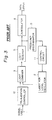
- Fig. 3 is a schematic diagram of a coherent type light receiving system employing the conventional intermediate frequency stabilizing.
- Reference numeral 12 indicates a polarization controller by which the planes of polarization of the signal light 1 and the local oscillator light emitted from the local oscillator laser 2 are brought into agreement with each other, 10 a frequency discriminator for generating an output voltage corresponding to a frequency fluctuation, and 11 a control circuit for controlling the oscillation wavelength (i.e. frequency) of the local oscillator laser 2 in accordance with the output voltage of the frequency discriminator 10.
- a polarization controller by which the planes of polarization of the signal light 1 and the local oscillator light emitted from the local oscillator laser 2 are brought into agreement with each other
- 10 a frequency discriminator for generating an output voltage corresponding to a frequency fluctuation
- 11 a control circuit for controlling the oscillation wavelength (i.e. frequency) of the local oscillator laser 2 in accordance with the output voltage of the frequency discriminator 10.
- the received signal converted into an electrical signal is fedback to the laser via the frequency discriminator 10 so as to make the frequency of the local oscillator light follow the frequency of the signal light 1 having undergone a frequency fluctuation.
- the frequency discriminator 10 generates an output voltage which is provided corresponding to a frequency fluctuation.
- the frequency of the local oscillator laser is controlled by the control circuit 11 through utilization of fluctuations in the output voltage thus obtained, thereby obtaining local oscillator light of a frequency following that of the signal light.
- the local oscillator laser is controlled by use of the output from one of the light receivers 5 a and 5 b in Fig. 2, so that the output of the frequency of the frequency discriminator 10 varies by fluctuations in the state of polarization of the signal light, leading to a failure in obtaining high light receiving sensitivity.
- an intermediate frequency stabilizing system useful for the polarization diversity light receiving system employing the baseband combining which does not involve the automatic phase adjustment adder 7, but no proposals have been made up to now.
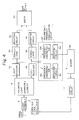
- Fig. 4 is a block diagram of an embodiment of the polarization diversity light receiving system employing the baseband combining according to the present invention.
- Reference numerals 10 a and 10 b indicate frequency discriminators for discriminating the frequencies of intermediate-frequency signals output from the light receivers 5 a and 5 b , 6 c and 6 d weighting circuits for weighting the frequency-discriminated signals as required, 9 b an adder for adding together the outputs of the weighting circuits 6 c and 6 d , 11 a control circuit for generating a frequency stabilizing signal, and 20 an intermediate frequency stabilizing circuit made up of the frequency discriminators 10 a and 10 b and the weighting circuits 6 c and 6 d .
- the intensity of a detected signal obtained by optical heterodyne or homodyne detection is in proportion to ⁇ P S P L , where P S is the power of signal light and P L is the power of local oscillator light.
- the branching ratio of the signal light by the polarized light separating element 4 be represented by ⁇ /(1 - ⁇ ) where (0 ⁇ a ⁇ 1)
- the outputs of the light receivers are in proportion to ⁇ ⁇ P S P L and ⁇ (1 - ⁇ )P S P L , respectively.
- the value ⁇ varies in the range of from 0 to 1 every moment in response to variations in the state of polarization of the signal light. Since the outputs of the frequency discriminators 10 a and 10 b are usually dependent on the intput voltage, it is impossible to stabilize the intermediate frequency regardless of the state of polarization by use of the output voltage from one of the light receivers.
- the present invention is based on the fact that the sum of squared values of the proportional coefficients ⁇ ⁇ P S P L and ⁇ (1 - ⁇ )P S P L of the output voltages from the light receivers 5 a and 5 b is not dependent on variations in the state of polarization. That is, the intermediate frequency stabilization circuit 20 is formed by connecting proper weighting circuits 6 c and 6 d to the outputs of the frequency discriminators 10 a and 10 b and is so arranged as to provide outputs each corresponding to the square of the output voltage of one of the light receivers 5 a and 5 b , and these outputs are added together by the adder 9 b to obtain the sum of the squared values.
- the received signal which is the sum of the squared values, is dependent on the frequency of the signal light but is not dependent on the state of its polarization, and this signal is applied to the control circuit 11, the output of which is applied as a control signal to the local oscillator laser 2 to control its frequency.
- the output voltage of the light receivers 5 a and 5 b can be obtained as squared values equivalently, even if the weighting circuits 6 c and 6 d are omitted.
- the present invention permits stabilization of the intermediate frequency regardless of the state of polarization of the signal light 1, making it possible to receive the signal light with a high degree of sensitivity.
- Fig. 5 illustrates another embodiment of the present invention. This embodiment is effective only for an FSK modulation system in which the signal light 1 is subjected to frequency shift keying.
- the demodulators 8 a and 8 b for demodulating FSK-modulated signals are similar in operation to the afore-mentioned frequency discriminators.
- the demodulators 8 a and 8 b for demodulating FSK-modulated signals are similar in operation to the afore-mentioned frequency discriminators.
- the outputs of the demodulators 8 a and 8 b are given, by the weighting circuits 6 a and 6 b , weights equivalently corresponding to their squares before being added together by the adder 9 a ; so that it is possible to obtain a control signal for the local oscillator laser 2 independently of the state of polarization of the signal light by partly branching the weighted outputs and adding them together by means of the adder 9 b .
- the intermediate frequency stabilization circuit 20 is equivalently constituted by the demodulators 8 a and 8 b and the weighting circuits 6 a and 6 b .
- the constitution of the present invention provides a stability of ⁇ 2 MHz regardless of the state of polarization of the signal light.
- the present invention stabilizes the intermediate frequency independently of the polarization characteristic of the signal light, and hence allows a substantial improvement of the sensitivity for receiving signal light.
- the stabilization of the intermediate frequency in the polarization diversity light receiving system can be performed independently of the state of polarization of signal light by an arrangement in which the control signal for the local oscillator laser 2 is provided equivalently in the form of the sum of squared values of the received signal.
- This improves the stability of the system and the sensitivity for receiving the signal light and permits frequency multiplexing. Accordingly, the present invention is of great practical utility.
Landscapes
- Physics & Mathematics (AREA)
- Electromagnetism (AREA)
- Engineering & Computer Science (AREA)
- Computer Networks & Wireless Communication (AREA)
- Signal Processing (AREA)
- Optical Communication System (AREA)
Claims (3)
- Système de réception de lumière à diversité de polarisation utilisant une combinaison de bande de base, dans lequel un signal lumineux d'un plan de polarisation arbitraire en tant que résultat de sa propagation sur une fibre optique est séparé (4) en composantes d'ondes polarisées orthogonales et est détecté au moyen de l'utilisation d'une sortie de lumière d'oscillation en provenance d'un laser d'oscillateur local (2) prévu au niveau du côté de réception, les composantes d'ondes polarisées étant détectées afin d'obtenir des signaux électriques qui sont combinés,
caractérisé par :
un moyen de stabilisation de fréquence intermédiaire (20) qui discrimine la fréquence de chacun des signaux électriques, qui génère une tension de sortie correspondant à une variation de la fréquence et qui pondère la tension de sortie de manière à disposer d'une valeur élevée au carré du signal électrique : et
un moyen d'addition (9b) pour combiner les sorties du moyen de stabilisation de fréquence intermédiaire,
dans lequel un signal de commande qui est la somme des valeurs élevées au carré des signaux électriques, obtenu au moyen du moyen d'addition, est utilisé pour commander le laser d'oscillateur local (2), ce qui stabilise sa fréquence. - Système de réception de lumière à diversité de polarisation utilisant une combinaison de bande de base selon la revendication 1, dans lequel ledit moyen de stabilisation de fréquence intermédiaire (20) est conçu pour recevoir les signaux électriques en plus de la réception de ceux-ci par des démodulateurs (8a, 8b) des signaux électriques.
- Système de réception de lumière à diversité de polarisation utilisant une combinaison de bande de base selon la revendication 1 ou 2, dans lequel ledit moyen de stabilisation de fréquence intermédiaire (20) est prévu pour le signal lumineux d'une modulation par déplacement de fréquence (MDF) au moyen de l'utilisation commune de démodulateurs (8a, 8b) des signaux électriques et de circuits de pondération (6a, 6b) au niveau de la sortie des démodulateurs (8a, 8b).
Applications Claiming Priority (2)
| Application Number | Priority Date | Filing Date | Title |
|---|---|---|---|
| JP62270367A JP2562623B2 (ja) | 1987-10-28 | 1987-10-28 | ベースバンド合成法による偏波ダイバーシティ光受信方式 |
| JP270367/87 | 1987-10-28 |
Publications (3)
| Publication Number | Publication Date |
|---|---|
| EP0314491A2 EP0314491A2 (fr) | 1989-05-03 |
| EP0314491A3 EP0314491A3 (en) | 1990-05-16 |
| EP0314491B1 true EP0314491B1 (fr) | 1993-08-25 |
Family
ID=17485277
Family Applications (1)
| Application Number | Title | Priority Date | Filing Date |
|---|---|---|---|
| EP88310146A Expired - Lifetime EP0314491B1 (fr) | 1987-10-28 | 1988-10-28 | Système de réception optique à diversité de polarisation |
Country Status (4)
| Country | Link |
|---|---|
| US (1) | US4888817A (fr) |
| EP (1) | EP0314491B1 (fr) |
| JP (1) | JP2562623B2 (fr) |
| DE (1) | DE3883480T2 (fr) |
Families Citing this family (16)
| Publication number | Priority date | Publication date | Assignee | Title |
|---|---|---|---|---|
| JPH063512B2 (ja) * | 1988-02-19 | 1994-01-12 | 富士通株式会社 | コヒーレント光通信用偏波ダイバーシティ光受信装置 |
| JPH0239131A (ja) * | 1988-07-29 | 1990-02-08 | Hitachi Ltd | 周波数間隔安定化方法、光ヘテロダイン又は光ホモダイン通信方法 |
| JPH02162330A (ja) * | 1988-12-16 | 1990-06-21 | Hitachi Ltd | 偏波ダイバシティ光受信方法とその装置および中間周波数安定化方法 |
| JP2540935B2 (ja) * | 1989-03-16 | 1996-10-09 | 日本電気株式会社 | 一括偏波制御方法 |
| US5115332A (en) * | 1989-07-20 | 1992-05-19 | Fujitsu Limited | Receiver for coherent optical communication |
| JPH04150628A (ja) * | 1990-10-15 | 1992-05-25 | Nec Corp | 光通信システムの波長安定化方法および回路 |
| US5321850A (en) * | 1991-10-09 | 1994-06-14 | Telefonaktiebolaget L M Ericsson | Diversity radio receiver automatic frequency control |
| US5388088A (en) * | 1992-04-02 | 1995-02-07 | At&T Corp. | Multiple polarization sensitive detection arrangement for fiber optic communications |
| JP2689875B2 (ja) * | 1993-12-24 | 1997-12-10 | 日本電気株式会社 | 光信号受信装置 |
| EP0699362A1 (fr) * | 1994-02-18 | 1996-03-06 | Koninklijke Philips Electronics N.V. | Detecteur quadratique a large bande ayant une courbe de reponse en frequence triangulaire, un systeme de transmission et un recepteur comportant un tel detecteur |
| DE19612604A1 (de) * | 1996-03-29 | 1997-10-02 | Sel Alcatel Ag | Optischer Empfänger mit einer Entzerrerschaltung für durch PMD verursachte Störungen und System mit einem solchen optischen Empfänger |
| RU2432362C2 (ru) | 2005-11-30 | 2011-10-27 | Эбботт Лэборетриз | Моноклональные антитела и их применения |
| US7406269B2 (en) * | 2006-03-10 | 2008-07-29 | Discovery Semiconductors, Inc. | Feedback-controlled coherent optical receiver with electrical compensation/equalization |
| US9337937B2 (en) | 2014-03-10 | 2016-05-10 | Cisco Technology, Inc. | Common mode rejection ratio control for coherent optical receivers |
| JP6884948B2 (ja) * | 2017-03-17 | 2021-06-09 | 国立研究開発法人情報通信研究機構 | 高速フォトディテクターアレー |
| JP2022114537A (ja) * | 2021-01-27 | 2022-08-08 | 富士通株式会社 | 波長分波装置、光送受信器、光回路、及び波長分波制御方法 |
Family Cites Families (5)
| Publication number | Priority date | Publication date | Assignee | Title |
|---|---|---|---|---|
| JPH0618348B2 (ja) * | 1984-02-06 | 1994-03-09 | 日本電信電話株式会社 | 光受信回路制御装置 |
| GB8515499D0 (en) * | 1985-06-19 | 1985-07-24 | British Telecomm | Digital information transmission system |
| US4723315A (en) * | 1986-06-24 | 1988-02-02 | Itek Corporation | Polarization matching mixer |
| DE3621734A1 (de) * | 1986-06-28 | 1988-01-07 | Standard Elektrik Lorenz Ag | Optischer ueberlagerungsempfaenger |
| US4718120A (en) * | 1986-11-24 | 1988-01-05 | American Telephone And Telegraph Company, At&T Bell Laboratories | Polarization insensitive coherent lightwave detector |
-
1987
- 1987-10-28 JP JP62270367A patent/JP2562623B2/ja not_active Expired - Lifetime
-
1988
- 1988-10-17 US US07/258,817 patent/US4888817A/en not_active Expired - Lifetime
- 1988-10-28 DE DE88310146T patent/DE3883480T2/de not_active Expired - Fee Related
- 1988-10-28 EP EP88310146A patent/EP0314491B1/fr not_active Expired - Lifetime
Also Published As
| Publication number | Publication date |
|---|---|
| JPH01114832A (ja) | 1989-05-08 |
| DE3883480D1 (de) | 1993-09-30 |
| EP0314491A3 (en) | 1990-05-16 |
| US4888817A (en) | 1989-12-19 |
| JP2562623B2 (ja) | 1996-12-11 |
| EP0314491A2 (fr) | 1989-05-03 |
| DE3883480T2 (de) | 1993-12-23 |
Similar Documents
| Publication | Publication Date | Title |
|---|---|---|
| EP0314491B1 (fr) | Système de réception optique à diversité de polarisation | |
| EP0251062B1 (fr) | Récepteur pour signaux optiques doublement symétrique | |
| US5687261A (en) | Fiber-optic delay-line stabilization of heterodyne optical signal generator and method using same | |
| EP0352809B1 (fr) | Récepteur optique hétérodyne à diversité de polarisation avec ajustement de la phase de deux signaux à fréquence intermédiaire pour la commande d'une source optique locale | |
| JPS63500069A (ja) | ディジタル情報伝送方法および装置 | |
| US20090016723A1 (en) | Optical-wireless hybrid transmission system and optical-wireless hybrid transmission method | |
| US5146359A (en) | Double-stage phase-diversity receiver | |
| US5140453A (en) | Optical receiving method utilizing polarization diversity and apparatus for carrying out the same | |
| US5367397A (en) | Wavelength-stabilizing method and its associated circuitry for an optical communication system | |
| JP2658180B2 (ja) | 偏波ダイバーシチ光受信装置 | |
| US6493131B1 (en) | Wavelength-locking of optical sources | |
| US5510927A (en) | Method for setting the local oscillator of an optical superheterodyne receiver | |
| US6043921A (en) | Fading-free optical phase rate receiver | |
| JPH0572777B2 (fr) | ||
| EP0390069B1 (fr) | Récepteur hétérodyne à diversité de polarisation de type de combinaison en bande de base où des signaux FI sont ajustés par contre-réaction à partir d'un signal de sortie d'un dispositif | |
| US5568305A (en) | Heterodyne receiver provided with a frequency discriminator for coherent lightwave communications | |
| JPH05191352A (ja) | 偏光変調を用いたコヒーレント光ファイバ通信システム | |
| JPH04248721A (ja) | バランス型光受信器 | |
| Takamasa et al. | Polarization diversity technique for coherent optical detection | |
| Knibbe et al. | Integrated heterodyne receiver and spatial tracker for binary FSK communication | |
| JP2734137B2 (ja) | 両偏波受信システム | |
| JPH0795178B2 (ja) | 中間周波数安定化方法 | |
| US5629959A (en) | Wideband square-law detector having a triangular frequency characteristic as well as a transmission system and a receiver including such a detector | |
| JPH02120726A (ja) | コヒーレント光通信方式 | |
| Emura et al. | 4 to 5 Gb/s phase diversity homodyne detection experiment |
Legal Events
| Date | Code | Title | Description |
|---|---|---|---|
| PUAI | Public reference made under article 153(3) epc to a published international application that has entered the european phase |
Free format text: ORIGINAL CODE: 0009012 |
|
| AK | Designated contracting states |
Kind code of ref document: A2 Designated state(s): DE FR GB |
|
| PUAL | Search report despatched |
Free format text: ORIGINAL CODE: 0009013 |
|
| AK | Designated contracting states |
Kind code of ref document: A3 Designated state(s): DE FR GB |
|
| 17P | Request for examination filed |
Effective date: 19900719 |
|
| 17Q | First examination report despatched |
Effective date: 19921028 |
|
| GRAA | (expected) grant |
Free format text: ORIGINAL CODE: 0009210 |
|
| AK | Designated contracting states |
Kind code of ref document: B1 Designated state(s): DE FR GB |
|
| REF | Corresponds to: |
Ref document number: 3883480 Country of ref document: DE Date of ref document: 19930930 |
|
| ET | Fr: translation filed | ||
| PLBE | No opposition filed within time limit |
Free format text: ORIGINAL CODE: 0009261 |
|
| STAA | Information on the status of an ep patent application or granted ep patent |
Free format text: STATUS: NO OPPOSITION FILED WITHIN TIME LIMIT |
|
| 26N | No opposition filed | ||
| PGFP | Annual fee paid to national office [announced via postgrant information from national office to epo] |
Ref country code: GB Payment date: 20010914 Year of fee payment: 14 |
|
| PGFP | Annual fee paid to national office [announced via postgrant information from national office to epo] |
Ref country code: DE Payment date: 20011005 Year of fee payment: 14 |
|
| PGFP | Annual fee paid to national office [announced via postgrant information from national office to epo] |
Ref country code: FR Payment date: 20011011 Year of fee payment: 14 |
|
| REG | Reference to a national code |
Ref country code: GB Ref legal event code: IF02 |
|
| PG25 | Lapsed in a contracting state [announced via postgrant information from national office to epo] |
Ref country code: GB Free format text: LAPSE BECAUSE OF NON-PAYMENT OF DUE FEES Effective date: 20021028 |
|
| PG25 | Lapsed in a contracting state [announced via postgrant information from national office to epo] |
Ref country code: DE Free format text: LAPSE BECAUSE OF NON-PAYMENT OF DUE FEES Effective date: 20030501 |
|
| GBPC | Gb: european patent ceased through non-payment of renewal fee | ||
| PG25 | Lapsed in a contracting state [announced via postgrant information from national office to epo] |
Ref country code: FR Free format text: LAPSE BECAUSE OF NON-PAYMENT OF DUE FEES Effective date: 20030630 |
|
| REG | Reference to a national code |
Ref country code: FR Ref legal event code: ST |