EP0316861A2 - Hämatologisches Diagnosegerät unter Verwendung der Expertensystemtechnologie - Google Patents
Hämatologisches Diagnosegerät unter Verwendung der Expertensystemtechnologie Download PDFInfo
- Publication number
- EP0316861A2 EP0316861A2 EP88119016A EP88119016A EP0316861A2 EP 0316861 A2 EP0316861 A2 EP 0316861A2 EP 88119016 A EP88119016 A EP 88119016A EP 88119016 A EP88119016 A EP 88119016A EP 0316861 A2 EP0316861 A2 EP 0316861A2
- Authority
- EP
- European Patent Office
- Prior art keywords
- data
- messages
- patient
- hematology
- diagnostic
- Prior art date
- Legal status (The legal status is an assumption and is not a legal conclusion. Google has not performed a legal analysis and makes no representation as to the accuracy of the status listed.)
- Granted
Links
- 238000005516 engineering process Methods 0.000 title claims description 6
- 238000003745 diagnosis Methods 0.000 title description 11
- 230000002489 hematologic effect Effects 0.000 claims abstract description 63
- 230000015654 memory Effects 0.000 claims abstract description 31
- 238000012545 processing Methods 0.000 claims abstract description 26
- 210000004369 blood Anatomy 0.000 claims abstract description 9
- 239000008280 blood Substances 0.000 claims abstract description 9
- 238000000034 method Methods 0.000 claims description 7
- 238000005534 hematocrit Methods 0.000 claims description 6
- 238000004458 analytical method Methods 0.000 claims description 5
- 238000007639 printing Methods 0.000 claims description 4
- 230000008569 process Effects 0.000 claims description 4
- 230000000007 visual effect Effects 0.000 claims description 4
- 210000003714 granulocyte Anatomy 0.000 claims description 3
- 238000003556 assay Methods 0.000 claims description 2
- 210000004698 lymphocyte Anatomy 0.000 claims description 2
- 210000001616 monocyte Anatomy 0.000 claims description 2
- 210000001124 body fluid Anatomy 0.000 claims 9
- 238000003491 array Methods 0.000 claims 1
- 229940000425 combination drug Drugs 0.000 claims 1
- 150000003278 haem Chemical class 0.000 description 14
- 238000013459 approach Methods 0.000 description 13
- 208000007502 anemia Diseases 0.000 description 9
- 230000003340 mental effect Effects 0.000 description 7
- 238000012986 modification Methods 0.000 description 6
- 230000004048 modification Effects 0.000 description 6
- 238000013473 artificial intelligence Methods 0.000 description 5
- 230000008901 benefit Effects 0.000 description 5
- 238000004590 computer program Methods 0.000 description 4
- 238000010586 diagram Methods 0.000 description 4
- 239000003814 drug Substances 0.000 description 4
- 230000005055 memory storage Effects 0.000 description 4
- 238000013519 translation Methods 0.000 description 4
- 208000014951 hematologic disease Diseases 0.000 description 3
- 238000011160 research Methods 0.000 description 3
- 230000005856 abnormality Effects 0.000 description 2
- 239000000032 diagnostic agent Substances 0.000 description 2
- 230000000694 effects Effects 0.000 description 2
- 239000000284 extract Substances 0.000 description 2
- 230000002452 interceptive effect Effects 0.000 description 2
- 210000000265 leukocyte Anatomy 0.000 description 2
- 210000002751 lymph Anatomy 0.000 description 2
- 230000002093 peripheral effect Effects 0.000 description 2
- 238000012797 qualification Methods 0.000 description 2
- 230000001502 supplementing effect Effects 0.000 description 2
- 238000012360 testing method Methods 0.000 description 2
- 238000012549 training Methods 0.000 description 2
- 206010033661 Pancytopenia Diseases 0.000 description 1
- 230000002159 abnormal effect Effects 0.000 description 1
- LPQOADBMXVRBNX-UHFFFAOYSA-N ac1ldcw0 Chemical compound Cl.C1CN(C)CCN1C1=C(F)C=C2C(=O)C(C(O)=O)=CN3CCSC1=C32 LPQOADBMXVRBNX-UHFFFAOYSA-N 0.000 description 1
- 230000009471 action Effects 0.000 description 1
- 230000002730 additional effect Effects 0.000 description 1
- 210000000601 blood cell Anatomy 0.000 description 1
- 238000004820 blood count Methods 0.000 description 1
- 238000004364 calculation method Methods 0.000 description 1
- 238000004891 communication Methods 0.000 description 1
- 230000001143 conditioned effect Effects 0.000 description 1
- 238000010276 construction Methods 0.000 description 1
- 230000007423 decrease Effects 0.000 description 1
- 230000000881 depressing effect Effects 0.000 description 1
- 238000011161 development Methods 0.000 description 1
- 229940079593 drug Drugs 0.000 description 1
- 230000009977 dual effect Effects 0.000 description 1
- 230000007613 environmental effect Effects 0.000 description 1
- 238000011156 evaluation Methods 0.000 description 1
- 230000007717 exclusion Effects 0.000 description 1
- 230000001747 exhibiting effect Effects 0.000 description 1
- 230000006870 function Effects 0.000 description 1
- 210000005096 hematological system Anatomy 0.000 description 1
- 230000006872 improvement Effects 0.000 description 1
- 201000006747 infectious mononucleosis Diseases 0.000 description 1
- 230000005764 inhibitory process Effects 0.000 description 1
- 238000007689 inspection Methods 0.000 description 1
- 238000005259 measurement Methods 0.000 description 1
- 238000012827 research and development Methods 0.000 description 1
- 238000012552 review Methods 0.000 description 1
- 239000007858 starting material Substances 0.000 description 1
- 230000001960 triggered effect Effects 0.000 description 1
Images

Classifications
-
- G—PHYSICS
- G16—INFORMATION AND COMMUNICATION TECHNOLOGY [ICT] SPECIALLY ADAPTED FOR SPECIFIC APPLICATION FIELDS
- G16H—HEALTHCARE INFORMATICS, i.e. INFORMATION AND COMMUNICATION TECHNOLOGY [ICT] SPECIALLY ADAPTED FOR THE HANDLING OR PROCESSING OF MEDICAL OR HEALTHCARE DATA
- G16H15/00—ICT specially adapted for medical reports, e.g. generation or transmission thereof
-
- G—PHYSICS
- G16—INFORMATION AND COMMUNICATION TECHNOLOGY [ICT] SPECIALLY ADAPTED FOR SPECIFIC APPLICATION FIELDS
- G16H—HEALTHCARE INFORMATICS, i.e. INFORMATION AND COMMUNICATION TECHNOLOGY [ICT] SPECIALLY ADAPTED FOR THE HANDLING OR PROCESSING OF MEDICAL OR HEALTHCARE DATA
- G16H50/00—ICT specially adapted for medical diagnosis, medical simulation or medical data mining; ICT specially adapted for detecting, monitoring or modelling epidemics or pandemics
- G16H50/20—ICT specially adapted for medical diagnosis, medical simulation or medical data mining; ICT specially adapted for detecting, monitoring or modelling epidemics or pandemics for computer-aided diagnosis, e.g. based on medical expert systems
-
- G—PHYSICS
- G16—INFORMATION AND COMMUNICATION TECHNOLOGY [ICT] SPECIALLY ADAPTED FOR SPECIFIC APPLICATION FIELDS
- G16H—HEALTHCARE INFORMATICS, i.e. INFORMATION AND COMMUNICATION TECHNOLOGY [ICT] SPECIALLY ADAPTED FOR THE HANDLING OR PROCESSING OF MEDICAL OR HEALTHCARE DATA
- G16H10/00—ICT specially adapted for the handling or processing of patient-related medical or healthcare data
- G16H10/60—ICT specially adapted for the handling or processing of patient-related medical or healthcare data for patient-specific data, e.g. for electronic patient records
-
- G—PHYSICS
- G16—INFORMATION AND COMMUNICATION TECHNOLOGY [ICT] SPECIALLY ADAPTED FOR SPECIFIC APPLICATION FIELDS
- G16H—HEALTHCARE INFORMATICS, i.e. INFORMATION AND COMMUNICATION TECHNOLOGY [ICT] SPECIALLY ADAPTED FOR THE HANDLING OR PROCESSING OF MEDICAL OR HEALTHCARE DATA
- G16H40/00—ICT specially adapted for the management or administration of healthcare resources or facilities; ICT specially adapted for the management or operation of medical equipment or devices
- G16H40/60—ICT specially adapted for the management or administration of healthcare resources or facilities; ICT specially adapted for the management or operation of medical equipment or devices for the operation of medical equipment or devices
- G16H40/63—ICT specially adapted for the management or administration of healthcare resources or facilities; ICT specially adapted for the management or operation of medical equipment or devices for the operation of medical equipment or devices for local operation
-
- G—PHYSICS
- G16—INFORMATION AND COMMUNICATION TECHNOLOGY [ICT] SPECIALLY ADAPTED FOR SPECIFIC APPLICATION FIELDS
- G16H—HEALTHCARE INFORMATICS, i.e. INFORMATION AND COMMUNICATION TECHNOLOGY [ICT] SPECIALLY ADAPTED FOR THE HANDLING OR PROCESSING OF MEDICAL OR HEALTHCARE DATA
- G16H70/00—ICT specially adapted for the handling or processing of medical references
- G16H70/60—ICT specially adapted for the handling or processing of medical references relating to pathologies
-
- Y—GENERAL TAGGING OF NEW TECHNOLOGICAL DEVELOPMENTS; GENERAL TAGGING OF CROSS-SECTIONAL TECHNOLOGIES SPANNING OVER SEVERAL SECTIONS OF THE IPC; TECHNICAL SUBJECTS COVERED BY FORMER USPC CROSS-REFERENCE ART COLLECTIONS [XRACs] AND DIGESTS
- Y10—TECHNICAL SUBJECTS COVERED BY FORMER USPC
- Y10S—TECHNICAL SUBJECTS COVERED BY FORMER USPC CROSS-REFERENCE ART COLLECTIONS [XRACs] AND DIGESTS
- Y10S128/00—Surgery
- Y10S128/92—Computer assisted medical diagnostics
-
- Y—GENERAL TAGGING OF NEW TECHNOLOGICAL DEVELOPMENTS; GENERAL TAGGING OF CROSS-SECTIONAL TECHNOLOGIES SPANNING OVER SEVERAL SECTIONS OF THE IPC; TECHNICAL SUBJECTS COVERED BY FORMER USPC CROSS-REFERENCE ART COLLECTIONS [XRACs] AND DIGESTS
- Y10—TECHNICAL SUBJECTS COVERED BY FORMER USPC
- Y10S—TECHNICAL SUBJECTS COVERED BY FORMER USPC CROSS-REFERENCE ART COLLECTIONS [XRACs] AND DIGESTS
- Y10S706/00—Data processing: artificial intelligence
- Y10S706/902—Application using ai with detail of the ai system
- Y10S706/924—Medical
Definitions
- This invention relates to hematology-diagnosis apparatus, that is apparatus which on the basis of instrument-obtained hematological data fed into the apparatus, retrieves from memory storage diagnostic and hematological information, and makes a record thereof available to the hematology specialist (hematologist) or even the general practitioner Physician.
- the apparatus employs computer/data processor technology, and more particularly expert system technology which is a branch of the technology commonly known as artificial intelligence.
- hematological and “diagnostic” are used in broad and somewhat overlapping sense at this point; subsequently, in the description, distinction will be made between “hematological reminders” or “hematological messages”, and “diagnostic reminders” or “diagnostic messages”; see for example Appendix 1 which presents some typical diagnostic printouts. Appendices will be referred to throughout this text; they are found at the end of the text. As will be seen herein nonethelessafter, at the location reserved for "diagnostic reminders” there will occasionally appear messages which decline to present a diagnosis in the truest sense of that term, or even messages termed "technical alerts" which indicate presence of actually, or possibly, invalid input data.
- hematological/medical terminology used in this text follows rather closely the terminology presented in BI 1 and BI 9 to BI 13.
- the artificial intelligence/expert system terminology utilized in this text follows closely the terminology presented in BI 2, especially its Glossary; see also BI 3 to BI 6. It has been stated above, that "hematological data” are fed to the apparatus; in this text, “hematological parameters” or simply “parameters”, or “hematological arguments” or simply “arguments” are used interchangeably with “hematological data”. "Messages of hematology-diagnostic significance” is used occasionally as generic for "hematological” and “diagnostic” messages.
- Apparatus of the invention system of the invention
- Apparatus System
- hematological diagnostics is still practiced largely by the time-honored approach of lookup in authoritative works such as BI 1, or else the hematologist or physician depends upon his own memory. Either way, the approach is mental.
- the hematological parameters which are processed by the Apparatus are four in number, they will be referred to throughout this description as P H G L; these are abbreviations for Platelet Count, Hematocrit, Granulocyte Count, Lymphocyte/Monocyte Count. Alternative abbreviations for these are PLT, HCT, #GRANS, #LYMPH.
- the mental approach operates on the same, or similar parameters, or on parameters some of which are in the quartet just stated or similar thereto, plus other kinds of input data, depending on the instrument type or data source.
- the mental approach will now be discussed, assuming it is based on P H G L data, but the discussion is most general.
- the parameters P H G L are presented to the "mental processor" (or the Apparatus) as numerics.
- the mental approach is by a method known in scientific or mathematical fields as trial-and-error method.
- the physician assumes that certain trial hematologic/diagnostic conditions or conclusions - plural ones (rather than just one single one) are quite common - apply to the quartet, and hence to the patient in question.
- the mental processor must continue to make trial assumptions, in order to be sure to reach all of the possibly plural "hits".
- HEME hematology-diagnostic systems
- IBM International Business Machines
- HEME was intended to operate as a continuously self-improving system. It was utilized chiefly as a research tool, and as a training device for student-hematologists. As is indicated in BI 11, pages 764, 765, HEME received little use for various reasons stated thereat.
- ANEMIA The other better-known hematology-diagnostic system is ANEMIA which is described in BI 13.
- ANEMIA is an Italian-originated computer program which is designed to assist in the diagnosis of the anemia. Like HEME, ANEMIA was operated at a research center, and did not progress beyond that stage.
- HEME and ANEMIA were far too complex to be used by physicians who are not also computer experts.
- the two systems were interactive (see BI 2), meaning that in order to develop a diagnosis, the user had to interrogate the system sequentially so and repeatedly, with the system providing answers in several tiers of interrogation.
- interactive systems have certain advantages in certain applications, but they are not too well-suited for the small-office practitioner.
- the System of this invention is noninteractive; the user of the System needs very few skills in operating the system which essentially takes care of itself in a "one-shot-operation".
- intercommunication is in human language in narrative sentence form, or in the so-called short mode, in short-slogan-type word arrangements, also expressed in simple human language.
- a still further object of the present invention is to provide such hematology-diagnosis apparatus in a noninteractive arrangement which is easily operable, does not require extensive training in computer technology, and requires little or no human entry of data, and which provides readout expressed in human language.
- the System has some resemblance to rule-based systems and to frame-based systems, but only insofar as the end result is concerned.
- the scheme of this System in operating on the input parameters to arrive at the output printout, is unique. Briefly stated here, referring preliminarily to Appendix 5, the scheme of this System is to allocate approximately 70 positions -- these are space-positions insofar as locations in memory is concerned, but also time positions, for scanning --, to the approximately 70 possible hematologic and diagnostic messages, or more accurately to their respective 70 one-bit identifiers.
- One preselected bit-string or bit-stream of these positions is formed for each one of the four parameters H P G L, as represented in Appendix 5; H has twelve bit strings available, but the preselected one is predicated on the particular H input numeric or argument on hand, and similarly for P G L.
- Alignment, in one particular position, of all binary ones in the four bit-strings results in "success” or “hit”, and often multiple hits are achieved for the hematological messages, or the separately printed out diagnostic messages, or both.
- the "hit" hematological and diagnostic messages or reminders are fetched out of memory, and are printed out. The Statement of this paragraph is somewhat simplified, and will be amplified subsequently.
- the Apparatus comprises a computer, which for example may be a personal computer, and as such is provided with its usual memory facilities, a central processing unit and peripheral devices such as a printer and viewing screen.
- a knowledge base cf. B 12
- the Apparatus also includes means for entering the input data into the Apparatus. The Apparatus accordingly executes the instructions, and prints out the applicable hematological and diagnostic messages.
- the invention will be described, by way of example, under the assumption that the numerics for the parameters H P G L have been obtained as measured or indicated by a hematology system manufactured by Becton Dickinson and Company, hereinafter occasionally referred to as Becton Dickinson or simply B-D, of Franklin Lakes, New Jersey 07417, USA, and more specifically the Clay Adams Division of that Company, also of Franklin Lakes, New Jersey 07417.
- Becton Dickinson is the assignee of the present invention. That B-D System is known as the QBC II Centrifugal Hematological System.
- QBC is a Registered Trademark of Becton Dickinson and is an acronym for Quantitative Buffy Coat.
- the latter system will be briefly referred to as the QBC II System; it will be briefly explained here.
- the present invention could be practiced by processing hematologic parametric data, obtained from other systems or other instruments, or even on the basis of calculated hematologic parametric data, whether calculated by machine or humanly so.
- the QBC II System is described in literature available from the manufacturer; refer to BI 14 to BI 17. Aspects of the QBC II are described in professional journal literature; see BI 18, BI 19. Briefly stated here, the QBC II System includes preparation of an examinee's blood specimen or assay in a special blood tube, known as buffy coat analysis tube (see BI 14 to BI 17; BI 19), placing this tube in a centrifuge and subjecting it to centrifugal action as described in BI 14, BI 16, BI 17, see also BI 18; and then emplacing the tube in an instrument termed QBC II (the QBC II proper) and positioning it on the instrument in six (for venous blood) or seven (for capillary blood) discrete positions, as described in BI6 to BI9.
- the QBC II instrument proper produces visual numeric indication, not just of the four parameters H P G L, but three additional numeric parameters indications, for a total of seven. The three additional parameters will be discussed below.
- the QBC II instrument visual indication is by means of a display, on the instrument panel, produced by light-emissive-diodes. Additionally, and option strictlyally, a computer-printer, such as Epson, Model LX 86 may be plugged into the QBC II instrument and the seven-parameter numerics will also be printed. For the purposes of this description, it may be assumed that as a minimum, the H P G L numerics have been provided to the user of the System of the present invention, by personal reading of the QBC II instrument, or by his or her reading the instrument-printer's printout currently as the printout is being made, or reading it at a later time, or by communication to the operator currently or later by voice or in writing, or electronically. The System will recompute and print out the three additional parametric numerics, whether the operator initially knew their values or not.
- a computer-printer such as Epson, Model LX 86 may be plugged into the QBC II instrument and the seven-parameter numerics will also be
- the QBC II instrument displays, and its printer prints the numerics for the altogether seven parameters.
- the system of the invention reprints all seven, although it receives as inputs only the four mentioned H P L G.
- H is expressed as percentage
- P L G are each expressed in x 109/L, or multiply by 109/L.
- a fifth parameter, W B C or Total W B C White Blood Cell Count) is also expressed in 109/L.
- the sixth and seventh parameters indicate Percent Granulocytes and Percent Lymphs + Monos, respectively. Thus, the latter two are related to the parameters G and L previously discussed.
- a computer or data processor 10 which may be assumed to be a personal computer, for example IBM PC Model AT.
- the computer 10 is equipped with the usual peripheral devices, namely a cathode ray tube (CRT) monitor or screen 12, and printer (PTR) 14, which for example may be Epson printer, Model LX 86.
- the computer 10 is further equipped with the usual keyboard (KBD) 16, and a receptacle 18, in which a memory storage device, such as a magnetic "floppy disk" 20 is received. It may be assumed that the computer 10 has been pre-conditioned, to PL/M-86 language; that language is explained in BI 20.
- the floppy disk 20 stores the knowledge base of the expert system; "knowledge base” is used in the sense of BI 2 and BI 4. As applied to the expert system hereunder consideration, knowledge base will be detailed below. Suffice it to state here, the knowledge base embraces the mass of hematological/diagnostic knowledge of the kind presented in BI 1, from which mass of knowledge there is to be extracted the particular knowledge applicable to the four parametric numerics H P G L obtained from the hematological instrument, for example the QBC II, or else obtained by calculation.
- the disk 20 further stores the "inference engine" -- usage of this term is also as in BI 2 --; broadly stated at this time, inference engine implies the processing, by the Apparatus, on the basis of the four parametric numerics, as applied to the knowledge base, to produce the applicable diagnostic printouts of the kind shown in Appendix 1.
- the disk 20 in place shall be assumed to be part of the memory storage of the computer 10.
- the keyboard 16 is used by the Operator to enter the four basic parametric numerics for H P G L. Basically, the operator will enter via the keyboard 16 merely the four numerics; the printer 14 will subsequently print, side by-side to the same numerics respectively, descriptive phrases of the kind shown in the examples of Appendix 1. Following the entry of the four numerics, the operator will follow this by depressing either the letter-key "S” or the letter-key "L". "S” implies the “short mode” and further implies a command to the Apparatus to execute in the short mode. "L” analogously implies selection of the "long mode” and a command to the Apparatus to execute in the long mode.
- Appendix 1 includes examples of short-mode, and long-mode presentation, more on these examples under the heading "The Expert System” ( Figure 3; Appendix 1); also, more on the manner of discrimination between “L” and “S” execution of the system, below. Depression of "S” or “L” being also an “execute” command, the system proceeds to print out documents of the kind shown in Appendix 1.
- the computer 10 is shown in block form with the usual internal equipment associated with this type of personal computer.
- Its memory storage facility in addition to the disk (DK) 20, includes a random access memory (RAM) 22 and a read-only-memory (ROM) 24.
- RAM random access memory
- ROM read-only-memory
- the memories 22 and 24 could each be considered in plural stage or group form rather than necessarily being a sole unit.
- DDR disk drive
- the computer 10 further includes the usual central processing unit (CPU) 28 which performs the processing required by the present invention, that is the processing required by the "inference engine” to be presently discussed with reference to Figures 3 and 4. Such processing also includes some operations which are arithmetic-type computations in the truest sense.
- the computer 10 includes input-output units (I/Os), or interfaces 20.
- I/Os input-output units
- the expert system is assigned reference numeral 100. It is composed of two major sub-blocks, namely the knowledge base 102 and the inference engine 104.
- the general definitions given for knowledge base and inference engine should be continued; elaborations thereon will be given below.
- the general flow is four parametric numerics ingoing into the inference engine 104, and also knowledge base information ingoing to the inference engine 104.
- Outgoing of the inference engine 104 are printouts of the kind shown in Appendix 1. Additional consideration of the latter printouts, at this point, is useful in preparation for the further description of Figure 3, and also of Figure 4.
- Appendix page 1.1 (H 40/S) is applicable to a patient exhibiting all hematologic values within normal limits. This page indicates three kinds of so-called reminders which form part of the knowledge base 102. Side-by-side to the reprinted four basic numerics for H P G L are "descriptive" reminders, also termed “qualitative reminders” and sometimes termed “descriptors” or “qualitative phrases”. ANEMIA (see BI 13, page 17) generated similar descriptors, in a somewhat differing context. Indicated next on Appendix page 1.1 is a second kind of reminder, there given as “General Hematologic Clinical Reminders", or simply hematologic reminders. Next follows a third kind of reminder, given on Appendix page 1.1 as "Diagnostic Considerations", or simply diagnostic reminder.
- subcase reminder the fourth kind of reminder, termed "subcase reminder" will under certain circumstances appear as subordinate to the hematologic reminder or the diagnostic reminder. This happens when the hematologic or diagnostic reminder embraces a rather broad range, whereas the subordinate subcase reminder applies to a narrow range which lies within the broader range, and that narrow range is applicable to the patient.
- page 1.2 (H 40/L) is a long-mode printout; its four H P G L values are respectively the same as those of H 40/S and apply to the same patient.
- Appendix 1 pages 1.3 and 1.4 (H 53/S and H 53/L) apply to one and the same patient. From here on a single printout (short or long mode) per quartet of H D G L numerics, will be given in some instances.
- the reminders appear as "complete messages"; each complete message consists of "header” and "body” of message.
- pages 1.1 (H 40/S) and 1.3 (H 53/S) merely the headers are shown.
- the artificial byte is a pseudo-end-of-message byte. It is interpreted as the end-of-message in short mode, so that the message retrieval ends at the end of the header.
- the System ignores the artificial byte, and continues on its retrieval through the body of the message, to the true end of the message.
- H is assigned twelve CIIs or ranges, P eight, G ten, and L eight, as had already been indicated in the specification introduction.
- the tabulation for H is typical also for the other parameters; for each CII the applicable hematocrit range is shown, plus the descriptor or descriptive reminder, previously mentioned.
- the knowledge base block 102 following "CII Boundaries" lists the Reminder Types -- these have been described above --; also Priority Information, Applicable and Null Domains -- these will be discussed; and finally reminder Texts -- these have been discussed with reference to Appendix 1; further aspects of the reminder texts will be discussed under the next heading.
- Appendix 3 presents a compact form of the knowledge base. It has been stated previously, in the specification introduction that the number of messages is about 70, and this number extracts both the diagnostic messages and the hematological messages. More accurately, and speaking as of 1986/1987, the number stands at 69; the system approach is to assign the number sequence 0 to 68, rather than 1 to 69; Appendix 3 is organized in this manner. Incidentally, concerning the previous discussion of multiple (rather than single) messages, these multiple messages are intended to apply within one and the same rubric, either hematologic or diagnostic.
- the lin-item TYPE H indicates that the reminder is hematologic.
- the next line-item TYPE H indicates that the reminder is hematologic.
- the next line-item DOM H will be passed for the time being.
- the next four line-items define the "Applicable Domain" for No. 0.
- H P G L a respective range of CIIs is given, which range is applicable for No. 0.
- the null domain is a more restricted range of CIIs which fall respectively within the CIIs of the applicable domains. How the "overruling by the null domain is accomplished" will be explained with reference to Figure 4.
- a "dominance multiplier" is allocated to each of the four parameters; the multiplier is a number very close to 1; more specifically: H -- 1.100; P -- 1.010; G -- 1.001; L -- 1.000.
- the multiplier is a number very close to 1; more specifically: H -- 1.100; P -- 1.010; G -- 1.001; L -- 1.000.
- the respective weight is multiplied by its respective dominance multiplier, and the resulting multiplication products are summed; the resulting sum might be termed, "priority-score-number”. This number is computed for each hematologic message which qualifies for printout, and printout occurs in the order of highest priority-score-number. Analogous processing occurs for the qualifying diagnostic reminders.
- the scheme of weight assignments and dominance multipliers is to provide tie-breaking priority allocations for situations where otherwise ties among several messages would exist.
- the relative values of dominance multipliers assure that other things being equal among the plural messages, the messages triggered by abnormal hematocrit will be printed first, etc. If despite all these measures taken, a tie nevertheless comes about, the "tied" messages will be printed out in the order first retrieved, first printed out.
- Appendix 4 -- Reminder Summary on page 4.1 reflects for Nos. 0, 1, 2, 3 information which repeats that given in Appendix 3 and adds to it the respective message headers, and the parametric numeric ranges applicable to the respective CIIs.
- Appendix page 4.2 presents the respective complete message text (header and body) for Nos. 0 to 3 in order. Refer again to Table 1, and the discussion underneath it which points to the fact that the hematologic message applicable to the printout shown in Appendix 1, page 1.2 applies to No. 13 of Appendix 3. That complete hematologic message of No. 13, as well as the complete hematologic message No. 0, both apply to normal hematocrit, but there are some differences between these two complete messages. This is because Nos. 13 and 0 arise under mutually exclusive conditions. Still other reminder texts are presented in other examples in Appendix 1.
- Reminder Texts is the last item listed in the block 102, the Knowledge Base, of Figure 3, and indeed completes the description of Figure 3.
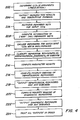
- Figure 4 is an operational flow chart for the System. Recall, in connection with the description of Figures 1 and 2 that the operation is initiated by entering the four parametric numerics via the keyboard 16 and selection of the long mode by entering the letter L, or the short mode by entering the letter S. In consequence, the System begins to execute the instructions stored in the memory facilities, by determining the CIIs of the four parameters or arguments H P L G which are applicable to the four input numerics, as represented by the block 202 in Figure 4.
- This step might also be termed a preselection of the applicable CIIs; referring to Appendix 2, that one of the twelve available CIIs for H is selected which is applicable to the H value of the input numeric, together with its descriptor (see Appendix 2), and similarly for the remaining three parameters or arguments P G L.
- the next block 206 calls for retrieval of "Reminder Sets for Input CIIS.”
- the retrieved reminder sets are four in number, namely one for the applicable CII for each respective parameter H P G L.
- the set is a selection of all those numbers from the sequence No. 0 to No. 68 (Appendix 3) which applied to the selected CII in question.
- Appendix 5 are shown the declarations for the twelve possible CIIs for H; then those for the eight CIIs for P; then those for the ten for G; and then the eight for L.
- the numbering given for the CIIs begins, in each instance, with one (1).
- the numbering of the reminder set Nos. and their relative columnar positions, begins with zero (0).
- the CII presentation of Appendix 5, and indeed the remaining contents of Appendix 5 are stored in the memory facility of the System as part of the knowledge base.
- each CII is arranged as a bit string which in turn is arranged as nine bytes; the numbering of these bytes, for the purposes of the present discussion, begins with one (1).
- the seventy-two positions adequately accommodate the sixty-nine reminder sets defined in Appendix 3 in the sequence 0 to 68; recall that this sequence (and hence the columnar positions) do not embrace the diagnostic reminder message of Appendix page 1.5, (H 49.9/S); see Miscellaneous Matters".
- This byte reads 11111111; this should not be construed to mean a numeric value of 255 (decimal expression). Rather, the suffix-letter B implies that each one of the bit-positions of this byte contains a binary 1, or is "set” or is "up” or "on”.
- the System computes the intersections of the reminder sets; this is done by executing the logical AND function, bit-position by bit-position in the successive columns (Appendix 5) for the four applicable parametrics CIIs. To survive for possible further qualification for printout it is necessary that a binary 1 appear in each one of the four applicable CII-representation (Appendix 5) in a given column. Referring to Appendix 5, and also Table 1, Nos. 0, 13, 53 will survive.
- the System (block 210, Figure 4) next eliminates or excludes reminders for which the applicable input CIIs are in null-domains, in this instance No. 0 (see appendix 3). As has been stated previously, exclusion of a reminder by null-domain inhibition also requires presence of logical AND condition in the four applicable CIIs. In this instance reminder No. 0 is eliminated, but Nos. 13 and 53 will remain.
- the next two steps are represented by the blocks 214 and 216 of Figure 4.
- the step or block 214 calls for computing parameter weights; the step or block 216 calls for computing priority ranking of hematological reminders.
- These two steps have been described in connection with a description of Figure 3, and the knowledge base. Supplementing that previous discussion the actual dominant factor data is stored in a memory location which is specified by a data declaration arranged in an array of bytes in hex format (BI20, Appendix E) where each byte contains the dominant factor information for the respective reminder message.
- step 214 the System, in proceeding from step 214 to step 216 and ultimately to step 220 (Compute Priority Ranking of Diagnostic Reminders), inherently makes its own priority selection as between all remaining hematological reminders (plus their subcases) on the one hand -- these are preferred --, and all remaining diagnostic reminders (plus their subcases) on the other hand. This is on the basis of the reminder-type indication as presented for the individual reminders in Appendix 3.
- the steps 220 and 222 are analogous to the steps 216 and 218, but apply to the diagnostic reminders and their subcases. As to the processing of the diagnostic reminder of Appendix page 1.5, see “Miscellaneous Matters.”
- the System prints out all "outputs" in the order 204, 218, 222, in either short mode or long mode, and with priority ranking as described for the steps 216, 220.
- the System locates by way of a "lookup table" the memory addresses which correspond to the reminder texts to be printed out. Although there is a numerical correspondence of message numbers (total 69; numbering begins with one) and memory addresses, yet the memory stores much other information besides the messages, and accordingly has a much greater number of addresses.
- Appendix 6 presents the program, in PL/M-86 Compiler language, which the expert System executes in proceeding through the steps shown in Figure 4.
- this Compiler language the reader is referred to BI 20.
- the knowledge base in human language is prepared on the basis of BI 1, the knowl edge engineer's own knowledge, and reference to other authorities.
- This work entails the creation of the reminder messages, the establishment of the clinically important intervals (CIIs), the allocation of the messages to the CIIs, the specification of the dominant factors, and more generally the items and matters which in the preceding description have been allocated to the knowledge base.
- the Expert System When the Expert System is operational, the items required to be printed out, i.e., the messages will come in human language (Appendix 1).
- the reminder messages as well as the other items constituting the knowledge base need to go through code or language translation, and this is also the case for the creation of the program to be stored in the System's memory facility.
- the System allows for the possible future contingencies of allocating multiple subcases to one and the some superordinate message, with priority allocation among such subcases, on the basis of their dominance factors and weighting, much in the same manner as for non-subcase messages.
- Technical alerts are messages which indicate invalid combinations of HPGL numerics, some indicated to be unconditionally invalid, others merely possibly likely to or conditionally so. It should be noted that ANEMIA (BI 13, page 19) monitored input data for invalidity. An important feature of the System is that the technical alert suggests the likely error by the human operator which induced the invalid instrument readings.
- Appendix 9 printouts Examples of technical alerts are shown in the Appendix 9 printouts.
- Appendix pages 9.1, 9.2, 9.3 present one example of a technical alert, among the diagnostic messages.
- page 9.1 may be identified as H 15/S
- page 9.2 as H 15/L
- the technical alert in the H 15 printouts is conditional; it suggests several possible operator errors such as blood leakage.
- the HPGL numerics are compatible with pancytopenia, and suggests repetition of the test, and then acceptance as valid, the repetition of the measurements.
- Appendix page 9.4 presents a more nearly unconditional technical alert; there are no alternative valid diagnostic reminders.
- Appendix page 9.5 (H 28.2/S) does present alternative valid diagnostic reminders, and hence should be regarded as presenting a conditional technical alert.
- Appendix page 9.6 (H 28.2/S) which is an alternative short-mode version to page 9.5, will be discussed in the next section.
- the described system admits of various modifications. For example, the number of stored messages (Appendix 3) could be readily increased.
- a noninteractive expert system is used. This has the decided advantage that advice is given to the physician in "one shot", rather than the mutual repeated interrogations required by prior art approaches.
- the user of the system need not be a computer expert.
- the System does not forget important information, does not become tired, distracted or rushed, and so provides a consistently high quality interpretation of numerical results.
Landscapes
- Engineering & Computer Science (AREA)
- Health & Medical Sciences (AREA)
- Medical Informatics (AREA)
- Public Health (AREA)
- Epidemiology (AREA)
- Primary Health Care (AREA)
- General Health & Medical Sciences (AREA)
- Biomedical Technology (AREA)
- Databases & Information Systems (AREA)
- Pathology (AREA)
- Data Mining & Analysis (AREA)
- Medical Treatment And Welfare Office Work (AREA)
- Investigating Or Analysing Biological Materials (AREA)
- Paper (AREA)
- Investigating Or Analyzing Materials By The Use Of Ultrasonic Waves (AREA)
- Amplifiers (AREA)
- Medicines Containing Antibodies Or Antigens For Use As Internal Diagnostic Agents (AREA)
- Measuring And Recording Apparatus For Diagnosis (AREA)
- Measurement Of The Respiration, Hearing Ability, Form, And Blood Characteristics Of Living Organisms (AREA)
Applications Claiming Priority (2)
| Application Number | Priority Date | Filing Date | Title |
|---|---|---|---|
| US07/103,935 US5023785A (en) | 1987-11-16 | 1987-11-16 | Hematology - diagnosis apparatus employing expert system technology |
| US103935 | 1987-11-16 |
Publications (3)
| Publication Number | Publication Date |
|---|---|
| EP0316861A2 true EP0316861A2 (de) | 1989-05-24 |
| EP0316861A3 EP0316861A3 (de) | 1991-09-18 |
| EP0316861B1 EP0316861B1 (de) | 1995-06-28 |
Family
ID=22297792
Family Applications (1)
| Application Number | Title | Priority Date | Filing Date |
|---|---|---|---|
| EP88119016A Expired - Lifetime EP0316861B1 (de) | 1987-11-16 | 1988-11-15 | Hämatologisches Diagnosegerät unter Verwendung der Expertensystemtechnologie |
Country Status (8)
| Country | Link |
|---|---|
| US (1) | US5023785A (de) |
| EP (1) | EP0316861B1 (de) |
| JP (1) | JPH0221364A (de) |
| CN (1) | CN1030017C (de) |
| AT (1) | ATE124554T1 (de) |
| DE (1) | DE3854076T2 (de) |
| ES (1) | ES2076154T3 (de) |
| GR (1) | GR3017537T3 (de) |
Cited By (3)
| Publication number | Priority date | Publication date | Assignee | Title |
|---|---|---|---|---|
| WO2001038881A1 (en) * | 1999-11-23 | 2001-05-31 | University Of Cincinnati | Methods and apparatus for detecting artifactual output from a chemical analyzer |
| WO2001018735A3 (en) * | 1999-09-10 | 2002-02-07 | Becton Dickinson Co | Apparatus and methods for drug analysis and development |
| US6925391B1 (en) | 1999-11-23 | 2005-08-02 | University Of Cincinnati | Methods and apparatus for detecting artifactual output from a chemical analyzer |
Families Citing this family (38)
| Publication number | Priority date | Publication date | Assignee | Title |
|---|---|---|---|---|
| US5546323A (en) * | 1990-10-10 | 1996-08-13 | Cell Analysis Systems, Inc. | Methods and apparatus for measuring tissue section thickness |
| US5235522A (en) * | 1990-10-10 | 1993-08-10 | Cell Analysis Systems, Inc. | Method and apparatus for automated analysis of biological specimens |
| US5215100A (en) * | 1991-04-29 | 1993-06-01 | Occupational Preventive Diagnostic, Inc. | Nerve condition monitoring system and electrode supporting structure |
| US5437279A (en) * | 1992-07-02 | 1995-08-01 | Board Of Regents, The University Of Texas System | Method of predicting carcinomic metastases |
| US5692220A (en) * | 1993-09-02 | 1997-11-25 | Coulter Corporation | Decision support system and method for diagnosis consultation in laboratory hematopathology |
| EP0684575A4 (de) * | 1993-12-14 | 1997-05-14 | Mochida Pharm Co Ltd | Medizinischer messapparat. |
| US5594638A (en) * | 1993-12-29 | 1997-01-14 | First Opinion Corporation | Computerized medical diagnostic system including re-enter function and sensitivity factors |
| US6725209B1 (en) * | 1993-12-29 | 2004-04-20 | First Opinion Corporation | Computerized medical diagnostic and treatment advice system and method including mental status examination |
| USRE43433E1 (en) | 1993-12-29 | 2012-05-29 | Clinical Decision Support, Llc | Computerized medical diagnostic and treatment advice system |
| US5935060A (en) * | 1996-07-12 | 1999-08-10 | First Opinion Corporation | Computerized medical diagnostic and treatment advice system including list based processing |
| US6206829B1 (en) | 1996-07-12 | 2001-03-27 | First Opinion Corporation | Computerized medical diagnostic and treatment advice system including network access |
| US5660176A (en) * | 1993-12-29 | 1997-08-26 | First Opinion Corporation | Computerized medical diagnostic and treatment advice system |
| US5574828A (en) * | 1994-04-28 | 1996-11-12 | Tmrc | Expert system for generating guideline-based information tools |
| US5692502A (en) * | 1995-09-11 | 1997-12-02 | Alpert; Scott E. | Computer-aided drug recognition screeening evaluation system and method |
| US6063026A (en) * | 1995-12-07 | 2000-05-16 | Carbon Based Corporation | Medical diagnostic analysis system |
| US5746204A (en) * | 1995-12-07 | 1998-05-05 | Carbon Based Corporation | Disease indicator analysis system |
| US6148814A (en) * | 1996-02-08 | 2000-11-21 | Ihc Health Services, Inc | Method and system for patient monitoring and respiratory assistance control through mechanical ventilation by the use of deterministic protocols |
| US5802495A (en) * | 1996-03-01 | 1998-09-01 | Goltra; Peter | Phrasing structure for the narrative display of findings |
| US6234964B1 (en) | 1997-03-13 | 2001-05-22 | First Opinion Corporation | Disease management system and method |
| US6198839B1 (en) | 1997-09-05 | 2001-03-06 | Tripath Imaging, Inc. | Dynamic control and decision making method and apparatus |
| US6273854B1 (en) | 1998-05-05 | 2001-08-14 | Body Bio Corporation | Medical diagnostic analysis method and system |
| US6797519B2 (en) | 2001-10-10 | 2004-09-28 | Haemoscope Corporation | Method and apparatus for diagnosing hemostasis |
| US6787363B2 (en) | 1999-02-22 | 2004-09-07 | Haemoscope Corporation | Method and apparatus for hemostasis and blood management |
| US20040138822A1 (en) * | 2000-01-21 | 2004-07-15 | Patrick Rambaud | Method and system for managing batches of immunocompetent cells collected from human or animal subjects for deferred use, and related therapy methods |
| FR2804126B1 (fr) * | 2000-01-21 | 2005-09-30 | Patrick Rambaud | Procede et systeme de gestion de lots de cellules immuno-competentes prelevees sur des sujets humains ou animaux en vue d'utilisations differees |
| US20020068857A1 (en) | 2000-02-14 | 2002-06-06 | Iliff Edwin C. | Automated diagnostic system and method including reuse of diagnostic objects |
| WO2003036539A1 (en) * | 2001-10-23 | 2003-05-01 | Citizen Watch Co., Ltd. | Health management system and health management program |
| US6682481B2 (en) | 2002-06-07 | 2004-01-27 | Board Of Regents, The University Of Texas System | Resuscitation from shock |
| US7780595B2 (en) | 2003-05-15 | 2010-08-24 | Clinical Decision Support, Llc | Panel diagnostic method and system |
| US9081879B2 (en) | 2004-10-22 | 2015-07-14 | Clinical Decision Support, Llc | Matrix interface for medical diagnostic and treatment advice system and method |
| US20080097811A1 (en) * | 2006-10-24 | 2008-04-24 | Fritz Kramer | Systems and methods for reducing poverty |
| US20090119130A1 (en) * | 2007-11-05 | 2009-05-07 | Zebadiah Kimmel | Method and apparatus for interpreting data |
| US20100191544A1 (en) * | 2009-01-27 | 2010-07-29 | Adam Bosworth | Protocol Authoring for a Health Coaching Service |
| US20100280838A1 (en) * | 2009-05-01 | 2010-11-04 | Adam Bosworth | Coaching Engine for a Health Coaching Service |
| US8560479B2 (en) | 2009-11-23 | 2013-10-15 | Keas, Inc. | Risk factor coaching engine that determines a user health score |
| CN103163287B (zh) * | 2011-12-09 | 2016-08-03 | 深圳迈瑞生物医疗电子股份有限公司 | 一种生物样本分析仪测量结果的处理方法及装置 |
| CN104458519B (zh) * | 2014-12-08 | 2017-01-18 | 重庆南方数控设备有限责任公司 | 获取血沉数据的精确检测方法 |
| CN108966665B (zh) * | 2017-03-27 | 2020-07-03 | 日立建机株式会社 | 作业机械的液压控制系统 |
Family Cites Families (13)
| Publication number | Priority date | Publication date | Assignee | Title |
|---|---|---|---|---|
| US3686486A (en) * | 1970-12-02 | 1972-08-22 | Coulter Electronics | Apparatus for obtaining statistical hematological indices and analyzing same and method |
| US4290114A (en) * | 1976-07-01 | 1981-09-15 | Sinay Hanon S | Medical diagnostic computer |
| US4199748A (en) * | 1976-11-01 | 1980-04-22 | Rush-Presbyterian-St. Luke's Medical Center | Automated method and apparatus for classification of cells with application to the diagnosis of anemia |
| US4167038A (en) * | 1977-10-17 | 1979-09-04 | Hycel, Inc. | Calculated parameter generation in a hematology parameter measurement apparatus |
| US4202033A (en) * | 1977-12-27 | 1980-05-06 | Royco Instruments, Inc. | Apparatus and method utilizing calculator for quality control of hematology sample analysis |
| US4315309A (en) * | 1979-06-25 | 1982-02-09 | Coli Robert D | Integrated medical test data storage and retrieval system |
| JPS57211338A (en) * | 1981-06-24 | 1982-12-25 | Tokyo Shibaura Electric Co | Tatal image diagnosis data treating apparatus |
| US4489387A (en) * | 1981-08-20 | 1984-12-18 | Lamb David E | Method and apparatus for coordinating medical procedures |
| US4733354A (en) * | 1984-11-23 | 1988-03-22 | Brian Potter | Method and apparatus for automated medical diagnosis using decision tree analysis |
| US4730259A (en) * | 1985-03-01 | 1988-03-08 | Gallant Stephen I | Matrix controlled expert system producible from examples |
| US4763277A (en) * | 1986-01-17 | 1988-08-09 | International Business Machines Corporation | Method for obtaining information in an expert system |
| JPS62226278A (ja) * | 1986-03-27 | 1987-10-05 | Kea Netsuto Kk | 医療指導情報提供装置 |
| JPS62245373A (ja) * | 1986-04-17 | 1987-10-26 | Toshiba Corp | 医療用診断支援装置 |
-
1987
- 1987-11-16 US US07/103,935 patent/US5023785A/en not_active Expired - Lifetime
-
1988
- 1988-11-15 ES ES88119016T patent/ES2076154T3/es not_active Expired - Lifetime
- 1988-11-15 DE DE3854076T patent/DE3854076T2/de not_active Expired - Fee Related
- 1988-11-15 EP EP88119016A patent/EP0316861B1/de not_active Expired - Lifetime
- 1988-11-15 AT AT88119016T patent/ATE124554T1/de not_active IP Right Cessation
- 1988-11-15 CN CN88108534A patent/CN1030017C/zh not_active Expired - Fee Related
- 1988-11-16 JP JP63289936A patent/JPH0221364A/ja active Pending
-
1995
- 1995-09-27 GR GR950402657T patent/GR3017537T3/el unknown
Cited By (4)
| Publication number | Priority date | Publication date | Assignee | Title |
|---|---|---|---|---|
| WO2001018735A3 (en) * | 1999-09-10 | 2002-02-07 | Becton Dickinson Co | Apparatus and methods for drug analysis and development |
| WO2001038881A1 (en) * | 1999-11-23 | 2001-05-31 | University Of Cincinnati | Methods and apparatus for detecting artifactual output from a chemical analyzer |
| US6925391B1 (en) | 1999-11-23 | 2005-08-02 | University Of Cincinnati | Methods and apparatus for detecting artifactual output from a chemical analyzer |
| US7539580B2 (en) | 1999-11-23 | 2009-05-26 | University Of Cincinnati | Method and apparatus for detecting artifactual output from a chemical analyzer |
Also Published As
| Publication number | Publication date |
|---|---|
| EP0316861B1 (de) | 1995-06-28 |
| JPH0221364A (ja) | 1990-01-24 |
| CN1034282A (zh) | 1989-07-26 |
| CN1030017C (zh) | 1995-10-11 |
| ES2076154T3 (es) | 1995-11-01 |
| EP0316861A3 (de) | 1991-09-18 |
| GR3017537T3 (en) | 1995-12-31 |
| US5023785A (en) | 1991-06-11 |
| DE3854076T2 (de) | 1995-11-02 |
| ATE124554T1 (de) | 1995-07-15 |
| DE3854076D1 (de) | 1995-08-03 |
Similar Documents
| Publication | Publication Date | Title |
|---|---|---|
| US5023785A (en) | Hematology - diagnosis apparatus employing expert system technology | |
| US4290114A (en) | Medical diagnostic computer | |
| Greenes et al. | Design and implementation of a clinical data management system | |
| US4733354A (en) | Method and apparatus for automated medical diagnosis using decision tree analysis | |
| Lincoln et al. | Computers, health care, and medical information science | |
| Weyl et al. | A modular self-describing clinical databank system | |
| Davis et al. | Computer-stored medical record | |
| Levy et al. | Computer handling of ambulatory clinic records | |
| Hammond et al. | GEMISCH—A minicomputer information support system | |
| Eich et al. | Decision support in acute abdominal pain using an expert system for different knowledge bases | |
| Best | The potential role of computers in medical practice | |
| McDonald et al. | A clinical information system (CIS) for ambulatory care | |
| Pryor et al. | Help–A Computer System for Medical Decision Making | |
| Funnell et al. | IDA: An interactive data analysis system for clinical and experimental research | |
| Sherman | A pocket diagnostic calculator program for computing Bayesian probabilities for nine diseases with sixteen symptoms: Part A | |
| Simborg et al. | Summary time oriented record (STOR)—a progress report | |
| Allen et al. | Use of a time-shared general-purpose file-handling system in hospital research | |
| Van Dyne et al. | Using machine learning and expert systems to predict preterm delivery in pregnant women | |
| Lohlein | Introducing a Standardized Approach to the Diagnosis of Anxiety and Depression in a Women’s Health Clinic | |
| JPH0789178A (ja) | バーコードラベル作成システム | |
| Okada et al. | Conversational file processing system FLXFL (FLeXible FiLe) for nonprogrammers | |
| Huet et al. | An automaton computer program for a microcomputerized real-time (thesaurus based) abstract medical record | |
| Benoit et al. | Direct physician entry of injury information and automated coding via a graphical user interface | |
| Gilchrist | Research data management | |
| Guy et al. | A data processing system for psychotropic drug evaluation |
Legal Events
| Date | Code | Title | Description |
|---|---|---|---|
| PUAI | Public reference made under article 153(3) epc to a published international application that has entered the european phase |
Free format text: ORIGINAL CODE: 0009012 |
|
| AK | Designated contracting states |
Kind code of ref document: A2 Designated state(s): AT BE CH DE ES FR GB GR IT LI NL SE |
|
| 17P | Request for examination filed |
Effective date: 19901204 |
|
| PUAL | Search report despatched |
Free format text: ORIGINAL CODE: 0009013 |
|
| AK | Designated contracting states |
Kind code of ref document: A3 Designated state(s): AT BE CH DE ES FR GB GR IT LI NL SE |
|
| 17Q | First examination report despatched |
Effective date: 19930913 |
|
| GRAA | (expected) grant |
Free format text: ORIGINAL CODE: 0009210 |
|
| AK | Designated contracting states |
Kind code of ref document: B1 Designated state(s): AT BE CH DE ES FR GB GR IT LI NL SE |
|
| PG25 | Lapsed in a contracting state [announced via postgrant information from national office to epo] |
Ref country code: LI Effective date: 19950628 Ref country code: CH Effective date: 19950628 |
|
| REF | Corresponds to: |
Ref document number: 124554 Country of ref document: AT Date of ref document: 19950715 Kind code of ref document: T |
|
| REF | Corresponds to: |
Ref document number: 3854076 Country of ref document: DE Date of ref document: 19950803 |
|
| ITF | It: translation for a ep patent filed | ||
| ET | Fr: translation filed | ||
| REG | Reference to a national code |
Ref country code: CH Ref legal event code: PL |
|
| REG | Reference to a national code |
Ref country code: ES Ref legal event code: FG2A Ref document number: 2076154 Country of ref document: ES Kind code of ref document: T3 |
|
| REG | Reference to a national code |
Ref country code: GR Ref legal event code: FG4A Free format text: 3017537 |
|
| PLBE | No opposition filed within time limit |
Free format text: ORIGINAL CODE: 0009261 |
|
| STAA | Information on the status of an ep patent application or granted ep patent |
Free format text: STATUS: NO OPPOSITION FILED WITHIN TIME LIMIT |
|
| 26N | No opposition filed | ||
| PGFP | Annual fee paid to national office [announced via postgrant information from national office to epo] |
Ref country code: SE Payment date: 19991104 Year of fee payment: 12 |
|
| PGFP | Annual fee paid to national office [announced via postgrant information from national office to epo] |
Ref country code: AT Payment date: 19991112 Year of fee payment: 12 |
|
| PGFP | Annual fee paid to national office [announced via postgrant information from national office to epo] |
Ref country code: GR Payment date: 19991129 Year of fee payment: 12 |
|
| PG25 | Lapsed in a contracting state [announced via postgrant information from national office to epo] |
Ref country code: AT Free format text: LAPSE BECAUSE OF NON-PAYMENT OF DUE FEES Effective date: 20001115 |
|
| PG25 | Lapsed in a contracting state [announced via postgrant information from national office to epo] |
Ref country code: SE Free format text: THE PATENT HAS BEEN ANNULLED BY A DECISION OF A NATIONAL AUTHORITY Effective date: 20001129 |
|
| PG25 | Lapsed in a contracting state [announced via postgrant information from national office to epo] |
Ref country code: GR Free format text: LAPSE BECAUSE OF NON-PAYMENT OF DUE FEES Effective date: 20001130 |
|
| EUG | Se: european patent has lapsed |
Ref document number: 88119016.9 |
|
| PGFP | Annual fee paid to national office [announced via postgrant information from national office to epo] |
Ref country code: GB Payment date: 20011018 Year of fee payment: 14 Ref country code: FR Payment date: 20011018 Year of fee payment: 14 Ref country code: DE Payment date: 20011018 Year of fee payment: 14 |
|
| PGFP | Annual fee paid to national office [announced via postgrant information from national office to epo] |
Ref country code: NL Payment date: 20011026 Year of fee payment: 14 |
|
| PGFP | Annual fee paid to national office [announced via postgrant information from national office to epo] |
Ref country code: BE Payment date: 20011116 Year of fee payment: 14 |
|
| PGFP | Annual fee paid to national office [announced via postgrant information from national office to epo] |
Ref country code: ES Payment date: 20011207 Year of fee payment: 14 |
|
| REG | Reference to a national code |
Ref country code: GB Ref legal event code: IF02 |
|
| PG25 | Lapsed in a contracting state [announced via postgrant information from national office to epo] |
Ref country code: GB Free format text: LAPSE BECAUSE OF NON-PAYMENT OF DUE FEES Effective date: 20021115 |
|
| PG25 | Lapsed in a contracting state [announced via postgrant information from national office to epo] |
Ref country code: ES Free format text: LAPSE BECAUSE OF NON-PAYMENT OF DUE FEES Effective date: 20021116 |
|
| PG25 | Lapsed in a contracting state [announced via postgrant information from national office to epo] |
Ref country code: BE Free format text: LAPSE BECAUSE OF NON-PAYMENT OF DUE FEES Effective date: 20021130 |
|
| BERE | Be: lapsed |
Owner name: *BECTON DICKINSON AND CY Effective date: 20021130 |
|
| PG25 | Lapsed in a contracting state [announced via postgrant information from national office to epo] |
Ref country code: NL Free format text: LAPSE BECAUSE OF NON-PAYMENT OF DUE FEES Effective date: 20030601 |
|
| PG25 | Lapsed in a contracting state [announced via postgrant information from national office to epo] |
Ref country code: DE Free format text: LAPSE BECAUSE OF NON-PAYMENT OF DUE FEES Effective date: 20030603 |
|
| GBPC | Gb: european patent ceased through non-payment of renewal fee | ||
| PG25 | Lapsed in a contracting state [announced via postgrant information from national office to epo] |
Ref country code: FR Free format text: LAPSE BECAUSE OF NON-PAYMENT OF DUE FEES Effective date: 20030731 |
|
| NLV4 | Nl: lapsed or anulled due to non-payment of the annual fee |
Effective date: 20030601 |
|
| REG | Reference to a national code |
Ref country code: FR Ref legal event code: ST |
|
| REG | Reference to a national code |
Ref country code: ES Ref legal event code: FD2A Effective date: 20031213 |
|
| PG25 | Lapsed in a contracting state [announced via postgrant information from national office to epo] |
Ref country code: IT Free format text: LAPSE BECAUSE OF NON-PAYMENT OF DUE FEES;WARNING: LAPSES OF ITALIAN PATENTS WITH EFFECTIVE DATE BEFORE 2007 MAY HAVE OCCURRED AT ANY TIME BEFORE 2007. THE CORRECT EFFECTIVE DATE MAY BE DIFFERENT FROM THE ONE RECORDED. Effective date: 20051115 |