EP0317035A2 - Herstellungsverfahren von Methanol und Katalysatorzusammensetzung für dieses Verfahren - Google Patents
Herstellungsverfahren von Methanol und Katalysatorzusammensetzung für dieses Verfahren Download PDFInfo
- Publication number
- EP0317035A2 EP0317035A2 EP88202601A EP88202601A EP0317035A2 EP 0317035 A2 EP0317035 A2 EP 0317035A2 EP 88202601 A EP88202601 A EP 88202601A EP 88202601 A EP88202601 A EP 88202601A EP 0317035 A2 EP0317035 A2 EP 0317035A2
- Authority
- EP
- European Patent Office
- Prior art keywords
- component
- methanol
- range
- formate
- production
- Prior art date
- Legal status (The legal status is an assumption and is not a legal conclusion. Google has not performed a legal analysis and makes no representation as to the accuracy of the status listed.)
- Withdrawn
Links
- OKKJLVBELUTLKV-UHFFFAOYSA-N Methanol Chemical compound OC OKKJLVBELUTLKV-UHFFFAOYSA-N 0.000 title claims abstract description 132
- 238000000034 method Methods 0.000 title claims abstract description 45
- 238000004519 manufacturing process Methods 0.000 title claims abstract description 23
- 239000003054 catalyst Substances 0.000 title claims abstract description 21
- 239000000203 mixture Substances 0.000 title claims description 11
- 229910052739 hydrogen Inorganic materials 0.000 claims abstract description 31
- 239000001257 hydrogen Substances 0.000 claims abstract description 31
- UFHFLCQGNIYNRP-UHFFFAOYSA-N Hydrogen Chemical compound [H][H] UFHFLCQGNIYNRP-UHFFFAOYSA-N 0.000 claims abstract description 29
- UGFAIRIUMAVXCW-UHFFFAOYSA-N Carbon monoxide Chemical compound [O+]#[C-] UGFAIRIUMAVXCW-UHFFFAOYSA-N 0.000 claims abstract description 28
- 229910002091 carbon monoxide Inorganic materials 0.000 claims abstract description 28
- HZPNKQREYVVATQ-UHFFFAOYSA-L nickel(2+);diformate Chemical compound [Ni+2].[O-]C=O.[O-]C=O HZPNKQREYVVATQ-UHFFFAOYSA-L 0.000 claims abstract description 21
- 230000003197 catalytic effect Effects 0.000 claims abstract description 20
- XLYOFNOQVPJJNP-UHFFFAOYSA-N water Substances O XLYOFNOQVPJJNP-UHFFFAOYSA-N 0.000 claims abstract description 17
- 229910052783 alkali metal Inorganic materials 0.000 claims abstract description 8
- 239000008246 gaseous mixture Substances 0.000 claims abstract description 7
- 150000001340 alkali metals Chemical class 0.000 claims abstract description 6
- 229910052784 alkaline earth metal Inorganic materials 0.000 claims abstract description 6
- 150000001342 alkaline earth metals Chemical class 0.000 claims abstract description 6
- 238000006243 chemical reaction Methods 0.000 claims description 25
- 239000007789 gas Substances 0.000 claims description 19
- 230000015572 biosynthetic process Effects 0.000 claims description 15
- -1 potassium alkoxides Chemical class 0.000 claims description 12
- 238000003786 synthesis reaction Methods 0.000 claims description 11
- 239000003085 diluting agent Substances 0.000 claims description 10
- LFQSCWFLJHTTHZ-UHFFFAOYSA-N Ethanol Chemical compound CCO LFQSCWFLJHTTHZ-UHFFFAOYSA-N 0.000 claims description 9
- 238000005984 hydrogenation reaction Methods 0.000 claims description 8
- VNWKTOKETHGBQD-UHFFFAOYSA-N methane Chemical compound C VNWKTOKETHGBQD-UHFFFAOYSA-N 0.000 claims description 8
- 238000005810 carbonylation reaction Methods 0.000 claims description 7
- 230000006315 carbonylation Effects 0.000 claims description 6
- SBZXBUIDTXKZTM-UHFFFAOYSA-N diglyme Chemical compound COCCOCCOC SBZXBUIDTXKZTM-UHFFFAOYSA-N 0.000 claims description 6
- DGAQECJNVWCQMB-PUAWFVPOSA-M Ilexoside XXIX Chemical compound C[C@@H]1CC[C@@]2(CC[C@@]3(C(=CC[C@H]4[C@]3(CC[C@@H]5[C@@]4(CC[C@@H](C5(C)C)OS(=O)(=O)[O-])C)C)[C@@H]2[C@]1(C)O)C)C(=O)O[C@H]6[C@@H]([C@H]([C@@H]([C@H](O6)CO)O)O)O.[Na+] DGAQECJNVWCQMB-PUAWFVPOSA-M 0.000 claims description 5
- 229910052700 potassium Inorganic materials 0.000 claims description 5
- 239000011591 potassium Substances 0.000 claims description 5
- 229910052708 sodium Inorganic materials 0.000 claims description 5
- 239000011734 sodium Substances 0.000 claims description 5
- 239000003345 natural gas Substances 0.000 claims description 4
- LPNYRYFBWFDTMA-UHFFFAOYSA-N potassium tert-butoxide Chemical compound [K+].CC(C)(C)[O-] LPNYRYFBWFDTMA-UHFFFAOYSA-N 0.000 claims description 4
- 150000002170 ethers Chemical class 0.000 claims description 3
- 230000003647 oxidation Effects 0.000 claims description 3
- 238000007254 oxidation reaction Methods 0.000 claims description 3
- 238000007327 hydrogenolysis reaction Methods 0.000 claims description 2
- 238000000629 steam reforming Methods 0.000 claims description 2
- TZIHFWKZFHZASV-UHFFFAOYSA-N methyl formate Chemical compound COC=O TZIHFWKZFHZASV-UHFFFAOYSA-N 0.000 description 14
- BDAGIHXWWSANSR-UHFFFAOYSA-M Formate Chemical compound [O-]C=O BDAGIHXWWSANSR-UHFFFAOYSA-M 0.000 description 8
- 125000004432 carbon atom Chemical group C* 0.000 description 8
- PXHVJJICTQNCMI-UHFFFAOYSA-N Nickel Chemical compound [Ni] PXHVJJICTQNCMI-UHFFFAOYSA-N 0.000 description 6
- 238000002203 pretreatment Methods 0.000 description 6
- 150000002815 nickel Chemical class 0.000 description 5
- IJGRMHOSHXDMSA-UHFFFAOYSA-N Atomic nitrogen Chemical compound N#N IJGRMHOSHXDMSA-UHFFFAOYSA-N 0.000 description 4
- KDLHZDBZIXYQEI-UHFFFAOYSA-N Palladium Chemical compound [Pd] KDLHZDBZIXYQEI-UHFFFAOYSA-N 0.000 description 4
- ZLMJMSJWJFRBEC-UHFFFAOYSA-N Potassium Chemical compound [K] ZLMJMSJWJFRBEC-UHFFFAOYSA-N 0.000 description 4
- WQDUMFSSJAZKTM-UHFFFAOYSA-N Sodium methoxide Chemical compound [Na+].[O-]C WQDUMFSSJAZKTM-UHFFFAOYSA-N 0.000 description 4
- 230000000694 effects Effects 0.000 description 4
- 239000007788 liquid Substances 0.000 description 4
- 239000007791 liquid phase Substances 0.000 description 4
- QTBSBXVTEAMEQO-UHFFFAOYSA-N Acetic acid Chemical compound CC(O)=O QTBSBXVTEAMEQO-UHFFFAOYSA-N 0.000 description 3
- UHOVQNZJYSORNB-UHFFFAOYSA-N Benzene Chemical compound C1=CC=CC=C1 UHOVQNZJYSORNB-UHFFFAOYSA-N 0.000 description 3
- YMWUJEATGCHHMB-UHFFFAOYSA-N Dichloromethane Chemical compound ClCCl YMWUJEATGCHHMB-UHFFFAOYSA-N 0.000 description 3
- RTZKZFJDLAIYFH-UHFFFAOYSA-N Diethyl ether Chemical compound CCOCC RTZKZFJDLAIYFH-UHFFFAOYSA-N 0.000 description 3
- YXFVVABEGXRONW-UHFFFAOYSA-N Toluene Chemical compound CC1=CC=CC=C1 YXFVVABEGXRONW-UHFFFAOYSA-N 0.000 description 3
- 150000004703 alkoxides Chemical class 0.000 description 3
- 239000006227 byproduct Substances 0.000 description 3
- 229910052751 metal Inorganic materials 0.000 description 3
- 239000002184 metal Substances 0.000 description 3
- VLKZOEOYAKHREP-UHFFFAOYSA-N n-Hexane Chemical compound CCCCCC VLKZOEOYAKHREP-UHFFFAOYSA-N 0.000 description 3
- 229910052759 nickel Inorganic materials 0.000 description 3
- 239000011541 reaction mixture Substances 0.000 description 3
- 239000002904 solvent Substances 0.000 description 3
- RFFLAFLAYFXFSW-UHFFFAOYSA-N 1,2-dichlorobenzene Chemical compound ClC1=CC=CC=C1Cl RFFLAFLAYFXFSW-UHFFFAOYSA-N 0.000 description 2
- MSXVEPNJUHWQHW-UHFFFAOYSA-N 2-methylbutan-2-ol Chemical compound CCC(C)(C)O MSXVEPNJUHWQHW-UHFFFAOYSA-N 0.000 description 2
- QTBSBXVTEAMEQO-UHFFFAOYSA-M Acetate Chemical compound CC([O-])=O QTBSBXVTEAMEQO-UHFFFAOYSA-M 0.000 description 2
- FERIUCNNQQJTOY-UHFFFAOYSA-N Butyric acid Chemical compound CCCC(O)=O FERIUCNNQQJTOY-UHFFFAOYSA-N 0.000 description 2
- YNQLUTRBYVCPMQ-UHFFFAOYSA-N Ethylbenzene Chemical compound CCC1=CC=CC=C1 YNQLUTRBYVCPMQ-UHFFFAOYSA-N 0.000 description 2
- BZLVMXJERCGZMT-UHFFFAOYSA-N Methyl tert-butyl ether Chemical compound COC(C)(C)C BZLVMXJERCGZMT-UHFFFAOYSA-N 0.000 description 2
- IMNFDUFMRHMDMM-UHFFFAOYSA-N N-Heptane Chemical compound CCCCCCC IMNFDUFMRHMDMM-UHFFFAOYSA-N 0.000 description 2
- WYURNTSHIVDZCO-UHFFFAOYSA-N Tetrahydrofuran Chemical compound C1CCOC1 WYURNTSHIVDZCO-UHFFFAOYSA-N 0.000 description 2
- 150000001335 aliphatic alkanes Chemical class 0.000 description 2
- RDOXTESZEPMUJZ-UHFFFAOYSA-N anisole Chemical compound COC1=CC=CC=C1 RDOXTESZEPMUJZ-UHFFFAOYSA-N 0.000 description 2
- MVPPADPHJFYWMZ-UHFFFAOYSA-N chlorobenzene Chemical compound ClC1=CC=CC=C1 MVPPADPHJFYWMZ-UHFFFAOYSA-N 0.000 description 2
- 229910017052 cobalt Inorganic materials 0.000 description 2
- 239000010941 cobalt Substances 0.000 description 2
- GUTLYIVDDKVIGB-UHFFFAOYSA-N cobalt atom Chemical compound [Co] GUTLYIVDDKVIGB-UHFFFAOYSA-N 0.000 description 2
- 230000000052 comparative effect Effects 0.000 description 2
- 230000003750 conditioning effect Effects 0.000 description 2
- 230000003247 decreasing effect Effects 0.000 description 2
- USIUVYZYUHIAEV-UHFFFAOYSA-N diphenyl ether Chemical compound C=1C=CC=CC=1OC1=CC=CC=C1 USIUVYZYUHIAEV-UHFFFAOYSA-N 0.000 description 2
- 238000001035 drying Methods 0.000 description 2
- 150000002148 esters Chemical class 0.000 description 2
- MNWFXJYAOYHMED-UHFFFAOYSA-N heptanoic acid Chemical compound CCCCCCC(O)=O MNWFXJYAOYHMED-UHFFFAOYSA-N 0.000 description 2
- 238000011065 in-situ storage Methods 0.000 description 2
- KQNPFQTWMSNSAP-UHFFFAOYSA-N isobutyric acid Chemical compound CC(C)C(O)=O KQNPFQTWMSNSAP-UHFFFAOYSA-N 0.000 description 2
- GWYFCOCPABKNJV-UHFFFAOYSA-N isovaleric acid Chemical compound CC(C)CC(O)=O GWYFCOCPABKNJV-UHFFFAOYSA-N 0.000 description 2
- UAEPNZWRGJTJPN-UHFFFAOYSA-N methylcyclohexane Chemical compound CC1CCCCC1 UAEPNZWRGJTJPN-UHFFFAOYSA-N 0.000 description 2
- 150000002816 nickel compounds Chemical class 0.000 description 2
- 229910052757 nitrogen Inorganic materials 0.000 description 2
- 229910052763 palladium Inorganic materials 0.000 description 2
- 230000002035 prolonged effect Effects 0.000 description 2
- 230000035484 reaction time Effects 0.000 description 2
- 239000002002 slurry Substances 0.000 description 2
- QDRKDTQENPPHOJ-UHFFFAOYSA-N sodium ethoxide Chemical compound [Na+].CC[O-] QDRKDTQENPPHOJ-UHFFFAOYSA-N 0.000 description 2
- CGRKYEALWSRNJS-UHFFFAOYSA-N sodium;2-methylbutan-2-olate Chemical compound [Na+].CCC(C)(C)[O-] CGRKYEALWSRNJS-UHFFFAOYSA-N 0.000 description 2
- JYCDILBEUUCCQD-UHFFFAOYSA-N sodium;2-methylpropan-1-olate Chemical compound [Na+].CC(C)C[O-] JYCDILBEUUCCQD-UHFFFAOYSA-N 0.000 description 2
- SYXYWTXQFUUWLP-UHFFFAOYSA-N sodium;butan-1-olate Chemical compound [Na+].CCCC[O-] SYXYWTXQFUUWLP-UHFFFAOYSA-N 0.000 description 2
- RCOSUMRTSQULBK-UHFFFAOYSA-N sodium;propan-1-olate Chemical compound [Na+].CCC[O-] RCOSUMRTSQULBK-UHFFFAOYSA-N 0.000 description 2
- HXJUTPCZVOIRIF-UHFFFAOYSA-N sulfolane Chemical compound O=S1(=O)CCCC1 HXJUTPCZVOIRIF-UHFFFAOYSA-N 0.000 description 2
- VZGDMQKNWNREIO-UHFFFAOYSA-N tetrachloromethane Chemical compound ClC(Cl)(Cl)Cl VZGDMQKNWNREIO-UHFFFAOYSA-N 0.000 description 2
- NQPDZGIKBAWPEJ-UHFFFAOYSA-N valeric acid Chemical compound CCCCC(O)=O NQPDZGIKBAWPEJ-UHFFFAOYSA-N 0.000 description 2
- XTDQDBVBDLYELW-UHFFFAOYSA-N 2,2,3-trimethylpentane Chemical compound CCC(C)C(C)(C)C XTDQDBVBDLYELW-UHFFFAOYSA-N 0.000 description 1
- ZDULHUHNYHJYKA-UHFFFAOYSA-N 2-propan-2-ylsulfonylpropane Chemical compound CC(C)S(=O)(=O)C(C)C ZDULHUHNYHJYKA-UHFFFAOYSA-N 0.000 description 1
- GWYFCOCPABKNJV-UHFFFAOYSA-M 3-Methylbutanoic acid Natural products CC(C)CC([O-])=O GWYFCOCPABKNJV-UHFFFAOYSA-M 0.000 description 1
- CMJLMPKFQPJDKP-UHFFFAOYSA-N 3-methylthiolane 1,1-dioxide Chemical compound CC1CCS(=O)(=O)C1 CMJLMPKFQPJDKP-UHFFFAOYSA-N 0.000 description 1
- WPZZIEDLYNWUFG-UHFFFAOYSA-N 4-butyl-2-methylthiolane 1,1-dioxide Chemical compound CCCCC1CC(C)S(=O)(=O)C1 WPZZIEDLYNWUFG-UHFFFAOYSA-N 0.000 description 1
- ZCYVEMRRCGMTRW-UHFFFAOYSA-N 7553-56-2 Chemical compound [I] ZCYVEMRRCGMTRW-UHFFFAOYSA-N 0.000 description 1
- WKBOTKDWSSQWDR-UHFFFAOYSA-N Bromine atom Chemical compound [Br] WKBOTKDWSSQWDR-UHFFFAOYSA-N 0.000 description 1
- BMTAFVWTTFSTOG-UHFFFAOYSA-N Butylate Chemical compound CCSC(=O)N(CC(C)C)CC(C)C BMTAFVWTTFSTOG-UHFFFAOYSA-N 0.000 description 1
- WWZKQHOCKIZLMA-UHFFFAOYSA-N Caprylic acid Natural products CCCCCCCC(O)=O WWZKQHOCKIZLMA-UHFFFAOYSA-N 0.000 description 1
- OKTJSMMVPCPJKN-UHFFFAOYSA-N Carbon Chemical compound [C] OKTJSMMVPCPJKN-UHFFFAOYSA-N 0.000 description 1
- ZAMOUSCENKQFHK-UHFFFAOYSA-N Chlorine atom Chemical compound [Cl] ZAMOUSCENKQFHK-UHFFFAOYSA-N 0.000 description 1
- XDTMQSROBMDMFD-UHFFFAOYSA-N Cyclohexane Chemical compound C1CCCCC1 XDTMQSROBMDMFD-UHFFFAOYSA-N 0.000 description 1
- ZAFNJMIOTHYJRJ-UHFFFAOYSA-N Diisopropyl ether Chemical compound CC(C)OC(C)C ZAFNJMIOTHYJRJ-UHFFFAOYSA-N 0.000 description 1
- KEAYESYHFKHZAL-UHFFFAOYSA-N Sodium Chemical compound [Na] KEAYESYHFKHZAL-UHFFFAOYSA-N 0.000 description 1
- WAIPAZQMEIHHTJ-UHFFFAOYSA-N [Cr].[Co] Chemical compound [Cr].[Co] WAIPAZQMEIHHTJ-UHFFFAOYSA-N 0.000 description 1
- 239000002253 acid Substances 0.000 description 1
- 150000007513 acids Chemical class 0.000 description 1
- 230000003213 activating effect Effects 0.000 description 1
- 230000004913 activation Effects 0.000 description 1
- 150000001298 alcohols Chemical class 0.000 description 1
- 239000003513 alkali Substances 0.000 description 1
- 125000003545 alkoxy group Chemical group 0.000 description 1
- 150000001491 aromatic compounds Chemical class 0.000 description 1
- 150000004945 aromatic hydrocarbons Chemical class 0.000 description 1
- GONOPSZTUGRENK-UHFFFAOYSA-N benzyl(trichloro)silane Chemical compound Cl[Si](Cl)(Cl)CC1=CC=CC=C1 GONOPSZTUGRENK-UHFFFAOYSA-N 0.000 description 1
- GDTBXPJZTBHREO-UHFFFAOYSA-N bromine Substances BrBr GDTBXPJZTBHREO-UHFFFAOYSA-N 0.000 description 1
- 229910052794 bromium Inorganic materials 0.000 description 1
- 229910052799 carbon Inorganic materials 0.000 description 1
- 229950005499 carbon tetrachloride Drugs 0.000 description 1
- 125000002915 carbonyl group Chemical group [*:2]C([*:1])=O 0.000 description 1
- 150000001732 carboxylic acid derivatives Chemical class 0.000 description 1
- 239000003153 chemical reaction reagent Substances 0.000 description 1
- 239000003638 chemical reducing agent Substances 0.000 description 1
- 229910052801 chlorine Inorganic materials 0.000 description 1
- 239000000460 chlorine Substances 0.000 description 1
- 239000003245 coal Substances 0.000 description 1
- 238000009833 condensation Methods 0.000 description 1
- 230000005494 condensation Effects 0.000 description 1
- 125000004093 cyano group Chemical group *C#N 0.000 description 1
- 150000001924 cycloalkanes Chemical class 0.000 description 1
- XBDQKXXYIPTUBI-UHFFFAOYSA-N dimethylselenoniopropionate Natural products CCC(O)=O XBDQKXXYIPTUBI-UHFFFAOYSA-N 0.000 description 1
- 230000000763 evoking effect Effects 0.000 description 1
- 238000002474 experimental method Methods 0.000 description 1
- 150000004675 formic acid derivatives Chemical class 0.000 description 1
- 239000000446 fuel Substances 0.000 description 1
- 238000001030 gas--liquid chromatography Methods 0.000 description 1
- 239000007792 gaseous phase Substances 0.000 description 1
- 238000002309 gasification Methods 0.000 description 1
- 239000003502 gasoline Substances 0.000 description 1
- 229910052736 halogen Inorganic materials 0.000 description 1
- 150000002367 halogens Chemical class 0.000 description 1
- 229910000856 hastalloy Inorganic materials 0.000 description 1
- 229930195733 hydrocarbon Natural products 0.000 description 1
- 150000002430 hydrocarbons Chemical class 0.000 description 1
- 150000002431 hydrogen Chemical class 0.000 description 1
- 230000001433 inducive effect Effects 0.000 description 1
- 239000003701 inert diluent Substances 0.000 description 1
- 239000011261 inert gas Substances 0.000 description 1
- 239000011630 iodine Substances 0.000 description 1
- 229910052740 iodine Inorganic materials 0.000 description 1
- 239000003350 kerosene Substances 0.000 description 1
- 150000002739 metals Chemical class 0.000 description 1
- NBTOZLQBSIZIKS-UHFFFAOYSA-N methoxide Chemical compound [O-]C NBTOZLQBSIZIKS-UHFFFAOYSA-N 0.000 description 1
- UZKWTJUDCOPSNM-UHFFFAOYSA-N methoxybenzene Substances CCCCOC=C UZKWTJUDCOPSNM-UHFFFAOYSA-N 0.000 description 1
- GYNNXHKOJHMOHS-UHFFFAOYSA-N methyl-cycloheptane Natural products CC1CCCCCC1 GYNNXHKOJHMOHS-UHFFFAOYSA-N 0.000 description 1
- 238000002156 mixing Methods 0.000 description 1
- 239000002808 molecular sieve Substances 0.000 description 1
- DUWWHGPELOTTOE-UHFFFAOYSA-N n-(5-chloro-2,4-dimethoxyphenyl)-3-oxobutanamide Chemical compound COC1=CC(OC)=C(NC(=O)CC(C)=O)C=C1Cl DUWWHGPELOTTOE-UHFFFAOYSA-N 0.000 description 1
- FUZZWVXGSFPDMH-UHFFFAOYSA-N n-hexanoic acid Natural products CCCCCC(O)=O FUZZWVXGSFPDMH-UHFFFAOYSA-N 0.000 description 1
- 229940078494 nickel acetate Drugs 0.000 description 1
- BMGNSKKZFQMGDH-FDGPNNRMSA-L nickel(2+);(z)-4-oxopent-2-en-2-olate Chemical compound [Ni+2].C\C([O-])=C\C(C)=O.C\C([O-])=C\C(C)=O BMGNSKKZFQMGDH-FDGPNNRMSA-L 0.000 description 1
- 239000012299 nitrogen atmosphere Substances 0.000 description 1
- 229910052756 noble gas Inorganic materials 0.000 description 1
- TVMXDCGIABBOFY-UHFFFAOYSA-N octane Chemical compound CCCCCCCC TVMXDCGIABBOFY-UHFFFAOYSA-N 0.000 description 1
- 239000012071 phase Substances 0.000 description 1
- IUGYQRQAERSCNH-UHFFFAOYSA-N pivalic acid Chemical compound CC(C)(C)C(O)=O IUGYQRQAERSCNH-UHFFFAOYSA-N 0.000 description 1
- BITYAPCSNKJESK-UHFFFAOYSA-N potassiosodium Chemical compound [Na].[K] BITYAPCSNKJESK-UHFFFAOYSA-N 0.000 description 1
- 238000002360 preparation method Methods 0.000 description 1
- 235000019260 propionic acid Nutrition 0.000 description 1
- 150000003839 salts Chemical class 0.000 description 1
- URGAHOPLAPQHLN-UHFFFAOYSA-N sodium aluminosilicate Chemical compound [Na+].[Al+3].[O-][Si]([O-])=O.[O-][Si]([O-])=O URGAHOPLAPQHLN-UHFFFAOYSA-N 0.000 description 1
- 229910000104 sodium hydride Inorganic materials 0.000 description 1
- 239000012312 sodium hydride Substances 0.000 description 1
- 239000007858 starting material Substances 0.000 description 1
- 238000003756 stirring Methods 0.000 description 1
- 125000001424 substituent group Chemical group 0.000 description 1
- 125000001174 sulfone group Chemical group 0.000 description 1
- YLQBMQCUIZJEEH-UHFFFAOYSA-N tetrahydrofuran Natural products C=1C=COC=1 YLQBMQCUIZJEEH-UHFFFAOYSA-N 0.000 description 1
- 239000008096 xylene Substances 0.000 description 1
- 150000003738 xylenes Chemical class 0.000 description 1
Images

Classifications
-
- C—CHEMISTRY; METALLURGY
- C07—ORGANIC CHEMISTRY
- C07C—ACYCLIC OR CARBOCYCLIC COMPOUNDS
- C07C29/00—Preparation of compounds having hydroxy or O-metal groups bound to a carbon atom not belonging to a six-membered aromatic ring
- C07C29/132—Preparation of compounds having hydroxy or O-metal groups bound to a carbon atom not belonging to a six-membered aromatic ring by reduction of an oxygen containing functional group
- C07C29/136—Preparation of compounds having hydroxy or O-metal groups bound to a carbon atom not belonging to a six-membered aromatic ring by reduction of an oxygen containing functional group of >C=O containing groups, e.g. —COOH
- C07C29/147—Preparation of compounds having hydroxy or O-metal groups bound to a carbon atom not belonging to a six-membered aromatic ring by reduction of an oxygen containing functional group of >C=O containing groups, e.g. —COOH of carboxylic acids or derivatives thereof
- C07C29/149—Preparation of compounds having hydroxy or O-metal groups bound to a carbon atom not belonging to a six-membered aromatic ring by reduction of an oxygen containing functional group of >C=O containing groups, e.g. —COOH of carboxylic acids or derivatives thereof with hydrogen or hydrogen-containing gases
-
- C—CHEMISTRY; METALLURGY
- C07—ORGANIC CHEMISTRY
- C07C—ACYCLIC OR CARBOCYCLIC COMPOUNDS
- C07C29/00—Preparation of compounds having hydroxy or O-metal groups bound to a carbon atom not belonging to a six-membered aromatic ring
- C07C29/15—Preparation of compounds having hydroxy or O-metal groups bound to a carbon atom not belonging to a six-membered aromatic ring by reduction of oxides of carbon exclusively
- C07C29/151—Preparation of compounds having hydroxy or O-metal groups bound to a carbon atom not belonging to a six-membered aromatic ring by reduction of oxides of carbon exclusively with hydrogen or hydrogen-containing gases
- C07C29/153—Preparation of compounds having hydroxy or O-metal groups bound to a carbon atom not belonging to a six-membered aromatic ring by reduction of oxides of carbon exclusively with hydrogen or hydrogen-containing gases characterised by the catalyst used
- C07C29/156—Preparation of compounds having hydroxy or O-metal groups bound to a carbon atom not belonging to a six-membered aromatic ring by reduction of oxides of carbon exclusively with hydrogen or hydrogen-containing gases characterised by the catalyst used containing iron group metals, platinum group metals or compounds thereof
-
- Y—GENERAL TAGGING OF NEW TECHNOLOGICAL DEVELOPMENTS; GENERAL TAGGING OF CROSS-SECTIONAL TECHNOLOGIES SPANNING OVER SEVERAL SECTIONS OF THE IPC; TECHNICAL SUBJECTS COVERED BY FORMER USPC CROSS-REFERENCE ART COLLECTIONS [XRACs] AND DIGESTS
- Y02—TECHNOLOGIES OR APPLICATIONS FOR MITIGATION OR ADAPTATION AGAINST CLIMATE CHANGE
- Y02P—CLIMATE CHANGE MITIGATION TECHNOLOGIES IN THE PRODUCTION OR PROCESSING OF GOODS
- Y02P20/00—Technologies relating to chemical industry
- Y02P20/50—Improvements relating to the production of bulk chemicals
- Y02P20/52—Improvements relating to the production of bulk chemicals using catalysts, e.g. selective catalysts
Definitions
- the invention relates to a process for the production of methanol and a catalyst composition for said process.
- the invention relates to a process for the production of methanol by reaction of carbon monoxide with hydrogen in the presence of a catalytic system in the liquid phase derived from a nickel salt and an alcoholate.
- a process for the production of methanol is described in US patent specification No. 4,619,946 comprising reacting at relatively low temperature carbon monoxide with hydrogen in the presence of a catalytic system derived from sodium hydride, sodium alcoholate and acetate of nickel, palladium or cobalt.
- the alcoholate applied is preferably a lower alkanolate having 1-6 carbon atoms and more preferably a tert-alkanolate, while as metal salt nickel acetate is preferably used.
- the catalyst is subjected to a conditioning or activating step for a prolonged time with a gaseous mixture comprising carbon monoxide and hydrogen at such an elevated temperature and elevated pressure that a substantial amount of carbon monoxide and hydrogen is consumed for this conditioning.
- the alcohol to be applied is preferably selected from lower alkanols, having from 1 to 6 carbon atoms and more preferably tertiary amyl alcohol.
- Another process for the production of methanol is described in published Japanese patent application No. 56-169,634.
- This process comprises reacting carbon monoxide and hydrogen in the presence of a catalyst comprising a nickel compound and a metal alkoxide, in the liquid phase at temperatures of 200 °C or lower. More preferably an alkali metal alkoxide might be used.
- the catalyst to be used for this process may be prepared by mixing a nickel compound with an alkali metal alkoxide, while it is preferable to use an organic diluent which is liquid under the preparation and use conditions of the catalyst system.
- improved methanol manufacturing process is meant a process utilizing a catalyst having enhanced activity at low temperatures, and retaining its activity for a long time under economically more attractive operating conditions.
- An object of the present invention is therefore to provide such an improved manufacturing process for methanol.
- Another object of the present invention is to provide an improved catalyst system therefor.
- substantially dry nickel formate as used throughout the specification is meant nickel formate, which has a water content ⁇ 0.3% by weight.
- Such nickel formate can be obtained by e.g. drying the starting salt in a vacuum oven at a temperature in the range of from 100-200 °C and more preferably in the range of from 125-175 °C.
- the water as component (b) may form in situ a predetermined, suitably selected amount of alcohol under activation and/or reaction conditions of the methanol synthesis.
- the predetermined amount of water has been found to be at least 1.0 moles and at most 3.5 moles per mole nickel formate, for attractive yields of methanol, and will be more preferably in the range of from 1.5 to 3.0 mol water per mol nickel formate.
- the process according to the present invention has surprisingly been found to be performed with optimal results at temperatures in the range of from 30-100 °C and more preferably in the range of from 50-90 °C.
- the pressure applied during the present process is not very critical and may vary within wide ranges, but preferably in the range of from 5 to 100 bar.
- the alcoholate of component (c) is preferably a sodium alcoholate or a potassium alcoholate.
- preference is given to alkoxides particularly to those having in the range of from 1 to 20 carbon atoms per molecule, preferably from 1 to 10 carbon atoms, such as sodium methoxide, sodium ethoxide, sodium propoxide, sodium butoxide, sodium isobutoxide, sodium tert-pentoxide and potassium-2-methyldodec-2-oxide.
- potassium tert-butoxide is particularly preferred.
- the activity of the catalytic system can be further enhanced by a pre-treatment.
- the catalytic system is pre-treated by contacting it for a prolonged time with a gaseous mixture comprising carbon monoxide and hydrogen at such an elevated temperature and elevated pressure that no substantial consumption of carbon monoxide and hydrogen takes place.
- a gaseous mixture comprising carbon monoxide and hydrogen at such an elevated temperature and elevated pressure that no substantial consumption of carbon monoxide and hydrogen takes place.
- a period of from 10 min to 5 h at a temperature between 30 °C and 120 °C and a pressure between 5 and 100 bar is sufficient for the pre-treatment.
- the pre-treatment has reached its end where the pressure progressively starts decreasing which is a signal for formation of substantial amounts of methanol.
- the present pre-treatment consumes very little carbon monoxide and hydrogen but yet results in the formation of a catalytic system having a considerably enhanced activity for the production of methanol.
- the temperature may be adjusted to the required reaction temperature, which is a value at which substantial amounts of methanol are produced. This adjustment may be an increase of the temperature, but it is also possible that the temperature can be decreased. Such an increase or decrease of the temperature will usually be over a range of 10 °C to 50 °C. It is, however, possible, that no adjustment of the temperature is required at all, pre-treatment and methanol production being carried out at substantially the same temperature.
- the process according to the present invention is carried out with preferably a substantially dry organic diluent in which the catalytic system is dissolved or is suspended.
- the substantially dry solvents may be obtained by methods known per se and preferably by drying over molecular sieves e.g. of the type 3A. However it will be appreciated that solvents may be used containing a minor content of water, which has to be compensated by the addition of a smaller predetermined amount.
- a weight ratio of organic diluent to component (a) in the range of from 0.1 to 5000 is used, but this weight ratio may be lower than 0.1 or higher than 5000.
- Suitable diluents are ethers such as anisole, 2,5,8-trioxanonane (also referred to as "diglyme”), diethyl ether, diphenyl ether, diisopropyl ether and tetrahydrofuran; aromatic hydrocarbons, such as benzene, toluene, the three xylenes and ethylbenzene; halogenated aromatic compounds, such as chlorobenzene and o-dichlorobenzene; halogenated alkanes, such as dichloromethane and carbontetrachloride; alkanes, such as hexane, heptane, octane, 2,2,3-trimethylpentane and kerosene fractions; cycloalkanes, such as cyclohexane and methylcyclohexane; sulphones, such as diisopropyl sulphone, tetrahydr
- the process may be carried out using a molar ratio of component (a) to component (b) which is not critical and may vary within wide ranges, preferably in the range of from 1:0.2 to 1:20 and more preferably of from 1:3 to 1:8.
- the carbon monoxide and hydrogen may be used as pure gases or diluted with an inert gas such as a noble gas or nitrogen.
- the process according to the present invention may be carried out using a molar ratio carbon monoxide to hydrogen in the gaseous mixture which is not critical and may vary within wide ranges, suitably in the range of from 1:0.2 to 1:20.
- the carbon monoxide and hydrogen may preferably be obtained by partial oxidation of hydrocarbons, for example of natural gas with air or coal gasification, resulting in carbon monoxide-hydrogen mixtures containing nitrogen.
- the methanol produced according to the invention forms another feature of the invention. It may be used for a variety of purposes, for example for the manufacture of synthetic gasoline, as a fuel component and for the production of methyl tert-butyl ether.
- the process according to the present invention may be carried out batchwise, semi-continuously or continuously.
- Methanol can be recovered from the used stripping gas in any suitable manner for example by condensation.
- nickel salts are to be used derived from acetic acid, propanoic acid, butanoic acid, 2-methylpropanoic acid, pentanoic acid, 3-methylbutanoic acid, 2,2-dimethylpropanoic acid, hexanoic acid or heptanoic acid.
- These acids may be further substituted by one or two substituents selected from carboxy, hydroxy, cyano, alkoxy and halogen and more preferably chlorine, bromine or iodine.
- the alcoholate of component (b) is preferably a sodium alcoholate or a potassium alcoholate.
- potassium tert.-butoxide is particularly preferred.
- Another object of the present invention is formed by the catalytic systems in the process as described hereinbefore and which may be obtained by combining the following components: Component (a): a substantial dry nickel formate, Component (b): a predetermined amount of water and more specifically an amount of from 1.0 to 3.5 equivalents per equivalent nickel, and Component (c): an alcoholate derived from an alkali metal or from an alkaline earth metal.
- the catalyst systems will include from 1.5 to 3.0 mol water per mol nickel formate.
- Another object of the invention is formed by the before identified catalytic systems, mixed with one or more inert diluents and or carbon monoxide and hydrogen under an operational pressure suitable for the process of the invention, or lower.
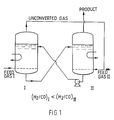
- a formate ester is formed (carbonylation step) e.g. methyl formate in the liquid phase using the catalyst system of the present invention in a low temperature process and using a feed gas, which is relatively rich in carbon monoxide, while in the other reaction zone this formate is hydrogenated in the liquid phase using the same catalytic composition and using a feed gas, which is relatively rich in hydrogen.
- the catalyst solution or slurry is circulated between the two reaction vessels.
- a synthesis gas stream of higher H2/CO ratio is obtained by partial conversion of the first mentioned stream to form mainly the formate ester.
- the unconverted, hydrogen enriched residual gas stream from the first zone may be used to hydrogenate this formate ester in the second zone.
- these two feed streams are derived from natural gas, which is converted by partial oxidation to synthesis gas, relatively rich in carbon monoxide, and by steam reforming to a gas relatively rich in hydrogen.
- methylformate Since methylformate is relatively volatile, it will be a substantial by-product of the methanol produced unless the steady state formate concentration can be kept deliberately low, which is not inducive to a high hydrogenation rate. Possible methylformate as byproduct can be reconverted into methanol.
- One of the individually produced gas mixtures relatively rich in CO is introduced in the left reactor where carbonylation is the predominant reaction.
- the carbonylation rate as well as equilibrium are favoured by the relatively high CO partial pressure (i.e. more than in a stoichiometric mixture usually applied).
- the ester hydrogenation step (b) may predominantly take place in the right hand reactor.
- the reaction rate benefits from the high hydrogen partial pressure and the relatively low CO pressure.
- the carbonylation reaction step is carried out at relatively low temperature (from 30-70 °C) in the left reactor, taking into account that this reaction step is a fast but equilibrium limited reaction, while the second hydrogenation reaction step is carried out at relatively higher temperature (from 70-120 °C) in the right hand reactor (reference is made to the figure 2), taking into account that the ester hydrogenation is not limited by equilibrium but by kinetics.
- relatively low temperature from 30-70 °C
- the second hydrogenation reaction step is carried out at relatively higher temperature (from 70-120 °C) in the right hand reactor (reference is made to the figure 2), taking into account that the ester hydrogenation is not limited by equilibrium but by kinetics.
- this embodiment can certainly not be regarded as obvious to a skilled person who might only be inclined to look for improved single stage processes, due to the general conception that separate reaction vessels would mean a disadvantage.
- Hastelloy C Hastelloy is a trade name
- Nickel formate was used which had been preheated under vacuum at 150 °C during 16 hours.
- the autoclave was charged under a nitrogen atmosphere with diglyme (50 ml), substantially dry nickel formate (10 mmol) and 20 mmol water, and heated to a temperature of 45 °C under stirring and kept this temperature for 0.5 h. Then a solution of 60 mmol potassium tert.butylate in 50 ml diglyme was added. The autoclave was sealed and a mixture of carbon monoxide and hydrogen was introduced into the autoclave until a partial CO pressure of 15 bar and a partial H2 pressure of 30 bar was reached.
- the autoclave was further heated to a temperature of 80 °C and kept 2 hours at this temperature and 3 hours at 100 °C.
- the pressure was kept at a value between 30 and 60 bar by intermittent introduction of additional carbon monoxide and hydrogen in a ratio of 1:3.
- the pressure was kept in the range from 30-60 bar by continue addition of hydrogen and carbon monoxide in a 3:1 ratio.
- the pressure was kept in the range from 30-60 bar by continue addition of hydrogen and carbon monoxide in a 3:1 ratio.
Landscapes
- Chemical & Material Sciences (AREA)
- Organic Chemistry (AREA)
- Chemical Kinetics & Catalysis (AREA)
- Organic Low-Molecular-Weight Compounds And Preparation Thereof (AREA)
- Catalysts (AREA)
- Low-Molecular Organic Synthesis Reactions Using Catalysts (AREA)
Applications Claiming Priority (2)
| Application Number | Priority Date | Filing Date | Title |
|---|---|---|---|
| GB8727058 | 1987-11-19 | ||
| GB878727058A GB8727058D0 (en) | 1987-11-19 | 1987-11-19 | Production of methanol |
Publications (2)
| Publication Number | Publication Date |
|---|---|
| EP0317035A2 true EP0317035A2 (de) | 1989-05-24 |
| EP0317035A3 EP0317035A3 (de) | 1991-04-24 |
Family
ID=10627194
Family Applications (1)
| Application Number | Title | Priority Date | Filing Date |
|---|---|---|---|
| EP19880202601 Withdrawn EP0317035A3 (de) | 1987-11-19 | 1988-11-18 | Herstellungsverfahren von Methanol und Katalysatorzusammensetzung für dieses Verfahren |
Country Status (7)
| Country | Link |
|---|---|
| US (2) | US4914136A (de) |
| EP (1) | EP0317035A3 (de) |
| JP (1) | JPH02138140A (de) |
| BR (1) | BR8806029A (de) |
| GB (1) | GB8727058D0 (de) |
| NZ (1) | NZ226986A (de) |
| ZA (1) | ZA888605B (de) |
Cited By (1)
| Publication number | Priority date | Publication date | Assignee | Title |
|---|---|---|---|---|
| EP0375071A3 (de) * | 1988-12-23 | 1991-05-08 | SNAMPROGETTI S.p.A. | Flüssigphaseverfahren zur Herstellung von Methanol aus Synthesegas |
Families Citing this family (4)
| Publication number | Priority date | Publication date | Assignee | Title |
|---|---|---|---|---|
| US6039554A (en) * | 1995-12-18 | 2000-03-21 | Akutagawa Confectionery Co., Ltd. | Molding apparatus for producing solidified articles |
| US7446474B2 (en) * | 2002-10-10 | 2008-11-04 | Applied Materials, Inc. | Hetero-junction electron emitter with Group III nitride and activated alkali halide |
| US7015467B2 (en) * | 2002-10-10 | 2006-03-21 | Applied Materials, Inc. | Generating electrons with an activated photocathode |
| US20180086683A1 (en) * | 2016-09-29 | 2018-03-29 | Richard Sapienza | Small scale production of methoxy compounds |
Family Cites Families (9)
| Publication number | Priority date | Publication date | Assignee | Title |
|---|---|---|---|---|
| BE491394A (de) * | 1949-09-30 | |||
| US3422081A (en) * | 1965-11-15 | 1969-01-14 | Continental Can Co | Process for preparing stereoregular acrylamide polymers with an alkali metal alkoxide and polyvalent metal salt catalyst |
| US3862993A (en) * | 1973-06-06 | 1975-01-28 | Continental Oil Co | Process for condensation of alcohols |
| JPS56169634A (en) * | 1980-06-03 | 1981-12-26 | Mitsui Petrochem Ind Ltd | Synthetic method of organic compound containing oxygen |
| NO154694C (no) * | 1984-11-23 | 1986-12-03 | Sintef | Fremgangsmaate for fremstilling av metanol i vaeskefase. |
| US4614749A (en) * | 1985-03-12 | 1986-09-30 | Sapienza Richard S | Low temperature catalysts for methanol production |
| US4619946A (en) * | 1985-03-12 | 1986-10-28 | Sapienza Richard S | Low temperature catalysts for methanol production |
| GB8708005D0 (en) * | 1987-04-03 | 1987-05-07 | Shell Int Research | Production of methanol |
| GB8708004D0 (en) * | 1987-04-03 | 1987-05-07 | Shell Int Research | Production of methanol |
-
1987
- 1987-11-19 GB GB878727058A patent/GB8727058D0/en active Pending
-
1988
- 1988-06-30 US US07/213,818 patent/US4914136A/en not_active Expired - Lifetime
- 1988-11-17 ZA ZA888605A patent/ZA888605B/xx unknown
- 1988-11-17 BR BR888806029A patent/BR8806029A/pt unknown
- 1988-11-17 NZ NZ226986A patent/NZ226986A/en unknown
- 1988-11-17 JP JP63289059A patent/JPH02138140A/ja active Pending
- 1988-11-18 EP EP19880202601 patent/EP0317035A3/de not_active Withdrawn
-
1989
- 1989-11-28 US US07/442,264 patent/US4975404A/en not_active Expired - Lifetime
Cited By (1)
| Publication number | Priority date | Publication date | Assignee | Title |
|---|---|---|---|---|
| EP0375071A3 (de) * | 1988-12-23 | 1991-05-08 | SNAMPROGETTI S.p.A. | Flüssigphaseverfahren zur Herstellung von Methanol aus Synthesegas |
Also Published As
| Publication number | Publication date |
|---|---|
| ZA888605B (en) | 1989-07-26 |
| NZ226986A (en) | 1990-11-27 |
| EP0317035A3 (de) | 1991-04-24 |
| US4975404A (en) | 1990-12-04 |
| JPH02138140A (ja) | 1990-05-28 |
| GB8727058D0 (en) | 1987-12-23 |
| BR8806029A (pt) | 1989-08-08 |
| US4914136A (en) | 1990-04-03 |
Similar Documents
| Publication | Publication Date | Title |
|---|---|---|
| EP0375071B1 (de) | Flüssigphaseverfahren zur Herstellung von Methanol aus Synthesegas | |
| US5189203A (en) | Process for preparing acetic acid, methyl acetate, acetic anhydride or mixtures thereof | |
| US5221652A (en) | Methanol synthesis using a catalyst combination of alkali or alkaline earth salts and reduced copper chromite for methanol synthesis | |
| US4888361A (en) | Process for the production of methanol and catalyst composition for said process | |
| US4111837A (en) | Homologation of alkanols | |
| US6028119A (en) | Process for methanol production | |
| US4935398A (en) | Process for the production of methanol and a composition suitable for use as a catalyst in said process | |
| EP0701990B1 (de) | Hydrocarbonylierung von Dimethyläther | |
| EP0317035A2 (de) | Herstellungsverfahren von Methanol und Katalysatorzusammensetzung für dieses Verfahren | |
| US5874630A (en) | Synthesis of mercaptans from alcohols | |
| AU603700B2 (en) | Process for the production of methanol and catalyst composition for said process | |
| JP3506602B2 (ja) | メタノールの製造方法 | |
| AU605934B2 (en) | Process for the production of methanol and catalyst composition for said process | |
| AU608646B2 (en) | Process for the manufacture of methanol | |
| CA1175798A (en) | Method for the production of methyl formate and methanol | |
| WO2007094471A1 (ja) | メタノール合成用触媒及び当該触媒の製造方法、並びにメタノールの製造方法 | |
| US4613623A (en) | Low temperature synthesis of methyl formate | |
| US4992479A (en) | Process for the preparation of methanol and composition suitable for use as a catalyst in said process | |
| JPS6351130B2 (de) | ||
| JP3553740B2 (ja) | メタノールの製造方法 | |
| JP2012211100A (ja) | メタノールの製造方法およびメタノール製造用触媒 | |
| GB2240052A (en) | Process and catalyst for reducing carbon monoxide to methanol | |
| JPS5911525B2 (ja) | 一酸化炭素の製造方法 | |
| CN116803969A (zh) | 一种利用天然气和二氧化碳制备醋酸的方法 | |
| NO165956B (no) | Fremgangsmaate for fremstilling av hydrokarboner og oksygenerte hydrokarboner. |
Legal Events
| Date | Code | Title | Description |
|---|---|---|---|
| PUAI | Public reference made under article 153(3) epc to a published international application that has entered the european phase |
Free format text: ORIGINAL CODE: 0009012 |
|
| AK | Designated contracting states |
Kind code of ref document: A2 Designated state(s): BE GB IT NL |
|
| PUAL | Search report despatched |
Free format text: ORIGINAL CODE: 0009013 |
|
| AK | Designated contracting states |
Kind code of ref document: A3 Designated state(s): BE GB IT NL |
|
| STAA | Information on the status of an ep patent application or granted ep patent |
Free format text: STATUS: THE APPLICATION IS DEEMED TO BE WITHDRAWN |
|
| 18D | Application deemed to be withdrawn |
Effective date: 19911025 |