EP0317096A2 - Vecteurs d'expression d'ADN recombinants et composés d'ADN codant pour l'isopénicilline-N-synthétase de streptomyces lipmanii - Google Patents
Vecteurs d'expression d'ADN recombinants et composés d'ADN codant pour l'isopénicilline-N-synthétase de streptomyces lipmanii Download PDFInfo
- Publication number
- EP0317096A2 EP0317096A2 EP88310084A EP88310084A EP0317096A2 EP 0317096 A2 EP0317096 A2 EP 0317096A2 EP 88310084 A EP88310084 A EP 88310084A EP 88310084 A EP88310084 A EP 88310084A EP 0317096 A2 EP0317096 A2 EP 0317096A2
- Authority
- EP
- European Patent Office
- Prior art keywords
- residue
- dna
- isopenicillin
- plasmid
- synthetase
- Prior art date
- Legal status (The legal status is an assumption and is not a legal conclusion. Google has not performed a legal analysis and makes no representation as to the accuracy of the status listed.)
- Ceased
Links
- 108020004414 DNA Proteins 0.000 title claims abstract description 167
- 108010012172 isopenicillin N synthetase Proteins 0.000 title claims abstract description 100
- 239000013604 expression vector Substances 0.000 title claims abstract description 31
- 150000001875 compounds Chemical class 0.000 title claims abstract description 28
- 108020004511 Recombinant DNA Proteins 0.000 title claims abstract description 21
- 241000187395 Streptomyces microflavus Species 0.000 title claims description 65
- 239000013598 vector Substances 0.000 claims abstract description 54
- 230000003213 activating effect Effects 0.000 claims abstract description 43
- 230000035897 transcription Effects 0.000 claims abstract description 37
- 238000013518 transcription Methods 0.000 claims abstract description 37
- 238000013519 translation Methods 0.000 claims abstract description 37
- 241000187747 Streptomyces Species 0.000 claims abstract description 18
- 241001619326 Cephalosporium Species 0.000 claims abstract description 10
- 230000005030 transcription termination Effects 0.000 claims abstract description 10
- 241000228143 Penicillium Species 0.000 claims abstract description 9
- 239000013612 plasmid Substances 0.000 claims description 123
- 210000004027 cell Anatomy 0.000 claims description 63
- 239000012634 fragment Substances 0.000 claims description 51
- 238000000034 method Methods 0.000 claims description 38
- 230000014509 gene expression Effects 0.000 claims description 35
- 241000588724 Escherichia coli Species 0.000 claims description 34
- 108091028043 Nucleic acid sequence Proteins 0.000 claims description 34
- 230000000694 effects Effects 0.000 claims description 34
- 241001646716 Escherichia coli K-12 Species 0.000 claims description 33
- MIFYHUACUWQUKT-UHFFFAOYSA-N Isopenicillin N Natural products OC(=O)C1C(C)(C)SC2C(NC(=O)CCCC(N)C(O)=O)C(=O)N21 MIFYHUACUWQUKT-UHFFFAOYSA-N 0.000 claims description 21
- 125000000539 amino acid group Chemical group 0.000 claims description 15
- 102000004190 Enzymes Human genes 0.000 claims description 12
- 108090000790 Enzymes Proteins 0.000 claims description 12
- 238000002703 mutagenesis Methods 0.000 claims description 9
- 231100000350 mutagenesis Toxicity 0.000 claims description 9
- 230000008488 polyadenylation Effects 0.000 claims description 7
- 238000004519 manufacturing process Methods 0.000 claims description 5
- 238000002741 site-directed mutagenesis Methods 0.000 claims description 5
- 239000000758 substrate Substances 0.000 claims description 5
- 125000002480 thymidyl group Chemical group 0.000 claims description 5
- 238000003780 insertion Methods 0.000 claims description 4
- 230000037431 insertion Effects 0.000 claims description 4
- DCXYFEDJOCDNAF-UHFFFAOYSA-N Asparagine Natural products OC(=O)C(N)CC(N)=O DCXYFEDJOCDNAF-UHFFFAOYSA-N 0.000 claims description 3
- KDXKERNSBIXSRK-UHFFFAOYSA-N Lysine Natural products NCCCCC(N)C(O)=O KDXKERNSBIXSRK-UHFFFAOYSA-N 0.000 claims description 3
- 125000003295 alanine group Chemical group N[C@@H](C)C(=O)* 0.000 claims description 3
- 125000003275 alpha amino acid group Chemical group 0.000 claims description 3
- 125000000637 arginyl group Chemical group N[C@@H](CCCNC(N)=N)C(=O)* 0.000 claims description 3
- 125000000613 asparagine group Chemical group N[C@@H](CC(N)=O)C(=O)* 0.000 claims description 3
- CKLJMWTZIZZHCS-REOHCLBHSA-N aspartic acid group Chemical group N[C@@H](CC(=O)O)C(=O)O CKLJMWTZIZZHCS-REOHCLBHSA-N 0.000 claims description 3
- 210000004899 c-terminal region Anatomy 0.000 claims description 3
- 238000012258 culturing Methods 0.000 claims description 3
- 125000000151 cysteine group Chemical group N[C@@H](CS)C(=O)* 0.000 claims description 3
- 238000012217 deletion Methods 0.000 claims description 3
- 230000037430 deletion Effects 0.000 claims description 3
- 125000000291 glutamic acid group Chemical group N[C@@H](CCC(O)=O)C(=O)* 0.000 claims description 3
- 125000000404 glutamine group Chemical group N[C@@H](CCC(N)=O)C(=O)* 0.000 claims description 3
- 125000003630 glycyl group Chemical group [H]N([H])C([H])([H])C(*)=O 0.000 claims description 3
- 125000000487 histidyl group Chemical group [H]N([H])C(C(=O)O*)C([H])([H])C1=C([H])N([H])C([H])=N1 0.000 claims description 3
- 125000000741 isoleucyl group Chemical group [H]N([H])C(C(C([H])([H])[H])C([H])([H])C([H])([H])[H])C(=O)O* 0.000 claims description 3
- 125000001909 leucine group Chemical group [H]N(*)C(C(*)=O)C([H])([H])C(C([H])([H])[H])C([H])([H])[H] 0.000 claims description 3
- 125000003588 lysine group Chemical group [H]N([H])C([H])([H])C([H])([H])C([H])([H])C([H])([H])C([H])(N([H])[H])C(*)=O 0.000 claims description 3
- 125000001360 methionine group Chemical group N[C@@H](CCSC)C(=O)* 0.000 claims description 3
- COLNVLDHVKWLRT-QMMMGPOBSA-N phenylalanine group Chemical group N[C@@H](CC1=CC=CC=C1)C(=O)O COLNVLDHVKWLRT-QMMMGPOBSA-N 0.000 claims description 3
- 125000002924 primary amino group Chemical group [H]N([H])* 0.000 claims description 3
- 125000001500 prolyl group Chemical group [H]N1C([H])(C(=O)[*])C([H])([H])C([H])([H])C1([H])[H] 0.000 claims description 3
- 125000003607 serino group Chemical group [H]N([H])[C@]([H])(C(=O)[*])C(O[H])([H])[H] 0.000 claims description 3
- 125000000341 threoninyl group Chemical group [H]OC([H])(C([H])([H])[H])C([H])(N([H])[H])C(*)=O 0.000 claims description 3
- 125000000430 tryptophan group Chemical group [H]N([H])C(C(=O)O*)C([H])([H])C1=C([H])N([H])C2=C([H])C([H])=C([H])C([H])=C12 0.000 claims description 3
- 125000001493 tyrosinyl group Chemical group [H]OC1=C([H])C([H])=C(C([H])=C1[H])C([H])([H])C([H])(N([H])[H])C(*)=O 0.000 claims description 3
- 125000002987 valine group Chemical group [H]N([H])C([H])(C(*)=O)C([H])(C([H])([H])[H])C([H])([H])[H] 0.000 claims description 3
- 230000001131 transforming effect Effects 0.000 claims description 2
- 125000003178 carboxy group Chemical group [H]OC(*)=O 0.000 claims 2
- BYEIJZFKOAXBBV-ATZCPNFKSA-N N-[(5S)-5-amino-5-carboxypentanoyl]-L-cysteinyl-D-valine Chemical compound CC(C)[C@H](C(O)=O)NC(=O)[C@H](CS)NC(=O)CCC[C@H](N)C(O)=O BYEIJZFKOAXBBV-ATZCPNFKSA-N 0.000 claims 1
- MIFYHUACUWQUKT-QSKNDCFUSA-N isopenicillin n Chemical compound OC(=O)[C@@H]1C(C)(C)S[C@H]2[C@H](NC(=O)CCC[C@H](N)C(O)=O)C(=O)N21 MIFYHUACUWQUKT-QSKNDCFUSA-N 0.000 claims 1
- 108090000623 proteins and genes Proteins 0.000 abstract description 40
- 238000010276 construction Methods 0.000 abstract description 18
- LFQSCWFLJHTTHZ-UHFFFAOYSA-N Ethanol Chemical compound CCO LFQSCWFLJHTTHZ-UHFFFAOYSA-N 0.000 description 51
- 101710107944 Isopenicillin N synthase Proteins 0.000 description 37
- 230000014616 translation Effects 0.000 description 35
- 239000000243 solution Substances 0.000 description 34
- 238000006243 chemical reaction Methods 0.000 description 31
- FAPWRFPIFSIZLT-UHFFFAOYSA-M Sodium chloride Chemical compound [Na+].[Cl-] FAPWRFPIFSIZLT-UHFFFAOYSA-M 0.000 description 24
- 108091008146 restriction endonucleases Proteins 0.000 description 22
- 108091026890 Coding region Proteins 0.000 description 20
- HEDRZPFGACZZDS-UHFFFAOYSA-N Chloroform Chemical compound ClC(Cl)Cl HEDRZPFGACZZDS-UHFFFAOYSA-N 0.000 description 19
- 230000003115 biocidal effect Effects 0.000 description 18
- MIFYHUACUWQUKT-GTQWGBSQSA-N isopenicillin N Chemical compound OC(=O)[C@H]1C(C)(C)S[C@@H]2[C@H](NC(=O)CCC[C@H](N)C(O)=O)C(=O)N21 MIFYHUACUWQUKT-GTQWGBSQSA-N 0.000 description 18
- 239000008188 pellet Substances 0.000 description 18
- XLYOFNOQVPJJNP-UHFFFAOYSA-N water Chemical compound O XLYOFNOQVPJJNP-UHFFFAOYSA-N 0.000 description 18
- 150000003952 β-lactams Chemical class 0.000 description 15
- 229910001868 water Inorganic materials 0.000 description 14
- 102000053602 DNA Human genes 0.000 description 13
- 239000007984 Tris EDTA buffer Substances 0.000 description 13
- 239000000203 mixture Substances 0.000 description 13
- 108090000204 Dipeptidase 1 Proteins 0.000 description 12
- 239000000872 buffer Substances 0.000 description 12
- 239000000284 extract Substances 0.000 description 12
- 239000011541 reaction mixture Substances 0.000 description 12
- 239000011780 sodium chloride Substances 0.000 description 12
- VMHLLURERBWHNL-UHFFFAOYSA-M Sodium acetate Chemical compound [Na+].CC([O-])=O VMHLLURERBWHNL-UHFFFAOYSA-M 0.000 description 11
- 239000004098 Tetracycline Substances 0.000 description 11
- 238000005119 centrifugation Methods 0.000 description 11
- 229960002180 tetracycline Drugs 0.000 description 11
- 229930101283 tetracycline Natural products 0.000 description 11
- 235000019364 tetracycline Nutrition 0.000 description 11
- 150000003522 tetracyclines Chemical class 0.000 description 11
- QKNYBSVHEMOAJP-UHFFFAOYSA-N 2-amino-2-(hydroxymethyl)propane-1,3-diol;hydron;chloride Chemical compound Cl.OCC(N)(CO)CO QKNYBSVHEMOAJP-UHFFFAOYSA-N 0.000 description 10
- 229920001817 Agar Polymers 0.000 description 10
- 239000008272 agar Substances 0.000 description 10
- 239000003242 anti bacterial agent Substances 0.000 description 10
- 238000010367 cloning Methods 0.000 description 10
- 229940088598 enzyme Drugs 0.000 description 10
- 239000003550 marker Substances 0.000 description 10
- 108020004999 messenger RNA Proteins 0.000 description 10
- 239000000047 product Substances 0.000 description 10
- 108020004682 Single-Stranded DNA Proteins 0.000 description 8
- 238000003556 assay Methods 0.000 description 8
- 238000011534 incubation Methods 0.000 description 8
- KCXVZYZYPLLWCC-UHFFFAOYSA-N EDTA Chemical compound OC(=O)CN(CC(O)=O)CCN(CC(O)=O)CC(O)=O KCXVZYZYPLLWCC-UHFFFAOYSA-N 0.000 description 7
- 229930182555 Penicillin Natural products 0.000 description 7
- 239000003782 beta lactam antibiotic agent Substances 0.000 description 7
- 229940124587 cephalosporin Drugs 0.000 description 7
- 230000010076 replication Effects 0.000 description 7
- 230000009466 transformation Effects 0.000 description 7
- 239000002132 β-lactam antibiotic Substances 0.000 description 7
- 229940124586 β-lactam antibiotics Drugs 0.000 description 7
- ZKHQWZAMYRWXGA-KQYNXXCUSA-J ATP(4-) Chemical compound C1=NC=2C(N)=NC=NC=2N1[C@@H]1O[C@H](COP([O-])(=O)OP([O-])(=O)OP([O-])([O-])=O)[C@@H](O)[C@H]1O ZKHQWZAMYRWXGA-KQYNXXCUSA-J 0.000 description 6
- ZKHQWZAMYRWXGA-UHFFFAOYSA-N Adenosine triphosphate Natural products C1=NC=2C(N)=NC=NC=2N1C1OC(COP(O)(=O)OP(O)(=O)OP(O)(O)=O)C(O)C1O ZKHQWZAMYRWXGA-UHFFFAOYSA-N 0.000 description 6
- 229930186147 Cephalosporin Natural products 0.000 description 6
- 108091033380 Coding strand Proteins 0.000 description 6
- PEDCQBHIVMGVHV-UHFFFAOYSA-N Glycerine Chemical compound OCC(O)CO PEDCQBHIVMGVHV-UHFFFAOYSA-N 0.000 description 6
- TWRXJAOTZQYOKJ-UHFFFAOYSA-L Magnesium chloride Chemical compound [Mg+2].[Cl-].[Cl-] TWRXJAOTZQYOKJ-UHFFFAOYSA-L 0.000 description 6
- 241000228417 Sarocladium strictum Species 0.000 description 6
- 229960000723 ampicillin Drugs 0.000 description 6
- AVKUERGKIZMTKX-NJBDSQKTSA-N ampicillin Chemical compound C1([C@@H](N)C(=O)N[C@H]2[C@H]3SC([C@@H](N3C2=O)C(O)=O)(C)C)=CC=CC=C1 AVKUERGKIZMTKX-NJBDSQKTSA-N 0.000 description 6
- 229940088710 antibiotic agent Drugs 0.000 description 6
- 102000006635 beta-lactamase Human genes 0.000 description 6
- 150000001780 cephalosporins Chemical class 0.000 description 6
- 230000002068 genetic effect Effects 0.000 description 6
- 238000009396 hybridization Methods 0.000 description 6
- 230000010354 integration Effects 0.000 description 6
- 230000003834 intracellular effect Effects 0.000 description 6
- 238000002955 isolation Methods 0.000 description 6
- 238000012545 processing Methods 0.000 description 6
- 102000004169 proteins and genes Human genes 0.000 description 6
- 238000011160 research Methods 0.000 description 6
- 239000000523 sample Substances 0.000 description 6
- 239000006228 supernatant Substances 0.000 description 6
- 238000011144 upstream manufacturing Methods 0.000 description 6
- 239000000020 Nitrocellulose Substances 0.000 description 5
- JGSARLDLIJGVTE-MBNYWOFBSA-N Penicillin G Chemical compound N([C@H]1[C@H]2SC([C@@H](N2C1=O)C(O)=O)(C)C)C(=O)CC1=CC=CC=C1 JGSARLDLIJGVTE-MBNYWOFBSA-N 0.000 description 5
- 239000008346 aqueous phase Substances 0.000 description 5
- 230000029087 digestion Effects 0.000 description 5
- 239000000499 gel Substances 0.000 description 5
- 229920001220 nitrocellulos Polymers 0.000 description 5
- 239000002773 nucleotide Substances 0.000 description 5
- 229940049954 penicillin Drugs 0.000 description 5
- 238000001556 precipitation Methods 0.000 description 5
- 235000018102 proteins Nutrition 0.000 description 5
- 230000003362 replicative effect Effects 0.000 description 5
- OPIFSICVWOWJMJ-AEOCFKNESA-N 5-bromo-4-chloro-3-indolyl beta-D-galactoside Chemical compound O[C@@H]1[C@@H](O)[C@@H](O)[C@@H](CO)O[C@H]1OC1=CNC2=CC=C(Br)C(Cl)=C12 OPIFSICVWOWJMJ-AEOCFKNESA-N 0.000 description 4
- 108010087702 Penicillinase Proteins 0.000 description 4
- 241000228150 Penicillium chrysogenum Species 0.000 description 4
- ISWSIDIOOBJBQZ-UHFFFAOYSA-N Phenol Chemical compound OC1=CC=CC=C1 ISWSIDIOOBJBQZ-UHFFFAOYSA-N 0.000 description 4
- 241000187433 Streptomyces clavuligerus Species 0.000 description 4
- 238000000137 annealing Methods 0.000 description 4
- 238000004166 bioassay Methods 0.000 description 4
- 125000003729 nucleotide group Chemical group 0.000 description 4
- 229950009506 penicillinase Drugs 0.000 description 4
- 238000002360 preparation method Methods 0.000 description 4
- 230000008569 process Effects 0.000 description 4
- 230000001105 regulatory effect Effects 0.000 description 4
- 239000007858 starting material Substances 0.000 description 4
- 241000228212 Aspergillus Species 0.000 description 3
- 241000351920 Aspergillus nidulans Species 0.000 description 3
- 108020004705 Codon Proteins 0.000 description 3
- KFZMGEQAYNKOFK-UHFFFAOYSA-N Isopropanol Chemical class CC(C)O KFZMGEQAYNKOFK-UHFFFAOYSA-N 0.000 description 3
- 102000003960 Ligases Human genes 0.000 description 3
- 108090000364 Ligases Proteins 0.000 description 3
- 241000191938 Micrococcus luteus Species 0.000 description 3
- HEMHJVSKTPXQMS-UHFFFAOYSA-M Sodium hydroxide Chemical compound [OH-].[Na+] HEMHJVSKTPXQMS-UHFFFAOYSA-M 0.000 description 3
- 238000005273 aeration Methods 0.000 description 3
- 230000003698 anagen phase Effects 0.000 description 3
- 230000015572 biosynthetic process Effects 0.000 description 3
- 230000000295 complement effect Effects 0.000 description 3
- 239000012153 distilled water Substances 0.000 description 3
- 238000009585 enzyme analysis Methods 0.000 description 3
- 238000012869 ethanol precipitation Methods 0.000 description 3
- ZMMJGEGLRURXTF-UHFFFAOYSA-N ethidium bromide Chemical compound [Br-].C12=CC(N)=CC=C2C2=CC=C(N)C=C2[N+](CC)=C1C1=CC=CC=C1 ZMMJGEGLRURXTF-UHFFFAOYSA-N 0.000 description 3
- 229960005542 ethidium bromide Drugs 0.000 description 3
- 239000013613 expression plasmid Substances 0.000 description 3
- 238000000855 fermentation Methods 0.000 description 3
- 230000004151 fermentation Effects 0.000 description 3
- 229910001629 magnesium chloride Inorganic materials 0.000 description 3
- 244000005700 microbiome Species 0.000 description 3
- 238000000527 sonication Methods 0.000 description 3
- 230000014621 translational initiation Effects 0.000 description 3
- 229920000936 Agarose Polymers 0.000 description 2
- CIWBSHSKHKDKBQ-JLAZNSOCSA-N Ascorbic acid Chemical compound OC[C@H](O)[C@H]1OC(=O)C(O)=C1O CIWBSHSKHKDKBQ-JLAZNSOCSA-N 0.000 description 2
- 108700010070 Codon Usage Proteins 0.000 description 2
- 241000701959 Escherichia virus Lambda Species 0.000 description 2
- CSNNHWWHGAXBCP-UHFFFAOYSA-L Magnesium sulfate Chemical compound [Mg+2].[O-][S+2]([O-])([O-])[O-] CSNNHWWHGAXBCP-UHFFFAOYSA-L 0.000 description 2
- 241000364057 Peoria Species 0.000 description 2
- 108010021757 Polynucleotide 5'-Hydroxyl-Kinase Proteins 0.000 description 2
- 102000008422 Polynucleotide 5'-hydroxyl-kinase Human genes 0.000 description 2
- 229920004890 Triton X-100 Polymers 0.000 description 2
- 239000002253 acid Substances 0.000 description 2
- 239000011543 agarose gel Substances 0.000 description 2
- 101150114167 ampC gene Proteins 0.000 description 2
- 238000004458 analytical method Methods 0.000 description 2
- 102000005936 beta-Galactosidase Human genes 0.000 description 2
- 108010005774 beta-Galactosidase Proteins 0.000 description 2
- 230000001851 biosynthetic effect Effects 0.000 description 2
- -1 but not limited to Substances 0.000 description 2
- AIYUHDOJVYHVIT-UHFFFAOYSA-M caesium chloride Chemical compound [Cl-].[Cs+] AIYUHDOJVYHVIT-UHFFFAOYSA-M 0.000 description 2
- 229940041514 candida albicans extract Drugs 0.000 description 2
- 230000015556 catabolic process Effects 0.000 description 2
- 239000003795 chemical substances by application Substances 0.000 description 2
- 229960005091 chloramphenicol Drugs 0.000 description 2
- WIIZWVCIJKGZOK-RKDXNWHRSA-N chloramphenicol Chemical compound ClC(Cl)C(=O)N[C@H](CO)[C@H](O)C1=CC=C([N+]([O-])=O)C=C1 WIIZWVCIJKGZOK-RKDXNWHRSA-N 0.000 description 2
- 239000013611 chromosomal DNA Substances 0.000 description 2
- 239000013599 cloning vector Substances 0.000 description 2
- 238000009833 condensation Methods 0.000 description 2
- 230000005494 condensation Effects 0.000 description 2
- 238000006731 degradation reaction Methods 0.000 description 2
- 238000010790 dilution Methods 0.000 description 2
- 239000012895 dilution Substances 0.000 description 2
- 210000003527 eukaryotic cell Anatomy 0.000 description 2
- 238000000338 in vitro Methods 0.000 description 2
- 230000002779 inactivation Effects 0.000 description 2
- 238000012423 maintenance Methods 0.000 description 2
- 239000002609 medium Substances 0.000 description 2
- 238000002156 mixing Methods 0.000 description 2
- 239000013642 negative control Substances 0.000 description 2
- 150000002960 penicillins Chemical class 0.000 description 2
- 150000002989 phenols Chemical class 0.000 description 2
- 238000013492 plasmid preparation Methods 0.000 description 2
- LWIHDJKSTIGBAC-UHFFFAOYSA-K potassium phosphate Substances [K+].[K+].[K+].[O-]P([O-])([O-])=O LWIHDJKSTIGBAC-UHFFFAOYSA-K 0.000 description 2
- 238000000746 purification Methods 0.000 description 2
- 229920006395 saturated elastomer Polymers 0.000 description 2
- 238000012163 sequencing technique Methods 0.000 description 2
- 239000001632 sodium acetate Substances 0.000 description 2
- 235000017281 sodium acetate Nutrition 0.000 description 2
- 230000002194 synthesizing effect Effects 0.000 description 2
- 239000012138 yeast extract Substances 0.000 description 2
- 108091032973 (ribonucleotides)n+m Proteins 0.000 description 1
- WTLKTXIHIHFSGU-UHFFFAOYSA-N 2-nitrosoguanidine Chemical compound NC(N)=NN=O WTLKTXIHIHFSGU-UHFFFAOYSA-N 0.000 description 1
- 108700028369 Alleles Proteins 0.000 description 1
- 241000193830 Bacillus <bacterium> Species 0.000 description 1
- 108091003079 Bovine Serum Albumin Proteins 0.000 description 1
- 235000008495 Chrysanthemum leucanthemum Nutrition 0.000 description 1
- KRKNYBCHXYNGOX-UHFFFAOYSA-K Citrate Chemical compound [O-]C(=O)CC(O)(CC([O-])=O)C([O-])=O KRKNYBCHXYNGOX-UHFFFAOYSA-K 0.000 description 1
- 101710095468 Cyclase Proteins 0.000 description 1
- 102000012410 DNA Ligases Human genes 0.000 description 1
- 108010061982 DNA Ligases Proteins 0.000 description 1
- 108020003215 DNA Probes Proteins 0.000 description 1
- 239000003298 DNA probe Substances 0.000 description 1
- 230000007023 DNA restriction-modification system Effects 0.000 description 1
- 238000001712 DNA sequencing Methods 0.000 description 1
- 241001524679 Escherichia virus M13 Species 0.000 description 1
- PLUBXMRUUVWRLT-UHFFFAOYSA-N Ethyl methanesulfonate Chemical compound CCOS(C)(=O)=O PLUBXMRUUVWRLT-UHFFFAOYSA-N 0.000 description 1
- 229920001917 Ficoll Polymers 0.000 description 1
- GRRNUXAQVGOGFE-UHFFFAOYSA-N Hygromycin-B Natural products OC1C(NC)CC(N)C(O)C1OC1C2OC3(C(C(O)C(O)C(C(N)CO)O3)O)OC2C(O)C(CO)O1 GRRNUXAQVGOGFE-UHFFFAOYSA-N 0.000 description 1
- 102000016943 Muramidase Human genes 0.000 description 1
- 108010014251 Muramidase Proteins 0.000 description 1
- 108010062010 N-Acetylmuramoyl-L-alanine Amidase Proteins 0.000 description 1
- 241000187654 Nocardia Species 0.000 description 1
- 101710163270 Nuclease Proteins 0.000 description 1
- 108091034117 Oligonucleotide Proteins 0.000 description 1
- 108700026244 Open Reading Frames Proteins 0.000 description 1
- 239000001888 Peptone Substances 0.000 description 1
- 108010080698 Peptones Proteins 0.000 description 1
- 239000002202 Polyethylene glycol Substances 0.000 description 1
- 108091081024 Start codon Proteins 0.000 description 1
- 229930006000 Sucrose Natural products 0.000 description 1
- CZMRCDWAGMRECN-UGDNZRGBSA-N Sucrose Chemical compound O[C@H]1[C@H](O)[C@@H](CO)O[C@@]1(CO)O[C@@H]1[C@H](O)[C@@H](O)[C@H](O)[C@@H](CO)O1 CZMRCDWAGMRECN-UGDNZRGBSA-N 0.000 description 1
- RZCIEJXAILMSQK-JXOAFFINSA-N TTP Chemical compound O=C1NC(=O)C(C)=CN1[C@H]1[C@H](O)[C@H](O)[C@@H](COP(O)(=O)OP(O)(=O)OP(O)(O)=O)O1 RZCIEJXAILMSQK-JXOAFFINSA-N 0.000 description 1
- 241000613460 Tanacetum vulgare Species 0.000 description 1
- 108700009124 Transcription Initiation Site Proteins 0.000 description 1
- 239000013504 Triton X-100 Substances 0.000 description 1
- 241000700605 Viruses Species 0.000 description 1
- 150000007513 acids Chemical class 0.000 description 1
- 230000009471 action Effects 0.000 description 1
- 230000004913 activation Effects 0.000 description 1
- 229950008644 adicillin Drugs 0.000 description 1
- 235000010323 ascorbic acid Nutrition 0.000 description 1
- 229960005070 ascorbic acid Drugs 0.000 description 1
- 239000011668 ascorbic acid Substances 0.000 description 1
- 235000015278 beef Nutrition 0.000 description 1
- 229940098773 bovine serum albumin Drugs 0.000 description 1
- UDSAIICHUKSCKT-UHFFFAOYSA-N bromophenol blue Chemical compound C1=C(Br)C(O)=C(Br)C=C1C1(C=2C=C(Br)C(O)=C(Br)C=2)C2=CC=CC=C2S(=O)(=O)O1 UDSAIICHUKSCKT-UHFFFAOYSA-N 0.000 description 1
- 239000006285 cell suspension Substances 0.000 description 1
- 210000004671 cell-free system Anatomy 0.000 description 1
- 230000001413 cellular effect Effects 0.000 description 1
- ZAIPMKNFIOOWCQ-UEKVPHQBSA-N cephalexin Chemical compound C1([C@@H](N)C(=O)N[C@H]2[C@@H]3N(C2=O)C(=C(CS3)C)C(O)=O)=CC=CC=C1 ZAIPMKNFIOOWCQ-UEKVPHQBSA-N 0.000 description 1
- 229940106164 cephalexin Drugs 0.000 description 1
- 230000008859 change Effects 0.000 description 1
- 238000007385 chemical modification Methods 0.000 description 1
- 239000002962 chemical mutagen Substances 0.000 description 1
- YTRQFSDWAXHJCC-UHFFFAOYSA-N chloroform;phenol Chemical compound ClC(Cl)Cl.OC1=CC=CC=C1 YTRQFSDWAXHJCC-UHFFFAOYSA-N 0.000 description 1
- 238000003776 cleavage reaction Methods 0.000 description 1
- 239000000356 contaminant Substances 0.000 description 1
- 238000001816 cooling Methods 0.000 description 1
- 238000005520 cutting process Methods 0.000 description 1
- SUYVUBYJARFZHO-RRKCRQDMSA-N dATP Chemical compound C1=NC=2C(N)=NC=NC=2N1[C@H]1C[C@H](O)[C@@H](COP(O)(=O)OP(O)(=O)OP(O)(O)=O)O1 SUYVUBYJARFZHO-RRKCRQDMSA-N 0.000 description 1
- SUYVUBYJARFZHO-UHFFFAOYSA-N dATP Natural products C1=NC=2C(N)=NC=NC=2N1C1CC(O)C(COP(O)(=O)OP(O)(=O)OP(O)(O)=O)O1 SUYVUBYJARFZHO-UHFFFAOYSA-N 0.000 description 1
- RGWHQCVHVJXOKC-SHYZEUOFSA-J dCTP(4-) Chemical compound O=C1N=C(N)C=CN1[C@@H]1O[C@H](COP([O-])(=O)OP([O-])(=O)OP([O-])([O-])=O)[C@@H](O)C1 RGWHQCVHVJXOKC-SHYZEUOFSA-J 0.000 description 1
- HAAZLUGHYHWQIW-KVQBGUIXSA-N dGTP Chemical compound C1=NC=2C(=O)NC(N)=NC=2N1[C@H]1C[C@H](O)[C@@H](COP(O)(=O)OP(O)(=O)OP(O)(O)=O)O1 HAAZLUGHYHWQIW-KVQBGUIXSA-N 0.000 description 1
- 239000008367 deionised water Substances 0.000 description 1
- 229910021641 deionized water Inorganic materials 0.000 description 1
- 239000005547 deoxyribonucleotide Substances 0.000 description 1
- 125000002637 deoxyribonucleotide group Chemical group 0.000 description 1
- 230000001419 dependent effect Effects 0.000 description 1
- 238000013461 design Methods 0.000 description 1
- ZPWVASYFFYYZEW-UHFFFAOYSA-L dipotassium hydrogen phosphate Chemical compound [K+].[K+].OP([O-])([O-])=O ZPWVASYFFYYZEW-UHFFFAOYSA-L 0.000 description 1
- 229910000396 dipotassium phosphate Inorganic materials 0.000 description 1
- 235000019797 dipotassium phosphate Nutrition 0.000 description 1
- 238000005516 engineering process Methods 0.000 description 1
- 230000007613 environmental effect Effects 0.000 description 1
- 101150015862 epi gene Proteins 0.000 description 1
- 238000002474 experimental method Methods 0.000 description 1
- 238000000605 extraction Methods 0.000 description 1
- 239000011536 extraction buffer Substances 0.000 description 1
- 239000011521 glass Substances 0.000 description 1
- 230000012010 growth Effects 0.000 description 1
- 239000001963 growth medium Substances 0.000 description 1
- GRRNUXAQVGOGFE-NZSRVPFOSA-N hygromycin B Chemical compound O[C@@H]1[C@@H](NC)C[C@@H](N)[C@H](O)[C@H]1O[C@H]1[C@H]2O[C@@]3([C@@H]([C@@H](O)[C@@H](O)[C@@H](C(N)CO)O3)O)O[C@H]2[C@@H](O)[C@@H](CO)O1 GRRNUXAQVGOGFE-NZSRVPFOSA-N 0.000 description 1
- 229940097277 hygromycin b Drugs 0.000 description 1
- 239000002054 inoculum Substances 0.000 description 1
- BAUYGSIQEAFULO-UHFFFAOYSA-L iron(2+) sulfate (anhydrous) Chemical compound [Fe+2].[O-]S([O-])(=O)=O BAUYGSIQEAFULO-UHFFFAOYSA-L 0.000 description 1
- 229910000359 iron(II) sulfate Inorganic materials 0.000 description 1
- 229960000318 kanamycin Drugs 0.000 description 1
- 229930027917 kanamycin Natural products 0.000 description 1
- SBUJHOSQTJFQJX-NOAMYHISSA-N kanamycin Chemical compound O[C@@H]1[C@@H](O)[C@H](O)[C@@H](CN)O[C@@H]1O[C@H]1[C@H](O)[C@@H](O[C@@H]2[C@@H]([C@@H](N)[C@H](O)[C@@H](CO)O2)O)[C@H](N)C[C@@H]1N SBUJHOSQTJFQJX-NOAMYHISSA-N 0.000 description 1
- 229930182823 kanamycin A Natural products 0.000 description 1
- 239000012160 loading buffer Substances 0.000 description 1
- 239000006166 lysate Substances 0.000 description 1
- 230000002934 lysing effect Effects 0.000 description 1
- 229960000274 lysozyme Drugs 0.000 description 1
- 239000004325 lysozyme Substances 0.000 description 1
- 235000010335 lysozyme Nutrition 0.000 description 1
- 229910052943 magnesium sulfate Inorganic materials 0.000 description 1
- 235000019341 magnesium sulphate Nutrition 0.000 description 1
- MBABOKRGFJTBAE-UHFFFAOYSA-N methyl methanesulfonate Chemical compound COS(C)(=O)=O MBABOKRGFJTBAE-UHFFFAOYSA-N 0.000 description 1
- 229910000402 monopotassium phosphate Inorganic materials 0.000 description 1
- 235000019796 monopotassium phosphate Nutrition 0.000 description 1
- 230000000869 mutational effect Effects 0.000 description 1
- 102000039446 nucleic acids Human genes 0.000 description 1
- 108020004707 nucleic acids Proteins 0.000 description 1
- 150000007523 nucleic acids Chemical class 0.000 description 1
- 239000006916 nutrient agar Substances 0.000 description 1
- 235000015097 nutrients Nutrition 0.000 description 1
- MIFYHUACUWQUKT-GPUHXXMPSA-N penicillin N Chemical compound OC(=O)[C@H]1C(C)(C)S[C@@H]2[C@H](NC(=O)CCC[C@@H](N)C(O)=O)C(=O)N21 MIFYHUACUWQUKT-GPUHXXMPSA-N 0.000 description 1
- 235000019319 peptone Nutrition 0.000 description 1
- 230000000865 phosphorylative effect Effects 0.000 description 1
- 230000007505 plaque formation Effects 0.000 description 1
- 239000013600 plasmid vector Substances 0.000 description 1
- 229920001223 polyethylene glycol Polymers 0.000 description 1
- 229920001184 polypeptide Polymers 0.000 description 1
- GNSKLFRGEWLPPA-UHFFFAOYSA-M potassium dihydrogen phosphate Chemical compound [K+].OP(O)([O-])=O GNSKLFRGEWLPPA-UHFFFAOYSA-M 0.000 description 1
- 239000002243 precursor Substances 0.000 description 1
- 229930010796 primary metabolite Natural products 0.000 description 1
- 108090000765 processed proteins & peptides Proteins 0.000 description 1
- 102000004196 processed proteins & peptides Human genes 0.000 description 1
- 230000005855 radiation Effects 0.000 description 1
- 230000002285 radioactive effect Effects 0.000 description 1
- 210000003705 ribosome Anatomy 0.000 description 1
- 229920002477 rna polymer Polymers 0.000 description 1
- 230000007017 scission Effects 0.000 description 1
- 238000012216 screening Methods 0.000 description 1
- 238000012868 site-directed mutagenesis technique Methods 0.000 description 1
- 239000011734 sodium Substances 0.000 description 1
- 241000894007 species Species 0.000 description 1
- 238000010186 staining Methods 0.000 description 1
- 239000000126 substance Substances 0.000 description 1
- 239000005720 sucrose Substances 0.000 description 1
- 238000010189 synthetic method Methods 0.000 description 1
- 239000012137 tryptone Substances 0.000 description 1
- 108700026220 vif Genes Proteins 0.000 description 1
- 230000029812 viral genome replication Effects 0.000 description 1
- 238000012800 visualization Methods 0.000 description 1
Images


Classifications
-
- C—CHEMISTRY; METALLURGY
- C12—BIOCHEMISTRY; BEER; SPIRITS; WINE; VINEGAR; MICROBIOLOGY; ENZYMOLOGY; MUTATION OR GENETIC ENGINEERING
- C12N—MICROORGANISMS OR ENZYMES; COMPOSITIONS THEREOF; PROPAGATING, PRESERVING, OR MAINTAINING MICROORGANISMS; MUTATION OR GENETIC ENGINEERING; CULTURE MEDIA
- C12N9/00—Enzymes; Proenzymes; Compositions thereof; Processes for preparing, activating, inhibiting, separating or purifying enzymes
- C12N9/93—Ligases (6)
-
- C—CHEMISTRY; METALLURGY
- C12—BIOCHEMISTRY; BEER; SPIRITS; WINE; VINEGAR; MICROBIOLOGY; ENZYMOLOGY; MUTATION OR GENETIC ENGINEERING
- C12N—MICROORGANISMS OR ENZYMES; COMPOSITIONS THEREOF; PROPAGATING, PRESERVING, OR MAINTAINING MICROORGANISMS; MUTATION OR GENETIC ENGINEERING; CULTURE MEDIA
- C12N15/00—Mutation or genetic engineering; DNA or RNA concerning genetic engineering, vectors, e.g. plasmids, or their isolation, preparation or purification; Use of hosts therefor
- C12N15/09—Recombinant DNA-technology
- C12N15/11—DNA or RNA fragments; Modified forms thereof; Non-coding nucleic acids having a biological activity
- C12N15/52—Genes encoding for enzymes or proenzymes
-
- C—CHEMISTRY; METALLURGY
- C12—BIOCHEMISTRY; BEER; SPIRITS; WINE; VINEGAR; MICROBIOLOGY; ENZYMOLOGY; MUTATION OR GENETIC ENGINEERING
- C12N—MICROORGANISMS OR ENZYMES; COMPOSITIONS THEREOF; PROPAGATING, PRESERVING, OR MAINTAINING MICROORGANISMS; MUTATION OR GENETIC ENGINEERING; CULTURE MEDIA
- C12N15/00—Mutation or genetic engineering; DNA or RNA concerning genetic engineering, vectors, e.g. plasmids, or their isolation, preparation or purification; Use of hosts therefor
- C12N15/09—Recombinant DNA-technology
- C12N15/63—Introduction of foreign genetic material using vectors; Vectors; Use of hosts therefor; Regulation of expression
- C12N15/74—Vectors or expression systems specially adapted for prokaryotic hosts other than E. coli, e.g. Lactobacillus, Micromonospora
- C12N15/76—Vectors or expression systems specially adapted for prokaryotic hosts other than E. coli, e.g. Lactobacillus, Micromonospora for Actinomyces; for Streptomyces
Definitions
- the present invention comprises a DNA sequence that encodes the isopenicillin N synthetase activity of Streptomyces lipmanii .
- Isopenicillin N synthetase catalyzes the reaction in which isopenicillin N is formed from ⁇ -(L- ⁇ -aminoadipyl)-L-cysteinyl-D-valine.
- This reaction is a critical step in the biosynthesis of important antibiotics such as penicillins from Streptomyces lipmanii , Aspergillus nidulans , Penicillium chrysogenum , Cephalosporium acremonium , and S. clavuligerus ; cephalosporins from C. acremonium ; and 7 ⁇ -methoxy-cephalosporins from S. clavuligerus and S. lipmanii .
- the novel DNA sequence that encodes the isopenicillin N synthetase activity was isolated from Streptomyces lipmanii and is useful to construct recombinant DNA expression vectors that drive expression of the activity.
- the present invention includes vectors that drive high-level expression of the isopenicillin N synthetase activity in many diverse host cells, such as Streptomyces , E. coli , Cephalosporium , Aspergillus , and Penicillium .
- the E. coli -produced isopenicillin N synthetase activity catalyses the reaction that forms isopenicillin N from ⁇ -(L- ⁇ -aminoadipyl)-L-cysteinyl-D-valine.
- Crude cell extracts from E. coli host cells transformed with the E. coli vectors of the present invention exhibit isopenicillin N synthetase activity.
- the E. coli vectors of the present invention thus provide an efficient means for obtaining large amounts of active isopenicillin N synthetase.
- Isopenicillin N synthetase is useful, not only for the production of isopenicillin N, but also for the condensation of tripeptides other than ⁇ -(L- ⁇ -aminoadipyl)-L-cysteinyl-D-valine to form novel antibiotics.
- the DNA compounds encoding isopenicillin N synthetase are readily modified to construct expression vectors that increase the efficiency and yield of antibiotic fermentations involving organisms such as Aspergillus nidulans , Cephalosporium acremonium , Penicillium chrysogenum , Streptomyces clavuligerus , and S. lipmanii .
- organisms such as Aspergillus nidulans , Cephalosporium acremonium , Penicillium chrysogenum , Streptomyces clavuligerus , and S. lipmanii .
- the isopenicillin N synthetase-encoding DNA of the present invention was isolated from S. lipmanii
- the present DNA compounds can be used to construct vectors that drive expression of isopenicillin N synthetase activity in a wide variety of host cells, as the E. coli vectors of the present invention illustrate.
- the isopenicillin N synthetase-encoding DNA compounds of the present invention can be used to produce vectors useful for improving efficiency and yield of fermentations involving penicillin and cephalosporin antibiotic-producing organisms of all genera.
- the isopenicillin N synthetase-encoding DNA compounds of the present invention were derived from Streptomyces lipmanii genomic DNA and were isolated in conjunction with the transcription and translation activating sequence that controls the expression of the isopenicillin N synthetase-encoding genomic DNA.
- the present invention comprises this novel transcription and translation activating sequence, which can be used to drive expression of genes in Streptomyces , especially S. lipmanii , and related organisms.
- the present invention also comprises the regulatory signals of the isopenicillin N synthetase gene that are located at the 3′ end of the coding strand of the coding region of the gene. These 3′ regulatory sequences encode the transcription termination and mRNA polyadenylation and processing signals of the Streptomyces lipmanii isopenicillin N synthetase gene. The presence of these signals in the proper position (at the 3′ end of the coding strand of the coding region of the gene to be expressed) in an expression vector enhances expression of the product encoded by the vector.
- Antibiotic - a substance produced by a microorganism that, either naturally or with limited chemical modification, will inhibit the growth of or kill another microorganism or eukaryotic cell.
- Antibiotic Biosynthetic Gene - a DNA segment that encodes an activity that is necessary for a reaction in the process of converting primary metabolites into antibiotics.
- Antibiotic-Producing Organism any organism, including, but not limited to, Aspergillus , Streptomyces , Bacillus , Monospora , Cephalosporium , Penicillium , and Nocardia , that either produces an antibiotic or contains genes that, if expressed, would produce an antibiotic.
- Antibiotic Resistance-Conferring Gene a DNA segment that encodes an activity that confers resistance to an antibiotic.
- Cloning the process of incorporating a segment of DNA into a recombinant DNA vector.
- Genomic Library a set of recombinant DNA cloning vectors into which segments of DNA, which substantially represent the entire genome of a particular organism, have been cloned.
- HmR the hygromycin B resistance-conferring gene.
- Hybridization the process of annealing two homologous single-stranded DNA molecules to form a double-stranded DNA molecule, which may or may not be completely base-paired.
- IPS or IPNS - Isopenicillin N synthetase may refer to the protein or DNA encoding the protein.
- Recombinant DNA Cloning Vector any autonomously replicating or integrating agent, including, but not limited to, plasmids, comprising a DNA molecule to which one or more additional DNA molecules can be or have been added.
- Recombinant DNA Expression Vector any autonomously replicating or integrating agent, including, but not limited to, plasmids, comprising a transcription and translation activating sequence positioned to drive expression of a DNA segment that encodes a polypeptide or RNA of research or commercial interest.
- Recombinant DNA vector any recombinant DNA cloning or expression vector.
- Restriction Fragment any linear DNA molecule generated by the action of one or more enzymes.
- Sensitive Host Cell - a host cell that cannot grow in the presence of a given antibiotic without a DNA segment that confers resistance thereto.
- TcR - the tetracycline resistance-conferring gene.
- Transcription Activating Sequence a DNA sequence, such as a promoter, that promotes transcription of DNA.
- Transformant - a recipient host cell that has undergone transformation.
- Transformation the introduction of DNA into a recipient host cell that changes the genotype and results in a change in the recipient cell.
- Translation Activating Sequence a DNA sequence, such as a ribosome-binding site-encoding sequence, that, when translated into mRNA, promotes translation of mRNA into protein.
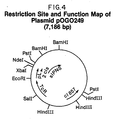
- restriction site and function maps presented in Figures 1-4 of the accompanying drawings are approximate representations of the recombinant DNA vectors discussed herein.
- the spacing of restriction sites on the map is proportional to the actual spacing of the restriction sites on the vector, but observed restriction site distances may vary somewhat from calculated map distances.
- the restriction site information is not exhaustive; therefore, there may be more restriction sites of a given type on the vector than actually shown on the map.
- the present invention comprises DNA compounds and recombinant DNA cloning and expression vectors that encode the isopenicillin N synthetase activity of Streptomyces lipmanii .
- the sequence of the S. lipmanii isopenicillin N synthetase-encoding DNA is depicted below, together with a portion of the DNA that flanks the 3′ and 5′ ends of the coding region in the S. lipmanii genome. In the depiction, only the "sense" or coding strand of the double-stranded DNA molecule is shown, and the DNA is depicted from left to right in the 5′ ⁇ 3′ orientation. The nucleotide sequence is numbered; the numbers appear above the DNA sequence.
- amino acid residue sequence of the isopenicillin N synthetase encoded by the DNA is listed from left to right in the amino-terminus ⁇ carboxy-terminus direction. Each amino acid residue appears below the DNA that encodes it. The amino acid residue sequence is numbered; the numbers appear below the amino acid residue sequence.
- the first DNA residue of the translation initiation codon is numbered 1; negative numbers refer to the distance in bp (base pairs) upstream from the translation initiation site (zero is not used).
- A is deoxyadenyl
- G is deoxyguanyl
- C is deoxycytidyl
- T is thymidyl
- ALA is an Alanine residue
- ARG is an Arginine residue
- ASN is an Asparagine residue
- ASP is an Aspartic Acid residue
- CYS is a Cysteine residue
- GLN is a Glutamine residue
- GLU is a Glutamic Acid residue
- GLY is a Glycine residue
- HIS is a Histidine residue
- ILE is an Isoleucine residue
- LEU is a Leucine residue
- LYS is a Lysine residue
- MET is a Methionine residue
- PHE is a Phenylalanine residue
- PRO is a Proline residue
- SER is a Serine residue
- THR is a Threonine residue
- TRP is a Tryptophan residue
- TYR is
- the DNA sequence depicted above is an important part of the present invention. Due to the degenerate nature of the genetic code, which results from there being more than one codon for most of the amino acid residues and stop signal, the amino acid residue sequence of isopenicillin N synthetase depicted above can be encoded by a multitude of different DNA sequences. Because these alternate DNA sequences would encode the same amino acid residue sequence of the present invention, the present invention further comprises these alternate sequences.
- IPNS-encoding sequences can be conventionally synthesized by the modified phosphotriester method using fully protected deoxyribonucleotide building blocks. Such synthetic methods are well known in the art and can be carried out in substantial accordance with the procedure of Itakura et al ., 1977, Science 198:1056 and Crea et al ., 1978, Proc. Nat. Acad. Sci. USA 75:5765. An especially preferred method of synthesizing DNA is disclosed in Hsiung et al ., 1983, Nucleic Acid Research 11:3227 and Narang et al ., 1980, Methods in Enzymology 68:90. In addition to the manual procedures referenced above, the DNA sequence can be synthesized using automated DNA synthesizers, such as the Systec 1450A or ABS 380A DNA Synthesizers.
- IPNS-encoding DNA sequences there could be genetic variants of the isopenicillin N synthetase-encoding DNA of the present invention. These genetic variants would share substantial DNA and amino acid residue sequence homology with the compounds of the present invention and would have similar, if not identical, activity, but would differ somewhat in nucleotide sequence from the specific, illustrative compounds of the invention. These genetic variants are equivalent to the compounds of the present invention and can be obtained by virtue of homology with the IPNS-encoding DNA sequences of the present invention.
- the isopenicillin N synthetase activity-encoding DNA compounds of the present invention were isolated from a strain of Streptomyces lipmanii .
- a genomic library of the total genomic DNA of the S. lipmanii strain was constructed and examined for the presence of sequences homologous to a deoxyribooligonucleotide probe. This probe was constructed in accordance with information obtained about the amino-terminal amino acid sequence of the S. lipmanii isopenicillin N synthetase, with knowledge of the genetic code, and with knowledge of codon usage preferences of Streptomyces .
- Several of the vectors of the genomic library were identified that were nearly homologous to the deoxyribooligonucleotide. DNA sequencing revealed which vectors encoded the S. lipmanii isopenicillin N synthetase.
- the Streptomyces lipmanii isopenicillin N synthetase gene was then cloned into another vector to yield plasmid pOGO239, which was transformed into E. coli K12 JM109 host cells.
- the E. coli K12 JM109/pOGO239 transformants were deposited and made part of the stock culture collection of the Northern Regional Research Laboratories (NRRL), Agricultural Research Service, U.S. Department of Agriculture, Peoria, Illinois 61604, under the accession number NRRL B-18250 (date of deposit: August 11, 1987).
- NRRL Northern Regional Research Laboratories
- NRRL B-18250 accession number
- Plasmid pOGO239 can be isolated from E. coli K12 JM109/pOGO239 by the procedure described in Example 1. Plasmid pOGO239 serves as useful starting material for vectors of the invention. Plasmid pOGO239 contains the intact Streptomyces lipmanii IPNS gene, which can be isolated from the plasmid on an ⁇ 2.8 kb Sal I restriction fragment. Plasmid pOGO239 was used as starting material in the construction of a plasmid, designated pOGO249, that drives high-level expression of isopenicillin N synthetase in E. coli . To facilitate manipulation of the S. lipmanii IPNS coding sequence as well as any manipulations of the native Streptomyces promoter sequence, a restriction enzyme Nde I recognition sequence was created at position -3 to +3 of the S. lipmanii IPNS DNA coding sequence.
- the creation of the Nde I site was done by M13 site-directed mutagenesis techniques and involved changing DNA bases -1 to -3 from GCC to CAT.
- DNA mutagenesis techniques are commonly used to introduce restriction enzyme recognition sites into DNA sequences and that in this case the encoded amino acid sequence was not changed.
- the mutagenesis and intermediate constructs are described in greater detail in Examples 2 through 4.
- the resulting plasmid designated pOGO246 and described more fully in Example 4, differs from plasmid pOGO239 only in the presence of a restriction enzyme Nde I site.
- a restriction site and function map of plasmid pOGO246 is presented in Figure 2 of the accompanying drawings.
- Plasmid pOGO249 is described below and in more detail in Example 5.
- a restriction site and function map of plasmid pOGO249 is presented in Figure 4 of the accompanying drawings.
- Plasmid pOGO249 was constructed by inserting the Streptomyces lipmanii IPNS coding sequence into plasmid pCZR111, an expression vector that comprises the lambda pL transcription and translation activating sequence, the cI857 temperature sensitive repressor gene, a tetracycline resistance-conferring gene, and DNA sequences encoding vector replication functions.
- the use of the type of temperature-inducible expression system present on plasmid pCZR111 is described in European Patent Publication Serial No. 0217529, published April 8, 1987.
- Plasmid pCZR111 is available from the NRRL under the accession number NRRL B-18249 (date of deposit: August 11, 1987). A restriction site and function map of plasmid pCZR111 is presented in Figure 3 of the accompanying drawings.
- Plasmid pOGO249 comprises the lambda pL promoter and a 2-cistron translation activating sequence positioned to drive expression of the protein-coding sequence of the Streptomyces lipmanii isopenicillin N synthetase gene. Two-cistron constructions are generally described in Schoner et al ., 1984, Proc. Natl. Acad. Sci. 81:5403-5407 and Schoner et al ., 1986, Proc. Natl. Acad. Sci. 83:8506-8510.
- the IPNS coding sequences contained in plasmid pOGO249 originated from the ⁇ 1.2 kb Nde I- Bam HI restriction fragment of plasmid pOGO246.
- E. coli K12 JM109/pOGO249 cells express isopenicillin N synthetase at high levels, approaching 25% of the total cell protein. Crude cell extracts from these E. coli K12 JM109/pOGO249 transformants are able to catalyze the conversion of ⁇ -(L- ⁇ -aminoadipyl)-L-cysteinyl-D-valine into isopenicillin N, whereas cell extracts from non-transformed E. coli K12 JM109 cells cannot catalyze this conversion.
- the method of assay for the conversion reaction is described in Example 6.
- Plasmid pOGO249 provides an efficient means of producing large amounts of isopenicillin N synthetase in E. coli . Because E. coli transformants containing plasmid pOGO249 express isopenicillin N synthetase at levels approaching 25% of total cell protein, and because culturing E. coli is less complex than culturing organisms that naturally produce isopenicillin N synthetase, E. coli /pOGO249 transformants can be used to produce recombinant isopenicillin N synthetase more efficiently and economically than non-recombinant or "natural" isopenicillin N synthetase producers.
- Isopenicillin N synthetase can be used to produce isopenicillin N from ⁇ -(L- ⁇ -aminoadipyl)-L-cysteinyl-D-valine in a cell-free system, as described in Example 6.
- Isopenicillin N is not only a useful antibiotic but also the starting material for the production of such important antibiotics as penicillin N, cephalexin, and other cephalosporins as described in U.S. Patent No. 4,307,192.
- Another important use of isopenicillin N synthetase is for condensing tripeptides other than ⁇ -(L- ⁇ -aminoadipyl)-L-cysteinyl-D-valine into novel ⁇ -lactam derivatives.
- E. coli expression vectors of the present invention provide an inexpensive and efficient method of obtaining isopenicillin N synthetase, both in crude cell extracts and in substantially purified form, which can be used in vitro to condense tripeptides that do not naturally occur in nature to form novel antibiotics or antibiotic core structures.
- Plasmid pOGO249 is especially preferred for driving expression of IPNS in E. coli not only because of the high expression levels achieved when using the plasmid but also because of the selectable marker present on the plasmid.
- Many recombinant DNA vectors encode a ⁇ -lactamase, so that cells transformed with such vectors can grow in the presence of certain ⁇ -lactam antibiotics, such as ampicillin.
- ⁇ -lactam antibiotics such as ampicillin.
- one desires to use a cell-free extract containing IPNS for purposes of constructing ⁇ -lactams one would not want the extract to contain ⁇ -lactamase activity.
- plasmid pOGO249 does not encode a ⁇ -lactamase for a selectable marker but rather encodes the tetracycline resistance-conferring gene, the gene product of which is non-reactive with ⁇ -lactams.
- IPNS expression vectors of the present invention are not limited to a particular selectable marker. Those skilled in the art recognize that many selectable markers are suitable for use on IPNS expression vectors. Such selectable markers include genes that confer kanamycin resistance, i.e., a selectable marker on Tn903, and genes that confer chloramphenicol resistance, i.e., a selectable marker on plasmids pACYC184 and pBR325.
- the vectors of the present invention include vectors that drive expression of IPNS in ⁇ -lactam producing organisms.
- the ⁇ -lactamase gene is not preferred for use as a selectable marker in a ⁇ -lactam-producing microorganism.
- the ⁇ -lactamase gene might be present on vectors of the present invention designed for use in ⁇ -lactam-producing organisms, such as Penicillium or Cephalosporium , simply because of its utility as a selectable marker in E. coli .
- Many vectors designed for ⁇ -lactam-producing organisms also are constructed so as to replicate in E. coli for ease of plasmid preparation. Certain ⁇ -lactam-producing organisms, such as C.
- the present invention also comprises vectors that utilize a selectable marker other than the ⁇ -lactamase gene, such as a chloramphenicol acetyltransferase-encoding gene.
- a ⁇ -lactamase gene is gen strictlyerally not suitable for use as a selectable marker in penicillin or cephalosporin antibiotic-producing organisms, such as Cephalosporium acremonium , Penicillium chrysogenum , Streptomyces clavuligerus , or Aspergillus nidulans , nor do these organisms encode an endogenous ⁇ -lactamase.
- cephalosporium acremonium such as Cephalosporium acremonium , Penicillium chrysogenum , Streptomyces clavuligerus , or Aspergillus nidulans
- E. coli strains even those sensitive to ⁇ -lactams, do encode and express, at low levels, an endogenous ⁇ -lactamase, i.e., the E. coli amp C gene product. See Juarin et al ., 1981, Proc. Natl.
- E. coli K12 RV308 was subjected to mutagenesis to obtain a strain, designated E. coli K12 A85892, that does not express a ⁇ -lactamase activity (unless the activity is encoded on a recombinant vector present in the cell).
- E. coli K12 A85892 can be obtained from the Northern Regional Research Center under the accession number NRRL B-18096 (date of deposit: August 8, 1986).
- the search for unnatural tripeptides that will serve as substrates for isopenicillin N synthetase can be complemented by a search for mutant isopenicillin N synthetases that will accept unnatural tripeptides as substrate.
- the present invention provides the starting material for such a search for a mutant isopenicillin N synthetase.
- E. coli is the best host for mutational cloning experiments, and the E.
- coli expression vectors of the present invention can be readily mutated by procedures well known in the art, such as, for example, treatment with radiation (X-ray or UV) or chemical mutagens (such as ethylmethanesulfonate, nitrosoguanidine, or methyl methanesulfonate) or site-specific mutagenesis, to obtain mutant enzymes that recognize unnatural tripeptides as substrate and catalyze the condensation of those unnatural tripeptides to unnatural ⁇ -lactams.
- procedures well known in the art, such as, for example, treatment with radiation (X-ray or UV) or chemical mutagens (such as ethylmethanesulfonate, nitrosoguanidine, or methyl methanesulfonate) or site-specific mutagenesis, to obtain mutant enzymes that recognize unnatural tripeptides as substrate and catalyze the condensation of those unnatural tripeptides to unnatural
- the present invention is not limited to the particular vectors exemplified herein.
- the DNA compounds of the present invention encode the isopenicillin N synthetase activity of Streptomyces lipmanii and can be used to isolate homologous DNA compounds from other Streptomyces strains that encode genetic variants of the isopenicillin N synthetase of the present invention. Consequently, the present invention comprises DNA compounds homologous to the isopenicillin N synthetase-encoding DNA on plasmids pOGO239, pOGO246, and pOGO249 that encode isopenicillin N synthetase activity.
- DNA compounds of the present invention can be used to construct expression vectors that drive expression of isopenicillin N synthetase in any host cell.
- These vectors can be constructed for any host cell by choosing elements that function in the host cell of choice. Such elements might encode vector replication or integration functions and a transcription and translation activating sequence to drive expression of the isopenicillin N synthetase activity.
- the E. coli expression vectors of the invention are not limited to the specific vectors exemplified herein.
- the present invention comprises any E. coli expression plasmid or vector that drives expression of isopenicillin N synthetase in E. coli .
- the present invention comprises expression vectors that drive expression of isopenicillin N synthetase and utilize a replicon functional in E. coli , such as, for example, a runaway replicon or a replicon from such plasmids as pBR322, pACYC184, F, ColV-K94, Rl, R6-5, or R100.
- a replicon functional in E. coli such as, for example, a runaway replicon or a replicon from such plasmids as pBR322, pACYC184, F, ColV-K94, Rl, R6-5, or R100.
- the present invention solely limited to plasmi
- the present invention is not limited to a particular transcription and translation activating sequence to drive expression of the isopenicillin N synthetase activity-encoding DNA.
- the present invention comprises the use of any transcription and translation activating sequence to express isopenicillin N synthetase in E. coli .
- Many transcription and translation activating sequences that function in E. coli are known and are suitable for driving expression of isopenicillin N synthetase activity in E. coli .
- Such transcription and translation activating sequences include, but are not limited to, the lpp , lac , trp , tac , ⁇ p L , and ⁇ p R transcription and translation activating sequences.
- replicons and transcription and translation activating sequences from other organisms can be ligated to the present isopenicillin N synthetase-encoding DNA compounds to form expression vectors that drive expression of isopenicillin N synthetase activity in host cells in which the replicon and activating sequence function.
- E. coli is the host best suited for isopenicillin N synthetase production and subsequent purification for in vitro use
- vectors that drive expression of isopenicillin N synthetase activity in host cells other than E. coli are also useful, especially for purposes of increasing the ⁇ -lactam antibiotic-producing ability and efficiency of a given organism.
- ⁇ -lactam antibiotic-producing organisms are used in the pharmaceutical industry for purposes of antibiotic production.
- the antibiotic-producing ability of these organisms can be increased and made more efficient by increasing the intracellular concentration of rate-limiting antibiotic biosynthetic enzymes during the fermentation.
- the isopenicillin N synthetase activity-encoding DNA compounds of the present invention can be used to construct expression vectors.
- these IPNS expression vectors are transformed into a host cell that produces a ⁇ -lactam antibiotic via an intermediate reaction involving isopenicillin N synthetase activity, the intracellular concentration of isopenicillin N synthetase activity is increased.
- IPNS activity is the rate-limiting factor of the ⁇ -lactam biosynthesis in the untransformed host cell
- host cells containing these IPNS expression vectors produce more ⁇ -lactam antibiotic than their untransformed counterparts.
- a vector that will increase the intracellular concentration of isopenicillin N synthetase activity of a given host cell into which the vector is transformed requires the following elements: 1) an isopenicillin N synthetase activity-encoding DNA compound; 2) a transcription and translation activating sequence that not only functions in the host cell to be transformed, but also is positioned in the correct orientation and position to drive expression of the isopenicillin N synthetase activity-encoding DNA; and 3) replication or integration functions that provide for maintenance of the vector in the host cell.
- an IPNS expression vector could also comprise an antibiotic resistance-conferring gene or some other element that provides a means of selecting for host cells which contain the vector, but such selectable elements may be neither necessary nor desired when the vector integrates into the chromosomal DNA of the host cell.
- Plasmid pOGO239 comprises the intact isopenicillin N synthetase gene of Streptomyces lipmanii , so transformation of S. lipmanii with plasmid pOGO239 leads to increased copy number of the isopenicillin N synthetase gene and thus to increased intracellular concentration of the enzyme.
- the intact S. lipmanii isopenicillin N synthetase gene of the invention is also useful in such host cells as Aspergillus , Cephalosporium , and Penicillium .
- plasmid pOGO239 transformation of these host cells with a plasmid of the invention such as plasmid pOGO239 would lead to increased copy number of the isopenicillin N synthetase gene and to increased intracellular concentration of the enzyme.
- the IPNS gene of the invention was isolated from a Streptomyces host cell, the IPNS gene is particularly well-suited for use in expression vectors designed to drive high-level expression of IPNS in Streptomyces .
- the literature is replete with techniques for constructing Streptomyces expression vectors and for transforming Streptomyces host cells. See, for instance, Garcia-Dominguez et al ., 1987, Applied and Environmental Microbiology 53(6):1376-1381.
- the IPNS gene of the invention can be readily incorporated into an expression vector that comprises a Streptomyces replicon, and a variety of known Streptomyces replicons are available for such use.
- Table II is an illustrative, but not comprehensive, listing of Streptomyces plasmids from which Streptomyces replicons can be obtained. Those skilled in the art recognize that, so long as the replicon function is not disrupted, all or part of the plasmids listed in the Table may be used to construct vectors that contain the IPNS gene of the present invention. The plasmid-containing host and depository accession number are also listed in Table II.
- the Streptomyces lipmanii IPNS coding sequence of the invention can also be put under the control of transcription and translation activating sequences derived from Penicillium , Cephalosporium , or any other host cell to construct a recombinant gene especially for use in the given organism.
- European Patent Publication published December 10, 1986, Serial No. 0200425, incorporated herein by reference, discloses the transcription and translation activating sequences of the C. acremonium IPNS gene, which can be fused to the S. lipmanii IPNS coding sequence of the present invention to create a recombinant IPNS gene that drives expression (when incorporated into an expression vector and the vector introduced into Cephalosporium ) of the S.
- the present invention results from the cloning of an intact, functional, Streptomyces lipmanii DNA sequence that encodes not only the amino acid residue sequence of isopenicillin N synthetase but also the transcription and translation activating sequence necessary to drive expression of isopenicillin N synthetase in S. lipmanii .
- the isopenicillin N synthetase gene of the present invention comprises the sequences located downstream of the coding region that are responsible for terminating transcription and for providing the mRNA polyadenylation and processing signals. These 5′ and 3′ regulatory elements comprise an important aspect of the present invention.
- plasmids pOGO239 and pOGO246 comprise ⁇ 1.0 kb of the genomic DNA that was located upstream of the isopenicillin N synthetase-encoding DNA in the S. lipmanii genome
- plasmids pOGO239 and pOGO246 necessarily comprise the transcription and translation activating sequence of the S. lipmanii isopenicillin N synthetase gene.
- Most transcription and translation activating sequences are encoded upstream of the DNA to be activated, although some ribosomal RNA-encoding DNA sequences are activated by transcription activating sequences that are not located upstream of the coding region.
- Upstream in the present context, refers to DNA in the 5′ direction from the 5′ end of the coding strand of the isopenicillin N synthetase-encoding DNA.
- the Streptomyces lipmanii transcription and translation activating sequence encoded on plasmid pOGO239 is correctly positioned to drive expression of the isopenicillin N synthetase activity-encoding DNA.
- plasmid pOGO239 no deletions or insertions affecting the transcription and translation activating sequence were introduced in the DNA flanking the 5′ end of the coding strand of the isopenicillin N synthetase activity-encoding DNA.
- the activating sequence comprises an important part of the present invention. The activating sequence of the S.
- lipmanii isopenicillin N synthetase gene can be isolated on the ⁇ 1.2 kb Sal I- Pst I restriction fragment located immediately upstream of and adjacent to the isopenicillin N synthetase activity-encoding DNA on plasmid pOGO239.
- the Pst I site encodes amino acid residues 55 and 56 of the isopenicillin N synthetase protein, so the amino terminal coding region of the isopenicillin N synthetase is also contained on this Sal I- Pst I fragment.
- Any restriction fragment that comprises the aforementioned ⁇ 1.2 kb Sal I- Pst I restriction fragment necessarily comprises the S. lipmanii transcription and translation activating sequence of the present invention.
- the Streptomyces lipmanii transcription and translation activating sequence can be used to drive expression of any DNA sequence in S. lipmanii i and other Streptomyces species.
- the transcription and translation activating sequence from the S. lipmanii isopenicillin N synthetase gene can be fused to protein coding regions in several useful ways.
- the activating sequence can be isolated on an ⁇ 1 kb Sal I- Nde I restriction fragment from plasmid pOGO246.
- plasmid pOGO246 is derived from plasmid pOGO239 via site-directed mutagenesis to create an Nde I restriction site at the translation initiation site, so can any protein-coding sequence of interest be adapted to contain compatible ends for convenient ligation to the S. lipmanii activating sequence.
- Such strategies will be readily apparent to those skilled in the art and may be different for different protein-coding sequences.
- An exemplary strategy is outlined in Example 5, which describes the protocol for fusing the S. lipmanii isopenicillin N synthetase protein-coding sequence to the E. coli transcriptilon and translation activating sequence on plasmid pCZR111.
- Streptomyces lipmanii isopenicillin N synthetase protein-coding sequence can be joined to transcription and translation activating sequences from any organism of interest.
- an activating sequence from the organism of interest can be reconstructed so that the 5′-ATG transcription initiation site is nested within an Nde I restriction site, 5′-CATATG-3′.
- the S. lipmanii isopenicillin N synthetase protein-coding sequence of plasmid pOGO246 can then be simply joined to the promoter to produce a hybrid gene that will drive expression of the S. lipmanii isopenicillin N synthetase in any organism in which the activating sequence functions.
- the flanking ends of the hybrid gene can be similarly adapted, if necessary, to allow insertion of the hybrid gene into a vector suitable for the organism of interest.
- Plasmid pOGO239 also comprises the 3′ regulatory sequences of the Streptomyces lipmanii isopenicillin N synthetase gene.
- sequences responsible for transcription termination, mRNA polyadenylation, and mRNA processing are encoded within the region ⁇ 500 bp downstream of the stop codon of the coding region of a gene. Therefore, the ⁇ 0.94 kb Kpn I- Sal I restriction fragment that comprises the isopenicillin N synthetase carboxy-terminal-encoding DNA and downstream sequences also comprises the transcription termination and mRNA polyadenylation and processing signals of the S. lipmanii isopenicillin N synthetase gene.
- the transcription termination sequence in plasmid pOGO239 can be appended to other recombinant gene constructions to facilitate transcription termination in those constructs.
- a Kpn I restriction site located at about the codons for amino acid residues 260 and 261 of the S. lipmanii isopenicillin N synthetase amino acid residue sequence
- a Sal I restriction enzyme recognition site located ⁇ 800 bp downstream of the translation termination site provides a convenient distal or downstream end, allowing the transcription terminator to be isolated on an ⁇ 940 bp Kpn I- Sal I restriction fragment from plasmid pOGO239.
- Expression of a given DNA sequence on a recombinant DNA expression vector can be enhanced by placing a transcription termination and mRNA polyadenylation and processing signal at the 3′ end of the coding strand of the coding region to be expressed.
- the present invention provides a transcription termination and mRNA polyadenylation and processing signal that can be used for the purposes of increasing expression of any gene product from a recombinant DNA vector in Streptomyces and related host cells.
- a lyophil of E. coli K12 JM109/pOGO239 is obtained from the Northern Regional Research Laboratories (NRRL), Peoria, IL 61604, under the accession number NRRL B-18250 (date of deposit: August 11, 1987).
- the lyophil can be directly used as the "culture" in the process described below.
- L-broth 10 g tryptone, 10 g NaCl, and 5 g yeast extract per liter
- ampicillin 100 ⁇ g/mL ampicillin was inoculated with a culture of E. coli K12 JM109/pOGO239 and incubated with aeration at 37°C overnight (15-18 hours).
- the resulting mixture was incubated on ice for 15 minutes.
- the cellular debris was removed from the solution by centrifugation at 17,000 rpm in a Beckman JA-17 rotor for about 45 minutes at 4°C. About 28.6 g of CsCl and ⁇ 1 mL of a 5 mg/mL ethidium bromide solution were added to the ⁇ 30 mL of supernatant. Then, the volume was adjusted to 40 mL with water and the solution decanted into a VTi50 ultracentrifuge tube (Beckman).
- the tube was sealed, and the solution was centrifuged in a VTi50 rotor at 49,500 rpm for ⁇ 18 hours.
- the ethanol mixture was cooled to -20°C, and the plasmid DNA was pelleted by centrifugation in a JA-17 rotor (Beckman) at 10,000 rpm for 30 minutes at -10°C.
- the resulting pellet was resuspended in ⁇ 1 mL of TE buffer and then extracted with an equal volume of a phenol-chloroform mixture (1:1, v/v).
- the DNA in the aqueous phase was recovered by the addition of 0.1 volume of 3 M NaOAc and 2 volumes of ethanol, followed by incubation at -20°C for ⁇ 30 minutes and centrifugation at 15,000 rpm for 20 minutes.
- the resulting DNA pellet was rinsed first with 70% ethanol and then with 100% ethanol and dried.
- Phage mOGO244 was constructed by "shotgun" cloning of a Sal I restriction digest of a lambda EMBL3 clone into a Sal I-cut M13 vector.
- the lambda EMBL3 clone originated from a Streptomyces lipmanii genomic EMBL3 library and was identified by plaque hybridization using a "guessmer” DNA probe designed on the basis of the amino-terminal amino acid residue sequence of purified S. lipmanii IPNS and species codon-usage bias.
- the desired phage M13 clone was identified using the "guessmer" probe in a plaque hybridization procedure.
- mOGO244 is greatly simplified, primarily because plasmid pOGO239 can be used as the source of the S. lipmanii IPNS gene.
- the M13-derived phage mOGO244 was a useful intermediate in the site-specific mutagenesis carried out to create an Nde I restriction enzyme recognition site in the S. lipmanii IPNS coding sequence.
- Approximately 25 ⁇ g of the plasmid pOGO239 DNA in 25 ⁇ l 0.1X TE buffer, as prepared in Example 1B, are added to and mixed with 40 ⁇ l of 10X Sal I buffer (1.5 M NaCl; 100 mM Tris-HCl, pH 7.5; and 100 mM MgCl2), 335 ⁇ l of glass-distilled water, and 5 ⁇ l ( ⁇ 50 units) of restriction enzyme Sal I. Unless otherwise noted, restriction enzymes were obtained from New England Biolabs, 32 Tozer Road, Beverly, MA 01915. Unit definitions herein correspond to the particular manufacturer's unit definitions. The resulting reaction is incubated at 37°C for 90 minutes. The reaction is then extracted with an equal volume of CHCL3.
- restriction enzymes were obtained from New England Biolabs, 32 Tozer Road, Beverly, MA 01915.
- the DNA in the aqueous phase is concentrated by ethanol precipitation as follows. One-tenth volume of 3 M sodium acetate (NaOAc) solution and 2.5 volumes of ethanol are added to the DNA solution, which is then mixed and incubated at -20°C for ⁇ 1 hour. If desired, tRNA can be added to the ethanol-DNA solution to facilitate precipitation of the DNA. After incubation at -20°C, the solution is centrifuged for 20 minutes at 15,000 rpm. The DNA pellet is rinsed first with 70% ethanol and then with 100% ethanol and dried. The pellet is resuspended in ⁇ 20 ⁇ l of 0.1X TE buffer and constitutes ⁇ 10 ⁇ g of Sal I-digested plasmid pOGO239 DNA. The Sal I-digested DNA is stored at -20°C.
- phage M13mp19 DNA (available from New England Biolabs (NEB)) was digested in 100 ⁇ l of Sal I buffer with 1 ⁇ l ( ⁇ 20 units) of restriction enzyme Sal I for 90 minutes at 37°C.
- the reaction mixture was extracted with phenol:chloroform and the DNA, in the aqueous phase, concentrated by ethanol precipitation.
- the DNA pellet was resuspended in 20 ⁇ l of 0.1X TE buffer and constituted ⁇ 2 ⁇ g of the desired Sal I-digested M13mp19 vector.
- the vector DNA obtained was stored at -20°C.
- One ⁇ l of Sal I-digested plasmid pOGO239 DNA and 1 ⁇ l of Sal I-digested vector M13mp19 are ligated in a 20 ⁇ l reaction containing the DNA fragments, 2 ⁇ l of 10X ligase buffer (0.5 M Tris-HCl, pH 7.5, and 100 mM MgCl2), 2 ⁇ l of 5 mM ATP, 1 ⁇ l of 6 ⁇ g/ ⁇ l BSA, 12 ⁇ l of glass-distilled water, and 1 ⁇ l (1 Weiss unit) of T4 DNA ligase (Boehringer-Mannheim Biochemicals (BMB), P.O. Box 50816, Indianapolis, IN 46250).
- the reaction is incubated ⁇ 18 hours at 15°C.
- the ligated DNA constitutes the desired phage mOGO244 along with other ligation products.
- Competent E. coli K12 JM109 (“Epicurean ColiTM”) were purchased from Stratagene (3770 Tansy Street, San Diego, CA 92121) and transformed with a ligation reaction constituting phage mOGO244 (such as described in Example 2C) in substantial accordance with the manufacturer's directions, except that the DNA was in a volume of 20 ⁇ l and no dilution into medium or expression time was necessary. Post-transformation, the cells were distributed in ⁇ 1, 10, 20, 40 and 50 ⁇ l aliquants to 13 X 100 mm sterile glass tubes containing 0.25 mL/tube E. coli K12 JM109 in logarithmic growth phase.
- top agar L broth with 0.8% agar kept molten at 45°C.
- the cell-top agar mixture was then plated on L-agar plates containing 40 ⁇ g/mL 5-bromo-4-chloro-3-indolyl- ⁇ -D-galactoside (X-gal) and 0.1 M isopropylthio- ⁇ -galactoside (IPTG), and the plates were incubated at 37°C overnight.
- Trans formants are identified by insertional inactivation of ⁇ -galactosidase activity (colorless plaque phenotype) and restriction enzyme analysis of replicative form (RF) DNA.
- RF replicative form
- Replicative form DNA is prepared from the cell pellets in substantial accordance with the teaching of the alkaline plasmid preparation procedure of Birnboim and Doly, 1979, Nuc. Acid Res. 7(6): 1513-1523, with the following exceptions. The procedure is scaled up such that 1.5X volumes of Solutions I, II, and III are used, and the cleared lysate is extracted once with an equal volume of CHCl3.
- the DNA is then precipitated by the addition of 0.4 volumes of isopropanol and incubation at room temperature for 20 minutes.
- the DNA is collected by centrifugation and then precipitated with ethanol out of 0.3 M NaOAc.
- the analysis of the restriction pattern of the RF DNA is facilitated by the existence of an asymmetric Xho I restriction enzyme recognition site that is not only diagnostic for the presence of the desired insert but also can be used to orient the insert sequence relative to the multiple-cloning site (MCS) of the M13 vector.
- MCS multiple-cloning site
- a 10 mL culture of early logarithmic growth phase E. coli K12 JM109 was inoculated with ⁇ 200 ⁇ l of phage stock (prepared in Example 2D) and incubated ⁇ 18 hours at 37°C with aeration. The culture was centrifuged and the resulting supernatant transferred to a new tube and recentrifuged. The supernatant was again decanted to a fresh tube. One mL of a solution of 25% polyethylene glycol (molecular weight ⁇ 3,350) in 3 M NaCl was added to the supernatant, which was then incubated for 15 minutes at room temperature.
- the resulting mixture was centrifuged for 30 minutes at 10,000 rpm in a JA-14 rotor (Beckman).
- the pellet obtained by the centrifugation contained the single-stranded phage mOGO244 and was resuspended in 400 ⁇ l of TE buffer.
- the solution was extracted first with CHCl3 and then with TE-saturated phenol. The phenol was allowed to stay in contact with the aqueous phase for 15 minutes.
- the solution was then extracted twice with a mixture of TE-saturated phenol:CHCl3 (1:1, v/v), and twice with CHCl3 alone.
- the DNA was then precipitated out of 0.3 M NaOAc.
- the DNA was collected by centrifugation, and the pellet was resuspended in 100 ⁇ l of 0.1 X TE buffer. This solution constituted ⁇ 5 ⁇ g of single-stranded phage mOGO244 DNA.
- the single-stranded DNA fragments used in the mutagenesis (and subsequent hybridizations to detect desired phages) were synthesized on an automated DNA synthesizer, with the exception of the M13 universal primer (a 15-mer), which was purchased from BRL.
- the mutagenesis fragments were designated as follows: (1) SIPS6, a single-stranded DNA 36 nucleotides in length that is homologous to the IPNS coding sequence in phage mOGO244 except for three bases, the mismatch (underlined) of which will create a restriction enzyme Nde I recognition sequence at about position 1 of the IPNS coding sequence, with the DNA sequence: (2) SIPS7, a single-stranded DNA 18 nucleotides in length that is merely a subfragment of SIPS6, with the DNA sequence:
- the 5′ ends of about 100 pmols of SIPS6 were phosphorylated (kinased) in a reaction mixture containing single-stranded DNA at a concentration of 1 pmol/ ⁇ l, 10 ⁇ l of 10X ligase buffer, 1000 pmols adenosine triphosphate (ATP), 10 ⁇ l of 0.1 M DTT, 65 ⁇ l of glass-distilled water, and 1 ⁇ l (10 Richardson units) of T4 polynucleotide kinase (BMB).
- the reaction mixture was incubated at 37°C for 30 minutes, at which time an additional 1 ⁇ l of enzyme was added.
- reaction mixture was then incubated for another 30 minutes at 37°C and then quenched by incubation at 68°C for 5 minutes.
- the 5′ ends of about 40 pmols of M13 universal primer were kinased in an analogous 40 ⁇ l of reaction mixture containing the same amount of enzyme.
- the single-stranded phage mOGO244 DNA was mutagenized in substantial accordance with the teaching of Adelman et al ., 1983, DNA 2(3): 183-193 as described below.
- the extension reaction mixture was incubated at room temperature for 1 hour, then at 37°C for 4 hours, and finally at 14°C for ⁇ 18 hours.
- the extension reaction was extracted once with CHCl3 and the DNA precipitated with ethanol and NaOAc and collected by centrifugation.
- the DNA pellet was resuspended in 400 ⁇ l 1X S1 buffer (0.3 M NaCl and 3 mM ZnOAc).
- Half the DNA solution was held in reserve at -20°C; half was aliquoted to five 1.5 mL tubes.
- To four of these tubes was added 1 ⁇ l of S1 nuclease (BMB) that had been diluted to 200 30-minute units per ⁇ l. The reactions were incubated at room temperature for 5, 10, 15, and 20 minutes, respectively.
- the reactions were stopped by first adding 5-10 ⁇ g of tRNA to the reaction mixture to serve as carrier, then extracting with a TE-saturated phenol-CHCl3 mixture (1:1, v/v). The sample that was not treated with S1 (the negative control) was also extracted. The DNA in the aqueous phase was concentrated by ethanol precipitation and collected by centrifugation. The DNA pellets were each resuspended in 20 ⁇ l water.
- the nitrocellulose filters were prehybridized for ⁇ 5 minutes at room temperature in a solution of 6X SSC (20X SSC is 3 M NaCl and 0.3 M Na citrate), 10X Denhardt's solution (0.2 g of poly(vinylpyrollidone), 0.2 g of bovine serum albumin, and 0.2 g of Ficoll per 100 mL of water), 0.1% NaPPi, 0.1% SDS, and 10 ⁇ g/mL of denatured E. coli chromosomal DNA.
- 6X SSC is 3 M NaCl and 0.3 M Na citrate
- 10X Denhardt's solution 0.2 g of poly(vinylpyrollidone), 0.2 g of bovine serum albumin, and 0.2 g of Ficoll per 100 mL of water
- 0.1% NaPPi 0.1% SDS
- 10 ⁇ g/mL of denatured E. coli chromosomal DNA The filters were then hybridized in a solution of 6X SSC, 10
- the 32P-SIPS7 was prepared by phosphorylating the 5′ ends of 100 pmols of SIPS7 in substantial accordance with the procedure described earlier in this example, except that ⁇ 70 pmol of ⁇ -32P-ATP (New England Nuclear (NEN), 549 Albany Street, Boston, MA, 02118, Catalog # NEG-002A) were used instead of non-radioactive ATP. After hybridization, the filters were rinsed twice for 5 minutes per wash in excess 6X SSC at room temperature, then at 56°C in excess 6X SSC for 20 minutes per wash. The filters were air-dried and autoradiographed for 2 hours at -70°C with a Quanta III intensifying screen (DuPont).
- ⁇ -32P-ATP New England Nuclear (NEN), 549 Albany Street, Boston, MA, 02118, Catalog # NEG-002A
- Desired mutants those containing sequences complementary to the sequence of SIPS7, exposed the film due to binding of the radiolabelled oligomer by the phage DNA bound to the filter.
- the RF of phage mOGO245 contains the IPNS coding sequence on the Nde I- Bam HI (partial) restriction fragment utilized in the construction of the E. coli expression plasmid pOGO249, it is sometimes difficult to accumulate the RF of mOGO245 in sufficient quantity for fragment isolation.
- the intermediate plasmid pOGO246 was constructed.
- Replicative form DNA from phage mOGO245-infected E. coli K12 JM109 was isolated in substantial accordance with the procedure described in Example 2D.
- About 2 ⁇ g of the RF of phage mOGO245 DNA were digested with restriction enzyme Sal I ( ⁇ 10 units) in a reaction containing the DNA in 1X Sal I buffer. After incubation for ⁇ 90 minutes at 37°C, the reaction mixture was extracted with CHCl3 and the DNA concentrated by precipitation with ethanol and NaOAc. The DNA was collected by centrifugation and the pellet resuspended in 10 ⁇ l of water.
- Sal I-digested plasmid pUC19 DNA (available from NEB) was prepared in substantial accordance with the procedure described in Example 2B.
- the ligation reaction constituting the desired plasmid pOGO246 was transformed into competent E. coli K12 JM109 (Stratagene) in substantial accordance with the manufacturer's protocol except that 1 mL of L broth was used for dilution. Aliquots of the transformation mixture were plated on L-agar plates containing ampicillin (100 ⁇ g,/mL), X-gal (40 ⁇ g/mL), and IPTG (0.1 M). Plates were incubated at 37°C for ⁇ 18 hours. Desired transformants were identified by their ampicillin-resistant phenotype and white colony color, due to insertional inactivation of ⁇ -galactosidase, and by restriction enzyme analysis of their plasmid DNA.
- Plasmid DNA was prepared from 3 mL cultures in substantial accordance with the procedure described in Example 2D for preparing RF DNA from phage M13-infected E. coli K12 JM109 cell pellets. Plasmid DNA from one transformant was prepared in substantial accordance with the procedure described in Example 1 for use in subsequent constructions.
- Plasmid pOGO249 was constructed by ligating together the following three DNA restriction fragments: an ⁇ 1.2 kb Nde I- Bam HI restriction fragment from plasmid pOGO246 that contains the Streptomyces lipmanii IPNS coding sequence; an ⁇ 5.3 kb Eco RI- Bam HI restriction fragment from plasmid pIT511 DNA that contains the DNA sequences coding for the cI857 repressor, the plasmid origin of replication, and the tetracycline resistance-conferring gene; and an ⁇ 520 bp Eco RI- Nde I restriction fragment from plasmid pBW33 DNA that contains the DNA sequences coding for the pL promoter and the translation activating sequence.
- Plasmid pIT511 is disclosed and claimed in European Patent Publication Serial No. 0281391, published September 7, 1988.
- Plasmid pBW33 is disclosed and claimed in Japanese Patent Publication Serial No. 48378/87, published March 3, 1987.
- plasmids can share common DNA sequences encoding promoters, translation activating sequences, essential plasmid functions such as origin of replication, and plasmid features such as genes conferring antibiotic resistance. It is often matters of convenience rather than design that dictate choices for sources of DNA sequences, such as which plasmids are prepared and ready for use.
- plasmid pOGO249 construction of plasmid pOGO249 will be taught using plasmid pCZR111 DNA as the source plasmid for the DNA sequences encoding the ⁇ pL promoter, the plasmid origin of replication, the cI857 gene, and the tetracycline resistance-conferring gene, and synthetic DNA as the source of the DNA encoding the transcription activating sequence.
- a lyophil of E. coli K12 RV308/pCZR111 is obtained from the NRRL under the accession number NRRL B-18249.
- the lyophil is reconstituted in L broth; the resulting culture is used to prepare plasmid pCZR111 DNA in substantial accordance with the procedure described in Example 1.
- the selectable marker on plasmid pCZR111 is the tetracycline resistance-conferring gene
- the culture medium contains 10 ⁇ g/mL of tetracycline and no ampicillin.
- the culture is incubated at 25-30°C, instead of 37°C, to prevent transcription from the lambda pL promoter.
- plasmid pCZR111 DNA is obtained by this procedure and dissolved in ⁇ 1 mL of 0.1X TE buffer.
- a restriction site and function map of plasmid pCZR111 is presented in Figure 4 of the accompanying drawings.
- the resulting reaction is incubated at 37°C for 90 minutes.
- the DNA is concentrated by precipitation with ethanol and NaOAc and collected by centrifugation.
- the DNA pellet is resuspended in ⁇ 80 ⁇ l of water and ⁇ 20 ⁇ l of 5X loading buffer (70% glycerol, 50 mM EDTA, and 1 mg/mL bromphenol blue) and electrophoresed on an ⁇ 1.0% agarose gel until the desired ⁇ 5.8 kb Xba I- Bam HI restriction fragment is clearly separated from the other digestion product, an ⁇ 600 bp Xba I- Bam HI restriction fragment. Visualization of the electrophoresed DNA is accomplished by staining the gel in a dilute solution of ethidium bromide ( ⁇ 1 ⁇ g/ ⁇ l) and exposing the gel to long-wave UV light.
- 5X loading buffer 70% glycerol, 50 mM EDTA, and 1 mg/mL bromphenol blue
- the desired fragment is located, excised from the gel, and the ⁇ 5.8 kb Xba I- Bam HI restriction fragment recovered using a D-GelTM DNA electroeluter (Epigene, Box 4817, Baltimore, MD, 21211) in substantial accordance with the manufacturer's directions.
- Two volumes of ethanol are added to the DNA, which is recovered from the eluter in 500 ⁇ l of 1 M NaCl.
- the resulting solution is incubated at -20°C for ⁇ 5 hours, then centrifuged at 15,000 rpm for 20 minutes.
- the DNA pellet is rinsed first with 70% ethanol and then with 100% ethanol, dried, and resuspended in 20 ⁇ l of 0.1X TE buffer. This solution constitutes about 2 ⁇ g of the desired ⁇ 5.8 kb Xba I- Bam HI restriction fragment and is stored at -20°C.
- plasmid pOGO246, as prepared in Example 4D were digested to completion with restriction enzyme Nde I in a reaction containing 40 ⁇ l of 10X Sal I buffer, plasmid pOGO246 DNA in 20 ⁇ l of 0.1X TE buffer, 340 ⁇ l of water, and 10 ⁇ l ( ⁇ 80 units) of restriction enzyme Nde I.
- the reaction was incubated at 37°C for 90 minutes, and the digestion checked for completion by confirming the appearance of two restriction fragments, an ⁇ 1.9 kb fragment and an ⁇ 3.6 kb fragment, on a ⁇ 1.0% agarose analytical gel.
- the reaction mixture was extracted with CHCl3, concentrated by precipitation with ethanol and NaOAc, and collected by centrifugation.
- the DNA pellet was resuspended in 400 ⁇ l of 1X Sal buffer. About 2 ⁇ l (46 units) of restriction enzyme Bam HI were added to the reaction mixture, which was then incubated at 37°C for 5 minutes. The reaction was stopped by extraction with CHCl3 and the DNA concentrated by precipitation with ethanol and NaOAc. The reaction progress was evaluated by running an aliquot of the digest on a 1% analytical agarose gel and looking for a complete range of the possible restriction fragments that could be generated by cutting at one, two, or three of the Bam HI recognition sites present on the plasmid pOGO246 DNA at random.
- the DNA was then electrophoresed on a 1% agarose preparative gel until the desired ⁇ 1.2 kb Nde I- Bam HI restriction fragment was separated from the other restriction fragments generated, which included ⁇ 0.20, ⁇ 0.47, ⁇ 0.58, ⁇ 0.65, and ⁇ 3.5 kb restriction fragments generated by complete digestion by restriction enzyme Bam HI, and ⁇ 0.67, ⁇ 1.1, ⁇ 1.3, ⁇ 1.7, and ⁇ 1.9 kb restriction fragments generated by incomplete digestion by restriction enzyme Bam HI.
- the desired ⁇ 1.2 kb Nde I- Bam HI restriction fragment was recovered as described in Example 5B.
- the DNA pellet was resuspended in 10 ⁇ l water and constituted ⁇ 1 ⁇ g of the desired ⁇ 1.2 kb Nde I- Bam HI restriction fragment.
- Two complementary single-stranded DNA fragments can be synthesized on an automated DNA synthesizer and subsequently annealed to form a double-stranded fragment.
- Many DNA synthesizing instruments are known in the art and are suitable for making the fragments.
- One such instrument is an ABS 380A DNA Synthesizer (Applied Biosystems, Inc.).
- the fragment can also be conventionally prepared in substantial accordance with the procedures of Itakura et al ., 1977, Science, 198 :1056 and Crea et al ., 1978, Proc. Natl. Acad. Sci. USA, 75:5765.
- linkers 5′-CTAGAGGGTATTAATAATGTATCGCGATTTAAATAAGGAGGAATAACA-3′ ; and 5′-TATGTTATTCCTCCTTATTTAAATCGCGATACATTATTAATACCCT-3′
- 5′-CTAGAGGGTATTAATAATGTATCGCGATTTAAATAAGGAGGAATAACA-3′ 5′-TATGTTATTCCTCCTTATTTAAATCGCGATACATTATTAATACCCT-3′
- the reactions are incubated at 37°C for 30 minutes.
- the two reactions are then combined, and the resulting 100 ⁇ l of reaction mixture are heated to 90°C and allowed to cool slowly to 4°C to optimize annealing of the complementary single-stranded fragments.
- the resulting double-stranded DNA fragment is:
- coli K12 JM109 cells (Stratagene) in substantial accordance with the manufacturer's directions.
- the transformation mixture was plated onto L-agar plates containing tetracycline (10 ⁇ g/mL) and the plates incubated at 25°-30°C to prevent transcription from the lambda pL promoter. Desired transformants were identified by their tetracycline-resistant phenotype and restriction enzyme analysis of their plasmid DNA, which was prepared as described in Example 4D.
- E. coli K12 JM109/pOGO249 An isolate of E. coli K12 JM109/pOGO249 was inoculated into ⁇ 5 mL of L broth containing 10 ⁇ g/ml tetracycline, and the culture was incubated in an air-shaker incubator at 30°C for ⁇ 18 hours. One and one half mL of this culture were used to inoculate 15 mL of L broth containing 10 ⁇ g/mL tetracycline, and the resulting culture was incubated at 42°C for 6 hours.
- the cells were sonicated by six, ten-second bursts of sonication delivered by a Sonifier Cell Disruptor, Model W-225 (Heat Systems-Ultrasonics, Inc., Plainview, Long Island, NY) using the micro tip. The time between bursts of sonication was 30 seconds, and the mixture was kept in an ice bath during the procedure. After sonication, the cell mixture was centrifuged to remove debris and then used directly in the assay.
- the following assay procedure is derived from the procedure of Shen et al ., 1984, J. of Antibiotics 37(9):1044-1048.
- the isopenicillin N synthetase assay reaction was carried out in a total volume of 500 ⁇ l.
- 1 mL of a solution of 1.4 mM ⁇ -(L- ⁇ -aminoadipyl)-L-cysteinyl-D-valine and 3.75 mM DTT was allowed to react at room temperature for 30 minutes to reduce any dimeric tripeptide to the monomeric form.
- penicillinase A is obtained from Riker's Laboratories, Inc.; the enzyme is sold in vials of 100,000 units, which are rehydrated to 5.0 mL with H2O. Five ⁇ l (100 units) of the rehydrated pencillinase A were added to the remainder of each reaction mixture, allowed to react for 5 minutes at room temperature, and then 100 ⁇ l of each penicillinase A-treated extract was dispensed into the wells of a bioassay plate. This penicillinase A treatment is done to check that the zones on the bioassay plate are due to the presence of a penicillin rather than a cephalosporin or other contaminant.
- the bioassay plates were composed of K131 nutrient agar, which is prepared by dissolving 30.5 g BBL Antibiotic Medium #11 (Becton Dickinson & Company, Cockeysville, MD) in 1 liter of deionized water, bringing the solution to a boil, cooling to 70°C, and then autoclaving 35 minutes at 121°C and 15 psi.
- the plates were seeded with 4 ml of a fresh overnight culture of Micrococcus luteus (ATCC 9341) per 700 ml of agar. The M.
- K544 nutrient broth which is composed of: Difco peptone, 5.0 g; Difco yeast extract, 1.5 g; sodium chloride, 3.5 g; dipotassium phosphate (anhydrous), 3.7 g; monopotassium phosphate, 1.3 g; Difco beef extract, 1.5 g, in 1 liter of deionized
- the seeded agar was dispensed into 100 x 15 mm plates, at 15 mL of seeded agar per plate.
- the wells were prepared by applying suction using a disposable 5 ml pipette; each well was 10 mm in diameter.
- the plates were prepared and the samples dispensed into the wells, the plates were placed in a 37°C incubator for 18 hours.
- the assay results were determined by measuring the diameter of the cleared areas around each sample well, which result from the Micrococcus luteus being unable to grow when a penicillin is present.
Landscapes
- Health & Medical Sciences (AREA)
- Genetics & Genomics (AREA)
- Life Sciences & Earth Sciences (AREA)
- Engineering & Computer Science (AREA)
- Chemical & Material Sciences (AREA)
- Biomedical Technology (AREA)
- Organic Chemistry (AREA)
- Zoology (AREA)
- Wood Science & Technology (AREA)
- Bioinformatics & Cheminformatics (AREA)
- General Engineering & Computer Science (AREA)
- Biotechnology (AREA)
- Molecular Biology (AREA)
- Biochemistry (AREA)
- Microbiology (AREA)
- General Health & Medical Sciences (AREA)
- Physics & Mathematics (AREA)
- Plant Pathology (AREA)
- Biophysics (AREA)
- Medicinal Chemistry (AREA)
- Micro-Organisms Or Cultivation Processes Thereof (AREA)
- Preparation Of Compounds By Using Micro-Organisms (AREA)
- Enzymes And Modification Thereof (AREA)
Applications Claiming Priority (2)
| Application Number | Priority Date | Filing Date | Title |
|---|---|---|---|
| US07/115,950 US4950603A (en) | 1987-11-02 | 1987-11-02 | Recombinant DNA expression vectors and DNA compounds that encode isopenicillin N synthetase from Streptomyces lipmanii |
| US115950 | 1987-11-02 |
Publications (2)
| Publication Number | Publication Date |
|---|---|
| EP0317096A2 true EP0317096A2 (fr) | 1989-05-24 |
| EP0317096A3 EP0317096A3 (fr) | 1989-11-23 |
Family
ID=22364332
Family Applications (1)
| Application Number | Title | Priority Date | Filing Date |
|---|---|---|---|
| EP88310084A Ceased EP0317096A3 (fr) | 1987-11-02 | 1988-10-27 | Vecteurs d'expression d'ADN recombinants et composés d'ADN codant pour l'isopénicilline-N-synthétase de streptomyces lipmanii |
Country Status (6)
| Country | Link |
|---|---|
| US (1) | US4950603A (fr) |
| EP (1) | EP0317096A3 (fr) |
| AU (1) | AU611727B2 (fr) |
| DK (1) | DK606088A (fr) |
| HU (1) | HU204091B (fr) |
| IL (1) | IL88171A0 (fr) |
Cited By (1)
| Publication number | Priority date | Publication date | Assignee | Title |
|---|---|---|---|---|
| WO1998016648A3 (fr) * | 1996-10-15 | 1998-08-13 | Isis Innovation | Enzymes isopenicilline n synthetase et desacetoxycephalosporine c synthetase et procedes |
Families Citing this family (12)
| Publication number | Priority date | Publication date | Assignee | Title |
|---|---|---|---|---|
| FI104264B (fi) * | 1988-08-11 | 1999-12-15 | Dsm Ip Assets Bv | Menetelmä sekundääristen metaboliittien tuoton parantamiseksi käyttämällä rykelmöityjä biosynteettisiä geenejä |
| US5589385A (en) * | 1990-07-26 | 1996-12-31 | American Cyanamid Company | Cloning of the biosynthetic pathway for chlortetracycline and tetracycline formation and cosmids useful therein |
| US6284483B1 (en) * | 1999-10-06 | 2001-09-04 | Board Of Trustees Operating Michigan State University | Modified synthetases to produce penicillins and cephalosporins under the control of bicarbonate |
| US9637746B2 (en) | 2008-12-15 | 2017-05-02 | Greenlight Biosciences, Inc. | Methods for control of flux in metabolic pathways |
| CN105132387A (zh) * | 2008-12-22 | 2015-12-09 | 绿光生物科学公司 | 用于制造化合物的组合物和方法 |
| EP2566953B1 (fr) | 2010-05-07 | 2019-01-02 | Greenlight Biosciences, Inc. | Méthodes pour commander un flux dans des voies métaboliques via la relocalisation d'une enzyme |
| EP2611922A1 (fr) | 2010-08-31 | 2013-07-10 | Greenlight Biosciences, Inc. | Procédés pour la commande de flux dans des voies métaboliques par manipulation de protéase |
| CN104093848A (zh) | 2011-09-09 | 2014-10-08 | 绿光生物科学公司 | 碳青霉烯(carbapenem)的无细胞制备 |
| AU2014306074B2 (en) | 2013-08-05 | 2018-08-30 | Greenlight Biosciences, Inc. | Engineered proteins with a protease cleavage site |
| BR112017020690A2 (pt) | 2015-03-30 | 2018-06-26 | Greenlight Biosciences Inc | produção livre de células de ácido ribonucleico |
| CA3020312A1 (fr) | 2016-04-06 | 2017-10-12 | Greenlight Biosciences, Inc. | Production acellulaire d'acide ribonucleique |
| KR102894284B1 (ko) | 2017-10-11 | 2025-12-03 | 그린라이트 바이오사이언시스, 아이엔씨. | 뉴클레오시드 트리포스페이트 및 리보핵산 생산을 위한 방법 및 조성물 |
Family Cites Families (6)
| Publication number | Priority date | Publication date | Assignee | Title |
|---|---|---|---|---|
| RU1780542C (ru) * | 1985-04-22 | 1992-12-07 | Эли Лилли Энд Компани | Способ конструировани рекомбинантной плазмидной ДНК pPS 20, кодирующей изопенициллин-N-синтетазу, способ получени штамма СернаLоSроRIUм асRемоNIUм, обладающего активностью изопенициллин-N-синтетазы |
| IL78531A0 (en) * | 1985-04-22 | 1986-08-31 | Lilly Co Eli | Recombinant dna expression vectors and dna compounds which encode isopenicillin n synthetase |
| US4892819A (en) * | 1985-11-25 | 1990-01-09 | Eli Lilly And Company | Recombinant DNA expression vectors and DNA compounds that encode isopenicillin N synthetase from penicillium chrysogenum |
| DE3789880T2 (de) * | 1986-01-31 | 1994-09-08 | Beecham Group Plc | Isolierung und Expression von bei der Biosynthese von Beta-Laktamen beteiligten Genen. |
| EP0303364A1 (fr) * | 1987-08-10 | 1989-02-15 | The Governors of the University of Alberta | Clonage et détermination de la séquence nucléotide du gène isopénicilline-N-synthétase de streptomyces clavuligerus |
| US4885252A (en) * | 1987-09-08 | 1989-12-05 | Eli Lilly And Company | Recombinant DNA expression vectors and DNA compounds that encode isopenicillin N synthetase from aspergillus nidulans |
-
1987
- 1987-11-02 US US07/115,950 patent/US4950603A/en not_active Expired - Fee Related
-
1988
- 1988-10-26 IL IL88171A patent/IL88171A0/xx unknown
- 1988-10-27 EP EP88310084A patent/EP0317096A3/fr not_active Ceased
- 1988-10-31 AU AU24551/88A patent/AU611727B2/en not_active Ceased
- 1988-10-31 DK DK606088A patent/DK606088A/da not_active Application Discontinuation
- 1988-11-01 HU HU885665A patent/HU204091B/hu unknown
Cited By (1)
| Publication number | Priority date | Publication date | Assignee | Title |
|---|---|---|---|---|
| WO1998016648A3 (fr) * | 1996-10-15 | 1998-08-13 | Isis Innovation | Enzymes isopenicilline n synthetase et desacetoxycephalosporine c synthetase et procedes |
Also Published As
| Publication number | Publication date |
|---|---|
| US4950603A (en) | 1990-08-21 |
| DK606088A (da) | 1989-06-15 |
| DK606088D0 (da) | 1988-10-31 |
| IL88171A0 (en) | 1989-06-30 |
| HU204091B (en) | 1991-11-28 |
| AU2455188A (en) | 1989-05-25 |
| AU611727B2 (en) | 1991-06-20 |
| EP0317096A3 (fr) | 1989-11-23 |
| HUT50508A (en) | 1990-02-28 |
Similar Documents
| Publication | Publication Date | Title |
|---|---|---|
| US5070020A (en) | Recombinant dna expression vectors and dna compounds that encode deacetoxycephalosporin c synthetase | |
| EP0225128B1 (fr) | Vecteurs d'expression d'ADN recombinants et composés d'ADN codant l'isopénicilline-N-synthétase de penicillium chrysogenum | |
| EP0121352B1 (fr) | Une séquence de guidage pour activer la sécrétion des produits à gènes | |
| US5015573A (en) | DNA vectors and their use in recombinant DNA technology | |
| EP0317096A2 (fr) | Vecteurs d'expression d'ADN recombinants et composés d'ADN codant pour l'isopénicilline-N-synthétase de streptomyces lipmanii | |
| SU1739856A3 (ru) | Способ конструировани рекомбинантной плазмидной ДНК, кодирующей фермент деацетоксицефалоспорин С синтетазу/деацетилцефалоспорин С синтетазу | |
| EP0377295B1 (fr) | Vecteurs d'expression comportant un ADN recombinant et composés d'ADN codant pour l'activité isopénicilline N-épimérase (racémase) | |
| FI95810B (fi) | Eristetty DNA-yhdiste, joka koodaa rekombinantti DNA isopenisilliini N-syntetaasia, sitä sisältävät vektorit ja menetelmä isopenisilliini N-syntetaasiaktiivisuuden tuottamiseksi näiden avulla | |
| US4885251A (en) | Recombinant DNA expression vectors and DNA compounds which encode isopenicillin N synthetase | |
| EP0307171A1 (fr) | Vecteurs d'expression d'ADN recombinant et compositions d'ADN codant pour l'isopénicilline N synthétase d'Aspergillus nidulans | |
| EP0444775B1 (fr) | Vecteurs d'expression d'ADN recombinant et composés d'ADN encodant l'activité d'isopénicilline N épimérase | |
| EP0279665A2 (fr) | Méthode de régulation de l'expression d'un gène étranger par contrôle de la température de culture et procédé pour la production d'un produit de gène étranger par cette méthode | |
| EP0422790B1 (fr) | Vecteurs d'expression d'ADN recombinants et composés d'ADN codant une activité acyltransférase d'aspergillus | |
| JP2002505587A (ja) | T.バリアビリス由来のd−アミノ酸オキシダーゼプロモーター | |
| EP0493926A1 (fr) | Procédé pour augmenter la stabilité structurelle des secteurs d'expression d'ADN recombinant | |
| JPH07112430B2 (ja) | プラスミド | |
| JPS60199385A (ja) | プラスミドベクタ−pTP20−10 |
Legal Events
| Date | Code | Title | Description |
|---|---|---|---|
| PUAI | Public reference made under article 153(3) epc to a published international application that has entered the european phase |
Free format text: ORIGINAL CODE: 0009012 |
|
| 17P | Request for examination filed |
Effective date: 19881112 |
|
| AK | Designated contracting states |
Kind code of ref document: A2 Designated state(s): BE CH DE ES FR GB GR IT LI NL SE |
|
| PUAL | Search report despatched |
Free format text: ORIGINAL CODE: 0009013 |
|
| AK | Designated contracting states |
Kind code of ref document: A3 Designated state(s): BE CH DE ES FR GB GR IT LI NL SE |
|
| 17Q | First examination report despatched |
Effective date: 19920526 |
|
| STAA | Information on the status of an ep patent application or granted ep patent |
Free format text: STATUS: THE APPLICATION HAS BEEN REFUSED |
|
| 18R | Application refused |
Effective date: 19940131 |