EP0317607B1 - Nouveau procede de production d'alpha-tocopherol et nouveaux intermediaires dans ce procede - Google Patents
Nouveau procede de production d'alpha-tocopherol et nouveaux intermediaires dans ce procede Download PDFInfo
- Publication number
- EP0317607B1 EP0317607B1 EP88904964A EP88904964A EP0317607B1 EP 0317607 B1 EP0317607 B1 EP 0317607B1 EP 88904964 A EP88904964 A EP 88904964A EP 88904964 A EP88904964 A EP 88904964A EP 0317607 B1 EP0317607 B1 EP 0317607B1
- Authority
- EP
- European Patent Office
- Prior art keywords
- compound
- formula
- reaction
- alkali metal
- catalyst
- Prior art date
- Legal status (The legal status is an assumption and is not a legal conclusion. Google has not performed a legal analysis and makes no representation as to the accuracy of the status listed.)
- Expired
Links
Classifications
-
- C—CHEMISTRY; METALLURGY
- C07—ORGANIC CHEMISTRY
- C07D—HETEROCYCLIC COMPOUNDS
- C07D311/00—Heterocyclic compounds containing six-membered rings having one oxygen atom as the only hetero atom, condensed with other rings
- C07D311/02—Heterocyclic compounds containing six-membered rings having one oxygen atom as the only hetero atom, condensed with other rings ortho- or peri-condensed with carbocyclic rings or ring systems
- C07D311/04—Benzo[b]pyrans, not hydrogenated in the carbocyclic ring
- C07D311/58—Benzo[b]pyrans, not hydrogenated in the carbocyclic ring other than with oxygen or sulphur atoms in position 2 or 4
- C07D311/70—Benzo[b]pyrans, not hydrogenated in the carbocyclic ring other than with oxygen or sulphur atoms in position 2 or 4 with two hydrocarbon radicals attached in position 2 and elements other than carbon and hydrogen in position 6
- C07D311/72—3,4-Dihydro derivatives having in position 2 at least one methyl radical and in position 6 one oxygen atom, e.g. tocopherols
Definitions
- This invention enables a novel synthesis for vitamin E which has the structure
- the present invention provides benzopyran derivatives as depicted below, said benzopyran derivatives being valuable intermediates for the synthesis of vitamin E, and said intermediates being obtainable, through the reaction in the presence of a palladium containing catalyst, of a compound of the formula
- R2 is lower alkyl
- this invention provides intermediates which can be utilized to produce the compound I in any of its stereo configurations including naturally occurring optically active vitamin E which has the formula
- R2, R3 and R4 are as above:
- lower alkyl denominates both straight chain and branched chain alkyl groups having from 1 to 7 carbon atoms, e.g. methyl, ethyl, etc.
- lower alkoxy denominates lower alkoxy groups containing 1 to 7 carbon atoms, such as methoxy, ethoxy, i- propoxy, t-butoxy, etc.
- lower alkanoic acid denominates an alkanoic acids of from 1 to 7 carbon atoms such as formic acid, acetic acid, etc.
- lower alkanoyl designates the monovalent radical formed from a lower alkanoic acid by removal of the OH group on the COOH moiety.
- preferred lower alkanoyl groups are acetyl, pivaloyl, butyryl, propionyl, with acetyl being especially preferred.
- halogen or “halo”, unless otherwise stated, comprehends all halogens such as fluorine, chlorine, bromine and iodine.
- Alkali metal includes all alkali metals, e.g. lithium, sodium, potassium.
- a thickened taper line ( ) indicates a substituent which is in the beta-orientation (in front of the plane of the molecule)
- a broken line ( ) indicates a substituent which is in the alpha-orientation (behind the plane of the molecule)
- a wavy line ( ) indicates a substituent which is in either the alpha- or beta-orientation or mixtures of these isomers.
- aryl signifies mononuclear aromatic hydrocarbon groups such as phenyl, which can be unsubstituted or substituted in one or more positions with a lower alkylenedioxy, nitro, halo, a lower alkyl or a lower alkoxy substituent, and polynuclear aryl groups such as naphthyl, anthryl, phenanthryl, etc., which can be unsubstituted or substituted with one or more of the aforementioned groups.
- the preferred aryl groups are the substituted and unsubstituted mononuclear aryl groups, particularly phenyl.
- ether hydroxy protecting group designates any ether group useful for protecting a hydroxy group which, upon acid catalyzed cleavage or hydrogenolysis yields the free hydroxy group.
- Suitable ether protecting groups are, for example, the tetrahydropyranyl, benzyl, t-butyl or 4-methoxy-tetrahydropyranyl ethers.
- arylmethyl ethers such as benzhydryl, or trityl ethers or alpha-lower alkoxy lower alkyl ethers, for example, methoxymethyl or tri(lower alkyl)silyl ethers such as trimethylsilyl ether diethyl-t-butylsilyl ether or dimethyl-tert-butylsilyl ether.
- Acid catalyzed cleavage is suitably carried out by treatment with an organic or inorganic acid.
- the preferred inorganic acids are the mineral acids such as sulfuric acid, hydrohalic acid, etc.
- organic acids are lower alkanoic acids such as acetic acid, or sulfonic acids such as para-toluenesulfonic acid, etc.
- the acid catalyzed cleavage can be carried out in an aqueous medium or in an organic solvent medium. Where an organic acid or alcohol is utilized, the organic acid or alcohol can be the solvent medium. In the case of tetrahydropyranyl ethers, the cleavage is generally carried out in an aqueous medium. In carrying out such cleavage, temperature and pressure are not critical and this reaction can thus be carried out, e.g. at room temperature and atmospheric pressure.
- esters group denotes those esters as commonly used to protect hydroxy groups, which can be removed to liberate the hydroxy group by hydrolysis.
- esters formed by R4 are those esters formed by reacting the hydroxy group with a lower alkanoic acid containing from 1 to 7 carbon atoms present as acetic acid, propionic acid, butyric acid, as well as aroic acids such as benzoic acid and carbonic acid chlorides of the formula
- R2 is lower alkyl or aryl as well as lower alkoxy-lower alkanoic acids where the lower alkoxy is as above and the lower alkanoic acids contain from 2 to 7 carbon atoms.
- R3 and R2 are as above.
- R3 and R2 are as above.
- the above condensation to produce the compound of formula IV or any of the stereoisomers thereof is suitably carried out in an inert organic solvent medium in the presence of a base and a catalyst which is an organic complex of zero valent palladium.
- a catalyst which is an organic complex of zero valent palladium.
- the preferred catalysts are those complexes of palladium with tri(alkyl or aryl) phosphines.
- the particularly preferred catalysts for use in this reaction are palladium tetrakis(triarylphosphines).
- an organic solvent medium is utilized and the reaction proceeds at temperatures of from -90°C to + 50°C, with temperatures of from about -78° to -20°C being preferred.
- the reaction is carried out in the presence of a strong base used to convert compound III to its salts.
- Any strong base can be utilized, such as the alkali metal lower alkoxides, alkali metal hydrides or lower alkyl alkali metals.
- any conventional inert organic solvent can be utilized as the reaction medium.
- the preferred solvents are organic ethers and those organic solvents which are liquid at the reaction temperature utilized.
- the compound of formula IV can be converted to the compound of formula I or its various stereoisomers such as to compounds of formula I-A depending upon the stereo-configuration of the methyl groups designated by the wavy line in the compound of formula IV via the following intermediates:
- R3 is as above.
- the compound of formula IV is converted to the compound of V by ester hydrolysis.
- This ester hydrolysis causes decarboxylation of the compound of formula IV.
- Any of the conditions conventional in ester hydrolysis can be utilized to carry out this conversion.
- the compound of formula V is converted to the compound of formula VI in accordance with the standard conditions for a Wolff-Kishner reaction by treating the compound of formula V with hydrazine and alkali metal hydroxide.
- the compound of formula VI is converted directly to the compound of formula I or its various stereoisomers, such as the compound of formula I-A by hydrogenation utilizing a conventional hydrogenation catalyst, such as platinum or palladium on carbon or Raney nickel. Any of the conditions conventional for such hydrogenations can be utilized in this conversion.
- R3 is an ether removable by hydrolysis rather than hydrogenolysis, the ether group is removed by ether hydrolysis after hydrogenation.
- the compound of formula IV can be converted to the compound of formula I or its various steroisomeric forms by hydrogenation to form a compound of the formula
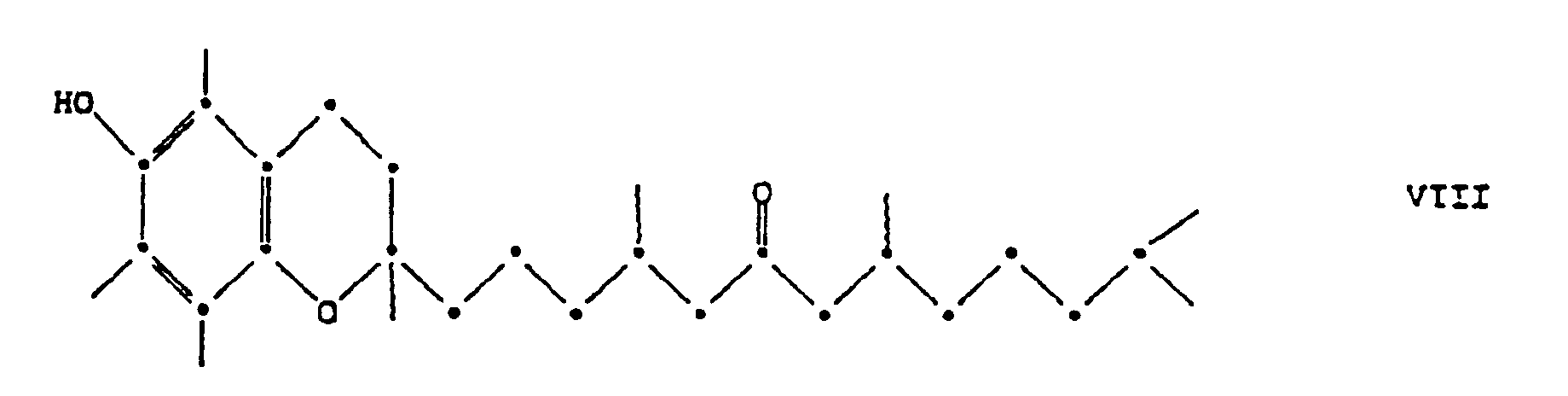
- the compound of formula VII is next converted to a compound of the formula by ester hydrolysis which causes decarboxylation of the compound of formula VII.
- the ester hydrolysis is carried out in the same manner as described in connection with the formation of a compound of formula V from a compound of formula IV.
- the compound of formula VIII can be directly converted to the compound of formula I or any of its desired steroisomeric forms by utilizing a standard Wolff-Kishner reaction such as described in connection with the formation of a compound of formula VI.
- the compound of formula III may be produced from a compound of the formula via the following intermediates
- the compound of formula IX may be converted to the compound of formula X having the same stereoconfiguration as the compound of formula X by halogenation. Any conventional method of converting an organic acid to the corresponding acid halide can be utilized in this conversion.
- the compound of formula X may be converted to the compound of formula XI by reacting the compound of formula X with Meldrum's acid according to conventional procedures such as disclosed by Oikawa, Sugano, et al., J. Org. Chem., 1978, 43 2087; and Davidson, and Bernhardt, J. Am. Chem. Soc., 1948, 70 3426.
- the compound of formula XI can be converted to the compound of formula III, III-A or III-B, depending upon the stereo configuration of the compound of formula XI, by refluxing the compound of formula XI with a lower alkanol.
- the particular lower alkanol that is utilized becomes the lower alkyl substituent R2 in the compound of formula III.
- Vitamin E is obtained according to US-PS 4.029.678 through the steps
- Example 5 The product from Example 5 is hydrogerated in 5ml of ethyl acetate over 25mg of 10 % by weight palladium on carbon until gas uptake ceases. The catalyst is filtered and the filtrate is concentrated in vacuo giving (2R, 4′RS, 8′R)-alpha-tocopherol as an oil.
Landscapes
- Chemical & Material Sciences (AREA)
- Organic Chemistry (AREA)
- Organic Low-Molecular-Weight Compounds And Preparation Thereof (AREA)
- Pharmaceuticals Containing Other Organic And Inorganic Compounds (AREA)
- Pyrane Compounds (AREA)
- Low-Molecular Organic Synthesis Reactions Using Catalysts (AREA)
- Plural Heterocyclic Compounds (AREA)
Claims (22)

dans laquelle R₃ forme un groupe protecteur hydroxy éthérifié et R₂ est un alkyle en C₁ à C₇,
dans lequel on fait réagir un composé de formule

dans laquelle R₃ est tel que défini ci-dessus ; et R₄ forme un groupe ester avec un composé de formule

dans laquelle R₂ est tel que défini ci-dessus, dans un milieu solvant organique renfermant une base et un catalyseur qui est un complexe organique de palladium zéro valent, ladite réaction étant mise en oeuvre à une température de -90°C à 50°C.

dans laquelle R₂ est un alkyle en C₁ à C₇ et R₃ forme un groupe protecteur hydroxy étherifié,
dans lequel on fait réagir un ester de formule


ou la formule

dans lesquelles R₃ est tel que défini ci-dessus ; et R₄ forme un groupe protecteur estérifié ;
ladite réaction étant mise en oeuvre dans un milieu solvant organique inerte renfermant une base et un catalyseur qui est un complexe organique du palladium, ladite réaction étant réalisée à une température de -90°C à 50°C.

dans laquelle R₃ est un groupe protecteur hydroxy éthérifié, ou bien un composé de formule

dans laquelle R₃ forme un groupe protecteur hydroxy éthérifié ; et R₂ est un alkyle en C₁ à C₇.

dans laquelle R₃ forme un groupe protecteur hydroxy éthérifié.


dans laquelle R₂ est un alkyle en C₁ à C₇.
Priority Applications (1)
| Application Number | Priority Date | Filing Date | Title |
|---|---|---|---|
| AT88904964T ATE70835T1 (de) | 1987-06-05 | 1988-05-31 | Verfahren zur herstellung von alpha-tocopherol und zwischenprodukte fuer dieses verfahren. |
Applications Claiming Priority (2)
| Application Number | Priority Date | Filing Date | Title |
|---|---|---|---|
| US58309 | 1987-06-05 | ||
| US07/058,309 US4801724A (en) | 1987-06-05 | 1987-06-05 | Vitamin E intermediate |
Publications (2)
| Publication Number | Publication Date |
|---|---|
| EP0317607A1 EP0317607A1 (fr) | 1989-05-31 |
| EP0317607B1 true EP0317607B1 (fr) | 1991-12-27 |
Family
ID=22016016
Family Applications (1)
| Application Number | Title | Priority Date | Filing Date |
|---|---|---|---|
| EP88904964A Expired EP0317607B1 (fr) | 1987-06-05 | 1988-05-31 | Nouveau procede de production d'alpha-tocopherol et nouveaux intermediaires dans ce procede |
Country Status (7)
| Country | Link |
|---|---|
| US (1) | US4801724A (fr) |
| EP (1) | EP0317607B1 (fr) |
| JP (1) | JPH01503463A (fr) |
| AT (1) | ATE70835T1 (fr) |
| DE (1) | DE3867213D1 (fr) |
| DK (1) | DK42989D0 (fr) |
| WO (1) | WO1988009791A1 (fr) |
Families Citing this family (1)
| Publication number | Priority date | Publication date | Assignee | Title |
|---|---|---|---|---|
| CA2573128A1 (fr) * | 2004-07-09 | 2006-01-26 | Warner-Lambert Company Llc | Preparation de beta-aminoacides ayant une affinite pour la proteine alpha-2-delta |
Family Cites Families (1)
| Publication number | Priority date | Publication date | Assignee | Title |
|---|---|---|---|---|
| US4029678A (en) * | 1975-12-08 | 1977-06-14 | Hoffmann-La Roche Inc. | Asymmetric synthesis |
-
1987
- 1987-06-05 US US07/058,309 patent/US4801724A/en not_active Expired - Fee Related
-
1988
- 1988-05-31 WO PCT/EP1988/000485 patent/WO1988009791A1/fr not_active Ceased
- 1988-05-31 AT AT88904964T patent/ATE70835T1/de not_active IP Right Cessation
- 1988-05-31 JP JP63504618A patent/JPH01503463A/ja active Pending
- 1988-05-31 EP EP88904964A patent/EP0317607B1/fr not_active Expired
- 1988-05-31 DE DE8888904964T patent/DE3867213D1/de not_active Expired - Lifetime
-
1989
- 1989-01-31 DK DK042989A patent/DK42989D0/da not_active Application Discontinuation
Also Published As
| Publication number | Publication date |
|---|---|
| ATE70835T1 (de) | 1992-01-15 |
| WO1988009791A1 (fr) | 1988-12-15 |
| DK42989A (da) | 1989-01-31 |
| US4801724A (en) | 1989-01-31 |
| DE3867213D1 (de) | 1992-02-06 |
| DK42989D0 (da) | 1989-01-31 |
| EP0317607A1 (fr) | 1989-05-31 |
| JPH01503463A (ja) | 1989-11-22 |
Similar Documents
| Publication | Publication Date | Title |
|---|---|---|
| US4789750A (en) | 2-(trimethyl-tridecenyl)-tetramethylchroman intermediates for vitamin E | |
| US4559407A (en) | Intermediate in the production of vitamin E | |
| US5110955A (en) | Tocopherol synthesis: chromane cyclization and catalysis | |
| US4689427A (en) | Hydroquinone derivatives useful in the production of vitamin E | |
| US4801724A (en) | Vitamin E intermediate | |
| US4877890A (en) | Vitamin E intermediate | |
| US4151177A (en) | Synthesis of optically active vitamin E | |
| US4942249A (en) | Process for producing vitamin E | |
| EP0320777B1 (fr) | Approche pour produire la vitamine E naturelle en faisant usage d'une synthèse assymétrique | |
| EP0003221B1 (fr) | Procédé de préparation de dérivés de 3,4-dihydrobenzopyranne et produits de départ pour ce procédé | |
| US4016178A (en) | Synthesis of vitamin E | |
| US4914217A (en) | Asymmetric synthesis of natural vitamin E | |
| US4898962A (en) | Natural vitamin E intermediate | |
| JPH0129792B2 (fr) | ||
| US4806661A (en) | Chromanemelonate esters | |
| US4855085A (en) | Asymmetric synthesis of natural vitamin E | |
| US4900476A (en) | Quinone intermediates for asymmetric synthesis of natural vitamin E | |
| US4879395A (en) | Vitamin E intermediate | |
| US4853472A (en) | Vitamin E intermediates | |
| US4029678A (en) | Asymmetric synthesis | |
| US4898953A (en) | Natural Vitamin E intermediate | |
| US4882441A (en) | Lower-alkyl or aryl-sulfonyl unsaturated tacopherols | |
| US4205001A (en) | Inversion process | |
| US4182719A (en) | Synthesis of optically active vitamin E | |
| US4189612A (en) | S-(+) 2,3,6-trimethyl-5-(2,2,4-trimethyl-1,3-dioxolane-4-ethyl)phenol |
Legal Events
| Date | Code | Title | Description |
|---|---|---|---|
| PUAI | Public reference made under article 153(3) epc to a published international application that has entered the european phase |
Free format text: ORIGINAL CODE: 0009012 |
|
| 17P | Request for examination filed |
Effective date: 19890124 |
|
| AK | Designated contracting states |
Kind code of ref document: A1 Designated state(s): AT BE CH DE FR GB IT LI NL |
|
| RAP1 | Party data changed (applicant data changed or rights of an application transferred) |
Owner name: F. HOFFMANN-LA ROCHE AG |
|
| RAP1 | Party data changed (applicant data changed or rights of an application transferred) |
Owner name: F. HOFFMANN-LA ROCHE AG |
|
| 17Q | First examination report despatched |
Effective date: 19900312 |
|
| GRAA | (expected) grant |
Free format text: ORIGINAL CODE: 0009210 |
|
| AK | Designated contracting states |
Kind code of ref document: B1 Designated state(s): AT BE CH DE FR GB IT LI NL |
|
| PG25 | Lapsed in a contracting state [announced via postgrant information from national office to epo] |
Ref country code: IT Free format text: LAPSE BECAUSE OF FAILURE TO SUBMIT A TRANSLATION OF THE DESCRIPTION OR TO PAY THE FEE WITHIN THE PRESCRIBED TIME-LIMIT;WARNING: LAPSES OF ITALIAN PATENTS WITH EFFECTIVE DATE BEFORE 2007 MAY HAVE OCCURRED AT ANY TIME BEFORE 2007. THE CORRECT EFFECTIVE DATE MAY BE DIFFERENT FROM THE ONE RECORDED. Effective date: 19911227 Ref country code: BE Effective date: 19911227 Ref country code: CH Effective date: 19911227 Ref country code: AT Effective date: 19911227 Ref country code: LI Effective date: 19911227 Ref country code: FR Effective date: 19911227 Ref country code: NL Effective date: 19911227 |
|
| REF | Corresponds to: |
Ref document number: 70835 Country of ref document: AT Date of ref document: 19920115 Kind code of ref document: T |
|
| REF | Corresponds to: |
Ref document number: 3867213 Country of ref document: DE Date of ref document: 19920206 |
|
| REG | Reference to a national code |
Ref country code: CH Ref legal event code: PL |
|
| EN | Fr: translation not filed | ||
| PG25 | Lapsed in a contracting state [announced via postgrant information from national office to epo] |
Ref country code: GB Effective date: 19920531 |
|
| NLV1 | Nl: lapsed or annulled due to failure to fulfill the requirements of art. 29p and 29m of the patents act | ||
| PLBE | No opposition filed within time limit |
Free format text: ORIGINAL CODE: 0009261 |
|
| STAA | Information on the status of an ep patent application or granted ep patent |
Free format text: STATUS: NO OPPOSITION FILED WITHIN TIME LIMIT |
|
| 26N | No opposition filed | ||
| GBPC | Gb: european patent ceased through non-payment of renewal fee |
Effective date: 19920531 |
|
| PG25 | Lapsed in a contracting state [announced via postgrant information from national office to epo] |
Ref country code: DE Effective date: 19930202 |