EP0317675A1 - Dosen für kohlensäurehaltige Getränke - Google Patents
Dosen für kohlensäurehaltige Getränke Download PDFInfo
- Publication number
- EP0317675A1 EP0317675A1 EP87310415A EP87310415A EP0317675A1 EP 0317675 A1 EP0317675 A1 EP 0317675A1 EP 87310415 A EP87310415 A EP 87310415A EP 87310415 A EP87310415 A EP 87310415A EP 0317675 A1 EP0317675 A1 EP 0317675A1
- Authority
- EP
- European Patent Office
- Prior art keywords
- core
- layers
- beverage
- stress
- film
- Prior art date
- Legal status (The legal status is an assumption and is not a legal conclusion. Google has not performed a legal analysis and makes no representation as to the accuracy of the status listed.)
- Granted
Links
- 235000014171 carbonated beverage Nutrition 0.000 title claims abstract description 19
- 239000000463 material Substances 0.000 claims abstract description 125
- 235000013361 beverage Nutrition 0.000 claims abstract description 40
- 229920000098 polyolefin Polymers 0.000 claims abstract description 24
- 230000004888 barrier function Effects 0.000 claims abstract description 17
- 239000012815 thermoplastic material Substances 0.000 claims abstract description 7
- -1 polypropylene Polymers 0.000 claims description 26
- 239000004743 Polypropylene Substances 0.000 claims description 23
- 229920001155 polypropylene Polymers 0.000 claims description 21
- 239000000853 adhesive Substances 0.000 claims description 8
- 230000001070 adhesive effect Effects 0.000 claims description 8
- VXNZUUAINFGPBY-UHFFFAOYSA-N 1-Butene Chemical compound CCC=C VXNZUUAINFGPBY-UHFFFAOYSA-N 0.000 claims description 3
- 229920006379 extruded polypropylene Polymers 0.000 claims description 3
- 229920001577 copolymer Polymers 0.000 claims description 2
- 229920001519 homopolymer Polymers 0.000 claims 1
- 239000013598 vector Substances 0.000 abstract description 22
- 239000010410 layer Substances 0.000 description 79
- 239000011162 core material Substances 0.000 description 42
- 238000010276 construction Methods 0.000 description 14
- 238000012360 testing method Methods 0.000 description 14
- 239000005026 oriented polypropylene Substances 0.000 description 13
- 229920006378 biaxially oriented polypropylene Polymers 0.000 description 12
- 239000011127 biaxially oriented polypropylene Substances 0.000 description 12
- 238000000034 method Methods 0.000 description 11
- 229920003023 plastic Polymers 0.000 description 11
- 239000004033 plastic Substances 0.000 description 11
- 229910052751 metal Inorganic materials 0.000 description 10
- 239000002184 metal Substances 0.000 description 10
- 229910052782 aluminium Inorganic materials 0.000 description 9
- XAGFODPZIPBFFR-UHFFFAOYSA-N aluminium Chemical compound [Al] XAGFODPZIPBFFR-UHFFFAOYSA-N 0.000 description 9
- 238000004519 manufacturing process Methods 0.000 description 9
- 229920000728 polyester Polymers 0.000 description 7
- CURLTUGMZLYLDI-UHFFFAOYSA-N Carbon dioxide Chemical compound O=C=O CURLTUGMZLYLDI-UHFFFAOYSA-N 0.000 description 6
- 238000013461 design Methods 0.000 description 6
- 229920000139 polyethylene terephthalate Polymers 0.000 description 6
- 239000005020 polyethylene terephthalate Substances 0.000 description 6
- 238000004826 seaming Methods 0.000 description 6
- 239000004820 Pressure-sensitive adhesive Substances 0.000 description 5
- 239000002131 composite material Substances 0.000 description 5
- 235000014214 soft drink Nutrition 0.000 description 5
- 229910000831 Steel Inorganic materials 0.000 description 4
- 239000012790 adhesive layer Substances 0.000 description 4
- 229920001748 polybutylene Polymers 0.000 description 4
- 230000008569 process Effects 0.000 description 4
- 239000002356 single layer Substances 0.000 description 4
- 239000010959 steel Substances 0.000 description 4
- 229920002799 BoPET Polymers 0.000 description 3
- 229920003354 Modic® Polymers 0.000 description 3
- 229920003300 Plexar® Polymers 0.000 description 3
- 229910002092 carbon dioxide Inorganic materials 0.000 description 3
- 230000007812 deficiency Effects 0.000 description 3
- 239000012530 fluid Substances 0.000 description 3
- XLYOFNOQVPJJNP-UHFFFAOYSA-N water Substances O XLYOFNOQVPJJNP-UHFFFAOYSA-N 0.000 description 3
- 238000003466 welding Methods 0.000 description 3
- 238000004804 winding Methods 0.000 description 3
- 229920000219 Ethylene vinyl alcohol Polymers 0.000 description 2
- 239000004698 Polyethylene Substances 0.000 description 2
- 230000009172 bursting Effects 0.000 description 2
- 239000011248 coating agent Substances 0.000 description 2
- 238000000576 coating method Methods 0.000 description 2
- 238000001816 cooling Methods 0.000 description 2
- 238000011161 development Methods 0.000 description 2
- 230000018109 developmental process Effects 0.000 description 2
- 238000010586 diagram Methods 0.000 description 2
- 230000007774 longterm Effects 0.000 description 2
- 239000003921 oil Substances 0.000 description 2
- 238000004806 packaging method and process Methods 0.000 description 2
- 229920006267 polyester film Polymers 0.000 description 2
- 229920000573 polyethylene Polymers 0.000 description 2
- 229920000642 polymer Polymers 0.000 description 2
- 238000007789 sealing Methods 0.000 description 2
- 230000003068 static effect Effects 0.000 description 2
- 239000000126 substance Substances 0.000 description 2
- BQCIDUSAKPWEOX-UHFFFAOYSA-N 1,1-Difluoroethene Chemical compound FC(F)=C BQCIDUSAKPWEOX-UHFFFAOYSA-N 0.000 description 1
- VEXZGXHMUGYJMC-UHFFFAOYSA-M Chloride anion Chemical compound [Cl-] VEXZGXHMUGYJMC-UHFFFAOYSA-M 0.000 description 1
- 229920002633 Kraton (polymer) Polymers 0.000 description 1
- 230000004913 activation Effects 0.000 description 1
- 238000013459 approach Methods 0.000 description 1
- 230000008901 benefit Effects 0.000 description 1
- 230000002457 bidirectional effect Effects 0.000 description 1
- 239000001569 carbon dioxide Substances 0.000 description 1
- 239000000919 ceramic Substances 0.000 description 1
- 230000008859 change Effects 0.000 description 1
- 239000011247 coating layer Substances 0.000 description 1
- 238000005520 cutting process Methods 0.000 description 1
- 238000005034 decoration Methods 0.000 description 1
- 230000003247 decreasing effect Effects 0.000 description 1
- 238000007323 disproportionation reaction Methods 0.000 description 1
- 230000005489 elastic deformation Effects 0.000 description 1
- 229920001971 elastomer Polymers 0.000 description 1
- 239000000806 elastomer Substances 0.000 description 1
- 238000004049 embossing Methods 0.000 description 1
- 238000005516 engineering process Methods 0.000 description 1
- UFRKOOWSQGXVKV-UHFFFAOYSA-N ethene;ethenol Chemical compound C=C.OC=C UFRKOOWSQGXVKV-UHFFFAOYSA-N 0.000 description 1
- 239000004715 ethylene vinyl alcohol Substances 0.000 description 1
- 238000002474 experimental method Methods 0.000 description 1
- 238000001125 extrusion Methods 0.000 description 1
- 235000013305 food Nutrition 0.000 description 1
- 238000010438 heat treatment Methods 0.000 description 1
- 230000006872 improvement Effects 0.000 description 1
- 230000006698 induction Effects 0.000 description 1
- 238000002347 injection Methods 0.000 description 1
- 239000007924 injection Substances 0.000 description 1
- 238000001746 injection moulding Methods 0.000 description 1
- 238000002372 labelling Methods 0.000 description 1
- 238000003475 lamination Methods 0.000 description 1
- 238000005259 measurement Methods 0.000 description 1
- 150000002739 metals Chemical class 0.000 description 1
- 239000000203 mixture Substances 0.000 description 1
- 238000012544 monitoring process Methods 0.000 description 1
- 239000010705 motor oil Substances 0.000 description 1
- 229920005644 polyethylene terephthalate glycol copolymer Polymers 0.000 description 1
- 238000007639 printing Methods 0.000 description 1
- 230000009467 reduction Effects 0.000 description 1
- 239000012925 reference material Substances 0.000 description 1
- 238000005057 refrigeration Methods 0.000 description 1
- 230000004044 response Effects 0.000 description 1
- 230000000630 rising effect Effects 0.000 description 1
- 239000000565 sealant Substances 0.000 description 1
- 238000004088 simulation Methods 0.000 description 1
- 239000002904 solvent Substances 0.000 description 1
- 238000003860 storage Methods 0.000 description 1
- 238000003856 thermoforming Methods 0.000 description 1
- 229920001187 thermosetting polymer Polymers 0.000 description 1
Images




Classifications
-
- B—PERFORMING OPERATIONS; TRANSPORTING
- B65—CONVEYING; PACKING; STORING; HANDLING THIN OR FILAMENTARY MATERIAL
- B65D—CONTAINERS FOR STORAGE OR TRANSPORT OF ARTICLES OR MATERIALS, e.g. BAGS, BARRELS, BOTTLES, BOXES, CANS, CARTONS, CRATES, DRUMS, JARS, TANKS, HOPPERS, FORWARDING CONTAINERS; ACCESSORIES, CLOSURES, OR FITTINGS THEREFOR; PACKAGING ELEMENTS; PACKAGES
- B65D3/00—Rigid or semi-rigid containers having bodies or peripheral walls of curved or partially-curved cross-section made by winding or bending paper without folding along defined lines
- B65D3/22—Rigid or semi-rigid containers having bodies or peripheral walls of curved or partially-curved cross-section made by winding or bending paper without folding along defined lines with double walls; with walls incorporating air-chambers; with walls made of laminated material
-
- B—PERFORMING OPERATIONS; TRANSPORTING
- B29—WORKING OF PLASTICS; WORKING OF SUBSTANCES IN A PLASTIC STATE IN GENERAL
- B29D—PRODUCING PARTICULAR ARTICLES FROM PLASTICS OR FROM SUBSTANCES IN A PLASTIC STATE
- B29D22/00—Producing hollow articles
- B29D22/003—Containers for packaging, storing or transporting, e.g. bottles, jars, cans, barrels, tanks
-
- B—PERFORMING OPERATIONS; TRANSPORTING
- B31—MAKING ARTICLES OF PAPER, CARDBOARD OR MATERIAL WORKED IN A MANNER ANALOGOUS TO PAPER; WORKING PAPER, CARDBOARD OR MATERIAL WORKED IN A MANNER ANALOGOUS TO PAPER
- B31C—MAKING WOUND ARTICLES, e.g. WOUND TUBES, OF PAPER, CARDBOARD OR MATERIAL WORKED IN A MANNER ANALOGOUS TO PAPER
- B31C3/00—Making tubes or pipes by feeding obliquely to the winding mandrel centre line
-
- B—PERFORMING OPERATIONS; TRANSPORTING
- B29—WORKING OF PLASTICS; WORKING OF SUBSTANCES IN A PLASTIC STATE IN GENERAL
- B29C—SHAPING OR JOINING OF PLASTICS; SHAPING OF MATERIAL IN A PLASTIC STATE, NOT OTHERWISE PROVIDED FOR; AFTER-TREATMENT OF THE SHAPED PRODUCTS, e.g. REPAIRING
- B29C48/00—Extrusion moulding, i.e. expressing the moulding material through a die or nozzle which imparts the desired form; Apparatus therefor
- B29C48/001—Combinations of extrusion moulding with other shaping operations
- B29C48/0017—Combinations of extrusion moulding with other shaping operations combined with blow-moulding or thermoforming
-
- B—PERFORMING OPERATIONS; TRANSPORTING
- B29—WORKING OF PLASTICS; WORKING OF SUBSTANCES IN A PLASTIC STATE IN GENERAL
- B29C—SHAPING OR JOINING OF PLASTICS; SHAPING OF MATERIAL IN A PLASTIC STATE, NOT OTHERWISE PROVIDED FOR; AFTER-TREATMENT OF THE SHAPED PRODUCTS, e.g. REPAIRING
- B29C48/00—Extrusion moulding, i.e. expressing the moulding material through a die or nozzle which imparts the desired form; Apparatus therefor
- B29C48/001—Combinations of extrusion moulding with other shaping operations
- B29C48/0018—Combinations of extrusion moulding with other shaping operations combined with shaping by orienting, stretching or shrinking, e.g. film blowing
-
- B—PERFORMING OPERATIONS; TRANSPORTING
- B29—WORKING OF PLASTICS; WORKING OF SUBSTANCES IN A PLASTIC STATE IN GENERAL
- B29C—SHAPING OR JOINING OF PLASTICS; SHAPING OF MATERIAL IN A PLASTIC STATE, NOT OTHERWISE PROVIDED FOR; AFTER-TREATMENT OF THE SHAPED PRODUCTS, e.g. REPAIRING
- B29C48/00—Extrusion moulding, i.e. expressing the moulding material through a die or nozzle which imparts the desired form; Apparatus therefor
- B29C48/001—Combinations of extrusion moulding with other shaping operations
- B29C48/0021—Combinations of extrusion moulding with other shaping operations combined with joining, lining or laminating
-
- B—PERFORMING OPERATIONS; TRANSPORTING
- B29—WORKING OF PLASTICS; WORKING OF SUBSTANCES IN A PLASTIC STATE IN GENERAL
- B29C—SHAPING OR JOINING OF PLASTICS; SHAPING OF MATERIAL IN A PLASTIC STATE, NOT OTHERWISE PROVIDED FOR; AFTER-TREATMENT OF THE SHAPED PRODUCTS, e.g. REPAIRING
- B29C48/00—Extrusion moulding, i.e. expressing the moulding material through a die or nozzle which imparts the desired form; Apparatus therefor
- B29C48/001—Combinations of extrusion moulding with other shaping operations
- B29C48/0022—Combinations of extrusion moulding with other shaping operations combined with cutting
-
- B—PERFORMING OPERATIONS; TRANSPORTING
- B29—WORKING OF PLASTICS; WORKING OF SUBSTANCES IN A PLASTIC STATE IN GENERAL
- B29C—SHAPING OR JOINING OF PLASTICS; SHAPING OF MATERIAL IN A PLASTIC STATE, NOT OTHERWISE PROVIDED FOR; AFTER-TREATMENT OF THE SHAPED PRODUCTS, e.g. REPAIRING
- B29C48/00—Extrusion moulding, i.e. expressing the moulding material through a die or nozzle which imparts the desired form; Apparatus therefor
- B29C48/03—Extrusion moulding, i.e. expressing the moulding material through a die or nozzle which imparts the desired form; Apparatus therefor characterised by the shape of the extruded material at extrusion
- B29C48/09—Articles with cross-sections having partially or fully enclosed cavities, e.g. pipes or channels
-
- B—PERFORMING OPERATIONS; TRANSPORTING
- B29—WORKING OF PLASTICS; WORKING OF SUBSTANCES IN A PLASTIC STATE IN GENERAL
- B29C—SHAPING OR JOINING OF PLASTICS; SHAPING OF MATERIAL IN A PLASTIC STATE, NOT OTHERWISE PROVIDED FOR; AFTER-TREATMENT OF THE SHAPED PRODUCTS, e.g. REPAIRING
- B29C48/00—Extrusion moulding, i.e. expressing the moulding material through a die or nozzle which imparts the desired form; Apparatus therefor
- B29C48/15—Extrusion moulding, i.e. expressing the moulding material through a die or nozzle which imparts the desired form; Apparatus therefor incorporating preformed parts or layers, e.g. extrusion moulding around inserts
- B29C48/151—Coating hollow articles
Definitions
- This invention relates to thin wall beverage cans based on a polyolefin which have acceptable yield strength, modulus and creep resistance values and which are suitable for use with carbonated beverages.
- US-A-4,379,014 discloses a method for the manufacture of containers.
- a container body is manufactured by spiral winding of a monoaxially molecular-oriented polyester film.
- a polyester strip which is monoaxially molecular oriented in the strip direction is coated with a layer of non-molecular oriented amorphous polyester material.
- the coating layers may be polyethylene but it is stated that sometimes the polyethylene materials do not give good sealant strength or the overlapped joint that the material requires is too wide. This results in a lack of good adhesion and, as a result, the coating material may need to be a modified polyester (PETG).
- PETG modified polyester
- the polyester strip is wrapped around the container body in only one direction.
- US-A-4,181,239 discloses a cylindrical container body for packaging pressurized carbonated beverages requiring at least two layers of a polyester film.
- US-A-4,451,524 discloses a polypropylene strap for use in packaging articles.
- the polypropylene strap does not require subjection to a surface embossing process to prevent it from being longitudinally split and in addition has a tensile strength higher than that of conventional polypropylene strap and good elongation resistance, high rigidity and is flexible.
- This patent does not address the problems inherent in a pressurized container, such as a carbonated beverage container, such as the necessity for sufficient volume swell resistance in both hoop and axial directions.
- a standard can (0.36 litre or 12 U.S. fluid ounces) must fit into and dispense from the many existing vending machines.
- the overall outside dimensions of any standard can are constrained, limited and fixed to those ordinarily found for the aluminum and steel cans for which the vending machines have been designed to accept and to vend.
- the beverage capacity in the can is fixed. Therefore, the can diameter, can height and can wall thickness must be designed in concert to satisfy standard can vendability requirements.
- a carbonated beverage can is a pressure vessel.
- Typical soft drink beverages will have an internal pressure of about 0.38 MPa gauge (55 psig) once the beverage is filled with four volumes of CO2 gas, sealed with an end or lid and then brought to room temperature. With temperatures rising much above 40°C (105°F), internal pressures of about 0.6 MPa gauge (87 psig) are achieved as the CO2 gas expands and exerts a higher internal pressure as it warms. This is the pressure at which a conventional easy-open metal end on a metal can will buckle.
- the can sidewall material must not appreciably creep, deform or grow in size to an unacceptable level.
- the can body must not split, twist, torque or otherwise fail up to this lid buckling pressure. It is known that for a cylindrical shell or a cylindrical can body, hoop direction pressure-induced stress in the can body sidewall is twice as large as the axial direction pressure-induced stress in the can body sidewall.
- the can body material is necessarily homogeneous and monolayer, i.e. it consists of a uniform gauge and thickness material of singular components, e.g. thin aluminum or thin steel sidewall material.
- monolayer, homogeneous material containers including homogeneous, monolayer plastic containers
- the can sidewall must necessarily be engineered so that the more severe design criterion -- the hoop stress -- is satisfied. Therefore, monolayer, homogeneous can bodies have been limited to always satisfying the more severe hoop stress requirement while being over engineered (by default) in satisfying the less demanding criterion, the axial stress requirement.
- a container for which the can body sidewall materials and method of layered construction provide a disproportionation of stress resisting properties such that the 2:1 hoop stress to axial stress forces in a cylindrical can body geometry are better satisfied, has been long needed in the industry.
- Can performance that is, satisfactory sidewall resistance to the stresses created by the internal pressure of the carbonation, is largely governed by key can wall material properties; namely (1) elastic modulus, (2) initial tensile yield strength; and (3) creep resistance. Ultimate breaking strength or ultimate breaking elongation are of little consequence.
- the elastic modulus of the sidewall material must be high so that deformation, i.e. volume swell of the container, is minimized.
- the initial tensile yield strength must be high so that the sidewall stresses (these stresses are a function of sidewall thickness, pressurization level and can diameter (for hoop stress)) are resisted and little strain (deformation) occurs.
- the properties of high modulus and high yield strength in combination are the key to providing the thinnest wall possible.
- a beverage can for carbonated beverages which comprises a can body no more than 2 mm (80 mils) thick comprising a core of a thermoplastic material and bonded thereto at least two layers of a film or sheet of a polyolefin material which has been monoaxially or biaxially stretched to a tensile yield strength of at least 55 MPa (8000 psi) in a given direction and an elastic modulus of at least 27.6 MPa (400,000 psi) in a given direction, one of such layers being wrapped around said core at a positive angle relative to the longitudinal axis of said core and the other of such layers being wrapped round said core at a substantially corresponding negative angle, the can body comprising at least one layer of barrier material, and can ends attached to said can body.
- a polyolefin and most particularly polypropylene, can be used to manufacture a thin wall beverage can, and that the use of a polyolefin when oriented to a degree which assures high modulus and high initial tensile yield strength (for example, when compared to the modulus and initial tensile yield strength values for polyester such as polyethylene terephthalate (PET) or oriented PET), allows for thin-walled beverage containers.
- PET polyethylene terephthalate
- PET polyethylene terephthalate
- oriented PET polyester
- thermoplastic materials in making the can and thus greater efficiency in its manufacture.
- thin-wall we mean a wall thickness of no more than 2 mm (80 mils), preferably less than 1.3 mm (50 mils), and most preferably less than 0.8 mm (30 mils).
- unoriented polypropylene films and sheet have been used for various other applications but have low modulus, low initial tensile yield strength and poor creep. As such, these films and sheet are unacceptable to make thin-walled carbonated beverage cans as modulus values of the unoriented films are from 2.5 to 5 times too low, and initial tensile yield values are 3 to 4 times too low.
- high quality biaxially oriented polypropylene film for example Hercules T-503 film, while having a high modulus, shows unacceptable initial tensile yield values, about 2 times too low.
- Monoaxially oriented polypropylene manufactured for strapping tape shows good modulus and initial tensile yield strength, but is much too thick to achieve a thin wall beverage can construction. Further, strapping tape is only available in relatively narrow widths.
- the can of the invention has good strength and volume swell resistance in both the hoop and axial directions.
- the use of the polyolefin results in acceptable modulus, creep and yield strength values and better modulus and yield strength values than commercially available PET or other polyester containers. The higher the modulus, the thinner the can wall can be made for end seaming. This results in less use of thermoplastic materials in making the can and thus greater efficiency in the manufacture of the can.
- a standard aluminum end or top may be attached to can walls having a thickness of as little as 0.8 mm (30 mils).
- Figure 1 displays the combinations of pressures and temperatures typically found in a standard (0.36 litre or 12 U.S. fluid ounce) soft drink beverage can.
- the plotted line represents the pressure in a standard can that contains a sugar product soft drink having a carbonation level of four volumes of carbon dioxide.
- the shaded area at 610 to 620 kPa (87 to 90 psig) is the pressure at which a typical easy-open aluminum pull tab lid will buckle from internal pressure.
- This critical pressure, and the temperature at which the internal pressure in a standard can containing the soft drink reaches the critical pressure determine the upper boundary conditions that must be satisfied in designing the can body to resist pressure (586 KPa gauge and 41°C or 85 psig, 105°F).
- Figure 2 shows how these internal pressures in the can cause a corresponding stress in the can sidewall.
- This stress in this case the hoop stress, is calculated on the basis of the geometry of the cylindrical shell can body with the radius of the can (r) and can body wall thickness of the can (t) in combination with the internal pressure (pa) governing the circumferential (hoop) stress.
- This hoop stress pa x r ) is found on the vertical axis.
- the radius is approximately 3.3 cm (1.3 inch).
- Various can body wall thicknesses are shown on the horizontal axis. Thus, for any given pressure and can body wall thickness a corresponding hoop stress can be calculated once the can radius is fixed.
- the important can body wall material property that governs resistance to hoop stress forces is the tensile yield strength.
- the tensile yield strength of a material is the break point on the tensile stress/strain curve. Below the tensile yield point, little stretch deformation of the material is shown as stress is applied. Above the tensile yield point, considerable stretch deformation of the material is shown as the material easily yields, and permanently deforms without much resistance to stress.
- it is crucial that tensile yield properties of the can body wall material are such that the hoop stress in the can body sidewall is resisted, precluding appreciable stretch deformation of the can wall material.
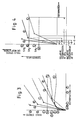
- Figure 3 is a representation of these principles for various representative materials.
- the tensile yield stress for various materials is shown on the vertical axis; corresponding deformation (stretch, strain) is shown on the horizontal axis.
- a reference hoop stress (SH) as a function of a given can body wall thickness, radius and pressure, is chosen as a point at which these examples may be compared.
- Curves A, B and C have tensile srength values (indicated by the circled point) above the dotted line indicating the reference hoop stress (SH). These materials show little deformation at the reference hoop stress level. Curves D and E show tensile yield strength values below the reference hoop stress and correspondingly show significant deformation at the reference hoop stress. Curves F1 and F2 show tensile yield strength values below the reference hoop stress with tensile break strength values below the hoop stress as well. These materials will continue to deform until they fail by splitting or bursting when the reference hoop stress is found inside the container.
- Figure 5 presents treatment of a second major criterion for achievement of a thin wall can body beverage can.
- ⁇ V/V volume swell percent
- ⁇ V/V volume swell percent
- the elastic modulus of a material is the measure of its ability to resist deformation under load up to a strain point at which permanent deformation (non-elastic, non-recoverable deformation) occurs.
- the magnitude of the elastic modulus is the slope of the initial elastic deformation portion of the stress/strain curve.
- high modulus causes very little strain (deformation).
- Low modulus materials such as rubbery materials, show very low modulus, i.e. deform significantly under low stress.
- the deforming stresses are a constant load. Materials having very high modulus will deform less significantly under this constant load. Therefore, volume swell of the can body will be minimized. However, this high elastic modulus is insufficient in itself to provide a thin-walled beverage container. The tensile yield strength must also be sufficiently high in combination with high modulus in order to achieve a thin-walled vessel.
- Figure 6 is a summary of the stress/strain properties of representative materials in terms of a minimum modulus (M) at a given thickness (X) and tensile yield strength (circled point).
- M minimum modulus
- X thickness
- tensile yield strength circled point
- the acceptability of the various materials with respect to satisfying both the minimum elastic modulus criterion and the tensile yield strength criterion simultaneously can be summarised as follows:-
- the hatched areas of Fig 6 shows the region of properties necessary in order to achieve thin wall can bodies.
- One object of the present invention is in meeting both criteria to achieve a thin wall can body with polyolefin polymers, polypropylene in particular.
- such a necessary combination of high modulus and high tensile yield strength precluded the use of unoriented polyolefins to make thin wall can bodies.
- Figure 7 and Table 1 below summarises measured stress/strain properties for highly oriented polypropylene film and sheet that can be used to provide beverge cans in accordance with the invention versus other polypropylenes and polyesters in thin gauge sheet or film suitable for wrapping.
- the numbers of the curves in Fig 7 are keyed to the entries in Table 1.
- Table 1 also summarises the elastic modulus and yield strength for different materials.
- Figure 8 is a graph of room temperature creep at 70 MPa (10,000 psi) stress over a period of time of up to 300 hours, for unoriented polypropylene (curve A), oriented polypropylene (curve B), creep resistant biaxially oriented polypropylene (curve c), monoaxially oriented polypropylene with a cap adhesive layer (curve D) and oriented PET (curve E) film.
- a monoaxial oriented polypropylene with a cap adhesive layer ranges from 3 ⁇ to 6 percent at 0 hours and 300 hours respectively.
- Figure 9 shows stress resistance vectors for various constructions of a beverage can body.
- Case 9A shows stress resistance vectors which are equal to each other as is the case for homogeneous materials.
- Example materials are steel, aluminum, injection molded or wrapped film beverage cans.
- Homogeneous property materials provide no opportunity to balance the stress resistance vectors to optimize the hoop performance versus the axial performance. Thus, a larger than necessary stress resistance vector in the axial direction results. This results in the requirement of thicker walls of homogeneous materials.
- Case 9B shows the stress resistance vectors for an unbalanced axial resistant can.
- Examples are thermoformed plastic or D&I (drawn and ironed) plastic cans.
- the primary stress resistant vector is in the axial direction due to thermoforming and orientation of plastic in the axial direction.
- a thicker wall must be used to overcome the hoop stress resistance deficiency.
- Axial and hoop properties are as shown in Table 1, item 7, types A, B, C for case 9B cans.
- Case 9C shows unbalanced radial and axial stress resistance vectors for a can wall material with anisotropic properties made by convolute wrapping.
- the magnitude of these stress resistance vectors depends upon the exact can wall material properties in either direction, and continuous manufacture of endless can body lengths is not possible.
- Case 9D shows balanced stress resistant vectors for a can constructed in accordance with the present invention.
- the film or sheet is wrapped at plus and minus angles. This satisfies the bidirectional and unbalanced hoop and axial stress resistance with a stress resistance ratio in the hoop to axial direction of 2:1. This is optimum for this particular application. This results in a optimized use of materials to meet stresses while having a reduced wall thickness.
- Figure 10 shows resultant hoop and axial stress vectors for wrapped constructions where a highly monoaxially oriented layer or layer is/are applied at various unidirectional angles (i.e. not the invention).
- Case 10A shows one film layer being used to wrap the core at a film wrap angle of plus 90 degrees from a center perpendicular axis through the can. This type of wrap angle does not allow one to continuously manufacture a can and results in unsatisfactory axial stress resistance. Thus, a thicker container wall must be used.
- Case 10B shows wrapping of one film layer at a plus 55 degrees film wrap angle to the axis of the core.
- the hoop stress resistance vector shortens as the wrap angle changes and the axial stress resistance vector increases.
- the hoop stress resistance vector must be satisfied by use of thicker wall material.
- Case 10C shows one film layer wrapped to a 0 degree angle on the core.
- the axial stress resistance vector as may be expected, is at its maximum but the hoop stress resistance vector has been lost. Thus, the hoop stress resistance vector must be satisfied in much thicker wall material.
- Figure 11 compares resultant stress resistance vectors for layered constructions where highly monoaxially oriented layers are applied unidirectionally or in crossplied directions.
- Cases 11A shows one film layer wrapped at a plus 55 degree angle to the axis of the core.
- the hoop and axial stress resistant factors are unbalanced and insufficient to meet the hoop and axial design stress at a thickness of T/2.
- torquing, twisting and splitting results when the can is pressurized. Thus, such a can would fail when used with carbonated beverages.
- Case 11B shows two film layers, both of which are wrapped at plus 55 degree angles to the axis of the core.
- the axial stress resistant factors here are improved, but are still insufficient to meet the hoop and axial design stress at wall thickness equals T. Torquing, twisting and splitting result when the can is pressurized. As a result, the can fails when used with pressurized carbonated beverages. If T, thickness, is equal to the maximum thickness constraint of the can, then a unidirectional wrap design will not satisfy the beverage can needs.
- Case 11C shows two film layers which are wrapped at plus/minus degree angles to each other (our invention).
- the hoop and axial stress resistance factors are balanced and are sufficient to meet the hoop and axial design stress at wall thickness equal T. No torquing, twisting or splitting takes place when the can is pressurized.
- the can meets thickness constraints as well as performance constraints.
- Case 11D shows two film layers which are wrapped at 0 degrees and 90 degree angles to the axis of the core. This results in inefficient hoop and axial stress vectors at ratios of 1:1 (as in Case 9A). it is also not possible for this can to be continuously manufactured due to the wrapping constraints at a 90 degree angle.
- Case 11C illustrates the hoop and axial stress resistant factors which work for a beverage can which will withstand pressurization conditions of use, as with carbonated beverages, with a minimum wall thickness.
- the two film layers are wrapped at plus/minus angles to each other although they need not be 55 degree angles.
- a monoaxially stretched film is preferably wrapped at an angle between 50 and 60 degrees to the core axis and most preferably at about 55 degrees.
- Biaxially stretched film layers are preferably wrapped at an angle between 60 and 80 degrees to the core axis and most preferably at about 70 degrees.
- the three materials asterisked (*) represent the materials which are suitable for use in constructing beverage cans in accordance with the present invention.
- material No. 4 has an elastic modulus greater than the required 2760 MPa (400,000 psi) but does not have the 55 MPa (8,000 psi) yield strength required.
- Material No. 5 does not meet either requirement.
- Material No 6 barely meets the yield strength requirement but does not have a great enough elastic modulus.
- Material No 7 does not meet the modulus requirements in both the hoop and axial directions, as is required.
- Material No 8 meets the yield strength requirements and the elastic modulus requirements but is a PET film.
- polyolefin film or sheet materials said film or sheet oriented either monoaxially or biaxially to achieve a combination of high modulus, high tensile yield strength and improved creep resistance, preferably oriented monoaxially, can be used to provide thin wall can bodies that resist hoop stresses and minimize volume swell, such thin wall structure having been previously unattainable with polyolefin materials.
- a core is produced by first making a core of any thermoplastic material such as a polyolefin.
- a polyolefin Preferably polypropylene or more preferably, extruded polypropylene or co-extruded polypropylene layer, tie layer, and barrier layer are used to make the core.
- the core would be made by extruding polypropylene or perhaps a polypropylene/tie layer/barrier layer/tie layer/polypropylene layer into a tubular core which then may be used to produce the can body by methods such as winding film around the core supported on a mandrel and subjecting it to heat to hold the film together.
- pressure sensitive film can be wound and will adhere without heat activation or heat bonding.
- a tie layer such as "Admer”, available from Mitsui of Japan, "Modic”, available from Mitsubishi of Japan, or “Plexar”, available from Norchem, or “CXA”, available from Dupont, may be used, although a tie layer is certainly not limited to these materials.
- Admer "Modic”, “Plexar” and “CXA” are Registered Trade Marks.)
- the tie layer merely needs to be type of adhesive which will bond layered structures such as polypropylene/tie layer/barrier layer/tie layer/polypropylene together.
- the barrier layer may be an ethylene vinyl alcohol copolymer (such as "EVAL” (RTM) available from Evalca) or a vinylidene fluoride polymer (such as “SORAN” (RTM) available from Dow Chemical), although the barrier layer is not necessarily limited to these two materials.
- EVAL ethylene vinyl alcohol copolymer
- SORAN vinylidene fluoride polymer
- Film layers of polyolefin are produced and are stretched (oriented) in one or two directions. If the film is stretched in only one direction, it is referred to as monoaxially oriented film. If the film is stretched in two directions, then the film is referred to as biaxially oriented film.
- the film is slit into appropriate widths and then at lest two film layers of the polyolefin are wrapped around the core at an angle (plus and minus) to the core axis to yield sufficient strength and volume swell resistance in both hoop and axial directions.
- said layers have been biaxially stretched and are wrapped around the core at positive and negative angles between 60 degrees and 80 degrees to the core axis, or said layers have been monoaxially stretched and are wrapped around the core at positive and negative angles between 50 degrees and 60 degrees to the core axis.
- An adhesive may be used between the core and the film layers in order to bond the film layers to the core and between the film layers themselves so as to bond the film layers together.
- the adhesive may be, for example, a "Kraton" (RTM) elastomer available from Shell Oil Company, PVDC (polyvinylidine chloride, available from Dow Chemical Company), a polybutene-1, a butene-1 copolymer, or a polybutene-1/polypropylene blend, available from Shell Oil Company.
- RTM Rohmethylene chloride
- PVDC polyvinylidine chloride
- the adhesive is in the form of a polybutene-1 "cap” layer which is bonded to at least one side of a film layer by some method such as coextrusion or hot lamination.
- the polybutene-1 acts as a "cap” layer and will soften when activated with heat or friction, and thereby provides an adhesive for bonding the polyolefin film or films with themselves as well as with the core.
- the adhesive may be heat activated or may be pressure sensitive.
- At least one layer of barrier material is contained within the can body. It can be present in the core, between the core and the film layers of polyolefin or within the film layers.
- the barrier material may, for example, be EVOH or Saran,.
- the barrier layer is preferably coextruded as part of the core when the core is made up of, preferably, a polyolefin, and most preferably, a coextruded polypropylene layer, with a tie layer (Admer, Modic, Plexar or CXA as previously discussed) and a barrier layer.
- the barrier layer may be coextruded or may be applied as a coating or a film, or may be included in the can by some other means.
- the core wrapped with the polyolefin films is referred to as the "can body".
- Ends are attached to the can body by any suitable method.
- Aluminum ends can be double-seamed or barrier sheet formed ends (PP/tie layer/barrier/tie layer/PP) can be spin welded.
- a tape-type easy open feature can be used as can any other suitable ends for attachment.
- a bottle neck can be spin welded or attached by some other suitable means to the can body.
- the film can be metallized to give additional barrier properties and good graphics.
- the ends may be either metal or plastics or some other suitable material.
- the ends could be made of composites which are made of both metal and plastics.
- the composite can be in the form of a plastic/metal/plastic laminated composite or a metal sealing ring round a plastic disk.
- the latter type of end can be made by insert injection molding.
- the sealing of the ends to the can body can be done by mechanical means, for example by single seaming, double seaming or a welding process, such as spin welding or induction heating. Or, both a mechanical and a welding process can be used together.
- layers of non-plastics such as aluminum, steel or paper may be added when making the can.
- Test specimens were fabricated by first extruding a polypropylene core about 6.6 cm (2.6 inches) in diameter having a cylinder wall thickness of about 0.33 mm (13 mils). Pressure sensitive adhesive was used to bond the wrapped film or sheet layers to this core surface and to one another. Specimens 20 to 25 cm (8 to 10 inches) in length were cut from the wrapped corestock, then clamped and sealed onto metal end plugs. One end plug is suitable for connection to a pressure source. Specimens and end plugs were then immersed in a water bath at test temperature (usually 43°C or 110°F) and the inner specimen cylinder volume allowed to fill with the warm bath water. Specimens were then connected to the pressure sources by means of a fitting at one end plug.
- volume swell was then measured as a function of time under these conditions of temperature and pressure.
- the method used to determine volume swell used photography, and measurements made from photographs which recorded dimensional change in the diameter and length of the specimen as compared to its initial dimensions at various times. This proved to be a simple technique: A camera was mounted above the immersed specimens and at various times a photograph was taken. Prints were developed, specimen dimensions were measured, volume swell was calculated and finally volume swell was plotted as a function of time. Specimens were generally held at this pressure and temperature for a four hour period.
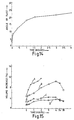
- Figure 12 shows the volume precent growth for high modulus, low yield strength biaxially oriented polypropylene material wrapped convolutely onto the 0.33 mm (13 mil) polypropylene core.
- Curves A and B respectively of Fig 12, of this pressure sensitive adhesive coated strength wrap material and pressurization to 0.7 MPa gauge (100 psig) at 38°C (100°F)
- these examples show a volume swell of over 100% in less than 10 seconds, followed by bursting. This is clearly unacceptable performance for a carbonated beverage container and shows that biaxially oriented film as employed previously is unsatisfactory.
- a 0.33 mm (13 mil) thick polypropylene bladder which as been wrapped with ten layers of Hercules T-503 film after eight (8) seconds pressurization at 0.7 MPa gauge, 38°C (100 psig, 110°F) has a volume swell, calculated from photographic dimensions, of 112 percent.
- Figure 13 shows the volume percent growth for improved creep resistant, high yield strength biaxially oriented polypropylene (material 3 in Table 1 above) as a function of wrapping angle (50 degrees versus 70 degrees) and as a function of plus/minus ply layer wrapping (balanced) versus unidirectional wrapping. Twelve layers of 25 ⁇ m (one-mil) thickness pressure sensitive adhesive coated film were used for all of three examples wrapped onto a 0.33 mm (13 mil) wall thickness polypropylene core. The can body wall thickness is about 0.84 mm (33 mils) for these examples.
- Curve A of Fig 13 illustrates 50° balanced wrapping
- Curve B illustrates 70° unidirectional wrapping
- Curve C illustrates 70° balanced wrapping.
- the two "balanced" examples have two-3 ply layers at the plus angle specified (either plus 50 or plus 70 degrees) and two-3 ply layers at the minus angle specified (either minus 50 or minus 70 degrees).
- this improved creep resistant biaxially oriented polypropylene has a combination of high modulus (about 3400 MPa or 500,000 psi) and high yield strength (greater than 55 MPa 8,000 psi) in at least one orientation direction, in this case the machine direction (M.D.).
- M.D. machine direction
- the results in this figure are shown as percent volume growth versus time in hours at 0.7 MPa gauge and 43°C (100 psig and 110°F).
- plus/minus wrapping is essential to minimizing volume swell.
- four-hour results comparing the 70 degree wrapped structures, balanced (C) and one direction (B) wrapping, wherein the one direction wrapped construction (B) exhibits about twice the volume swell shown for the balanced (plus/minus) wrapped construction (C).
- Figure 15 shows volume swell test results for monoaxially oriented polypropylene strength wrap materials as disclosed in Table 1 (and see Figure 4) for materials 1 and 2. Testing conditions were altered slightly to better reflect a maximum temperature and pressure likely to be found when a metal end seamed beverage can top will buckle (namely 0.59 MPa gauge and 41°C or 85 psig and 105°F as shown in Figure 1) and to allow time to simulate cooling of the can to room temperature/corresponding pressure, followed by a simulation of refrigeration/corresponding pressure in monitoring volume swell and recoverable volume swell.
- These monoaxially oriented polypropylene strength wrap materials were 90 or 100 ⁇ m (3.5 or 4.0 mils) in thickness. As disclosed, either material has very high modulus and very high yield strength (Table 1 and Figure 4). Only two layers of these materials were used, thus the total strength wrap material thickness for these test specimens was 180 or 200 ⁇ m (7 or 8 mils) respectively. Layers were applied at plus/minus wrap angles of about ⁇ 55 degrees to form the cross-plied configuration. Layers were bonded to the 0.33 mm (13 mil) core and to each other with about a 25 ⁇ m (one-mil) (dry) pressure sensitive adhesive painted on from solvent.
- the total can body wall is 0.56 to 0.58 mm (22 to 23 mils), including a 0.33 mm (13 mil) thickness core, 0.18 or 0.2 mm (7 or 8 mils) of strength wrapped sheet material and 50 ⁇ m (2 mils) of pressure sensitive adhesive.
- Both materials 1 and 2 showed excellent resistance to volume swell in the room temperature test, with material 2 (Curve D) showing less than about 4% volume swell and somewhat better performance than material 1 (Curve C).
- material 2 (Curve B) showed a significant advantage in volume swell resistance as compared to material 1 (Curve A).
- Material 2 is integrally cap coated as disclosed in Table 1 and a significant contribution to reduced volume swell may be attributed to transverse direction (T.D.) sheet properties not found in material 1.
- T.D. transverse direction
- Figure 16 summarises results for Figures 12, 13 and 15 wherein curve A represents the results obtained with 0.25 mm (10 mils) of convolute wrapped low yield strength biaxially oriented polypropylene film (material 4 of Table 1), curve B represent the results obtained with 0.3 mm (12 mils) of cross-lied (at 70 degree plus/minus angles) improved creep resistance, high yield strength biaxially oriented polypropylene film (material 3 of Table 1) and curve C represents the results obtained with 0.2 mm (8 mils) of cross-plied (at 55 degree plus/minus angles) very high yield strength, very high modulus monoaxially oriented polypropylene sheet (material 2 of Table 1).
- the samples are compared for volume swell at conditions where pressure is greater than 0.6 MPa gauge (85 psig) and temperature is greater than 41°C (105°F).
- Figure 17 shows a simple and illustrative can body with core material 1 and two layers 2 and 3 of strength wrap material.
- the core axis is shown by line X and the winding angles of layers 2 and 3 with respect to the core axis are shown by ⁇ + and ⁇ .
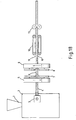
- Figure 18 is a schematic diagram, in partial cross-section, of apparatus that can be employed in the continuous manufacture of beverage can bodies in accordance with the invention.
- Thermoplastic material is supplied to hopper 1 of an extruded 2 and is extruded through die 3 in the form of a cylindrical extrudate 4, which provides the core of the can bodies.
- Oppositely rotating heads 5 and 6, and associated supply reels 7 and 8, apply cross-plies in a plus/minus configuration of layers of high strength polyolefin wrap material to the extrudate 4.
- the wrapped core 11 is drawn through the apparatus by puller 12 and cut into lengths appropriate for the desired can bodies by cutting device 13.
Landscapes
- Engineering & Computer Science (AREA)
- Mechanical Engineering (AREA)
- Laminated Bodies (AREA)
- Food Preservation Except Freezing, Refrigeration, And Drying (AREA)
Priority Applications (5)
| Application Number | Priority Date | Filing Date | Title |
|---|---|---|---|
| US06/885,507 US4766019A (en) | 1986-07-14 | 1986-07-14 | Carbonated beverage can and method for producing a carbonated beverage can |
| EP87310415A EP0317675B1 (de) | 1987-11-25 | 1987-11-25 | Dosen für kohlensäurehaltige Getränke |
| AT87310415T ATE77323T1 (de) | 1987-11-25 | 1987-11-25 | Dosen fuer kohlensaeurehaltige getraenke. |
| DE8787310415T DE3779922T2 (de) | 1987-11-25 | 1987-11-25 | Dosen fuer kohlensaeurehaltige getraenke. |
| ES198787310415T ES2032836T3 (es) | 1987-11-25 | 1987-11-25 | Bote para bebidas carbonicas. |
Applications Claiming Priority (1)
| Application Number | Priority Date | Filing Date | Title |
|---|---|---|---|
| EP87310415A EP0317675B1 (de) | 1987-11-25 | 1987-11-25 | Dosen für kohlensäurehaltige Getränke |
Publications (2)
| Publication Number | Publication Date |
|---|---|
| EP0317675A1 true EP0317675A1 (de) | 1989-05-31 |
| EP0317675B1 EP0317675B1 (de) | 1992-06-17 |
Family
ID=8198117
Family Applications (1)
| Application Number | Title | Priority Date | Filing Date |
|---|---|---|---|
| EP87310415A Expired - Lifetime EP0317675B1 (de) | 1986-07-14 | 1987-11-25 | Dosen für kohlensäurehaltige Getränke |
Country Status (4)
| Country | Link |
|---|---|
| EP (1) | EP0317675B1 (de) |
| AT (1) | ATE77323T1 (de) |
| DE (1) | DE3779922T2 (de) |
| ES (1) | ES2032836T3 (de) |
Cited By (3)
| Publication number | Priority date | Publication date | Assignee | Title |
|---|---|---|---|---|
| US4921240A (en) * | 1988-01-13 | 1990-05-01 | Xerox Corporation | Plural belt document feeder |
| EP1145971A3 (de) * | 2000-04-12 | 2004-01-02 | Sonoco Development, Inc. | Abziehbares Filmetikett für einen Behälter aus Verbundwerkstoff |
| EP1459876A3 (de) * | 2003-03-20 | 2008-06-11 | Sonoco Development, Inc. | Aus vorgeleimten Schichten hergestelltes Rohr |
Citations (2)
| Publication number | Priority date | Publication date | Assignee | Title |
|---|---|---|---|---|
| DE2518341A1 (de) * | 1974-06-21 | 1976-01-08 | Dynamit Nobel Ag | Folien oder platten aus molekularorientierten thermoplastischen kunststoffen |
| EP0163492A2 (de) * | 1984-05-29 | 1985-12-04 | Ajinomoto Co., Inc. | Körper für einen druckbeständigen Behälter |
-
1987
- 1987-11-25 ES ES198787310415T patent/ES2032836T3/es not_active Expired - Lifetime
- 1987-11-25 AT AT87310415T patent/ATE77323T1/de not_active IP Right Cessation
- 1987-11-25 DE DE8787310415T patent/DE3779922T2/de not_active Expired - Lifetime
- 1987-11-25 EP EP87310415A patent/EP0317675B1/de not_active Expired - Lifetime
Patent Citations (2)
| Publication number | Priority date | Publication date | Assignee | Title |
|---|---|---|---|---|
| DE2518341A1 (de) * | 1974-06-21 | 1976-01-08 | Dynamit Nobel Ag | Folien oder platten aus molekularorientierten thermoplastischen kunststoffen |
| EP0163492A2 (de) * | 1984-05-29 | 1985-12-04 | Ajinomoto Co., Inc. | Körper für einen druckbeständigen Behälter |
Cited By (3)
| Publication number | Priority date | Publication date | Assignee | Title |
|---|---|---|---|---|
| US4921240A (en) * | 1988-01-13 | 1990-05-01 | Xerox Corporation | Plural belt document feeder |
| EP1145971A3 (de) * | 2000-04-12 | 2004-01-02 | Sonoco Development, Inc. | Abziehbares Filmetikett für einen Behälter aus Verbundwerkstoff |
| EP1459876A3 (de) * | 2003-03-20 | 2008-06-11 | Sonoco Development, Inc. | Aus vorgeleimten Schichten hergestelltes Rohr |
Also Published As
| Publication number | Publication date |
|---|---|
| ATE77323T1 (de) | 1992-07-15 |
| DE3779922T2 (de) | 1992-12-24 |
| DE3779922D1 (de) | 1992-07-23 |
| EP0317675B1 (de) | 1992-06-17 |
| ES2032836T3 (es) | 1993-03-01 |
Similar Documents
| Publication | Publication Date | Title |
|---|---|---|
| CA1270214A (en) | Fiber wound plastic beverage can | |
| US4559257A (en) | Laminate together with a method for its manufacture | |
| US4085244A (en) | Balanced orientated flexible packaging composite | |
| US3940001A (en) | Recyclable plastic containers | |
| US4652490A (en) | Heat shrinkable laminated packaging material | |
| US4405400A (en) | Laminated material | |
| US6312772B1 (en) | Multilayer laminate formed from a substantially stretched non-molten wholly aromatic liquid crystalline polymer and non-polyester thermoplastic polymer | |
| US4216268A (en) | Balanced oriented flexible packaging composite | |
| US4766019A (en) | Carbonated beverage can and method for producing a carbonated beverage can | |
| US5782375A (en) | Drawn and ironed cans of a metal-plastic construction and their fabrication process | |
| CA2040364A1 (en) | Method of producing a cup-shaped, sterilisable container, as well as container | |
| US6098829A (en) | Can components having a metal-plastic-metal structure | |
| EP0126575A2 (de) | Durch Reibung geschweisste beschichtete Behälter | |
| US4675219A (en) | Process for drawing plastic laminates | |
| EP0317675B1 (de) | Dosen für kohlensäurehaltige Getränke | |
| JPH08142283A (ja) | バッグインボックス用包装材料 | |
| EP0731752B1 (de) | Dosenteil mit metall/kunststoff/metallstruktur | |
| JP2548587B2 (ja) | 炭酸飲料用飲料缶 | |
| EP0731738B1 (de) | Tiefgezogener und abgestreckter behälter von metallkunstoff und ihren herstellungsverfahren | |
| JPS6045154A (ja) | ポリエステル樹脂複合容器およびその製造方法 | |
| MXPA04012620A (es) | Revestimiento de lata de material mixto de pelicula de bajo costo. | |
| JPS59134144A (ja) | 熱可塑性プラスチツク食品容器及びその製造法 | |
| CA1292433C (en) | Carbonated beverage can and method for producing a carbonated beveragecan | |
| JPS60251030A (ja) | 耐内圧性容器用胴部材 | |
| GB2132935A (en) | Method for manufacturing containers |
Legal Events
| Date | Code | Title | Description |
|---|---|---|---|
| PUAI | Public reference made under article 153(3) epc to a published international application that has entered the european phase |
Free format text: ORIGINAL CODE: 0009012 |
|
| AK | Designated contracting states |
Kind code of ref document: A1 Designated state(s): AT BE CH DE ES FR GB GR IT LI LU NL SE |
|
| 17P | Request for examination filed |
Effective date: 19890925 |
|
| RAP1 | Party data changed (applicant data changed or rights of an application transferred) |
Owner name: SHELL INTERNATIONALE RESEARCH MAATSCHAPPIJ B.V. |
|
| 17Q | First examination report despatched |
Effective date: 19910430 |
|
| GRAA | (expected) grant |
Free format text: ORIGINAL CODE: 0009210 |
|
| AK | Designated contracting states |
Kind code of ref document: B1 Designated state(s): AT BE CH DE ES FR GB GR IT LI LU NL SE |
|
| PG25 | Lapsed in a contracting state [announced via postgrant information from national office to epo] |
Ref country code: SE Effective date: 19920617 Ref country code: GR Free format text: LAPSE BECAUSE OF FAILURE TO SUBMIT A TRANSLATION OF THE DESCRIPTION OR TO PAY THE FEE WITHIN THE PRESCRIBED TIME-LIMIT Effective date: 19920617 |
|
| REF | Corresponds to: |
Ref document number: 77323 Country of ref document: AT Date of ref document: 19920715 Kind code of ref document: T |
|
| REF | Corresponds to: |
Ref document number: 3779922 Country of ref document: DE Date of ref document: 19920723 |
|
| ITF | It: translation for a ep patent filed | ||
| ET | Fr: translation filed | ||
| REG | Reference to a national code |
Ref country code: ES Ref legal event code: FG2A Ref document number: 2032836 Country of ref document: ES Kind code of ref document: T3 |
|
| PLBE | No opposition filed within time limit |
Free format text: ORIGINAL CODE: 0009261 |
|
| STAA | Information on the status of an ep patent application or granted ep patent |
Free format text: STATUS: NO OPPOSITION FILED WITHIN TIME LIMIT |
|
| 26N | No opposition filed | ||
| EPTA | Lu: last paid annual fee | ||
| PGFP | Annual fee paid to national office [announced via postgrant information from national office to epo] |
Ref country code: FR Payment date: 20011001 Year of fee payment: 15 |
|
| PGFP | Annual fee paid to national office [announced via postgrant information from national office to epo] |
Ref country code: AT Payment date: 20011026 Year of fee payment: 15 |
|
| PGFP | Annual fee paid to national office [announced via postgrant information from national office to epo] |
Ref country code: LU Payment date: 20011030 Year of fee payment: 15 Ref country code: GB Payment date: 20011030 Year of fee payment: 15 |
|
| PGFP | Annual fee paid to national office [announced via postgrant information from national office to epo] |
Ref country code: BE Payment date: 20011102 Year of fee payment: 15 |
|
| PGFP | Annual fee paid to national office [announced via postgrant information from national office to epo] |
Ref country code: ES Payment date: 20011119 Year of fee payment: 15 |
|
| PGFP | Annual fee paid to national office [announced via postgrant information from national office to epo] |
Ref country code: NL Payment date: 20011121 Year of fee payment: 15 |
|
| PGFP | Annual fee paid to national office [announced via postgrant information from national office to epo] |
Ref country code: DE Payment date: 20011205 Year of fee payment: 15 |
|
| REG | Reference to a national code |
Ref country code: GB Ref legal event code: IF02 |
|
| PGFP | Annual fee paid to national office [announced via postgrant information from national office to epo] |
Ref country code: CH Payment date: 20020129 Year of fee payment: 15 |
|
| PG25 | Lapsed in a contracting state [announced via postgrant information from national office to epo] |
Ref country code: LU Free format text: LAPSE BECAUSE OF NON-PAYMENT OF DUE FEES Effective date: 20021125 Ref country code: GB Free format text: LAPSE BECAUSE OF NON-PAYMENT OF DUE FEES Effective date: 20021125 Ref country code: AT Free format text: LAPSE BECAUSE OF NON-PAYMENT OF DUE FEES Effective date: 20021125 |
|
| PG25 | Lapsed in a contracting state [announced via postgrant information from national office to epo] |
Ref country code: ES Free format text: LAPSE BECAUSE OF NON-PAYMENT OF DUE FEES Effective date: 20021126 |
|
| PG25 | Lapsed in a contracting state [announced via postgrant information from national office to epo] |
Ref country code: LI Free format text: LAPSE BECAUSE OF NON-PAYMENT OF DUE FEES Effective date: 20021130 Ref country code: CH Free format text: LAPSE BECAUSE OF NON-PAYMENT OF DUE FEES Effective date: 20021130 Ref country code: BE Free format text: LAPSE BECAUSE OF NON-PAYMENT OF DUE FEES Effective date: 20021130 |
|
| BERE | Be: lapsed |
Owner name: *SHELL INTERNATIONALE RESEARCH MAATSCHAPPIJ B.V. Effective date: 20021130 |
|
| PG25 | Lapsed in a contracting state [announced via postgrant information from national office to epo] |
Ref country code: NL Free format text: LAPSE BECAUSE OF NON-PAYMENT OF DUE FEES Effective date: 20030601 |
|
| PG25 | Lapsed in a contracting state [announced via postgrant information from national office to epo] |
Ref country code: DE Free format text: LAPSE BECAUSE OF NON-PAYMENT OF DUE FEES Effective date: 20030603 |
|
| REG | Reference to a national code |
Ref country code: CH Ref legal event code: PL |
|
| GBPC | Gb: european patent ceased through non-payment of renewal fee | ||
| PG25 | Lapsed in a contracting state [announced via postgrant information from national office to epo] |
Ref country code: FR Free format text: LAPSE BECAUSE OF NON-PAYMENT OF DUE FEES Effective date: 20030731 |
|
| NLV4 | Nl: lapsed or anulled due to non-payment of the annual fee |
Effective date: 20030601 |
|
| REG | Reference to a national code |
Ref country code: FR Ref legal event code: ST |
|
| REG | Reference to a national code |
Ref country code: ES Ref legal event code: FD2A Effective date: 20031213 |
|
| PG25 | Lapsed in a contracting state [announced via postgrant information from national office to epo] |
Ref country code: IT Free format text: LAPSE BECAUSE OF NON-PAYMENT OF DUE FEES Effective date: 20051125 |