EP0317883B1 - Teilfluorierte Diphenylether, Verfahren zu ihrer Herstellung und ihre Verwendung - Google Patents
Teilfluorierte Diphenylether, Verfahren zu ihrer Herstellung und ihre Verwendung Download PDFInfo
- Publication number
- EP0317883B1 EP0317883B1 EP88119070A EP88119070A EP0317883B1 EP 0317883 B1 EP0317883 B1 EP 0317883B1 EP 88119070 A EP88119070 A EP 88119070A EP 88119070 A EP88119070 A EP 88119070A EP 0317883 B1 EP0317883 B1 EP 0317883B1
- Authority
- EP
- European Patent Office
- Prior art keywords
- formula
- diphenyl ether
- compound
- carbon atoms
- hydrogen fluoride
- Prior art date
- Legal status (The legal status is an assumption and is not a legal conclusion. Google has not performed a legal analysis and makes no representation as to the accuracy of the status listed.)
- Expired - Lifetime
Links
- USIUVYZYUHIAEV-UHFFFAOYSA-N diphenyl ether Chemical class C=1C=CC=CC=1OC1=CC=CC=C1 USIUVYZYUHIAEV-UHFFFAOYSA-N 0.000 title claims description 43
- 238000000034 method Methods 0.000 title claims description 22
- 238000002360 preparation method Methods 0.000 title claims description 9
- KRHYYFGTRYWZRS-UHFFFAOYSA-N Fluorane Chemical compound F KRHYYFGTRYWZRS-UHFFFAOYSA-N 0.000 claims description 23
- 229910000040 hydrogen fluoride Inorganic materials 0.000 claims description 22
- 150000001875 compounds Chemical class 0.000 claims description 20
- OKKJLVBELUTLKV-UHFFFAOYSA-N Methanol Chemical compound OC OKKJLVBELUTLKV-UHFFFAOYSA-N 0.000 claims description 15
- LFQSCWFLJHTTHZ-UHFFFAOYSA-N Ethanol Chemical compound CCO LFQSCWFLJHTTHZ-UHFFFAOYSA-N 0.000 claims description 14
- VLKZOEOYAKHREP-UHFFFAOYSA-N n-Hexane Chemical compound CCCCCC VLKZOEOYAKHREP-UHFFFAOYSA-N 0.000 claims description 14
- YMWUJEATGCHHMB-UHFFFAOYSA-N Dichloromethane Chemical compound ClCCl YMWUJEATGCHHMB-UHFFFAOYSA-N 0.000 claims description 11
- 125000004432 carbon atom Chemical group C* 0.000 claims description 11
- 238000006243 chemical reaction Methods 0.000 claims description 8
- 229910052739 hydrogen Inorganic materials 0.000 claims description 8
- XLYOFNOQVPJJNP-UHFFFAOYSA-N water Substances O XLYOFNOQVPJJNP-UHFFFAOYSA-N 0.000 claims description 8
- 125000000217 alkyl group Chemical group 0.000 claims description 7
- IMNFDUFMRHMDMM-UHFFFAOYSA-N N-Heptane Chemical compound CCCCCCC IMNFDUFMRHMDMM-UHFFFAOYSA-N 0.000 claims description 6
- -1 fluoro compound Chemical class 0.000 claims description 6
- 239000003960 organic solvent Substances 0.000 claims description 5
- HEDRZPFGACZZDS-UHFFFAOYSA-N Chloroform Chemical compound ClC(Cl)Cl HEDRZPFGACZZDS-UHFFFAOYSA-N 0.000 claims description 4
- 150000001338 aliphatic hydrocarbons Chemical class 0.000 claims description 4
- SNMVRZFUUCLYTO-UHFFFAOYSA-N n-propyl chloride Chemical compound CCCCl SNMVRZFUUCLYTO-UHFFFAOYSA-N 0.000 claims description 4
- 239000002904 solvent Substances 0.000 claims description 4
- 229960001701 chloroform Drugs 0.000 claims description 3
- UFHFLCQGNIYNRP-UHFFFAOYSA-N Hydrogen Chemical compound [H][H] UFHFLCQGNIYNRP-UHFFFAOYSA-N 0.000 claims description 2
- LRHPLDYGYMQRHN-UHFFFAOYSA-N N-Butanol Chemical class CCCCO LRHPLDYGYMQRHN-UHFFFAOYSA-N 0.000 claims description 2
- 239000004952 Polyamide Substances 0.000 claims description 2
- 125000001931 aliphatic group Chemical group 0.000 claims description 2
- 238000010790 dilution Methods 0.000 claims description 2
- 239000012895 dilution Substances 0.000 claims description 2
- 239000001257 hydrogen Substances 0.000 claims description 2
- 229920002647 polyamide Polymers 0.000 claims description 2
- 229920000728 polyester Polymers 0.000 claims description 2
- BDERNNFJNOPAEC-UHFFFAOYSA-N propan-1-ol Chemical class CCCO BDERNNFJNOPAEC-UHFFFAOYSA-N 0.000 claims description 2
- 239000000376 reactant Substances 0.000 claims description 2
- 239000007795 chemical reaction product Substances 0.000 claims 2
- 239000004642 Polyimide Substances 0.000 claims 1
- 150000004945 aromatic hydrocarbons Chemical class 0.000 claims 1
- 229920001721 polyimide Polymers 0.000 claims 1
- 239000000047 product Substances 0.000 description 9
- OKTJSMMVPCPJKN-UHFFFAOYSA-N Carbon Chemical compound [C] OKTJSMMVPCPJKN-UHFFFAOYSA-N 0.000 description 8
- 229910000831 Steel Inorganic materials 0.000 description 7
- 229910052731 fluorine Inorganic materials 0.000 description 7
- 238000002844 melting Methods 0.000 description 7
- 230000008018 melting Effects 0.000 description 7
- 239000010959 steel Substances 0.000 description 7
- 125000001449 isopropyl group Chemical group [H]C([H])([H])C([H])(*)C([H])([H])[H] 0.000 description 6
- 125000004203 4-hydroxyphenyl group Chemical group [H]OC1=C([H])C([H])=C(*)C([H])=C1[H] 0.000 description 5
- 238000003756 stirring Methods 0.000 description 5
- CTQNGGLPUBDAKN-UHFFFAOYSA-N O-Xylene Chemical group CC1=CC=CC=C1C CTQNGGLPUBDAKN-UHFFFAOYSA-N 0.000 description 4
- 125000001037 p-tolyl group Chemical group [H]C1=C([H])C(=C([H])C([H])=C1*)C([H])([H])[H] 0.000 description 4
- 239000000243 solution Substances 0.000 description 4
- UXVMQQNJUSDDNG-UHFFFAOYSA-L Calcium chloride Chemical compound [Cl-].[Cl-].[Ca+2] UXVMQQNJUSDDNG-UHFFFAOYSA-L 0.000 description 3
- ISWSIDIOOBJBQZ-UHFFFAOYSA-N Phenol Chemical compound OC1=CC=CC=C1 ISWSIDIOOBJBQZ-UHFFFAOYSA-N 0.000 description 3
- YXFVVABEGXRONW-UHFFFAOYSA-N Toluene Chemical compound CC1=CC=CC=C1 YXFVVABEGXRONW-UHFFFAOYSA-N 0.000 description 3
- 239000001110 calcium chloride Substances 0.000 description 3
- 229910001628 calcium chloride Inorganic materials 0.000 description 3
- 235000011148 calcium chloride Nutrition 0.000 description 3
- 239000011541 reaction mixture Substances 0.000 description 3
- 239000012265 solid product Substances 0.000 description 3
- 0 CCCC(C)CC(*)CCC(CC*)C(C(F)(F)F)(C(F)(F)F)c(cc1)ccc1OC(CC1)CCC1C(*(CC*)CC**C1CCCCC1)(C(F)(F)F)C(F)(F)F Chemical compound CCCC(C)CC(*)CCC(CC*)C(C(F)(F)F)(C(F)(F)F)c(cc1)ccc1OC(CC1)CCC1C(*(CC*)CC**C1CCCCC1)(C(F)(F)F)C(F)(F)F 0.000 description 2
- 125000003118 aryl group Chemical group 0.000 description 2
- 238000009833 condensation Methods 0.000 description 2
- 230000005494 condensation Effects 0.000 description 2
- 238000001816 cooling Methods 0.000 description 2
- 238000004821 distillation Methods 0.000 description 2
- 238000001035 drying Methods 0.000 description 2
- 229930195733 hydrocarbon Natural products 0.000 description 2
- 150000002430 hydrocarbons Chemical class 0.000 description 2
- 239000000203 mixture Substances 0.000 description 2
- 229940078552 o-xylene Drugs 0.000 description 2
- 239000012074 organic phase Substances 0.000 description 2
- 125000000843 phenylene group Chemical group C1(=C(C=CC=C1)*)* 0.000 description 2
- 238000001953 recrystallisation Methods 0.000 description 2
- 238000005406 washing Methods 0.000 description 2
- 238000010626 work up procedure Methods 0.000 description 2
- 239000004215 Carbon black (E152) Substances 0.000 description 1
- PXGOKWXKJXAPGV-UHFFFAOYSA-N Fluorine Chemical compound FF PXGOKWXKJXAPGV-UHFFFAOYSA-N 0.000 description 1
- 150000001735 carboxylic acids Chemical class 0.000 description 1
- 238000004140 cleaning Methods 0.000 description 1
- 238000006482 condensation reaction Methods 0.000 description 1
- 150000001896 cresols Chemical class 0.000 description 1
- 239000012043 crude product Substances 0.000 description 1
- 239000013078 crystal Substances 0.000 description 1
- 238000001704 evaporation Methods 0.000 description 1
- 230000008020 evaporation Effects 0.000 description 1
- 239000011737 fluorine Substances 0.000 description 1
- 239000007789 gas Substances 0.000 description 1
- 238000010438 heat treatment Methods 0.000 description 1
- 239000005457 ice water Substances 0.000 description 1
- 150000003949 imides Chemical class 0.000 description 1
- 239000000543 intermediate Substances 0.000 description 1
- 239000000463 material Substances 0.000 description 1
- 229910052759 nickel Inorganic materials 0.000 description 1
- PXHVJJICTQNCMI-UHFFFAOYSA-N nickel Substances [Ni] PXHVJJICTQNCMI-UHFFFAOYSA-N 0.000 description 1
- 238000000746 purification Methods 0.000 description 1
- 239000012264 purified product Substances 0.000 description 1
- 230000035484 reaction time Effects 0.000 description 1
- 238000010992 reflux Methods 0.000 description 1
- 238000000926 separation method Methods 0.000 description 1
- 239000007787 solid Substances 0.000 description 1
- 238000013022 venting Methods 0.000 description 1
- 239000008096 xylene Substances 0.000 description 1
- 150000003738 xylenes Chemical class 0.000 description 1
Classifications
-
- C—CHEMISTRY; METALLURGY
- C07—ORGANIC CHEMISTRY
- C07C—ACYCLIC OR CARBOCYCLIC COMPOUNDS
- C07C43/00—Ethers; Compounds having groups, groups or groups
- C07C43/02—Ethers
- C07C43/257—Ethers having an ether-oxygen atom bound to carbon atoms both belonging to six-membered aromatic rings
- C07C43/29—Ethers having an ether-oxygen atom bound to carbon atoms both belonging to six-membered aromatic rings containing halogen
-
- C—CHEMISTRY; METALLURGY
- C07—ORGANIC CHEMISTRY
- C07C—ACYCLIC OR CARBOCYCLIC COMPOUNDS
- C07C43/00—Ethers; Compounds having groups, groups or groups
- C07C43/02—Ethers
- C07C43/257—Ethers having an ether-oxygen atom bound to carbon atoms both belonging to six-membered aromatic rings
- C07C43/295—Ethers having an ether-oxygen atom bound to carbon atoms both belonging to six-membered aromatic rings containing hydroxy or O-metal groups
-
- C—CHEMISTRY; METALLURGY
- C08—ORGANIC MACROMOLECULAR COMPOUNDS; THEIR PREPARATION OR CHEMICAL WORKING-UP; COMPOSITIONS BASED THEREON
- C08G—MACROMOLECULAR COMPOUNDS OBTAINED OTHERWISE THAN BY REACTIONS ONLY INVOLVING UNSATURATED CARBON-TO-CARBON BONDS
- C08G63/00—Macromolecular compounds obtained by reactions forming a carboxylic ester link in the main chain of the macromolecule
- C08G63/68—Polyesters containing atoms other than carbon, hydrogen and oxygen
- C08G63/682—Polyesters containing atoms other than carbon, hydrogen and oxygen containing halogens
- C08G63/6824—Polyesters containing atoms other than carbon, hydrogen and oxygen containing halogens derived from polycarboxylic acids and polyhydroxy compounds
-
- C—CHEMISTRY; METALLURGY
- C08—ORGANIC MACROMOLECULAR COMPOUNDS; THEIR PREPARATION OR CHEMICAL WORKING-UP; COMPOSITIONS BASED THEREON
- C08G—MACROMOLECULAR COMPOUNDS OBTAINED OTHERWISE THAN BY REACTIONS ONLY INVOLVING UNSATURATED CARBON-TO-CARBON BONDS
- C08G69/00—Macromolecular compounds obtained by reactions forming a carboxylic amide link in the main chain of the macromolecule
- C08G69/02—Polyamides derived from amino-carboxylic acids or from polyamines and polycarboxylic acids
- C08G69/26—Polyamides derived from amino-carboxylic acids or from polyamines and polycarboxylic acids derived from polyamines and polycarboxylic acids
-
- C—CHEMISTRY; METALLURGY
- C08—ORGANIC MACROMOLECULAR COMPOUNDS; THEIR PREPARATION OR CHEMICAL WORKING-UP; COMPOSITIONS BASED THEREON
- C08G—MACROMOLECULAR COMPOUNDS OBTAINED OTHERWISE THAN BY REACTIONS ONLY INVOLVING UNSATURATED CARBON-TO-CARBON BONDS
- C08G73/00—Macromolecular compounds obtained by reactions forming a linkage containing nitrogen with or without oxygen or carbon in the main chain of the macromolecule, not provided for in groups C08G12/00 - C08G71/00
- C08G73/06—Polycondensates having nitrogen-containing heterocyclic rings in the main chain of the macromolecule
- C08G73/10—Polyimides; Polyester-imides; Polyamide-imides; Polyamide acids or similar polyimide precursors
- C08G73/1046—Polyimides containing oxygen in the form of ether bonds in the main chain
- C08G73/105—Polyimides containing oxygen in the form of ether bonds in the main chain with oxygen only in the diamino moiety
Definitions
- the invention relates to new, partially fluorinated diphenyl ethers, processes for their preparation in the presence of hydrogen fluoride and their use as intermediates for building blocks of partially fluorinated polycondensates.
- Partially fluorinated diphenyl ethers are known.
- US Pat. No. 3,355,500 describes the preparation of 4,4'-bis (hexafluoro-2-hydroxy-2-propyl) diphenyl ether.
- Diarylfluoro compounds in which two substituted phenylene cores are connected via a hexafluoroisopropylidene bridge are known from US Pat. No. 3,310,573 and from IL Knunyants et al., Izv. Akad. Nauk. SSSR, Otdel. Khim. Nauk. 4 , 668-692 (1960); English edition pp. 647-653 (1960) known.
- the implementation of the known dihydroxy compounds in the presence of hydrogen fluoride to give higher molecular weight products which are connected via two hexafluoroisopropylidene bridges cannot be found in the prior art.
- the invention relates to compounds of the formula in which independently of one another R is OH or lower alkyl having 1 to 4 C atoms and R 'is hydrogen or lower alkyl having 1 to 4 C atoms, the alkyl preferably being CH3, a process for their preparation and their use.
- R is OH or lower alkyl having 1 to 4 C atoms and R 'is hydrogen or lower alkyl having 1 to 4 C atoms, the alkyl preferably being CH3, a process for their preparation and their use.
- the radical R ' is preferably in the o-position to the radical R.
- the compounds according to the invention can generally be prepared by two processes, namely a) by condensation of one mole of a dicarbinol a1) of the formula with at least 2 moles of an aromatic substituted hydrocarbon a2) of the formula or b) by condensation of at least 2 moles of a compound b1) of the formula with one mole of diphenyl ether (V) b2) in the presence of hydrogen fluoride.
- aromatic substituted hydrocarbons III are phenylene compounds which are substituted by OH and / or alkyl radicals having 1 to 4 carbon atoms, such as phenol, toluene, the various xylenes and cresols.
- Compounds of the formula (II) which can be used in process a) are described in US Pat. No. 3,355,500.
- reaction temperatures in processes a) and b) are between 80 and 180 ° C., preferably between 100 and 170 ° C.
- the reaction times are generally 24 to 90, preferably 65 to 90 hours.
- the molar ratio of the reactants used is determined in process a) by the ratio of the compounds (II): compounds (III) and in process b) by the ratio of the diphenyl ether: compounds (IV), in both cases it is generally at least 1 : 2, preferably 1: (2.2 to 4).
- the proportion of hydrogen fluoride (HF) which is necessary in the reaction for the preparation of the invention is based on compound (II) in process a) and is generally in a molar ratio of 1: (7 to 25), preferably 1: (10 In process b), the molar ratio of the compounds (IV): (HF) is generally 1: (6 to 15), preferably 1: (8 to 13).
- the hydrogen fluoride is generally vented from the reactor at about 80 ° C. after the reaction has ended and the remaining residue, if appropriate after dilution with an organic solvent, for example at room temperature, is removed from the reactor.
- the crude mixture obtained is mixed with water, washed and separated.
- the reaction material can be recrystallized from an organic solvent with or without pretreatment with activated carbon be subjected to stirring or stirring in organic solvents, preferably in chloropropane or methanol.
- Suitable solvents that can be used in the workup are aliphatic hydrocarbons with 5 to 10 carbon atoms, aliphatic monoalcohols with 1 to 4 carbon atoms in the alkyl radical and mono- or polychlorinated aliphatic hydrocarbons with 1 to 4 carbon atoms Alkyl group.
- Examples include n-hexane, n-heptane, methanol, ethanol, the various propanols and butanols, as well as chloropropane and di- and trichloromethane.
- the purified products are obtained as colorless crystals.
- Special new partially fluorinated diphenyl ethers which are within the scope of the invention are: 4,4'-bis [2- (4-hydroxyphenyl) hexafluoro-isopropyl] diphenyl ether, 4,4'-bis [2- (4-methylphenyl) hexafluoro-isopropyl] diphenyl ether, 4,4'-bis [2- (3,4-dimethylphenyl) hexafluoro-isopropyl] diphenyl ether.
- the new compounds can be used to prepare synthetic building blocks for partially fluorinated polycondensates, e.g. Polyesters, polyamides and imides are used, as described in the patent applications on the same day .
- EP-A 0317884 Partially fluorinated carboxylic acids and derivatives thereof, processes for their preparation and use
- EP- A 0317882 Fluorine-containing compounds based on 4,4'-bis [2- (4-hydroxyphenyl) hexafluoroisopropyl] diphenyl ether, process for their preparation and their use.
- VA steel means chrome-nickel steel.
- the product was slurried in 1.5 l of chloropropane and stirred for several hours. After separation from the solvent and drying, 717 g of crystalline product (yield: 81.2%) were obtained, which according to the gas chromatogram has a purity of 99.1%. Melting point: 179 to 180 ° C. c) 286 g of 2- (4-hydroxyphenyl) hexafluoropropanol-2 and 85 g of diphenyl ether were placed in a 1 l VA steel autoclave with a stirrer. 200 g of anhydrous hydrogen fluoride were then pumped into the sealed autoclave. The reaction was carried out at 120 ° C for 65 hours.
- the hydrogen fluoride was then vented off at 80 ° C., the solid residue was slurried with water and rinsed out of the autoclave. After washing with water, the product was mixed with activated carbon and ethanol, heated for 2 hours, filtered and cooled. Yield 154 g ⁇ 47%. Melting point: 179 to 180 ° C.
- the hydrogen fluoride was then vented at 80 ° C., the product was sucked out of the autoclave and diluted with 200 ml of methylene chloride.
- the organic solution was washed twice with water, dried over CaCl2 and concentrated by distillation. There remained 401 g, which, dissolved in 400 ml of n-hexane, was sucked through a frit using a filter aid and separated from the solvent by distillation.
- the residue (385 g or 79% yield) was recrystallized from 400 ml of ethanol. Melting point: 89 to 90 ° C.
Landscapes
- Chemical & Material Sciences (AREA)
- Organic Chemistry (AREA)
- Health & Medical Sciences (AREA)
- Chemical Kinetics & Catalysis (AREA)
- Medicinal Chemistry (AREA)
- Polymers & Plastics (AREA)
- Organic Low-Molecular-Weight Compounds And Preparation Thereof (AREA)
- Polyamides (AREA)
- Polyesters Or Polycarbonates (AREA)
Description
- Die Erfindung betrifft neue, teilfluorierte Diphenylether, Verfahren zu ihrer Herstellung in Gegenwart von Fluorwasserstoff und ihre Verwendung als Zwischenprodukte für Bausteine teilfluorierter Polykondensate.
- Teilfluorierte Diphenylether sind bekannt. So beschreibt das US- A 3,355,500 die Herstellung von 4,4'-Bis-(hexafluor-2-hydroxy-2-propyl)-diphenylether. Diarylfluorverbindungen, bei denen zwei substituierte Phenylenkerne über eine Hexafluorisopropylidenbrücke verbunden sind, sind aus US-A 3,310,573 und aus I.L. Knunyants et al., Izv. Akad. Nauk. SSSR, Otdel. Khim. Nauk. 4, 668-692 (1960); englische Ausgabe S. 647-653 (1960) bekannt. Die Umsetzung der bekannten Dihydroxyverbindungen in Gegenwart von Fluorwasserstoff zu höhermolekularen Produkten, die über zwei Hexafluorisopropylidenbrücken verbunden sind, kann dem Stand der Technik jedoch nicht entnommen werden.
- Gegenstand der Erfindung sind Verbindungen der Formel

in der unabhängig voneinander R gleich OH oder niederes Alkyl mit 1 bis 4 C-Atomen und R' gleich Wasserstoff oder niederes Alkyl mit 1 bis 4 C-Atomen ist, wobei das Alkyl vorzugsweise CH₃ ist, ein Verfahren zu ihrer Herstellung und ihre Verwendung. In der Formel I befindet sich der Rest R' vorzugsweise in o-Stellung zum Rest R. - Die Verbindungen gemäß Erfindung können im allgemeinen nach zwei Verfahren hergestellt werden, und zwar a) durch Kondensation von einem Mol eines Dicarbinols a₁) der Formel

mit mindestens 2 Mol eines aromatischen substituierten Kohlenwasserstoffes a₂) der Formel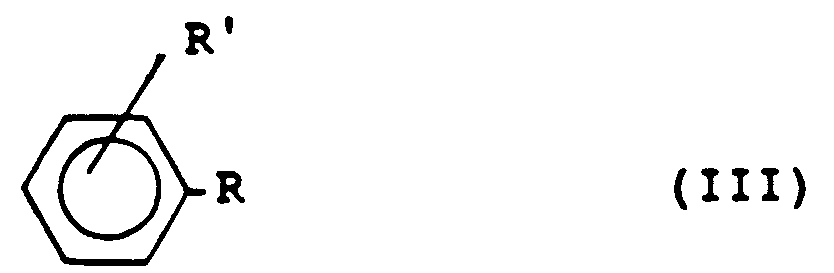
oder b) durch Kondensation von mindestens 2 Mol einer Verbindung b₁) der Formel
mit einem Mol Diphenylether (V) b₂) in Gegenwart von Fluorwasserstoff. Beispiele für aromatische substituierte Kohlenwasserstoffe III sind Phenylenverbindungen, die mit OH und/oder Alkylresten mit 1 bis 4 C-Atomen substituiert sind, wie Phenol, Toluol, die verschiedenen Xylole und Kresole. Verbindungen der Formel (II), die bei Verfahren a) eingesetzt werden können, sind in der US-A 3,355,500 beschrieben. - Verbindungen der Formel (IV), die gemäß Verfahren b) zu den erfindungsgemäßen Verbindungen umgesetzt werden, sind ebenfalls bekannt und in J.O.C. 30, S. 998-1001 (1965), beschrieben. Diese Verbindungen werden mit Diphenylether zur Reaktion gebracht.
- Die Reaktionstemperaturen bei den Verfahren a) und b) liegen zwischen 80 und 180°C, vorzugsweise zwischen 100 und 170°C.
- Die Reaktionszeiten betragen im allgemeinen 24 bis 90, vorzugsweise 65 bis 90 Stunden.
- Das Molverhältnis der eingesetzten Reaktionspartner wird bestimmt bei Verfahren a) durch das Verhältnis der Verbindungen (II) : Verbindungen (III), sowie bei Verfahren b) durch das Verhältnis des Diphenylethers : Verbindungen (IV), es beträgt in beiden Fällen im allgemeinen mindestens 1:2, vorzugsweise 1 :(2,2 bis 4) .
- Der Anteil an Fluorwasserstoff (HF), der bei der Reaktion zur Herstellung der erfindungsgemäßen nötig ist, wird bei Verfahren a) auf die Verbindung (II) bezogen und liegt im allgemeinen im Molverhältnis 1 :(7 bis 25) , vorzugsweise 1 :(10 bis 20).Bei dem Verfahren b) beträgt das Molverhältnis der Verbindungen (IV) : (HF) im allgemeinen 1 : (6 bis 15), vorzugsweise 1 : (8 bis 13).
- Zur Aufarbeitung des Reaktionsgutes wird im allgemeinen der Fluorwasserstoff nach Beendigung der Reaktion bei ca. 80°C aus dem Reaktor abgegast und der verbleibende Rückstand, gegebenenfalls nach Verdünnen mit einem organischen Lösungsmittel, z.B. bei Raumtemperatur, dem Reaktor entnommen. Das erhaltene Rohgemisch wird mit Wasser vermischt, gewaschen und abgetrennt. Zur weiteren Reinigung kann das Reaktionsgut einer Umkristallisation aus einem organischen Lösungsmittel mit oder ohne Vorbehandlung mit Aktivkohle unterworfen werden, oder es erfolgt ein Ausrühren in organischen Lösungsmitteln, vorzugweise in Chlorpropan oder Methanol. Als Lösungsmittel, die bei der Aufarbeitung eingesetzt werden können, eignen sich aliphatische Kohlenwasserstoffe mit 5 bis 10 C-Atomen, aliphatische Monoalkohole mit 1 bis 4 C-Atomen im Alkylrest und ein- oder mehrfach chlorierte aliphatische Kohlenwasserstoffe mit 1 bis 4 C-Atomen im Alkylrest. Beispiele hierfür sind n-Hexan, n-Heptan, Methanol, Ethanol, die verschiedenen Propanole und Butanole, sowie Chlorpropan und Di- und Trichlormethan. Im allgemeinen fallen die gereinigten Produkte als farblose Kristallisate an.
- Spezielle neue teilfluorierte Diphenylether, die im Rahmen der Erfindung liegen, sind:
4,4'-Bis[2-(4-hydroxyphenyl)-hexafluor-isopropyl]-diphenylether,
4,4'-Bis[2-(4-methylphenyl)-hexafluor-isopropyl]-diphenylether,
4,4'-Bis[2-(3,4-dimethylphenyl)-hexafluor-isopropyl]-diphenylether. - Die neuen Verbindungen können zur Herstellung von Synthesebausteinen für teilfluorierte Polykondensate, z.B. Polyester, Polyamide und -imide verwendet werden, wie sie in den Patentanmeldungen vom selben Tage....... EP-A 0317884 "Teilfluorierte Carbonsäuren, sowie Derivate davon, Verfahren zu ihrer Herstellung und Verwendung" und .... EP-A 0317882 "Fluorhaltige Verbindungen auf Basis von 4,4'-Bis-[2-(4-hydroxyphenyl)hexafluorisopropyl]-diphenylether, Verfahren zu ihrer Herstellung und ihre Verwendung" beschrieben worden sind.
- In den folgenden Beispielen bedeutet VA-Stahl Chrom-Nickel-Stahl.
-
a) In einem 1 l Rührautaklaven aus VA-Stahl wurden 251 g 4,4'-Bis[hexafluor-2-hydroxy-2-propyl]-diphenylether, 94 g Phenol und 180 g wasserfreier Fluorwasserstoff vereinigt und 72 Stunden bei 120°C gerührt. Nach Abgasen des Fluorwasserstoffs wurde das zum Teil feste Produkt in Ethanol aufgeschlämmt und dem Autoklaven entnommen. Durch Erhitzen in Gegenwart von 30 g Aktivkohle wurde das Rohprodukt in Lösung gebracht, aus der nach Abkühlen 278 g eines kristallinen Produktes 4,4'-Bis[2-(4-hydroxyphenyl)-hexafluorisopropyl]-diphenylether (Ausbeute: 85 %) ausfielen, das nach Waschen mit Wasser und Trocknen einen Schmelzpunkt von 179 bis 180°C besaß.Analyse für C₃₀H₁₈F₁₂O₃: Berechnet: C 55,04 % H 2,75 % F 34,86 % Gefunden: C 55,00 % H 2,60 % F 35,10 %
b) Ein 2 l VA-Stahlreaktor wurde mit 68 g 4,4'-Bis-[hexafluor-2-hydroxy-2-propyl]-diphenylether, 282 g Phenol und 450 g wasserfreiem Fluorwasserstoff gefüllt. Die Kondensationsreaktion wurde 66 Stunden bei 140°C unter Rühren durchgeführt. Nach Absenken der Temperatur auf 80°C wurde der Fluorwasserstoff abgegast. Anschließend wurde das feste Produkt dem Autoklaven entnommen, gut mit Wasser gewaschen und mit CaCl₂ getrocknet. Zur Reinigung wurde das Produkt mehrere Stunden in 1,5 l Chlorpropan aufgeschlämmt und gerührt. Nach Abtrennen von dem Lösungsmittel und Trocknen wurden 717 g kristallines Produkt (Ausbeute: 81,2 %) erhalten, das laut Gaschromatogramm eine Reinheit von 99,1 % besitzt.
Schmelzpunkt: 179 bis 180°C.
c) In einem 1 l VA-Stahlautoklaven mit Rührer wurden 286 g 2-(4-Hydroxyphenyl)hexafluorpropanol-2 und 85 g Diphenylether vorgelegt. 200 g wasserfreier Fluorwasserstoff wurden dann in den verschlossenen Autoklaven gepumpt. Die Reaktion wurde bei 120°C 65 Stunden lang durchgeführt. Anschließend wurde der Fluorwasserstoff bei 80°C abgegast, der feste Rückstand mit Wasser aufgeschlämmt und aus dem Autoklaven gespült. Nach Waschen mit Wasser wurde das Produkt mit Aktivkohle und Ethanol versetzt, 2 Stunden erhitzt, filtriert und abgekühlt. Ausbeute 154 g ≙ 47 %.
Schmelzpunkt: 179 bis 180°C. -
a) 825 g 2-(4-Methylphenyl)hexafluorpropanol-2, 256 g Diphenylether und 540 g wasserfreier Fluorwasserstoff wurden in einem 2 l VA-Stahlautoklaven 65 Stunden unter Rühren auf 170°C erwärmt. Bei 80°C wurde anschließend der Fluorwasserstoff abgegast; auf den erkalteten Rückstand wurden 500 ml n-Hexan gegeben, das Gemisch aufgerührt und aus dem Autoklaven herausgesaugt. Die organische Phase wurde zweimal mit Wasser gewaschen, das n-Hexan abgezogen und der Rückstand (775 g) mit 1,5 l Methanol ausgerührt. Das feste Produkt (587 g oder 60,2 % Ausbeute) wurde vom Methanol abgetrennt und getrocknet. Schmelzpunkt: 89 bis 90,5°C.Analyse für C₃₂H₂₂F₁₂O: Berechnet: C 59,08 % H 3,38 % F 35,08 % Gefunden: C 59,50 % H 3,35 % F 35,10 %
b) In einem 1 l Stahlautoklaven mit Rührer wurden 387 g 2-(4-Methylphenyl)hexafluorpropanol-2, 128 g Diphenylether und 270 g wasserfreier Fluorwasserstoff vereinigt und 64 Stunden bei 150°C gerührt. Bei 80°C wurde anschließend der Fluorwasserstoff abgegast, das Produkt aus dem Autoklaven herausgesaugt und mit 200 ml Methylenchlorid verdünnt. Die organische Lösung wurde zweimal mit Wasser gewaschen, über CaCl₂ getrocknet und destillativ eingeengt. Es verblieben 401 g, die,in 400 ml n-Hexan gelöst, durch eine Fritte unter Verwendung eines Filtrierhilfsmittels gesaugt und vom Lösungsmittel durch Destillation getrennt wurden. Der Rückstand (385 g oder 79 % Ausbeute) wurde aus 400 ml Ethanol umkristallisiert.
Schmelzpunkt: 89 bis 90°C. -
a) In einem 2 l VA-Autoklaven wurden 256 g Diphenylether und 812 g 2-(3,4-Dimethylphenyl)-hexafluorpropanol-2 vorgelegt und 540 g wasserfreier Fluorwasserstoff eingepumpt. Anschließend wurde das Reaktionsgemisch unter Rühren 65 Stunden bei 150°C gehalten. Nach Abdampfen des Fluorwasserstoffs bei 80°C wurde das Produkt auf Raumtemperatur abgekühlt, mit 250 ml n-Hexan versetzt und dem Autoklaven entnommen. Nach kurzem Erhitzen am Rückfluß kristallisierten aus der n-Hexanlösung beim Abkühlen 466 g Produkt aus, die nach Umkristallisieren aus Ethanol einen Schmelzpunkt von 140 bis 141°C haben. Ausbeute: 45,8 %.Analyse für C₃₄H₂₆F₁₂O: Berechnet: C 60,18 % H 3,83 % F 33,63 % Gefunden: C 60,15 % H 3,80 % F 33,70 %
b) In einem 2 l VA-Autoklaven wurden 312 g 4,4'-Bis-(hexafluor-2-hydroxy-2-propyl)diphenylether und 268 g o-Xylol eingefüllt und anschließend in den verschlossenen Autoklaven 300 g wasserfreier Fluorwasserstoff eingepumpt. Das Reaktionsgemisch wurde 87 Stunden bei 120°C gerührt. Nach Abgasen des Fluorwasserstoffs bei 80°C wurde das auf Raumtemperatur abgekühlte Produkt dem Autoklaven entnommen und auf Eiswasser gegeben. Die organische Phase wurde mit 200 ml Dichlormethan verdünnt, die Lösung über CaCl₂ getrocknet. Nach Abdestillieren von Methylenchlorid und überschüssigem o-Xylol verblieben 358 g Rückstand, der nach Behandeln mit 35 g Aktivkohle und Umkristallisieren aus 400 ml Chloroform einen Schmelzpunkt von 139 bis 141°C zeigte. Ausbeute: 85,2 %.
Claims (14)
- Verbindung der Formel

- 4,4'-Bis[2-(2-(4-hydroxyphenyl)-hexafluor-isopropyl]-diphenylether.
- 4,4'-Bis[2-(4-methylphenyl)-hexafluor-isopropyl]-diphenylether.
- 4,4'-Bis[2-(3,4-dimethylphenyl)hexafluor-isopropyl]-diphenylether.
- Verfahren zur Herstellung einer Verbindung der Formel
 a) ein Dicarbinol a₁) der Formel
 b) eine Fluorverbindung b₁) der Formel-in den Formeln haben R, R' die in Formel (I) genannte Bedeutung -,in Gegenwart von Fluorwasserstoff bei Temperaturen zwischen 80 und 180°C zur Reaktion gebracht werden, der Fluorwasserstoff nach der Reaktion entfernt und das Reaktionsprodukt aufgearbeitet wird.
- Ausführungsform nach Anspruch 1 oder 5, dadurch gekennzeichnet, daß niederes Alkyl die Gruppe -CH₃ ist.
- Ausführungsform nach Anspruch 1, 5 oder 6, dadurch gekennzeichnet, daß R' in ortho-Stellung zum Rest R steht.
- Verfahren nach einem oder mehreren der Ansprüche 5 bis 7, dadurch gekennzeichnet, daß die Reaktionspartner im Verhältnis von 1 zu mindestens 2, vorzugsweise 1:(2,2 bis 4), beim Verfahren a) bezogen auf das Verhältnis von (II) zu (III) und beim Verfahren b) bezogen auf das Verhältnis von (V) zu (IV) eingesetzt werden.
- Verfahren nach einem oder mehreren der Ansprüche 5 bis 8, dadurch gekennzeichnet, daß das Molverhältnis von Fluorwasserstoff zu Verbindung (II)(7 bis 25): 1, vorzugsweise (10 bis 20) : 1 und dasjenige zu Verbindung (IV)(6 bis 15): 1, vorzugsweise (8 bis 13): 1 ist.
- Verfahren nach einem oder mehreren der Ansprüche 5 bis 9, dadurch gekennzeichnet, daß die Reaktion bei 100 bis 170°C durchgeführt wird.
- Verfahren nach einem oder mehreren der Ansprüche 5 bis 10, dadurch gekennzeichnet, daß die Reaktion in 24 bis 90 Stunden durchgeführt wird.
- Verfahren nach einem oder mehreren der Ansprüche 5 bis 11, dadurch gekennzeichnet, daß das Reaktionsprodukt, gegebenenfalls nach Verdünnung mit einem organischen Lösungsmittel, mit Wasser behandelt und anschließend aus einem organischen Lösungsmittel umkristallisiert oder ausgerührt wird.
- Verfahren nach Anspruch 12, dadurch gekennzeichnet, daß mindestens ein Lösungsmittel aus der Gruppe aliphatische Kohlenwasserstoffe mit 5 bis 10 C-Atomen, aliphatische Monoalkohole mit 1 bis 4 C-Atomen im Alkylrest und ein- oder mehrfach chlorierte aliphatische Kohlenwasserstoffe mit 1 bis 4 C-Atomen im Alkylrest eingesetzt wird, wie n-Hexan, n-Heptan, Methanol, Ethanol, die verschiedenen Propanole und Butanole, sowie Chlorpropan und Di- und Trichlormethan.
- Verwendung der Verbindung gemäß Anspruch 1 zur Herstellung von teilfluorierten Polykondensaten, insbesondere von teilfluorierten Polyestern, Polyamiden und Polyimiden.
Applications Claiming Priority (2)
| Application Number | Priority Date | Filing Date | Title |
|---|---|---|---|
| DE3739795 | 1987-11-24 | ||
| DE19873739795 DE3739795A1 (de) | 1987-11-24 | 1987-11-24 | Teilfluorierte diphenylether, verfahren zu ihrer herstellung und ihre verwendung |
Publications (3)
| Publication Number | Publication Date |
|---|---|
| EP0317883A2 EP0317883A2 (de) | 1989-05-31 |
| EP0317883A3 EP0317883A3 (en) | 1990-12-27 |
| EP0317883B1 true EP0317883B1 (de) | 1993-06-16 |
Family
ID=6341149
Family Applications (1)
| Application Number | Title | Priority Date | Filing Date |
|---|---|---|---|
| EP88119070A Expired - Lifetime EP0317883B1 (de) | 1987-11-24 | 1988-11-17 | Teilfluorierte Diphenylether, Verfahren zu ihrer Herstellung und ihre Verwendung |
Country Status (5)
| Country | Link |
|---|---|
| US (1) | US4992593A (de) |
| EP (1) | EP0317883B1 (de) |
| JP (1) | JPH01165541A (de) |
| KR (1) | KR890008062A (de) |
| DE (2) | DE3739795A1 (de) |
Families Citing this family (4)
| Publication number | Priority date | Publication date | Assignee | Title |
|---|---|---|---|---|
| US5283371A (en) * | 1986-03-13 | 1994-02-01 | National Research Development Corporation | Intermediates useful in the production of pesticides |
| DE3909881A1 (de) * | 1989-03-25 | 1990-10-11 | Hoechst Ag | Hexafluorisopropylgruppenhaltige monomere, verfahren zu ihrer herstellung und ihre verwendung |
| DE4020184A1 (de) * | 1990-06-25 | 1992-01-02 | Hoechst Ag | Teilfluorierte biphenyle, verfahren zu ihrer herstellung und ihre verwendung |
| US5498803A (en) * | 1994-03-07 | 1996-03-12 | The United States Of America As Represented By The Administrator Of The National Aeronautics And Space Administration | Poly(arylene ether)s containing pendent ethynyl groups |
Family Cites Families (7)
| Publication number | Priority date | Publication date | Assignee | Title |
|---|---|---|---|---|
| US3310573A (en) * | 1963-06-17 | 1967-03-21 | Du Pont | Diaryl fluoro compounds |
| US3355500A (en) * | 1964-03-18 | 1967-11-28 | Allied Chem | 4, 4'-bis (1, 1, 3, 3-tetrafluoro-1, 3-dichloro-2-hydroxy-2-propyl)-diphenylether |
| US3449296A (en) * | 1967-05-29 | 1969-06-10 | Du Pont | Polybenzoxazole film |
| US4695655A (en) * | 1984-09-04 | 1987-09-22 | Hughes Aircraft Company | Ethynylthiophenoxy derivatives of diphenylhexafluoropropane |
| EP0192480B1 (de) * | 1985-02-22 | 1994-11-23 | MITSUI TOATSU CHEMICALS, Inc. | Bis(3-aminophenoxy)aromaten und Verfahren zu ihrer Herstellung |
| US4845183A (en) * | 1987-11-24 | 1989-07-04 | Hoechst Celanese Corporation | Heat resistant polyamide and polybenzoxazole from bis-((amino-hydroxyphenyl)hexafluoroisopropyl)diphenyl ethers |
| US4822868A (en) * | 1987-11-24 | 1989-04-18 | Hoechst Celanese Corporation | Polycarbonamide of bis(2-(4-carboxyphenyl)-hexafluoroisopropyl)diphenyl ether |
-
1987
- 1987-11-24 DE DE19873739795 patent/DE3739795A1/de not_active Withdrawn
-
1988
- 1988-11-17 EP EP88119070A patent/EP0317883B1/de not_active Expired - Lifetime
- 1988-11-17 DE DE8888119070T patent/DE3881834D1/de not_active Expired - Fee Related
- 1988-11-22 JP JP63293754A patent/JPH01165541A/ja active Pending
- 1988-11-23 KR KR1019880015401A patent/KR890008062A/ko not_active Withdrawn
- 1988-11-23 US US07/275,787 patent/US4992593A/en not_active Expired - Fee Related
Also Published As
| Publication number | Publication date |
|---|---|
| JPH01165541A (ja) | 1989-06-29 |
| EP0317883A3 (en) | 1990-12-27 |
| DE3881834D1 (de) | 1993-07-22 |
| US4992593A (en) | 1991-02-12 |
| KR890008062A (ko) | 1989-07-08 |
| EP0317883A2 (de) | 1989-05-31 |
| DE3739795A1 (de) | 1989-06-08 |
Similar Documents
| Publication | Publication Date | Title |
|---|---|---|
| DE3816120A1 (de) | Verfahren zur herstellung von unsymmetrischen biarylverbindungen | |
| EP0317883B1 (de) | Teilfluorierte Diphenylether, Verfahren zu ihrer Herstellung und ihre Verwendung | |
| EP0034741B1 (de) | Verfahren zur Herstellung eines substituierten Bromfluorbenzols und 3-Brom-4-fluorbenzonitril | |
| EP0415214B1 (de) | Verfahren zur Herstellung von alpha-Fluoracrylsäurederivaten | |
| CH633244A5 (de) | M-brom-benzotrifluoride. | |
| DE3836175A1 (de) | Fluor enthaltende phenole | |
| DE2548970C3 (de) | Verfahren zur Herstellung von Trichlormethyl-trifluormethyl-benzolen | |
| CH500148A (de) | Verfahren zur Herstellung von a,w-Bis-(fluorperhalogenisopropoxy)-perfluoralkanen | |
| EP0123187A2 (de) | Verfahren zur Herstellung von fluorierten Phenylessigsäureestern und neue fluorierte Trichlorethylbenzole | |
| EP1223158B1 (de) | Verfahren zur Herstellung trifluormethyl-substituierter Biphenylcarbonsäuren und neue trichlormethyl- und trifluormethyl-substituierte Biphenylcarbonitrile | |
| EP0498847B1 (de) | Verfahren zur herstellung von 1,4-bis-(4-hydroxybenzoyl)-benzol | |
| EP0693466A1 (de) | Verfahren zur Herstellung von aromatischen fluorierten Verbindungen und neue Diamide | |
| EP0136566A2 (de) | Verfahren zur Herstellung von 3,4-Dichlorbenzotrihalogeniden | |
| EP0075698B1 (de) | Verfahren zur Herstellung von 10,11-Dihydro-5H-dibenzo (a,d) cyclohepten-5-on und dessen Substitutionsprodukten | |
| DE2653601A1 (de) | Perfluoralkylgruppen enthaltende hydroxyketone | |
| CH618678A5 (en) | Process for the preparation of aromatic acid amides | |
| EP0464472A2 (de) | Teilfluorierte Biphenyle, Verfahren zu ihrer Herstellung und ihre Verwendung | |
| EP0111329B1 (de) | Fluormethylchinolin-Derivate und ihre Herstellung | |
| EP1125913A1 (de) | Verfahren zur Herstellung von 3,5-Bis-(trifluormethyl)-benzoylchloriden und neue 3,5-Bis-(trihalogenomethyl)- und 3,5-Dimethylbenzoylhalogenide | |
| DE69127687T2 (de) | Verfahren zur Herstellung von Nepinolon | |
| DE3216851A1 (de) | Verfahren zur herstellung von substituierten biphenylverbindungen | |
| EP0238569B1 (de) | Verfahren zur herstellung von cycloalkancarbonsäuren | |
| EP0370219A1 (de) | Neue 4-Trifluormethylmercaptophenole und ihre Herstellung | |
| EP0463556A2 (de) | Teilfluorierte Tetracarbonsäure sowie deren Dianhydrid, Verfahren zu ihrer Herstellung und ihre Verwendung | |
| EP0045430A1 (de) | Verfahren zur alpha-Bromierung von gegebenenfalls substituierten Fluortoluolen und Gemische von in alpha-Stellung verschieden hoch bromierten, gegebenenfalls substituierten Fluortoluolen |
Legal Events
| Date | Code | Title | Description |
|---|---|---|---|
| PUAI | Public reference made under article 153(3) epc to a published international application that has entered the european phase |
Free format text: ORIGINAL CODE: 0009012 |
|
| AK | Designated contracting states |
Kind code of ref document: A2 Designated state(s): BE CH DE FR GB IT LI NL |
|
| PUAL | Search report despatched |
Free format text: ORIGINAL CODE: 0009013 |
|
| AK | Designated contracting states |
Kind code of ref document: A3 Designated state(s): BE CH DE FR GB IT LI NL |
|
| 17P | Request for examination filed |
Effective date: 19901221 |
|
| 17Q | First examination report despatched |
Effective date: 19920430 |
|
| GRAA | (expected) grant |
Free format text: ORIGINAL CODE: 0009210 |
|
| AK | Designated contracting states |
Kind code of ref document: B1 Designated state(s): BE CH DE FR GB IT LI NL |
|
| ITF | It: translation for a ep patent filed | ||
| REF | Corresponds to: |
Ref document number: 3881834 Country of ref document: DE Date of ref document: 19930722 |
|
| ET | Fr: translation filed | ||
| GBT | Gb: translation of ep patent filed (gb section 77(6)(a)/1977) |
Effective date: 19930823 |
|
| PGFP | Annual fee paid to national office [announced via postgrant information from national office to epo] |
Ref country code: DE Payment date: 19940119 Year of fee payment: 6 |
|
| PLBE | No opposition filed within time limit |
Free format text: ORIGINAL CODE: 0009261 |
|
| STAA | Information on the status of an ep patent application or granted ep patent |
Free format text: STATUS: NO OPPOSITION FILED WITHIN TIME LIMIT |
|
| 26N | No opposition filed | ||
| PGFP | Annual fee paid to national office [announced via postgrant information from national office to epo] |
Ref country code: FR Payment date: 19941020 Year of fee payment: 7 |
|
| PGFP | Annual fee paid to national office [announced via postgrant information from national office to epo] |
Ref country code: CH Payment date: 19941024 Year of fee payment: 7 |
|
| PGFP | Annual fee paid to national office [announced via postgrant information from national office to epo] |
Ref country code: GB Payment date: 19941028 Year of fee payment: 7 |
|
| PGFP | Annual fee paid to national office [announced via postgrant information from national office to epo] |
Ref country code: BE Payment date: 19941117 Year of fee payment: 7 |
|
| PGFP | Annual fee paid to national office [announced via postgrant information from national office to epo] |
Ref country code: NL Payment date: 19941130 Year of fee payment: 7 |
|
| PG25 | Lapsed in a contracting state [announced via postgrant information from national office to epo] |
Ref country code: DE Effective date: 19950801 |
|
| PG25 | Lapsed in a contracting state [announced via postgrant information from national office to epo] |
Ref country code: GB Effective date: 19951117 |
|
| PG25 | Lapsed in a contracting state [announced via postgrant information from national office to epo] |
Ref country code: LI Effective date: 19951130 Ref country code: CH Effective date: 19951130 Ref country code: BE Effective date: 19951130 |
|
| BERE | Be: lapsed |
Owner name: HOECHST A.G. Effective date: 19951130 |
|
| PG25 | Lapsed in a contracting state [announced via postgrant information from national office to epo] |
Ref country code: NL Effective date: 19960601 |
|
| REG | Reference to a national code |
Ref country code: CH Ref legal event code: PL |
|
| GBPC | Gb: european patent ceased through non-payment of renewal fee |
Effective date: 19951117 |
|
| PG25 | Lapsed in a contracting state [announced via postgrant information from national office to epo] |
Ref country code: FR Effective date: 19960731 |
|
| NLV4 | Nl: lapsed or anulled due to non-payment of the annual fee |
Effective date: 19960601 |
|
| REG | Reference to a national code |
Ref country code: FR Ref legal event code: ST |
|
| PG25 | Lapsed in a contracting state [announced via postgrant information from national office to epo] |
Ref country code: IT Free format text: LAPSE BECAUSE OF NON-PAYMENT OF DUE FEES;WARNING: LAPSES OF ITALIAN PATENTS WITH EFFECTIVE DATE BEFORE 2007 MAY HAVE OCCURRED AT ANY TIME BEFORE 2007. THE CORRECT EFFECTIVE DATE MAY BE DIFFERENT FROM THE ONE RECORDED. Effective date: 20051117 |