EP0463556A2 - Teilfluorierte Tetracarbonsäure sowie deren Dianhydrid, Verfahren zu ihrer Herstellung und ihre Verwendung - Google Patents
Teilfluorierte Tetracarbonsäure sowie deren Dianhydrid, Verfahren zu ihrer Herstellung und ihre Verwendung Download PDFInfo
- Publication number
- EP0463556A2 EP0463556A2 EP91110054A EP91110054A EP0463556A2 EP 0463556 A2 EP0463556 A2 EP 0463556A2 EP 91110054 A EP91110054 A EP 91110054A EP 91110054 A EP91110054 A EP 91110054A EP 0463556 A2 EP0463556 A2 EP 0463556A2
- Authority
- EP
- European Patent Office
- Prior art keywords
- bar
- cobalt
- reaction
- manganese
- formula
- Prior art date
- Legal status (The legal status is an assumption and is not a legal conclusion. Google has not performed a legal analysis and makes no representation as to the accuracy of the status listed.)
- Withdrawn
Links
- GTDPSWPPOUPBNX-UHFFFAOYSA-N ac1mqpva Chemical class CC12C(=O)OC(=O)C1(C)C1(C)C2(C)C(=O)OC1=O GTDPSWPPOUPBNX-UHFFFAOYSA-N 0.000 title claims abstract description 9
- 150000000000 tetracarboxylic acids Chemical class 0.000 title description 6
- 238000004519 manufacturing process Methods 0.000 title description 2
- 150000001875 compounds Chemical class 0.000 claims abstract description 24
- 230000003647 oxidation Effects 0.000 claims abstract description 15
- 238000007254 oxidation reaction Methods 0.000 claims abstract description 15
- 239000000203 mixture Substances 0.000 claims abstract description 10
- GDTBXPJZTBHREO-UHFFFAOYSA-N bromine Substances BrBr GDTBXPJZTBHREO-UHFFFAOYSA-N 0.000 claims abstract description 9
- 229910052794 bromium Inorganic materials 0.000 claims abstract description 9
- 239000003054 catalyst Substances 0.000 claims abstract description 9
- WKBOTKDWSSQWDR-UHFFFAOYSA-N Bromine atom Chemical compound [Br] WKBOTKDWSSQWDR-UHFFFAOYSA-N 0.000 claims abstract description 8
- 230000002378 acidificating effect Effects 0.000 claims abstract description 8
- 150000003839 salts Chemical class 0.000 claims abstract description 7
- 239000004952 Polyamide Substances 0.000 claims abstract description 6
- 229920002647 polyamide Polymers 0.000 claims abstract description 6
- 229910001385 heavy metal Inorganic materials 0.000 claims abstract description 5
- 239000004642 Polyimide Substances 0.000 claims abstract description 4
- 229920001721 polyimide Polymers 0.000 claims abstract description 4
- 150000001733 carboxylic acid esters Chemical class 0.000 claims abstract description 3
- 150000003949 imides Chemical class 0.000 claims abstract description 3
- QTBSBXVTEAMEQO-UHFFFAOYSA-N Acetic acid Chemical compound CC(O)=O QTBSBXVTEAMEQO-UHFFFAOYSA-N 0.000 claims description 36
- 238000000034 method Methods 0.000 claims description 31
- 238000006243 chemical reaction Methods 0.000 claims description 22
- ZUOUZKKEUPVFJK-UHFFFAOYSA-N diphenyl Chemical compound C1=CC=CC=C1C1=CC=CC=C1 ZUOUZKKEUPVFJK-UHFFFAOYSA-N 0.000 claims description 18
- 239000001301 oxygen Substances 0.000 claims description 18
- 229910052760 oxygen Inorganic materials 0.000 claims description 18
- QVGXLLKOCUKJST-UHFFFAOYSA-N atomic oxygen Chemical compound [O] QVGXLLKOCUKJST-UHFFFAOYSA-N 0.000 claims description 17
- WFDIJRYMOXRFFG-UHFFFAOYSA-N Acetic anhydride Chemical compound CC(=O)OC(C)=O WFDIJRYMOXRFFG-UHFFFAOYSA-N 0.000 claims description 15
- 229960000583 acetic acid Drugs 0.000 claims description 15
- 239000010941 cobalt Substances 0.000 claims description 12
- GUTLYIVDDKVIGB-UHFFFAOYSA-N cobalt atom Chemical class [Co] GUTLYIVDDKVIGB-UHFFFAOYSA-N 0.000 claims description 12
- 229910017052 cobalt Inorganic materials 0.000 claims description 11
- 239000004305 biphenyl Substances 0.000 claims description 10
- 235000010290 biphenyl Nutrition 0.000 claims description 10
- 229910052684 Cerium Inorganic materials 0.000 claims description 9
- XLYOFNOQVPJJNP-UHFFFAOYSA-N water Substances O XLYOFNOQVPJJNP-UHFFFAOYSA-N 0.000 claims description 9
- CPELXLSAUQHCOX-UHFFFAOYSA-N Hydrogen bromide Chemical compound Br CPELXLSAUQHCOX-UHFFFAOYSA-N 0.000 claims description 8
- 239000012362 glacial acetic acid Substances 0.000 claims description 8
- 125000004432 carbon atom Chemical group C* 0.000 claims description 7
- 239000011572 manganese Chemical class 0.000 claims description 7
- PWHULOQIROXLJO-UHFFFAOYSA-N Manganese Chemical class [Mn] PWHULOQIROXLJO-UHFFFAOYSA-N 0.000 claims description 6
- 239000007789 gas Substances 0.000 claims description 6
- 229910052748 manganese Inorganic materials 0.000 claims description 6
- 238000002360 preparation method Methods 0.000 claims description 6
- 229910021645 metal ion Inorganic materials 0.000 claims description 5
- XBDQKXXYIPTUBI-UHFFFAOYSA-N dimethylselenoniopropionate Natural products CCC(O)=O XBDQKXXYIPTUBI-UHFFFAOYSA-N 0.000 claims description 4
- 229910000042 hydrogen bromide Inorganic materials 0.000 claims description 4
- 150000002762 monocarboxylic acid derivatives Chemical class 0.000 claims description 4
- 239000011541 reaction mixture Substances 0.000 claims description 4
- 150000008064 anhydrides Chemical class 0.000 claims description 3
- 150000001649 bromium compounds Chemical class 0.000 claims description 3
- CPELXLSAUQHCOX-UHFFFAOYSA-M Bromide Chemical compound [Br-] CPELXLSAUQHCOX-UHFFFAOYSA-M 0.000 claims description 2
- 150000001242 acetic acid derivatives Chemical class 0.000 claims description 2
- PQLVXDKIJBQVDF-UHFFFAOYSA-N acetic acid;hydrate Chemical compound O.CC(O)=O PQLVXDKIJBQVDF-UHFFFAOYSA-N 0.000 claims description 2
- 235000019260 propionic acid Nutrition 0.000 claims description 2
- IUVKMZGDUIUOCP-BTNSXGMBSA-N quinbolone Chemical compound O([C@H]1CC[C@H]2[C@H]3[C@@H]([C@]4(C=CC(=O)C=C4CC3)C)CC[C@@]21C)C1=CCCC1 IUVKMZGDUIUOCP-BTNSXGMBSA-N 0.000 claims description 2
- ZMIGMASIKSOYAM-UHFFFAOYSA-N cerium Chemical compound [Ce][Ce][Ce][Ce][Ce][Ce][Ce][Ce][Ce][Ce][Ce][Ce][Ce][Ce][Ce][Ce][Ce][Ce][Ce][Ce][Ce][Ce][Ce][Ce][Ce][Ce][Ce][Ce][Ce][Ce][Ce][Ce][Ce][Ce][Ce][Ce][Ce][Ce] ZMIGMASIKSOYAM-UHFFFAOYSA-N 0.000 claims 4
- 150000001408 amides Chemical class 0.000 claims 1
- 239000012429 reaction media Substances 0.000 claims 1
- -1 polycarboximides Polymers 0.000 abstract description 16
- 229910052731 fluorine Inorganic materials 0.000 description 8
- 229910052739 hydrogen Inorganic materials 0.000 description 8
- YXFVVABEGXRONW-UHFFFAOYSA-N Toluene Chemical compound CC1=CC=CC=C1 YXFVVABEGXRONW-UHFFFAOYSA-N 0.000 description 6
- 239000000243 solution Substances 0.000 description 6
- KRHYYFGTRYWZRS-UHFFFAOYSA-N Fluorane Chemical compound F KRHYYFGTRYWZRS-UHFFFAOYSA-N 0.000 description 5
- 229910052751 metal Inorganic materials 0.000 description 5
- 239000002184 metal Substances 0.000 description 5
- IJGRMHOSHXDMSA-UHFFFAOYSA-N Atomic nitrogen Chemical compound N#N IJGRMHOSHXDMSA-UHFFFAOYSA-N 0.000 description 4
- 125000000217 alkyl group Chemical group 0.000 description 4
- 238000004458 analytical method Methods 0.000 description 4
- 230000005494 condensation Effects 0.000 description 4
- 239000012065 filter cake Substances 0.000 description 4
- 229910000040 hydrogen fluoride Inorganic materials 0.000 description 4
- 239000002904 solvent Substances 0.000 description 4
- 238000003756 stirring Methods 0.000 description 4
- HEDRZPFGACZZDS-UHFFFAOYSA-N Chloroform Chemical compound ClC(Cl)Cl HEDRZPFGACZZDS-UHFFFAOYSA-N 0.000 description 3
- YMWUJEATGCHHMB-UHFFFAOYSA-N Dichloromethane Chemical compound ClCCl YMWUJEATGCHHMB-UHFFFAOYSA-N 0.000 description 3
- RTZKZFJDLAIYFH-UHFFFAOYSA-N Diethyl ether Chemical compound CCOCC RTZKZFJDLAIYFH-UHFFFAOYSA-N 0.000 description 3
- VEXZGXHMUGYJMC-UHFFFAOYSA-N Hydrochloric acid Chemical compound Cl VEXZGXHMUGYJMC-UHFFFAOYSA-N 0.000 description 3
- OKKJLVBELUTLKV-UHFFFAOYSA-N Methanol Chemical compound OC OKKJLVBELUTLKV-UHFFFAOYSA-N 0.000 description 3
- ZMXDDKWLCZADIW-UHFFFAOYSA-N N,N-Dimethylformamide Chemical compound CN(C)C=O ZMXDDKWLCZADIW-UHFFFAOYSA-N 0.000 description 3
- IMNFDUFMRHMDMM-UHFFFAOYSA-N N-Heptane Chemical compound CCCCCCC IMNFDUFMRHMDMM-UHFFFAOYSA-N 0.000 description 3
- HEMHJVSKTPXQMS-UHFFFAOYSA-M Sodium hydroxide Chemical compound [OH-].[Na+] HEMHJVSKTPXQMS-UHFFFAOYSA-M 0.000 description 3
- 150000001338 aliphatic hydrocarbons Chemical class 0.000 description 3
- 125000003178 carboxy group Chemical group [H]OC(*)=O 0.000 description 3
- 229960001701 chloroform Drugs 0.000 description 3
- 239000007791 liquid phase Substances 0.000 description 3
- WPBNNNQJVZRUHP-UHFFFAOYSA-L manganese(2+);methyl n-[[2-(methoxycarbonylcarbamothioylamino)phenyl]carbamothioyl]carbamate;n-[2-(sulfidocarbothioylamino)ethyl]carbamodithioate Chemical compound [Mn+2].[S-]C(=S)NCCNC([S-])=S.COC(=O)NC(=S)NC1=CC=CC=C1NC(=S)NC(=O)OC WPBNNNQJVZRUHP-UHFFFAOYSA-L 0.000 description 3
- 150000002739 metals Chemical class 0.000 description 3
- 239000003960 organic solvent Substances 0.000 description 3
- 239000000047 product Substances 0.000 description 3
- XKRFYHLGVUSROY-UHFFFAOYSA-N Argon Chemical compound [Ar] XKRFYHLGVUSROY-UHFFFAOYSA-N 0.000 description 2
- ZAMOUSCENKQFHK-UHFFFAOYSA-N Chlorine atom Chemical compound [Cl] ZAMOUSCENKQFHK-UHFFFAOYSA-N 0.000 description 2
- MYMOFIZGZYHOMD-UHFFFAOYSA-N Dioxygen Chemical compound O=O MYMOFIZGZYHOMD-UHFFFAOYSA-N 0.000 description 2
- KFZMGEQAYNKOFK-UHFFFAOYSA-N Isopropanol Chemical compound CC(C)O KFZMGEQAYNKOFK-UHFFFAOYSA-N 0.000 description 2
- 150000001502 aryl halides Chemical class 0.000 description 2
- 230000015572 biosynthetic process Effects 0.000 description 2
- GWXLDORMOJMVQZ-UHFFFAOYSA-N cerium Chemical compound [Ce] GWXLDORMOJMVQZ-UHFFFAOYSA-N 0.000 description 2
- 238000009833 condensation Methods 0.000 description 2
- USIUVYZYUHIAEV-UHFFFAOYSA-N diphenyl ether Chemical compound C=1C=CC=CC=1OC1=CC=CC=C1 USIUVYZYUHIAEV-UHFFFAOYSA-N 0.000 description 2
- 230000002349 favourable effect Effects 0.000 description 2
- 229910052736 halogen Inorganic materials 0.000 description 2
- 150000002367 halogens Chemical class 0.000 description 2
- 125000002496 methyl group Chemical group [H]C([H])([H])* 0.000 description 2
- VLKZOEOYAKHREP-UHFFFAOYSA-N n-Hexane Chemical compound CCCCCC VLKZOEOYAKHREP-UHFFFAOYSA-N 0.000 description 2
- 229910052757 nitrogen Inorganic materials 0.000 description 2
- 238000001953 recrystallisation Methods 0.000 description 2
- 239000007787 solid Substances 0.000 description 2
- HJUGFYREWKUQJT-UHFFFAOYSA-N tetrabromomethane Chemical compound BrC(Br)(Br)Br HJUGFYREWKUQJT-UHFFFAOYSA-N 0.000 description 2
- 238000004448 titration Methods 0.000 description 2
- RIOQSEWOXXDEQQ-UHFFFAOYSA-N triphenylphosphine Chemical compound C1=CC=CC=C1P(C=1C=CC=CC=1)C1=CC=CC=C1 RIOQSEWOXXDEQQ-UHFFFAOYSA-N 0.000 description 2
- 241001301278 Cerion Species 0.000 description 1
- FXHOOIRPVKKKFG-UHFFFAOYSA-N N,N-Dimethylacetamide Chemical compound CN(C)C(C)=O FXHOOIRPVKKKFG-UHFFFAOYSA-N 0.000 description 1
- VEQPNABPJHWNSG-UHFFFAOYSA-N Nickel(2+) Chemical class [Ni+2] VEQPNABPJHWNSG-UHFFFAOYSA-N 0.000 description 1
- 229910021585 Nickel(II) bromide Inorganic materials 0.000 description 1
- 229910021586 Nickel(II) chloride Inorganic materials 0.000 description 1
- HCHKCACWOHOZIP-UHFFFAOYSA-N Zinc Chemical compound [Zn] HCHKCACWOHOZIP-UHFFFAOYSA-N 0.000 description 1
- 239000002253 acid Substances 0.000 description 1
- 229910052783 alkali metal Inorganic materials 0.000 description 1
- 150000001340 alkali metals Chemical class 0.000 description 1
- SWLVFNYSXGMGBS-UHFFFAOYSA-N ammonium bromide Chemical compound [NH4+].[Br-] SWLVFNYSXGMGBS-UHFFFAOYSA-N 0.000 description 1
- 229910052786 argon Inorganic materials 0.000 description 1
- 150000001491 aromatic compounds Chemical class 0.000 description 1
- 150000004945 aromatic hydrocarbons Chemical class 0.000 description 1
- 125000004429 atom Chemical group 0.000 description 1
- 229910052799 carbon Inorganic materials 0.000 description 1
- 239000011203 carbon fibre reinforced carbon Substances 0.000 description 1
- 150000001768 cations Chemical class 0.000 description 1
- 239000000460 chlorine Substances 0.000 description 1
- 229910052801 chlorine Inorganic materials 0.000 description 1
- 229910001429 cobalt ion Inorganic materials 0.000 description 1
- 239000013078 crystal Substances 0.000 description 1
- 230000018044 dehydration Effects 0.000 description 1
- 238000006297 dehydration reaction Methods 0.000 description 1
- 238000010790 dilution Methods 0.000 description 1
- 239000012895 dilution Substances 0.000 description 1
- 229910001882 dioxygen Inorganic materials 0.000 description 1
- 150000002168 ethanoic acid esters Chemical class 0.000 description 1
- 125000001495 ethyl group Chemical group [H]C([H])([H])C([H])([H])* 0.000 description 1
- 239000000706 filtrate Substances 0.000 description 1
- 238000010438 heat treatment Methods 0.000 description 1
- 239000011261 inert gas Substances 0.000 description 1
- 239000000543 intermediate Substances 0.000 description 1
- 238000002955 isolation Methods 0.000 description 1
- 125000001449 isopropyl group Chemical group [H]C([H])([H])C([H])(*)C([H])([H])[H] 0.000 description 1
- 229910001437 manganese ion Inorganic materials 0.000 description 1
- 239000000463 material Substances 0.000 description 1
- 238000002844 melting Methods 0.000 description 1
- 230000008018 melting Effects 0.000 description 1
- DOTMOQHOJINYBL-UHFFFAOYSA-N molecular nitrogen;molecular oxygen Chemical compound N#N.O=O DOTMOQHOJINYBL-UHFFFAOYSA-N 0.000 description 1
- 239000000178 monomer Substances 0.000 description 1
- SNMVRZFUUCLYTO-UHFFFAOYSA-N n-propyl chloride Chemical compound CCCCl SNMVRZFUUCLYTO-UHFFFAOYSA-N 0.000 description 1
- QMMRZOWCJAIUJA-UHFFFAOYSA-L nickel dichloride Chemical compound Cl[Ni]Cl QMMRZOWCJAIUJA-UHFFFAOYSA-L 0.000 description 1
- IPLJNQFXJUCRNH-UHFFFAOYSA-L nickel(2+);dibromide Chemical compound [Ni+2].[Br-].[Br-] IPLJNQFXJUCRNH-UHFFFAOYSA-L 0.000 description 1
- 150000002894 organic compounds Chemical class 0.000 description 1
- 239000012074 organic phase Substances 0.000 description 1
- 238000010525 oxidative degradation reaction Methods 0.000 description 1
- 150000002926 oxygen Chemical class 0.000 description 1
- 235000011837 pasties Nutrition 0.000 description 1
- 239000012071 phase Substances 0.000 description 1
- 238000005191 phase separation Methods 0.000 description 1
- 239000003880 polar aprotic solvent Substances 0.000 description 1
- 238000004886 process control Methods 0.000 description 1
- 238000000746 purification Methods 0.000 description 1
- 239000012264 purified product Substances 0.000 description 1
- 239000000376 reactant Substances 0.000 description 1
- 238000010992 reflux Methods 0.000 description 1
- 230000000630 rising effect Effects 0.000 description 1
- 239000000725 suspension Substances 0.000 description 1
- 238000010626 work up procedure Methods 0.000 description 1
- 239000008096 xylene Substances 0.000 description 1
- 150000003738 xylenes Chemical class 0.000 description 1
Classifications
-
- C—CHEMISTRY; METALLURGY
- C07—ORGANIC CHEMISTRY
- C07C—ACYCLIC OR CARBOCYCLIC COMPOUNDS
- C07C63/00—Compounds having carboxyl groups bound to a carbon atoms of six-membered aromatic rings
- C07C63/68—Compounds having carboxyl groups bound to a carbon atoms of six-membered aromatic rings containing halogen
- C07C63/72—Polycyclic acids
Definitions
- the invention relates to a partially fluorinated tetracarboxylic acid, in particular the 4,4'-bis [2- (3,4-dicarboxyphenyl) hexafluoroisopropyl] biphenyl, its dianhydride, processes for their preparation and their use.
- the invention relates to a compound of the formula and their dianhydride, process for their preparation and their use as a monomer component for polycondensates, in particular polyimides.
- the compound according to the invention is prepared by oxidation of the 4,4'-bis [2- (3,4-dialkylphenyl) hexafluoroisopropyl] biphenyl with molecular oxygen in an acidic organic medium, the acidic medium being at least 40% by weight consists of a monocarboxylic acid with 1 to 4 carbon atoms, in particular acetic acid or propionic acid or mixtures thereof, in the presence of a catalyst combination of at least 2 heavy metal salts, especially cobalt and manganese, as well as bromine. Cerions may also be present. Acetic acid is preferable because of its greater resistance to oxidative degradation.
- the ratio of acidic medium to the biphenyl compound to be oxidized is at most 40:60% by weight, based on the total reaction mass.
- the reaction according to methods a) and b) is carried out at a temperature of 80 to 180 ° C., preferably 100 to 160 ° C.
- the molar ratio of the reactants used is determined in method a) by the ratio of compound (III) to compound (IV) and in method b) by the ratio of biphenyl to compound (V); it is at least 1: 2, preferably 1: 2.2 to 1: 4.4.
- the proportion of hydrogen fluoride which is necessary in the reaction for the preparation of the compounds of the formula (II) is based on the compound (III) in method a) and is generally in a molar ratio of 1: 7 to 1:25, preferably 1: 8 to 1:12.
- the molar ratio of compound (V) to hydrogen fluoride is generally 1: 6 to 1:15, preferably 1: 8 to 1:12.
- the hydrogen fluoride is generally vented from the reactor at about 80 ° C. after the reaction has ended, and the remaining residue, if appropriate after dilution with an organic solvent, is removed from the reactor, preferably at a temperature of 20 to 30 ° C. .
- Suitable solvents that can be used are aliphatic hydrocarbons with 5 to 10 carbon atoms, aromatic hydrocarbons with 6 to 8 carbon atoms and mono- or polychlorinated aliphatic hydrocarbons with 1 to 4 carbon atoms in the alkyl radical.
- Examples include n-hexane, n-heptane, toluene, the various xylenes, and di- and trichloromethane, preferably toluene, di- or trichloromethane.
- the crude mixture obtained is mixed with water, washed and separated.
- the purified products are obtained as colorless crystals.
- reaction material can be subjected to recrystallization from an organic solvent, or it is stirred in organic solvents, preferably in isopropanol, methanol or 1-chloropropane.
- the compound of the formula (VII) can be prepared by known processes from compounds of the formula (V) and aryl halides.
- the formation of the aryl-aryl bond between two components of the formula (VII) is carried out in a polar aprotic solvent such as dimethylacetamide or dimethylformamide in the presence of a mixture of 1 to 10 mol%, preferably 3 to 6 mol%, of a nickel (II) Salt, preferably NiCl2 or NiBr2, and 5 to 40 mol%, preferably 20 to 30 mol%, of an organic phosphorus (III) compound, preferably triphenylphosphine, and zinc powder in an amount of 120 to 160 mol%, based on the amount used Aryl halide.
- a polar aprotic solvent such as dimethylacetamide or dimethylformamide
- a nickel (II) Salt preferably NiCl2 or NiBr2
- an organic phosphorus (III) compound preferably triphenylphosphine
- zinc powder in an amount of 120 to 160 mol%, based on the amount used Aryl halide.
- the reaction is carried out in an inert gas atmosphere, in particular nitrogen or argon, at a temperature of 40 to 80 ° C .; the reaction takes 2 to 8 hours.
- an inert gas atmosphere in particular nitrogen or argon
- the solids content is filtered off and the filtrate is washed several times with water after adding a water-immiscible solvent, for example a mono- or polychlorinated aliphatic hydrocarbon with 1-4 carbon atoms in the alkyl radical, in particular di- or trichloromethane, acetic acid ester or diethyl ether.
- a water-immiscible solvent for example a mono- or polychlorinated aliphatic hydrocarbon with 1-4 carbon atoms in the alkyl radical, in particular di- or trichloromethane, acetic acid ester or diethyl ether.
- the two heavy metal salts especially those of cobalt and manganese, are generally used in a ratio of 3: 1 to 1: 3, preferably 1: 1.
- the sum of the concentrations of the two cations is generally 0.01 to 0.2, preferably 0.02 to 0.12 and in particular 0.04 to 0.08 g / atom / kg total mass.
- the ratio of the sum of the metal salts, preferably that of cobalt and manganese, to bromine is generally 1: 0.01 to 1: 0.8, preferably 1: 0.05 to 1: 0.4.
- cerium ions in addition to the two metal ions of the catalyst. These catalyze the oxidation of incompletely oxidized intermediates. Their presence increases the purity and the yield of the partially fluorinated tetracarboxylic acid.
- the cerium ions are added to the catalyst in the ratio of the sum of the cobalt and manganese ions to cerium ions such as 1: 0.02 to 1: 1.2, preferably 1: 0.05 to 1: 0.6.
- the molar ratio of the two metals is generally 1: 0.02 to 1: 1.2, the ratio of the metals to bromine being as described above.
- the molar ratios always relate to the total mass, i.e. on the sum of the compound, solvent and catalyst to be oxidized.
- the corresponding acetates are preferably used as metal salts.
- Bromine can be used in the form of bromides, for example the bromides of the alkali metals including ammonium bromide and the metals cobalt, manganese and cerium, or as a solution of hydrogen bromide in water or glacial acetic acid. It is also possible to use bromine-containing organic compounds which break down during the oxidation and release bromine ions, for example tetrabromomethane.
- the oxidation is generally carried out at a temperature of 120 to 220, preferably 140 to 190 and in particular 155 to 180 ° C.
- the pressure in the reactor is generally 5 to 40, preferably 10 to 30 and in particular 14 to 20 bar.
- the air required for the oxidation is introduced into the liquid phase near the bottom of the reactor and is preferably finely distributed in the liquid phase by vigorous stirring or by special nozzles. It is particularly expedient to use an oxidation mixture whose oxygen content has been increased to over 21% by volume by adding pure oxygen. This measure achieves high oxygen partial pressures in the gas bubbles entering the liquid phase. It is advantageous if the oxygen partial pressure at the outlet point of the introduction device is at least 1 bar, preferably 2 to 15 and in particular 3 to 10 bar.
- the oxygen partial pressure is defined by the formula ie it is the mathematical product of the residual oxygen content and the difference between the total pressure and the acetic acid vapor pressure at the present reaction temperature. This oxygen partial pressure in the gas phase above the reaction solution should not fall below 0.2 bar and is preferably 0.35 to 2.8, in particular 0.45 to 1.3 bar.
- the water concentration of the acidic medium in which the reaction is carried out has a significant influence on the implementation of the process according to the invention.
- the tetraalkyl compounds can also be oxidized in - for example - acetic acid with a water concentration of 15% by weight or more, the yield is reduced and, above all, the purity of the products obtained and the oxidation of all four alkyl groups takes place only incompletely.
- the metal ions of the catalyst are precipitated by tetracarboxylic acids and thus inactivated.
- the range for the water concentration in which the metal ions remain dissolved and in which the oxidation takes place completely is 2 to 12, preferably 2 to 7 and in particular 3 to 5% by weight of water in the monocarboxylic acid.
- the tetracarboxylic acid obtained by the process according to the invention is treated in a conventional manner with acetic anhydride and obtained from the reaction solution by known methods.
- the compounds according to the invention are used above all for the production of polycondensates such as polyimides, polycarboxamides, polyamide carboxylic esters, polyamides and imide oligomers which, inter alia, have low melting points, high solubility, low dielectric constants and increased thermal stability.
- the exothermic reaction lasted 1 hour.
- the air was then replaced by a mixture of nitrogen-oxygen (9: 1) and the temperature was kept at 175 ° C. for a further 45 minutes.
- the voluminous acetic acid-moist filter cake (530 g) from the isolation as 12F-biphenyl-tetracarboxylic acid was filled into a two-liter four-necked flask together with 200 g of glacial acetic acid. 102 g (1.0 mol) of acetic anhydride were added dropwise with stirring at about 85 ° C. in the course of 30 minutes. The temperature rose to 120 ° C. and the thin suspension was kept at this value for one hour (6% by weight of acetic anhydride in the glacial acetic acid).
Landscapes
- Chemical & Material Sciences (AREA)
- Organic Chemistry (AREA)
- Organic Low-Molecular-Weight Compounds And Preparation Thereof (AREA)
- Low-Molecular Organic Synthesis Reactions Using Catalysts (AREA)
- Furan Compounds (AREA)
- Macromolecular Compounds Obtained By Forming Nitrogen-Containing Linkages In General (AREA)
Abstract
Description
- Die Erfindung betrifft eine teilfluorierte Tetracarbonsäure, im speziellen das 4,4'-Bis[2-(3,4-dicarboxyphenyl)hexafluorisopropyl]biphenyl, dessen Dianhydrid, Verfahren zu ihrer Herstellung sowie ihre Verwendung.
- Die Herstellung des 4,4'-Bis [2-(3,4-dicarboxyphenyl)hexafluorisopropyl]diphenylethers durch Luftoxidation in saurem Medium in Gegenwart eines Katalysatorgemisches ist bekannt [DE-A-37 39 796].
- Gegenstand der Erfindung ist eine Verbindung der Formel

sowie deren Dianhydrid, Verfahren zu ihrer Herstellung und ihre Verwendung als Monomerkomponente für Polykondensate, insbesondere Polyimide. - Die Herstellung der Verbindung gemäß der Erfindung erfolgt durch Oxidation des 4,4'-Bis[2-(3,4-dialkylphenyl)hexafluorisopropyl]biphenyls mit molekularem Sauerstoff in einem sauren organischen Medium, wobei das saure Medium zu mindestens 40 Gew.-% aus einer Monocarbonsäure mit 1 bis 4 Kohlenstoffatomen, insbesondere Essigsäure oder Propionsäure oder deren Mischungen, besteht, in Gegenwart einer Katalysatorkombination aus mindestens 2 Schwermetallsalzen, insbesondere des Kobalts und Mangans, sowie Brom. Daneben können noch Cerionen vorhanden sein. Essigsäure ist wegen ihrer größeren Beständigkeit gegen einen oxidativen Abbau vorzuziehen. Das Verhältnis von saurem Medium zu der zu oxidierenden Biphenylverbindung maximal von 40:60 Gew.-%, bezogen auf die Gesamtreaktionsmasse, betragen.
- Die eingesetzte Biphenylverbindung

in der R gleich niederes Alkyl mit 1-4 C-Atomen ist, wobei Alkyl vorzugsweise Methyl, Ethyl und Isopropyl, insbesondere Methyl ist, wird im allgemeinen nach drei verschiedenen Methoden hergestellt, und zwar: - a) durch Kondensation von einem Mol eines Dicarbinols der Formel

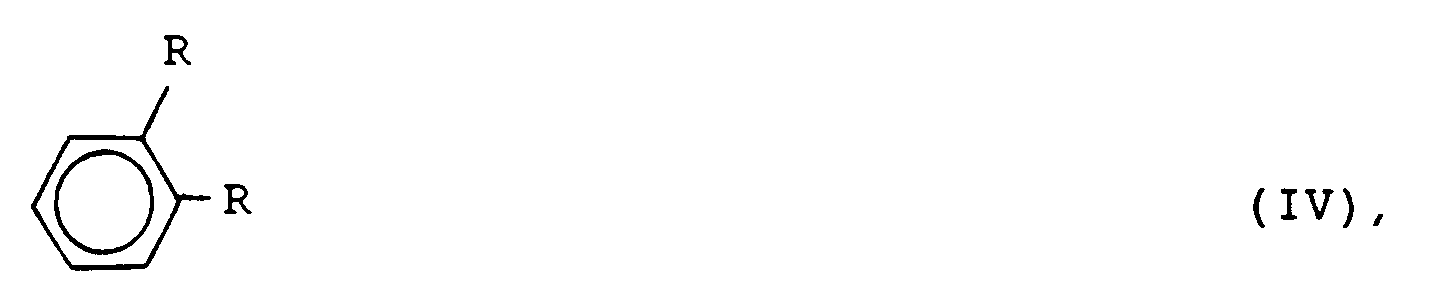
oder - b) durch Kondensation von mindestens 2 Mol einer Verbindung der Formel

oder - c) durch Bildung der Kohlenstoff-Kohlenstoff-Bindung zwischen 2 gleichen teilfluorierten aromatischen Verbindungen der Formel

- Verbindungen der Formel (III), die beim Vorgehen nach a) eingesetzt werden, sind in der US-Patentschrift 3,355,500 und in J. Org. Chem. 30, 998 (1965) beschrieben. Verbindungen der Formel (V), die nach Methode b) zu den Verbindungen gemäß Formel (II) umgesetzt werden, sind ebenfalls in J. Org. Chemie 30, 998-1001 (1965) beschrieben.
- Die Reaktion nach Methode a) und b) wird bei einer Temperatur von 80 bis 180°C, vorzugsweise von 100 bis 160°C, durchgeführt.
- Für die Reaktion nach Methode a) und b) ist ein Zeitraum von 20 bis 90 Stunden, vorzugsweise von 40 bis 70 Stunden, erforderlich.
- Das Molverhältnis der eingesetzten Reaktionspartner wird bestimmt bei Methode a) durch das Verhältnis der Verbindung (III) zu Verbindung (IV), sowie bei Methode b) durch das Verhältnis des Biphenyls zu Verbindung (V); es beträgt jeweils mindestens 1:2, vorzugsweise 1:2,2 bis 1:4,4.
- Der Anteil an Fluorwasserstoff, der bei der Reaktion zur Herstellung der Verbindungen gemäß Formel (II) notwendig ist, wird bei Methode a) auf die Verbindung (III) bezogen und liegt im allgemeinen bei einem Molverhältnis von 1:7 bis 1:25, vorzugsweise 1:8 bis 1:12. Bei der Methode b) beträgt das Molverhältnis der Verbindung (V) zu Fluorwasserstoff im allgemeinen 1:6 bis 1:15, vorzugsweise 1:8 bis 1:12.
- Zur Aufarbeitung des Reaktionsgutes wird im allgemeinen der Fluorwasserstoff nach Beendigung der Reaktion bei ca. 80°C aus dem Reaktor abgegast und der verbleibende Rückstand, gegebenenfalls nach Verdünnen mit einem organischen Lösungsmittel, dem Reaktor entnommen, vorzugsweise bei einer Temperatur von 20 bis 30°C.
- Als Lösungsmittel, die dabei verwendet werden können, eignen sich aliphatische Kohlenwasserstoffe mit 5 bis 10 C-Atomen, aromatische Kohlenwasserstoffe mit 6 bis 8 C-Atomen und ein- oder mehrfach chlorierte aliphatische Kohlenwasserstoffe mit 1 bis 4 C-Atomen im Alkylrest. Beispiele hierfür sind n-Hexan, n-Heptan, Toluol, die verschiedenen Xylole, sowie Di- und Trichlormethan, vorzugsweise Toluol, Di- oder Trichlormethan.
- Das erhaltene Rohgemisch wird mit Wasser versetzt, gewaschen und abgetrennt. Im allgemeinen fallen die gereinigten Produkte als farblose Kristallisate an.
- Zur weiteren Reinigung kann das Reaktionsgut einer Umkristallisation aus einem organischen Lösungsmittel unterworfen werden, oder es erfolgt ein Ausrühren in organischen Lösungsmitteln, vorzugsweise in Isopropanol, Methanol oder 1-Chlorpropan.
- Die Herstellung der Verbindung gemäß Formel (VII) ist nach bekannten Verfahren möglich aus Verbindungen der Formel (V) und Arylhalogeniden.
- Die Bildung der Aryl-Arylbindung zwischen zwei Komponenten nach Formel (VII) wird durchgeführt in einem polaren aprotischen Lösungsmittel wie Dimethylacetamid oder Dimethylformamid in Gegenwart eines Gemisches aus 1 bis 10 Mol%, vorzugsweise 3 bis 6 Mol%, eines Nickel-(II)-Salzes, vorzugsweise NiCl₂ oder NiBr₂, und 5 bis 40 Mol%, vorzugsweise 20 bis 30 Mol%, einer organischen Phosphor-(III)-Verbindung, vorzugsweise Triphenylphosphin, und Zinkpulver in einer Menge von 120 bis 160 Mol%, bezogen auf das eingesetzte Arylhalogenid.
- Die Reaktion wird in einer Inertgasatmosphäre, insbesondere von Stickstoff oder Argon, bei einer Temperatur von 40 bis 80°C ausgeführt; die Reaktion dauert 2 bis 8 Stunden.
- Der Feststoffanteil wird abfiltriert und das Filtrat nach Zusatz eines nicht mit Wasser mischbaren Lösungsmittels, z.B. ein ein- oder mehrfach chlorierter aliphatischer Kohlenwasserstoff mit 1-4 Kohlenstoffatomen im Alkylrest, insbesondere Di- oder Trichlormethan, Essigsäureester oder Diethylether, mehrfach mit Wasser gewaschen. Dabei stellt sich eine Phasentrennung ein. Nach Trocknung der organischen Phase wird das Lösungsmittel abdestilliert und das zurückbleibende Produkt durch Umkristallisation gereinigt.
- Für den vollständigen Ablauf der Oxidation sind Bromidionen unbedingt notwendig. Die beiden Schwermetallsalze, insbesondere die des Kobalts und des Mangans, werden im allgemeinen im Verhältnis von 3:1 bis 1:3, vorzugsweise 1:1 eingesetzt. Die Summe der Konzentrationen der beiden Kationen beträgt im allgemeinen 0,01 bis 0,2, vorzugsweise 0,02 bis 0,12 und insbesondere 0,04 bis 0,08 g/Atom/kg Gesamtmasse. Das Verhältnis der Summe der Metallsalze, vorzugsweise der von Kobalt und Mangan, zu Brom ist im allgemeinen 1:0,01 bis 1:0,8, vorzugsweise 1:0,05 bis 1:0,4.
- Es ist auch möglich, zusätzlich zu den beiden Metallionen des Katalysators auch Cerionen einzusetzen. Diese katalysieren die Oxidation unvollständig oxidierter Zwischenstufen. Ihre Anwesenheit erhöht die Reinheit und die Ausbeute der teilfluorierten Tetracarbonsäure. Die Cerionen werden dem Katalysator im Verhältnis der Summe der Kobalt- und Manganionen zu Cerionen wie 1:0,02 bis 1:1,2, vorzugsweise 1:0,05 bis 1:0,6, zugefügt.
- Wird ein Gemisch der Metallionen von Kobalt und Cer verwendet, so beträgt das Molverhältnis der beiden Metalle im allgemeinen 1:0,02 bis 1:1,2, wobei das Verhältnis der Metalle zu Brom wie vorstehend beschrieben ist. Die Molverhältnisse beziehen sich stets auf die Gesamtmasse, d.h. auf die Summe der zu oxidierenden Verbindung, Lösungsmittel und Katalysator. Vorzugsweise werden als Metallsalze die entsprechenden Acetate eingesetzt.
- Brom kann in Form von Bromiden, z.B. der Bromide der Alkalimetalle einschließlich des Ammoniumbromids und der Metalle Kobalt, Mangan und Cer, oder als Lösung von Bromwasserstoff in Wasser oder Eisessig eingesetzt werden. Es können auch bromhaltige organische Verbindungen verwendet werden, die während der Oxidation zerfallen und Bromionen freisetzen, z.B. Tetrabrommethan.
- Die Oxidation wird im allgemeinen bei einer Temperatur von 120 bis 220, vorzugsweise 140 bis 190 und insbesondere 155 bis 180°C durchgeführt. Der Druck im Reaktor beträgt im allgemeinen 5 bis 40, vorzugsweise 10 bis 30 und insbesondere 14 bis 20 bar.
- Für die Verfahrensweise ist es günstig, daß die zur Oxidation benötigte Luft nahe dem Boden des Reaktors in die Flüssigphase eingeleitet und vorzugsweise durch starkes Rühren oder durch spezielle Düsen in der Flüssigphase fein verteilt wird. Besonders günstig ist es, ein Oxidationsgemisch zu verwenden, dessen Sauerstoffgehalt durch Beimischen von reinem Sauerstoff auf einen Anteil von über 21 Volumen-% erhöht wurde. Durch diese Maßnahme werden hohe Sauerstoff-Partialdrucke in den in die Flüssigphase eintretenden Gasblasen erreicht. Es ist vorteilhaft, wenn der Sauerstoff-Partialdruck an der Austrittsstelle der Einleitungsvorrichtung mindestens 1 bar, vorzugsweise 2 bis 15 und insbesondere 3 bis 10 bar, beträgt.
- Es ist für die Verfahrensführung weiterhin günstig, daß der Restsauerstoffgehalt des Abgases bestimmte Werte nicht unterschreitet. Der Sauerstoff-Partialdruck wird definiert durch die Formel

d.h. er ist das mathematische Produkt aus dem Restsauerstoffgehalt und der Differenz aus dem Gesamtdruck und dem Essigsäuredampfdruck bei der vorliegenden Reaktionstemperatur. Dieser Sauerstoff-Partialdruck in der Gasphase über der Reaktionslösung soll 0,2 bar nicht unterschreiten und beträgt bevorzugt 0,35 bis 2,8, insbesondere 0,45 bis 1,3 bar. - Nach Beendigung der stark exothermen Reaktion ist es zweckmäßig, zur Vervollständigung der Oxidation aller Alkylgruppen den Reaktor für 1 bis 3 Stunden, vorzugsweise für etwa 2 Stunden, auf 150 bis 190°C, vorzugsweise 160 bis 180°C, bei einem Sauerstoffpartialdruck von 0,4 bis 2 bar, vorzugsweise 0,5 bis 1,3 bar, zu halten.
- Einen wesentlichen Einfluß auf die Durchführung des erfindungsgemäßen Verfahrens hat die Wasserkonzentration des sauren Mediums, in dem die Reaktion durchgeführt wird.
- Zwar können die Tetraalkylverbindungen auch in - beispielsweise - Essigsäure mit einer Wasserkonzentration von 15 Gew.% und mehr oxidiert werden, jedoch vermindert sich dabei Ausbeute und vor allem die Reinheit der erhaltenen Produkte und die Oxidation aller vier Alkylgruppen läuft nur noch unvollständig ab. Andererseits wurde festgestellt, daß in wasserfreier Essigsäure die Metallionen des Katalysators durch Tetracarbonsäuren ausgefällt und damit inaktiviert werden. Der Bereich für die Wasserkonzentration, in dem die Metallionen gelöst bleiben und in dem die Oxidation vollständig abläuft, beträgt 2 bis 12, vorzugsweise 2 bis 7 und insbesondere 3 bis 5 Gew.% Wasser in der Monocarbonsäure.
- Zur Überführung in das Dianhydrid wird die nach dem erfindungsgemäßen Verfahren erhaltene Tetracarbonsäure in üblicher Weise mit Acetanhydrid behandelt und nach bekannten Methoden aus der Reaktionslösung gewonnen.
- Die erfindungsgemäßen Verbindungen werden vor allem zur Herstellung von Polykondensaten wie Polyimiden, Polycarbonsäureamiden, Polyamidcarbonsäureestern, Polyamiden und Imidoligomeren eingesetzt, die u.a. niedrige Schmelzpunkte, hohe Löslichkeit, niedrige Dielektrizitätskonstanten, erhöhte thermische Stabilität aufweisen.
- 165,6 g 4,4'-Bis[2-(3,4-dimethylphenyl)hexafluorisopropyl]biphenyl, 2,49 g Co(OAc)₂.4H₂O, 2,45 g Mn(OAc)₂.4H₂O, 0,45 g HBr entsprechend 4,5 g 10%iger HBr-Lösung in Eisessig und 450 g Eisessig wurden in einem Ein-Liter-Autoklaven, der mit Rührer, Heizmantel, Gaseinleitungsrohr, Thermometer, Rückflußkühler und einem Sauerstoffmeßgerät in der Abgasleitung ausgerüstet war, vorgelegt. Unter 16 bar Stickstoff wurde das Reaktionsgemisch auf 150°C erhitzt. Dann wurde durch das nah am Boden befindliche Einleitungsrohr Luft eingeleitet. Die exotherme Reaktion setzte sofort unter Sauerstoffaufnahme ein, wobei die Temperatur bis auf 185°C stieg. Es wurde soviel Luft eingeleitet, daß der Sauerstoffgehalt im Abgas zwischen 5 und 9 Vol-% lag.
- Die exotherme Reaktion dauerte 1 Stunde. Anschließend wurde die Luft durch eine Mischung von Stickstoff-Sauerstoff (9:1) ersetzt und die Temperatur durch Heizen noch 45 Minuten bei 175°C gehalten.
- Die auf 100°C abgekühlte pastöse Reaktionsmischung wurde dem Reaktionsgefäß entnommen, unter Rühren auf 20°C abgekühlt und abgesaugt. Der voluminöse Filterkuchen wurde viermal mit jeweils 150 g Eisessig gewaschen. Der Filterkuchen (530 g) (Tetracarbonsäure : Essigsäure ca. 1:2) wurde bei 70°C/65 mbar im Luftstrom getrocknet.
- Ausbeute:
- 176,3 g (93,9 % d.Th.)
- Festpunkt:
- 208-212°C (Dehydratisierung) bei 270°C vollständig geschmolzen
- Carboxylgruppengehalt:
- 5,13 mVal COOH/g (ber. 5,11)
- Farbe:
- beige
- Der voluminöse essigsäurefeuchte Filterkuchen (530 g) aus der Isolierung als 12F-Biphenyl-tetracarbonsäure wurde zusammen mit 200 g Eisessig in einen Zwei-Liter-Vierhalskolben gefüllt. Unter Rühren wurde bei etwa 85°C im Laufe von 30 Minuten 102 g (1,0 Mol) Acetanhydrid eingetropft. Die Temperatur stieg auf 120°C, und die dünnflüssige Suspension wurde für eine Stunde bei diesem Wert gehalten (6 Gew.% Acetanhydrid in dem Eisessig).
- Die Reaktionslösung wurde unter Rühren auf 20°C abgekühlt und der Feststoffanteil abgesaugt. Der Filterkuchen wurde sechsmal mit je 60 g einer Mischung aus 92 Gew.-% Eisessig und 8 Gew.-% Acetanhydrid gewaschen, abgesaugt und bei 100°C/65 mbar im Luftstrom getrocknet.
- Ausbeute:
- 147,3 g 12F-Biphenyl-tetracarbonsäuredianhydrid (82,2 % d.Th.)
- Festpunkt:
- 276-278°C
| Analyse für C₃₄H₁₈F₁₂O₈: | |||
| ber.: | C 52,19 % | H 2,32 % | F 29,14 % |
| gef.: | C 52,10 % | H 2,25 % | F 29,30 % |
2,66 mVal Anhydrid/g (ber. 2,68)
| Analyse für C₃₄H₁₄F₁₂O₆: | |||
| ber.: | C 54,70 % | H 1,89 % | F 30,54 % |
| gef.: | C 54,6 % | H 2,0 % | F 30,7 % |
Claims (17)
- Verbindung der Formel

- Verfahren zur Herstellung einer Verbindung der Formel

- Verfahren nach Anspruch 2, dadurch gekennzeichnet, daß das saure organische Medium zu mindestens 40 Gew.-% aus Essigsäure und/oder Propionsäure besteht, bezogen auf das Gesamtgewicht.
- Verfahren nach Anspruch 2 oder 3, dadurch gekennzeichnet, daß die Reaktionstemperatur 140 bis 190, insbesondere 155 bis 180°C beträgt.
- Verfahren nach einem oder mehreren der Ansprüche 2 bis 4, dadurch gekennzeichnet, daß die Oxidation bei einem Druck von 10 bis 30, insbesondere von 14 bis 20 bar durchgeführt wird.
- Verfahren nach einem oder mehreren der Ansprüche 2 bis 5, dadurch gekennzeichnet, daß der zur Oxidation eingesetzte Luftsauerstoff ein Sauerstoffgehalt von über 21 Vol-% besitzt und daß an der Einleitstelle des Sauerstoffs der Sauerstoffpartialdruck mindestens 1 bar, vorzugsweise 2 bis 15, insbesondere 3 bis 10 bar beträgt.
- Verfahren nach einem oder mehreren der Ansprüche 2 bis 6, dadurch gekennzeichnet, daß der Sauerstoffpartialdruck in der Gasphase über dem Reaktionsmedium mindestens 0,2 bar, vorzugsweise 0,35 bis 2,8, insbesondere 0,45 bis 1,3 bar beträgt.
- Verfahren nach einem oder mehreren der Ansprüche 2 bis 7, dadurch gekennzeichnet, daß Schwermetallsalze von Kobalt, Mangan und/oder Cer eingesetzt und diese als Acetate verwendet werden.
- Verfahren nach einem oder mehreren der Ansprüche 2 bis 8, dadurch gekennzeichnet, daß Brom in Form von Bromiden oder als Lösung von Bromwasserstoff in Wasser oder Eisessig eingesetzt wird.
- Verfahren nach einem oder mehreren der Ansprüche 2 bis 9, dadurch gekennzeichnet, daß das Molverhältnis von Kobalt zu Mangan gleich 3:1 bis 1:3 ist, wobei die Summe der Konzentration der beiden Elemente Kobalt und Mangan gleich 0,01 bis 0,20 g-Atom/kg Gesamtreaktionsmasse, vorzugsweise 0,02 bis 0,12, insbesondere 0,04 bis 0,08 g-Atom/kg beträgt.
- Verfahren nach einem oder mehreren der Ansprüche 2 bis 10, dadurch gekennzeichnet, daß das Molverhältnis der Summe von Kobalt und Mangan zu Brom 1:0,01 bis 1:0,8, vorzugsweise 1:0,05 bis 1:0,4 beträgt.
- Verfahren nach einem oder mehreren der Ansprüche 2 bis 11, dadurch gekennzeichnet, daß als zusätzliches Metallion Cer im Katalysator enthalten ist, wobei das Molverhältnis der Summe von Kobalt und Mangan zu Cer 1:0,02 bis 1:1,2, vorzugsweise 1:0,05 bis 1:0,6 beträgt.
- Verfahren nach einem oder mehreren der Ansprüche 2 bis 12, dadurch gekennzeichnet, daß das Molverhältnis von Kobalt zu Cer 1:0,02 bis 1:1,2 beträgt.
- Verfahren nach einem oder mehreren der Ansprüche 2 bis 13, dadurch gekennzeichnet, daß der Reaktionsansatz nach Beendigung der exothermen Reaktion für 1 bis 3 Stunden auf 150 bis 190°C bei einem Sauerstoffpartialdruck von 0,4 bis 2 bar gehalten wird.
- Verfahren nach einem oder mehreren der Ansprüche 2 bis 14, dadurch gekennzeichnet, daß die Reaktion bei einer Wasserkonzentration der Monocarbonsäure von 2 bis 12, vorzugsweise 2 bis 7 und insbesondere bei 3 bis 5 Gew.% durchgeführt wird.
- Verwendung der Verbindungen gemäß Anspruch 1 zur Herstellung von Polykondensaten.
- Verwendung nach Anspruch 16, dadurch gekennzeichnet, daß Polyimide, Polycarbonsäureamide, Polyamidcarbonsäureester, Polyamide und Imidoligomere hergestellt werden.
Applications Claiming Priority (2)
| Application Number | Priority Date | Filing Date | Title |
|---|---|---|---|
| DE4020186A DE4020186A1 (de) | 1990-06-25 | 1990-06-25 | Teilfluorierte tetracarbonsaeure sowie deren dianhydrid, verfahren zu ihrer herstellung und ihre verwendung |
| DE4020186 | 1990-06-25 |
Publications (2)
| Publication Number | Publication Date |
|---|---|
| EP0463556A2 true EP0463556A2 (de) | 1992-01-02 |
| EP0463556A3 EP0463556A3 (en) | 1992-10-21 |
Family
ID=6409028
Family Applications (1)
| Application Number | Title | Priority Date | Filing Date |
|---|---|---|---|
| EP19910110054 Withdrawn EP0463556A3 (en) | 1990-06-25 | 1991-06-19 | Partially fluorinated tetracarboxylic acid and its dianhydride, process for preparing it and its use |
Country Status (4)
| Country | Link |
|---|---|
| US (1) | US5153334A (de) |
| EP (1) | EP0463556A3 (de) |
| JP (1) | JPH04230237A (de) |
| DE (1) | DE4020186A1 (de) |
Families Citing this family (2)
| Publication number | Priority date | Publication date | Assignee | Title |
|---|---|---|---|---|
| US6657068B2 (en) * | 2002-03-22 | 2003-12-02 | General Electric Company | Liquid phase oxidation of halogenated ortho-xylenes |
| CN113831533A (zh) * | 2021-07-30 | 2021-12-24 | 杭州福斯特电子材料有限公司 | 聚酰亚胺组合物、聚酰亚胺聚合物、聚酰亚胺膜及挠性覆铜板 |
Family Cites Families (5)
| Publication number | Priority date | Publication date | Assignee | Title |
|---|---|---|---|---|
| US3355500A (en) * | 1964-03-18 | 1967-11-28 | Allied Chem | 4, 4'-bis (1, 1, 3, 3-tetrafluoro-1, 3-dichloro-2-hydroxy-2-propyl)-diphenylether |
| EP0285160B1 (de) * | 1987-04-03 | 1993-12-08 | Daikin Industries, Limited | Fluor enthaltende aromatische Verbindung, Verfahren für ihre Herstellung und ihre Verwendung |
| DE3879113D1 (de) * | 1987-11-24 | 1993-04-15 | Hoechst Ag | Teilfluorierte carbonsaeuren sowie derivate davon, verfahren zu ihrer herstellung und verwendung. |
| DE3739796A1 (de) * | 1987-11-24 | 1989-06-08 | Hoechst Ag | Teilfluorierte tetracarbonsaeure sowie deren dianhydrid, verfahren zu ihrer herstellung und verwendung |
| US5003031A (en) * | 1989-05-15 | 1991-03-26 | Occidental Chemical Corporation | Polyimides and co-polyimides based on dioxydiphthalic anhydride |
-
1990
- 1990-06-25 DE DE4020186A patent/DE4020186A1/de not_active Withdrawn
-
1991
- 1991-06-19 EP EP19910110054 patent/EP0463556A3/de not_active Withdrawn
- 1991-06-20 US US07/718,020 patent/US5153334A/en not_active Expired - Fee Related
- 1991-06-25 JP JP3152889A patent/JPH04230237A/ja active Pending
Also Published As
| Publication number | Publication date |
|---|---|
| EP0463556A3 (en) | 1992-10-21 |
| JPH04230237A (ja) | 1992-08-19 |
| DE4020186A1 (de) | 1992-01-02 |
| US5153334A (en) | 1992-10-06 |
Similar Documents
| Publication | Publication Date | Title |
|---|---|---|
| DE1643347A1 (de) | Verfahren zur Herstellung von aromatischen Lactonen | |
| EP0317884B1 (de) | Teilfluorierte Carbonsäuren sowie Derivate davon, Verfahren zu ihrer Herstellung und Verwendung | |
| EP0463556A2 (de) | Teilfluorierte Tetracarbonsäure sowie deren Dianhydrid, Verfahren zu ihrer Herstellung und ihre Verwendung | |
| EP0353645B1 (de) | Verfahren zur Herstellung von hochreinem 5,5-[2,2,2-trifluor-1-(trifluormethyl)-ethyliden] bis-1,3-isobenzofurandion | |
| EP1223158B1 (de) | Verfahren zur Herstellung trifluormethyl-substituierter Biphenylcarbonsäuren und neue trichlormethyl- und trifluormethyl-substituierte Biphenylcarbonitrile | |
| EP0317883B1 (de) | Teilfluorierte Diphenylether, Verfahren zu ihrer Herstellung und ihre Verwendung | |
| DE2719903A1 (de) | Verfahren zur herstellung von maleinimiden und dimaleinimiden | |
| EP1094999B1 (de) | Herstellung von fluoridarmen organischen verbindungen | |
| EP0464471A2 (de) | Teilfluorierte Dicarbonsäure sowie deren Säurechlorid, Verfahren zu ihrer Herstellung und ihre Verwendung | |
| EP0676389A2 (de) | Verfahren zur Herstellung von 0-Chloromethylbenzoesäurechloriden | |
| DE3227846A1 (de) | Verfahren zur gewinnung und reinigung von phenoxybenzoesaeurederivaten | |
| DE602004005508T2 (de) | Verfahren zur Herstellung von perfluorierten monofunktionellen Carbonylverbindungen | |
| DD260493A5 (de) | Verfahren zur herstellung von alkylsulfonylalkychlorbenzolen | |
| DE3332017A1 (de) | Verfahren zur herstellung von 3,4-dichlorbenzotrihalogeniden | |
| DE4036631A1 (de) | Verfahren zur selektiven abspaltung von chloratomen aus chlorphthalsaeure-verbindungen | |
| EP0417543B1 (de) | Verfahren zur Herstellung von 3-Methylchinolin-8-carbonsäure | |
| US5274126A (en) | Partially fluorinated tetracarboxylic acid and the dianhydride thereof, a process for their preparation and their use | |
| DE3739796A1 (de) | Teilfluorierte tetracarbonsaeure sowie deren dianhydrid, verfahren zu ihrer herstellung und verwendung | |
| DE10004717A1 (de) | V.z.H.v.3,5-Bis-(trifluormethyl)-benzoylchloriden u.neue 3,5-Dimethyl-benzoylchloride u.3,5-Bis-(trichlormethyl)-benzoylchloride | |
| EP0252408B1 (de) | Verfahren zur Herstellung von Carbonsäurehalogeniden | |
| EP0464472A2 (de) | Teilfluorierte Biphenyle, Verfahren zu ihrer Herstellung und ihre Verwendung | |
| DE3216851A1 (de) | Verfahren zur herstellung von substituierten biphenylverbindungen | |
| DE2721142A1 (de) | Verfahren zur herstellung von 3-bromphthalid | |
| DE2848197A1 (de) | Verfahren zur herstellung von perfluorcarbonsaeuren und addukte aus einer perfluorcarbonsaeure und einem carbonsaeureamid | |
| EP0247485A2 (de) | Verfahren zur Herstellung von Oxetan-3-carbonsäuren |
Legal Events
| Date | Code | Title | Description |
|---|---|---|---|
| PUAI | Public reference made under article 153(3) epc to a published international application that has entered the european phase |
Free format text: ORIGINAL CODE: 0009012 |
|
| AK | Designated contracting states |
Kind code of ref document: A2 Designated state(s): CH DE FR GB IT LI |
|
| PUAL | Search report despatched |
Free format text: ORIGINAL CODE: 0009013 |
|
| AK | Designated contracting states |
Kind code of ref document: A3 Designated state(s): CH DE FR GB IT LI |
|
| 17P | Request for examination filed |
Effective date: 19921224 |
|
| 17Q | First examination report despatched |
Effective date: 19940408 |
|
| STAA | Information on the status of an ep patent application or granted ep patent |
Free format text: STATUS: THE APPLICATION HAS BEEN WITHDRAWN |
|
| 18W | Application withdrawn |
Withdrawal date: 19940804 |