EP0317977A2 - Production d'alcanoates d'hydroxyalkyles trisubstitués à partir d'aldéhydes - Google Patents
Production d'alcanoates d'hydroxyalkyles trisubstitués à partir d'aldéhydes Download PDFInfo
- Publication number
- EP0317977A2 EP0317977A2 EP88119484A EP88119484A EP0317977A2 EP 0317977 A2 EP0317977 A2 EP 0317977A2 EP 88119484 A EP88119484 A EP 88119484A EP 88119484 A EP88119484 A EP 88119484A EP 0317977 A2 EP0317977 A2 EP 0317977A2
- Authority
- EP
- European Patent Office
- Prior art keywords
- bottoms
- temperature
- crude
- residence time
- minutes
- Prior art date
- Legal status (The legal status is an assumption and is not a legal conclusion. Google has not performed a legal analysis and makes no representation as to the accuracy of the status listed.)
- Granted
Links
Images

Classifications
-
- C—CHEMISTRY; METALLURGY
- C07—ORGANIC CHEMISTRY
- C07C—ACYCLIC OR CARBOCYCLIC COMPOUNDS
- C07C67/00—Preparation of carboxylic acid esters
- C07C67/44—Preparation of carboxylic acid esters by oxidation-reduction of aldehydes, e.g. Tishchenko reaction
Definitions
- trisubstituted hydroxyalkyl alkanoates e.g., the isomers of 2,2,4-trimethyl-1,3-pentanediol monoisobutyrate (2,2,4-trimethyl-3-hydroxypentyl isobutyrate and 2,2,4-trimethyl-1- hydroxypentyl isobutyrate), has been described in U.S. 3,091,632, issued to H.J. Hagemeyer et al. on May 28, 1963.
- This patent describes a process for producing the glycol monoesters by the reaction of an aldehyde in contact with a metal alkoxide catalyst under essentially dry, acid free conditions.
- the reaction is conducted at about 65°C to 105°C at a catalyst concentration less than two weight percent based on the aldehyde and a residence time of less than three hours; the catalyst is added as an alcohol solution.
- the condensation product was conveyed to a mix tank where water was added and then to a stripping column to azeotropically recover unreacted aldehyde and to reverse any aldol formed in the process.
- This first step in product recovery was this water treatment; refining followed by drying and distilling the water treated reaction product mixture after the unreacted aldehyde had been azeotropically removed by the water treatment.
- 3,718,689 conducts the reaction product through a total of two decantation steps, one in-line mixing step and five distillation steps.
- the initial crude reaction product is introduced into a first distillation stripping column 17 where it is steam stripped to remove unreacted isobutyraldehyde overhead and organic salts in aqueous solutions as a bottoms fraction.
- the product from this column goes through a double decantation with an intermediate water wash through decanters 28 and 33 and in-line mixer 32.
- trisubstituted hydroxyalkyl alkanoates hereafter called trisubstituted glycol monoesters, or the structural formula: wherein X is a hydrogen atom or a group with the proviso that at any one time only one X group is a hydrogen atom and R and R ⁇ are as hereinafter defined such as 2,2,4-trimethyl-3-hydroxypentyl isobutyrate and 2,2,4-trimethyl-1-hydroxypentyl isobutyrate, by the catalytic condensation of aldehydes, such as isobutyraldehyde, using a strong base catalyst is well known and has been practiced commercially for decades.
- aldehydes such as isobutyraldehyde
- the concentration of alkali metal hydroxide in the aqueous catalyst solution is at least 30 weight percent, preferably at least about 35 weight percent, and should not exceed an amount where the resulting aqueous solution ceases to be a liquid at ambient room temperature of about 22°C.
- An aqueous solution of metal hydroxide in which the concentration of metal hydroxide is about 60 weight percent represents a preferred upper limit.
- the concentration of alkali metal hydroxide catalyst present in the reactor can be from about 0.1 to 2 mole percent, preferably from 0.3 to 0.8 mole percent, based on the aldehyde.
- the alkali metal alkoxides were used in anhydrous media.
- the condensation reaction is effected at an elevated temperature.
- a suitable temperature range is from about 50°C to about 150°C. In the practice of preferred embodiments a temperature of from about 70°C to about 130°C is employed.
- Pressures are not critical and satisfactory results are obtained by using atmospheric pressure or moderately superatmospheric pressure, e.g., about one to 10 atmospheres, to minimize vaporization in the reactor.
- the effluent may then be preheated before it is directly introduced into a distillation column. Unreacted aldehyde is recovered as a dry side stream and recycled, water added with the catalyst solution is removed overhead and crude concentrated reaction product is removed as a bottoms stream and transferred to a vessel for storage prior to further purification.
- This first direct distillation is an important and critical feature of this invention and must be carried out before the reactor effluent cools or comes into contact with added water.
- the average residence time of the effluent in this distillation column can vary from about 5 to about 240 minutes, preferably from about 10 to about 60 minutes; the distillation can be carried out at from about 200 torr to about 1,000 torr, preferably in an inert atmosphere.
- the residence time and temperature of the crude concentrated reaction product in the kettle of this first distillation column is also important.
- the presence of the crude concentrate in the kettle for too long a period at too high a kettle temperature is detrimental and results in decomposition of desired trisubstituted glycol monoester of Formula I to unwanted diol and diester that complicate subsequent purification.
- the kettle temperature can vary from about 150°C to about 210°C, preferably from about 160°C to about 200°C and most preferably from about 180°C to about 190°C.
- the residence time should not exceed about 120 minutes, preferably less than about 60 minutes, and most preferably less than about 30 minutes. The lower the temperature in the kettle, the longer is the residence time that can be tolerated. After the effluent from the reactor has undergone this initial distillation it can be stored at ambient conditions until further purification is desired.
- the crude concentrate is further purified by water-washing and a second distillation.
- the crude concentrate recovered from the first distillation column is subjected to one or more water-washes, preferably at least two, before the second distillation.
- the amount of water used in each wash can vary to a considerable extent and can be as high as 20 volume percent or more based on the crude concentrate.
- the first wash uses a concentration of about 10 volume percent and the subsequent washes use less, say up to about 5 volume percent. It was observed that two washes, the first using about 10 volume percent and the second using about 4 volume percent were more effective than a single wash that used about 20 volume percent water.
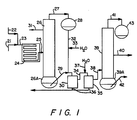
- Figure 1 is a schematic flow diagram of a system for carrying out the invention
- Figure 2 is a graphic representation illustrating the effect kettle residence time and temperature have on the stability of the isomeric mixture 2,2,4-trimethyl-1,3-pentanediol isobutyrate.
- the aldehyde is continuously fed into line 21 and joined by concentrated catalyst solution, continuously introduced via line 22, the feed rates of each maintained to obtain the desired catalyst concentration in the feed.
- the resulting mixture flows through line 23 into tubular reactor 24, which can be insulated, maintained at an elevated temperature and pressure.
- the effluent from tubular reactor 24 is conveyed via insulated line 25 into the mid-section of a multi-tray distillation column 26.
- Insulated line 25 can be equipped with heating means. Dry aldehyde is recovered as a side stream via line 31 and recycled into the system via line 21.
- Run B A commercial scale reactor constructed essentially the same as the tubular reactor described in Run A was used to catalytically react isobutyraldehyde at a temperature of 123°C ⁇ 3°C and a pressure of about 70 psig. Isobutyraldehyde was fed to the tubular reactor 24 at a liquid hourly space velocity of 0.1 hr. ⁇ 1; the catalyst was present at a concentration of approximately 0.6 mole percent based on isobutyraldehyde. The reaction was stabilized and then a fraction of the crude reaction product was removed from tubular reactor 24 at point 25 (suitably valved) and stored in a container. This crude had essentially the same composition as the crude product obtained using the tubular reactor described in Run A.
- isobutyraldehyde was condensed in a manner essentially the same as described in Example 1 and the unreacted isobutyraldehyde and water were removed at high vacuum (ca. 10 mm of Hg) and low temperature (ca. 60°C).
- This material had a 2,2,4-trimethyl-1,3-pentanediol monoisobutyrate content of 95 weight percent, 2.7 weight percent of diol, 0.3 weight percent of diester and 0.6 weight percent of isobutanol.
- the effect the residence time and temperature on diol and diester formation in distillation column kettle 26A was studied by heating samples of the material in sealed flasks at selected temperatures and time periods.
- Run A - Isobutyraldehyde was reacted to form the 2,2,4-trimethyl-1,3-pentanediol monoisobutyrates using the equipment used in Example 1 and following essentially the same reaction conditions.
- the distillation conditions and the composition of the reaction product crude recovered in kettle 26A at the bottom of the distillation column are set forth in Table III.
- the average residence time of material in kettle 26A was 15 minutes and the kettle temperature was kept at about 189°C.
- Run B For comparative purposes Run A was repeated. However, in this run the material entering the distillation column was preheated to 133°C and the kettle temperature was kept at about 208°C; residence time was also 15 minutes. Results are set forth in Table III; see footnotes to Table I for product definitions. TABLE III Run A Run B Hours 2-3 2-4 Temp., C Preheat 121 133 Kettle 189 208 Overhead 63 63 Anal. of Conc. % IBT 89.3 89.4 Diol 1.7 2.3 Diester 0.8 1.8 IBOH 0.9 0.8 IBAL 4.2 3.2
- distillation column 39 In this distillation the pressure in distillation column 39 was 100 torr and kettle 39A temperature was about 195°C ⁇ 3°C.
- Table VI shows the analysis of the fractions recovered after distillation had terminated; see footnotes to Table I for product identification.
Landscapes
- Chemical & Material Sciences (AREA)
- Organic Chemistry (AREA)
- Chemical Kinetics & Catalysis (AREA)
- Organic Low-Molecular-Weight Compounds And Preparation Thereof (AREA)
- Low-Molecular Organic Synthesis Reactions Using Catalysts (AREA)
Priority Applications (1)
| Application Number | Priority Date | Filing Date | Title |
|---|---|---|---|
| AT88119484T ATE86963T1 (de) | 1987-11-25 | 1988-11-23 | Herstellung von trisubstituierten hydroxyalkylalkanoaten aus aldehyden. |
Applications Claiming Priority (2)
| Application Number | Priority Date | Filing Date | Title |
|---|---|---|---|
| US125139 | 1987-11-25 | ||
| US07/125,139 US4883906A (en) | 1987-11-25 | 1987-11-25 | Production of trisubstituted hydroxyalkyl alkanoates from aldehydes |
Publications (3)
| Publication Number | Publication Date |
|---|---|
| EP0317977A2 true EP0317977A2 (fr) | 1989-05-31 |
| EP0317977A3 EP0317977A3 (fr) | 1991-03-20 |
| EP0317977B1 EP0317977B1 (fr) | 1993-03-17 |
Family
ID=22418360
Family Applications (1)
| Application Number | Title | Priority Date | Filing Date |
|---|---|---|---|
| EP88119484A Expired - Lifetime EP0317977B1 (fr) | 1987-11-25 | 1988-11-23 | Production d'alcanoates d'hydroxyalkyles trisubstitués à partir d'aldéhydes |
Country Status (8)
| Country | Link |
|---|---|
| US (1) | US4883906A (fr) |
| EP (1) | EP0317977B1 (fr) |
| JP (1) | JPH0627100B2 (fr) |
| AT (1) | ATE86963T1 (fr) |
| BR (1) | BR8806194A (fr) |
| CA (1) | CA1329394C (fr) |
| DE (1) | DE3879399T2 (fr) |
| ZA (1) | ZA888775B (fr) |
Families Citing this family (7)
| Publication number | Priority date | Publication date | Assignee | Title |
|---|---|---|---|---|
| US5166413A (en) * | 1988-11-02 | 1992-11-24 | Neste Oxo Aktiebolag | Process for preparation of branched 1,3-glycols and their monoesters |
| US5180847A (en) * | 1991-02-15 | 1993-01-19 | Basf Corporation | Processes for preparing 2,2,4-trimethyl-1,3-pentanediol derivatives |
| JP4048578B2 (ja) * | 1997-08-07 | 2008-02-20 | チッソ株式会社 | 塩基触媒及びカルボニル化合物誘導体の製造方法 |
| DE19956410A1 (de) * | 1999-11-24 | 2001-05-31 | Oxeno Olefinchemie Gmbh | Verfahren zur Durchführung von Aldolkondensationen |
| KR100497168B1 (ko) * | 2002-02-28 | 2005-06-23 | 주식회사 엘지화학 | 지방족 알데히드의 회수방법 및 이를 이용한2,2,4-트리메틸-1,3-펜탄디올 모노이소부티레이트의제조방법 |
| CN106471041B (zh) * | 2014-07-03 | 2019-12-20 | 科思创德国股份有限公司 | 纯化聚碳酸酯多元醇的方法及其纯化装置 |
| CN109569488B (zh) * | 2018-11-08 | 2020-12-08 | 濮阳宏业高新科技发展有限公司 | 一种连续精馏生产醇酯十二系统及其生产醇酯十二的方法 |
Family Cites Families (3)
| Publication number | Priority date | Publication date | Assignee | Title |
|---|---|---|---|---|
| US3081344A (en) * | 1961-04-24 | 1963-03-12 | Eastman Kodak Co | Preparation of esters by aldehyde condensation |
| US3718689A (en) * | 1972-02-10 | 1973-02-27 | Union Carbide Corp | Preparation of trisubstituted-hydroxyalkyl alkanoates |
| DE3447029A1 (de) * | 1984-12-22 | 1986-06-26 | Ruhrchemie Ag, 4200 Oberhausen | Verfahren zur herstellung von 2,2,4-trimethyl-1,3-pentandiolmonoisobutyrat |
-
1987
- 1987-11-25 US US07/125,139 patent/US4883906A/en not_active Expired - Lifetime
-
1988
- 1988-11-23 EP EP88119484A patent/EP0317977B1/fr not_active Expired - Lifetime
- 1988-11-23 CA CA000585588A patent/CA1329394C/fr not_active Expired - Fee Related
- 1988-11-23 AT AT88119484T patent/ATE86963T1/de not_active IP Right Cessation
- 1988-11-23 ZA ZA888775A patent/ZA888775B/xx unknown
- 1988-11-23 DE DE8888119484T patent/DE3879399T2/de not_active Expired - Fee Related
- 1988-11-24 BR BR888806194A patent/BR8806194A/pt active Search and Examination
- 1988-11-24 JP JP63294827A patent/JPH0627100B2/ja not_active Expired - Lifetime
Also Published As
| Publication number | Publication date |
|---|---|
| CA1329394C (fr) | 1994-05-10 |
| DE3879399T2 (de) | 1993-06-24 |
| DE3879399D1 (de) | 1993-04-22 |
| ZA888775B (en) | 1989-08-30 |
| JPH01186842A (ja) | 1989-07-26 |
| EP0317977B1 (fr) | 1993-03-17 |
| ATE86963T1 (de) | 1993-04-15 |
| JPH0627100B2 (ja) | 1994-04-13 |
| US4883906A (en) | 1989-11-28 |
| EP0317977A3 (fr) | 1991-03-20 |
| BR8806194A (pt) | 1989-08-15 |
Similar Documents
| Publication | Publication Date | Title |
|---|---|---|
| US5180847A (en) | Processes for preparing 2,2,4-trimethyl-1,3-pentanediol derivatives | |
| EP0005998B1 (fr) | Préparation de l'acide formique par hydrolyse du formiate de méthyle | |
| US4311851A (en) | Preparation of carboxylic acid esters with BF3 -alcohol complex catalyst | |
| EP0522368B1 (fr) | Préparation de néopentylglycol (IV) | |
| US4322564A (en) | Process for hydroformylation of olefins | |
| EP0023119B1 (fr) | Procédé de préparation d'isobutylène de pureté élevée | |
| EP0317977B1 (fr) | Production d'alcanoates d'hydroxyalkyles trisubstitués à partir d'aldéhydes | |
| EP0295361B1 (fr) | Préparation de pseudo ionones | |
| CA1057313A (fr) | Procede pour la production en continu du 2-ethylhexanol | |
| JPH0782192A (ja) | ネオペンチルグリコールの製造法 | |
| US4260813A (en) | Process for the continuous production of ethylene glycol monoethyl ether acetate | |
| EP0599883B1 (fr) | Procede en continu de preparation de 2-ethyle-2-(hydroxymethyl) hexanale et de 2-butyl-2-ethyle-1,3-propanediol | |
| US3972951A (en) | Process for the formation of 2,6-diphenyl-phenol | |
| US4262138A (en) | Preparation of carboxylic acid esters with BF3 complex catalyst | |
| US4551560A (en) | Thermally-induced hydrolysis of acetal | |
| EP0455906B1 (fr) | Récupération de l'acide acrylique et/ou de l'acrylate d'éthyle de l'acide noir | |
| JPS6115859A (ja) | アルファーベータエチレン性不飽和モノカルボン酸化合物の製造方法 | |
| EP0017441B2 (fr) | Préparation d'esters | |
| US4045500A (en) | Preparation of ethylene glycol | |
| EP0097891B1 (fr) | Procédé pour raffiner des produits bruts d'aldéhyde | |
| US4855516A (en) | Method of manufacturing 2-propyn-1-ol | |
| US4529550A (en) | Hydrolysis of anhydride in the production of C5 -C9 saturated aliphatic monocarboxylic acids | |
| EP0225738A1 (fr) | Procédé de récupération de composés utiles contenant au moins du téréphtalate de diméthyle à partir des sous-produits à haut point d'ébullition résultant de la production du téréphtalate de diméthyle | |
| EP0710640B1 (fr) | Récupération et purification de l'alcool tertiobutylique | |
| US3956074A (en) | Recovery of methylglyoxal acetal by plural stage distillation with intermediate phase separation |
Legal Events
| Date | Code | Title | Description |
|---|---|---|---|
| PUAI | Public reference made under article 153(3) epc to a published international application that has entered the european phase |
Free format text: ORIGINAL CODE: 0009012 |
|
| AK | Designated contracting states |
Kind code of ref document: A2 Designated state(s): AT BE CH DE FR GB IT LI |
|
| PUAL | Search report despatched |
Free format text: ORIGINAL CODE: 0009013 |
|
| 17P | Request for examination filed |
Effective date: 19901231 |
|
| AK | Designated contracting states |
Kind code of ref document: A3 Designated state(s): AT BE CH DE FR GB IT LI |
|
| 17Q | First examination report despatched |
Effective date: 19911129 |
|
| GRAA | (expected) grant |
Free format text: ORIGINAL CODE: 0009210 |
|
| AK | Designated contracting states |
Kind code of ref document: B1 Designated state(s): AT BE CH DE FR GB IT LI |
|
| REF | Corresponds to: |
Ref document number: 86963 Country of ref document: AT Date of ref document: 19930415 Kind code of ref document: T |
|
| ITF | It: translation for a ep patent filed | ||
| REF | Corresponds to: |
Ref document number: 3879399 Country of ref document: DE Date of ref document: 19930422 |
|
| ET | Fr: translation filed | ||
| PLBE | No opposition filed within time limit |
Free format text: ORIGINAL CODE: 0009261 |
|
| STAA | Information on the status of an ep patent application or granted ep patent |
Free format text: STATUS: NO OPPOSITION FILED WITHIN TIME LIMIT |
|
| 26N | No opposition filed | ||
| PGFP | Annual fee paid to national office [announced via postgrant information from national office to epo] |
Ref country code: CH Payment date: 19940324 Year of fee payment: 6 |
|
| PGFP | Annual fee paid to national office [announced via postgrant information from national office to epo] |
Ref country code: DE Payment date: 19940913 Year of fee payment: 7 |
|
| PGFP | Annual fee paid to national office [announced via postgrant information from national office to epo] |
Ref country code: GB Payment date: 19940919 Year of fee payment: 7 |
|
| PGFP | Annual fee paid to national office [announced via postgrant information from national office to epo] |
Ref country code: FR Payment date: 19941004 Year of fee payment: 7 |
|
| PGFP | Annual fee paid to national office [announced via postgrant information from national office to epo] |
Ref country code: AT Payment date: 19941007 Year of fee payment: 7 |
|
| PGFP | Annual fee paid to national office [announced via postgrant information from national office to epo] |
Ref country code: BE Payment date: 19941110 Year of fee payment: 7 |
|
| PG25 | Lapsed in a contracting state [announced via postgrant information from national office to epo] |
Ref country code: LI Effective date: 19941130 Ref country code: CH Effective date: 19941130 |
|
| REG | Reference to a national code |
Ref country code: CH Ref legal event code: PL |
|
| PG25 | Lapsed in a contracting state [announced via postgrant information from national office to epo] |
Ref country code: GB Effective date: 19951123 Ref country code: AT Effective date: 19951123 |
|
| PG25 | Lapsed in a contracting state [announced via postgrant information from national office to epo] |
Ref country code: BE Effective date: 19951130 |
|
| BERE | Be: lapsed |
Owner name: UNION CARBIDE CORP. Effective date: 19951130 |
|
| GBPC | Gb: european patent ceased through non-payment of renewal fee |
Effective date: 19951123 |
|
| PG25 | Lapsed in a contracting state [announced via postgrant information from national office to epo] |
Ref country code: FR Effective date: 19960731 |
|
| PG25 | Lapsed in a contracting state [announced via postgrant information from national office to epo] |
Ref country code: DE Effective date: 19960801 |
|
| REG | Reference to a national code |
Ref country code: FR Ref legal event code: ST |
|
| PG25 | Lapsed in a contracting state [announced via postgrant information from national office to epo] |
Ref country code: IT Free format text: LAPSE BECAUSE OF NON-PAYMENT OF DUE FEES;WARNING: LAPSES OF ITALIAN PATENTS WITH EFFECTIVE DATE BEFORE 2007 MAY HAVE OCCURRED AT ANY TIME BEFORE 2007. THE CORRECT EFFECTIVE DATE MAY BE DIFFERENT FROM THE ONE RECORDED. Effective date: 20051123 |