EP0317995A2 - Procédé pour préparer des articles en mousse de propylène - Google Patents
Procédé pour préparer des articles en mousse de propylène Download PDFInfo
- Publication number
- EP0317995A2 EP0317995A2 EP88119568A EP88119568A EP0317995A2 EP 0317995 A2 EP0317995 A2 EP 0317995A2 EP 88119568 A EP88119568 A EP 88119568A EP 88119568 A EP88119568 A EP 88119568A EP 0317995 A2 EP0317995 A2 EP 0317995A2
- Authority
- EP
- European Patent Office
- Prior art keywords
- particles
- pressure
- propylene resin
- mold
- expanded particles
- Prior art date
- Legal status (The legal status is an assumption and is not a legal conclusion. Google has not performed a legal analysis and makes no representation as to the accuracy of the status listed.)
- Granted
Links
Images

Classifications
-
- B—PERFORMING OPERATIONS; TRANSPORTING
- B29—WORKING OF PLASTICS; WORKING OF SUBSTANCES IN A PLASTIC STATE IN GENERAL
- B29C—SHAPING OR JOINING OF PLASTICS; SHAPING OF MATERIAL IN A PLASTIC STATE, NOT OTHERWISE PROVIDED FOR; AFTER-TREATMENT OF THE SHAPED PRODUCTS, e.g. REPAIRING
- B29C44/00—Shaping by internal pressure generated in the material, e.g. swelling or foaming ; Producing porous or cellular expanded plastics articles
- B29C44/34—Auxiliary operations
- B29C44/36—Feeding the material to be shaped
- B29C44/38—Feeding the material to be shaped into a closed space, i.e. to make articles of definite length
- B29C44/44—Feeding the material to be shaped into a closed space, i.e. to make articles of definite length in solid form
- B29C44/445—Feeding the material to be shaped into a closed space, i.e. to make articles of definite length in solid form in the form of expandable granules, particles or beads
-
- B—PERFORMING OPERATIONS; TRANSPORTING
- B29—WORKING OF PLASTICS; WORKING OF SUBSTANCES IN A PLASTIC STATE IN GENERAL
- B29C—SHAPING OR JOINING OF PLASTICS; SHAPING OF MATERIAL IN A PLASTIC STATE, NOT OTHERWISE PROVIDED FOR; AFTER-TREATMENT OF THE SHAPED PRODUCTS, e.g. REPAIRING
- B29C44/00—Shaping by internal pressure generated in the material, e.g. swelling or foaming ; Producing porous or cellular expanded plastics articles
- B29C44/34—Auxiliary operations
- B29C44/3415—Heating or cooling
- B29C44/3426—Heating by introducing steam in the mould
-
- B—PERFORMING OPERATIONS; TRANSPORTING
- B29—WORKING OF PLASTICS; WORKING OF SUBSTANCES IN A PLASTIC STATE IN GENERAL
- B29K—INDEXING SCHEME ASSOCIATED WITH SUBCLASSES B29B, B29C OR B29D, RELATING TO MOULDING MATERIALS OR TO MATERIALS FOR MOULDS, REINFORCEMENTS, FILLERS OR PREFORMED PARTS, e.g. INSERTS
- B29K2023/00—Use of polyalkenes or derivatives thereof as moulding material
- B29K2023/10—Polymers of propylene
- B29K2023/12—PP, i.e. polypropylene
Definitions
- the present invention relates to a process for preparing a foamed article from a propylene resin, and more particularly to a process for producing a foamed molding in a mold from pre-expanded particles of a propylene resin, which can be suitably used as cushioning materials or energy-absorbing materials such as core materials for bumpers of cars.
- An object of the present invention is to provide a process for preparing a foamed article having the above-mentioned excellent properties from pre-expanded particles of a propylene resin in good productivity.
- a process for preparing a foamed article from a propylene resin in a mold comprising compressing preexpanded particles of a propylene resin, filling the compressed particles into a mold and heating the particles with steam so as to fuse and bond the particles together, wherein the steam has a pressure lower than the pressure at filling the compressed pre-expanded particles.
- propylene resin used in the present invention are, for instance, propylene homopolymer, ethylene-propylene random copolymer, ethylene-propylene block copolymer, ethylene-propylene-butene random terpolymer, propylene-vinyl chloride copolymer, propylene-butene copolymer, copolymer of propylene and maleic anhydride, and the like. Among them, stereospecific polymers are preferred. These propylene resins can be used alone or in admixture thereof.
- propylene resins crosslinked by peroxide or radiation can be used.
- the propylene resins can be used in admixture with other thermoplastic resins so long as the properties of the propylene resin are not impaired.
- the other thermoplastic resins are, for instance, low density polyethylene, linear low density polyethylene, polystyrene, polybutene, an ionomer, and the like.
- the amount of the thermoplastic resin is from 5 to 20 parts by weight based on 100 parts by weight of the propylene resin.
- the propylene resin is used in admixture with polystyrene, it is preferable that the amount of the polystyrene is from 5 to 10 parts by weight based on the propylene resin.
- the propylene resin is previously molten by using an extruder, a kneader, a Banbury mixer, a roll, or the like, and is molded into particles having a desired shape such as cylinder, cylindroid, sphere, cube or rectangul parallelepiped and having an average particle diameter of 0.1 to 10 mm, preferably 0.7 to 5 mm, for easily pre-expanding.
- the terminology "average particle diameter" is intended to refer to a diameter of a sphere having a volume being equal to that of the polypropylene particle.
- the pre-expanded particles of the propylene resin used in the present invention have distinct two melting temperatures when the melting temperatures are analyzed by means of differential scanning calorimetry (hereinafter referred to as "DSC").
- the heat of fusion Q H for the peak based on the higher melting temperature is from 0.5 to 3.5 cal/g, preferably 1.0 to 3.1 cal/g.
- the present invention is not restricted by the relationship between the two melting temperatures, but it is preferable that the difference between two melting temperatures is 15° to 25°C from the viewpoint that the pre-expanded particles are easily fused together at molding in a mold.
- the difference between two melting temperatures depends on the molecular structure and heat history of the propylene resin, the amount of a blowing agent, the pressure at expanding, and the like.
- the lower melting temperature is usually within a range of 125° to 155°C and the higher melting temperature is usually within a range of 145° to 175°C.
- the two melting temperatures are varied due to the kinds of the propylene resin used.
- the pre-expanded particles can be molded to a foamed article having excellent properties required in the present invention.
- the heat of fusion for the peak based on the higher melting temperature is more than 3.5 cal/g, it is difficult to mold the pre-expanded particles in a mold since the preexpanded particles are hardly fused and bonded together.
- the heat of fusion Q H is less than 0.5 cal/g, although it is possible to mold the preexpanded particles in a mold, the obtained foamed article has a large dimensional shrinkage and the appearance is deteriorated.
- the method for preparing pre-expanded particles of a propylene resin having a heat of fusion for the peak based on the higher melting temperature Q H of 0.5 to 3.5 cal/g there is no limitation for the method for preparing pre-expanded particles of a propylene resin having a heat of fusion for the peak based on the higher melting temperature Q H of 0.5 to 3.5 cal/g, and usual methods can be applied.
- a method comprising including a volatile blowing agent into the propylene resin particles in a pressure vessel, dispersing the particles into water with stirring, heating the aqueous dispersion to a predetermined temperature under pressure and releasing the dispersion into a low pressure zone.
- the heat of fusion Q H depends on the molecular structure of the propylene resin, and in general, the higher the expansion temperature is, the smaller the heat of fusion Q H of the pre-expanded particles of the propylene resin is.
- the pre-expanded particles used in the present invention can be easily obtained.
- the expansion temperature is suitably determined in accordance with the kind of the propylene resin, amount of the blowing agent and the desired expansion ratio of pre-expanded particles.
- examples of the volatile blowing agent which is contained into the propylene resin are, for instance, aliphatic hydrocarbons such as propane, butane, pentane and hexane; alicyclic hydrocarbons such as cyclopentane and cyclobutane; halogenated hydrocarbons such as trichloromonofluoro methane, dichlorodifluoromethane, dichlorotetrafluotoethane, trichlorotrifluoroethane, methyl chloride, methylene chloride and ethyl chloride; and the like.
- the blowing agent can be used alone or in admixture thereof.
- the amount of the blowing agent is not particularly limited and is suitably decided according to the desired expansion ratio of the pre-expanded particles of the propylene resin. Usually, the amount of the blowing agent is 5 to 50 parts by weight based on 100 parts by weight of the propylene resin.
- a dispersing agent When preparing the aqueous dispersion, a dispersing agent can be used.
- the dispersing agent are, for instance, calcium tertiary phosphate, basic magnesium carbonate, basic zinc carbonate, calcium carbonate, and in addition thereto a slight amount of a surface active agent such as sodium dodecylbenzenesulfonate, sodium n-paraffinicsulfonate or sodium ⁇ -olefinsulfonate.
- the amount of the dispersing agent and the surface active agent depends on the kinds of the dispersing agent and the surface active agent and the kinds and the amounts of the propylene resin particles. Usually, the amount of the dispersing agent is from 0.2 to 3 parts by weight per 100 parts by weight of water, and the amount of the surface active agent is from 0.001 to 0.1 part by weight per 100 parts by weight of water.
- propylene resin particles containing the volatile blowing agent in an amount of 20 to 100 parts by weight per 100 parts by weight of water in order to improve the dispersibility in water.
- the aqueous dispersion After the obtained aqueous dispersion is heated under pressure, the aqueous dispersion is released from the vessel into a low pressure zone through an orifice having a hole size of 2 to 10 mm, thereby the propylene resin particles are pre-expanded to give pre-expanded particles of the resin used in the present invention.
- the aqueous dispersion is previously heated to a predetermined expansion temperature under pressure in the pressure vessel.
- the expansion temperature can not be absolutely determined since the expansion temperature depends on the kinds of the propylene resin and the desired heat of fusion Q H measured by DSC method for the peak based on the higher melting temperature of the pre-expanded particles of the resin which is selected from 0.5 to 3.5 cal/g.
- the expansion temperature mentioned above is decided from the range of about (T M + 2)°C to (T M + 10)°C, wherein T M is a melting temperature measured by DSC method.
- the expansion pressure is decided in accordance with the desired expansion ratio and is usually from 10 to 50 kg/cm2G.
- Any pressure vessel is applicable to the process of the present invention so long as the vessel satisfactorily withstands the above pressure and temperature.
- the pressure vessel are, for instance, an autoclave, and the like.
- the measurement of the melting temperature T M of the propylene resin and the heat of fusion Q H for the peak based on the higher melting temperature of the preexpanded particles is carried out by elevating a temperature at a rate of 10°C/minute with the above-mentioned apparatus with respect to the amount of 1 to 10 mg of the sample thereof.
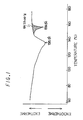
- Fig. 2 is a DSC chart of propylene-ethylene random copolymer having an ethylene content of 3.3 % by weight, which illustrates a manner to determine the melting temperature T M of the copolymer.
- Fig. 1 is a DSC chart of the pre-expanded propylene resin particles obtained in Example 7, which illustrates a manner to determine the heat of fusion Q H for the peak based on the higher melting temperature. That is, the straight line A for finding the Q H is a tangent drawn from a point where a slope of a curve between the higher peak and the lower peak is 0 toward the right shoulder of the higher peak.
- pre-expanded particles are compressed by using a pressured gas, which are filled in a mold which can be closed but can not be sealed, steam is introduced into the mold and the pre-expanded particles are fused and bonded together with adjusting the steam pressure so that the steam pressure is smaller than the inner pressure of the mold at filling (hereinafter referred to as "filling pressure") to give a foamed article having a shape almost corrsponding to the mold.
- the filling pressure depends on the diameters, kinds, the heat of fusion Q H for the peak based on the higher melting temperature of pre-expanded particles and the like, the filling pressure cannot be absolutely determined. However, it is preferable that the filling pressure is usually from 2.0 to 5.0 kg/cm2G, more preferably from 2.5 to 3.6 kg/cm2G. When the filling pressure is less than 2.0 kg/cm2G, shrinkage, sink or wrinkle easily generates on the surface of the foamed article.
- the energy therefore the cost for pre-expanding the propylene resin particles or for compressing the pre-expanded particles is increased as well as the pre-expanded particles are unsatisfactorily fused and bonded together.
- the compressed pre-expanded particles are filled in a mold, and are subjected to heating and compressing to fuse and bond together.
- steam is employed.
- the pressure of the steam is controlled so that the pressure is lower than the filling pressure.
- the steam pressure is not less than 1.8 kg/cm2G. Since the difference between the filling pressure and the steam pressure depends on the heat of fusion Q H for the peak based on the higher melting temperature, and the like, the difference can not be absolutely determined. However, it is desirable that the difference between the filling pressure and the steam pressure is not less than 0.1 kg/cm2G.
- the heating temperature and heating period of time of a mold are suitably controlled in accordance with the volume of the mold, the kinds of the pre-expanded particles, and the like.
- the heating temperature is from 116° to 152°C, more preferably from 120° to 145°C, and it is preferable that the heating time is from 7 to 30 seconds, more preferably from 8 to 20 seconds.
- the mold is opened, and a foamed article is removed from the mold.
- a foamed article having excellent surface appearence, excellent fusibility and small dimensional shrinkage can be easily prepared from the propylene resin in good productivity. Furthermore, the cost for molding can be lowered since the pressure of the compressed gas employed for compressing the pre-expanded particles can be lowered.
- a pressure vessel was charged with 100 parts of pellets of a random copolymer of ethylene and propylene (commercially available under the trade name "Noblen” made by Sumitomo Kagaku Kogyo Kabushiki Kaisha, ethylene content: 3.3 %, weight: about 1.8 mg/pellet, melting temperature TM by DSC: 143.5°C) (hereinafter referred to as "bead (A)”), pellets of a random copolymer of ethylene and propylene (commercially available under the trade name "Noblen”; ethylene content: 4.5 %, weight: about 1.8 mg/pellet, melting temperature TM by DSC: 135.5°C) (hereinafter referred to as "bead (B)”) or pellets of a block copolymer of ethylene and propylene (commercially available under the trade name "Noblen”; ethylene content: 5.0 %, weight: about 1.8 mg/pellet, melting temperature TM by DSC: 158°C) (her
- the inner pressure of the vessel was about 17 to 30 kg/cm2G.
- a valve provided at a lower part of the vessel was opened to release the aqueous dispersion from the vessel to the atmosphere through an orifice having a hole size of 4 mm ⁇ with adjusting the inner pressure of the vessel so as to be 17 to 31 kg/cm2 G by introducing dichlorodi-fluoromethane into the vessel.
- the thus obtained pre-expanded particles had an expansion ratio of 15 to 45.
- Each of the obtained pre-expanded particles had a heat of fusion Q H for the peak based on the higher melting temperature, which was determined by DSC, as shown in Table 1.
- the pre-expanded particles were filled into a pressure vessel and was compressed with air so that the pressure was equal to a filling pressure as shown in Table 1, and the compressed pre-expanded particles were filled into a block mold having a dimension of 620 mm x 920 mm x 60 mm and were heated with steam having a pressure shown in Table 1 for a period of time shown in Table 1 to give a foamed article.
- the period of time required for the one shot cycle was shown in Table 1.
- the properties of the obtained foamed articles such as expansion ratio of foamed article, compression ratio of a foamed article, fusibility, surface appearance, shrinkage and sink, and variation of dimension were measured. The results are shown in Table 1.
- the weight of a foamed article which was previously and throughly dried at room temperature was measured, and the volume of the foamed article was measured by sinking into water.
- the weight of pre-expanded particles which were filled in a mold at a pressure nearly equal to atmospheric pressure was divided by the weight of pre-expanded particles when the pre-expanded particles were compressed in the mold and then the excess gas was removed from the mold, and the compression ratio was calculated in accordance with the following formula.
- the compression ratio is less than 10%, the appearance of the surface of the obtained foamed article is deteriorated and sink or shrinkage tends to easily generate in the foamed article.
- the compression ratio is more than 60 %, the pre-expanded particles are unsatisfactorily fused and bonded together, and the period of time for one shot cycle is prolonged as well as a molding machine or a mold having a higher pressure resistance is needed.
- the surface of a foamed article was observed with naked eyes, and was evaluated according to the following criteria. ⁇ : The surface is smooth and little spaces between the particles are observed. ⁇ : The surface is smooth but spaces between the particles are slightly observed. ⁇ : The surface is uneven and there are large spaces between the particles.
- the satisfied fusibility for a foamed article was at least 60 %.
- the thickness of the thinnest part of a foamed article (theorical thickness of the foamed article: 60 mm) was measured with slide calipers. ⁇ : Not less than 60 mm ⁇ : From 58 mm to less than 60 mm ⁇ : Less than 58 mm
- Length and width of each of five samples of the foamed articles were measured at four points of width and four points of length of each sample.
- the obtained foamed articles are excellent in surface appearance and fusibility, and scarcely have shrinkage and variation of dimension.
- a foamed article having small dimensional shrinkage, excellent fusibility and excellent appearance of surface can be prepared from pre-expanded particles of a propylene resin in good productivity. Further, according to the process of the present invention, theommement cost for equipments is reduced in comparison with the conventional process comprising compressing pre-expanded particles, filling the compressed particles into a mold, and fusing and bonding the pre-expanded particles together with steam of which pressure is equal to or greater than the filling pressure. Furthermore, the quality of a foamed article prepared according to the process of the present invention are superior to that prepared in accordance with a conventional process.
Landscapes
- Manufacture Of Porous Articles, And Recovery And Treatment Of Waste Products (AREA)
- Molding Of Porous Articles (AREA)
Applications Claiming Priority (2)
| Application Number | Priority Date | Filing Date | Title |
|---|---|---|---|
| JP62297160A JPH0657435B2 (ja) | 1987-11-25 | 1987-11-25 | ポリプロピレン系樹脂の型内発泡成形法 |
| JP297160/87 | 1987-11-25 |
Publications (3)
| Publication Number | Publication Date |
|---|---|
| EP0317995A2 true EP0317995A2 (fr) | 1989-05-31 |
| EP0317995A3 EP0317995A3 (fr) | 1991-01-09 |
| EP0317995B1 EP0317995B1 (fr) | 1995-05-24 |
Family
ID=17842967
Family Applications (1)
| Application Number | Title | Priority Date | Filing Date |
|---|---|---|---|
| EP88119568A Expired - Lifetime EP0317995B1 (fr) | 1987-11-25 | 1988-11-24 | Procédé pour préparer des articles en mousse de propylène |
Country Status (3)
| Country | Link |
|---|---|
| EP (1) | EP0317995B1 (fr) |
| JP (1) | JPH0657435B2 (fr) |
| DE (1) | DE3853870T2 (fr) |
Cited By (7)
| Publication number | Priority date | Publication date | Assignee | Title |
|---|---|---|---|---|
| EP0495125A4 (en) * | 1990-08-06 | 1993-02-10 | Kanegafuchi Kagaku Kogyo Kabushiki Kaisha | Foam-molded item of olefinic synthetic resin and method of manufacturing the same |
| US5466405A (en) * | 1992-12-18 | 1995-11-14 | Gerb. Happich Gmbh | Method for the manufacture of a sun visor |
| EP0697274A3 (fr) * | 1994-08-16 | 1996-11-27 | Jsp Corp | Objet moulé par expansion avec un volume libre et procédé pour sa production |
| US6040348A (en) * | 1997-07-24 | 2000-03-21 | Solvay Poloyolefins Europe-Belgium (Societe Anonyme) | Composition based on propylene polymers for expanded granules, process for obtaining it and its use |
| US6586528B1 (en) | 2000-11-15 | 2003-07-01 | Polypropylene Belgium (Naamlose Vennootshap) | Composition based on propylene polymers and process for obtaining same |
| US6642317B1 (en) | 2000-11-15 | 2003-11-04 | Polypropylene Belgium Naamlose Vennootschap | Composition based on propylene polymers and process for obtaining same |
| EP1031602A4 (fr) * | 1998-07-30 | 2004-03-31 | Kaneka Corp | Grains de resine de polypropylene pre-expanses et procede de production d'un objet moule a partir de ces grains de resine par moussage dans le moule |
Families Citing this family (1)
| Publication number | Priority date | Publication date | Assignee | Title |
|---|---|---|---|---|
| EP2487199B1 (fr) * | 2009-10-06 | 2017-01-25 | Kaneka Corporation | Particules expansées de résine de polypropylène et corps moulé expansé dans le moule de la résine de polypropylène |
Family Cites Families (5)
| Publication number | Priority date | Publication date | Assignee | Title |
|---|---|---|---|---|
| JPS6049040A (ja) * | 1983-08-29 | 1985-03-18 | Japan Styrene Paper Co Ltd | ポリプロピレン系樹脂発泡粒子 |
| CA1254011A (fr) * | 1984-02-22 | 1989-05-16 | Japan Styrene Paper Corporation | Methode et dispositif de production d'un article en resine thermoplastique moulee-expansee |
| JPS62151325A (ja) * | 1985-12-26 | 1987-07-06 | Mitsubishi Yuka Badische Co Ltd | ポリプロピレン系樹脂発泡粒子の型内成形法 |
| US4698191A (en) * | 1986-01-31 | 1987-10-06 | Mitsubishi Yuka Badische Co., Ltd. | Methods of producing molded products from foamed polypropylene particles |
| JPS62212131A (ja) * | 1986-03-14 | 1987-09-18 | Mitsubishi Yuka Badische Co Ltd | 熱可塑性樹脂発泡粒子の型内成形法 |
-
1987
- 1987-11-25 JP JP62297160A patent/JPH0657435B2/ja not_active Expired - Lifetime
-
1988
- 1988-11-24 DE DE3853870T patent/DE3853870T2/de not_active Expired - Fee Related
- 1988-11-24 EP EP88119568A patent/EP0317995B1/fr not_active Expired - Lifetime
Cited By (8)
| Publication number | Priority date | Publication date | Assignee | Title |
|---|---|---|---|---|
| EP0495125A4 (en) * | 1990-08-06 | 1993-02-10 | Kanegafuchi Kagaku Kogyo Kabushiki Kaisha | Foam-molded item of olefinic synthetic resin and method of manufacturing the same |
| US5763023A (en) * | 1990-08-06 | 1998-06-09 | Kanegafuchi Kagaku Kogyo Kabushiki Kaisha | Expansion-molded articles of an olefin synthetic resin and manufacturing method thereof |
| US5466405A (en) * | 1992-12-18 | 1995-11-14 | Gerb. Happich Gmbh | Method for the manufacture of a sun visor |
| EP0697274A3 (fr) * | 1994-08-16 | 1996-11-27 | Jsp Corp | Objet moulé par expansion avec un volume libre et procédé pour sa production |
| US6040348A (en) * | 1997-07-24 | 2000-03-21 | Solvay Poloyolefins Europe-Belgium (Societe Anonyme) | Composition based on propylene polymers for expanded granules, process for obtaining it and its use |
| EP1031602A4 (fr) * | 1998-07-30 | 2004-03-31 | Kaneka Corp | Grains de resine de polypropylene pre-expanses et procede de production d'un objet moule a partir de ces grains de resine par moussage dans le moule |
| US6586528B1 (en) | 2000-11-15 | 2003-07-01 | Polypropylene Belgium (Naamlose Vennootshap) | Composition based on propylene polymers and process for obtaining same |
| US6642317B1 (en) | 2000-11-15 | 2003-11-04 | Polypropylene Belgium Naamlose Vennootschap | Composition based on propylene polymers and process for obtaining same |
Also Published As
| Publication number | Publication date |
|---|---|
| JPH01136726A (ja) | 1989-05-30 |
| EP0317995A3 (fr) | 1991-01-09 |
| JPH0657435B2 (ja) | 1994-08-03 |
| DE3853870D1 (de) | 1995-06-29 |
| EP0317995B1 (fr) | 1995-05-24 |
| DE3853870T2 (de) | 1995-10-12 |
Similar Documents
| Publication | Publication Date | Title |
|---|---|---|
| US4720509A (en) | Pre-expanded particles of propylene resin | |
| EP0775722B1 (fr) | Particules expansees d'homopolymere de propylene et moulages faits de ces particules | |
| EP0263989B1 (fr) | Procédé pour préparer des articles formés en mousse de polypropylène | |
| JPWO1996031558A1 (ja) | ポリプロピレン単独重合体発泡粒子及び発泡粒子成型体 | |
| US6077875A (en) | Foamed and expanded beads of polypropylene resin for molding | |
| US4861531A (en) | Process for production of expansion-molded articles in a mold of linear low density polyethylene resins | |
| EP0334313B1 (fr) | Particules mousse en résine de propylène et article en mousse formée | |
| EP0317995B1 (fr) | Procédé pour préparer des articles en mousse de propylène | |
| JP3692760B2 (ja) | ポリプロピレン系樹脂型内発泡成形体の製造方法 | |
| JP3858517B2 (ja) | ポリプロピレン系樹脂予備発泡粒子、およびその予備発泡粒子と型内発泡成形体の製造法 | |
| US6027806A (en) | Expanded resin beads | |
| JP3950557B2 (ja) | ポリプロピレン系樹脂予備発泡粒子およびそれからの型内発泡成形体の製造方法 | |
| JP3514046B2 (ja) | ポリプロピレン系樹脂予備発泡粒子 | |
| JP3461583B2 (ja) | ポリプロピレン系樹脂型内発泡成形体の製造方法 | |
| JPH0386737A (ja) | ポリオレフィン系樹脂発泡粒子の製造方法 | |
| EP4079797A1 (fr) | Perles expansées multicouches et article moulé correspondant | |
| JP2790791B2 (ja) | ポリプロピレン系樹脂型内発泡成形体の製造方法 | |
| JP2675373B2 (ja) | 自動車用バンパー芯材 | |
| JP2000319437A (ja) | ポリプロピレン系樹脂発泡粒子及びその型内発泡成形体 | |
| JPS6112735A (ja) | ポリオレフイン系樹脂予備発泡粒子 | |
| JPH07278341A (ja) | 無架橋直鎖状低密度ポリエチレン系樹脂予備発泡粒子及びその製造方法 |
Legal Events
| Date | Code | Title | Description |
|---|---|---|---|
| PUAI | Public reference made under article 153(3) epc to a published international application that has entered the european phase |
Free format text: ORIGINAL CODE: 0009012 |
|
| AK | Designated contracting states |
Kind code of ref document: A2 Designated state(s): DE FR GB |
|
| PUAL | Search report despatched |
Free format text: ORIGINAL CODE: 0009013 |
|
| AK | Designated contracting states |
Kind code of ref document: A3 Designated state(s): DE FR GB |
|
| 17P | Request for examination filed |
Effective date: 19910620 |
|
| 17Q | First examination report despatched |
Effective date: 19930329 |
|
| GRAA | (expected) grant |
Free format text: ORIGINAL CODE: 0009210 |
|
| AK | Designated contracting states |
Kind code of ref document: B1 Designated state(s): DE FR GB |
|
| REF | Corresponds to: |
Ref document number: 3853870 Country of ref document: DE Date of ref document: 19950629 |
|
| ET | Fr: translation filed | ||
| PLBE | No opposition filed within time limit |
Free format text: ORIGINAL CODE: 0009261 |
|
| STAA | Information on the status of an ep patent application or granted ep patent |
Free format text: STATUS: NO OPPOSITION FILED WITHIN TIME LIMIT |
|
| 26N | No opposition filed | ||
| PGFP | Annual fee paid to national office [announced via postgrant information from national office to epo] |
Ref country code: FR Payment date: 19971112 Year of fee payment: 10 |
|
| PGFP | Annual fee paid to national office [announced via postgrant information from national office to epo] |
Ref country code: GB Payment date: 19971117 Year of fee payment: 10 |
|
| PG25 | Lapsed in a contracting state [announced via postgrant information from national office to epo] |
Ref country code: GB Free format text: LAPSE BECAUSE OF NON-PAYMENT OF DUE FEES Effective date: 19981124 |
|
| GBPC | Gb: european patent ceased through non-payment of renewal fee |
Effective date: 19981124 |
|
| PG25 | Lapsed in a contracting state [announced via postgrant information from national office to epo] |
Ref country code: FR Free format text: LAPSE BECAUSE OF NON-PAYMENT OF DUE FEES Effective date: 19990730 |
|
| REG | Reference to a national code |
Ref country code: FR Ref legal event code: ST |
|
| PGFP | Annual fee paid to national office [announced via postgrant information from national office to epo] |
Ref country code: DE Payment date: 19991129 Year of fee payment: 12 |
|
| PG25 | Lapsed in a contracting state [announced via postgrant information from national office to epo] |
Ref country code: DE Free format text: LAPSE BECAUSE OF NON-PAYMENT OF DUE FEES Effective date: 20010801 |