EP0318009B1 - Alternateur d'automobile - Google Patents
Alternateur d'automobile Download PDFInfo
- Publication number
- EP0318009B1 EP0318009B1 EP88119604A EP88119604A EP0318009B1 EP 0318009 B1 EP0318009 B1 EP 0318009B1 EP 88119604 A EP88119604 A EP 88119604A EP 88119604 A EP88119604 A EP 88119604A EP 0318009 B1 EP0318009 B1 EP 0318009B1
- Authority
- EP
- European Patent Office
- Prior art keywords
- brush holder
- projections
- cover
- cover body
- recesses
- Prior art date
- Legal status (The legal status is an assumption and is not a legal conclusion. Google has not performed a legal analysis and makes no representation as to the accuracy of the status listed.)
- Expired - Lifetime
Links
- 230000004323 axial length Effects 0.000 claims description 9
- 229920005992 thermoplastic resin Polymers 0.000 claims description 2
- XLYOFNOQVPJJNP-UHFFFAOYSA-N water Substances O XLYOFNOQVPJJNP-UHFFFAOYSA-N 0.000 description 10
- 229920001971 elastomer Polymers 0.000 description 9
- 230000001681 protective effect Effects 0.000 description 9
- 239000005060 rubber Substances 0.000 description 9
- 238000004458 analytical method Methods 0.000 description 4
- 230000006835 compression Effects 0.000 description 4
- 238000007906 compression Methods 0.000 description 4
- 230000000694 effects Effects 0.000 description 4
- 210000000078 claw Anatomy 0.000 description 3
- 238000001816 cooling Methods 0.000 description 3
- 230000003247 decreasing effect Effects 0.000 description 3
- 238000010438 heat treatment Methods 0.000 description 3
- 239000000463 material Substances 0.000 description 3
- 229910052751 metal Inorganic materials 0.000 description 3
- 239000002184 metal Substances 0.000 description 3
- OKTJSMMVPCPJKN-UHFFFAOYSA-N Carbon Chemical compound [C] OKTJSMMVPCPJKN-UHFFFAOYSA-N 0.000 description 2
- 229910002804 graphite Inorganic materials 0.000 description 2
- 239000010439 graphite Substances 0.000 description 2
- 230000009545 invasion Effects 0.000 description 2
- 238000002844 melting Methods 0.000 description 2
- 230000008018 melting Effects 0.000 description 2
- 238000000465 moulding Methods 0.000 description 2
- 239000004033 plastic Substances 0.000 description 2
- 229920003002 synthetic resin Polymers 0.000 description 2
- 239000000057 synthetic resin Substances 0.000 description 2
- 229910000838 Al alloy Inorganic materials 0.000 description 1
- RYGMFSIKBFXOCR-UHFFFAOYSA-N Copper Chemical compound [Cu] RYGMFSIKBFXOCR-UHFFFAOYSA-N 0.000 description 1
- 239000004677 Nylon Substances 0.000 description 1
- 238000010521 absorption reaction Methods 0.000 description 1
- 229910052782 aluminium Inorganic materials 0.000 description 1
- XAGFODPZIPBFFR-UHFFFAOYSA-N aluminium Chemical compound [Al] XAGFODPZIPBFFR-UHFFFAOYSA-N 0.000 description 1
- 230000000295 complement effect Effects 0.000 description 1
- 229910052802 copper Inorganic materials 0.000 description 1
- 239000010949 copper Substances 0.000 description 1
- 230000001419 dependent effect Effects 0.000 description 1
- 230000000994 depressogenic effect Effects 0.000 description 1
- 238000011161 development Methods 0.000 description 1
- 230000018109 developmental process Effects 0.000 description 1
- 238000004512 die casting Methods 0.000 description 1
- 239000000428 dust Substances 0.000 description 1
- 230000033001 locomotion Effects 0.000 description 1
- 238000004519 manufacturing process Methods 0.000 description 1
- 238000010137 moulding (plastic) Methods 0.000 description 1
- 229920001778 nylon Polymers 0.000 description 1
- 230000002093 peripheral effect Effects 0.000 description 1
- 238000007789 sealing Methods 0.000 description 1
- 229920002379 silicone rubber Polymers 0.000 description 1
- 239000004945 silicone rubber Substances 0.000 description 1
- 239000010935 stainless steel Substances 0.000 description 1
- 229910001220 stainless steel Inorganic materials 0.000 description 1
Images


Classifications
-
- H—ELECTRICITY
- H02—GENERATION; CONVERSION OR DISTRIBUTION OF ELECTRIC POWER
- H02K—DYNAMO-ELECTRIC MACHINES
- H02K5/00—Casings; Enclosures; Supports
- H02K5/04—Casings or enclosures characterised by the shape, form or construction thereof
- H02K5/14—Means for supporting or protecting brushes or brush holders
- H02K5/141—Means for supporting or protecting brushes or brush holders for cooperation with slip-rings
Definitions
- the present invention relates to an automotive alternator according to the preamble of claim 1.
- a generic automotive alternator is disclosed in the JP-A-59 169 350.
- This known alternator comprises slip rings provided at one end of a rotary shaft and brushes being is sliding contact with the slip rings.
- the brushes extend through an opening of a substantially cylindrical cover body into receiving portions of a brush holder.
- the brush holder and the cover body are engagable via recesses and/or projections.
- the conventional alternator is possibly not enough sealed, so that operation could be disturbed under some operating conditions.
- the seal rubber includes a seal portion for covering axial end faces of the slip ring cover and the brush holder and another seal portion to be inserted between the slip ring cover and the brush holder.
- These seal portions are formed integrally with each other as shown in, for example, the drawings of Japanese Utility Model Unexamined Publication 58-51663.
- the brush holder is positioned on the rear frame of the alternator with the seal portion of the seal rubber interposed between the brush holder and the slip ring cover. Subsequently, the other portion of the seal rubber is pressed in the axial direction of the alternator by fixing the rear cover for covering the brush portion and its neighborhood to the rear frame, thereby performing the seal of the brush portion in the radial and axial directions thereof.
- the essential advantage of the automotive alternator according to the invention lies in that a protective structure for performing the seal needs only a compression force in the axial direction of the alternator.
- the cover body and the seal members are assembled while being pressed in axial direction toward the frame by the rear cover.
- the present invention is based upon an inventive concept that a slip ring cover is formed independently of a rear frame of an alternator and is engaged with a brush holder to thereby perform the radial seal of them, whereas seal members are provided for performing the axial seal between the contact surfaces of the rear frame and the slip ring cover and the seal of the other axial end face of the slip ring cover.
- a semicylindrical slip ring cover portion 501 is formed integrally with a rear frame 502 of a generator by means of aluminum die casting or the like.
- a seal rubber includes a seal portion 505 for covering axial end faces of the slip ring cover portion 501 and a brush holder 503 and another seal portion 506 extending from the portion 505 downwardly in the axial direction of the alternator.
- the seal portion 505 is inserted between the end face of the slip ring cover portion 501 and a rear cover of the alternator, and is pressed by the rear cover in the axial direction to seal the shaft end portion.
- the other seal portion 506 is interposed between the slip ring cover portion 501 and the brush holder 503, and the brush holder 503 is pressed in a radial direction of the alternator to seal portions of the brush holder 503 around an opening thereof for the brushes.
- the seal portions 505 and 506 have to seal the structure at the same time in the axial and radial directions, respectively, the seal effects at corners 507 and 508 might not be ensured due to variations in size of the component parts of the structure or variations in position of the brushes, the seal rubber or the like when fixed in place.
- the conventional structure would suffer from such a problem that oil or the like enter, in particular, through these corners into the structure to cause the brush, the slip ring and the like to be worn abnormally.
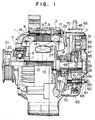
- a stator 4 is mounted on an inner circumferential portion of the front frame 1.
- the stator 4 is composed of a stator core 5 and a stator coil wound around the stator core 5 as well known in the art.
- bearing boxes 7 and 8 In the central portions of side walls of the frames 1 and 2, there are integrally provided cylindrical bearing boxes 7 and 8 each of which projects inwardly of the alternator. Bearings 9 and 10 are mounted in the bearing boxes 7 and 8, respectively and are adapted to rotatably support a shaft 11.
- a rotor core is fixed to the shaft 11 so that the rotor core is located within the stator 4.
- the rotor core has a pair of pole cores 12 and 13 each of which are provided with a plurality of claw portions and which are assembled together such that the claw portions thereof are engaged with each other.
- a rotor coil 14 is clamped between the claw portions of the pole cores 12 and 13.
- Centrifugal cooling fans 16 and 17 made of metal are fixed to the side faces of the pole cores 12 and 13 coaxialy with the shaft 11, respectively. Blades of the fans 16 and 17 are directed toward the outside with respect to the pole cores 12 and 13. Also, the fan 16 is of a slant flow type which has the blades directed in the rotational direction of the rotor in order to blow the air into the pole cores 12 and 13 to cool the rotor coil 14.
- a pulley 21 is mounted by a nut 22 on an end portion of the shaft 11 that projects outwardly from the front frame 1.
- An engine of a motor vehicle is drivingly connected to the shaft 11 through the pulley and a V-belt (not shown).
- Slip rings 25 and 26 made of copper or stainless steel are attached to the other end portion of the shaft 11 that projects outwardly from the rear frame 2. The slip rings are electrically connected to the rotor coil 14 through wires 27.
- a pair of brushes 45 and 46 made of electric graphite or metal graphite there are arranged a pair of brushes 45 and 46 made of electric graphite or metal graphite, a brush holder 30 for holding these brushes and pigtails connected to the brushes, a cover member, i.e., slip ring cover 50 for covering the slip rings along with the brush holder, and other components such as rectifier 62 and an IC regulator 65.
- a rear cover 63 which is mounted onto the rear frame 2 by a plurality of bolts 61.
- the brushes 45 and 46 are pressed against the slip rings 25 and 26 by brush springs 47 and 48 received in the brush holder 30, and are brought into sliding contact with outer surfaces of the slip rings 25 and 26 as the slip rings are rotated.
- the brush holder 30 and the slip ring cover 50 are assembled together to form a one-piece unit for covering the slip rings 25 and 26, and when the rear cover 63 is fixed, are pressed against the rear frame 2 through seal members 70 and 71 which are made of rubber and arranged on opposite end faces, in the axial direction of the shaft 11, of the brush holder 30 and the slip ring cover 50.
- a body of the brush holder 30 is made of synthetic resin, and is substantially box-shaped with an enlarged portion at one end thereof on the slip ring cover side as shown in Figs. 2, 3 and 7.
- the body of the brush holder 30 has first receiving portions 31 for receiving the brushes 45 and 46 and second receiving portions 32 for receiving the pigtails 49.
- the brush holder 30 is molded with a plus terminal 33 and a minus terminal 34 that are made of metal plates and are projected from opposite circumferential side walls 30a and 30b of the brush holder, respectively. These plus and minus terminals have holes perforated for mounting the brush holder 30 on the alternator.
- the enlarged portion of the body of the brush holder 30 has a front surface curved along the circumferential surfaces of the slip rings 25 and 26.
- the first and second receiving portions 31 and 32 are opened in the curved surface of the enlarged portion.
- recesses 35 and 36 are formed in the enlarged body portion close to the circumferentially opposite ends of the curved surface thereof, respectively.
- Each of the recesses 35 and 36 has a substantially rectangular cross section and extends in the axial direction over the entire length of the enlarged portion.
- Four shallow grooves 37 each extending in the axial direction are formed inside the recesses 35 and 36 in the curved surface of the brush holder body.
- a step 30C1 is formed in one of the axial end faces of the brush holder 30 as shown in Fig. 2, so that the axial end face of the enlarged body portion is at a higher level than the other end face 30C of the brush holder.
- a first small projection 38 having a height of about 0.5 mm is formed on the raised end face of the enlarged body portion.
- the small projection 38 consists of a pair of projected portions 38a, 38a, each of which has a U-shape for surrounding the axial end of the recess 35 or 36, and an arcuate projected portion 38b for connecting these projected portions 38a, 38a.
- a slightly raised flat land 40 is formed on the other axial end face 30d of the brush holder 30 as shown in Fig. 3.
- the flat land 40 has an area that is about two thirds of the overall area of the end face 30d.
- a second small projection 39 consisting of a pair of projected portions 39a, 39a and an arcuate projected portion 39b is provided on the flat land in the same manner as in the opposite side end face of the brush holder.
- a pair of detents 41 or 42 spaced from each other in the axial direction are formed on each of the circumferential sides of the enlarged body portion of the brush holder 30.
- the brushes 45 and 46 are received in the first receiving portions 31 of the brush holder 30 together with the brush springs 47 and 48, respectively.
- the pigtails 49 are received in the second receiving portions 32 with their ends being soldered to the terminals 33 and 34, thereby preventing the brushes 45 and 46 from falling out of the holder and at the same time electrically connecting the brushes 45 and 46 to the terminals 33 and 34, respectively.
- the slip ring cover 50 serves as a cover member for covering and protecting the slip rings 25 and 26 of the shaft 11, and are made of thermoplastic resin such as nylon or the like.
- the slip ring cover 50 comprises a cylindrical portion 52 which is provided at its side with an opening 51 for passage of the brushes 45 and 46, and which covers the slip rings 25 and 26 through about three quarters of the entire circumference thereof.
- Projections 53 and 54 each extending in the axial direction are formed at both the side edges of the cylindrical portion 52 so as to engage with the recesses 35 and 36 of the brush holder 30. As shown in Fig.
- each of the projections 53 and 54 is composed of a pair of projected segments 53a, 53b or 54a, 54b that have a relatively small thickness and that are arranged in a V-shape.
- Projections 55 of hook-like cross-section are formed on the outsides of the projections 53 and 54 of the cylindrical portion 55, respectively. These projections 55 are to be engaged with the projections 41, 42 of the brush holder 30 when the slip ring cover 50 and the brush holder 30 are coupled to each other.
- a retaining portion as indicated by reference numeral 56 in Fig. 7, which is brought into abutment with the detent 41 or 42 of the brush holder 30 for limiting the axial movement of the slip ring cover 50.
- Inner portions 57, 57 of the projections 53 and 54 of the slip ring cover 50 are made flat to conformity with the inner surfaces of the recesses 35 and 36 of the brush holder 30, thereby facilitating the engagement with the brush holder 30. Also, a plurality of rod-like projections 58 each extending in the axial direction are formed on the inner circumferential wall of the cylindrical portion 52.
- a small projection 59 or 60 having a height of about 0.5 mm and a width of about 0.5 mm is integrally framed on and along each axial end face 52a of the cylindrical portion 52 in the same manner as the small projections 38 and 39 of the brush holder 30. Also, the projections 53 and 54 are projected by about 0.5 mm from both the end faces 52a and are continuous with the small projections 59 and 60, respectively.
- each projection 53 or 54 is somewhat larger than the width b of each recess 35 or 36 of the brush holder 30. Also, a distance c between a distal end of each hook-like projection 55 and the tip end of the associated projection 53 or 54 is set to be slightly larger than a distance d between the bottom of each recess 35 or 36 and the end of the associated detect 41 or 42.
- the thus constracted brush holder 30 and slip ring cover 50 are assembled together in the following manner. First of all, as indicated by an arrow in Fig. 7, the respective projections 53 and 54 of the cover 50 are inserted into the recesses 35 and 36 of the brush holder 30. At the same time, the projections 55 of the cover 50 ride over the detects 41 and 42 of the brush holder 30. In this case, since the width a is larger than the width b as described above, the cover 50 is pressingly inserted into the holder 30.
- the distance c is larger than the distance d , when the projection segments 53a, 53b, 54a and 54b are inserted into the recesses 35 and 36 of the brush holder 30, respectively, the tip ends of the projection segments 53a, 53b, 54a and 54b are pressingly fitted to the corner portions of the bottoms of the recesses 35 and 36 at a predetermined pressure.
- the posture of the cover 50 relative to the brush holder 30 is kept accurate or exact.
- the retaining portions 56 of the hook-like projections 55 are brought into contact with end faces of the detents 41 and 42, thereby performing the positioning between the brush holder 30 and the cover 50.
- the axial length of the brush holder 30 is substantially coincident with that of the cover 50.
- the height of the first small projection 38 of the brush holder 30 is substantially the same as that of the small projection 59 of the cover 50, and the height of the second small projection 39 of the brush holder 30 is substantially the same as that of the small projection 60 of the cover 50.
- a seat 2b against which pressed are the brush holder 30 and the cover 50 is formed around a central hole 2a of the rear frame 2 through which the shaft 11 is to be passed.
- Fig. 11 shows a first seal member 70 which is to be interposed between the rear frame 2 and the brush holder 30 and cover 50 assembly.
- the seal member 70 is made of foamed silicone rubber, and is composed of an annular portion 70a that is to be brought into contact with one axial end face 52a of the cover and a rectangular portion 70b that is to be brought into contact with the flat land 40 of the brush holder 30.
- a second seal member 71 to be interposed between the rear cover 63 and the assembly of the brush holder 30 and the cover 50 is shown in Fig. 12.
- the second seal member 71 is also formed of rubber.
- the second seal member 71 is composed of a bottomed cylindrical portion 71a for covering the end portion of the shaft 11, a circumferential groove 71b against which contacted are the first small projection 38 of the brush holder and the other end face 52a of the cover 50, a passage 71c for connecting the inside and outside of the cylindrical portion 71a as indicated by dotted lines in Fig. 12, and a cover portion 71d for covering the passage 71c and an outlet 71C1 thereof.
- Fig. 13 shows the second seal member 71 in the state of having been mounted on the brush holder 30 and the cover 50.
- the axial opening of the cover 50 is covered by the cylindrical portion 71a of the seal member 71.
- the groove 71b of the seal member 71 is engaged with lhe step 30C1 of the brush holder 30.
- the inside and outside of the cover 50 are in communication with each other through the passage 71c of the seal member 71.
- the entrainment or invasion of water, oil or the like into the passage 71c may be prevented by the cover portion 71d.
- the rectifier 61 is first positioned in place on the rear frame 2.
- the IC regulator 65 is fastened on the rectifier 62 by bolts 64.
- the seal member 70 is positioned on the seat 2b of the rear frame 2.
- the brush holder 30 assembled with the cover 50 are fastened at the plus and minus terminals 33 and 34 to the rectifier 62 and the IC regulator 65 by screws 68, respectively.
- the rectifier 62 serves to rectify the output current of the stator coil 6, and is composed of a plurality of diodes 66 and cooling fins 67.
- the IC regulator 65 serves to control the output voltage of the alternator by adjusting an excited current to the rotor coil 14.
- the second seal member 71 is positioned on the brush holder 30 and the slip ring cover 50, and subsequently, the rear cover 63 provided with cooling air absorption holes 63a (see Fig. 10) is mounted thereover.
- the rear cover 63 is fastened together with the rectifier 62 to the rear frame 2 by the bolts 61 and nuts 69.
- the rear cover 63 presses the second seal member 71 in the axial direction, and further presses the first seal member 70 through the brush holder 30 and the cover 50.
- the first seal member 70 is elastically deformed between the seat 2b of the rear frame 2 and the flat land 40 of the brush holder 30 and the axial end face 52a of the cover 50, and are in intimate contact with these components to seal the same.
- a difference in level between the small projection 60 of the cover 50 and the brush holder 30 is decreased by providing the flat land 40 on the brush holder 30, it is possible to decrease the slat between the brush holder 30 and the cover 50 to enhance the seal effect when the brush holder 30 and the cover 50 are positioned on the seat 2b of the rear frame 2 through the first seal member 70.
- the second seal member 71 is interposed between the brush holder 30 and cover 50 and a seat 63b (see Fig. 10) provided on the rear cover 63 to seal the former.
- first and second small projections 38 and 39 and the small projections 59 and 60 are formed on the respective axial end faces of the brush holder 30 and the cover 50, whereby these projections 38, 39, 59 and 60 are pressed against the first and second seal rubbers 70 and 71 to thereby prevent oil or water from entering into the cylindrical portion 52 of the cover 50 without fail.
- the thin plate-like projections 53a, 53b, 54a and 54b formed in the cover 50 are engaged with the recesses 35 and 36 of the brush holder 30 at a predetermined pressure, even if oil or water enters through gaps between the hook-like projections 55 and the brush holder 30, it is possible to reliably prevent the oil or water from entering into the space wherein the brushes 45 and 46 and so forth lie, by the thin plate-like projections 53a, 53b, 54a and 54.
- the pairs of detents 41 and 42 are spaced from each other without facing the plus and minus terminals 33 and 34, whereby the brush holder 30 may be insert-molded in a two-divided manner in the direction indicated by the arrow A in Fig. 5. Therefore, it is very easy to form the brush holder 30.
- the cover 50 is shaped as shown in Fig. 6 and it is possible to injection-mold the cover 50 in a two-divided manner in the direction perpendicular to the paper surface of this figure, it is easy to form the cover 50 as is in the case of forming the brush holder.
- the projections 53 and 54 are formed on the cover 50 and the recesses 35 and 36 are formed in the brush holder 30, it is apparent that the recesses may be formed in the cover and the projections may be formed on the brush holder to bring the same effect.
- the projections 53 or 54 are formed of the two projection segments 53a, 53b or 54a, 54b.
- the number of the projection segments may be one or three or more.
- Automotive alternators in accordance with second and third embodiments of the invention will now be described with reference to Figs. 14 to 16.
- the structure of the first embodiment may be equally applied to those of the second and third embodiments except for the brush holder and the slip ring cover.
- the description will be made only on the difference between the second or third embodiment and the first embodiment, and the same reference numerals as used in the foregoing description on the first embodiment will be used to indicate the like components or parts of the second and third embodiments.
- the brush holder and the slip ring cover of synthetic resin in view of the manufacture cost and difficulty.
- the plastic molded parts may have small dimensional variations relative to desired dimensions due to the molding condition, the difference in molding dies or the like.
- the axial length h1 of the recess 35 or 36 of the brush holder 30 and the axial length h2 of the projection 53 or 54 of the slip ring cover 50 would not be the same. Accordingly, when the recesses 35 and 36 of the brush holder 30 are engaged with the projections 53 and 54 of the slip ring cover 50, there would be produced a step ⁇ h3 of, for example, about 0.4 mm in the axial direction.
- a slip ring cover 150 is dimensioned so that a length of the cylindrical portion 152 including small projections 159 and 160 formed on axially opposite end faces of the cylindrical portion 152, i.e., an axial length H1 of the V-shaped projections formed on both side edges of the cylindrical portion 152 is somewhat longer than the axial length H2 of the brush holder 30 including the small projections 38 and 39 by, for example, about 0.4 mm. Therefore, when the projections of the slip ring cover 150 are inserted into the recesses 35 and 36 of the brush holder 30, there is a difference ⁇ H3 in length therebetween.
- the projections of the slip ring cover 150 are inserted into the recesses 35 and 36 of the brush holder 30 so as to couple the two components in the same manner as in the foregoing embodiment.
- the small projection 159 or 160 of the slip ring cover 150 projected by ⁇ H3 from the projection 38 or 39 of the brush holder 30 is modified or shaved by means of a heat treatment so that the connection of the small projection of the slip ring cover with that of the brush holder is smoothed.
- the opposite axial end faces are made substantially flat when the brush holder 30 and the slip ring cover 150 are coupled to each other. It will be understood that, if the slip ring cover 150 is made of material having a lower melting point than that of the material of the brush holder 30, the heat treatment after the assembling is facilitated.
- the axial length of the recesses 35 and 36 of the brush holder 30 may be somewhat longer than the axial length of the projections of the slip ring cover 150, so that the step ⁇ H3 is made smooth by heat treatment of the axially projected portions of the brush holder corresponding to the recesses 35 and 36.
- the brush holder 30 is preferably made of plastic material having a lower melting point than that of the slip ring cover 150.
- An automotive alternator according to the third embodiment is different from the second embodiment in dimension of the engagement portions formed in the brush holder and the slip ring cover of the protective structure.
- a recess 235 formed in the end of an enlarged body portion of a brush holder 230 has a width f and a depth h which are gradually decreased toward the axially inside, i.e., in the upper direction in Fig. 16.
- a V-shaped projection 253 provided at the side edge of a cylindrical portion 252 of a slip cover 250 is formed so that its width e and height g from a tip end of an hook-like projection 255 are gradually decreased in complementary relation with the shape of the associated recess 235.
- the widths and the heights of the recess 235 of the brush holder and the projection 253 of the slip cover are so selected that, upon the completion of the engagement therebetween, the end tips of the projection 253 are held in close contact with the bottom corners of the recess portions 235 at a predetermined pressure.
- the other recess of the brush holder and the other projection of the slip ring cover are formed in the same manner.
- the cover body for covering the slip rings is coupled to the brush holder with the axial projections and recesses of the slip ring cover and the brush holder being engaged in close contact with each other.
- the cover body and the brush holder are completely sealed by the engagement of the projections and the recesses.
- the brush holder on which the cover body is mounted is fastened to the alternator body through the first and second seal members while being subjected to an axial compression.
- the rear end of the cover body is pressed in the axial direction by the rear cover.
- the seal members which are disposed on the opposite end faces of the cover body, to be elastically deformed and held in intimate contact with the rear frame, the brush holder and the like, the axially opposite end faces of the cover body may be completely sealed.
- the seal of the structure may be completely performed only by the axial compression when the brush holder and the cover body are mounted on the alternator. It is possible to ensure the seal around the slip rings independently of the assembling precision.
- An automotive AC generator or alternator has a protective structure (30, 50, 70, 71) for fluid-tightly closing a brush unit and its associated components to thereby prevent water or oil from entering thereinto.
- the protective structure includes a brush holder (30) for encasing brushes (45, 46) and a slip ring cover (50) for covering slip rings (25, 26).
- the brush holder and the cover are coupled to each other with axial recesses being engaged with associated projections.
- the thus coupled brush holder and slip ring are fixed while being pressed in the axial direction toward a rear frame (2) of the alternator by a rear cover (63) thereof with a seal member (70) interposed between axial end faces of the brush holder and slip ring cover and the rear frame and with another seal member (71) interposed between the other axial end faces of the brush holder and slip ring cover and the rear cover (63).
Landscapes
- Engineering & Computer Science (AREA)
- Power Engineering (AREA)
- Motor Or Generator Current Collectors (AREA)
- Motor Or Generator Frames (AREA)
Claims (8)
- Alternateur d'automobile comprenant: un rotor autour duquel est enroulée une bobine de rotor (14), le rotor comprenant un arbre rotatif (11) adapté à être entraîné par un moteur d'automobile; un châssis (2) pour loger le rotor; des bagues collectrices (25, 26) prévues à une extrémité de l'arbre rotatif (11) et reliées électriquement à la bobine (14) du rotor; un porte-balais (30; 230) comprenant des portions de réception (31) pour recevoir des balais (45, 46) qui sont en contact glissant avec les bagues collectrices (25, 26); un corps de couvercle (50; 150; 250) dont un côté comprend une ouverture par laquelle s'étendent les balais (45, 46), le corps de couvercle (50; 150; 250) étant disposé autour d'un périphérie externe des bagues collectrices (25, 26) pour recouvrir les bagues collectrices (25, 26) en coopération avec le porte-balais (30; 230), dans lequel le porte-balais (30; 230) comprend une paire d'évidements ou de saillies (35, 36; 235) s'étendant dans la direction axiale de l'arbre rotatif (11) et formés respectivement sur les deux côtés desdites portions de réception (31), ledit corps de couvercle (50; 150; 250) comprend une portion cylindrique (52; 252), des éléments d'étanchéité (70, 71) sont interposés, respectivement, entre ledit châssis (2) et ledit porte-balais (30; 230) et le corps de couvercle (50; 150; 250) et entre ledit porte-balais (30; 230) et le corps de couvercle (50; 150; 250) et un couvercle arrière 63), dans lequel ledit porte-balais (30; 230) et ledit corps de couvercle (50; 150; 250) sont serrés entre ledit châssis (2) et ledit couvercle arrière (63) par l'intermédiaire desdits éléments d'étanchéité (70, 71) pour être maintenus en place.
- Alternateur d'automobile selon la revendication 1, caractérisé en ce que lesdites saillies (35, 36; 53, 54; 235; 253) formées sur ledit porte-balais (30; 230) ou ledit corps de couvercle (50; 150; 250) sont formées par des éléments minces et déformables (53a, 53b, 54a, 54b).
- Alternateur d'automobile selon la revendication 2, caractérisé en ce que chacune desdites saillies (53, 54; 253) dudit corps de couvercle (50; 150; 250) est en forme de fourche à une extrémité (53a, 53b, 54a, 54b) de manière à venir en contact intime avec deux portions de coin du fond de chaque évidement (35, 36; 235) dudit porte-balais (30; 230), lesquels évidements sont de section rectangulaire.
- Alternateur d'automobile selon la revendicatlon 2, caractérisé en ce que de petites saillies (38, 39, 59, 60; 159, 160) sont respectivement formées sur les faces d'extrémité axiales (52a) dudit corps de couvercle (50; 150; 250) et sur des faces d'extrémité axiales dudit porte-balais (30; 230), ledit corps de couvercle et ledit porte-balais sont amenés en contact avec lesdits éléments d'étanchéité (70, 71, respectivement, par les faces d'extrémité axiales, et lesdites petites saillies forment des boucles fermées dans leur ensemble quand ledit corps de couvercle et ledit porte-balais sont accouplés l'un à l'autre.
- Alternateur d'automobile selon la revendication 4, caractérisé en ce que des gorges axiales (37) sont formées entre lesdits évidements ou lesdites saillies (35, 36; 235) dudit porte-balais (30; 230) et desdites portions de réception (31) de ces dernières.
- Alternateur d'automobile selon la revendication 4, caractérisé en ce qu'un évidement (2b) est formé sur la surface latérale externe dudit châssis (2) pour recevoir ledit porte-balais (30; 230); une zone plate surélevée (40) dont la hauteur est inférieure à la hauteur desdites petites saillies (39) est formée sur une surface latérale (30d) dudit porte-balais qui est face audit évidement (2b) dudit châssis, et l'un (70) desdits éléments d'étanchéité est pressé entre ledit évidement (2b) dudit châssis et ladite zone plate surélevée (40) dudit porte-balais et la surface latérale axiale dudit corps de couvercle.
- Alternateur d'automobile selon la revendication 1, caractérisé en ce que des saillies d'arrêt (41, 42) sont prévues sur les deux surfaces latérales axiales dudit porte-balais, et ladite portion cylindrique comprend des saillies en forme de crochets (55; 255) pour amener lesdites saillies et lesdits évidements en contact intime les uns avec les autres.
- Alternateur d'automobile selon la revendication 1, caractérisé en ce que l'un parmi lesdits évidements ou saillies (35, 36; 235) et lesdites portions d'engagement (53, 54; 253) a une longueur axiale plus longue que l'autre avec un gradin prédéterminé (ΔH3) entre eux, et l'un au moins d'entre eux est réalisé en résine thermoplastique, pour permettre de lisser le gradin (ΔH3).
Applications Claiming Priority (4)
| Application Number | Priority Date | Filing Date | Title |
|---|---|---|---|
| JP29689487A JPH01138952A (ja) | 1987-11-25 | 1987-11-25 | 車両用交流発電機 |
| JP296894/87 | 1987-11-25 | ||
| JP63103408A JPH0732571B2 (ja) | 1988-04-26 | 1988-04-26 | 交流発電機の製造方法 |
| JP103408/88 | 1988-04-26 |
Publications (3)
| Publication Number | Publication Date |
|---|---|
| EP0318009A2 EP0318009A2 (fr) | 1989-05-31 |
| EP0318009A3 EP0318009A3 (en) | 1989-11-15 |
| EP0318009B1 true EP0318009B1 (fr) | 1994-03-09 |
Family
ID=26444047
Family Applications (1)
| Application Number | Title | Priority Date | Filing Date |
|---|---|---|---|
| EP88119604A Expired - Lifetime EP0318009B1 (fr) | 1987-11-25 | 1988-11-24 | Alternateur d'automobile |
Country Status (3)
| Country | Link |
|---|---|
| US (1) | US4959576A (fr) |
| EP (1) | EP0318009B1 (fr) |
| DE (1) | DE3888295T2 (fr) |
Cited By (1)
| Publication number | Priority date | Publication date | Assignee | Title |
|---|---|---|---|---|
| DE10361860A1 (de) * | 2003-12-30 | 2005-07-28 | Robert Bosch Gmbh | Schutzkappe, insbesondere für einen Drehstromgenerator |
Families Citing this family (40)
| Publication number | Priority date | Publication date | Assignee | Title |
|---|---|---|---|---|
| JP2752297B2 (ja) * | 1992-06-23 | 1998-05-18 | 株式会社日立製作所 | 車両用交流発電機 |
| US5268605A (en) * | 1993-03-29 | 1993-12-07 | General Motors Corporation | Electrical field connection |
| US5296772A (en) * | 1993-04-05 | 1994-03-22 | General Motors Corporation | Ventilated brush holder |
| FR2732831B1 (fr) * | 1995-04-06 | 1997-06-20 | Valeo Equip Electr Moteur | Porte-balais pour alternateur de vehicule automobile |
| FR2732830B1 (fr) * | 1995-04-06 | 1997-06-20 | Valeo Equip Electr Moteur | Porte-balais pour alternateur de vehicule automobile |
| EP0762614A3 (fr) * | 1995-09-06 | 1998-05-13 | Denso Corporation | Alternateur |
| DE19802303C1 (de) * | 1998-01-22 | 1999-07-29 | Bosch Gmbh Robert | Elektrische Maschine |
| GB9814690D0 (en) * | 1998-07-08 | 1998-09-02 | Johnson Electric Sa | Dust guard |
| JP3911879B2 (ja) | 1998-11-02 | 2007-05-09 | 株式会社デンソー | 車両用交流発電機 |
| JP3420952B2 (ja) * | 1998-11-27 | 2003-06-30 | 三菱電機株式会社 | 車両用交流発電機 |
| JP4003334B2 (ja) | 1999-02-04 | 2007-11-07 | 株式会社デンソー | 車両用交流発電機 |
| US6215211B1 (en) * | 1999-05-10 | 2001-04-10 | Visteon Global Technologies, Inc. | Alternator bearing sleeve, brush holder, and cap system |
| KR100333167B1 (ko) * | 2000-04-27 | 2002-04-18 | 에릭 발리베 | 차량용 알티네이터의 화염차단구조 |
| JP3685392B2 (ja) * | 2001-02-06 | 2005-08-17 | 三菱電機株式会社 | 交流発電機 |
| CN100557922C (zh) * | 2001-03-16 | 2009-11-04 | 阿尔泰克发电系统有限责任公司 | 交流发电机的制造方法 |
| JP3855762B2 (ja) * | 2001-03-29 | 2006-12-13 | 株式会社デンソー | 車両用交流発電機 |
| DE10155221A1 (de) * | 2001-11-09 | 2003-05-22 | Bosch Gmbh Robert | Elektrische Maschine, insbesondere Drehstromgenerator für Kraftfahrzeuge |
| DE10243816A1 (de) * | 2002-09-20 | 2004-04-15 | Robert Bosch Gmbh | Elektrische Maschine und Kühlkörper |
| EP1528656B1 (fr) * | 2003-10-29 | 2006-12-27 | Siemens Aktiengesellschaft | Porte-balais pour un mécanisme de commande à moteur électrique et mécanisme de commande à moteur électrique |
| JP4111172B2 (ja) * | 2004-06-16 | 2008-07-02 | 株式会社デンソー | 車両用交流発電機 |
| JP4306581B2 (ja) * | 2004-10-19 | 2009-08-05 | 株式会社デンソー | 車両用交流発電機 |
| JP4265571B2 (ja) * | 2005-06-01 | 2009-05-20 | 株式会社デンソー | 車両用交流発電機 |
| JP4556808B2 (ja) * | 2005-08-23 | 2010-10-06 | 株式会社デンソー | 車両用交流発電機 |
| JP4483797B2 (ja) * | 2006-02-08 | 2010-06-16 | 株式会社デンソー | 車両用回転電機のブラシ装置 |
| JP2007221879A (ja) * | 2006-02-15 | 2007-08-30 | Denso Corp | 車両用交流発電機 |
| US7531938B2 (en) * | 2006-03-13 | 2009-05-12 | Mcmillan Electric Company | Insertable brush holder assembly for electric motor |
| US20070216238A1 (en) * | 2006-03-16 | 2007-09-20 | Itt Industries | Self contained pump electrical equipment power supply integrated into sealing device |
| JP5007537B2 (ja) * | 2006-08-24 | 2012-08-22 | 株式会社デンソー | 車両用交流発電機 |
| JP4333754B2 (ja) * | 2007-02-21 | 2009-09-16 | 株式会社デンソー | 車両用交流発電機 |
| TWM373604U (en) * | 2009-07-03 | 2010-02-01 | Victory Ind Corp | Carbon brush holder with improved escape hole |
| EP2688185B1 (fr) * | 2011-06-07 | 2018-01-17 | Mitsubishi Electric Corporation | Machine électrique tournante |
| US9077218B2 (en) * | 2012-02-24 | 2015-07-07 | Remy Technologies, Llc | Alternator brush holder |
| DE102012213700A1 (de) * | 2012-08-02 | 2014-02-06 | Robert Bosch Gmbh | Bürstenvorrichtung, elektrische Maschine |
| JP6604016B2 (ja) * | 2015-03-31 | 2019-11-13 | 日本電産株式会社 | モータ |
| JP6492892B2 (ja) * | 2015-03-31 | 2019-04-03 | 日本電産株式会社 | モータ |
| JP2016226231A (ja) * | 2015-06-03 | 2016-12-28 | 株式会社デンソー | 回転電機 |
| IT201700103738A1 (it) * | 2017-09-15 | 2019-03-15 | Eldor Corp Spa | Gruppo porta-spazzole per una macchina elettrica a rotore eccitato |
| EP3799270B1 (fr) | 2019-09-26 | 2023-07-19 | Mahle International GmbH | Ensemble de couvercle de protection |
| EP3799268A1 (fr) | 2019-09-26 | 2021-03-31 | Mahle International GmbH | Ensemble pour une machine électrique rotative |
| JP2023149740A (ja) * | 2022-03-31 | 2023-10-13 | ニデック株式会社 | モータユニット |
Family Cites Families (16)
| Publication number | Priority date | Publication date | Assignee | Title |
|---|---|---|---|---|
| US3233130A (en) * | 1963-06-28 | 1966-02-01 | Ford Motor Co | Sealed brush chamber for an alternator |
| DE2049962C3 (de) * | 1970-10-12 | 1974-05-30 | Robert Bosch Gmbh, 7000 Stuttgart | Abdeckung für den Schleifringraum eins Wechselstromgenerators |
| FR2256575A1 (en) * | 1973-12-28 | 1975-07-25 | Sev Marchal | Vehicle alternator with protected slip-rings - has housing outside bearings receiving slip-rings |
| US4100440A (en) * | 1974-05-22 | 1978-07-11 | Robert Bosch Gmbh | Alternator-rectifier-regulator unit or mushroom shape for vehicular service |
| FR2375745A1 (fr) * | 1976-12-22 | 1978-07-21 | Ducellier & Cie | Machine electrique tournante |
| IT1099356B (it) * | 1978-10-11 | 1985-09-18 | Magneti Marelli Spa | Alternatore per motori a combustione interna, papticolarmente motore di veicoli |
| DE2846069C2 (de) * | 1978-10-23 | 1985-04-25 | Hilti Ag, Schaan | Abschirmung für den Kollektor eines Elektromotors |
| JPS571077A (en) * | 1980-05-21 | 1982-01-06 | Bridgestone Tire Co Ltd | Earthquake proof liquid storage tank |
| US4384225A (en) * | 1980-07-10 | 1983-05-17 | Mitsubishi Denki Kabushiki Kaisha | Charging generator for motor vehicle |
| JPS57110053A (en) * | 1980-12-26 | 1982-07-08 | Nippon Denso Co Ltd | Brush holder |
| JPS5851663A (ja) * | 1981-09-24 | 1983-03-26 | Fujitsu Ltd | 交換台トランク方式 |
| JPS5986851U (ja) * | 1982-11-30 | 1984-06-12 | 三菱電機株式会社 | 車両用交流発電機 |
| JPS59169350A (ja) * | 1983-03-16 | 1984-09-25 | Hitachi Ltd | 車輛用発電機の集電装置 |
| DE8409001U1 (de) * | 1984-03-23 | 1985-06-20 | Robert Bosch Gmbh, 7000 Stuttgart | Wechsel-, insbesondere Drehstrom-Generator für Fahrzeuge |
| US4680495A (en) * | 1986-05-15 | 1987-07-14 | Motorola, Inc. | Spark protected alternator |
| US4859894A (en) * | 1986-09-01 | 1989-08-22 | Mitsuba Electric Mfg. Co., Ltd. | Alternating current generator for use in a vehicle |
-
1988
- 1988-11-22 US US07/274,856 patent/US4959576A/en not_active Expired - Lifetime
- 1988-11-24 DE DE3888295T patent/DE3888295T2/de not_active Expired - Lifetime
- 1988-11-24 EP EP88119604A patent/EP0318009B1/fr not_active Expired - Lifetime
Non-Patent Citations (1)
| Title |
|---|
| PATENT ABSTRACTS OF JAPAN, vol. 9, no. 23 (E-293)(1746), 30 January 1985 ; & JP-A-59169350 * |
Cited By (1)
| Publication number | Priority date | Publication date | Assignee | Title |
|---|---|---|---|---|
| DE10361860A1 (de) * | 2003-12-30 | 2005-07-28 | Robert Bosch Gmbh | Schutzkappe, insbesondere für einen Drehstromgenerator |
Also Published As
| Publication number | Publication date |
|---|---|
| US4959576A (en) | 1990-09-25 |
| EP0318009A3 (en) | 1989-11-15 |
| EP0318009A2 (fr) | 1989-05-31 |
| DE3888295T2 (de) | 1994-06-30 |
| DE3888295D1 (de) | 1994-04-14 |
Similar Documents
| Publication | Publication Date | Title |
|---|---|---|
| US4959576A (en) | Automotive alternator | |
| US5345132A (en) | Vehicular alternating current dynamo | |
| CA1304769C (fr) | Stator avec support d'extremite pour machine dynamoelectrique | |
| JP3911879B2 (ja) | 車両用交流発電機 | |
| US6515398B1 (en) | Alternator having passage for ventilating slip-ring surface | |
| JP3379457B2 (ja) | 車両用交流発電機 | |
| EP0671802B1 (fr) | Alternateur pour véhicule automobile | |
| US6876111B2 (en) | Bearing structure having a resin case with axial slit | |
| US6710499B2 (en) | AC generator having air port in slip ring cover | |
| US6664699B2 (en) | Rotary electric machine | |
| JP2002010568A (ja) | 車両用交流発電機 | |
| CN110679066B (zh) | 带有热配合轴承的旋转电机 | |
| US7348700B2 (en) | Automotive alternator having water shield for protecting brushes from water damage | |
| GB1588847A (en) | Rotary electric machine | |
| EP1608051B1 (fr) | Alternateur ayant un couvercle de bague collectrice connecté avec le porte-balais | |
| EP0198095B1 (fr) | Rotor de génératrice monté sur un véhicule | |
| JPH0732571B2 (ja) | 交流発電機の製造方法 | |
| JPH01138952A (ja) | 車両用交流発電機 | |
| JPS63174536A (ja) | 車両用交流発電機 | |
| JP3785964B2 (ja) | 車両用交流発電機 | |
| JPH0588058B2 (fr) | ||
| JPH08294257A (ja) | 車両用交流発電機 | |
| JP3644126B2 (ja) | 交流発電機 | |
| JPH0783574B2 (ja) | 車両用交流発電機 | |
| JPS5840755Y2 (ja) | 回転電機のカバ−取付装置 |
Legal Events
| Date | Code | Title | Description |
|---|---|---|---|
| PUAI | Public reference made under article 153(3) epc to a published international application that has entered the european phase |
Free format text: ORIGINAL CODE: 0009012 |
|
| AK | Designated contracting states |
Kind code of ref document: A2 Designated state(s): DE FR GB IT |
|
| PUAL | Search report despatched |
Free format text: ORIGINAL CODE: 0009013 |
|
| AK | Designated contracting states |
Kind code of ref document: A3 Designated state(s): DE FR GB IT |
|
| 17P | Request for examination filed |
Effective date: 19891221 |
|
| 17Q | First examination report despatched |
Effective date: 19910918 |
|
| GRAA | (expected) grant |
Free format text: ORIGINAL CODE: 0009210 |
|
| AK | Designated contracting states |
Kind code of ref document: B1 Designated state(s): DE FR GB IT |
|
| REF | Corresponds to: |
Ref document number: 3888295 Country of ref document: DE Date of ref document: 19940414 |
|
| ITF | It: translation for a ep patent filed | ||
| ET | Fr: translation filed | ||
| PLBE | No opposition filed within time limit |
Free format text: ORIGINAL CODE: 0009261 |
|
| STAA | Information on the status of an ep patent application or granted ep patent |
Free format text: STATUS: NO OPPOSITION FILED WITHIN TIME LIMIT |
|
| 26N | No opposition filed | ||
| REG | Reference to a national code |
Ref country code: GB Ref legal event code: IF02 |
|
| PGFP | Annual fee paid to national office [announced via postgrant information from national office to epo] |
Ref country code: DE Payment date: 20071122 Year of fee payment: 20 |
|
| PGFP | Annual fee paid to national office [announced via postgrant information from national office to epo] |
Ref country code: IT Payment date: 20071126 Year of fee payment: 20 |
|
| PGFP | Annual fee paid to national office [announced via postgrant information from national office to epo] |
Ref country code: GB Payment date: 20071121 Year of fee payment: 20 Ref country code: FR Payment date: 20071108 Year of fee payment: 20 |
|
| REG | Reference to a national code |
Ref country code: GB Ref legal event code: PE20 Expiry date: 20081123 |
|
| PG25 | Lapsed in a contracting state [announced via postgrant information from national office to epo] |
Ref country code: GB Free format text: LAPSE BECAUSE OF EXPIRATION OF PROTECTION Effective date: 20081123 |