EP0318129B1 - Catalyseur d'hydrogénation - Google Patents
Catalyseur d'hydrogénation Download PDFInfo
- Publication number
- EP0318129B1 EP0318129B1 EP88304468A EP88304468A EP0318129B1 EP 0318129 B1 EP0318129 B1 EP 0318129B1 EP 88304468 A EP88304468 A EP 88304468A EP 88304468 A EP88304468 A EP 88304468A EP 0318129 B1 EP0318129 B1 EP 0318129B1
- Authority
- EP
- European Patent Office
- Prior art keywords
- catalyst
- lactone
- hydrogen
- catalyst composition
- diol
- Prior art date
- Legal status (The legal status is an assumption and is not a legal conclusion. Google has not performed a legal analysis and makes no representation as to the accuracy of the status listed.)
- Expired - Lifetime
Links
- 239000003054 catalyst Substances 0.000 title claims abstract description 76
- 238000005984 hydrogenation reaction Methods 0.000 title claims abstract description 28
- YEJRWHAVMIAJKC-UHFFFAOYSA-N 4-Butyrolactone Chemical compound O=C1CCCO1 YEJRWHAVMIAJKC-UHFFFAOYSA-N 0.000 claims abstract description 72
- 229930188620 butyrolactone Natural products 0.000 claims abstract description 26
- 229910052802 copper Inorganic materials 0.000 claims abstract description 20
- 239000010949 copper Substances 0.000 claims abstract description 20
- RYGMFSIKBFXOCR-UHFFFAOYSA-N Copper Chemical compound [Cu] RYGMFSIKBFXOCR-UHFFFAOYSA-N 0.000 claims abstract description 19
- 229910052783 alkali metal Inorganic materials 0.000 claims abstract description 16
- 150000001340 alkali metals Chemical class 0.000 claims abstract description 16
- 229910052751 metal Inorganic materials 0.000 claims abstract description 13
- 239000002184 metal Substances 0.000 claims abstract description 13
- 239000001257 hydrogen Substances 0.000 claims description 38
- 229910052739 hydrogen Inorganic materials 0.000 claims description 38
- 238000006243 chemical reaction Methods 0.000 claims description 37
- UFHFLCQGNIYNRP-UHFFFAOYSA-N Hydrogen Chemical compound [H][H] UFHFLCQGNIYNRP-UHFFFAOYSA-N 0.000 claims description 33
- 150000002596 lactones Chemical class 0.000 claims description 33
- 238000000034 method Methods 0.000 claims description 29
- KDLHZDBZIXYQEI-UHFFFAOYSA-N Palladium Chemical compound [Pd] KDLHZDBZIXYQEI-UHFFFAOYSA-N 0.000 claims description 27
- 239000000203 mixture Substances 0.000 claims description 23
- 239000007791 liquid phase Substances 0.000 claims description 16
- 150000002009 diols Chemical class 0.000 claims description 15
- CDQSJQSWAWPGKG-UHFFFAOYSA-N butane-1,1-diol Chemical compound CCCC(O)O CDQSJQSWAWPGKG-UHFFFAOYSA-N 0.000 claims description 14
- 239000007788 liquid Substances 0.000 claims description 10
- 229910052763 palladium Inorganic materials 0.000 claims description 10
- HCWCAKKEBCNQJP-UHFFFAOYSA-N magnesium orthosilicate Chemical group [Mg+2].[Mg+2].[O-][Si]([O-])([O-])[O-] HCWCAKKEBCNQJP-UHFFFAOYSA-N 0.000 claims description 8
- 229910052919 magnesium silicate Inorganic materials 0.000 claims description 8
- 239000000391 magnesium silicate Substances 0.000 claims description 8
- 235000019792 magnesium silicate Nutrition 0.000 claims description 8
- 239000000376 reactant Substances 0.000 claims description 8
- 239000012808 vapor phase Substances 0.000 claims description 8
- 230000003197 catalytic effect Effects 0.000 claims description 7
- RTZKZFJDLAIYFH-UHFFFAOYSA-N Diethyl ether Chemical compound CCOCC RTZKZFJDLAIYFH-UHFFFAOYSA-N 0.000 claims description 6
- 238000009835 boiling Methods 0.000 claims description 6
- 238000004519 manufacturing process Methods 0.000 claims description 6
- BASFCYQUMIYNBI-UHFFFAOYSA-N platinum Chemical compound [Pt] BASFCYQUMIYNBI-UHFFFAOYSA-N 0.000 claims description 6
- BVKZGUZCCUSVTD-UHFFFAOYSA-L Carbonate Chemical compound [O-]C([O-])=O BVKZGUZCCUSVTD-UHFFFAOYSA-L 0.000 claims description 5
- 239000002585 base Substances 0.000 claims description 5
- 239000000463 material Substances 0.000 claims description 5
- 238000002156 mixing Methods 0.000 claims description 5
- 239000002002 slurry Substances 0.000 claims description 5
- 239000007787 solid Substances 0.000 claims description 5
- 238000001354 calcination Methods 0.000 claims description 4
- XLYOFNOQVPJJNP-UHFFFAOYSA-N water Substances O XLYOFNOQVPJJNP-UHFFFAOYSA-N 0.000 claims description 4
- QTBSBXVTEAMEQO-UHFFFAOYSA-M Acetate Chemical compound CC([O-])=O QTBSBXVTEAMEQO-UHFFFAOYSA-M 0.000 claims description 3
- LFQSCWFLJHTTHZ-UHFFFAOYSA-N Ethanol Chemical compound CCO LFQSCWFLJHTTHZ-UHFFFAOYSA-N 0.000 claims description 3
- DGAQECJNVWCQMB-PUAWFVPOSA-M Ilexoside XXIX Chemical compound C[C@@H]1CC[C@@]2(CC[C@@]3(C(=CC[C@H]4[C@]3(CC[C@@H]5[C@@]4(CC[C@@H](C5(C)C)OS(=O)(=O)[O-])C)C)[C@@H]2[C@]1(C)O)C)C(=O)O[C@H]6[C@@H]([C@H]([C@@H]([C@H](O6)CO)O)O)O.[Na+] DGAQECJNVWCQMB-PUAWFVPOSA-M 0.000 claims description 3
- 229910002651 NO3 Inorganic materials 0.000 claims description 3
- NHNBFGGVMKEFGY-UHFFFAOYSA-N Nitrate Chemical compound [O-][N+]([O-])=O NHNBFGGVMKEFGY-UHFFFAOYSA-N 0.000 claims description 3
- ZLMJMSJWJFRBEC-UHFFFAOYSA-N Potassium Chemical compound [K] ZLMJMSJWJFRBEC-UHFFFAOYSA-N 0.000 claims description 3
- KJTLSVCANCCWHF-UHFFFAOYSA-N Ruthenium Chemical compound [Ru] KJTLSVCANCCWHF-UHFFFAOYSA-N 0.000 claims description 3
- 239000007864 aqueous solution Substances 0.000 claims description 3
- 125000004432 carbon atom Chemical group C* 0.000 claims description 3
- 150000005323 carbonate salts Chemical class 0.000 claims description 3
- 150000004649 carbonic acid derivatives Chemical class 0.000 claims description 3
- 150000003841 chloride salts Chemical class 0.000 claims description 3
- ACCCMOQWYVYDOT-UHFFFAOYSA-N hexane-1,1-diol Chemical compound CCCCCC(O)O ACCCMOQWYVYDOT-UHFFFAOYSA-N 0.000 claims description 3
- 229910052741 iridium Inorganic materials 0.000 claims description 3
- GKOZUEZYRPOHIO-UHFFFAOYSA-N iridium atom Chemical compound [Ir] GKOZUEZYRPOHIO-UHFFFAOYSA-N 0.000 claims description 3
- 229910052762 osmium Inorganic materials 0.000 claims description 3
- SYQBFIAQOQZEGI-UHFFFAOYSA-N osmium atom Chemical compound [Os] SYQBFIAQOQZEGI-UHFFFAOYSA-N 0.000 claims description 3
- 229910052697 platinum Inorganic materials 0.000 claims description 3
- 229910052700 potassium Inorganic materials 0.000 claims description 3
- 239000011591 potassium Substances 0.000 claims description 3
- 229910052702 rhenium Inorganic materials 0.000 claims description 3
- WUAPFZMCVAUBPE-UHFFFAOYSA-N rhenium atom Chemical compound [Re] WUAPFZMCVAUBPE-UHFFFAOYSA-N 0.000 claims description 3
- 229910052703 rhodium Inorganic materials 0.000 claims description 3
- 239000010948 rhodium Substances 0.000 claims description 3
- MHOVAHRLVXNVSD-UHFFFAOYSA-N rhodium atom Chemical compound [Rh] MHOVAHRLVXNVSD-UHFFFAOYSA-N 0.000 claims description 3
- 229910052707 ruthenium Inorganic materials 0.000 claims description 3
- 229910052708 sodium Inorganic materials 0.000 claims description 3
- 239000011734 sodium Substances 0.000 claims description 3
- PAPBSGBWRJIAAV-UHFFFAOYSA-N ε-Caprolactone Chemical group O=C1CCCCCO1 PAPBSGBWRJIAAV-UHFFFAOYSA-N 0.000 claims description 3
- WHXSMMKQMYFTQS-UHFFFAOYSA-N Lithium Chemical compound [Li] WHXSMMKQMYFTQS-UHFFFAOYSA-N 0.000 claims description 2
- 239000004480 active ingredient Substances 0.000 claims description 2
- 238000001035 drying Methods 0.000 claims description 2
- 229910052744 lithium Inorganic materials 0.000 claims description 2
- 125000004435 hydrogen atom Chemical group [H]* 0.000 claims 2
- 229940116318 copper carbonate Drugs 0.000 claims 1
- GEZOTWYUIKXWOA-UHFFFAOYSA-L copper;carbonate Chemical compound [Cu+2].[O-]C([O-])=O GEZOTWYUIKXWOA-UHFFFAOYSA-L 0.000 claims 1
- 238000010438 heat treatment Methods 0.000 claims 1
- 239000003701 inert diluent Substances 0.000 claims 1
- 239000012442 inert solvent Substances 0.000 claims 1
- WERYXYBDKMZEQL-UHFFFAOYSA-N butane-1,4-diol Chemical compound OCCCCO WERYXYBDKMZEQL-UHFFFAOYSA-N 0.000 abstract description 26
- 230000000737 periodic effect Effects 0.000 abstract 1
- KWYUFKZDYYNOTN-UHFFFAOYSA-M Potassium hydroxide Chemical compound [OH-].[K+] KWYUFKZDYYNOTN-UHFFFAOYSA-M 0.000 description 45
- GPNDARIEYHPYAY-UHFFFAOYSA-N palladium(ii) nitrate Chemical compound [Pd+2].[O-][N+]([O-])=O.[O-][N+]([O-])=O GPNDARIEYHPYAY-UHFFFAOYSA-N 0.000 description 8
- LYCAIKOWRPUZTN-UHFFFAOYSA-N Ethylene glycol Chemical compound OCCO LYCAIKOWRPUZTN-UHFFFAOYSA-N 0.000 description 7
- IJGRMHOSHXDMSA-UHFFFAOYSA-N Atomic nitrogen Chemical compound N#N IJGRMHOSHXDMSA-UHFFFAOYSA-N 0.000 description 6
- VYPSYNLAJGMNEJ-UHFFFAOYSA-N Silicium dioxide Chemical compound O=[Si]=O VYPSYNLAJGMNEJ-UHFFFAOYSA-N 0.000 description 6
- HEMHJVSKTPXQMS-UHFFFAOYSA-M Sodium hydroxide Chemical compound [OH-].[Na+] HEMHJVSKTPXQMS-UHFFFAOYSA-M 0.000 description 6
- 239000003085 diluting agent Substances 0.000 description 6
- 150000002334 glycols Chemical class 0.000 description 5
- -1 poly(1,4-butylene terephthalate) Polymers 0.000 description 5
- PNEYBMLMFCGWSK-UHFFFAOYSA-N aluminium oxide Inorganic materials [O-2].[O-2].[O-2].[Al+3].[Al+3] PNEYBMLMFCGWSK-UHFFFAOYSA-N 0.000 description 4
- 238000010790 dilution Methods 0.000 description 4
- 239000012895 dilution Substances 0.000 description 4
- 239000008187 granular material Substances 0.000 description 4
- 150000002739 metals Chemical class 0.000 description 4
- 150000003839 salts Chemical class 0.000 description 4
- 229920001169 thermoplastic Polymers 0.000 description 4
- 239000004416 thermosoftening plastic Substances 0.000 description 4
- RNCXCPUOPDATPU-UHFFFAOYSA-N chromium(3+) oxocopper oxygen(2-) Chemical compound [O-2].[Cr+3].[Cu]=O.[O-2].[O-2].[Cr+3] RNCXCPUOPDATPU-UHFFFAOYSA-N 0.000 description 3
- XTVVROIMIGLXTD-UHFFFAOYSA-N copper(II) nitrate Chemical compound [Cu+2].[O-][N+]([O-])=O.[O-][N+]([O-])=O XTVVROIMIGLXTD-UHFFFAOYSA-N 0.000 description 3
- 230000003247 decreasing effect Effects 0.000 description 3
- 239000007789 gas Substances 0.000 description 3
- XXMIOPMDWAUFGU-UHFFFAOYSA-N hexane-1,6-diol Chemical compound OCCCCCCO XXMIOPMDWAUFGU-UHFFFAOYSA-N 0.000 description 3
- 150000002431 hydrogen Chemical class 0.000 description 3
- 229910052757 nitrogen Inorganic materials 0.000 description 3
- 239000012071 phase Substances 0.000 description 3
- 238000002360 preparation method Methods 0.000 description 3
- 239000012266 salt solution Substances 0.000 description 3
- 239000000377 silicon dioxide Substances 0.000 description 3
- OZJPLYNZGCXSJM-UHFFFAOYSA-N 5-valerolactone Chemical compound O=C1CCCCO1 OZJPLYNZGCXSJM-UHFFFAOYSA-N 0.000 description 2
- XKRFYHLGVUSROY-UHFFFAOYSA-N Argon Chemical compound [Ar] XKRFYHLGVUSROY-UHFFFAOYSA-N 0.000 description 2
- LRHPLDYGYMQRHN-UHFFFAOYSA-N N-Butanol Chemical compound CCCCO LRHPLDYGYMQRHN-UHFFFAOYSA-N 0.000 description 2
- SECXISVLQFMRJM-UHFFFAOYSA-N N-Methylpyrrolidone Chemical compound CN1CCCC1=O SECXISVLQFMRJM-UHFFFAOYSA-N 0.000 description 2
- WYURNTSHIVDZCO-UHFFFAOYSA-N Tetrahydrofuran Chemical compound C1CCOC1 WYURNTSHIVDZCO-UHFFFAOYSA-N 0.000 description 2
- XLOMVQKBTHCTTD-UHFFFAOYSA-N Zinc monoxide Chemical compound [Zn]=O XLOMVQKBTHCTTD-UHFFFAOYSA-N 0.000 description 2
- 238000006555 catalytic reaction Methods 0.000 description 2
- LQZZUXJYWNFBMV-UHFFFAOYSA-N dodecan-1-ol Chemical compound CCCCCCCCCCCCO LQZZUXJYWNFBMV-UHFFFAOYSA-N 0.000 description 2
- 230000000694 effects Effects 0.000 description 2
- JBKVHLHDHHXQEQ-UHFFFAOYSA-N epsilon-caprolactam Chemical compound O=C1CCCCCN1 JBKVHLHDHHXQEQ-UHFFFAOYSA-N 0.000 description 2
- WGCNASOHLSPBMP-UHFFFAOYSA-N hydroxyacetaldehyde Natural products OCC=O WGCNASOHLSPBMP-UHFFFAOYSA-N 0.000 description 2
- 229910044991 metal oxide Inorganic materials 0.000 description 2
- 150000004706 metal oxides Chemical class 0.000 description 2
- 239000000243 solution Substances 0.000 description 2
- 239000006200 vaporizer Substances 0.000 description 2
- 229940043375 1,5-pentanediol Drugs 0.000 description 1
- ALZLTHLQMAFAPA-UHFFFAOYSA-N 3-Methylbutyrolactone Chemical compound CC1COC(=O)C1 ALZLTHLQMAFAPA-UHFFFAOYSA-N 0.000 description 1
- PXIPZIPSDBXFQR-UHFFFAOYSA-N 4,5-dimethyloxolan-2-one Chemical compound CC1CC(=O)OC1C PXIPZIPSDBXFQR-UHFFFAOYSA-N 0.000 description 1
- GQUBDAOKWZLWDI-UHFFFAOYSA-N 5-methyloxan-2-one Chemical compound CC1CCC(=O)OC1 GQUBDAOKWZLWDI-UHFFFAOYSA-N 0.000 description 1
- VNXMFQWTDCWMDQ-UHFFFAOYSA-N 5-methyloxepan-2-one Chemical compound CC1CCOC(=O)CC1 VNXMFQWTDCWMDQ-UHFFFAOYSA-N 0.000 description 1
- 239000004215 Carbon black (E152) Substances 0.000 description 1
- QPLDLSVMHZLSFG-UHFFFAOYSA-N Copper oxide Chemical compound [Cu]=O QPLDLSVMHZLSFG-UHFFFAOYSA-N 0.000 description 1
- 239000005751 Copper oxide Substances 0.000 description 1
- 229910020521 Co—Zn Inorganic materials 0.000 description 1
- ALQSHHUCVQOPAS-UHFFFAOYSA-N Pentane-1,5-diol Chemical compound OCCCCCO ALQSHHUCVQOPAS-UHFFFAOYSA-N 0.000 description 1
- 239000004721 Polyphenylene oxide Substances 0.000 description 1
- OFOBLEOULBTSOW-UHFFFAOYSA-N Propanedioic acid Natural products OC(=O)CC(O)=O OFOBLEOULBTSOW-UHFFFAOYSA-N 0.000 description 1
- ODXRWHGACRVUPD-UHFFFAOYSA-N [O-2].[Th+4].[Co+2].[Ni+2].[O-2].[O-2].[O-2] Chemical compound [O-2].[Th+4].[Co+2].[Ni+2].[O-2].[O-2].[O-2] ODXRWHGACRVUPD-UHFFFAOYSA-N 0.000 description 1
- GFCDJPPBUCXJSC-UHFFFAOYSA-N [O-2].[Zn+2].[Cu]=O Chemical compound [O-2].[Zn+2].[Cu]=O GFCDJPPBUCXJSC-UHFFFAOYSA-N 0.000 description 1
- 150000001298 alcohols Chemical class 0.000 description 1
- 229920003232 aliphatic polyester Polymers 0.000 description 1
- 150000001339 alkali metal compounds Chemical class 0.000 description 1
- 125000000217 alkyl group Chemical group 0.000 description 1
- 150000004645 aluminates Chemical class 0.000 description 1
- 229910052786 argon Inorganic materials 0.000 description 1
- 229920001400 block copolymer Polymers 0.000 description 1
- 150000001875 compounds Chemical class 0.000 description 1
- 239000000356 contaminant Substances 0.000 description 1
- 150000001879 copper Chemical class 0.000 description 1
- 229910000431 copper oxide Inorganic materials 0.000 description 1
- 238000010908 decantation Methods 0.000 description 1
- 230000007812 deficiency Effects 0.000 description 1
- 150000005690 diesters Chemical class 0.000 description 1
- 238000009826 distribution Methods 0.000 description 1
- 239000000428 dust Substances 0.000 description 1
- 150000002170 ethers Chemical class 0.000 description 1
- 238000001914 filtration Methods 0.000 description 1
- JBFHTYHTHYHCDJ-UHFFFAOYSA-N gamma-caprolactone Chemical compound CCC1CCC(=O)O1 JBFHTYHTHYHCDJ-UHFFFAOYSA-N 0.000 description 1
- 239000001307 helium Substances 0.000 description 1
- 229910052734 helium Inorganic materials 0.000 description 1
- SWQJXJOGLNCZEY-UHFFFAOYSA-N helium atom Chemical compound [He] SWQJXJOGLNCZEY-UHFFFAOYSA-N 0.000 description 1
- SXCBDZAEHILGLM-UHFFFAOYSA-N heptane-1,7-diol Chemical compound OCCCCCCCO SXCBDZAEHILGLM-UHFFFAOYSA-N 0.000 description 1
- 229930195733 hydrocarbon Natural products 0.000 description 1
- 150000002430 hydrocarbons Chemical class 0.000 description 1
- 238000007327 hydrogenolysis reaction Methods 0.000 description 1
- 150000004679 hydroxides Chemical class 0.000 description 1
- 238000011065 in-situ storage Methods 0.000 description 1
- 239000011261 inert gas Substances 0.000 description 1
- OTUXRAAQAFDEQT-UHFFFAOYSA-N magnesium oxosilicon(2+) oxygen(2-) Chemical compound [O-2].[Mg+2].[Si+2]=O.[O-2] OTUXRAAQAFDEQT-UHFFFAOYSA-N 0.000 description 1
- VZCYOOQTPOCHFL-UPHRSURJSA-N maleic acid Chemical compound OC(=O)\C=C/C(O)=O VZCYOOQTPOCHFL-UPHRSURJSA-N 0.000 description 1
- 239000011976 maleic acid Substances 0.000 description 1
- FPYJFEHAWHCUMM-UHFFFAOYSA-N maleic anhydride Chemical compound O=C1OC(=O)C=C1 FPYJFEHAWHCUMM-UHFFFAOYSA-N 0.000 description 1
- 125000001570 methylene group Chemical group [H]C([H])([*:1])[*:2] 0.000 description 1
- 239000000178 monomer Substances 0.000 description 1
- 229910052754 neon Inorganic materials 0.000 description 1
- GKAOGPIIYCISHV-UHFFFAOYSA-N neon atom Chemical compound [Ne] GKAOGPIIYCISHV-UHFFFAOYSA-N 0.000 description 1
- OEIJHBUUFURJLI-UHFFFAOYSA-N octane-1,8-diol Chemical compound OCCCCCCCCO OEIJHBUUFURJLI-UHFFFAOYSA-N 0.000 description 1
- ZYDGQQTXLBNSGJ-UHFFFAOYSA-N oxonan-2-one Chemical compound O=C1CCCCCCCO1 ZYDGQQTXLBNSGJ-UHFFFAOYSA-N 0.000 description 1
- 239000002245 particle Substances 0.000 description 1
- 229920000728 polyester Polymers 0.000 description 1
- 229920000570 polyether Polymers 0.000 description 1
- 229920000642 polymer Polymers 0.000 description 1
- 239000011148 porous material Substances 0.000 description 1
- 239000000843 powder Substances 0.000 description 1
- HNJBEVLQSNELDL-UHFFFAOYSA-N pyrrolidin-2-one Chemical compound O=C1CCCN1 HNJBEVLQSNELDL-UHFFFAOYSA-N 0.000 description 1
- 239000011347 resin Substances 0.000 description 1
- 229920005989 resin Polymers 0.000 description 1
- 238000013341 scale-up Methods 0.000 description 1
- 238000005245 sintering Methods 0.000 description 1
- 229910001220 stainless steel Inorganic materials 0.000 description 1
- 239000010935 stainless steel Substances 0.000 description 1
- YLQBMQCUIZJEEH-UHFFFAOYSA-N tetrahydrofuran Natural products C=1C=COC=1 YLQBMQCUIZJEEH-UHFFFAOYSA-N 0.000 description 1
- VZCYOOQTPOCHFL-UHFFFAOYSA-N trans-butenedioic acid Natural products OC(=O)C=CC(O)=O VZCYOOQTPOCHFL-UHFFFAOYSA-N 0.000 description 1
- 239000011787 zinc oxide Substances 0.000 description 1
Classifications
-
- C—CHEMISTRY; METALLURGY
- C07—ORGANIC CHEMISTRY
- C07C—ACYCLIC OR CARBOCYCLIC COMPOUNDS
- C07C29/00—Preparation of compounds having hydroxy or O-metal groups bound to a carbon atom not belonging to a six-membered aromatic ring
- C07C29/132—Preparation of compounds having hydroxy or O-metal groups bound to a carbon atom not belonging to a six-membered aromatic ring by reduction of an oxygen containing functional group
- C07C29/136—Preparation of compounds having hydroxy or O-metal groups bound to a carbon atom not belonging to a six-membered aromatic ring by reduction of an oxygen containing functional group of >C=O containing groups, e.g. —COOH
- C07C29/147—Preparation of compounds having hydroxy or O-metal groups bound to a carbon atom not belonging to a six-membered aromatic ring by reduction of an oxygen containing functional group of >C=O containing groups, e.g. —COOH of carboxylic acids or derivatives thereof
- C07C29/149—Preparation of compounds having hydroxy or O-metal groups bound to a carbon atom not belonging to a six-membered aromatic ring by reduction of an oxygen containing functional group of >C=O containing groups, e.g. —COOH of carboxylic acids or derivatives thereof with hydrogen or hydrogen-containing gases
-
- B—PERFORMING OPERATIONS; TRANSPORTING
- B01—PHYSICAL OR CHEMICAL PROCESSES OR APPARATUS IN GENERAL
- B01J—CHEMICAL OR PHYSICAL PROCESSES, e.g. CATALYSIS OR COLLOID CHEMISTRY; THEIR RELEVANT APPARATUS
- B01J23/00—Catalysts comprising metals or metal oxides or hydroxides, not provided for in group B01J21/00
- B01J23/70—Catalysts comprising metals or metal oxides or hydroxides, not provided for in group B01J21/00 of the iron group metals or copper
- B01J23/89—Catalysts comprising metals or metal oxides or hydroxides, not provided for in group B01J21/00 of the iron group metals or copper combined with noble metals
- B01J23/8926—Copper and noble metals
-
- B—PERFORMING OPERATIONS; TRANSPORTING
- B01—PHYSICAL OR CHEMICAL PROCESSES OR APPARATUS IN GENERAL
- B01J—CHEMICAL OR PHYSICAL PROCESSES, e.g. CATALYSIS OR COLLOID CHEMISTRY; THEIR RELEVANT APPARATUS
- B01J23/00—Catalysts comprising metals or metal oxides or hydroxides, not provided for in group B01J21/00
- B01J23/70—Catalysts comprising metals or metal oxides or hydroxides, not provided for in group B01J21/00 of the iron group metals or copper
- B01J23/89—Catalysts comprising metals or metal oxides or hydroxides, not provided for in group B01J21/00 of the iron group metals or copper combined with noble metals
- B01J23/8933—Catalysts comprising metals or metal oxides or hydroxides, not provided for in group B01J21/00 of the iron group metals or copper combined with noble metals also combined with metals, or metal oxides or hydroxides provided for in groups B01J23/02 - B01J23/36
- B01J23/8946—Catalysts comprising metals or metal oxides or hydroxides, not provided for in group B01J21/00 of the iron group metals or copper combined with noble metals also combined with metals, or metal oxides or hydroxides provided for in groups B01J23/02 - B01J23/36 with alkali or alkaline earth metals
Definitions
- the invention relates to a novel hydrogenation catalyst and to a method for its preparation.
- the invention relates to the use of said catalyst in the selective hydrogenation of a lactone to a glycol.
- glycols in high demand are those having four or more carbon atoms such as 1,6-hexanediol and especially, 1,4-butanediol.
- Glycols such as 1,4-butanediol and 1,6-hexanediol are useful as monomers in a number of polymers including, thermoplastics such as the polyester thermoplastics and polyether thermoplastics.
- thermoplastics include poly(1,4-butylene terephthalate) resin block copolymers containing blocks of poly(butyl ether) and aliphatic polyesters such as poly(hexylene adipate).
- 1,4-butanediol may be produced by a number of processes, among which is the production in a single hydrogenation step from a diester of maleic acid or in a two step process converting maleic anhydride first to gamma-butyrolactone and subsequently in a second reaction step to 1,4-butanediol.
- processes among which is the production in a single hydrogenation step from a diester of maleic acid or in a two step process converting maleic anhydride first to gamma-butyrolactone and subsequently in a second reaction step to 1,4-butanediol.
- Several references have dealt with the conversion of gamma-butyrolactone to 1,4-butanediol, the majority of which recommend the liquid phase for carrying out the reaction. However, it is known to conduct the reaction in the vapor phase as well.
- WO No. 82/03854 discloses the hydrogenolysis of gamma-butyrolactone in the vapor phase over a copper oxide and zinc oxide catalyst. Reactor productivity in this process is generally low.
- British Patent No. 1,230,276 discloses the hydrogenation of gamma-butyrolactone using a copper oxide-chromium oxide catalyst. The hydrogenation is carried out in the liquid phase. Batch reactions are exemplified having very high total reactor pressures. Reactant and product partial pressures in the reactors are well above the respective dew points.
- British Patent No. 1,314,126 and U. S. Patent No. 4,652,685 discloses the hydrogenation of gamma-butyrolactone in the liquid phase over a nickel-cobalt-thorium oxide catalyst. Batch reactions are exemplified having high total pressures and component partial pressures well above respective component dew points. Like the process above, this catalytic reaction is time consuming and expensive to operate.
- British Patent No. 1,344,557 and U.S. Patent No. 4,652,685 discloses the hydrogenation of gamma-butyrolactone in the liquid phase over a copper oxide-chromium oxide catalyst.
- a vapor phase or vapor containing mixed phase is indicated as suitable in some instances.
- a continuous flow tubular reactor is exemplified using high total reactor pressures. The selectivity of these processes is not entirely satisfactory due in part to the moderate activity of the catalyst.
- British Patent No. 1,512,751 discloses the hydrogenation of gamma-butyrolactone to 1,4-butanediol in the liquid phase over a copper oxide-chromium oxide catalyst. Batch reactions are exemplified with high total reactor pressures and, where determinable, reactant and product partial pressures well above the respective dew points. However the process suffers the same objections pointed out above.
- U.S. Patent No. 4,301,077 discloses the hydrogenation to 1,4-butanediol of gamma-buryrolactone over a Ru-Ni-Co-Zn catalyst. As taught, the reaction may be conducted in the liquid or gas phase or in a mixed liquid-gas phase. Exemplified are continuous flow liquid phase reactions at high total reactor pressures and relatively low reactor productivities.
- U.S. Patent No. 4,048,196 discloses the production of 1,4-butanediol by the liquid phase hydrogenation of gamma-butyrolactone over a copper oxide-zinc oxide catalyst. Exemplified is a continuous flow tubular reactor operating at high total reactor pressures and high reactant and product partial pressures.
- a hydrogenation catalyst which is supported on a suitable support.
- the hydrogenation catalyst which is highly active, comprises (a) between 8 and 40 wt. % copper; (b) between 0.05 and 5 wt. % of palladium, platinum, rhodium, ruthenium, rhenium, osmium and/or iridium, and (c) between 2 and 10 wt. % of an alkali metal; the preferred weight ratio ranges being between 10 and 25 wt. % of component (a) between 0.09 and 1 wt. % of component (b) and between 2 and 6 wt. % of component (c).
- the support on which the above metals are deposited provides the remaining part of the catalyst composition and is for example 45% or more of the catalyst composition.
- Suitable supports include magnesium silicate, silica, alumina and magnesium oxide-silicon oxide mixture.
- the alkali metal is preferably potassium, sodium or lithium or mixtures of these. Most preferred of these metal species are potassium and sodium.
- the metals which comprise component (b) are selected from the group of palladium, platinum, rhodium, ruthenium, rhenium, osmium and iridium and mixtures thereof; of these palladium or mixtures containing palladium are preferred.
- the catalytic materials of the present invention are conveniently prepared by mixing the nitrate, acetate, carbonate or chloride salts of copper and component (b) with an alkali metal base, such as the hydroxides or aluminates of the alkali metal in aqueous solution, e.g. a 40% to 80% aqueous solution, in proportions suitable to provide the metal ratio within the above range.
- an alkali metal base such as the hydroxides or aluminates of the alkali metal in aqueous solution, e.g. a 40% to 80% aqueous solution, in proportions suitable to provide the metal ratio within the above range.
- the weight ratio of copper salt to the salt of component (b) is between 20:1 and 500:1.
- the weight ratio of the salt of component (b) to alkali metal compound is between 1:15 and 1:1.
- the insoluble support material in particulate form, is then added to the solution and uniformly mixed therein to from a slurry.
- an alkaline metal carbonate is then added to precipitate carbonate salts of these metals with absorbed alkali metal onto the support material.
- the slurry is agitated until the required amount of active ingredients have been deposited on the support, after which the solids are recovered by filtration or liquid decantation as a wet cake which is then dried and calcined to convert the carbonate salts to oxides. Calcination is generally effected at a temperature of between 350°C. and 475°C. for a period of from 10 to 20 hours.
- the product is recovered in discrete particles such as granules, dust or powder which can be formed into tablets, hollow or solid core extruded fluted shapes or any other convenient form.
- the metal salts can be deposited on the support sequentially with drying and calcining between each addition if desired for closer control of the catalyst composition. Sintering of the catalyst is to be avoided; accordingly, the upper calcination temperature is critical for maintaining high catalyst activity.
- the catalyst prepared in the above manner is then reduced for suitable use in the hydrogenation of lactones to the selective production of glycols.
- the reduction of catalyst oxides be effected imminent to use in the high temperature hydrogenation of lactone or reduced in situ in the hydrogenation reaction.
- the catalyst reduction is efficiently carried out under relatively mild conditions, between 150°C. and 350°C., over a period of from 5 to 12 hours by contacting the supported metal oxides with gradually increasing amounts of hydrogen at incrementally increasing temperatures. Since the reaction is highly exothermic, heat in the reduction zone is controlled by initial dilution of the hydrogen with an inert gas such as nitrogen, helium, argon, neon, etc.
- Initial contact with reducing gas can be effected with as little as 0.5% hydrogen in nitrogen diluent at a temperature of between 175° and 210°C.; although hydrogen dilution to between 0.5% and 10% for initial contact is effective. Generally, the higher the concentration of the copper component, the greater the dilution of hydrogen to control the exotherm.
- the hydrogen concentration is increased and the temperature is raised to about 250°C. where it is held for an additional 0.5 to 2 hours. Finally, the temperature is raised to 300°C. and the solids contacted with hydrogen for an additional 4 to 8 hours until substantially all of the metal oxides and alkali metal are converted to the metallic state.
- the concentration of hydrogen is gradually increased to 100% and the oxides are decomposed to leave metallic copper, the metal or metals of component (b) and alkali metal absorbed on the support.
- Catalysts generally having a surface area of from 10 to 250 m2/g are suitably employed, although those having a surface area of from 30 to 150 m2/g and a pore volume of from 0.2 to 1.2 cm3/g are most preferred.
- the catalyst in this reduced state is then suitably introduced into the hydrogenation zone for conversion of the lactone to a glycol.
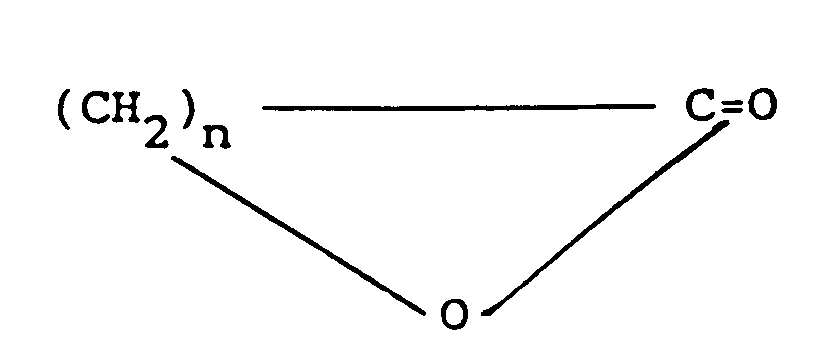
- lactones suitably employed in the process using the present catalyst are represented by the formula: wherein n is an integer having a value of from 3 to 8 of which butyrolactone, valerolactone, caprolactone and caprylolactone are preferred species; butyrolactone being most preferred. Lactones wherein one or more of the methylene groups are substituted with lower alkyl, e.g., 3-methyl-butyrolactone, 4-ethyl-butyrolactone, 3,4-dimethyl-butyrolactone, 4-methyl-valerolactone, 4-methyl-caprolactone, etc. are also suitably employed.
- butyrolactone and hydrogen are reacted in the vapor phase in a catalyst fixed bed tubular reactor to the corresponding 1,4-butanediol.
- the mole ratio of hydrogen to lactone can be varied between 50:1 and 300:1, however, a ratio of 100:1 to 200:1 is preferred.
- grams of reactant feed/hour/grams of catalyst is between 0.05 to 0.2, or 1 gram of feed per hour to 20 grams of catalyst in the fixed bed operation.
- the reaction conditions should be maintained towards the alkaline side of neutrality.
- the reaction is effected above the dew point of the lactone reactant, which, in the case of butyrolactone, is above 100°C.
- the reaction temperature is maintained between 140°C. and 250°C., preferably, between 160°C. and 180°C.
- the hydrogen pressure in the vapor phase reaction may vary between 0.69 and 10.3 MPa (100 and 1500 pounds); preferably, between 2.8 and 6.9 MPa (400 and 1,000 pounds). It is found in the hydrogenation of lactone that the lower temperature favors selectivity but results in lower conversions.
- the ideal temperature and pressure for conversion of butyrolactone has been found to be 165°-175°C. at 4.1-6.2 MPa (600-900 pounds) hydrogen.
- the resulting product vapors are condensed to give product in at least 85% yield and up to 97% purity.
- the presence of contaminants such as tetrahydrofuran and butanol are reduced to less than 1% by the use of the present catalyst system.
- the present catalytic reactions of lactones to diols can be carried out in the vapor or in the liquid phase and in a batch or continuous manner.
- somewhat lower temperatures and higher pressures can be employed.
- temperatures between 130°C. and 160°C. and pressure between 3.4 and 10.3 MPa (500 and 1500 pounds) hydrogen, preferably 4.1 to 8.3 MPa (600 to 1200 pounds) hydrogen, are suitable.
- a diluent is optional.
- the diluent such as an alcohol, ether, hydrocarbon should have a boiling point below the operating temperature; whereas in liquid phase reactions diluents having a boiling point above operating temperature are employed.
- liquid compounds which may be used as diluents in the liquid phase reaction are high boiling alcohols, such as dodecanol, ethylene glycol, high boiling ethers, water, N-alkylpyrrolidones, such as N-methyl-2-pyrrolidone, butanediol, and the like. Dilution of the reactants may be as high as 50%, although the diluent concentration of not more than 35% is preferred.
- a stainless steel tubular reaction with an O.D. of 2.54 cm (1 inch) and I.D. 2.36 cm (0.93 inches) was packed with 70 cm3 (ml) (27 g.) of the catalyst from Example 1 to provide a 17.8 cm (7 inch) bed length.
- the catalyst was reduced over a six hour period at 150°-300°C. using hydrogen in nitrogen in increasing concentration of from about 3% to about 10% H2.
- the hydrogen mixture was introduced intermittently until there was little exotherm, after which the hydrogen concentration was increased to 100%.
- a feed of ⁇ -Butyrolactone was pumped to a vaporizer from which the vapor was carried by a hydrogen stream to the reaction.
- the ratio of hydrogen to butyrolactone feed (99% pure) was 150:1.
- the reactor was maintained at 160°C.
- Example 1 was repeated, except that the amount of palladium nitrate was increased to 0.3 g. and the amount of potassium hydroxide was decreased to 1.2 g.
- the resulting catalyst contained 12% metallic copper, 0.5% metallic palladium and 2% KOH.
- Example 2 was repeated using this catalyst, except that the hydrogen pressure was maintained at 6.2 MPa (900 psig.) and the LHSV was 0.12. A 96.5% conversion of butyrolactone with 99.0% selectivity to butanediol was obtained.
- Example 1 was repeated, except that the amount of palladium nitrate was increased to 0.45 g. and the amount of potassium hydroxide was reduced to 1.8 g.
- the resulting catalyst contained 12% metallic copper, 0.3% metallic palladium and 3% KOH.
- Example 2 was repeated using this catalyst, except that the hydrogen pressure was maintained at 6.2 MPa (900 psig.) A 95% conversion of butyrolactone with 99% selectivity to butanediol was obtained.
- Example 1 was repeated, except that the amount of palladium nitrate was increased to 0.3 g. and the amount of potassium hydroxide was decreased to 1.8 g.
- the resulting catalytic product contained 12% metallic copper, 0.2% metallic palladium and 3% KOH.
- Example 2 was repeated using the catalyst of this example, except that the hydrogenation temperature employed was 180°C. and the LHSV was 0.06. An 85% conversion of butyrolactone with 96% selectivity to butanediol was obtained.
- Example 1 was repeated, except that the amount of copper nitrate was increased to 28.7 g., palladium nitrate was increased to 0.45 g., and the amount of potassium hydroxide was decreased to 1.8 g.
- the resulting catalyst contained 15% metallic copper, 0.3% metallic palladium and 3% KOH.
- Example 2 was repeated using the catalyst, except that ⁇ -caprolactam was substituted for butyrolactam and the hydrogenation temperature was maintained at 180°C. A 92% conversion of ⁇ -caprolactam with 92% selectivity to hexanediol was obtained.
- Example 1 was repeated, except that the amount of palladium nitrate was increased to 0.45 g. and the amount of potassium hydroxide was reduced to 1.2 g.
- the resulting catalyst contained 12% metallic copper, 0.3% metallic palladium and 2% KOH.
- Example 2 was repeated using this catalyst, except that the liquid feed to the vaporizer was a 1:1 mixture of butyrolactone and 1,4-butanediol, the hydrogen pressure was maintained at 6.2 MPa (900 psig.) and the LHSV was 0.1. A 98% conversion of butyrolactone with 97% selectivity to butanediol was obtained.
- Example 1 is repeated, except that a ⁇ -alumina support is substituted for magnesium silicate and sodium hydroxide is substituted for potassium hydroxide.
- the catalyst product contains 12% metallic copper, 0.1% metallic palladium and 5% NaOH supported on ⁇ -alumina.
- Example 2 The procedure described in Example 2 is repeated with this catalyst and a 90% conversion of butyrolactone with 90% selectivity to butanediol is obtained.
- Example 1 When the other granular support materials, e.g., silica alumina, silica, etc. are substituted in Example 1 for magnesium silicate the conversion of butyrolactone and selectivity to butanediol are similar.
- silica alumina, silica, etc. When the other granular support materials, e.g., silica alumina, silica, etc. are substituted in Example 1 for magnesium silicate the conversion of butyrolactone and selectivity to butanediol are similar.
- any of the other above named lactones can be substituted for butyrolactone in the hydrogenation reaction where the temperature is maintained above the dew point of the lactone, to provide at least 85% conversion of lactone in high selectivity to diol product.
- Example 1 is repeated, except that the amount of copper nitrate was increased to 28.7 g. and palladium nitrate was increased to 0.45 g.
- the resulting catalyst contained 15% of metallic copper, 0.3% of metallic palladium and 5% of KOH.
- This catalyst was used in the liquid phase hydrogenation of butyrolactone to butanediol.
- the hydrogenation reaction was conducted at 140°C. and under 8.3 MPa (1200 psig.) hydrogen pressure, by means of hydrogen to butyrolactone feed mole ratio of 100:1, in order to maintain the butyrolactone in the liquid phase.
- the procedure in the tubular reaction and catalyst bed described in Example 2 was repeated except that the LHSV was raised to 0.1.
- the liquid diol product was cooled and collected. A conversion of 99% butyrolactone with 93% selectivity to butanediol was realized.
- Example 1 is repeated except the the amount of palladium nitrate was increased to 0.45 g. and a 0.159 cm (1/16 inch) extruded and fluted magnesium silicate support is substituted for the magnesium silicate granules.
- the resulting catalyst contained 12% of metallic copper, 0.3% metallic palladium and 5% KOH on the support in an extruded, fluted form.
Landscapes
- Chemical & Material Sciences (AREA)
- Organic Chemistry (AREA)
- Engineering & Computer Science (AREA)
- Materials Engineering (AREA)
- Chemical Kinetics & Catalysis (AREA)
- Organic Low-Molecular-Weight Compounds And Preparation Thereof (AREA)
- Catalysts (AREA)
- Furan Compounds (AREA)
Claims (22)
- Composition de catalyseur d'hydrogénation, sur un support approprié, comportant:(a) 8 à 40% en poids de cuivre métallique;(b) 0,05 à 5% en poids de palladium, de platine, de rhodium, de ruthénium, de rhénium, d'osmium et/ou d'irridium; et(c) 2 à 10% d'un métal alcalin.
- La composition de catalyseur de la revendication 1, dans laquelle la composition contient 10 à 25% en poids du composant (a), 0,09 à 1% en poids du composant (b) et 2 à 6% en poids d'un métal alcalin choisi dans le groupe comportant le potassium, le sodium et le lithium.
- La composition de catalyseur de la revendication 1 ou de la revendication 2, dans laquelle le support est du silicate de magnésium à raison de plus de 45% de la composition totale.
- La composition de catalyseur de l'une des revendications 1, 2 ou 3, dans laquelle le composant (b) contient du palladium.
- La composition de catalyseur de l'une des revendication 1, 2 ou 3, dans laquelle le composant (b) est du palladium.
- La composition de catalyseur de l'une des revendications ci-dessus sous forme extrudée, cannelée.
- Procédé pour préparer le catalyseur de la revendication 1, comportant: le mélange du nitrate, de l'acétate ou du chlorure de cuivre et du composant (b) avec une base de métal alcalin, l'addition à ce mélange du matériau de support, l'agitation du mélange jusqu'à ce que la quantité voulue d'ingrédients actifs soit déposée sur le support, le séchage et la calcination des substances solides récupérées.
- Procédé pour préparer le catalyseur de la revendication 1, comportant le mélange dans des conditions aqueuses du carbonate de cuivre, du carbonate du métal du composant (b) et de la base de métal alcalin avec ledit support pour former une suspension jusqu'à ce que lesdits carbonates et la base de métal alcalin aient été déposés sur le support dans les proportions voulues pour produire le catalyseur de la revendication 1, l'enlèvement de l'eau, le chauffage des substances solides récupérées jusqu'à une température de 350°C à 475°C durant un temps de 10 à 20 heures pour transformer les carbonates en oxydes, et la réduction desdits oxydes avec de l'hydrogène à une concentration que l'on augmente graduellement, à partir d'une concentration initiale d'hydrogène dans un diluant inerte jusqu'à une concentration finale de 100% d'hydrogène, dans des conditions de température augmentant de 150°C à 350°C, durant une période de 5 à 12 heures.
- Le procédé de la revendication 8, dans lequel on produit les carbonates soumis au mélange dans des conditions aqueuses en mélangeant le nitrate, l'acétate ou le chlorure de cuivre et du métal du composant (b) avec une base de métal alcalin en solution aqueuse, et en ajoutant des carbonates de métal alcalin.
- Procédé selon la revendication 8 ou 9 dans lequel la composition de catalyseur est sous forme extrudée cannelée.
- Procédé en phase vapeur de mise en contact d'une lactone de formule

- Le procédé de la revendication 11, dans lequel ladite lactone est la butyrolactone et ledit diol est le butanediol.
- Le procédé de la revendication 11 dans lequel ladite lactone est une caprolactone et ledit diol est de l'hexanediol.
- Le procédé de la revendication 11 dans lequel on travaille de manière continue dans un réacteur à lit fixe à une vitesse de 0,05 à 0,2 g d'alimentation en lactone/heure/charge en poids de catalyseur.
- Le procédé de la revendication 14 dans lequel ladite lactone est la butyrolactone, le catalyseur est supporté sur du silicate de magnésium et le catalyseur contient 10% à 25% en poids de cuivre métallique, 2 à 6% en poids de métal alcalin absorbé et 0,1 à 1% en poids de palladium déposés, la réaction est effectuée à une température de 160°C à 180°C, sous une pression de 2,8 à 6,9 MPa d'hydrogène, et le diol est du butanediol.
- Procédé selon l'une des revendications 11 à 15, dans lequel les réactifs sont dilués avec jusqu'à 50% en poids d'un liquide à bas point d'ébullition qui est un alcool, un éther, un diol ou de l'eau.
- Procédé selon l'une des revendications 11 à 16, dans lequel la composition de catalyseur est présente dans la réaction à raison de 1% en poids à 5% en poids par rapport à ladite lactone.
- Procédé en phase liquide de mise en contact d'une lactone de formule

- Le procédé de la revendication 18, dans lequel ladite lactone est la butyrolactone et ledit diol est le butanediol.
- Le procédé de la revendication 18, dans lequel ladite lactone est une caprolactone et ledit diol est de l'hexanediol.
- Procédé selon la revendications 18, dans lequel les réactifs sont dilués avec jusqu'à 50% en poids d'un liquide inerte à point d'ébullition élevé qui est un alcool, un éther, ou de la N-alkylpyrrolidone.
- Procédé de mise en contact d'une lactone de formule
Priority Applications (1)
| Application Number | Priority Date | Filing Date | Title |
|---|---|---|---|
| AT88304468T ATE80810T1 (de) | 1987-11-27 | 1988-05-17 | Hydrierungskatalysator. |
Applications Claiming Priority (2)
| Application Number | Priority Date | Filing Date | Title |
|---|---|---|---|
| US07/126,065 US4797382A (en) | 1987-11-27 | 1987-11-27 | Hydrogenation catalyst and process for preparing the catalyst |
| US126065 | 2002-04-19 |
Publications (2)
| Publication Number | Publication Date |
|---|---|
| EP0318129A1 EP0318129A1 (fr) | 1989-05-31 |
| EP0318129B1 true EP0318129B1 (fr) | 1992-09-23 |
Family
ID=22422806
Family Applications (1)
| Application Number | Title | Priority Date | Filing Date |
|---|---|---|---|
| EP88304468A Expired - Lifetime EP0318129B1 (fr) | 1987-11-27 | 1988-05-17 | Catalyseur d'hydrogénation |
Country Status (5)
| Country | Link |
|---|---|
| US (1) | US4797382A (fr) |
| EP (1) | EP0318129B1 (fr) |
| JP (1) | JPH01168346A (fr) |
| AT (1) | ATE80810T1 (fr) |
| DE (1) | DE3874863T2 (fr) |
Families Citing this family (19)
| Publication number | Priority date | Publication date | Assignee | Title |
|---|---|---|---|---|
| JP2595358B2 (ja) * | 1989-12-07 | 1997-04-02 | 東燃株式会社 | 1,4―ブタンジオールおよびテトラヒドロフランの製造方法 |
| CS217291A3 (en) * | 1990-07-19 | 1992-02-19 | Dsm Nv | Catalyst systems based on palladium for selective hydrogenation of diene polymers and copolymers |
| GB9324782D0 (en) * | 1993-12-02 | 1994-01-19 | Davy Mckee London | Process |
| JP3829421B2 (ja) * | 1996-12-24 | 2006-10-04 | 豊田合成株式会社 | 自動車用ウエザストリップ |
| JPH11227471A (ja) | 1998-02-13 | 1999-08-24 | Toyoda Gosei Co Ltd | フロントドアウエザストリップ及びその製造方法 |
| US6647666B2 (en) | 1998-02-13 | 2003-11-18 | Toyoda Gosei Co., Ltd. | Sealing structure of opening section in vehicle |
| JP4304395B2 (ja) | 1999-12-10 | 2009-07-29 | 豊田合成株式会社 | 自動車用ウェザストリップ |
| US20040030199A1 (en) * | 2002-01-29 | 2004-02-12 | Maughon Robert R. | Process for reducing alpha-haloketones to secondary alpha-haloalcohols |
| DE10225929A1 (de) * | 2002-06-11 | 2003-12-24 | Basf Ag | Zweistufiges Verfahren zur Herstellung von Butandiol mit Zwischenabtrennung von Bernsteinsäureanhydrid |
| DE10225927A1 (de) * | 2002-06-11 | 2003-12-24 | Basf Ag | Verfahren zur Herstellung von Butandiol durch kombinierte Gasphasen- und Flüssigphasensynthese |
| DE10225926A1 (de) * | 2002-06-11 | 2003-12-24 | Basf Ag | Verfahren zur Herstellung von Butandiol |
| EP1828095B1 (fr) * | 2004-12-23 | 2011-10-05 | Shell Internationale Research Maatschappij B.V. | Procede d'hydrogenation d'une lactone ou d'un acide carboxylique ou d'un ester comprenant un groupe gamma-carbonyle |
| US8580978B2 (en) * | 2009-08-07 | 2013-11-12 | Shell Oil Company | Process for preparing a hydroxyacid or hydroxyester |
| US20110112326A1 (en) * | 2009-08-07 | 2011-05-12 | Jean-Paul Lange | Process for hydrogenation |
| WO2013012047A1 (fr) | 2011-07-20 | 2013-01-24 | 三菱化学株式会社 | Procédé de production d'un hydrure contenant un composé insaturé ayant quatre atomes de carbone à titre de matériau de départ |
| WO2013012048A1 (fr) * | 2011-07-20 | 2013-01-24 | 三菱化学株式会社 | Procédé de production de 1,4-butanediol |
| KR20160015839A (ko) * | 2014-07-31 | 2016-02-15 | 삼성전자주식회사 | 수소화 촉매를 제조하는 방법 및 이를 이용하여 락톤으로부터 디올을 제조하는 방법 |
| CN107245026A (zh) * | 2017-06-22 | 2017-10-13 | 江苏飞翔化工股份有限公司 | 无溶剂由内酯制备二醇的方法 |
| CN112672823A (zh) * | 2018-09-17 | 2021-04-16 | 沙特基础工业全球技术公司 | 用于由合成气产生醇和醚的催化剂 |
Citations (1)
| Publication number | Priority date | Publication date | Assignee | Title |
|---|---|---|---|---|
| EP0100607A1 (fr) * | 1982-07-09 | 1984-02-15 | The British Petroleum Company p.l.c. | Composition catalytique et son utilisation pour la production d'alcools à partir de gaz de synthèse |
Family Cites Families (8)
| Publication number | Priority date | Publication date | Assignee | Title |
|---|---|---|---|---|
| US3497908A (en) * | 1968-02-16 | 1970-03-03 | Paul A Zamarra | Snap connection hinge |
| US3849336A (en) * | 1972-02-07 | 1974-11-19 | Larox Res Corp | Palladium compositions suitable as oxidation catalysts |
| GB1344557A (en) * | 1972-06-23 | 1974-01-23 | Mitsubishi Petrochemical Co | Process for preparing 1,4-butanediol |
| US4083809A (en) * | 1976-08-20 | 1978-04-11 | Gaf Corporation | Hydrogenation catalyst and method of producing same |
| DE2819209A1 (de) * | 1978-05-02 | 1979-11-08 | Wacker Chemie Gmbh | Katalysator und verfahren zur herstellung von trichloraethylen |
| US4199436A (en) * | 1979-02-12 | 1980-04-22 | Institut Francais Du Petrole | Process for steam-dealkylating alkylaromatic hydrocarbons |
| CA1195678A (fr) * | 1981-12-21 | 1985-10-22 | Frederick A. Pesa | Enrichissement de gaz de synthese |
| US4550185A (en) * | 1983-12-22 | 1985-10-29 | E. I. Du Pont De Nemours And Company | Process for making tetrahydrofuran and 1,4-butanediol using Pd/Re hydrogenation catalyst |
-
1987
- 1987-11-27 US US07/126,065 patent/US4797382A/en not_active Expired - Fee Related
-
1988
- 1988-05-17 EP EP88304468A patent/EP0318129B1/fr not_active Expired - Lifetime
- 1988-05-17 DE DE8888304468T patent/DE3874863T2/de not_active Expired - Fee Related
- 1988-05-17 AT AT88304468T patent/ATE80810T1/de not_active IP Right Cessation
- 1988-11-25 JP JP63296426A patent/JPH01168346A/ja active Pending
Patent Citations (1)
| Publication number | Priority date | Publication date | Assignee | Title |
|---|---|---|---|---|
| EP0100607A1 (fr) * | 1982-07-09 | 1984-02-15 | The British Petroleum Company p.l.c. | Composition catalytique et son utilisation pour la production d'alcools à partir de gaz de synthèse |
Also Published As
| Publication number | Publication date |
|---|---|
| EP0318129A1 (fr) | 1989-05-31 |
| DE3874863D1 (de) | 1992-10-29 |
| US4797382A (en) | 1989-01-10 |
| JPH01168346A (ja) | 1989-07-03 |
| DE3874863T2 (de) | 1993-04-15 |
| ATE80810T1 (de) | 1992-10-15 |
Similar Documents
| Publication | Publication Date | Title |
|---|---|---|
| US4797382A (en) | Hydrogenation catalyst and process for preparing the catalyst | |
| US6291725B1 (en) | Catalysts and process for hydrogenolysis of sugar alcohols to polyols | |
| EP0296734B1 (fr) | Catalyseur en cuivre pour la conversion de l'oxyde de carbone | |
| EP0175558A1 (fr) | Procédé d'hydrogénation en phase gazeuse d'acides carboxyliques en esters et alcools | |
| EP0297657B1 (fr) | Catalyseur de déshydrogénation | |
| US4885411A (en) | Hydrogenation process for converting lactones to diols | |
| US5030771A (en) | Method of producing aliphatic and cycloaliphatic diols by catalytic hydrogenation of dicarboxylic acid esters | |
| EP0319116B1 (fr) | Catalyseur d'hydrogénation | |
| EP0484800B1 (fr) | Procédé de préparation de néopentyl-glycol | |
| US4885410A (en) | Hydrogenation catalyst | |
| US4048116A (en) | Catalyst for the hydrogenation of acetylene alcohols | |
| EP0277562B1 (fr) | Hydrogénation d'acides citriques ou d'acides citriques substitués en tétrahydrofuranne substitué en 3, en butyrolactones substituées en 3 et 4 et en leurs mélanges | |
| EP0373947B1 (fr) | Procédé pour la préparation du butanediol-1,4 et du tétrahydrofurane | |
| JPS636056B2 (fr) | ||
| CA2100124A1 (fr) | Catalyseur de type silicone-aluminium et procede de production d'une olefine tertiaire | |
| US5395989A (en) | Process for producing neopentyl glycol | |
| US4482753A (en) | Catalyst for use in the hydrogenolysis of methyl glycol formals | |
| KR102619058B1 (ko) | 1,3-프로판디올 제조용 촉매 및 이를 이용한 1,3-프로판디올의 제조방법 | |
| JP2685130B2 (ja) | エタノールの製造方法 | |
| KR0131203B1 (ko) | γ-부티로락톤의 제법 | |
| CA1219285A (fr) | Hydrogenolyse pour l'obtention de monoethyleneglycol- monomethylether, de monoethyleneglycol et d'ethanol | |
| US4766155A (en) | Process for producing alcohols | |
| JP2639463B2 (ja) | 1,4―ブタンジオールおよびテトラヒドロフランの製造方法 | |
| KR100538979B1 (ko) | 말레인산에스테르로부터의 1,4-부탄디올의 제조 방법 | |
| JP2585737B2 (ja) | テルペンアルコ―ルの製造方法 |
Legal Events
| Date | Code | Title | Description |
|---|---|---|---|
| PUAI | Public reference made under article 153(3) epc to a published international application that has entered the european phase |
Free format text: ORIGINAL CODE: 0009012 |
|
| AK | Designated contracting states |
Kind code of ref document: A1 Designated state(s): AT BE CH DE FR GB IT LI LU NL SE |
|
| 17P | Request for examination filed |
Effective date: 19891116 |
|
| RAP1 | Party data changed (applicant data changed or rights of an application transferred) |
Owner name: GAF CHEMICALS CORPORATION |
|
| 17Q | First examination report despatched |
Effective date: 19901204 |
|
| RAP1 | Party data changed (applicant data changed or rights of an application transferred) |
Owner name: ISP INVESTMENTS INC. |
|
| GRAA | (expected) grant |
Free format text: ORIGINAL CODE: 0009210 |
|
| AK | Designated contracting states |
Kind code of ref document: B1 Designated state(s): AT BE CH DE FR GB IT LI LU NL SE |
|
| REF | Corresponds to: |
Ref document number: 80810 Country of ref document: AT Date of ref document: 19921015 Kind code of ref document: T |
|
| RBV | Designated contracting states (corrected) |
Designated state(s): BE DE |
|
| REF | Corresponds to: |
Ref document number: 3874863 Country of ref document: DE Date of ref document: 19921029 |
|
| NLXE | Nl: other communications concerning ep-patents (part 3 heading xe) |
Free format text: IN PAT.BUL.21/92:SHOULD BE DELETED |
|
| PG25 | Lapsed in a contracting state [announced via postgrant information from national office to epo] |
Ref country code: BE Effective date: 19930531 |
|
| PLBE | No opposition filed within time limit |
Free format text: ORIGINAL CODE: 0009261 |
|
| STAA | Information on the status of an ep patent application or granted ep patent |
Free format text: STATUS: NO OPPOSITION FILED WITHIN TIME LIMIT |
|
| 26N | No opposition filed | ||
| BERE | Be: lapsed |
Owner name: ISP INVESTMENTS INC. Effective date: 19930531 |
|
| PG25 | Lapsed in a contracting state [announced via postgrant information from national office to epo] |
Ref country code: DE Effective date: 19940201 |