EP0318493B1 - Dispositif de test pour un sterilisateur de charges poreuses - Google Patents
Dispositif de test pour un sterilisateur de charges poreuses Download PDFInfo
- Publication number
- EP0318493B1 EP0318493B1 EP87905238A EP87905238A EP0318493B1 EP 0318493 B1 EP0318493 B1 EP 0318493B1 EP 87905238 A EP87905238 A EP 87905238A EP 87905238 A EP87905238 A EP 87905238A EP 0318493 B1 EP0318493 B1 EP 0318493B1
- Authority
- EP
- European Patent Office
- Prior art keywords
- test device
- masses
- envelope
- porous
- sterilizer
- Prior art date
- Legal status (The legal status is an assumption and is not a legal conclusion. Google has not performed a legal analysis and makes no representation as to the accuracy of the status listed.)
- Expired - Lifetime
Links
Images


Classifications
-
- A—HUMAN NECESSITIES
- A61—MEDICAL OR VETERINARY SCIENCE; HYGIENE
- A61L—METHODS OR APPARATUS FOR STERILISING MATERIALS OR OBJECTS IN GENERAL; DISINFECTION, STERILISATION OR DEODORISATION OF AIR; CHEMICAL ASPECTS OF BANDAGES, DRESSINGS, ABSORBENT PADS OR SURGICAL ARTICLES; MATERIALS FOR BANDAGES, DRESSINGS, ABSORBENT PADS OR SURGICAL ARTICLES
- A61L2/00—Disinfection or sterilisation of materials or objects, in general; Accessories therefor
- A61L2/26—Accessories
- A61L2/28—Devices for testing the effectiveness or completeness of sterilisation or disinfection, e.g. indicators which change colour
-
- A—HUMAN NECESSITIES
- A61—MEDICAL OR VETERINARY SCIENCE; HYGIENE
- A61L—METHODS OR APPARATUS FOR STERILISING MATERIALS OR OBJECTS IN GENERAL; DISINFECTION, STERILISATION OR DEODORISATION OF AIR; CHEMICAL ASPECTS OF BANDAGES, DRESSINGS, ABSORBENT PADS OR SURGICAL ARTICLES; MATERIALS FOR BANDAGES, DRESSINGS, ABSORBENT PADS OR SURGICAL ARTICLES
- A61L2/00—Disinfection or sterilisation of materials or objects, in general; Accessories therefor
- A61L2/24—Apparatus using programmed or automatic operation
-
- G—PHYSICS
- G01—MEASURING; TESTING
- G01M—TESTING STATIC OR DYNAMIC BALANCE OF MACHINES OR STRUCTURES; TESTING OF STRUCTURES OR APPARATUS, NOT OTHERWISE PROVIDED FOR
- G01M3/00—Investigating fluid-tightness of structures
- G01M3/002—Investigating fluid-tightness of structures by using thermal means
Definitions
- THIS INVENTION concerns a device for testing the efficiency of sterilizers such as those used in hospitals for sterilizing porous loads, and for detecting the presence of air in such sterilizers.
- a test device of this kind is described in British patent specification GB 2143322 and includes a plurality of porous masses of substantially man-made material with an indicator sheet sandwiched between them, and the whole assembly is held in close superimposed relationship by means which are permeable to allow the free passage of air and steam to the external surfaces of the masses.
- Sterilizers for porous loads require periodic engineer's checks to be carried out with test devices using thermocouples to provide an accurate reading of temperatures within the porous masses, and the present invention is concerned with an adaptation of the test device described and claimed in GB 2143322 to enable it to be used in engineer's tests during commissioning and recommissioning of sterilizers, and during quarterly and annual maintenance checks.
- thermocouples Engineer's tests require the simultaneous use of up to five thermocouples to be located at different positions on the test device within the sterilizer, typically, one in the free space within the sterilizer chamber, one or more within the mass of the test device and one in the condensate drain passage of the sterilizer chamber.
- a device for detecting the presence of air in a steam sterilizer for porous loads comprising at least two porous masses (10) of substantially man-made material, the material of said masses (10) being selected as one which will not undergo an exothermic reaction with steam under the conditions within a sterilizer under test, and means (15, 16) for removably holding the masses in close super-imposed relationship, said means being permeable to allow air and steam to pass freely into and out of the porous masses, characterised by at least one thermocouple and conductor leads (12) housed within a flat envelope (13) open along at least one edge region to permit said leads (12) to protrude therefrom and of a material having sufficient thickness and compressibility to accommodate the protruding leads (12), said envelope (13) being sandwiched between the masses (10) thus to be in intimate contact therewith.
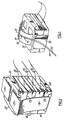
- a test device made in accordance with one embodiment of the invention comprises four porous masses 10 each formed from a stack of single rectangular sheets of a side dimension between 10 cm and 20 cm, of a man-made woven or non-woven material such as spun bonded polypropylene having a weight in the region of 50 to 150 grammes per square metre.
- the material is of a kind which will not undergo an exothermic reaction with steam under the conditions within a sterilizer under test.
- Each stack contains an appropriate number (typically about 80) of such sheets arranged in close superimposed relationship and enclosed by perforated shrink wrapping film for convenience to produce a block of some 4 cm in height.
- the overall height of the blocks making up the device is between 10 cm and 20 cm.
- thermocouples generally indicated at 11.
- Each thermocouple consists of a pair of conductor leads 12 which join at the thermocouple itself (not visible), and the latter with its conductor leads is enclosed within a flat rectangular envelope 13 open along at least one side to permit the leads 12 to protrude therefrom and consisting of a material identical or similar to the man-made material from which the masses 10 are produced.
- the envelopes 13 may be produced by folding a sheet of such material and then stitching along the two sides normal to the fold line.
- the "envelopes" may consist of two single sheets or a single larger sheet folded about its centre line to conform to the cross-sectional dimensions of the stack.
- the blocks 10 and envelopes 13 are between 10 cm and 20 cm square, and the material of the envelopes 13 is sufficiently thick and compressible to accommodate the leads 12 without any noticable increased thickness along the lines occupied by the leads.
- the housing of the leads in this way minimises the likelihood of steam tracking along the leads towards the thermocouple, owing to the effective seal created around the leads by the fabric of the envelope.
- An indicator 14 consisting of a sheet of paper bearing, for example, strips of so-called autoclave tape which is adapted to undergo a visual change under moist heat sterilizing conditions, and of the kind used for carrying out a normal test for such a device, can also be included in the engineer's test along with the thermocouples, and will be disposed, as illustrated in Fig. 1, at about the mid-point of the stack of blocks 10.
- the pack is assembled and held in close superimposed relationship by means of a stainless steel clamp which consists of two square end plates 15 slotted to receive a pair of resilient side panels 16 which act as compression springs.
- the side panels 16 are shaped to present a pair of broad stabilising feet 17 when the pack is assembled as in Fig. 2 and overturned to rest upon them.
- Fig. 3 illustrates an optional resilient plastics bridging piece 18 which is located in appropriate slots of the upper end plate 15 and which is provided with a series of apertures 19 through which the conductor wires 20 of an additional thermocouple 21 may pass to position the latter at a height of approximately 5 cm above the pock.
- the piece 18 may be omitted, however, since under certain circumstances it may act as a shield to the thermocouple thus providing a disadvantageously false temperature recording.
- a stainless steel stand 22 having a right angled foot 23 which is located beneath the device.
- Three pairs of guide members such as resilient linings 24 are held captive in slotted edge regions of the stand 22 at heights thereon equivalent to those at which the thermocouples are placed within the test device pack.
- the delicate thermocouple leads 12 can be pre-located, and supported with vertical and level alignment in the guides 24 leaving the user's hands free to assemble the blocks or masses 10 and to place over each thermocouple in turn, an envelope 13.
- the conductor wires 12 which are thus supported by the pack, are readily removed from the linings 24 which are slotted for this purpose, and the stand 22 can be removed.
- the envelopes 13 are intended to be disposed of after each test so that any indentation or channel in their material created by the thermocouple wires at the elevated pressure and temperature experienced during the test, cannot permit steam to track inwardly along such indentation or channel during a subsequent test.
- the device In use, the device is placed in a steam sterilizer which then undergoes a normal operational cycle or special test cycle.
- An additional thermocouple is placed in the chamber drain passage and, if bridging piece 18 is omitted, also in the chamber free space about 5 cm above the stack. Readings of temperature are recorded in the usual way from the thermocouples at different positions throughout the sterilizer, so that an indication is provided of the presence or absence of air within the sterilizer and of the steam penetration pattern into the device, during the test.
- the vertical thickness of the blocks may not be uniform, and the levels of the thermocouples within the stack can be selected according to the test requirements.
- the blocks from top to bottom of the pack may contain respectively 20, 140, 140 and 20 sheets, and thus measure respectively, 2.5 cm, 5.5 cm, 5.5 cm and 2.5 cm. There will usually be a division at the mid-point, with each half measuring between 5 cm and 10 cm in height and consisting of one or more individual blocks.
- the materials from which the clamp and stand are constructed may be other than stainless steel.
- Anodised aluminium or alloys containing such may be used, or polymeric materials either alone or in combination with metals.
Landscapes
- Health & Medical Sciences (AREA)
- Epidemiology (AREA)
- Life Sciences & Earth Sciences (AREA)
- Animal Behavior & Ethology (AREA)
- General Health & Medical Sciences (AREA)
- Public Health (AREA)
- Veterinary Medicine (AREA)
- General Physics & Mathematics (AREA)
- Physics & Mathematics (AREA)
- Apparatus For Disinfection Or Sterilisation (AREA)
- Investigating Or Analyzing Materials Using Thermal Means (AREA)
- Pretreatment Of Seeds And Plants (AREA)
- Measuring Or Testing Involving Enzymes Or Micro-Organisms (AREA)
- Investigating Or Analysing Biological Materials (AREA)
- Food Preservation Except Freezing, Refrigeration, And Drying (AREA)
- Medicines Containing Material From Animals Or Micro-Organisms (AREA)
- Solid-Sorbent Or Filter-Aiding Compositions (AREA)
Claims (16)
Priority Applications (1)
| Application Number | Priority Date | Filing Date | Title |
|---|---|---|---|
| AT87905238T ATE67309T1 (de) | 1986-08-13 | 1987-08-12 | Pruefvorrichtung fuer sterilisieranlage von poroesen guetern. |
Applications Claiming Priority (2)
| Application Number | Priority Date | Filing Date | Title |
|---|---|---|---|
| GB8619682A GB2200752B (en) | 1986-08-13 | 1986-08-13 | A porous load sterilizer. |
| GB8619682 | 1986-08-13 |
Publications (2)
| Publication Number | Publication Date |
|---|---|
| EP0318493A1 EP0318493A1 (fr) | 1989-06-07 |
| EP0318493B1 true EP0318493B1 (fr) | 1991-09-11 |
Family
ID=10602648
Family Applications (1)
| Application Number | Title | Priority Date | Filing Date |
|---|---|---|---|
| EP87905238A Expired - Lifetime EP0318493B1 (fr) | 1986-08-13 | 1987-08-12 | Dispositif de test pour un sterilisateur de charges poreuses |
Country Status (10)
| Country | Link |
|---|---|
| EP (1) | EP0318493B1 (fr) |
| CN (1) | CN1012014B (fr) |
| AT (1) | ATE67309T1 (fr) |
| AU (1) | AU7755287A (fr) |
| DE (1) | DE3772995D1 (fr) |
| ES (1) | ES2004798A6 (fr) |
| GB (1) | GB2200752B (fr) |
| IE (1) | IE60442B1 (fr) |
| WO (1) | WO1988001372A1 (fr) |
| ZA (1) | ZA875953B (fr) |
Families Citing this family (5)
| Publication number | Priority date | Publication date | Assignee | Title |
|---|---|---|---|---|
| DE9202347U1 (de) * | 1992-02-24 | 1992-04-16 | Wolf, Hans, 6950 Mosbach | Gerät zum Testen von Dampfsterilisatoren |
| GB2284621B (en) * | 1993-12-10 | 1997-09-10 | Glasdon Ltd | A foldable tent frame |
| CN1151703A (zh) * | 1994-05-27 | 1997-06-11 | 美国3M公司 | 对消毒器进行参数测量的电子测试装置 |
| US20110211991A1 (en) * | 2008-11-06 | 2011-09-01 | Foltz William E | Process challenge device and method |
| CN108273104A (zh) * | 2018-02-12 | 2018-07-13 | 3M创新有限公司 | 灭菌检测装置 |
Family Cites Families (4)
| Publication number | Priority date | Publication date | Assignee | Title |
|---|---|---|---|---|
| US4486387A (en) * | 1982-06-16 | 1984-12-04 | Propper Manufacturing Co., Inc. | Disposable prevacuum steam sterilizer test device |
| GB8319205D0 (en) * | 1983-07-15 | 1983-08-17 | Univ Manchester | Detecting presence of air in steam steriliser |
| AT388502B (de) * | 1984-03-23 | 1989-07-25 | Ver Edelstahlwerke Ag | Dampfsterilisator |
| DE8523448U1 (de) * | 1985-08-12 | 1985-10-03 | Tolzin, Hedwig, 4048 Grevenbroich | Aufnahmeeinrichtung für stapelförmiges Test-Sterilisiergut zum Testen von Dampfsterilisatoren |
-
1986
- 1986-08-13 GB GB8619682A patent/GB2200752B/en not_active Expired - Lifetime
-
1987
- 1987-08-11 ES ES8702364A patent/ES2004798A6/es not_active Expired
- 1987-08-12 DE DE8787905238T patent/DE3772995D1/de not_active Expired - Lifetime
- 1987-08-12 AU AU77552/87A patent/AU7755287A/en not_active Abandoned
- 1987-08-12 AT AT87905238T patent/ATE67309T1/de not_active IP Right Cessation
- 1987-08-12 IE IE215087A patent/IE60442B1/en not_active IP Right Cessation
- 1987-08-12 EP EP87905238A patent/EP0318493B1/fr not_active Expired - Lifetime
- 1987-08-12 WO PCT/GB1987/000567 patent/WO1988001372A1/fr not_active Ceased
- 1987-08-12 ZA ZA875953A patent/ZA875953B/xx unknown
- 1987-08-13 CN CN87105604A patent/CN1012014B/zh not_active Expired
Also Published As
| Publication number | Publication date |
|---|---|
| WO1988001372A1 (fr) | 1988-02-25 |
| IE60442B1 (en) | 1994-07-13 |
| ATE67309T1 (de) | 1991-09-15 |
| ZA875953B (en) | 1988-05-25 |
| CN1012014B (zh) | 1991-03-13 |
| GB8619682D0 (en) | 1986-09-24 |
| DE3772995D1 (de) | 1991-10-17 |
| IE872150L (en) | 1988-02-13 |
| CN87105604A (zh) | 1988-03-16 |
| GB2200752A (en) | 1988-08-10 |
| GB2200752B (en) | 1990-03-28 |
| EP0318493A1 (fr) | 1989-06-07 |
| ES2004798A6 (es) | 1989-02-01 |
| AU7755287A (en) | 1988-03-08 |
Similar Documents
| Publication | Publication Date | Title |
|---|---|---|
| CA1059412A (fr) | Indicateur de sterilite | |
| US5435971A (en) | Sterilization biological test pack | |
| US4699765A (en) | Device for detecting the presence of air in a steam steriliser | |
| US4382063A (en) | Sterile indicator device | |
| US4902478A (en) | Indicator sheet for an autoclave test pack | |
| JPS61265144A (ja) | 滅菌工程の有効性を検査するための使い捨て包装体 | |
| DE69002291D1 (de) | Wegwerfbare testpackungen fuer dampf- oder gassterilisatoren. | |
| JPH0424655B2 (fr) | ||
| EP0318493B1 (fr) | Dispositif de test pour un sterilisateur de charges poreuses | |
| EP0428245A1 (fr) | Dispositif de test à intégrateur pour la stérilisation à la vapeur | |
| ATE179081T1 (de) | Gerät zum testen von dampfsterilisatoren |
Legal Events
| Date | Code | Title | Description |
|---|---|---|---|
| PUAI | Public reference made under article 153(3) epc to a published international application that has entered the european phase |
Free format text: ORIGINAL CODE: 0009012 |
|
| 17P | Request for examination filed |
Effective date: 19890208 |
|
| AK | Designated contracting states |
Kind code of ref document: A1 Designated state(s): AT BE CH DE FR GB IT LI LU NL SE |
|
| RIN1 | Information on inventor provided before grant (corrected) |
Inventor name: THORNBER, MICHAEL, NEIL Inventor name: HAMBLETON, ROGER |
|
| 17Q | First examination report despatched |
Effective date: 19901126 |
|
| RBV | Designated contracting states (corrected) |
Designated state(s): AT BE CH DE FR IT LI LU NL SE |
|
| GRAA | (expected) grant |
Free format text: ORIGINAL CODE: 0009210 |
|
| AK | Designated contracting states |
Kind code of ref document: B1 Designated state(s): AT BE CH DE FR IT LI LU NL SE |
|
| REF | Corresponds to: |
Ref document number: 67309 Country of ref document: AT Date of ref document: 19910915 Kind code of ref document: T |
|
| REF | Corresponds to: |
Ref document number: 3772995 Country of ref document: DE Date of ref document: 19911017 |
|
| ET | Fr: translation filed | ||
| ITF | It: translation for a ep patent filed | ||
| PLBE | No opposition filed within time limit |
Free format text: ORIGINAL CODE: 0009261 |
|
| STAA | Information on the status of an ep patent application or granted ep patent |
Free format text: STATUS: NO OPPOSITION FILED WITHIN TIME LIMIT |
|
| 26N | No opposition filed | ||
| EPTA | Lu: last paid annual fee | ||
| EAL | Se: european patent in force in sweden |
Ref document number: 87905238.9 |
|
| PGFP | Annual fee paid to national office [announced via postgrant information from national office to epo] |
Ref country code: LU Payment date: 19950701 Year of fee payment: 9 |
|
| PGFP | Annual fee paid to national office [announced via postgrant information from national office to epo] |
Ref country code: FR Payment date: 19950710 Year of fee payment: 9 |
|
| PGFP | Annual fee paid to national office [announced via postgrant information from national office to epo] |
Ref country code: AT Payment date: 19950714 Year of fee payment: 9 |
|
| PGFP | Annual fee paid to national office [announced via postgrant information from national office to epo] |
Ref country code: SE Payment date: 19950717 Year of fee payment: 9 Ref country code: BE Payment date: 19950717 Year of fee payment: 9 |
|
| PGFP | Annual fee paid to national office [announced via postgrant information from national office to epo] |
Ref country code: CH Payment date: 19950718 Year of fee payment: 9 |
|
| PGFP | Annual fee paid to national office [announced via postgrant information from national office to epo] |
Ref country code: NL Payment date: 19950721 Year of fee payment: 9 Ref country code: DE Payment date: 19950721 Year of fee payment: 9 |
|
| PG25 | Lapsed in a contracting state [announced via postgrant information from national office to epo] |
Ref country code: LU Free format text: LAPSE BECAUSE OF NON-PAYMENT OF DUE FEES Effective date: 19960812 Ref country code: AT Effective date: 19960812 |
|
| PG25 | Lapsed in a contracting state [announced via postgrant information from national office to epo] |
Ref country code: SE Effective date: 19960813 |
|
| PG25 | Lapsed in a contracting state [announced via postgrant information from national office to epo] |
Ref country code: LI Effective date: 19960831 Ref country code: CH Effective date: 19960831 Ref country code: BE Effective date: 19960831 |
|
| BERE | Be: lapsed |
Owner name: THE VICTORIA UNIVERSITY OF MANCHESTER Effective date: 19960831 |
|
| PG25 | Lapsed in a contracting state [announced via postgrant information from national office to epo] |
Ref country code: NL Effective date: 19970301 |
|
| REG | Reference to a national code |
Ref country code: CH Ref legal event code: PL |
|
| PG25 | Lapsed in a contracting state [announced via postgrant information from national office to epo] |
Ref country code: FR Effective date: 19970430 |
|
| NLV4 | Nl: lapsed or anulled due to non-payment of the annual fee |
Effective date: 19970301 |
|
| PG25 | Lapsed in a contracting state [announced via postgrant information from national office to epo] |
Ref country code: DE Effective date: 19970501 |
|
| EUG | Se: european patent has lapsed |
Ref document number: 87905238.9 |
|
| REG | Reference to a national code |
Ref country code: FR Ref legal event code: ST |
|
| PG25 | Lapsed in a contracting state [announced via postgrant information from national office to epo] |
Ref country code: IT Free format text: LAPSE BECAUSE OF NON-PAYMENT OF DUE FEES Effective date: 20050812 |