EP0319024B1 - Verfahren zur Herstellung von optisch aktiver alpha-Isopropyl-p-chlorophenylessigsäure - Google Patents
Verfahren zur Herstellung von optisch aktiver alpha-Isopropyl-p-chlorophenylessigsäure Download PDFInfo
- Publication number
- EP0319024B1 EP0319024B1 EP88120157A EP88120157A EP0319024B1 EP 0319024 B1 EP0319024 B1 EP 0319024B1 EP 88120157 A EP88120157 A EP 88120157A EP 88120157 A EP88120157 A EP 88120157A EP 0319024 B1 EP0319024 B1 EP 0319024B1
- Authority
- EP
- European Patent Office
- Prior art keywords
- isopropyl
- formula
- optically active
- chlorophenylacetate
- icpa
- Prior art date
- Legal status (The legal status is an assumption and is not a legal conclusion. Google has not performed a legal analysis and makes no representation as to the accuracy of the status listed.)
- Expired - Lifetime
Links
Classifications
-
- C—CHEMISTRY; METALLURGY
- C07—ORGANIC CHEMISTRY
- C07C—ACYCLIC OR CARBOCYCLIC COMPOUNDS
- C07C51/00—Preparation of carboxylic acids or their salts, halides or anhydrides
- C07C51/09—Preparation of carboxylic acids or their salts, halides or anhydrides from carboxylic acid esters or lactones
Definitions
- the present invention relates to a process for producing optically active ⁇ -isopropyl-p-chlorophenyl-acetic acid (hereinafter referred to as ICPA) of the formula: wherein the symbol * stands for an asymmetric carbon atom.
- ICPA optically active ⁇ -isopropyl-p-chlorophenyl-acetic acid
- An optically active ICPA, in particular (+)-ICPA is useful as an acid component for producing pyrethroids, such as fenvarelate, used as effective insecticides (cf. JP-A-136245/1980).
- optically active ICPA for example, the following methods comprising optical resolution are known:
- the desired optically active ICPA can be obtained by decomposing the salt of the optically active ICPA with an amine after the optical resolution.
- the mother liquor After crystallizing the desired ICPA salt, the mother liquor is rich in the corresponding ICPA salt having the opposite optical activity. Since the optically active ICPA salt dissolved in the mother liquor is usually useless, it is industrially significant to reuse the salt by racemization and another optical resolution.
- an optically active ICPA salt is racemized very slowly. Therefore, in order to convert an optically active ICPA salt into the form of racemic modification, it is necessary in practice to perform a complicated process comprising decomposing the salt to give the corresponding optically active ICPA (which is the undesired ICPA enantiomer), racemizing the free ICPA, forming a salt of the obtained racemic modification with an amine, and then optically resolving the salt.
- the resolving agent required to carry out the method (i) is expensive and should have a high optical purity in order to obtain ICPA in a highly optically pure form.
- An object of the present invention is to provide a process for producing optically active ICPA, in which, after optical resolution, the residual undesired optically active ICPA derivative can be easily racemized as such.
- ICPA ester ⁇ -isopropyl-p-chlorophenylacetate
- the ICPA ester in the form of a racemic mixture corresponding to the formula (II) is subjected to optical resolution by preferential crystallization from an organic solvent at a degree of supersaturation of not more than 150 % at an intended crystallization temperature to separate an optically active ICPA ester of the formula (II).
- optically active ICPA ester obtained in the step 2 is subjected to hydrolysis with retaining its configuration to give the correspondingly optically active ICPA of the formula: wherein the meaning of the symbol * is the same as defined above.
- the undesired optically active ICPA ester remaining in the mother liquor after the optical resolution in the step 2 is subjected to racemization by a strong organic base to form the racemic mixture of the ICPA ester, which can be subjected to another optical resolution according to the process of the step 2.
- the ICPA ester used in the present invention is not in the form of a racemate, but in the form of a racemic mixture.
- Organic compounds having asymmetric centers can be classified into two groups, which are of racemic modifications and of optically active compounds.
- the racemic modifications are in turn classified as racemates, racemic mixtures and racemic solid solutions.
- the possibility that a racemic modification is present as racemic mixture is low, i.e. usually 5 to 10 % [cf. J. Jacques, A. Collet, S. H. Wilen, "Enantiomers, Racemates, and Resolutions", John Wiley & Sons (1981), p 43 to 88].
- the preferential crystallization method is used in the present invention.
- the racemic modification of ICPA or an acid halide thereof such as acid chloride or bromide may be used.
- the ICPA halide is preferably used in view of good reactivity.
- ICPA is a known compound and commercially available.
- the ICPA halide can be prepared from ICPA according to a known general procedure, for example by reacting ICPA with a halogenating agent such as thionyl chloride in the presence of a catalyst such as ⁇ -picoline in a suitable solvent such as benzene, toluene or n-hexane.
- a halogenating agent such as thionyl chloride
- a catalyst such as ⁇ -picoline
- suitable solvent such as benzene, toluene or n-hexane.
- the other starting material in the step 1 is the halo-substituted phenol (IV) such as 2,4,6-trichlorophenol, 2,4,6-tribromophenol or 2,6-dichloro-p-cresol.
- IV halo-substituted phenol
- the esterification of the compound (III) with the compound (IV) may be carried out in a solvent in the presence or absence of a neutralizing agent.
- a neutralizing agent such as an organic base, for example triethylamine, pyridine, tripropylamine, tributylamine, collidine or picoline, or an inorganic base, for example sodium hydroxide, sodium carbonate, potassium hydroxide, potassium carbonate or lithium carbonate.
- a neutralizing agent such as an organic base, for example triethylamine, pyridine, tripropylamine, tributylamine, collidine or picoline
- an inorganic base for example sodium hydroxide, sodium carbonate, potassium hydroxide, potassium carbonate or lithium carbonate.
- the amount of such a neutralizing agent used may be 1 to 5 equivalents based on the ICPA halide.
- the solvent used in the step 1 may be any solvent, provided it can dissolve the reacting substances without showing reactivity.
- a solvent is, for example, chloroform, methylene chloride, benzene, toluene, n-hexane, petroleum ether, ethyl ether, isopropyl ether, tetrahydrofuran, dioxane, acetone, methyl ethyl ketone, dimethylformamide or dimethylsulfoxide.
- the amount of such a solvent used is not restricted, it is usually 1 to 10 times by weight the amount of the compound (III).
- the esterification in the step 1 may be carried out in the presence of a catalyst such as a quaternary ammonium salt, for example benzyltriethylammonium chloride or tetra-n-butylammonium chloride.
- a catalyst such as a quaternary ammonium salt, for example benzyltriethylammonium chloride or tetra-n-butylammonium chloride.
- a catalyst is usually used in an amount of 0.1 to 20 % by mole based on the amount of the halo-substituted phenol (IV).
- the reaction temperature in step 1 is in the range of from - 20 to + 100 °C, preferably from 0 to 50 °C.
- the ICPA ester (II) in the form of racemic mixture can be obtained in a high yield.
- ICPA esters of the formula (II), both in the form of a racemic mixture and in an optically resolved form, are novel compounds.
- the optically active ICPA ester of the formula (II) can be obtained by subjecting the product of step 1 to optical resolution.
- the optical resolution is carried out by preferential crystallization from an organic solvent under such a condition that the solvent is supersaturated with the product of the step 1 at a degree of supersaturation of not more than 150 % at an intended crystallization temperature.
- Such an organic solvent used in the step 2 is not particularly restricted and for example an aromatic hydrocarbon such as benzene or toluene, an aliphatic hydrocarbon such as pentane, hexane, heptane, cyclohexane or petroleum ether, a halogenated hydrocarbon such as methylene chloride, chloroform, carbon tetrachloride or chlorobenzene, an ether such as ethyl ether, isopropyl ether, tetrahydrofuran or dioxane, an aprotic polar solvent such as acetone, methyl ethyl ketone, N,N-dimethylformamide or dimethylsulfoxide, an alcohol such as methanol, ethanol, n-propanol or isopropanol, an ester such as ethyl acetate, or a mixture thereof.
- aromatic hydrocarbon such as benzene or toluene
- the term of "supersaturation” is intended to mean a state that a solute, which is the ICPA ester, is present in a solvent in an amount of more than the amount required to form a saturated solution at a certain temperature, the whole quantity of the solute being not always dissolved in the solvent.
- the term “degree of supersaturation” means the ratio of the amount of a solute present in a supersaturated solution of the invention to the amount of the solute required for saturation at a certain temperature.
- the solute is present in the solvent in the amount of 1.5 times by weight the amount required for saturation.
- step 2 the ICPA ester (II) in the form of a racemic mixture is added to the organic solvent in such an amount that the solvent is supersaturated with the ester (II) at a degree of supersaturation of not more than 150 % at the intended crystallization temperature. Then, the mixture of the ester and the solvent is heated to form a solution. By cooling the solution to the crystallization temperature and/or concentrating the solution, the desired optically active ester (II) can be crystallized.
- the degree of supersaturation at the intended crystallization temperature is excessively high, since both the desired and the undesired enantiomers may be simultaneously crystallized, the optical purity of the obtained crystalline may be deteriorated. Therefore, it is preferred to prepare a supersaturated solution at a degree of supersaturation of not more than 150 %, in particular not more than 145 % at the intended crystallization temperature.
- the lower limit of the degree of supersaturation is not restricted, it is preferably at least 110 %. A lower degree may result in a deteriorated rate of crystallization.
- the crystallization temperature may vary with the particular condition.
- the ester (II) subjected to the crystallization is more or less optically active, i.e. the content of one enantiomer is more or less higher than that of the other enantiomer in the ester, the optically active ester of higher content is spontaneously preferentially crystallized after allowing to stand, cooling or concentrating the supersaturated solution.
- the ester (II) subjected to the crystallization is in the form of a racemic mixture. Since the solution of the ester (II) may remain in the state of supersaturation in usual sense even after cooling to the intended crystallization temperature, the crystallization of the desired optically active ester (II) may be induced by seeding a crystal of the corresponding optically active ester.
- the amount and particle size of the seed crystal are not restricted. Size-reduced crystals are preferably seeded in an amount in the range of from 1 to 10 % by weight based on the amount of the ICPA ester in the solution.
- the optically active ICPA ester used as the seed crystal can be prepared by halogenating the correspondingly optically active ICPA, esterifying the ICPA halide with the halo-substituted phenol (IV) and then recrystallizing the obtained optically active ICPA ester from hexane.
- optically active ICPA ester thus obtained in step 2 may be optionally purified by for example recrystallization.
- step 3 of the present method the optically active ICPA ester (II) obtained in step 2 is hydrolysed with retaining the configuration to give the desired correspondingly optically active ICPA (I).
- the hydrolysis is carried out in the presence of an acid, in particular an inorganic acid,such as sulfuric acid, hydrochloric acid, hydrobromic acid or nitric acid, such an acid being used as a 10 to 50 % by weight aqueous solution.
- an acid in particular an inorganic acid, such as sulfuric acid, hydrochloric acid, hydrobromic acid or nitric acid, such an acid being used as a 10 to 50 % by weight aqueous solution.
- the water required for the hydrolysis can be supplied from the above-mentioned aqueous solution of the acid.
- the amount of water used is not less than the equimolar amount based on the amount of the optically active ICPA ester.
- the upper limit of the amount of water is not restricted.
- An organic solvent may be present in this step, unless it influences the hydrolysis.
- the hydrolysis temperature may be in the range of from 20 °C to the boiling temperature of the reaction solution.
- optically active ICPA (I) can be obtained from the corresponding optically active ICPA ester.
- the undesired optically active ICPA ester can be easily racemized as such with using a racemizing agent, for example an organic strong base such as 1,8-diazabicyclo [5.4.0] undec-7-ene (DBU), 1,5-diazabicyclo [4.3.0] non-5-ene (DBN) or 1,4-diazabicyclo [2.2.2] octane (DBO), which is preferably present in an amount from 0.1 to 10 mole % based on the amount of the optically active ester subjected to racemization.
- a racemizing agent for example an organic strong base such as 1,8-diazabicyclo [5.4.0] undec-7-ene (DBU), 1,5-diazabicyclo [4.3.0] non-5-ene (DBN) or 1,4-diazabicyclo [2.2.2] octane (DBO), which is preferably present in an amount from 0.1 to 10 mole % based on the amount of the optical
- the mother liquor containing the undesired optically active ICPA ester may be usually directly subjected to racemization.
- the concentration of the racemizing agent may vary with the type of the racemizing agent used. In general, the higher the concentration of the racemizing agent is, the faster the racemization proceeds. However, when the concentration of the racemizing agent is excessively high, side reactions may occur.
- the concentration of DBU is preferably in the range of from 1 to 5 % by weight.
- the racemization is preferably carried out at a temperature of not higher than the boiling point of the reaction solution.
- the ICPA ester in the form of racemic mixture obtained in step 4 can be subjected to the process of step 2.
- the optically active ICPA ester having a desired configuration can be obtained. Then, the optically active ICPA ester is subjected to hydrolysis to give the desired optically active ICPA.
- the ester of the undesired optically active ICPA which remains in the mother liquor after crystallizing the desired optically active ICPA ester can be subjected to racemization as such to form racemic mixture which in turn may be subjected to optical resolution.
- the present invention is characterized by the use of the ICPA ester (II), the racemic mixture of which can be subjected to preferential crystallization and also which in an optically resolved form can be directly racemized.
- ICPA esters of the present invention are, for example, 2,4,6-tribromophenyl ester, 2,4,6-trichlorophenyl ester and 2,6-dichloro-p-tolyl ester.
- ICPA chloride was dissolved in chloroform (300 ml). The solution was dropwise added to a solution of 2,4,6-tribromophenol (143 g) and triethylamine (43.8 g) in chloroform (1200 ml) at room temperature over 30 minutes and then stirred for one hour.
- reaction mixture was washed with water, saturated sodium hydrogen carbonate and then water. After the organic phase was dried over anhydrous magnesium sulfate, the solvent was distilled off under vacuum.
- (+)-ICPA ester 500 mg in 6N-HCl (8 ml) was refluxed for one hour.
- the reaction mixture was cooled to room temperature, extracted with toluene and washed with water.
- the organic phase was extracted with 0.1 N sodium hydroxide (8 ml).
- the alkaline aqueous phase was acidified to pH 2 with 6N-HCl and extracted with toluene.
- the toluene phase was washed with water and concentrated under vacuum to give (+)-ICPA (yield 182.2 mg, 90.1 %).
- ICPA was esterified and post-treated in the same manner as in Example 1 to obtain 2,4,6-trichlorophenyl ICPA ester. Yield 71.8 % m.p.
- ICPA 2,6-dichloro-p-cresol in place of 2,4,6-tribromophenol
- ICPA was esterified and aftertreated in the same manner as in Example 1 to obtain 2,6-dichloro-p-tolyl ICPA ester. Yield 58.7 % m.p.
Landscapes
- Chemical & Material Sciences (AREA)
- Organic Chemistry (AREA)
- Engineering & Computer Science (AREA)
- Oil, Petroleum & Natural Gas (AREA)
- Organic Low-Molecular-Weight Compounds And Preparation Thereof (AREA)
Claims (20)
- Verfahren zur Herstellung einer optisch aktiven α-Isopropyl-p-chlorphenylessigsäure der Formel:
 (a) Herstellen eines α-Isopropyl-p-chlorphenylacetats der Formel (II)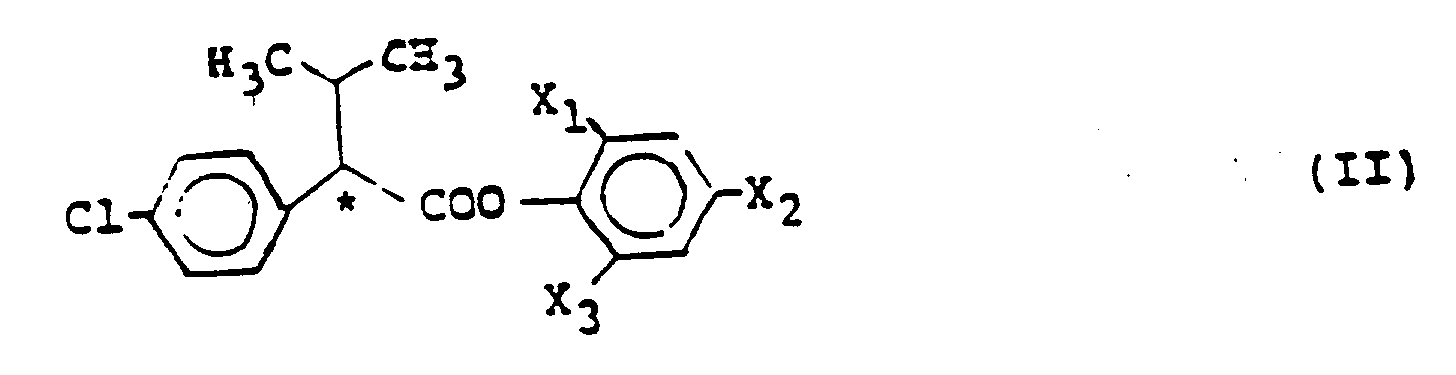

 (b) Herstellen von optisch aktivem α-Isopropyl-p-chlorphenylacetat der Formel (II), indem mit dem entsprechenden α-Isopropyl-p-chlorphenylacetat in Form eines Racemats eine Antipodentrennung durch selektive Kristallisation aus einem organischen Lösungsmittel durchgeführt wird, das bei der beabsichtigten Kristallisationstemperatur mit dem Racemat bei einem Übersättigungsgrad von nicht größer als 150 Gewichtsprozent übersättigt ist, und(c) Unterwerfen des optisch aktiven α-Isopropyl-p-chlorphenylacetats der Formel (II) einer Hydrolyse in Gegenwart einer Säure unter Beibehalten ihrer Konfiguration.
 - Verfahren nach Anspruch 1, in dem die Hydrolyse in Teil (c) in Gegenwart einer anorganischen Säure durchgeführt wird.
- Verfahren nach Anspruch 2, in dem die anorganische Säure Schwefelsäure, Salzsäure, Bromwasserstoffsäure oder Salpetersäure ist.
- Optisch aktives α-Isopropyl-p-chlorphenylacetat der Formel:

- Verfahren zur Herstellung eines optisch aktiven α-Isopropyl-p-chlorphenylacetats der Formel (II) nach Anspruch 4, das das Durchführen einer Antipodentrennung des entsprechenden α-Isopropyl-p-chlorphenylacetats in der Form eines Racemats durch selektive Kristallisation aus einem organischen Lösungsmittel, das bei der beabsichtigten Kristallisationstemperatur mit dem Racemat bei einem Übersättigungsgrad von nicht mehr als 150 Gewichtsprozent übersättigt ist, umfaßt.
- Verfahren zur Herstellung eines optisch aktiven α-Isopropyl-p-chlorphenylacetats der Formel (II) nach Anspruch 5, in dem das α-Isopropyl-p-chlorphenylacetat in der Form eines Racemats durch ein Verfahren hergestellt wird, in dem α-Isopropyl-p-chlorphenylessigsäure, oder ein Halogenid davon, der Formel:


- Verfahren nach Anspruch 5 oder 6, in dem die ganze Menge des Racemats in der übersättigten Lösung nicht immer im Lösungsmittel gelöst ist.
- Verfahren nach Anspruch 7, in dem ein gewünschtes optisch aktives α-Isopropyl-p-chlorphenylacetat der Formel (II) selektiv kristallisiert wird, der andere optisch aktive Ester der Formel (II) in der Mutterlauge zurückbleibt.
- α-Isopropyl-p-chlorphenylacetat in der Form eines Racemats entsprechend der Formel (II) nach Anspruch 4.
- Verfahren zur Herstellung von α-Isopropyl-p-chlorphenylacetat in der Form eines Racemats entsprechend der Formel (II) nach Anspruch 9, in der α-Isopropyl-p-chlorphenylessigsäure, oder ein Halogenid davon, der Formel:


- Verfahren nach Anspruch 10, in dem das α-Isopropyl-p-chlorphenylacetylhalogenid der Formel (III) in Gegenwart eines Neutralisationsmittels umgesetzt wird.
- Verfahren nach Anspruch 11, in dem das Neutralisationsmittel eine organische Base ist.
- Verfahren nach Anspruch 12, in dem das Neutralisationsmittel eine anorganische Base ist.
- Verfahren zur Herstellung einer optisch aktiven α-Isopropyl-p-chlorphenylessigsäure der Formel:
 (a) Herstellung eines α-Isopropyl-p-chlorphenylacetats in der Form eines Racemats entsprechend der Formel (II) nach Anspruch 9, in dem ein entsprechendes, optisch aktives α-Isopropyl-p-chlorphenylacetat der Formel (II) direkt der Racemisierung unterworfen wird,(b) Herstellung eines optisch aktiven α-Isopropyl-p-chlorphenylacetats der Formel (II) nach Anspruch 4, das das Durchführen einer Antipodentrennung des entsprechenden α-Isopropyl-p-chlorphenylacetats in Form eines Racemats durch selektive Kristallisation aus einem organischen Lösungsmittel, das bei der beabsichtigten Kristallisationstemperatur mit dem Racemat bei einem Übersättigungsgrad von nicht mehr als 150 Gewichtsprozent übersättigt ist, umfaßt, und(c) Unterwerfen des optisch aktiven α-Isopropyl-p-chlorphenylacetats der Formel (II)
- Verfahren nach Anspruch 14, in dem das optisch aktive α-Isopropyl-p-chlorphenylacetat, das nach der Kristallisation des gewünschten Esters nach Anspruch 8 in der Mutterlauge zurückgeblieben ist, der Racemisierung unterworfen wird.
- Verfahren nach Anspruch 15, in dem die Racemisierung in Gegenwart einer starken organischen Base durchgeführt wird.
- Verfahren nach Anspruch 16, in dem die starke organische Base 1,8-Diazabicyclo[5.4.0]undec-7-en, 1,5-Diazabicyclo[4.3.0]non-5-en oder 1,4-Diazabicyclo-[2.2.2]octan ist.
- Verfahren nach Anspruch 17, in dem die Menge der starken organischen Base im Bereich von 0,1 bis 10 Molprozent liegt, bezogen auf die Menge des optisch aktiven, der Racemisierung unterworfenen Esters.
- Verfahren nach Anspruch 18, in dem die Racemisierung in einem organischen Lösungsmittel durchgeführt wird.
- Verfahren nach Anspruch 19, in dem die Menge des organischen Lösungsmittels im Bereich des 20- bis 100-fachen der Gewichtsmenge der starken organischen Base liegt.
Applications Claiming Priority (10)
| Application Number | Priority Date | Filing Date | Title |
|---|---|---|---|
| JP30691887A JPH0662505B2 (ja) | 1987-12-03 | 1987-12-03 | α−イソプロピル−p−クロロフェニル酢酸エステル類およびその製造法 |
| JP306918/87 | 1987-12-03 | ||
| JP31163287A JPH0717560B2 (ja) | 1987-12-08 | 1987-12-08 | 光学活性なα−イソプロピル−p−クロロフェニル酢酸の製造法 |
| JP311632/87 | 1987-12-08 | ||
| JP314797/87 | 1987-12-11 | ||
| JP31479787 | 1987-12-11 | ||
| JP1342988A JPH01250339A (ja) | 1987-12-11 | 1988-01-22 | 光学活性なα−イソプロピル−p−クロロフェニル酢酸エステル類及びその製造法 |
| JP13429/88 | 1988-01-22 | ||
| JP63187461A JP2605366B2 (ja) | 1988-07-26 | 1988-07-26 | 光学活性α−イソプロピル−P−クロロフェニル酢酸エステル類のラセミ化方法 |
| JP187461/88 | 1988-07-26 |
Publications (3)
| Publication Number | Publication Date |
|---|---|
| EP0319024A2 EP0319024A2 (de) | 1989-06-07 |
| EP0319024A3 EP0319024A3 (de) | 1991-04-03 |
| EP0319024B1 true EP0319024B1 (de) | 1994-10-26 |
Family
ID=27519504
Family Applications (1)
| Application Number | Title | Priority Date | Filing Date |
|---|---|---|---|
| EP88120157A Expired - Lifetime EP0319024B1 (de) | 1987-12-03 | 1988-12-02 | Verfahren zur Herstellung von optisch aktiver alpha-Isopropyl-p-chlorophenylessigsäure |
Country Status (3)
| Country | Link |
|---|---|
| US (1) | US4983758A (de) |
| EP (1) | EP0319024B1 (de) |
| DE (1) | DE3851942T2 (de) |
Families Citing this family (3)
| Publication number | Priority date | Publication date | Assignee | Title |
|---|---|---|---|---|
| EP0824096A3 (de) * | 1996-08-13 | 1998-04-08 | Akzo Nobel N.V. | Verfahren zum Herstellen von halogenierten (Meth)acrylsäureestern und aus diesen (Meth)acrylsäureestern erhaltene Poly(meth)acrylate |
| JPWO2013094498A1 (ja) * | 2011-12-19 | 2015-04-27 | 住友化学株式会社 | α−置換−β−アミノ酸エステルのラセミ化方法 |
| FR2986804A1 (fr) * | 2012-02-09 | 2013-08-16 | Servier Lab | Procede de synthese enzymatique de l'acide (7s) 3,4-dimethoxybicyclo[4.2.0]octa-1,3,5-triene 7-carboxylique ou de ses esters, et application a la synthese de l'ivabradine et de ses sels |
Family Cites Families (7)
| Publication number | Priority date | Publication date | Assignee | Title |
|---|---|---|---|---|
| JPS56417B2 (de) * | 1973-07-05 | 1981-01-08 | ||
| JPS53118411A (en) * | 1976-12-28 | 1978-10-16 | Hideki Aoki | Apatite coating porcelain material and manufacture thereof |
| DE2960306D1 (en) * | 1978-06-27 | 1981-08-06 | Ciba Geigy Ag | Alpha-isopropyl-phenylacetic acid esters, their preparation and use as pesticides |
| JPS57171938A (en) * | 1981-04-15 | 1982-10-22 | Nissan Chem Ind Ltd | Preparation of optically active naphthylpropionic acid ester |
| JPS5980627A (ja) * | 1982-10-29 | 1984-05-10 | Sumitomo Chem Co Ltd | α−イソプロピル−p−クロロフエニル酢酸の光学分割法 |
| JPS6081144A (ja) * | 1983-10-13 | 1985-05-09 | Toyo Soda Mfg Co Ltd | α−ハロゲノ−β−フエニルプロピオン酸の製造方法 |
| JPS61103852A (ja) * | 1984-10-25 | 1986-05-22 | Nissan Chem Ind Ltd | 2−フエニルプロピオン酸エステル類の光学分割法 |
-
1988
- 1988-12-02 EP EP88120157A patent/EP0319024B1/de not_active Expired - Lifetime
- 1988-12-02 DE DE3851942T patent/DE3851942T2/de not_active Expired - Fee Related
- 1988-12-02 US US07/279,095 patent/US4983758A/en not_active Expired - Lifetime
Non-Patent Citations (1)
| Title |
|---|
| Methoden der Organischen Chemie (Houben-Weyl), Band IV, Teil 2, Seiten 509-511, 1955 * |
Also Published As
| Publication number | Publication date |
|---|---|
| DE3851942D1 (de) | 1994-12-01 |
| DE3851942T2 (de) | 1995-02-23 |
| US4983758A (en) | 1991-01-08 |
| EP0319024A3 (de) | 1991-04-03 |
| EP0319024A2 (de) | 1989-06-07 |
Similar Documents
| Publication | Publication Date | Title |
|---|---|---|
| US5616793A (en) | Methods of making (S)-3-(aminomethyl)-5-methylhexanoic acid | |
| JP2010229157A (ja) | S−(−)−クロロコハク酸またはその誘導体からr−(−)−カルニチンを調製するための方法 | |
| US5973182A (en) | Carbonate Intermediates useful in the preparation of optically active cyclohexylphenylglycolate esters | |
| US4983758A (en) | Process for producing an optically active α-isopropyl-p-chlorophenylacetic acid | |
| JPS6249268B2 (de) | ||
| US4622419A (en) | Process for the optical resolution of racemic mixtures of α-naphthyl-propionic acids | |
| EP0143371B2 (de) | Verfahren zur optischen Razematspaltung der alpha-Naphthylpropionsäuren | |
| JPH0432063B2 (de) | ||
| EP1185498B1 (de) | Herstellung von optisch aktiver cyclohexylphenylglykolsäure und ihrer ester | |
| CA2623355A1 (en) | Resolution of .alpha.-(phenoxy) phenylacetic acid derivatives with naphthyl-alkylamines | |
| US4571424A (en) | Optical resolution of racemic femoxetine | |
| EP0179487B1 (de) | 2-Phenylpropionsäureester, Methode zu ihrer optischen Trennung und danach erhaltene optisch aktive Substanz | |
| RU2015953C1 (ru) | Способ расщепления рацемата 2,2-диметилциклопропанкарбоновой кислоты | |
| WO1990008126A1 (en) | Resolution process | |
| WO2002068391A1 (en) | Process for resolving racemic mixtures of piperidine derivatives | |
| EP0107972A1 (de) | Verfahren zur optischen Spaltung von alpha-Isopropyl-p-chlorphenylessigsäure | |
| EP0441979B1 (de) | Optisch aktives 2-(alkylsubstituierte phenyl)-propionsäurederivat und optische trennung des (+/-)-1-methyl-3-phenylpropylamins | |
| JP2605366B2 (ja) | 光学活性α−イソプロピル−P−クロロフェニル酢酸エステル類のラセミ化方法 | |
| JP3300712B2 (ja) | 光学活性な2,2−ジメチル−5−フェニル−1,3−ジオキソラン−4−オンの製造法 | |
| JP3439797B2 (ja) | アミン誘導体の製造法 | |
| JPH06336480A (ja) | ピペリジン中間体の精製法 | |
| JPH0662505B2 (ja) | α−イソプロピル−p−クロロフェニル酢酸エステル類およびその製造法 | |
| JPH01151536A (ja) | 光学活性なα−イソプロピル−p−クロロフェニル酢酸の製造法 | |
| JPS61103853A (ja) | 2―フェニルプロピオン酸エステル類の光学分割法 | |
| JPH0435463B2 (de) |
Legal Events
| Date | Code | Title | Description |
|---|---|---|---|
| PUAI | Public reference made under article 153(3) epc to a published international application that has entered the european phase |
Free format text: ORIGINAL CODE: 0009012 |
|
| AK | Designated contracting states |
Kind code of ref document: A2 Designated state(s): CH DE FR GB IT LI NL |
|
| PUAL | Search report despatched |
Free format text: ORIGINAL CODE: 0009013 |
|
| 17P | Request for examination filed |
Effective date: 19901228 |
|
| AK | Designated contracting states |
Kind code of ref document: A3 Designated state(s): CH DE FR GB IT LI NL |
|
| 17Q | First examination report despatched |
Effective date: 19921117 |
|
| GRAA | (expected) grant |
Free format text: ORIGINAL CODE: 0009210 |
|
| AK | Designated contracting states |
Kind code of ref document: B1 Designated state(s): CH DE FR GB IT LI NL |
|
| ITF | It: translation for a ep patent filed | ||
| REF | Corresponds to: |
Ref document number: 3851942 Country of ref document: DE Date of ref document: 19941201 |
|
| ET | Fr: translation filed | ||
| PLBE | No opposition filed within time limit |
Free format text: ORIGINAL CODE: 0009261 |
|
| STAA | Information on the status of an ep patent application or granted ep patent |
Free format text: STATUS: NO OPPOSITION FILED WITHIN TIME LIMIT |
|
| 26N | No opposition filed | ||
| REG | Reference to a national code |
Ref country code: GB Ref legal event code: IF02 |
|
| PGFP | Annual fee paid to national office [announced via postgrant information from national office to epo] |
Ref country code: DE Payment date: 20021205 Year of fee payment: 15 |
|
| PGFP | Annual fee paid to national office [announced via postgrant information from national office to epo] |
Ref country code: FR Payment date: 20021210 Year of fee payment: 15 |
|
| PGFP | Annual fee paid to national office [announced via postgrant information from national office to epo] |
Ref country code: CH Payment date: 20021217 Year of fee payment: 15 |
|
| PGFP | Annual fee paid to national office [announced via postgrant information from national office to epo] |
Ref country code: NL Payment date: 20021227 Year of fee payment: 15 |
|
| PGFP | Annual fee paid to national office [announced via postgrant information from national office to epo] |
Ref country code: GB Payment date: 20031126 Year of fee payment: 16 |
|
| PG25 | Lapsed in a contracting state [announced via postgrant information from national office to epo] |
Ref country code: LI Free format text: LAPSE BECAUSE OF NON-PAYMENT OF DUE FEES Effective date: 20031231 Ref country code: CH Free format text: LAPSE BECAUSE OF NON-PAYMENT OF DUE FEES Effective date: 20031231 |
|
| PG25 | Lapsed in a contracting state [announced via postgrant information from national office to epo] |
Ref country code: NL Free format text: LAPSE BECAUSE OF NON-PAYMENT OF DUE FEES Effective date: 20040701 Ref country code: DE Free format text: LAPSE BECAUSE OF NON-PAYMENT OF DUE FEES Effective date: 20040701 |
|
| REG | Reference to a national code |
Ref country code: CH Ref legal event code: PL |
|
| PG25 | Lapsed in a contracting state [announced via postgrant information from national office to epo] |
Ref country code: FR Free format text: LAPSE BECAUSE OF NON-PAYMENT OF DUE FEES Effective date: 20040831 |
|
| NLV4 | Nl: lapsed or anulled due to non-payment of the annual fee |
Effective date: 20040701 |
|
| REG | Reference to a national code |
Ref country code: FR Ref legal event code: ST |
|
| PG25 | Lapsed in a contracting state [announced via postgrant information from national office to epo] |
Ref country code: GB Free format text: LAPSE BECAUSE OF NON-PAYMENT OF DUE FEES Effective date: 20041202 |
|
| GBPC | Gb: european patent ceased through non-payment of renewal fee |
Effective date: 20041202 |
|
| PG25 | Lapsed in a contracting state [announced via postgrant information from national office to epo] |
Ref country code: IT Free format text: LAPSE BECAUSE OF NON-PAYMENT OF DUE FEES;WARNING: LAPSES OF ITALIAN PATENTS WITH EFFECTIVE DATE BEFORE 2007 MAY HAVE OCCURRED AT ANY TIME BEFORE 2007. THE CORRECT EFFECTIVE DATE MAY BE DIFFERENT FROM THE ONE RECORDED. Effective date: 20051202 |