EP0319434A2 - Verfahren zur Reinigung von Hexamethylendiaminen - Google Patents
Verfahren zur Reinigung von Hexamethylendiaminen Download PDFInfo
- Publication number
- EP0319434A2 EP0319434A2 EP88420382A EP88420382A EP0319434A2 EP 0319434 A2 EP0319434 A2 EP 0319434A2 EP 88420382 A EP88420382 A EP 88420382A EP 88420382 A EP88420382 A EP 88420382A EP 0319434 A2 EP0319434 A2 EP 0319434A2
- Authority
- EP
- European Patent Office
- Prior art keywords
- zone
- slurry
- crystallization
- washing
- hexamethylenediamine
- Prior art date
- Legal status (The legal status is an assumption and is not a legal conclusion. Google has not performed a legal analysis and makes no representation as to the accuracy of the status listed.)
- Withdrawn
Links
- NAQMVNRVTILPCV-UHFFFAOYSA-N hexane-1,6-diamine Chemical compound NCCCCCCN NAQMVNRVTILPCV-UHFFFAOYSA-N 0.000 title claims abstract description 126
- 238000000034 method Methods 0.000 title claims abstract description 41
- 238000000746 purification Methods 0.000 title claims abstract description 18
- 238000002425 crystallisation Methods 0.000 claims abstract description 111
- 239000002002 slurry Substances 0.000 claims abstract description 76
- 238000005406 washing Methods 0.000 claims abstract description 73
- 239000007788 liquid Substances 0.000 claims abstract description 60
- 239000000203 mixture Substances 0.000 claims abstract description 41
- 239000007787 solid Substances 0.000 claims abstract description 41
- 238000001816 cooling Methods 0.000 claims abstract description 13
- 238000010438 heat treatment Methods 0.000 claims abstract description 7
- 238000011084 recovery Methods 0.000 claims abstract description 6
- 239000002826 coolant Substances 0.000 claims abstract description 3
- 239000012530 fluid Substances 0.000 claims abstract description 3
- 230000008025 crystallization Effects 0.000 claims description 108
- 238000004064 recycling Methods 0.000 claims description 13
- 239000000725 suspension Substances 0.000 claims description 12
- 230000008030 elimination Effects 0.000 claims description 9
- 238000003379 elimination reaction Methods 0.000 claims description 9
- 235000021395 porridge Nutrition 0.000 claims description 7
- 239000012452 mother liquor Substances 0.000 claims description 6
- 238000011282 treatment Methods 0.000 claims description 6
- 239000012809 cooling fluid Substances 0.000 claims description 3
- 239000003507 refrigerant Substances 0.000 claims description 2
- 238000005070 sampling Methods 0.000 claims 1
- 239000012535 impurity Substances 0.000 description 28
- 238000004519 manufacturing process Methods 0.000 description 16
- 239000000047 product Substances 0.000 description 12
- 239000013078 crystal Substances 0.000 description 10
- YMHQVDAATAEZLO-UHFFFAOYSA-N cyclohexane-1,1-diamine Chemical compound NC1(N)CCCCC1 YMHQVDAATAEZLO-UHFFFAOYSA-N 0.000 description 7
- 239000013529 heat transfer fluid Substances 0.000 description 5
- 239000002245 particle Substances 0.000 description 5
- 238000009434 installation Methods 0.000 description 4
- 230000008018 melting Effects 0.000 description 4
- 238000002844 melting Methods 0.000 description 4
- 241001080024 Telles Species 0.000 description 3
- 238000005352 clarification Methods 0.000 description 3
- 238000004040 coloring Methods 0.000 description 3
- 238000004821 distillation Methods 0.000 description 3
- 239000000126 substance Substances 0.000 description 3
- 238000011144 upstream manufacturing Methods 0.000 description 3
- 229920002302 Nylon 6,6 Polymers 0.000 description 2
- 239000004952 Polyamide Substances 0.000 description 2
- 235000021183 entrée Nutrition 0.000 description 2
- 239000000835 fiber Substances 0.000 description 2
- 230000004907 flux Effects 0.000 description 2
- 238000001640 fractional crystallisation Methods 0.000 description 2
- 239000000155 melt Substances 0.000 description 2
- 229920002647 polyamide Polymers 0.000 description 2
- 239000000700 radioactive tracer Substances 0.000 description 2
- 238000000926 separation method Methods 0.000 description 2
- OFOBLEOULBTSOW-UHFFFAOYSA-N Malonic acid Chemical compound OC(=O)CC(O)=O OFOBLEOULBTSOW-UHFFFAOYSA-N 0.000 description 1
- BTGRAWJCKBQKAO-UHFFFAOYSA-N adiponitrile Chemical compound N#CCCCCC#N BTGRAWJCKBQKAO-UHFFFAOYSA-N 0.000 description 1
- 239000006227 byproduct Substances 0.000 description 1
- 230000015556 catabolic process Effects 0.000 description 1
- 238000009903 catalytic hydrogenation reaction Methods 0.000 description 1
- 150000001875 compounds Chemical class 0.000 description 1
- 239000007859 condensation product Substances 0.000 description 1
- 230000007423 decrease Effects 0.000 description 1
- 238000006731 degradation reaction Methods 0.000 description 1
- 230000008021 deposition Effects 0.000 description 1
- 239000003085 diluting agent Substances 0.000 description 1
- 238000004043 dyeing Methods 0.000 description 1
- 238000005265 energy consumption Methods 0.000 description 1
- 238000000605 extraction Methods 0.000 description 1
- 230000008014 freezing Effects 0.000 description 1
- 238000007710 freezing Methods 0.000 description 1
- 235000011389 fruit/vegetable juice Nutrition 0.000 description 1
- 230000005484 gravity Effects 0.000 description 1
- 238000000265 homogenisation Methods 0.000 description 1
- 150000002466 imines Chemical class 0.000 description 1
- 238000012986 modification Methods 0.000 description 1
- 230000004048 modification Effects 0.000 description 1
- 238000006068 polycondensation reaction Methods 0.000 description 1
- 230000000135 prohibitive effect Effects 0.000 description 1
- 230000000717 retained effect Effects 0.000 description 1
- 150000003839 salts Chemical class 0.000 description 1
- 239000002904 solvent Substances 0.000 description 1
- 238000003756 stirring Methods 0.000 description 1
- 239000004753 textile Substances 0.000 description 1
- XLYOFNOQVPJJNP-UHFFFAOYSA-N water Substances O XLYOFNOQVPJJNP-UHFFFAOYSA-N 0.000 description 1
- 238000005221 zone crystallization Methods 0.000 description 1
Images

Classifications
-
- C—CHEMISTRY; METALLURGY
- C07—ORGANIC CHEMISTRY
- C07C—ACYCLIC OR CARBOCYCLIC COMPOUNDS
- C07C209/00—Preparation of compounds containing amino groups bound to a carbon skeleton
- C07C209/82—Purification; Separation; Stabilisation; Use of additives
- C07C209/84—Purification
Definitions
- the present invention relates to a process for the purification of impure hexamethylenediamine (HMD) to bring it to a high degree of purity.
- HMD hexamethylenediamine
- Hexamethylenediamine is a well known product, manufactured on an industrial scale, in particular by catalytic hydrogenation of adiponitrile. It is mainly used in the manufacture of polyamides by salification thereof with an equivalent amount of dicarboxylic acid, followed by polycondensation of the salt to form the polyamide.
- polycondensate of this type to produce filaments or fibers leads to filaments or fibers which are not very resistant and / or have coloring characteristics which do not meet the strict standards imposed by the textile industries.
- Crude hexamethylenediamine i.e. from a manufacturing stage, can be classically freed of impurities undesirable by undergoing a series of distillations and / or chemical treatments.
- hexamethylenediamine still contains a significant content of undesirable impurities. It is even believed that these impurities were formed both during manufacture and during the purification of hexamethylenediamine. Without knowing the precise nature of these impurities, it is believed that they are mainly aminohexylideneimine and condensation products of this imine, or of other compounds present in the medium, with hexamethylenediamine. These impurities, having reduced unsaturated bonds to the polarographer are commonly called "reducible impurities to the polarographer".
- distillation and / or extraction techniques whose efficiency is insufficient in this particular context also have at least one of the following drawbacks: - they involve a high energy consumption, - they have an increasing complexity of implementation with the purity requirements of the desired product, - They are a risk factor for degradation of the product sought at the high temperatures that may be necessary.
- the liquid mixture to be crystallized circulates several times in a closed circuit through the crystallization zones which must always be filled and that there reigns a turbulent flow in the crystallization zone, the speed of the liquid mixture being advantageously maintained in the crystallization zones at a value between 0.2 and 6 m / s, the growth rate during crystallization being advantageously kept as constant as possible in a range between 0.05 and 0.5 mm / min.
- crude hexamethylenediamine is meant impure hexamethylenediamine to be purified, that is to say a mixture of pure hexamethylenediamine, heavy impurities and / or light impurities, the nature and proportions of which can be very diverse, the content total in impurities preferably not exceeding 5% by weight in said mixture, or even 3% by weight.
- essentially liquid medium is intended to mean a medium which can result from the total or partial melting of the crude hexamethylenediamine, the content of suspended solid preferably being less than 1% by weight, where appropriate with minor amounts less than 1% by weight of exogenous solvent or diluent such as: water and / or a C1-C4 alkanol.
- the device comprises at least one agitated crystallization zone and cooled by circulation of a refrigerant fluid in a double jacket.
- the crystallization will be carried out in a crystallization zone which is also scraped.
- the cooling can be controlled by various means well known to specialists, such as controlling the maximum temperature difference between the heat transfer fluid circulating in the jacket of the crystallization zone and the medium formed by the product to be purified, the stirring speed in the crystallization zone, the exchange surface ... so that the crystals appear in the mass and not on the wall. Furthermore, good homogenization of the temperature in the medium, keeps it in suspension of the crystals and a satisfactory solid-liquid contact in the crystallization zone by various means known to specialists allow an advantageous practical implementation of the present process.
- the content of the solid in suspension in the slurry formed in the crystallization zone is at least equal to 10% by weight. It turns out to be advantageous to limit this content to 50% by weight at the most and for a good implementation of the method according to the invention, this content will be between 20 and 35% by weight of said slurry.
- the cooling temperature of the slurry is between 25 ° and 40.8 ° C.
- the evacuation of at least part of this slurry can be carried out by various means, for example, by gravity in the lower part of the crystallization zone and / or by means of a pump.
- porridge Depending on the content of suspended solid already present in the porridge, it may prove advantageous to subject said porridge to a concentration by eliminating, by any suitable means of liquid-solid separation, a fraction of the liquid which it contains (mother liquor); this elimination being advantageously carried out with the least possible entrainment of solid particles, for example, by using a hydrocyclone.
- the concentration should not bring the solid content above 50% by weight of the concentrated slurry.
- the resulting slurry if necessary after concentration, is then introduced at the head of a washing zone in which it circulates against the current of the washing liquid consisting of part of the purified and remelted hexamethylenediamine, the washing zone being separate from the crystallization zone and provided with heating means.
- the washing area is most often in the form of a column arranged vertically and provided at its foot with a melter.
- the first crystals of purified hexamethylenediamine, not yet washed, arriving near the melter are melted and constitute the first volumes of the liquid which is used to wash the following crystals.
- This column has a temperature gradient from top to bottom and allows, by the concurrent games of the solid-liquid counter-current, between the crystals which settle along it and the liquid coming from the partial melting which flows back, and the superficial melting of the crystals, washing the surface of the crystals, extracting the inclusions of impure liquid in the crystals as they settle.
- liquid hexamethylenediamine is recovered, the purity of which may be greater than 99.99%.
- part of the washing liquid enriched in impurities is recycled in the crystallization zone; this portion advantageously represents from 30 to 50% by weight of the production, which flows back.
- the evacuation of a clarified portion of the mixture located in the crystallization zone can constitute rejection of the operation.
- the clarification is advantageously carried out in a clarification zone situated above the crystallization zone, the two zones thus superimposed corresponding in practice to two sections of the same vertical crystallizer.
- the mother liquors from this concentration are recycled to the crystallization zone.
- the process thus described can also include various phases of crystallization and / or recycling, the aim of which will either be to improve the degree of purity of the hexamethylenediamine obtained at the bottom of the washing zone, or to increase the recovery yield. of hexamethylenediamine contained in the initial crude mixture, that is to simultaneously increase these two types of performance.
- the content of solid in suspension in each of the slurry present in the crystallization zones represents at least maximum 50% by weight of the porridge concerned; this content is advantageously between 20 and 35% by weight.
- each of the crystallization zones is scraped.
- the temperature difference between two successive zones will generally be between 0.1 and 3 ° C.
- zone 1 being that to which the crude hexamethylenediamine to be purified is supplied, this is briefly indicated.
- the porridge from zone 1 is introduced, if necessary after concentration, into zone 2; the slurry from zone 2 is then introduced, if necessary after concentration in the washing zone; the mother liquors from the concentration of the first mentioned slurry are then recycled into the crystallization zone 1 and those from the second mentioned slurry are then recycled also into the crystallization zone 2; at least part of the washing liquid from the top of the washing zone is recycled to the crystallization zone 2.
- said method further comprises: - the introduction of the clarified and evacuated portion of the crystallization zone concerned, single zone or zone 1, in an additional agitated crystallization zone and provided with a double jacket through which a cooling fluid circulates, - the controlled cooling of said additional crystallization zone so that a slurry is formed, the fraction of suspended solid of which represents at least 10% by weight and the temperature of which is between 25 and 38 ° C and is less than that of the zone from which the clarified portion comes, - the evacuation of at least part of this slurry followed, where appropriate by its solid concentration by elimination of a fraction of the liquid which it contains (mother liquors), - recycling the resulting slurry to the crystallization zone from which the clarified portion comes, - where appropriate, recycling the mother liquors to said additional crystallization zone, and - evacuation of a clarified portion of the mixture located in said additional crystallization zone.
- an additional zone is added upstream of the crystallization zone 1 crystallization arranged in series, the feed of which comprises a clarified portion of the mixture located in the crystallization zone 1 (intermediate discharge); the slurry from this additional crystallization zone is then, if necessary after concentration, introduced into the crystallization zone 1, the mother liquors from the concentration in question where appropriate are recycled to the additional crystallization zone and, portion clarified from the mixture in said additional crystallization zone is discharged and can then constitute the residue or final rejection of the operation.
- This additional crystallization zone treating in a way the intermediate rejection can of course include a plurality of crystallizers arranged in series and operating in a manner analogous to that described for the part of the installation and of the process intended for production.
- the washing zone which is most often constituted by a vertically arranged washing column can be constituted, for example, by at least two devices of this type arranged in parallel.
- one or more crystallization zones located between crystallization zone 1 and the washing zone may include a clarification zone similar to those which have been discussed in the body of the present specification; a clarified portion of the mixture located in the zone in question can then be introduced into the crystallization zone located immediately upstream within the meaning of the convention chosen and explained above.
- the supply of crude hexamethylenediamine to be purified can be carried out in various ways depending on the initial degree of purity of the crude mixture.
- the crude mixture when the crude mixture reaches a degree of purity of between 99.3 and 99.8%, for example, it can be fed into the crystallizer immediately preceding the washing zone; when the crude mixture reaches a degree of purity of between 99.1 and 99.3%, it can advantageously be fed into the crystallizer preceding that located immediately before the washing zone.
- the feed can also be distributed in the various crystallizers.
- the slurry from the offending crystallizer and which, most often is the one which operates at the lowest temperature of the operation, is fed, if necessary after concentration, at the head of said additional washing zone or that circulates against stream of washing liquid consisting of a portion of the purified (but still relatively impure) hexamethylenediamine remelted; another portion of the purified hexamethylenediamine although still relatively impure is taken at the foot of this washing zone to be recycled in the crystallizer located immediately downstream according to the above-mentioned convention, that is to say in that of crystallizers whose operating temperature is higher than that of the crystallizer from which the washing mixture originates while being closest to the latter.
- mother liquors from the concentration phase preceding, where appropriate, the introduction into the additional washing zone can advantageously be recycled to the crystallizer from which the slurry in question originates.
- the solid content of the stream supplied to the additional washing zone is 10 to 50% by weight.
- washing liquid is recycled to the crystallizer from which the slurry in question originated.
- the additional washing zone is advantageously located downstream of the crystallizer from which the residue from the operation comes.
- the present process in one of its advantageous modes of execution can be described as modular in the sense that it comprises, in a way, on the one hand a zone of crystallization in purification and a zone of washing of production and on the other hand, an enrichment crystallization zone and, if necessary, an additional washing zone making it possible to remove the residue from the operation, each crystallization zone being able to consist of 1 to 5 crystallizers assembled in series, the supply in crude hexamethylenediamine to be purified which can be distributed over several crystallizers in the zone working in purification or else produced on only one of the crystallizers in this zone, or even on the single crystallizer in this zone.
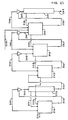
- the installation used comprises two parts, a part conventionally called - purification crystallization zone - and, a part called by cenvention - treatment zone for primary rejection or enrichment crystallization - the whole is shown diagrammatically in the figure 1 attached.
- the crystallization zone in purification comprises, from a on the one hand, a stirred and scraped crystallizer (111) provided with a double envelope (not shown) through which circulates a heat transfer fluid and, on the other hand, a washing tower (120) provided at its foot with a melter not shown.
- the crystallizer (111) is provided in particular with a conduit (100) through which the mixture of crude HMD to be purified is introduced and with a conduit (151) for removing a portion of the crystal slurry and introducing it into a hydrocyclone (shown diagrammatically by a triangle, one point of which points downwards in Figure 1).
- the column (120) is provided with a supply duct (140) located at its head, a production discharge duct (101) and a duct (170) allowing a portion of the liquid to be recycled washing with crystallizer (111).
- the primary rejection treatment zone has 3 agitated and scraped crystallizers, each provided with a double envelope through which a heat transfer fluid circulates and mounted in series (112), (113) and (114).
- the crystallizer (112) is mounted in series with the crystallizer (111); part of the feed to the crystallizer (112) is a clarified portion of the mixture in the crystallizer (111) which is introduced into the crystallizer (112) through the conduit (131).
- the residue (or final rejection of the operation) discharged through the conduit (134) is a clarified portion of the mixture found in the crystallizer (114).
- the conduit (100) is introduced at the top of the crystallizer (111) 4200 parts (by weight) per hour of a liquid mixture containing 99.495% (by weight) of HMD and 0.505% by weight of impurities.
- the content of diaminocyclohexane (DCH), impurity chosen as tracer is 0.20% (weight).
- the mixture supplied is at a minimum temperature of 41.8 ° C.
- a residue, final discharge evacuated through line (134), of 30 parts (weight) per hour is produced, which contains 30% by weight of HMD and 70% by weight of impurities.
- the DCH content of said final discharge is 28% by weight.
- each of the crystallizers (111 to 114) are produced slurries respectively discharged through the conduits (151 to 154) and which contain about 25% by weight of solid for 75% by weight of liquid; the respective fluxes and the overall content of impurities are indicated in table I.1 below: TABLE I.1 porridge parts / hour impurities (% by weight) (151) 31,200 1.41 (152) 21,550 2.10 (153) 10,750 2.82 (154) 5,400 12.00
- Each of these slurries is concentrated to form, on the one hand, an essentially liquid flow (containing approximately 2% by weight of solid particles) and on the other hand a flow whose content of solid particles reaches 45% by weight; thus, with reference to the crystallizer (112), for example, the slurry (152) gives rise to a stream (141) concentrated in solid and to a stream (161) of liquid with low solid content.
- Each liquid stream (160), (161), (162) and (163) is respectively recycled to the crystallizer (111), (112), (113) and (114) from which the slurries (151) are respectively obtained, (152), (153) and (154); the concentrated slurries (141) to (143) are fed respectively at the top of the crystallizers (111) to (113).
- each of the 4 crystallizers (111) to (114) are taken from the clarified portions respectively by the conduits (131) to (134); the portion (131) is introduced at the head of the crystallizer (112); the portion (132) is introduced at the head of the crystallizer (113); the portion (133) is introduced at the head of the crystallizer (114); the portion (134) constitutes the residue of the operation which has already been discussed.
- the installation used comprises two parts, a part conventionally called - purification crystallization zone - and, a part conventionally called - primary rejection treatment or enrichment crystallization zone -, the assembly is shown diagrammatically in the figure 2 attached.
- the crystallization and purification zone comprises, on the one hand, a stirred and scraped crystallizer (211), provided with a double envelope (not shown) through which a heat transfer fluid circulates and, on the other hand, a washing (221) provided at its foot with a melter not shown.
- the crystallizer (211) is provided in particular with a conduit (200) by which the mixture of crude HMD to be purified is introduced and with a conduit (251) to evacuate a portion of the slurry of crystals and introduce it into a hydrocyclone (shown diagrammatically by a triangle, the point of which points downwards in Figure 2).
- the column (221) is provided with a supply conduit (240) located at its head, a production evacuation conduit (201) and a conduit (270) for recycling a portion of liquid washing with crystallizer (211).
- the primary rejection treatment zone comprises on the one hand, 3 agitated and scraped crystallizers, each provided with a double envelope through which a heat transfer fluid circulates and mounted in series (212), (213) and (214) and d on the other hand, a washing tower (222).
- the crystallizer (212) is mounted in series with the crystallizer (211); a portion of the feed to the crystallizer (212) is a clarified portion of the mixture in the crystallizer (211) which is introduced into the crystallizer (212) through the conduit (231).
- the residue (or final rejection of the operation) discharged through the pipe (234) is a clarified portion of the mixture found in the crystallizer (214).
- the washing tower (222) is provided at its foot with a melter (not shown) and is fed at its head by means of the conduit (243) by a fraction enriched in solid from the slurry coming from the crystallizer (214) by the conduit (255) which introduces the mixture in question into a hydrocyclone (represented by a triangle pointing downwards); the fraction is introduced into the washing tower against the current of the washing liquid resulting from the melting carried out at the bottom of said tower; a portion of said liquid is taken from the bottom of the tower through the conduit (254) to be recycled at the top of the crystallizer (213). Another portion of said liquid is taken at the head of the tower through the conduit (271) to be recycled at the head of the crystallizer (214).
- each of the crystallizers (211 to 214) are produced slurries respectively discharged through the conduits (251), (252), (253) and (255) which contain approximately 25% by weight of solid for 75% by weight of liquid, the respective fluxes and the overall content of impurities being indicated in Table II.1 below.
- TABLE II.1 Porridge parts / hour impurities (% by weight) 251 31,200 1.41 252 21,550 2.10 253 10,750 2.82 255 5,400 19.00
- each of these slurries is concentrated to form, on the one hand, an essentially liquid flow (containing approximately 2% by weight of solid particles) and on the other hand a flow whose content of solid particles reaches 45% by weight; thus, with reference to the crystallizer (212), for example, the slurry (252) gives rise to a stream (241) concentrated in solid and to a stream (261) of liquid with low solid content.
- Each liquid stream (260), (261), (262) and (263) is respectively recycled to the crystallizer (211), (212), (213) and (214) from which the slurries (251) are respectively obtained, (252), (253) and (255); the concentrated slurries (241) and (242) are fed respectively at the top of the crystallizers (211) and (212).
- fraction (231) is introduced at the top of the crystallizer (212); the fraction (232) is introduced at the head of the crystallizer (213); the fraction (233) is introduced at the top of the crystallizer (214); fraction (234) constitutes the main rejection which has already been discussed.
Landscapes
- Chemical & Material Sciences (AREA)
- Organic Chemistry (AREA)
- Organic Low-Molecular-Weight Compounds And Preparation Thereof (AREA)
Applications Claiming Priority (2)
| Application Number | Priority Date | Filing Date | Title |
|---|---|---|---|
| FR8716834 | 1987-11-30 | ||
| FR8716834A FR2623801B1 (fr) | 1987-11-30 | 1987-11-30 | Procede de purification de l'hexamethylenediamine |
Publications (2)
| Publication Number | Publication Date |
|---|---|
| EP0319434A2 true EP0319434A2 (de) | 1989-06-07 |
| EP0319434A3 EP0319434A3 (de) | 1990-05-02 |
Family
ID=9357460
Family Applications (1)
| Application Number | Title | Priority Date | Filing Date |
|---|---|---|---|
| EP88420382A Withdrawn EP0319434A3 (de) | 1987-11-30 | 1988-11-16 | Verfahren zur Reinigung von Hexamethylendiaminen |
Country Status (3)
| Country | Link |
|---|---|
| EP (1) | EP0319434A3 (de) |
| JP (1) | JPH01168648A (de) |
| FR (1) | FR2623801B1 (de) |
Cited By (2)
| Publication number | Priority date | Publication date | Assignee | Title |
|---|---|---|---|---|
| WO1998011052A1 (de) * | 1996-09-10 | 1998-03-19 | Basf Aktiengesellschaft | Verfahren zur abtrennung von 2-aminomethylcyclopentylamin aus einer mischung enthaltend hexamethylendiamin und 2-aminomethylcyclopentylamin |
| CN115490599A (zh) * | 2021-09-27 | 2022-12-20 | 江苏科富恺机械设备有限公司 | 一种连续提纯间苯二胺的方法及系统 |
Family Cites Families (3)
| Publication number | Priority date | Publication date | Assignee | Title |
|---|---|---|---|---|
| GB1147458A (en) * | 1965-09-08 | 1969-04-02 | Ici Ltd | Purification process |
| LU54170A1 (de) * | 1966-08-11 | 1967-09-25 | ||
| US4282381A (en) * | 1980-08-21 | 1981-08-04 | E. I. Du Pont De Nemours And Company | Process for purifying hexamethylenediamine |
-
1987
- 1987-11-30 FR FR8716834A patent/FR2623801B1/fr not_active Expired - Lifetime
-
1988
- 1988-11-16 EP EP88420382A patent/EP0319434A3/de not_active Withdrawn
- 1988-11-29 JP JP30213688A patent/JPH01168648A/ja active Pending
Cited By (4)
| Publication number | Priority date | Publication date | Assignee | Title |
|---|---|---|---|---|
| WO1998011052A1 (de) * | 1996-09-10 | 1998-03-19 | Basf Aktiengesellschaft | Verfahren zur abtrennung von 2-aminomethylcyclopentylamin aus einer mischung enthaltend hexamethylendiamin und 2-aminomethylcyclopentylamin |
| US6251229B1 (en) * | 1996-09-10 | 2001-06-26 | Basf Aktiengesellschaft | Process for the separation of 2-aminomethylcyclopentylamine from a mixture containing hexamethyldiamine and 2-aminomethylcyclopentylamine |
| CN115490599A (zh) * | 2021-09-27 | 2022-12-20 | 江苏科富恺机械设备有限公司 | 一种连续提纯间苯二胺的方法及系统 |
| CN115490599B (zh) * | 2021-09-27 | 2023-12-26 | 江苏科富恺机械设备有限公司 | 一种连续提纯间苯二胺的方法及系统 |
Also Published As
| Publication number | Publication date |
|---|---|
| FR2623801B1 (fr) | 1990-04-20 |
| JPH01168648A (ja) | 1989-07-04 |
| FR2623801A1 (fr) | 1989-06-02 |
| EP0319434A3 (de) | 1990-05-02 |
Similar Documents
| Publication | Publication Date | Title |
|---|---|---|
| US4588414A (en) | Countercurrent, cooling crystallization and purification method for multi-component molten mixture | |
| EP0184526A1 (de) | Verfahren zur Verwendung einer zweistufigen Impfung zur Gewinnung von grosskörnigem Aluminiumoxid | |
| JPS6010763B2 (ja) | 再循環による向流結晶生成方法 | |
| WO2000064868A1 (en) | Process and apparatus for making ultra-pure dmso | |
| CN103442777B (zh) | 用于从浆料中分离出固体颗粒的设备和方法 | |
| FR2467185A1 (fr) | Procedes de separation et de purification du resorcinol et de l'hydroquinone | |
| JPS63185402A (ja) | 液状混合物から純粋な物質を結晶化によつて回収する方法および装置 | |
| FR2507595A1 (fr) | Processus en continu pour obtenir de l'acide terephtalique et du glycol purs en partant de polyethylene terephtalate residuel | |
| FR2623801A1 (fr) | Procede de purification de l'hexamethylenediamine | |
| EP0202165B1 (de) | Verfahren und Einrichtung für die Produktion von kristallisiertem Maltitol | |
| BE573797A (de) | ||
| EP0202168A1 (de) | Verfahren und Einrichtung zur Kristallisation von Mannitol | |
| EP0015626B1 (de) | Verfahren und Vorrichtung zur Herstellung von Natriumbikarbonatkristallen | |
| BE572517A (de) | ||
| EP0832986B1 (de) | Verfahren zur Regenerierung von Ionaustauschharzen im Verfahren zur Entfernung des Kalzium aus Zuckersaften | |
| RU2255046C1 (ru) | Способ получения медного купороса | |
| EP1124619B1 (de) | Verfahren zur reingewinnung fester chemischer produkte durch trockenes schwitzen | |
| EP0784705B1 (de) | Eine methode und eine vorrichtung für die kontinuierliche kristallisierung von zucker enthaltenden zusammensetzungen in einem abschliessenden kristallisationsstrom | |
| FR2581995A1 (fr) | Procede et installation de cristallisation de gluconodeltalactone | |
| BE732838A (de) | ||
| JP2775443B2 (ja) | 濾過による結晶の精製方法 | |
| RU2360005C1 (ru) | Способ производства сахара | |
| SU1219110A1 (ru) | Способ очистки веществ от примесей методом фракционного плавлени | |
| JPS594401A (ja) | 結晶精製装置 | |
| BE571087A (de) |
Legal Events
| Date | Code | Title | Description |
|---|---|---|---|
| PUAI | Public reference made under article 153(3) epc to a published international application that has entered the european phase |
Free format text: ORIGINAL CODE: 0009012 |
|
| AK | Designated contracting states |
Kind code of ref document: A2 Designated state(s): BE DE ES FR GB IT NL |
|
| PUAL | Search report despatched |
Free format text: ORIGINAL CODE: 0009013 |
|
| AK | Designated contracting states |
Kind code of ref document: A3 Designated state(s): BE DE ES FR GB IT NL |
|
| STAA | Information on the status of an ep patent application or granted ep patent |
Free format text: STATUS: THE APPLICATION HAS BEEN WITHDRAWN |
|
| 18W | Application withdrawn |
Withdrawal date: 19900509 |