EP0320873B1 - Procédé de préparation de revêtements élastomères sur des fibres et compositions de polymères en dispersion aqueuse - Google Patents
Procédé de préparation de revêtements élastomères sur des fibres et compositions de polymères en dispersion aqueuse Download PDFInfo
- Publication number
- EP0320873B1 EP0320873B1 EP88120799A EP88120799A EP0320873B1 EP 0320873 B1 EP0320873 B1 EP 0320873B1 EP 88120799 A EP88120799 A EP 88120799A EP 88120799 A EP88120799 A EP 88120799A EP 0320873 B1 EP0320873 B1 EP 0320873B1
- Authority
- EP
- European Patent Office
- Prior art keywords
- weight
- polymer
- water
- parts
- carboxyl
- Prior art date
- Legal status (The legal status is an assumption and is not a legal conclusion. Google has not performed a legal analysis and makes no representation as to the accuracy of the status listed.)
- Expired - Lifetime
Links
- 229920000642 polymer Polymers 0.000 title claims description 156
- 239000000835 fiber Substances 0.000 title claims description 95
- 239000000203 mixture Substances 0.000 title claims description 91
- 238000000576 coating method Methods 0.000 title claims description 33
- 238000004519 manufacturing process Methods 0.000 title claims description 4
- 229920013730 reactive polymer Polymers 0.000 claims description 74
- 239000007788 liquid Substances 0.000 claims description 71
- XLYOFNOQVPJJNP-UHFFFAOYSA-N water Substances O XLYOFNOQVPJJNP-UHFFFAOYSA-N 0.000 claims description 66
- 125000003178 carboxy group Chemical group [H]OC(*)=O 0.000 claims description 65
- 150000001412 amines Chemical group 0.000 claims description 45
- 238000000034 method Methods 0.000 claims description 42
- JVTAAEKCZFNVCJ-UHFFFAOYSA-N lactic acid Chemical compound CC(O)C(O)=O JVTAAEKCZFNVCJ-UHFFFAOYSA-N 0.000 claims description 32
- 239000002904 solvent Substances 0.000 claims description 27
- -1 vinyl nitrile Chemical class 0.000 claims description 27
- 230000008569 process Effects 0.000 claims description 26
- POAOYUHQDCAZBD-UHFFFAOYSA-N 2-butoxyethanol Chemical group CCCCOCCO POAOYUHQDCAZBD-UHFFFAOYSA-N 0.000 claims description 23
- 239000003822 epoxy resin Substances 0.000 claims description 23
- 229920000647 polyepoxide Polymers 0.000 claims description 23
- 239000010439 graphite Substances 0.000 claims description 16
- 229910002804 graphite Inorganic materials 0.000 claims description 16
- 239000004310 lactic acid Substances 0.000 claims description 16
- 235000014655 lactic acid Nutrition 0.000 claims description 16
- 229920002554 vinyl polymer Polymers 0.000 claims description 15
- OKTJSMMVPCPJKN-UHFFFAOYSA-N Carbon Chemical compound [C] OKTJSMMVPCPJKN-UHFFFAOYSA-N 0.000 claims description 14
- 239000003365 glass fiber Substances 0.000 claims description 14
- IISBACLAFKSPIT-UHFFFAOYSA-N bisphenol A Chemical compound C=1C=C(O)C=CC=1C(C)(C)C1=CC=C(O)C=C1 IISBACLAFKSPIT-UHFFFAOYSA-N 0.000 claims description 12
- 239000003795 chemical substances by application Substances 0.000 claims description 12
- UEEJHVSXFDXPFK-UHFFFAOYSA-N N-dimethylaminoethanol Chemical compound CN(C)CCO UEEJHVSXFDXPFK-UHFFFAOYSA-N 0.000 claims description 9
- 238000001035 drying Methods 0.000 claims description 9
- 229960002887 deanol Drugs 0.000 claims description 8
- 239000002270 dispersing agent Substances 0.000 claims description 8
- RAXXELZNTBOGNW-UHFFFAOYSA-N imidazole Natural products C1=CNC=N1 RAXXELZNTBOGNW-UHFFFAOYSA-N 0.000 claims description 8
- 239000000344 soap Substances 0.000 claims description 8
- 239000002253 acid Substances 0.000 claims description 7
- 125000000391 vinyl group Chemical group [H]C([*])=C([H])[H] 0.000 claims description 7
- 239000003960 organic solvent Substances 0.000 claims description 6
- 230000005855 radiation Effects 0.000 claims description 6
- 150000001993 dienes Chemical class 0.000 claims description 5
- 150000001875 compounds Chemical class 0.000 claims description 4
- 150000007524 organic acids Chemical class 0.000 claims description 4
- 230000002209 hydrophobic effect Effects 0.000 claims description 3
- 150000003512 tertiary amines Chemical class 0.000 claims description 3
- 238000009835 boiling Methods 0.000 claims description 2
- 238000010438 heat treatment Methods 0.000 claims description 2
- LXBGSDVWAMZHDD-UHFFFAOYSA-N 2-methyl-1h-imidazole Chemical compound CC1=NC=CN1 LXBGSDVWAMZHDD-UHFFFAOYSA-N 0.000 claims 2
- RIAHASMJDOMQER-UHFFFAOYSA-N 5-ethyl-2-methyl-1h-imidazole Chemical compound CCC1=CN=C(C)N1 RIAHASMJDOMQER-UHFFFAOYSA-N 0.000 claims 2
- KAKZBPTYRLMSJV-UHFFFAOYSA-N Butadiene Chemical compound C=CC=C KAKZBPTYRLMSJV-UHFFFAOYSA-N 0.000 description 50
- 239000011248 coating agent Substances 0.000 description 23
- NLHHRLWOUZZQLW-UHFFFAOYSA-N Acrylonitrile Chemical compound C=CC#N NLHHRLWOUZZQLW-UHFFFAOYSA-N 0.000 description 22
- 229920001971 elastomer Polymers 0.000 description 22
- 239000000806 elastomer Substances 0.000 description 18
- 239000006185 dispersion Substances 0.000 description 17
- JIGUQPWFLRLWPJ-UHFFFAOYSA-N Ethyl acrylate Chemical compound CCOC(=O)C=C JIGUQPWFLRLWPJ-UHFFFAOYSA-N 0.000 description 15
- 238000002474 experimental method Methods 0.000 description 15
- 239000010408 film Substances 0.000 description 15
- PNJWIWWMYCMZRO-UHFFFAOYSA-N pent‐4‐en‐2‐one Natural products CC(=O)CC=C PNJWIWWMYCMZRO-UHFFFAOYSA-N 0.000 description 15
- PPBRXRYQALVLMV-UHFFFAOYSA-N Styrene Chemical compound C=CC1=CC=CC=C1 PPBRXRYQALVLMV-UHFFFAOYSA-N 0.000 description 14
- 125000004432 carbon atom Chemical group C* 0.000 description 14
- 239000000243 solution Substances 0.000 description 13
- 239000000178 monomer Substances 0.000 description 12
- 239000002585 base Substances 0.000 description 11
- CSCPPACGZOOCGX-UHFFFAOYSA-N Acetone Chemical compound CC(C)=O CSCPPACGZOOCGX-UHFFFAOYSA-N 0.000 description 10
- 229920013646 Hycar Polymers 0.000 description 10
- CREMABGTGYGIQB-UHFFFAOYSA-N carbon carbon Chemical compound C.C CREMABGTGYGIQB-UHFFFAOYSA-N 0.000 description 10
- 239000011203 carbon fibre reinforced carbon Substances 0.000 description 10
- 239000004593 Epoxy Substances 0.000 description 9
- 239000004615 ingredient Substances 0.000 description 9
- 239000007787 solid Substances 0.000 description 9
- SMZOUWXMTYCWNB-UHFFFAOYSA-N 2-(2-methoxy-5-methylphenyl)ethanamine Chemical compound COC1=CC=C(C)C=C1CCN SMZOUWXMTYCWNB-UHFFFAOYSA-N 0.000 description 8
- NIXOWILDQLNWCW-UHFFFAOYSA-N 2-Propenoic acid Natural products OC(=O)C=C NIXOWILDQLNWCW-UHFFFAOYSA-N 0.000 description 8
- BAPJBEWLBFYGME-UHFFFAOYSA-N Methyl acrylate Chemical compound COC(=O)C=C BAPJBEWLBFYGME-UHFFFAOYSA-N 0.000 description 8
- 125000002573 ethenylidene group Chemical group [*]=C=C([H])[H] 0.000 description 8
- DSROZUMNVRXZNO-UHFFFAOYSA-K tris[(1-naphthalen-1-yl-3-phenylnaphthalen-2-yl)oxy]alumane Chemical compound C=1C=CC=CC=1C=1C=C2C=CC=CC2=C(C=2C3=CC=CC=C3C=CC=2)C=1O[Al](OC=1C(=C2C=CC=CC2=CC=1C=1C=CC=CC=1)C=1C2=CC=CC=C2C=CC=1)OC(C(=C1C=CC=CC1=C1)C=2C3=CC=CC=C3C=CC=2)=C1C1=CC=CC=C1 DSROZUMNVRXZNO-UHFFFAOYSA-K 0.000 description 8
- ZWEHNKRNPOVVGH-UHFFFAOYSA-N 2-Butanone Chemical compound CCC(C)=O ZWEHNKRNPOVVGH-UHFFFAOYSA-N 0.000 description 7
- CQEYYJKEWSMYFG-UHFFFAOYSA-N butyl acrylate Chemical compound CCCCOC(=O)C=C CQEYYJKEWSMYFG-UHFFFAOYSA-N 0.000 description 7
- 239000000463 material Substances 0.000 description 7
- RRHGJUQNOFWUDK-UHFFFAOYSA-N Isoprene Chemical compound CC(=C)C=C RRHGJUQNOFWUDK-UHFFFAOYSA-N 0.000 description 6
- CSJDCSCTVDEHRN-UHFFFAOYSA-N methane;molecular oxygen Chemical compound C.O=O CSJDCSCTVDEHRN-UHFFFAOYSA-N 0.000 description 6
- 125000003277 amino group Chemical group 0.000 description 5
- 239000001257 hydrogen Substances 0.000 description 5
- 229910052739 hydrogen Inorganic materials 0.000 description 5
- 150000007530 organic bases Chemical class 0.000 description 5
- 239000000126 substance Substances 0.000 description 5
- GOXQRTZXKQZDDN-UHFFFAOYSA-N 2-Ethylhexyl acrylate Chemical compound CCCCC(CC)COC(=O)C=C GOXQRTZXKQZDDN-UHFFFAOYSA-N 0.000 description 4
- XTXRWKRVRITETP-UHFFFAOYSA-N Vinyl acetate Chemical compound CC(=O)OC=C XTXRWKRVRITETP-UHFFFAOYSA-N 0.000 description 4
- NTXGQCSETZTARF-UHFFFAOYSA-N buta-1,3-diene;prop-2-enenitrile Chemical compound C=CC=C.C=CC#N NTXGQCSETZTARF-UHFFFAOYSA-N 0.000 description 4
- 125000005678 ethenylene group Chemical group [H]C([*:1])=C([H])[*:2] 0.000 description 4
- 229920002857 polybutadiene Polymers 0.000 description 4
- 239000005060 rubber Substances 0.000 description 4
- VXNZUUAINFGPBY-UHFFFAOYSA-N 1-Butene Chemical compound CCC=C VXNZUUAINFGPBY-UHFFFAOYSA-N 0.000 description 3
- YEYKMVJDLWJFOA-UHFFFAOYSA-N 2-propoxyethanol Chemical compound CCCOCCO YEYKMVJDLWJFOA-UHFFFAOYSA-N 0.000 description 3
- 239000004609 Impact Modifier Substances 0.000 description 3
- SJRJJKPEHAURKC-UHFFFAOYSA-N N-Methylmorpholine Chemical compound CN1CCOCC1 SJRJJKPEHAURKC-UHFFFAOYSA-N 0.000 description 3
- 229920000459 Nitrile rubber Polymers 0.000 description 3
- 239000005062 Polybutadiene Substances 0.000 description 3
- 239000004721 Polyphenylene oxide Substances 0.000 description 3
- KWYUFKZDYYNOTN-UHFFFAOYSA-M Potassium hydroxide Chemical compound [OH-].[K+] KWYUFKZDYYNOTN-UHFFFAOYSA-M 0.000 description 3
- HEMHJVSKTPXQMS-UHFFFAOYSA-M Sodium hydroxide Chemical compound [OH-].[Na+] HEMHJVSKTPXQMS-UHFFFAOYSA-M 0.000 description 3
- ZMANZCXQSJIPKH-UHFFFAOYSA-N Triethylamine Chemical compound CCN(CC)CC ZMANZCXQSJIPKH-UHFFFAOYSA-N 0.000 description 3
- OBOXTJCIIVUZEN-UHFFFAOYSA-N [C].[O] Chemical group [C].[O] OBOXTJCIIVUZEN-UHFFFAOYSA-N 0.000 description 3
- 238000013019 agitation Methods 0.000 description 3
- 125000001931 aliphatic group Chemical group 0.000 description 3
- 239000002131 composite material Substances 0.000 description 3
- 239000008151 electrolyte solution Substances 0.000 description 3
- LNEPOXFFQSENCJ-UHFFFAOYSA-N haloperidol Chemical compound C1CC(O)(C=2C=CC(Cl)=CC=2)CCN1CCCC(=O)C1=CC=C(F)C=C1 LNEPOXFFQSENCJ-UHFFFAOYSA-N 0.000 description 3
- 125000004435 hydrogen atom Chemical group [H]* 0.000 description 3
- 125000002887 hydroxy group Chemical group [H]O* 0.000 description 3
- 239000011159 matrix material Substances 0.000 description 3
- 238000002844 melting Methods 0.000 description 3
- 229920001778 nylon Polymers 0.000 description 3
- 229920000570 polyether Polymers 0.000 description 3
- 239000004848 polyfunctional curative Substances 0.000 description 3
- 150000003839 salts Chemical class 0.000 description 3
- 238000004513 sizing Methods 0.000 description 3
- 238000012360 testing method Methods 0.000 description 3
- MYRTYDVEIRVNKP-UHFFFAOYSA-N 1,2-Divinylbenzene Chemical compound C=CC1=CC=CC=C1C=C MYRTYDVEIRVNKP-UHFFFAOYSA-N 0.000 description 2
- ZGEGCLOFRBLKSE-UHFFFAOYSA-N 1-Heptene Chemical compound CCCCCC=C ZGEGCLOFRBLKSE-UHFFFAOYSA-N 0.000 description 2
- LIKMAJRDDDTEIG-UHFFFAOYSA-N 1-hexene Chemical compound CCCCC=C LIKMAJRDDDTEIG-UHFFFAOYSA-N 0.000 description 2
- LEJBBGNFPAFPKQ-UHFFFAOYSA-N 2-(2-prop-2-enoyloxyethoxy)ethyl prop-2-enoate Chemical compound C=CC(=O)OCCOCCOC(=O)C=C LEJBBGNFPAFPKQ-UHFFFAOYSA-N 0.000 description 2
- SBYMUDUGTIKLCR-UHFFFAOYSA-N 2-chloroethenylbenzene Chemical compound ClC=CC1=CC=CC=C1 SBYMUDUGTIKLCR-UHFFFAOYSA-N 0.000 description 2
- QTBSBXVTEAMEQO-UHFFFAOYSA-N Acetic acid Chemical compound CC(O)=O QTBSBXVTEAMEQO-UHFFFAOYSA-N 0.000 description 2
- HRPVXLWXLXDGHG-UHFFFAOYSA-N Acrylamide Chemical compound NC(=O)C=C HRPVXLWXLXDGHG-UHFFFAOYSA-N 0.000 description 2
- RTZKZFJDLAIYFH-UHFFFAOYSA-N Diethyl ether Chemical compound CCOCC RTZKZFJDLAIYFH-UHFFFAOYSA-N 0.000 description 2
- LSDPWZHWYPCBBB-UHFFFAOYSA-N Methanethiol Chemical compound SC LSDPWZHWYPCBBB-UHFFFAOYSA-N 0.000 description 2
- 239000004698 Polyethylene Substances 0.000 description 2
- JUJWROOIHBZHMG-UHFFFAOYSA-N Pyridine Chemical compound C1=CC=NC=C1 JUJWROOIHBZHMG-UHFFFAOYSA-N 0.000 description 2
- BZHJMEDXRYGGRV-UHFFFAOYSA-N Vinyl chloride Chemical compound ClC=C BZHJMEDXRYGGRV-UHFFFAOYSA-N 0.000 description 2
- 150000001252 acrylic acid derivatives Chemical class 0.000 description 2
- XXROGKLTLUQVRX-UHFFFAOYSA-N allyl alcohol Chemical compound OCC=C XXROGKLTLUQVRX-UHFFFAOYSA-N 0.000 description 2
- 150000004982 aromatic amines Chemical class 0.000 description 2
- 150000001735 carboxylic acids Chemical class 0.000 description 2
- YACLQRRMGMJLJV-UHFFFAOYSA-N chloroprene Chemical compound ClC(=C)C=C YACLQRRMGMJLJV-UHFFFAOYSA-N 0.000 description 2
- 229920001577 copolymer Polymers 0.000 description 2
- 238000004455 differential thermal analysis Methods 0.000 description 2
- GYZLOYUZLJXAJU-UHFFFAOYSA-N diglycidyl ether Chemical class C1OC1COCC1CO1 GYZLOYUZLJXAJU-UHFFFAOYSA-N 0.000 description 2
- 229940052303 ethers for general anesthesia Drugs 0.000 description 2
- 229920001519 homopolymer Polymers 0.000 description 2
- 150000007529 inorganic bases Chemical class 0.000 description 2
- 230000007246 mechanism Effects 0.000 description 2
- 125000002496 methyl group Chemical group [H]C([H])([H])* 0.000 description 2
- 230000004048 modification Effects 0.000 description 2
- 238000012986 modification Methods 0.000 description 2
- CCCMONHAUSKTEQ-UHFFFAOYSA-N octadec-1-ene Chemical compound CCCCCCCCCCCCCCCCC=C CCCMONHAUSKTEQ-UHFFFAOYSA-N 0.000 description 2
- YWAKXRMUMFPDSH-UHFFFAOYSA-N pentene Chemical compound CCCC=C YWAKXRMUMFPDSH-UHFFFAOYSA-N 0.000 description 2
- 229920003023 plastic Polymers 0.000 description 2
- 239000004033 plastic Substances 0.000 description 2
- 229920000768 polyamine Polymers 0.000 description 2
- 229920000728 polyester Polymers 0.000 description 2
- 239000004645 polyester resin Substances 0.000 description 2
- 229920001225 polyester resin Polymers 0.000 description 2
- 229920000573 polyethylene Polymers 0.000 description 2
- 150000003141 primary amines Chemical class 0.000 description 2
- 150000003254 radicals Chemical class 0.000 description 2
- 229920005989 resin Polymers 0.000 description 2
- 239000011347 resin Substances 0.000 description 2
- 239000004634 thermosetting polymer Substances 0.000 description 2
- IMNIMPAHZVJRPE-UHFFFAOYSA-N triethylenediamine Chemical compound C1CN2CCN1CC2 IMNIMPAHZVJRPE-UHFFFAOYSA-N 0.000 description 2
- GETQZCLCWQTVFV-UHFFFAOYSA-N trimethylamine Chemical compound CN(C)C GETQZCLCWQTVFV-UHFFFAOYSA-N 0.000 description 2
- MUTGBJKUEZFXGO-OLQVQODUSA-N (3as,7ar)-3a,4,5,6,7,7a-hexahydro-2-benzofuran-1,3-dione Chemical compound C1CCC[C@@H]2C(=O)OC(=O)[C@@H]21 MUTGBJKUEZFXGO-OLQVQODUSA-N 0.000 description 1
- CQDDDLREQHQBRR-UHFFFAOYSA-N 1-cyanoethyl prop-2-enoate Chemical compound N#CC(C)OC(=O)C=C CQDDDLREQHQBRR-UHFFFAOYSA-N 0.000 description 1
- LHENQXAPVKABON-UHFFFAOYSA-N 1-methoxypropan-1-ol Chemical compound CCC(O)OC LHENQXAPVKABON-UHFFFAOYSA-N 0.000 description 1
- AHDSRXYHVZECER-UHFFFAOYSA-N 2,4,6-tris[(dimethylamino)methyl]phenol Chemical compound CN(C)CC1=CC(CN(C)C)=C(O)C(CN(C)C)=C1 AHDSRXYHVZECER-UHFFFAOYSA-N 0.000 description 1
- JAHNSTQSQJOJLO-UHFFFAOYSA-N 2-(3-fluorophenyl)-1h-imidazole Chemical compound FC1=CC=CC(C=2NC=CN=2)=C1 JAHNSTQSQJOJLO-UHFFFAOYSA-N 0.000 description 1
- PTJDGKYFJYEAOK-UHFFFAOYSA-N 2-butoxyethyl prop-2-enoate Chemical compound CCCCOCCOC(=O)C=C PTJDGKYFJYEAOK-UHFFFAOYSA-N 0.000 description 1
- HKFPXINKVCOLOD-UHFFFAOYSA-N 2-hexylsulfanylethyl prop-2-enoate Chemical compound CCCCCCSCCOC(=O)C=C HKFPXINKVCOLOD-UHFFFAOYSA-N 0.000 description 1
- HFCUBKYHMMPGBY-UHFFFAOYSA-N 2-methoxyethyl prop-2-enoate Chemical compound COCCOC(=O)C=C HFCUBKYHMMPGBY-UHFFFAOYSA-N 0.000 description 1
- 125000003903 2-propenyl group Chemical group [H]C([*])([H])C([H])=C([H])[H] 0.000 description 1
- FASUFOTUSHAIHG-UHFFFAOYSA-N 3-methoxyprop-1-ene Chemical compound COCC=C FASUFOTUSHAIHG-UHFFFAOYSA-N 0.000 description 1
- MWVTWFVJZLCBMC-UHFFFAOYSA-N 4,4'-bipyridine Chemical group C1=NC=CC(C=2C=CN=CC=2)=C1 MWVTWFVJZLCBMC-UHFFFAOYSA-N 0.000 description 1
- MRBYTOUNXWKILZ-UHFFFAOYSA-N 4-methyl-3-methylidenepent-1-ene Chemical compound CC(C)C(=C)C=C MRBYTOUNXWKILZ-UHFFFAOYSA-N 0.000 description 1
- BHRTZSOPGCHQCQ-UHFFFAOYSA-N 8-cyanooctyl prop-2-enoate Chemical compound C=CC(=O)OCCCCCCCCC#N BHRTZSOPGCHQCQ-UHFFFAOYSA-N 0.000 description 1
- KJQMOGOKAYDMOR-UHFFFAOYSA-N CC(=C)C=C.CC(=C)C=C Chemical compound CC(=C)C=C.CC(=C)C=C KJQMOGOKAYDMOR-UHFFFAOYSA-N 0.000 description 1
- 229920000049 Carbon (fiber) Polymers 0.000 description 1
- 239000004970 Chain extender Substances 0.000 description 1
- 229920000742 Cotton Polymers 0.000 description 1
- 229920002943 EPDM rubber Polymers 0.000 description 1
- VGGSQFUCUMXWEO-UHFFFAOYSA-N Ethene Chemical compound C=C VGGSQFUCUMXWEO-UHFFFAOYSA-N 0.000 description 1
- 239000005977 Ethylene Substances 0.000 description 1
- UFHFLCQGNIYNRP-UHFFFAOYSA-N Hydrogen Chemical compound [H][H] UFHFLCQGNIYNRP-UHFFFAOYSA-N 0.000 description 1
- VQTUBCCKSQIDNK-UHFFFAOYSA-N Isobutene Chemical group CC(C)=C VQTUBCCKSQIDNK-UHFFFAOYSA-N 0.000 description 1
- CERQOIWHTDAKMF-UHFFFAOYSA-N Methacrylic acid Chemical compound CC(=C)C(O)=O CERQOIWHTDAKMF-UHFFFAOYSA-N 0.000 description 1
- VVQNEPGJFQJSBK-UHFFFAOYSA-N Methyl methacrylate Chemical compound COC(=O)C(C)=C VVQNEPGJFQJSBK-UHFFFAOYSA-N 0.000 description 1
- GYCMBHHDWRMZGG-UHFFFAOYSA-N Methylacrylonitrile Chemical compound CC(=C)C#N GYCMBHHDWRMZGG-UHFFFAOYSA-N 0.000 description 1
- DJEQZVQFEPKLOY-UHFFFAOYSA-N N,N-dimethylbutylamine Chemical compound CCCCN(C)C DJEQZVQFEPKLOY-UHFFFAOYSA-N 0.000 description 1
- CTQNGGLPUBDAKN-UHFFFAOYSA-N O-Xylene Chemical compound CC1=CC=CC=C1C CTQNGGLPUBDAKN-UHFFFAOYSA-N 0.000 description 1
- 239000004952 Polyamide Substances 0.000 description 1
- 229920002732 Polyanhydride Polymers 0.000 description 1
- 229920002367 Polyisobutene Polymers 0.000 description 1
- ZLMJMSJWJFRBEC-UHFFFAOYSA-N Potassium Chemical compound [K] ZLMJMSJWJFRBEC-UHFFFAOYSA-N 0.000 description 1
- 208000013201 Stress fracture Diseases 0.000 description 1
- XSTXAVWGXDQKEL-UHFFFAOYSA-N Trichloroethylene Chemical compound ClC=C(Cl)Cl XSTXAVWGXDQKEL-UHFFFAOYSA-N 0.000 description 1
- GSEJCLTVZPLZKY-UHFFFAOYSA-N Triethanolamine Chemical compound OCCN(CCO)CCO GSEJCLTVZPLZKY-UHFFFAOYSA-N 0.000 description 1
- QYKIQEUNHZKYBP-UHFFFAOYSA-N Vinyl ether Chemical compound C=COC=C QYKIQEUNHZKYBP-UHFFFAOYSA-N 0.000 description 1
- 208000027418 Wounds and injury Diseases 0.000 description 1
- 229960000583 acetic acid Drugs 0.000 description 1
- 230000002378 acidificating effect Effects 0.000 description 1
- 239000000853 adhesive Substances 0.000 description 1
- 230000001070 adhesive effect Effects 0.000 description 1
- 125000002723 alicyclic group Chemical group 0.000 description 1
- 229910052783 alkali metal Inorganic materials 0.000 description 1
- 150000001340 alkali metals Chemical group 0.000 description 1
- 125000004183 alkoxy alkyl group Chemical group 0.000 description 1
- 125000006350 alkyl thio alkyl group Chemical group 0.000 description 1
- XYLMUPLGERFSHI-UHFFFAOYSA-N alpha-Methylstyrene Chemical compound CC(=C)C1=CC=CC=C1 XYLMUPLGERFSHI-UHFFFAOYSA-N 0.000 description 1
- 229910052782 aluminium Inorganic materials 0.000 description 1
- XAGFODPZIPBFFR-UHFFFAOYSA-N aluminium Chemical compound [Al] XAGFODPZIPBFFR-UHFFFAOYSA-N 0.000 description 1
- 239000010425 asbestos Substances 0.000 description 1
- 230000008901 benefit Effects 0.000 description 1
- 230000000903 blocking effect Effects 0.000 description 1
- INLLPKCGLOXCIV-UHFFFAOYSA-N bromoethene Chemical compound BrC=C INLLPKCGLOXCIV-UHFFFAOYSA-N 0.000 description 1
- 239000004917 carbon fiber Substances 0.000 description 1
- 230000015271 coagulation Effects 0.000 description 1
- 238000005345 coagulation Methods 0.000 description 1
- 125000004386 diacrylate group Chemical group 0.000 description 1
- 150000004985 diamines Chemical class 0.000 description 1
- XXBDWLFCJWSEKW-UHFFFAOYSA-N dimethylbenzylamine Chemical compound CN(C)CC1=CC=CC=C1 XXBDWLFCJWSEKW-UHFFFAOYSA-N 0.000 description 1
- ATUOYWHBWRKTHZ-UHFFFAOYSA-N dimethylmethane Natural products CCC ATUOYWHBWRKTHZ-UHFFFAOYSA-N 0.000 description 1
- 238000004090 dissolution Methods 0.000 description 1
- 239000012153 distilled water Substances 0.000 description 1
- 230000000694 effects Effects 0.000 description 1
- 238000004070 electrodeposition Methods 0.000 description 1
- 238000010894 electron beam technology Methods 0.000 description 1
- 239000000839 emulsion Substances 0.000 description 1
- 238000005516 engineering process Methods 0.000 description 1
- 230000007613 environmental effect Effects 0.000 description 1
- 150000002118 epoxides Chemical class 0.000 description 1
- IDGUHHHQCWSQLU-UHFFFAOYSA-N ethanol;hydrate Chemical compound O.CCO IDGUHHHQCWSQLU-UHFFFAOYSA-N 0.000 description 1
- UIWXSTHGICQLQT-UHFFFAOYSA-N ethenyl propanoate Chemical compound CCC(=O)OC=C UIWXSTHGICQLQT-UHFFFAOYSA-N 0.000 description 1
- SUPCQIBBMFXVTL-UHFFFAOYSA-N ethyl 2-methylprop-2-enoate Chemical compound CCOC(=O)C(C)=C SUPCQIBBMFXVTL-UHFFFAOYSA-N 0.000 description 1
- 125000001495 ethyl group Chemical group [H]C([H])([H])C([H])([H])* 0.000 description 1
- LYCAIKOWRPUZTN-UHFFFAOYSA-N ethylene glycol Natural products OCCO LYCAIKOWRPUZTN-UHFFFAOYSA-N 0.000 description 1
- 239000011152 fibreglass Substances 0.000 description 1
- 239000000945 filler Substances 0.000 description 1
- 239000007888 film coating Substances 0.000 description 1
- 238000009501 film coating Methods 0.000 description 1
- 125000000524 functional group Chemical group 0.000 description 1
- 229920001002 functional polymer Polymers 0.000 description 1
- 239000007789 gas Substances 0.000 description 1
- 239000012362 glacial acetic acid Substances 0.000 description 1
- 239000011521 glass Substances 0.000 description 1
- 230000009477 glass transition Effects 0.000 description 1
- 229910052736 halogen Inorganic materials 0.000 description 1
- 150000002367 halogens Chemical group 0.000 description 1
- 125000000623 heterocyclic group Chemical group 0.000 description 1
- LNMQRPPRQDGUDR-UHFFFAOYSA-N hexyl prop-2-enoate Chemical compound CCCCCCOC(=O)C=C LNMQRPPRQDGUDR-UHFFFAOYSA-N 0.000 description 1
- 150000002431 hydrogen Chemical group 0.000 description 1
- 150000002432 hydroperoxides Chemical class 0.000 description 1
- WGCNASOHLSPBMP-UHFFFAOYSA-N hydroxyacetaldehyde Natural products OCC=O WGCNASOHLSPBMP-UHFFFAOYSA-N 0.000 description 1
- 238000009863 impact test Methods 0.000 description 1
- 230000001771 impaired effect Effects 0.000 description 1
- 239000003999 initiator Substances 0.000 description 1
- 125000001449 isopropyl group Chemical group [H]C([H])([H])C([H])(*)C([H])([H])[H] 0.000 description 1
- 239000004816 latex Substances 0.000 description 1
- 229920000126 latex Polymers 0.000 description 1
- PBOSTUDLECTMNL-UHFFFAOYSA-N lauryl acrylate Chemical compound CCCCCCCCCCCCOC(=O)C=C PBOSTUDLECTMNL-UHFFFAOYSA-N 0.000 description 1
- FPYJFEHAWHCUMM-UHFFFAOYSA-N maleic anhydride Chemical compound O=C1OC(=O)C=C1 FPYJFEHAWHCUMM-UHFFFAOYSA-N 0.000 description 1
- 230000008018 melting Effects 0.000 description 1
- 229910052751 metal Inorganic materials 0.000 description 1
- 239000002184 metal Substances 0.000 description 1
- 150000002736 metal compounds Chemical class 0.000 description 1
- VNWKTOKETHGBQD-UHFFFAOYSA-N methane Chemical class C VNWKTOKETHGBQD-UHFFFAOYSA-N 0.000 description 1
- XJRBAMWJDBPFIM-UHFFFAOYSA-N methyl vinyl ether Chemical compound COC=C XJRBAMWJDBPFIM-UHFFFAOYSA-N 0.000 description 1
- LVHBHZANLOWSRM-UHFFFAOYSA-N methylenebutanedioic acid Natural products OC(=O)CC(=C)C(O)=O LVHBHZANLOWSRM-UHFFFAOYSA-N 0.000 description 1
- 238000002156 mixing Methods 0.000 description 1
- 239000003607 modifier Substances 0.000 description 1
- 150000005673 monoalkenes Chemical class 0.000 description 1
- DYFFAVRFJWYYQO-UHFFFAOYSA-N n-methyl-n-phenylaniline Chemical compound C=1C=CC=CC=1N(C)C1=CC=CC=C1 DYFFAVRFJWYYQO-UHFFFAOYSA-N 0.000 description 1
- FSAJWMJJORKPKS-UHFFFAOYSA-N octadecyl prop-2-enoate Chemical compound CCCCCCCCCCCCCCCCCCOC(=O)C=C FSAJWMJJORKPKS-UHFFFAOYSA-N 0.000 description 1
- NZIDBRBFGPQCRY-UHFFFAOYSA-N octyl 2-methylprop-2-enoate Chemical compound CCCCCCCCOC(=O)C(C)=C NZIDBRBFGPQCRY-UHFFFAOYSA-N 0.000 description 1
- 239000003973 paint Substances 0.000 description 1
- HVAMZGADVCBITI-UHFFFAOYSA-M pent-4-enoate Chemical compound [O-]C(=O)CCC=C HVAMZGADVCBITI-UHFFFAOYSA-M 0.000 description 1
- ISWSIDIOOBJBQZ-UHFFFAOYSA-N phenol group Chemical group C1(=CC=CC=C1)O ISWSIDIOOBJBQZ-UHFFFAOYSA-N 0.000 description 1
- 230000000704 physical effect Effects 0.000 description 1
- 239000000049 pigment Substances 0.000 description 1
- 239000004014 plasticizer Substances 0.000 description 1
- 229920001485 poly(butyl acrylate) polymer Polymers 0.000 description 1
- 229920002647 polyamide Polymers 0.000 description 1
- 229920001748 polybutylene Polymers 0.000 description 1
- 229920000120 polyethyl acrylate Polymers 0.000 description 1
- 229920001195 polyisoprene Polymers 0.000 description 1
- 229920005594 polymer fiber Polymers 0.000 description 1
- 229920006254 polymer film Polymers 0.000 description 1
- 230000000379 polymerizing effect Effects 0.000 description 1
- 229920000098 polyolefin Polymers 0.000 description 1
- 238000002360 preparation method Methods 0.000 description 1
- HJWLCRVIBGQPNF-UHFFFAOYSA-N prop-2-enylbenzene Chemical compound C=CCC1=CC=CC=C1 HJWLCRVIBGQPNF-UHFFFAOYSA-N 0.000 description 1
- 239000001294 propane Substances 0.000 description 1
- 125000001436 propyl group Chemical group [H]C([*])([H])C([H])([H])C([H])([H])[H] 0.000 description 1
- UMJSCPRVCHMLSP-UHFFFAOYSA-N pyridine Natural products COC1=CC=CN=C1 UMJSCPRVCHMLSP-UHFFFAOYSA-N 0.000 description 1
- 230000003014 reinforcing effect Effects 0.000 description 1
- 239000012783 reinforcing fiber Substances 0.000 description 1
- 229910052895 riebeckite Inorganic materials 0.000 description 1
- 238000004626 scanning electron microscopy Methods 0.000 description 1
- 239000000565 sealant Substances 0.000 description 1
- 150000003335 secondary amines Chemical group 0.000 description 1
- 238000002791 soaking Methods 0.000 description 1
- QDRKDTQENPPHOJ-UHFFFAOYSA-N sodium ethoxide Chemical compound [Na+].CC[O-] QDRKDTQENPPHOJ-UHFFFAOYSA-N 0.000 description 1
- 239000003381 stabilizer Substances 0.000 description 1
- 238000005728 strengthening Methods 0.000 description 1
- 239000000758 substrate Substances 0.000 description 1
- 239000000725 suspension Substances 0.000 description 1
- 229920002994 synthetic fiber Polymers 0.000 description 1
- 239000012209 synthetic fiber Substances 0.000 description 1
- 239000008399 tap water Substances 0.000 description 1
- 235000020679 tap water Nutrition 0.000 description 1
- 239000010409 thin film Substances 0.000 description 1
- RKBCYCFRFCNLTO-UHFFFAOYSA-N triisopropylamine Chemical compound CC(C)N(C(C)C)C(C)C RKBCYCFRFCNLTO-UHFFFAOYSA-N 0.000 description 1
- 229960004418 trolamine Drugs 0.000 description 1
- 229960000834 vinyl ether Drugs 0.000 description 1
- 210000002268 wool Anatomy 0.000 description 1
- 239000008096 xylene Substances 0.000 description 1
Images
Classifications
-
- D—TEXTILES; PAPER
- D06—TREATMENT OF TEXTILES OR THE LIKE; LAUNDERING; FLEXIBLE MATERIALS NOT OTHERWISE PROVIDED FOR
- D06M—TREATMENT, NOT PROVIDED FOR ELSEWHERE IN CLASS D06, OF FIBRES, THREADS, YARNS, FABRICS, FEATHERS OR FIBROUS GOODS MADE FROM SUCH MATERIALS
- D06M15/00—Treating fibres, threads, yarns, fabrics, or fibrous goods made from such materials, with macromolecular compounds; Such treatment combined with mechanical treatment
- D06M15/693—Treating fibres, threads, yarns, fabrics, or fibrous goods made from such materials, with macromolecular compounds; Such treatment combined with mechanical treatment with natural or synthetic rubber, or derivatives thereof
-
- C—CHEMISTRY; METALLURGY
- C08—ORGANIC MACROMOLECULAR COMPOUNDS; THEIR PREPARATION OR CHEMICAL WORKING-UP; COMPOSITIONS BASED THEREON
- C08J—WORKING-UP; GENERAL PROCESSES OF COMPOUNDING; AFTER-TREATMENT NOT COVERED BY SUBCLASSES C08B, C08C, C08F, C08G or C08H
- C08J5/00—Manufacture of articles or shaped materials containing macromolecular substances
- C08J5/04—Reinforcing macromolecular compounds with loose or coherent fibrous material
- C08J5/06—Reinforcing macromolecular compounds with loose or coherent fibrous material using pretreated fibrous materials
-
- C—CHEMISTRY; METALLURGY
- C03—GLASS; MINERAL OR SLAG WOOL
- C03C—CHEMICAL COMPOSITION OF GLASSES, GLAZES OR VITREOUS ENAMELS; SURFACE TREATMENT OF GLASS; SURFACE TREATMENT OF FIBRES OR FILAMENTS MADE FROM GLASS, MINERALS OR SLAGS; JOINING GLASS TO GLASS OR OTHER MATERIALS
- C03C25/00—Surface treatment of fibres or filaments made from glass, minerals or slags
- C03C25/10—Coating
- C03C25/12—General methods of coating; Devices therefor
-
- C—CHEMISTRY; METALLURGY
- C03—GLASS; MINERAL OR SLAG WOOL
- C03C—CHEMICAL COMPOSITION OF GLASSES, GLAZES OR VITREOUS ENAMELS; SURFACE TREATMENT OF GLASS; SURFACE TREATMENT OF FIBRES OR FILAMENTS MADE FROM GLASS, MINERALS OR SLAGS; JOINING GLASS TO GLASS OR OTHER MATERIALS
- C03C25/00—Surface treatment of fibres or filaments made from glass, minerals or slags
- C03C25/10—Coating
- C03C25/24—Coatings containing organic materials
- C03C25/26—Macromolecular compounds or prepolymers
Definitions
- This invention relates to new compositions of elastomer-coated fibers and an improved process for preparing such fibers from water-dispersed, reactive polymers, and relates to these water-dispersed reactive polymers themselves, including carboxyl-containing polymers.
- Polymers of lower molecular weight which are reactive are known in the art. For example, U.S. Patent No.
- 4,133,957 describes amine-terminated liquid polymers represented by the formula wherein Y is a univalent radical obtained by removing hydrogen from an amine group of an aliphatic, alicyclic, heterocyclic or aromatic amine containing at least two secondary or mixed primary and secondary amine groups with no more than one primary amine group per molecule, and "B" is a polymeric backbone comprising carbon-carbon linkages.
- Y is a univalent radical obtained by removing hydrogen from an amine group of an aliphatic, alicyclic, heterocyclic or aromatic amine containing at least two secondary or mixed primary and secondary amine groups with no more than one primary amine group per molecule
- B is a polymeric backbone comprising carbon-carbon linkages.
- Other amine-containing liquid polymers having carbon-carbon linkage backbones and their uses are described in U.S. Patent Numbers 4,018,847; 4,055,541; 4,058,657; 4,088,708; 4,221,885; 4,260,700
- Amine-containing polymers are also known which have carbon-oxygen linkages in the polymeric backbones.
- An example of this type of amine-containing liquid polymer is the polyether polyamines described in U.S. Patent number 3,436,359.
- Other examples of amine-containing liquid polymers having carbon-oxygen backbone linkages and their uses are described in U.S. Patent Numbers 3,155,728; 3,236,895; 3,654,370; and 4,521,490.
- the '370 patent describes its amine-containing polymers as polyoxyalkylene polyamines.
- the '490 patent describes its amine-containing polymers as poly(oxyhydrocarbolene)diamines.
- the Jefferson Chemical Company subsidiary of Texaco, Inc. markets a line of amine-containing polymers under the Trademark Jeffamine® polyoxypropyleneamines.
- Carboxyl-containing reactive polymers are also known in the art.
- U.S. Patent Nos. 3,235,589 and 3,285,949 describe carboxyl-terminated liquid polymers having a polymeric backbone comprising carbon-carbon linkages prepared by polymerizing dienes with or without vinyl nitriles and/or styrene in the presence of a bis-azocyanoalkyl acid initiator or an alkylene dicarboxylic acid peroxide.
- Carboxyl-containing polymers can also be prepared using the process described in U.S. Patent No.
- U.S. Patent No. 3,135,716 describes reactive polymers which can have mercaptan, hydroxyl, carboxyl and other groups.
- U.S. Patent Nos. 4,120,766; 4,207,238; 4,238,397; 4,444,692; and 4,481,148 all describe hydroxyl-containing and hydroxyl-terminated liquid polymers.
- U.S. Patent No. 3,770,698 describes phenol-terminated polymers.
- U.S. Patent Nos. 3,910,992; 4,129,713; and 4,255,538 describe vinylidene-terminated polymers having carbon-carbon and carbon-oxygen backbone linkages.
- the above polymers share some common characteristics. All are of lower molecular weight, ranging from about 200 to about 10,000 number average molecular weight. In many cases, the polymers are liquids at room temperature (about 25°C.). More importantly, all of the polymers are reactive, i.e. they can react, chain-extend, or cure with other chemicals, materials or polymers to form elastomeric or plastic solids.
- the above-referenced patents readily show and describe curing mechanisms and cure systems for the polymers. The reactive polymers can even co-cure with themselves as shown in U.S. Patent No. 4,058,657. Often, the material used as a curative for the reactive polymers is an epoxy resin.
- U.S. Patent Nos. 3,316,185; 4,018,847; 4,055,541; 4,088,708; 4,119,592; 4,260,700; and 4,320,047 all show cures of reactive polymers using epoxy resins and other curing agents.
- the reactive polymers are useful as components in castable systems, as tougheners for epoxy and polyester resins in structural plastics, and in paints, coatings, sealants, adhesives, and the like.
- the reactive polymers have been employed as impact or stress-fracture modifiers for brittle resins. In this work, they have been used in their pure liquid form or in the form of solvent solutions.
- An example of such work is described in the book published by the American Chemical Society entitled “ Rubber Modified Thermoset Resins " as part of the Advances in Chemistry Series, No. 208, edited by C. Keith Riew and John K. Gillham.
- Another reference on this subject is the article published in the ACS periodical, Rubber Chemistry and Technology , entitled “Amine Terminated Reactive Liquid Polymers; Modification of Thermoset Resins” Vol. 54, No. 2, May-June 1981, by C. K. Riew.
- the polymers can also be utilized in the form of a water-dispersion.
- One method that can be used to prepare water-dispersed compositions from liquid polymers involves mixing the polymer with water and soap using a high speed mixer such as an Eppenbach homogenizer or a Minisonic homogenizer. This process is not satisfactory as it introduces high levels of soap into the final composition.
- Another method of forming films on fibers is by electrodeposition or electropolymerization.
- a conductive fiber or a fiber with a conductive coating thereon is placed into an electrolyte solution containing electropolymerizable monomers.
- a current is applied and the monomers polymerize onto the fiber surface.
- An example of such a process is described in the article in Polymer Composites , February 1987, Vol. 8, No. 1, entitled “Application of Ductile Polymeric Coatings Onto Graphite Fibers" by J. P. Bell et al.
- a disadvantage of such a process is that the fiber must be conductive and the monomers employed must be compatible with the technique; i.e. electropolymerizable and dispersible in an electrolyte solution.
- the invention comprises an improved method and process to prepare an elastomer-coated fiber, wherein the elastomeric coating is uniformly thin and continuous, by coating the fiber using a water-dispersed, reactive polymer composition.
- the elastomeric coating on the fiber has a glass transition temperature (Tg value) of 0°C. or below.
- the present invention relates to an improved process for preparing uniformly thin and continuous elastomeric coatings on fibers by contacting the fibers with a water-dispersed composition, drying and then curing said composition; wherein said water-dispersed composition is one containing (1) reactive polymer, (2) epoxy resin, and (3) curing agent; and wherein said reactive polymer is a water-dispersed composition containing (a) 100 parts by weight of a reactive polymer being a carboxyl-terminated liquid polymer having a Tg value of below 0°C and an average molecular weight of from 200 to 10,000, (b) at least 10 parts by weight of a select organic solvent being miscible with water, (c) a base as a dispersing agent capable of interacting with the polymer to form a compound having both hydrophilic and hydrophobic character, traditional soaps excluded, and (d) at least 50 parts by weight of water.
- a reactive polymer being a carboxyl-terminated liquid polymer having a Tg value of below 0°
- the invention comprises water-dispersed, reactive polymer compositions. More specifically the invention further comprises a water-dispersed compositions containing (1) 100 parts by weight of a carboxyl-containing liquid polymer, (2) at least 25 parts by weight of an organic solvent which is both water and organic soluble and has a normal boiling point above 100°C., (3) at least 0.8 equivalent of a base for each 1.0 carboxyl equivalent, said base having a pk a value of greater than 7, and (4) from 50 to 750 parts by weight of water.
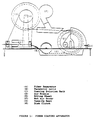
- Figure 1 shows a schematic of a method and process for coating fibers using a reactive polymer, water-dispersed composition, and drying and curing the reactive polymer to an elastomeric film.
- compositions of this invention comprise a fiber having a uniformly thin and continuous elastomeric coating thereon.
- the fibers employed can be any solid fiber. The types of fibers are described later in this specification.
- the elastomeric coating on the fiber is comprised of a cured reactive, lower molecular weight polymer. The main features of the reactive polymer are its ability to form a water-dispersed composition and to react to form an elastomer having a Tg value of 0°C. or below.
- the reactive polymers which are suitable for use in coating fibers, can be represented by the following general formula: Y n ( ⁇ PB ) wherein Y is either a univalent, reactive radical selected from the group consisting of carboxyl groups, amine groups, mercaptan groups, hydroxyl groups, phenolic groups and vinylidene groups or a monomeric unit of the polymeric backbone; n is an integer from 1 to 10; and PB is a polymeric backbone comprising carbon-carbon or carbon-oxygen linkages; provided that, when Y is a monomeric unit of the polymeric backbone that the polymeric backbone contains vinylene groups.
- the reactive polymers have a number average molecular weight of from 200 to 10,000 measured using a Vapor Pressure Osmometer or a Gel Permeation Chromatograph technique; have a Tg value using a Differential Thermal Analysis technique of below 0°C.; and are liquids or low melting solids at ambient or room temperature (about 25°C.).
- the polymeric backbone linkages comprise at least 70% by weight and more typically at least 90% by weight of the total polymer, and the reactive groups comprise from a minimum of 0.5% to 10% or more by weight of the total polymer.
- the polymer can contain internal, pendant and/or terminal reactive groups, and can contain a mix of two or more reactive groups.
- carboxyl-containing liquid polymers having polymeric backbones comprising carbon-carbon linkages are described in U.S. Patent Nos. 3,285,949 and 3,235,589. Such polymers are further described in U.S. Patent No. 4,119,592. These polymers are readily prepared by the reaction of vinylidene-containing monomers in the presence of a bis-azocyano acid such as azodicyanovaleric acid or by other methods adequately described in U.S. patent Nos. 3,135,716 and 3,235,589. The method of preparing the carboxyl-containing liquid polymer is not critical to this invention. Any carboxyl-containing liquid polymers meeting the specifications stated herein can be formed into water-dispersed compositions and used in this invention using the method disclosed herein.
- the carboxyl-containing liquid polymers can have pendant carboxyl groups (i.e., carboxyl groups which are attached to the polymeric backbone as side groups) and/or terminal carboxyl groups (i.e., carboxyl groups which are attached to the ends of the polymeric backbone).
- the carboxyl-terminated liquid polymers can be mono-functional; i.e. having a carboxyl group at one terminal end of the molecule, or di-functional; i.e. having a carboxyl group at each terminal end of the molecule.
- the mono-functional or di-functional polymer can contain pendant carboxyl groups.
- the total carboxyl functionality of the more preferred carboxyl-terminated liquid polymers can range from 1 to 10 or more, but more preferably ranges from 1 to 3 carboxyl groups per molecule.
- the more preferred carboxy-containing liquid polymers are referred to as carboxyl-terminated liquid polymers wherein the polymer has an average molecular weight of from 200 to 10,000; and has a Brookfield Viscosity (measured using a Brookfield RVT viscometer at 27°C with spindle No. 7 at about 20 rpm) of from 1000 mPa ⁇ s (cps) to 2,500,000 mPa ⁇ s (cps), and more preferably from 5000 mPa ⁇ s (cps) to 500,000 mPa ⁇ s (cps).
- a Brookfield Viscosity measured using a Brookfield RVT viscometer at 27°C with spindle No. 7 at about 20 rpm
- the preferred polymeric backbone is derived from interpolymerization of vinylidene monomers.
- vinylidene monomers are (a) monoolefins containing 2 to 14 carbon atoms, more preferably 2 to 8 carbon atoms, such as ethylene, propylene, isobutylene, 1-butene, 1-pentene, 1-hexene, 1-heptene, and the like; (b) dienes containing 4 to 10 carbon atoms, more preferably 4 to 8 carbon atoms, such as butadiene, isoprene (2-methyl-1,3-butadiene), 2-isopropyl-1,3-butadiene, chloroprene (2-chloro-,3-butadiene), and the like; (c) vinyl and allyl esters of carboxylic acids containing 2 to 8 carbon atoms such as vinyl acetate
- R1 is hydrogen or an alkyl radical containing 1 to 8 carbon atoms.
- suitable acrylates include ethyl acrylate, butyl acrylate, hexyl acrylate, 2-ethylhexyl acrylate, dodecyl acrylate, octadecyl acrylate, methoxyethyl acrylate, butoxyethyl acrylate, hexylthioethyl acrylate, ⁇ -cyanoethyl acrylate, cyanooctyl acrylate, methyl methacrylate, ethyl methacrylate, octyl methacrylate, and the like. Often two or more types of these polymerized monomeric units are contained in the polymeric backbone.
- the vinylidene monomers described above may be readily polymerized with up to about 50% by weight and more preferably up to about 35% by weight of at least one comonomer selected from the group consisting of (f) vinyl aromatics having the formula wherein R2 is hydrogen or methyl and R3 is hydrogen, halogen or an alkyl radical containing from 1 to 4 carbon atoms, such as styrene, ⁇ -methyl styrene, chlorostyrene, vinyl toluene, and the like; (g) vinyl nitriles having the formula such as acrylonitrile and methacrylonitrile; (h) vinyl halides such as vinyl bromide, vinyl chloride, and the like; (i) vinyl acids such as acrylic acid, methacrylic acid, and itaconic acid; (j) divinyls and diacrylates such as divinyl benzene, divinyl ether, diethylene glycol diacrylate, and the like; (k) amines of ⁇ , ⁇ -o
- Liquid polymer compositions having polymeric backbone derived from polymerized units of a major amount of at least one vinylidene monomer listed in (a) to (e) with a minor amount of at least one comonomer listed in (f) to (l) are within the scope of this invention.
- the choice of the vinylidene monomers interpolymerized into the polymeric backbone is such that the Tg of the reactive polymer is below 0°C.
- the Tg value of a homo- or interpolymer is readily determinable by Differential Thermal Analysis, or it can be calculated from knowledge of the Tg of the homopolymer of the individual monomers.
- An equation for calculating the Tg of copolymers is given on page 27 of the book " Mechanical Properties of High Polymers " by L. E. Neilsen, published by Reinhold Publishing Corp., 1967.
- the Tg value of many homopolymers are listed in the Tables given in Chapter 2 of the book.
- interpolymerized polymeric backbones of carbon-carbon linkages obtained from interpolymerization of vinylidene monomers include polyethylene, polyisobutylene, polyisoprene, polybutadiene, poly(vinyl ethyl ether), poly(ethylacrylate) and poly (butylacrylate) as well as polymers of butadiene and acrylonitrile; butadiene and styrene; butadiene, acrylonitrile, and acrylic acid; vinyl acetate and isoprene; vinyl acetate and chloroprene; methyl acrylate and butadiene; methyl acrylate and ethyl acrylate; methyl acrylate and butyl acrylate; methyl acrylate and 2-ethylhexyl acrylate; ethyl acrylate and ethylene; ethyl acrylate and isobutylene; ethyl acrylate and isoprene; eth
- the most preferred reactive polymers are the carboxyl-terminated polymers having polymeric backbones comprised of carbon-carbon linkages derived from interpolymerized units of from 50% to 99.6% by weight of a diene such as isoprene or butadiene, and up to 40% by weight of a vinyl nitrile such as acrylonitrile or a vinyl aromatic such as styrene, and up to 10% by weight of a vinyl acid such as acrylic acid, and having a carboxyl content of from 0.4% to 10% by weight, all weights based upon the total weight of the polymer.
- a diene such as isoprene or butadiene
- a vinyl nitrile such as acrylonitrile or a vinyl aromatic such as styrene
- a vinyl acid such as acrylic acid
- These polymers have a number average molecular weight of from 1000 to 5000, and a viscosity of from 1000 to 500,000 mPa ⁇ s (centipoises) (measured at 27°C. using a Brookfield RVT viscometer with spindle no. 7 at 20 rpm).
- the reactive polymers in this invention are in the form of a water dispersion.
- the water dispersed compositions comprise the reactive polymer, a select solvent, a dispersing agent, and water.
- the solvent used to prepare the water dispersed compositions requires the unusual property of being both water and organic soluble, that is having a balanced hydrophobic-hydrophilic character.
- Example of solvents having the above described properties include the glycol ethers such as 1-methoxy-2-methyl-ethanol, 2-propoxyethanol and 2-butoxy ethanol which is commercially known as butyl Cellosolve.
- the solvent is used in the composition at a level of at least 10 parts by weight based on 100 parts by weight of the polymer.
- the product composition is typically unstable and exhibits two phases.
- the solvent is used in the range of about 50 to about 500 parts by weight based on 100 parts by weight of the polymer.
- the upper amount of solvent used is limited basically by practical considerations. Excellent compositions were obtained when employing 100 parts by weight of the solvent per 100 parts by weight of the reactive polymer.
- the third ingredient of the reactive polymer, water dispersed composition is a dispersing agent.
- This material is a basic material, as further described herein, which is capable of interacting with the reactive polymer to form a compound which has both a hydrophilic and hydrophobic character.
- the dispersing agent is not a traditional soap. The use of these traditional soaps would cause interfacial and adhesion problems between the reactive polymer and the fiber, and, being hydroscopic in nature, would introduce water at the reactive polymer-fiber interfacial bond.
- the basic material interacts with the reactive polymer, typically with the functional reactive group, to form a "salt".
- Examples of basic dispersing agents are inorganic or organic bases. This material interacts with an acidic functional group, such as a carboxyl group, to form a hydrophilic salt.
- Examples of inorganic bases are sodium hydroxide, potassium hydroxide, and metal alcoholates such as sodium ethoxide. More preferably the base is an organic amine, preferably a tertiary amine.
- amines examples include trimethylamine, triethylamine, triisopropyl amine, dimethylbutyl amine, dimethylbenzyl amine, methyldiphenyl amine, triethanol amine, N-methyl peperidine, N-methyl morpholine, triethylenediamine, pyridine, 4,4'-dipyridyl propane, 2,4,6-tri (dimethylaminomethyl) phenol, and the like. Excellent results were obtained when the organic base used was dimethylaminoethanol. For use with carboxyl-containing polymers, a base which has a pk a value of greater than 7 is preferred.
- the amount of organic base employed is determined by the stoichiometry relationship of the base per 1.0 carboxyl equivalent.
- the carboxyl (acid) equivalent weight is calculated as 100 divided by the equivalents per hundred parts by weight of rubber of the carboxyl-containing polymer.
- a carboxyl-containing polymer can be solubilized using as low as about 0.8 equivalents of base per 1.0 carboxyl equivalent. However, better dispersion is obtained when 1.0 equivalent of base per 1.0 carboxyl equivalent is used, although up to a 20% excess can be readily employed without problems.
- the upper level of base used is basically limited by practical considerations.
- Water is the fourth ingredient in the compositions.
- the water used can be distilled water, demineralized water, or regular tap water.
- the amount of water used in preparing the composition is at least 50 parts by weight per 100 parts by weight of the polymer. More preferably, the amount of water employed is from 100 parts to 600 parts of water per 100 parts of the polymer. Excellent results were obtained using 500 parts by weight of water per 100 parts by weight of reactive polymer.
- Water dispersed compositions of amine-containing reactive polymers were readily formed comprising (1) 100 parts by weight of an amine-containing polymer, (2) at least 25 parts by weight of the select solvent, (3) at least 0.8 equivalent of an organic acid, and (4) at least 100 parts by weight of water.
- the water-dispersed, reactive polymer compositions can be prepared by admixing all four components together.
- the preferred method is to first dissolve the polymer in the solvent.
- the dissolution of the polymer in the organic solvent is enhanced by mild heating and agitation with, for example, a propeller type mixer operating at 50 to 300 rpm.
- the dispersing agent is added to the solvent solution of the liquid polymer with mild agitation.
- the water is added slowly with mild agitation to yield a suspension of the polymer in the water. No soap is used to prepare the water-dispersed compositions.
- the water-dispersed, reactive polymer compositions are typically “transparent” dispersions as opposed to the milky, opaque appearance of latexes.
- the water-dispersed amine-containing and carboxy-containing polymers can be readily used as a component in castable elastomeric systems, as an impact modifier for water-borne epoxy and polyester resins and coatings, and particularly for coating fibers.
- the water-dispersed reactive polymer compositions can be used to coat fibers in the form they are prepared. However, it is advantageous to dilute the compositions with additional water and use them in the form of a dispersion containing a 0.1% to 5% by weight of reactive polymer. More preferably, the compositions are used in the form of water dispersions containing 0.25% to 2% by weight of reactive polymer.
- the use of the water-dispersed compositions described herein have a substantial advantage over the use of a latex or a solvent solution in that the water dispersions can be diluted down to very low levels of total solids and yet remain stable for use.
- Latexes are typically high solids dispersions, and attempts to dilute them down to low levels usually result in instability of the system and coagulation. Further, latexes typically employ high levels of traditional soaps which is undesirable. With solvent solutions, although a low total solids level can be obtained, the use of large levels of solvent is undesirable.
- the fibers employed in this invention can be any solid synthetic or natural fiber.
- fibers are glass fibers, graphite fibers, and asbestos fibers; natural organic fibers such as wool and cotton; and synthetic fibers such as polyaramide fibers, polyester fibers, nylon® fibers, and polyolefin fibers such as polyethylene and polybutylene fibers.
- the preferred fibers to coat with the reactive polymers are those fibers which are used as strengthening materials for such substances.
- glass fibers and graphite fibers would represent the large volume fibers typically used in these applications. Of all of the fibers, the glass fibers are the most preferred type of fiber used in this invention.
- the present process of coating fibers using the water-dispersed, reactive polymer compositions described above results in excellent uniformly thin and continuous elastomeric coatings on fibers.
- thin is meant a film coating of up to 0.2 ⁇ m in thickness and having a ratio of film thickness to diameter of the fiber of no more than 1:10 and preferably of 1:50 or less.
- the film thickness to fiber diameter ratio is greater than 1:10, the reinforcing effectiveness of the fiber is seriously impaired by the compliance of the elastomeric film.
- a preferred process used to coat the fibers is to draw the fibers through the water-dispersed, reactive polymer composition, while simultaneously or subsequently adding the necessary curative ingredients, and then drying and curing the coating to an elastomeric film.
- the preferred process is further described as follows using an amine-terminated liquid polymer as an exemplary reactive polymer, said amine-terminated liquid polymers being not according to this invention.
- a water-dispersed composition of an amine-terminated liquid polymer having a poly (butadiene-acrylonitrile) backbone is first formed by dissolving the polymer in a select solvent such as butyl Cellosolve®, adding an organic acid such as lactic acid, followed by the addition of water.
- a select solvent such as butyl Cellosolve®
- organic acid such as lactic acid
- the curative ingredients for amine-terminated liquid polymers are well known and are clearly described in U.S. Patent Nos. 4,018,847; 4,055,541; and 4,521,490.
- the curative ingredients, i.e. the epoxy resin and curing agent are themselves water-dispersible, and can be used in this form. Hence, all three water dispersions can be admixed and used simultaneously.
- the strand for example graphite or glass, is separated into individual fibers and drawn through the water dispersion mix.
- the coated fiber is then dried and the reactive polymer cured to an elastomeric film.
- the curatives and their levels of use with a reactive polymer to produce a cured, elastomeric state is well known to the art.
- the most common curative used is an epoxy resin such as the aliphatic and cycloaliphatic epoxides and the diglycidylethers of Bisphenol A.
- Curing agents which can be employed in these systems include aliphatic and aromatic amines, polyamides, and dicyandiamides.
- Reactive polymers containing internal vinylene groups can be cured using free-radical peroxides and hydroperoxides.
- amine-containing liquid polymers can be cured using epoxy resins and/or hardeners as curatives.
- the ratio of these ingredients to the reactive polymer determines the physical properties of the cured elastomer.
- epoxy resin a digylcidyl ether of Bisphenol A
- chain extender Bisphenol A
- Hycar® ATBN liquid polymer a poly (Butadiene-16% acrylonitrile) liquid polymer having terminal amine groups and an AEW of 900
- the amine-containing liquid polymers can also be cured using 100 parts by weight of a cycloaliphatic diepoxide as the epoxy resin and 100 parts by weight of hexahydrophthalic anhydride as the hardener with similar results.
- a cycloaliphatic diepoxide as the epoxy resin
- hexahydrophthalic anhydride as the hardener
- other typical ingredients such as plasticizers, fillers, pigments, stabilizers and the like can also be used with the reactive polymers.
- the reactive polymers can also be conveniently cured using radiation.
- radiation for example, ultraviolet radiation in the presence of UV sensitizers, infrared radiation in the presence of thermal reactive agents, microwave radiation, and electron-beam radiation can all be employed to cure the reactive polymer to an elastomeric coating.
- FIG. 1 A preferred technique and an apparatus for coating the fibers is shown in Figure 1.
- the strand prior to entering the coating chamber, is separated into individual fibers by an air jet.
- the fibers are drawn through the compositions in the chamber at a set rate.
- the coated fiber is then passed through a drying region and a curing region.
- the drying is effected at a temperature and for a time sufficient to evaporate the solvent and water. Drying can be accomplished using a hot gas stream such as heated air or in a vacuum, at temperatures of from 50°C. to 120°C. for 10 seconds to 60 seconds or more. Curing times and temperatures depend upon the type of curing mechanism and type of curative ingredients employed. Typically, curing times range from thirty seconds to 60 minutes or more at temperatures of 50°C. to 150°C.
- the drying region and curing region can be part of the same continuous area.
- the fibers can be drawn through a common or consecutive baths.
- the curatives can be used in the form of water dispersions or solvent solutions.
- the fiber can be used as acquired, or cleaned and/or pre-treated prior to coating with the reactive polymer. If the fibers and reactive polymers do not themselves form a strong interfacial bond, the fibers can be pre-treated using known sizings to promote effective bonding between the fiber and the reactive polymer elastomeric film. It is important that the individual fibers have good and sufficient contact with the reactive polymer and curatives, and that the coated fibers are dried and at least partially cured to a non-blocking state prior to contact with each other.
- compositions were prepared by dissolving the ATBN liquid polymer in the butyl Cellosolve at a temperature of about 25°C followed by addition of the lactic acid. Water was then slowly added to the compositions while agitating the mixture at 50 to 300 rpm using an air stirrer with a marine blade.
- the first recipe exemplifies a preferred composition of the invention wherein a stable, translucent composition was prepared.
- the use of less solvent at 50 parts by weight based on 100 parts of liquid polymer
- Recipes 3 and 4 demonstrate the criticality of using the solvent and the organic acid, respectively, in the compositions. In both cases, the absence of one of the essential ingredients resulted in a non-stable composition.
- AT-RLP-1 has a polybutadiene backbone, a Brookfield viscosity of 127,000 mPa ⁇ s (cps.) at 27°C., and an amine equivalent weight of 1050
- AT-RLP-2 has a backbone of interpolymerized butadiene and acrylonitrile (about 10% by weight), a viscosity of 180,000 mPa ⁇ s (cps.), and an amine equivalent weight of 1200
- AT-RLP-3 has a backbone of interpolymerized butadiene, acrylonitrile (about 16% by weight), and acrylic acid (about 1.7% by weight) which carboxyl groups were converted to amine groups using the teachings of U.S.
- Patent No. 4,133,957 a viscosity of 460,000 mPa ⁇ s (cps), and an amine equivalent of about 800.
- the components used in the recipes below are shown in parts by weight. 1 2 3 AT-RLP-1 20 - - AT-RLP-2 - 20 - AT-RLP-3 - - 20 Butyl Cellosolve® 20 20 2 Lactic Acid 3 3 3 Water 100 100 100 Appearance Translucent and Stable Translucent and Stable Translucent and Stable Translucent and Stable
- Example 2 The experiment in Example 2 above was essentially repeated using a mono-functional amine-terminated liquid polymer having a polymeric backbone comprised of interpolymerized butadiene and acrylonitrile (about 16% by weight).
- the amine-terminated polymer has a viscosity of 64,000 mPa ⁇ s (cps.) and an amine equivalent weight of 2500.
- the recipe used was 10 parts by weight of polymer, 10 parts by weight of butyl Cellosolve®, 1.5 parts by weight of lactic acid, and 50 parts by weight of water. A stable, translucent composition was readily prepared.
- the above experiments were essentially repeated using an amine-containing liquid polymer having a polymeric backbone comprised of carbon-oxygen linkages.
- the amine-terminated polyether used is known as D-2000, which is commercially available from Texaco, Inc. through its Jefferson Chemical Co. subsidiary.
- the polymer is a polyoxypropyleneamine which has an average molecular weight of about 2000, a viscosity of about 265 mPa ⁇ s (centipoises) at 25°C., and an amine equivalent weight of 1040.
- the recipe used was 20 parts by weight of D-2000, 20 parts by of butyl Cellosolve®, 3 parts by weight of lactic acid and 100 parts by weight of water. A stable, translucent composition was readily prepared.
- Example 4 The experiment in Example 4 above was repeated using a higher molecular weight amine-containing polymer having a polymeric backbone comprised of carbon-oxygen linkages.
- the amine-terminated polymer used is known as HC-1101, which is commercially available from The 3M Co.
- the polymer has an average molecular weight of 10,000, and an amine equivalent weight of 4610.
- the polymer is a low-melting solid at room temperature. Hence, the polymer was heated to about 50°C. and used in a liquid state.
- the recipe used was 10 parts by weight of HC-1101, 10 parts by weight of butyl Cellosolve®, 1.5 parts by weight of lactic acid and 50 parts by weight of water. A stable, translucent composition was readily prepared.
- Carboxyl-terminated liquid polymers commercially available from The B.F. Goodrich Company marketed as Hycar® CTBN were used to prepare water-dispersed, carboxyl-containing liquid polymer compositions of this invention.
- compositions were prepared by dissolving the CTBN liquid polymer in the solvent, butyl Cellosolve®, at a temperature of about 25°C followed by addition of the respective base. Water was then slowly added to the compositions while agitating the mixture at 50-300 rpm using an air stirrer with a marine blade.
- CT-RLP-1 has a backbone of interpolymerized units of butadiene and acrylonitrile (about 10% by weight), a Brookfield viscosity of 60,000 mPa ⁇ s (cps.) at 27°C., and a carboxyl equivalent weight of about 2000
- CT-RLP-2 has a backbone of interpolymerized butadiene and acrylonitrile (about 18% by weight), a viscosity of 135,000 mPa ⁇ s (cps.), and a carboxyl equivalent weight of 1920
- CT-RLP-3 has a backbone of interpolymerized butadiene and acrylonitrile (26% by weight), a viscosity of 500,000 mPa ⁇ s (cps), and a carboxyl equivalent weight of 1750.
- the organic base was used in the example at 1.0 equivalent per 1.0 carboxyl equivalent .
- the components used in the recipes below are shown in parts by weight. 1 2 3 4 5 6 CT-RLP-1 20 - - - - - CT-RLP-2 - 20 - 20 20 20 CT-RLP-3 - - 20 - - - Butyl Cellosolve® 20 20 2 2 2 2 Dimethylaminoethanol 1 1 1 - - - Imidazole - - - 0.7 - - 2-Methyl Imidazole - - - - 0.8 - 2-Methyl-4-Ethyl Imidazole - - - - - 1.1 Water 100 100 100 100 100 100 100 100 100 100 100 100 100 100 100 100 100 100 100 100 100 100 100 100 100 100 100 100 100 100 100 100 100 100 100 100 100 100 100 100 100 100 100 100 100 100 100 100 100 100 100 100 100 100 100 100 100 100 100 100 100 100 100 100 100 100 100 100 100 100 100 100
- Example 6 The experiment in Example 6 above was essentially repeated using a carboxyl-terminated polymer having a polymeric backbone comprised of interpolymerized butadiene.
- the polymer has a viscosity of 60,000 mPa ⁇ s (cps.) and a carboxyl equivalent weight of 2220.
- the recipe used was 20 parts by weight of polymer, 20 parts by weight of butyl Cellosolve®, 1 part by weight of dimethylaminoethanol and 100 parts by weight of water.
- a stable, translucent composition was readily prepared.
- the above experiment was essentially repeated using a carboxyl-containing polymer having a polymeric backbone comprised of interpolymerized units of butadiene, acrylonitrile (about 18% by weight), and acrylic acid (1.7% by weight).
- the polymer has both terminal and pendant carboxyl groups.
- the polymer has an average molecular weight of about 3600, a viscosity of about 160,000 mPa ⁇ s (centipoises) at 27°C., and a carboxyl equivalent weight of about 1490.
- the recipe used was 20 parts by weight of polymer, 20 parts by of butyl Cellosolve®, 1 part by weight of dimethylaminoethanol and 100 parts by weight of water. A stable, translucent composition was readily prepared.
- compositions were prepared by dissolving the ATBN liquid polymer in the butyl Cellosolve® at a temperature of about 25°C followed by addition of the lactic acid. Water was then slowly added to the compositions while agitating the mixture at 50 to 300 rpm using an air stirrer with a marine blade.
- AT-RLP-1 has a polybutadiene backbone, a Brookfield viscosity of 127,000 mPa ⁇ s (cps.) at 27°C., and an amine equivalent weight of 1050
- AT-RLP-2 has a backbone of interpolymerized butadiene and acrylonitrile (about 10% by weight), a viscosity of 180,000 mPa ⁇ s (cps.), and an amine equivalent weight of 1200
- AT-RLP-3 has a backbone of interpolymerized butadiene, acrylonitrile (about 16% by weight), and acrylic acid (about 1.7% by weight) which carboxyl groups were converted to amine groups using the teachings of U.S.
- Patent No. 4,133,957 a viscosity of 460,000 mPa ⁇ s (cps), and an amine equivalent of about 800.
- the components used in the recipes below are shown in parts by weight. 1 2 3 AT-RLP-1 20 - - AT-RLP-2 - 20 - AT-RLP-3 - - 20 Butyl Cellosolve 20 20 20 Lactic Acid 3 3 3 Water 100 100 100 Appearance Translucent and Stable Translucent and Stable Translucent and Stable Translucent and Stable
- Example 10 The experiment in Example 10 above was essentially repeated using a mono-functional amine-terminated liquid polymer having a polymeric backbone comprised of interpolymerized butadiene and acrylonitrile (about 16% by weight).
- the amine-terminated polymer has a viscosity of 64,000 mPa ⁇ s (cps.) and an amine equivalent weight of 2500.
- the recipe used was 10 parts by weight of polymer, 10 parts by weight of butyl Cellosolve, 1.5 parts by weight of lactic acid, and 50 parts by weight of water. A stable, translucent composition was readily prepared.
- the above experiment was essentially repeated using an amine-containing liquid polymer having a polymeric backbone comprised of carbon-oxygen linkages.
- the amine-terminated polyether used is known as D-2000, which is commercially available from Texaco, Inc. through its Jefferson Chemical Co. subsidiary.
- the polymer is a polyoxypropyleneamine which has an average molecular weight of about 2000, a viscosity of about 265 mPa ⁇ s (centipoises) at 25°C., and an amine equivalent weight of 1040.
- the recipe used was 20 parts by weight of D-2000, 20 parts by weight of butyl Cellosolve®, 3 parts by weight of lactic acid and 100 parts by weight of water. A stable, translucent composition was readily prepared.
- Example 12 The experiment in Example 12 above was repeated using another amine-containing polymer having a higher molecular weight and a polymeric backbone comprised of carbon-oxygen linkages.
- the amine-terminated polymer used is known as HC-1101, which is commercially available from The 3M Co.
- the polymer has an average molecular weight of 10,000, and an amine equivalent weight of 4610.
- the polymer is a low-melting solid at room temperature. Hence, the polymer was heated to about 50°C. and used in a liquid state.
- the recipe used was 10 parts by weight of HC-1101, 10 parts by weight of butyl Cellosolve®, 1.5 parts by weight of lactic acid and 50 parts by weight of water. A stable, translucent composition was readily prepared.
- Carboxyl-terminated liquid polymers commercially available from the B.F. Goodrich Company marketed as Hycar® CTBN were used to prepare water-dispersed, carboxyl-containing liquid polymer compositions of this invention.
- compositions were prepared by dissolving the CTBN liquid polymer in the solvent, butyl Cellosolve, at a temperature of about 25°C followed by addition of the respective base. Water was then slowly added to the compositions while agitating the mixture at 50-300 rpm using an air stirrer with a marine blade.
- CT-RLP-1 has a backbone of interpolymerized units of butadiene and acrylonitrile (about 10% by weight), a Brookfield viscosity of 60,000 mPa ⁇ s (cps.) at 27°C., and a carboxyl equivalent weight of about 2000
- CT-RLP-2 has a backbone of interpolymerized butadiene and acrylonitrile (about 18% by weight), a viscosity of 135,000 mPa ⁇ s (cps.), and a carboxyl equivalent weight of 1920
- CT-RLP-3 has a backbone of interpolymerized butadiene and acrylonitrile (25% by weight), a viscosity of 500,000 mPa ⁇ s (cps), and a carboxyl equivalent weight of 1750.
- the organic base was used in the example at 1.0 equivalent per 1.0 carboxyl equivalent .
- the components used in the recipes below are shown in parts by weight. 1 2 3 4 5 6 CT-RLP-1 20 - - - - - CT-RLP-2 - 20 - 20 20 20 CT-RLP-3 - - 20 - - - Butyl Cellosolve® 20 20 20 20 20 20 20 Dimethylaminoethanol 1 1 1 - - - Imidazole - - - 0.7 - - 2-Methyl Imidazole - - - - 0.8 - 2-Methyl-4-Ethyl Imidazole - - - - - 1.1 Water 100 100 100 100 100 100 100 100 100 100 100 100 100 100 100 100 100 100 100 100 100 100 100 100 100 100 100 100 100 100 100 100 100 100 100 100 100 100 100 100 100 100 100 100 100 100 100 100 100 100 100 100 100 100 100 100 100 100 100 100 100 100 100 100 100 100 100 100 100 All of
- Example 6 The experiment in Example 6 above was essentially repeated using a carboxyl-terminated polymer having a polymeric backbone comprised of interpolymerized butadiene.
- the polymer has a viscosity of 60,000 mPa ⁇ s (cps.) and a carboxyl equivalent weight of 2220.
- the recipe used was 20 parts by weight of polymer, 20 parts by weight of butyl Cellosolve®, 1 part by weight of dimethylaminoethanol and 100 parts by weight of water.
- a stable, translucent composition was readily prepared.
- the above experiment was essentially repeated using a carboxyl-containing polymer having a polymeric backbone comprised of interpolymerized units of butadiene, acrylonitrile (about 18% by weight), and acrylic acid (1.7% by weight).
- the polymer has both terminal and pendant carboxyl groups.
- the polymer has an average molecular weight of about 3600, a viscosity of about 160,000 centipoises at 27°C., and a carboxyl equivalent weight of about 1490.
- the recipe used was 20 parts by weight of polymer, 20 parts by weight of butyl Cellosolve®, 1 part by weight of dimethylaminoethanol and 100 parts by weight of water. A stable, translucent composition was readily prepared.
- a water-dispersed composition prepared as in Example 1 was used to coat a carbon-graphite fiber.
- the reactive polymer employed was an amine-terminated liquid poly (butadiene-acrylonitrile) polymer as described in Example 1.
- the curatives employed were a bisphenol A type epoxy resin having an epoxy equivalent weight of 525 sold as Epi-Rez 520-C, and available in a water-dispersed form as CMD WJ 55-3520 Epoxy Resin from Interez, Inc. (the epoxy resin was dispersed in water and 2-propoxyethanol); and an amine curing agent having an amine equivalent weight of 174, and available in water-dispersed form as CMD WJ60-8537 Curing Agent from Interez, Inc.
- the amine was dispersed in water, 2-propoxyethanol, and glacial acetic acid).
- the water dispersions were compatible with each other and were admixed in a common coating pan.
- the fiber employed was a carbon-graphite fiber available as Thornel® 300 from Amoco Performance Products, Inc.
- the graphite fiber was first cleaned by soaking it in acetone for about 24 hours.
- the fiber roving was then placed on a reel and passed over an air jet to separate the individual filaments.
- the separate filaments were then drawn through a pretreatment solution of 0.1% epoxy resin (Epon® 828) and Ancamine® K-61B amine curative (10% by weight based on the epoxy) dissolved in a 50/50 mixture of acetone and methylethyl ketone. This was a sizing solution used to promote adhesion of the reactive polymer to the fiber.
- the sizing was dried and cured to the fiber.
- the treated fiber was then drawn through the three component water-dispersed mixture described above.
- the coated fiber was dried in a hot air stream and then cured at 120°C. for 2 hours.
- the thickness of the polymer film coated on the fiber was proportionate to the concentration of the polymer in the dispersion, and was calculated to be 0.010, 0.036, 0.062, and 0.114 ⁇ m in thickness, respectively.
- the coating, after cure, was immersed in acetone to establish that the reactive polymer was in fact in a cured state. Pictures taken by scanning electron microscopy showed the elastomeric coatings to be uniformly thin and continuous.
- the ratio of the thickness of the film to fiber diameter (7 ⁇ m) ranged from 1:700 to 1:50.
- Example 17 The process described in Example 17 was repeated using a glass fiber.
- the same reactive polymer, water-dispersed composition, and epoxy and amine curatives were employed at the same conditions. However, in this experiment, the fiber was not cleaned and pretreated prior to use, but was used as received.
- the glass fiber employed was Type E glass fiber sold as OCF Roving 366 Fiberglass by Owens Corning Fiberglass Co. The fiber had a diameter of 16 ⁇ m.
- the reactive polymer and curatives were used as water-dispersions and commonly placed into the coating chamber.
- the glass fibers were drawn through the chamber, passed through a drying section and then heated at 120°C. for 2 hours to cure the reactive polymer to an elastomeric film. Again, the state of cure was demonstrated by immersing a portion of the coated fiber in acetone and methylethyl ketone for one hour.
- the coating thickness was calculated to be 0.041, 0.105, and to 0.192 ⁇ m in thickness, respectively, depending in proportion on the concentration of the reactive polymer in the water dispersions (1%, 2%, and 3% by weight).
- Cured epoxy laminates were prepared which contained the elastomer-coated graphite fibers prepared in Example 9. These laminates were fabricated as follows. A prepreg was first prepared by contacting the coated fiber in an epoxy resin solution mix of 100 parts by weight of Epon® 828 (a diglycidylether of Biphenol A), 10 parts by weight of Ancamine® K61B (an amine curing agent of tris-(dimethyl-aminomethyl) phenol-tri (2-ethyl hexoate), and 70 parts by weight each of acetone and MEK. The fiber was wound at 32 strands per inch on an aluminum plate which was immersed in the above described epoxy resin solution for about one minute, then dried. The prepreg was then heated at 120°C.
- Epon® 828 a diglycidylether of Biphenol A
- Ancamine® K61B an amine curing agent of tris-(dimethyl-aminomethyl) phenol-tri (2-ethyl hexoate)
- Tests were made on samples for short beam shear, end-notched flexural interlaminar shear, and single edge-notched intralaminar shear. In these tests, failure occurred at the fiber/epoxy matrix interface when the ordinary graphite fibers were used, but occurred at the elastomer/epoxy matrix interface (or in the elastomer coating per se) when the elastomer coated graphite fibers were used, indicating excellent bonding between the graphite elastomer interface.
- the use of the elastomer coated fiber resulted in a significant increase in shear toughness of the laminate. Further, the use of the elastomer coated graphite fibers resulted in greater impact energy being absorbed in the samples in impact tests.
- Prepregs were prepared containing the elastomer coated glass fibers prepared in Example 18, following the procedures disclosed in Example 19 above. Epoxy laminates were also prepared in a similar manner. Again, improved shear strength was obtained with the use of the elastomer coated glass fibers. Also, impact toughness increased with the use of the elastomer coated glass fibers.
- the elastomer-coated glass fibers were also chopped into 0.635 cm (one-fourth inch) lengths and mixed at 75 grams by weight with 300 grams by weight of Nylon® 6, and optionally, 19 grams by weight of Polyanhydride resin PA-18 (a copolymer of 1-octadecene and maleic anhydride.)
- the mix was extruded using a single-screw Brabender extruded at 240°C.
- the extrudate was cut into 15.88 cm (6") lengths and molded at 250°C. to provide samples for testing.
- the Nylon® 6 samples made using the elastomer coated glass fibers demonstrated increased Izod impact strength and increased driven dart impact strength.
Landscapes
- Chemical & Material Sciences (AREA)
- Engineering & Computer Science (AREA)
- Materials Engineering (AREA)
- Life Sciences & Earth Sciences (AREA)
- Organic Chemistry (AREA)
- Chemical Kinetics & Catalysis (AREA)
- General Chemical & Material Sciences (AREA)
- Geochemistry & Mineralogy (AREA)
- General Life Sciences & Earth Sciences (AREA)
- Medicinal Chemistry (AREA)
- Health & Medical Sciences (AREA)
- Manufacturing & Machinery (AREA)
- Polymers & Plastics (AREA)
- Textile Engineering (AREA)
- Paints Or Removers (AREA)
- Compositions Of Macromolecular Compounds (AREA)
- Surface Treatment Of Glass Fibres Or Filaments (AREA)
- Epoxy Resins (AREA)
- Treatments For Attaching Organic Compounds To Fibrous Goods (AREA)
Claims (20)
- Procédé amélioré pour préparer des revêtements élastomères uniformément minces et continus sur des fibres, par mise en contact des fibres avec une composition dispersée dans l'eau, séchage puis durcissement de ladite composition; dans lequel ladite composition dispersée dans l'eau est une composition contenant (1) un polymère réactif, (2) une résine époxyde, et (3) un agent de durcissement ; et dans lequel ledit polymère réactif est une composition dispersée dans l'eau contenant (a) 100 parties en poids d'un polymère réactif, qui est un polymère liquide à terminaison carboxyle ayant une Tg inférieure à 0°C et une masse moléculaire moyenne de 200 à 10 000, (b) au moins 10 parties en poids d'un solvant organique sélectionné, miscible à l'eau, (c) une base servant de dispersant capable d'interagir avec le polymère pour former un composé ayant simultanément un caractère hydrophile et hydrophobe, à l'exclusion des savons classiques, et (d) au moins 50 parties en poids d'eau.
- Procédé selon la revendication 1, dans lequel le polymère liquide à terminaison carboxyle a une ossature polymère constituée de motifs interpolymérisés comprenant de 50 à 99,6 % en poids d'un diène, jusqu'à 40 % en poids d'un composé vinylnitrile ou vinylaromatique, et jusqu'à 10 % en poids d'un acide vinylique, et a une teneur en groupement carboxyle de 0,4 à 10 % en poids, tous les poids étant rapportés au poids du polymère.
- Procédé selon la revendication 2, dans lequel le solvant est présent dans la composition dispersée dans l'eau du polymère réactif en des quantités de 50 à 500 parties en poids pour 100 parties en poids du polymère, et le dispersant est une amine utilisée en une quantité d'au moins 0,8 équivalent de base par équivalent carboxyle.
- Procédé selon la revendication 3, dans lequel la fibre utilisée est une fibre de graphite ou une fibre de verre.
- Procédé selon la revendication 4, dans lequel le solvant est le butylcellosolve.
- Procédé selon la revendication 5, dans lequel l'acide organique est l'acide lactique.
- Procédé selon la revendication 5, dans lequel la base est une amine tertiaire.
- Procédé selon la revendication 5, dans lequel la base est choisie parmi l'ensemble comprenant le diméthylaminoéthanol, l'imidazole, le 2-méthylimidazole et le 2-méthyl-4-éthylimidazole.
- Procédé selon la revendication 1, dans lequel le polymère réactif est durci sous l'effet d'un rayonnement.
- Procédé selon la revendication 1, dans lequel le polymère réactif est durci par chauffage en présence desdits agents de durcissement.
- Procédé selon la revendication 1, dans lequel la résine époxyde est une résine époxyde du type bisphénol A, et l'agent de durcissement est un agent de durcissement du type amine.
- Procédé selon les revendications 1 à 11, dans lequel les fibres sont mises en contact avec les compositions dispersées dans l'eau (1) à (3) dans des bains successifs.
- Composition dispersée dans l'eau, contenant (1) 100 parties en poids d'un polymère liquide carboxylé, (2) au moins 25 parties en poids d'un solvant organique soluble simultanément dans l'eau et les composés organiques et ayant une température normale d'ébullition supérieure à 100°C, (3) au moins 0,8 équivalent d'une base par équivalent carboxyle, cette base ayant un pka supérieur à 7, et (4) de 50 à 750 parties en poids d'eau.
- Composition selon la revendication 13, dans laquelle le polymère liquide carboxylé est un polymère liquide à terminaison carboxyle ayant une masse moléculaire moyenne de 200 à 10 000.
- Composition selon la revendication 14, dans laquelle le polymère liquide à terminaison carboxyle a une ossature polymère constituée de motifs interpolymérisés comprenant 50 à 99,6 % en poids d'un diène, jusqu'à 40 % en poids d'un composé vinylnitrile ou vinylaromatique, et jusqu'à 10 % en poids d'un acide vinylique, et a une teneur en groupes carboxyle de 0,4 à 10 % en poids, tous les poids étant rapportés au poids du polymère.
- Composition selon les revendications 13 à 15, dans laquelle le solvant est présent en des quantités de 100 à 500 parties en poids pour 100 parties en poids du polymère.
- Composition selon la revendication 16, dans laquelle le solvant est le butylcellosolve.
- Composition selon la revendication 13, dans laquelle la base est une amine organique utilisée à raison de 1,0 équivalent de base par équivalent carboxyle.
- Composition selon la revendication 18, dans laquelle la base est une amine tertiaire.
- Composition selon la revendication 18, dans laquelle la base est choisie parmi l'ensemble comprenant le diméthylaminoéthanol, l'imidazole, le 2-méthylimidazole, et le 2-méthyl-4-éthylimidazole.
Applications Claiming Priority (6)
| Application Number | Priority Date | Filing Date | Title |
|---|---|---|---|
| US13438587A | 1987-12-17 | 1987-12-17 | |
| US134412 | 1987-12-17 | ||
| US07/134,412 US4882081A (en) | 1987-12-17 | 1987-12-17 | Compositions of water-dispersed carboxyl-containing liquid polymers |
| US134385 | 1987-12-17 | ||
| US14825188A | 1988-01-25 | 1988-01-25 | |
| US148251 | 1998-09-04 |
Publications (3)
| Publication Number | Publication Date |
|---|---|
| EP0320873A2 EP0320873A2 (fr) | 1989-06-21 |
| EP0320873A3 EP0320873A3 (en) | 1990-07-04 |
| EP0320873B1 true EP0320873B1 (fr) | 1993-03-31 |
Family
ID=27384570
Family Applications (1)
| Application Number | Title | Priority Date | Filing Date |
|---|---|---|---|
| EP88120799A Expired - Lifetime EP0320873B1 (fr) | 1987-12-17 | 1988-12-13 | Procédé de préparation de revêtements élastomères sur des fibres et compositions de polymères en dispersion aqueuse |
Country Status (6)
| Country | Link |
|---|---|
| EP (1) | EP0320873B1 (fr) |
| JP (1) | JPH0284586A (fr) |
| KR (1) | KR890010048A (fr) |
| CN (1) | CN1065076A (fr) |
| AU (1) | AU621845B2 (fr) |
| DE (1) | DE3879902T2 (fr) |
Families Citing this family (6)
| Publication number | Priority date | Publication date | Assignee | Title |
|---|---|---|---|---|
| US5080968A (en) * | 1988-01-25 | 1992-01-14 | The B. F. Goodrich Company | Composites of vinyl resins and elastomer-coated fibers |
| FR2691171B1 (fr) * | 1992-05-15 | 1994-12-23 | Vetrotex France Sa | Procédé de fabrication d'un fil continu par étirage mécanique et produits en résultant. |
| JP3707332B2 (ja) * | 2000-02-15 | 2005-10-19 | 日本板硝子株式会社 | ガラス繊維およびゴム製品 |
| ATE444265T1 (de) | 2001-03-15 | 2009-10-15 | Draka Comteq Bv | Verfahren zur herstellung einer beschichtungszusammenstezung |
| US8138262B2 (en) * | 2006-11-21 | 2012-03-20 | Ppg Industries Ohio, Inc. | Waterborne, radiation-curable coating compositions and related methods |
| US10174453B2 (en) * | 2014-07-16 | 2019-01-08 | Jsr Corporation | Sizing agent, composition, and formed article |
Family Cites Families (4)
| Publication number | Priority date | Publication date | Assignee | Title |
|---|---|---|---|---|
| US4104434A (en) * | 1974-01-30 | 1978-08-01 | Owens-Corning Fiberglas Corporation | Sizing composition and glass fibers sized therewith |
| US4119592A (en) * | 1977-02-25 | 1978-10-10 | The B. F. Goodrich Company | Rubbery bladders from epoxy compositions |
| US4120766A (en) * | 1977-03-28 | 1978-10-17 | The B. F. Goodrich Company | Hydroxyl-containing liquid polymers and process for preparation thereof |
| US4341677A (en) * | 1980-04-03 | 1982-07-27 | Ppg Industries, Inc. | Antioxidants and reinforced polymers and oil-in-water emulsions of antioxidants |
-
1988
- 1988-12-13 EP EP88120799A patent/EP0320873B1/fr not_active Expired - Lifetime
- 1988-12-13 DE DE8888120799T patent/DE3879902T2/de not_active Expired - Fee Related
- 1988-12-13 AU AU26828/88A patent/AU621845B2/en not_active Ceased
- 1988-12-17 JP JP63317638A patent/JPH0284586A/ja active Pending
- 1988-12-17 KR KR1019880016900A patent/KR890010048A/ko not_active Ceased
-
1992
- 1992-05-03 CN CN92103209A patent/CN1065076A/zh active Pending
Also Published As
| Publication number | Publication date |
|---|---|
| EP0320873A2 (fr) | 1989-06-21 |
| DE3879902T2 (de) | 1993-07-08 |
| JPH0284586A (ja) | 1990-03-26 |
| AU2682888A (en) | 1989-06-22 |
| KR890010048A (ko) | 1989-08-05 |
| DE3879902D1 (de) | 1993-05-06 |
| CN1065076A (zh) | 1992-10-07 |
| EP0320873A3 (en) | 1990-07-04 |
| AU621845B2 (en) | 1992-03-26 |
Similar Documents
| Publication | Publication Date | Title |
|---|---|---|
| US5350814A (en) | Unsaturated polyester-epoxy resin network composition | |
| US3945964A (en) | Aqueous epoxy emulsions | |
| US4478963A (en) | Filler particles coated with reactive liquid polymers in a matrix resin | |
| CA1276335C (fr) | Resines epoxy modifiees au caoutchouc | |
| US4214039A (en) | Polypropylene film with primer of a water dispersed epoxy resin coating | |
| US4524181A (en) | Curable epoxy compositions and cured resins obtained therefrom | |
| US4522962A (en) | Epoxy modified emulsion polymers | |
| US5627222A (en) | Toughened, fiber-reinforced thermosetting resin matrix prepregs and composites made therefrom | |
| US3322853A (en) | Polyblends containing a graft copolymer of hydroxylated diene rubber, a copolymer containing a polybasic ethylenically unsaturated carboxylic acid with another vinylidene monomer, and a polyepoxide | |
| US4524107A (en) | Toughened thermoset laminates | |
| KR970001404A (ko) | 자기 유화성 에폭시 수지 분산액 | |
| BRPI0508158B1 (pt) | composição, compósito, composição de revestimento em pó, processo para preparar laminados, processo para preparar compósito, revestimentos, laminados elétricos, cola de fibra de vidro, auxiliares de redução de brilho, encapsulantes | |
| US5140071A (en) | Aqueous epoxy resin dispersions with reactive emulsifiers for sizing carbon fibers and glass fibers | |
| US4446255A (en) | Sized carbon fibers suitable for use in composites of improved impact resistance | |
| EP0301720A2 (fr) | Composition de colle à base d'une résine époxyde modifiée par un caoutchouc | |
| US4680228A (en) | Adhesion of rubber to aramid cords | |
| CA2187763A1 (fr) | Modificateurs de durcissement d'un caoutchouc de faible viscosite ayant subi une epoxydation, destines a des resines epoxy | |
| US5000981A (en) | Compositions of elastomer-coated fibers | |
| US5080968A (en) | Composites of vinyl resins and elastomer-coated fibers | |
| JPH01266143A (ja) | ガラス繊維強化されたポリ(塩化ビニル)ブレンド及びその製造方法 | |
| EP0320873A2 (fr) | Procédé de préparation de revêtements élastomères sur des fibres et compositions de polymères en dispersion aqueuse | |
| EP0486044A2 (fr) | Matériau composite résistant à l'usure contenant des particules infusibles | |
| US5349015A (en) | Melt blending acid or anhydride-crafted block copolymer pellets with epoxy resin | |
| US5362805A (en) | Melt bending cooh-grafted hydrogenated block copolymer and epoxy resin | |
| EP0228013B1 (fr) | Procédé pour coller une couche de latex à une surface polymère et son produit |
Legal Events
| Date | Code | Title | Description |
|---|---|---|---|
| PUAI | Public reference made under article 153(3) epc to a published international application that has entered the european phase |
Free format text: ORIGINAL CODE: 0009012 |
|
| AK | Designated contracting states |
Kind code of ref document: A2 Designated state(s): BE DE FR GB IT |
|
| PUAL | Search report despatched |
Free format text: ORIGINAL CODE: 0009013 |
|
| AK | Designated contracting states |
Kind code of ref document: A3 Designated state(s): BE DE FR GB IT |
|
| 17P | Request for examination filed |
Effective date: 19901208 |
|
| 17Q | First examination report despatched |
Effective date: 19910701 |
|
| GRAA | (expected) grant |
Free format text: ORIGINAL CODE: 0009210 |
|
| AK | Designated contracting states |
Kind code of ref document: B1 Designated state(s): BE DE FR GB IT |
|
| PG25 | Lapsed in a contracting state [announced via postgrant information from national office to epo] |
Ref country code: IT Free format text: LAPSE BECAUSE OF FAILURE TO SUBMIT A TRANSLATION OF THE DESCRIPTION OR TO PAY THE FEE WITHIN THE PRE;WARNING: LAPSES OF ITALIAN PATENTS WITH EFFECTIVE DATE BEFORE 2007 MAY HAVE OCCURRED AT ANY TIME BEFORE 2007. THE CORRECT EFFECTIVE DATE MAY BE DIFFERENT FROM THE ONE RECORDED.SCRIBED TIME-LIMIT Effective date: 19930331 |
|
| REF | Corresponds to: |
Ref document number: 3879902 Country of ref document: DE Date of ref document: 19930506 |
|
| ET | Fr: translation filed | ||
| PGFP | Annual fee paid to national office [announced via postgrant information from national office to epo] |
Ref country code: BE Payment date: 19930727 Year of fee payment: 6 |
|
| PG25 | Lapsed in a contracting state [announced via postgrant information from national office to epo] |
Ref country code: GB Effective date: 19931213 |
|
| PLBE | No opposition filed within time limit |
Free format text: ORIGINAL CODE: 0009261 |
|
| STAA | Information on the status of an ep patent application or granted ep patent |
Free format text: STATUS: NO OPPOSITION FILED WITHIN TIME LIMIT |
|
| 26N | No opposition filed | ||
| GBPC | Gb: european patent ceased through non-payment of renewal fee |
Effective date: 19931213 |
|
| PG25 | Lapsed in a contracting state [announced via postgrant information from national office to epo] |
Ref country code: FR Effective date: 19940831 |
|
| PG25 | Lapsed in a contracting state [announced via postgrant information from national office to epo] |
Ref country code: DE Effective date: 19940901 |
|
| REG | Reference to a national code |
Ref country code: FR Ref legal event code: ST |
|
| PG25 | Lapsed in a contracting state [announced via postgrant information from national office to epo] |
Ref country code: BE Free format text: LAPSE BECAUSE OF NON-PAYMENT OF DUE FEES Effective date: 19941231 |