EP0321206B1 - Tube de coulée immergé pour la coulée continue - Google Patents
Tube de coulée immergé pour la coulée continue Download PDFInfo
- Publication number
- EP0321206B1 EP0321206B1 EP88311821A EP88311821A EP0321206B1 EP 0321206 B1 EP0321206 B1 EP 0321206B1 EP 88311821 A EP88311821 A EP 88311821A EP 88311821 A EP88311821 A EP 88311821A EP 0321206 B1 EP0321206 B1 EP 0321206B1
- Authority
- EP
- European Patent Office
- Prior art keywords
- nozzle
- sectional area
- immersion nozzle
- molten steel
- discharge ports
- Prior art date
- Legal status (The legal status is an assumption and is not a legal conclusion. Google has not performed a legal analysis and makes no representation as to the accuracy of the status listed.)
- Expired - Lifetime
Links
- 238000007654 immersion Methods 0.000 title claims description 71
- 238000009749 continuous casting Methods 0.000 title claims description 10
- 229910000831 Steel Inorganic materials 0.000 claims description 72
- 239000010959 steel Substances 0.000 claims description 72
- 230000003068 static effect Effects 0.000 claims description 14
- 239000002184 metal Substances 0.000 claims description 10
- 229910052751 metal Inorganic materials 0.000 claims description 10
- 238000000034 method Methods 0.000 claims description 6
- 238000007599 discharging Methods 0.000 description 17
- 238000005266 casting Methods 0.000 description 7
- 230000000694 effects Effects 0.000 description 6
- 238000011156 evaluation Methods 0.000 description 6
- 238000002474 experimental method Methods 0.000 description 4
- 230000005499 meniscus Effects 0.000 description 3
- 230000035515 penetration Effects 0.000 description 3
- 238000007711 solidification Methods 0.000 description 3
- 230000008023 solidification Effects 0.000 description 3
- XLYOFNOQVPJJNP-UHFFFAOYSA-N water Substances O XLYOFNOQVPJJNP-UHFFFAOYSA-N 0.000 description 3
- PNEYBMLMFCGWSK-UHFFFAOYSA-N aluminium oxide Inorganic materials [O-2].[O-2].[O-2].[Al+3].[Al+3] PNEYBMLMFCGWSK-UHFFFAOYSA-N 0.000 description 2
- 238000005097 cold rolling Methods 0.000 description 2
- 230000004907 flux Effects 0.000 description 2
- 239000000843 powder Substances 0.000 description 2
- 230000001105 regulatory effect Effects 0.000 description 2
- 238000003892 spreading Methods 0.000 description 2
- 230000007480 spreading Effects 0.000 description 2
- 235000002756 Erythrina berteroana Nutrition 0.000 description 1
- 244000088811 Erythrina rubrinervia Species 0.000 description 1
- 235000002753 Erythrina rubrinervia Nutrition 0.000 description 1
- 229910000655 Killed steel Inorganic materials 0.000 description 1
- 230000009471 action Effects 0.000 description 1
- 238000013459 approach Methods 0.000 description 1
- 230000015556 catabolic process Effects 0.000 description 1
- 230000000052 comparative effect Effects 0.000 description 1
- 230000001276 controlling effect Effects 0.000 description 1
- 230000007547 defect Effects 0.000 description 1
- 238000006731 degradation reaction Methods 0.000 description 1
- 210000001787 dendrite Anatomy 0.000 description 1
- 239000006185 dispersion Substances 0.000 description 1
- 238000009826 distribution Methods 0.000 description 1
- 239000012530 fluid Substances 0.000 description 1
- 230000006872 improvement Effects 0.000 description 1
- 238000007689 inspection Methods 0.000 description 1
- 230000003993 interaction Effects 0.000 description 1
- 238000004519 manufacturing process Methods 0.000 description 1
- 229910044991 metal oxide Inorganic materials 0.000 description 1
- 238000005096 rolling process Methods 0.000 description 1
- 238000000926 separation method Methods 0.000 description 1
Images


Classifications
-
- B—PERFORMING OPERATIONS; TRANSPORTING
- B22—CASTING; POWDER METALLURGY
- B22D—CASTING OF METALS; CASTING OF OTHER SUBSTANCES BY THE SAME PROCESSES OR DEVICES
- B22D11/00—Continuous casting of metals, i.e. casting in indefinite lengths
- B22D11/10—Supplying or treating molten metal
-
- B—PERFORMING OPERATIONS; TRANSPORTING
- B22—CASTING; POWDER METALLURGY
- B22D—CASTING OF METALS; CASTING OF OTHER SUBSTANCES BY THE SAME PROCESSES OR DEVICES
- B22D41/00—Casting melt-holding vessels, e.g. ladles, tundishes, cups or the like
- B22D41/50—Pouring-nozzles
-
- B—PERFORMING OPERATIONS; TRANSPORTING
- B22—CASTING; POWDER METALLURGY
- B22D—CASTING OF METALS; CASTING OF OTHER SUBSTANCES BY THE SAME PROCESSES OR DEVICES
- B22D11/00—Continuous casting of metals, i.e. casting in indefinite lengths
- B22D11/10—Supplying or treating molten metal
- B22D11/11—Treating the molten metal
- B22D11/114—Treating the molten metal by using agitating or vibrating means
- B22D11/115—Treating the molten metal by using agitating or vibrating means by using magnetic fields
Definitions
- This invention relates to an immersion nozzle for continuously casting molten metal, particularly clean molten steel having less non-metallic oxide inclusion, bubbles and powdery inclusion and a method of continuously casting molten metal by using this immersion nozzle.
- an immersion nozzle In the continuous casting of molten steel, an immersion nozzle has hitherto been used when molten steel is poured from a tundish into a mold.
- a typical example of this immersion nozzle is shown in Fig. 1, wherein the sectional area of the passage for passing molten steel through the immersion nozzle 1 is designed to be smaller than the total area of the discharge ports formed in the opposite sides of the immersion nozzle 1 from the viewpoint of restricting the size of the mold for continuously casting into a slab (including bloom, beam blank, billet and the like).
- Japanese Patent laid open No. 61-23558 and Japanese Utility Model laid open No. 55-88347 disclose a technique for preventing the penetration of the molten steel stream into the unsolidified region by improving the immersion nozzle.
- Fig. 2 shows an immersion nozzle 2 described in Japanese Patent laid open No. 61-23558, wherein the bottom of the nozzle is curved in semi-spherical form and three or more discharge ports 3 per side of the nozzle are formed therein for discharging molten steel.
- Fig. 3 shows an immersion nozzle 4 described in Japanese Utility Model laid open No. 55-88347, wherein two discharge ports 5 opposing to each other and opening in a horizontal or obliquely upward direction are arranged in the lower end portion of the nozzle and two discharge ports 6 opening in an obliquely downward direction are arranged just above the ports 5, whereby streams of molten steel discharged from these ports collide with each other.
- the inventors have made various studies in order to solve the aforementioned problems of the conventional immersion nozzles and have already proposed an immersion nozzle 11 for continuous casting, wherein at least one portion 15 of the passage for molten metal near to the bottom of the nozzle 11 is formed of reduced cross-sectional area and a plurality of discharge ports 12, 13, symmetrically arranged with respect to the axis of the nozzle, is arranged above and below the reduced cross-sectional area portion 15 in the longitudinal direction of the nozzle as shown in Fig. 4 (Japanese Patent laid open No. 63-101,058).
- the inventors have made further studies with respect to making uniform the discharging rate from each discharge port in the immersion nozzle as shown in Fig. 4 and they found that the discharging rate of molten steel from the discharge ports can be made uniform when the sectional area of each discharge port and the sectional area of the molten steel passage corresponding to the respective discharge port satisfy a certain relation, and as a result the invention has been accomplished.
- the invention is to provide a method of continuously casting molten steel wherein molten steel is uniformly discharged from upper and lower discharge ports in the above immersion nozzle to prevent the occurrence of a strong down component of the molten steel stream and at the same time make the molten steel stream uniform by a static magnetic field.
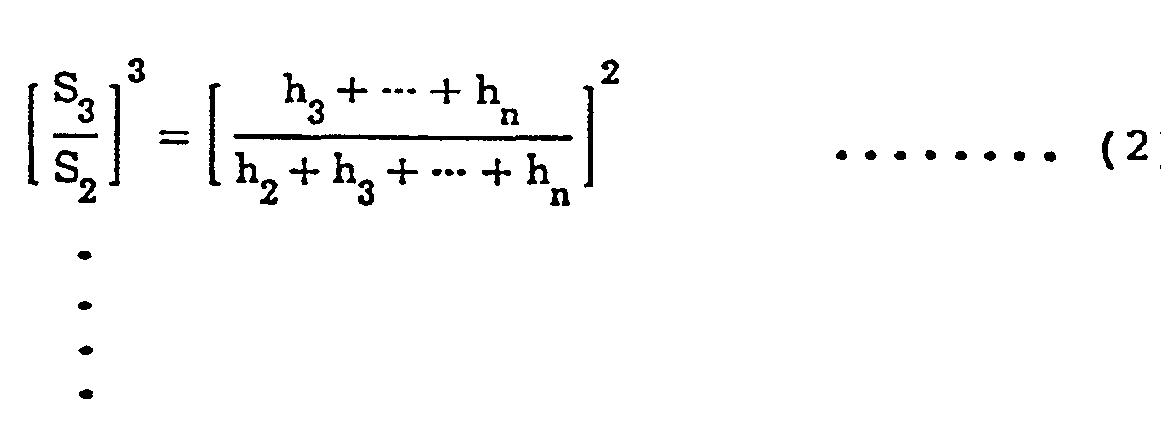
- an immersion nozzle for continuous casting in which at least one portion of reduced sectional area is formed in the passage for molten metal in the immersion nozzle nearto the bottom of the nozzle and a plurality of discharge ports, symmetrically arranged with respect to the axis of the nozzle, are arranged above and below the portion of reduced sectional area in the longitudinal direction of the nozzle, characterized in that the sectional area of each of the discharge ports (h i , h 2 , ..., h " in a descending scale) and the sectional area of each molten steel passage, corresponding to the respective discharge port (S 1 , 8 2 , ..., S n in a descending scale) satisfy the following relations :
- a method of continuous casting by con - tinuously feeding molten metal to a mold through an immersion nozzle and drawing a cast product from a lower end of the mold characterized in that a static magnetic field device is arranged in the mold to produce a static magnetic field between the immersion nozzle and the inner wall face of the mold and the immersion nozzle is as defined in the first aspect of the invention.
- the inventors have found from various experiments that when a plurality of discharge ports are merely arranged at two stages in the longitudinal direction as shown in Fig. 4, the stream of molten steel is not necessarily discharged at a uniform discharging rate from each of the discharge ports depending upon the area of the discharge port and the sectional area of the molten steel passage. If molten steel is discharged only from the lower discharge ports, the down-flow component becomes strong and deeply penetrates into the inside of the resulting cast slab, while if molten steel is discharged only from the upper discharge ports, the fluctuation of the molten steel surface becomes violent and catching of mold powder is caused. Therefore, in order to prevent these problems, it is important to discharge molten steel at a uniform discharging rate from each of the discharge ports.
- the inventors have made further studies and found out that the imbalance of molten steel streams discharged from the upper discharge port and the lower discharge port in the immersion nozzle results from the fact that the upper portion of the nozzle, having a faster speed of molten steel stream passing through the passage, has a smaller static pressure according to Bernoulli's theorem.
- the number of discharge ports may be four or more stages. In this case, there is the risk that the uppermost discharge port approaches the meniscus and hence may increase the fluctuation of the molten steel surface. Therefore, according to the invention, the number of discharge ports is preferably 2 or 3.
- K and K' are discharge coefficients in the longitudinal and lateral directions, respectively. Strictly speaking, the values of K and K' are different in each of the discharge ports, but it can be supposed that the discharge coefficient in the longitudinal direction K and the discharge coefficient in the lateral direction K' (which is eliminated in the course of manipulating the equations and has no actual influence) are approximately constant.
- the discharge coefficient K is experimentally about 0.8. Even when the sectional area of each passage deviates somewhat from the ideal condition satisfying the equations (xiii) and (xiv), it is practically acceptable, and the condition of 0.7 ⁇ K ⁇ 1 is an accepted preferable range in the invention.
- the reasonable range shown by the oblique lines in Fig. 6 indicates the relationship between the area ratio of the discharge ports and the sectional area ratio of the passages for obtaining 0.7 ⁇ K ⁇ 1.
- the sectional area ratio of the discharge ports and the sectional area ratio of the passages may be set so as to satisfy the above reasonable range.
- the portion defined by the oblique lines substantially lies within the contour of the maximum discharging speed of 1.4.
- Fig. 7 there is shown an evaluation of the inclusions detected in the resulting slab when molten steel is poured into a mold at a through put of 1.5 m/min through an immersion nozzle having a discharge port of sectional area corresponding to 1.7 times that of the conventional nozzle and a ratio of maximum discharging speed of 1.0-1.9 between the upper and lower discharge ports.
- the ratio of the maximum discharging speed is more than 1.4, the number of inclusions increases.
- the evaluation point of inclusions using a conventional immersion nozzle is 5.0.
- the bottom face 26 of the nozzle 20 facing the lower discharge port 23 is inclined downward at an angle of 5-50° at both of its side end portions as shown in Fig. 8, whereby the non-metallic inclusions and bubbles are separated from the main stream of the molten steel discharged and deep penetration thereof into the slab is effectively prevented.
- the reason why the downward angle of the bottom face is limited to a range of 5° to 50° is due to the fact that when the downward angle is less than 5°, the low pressure portion may be formed above the lower discharge port, while when it exceeds 50°, the down flow is strong and the bubbles and non-metallic inclusions deeply penetrate into the molten steel.
- Fig. 9 shows the relationship between the downward angle of the bottom face and the number of bubbles caught in a water model experiment.
- the number of bubbles caught means the number of bubbles having a diameter of not less than 2 mm caught in molten steel located downward at a position of 30 cm from the discharge port. The effect of the downward angle is apparent from the results shown in Fig. 9.
- the inventors have discovered the following when molten steel is continuously cast in a static magnetic field using the aforementioned immersion nozzle.
- molten steel discharged from the immersion nozzle 20 is cast while the discharged stream 36 is controlled by static magnetic field 38 generated from at least one pair of static magnet poles 37 arranged in the wide width face of the mold 30.
- the width of the magnet pole in such an arrangement of static magnet poles is preferably not more than 1/4 of full width of the resulting slab W.
- the magnetic force of the magnet pole is preferably strong and it is preferred to be not less than 1700 gauss at the practical through put of 1-5.0 t/min.
- An immersion nozzle provided with two stage discharge ports according to the invention was prepared so as to satisfy the relationship of the above equation (v) and was used to produce a cast slab at a through put of 2.5 t/min or 4.0 t/min. Moreover, the discharging speed of each discharge port was previously measured by means of a Pito tube in a water model. The evaluation of inclusion was made with respect to a specimen taken out from the resulting cast slab every heat to obtain results as shown in the following Table 2. For the comparison, the casting was carried out underthe same conditions as mentioned above but using the conventional immersion nozzle shown in Fig. 3 as a comparative example, and then the same evaluation as mentioned above was repeated to obtain the results as shown in Table 2.
- the above experiment was carried out under conditions where the sectional area of the discharge port in the conventional immersion nozzle was about 1.8 times the sectional area of the molten steel passage thereof, while the sectional area of the discharge port in the immersion nozzle according to the invention was 3.0 times the sectional area of the molten steel passage thereof the ratio of the sectional area in the molten steel passage located at the lower discharge port to the molten steel passage located at the upper discharge port was 0.8, and the downward angle of the bottom face 26 was 15°.
- Example 2 The same experiment as in Example 2 was repeated using the immersion nozzle of Fig. 8 according to the invention having a downward angle of the bottom face of 35°. As a result, the maximum catching depth of bubbles having a diameter of 1 mm was about 68 cm.
- An Af killed steel for cold rolling was cast at a through put of 2.8 ⁇ 4.0 t/min using the conventional immersion nozzle of Fig. 1 or the immersion nozzle of Fig. 5a in a curved type continuous slab caster of 220 mm in thickness and 1350-1500 mm in width having an arrangement of magnet poles shown in Fig. 11, in which the size of the magnet pole was 300 mm x 300 mm and the magnetic flux density was 3500 gauss.
- the sectional area of the discharge port in the conventional immersion nozzle was about 1.8 times the sectional area of the molten steel passage
- the sectional area of the discharge port was 4.0 times the sectional area of the molten steel passage
- the ratio of the sectional area in the molten steel passage located at the lower discharge port to the molten steel passage located at the upper discharge port was 0.8
- the ratio of the sectional area in the upper discharge port to the lower discharge port was 0.8.
- the amount of powdery inclusion and non-metallic inclusion as well as bubbles caught inside the continuously cast slab is reduced, whereby the quality of the slab is considerably improved.
Landscapes
- Engineering & Computer Science (AREA)
- Mechanical Engineering (AREA)
- Continuous Casting (AREA)
- Casting Support Devices, Ladles, And Melt Control Thereby (AREA)
Claims (5)



Applications Claiming Priority (6)
| Application Number | Priority Date | Filing Date | Title |
|---|---|---|---|
| JP62316144A JPH01157751A (ja) | 1987-12-16 | 1987-12-16 | 連続鋳造用浸漬ノズル |
| JP316144/87 | 1987-12-16 | ||
| JP19726587U JPH0428687Y2 (fr) | 1987-12-28 | 1987-12-28 | |
| JP329144/87 | 1987-12-28 | ||
| JP62329744A JPH01180763A (ja) | 1987-12-28 | 1987-12-28 | 鋼の連続鋳造方法 |
| JP197265/87U | 1987-12-28 |
Publications (2)
| Publication Number | Publication Date |
|---|---|
| EP0321206A1 EP0321206A1 (fr) | 1989-06-21 |
| EP0321206B1 true EP0321206B1 (fr) | 1991-03-06 |
Family
ID=27327357
Family Applications (1)
| Application Number | Title | Priority Date | Filing Date |
|---|---|---|---|
| EP88311821A Expired - Lifetime EP0321206B1 (fr) | 1987-12-16 | 1988-12-14 | Tube de coulée immergé pour la coulée continue |
Country Status (6)
| Country | Link |
|---|---|
| US (1) | US4949778A (fr) |
| EP (1) | EP0321206B1 (fr) |
| KR (1) | KR960004421B1 (fr) |
| BR (1) | BR8806679A (fr) |
| CA (1) | CA1318766C (fr) |
| DE (1) | DE3861957D1 (fr) |
Cited By (1)
| Publication number | Priority date | Publication date | Assignee | Title |
|---|---|---|---|---|
| DE10113026C2 (de) * | 2001-03-17 | 2003-03-27 | Thyssenkrupp Stahl Ag | Tauchrohr für das Vergießen von Metallschmelze, insbesondere von Stahlschmelze |
Families Citing this family (21)
| Publication number | Priority date | Publication date | Assignee | Title |
|---|---|---|---|---|
| US5205343A (en) * | 1989-06-03 | 1993-04-27 | Sms Schloemann-Siemag Aktiengesellschaft | Pouring tube for feeding molten steel into a continuous casting mold |
| US5591371A (en) * | 1992-02-20 | 1997-01-07 | British Steel Plc | Method and device for pouring molten metal |
| JP2778455B2 (ja) * | 1993-10-13 | 1998-07-23 | 日本鋼管株式会社 | 連続鋳造用浸漬ノズル |
| US6929055B2 (en) | 2000-02-29 | 2005-08-16 | Rotelec | Equipment for supplying molten metal to a continuous casting ingot mould |
| FR2805483B1 (fr) * | 2000-02-29 | 2002-05-24 | Rotelec Sa | Equipement pour alimenter en metal en fusion une lingotiere de coulee continue, et son procede d'utilisation |
| US20030007973A1 (en) * | 2001-06-22 | 2003-01-09 | Lynes Michael A. | Methods and compositions for manipulation of the immune response using anti-metallothionein antibody |
| DE50301315D1 (de) * | 2003-08-01 | 2006-02-16 | Hof Te Fiennes N V | Giesssystem und Verfahren zum Vergiessen von NE-Metallschmelzen |
| US7129042B2 (en) * | 2003-11-03 | 2006-10-31 | Diagnostic Hybrids, Inc. | Compositions and methods for detecting severe acute respiratory syndrome coronavirus |
| ES2323874T3 (es) * | 2003-11-17 | 2009-07-27 | Vesuvius Crucible Company | Boquilla de colado con salidas multiples. |
| WO2005079343A2 (fr) * | 2004-02-13 | 2005-09-01 | Memorial Sloan-Kettering Cancer Center | Identification et caracterisation de multiples formes d'epissage du gene recepteur opioide $g(m) |
| JP2005230826A (ja) * | 2004-02-17 | 2005-09-02 | Ishikawajima Harima Heavy Ind Co Ltd | 溶湯供給ノズル |
| FI20075059A0 (fi) | 2007-01-29 | 2007-01-29 | Valtion Teknillinen | Allergeeniä sitovat monoklonaaliset IgE-vasta-aineet ja hypoallergeenit:tyypin l lgE:n ja allergeenin immunokompleksivuorovaikutus |
| FI20070853A0 (fi) * | 2007-11-09 | 2007-11-09 | Glykos Finland Oy | Glykaania sitovat monoklonaaliset vasta-aineet |
| JP5047854B2 (ja) * | 2008-03-27 | 2012-10-10 | 黒崎播磨株式会社 | 連続鋳造用浸漬ノズル |
| RU2433884C1 (ru) * | 2008-03-27 | 2011-11-20 | Кросаки Харима Корпорейшн | Погружной разливочный стакан для непрерывной разливки |
| US9676029B2 (en) | 2010-07-02 | 2017-06-13 | Vesuvius Crucible Company | Submerged entry nozzle |
| CN102958629B (zh) * | 2010-07-02 | 2016-03-09 | 维苏威坩埚公司 | 浸入式水口 |
| JP5645736B2 (ja) * | 2011-03-31 | 2014-12-24 | 黒崎播磨株式会社 | 連続鋳造用浸漬ノズル |
| CN109909466B (zh) * | 2019-03-19 | 2023-12-19 | 沈阳麒飞新型材料科技有限公司 | 一种多水口连续浇注设备 |
| US20220267450A1 (en) | 2020-10-14 | 2022-08-25 | Viridian Therapeutics, Inc. | Compositions and methods for treatment of thyroid eye disease |
| EP4384219A4 (fr) | 2021-08-10 | 2025-06-18 | Viridian Therapeutics, Inc. | Compositions, posologies et méthodes pour le traitement d'une maladie oculaire thyroïdienne |
Family Cites Families (11)
| Publication number | Priority date | Publication date | Assignee | Title |
|---|---|---|---|---|
| DE844802C (de) * | 1941-07-30 | 1952-07-24 | Wieland Werke Ag | Gekuehlter Dorn zum stetigen Giessen von metallischen Rohren |
| US3371704A (en) * | 1967-02-20 | 1968-03-05 | Astrov Evgeny Ivanovitch | Device for supplying molten metal into a mould of a continuous casting machine |
| SU588059A1 (ru) * | 1976-04-12 | 1978-01-15 | Предприятие П/Я А-7697 | Стакан дл бокового подвода металла |
| SE436251B (sv) * | 1980-05-19 | 1984-11-26 | Asea Ab | Sett och anordning for omrorning av de icke stelnade partierna av en gjutstreng |
| JPS57106456A (en) * | 1980-12-24 | 1982-07-02 | Kawasaki Steel Corp | Immersion nozzle for continuous casting machine |
| JPS59202143A (ja) * | 1983-04-30 | 1984-11-15 | Nippon Steel Corp | 連続鋳造における溶融金属注入ノズル詰り防止方法 |
| JPS6123558A (ja) * | 1984-06-28 | 1986-02-01 | Nippon Kokan Kk <Nkk> | 連続鋳造用浸漬ノズル |
| JPS6188952A (ja) * | 1984-10-05 | 1986-05-07 | Kawasaki Steel Corp | 連続鋳造における鋳型内合金成分添加方法 |
| JPS61193755A (ja) * | 1985-02-25 | 1986-08-28 | Toshiba Corp | 電磁撹拌方法 |
| JPS61226149A (ja) * | 1985-04-01 | 1986-10-08 | Nippon Kokan Kk <Nkk> | 連続鋳造用浸漬ノズル |
| JPS63101058A (ja) * | 1986-10-16 | 1988-05-06 | Kawasaki Steel Corp | 連続鋳造用浸漬ノズル |
-
1988
- 1988-12-13 US US07/283,789 patent/US4949778A/en not_active Expired - Fee Related
- 1988-12-14 EP EP88311821A patent/EP0321206B1/fr not_active Expired - Lifetime
- 1988-12-14 DE DE8888311821T patent/DE3861957D1/de not_active Expired - Fee Related
- 1988-12-15 CA CA000585951A patent/CA1318766C/fr not_active Expired - Fee Related
- 1988-12-15 KR KR1019880016815A patent/KR960004421B1/ko not_active Expired - Fee Related
- 1988-12-16 BR BR888806679A patent/BR8806679A/pt not_active IP Right Cessation
Cited By (1)
| Publication number | Priority date | Publication date | Assignee | Title |
|---|---|---|---|---|
| DE10113026C2 (de) * | 2001-03-17 | 2003-03-27 | Thyssenkrupp Stahl Ag | Tauchrohr für das Vergießen von Metallschmelze, insbesondere von Stahlschmelze |
Also Published As
| Publication number | Publication date |
|---|---|
| KR890009501A (ko) | 1989-08-02 |
| EP0321206A1 (fr) | 1989-06-21 |
| DE3861957D1 (de) | 1991-04-11 |
| KR960004421B1 (ko) | 1996-04-03 |
| BR8806679A (pt) | 1989-08-29 |
| US4949778A (en) | 1990-08-21 |
| CA1318766C (fr) | 1993-06-08 |
Similar Documents
| Publication | Publication Date | Title |
|---|---|---|
| EP0321206B1 (fr) | Tube de coulée immergé pour la coulée continue | |
| JP5014934B2 (ja) | 鋼の連続鋳造方法 | |
| US5381857A (en) | Apparatus and method for continuous casting | |
| US3867978A (en) | Method and apparatus for introduction of steel into a continuous casting mold | |
| EP0550785B1 (fr) | Procédé pour coulée continue | |
| Ho et al. | The analysis of molten steel flow in billet continuous casting mold | |
| EP0523837A1 (fr) | Coulée continue d'acier | |
| JPH105957A (ja) | 連続鋳造鋳型内における溶鋼流動検知方法及び制御方法 | |
| CA2266085C (fr) | Machine de coulage continu | |
| JPS63154246A (ja) | 静磁場を用いる鋼の連続鋳造方法 | |
| US20030150588A1 (en) | Method and device for producing slabs | |
| KR20090073500A (ko) | 주형 내 용강의 유동 제어 방법 및 연속 주조 주편의 제조방법 | |
| JP3541594B2 (ja) | 連続鋳造鋳型内における溶鋼流動制御方法 | |
| KR102959444B1 (ko) | 연속 주조용의 침지 노즐 및 강의 연속 주조 방법 | |
| JPH01180763A (ja) | 鋼の連続鋳造方法 | |
| EP3725430A1 (fr) | Dispositif de traitement de matériau fondu | |
| JP2603402B2 (ja) | ストレート浸漬ノズルを用いた無欠陥鋳片の連続鋳造方法 | |
| RU2850474C2 (ru) | Погружной стакан для непрерывной разливки и способ непрерывной разливки стали | |
| KR960003711B1 (ko) | 연속 슬랩 주조방법 | |
| US20250196223A1 (en) | Immersion nozzle for continuous casting and continuous casting method for steel | |
| JPS62130752A (ja) | ブル−ムもしくはビレツトの連続鋳造方法 | |
| JP3039346B2 (ja) | 溶融金属の連続鋳造装置 | |
| JPH01157751A (ja) | 連続鋳造用浸漬ノズル | |
| KR880002056Y1 (ko) | 연속주조주형내 개재물 부상분리촉진 및 용강흐름에 의한 주편터짐 방지용 쌍침지노즐 | |
| JPH09108797A (ja) | 鋼の連続鋳造方法 |
Legal Events
| Date | Code | Title | Description |
|---|---|---|---|
| PUAI | Public reference made under article 153(3) epc to a published international application that has entered the european phase |
Free format text: ORIGINAL CODE: 0009012 |
|
| AK | Designated contracting states |
Kind code of ref document: A1 Designated state(s): DE FR GB SE |
|
| 17P | Request for examination filed |
Effective date: 19890724 |
|
| 17Q | First examination report despatched |
Effective date: 19900221 |
|
| GRAA | (expected) grant |
Free format text: ORIGINAL CODE: 0009210 |
|
| AK | Designated contracting states |
Kind code of ref document: B1 Designated state(s): DE FR GB SE |
|
| REF | Corresponds to: |
Ref document number: 3861957 Country of ref document: DE Date of ref document: 19910411 |
|
| ET | Fr: translation filed | ||
| PLBE | No opposition filed within time limit |
Free format text: ORIGINAL CODE: 0009261 |
|
| STAA | Information on the status of an ep patent application or granted ep patent |
Free format text: STATUS: NO OPPOSITION FILED WITHIN TIME LIMIT |
|
| 26N | No opposition filed | ||
| EAL | Se: european patent in force in sweden |
Ref document number: 88311821.8 |
|
| PGFP | Annual fee paid to national office [announced via postgrant information from national office to epo] |
Ref country code: GB Payment date: 19971205 Year of fee payment: 10 |
|
| PGFP | Annual fee paid to national office [announced via postgrant information from national office to epo] |
Ref country code: FR Payment date: 19971209 Year of fee payment: 10 |
|
| PGFP | Annual fee paid to national office [announced via postgrant information from national office to epo] |
Ref country code: SE Payment date: 19971218 Year of fee payment: 10 |
|
| PGFP | Annual fee paid to national office [announced via postgrant information from national office to epo] |
Ref country code: DE Payment date: 19971222 Year of fee payment: 10 |
|
| PG25 | Lapsed in a contracting state [announced via postgrant information from national office to epo] |
Ref country code: GB Free format text: LAPSE BECAUSE OF NON-PAYMENT OF DUE FEES Effective date: 19981214 |
|
| PG25 | Lapsed in a contracting state [announced via postgrant information from national office to epo] |
Ref country code: SE Free format text: LAPSE BECAUSE OF NON-PAYMENT OF DUE FEES Effective date: 19981215 |
|
| GBPC | Gb: european patent ceased through non-payment of renewal fee |
Effective date: 19981214 |
|
| PG25 | Lapsed in a contracting state [announced via postgrant information from national office to epo] |
Ref country code: FR Free format text: LAPSE BECAUSE OF NON-PAYMENT OF DUE FEES Effective date: 19990831 |
|
| REG | Reference to a national code |
Ref country code: FR Ref legal event code: ST |
|
| PG25 | Lapsed in a contracting state [announced via postgrant information from national office to epo] |
Ref country code: DE Free format text: LAPSE BECAUSE OF NON-PAYMENT OF DUE FEES Effective date: 19991001 |