EP0321249A2 - Agent et procédé de diagnostic d'une infection par le virus varicella zoster - Google Patents
Agent et procédé de diagnostic d'une infection par le virus varicella zoster Download PDFInfo
- Publication number
- EP0321249A2 EP0321249A2 EP88311887A EP88311887A EP0321249A2 EP 0321249 A2 EP0321249 A2 EP 0321249A2 EP 88311887 A EP88311887 A EP 88311887A EP 88311887 A EP88311887 A EP 88311887A EP 0321249 A2 EP0321249 A2 EP 0321249A2
- Authority
- EP
- European Patent Office
- Prior art keywords
- monoclonal antibody
- varicella zoster
- zoster virus
- monoclonal
- cells
- Prior art date
- Legal status (The legal status is an assumption and is not a legal conclusion. Google has not performed a legal analysis and makes no representation as to the accuracy of the status listed.)
- Granted
Links
Images
Classifications
-
- C—CHEMISTRY; METALLURGY
- C07—ORGANIC CHEMISTRY
- C07K—PEPTIDES
- C07K16/00—Immunoglobulins [IG], e.g. monoclonal or polyclonal antibodies
- C07K16/08—Immunoglobulins [IG], e.g. monoclonal or polyclonal antibodies against material from viruses
- C07K16/081—DNA viruses
- C07K16/085—Orthoherpesviridae (F), e.g. pseudorabies virus or Epstein-Barr virus
- C07K16/088—Varicella-zoster virus
Definitions
- the present invention relates to an agent for and method of diagnosing a varicella zoster virus infection.
- the varicella zoster virus disease is an acute virus disease accompanied by a sudden fever and eruptions.
- the virus usually infects infants, and for three to four days, produces varicella from crusts which finally become granular crusts, and the disease is then cured. If, however, the virus remains latent in ganglion of the posterior root of the spinal nerve, a recurrence can occur many years later to again produce zoster.
- An antibody against glycoprotein GP of varicella zoster virus is known from Virology, 129 , 357-368, 1983. Moreover, an antibody against a nucleocapsid NP of the varicella zoster virus is known. But, a single use of the antibody does not provide a sufficient sensitivity or a clear result.
- the object of the present invention is to provide a diagnostic agent and diagnostic method directed to the varicella zoster virus disease, using a combination of two kinds of antibodies, which provide a highly sensitive detection and a clear diagnostic result.
- the present invention provides a method of diagnosing a varicella zoster virus infection disease, comprising placing a monoclonal antibody to glycoprotein GP of the varicella zoster virus and a monoclonal antibody to nucleocapsid NP of the varicella zoster virus in contact with a sample comprising cells, and detecting a specific binding of both antibodies with cells infected with the virus.
- the present invention provides a diagnostic agent for varicella zoster virus infection disease comprising a monoclonal antibody to glycoprotein GP of the varicella zoster virus and a monoclonal antibody to nucleocapsid NP of the varicella zoster virus.
- the present invention provides a diagnostic kit for varicella zoster virus infection disease comprising a monoclonal antibody to glycoprotein GP of the varicella zoster virus and a monoclonal antibody to nucleocapsid NP of the varicella zoster virus.
- any monoclonal antibody to glycoprotein GP and any monoclonal antibody to nucleocapsid NP can be used. Nevertheless, after testing various monoclonal antibodies, it was found that, as a monoclonal antibody to the glycoprotein GP, a monoclonal antibody produces by hybridoma No. 8 (FERM BP-2123) is most preferable, and as a monoclonal antibody to the nucleocapsid NP, a monoclonal antibody produced by hybridoma No. 17 (FERM BP-2124) is most preferable.
- the former strongly binds to cytoplasm of a cell infected with the varicella zoster virus (target cell), and the latter strongly binds to a nucleus of a target cell. Therefore, a combination of the above-mentioned particular monoclonal antibodies is most preferable.
- a combination of the above-mentioned two monoclonal antibodies is used.
- the ratio of the monoclonal antibodies is not critical, a ratio of about 1:1 is preferable.
- a sample is taken from a patient by rubbing a lesion, to isolate cells of a lesion from basal raxer, with a cotton swab, and the cells are fixed with methanol or acetone, preferably acetone, on a slide glass.
- the fixed cells are then placed in contact with the above-mentioned monoclonal antibodies to allow a specific binding of the monoclonal antibodies to target cells.
- the monoclonal antibody to the glyceprotein GP binds to cytoplasm of the target cell
- the monoclonal antibody to the nucleocapsid NP binds to a nucleus of a target cell.
- Methods of detecting antibodies which are bound to the target cell include a direct method wherein the above-mentioned antibodies labeled with a label are used, and an indirect method wherein a labeled second antibody against the above-mentioned antibodies is used.
- the direct method wherein the above-mentioned two monoclonal antibodies labeled with a same label are used, is preferable.
- any labeling method conventionally used in immunoassays can be used; for example, an enzyme-label method, avidin- biotin method, fluorescein avidin method, fluorescein isothiocyanate method and the like.
- the fluorescein isothiocyanate method is most preferable as it provides an easy detection of stained cells under a fluorescence microscope.
- the mole ratio of fluorescein isothiocyanate and the antibody protein in a labeled antibody is preferably about 2.5 to 3.5. Where the ratio of fluorescein isothiocyanate is too low, the target cell is insufficiently stained, and detection of stained cells is difficult, but where the ratio of fluorescein isothiocyanate is too high, the monoclonal antibody excessively denaturated, and thus it becomes difficult to detect the target cells.
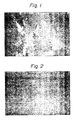
- Figure 1 represents a fluorescence micrograph showing cells stained with the monoclonal antibodies labeled in an adequate ratio of the label and the antibody; and
- Fig. 2 represents a fluorescein micrograph showing cells stained with the excessively labeled monoclonal antibodies.
- the antibody protein and fluorescein isothiocyanate should be allowed to react at a weight ratio of about 160:1 to 200:1.
- an antibody protein solution at a concentration of about 20 to 25 mg/ml, and a fluorescein isothiocyanate solution at a concentration of about 1 mg/ml are prepared, and the protein solution and the fluorescein isothiocyanate solution are mixed in a volume ratio of about 8:1, to allow a reaction.
- a carbonate buffer pH 9.5
- the reaction is preferably carried out at a temperature of between 2°C and 8°C for 10 to 20 hours.
- the labeled antibody thus prepared in a basic carbonate buffer is then purified on a column equilibrated with a neutral phosphate buffer to obtain a solution of the labeled antibody in the neutral phosphate buffer.
- Evans' Blue in an amount of 0.001% relative to the medium (W/V) is added. In this way, cells or parts of a cell to which the fluorescein isothiocyanate-labeled antibodies are not bound, are stained with Evans' Blue, i.e., are colored red, thereby parts of a cell stained by fluorescein isothiocyanate via the antibody can be clearly detected.
- HEL Human embryo lung cells
- Mice were intraperitoneally injected with the sonicate in an amount of 0.5 ml/mouse and 0.5 ml/mouse of Freund's complete adjuvant, and after one month, the same amount of the sonicate was intraperitoneally injected as a boost without an adjuvant. Three days after the boost, the spleens of the mice were separated and subjected to cell fusion.
- the spleen cells were washed with MEM medium, and treated with 155mM ammonium chloride solution to lyse erythocytes. Remaining lymphocytes were further washed with the medium, and mixed with myeloma SP2/10-Ag14 cells at a ratio of 10 : 1, and the mixture was centrifuged. Polyethylene glycol No. 4000 was added to the cell pellet to accelerate the cell fusion, and fused cells were selected in a medium containing hypoxanthine, aminopterin and thymidine (HAT medium).
- HAT medium hypoxanthine, aminopterin and thymidine
- a supernatant from each colony grown in the HAT medium was tested by an indirect immunofluorescence technique. Namely, human embryo lung cells were infected with the varicella zoster virus, and after confirming the cytopathic effect, the above-mentioned supernatant from the hybridoma was overlayed to the cell layer. The cells were incubated at 37°C for 60 minutes and washed with a phosphate buffer. Next, anti-mouse IgG-fluorescein isothiocyanate was overlayed to the washed cells, the cells were incubated at 37°C for 30 minutes, and then washed with a phosphate buffer.
- the resultant cells were observed by a fluorescence microscopy, and specifically stained cells with an apple green were determined. Colonies corresponding to the specifically stained human embryo lung cells were selected as hybridoma producing a desired monoclonal antibody to the varicella zoster virus, and as a result, hybridoma No. 8, which produces a monoclonal antibody recognizing glycoprotein GP of the varicella zoster virus, and hybridoma No. 17 which produces a monoclonal antibody recognizing nucleocapsid NP of the varicella zoster virus, were obtained.
- the above-mentioned hybridoma No. 8 was designated as VZV-MAb-cl 8, and deposited with the Fermentation Research Institute Agency of Industrial Science and Technology (FRI), 1-3, Higashi 1-chome, Tsukuba-shi, Ibaraki-ken, Japan, as FERM BP-2123, on October 25, 1988, as an international deposition under the Budapest Treaty.
- the hybridoma No. 17 was designated as VZV-MAb-cl 17, and deposited with the FRI as FERM BP-2124, on October 25, 1988.
- DMEM-NCTC109 medium having the following composition: DMEM (1) 1000 ml NCTC 109 150 ml NEAA (*100) 15 ml 100 mM Pyruvic acid 7 ml 3% Glutamine 15 ml Solution I (2) 15 ml Gentamycin (10 mg/ml) 1.5 ml (1) DMEM DMEM Powder 1 pack NaHCO3 2.0 g L-Glutamine 0.584 g Sodium pyruvate 0.110 g Penicillin G 1 x 10⁵ IU Streptomycin 0.1 g unit Distillated water to a total of 1000 ml (2) Solution I Oxaloacetic acid 100 mM Bovine insulin 20 IU/ml
- Pristane was intraperitoneally injected to BALB/C mice in an amount of 0.5 ml/mouse, and after three weeks, 1 x 10⁷ of the above-cultured hybridoma cells were intraperitoneally injected to the mouse.
- the above-mentioned medium was supplemented with 15% fetal calf serum.
- Ascites was obtained and was centrifuged to eliminate cells, and the supernatant was subjected to salting out with ammonium sulfate.
- a precipitated fraction obtained at between a 20% and 40% saturation was dissolved in a 0.05 M carbonate buffer (pH 9.5).
- the fluorescein isothiocyanate solution and the antibody solution were mixed at a ratio of 125 ⁇ l (0.125 mg) : 1000 ⁇ l (20 to 30 mg), and the mixture was incubated at 4°C for about 15 hours, in the dark, while stirring to allow the reaction of the fluorescein isothiocyanate and the antibody protein.
- the reaction mixture was applied to a PD-10 column equilibrated with a 0.01 M phosphate buffer (pH 7.2; containing 0.1 M NaCl and 0.02% NaN3), and an elution was carried out using the same phosphate buffer to obtain a yellow-color fraction containing an antibody labeled with fluorescein isothiocyanate. During this procedure, free fluorescein isothiocyanate remained in the column.
- the antibody-containing fraction was applied to an ion exchange column QAE Zetaprep, and 50 ml of a 0.01 M phosphate buffer (pH 7.2; containing 0.1 M NaCl) was passed through the column to elute the remaining free fluorescein isothiocyanate and nonreacted antibody.
- a 0.01 M phosphate buffer pH 7.2; containing 0.1 M NaCl
- 35 to 40 ml of a 0.01 M phosphate buffer (pH 7.2; containing 0.5 M NaCl) was passed through the column to recover the optimally labeled antibody.
- the recovered fraction was diluted 10-fold with a phosphate buffer (pH 7.2; containing 0.1 M NaCl and 0.02% NaN3), and the absorption spectrum of the diluted solution was measured at 530 to 250 nm.
- a cell sample was taken from a lesion base laxer of a patient infected with the varicella zoster virus, using a cotton swab, and the cells were smeared on three slide glasses (A, B, and C), at two sites on each slide glass, and dried in air. The cells were fixed with acetone and the acetone was then evaporated. A drop of a solution of the labeled monoclonal antibody produced by hybridoma No. 8 was added to each spot of cells on the slide glass A; a drop of a solution of the labeled monoclonal antibody produced by hybridoma No.
- Example 17 was added to each spot of cells on the slide glass B; and a drop of the mixed solution prepared in Example 3 containing both the labeled monoclonal antibodies produced by hybridoma No. 8 and No. 17 was added to each spot on the slide glass C.
- the slide glasses were incubated at 37°C for 30 minutes, washed with a washing solution PBS(-) to eliminate excess agents, and dried.
- a drop of an inclusion fluid was added to each spot of cells, a cover slit was placed over the spot, and the cells were observed under a fluorescence microscope.
- Figure 1 represents a fluorescence micrograph of cells treated with the mixture of the labeled monoclonal antibodies.
Landscapes
- Chemical & Material Sciences (AREA)
- Health & Medical Sciences (AREA)
- Organic Chemistry (AREA)
- Life Sciences & Earth Sciences (AREA)
- General Health & Medical Sciences (AREA)
- Immunology (AREA)
- Biochemistry (AREA)
- Biophysics (AREA)
- Virology (AREA)
- Genetics & Genomics (AREA)
- Medicinal Chemistry (AREA)
- Molecular Biology (AREA)
- Proteomics, Peptides & Aminoacids (AREA)
- Tropical Medicine & Parasitology (AREA)
- Preparation Of Compounds By Using Micro-Organisms (AREA)
- Micro-Organisms Or Cultivation Processes Thereof (AREA)
- Peptides Or Proteins (AREA)
Applications Claiming Priority (4)
| Application Number | Priority Date | Filing Date | Title |
|---|---|---|---|
| JP31525487 | 1987-12-15 | ||
| JP315254/87 | 1987-12-15 | ||
| JP274602/88 | 1988-11-01 | ||
| JP63274602A JP2652959B2 (ja) | 1987-12-15 | 1988-11-01 | 水痘・帯状疱疹ウイルス感染症の検出薬及び検出方法 |
Publications (3)
| Publication Number | Publication Date |
|---|---|
| EP0321249A2 true EP0321249A2 (fr) | 1989-06-21 |
| EP0321249A3 EP0321249A3 (fr) | 1991-05-15 |
| EP0321249B1 EP0321249B1 (fr) | 1995-01-25 |
Family
ID=26551104
Family Applications (1)
| Application Number | Title | Priority Date | Filing Date |
|---|---|---|---|
| EP88311887A Expired - Lifetime EP0321249B1 (fr) | 1987-12-15 | 1988-12-15 | Agent et procédé de diagnostic d'une infection par le virus varicella zoster |
Country Status (3)
| Country | Link |
|---|---|
| EP (1) | EP0321249B1 (fr) |
| JP (1) | JP2652959B2 (fr) |
| DE (1) | DE3852875T2 (fr) |
Cited By (5)
| Publication number | Priority date | Publication date | Assignee | Title |
|---|---|---|---|---|
| US5710248A (en) * | 1996-07-29 | 1998-01-20 | University Of Iowa Research Foundation | Peptide tag for immunodetection and immunopurification |
| US7452984B2 (en) | 2000-08-31 | 2008-11-18 | Mayo Foundation For Medical Education And Research | Detection of varicella-zoster virus |
| WO2010017381A3 (fr) * | 2008-08-07 | 2010-06-10 | The Regents Of The University Of Colorado, A Body Corporate | Procédés pour le diagnostic d’une infection par le virus zoster-varicelle |
| CN108181467A (zh) * | 2018-02-06 | 2018-06-19 | 长春祈健生物制品有限公司 | 一种稳定的用于fama法检测的抗原片的制备方法 |
| CN117106070A (zh) * | 2019-11-11 | 2023-11-24 | 珠海泰诺麦博制药股份有限公司 | 抗水痘-带状疱疹病毒的抗体 |
Family Cites Families (3)
| Publication number | Priority date | Publication date | Assignee | Title |
|---|---|---|---|---|
| EP0148644A3 (fr) * | 1984-01-06 | 1987-06-03 | The Board Of Trustees Of The Leland Stanford Junior University | Nouveau partenaire de fusion et ses produits |
| WO1986002092A1 (fr) * | 1984-09-28 | 1986-04-10 | Teijin Limited | Hybridome homme-souris produisant un anticorps humain antiviral, procede de preparation et anticorps monoclonal humain antiviral |
| GB8426467D0 (en) * | 1984-10-19 | 1984-11-28 | Technology Licence Co Ltd | Monoclonal antibodies |
-
1988
- 1988-11-01 JP JP63274602A patent/JP2652959B2/ja not_active Expired - Lifetime
- 1988-12-15 DE DE3852875T patent/DE3852875T2/de not_active Expired - Fee Related
- 1988-12-15 EP EP88311887A patent/EP0321249B1/fr not_active Expired - Lifetime
Cited By (8)
| Publication number | Priority date | Publication date | Assignee | Title |
|---|---|---|---|---|
| US5710248A (en) * | 1996-07-29 | 1998-01-20 | University Of Iowa Research Foundation | Peptide tag for immunodetection and immunopurification |
| US6255462B1 (en) | 1996-07-29 | 2001-07-03 | University Of Iowa Research Foundation | Peptide tag for immunodetection and immunopurification |
| US7452984B2 (en) | 2000-08-31 | 2008-11-18 | Mayo Foundation For Medical Education And Research | Detection of varicella-zoster virus |
| WO2010017381A3 (fr) * | 2008-08-07 | 2010-06-10 | The Regents Of The University Of Colorado, A Body Corporate | Procédés pour le diagnostic d’une infection par le virus zoster-varicelle |
| CN108181467A (zh) * | 2018-02-06 | 2018-06-19 | 长春祈健生物制品有限公司 | 一种稳定的用于fama法检测的抗原片的制备方法 |
| CN108181467B (zh) * | 2018-02-06 | 2019-03-12 | 长春祈健生物制品有限公司 | 一种稳定的用于fama法检测的抗原片的制备方法 |
| CN117106070A (zh) * | 2019-11-11 | 2023-11-24 | 珠海泰诺麦博制药股份有限公司 | 抗水痘-带状疱疹病毒的抗体 |
| CN117106070B (zh) * | 2019-11-11 | 2024-06-11 | 珠海泰诺麦博制药股份有限公司 | 抗水痘-带状疱疹病毒的抗体 |
Also Published As
| Publication number | Publication date |
|---|---|
| JPH021560A (ja) | 1990-01-05 |
| DE3852875T2 (de) | 1995-09-21 |
| JP2652959B2 (ja) | 1997-09-10 |
| EP0321249B1 (fr) | 1995-01-25 |
| EP0321249A3 (fr) | 1991-05-15 |
| DE3852875D1 (de) | 1995-03-09 |
Similar Documents
| Publication | Publication Date | Title |
|---|---|---|
| US5202234A (en) | Myocardial infarction immunoassay | |
| EP0040628B1 (fr) | Anticorps monoclonal d'hybridome, specifique pour l'antigene carcinoembryonal a poids moleculaire eleve | |
| EP0079696B1 (fr) | Anticorps monoclinaux spécifiques pour la glycoprotéine réceptrice de la transférinne humaine | |
| CA1338706C (fr) | Anticorps monoclonaux anti-cancer du sein chez la femme; leur utilisation pour visualiser ce type de cancer | |
| FI89175B (fi) | Foerfarande och produkter foer paovisande av humant t-celleukemivirus | |
| US4535057A (en) | Immunoassay employing monoclonal herpes simplex antibody and biotin-avidin detection system | |
| EP0179152B1 (fr) | Systeme de diagnostic pour la detection de cytomegalovirus | |
| US5382515A (en) | Creative kinase-MB immunoassay for myocardial infarction and reagents | |
| US4716104A (en) | Detecting presence of HCMV-specific IgM | |
| Snyder Jr et al. | Specificities of human immunoglobulins reactive with antigens in preparations of several mammalian type-C viruses | |
| EP0321249B1 (fr) | Agent et procédé de diagnostic d'une infection par le virus varicella zoster | |
| Price et al. | Characteristics of a cell surface antigen defined by an anti-human osteogenic sarcoma monoclonal antibody | |
| CA1240937A (fr) | Anticorps igm monoclonaux et methode de preparation | |
| JPH06503722A (ja) | 末端欠失神経成長因子受容体の検出に有用なイムノアッセイおよびモノクローナル抗体 | |
| US4818678A (en) | Diagnostic system for the detection of cytomegalovirus | |
| Knight et al. | Studies on a gross‐virus‐induced lymphoma in the rat. II. The role of cell‐membrane‐associated and serum p30 antigen in the antibody and cell‐mediated response | |
| AU772548B2 (en) | Monoclonal antibody against apolipoprotein A-I | |
| EP0575906A2 (fr) | Essai immunologique à liaison double de bêta-N-acétylglucosaminidase et anticorps monoclonal pour l'essai | |
| Gupta et al. | Identification of virion polypeptides in hamster cells transformed by herpes simplex virus type 1. | |
| EP0229492A2 (fr) | Antigène humain désigné par gp650 dans un état vraiment pur | |
| CA1177764A (fr) | Anticorps monoclonaux specifiques des glycoproteines de surface des cellules hematopoietiques humaines | |
| Civardi et al. | High prevalence of anti-HGV/E2 antibodies in HCV-positive patients with non Hodgkin's lymphoma | |
| Timonen | Human Natural Cell‐mediated Cytotoxicity against Fetal Fibroblasts: IV. Comparison of Cytotoxic Activity with Antibody‐dependent Cell‐mediated Cytotoxicity | |
| Haber et al. | Monoclonal Antibodies Specific for Cardiac Myosin: In Vivo and in Vitro Diagnostic Tools in Myocardial Infarction | |
| JPH01294674A (ja) | シュードウリジン誘導体 |
Legal Events
| Date | Code | Title | Description |
|---|---|---|---|
| PUAI | Public reference made under article 153(3) epc to a published international application that has entered the european phase |
Free format text: ORIGINAL CODE: 0009012 |
|
| 17P | Request for examination filed |
Effective date: 19890127 |
|
| AK | Designated contracting states |
Kind code of ref document: A2 Designated state(s): DE FR GB |
|
| PUAL | Search report despatched |
Free format text: ORIGINAL CODE: 0009013 |
|
| AK | Designated contracting states |
Kind code of ref document: A3 Designated state(s): DE FR GB |
|
| 17Q | First examination report despatched |
Effective date: 19930225 |
|
| GRAA | (expected) grant |
Free format text: ORIGINAL CODE: 0009210 |
|
| AK | Designated contracting states |
Kind code of ref document: B1 Designated state(s): DE FR GB |
|
| REF | Corresponds to: |
Ref document number: 3852875 Country of ref document: DE Date of ref document: 19950309 |
|
| ET | Fr: translation filed | ||
| PLBE | No opposition filed within time limit |
Free format text: ORIGINAL CODE: 0009261 |
|
| STAA | Information on the status of an ep patent application or granted ep patent |
Free format text: STATUS: NO OPPOSITION FILED WITHIN TIME LIMIT |
|
| 26N | No opposition filed | ||
| REG | Reference to a national code |
Ref country code: GB Ref legal event code: 732E |
|
| REG | Reference to a national code |
Ref country code: FR Ref legal event code: TP Ref country code: FR Ref legal event code: CD Ref country code: FR Ref legal event code: CA |
|
| PGFP | Annual fee paid to national office [announced via postgrant information from national office to epo] |
Ref country code: FR Payment date: 20011212 Year of fee payment: 14 |
|
| PGFP | Annual fee paid to national office [announced via postgrant information from national office to epo] |
Ref country code: GB Payment date: 20011219 Year of fee payment: 14 |
|
| REG | Reference to a national code |
Ref country code: GB Ref legal event code: IF02 |
|
| PGFP | Annual fee paid to national office [announced via postgrant information from national office to epo] |
Ref country code: DE Payment date: 20020109 Year of fee payment: 14 |
|
| PG25 | Lapsed in a contracting state [announced via postgrant information from national office to epo] |
Ref country code: GB Free format text: LAPSE BECAUSE OF NON-PAYMENT OF DUE FEES Effective date: 20021215 |
|
| PG25 | Lapsed in a contracting state [announced via postgrant information from national office to epo] |
Ref country code: DE Free format text: LAPSE BECAUSE OF NON-PAYMENT OF DUE FEES Effective date: 20030701 |
|
| GBPC | Gb: european patent ceased through non-payment of renewal fee |
Effective date: 20021215 |
|
| PG25 | Lapsed in a contracting state [announced via postgrant information from national office to epo] |
Ref country code: FR Free format text: LAPSE BECAUSE OF NON-PAYMENT OF DUE FEES Effective date: 20030901 |
|
| REG | Reference to a national code |
Ref country code: FR Ref legal event code: ST |