EP0321260B1 - Dispositif de test avec gouttes séchées de réactif sur une paroi inclinée - Google Patents
Dispositif de test avec gouttes séchées de réactif sur une paroi inclinée Download PDFInfo
- Publication number
- EP0321260B1 EP0321260B1 EP88311905A EP88311905A EP0321260B1 EP 0321260 B1 EP0321260 B1 EP 0321260B1 EP 88311905 A EP88311905 A EP 88311905A EP 88311905 A EP88311905 A EP 88311905A EP 0321260 B1 EP0321260 B1 EP 0321260B1
- Authority
- EP
- European Patent Office
- Prior art keywords
- drop
- immunoreagent
- buffer
- wall
- membrane
- Prior art date
- Legal status (The legal status is an assumption and is not a legal conclusion. Google has not performed a legal analysis and makes no representation as to the accuracy of the status listed.)
- Expired - Lifetime
Links
- 238000012360 testing method Methods 0.000 title claims description 16
- 239000003153 chemical reaction reagent Substances 0.000 title claims description 15
- 239000000872 buffer Substances 0.000 claims description 53
- 239000012528 membrane Substances 0.000 claims description 46
- 239000000463 material Substances 0.000 claims description 29
- 239000007788 liquid Substances 0.000 claims description 28
- 238000000034 method Methods 0.000 claims description 13
- 238000004519 manufacturing process Methods 0.000 claims description 11
- 239000012491 analyte Substances 0.000 claims description 9
- 239000000203 mixture Substances 0.000 claims description 9
- 230000003068 static effect Effects 0.000 claims description 9
- 239000004793 Polystyrene Substances 0.000 claims description 8
- 238000001035 drying Methods 0.000 claims description 8
- 229920002401 polyacrylamide Polymers 0.000 claims description 8
- 229920002223 polystyrene Polymers 0.000 claims description 8
- 238000003018 immunoassay Methods 0.000 claims description 7
- 238000000151 deposition Methods 0.000 claims description 5
- 238000003556 assay Methods 0.000 description 14
- 102000011022 Chorionic Gonadotropin Human genes 0.000 description 10
- 108010062540 Chorionic Gonadotropin Proteins 0.000 description 10
- 229940084986 human chorionic gonadotropin Drugs 0.000 description 9
- 239000000523 sample Substances 0.000 description 8
- 239000013610 patient sample Substances 0.000 description 5
- 239000011148 porous material Substances 0.000 description 5
- 239000000427 antigen Substances 0.000 description 4
- 102000036639 antigens Human genes 0.000 description 4
- 108091007433 antigens Proteins 0.000 description 4
- 238000006243 chemical reaction Methods 0.000 description 4
- 239000003446 ligand Substances 0.000 description 4
- 230000000717 retained effect Effects 0.000 description 4
- HRPVXLWXLXDGHG-UHFFFAOYSA-N Acrylamide Chemical compound NC(=O)C=C HRPVXLWXLXDGHG-UHFFFAOYSA-N 0.000 description 3
- 239000002250 absorbent Substances 0.000 description 3
- 230000002745 absorbent Effects 0.000 description 3
- 239000011324 bead Substances 0.000 description 3
- 239000011248 coating agent Substances 0.000 description 3
- 238000000576 coating method Methods 0.000 description 3
- 238000001514 detection method Methods 0.000 description 3
- 229940079593 drug Drugs 0.000 description 3
- 239000003814 drug Substances 0.000 description 3
- 238000011534 incubation Methods 0.000 description 3
- 229920000642 polymer Polymers 0.000 description 3
- 230000035935 pregnancy Effects 0.000 description 3
- YBJHBAHKTGYVGT-ZKWXMUAHSA-N (+)-Biotin Chemical compound N1C(=O)N[C@@H]2[C@H](CCCCC(=O)O)SC[C@@H]21 YBJHBAHKTGYVGT-ZKWXMUAHSA-N 0.000 description 2
- 108090001008 Avidin Proteins 0.000 description 2
- 230000000890 antigenic effect Effects 0.000 description 2
- BECPQYXYKAMYBN-UHFFFAOYSA-N casein, tech. Chemical class NCCCCC(C(O)=O)N=C(O)C(CC(O)=O)N=C(O)C(CCC(O)=N)N=C(O)C(CC(C)C)N=C(O)C(CCC(O)=O)N=C(O)C(CC(O)=O)N=C(O)C(CCC(O)=O)N=C(O)C(C(C)O)N=C(O)C(CCC(O)=N)N=C(O)C(CCC(O)=N)N=C(O)C(CCC(O)=N)N=C(O)C(CCC(O)=O)N=C(O)C(CCC(O)=O)N=C(O)C(COP(O)(O)=O)N=C(O)C(CCC(O)=N)N=C(O)C(N)CC1=CC=CC=C1 BECPQYXYKAMYBN-UHFFFAOYSA-N 0.000 description 2
- 229920001577 copolymer Polymers 0.000 description 2
- 230000000694 effects Effects 0.000 description 2
- 238000002474 experimental method Methods 0.000 description 2
- 239000012634 fragment Substances 0.000 description 2
- 229940088597 hormone Drugs 0.000 description 2
- 239000005556 hormone Substances 0.000 description 2
- 230000002045 lasting effect Effects 0.000 description 2
- 239000011159 matrix material Substances 0.000 description 2
- 238000005259 measurement Methods 0.000 description 2
- 239000000178 monomer Substances 0.000 description 2
- 239000004033 plastic Substances 0.000 description 2
- 229920003023 plastic Polymers 0.000 description 2
- -1 poly(acrylamide) Polymers 0.000 description 2
- 102000004196 processed proteins & peptides Human genes 0.000 description 2
- 108090000765 processed proteins & peptides Proteins 0.000 description 2
- 235000018102 proteins Nutrition 0.000 description 2
- 102000004169 proteins and genes Human genes 0.000 description 2
- 108090000623 proteins and genes Proteins 0.000 description 2
- 239000000243 solution Substances 0.000 description 2
- 239000004094 surface-active agent Substances 0.000 description 2
- 210000002700 urine Anatomy 0.000 description 2
- 241000894006 Bacteria Species 0.000 description 1
- 241000606161 Chlamydia Species 0.000 description 1
- 208000035473 Communicable disease Diseases 0.000 description 1
- 229920000742 Cotton Polymers 0.000 description 1
- 102000004190 Enzymes Human genes 0.000 description 1
- 108090000790 Enzymes Proteins 0.000 description 1
- 241000233866 Fungi Species 0.000 description 1
- 229930186217 Glycolipid Natural products 0.000 description 1
- 108090000288 Glycoproteins Proteins 0.000 description 1
- 102000003886 Glycoproteins Human genes 0.000 description 1
- 102000004895 Lipoproteins Human genes 0.000 description 1
- 108090001030 Lipoproteins Proteins 0.000 description 1
- 239000007993 MOPS buffer Substances 0.000 description 1
- 229920002302 Nylon 6,6 Polymers 0.000 description 1
- 239000004952 Polyamide Substances 0.000 description 1
- 229920000297 Rayon Polymers 0.000 description 1
- 241000606701 Rickettsia Species 0.000 description 1
- 208000019802 Sexually transmitted disease Diseases 0.000 description 1
- 241000194017 Streptococcus Species 0.000 description 1
- 241000700605 Viruses Species 0.000 description 1
- 230000010933 acylation Effects 0.000 description 1
- 238000005917 acylation reaction Methods 0.000 description 1
- 229930013930 alkaloid Natural products 0.000 description 1
- 230000029936 alkylation Effects 0.000 description 1
- 238000005804 alkylation reaction Methods 0.000 description 1
- 150000001413 amino acids Chemical class 0.000 description 1
- 238000013459 approach Methods 0.000 description 1
- 230000003115 biocidal effect Effects 0.000 description 1
- 229960002685 biotin Drugs 0.000 description 1
- 235000020958 biotin Nutrition 0.000 description 1
- 239000011616 biotin Substances 0.000 description 1
- 239000012503 blood component Substances 0.000 description 1
- 239000005018 casein Substances 0.000 description 1
- 235000021240 caseins Nutrition 0.000 description 1
- 229920002301 cellulose acetate Polymers 0.000 description 1
- 230000000052 comparative effect Effects 0.000 description 1
- 239000000306 component Substances 0.000 description 1
- 150000001875 compounds Chemical class 0.000 description 1
- 230000008021 deposition Effects 0.000 description 1
- 239000013536 elastomeric material Substances 0.000 description 1
- 239000012530 fluid Substances 0.000 description 1
- 150000004676 glycans Chemical class 0.000 description 1
- 208000015181 infectious disease Diseases 0.000 description 1
- 150000002632 lipids Chemical class 0.000 description 1
- 230000005499 meniscus Effects 0.000 description 1
- 238000000465 moulding Methods 0.000 description 1
- 102000039446 nucleic acids Human genes 0.000 description 1
- 108020004707 nucleic acids Proteins 0.000 description 1
- 150000007523 nucleic acids Chemical class 0.000 description 1
- 229920001778 nylon Polymers 0.000 description 1
- 210000000056 organ Anatomy 0.000 description 1
- 229920002647 polyamide Polymers 0.000 description 1
- 229920001184 polypeptide Polymers 0.000 description 1
- 229920001282 polysaccharide Polymers 0.000 description 1
- 239000005017 polysaccharide Substances 0.000 description 1
- 150000003141 primary amines Chemical class 0.000 description 1
- KCXFHTAICRTXLI-UHFFFAOYSA-N propane-1-sulfonic acid Chemical compound CCCS(O)(=O)=O KCXFHTAICRTXLI-UHFFFAOYSA-N 0.000 description 1
- 239000002964 rayon Substances 0.000 description 1
- 239000012047 saturated solution Substances 0.000 description 1
- 238000000926 separation method Methods 0.000 description 1
- 150000003431 steroids Chemical class 0.000 description 1
- 238000003860 storage Methods 0.000 description 1
- 230000006103 sulfonylation Effects 0.000 description 1
- 238000005694 sulfonylation reaction Methods 0.000 description 1
- 241001529453 unidentified herpesvirus Species 0.000 description 1
- 241001430294 unidentified retrovirus Species 0.000 description 1
- 229940088594 vitamin Drugs 0.000 description 1
- 239000011782 vitamin Substances 0.000 description 1
- 229930003231 vitamin Natural products 0.000 description 1
- 235000013343 vitamin Nutrition 0.000 description 1
- 238000009736 wetting Methods 0.000 description 1
Images
Classifications
-
- G—PHYSICS
- G01—MEASURING; TESTING
- G01N—INVESTIGATING OR ANALYSING MATERIALS BY DETERMINING THEIR CHEMICAL OR PHYSICAL PROPERTIES
- G01N33/00—Investigating or analysing materials by specific methods not covered by groups G01N1/00 - G01N31/00
- G01N33/48—Biological material, e.g. blood, urine; Haemocytometers
- G01N33/50—Chemical analysis of biological material, e.g. blood, urine; Testing involving biospecific ligand binding methods; Immunological testing
- G01N33/53—Immunoassay; Biospecific binding assay; Materials therefor
- G01N33/543—Immunoassay; Biospecific binding assay; Materials therefor with an insoluble carrier for immobilising immunochemicals
- G01N33/54366—Apparatus specially adapted for solid-phase testing
- G01N33/54386—Analytical elements
- G01N33/54387—Immunochromatographic test strips
- G01N33/54391—Immunochromatographic test strips based on vertical flow
-
- Y—GENERAL TAGGING OF NEW TECHNOLOGICAL DEVELOPMENTS; GENERAL TAGGING OF CROSS-SECTIONAL TECHNOLOGIES SPANNING OVER SEVERAL SECTIONS OF THE IPC; TECHNICAL SUBJECTS COVERED BY FORMER USPC CROSS-REFERENCE ART COLLECTIONS [XRACs] AND DIGESTS
- Y10—TECHNICAL SUBJECTS COVERED BY FORMER USPC
- Y10S—TECHNICAL SUBJECTS COVERED BY FORMER USPC CROSS-REFERENCE ART COLLECTIONS [XRACs] AND DIGESTS
- Y10S435/00—Chemistry: molecular biology and microbiology
- Y10S435/81—Packaged device or kit
-
- Y—GENERAL TAGGING OF NEW TECHNOLOGICAL DEVELOPMENTS; GENERAL TAGGING OF CROSS-SECTIONAL TECHNOLOGIES SPANNING OVER SEVERAL SECTIONS OF THE IPC; TECHNICAL SUBJECTS COVERED BY FORMER USPC CROSS-REFERENCE ART COLLECTIONS [XRACs] AND DIGESTS
- Y10—TECHNICAL SUBJECTS COVERED BY FORMER USPC
- Y10S—TECHNICAL SUBJECTS COVERED BY FORMER USPC CROSS-REFERENCE ART COLLECTIONS [XRACs] AND DIGESTS
- Y10S436/00—Chemistry: analytical and immunological testing
- Y10S436/807—Apparatus included in process claim, e.g. physical support structures
- Y10S436/808—Automated or kit
-
- Y—GENERAL TAGGING OF NEW TECHNOLOGICAL DEVELOPMENTS; GENERAL TAGGING OF CROSS-SECTIONAL TECHNOLOGIES SPANNING OVER SEVERAL SECTIONS OF THE IPC; TECHNICAL SUBJECTS COVERED BY FORMER USPC CROSS-REFERENCE ART COLLECTIONS [XRACs] AND DIGESTS
- Y10—TECHNICAL SUBJECTS COVERED BY FORMER USPC
- Y10T—TECHNICAL SUBJECTS COVERED BY FORMER US CLASSIFICATION
- Y10T436/00—Chemistry: analytical and immunological testing
- Y10T436/25—Chemistry: analytical and immunological testing including sample preparation
- Y10T436/25375—Liberation or purification of sample or separation of material from a sample [e.g., filtering, centrifuging, etc.]
- Y10T436/255—Liberation or purification of sample or separation of material from a sample [e.g., filtering, centrifuging, etc.] including use of a solid sorbent, semipermeable membrane, or liquid extraction
Definitions
- This invention relates to an immunoassay test device and a method of applying reagents to the device for optimum performance of the assay.
- Immunoassays are either currently in use, or planned for use, in detecting infectious disease such as Streptococcus, sexually transmitted diseases such as herpes viruses or chlamydia, and/or pregnancy via the detection of hCG (human chorionic gonadotropin). Drugs are also detectable. Appropriate devices have been developed to run such assays either at a doctor's office or the patient's home, using samples taken from the patient, such as urine. For example, useful devices are described in ourcopending European Patent Application No. 88308558.1. The details of that application are expressly incorporated herein by reference.
- such devices can include one or more chambers containing some of the reagents, each chamber having a sloping side wall that forms a well. At the bottom of each well is a membrane that is porous enough to pass liquid through, but constructed to retain an immunoproduct produced when the analyte in question is present in the patient's sample.
- the immunoreagents are described in that application as being coated onto the chamber side wall or added by the user. No details are given as to how a coating is to be applied, nor is it stated therein whether the coating is to be a uniform coating or in discrete locations only.
- the reagents that are pre-incorporated in the chamber include biotinylated antibody for the antigen that is the analyte, and a buffer.
- the buffer is needed because patient's sample, for example, urine, comes in such a wide range of pH, and the assay works optimally at a pH about 6 to 8.
- such buffer is preferably deposited as an essentially fully saturated solution at about 50 wt% concentration, in about 8w1, to permit the use of small-sized drops.
- biotinylated antibody and the buffer need to be deposited on the side wall of the chamber well, rather than on the membrane, because the reaction between biotin and avidin should not take place before patient's sample is added, and certainly not when the device is manufactured. Otherwise the biotinylated antibody is not free to migrate through a solution standing above the membrane to complex with available antigen.
- biotinylated antibody must be deposited and kept on the sloping side wall, until dried.
- some of the buffer is not deposited onto the membrane because 1) the pores of the membrane are too few to retain all the buffer, and 2) even if it could be so retained during manufacturing, much of the buffer so located will wash through too early in the incubation stage during use, if it is initially located in the membrane. That is, a patient sample is designed to "stand" above the membrane for incubation. However, the initial wetting of the membrane by the patient sample causes immediate inadvertent wash-through of any reagent in, but not bound to, the membrane. In that case, the buffer would not be retained in the well above the membrane where it is needed to maintain the pH of the patient sample for the antibody-complexing reaction.
- the slope of the wall could be rendered more gradual, to the point at which almost any volume drop will stick to any surface. This is not viable either, as a slight decrease in the wall slope drastically increases the amount of sample volume that has to be used for a given exposed area of membrane. In addition, the area of the membrane cannot be reduced much, since it then becomes difficult to detect a color change on the membrane.
- the sloping wall is generally restricted to an angle of at least 60°, for example about 65°, and the exposed membrane surface area is about 0.2 cm 2 .
- a test device for conducting an immunoassay comprising a) a chamber well containing a reagent selected from at least one immunoreagent and a buffer, the well having at least one wall sloped at a predetermined non-zero angle to the horizontal when in use, and b) a membrane at the bottom of the well, the membrane being permeable to liquid but impermeable to a complex comprising said immunoreagent and an analyte to which the immunoreagent is specific;
- the buffer or the immunoreagent is in at least one dried, water- redissolvable deposit on the sloping wall above said membrane, formed from an aqueous drop placed on the wall above the membrane, and wherein the angle of the sloping wall, and the volume and the composition of the aqueous drop containing said buffer or immunoreagent, are selected to prevent the placed drop from flowing down to the membrane.
- At least some of said buffer or immunoreagent is present in an amount no greater than that which can be deposited in an aqueous drop no larger than 6 f..ll.
- the above problem is solved by a method for manufacturing a test device for an immunoassay using a reagent selected from at least one immunoreagent and a buffer, comprising the steps of
- a device can be prepared which retains some of the reagents, defined herein to include both the immunoreagent and the buffer, on the sloping side wall of the well rather than on the membrane.
- the reagents of such a device are located in position to react efficiently with the patient sample deposited above the membrane at the bottom of the well, rather than prematurely wash through the membrane or react with the membrane.
- Yet another advantageous feature of the invention is that the reagents are located so as to not prematurely contact each other.
- the invention is described hereinafter for a preferred test device wherein all of the buffer and the antibody of the assay are located on a sloped polystyrene wall of the well, each in separate drops, used to assay for hCG.
- the invention is useful when only some of each of the antibody or buffer is on the wall, the remainder being on the membrane. Indeed, the invention is applicable to only some of the buffer being on the side wall, with all of the immunoreagent being on the matrix, as explained hereafter. It is also useful if some of the buffer is included in the drops of antibody, subject to the restrictions noted hereinafter.
- the invention is useful regardless of which analyte is being assayed - that is, it is useful for others besides hCG. Thus, it is useful with assays requiring only an immunoreagent and no buffer.
- immunoreagent includes any receptor specific for a particular ligand, usually an analyte of a patient sample.
- Representative ligands detectable with the present invention include primary amines, amino acids, peptides, polypeptides, proteins, lipoproteins, glycoproteins, drugs, haptens, enzymes, steroids, lipids, nucleic acids, hormones, vitamins, polysaccharides, glycolipids, alkaloids, organisms (bacteria, pro- tozoa, fungi, viruses including retroviruses, rickettsia and the like) and components thereof, blood components, tissue and organ antigens and other materials known to one skilled in the art.
- the ligand is an antibody which is directed against a drug, hormone, antibiotic or other compound having antigenic properties.
- the ligand can be an antigenic material, an antibody which is directed against another antibody (that is, an anti-antibody).
- Both monoclonal and polyclonal antibodies can be used, and they can be whole molecules or various fragments thereof.
- monoclonal antibodies are used in the assays.
- the test device is useful for the detection of hCG as an early indicator of pregnancy, where the immunoreagent is a biotinylated antibody to hCG.
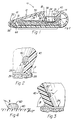
- a device 10 with which the invention is useful comprises, Figure 1, a frame 12 having a top surface 14, and a front edge 16. Mounted on edge 16 is a slide valve 50. Top surface 14 has at least one and preferably three wells or upper compartments 18 formed by a sloping side wall 40. At the bottom of each of the compartments is a filter 24 of appropriate pore size and pore volume. Filter 24 has an upper surface 25 and an under surface 26, Figure 2. Surface 26 is in liquid-flow contact with an absorbent material 28 that preferably occupies each of the lower compartments 30, Figure 1, paired with the upper ones.
- liquid-flow contact means, in sufficient proximity such that a liquid meniscus emanating from surface 26 will also wet material 28 and flow into it, if no air lock exists in the lower compartment.
- Material 28 is any bibulous material, having a sufficient pore volume to soak up about 2 cc of liquid.
- Useful materials include cellulose acetate, cotton, and rayon.
- Useful materials for filters 24 include polyamides, such as nylons, and for example nylon-66 microporous membranes manufactured under the tradenames BIODYNE Aor ULTIPOR N-66 or LOPRODYNE by Pall Corporation. The membranes may be precoated or pretreated (prior to use) with one or more water-soluble proteins, such as casein derivatives obtained from acylation, alkylation or sulfonylation of the casein.
- filter 24 is selected to be permeable to the liquid but impermeable to the immunoproduct of choice.
- impermeable means sufficiently non-porous as to trap for detection the immunoproduct, or the product of the reaction between the immunoreagent and the analyte of the patient's sample.
- a sandwich assay can be used, with an immunoreagent for the antigen of choice being bound to beads. That immunoreagent can be disposed solely on the matrix, given a filter 24 with pore sizes that are too small to allow the beads to pass through.
- the other immunoreagent of the sandwich assay that bears the detectable tag or label is added by the patient during the test, and is not initially in the compartment. Thus, only the buffer need be on the side wall in such case, pursuant to the invention as detailed hereinafter. (The tagged immunoreagent is able to pass through filter 24, unless it forms a sandwich immunoproduct.)
- the device can contain (between the filter and the absorbent material) a porous member which restricts flow back up to the membrane, but allows flow from the membrane to the absorbent material.
- a liquid level indicator ridge 38 is provided in the wall 40 of each well, as a circular ring.
- such an indicator can be one or two rings or fragments of a ring vertically spaced on wall 40, or a vertical bar or dot (not shown).
- Vent aperture 44 is provided in each compartment 30 to allow air passage out of the compartment as liquid flows in. Without such vents, or when the vent apertures are closed, an air lock precludes most of the liquid from flowing through filter 24 into the lower compartments.
- Slide valve 50 includes an elastomeric material 56 selected to insure that the value can be slid off vent 44 or onto it with a force between about 0.15 newtons and about 10 newtons, when material 56 is compressed a bout 0.15 mm.
- the reagents are located on side wall 40 as one or more dried drops 60, 60' Figure 1.
- all of the immunoreagent and all of the buffer are so located, in at least one drop 60 for the buffer, and at least one drop 60', Figure 3, for the immunoreagent and its attendant addenda.
- the preferred amount 3 ⁇ g in 8 ⁇ l of immunoreagent and 4 mg in 8 f..ll of buffer
- about four drops of 2 ⁇ l each of buffer are preferred and about 4 drops of 2 ⁇ l each of immunoreagent are preferred.
- Both sets of drops are preferably smaller than 4 ⁇ l, because for one reason such smaller volumes dry faster. It is further preferred that the drops be plural in number, to facilitate a more rapid redissolving than would be the case if all the buffer or all the immunoreagent were in just one drop.
- the immunoreagent is a biotinylated anti-hCG antibody that will react with avidin attached to polymeric beads that are retained on the membrane.
- the immunoreagent on wall 40 can be a labeled antibody that permits the retained complex to be detectable.
- any buffer is useful, provided it maintains the desired pH range.
- the preferred pH range is from about 6 to 8, as noted above.
- the preferred buffer is the MOPS buffer, which is 3-(N-morphilino)propanesulfonic acid, available from commercial sources.
- an acrylamide polymer is also included as an addendum, particularly in the drops containing the immunoreagent.
- Such polymers are useful in improving the keeping of the immunoreagent during manufacture and storage of the device, particularly for immunoassays of hCG.
- Useful acrylamide polymers include, but are not limited to, acrylamide homo- and copolymers.
- Useful copolymers are prepared from two or more ethylenically unsaturated polymerizable monomers, at least 50 weight percent of the combined monomer weight being acrylamide.
- Preferred polymers include, but are not limited to, poly(acrylamide), poly(acrylamide-c_o-1-vinyl-2-pyrrolidone)(90:10 weight ratio), poly(acrylamide-_co-1-vinyl-2-pyrrolidone)(50:50 weight ratio), poly(acrylamide-co-1-vinylimidazole)(90: 10 weight ratio), poly(acrylamide-co-2-methyl-1-vinylimidazole)(90:10 weight ratio), poly(acrylamide-co-N-methylolacrylamide)(80:20 weight ratio), poly(acrylamide- co-acrylic acid)(90:10 weight ratio), poly(acrylamide-co-2-vinylpyridine)(89:11 weight ratio), poly(acrylamide-co-2-methyl-5-vinylpyridine)(90:10 weight ratio), and poly(acrylamide-co-1-vinyl-2-pyrrolidone-co-acrylic acid) (75:15:10 weight ratio). More than one acrylamide polymer can be used if
- the acrylamide polymer may or may not be included with the buffer drops as addenda. It has been found that its presence is helpful in retaining the drops of buffer in place on the walls when the device experiences severe vibration during manufacturing, for example, when manufacturing using automated equipment. However, if manufacture is done by hand, the acrylamide polymer can be omitted entirely from the buffer drops.
- the critical aspects in locating the dried drops on wall 40 as shown are aspects defined by the drop in its liquid state, and the wall, Figures 2 and 3. These are, the drop volume, the drop composition, and properties of wall 40 as they relate to that drop. That is, depending upon the material and surface condition of wall 40, there is a particular angle of the sloping wall at which the drop will experience incipient flowing, and thus, "failure" as far as this invention is concerned.
- the values of the advancing contact angle a or a', Figs. 2 and 3 and the receding contact angle of the drop at the point of incipient flow are values that define the "contact angle hysteresis".
- viscos means “viscosity”, measured in mPa.s (centipoise) at room temperature.
- the sample liquid for each of the above examples was dispensed in the indicated volume onto a flat surface of two different materials.
- Material #1 was the material of wall surface 40 having an SPE-SPI surface smoothness of 3, while material #2 was undyed polystyrene of generally the same surface smoothness. In both cases the material was kept horizontal, Figure 4, so that a static contact angle y could be measured. The surface was then incrementally tilted 5° at a time, to ascertain when incipient failure (that is, flow downwards) initiated. The results appear in Table II.
- the drop volume for the buffer had to be less than 10 ⁇ l, since the angle of incipient failure for such a volume was in most cases less than 60° (the needed angle of ⁇ as noted above).
- the antibody drops can be that large, but practicalities dictate a smaller size since not that much antibody is needed and drying is facilitated.
- the preferred volume is 4 ⁇ l or less and preferably about 2 ⁇ l. From these tests, it is not clear at what larger volume the failure angle approaches 60°.
- a single well can have more than one immunoreagent on the wall 40 as long as they are such that they do not interfere with each other, or are placed on the wall in such a manner that they do not interfere with each other.
- Each immunoreagent is deposited in a manner such that it is stable and inert to reaction until a liquid sample is added to redissolve it.
- the immunoreagent can also have some buffer with it in at least one drop, provided that the amount of buffer is such that it will not destroy the activity of the immunoreagent over a suitable keeping period, such as at least five months.
- this amount is preferably about 0.025 moles of buffer per liter of anti-hCG antibody drop solution.
- the liquid can be formed as a drop pendant from a pipette, and then moved preferably horizontally to the sidewall to touch it off as a complete drop onto the wall. Such a method can be done manually, or completely automatically.
- the liquid drops can be formed by an ink jet application, in which case each drop is preferably built-up on the side wall by having suitable fractions of the drop ejected in closely spaced spurts. That is, in the case of the buffer drops, it is preferably applied in spurts of 0.1 to 0.15 mg lasting about 0.5 msec, every 50 to 200 msec. More broadly, the buffer liquid can be applied in similar amounts in spurts lasting from 0.3 msec to 0.7 msec, as frequently as 1 msec or as infrequently as 255 msec.
- the antibody drops are applied by inkjet ejection in similar amounts, except of course the total volume of a completed drop is less.
Landscapes
- Health & Medical Sciences (AREA)
- Immunology (AREA)
- Life Sciences & Earth Sciences (AREA)
- Engineering & Computer Science (AREA)
- Molecular Biology (AREA)
- Biomedical Technology (AREA)
- Chemical & Material Sciences (AREA)
- Hematology (AREA)
- Urology & Nephrology (AREA)
- Biotechnology (AREA)
- Biochemistry (AREA)
- Cell Biology (AREA)
- Food Science & Technology (AREA)
- Medicinal Chemistry (AREA)
- Physics & Mathematics (AREA)
- Analytical Chemistry (AREA)
- Microbiology (AREA)
- General Health & Medical Sciences (AREA)
- General Physics & Mathematics (AREA)
- Pathology (AREA)
- Investigating Or Analysing Biological Materials (AREA)
- Automatic Analysis And Handling Materials Therefor (AREA)
- Sampling And Sample Adjustment (AREA)
Claims (16)
caractérisé en ce qu'au moins une partie dudit réactif tampon ou dudit immuno-réactif est dans au moins un dépôt séché (60, 60') redissoluble dans l'eau, formé sur ladite paroi inclinée (40) au dessus de ladite membrane (24, 25, 26) à partir d'une goutte aqueuse placée sur ladite paroi (40) au dessus de la membrane (24, 25, 26),
et en ce que ledit angle (p) formé par ladite paroi inclinée (40) ainsi que le volume et la composition de ladite goutte (60, 60') contenant ledit réactif tampon ou ledit immuno-réactif, sont choisis de manière à empêcher ladite goutte (60, 60') de s'écouler sur ladite membrane (24, 25, 26).
ledit procédé étant caractérisé en ce que ladite goutte (60, 60') est déposée sur ladite paroi inclinée (40) au dessus de ladite membrane (24, 25, 26), ladite goutte (60, 60') ayant un volume prédéterminé et une composition incluant au moins une partie dudit réactif tampon ou dudit immuno-réactif, ladite composition étant choisie de telle sorte que, pou une goutte d'un tel volume prédéterminé et pour un tel angle prédéterminé (β), la goutte déposée (60, 60') ne s'écoule pas sur la membrane (24, 25, 26).
Applications Claiming Priority (2)
| Application Number | Priority Date | Filing Date | Title |
|---|---|---|---|
| US136164 | 1987-12-18 | ||
| US07/136,164 US4988627A (en) | 1987-12-18 | 1987-12-18 | Test device with dried reagent drops on inclined wall |
Publications (2)
| Publication Number | Publication Date |
|---|---|
| EP0321260A1 EP0321260A1 (fr) | 1989-06-21 |
| EP0321260B1 true EP0321260B1 (fr) | 1992-07-01 |
Family
ID=22471614
Family Applications (1)
| Application Number | Title | Priority Date | Filing Date |
|---|---|---|---|
| EP88311905A Expired - Lifetime EP0321260B1 (fr) | 1987-12-18 | 1988-12-16 | Dispositif de test avec gouttes séchées de réactif sur une paroi inclinée |
Country Status (5)
| Country | Link |
|---|---|
| US (1) | US4988627A (fr) |
| EP (1) | EP0321260B1 (fr) |
| JP (1) | JPH028745A (fr) |
| CA (1) | CA1302249C (fr) |
| DE (1) | DE3872499T2 (fr) |
Families Citing this family (21)
| Publication number | Priority date | Publication date | Assignee | Title |
|---|---|---|---|---|
| US5132086A (en) * | 1990-02-06 | 1992-07-21 | Chemtrak Corporation | Non-instrumented cholesterol assay |
| US5147609A (en) * | 1989-05-19 | 1992-09-15 | Pb Diagnostic Systems, Inc. | Assay element |
| DE4024545A1 (de) * | 1990-08-02 | 1992-02-06 | Boehringer Mannheim Gmbh | Verfahren und vorrichtung zum dosierten zufuehren einer biochemischen analysefluessigkeit auf ein target |
| DE4024544A1 (de) * | 1990-08-02 | 1992-02-06 | Boehringer Mannheim Gmbh | Analyseelement und verfahren zu seiner herstellung |
| US5227290A (en) * | 1990-08-29 | 1993-07-13 | Pocock Douglas A | Method for conducting diagnostic assays |
| US5998220A (en) | 1991-05-29 | 1999-12-07 | Beckman Coulter, Inc. | Opposable-element assay devices, kits, and methods employing them |
| US5877028A (en) | 1991-05-29 | 1999-03-02 | Smithkline Diagnostics, Inc. | Immunochromatographic assay device |
| US6168956B1 (en) | 1991-05-29 | 2001-01-02 | Beckman Coulter, Inc. | Multiple component chromatographic assay device |
| DE4202850A1 (de) * | 1992-01-31 | 1993-08-05 | Boehringer Mannheim Gmbh | Analysenelement fuer immunoassays |
| US5589344A (en) | 1994-06-15 | 1996-12-31 | Johnson & Johnson Clinical Diagnostics, Inc. | Test kit and method for competitive specific binding assay |
| US5879951A (en) | 1997-01-29 | 1999-03-09 | Smithkline Diagnostics, Inc. | Opposable-element assay device employing unidirectional flow |
| US5939252A (en) | 1997-05-09 | 1999-08-17 | Lennon; Donald J. | Detachable-element assay device |
| US6436713B1 (en) * | 1997-07-28 | 2002-08-20 | 3M Innovative Properties Company | Methods and devices for measuring total polar compounds in degrading oils |
| WO2002056019A1 (fr) * | 2001-01-15 | 2002-07-18 | Dsm Ip Assets B.V. | Dispositif de test |
| JP4828161B2 (ja) * | 2005-05-30 | 2011-11-30 | 株式会社吉野工業所 | 計量キャップ |
| JP5080494B2 (ja) | 2005-12-21 | 2012-11-21 | メソ スケール テクノロジーズ エルエルシー | アッセイ装置、方法および試薬 |
| EP1963853B1 (fr) | 2005-12-21 | 2016-03-09 | Meso Scale Technologies, LLC | Modules d'essais a reactifs d'essais et leurs procedes de preparation et d'emploi |
| US20070280857A1 (en) * | 2006-06-02 | 2007-12-06 | Applera Corporation | Devices and Methods for Positioning Dried Reagent In Microfluidic Devices |
| US20070280856A1 (en) * | 2006-06-02 | 2007-12-06 | Applera Corporation | Devices and Methods for Controlling Bubble Formation in Microfluidic Devices |
| JP4845997B2 (ja) * | 2008-05-16 | 2011-12-28 | パナソニック株式会社 | 光学素子とその製造方法 |
| CN107219170B (zh) * | 2017-07-24 | 2023-09-19 | 苏州鼎实医疗科技有限公司 | 试剂片 |
Family Cites Families (15)
| Publication number | Priority date | Publication date | Assignee | Title |
|---|---|---|---|---|
| US3655838A (en) * | 1969-03-20 | 1972-04-11 | Organon | Method of pelletizing analytical or immunological reagents |
| US3741876A (en) * | 1970-08-06 | 1973-06-26 | Mason Res Inst Inc | Method of measuring enzyme reaction rates |
| FR2484093A1 (fr) * | 1980-06-06 | 1981-12-11 | Farmatest | Reactif chimique indicateur pour le diagnostic " in vitro " de la grossesse |
| US4387164A (en) * | 1980-11-05 | 1983-06-07 | Fmc Corporation | Method and apparatus for chemical analysis using reactive reagents dispersed in soluble film |
| IL63855A (en) * | 1981-09-16 | 1984-10-31 | Teva Pharma | Method and kit for detecting pregnancy |
| US4639419A (en) * | 1981-10-22 | 1987-01-27 | Meloy Laboratories, Inc. | Immunological color change test involving two differently colored reagent spots |
| US4496654A (en) * | 1983-04-08 | 1985-01-29 | Quidel | Detection of HCG with solid phase support having avidin coating |
| US4693834A (en) * | 1986-05-05 | 1987-09-15 | Murex Corporation | Transverse flow diagnostic kit |
| DE3530993A1 (de) * | 1985-08-30 | 1987-03-05 | Miles Lab | Teststreifen mit festlegbarer probenaufnahmekapazitaet |
| DE3783920T2 (de) * | 1986-09-18 | 1993-05-19 | Pacific Biotech Inc | Verfahren zum impraegnieren einer matrix mit antikoerpern oder antigenen. |
| DE3787078T2 (de) * | 1986-11-24 | 1993-12-09 | Abbott Lab | Proberichtwirkung für analytisches Festphasengerät. |
| US4847199A (en) * | 1987-02-27 | 1989-07-11 | Eastman Kodak Company | Agglutination immunoassay and kit for determination of a multivalent immune species using a buffered salt wash solution |
| US4833087A (en) * | 1987-02-27 | 1989-05-23 | Eastman Kodak Company | Disposable container configured to produce uniform signal |
| US4857453A (en) * | 1987-04-07 | 1989-08-15 | Syntex (U.S.A.) Inc. | Immunoassay device |
| US4818677A (en) * | 1987-12-03 | 1989-04-04 | Monoclonal Antibodies, Inc. | Membrane assay using focused sample application |
-
1987
- 1987-12-18 US US07/136,164 patent/US4988627A/en not_active Expired - Lifetime
-
1988
- 1988-05-18 CA CA000567074A patent/CA1302249C/fr not_active Expired - Lifetime
- 1988-12-16 EP EP88311905A patent/EP0321260B1/fr not_active Expired - Lifetime
- 1988-12-16 DE DE8888311905T patent/DE3872499T2/de not_active Expired - Fee Related
- 1988-12-19 JP JP63320341A patent/JPH028745A/ja active Pending
Also Published As
| Publication number | Publication date |
|---|---|
| EP0321260A1 (fr) | 1989-06-21 |
| CA1302249C (fr) | 1992-06-02 |
| JPH028745A (ja) | 1990-01-12 |
| DE3872499T2 (de) | 1993-02-11 |
| DE3872499D1 (de) | 1992-08-06 |
| US4988627A (en) | 1991-01-29 |
Similar Documents
| Publication | Publication Date | Title |
|---|---|---|
| US4988627A (en) | Test device with dried reagent drops on inclined wall | |
| EP0308232B1 (fr) | Filtre polymérique pour retarder le flux et dispositif d'essai contenant un tel filtre | |
| US4828386A (en) | Multiwell plates containing membrane inserts | |
| US5316732A (en) | Extraction vial | |
| US5219528A (en) | Apparatus for rapid immunoassays | |
| US7217520B2 (en) | Microwell biochip | |
| US7011940B1 (en) | Quality control for cytochemical assays | |
| US6413784B1 (en) | Multi-sectioned fluid delivery devices for detecting target molecules by immunoassay | |
| US4234316A (en) | Device for delivering measured quantities of reagents into assay medium | |
| EP0712495B1 (fr) | Dispositif medical de titrage a flux lateral et contenant un systeme d'extraction d'echantillons | |
| US4833087A (en) | Disposable container configured to produce uniform signal | |
| EP0013156A1 (fr) | Structure particulaire et élément pour l'analyse ou le transport d'un liquide et méthode pour la préparation d'un tel élément | |
| EP0321261B1 (fr) | Utilisation d'un récepteur immobilisé conjugué avec la biotine dans un dispositif, nécessaire de test et méthode pour déterminer un ligand | |
| US6281004B1 (en) | Quality control for cytochemical assays | |
| WO1993017338A1 (fr) | Dosage a courbe de sensibilite aux doses amelioree | |
| EP0238012A2 (fr) | Elément pour essai immunologique et procédé pour son utilisation | |
| EP0299359A2 (fr) | Système pour délivrer des réactifs utilisés dans des dispositifs analytiques de phase solide | |
| JPH07104345B2 (ja) | 液体試料の成分を分析測定するためのテスト担体 | |
| NZ231893A (en) | Dipstick for assaying viscous liquids or liquids containing cellular or particulate matter | |
| JPH0219903B2 (fr) | ||
| CA2171968A1 (fr) | Dispositif pour epreuve | |
| EP0360452A2 (fr) | Particules de latex pour réactifs analytiques, composés et méthodes | |
| JP3147560B2 (ja) | 多項目分析方法 | |
| EP0190335A1 (fr) | Fourniture pour analyses de diagnostic | |
| US20020106658A1 (en) | Blocking chemistries for nylon membrane |
Legal Events
| Date | Code | Title | Description |
|---|---|---|---|
| PUAI | Public reference made under article 153(3) epc to a published international application that has entered the european phase |
Free format text: ORIGINAL CODE: 0009012 |
|
| AK | Designated contracting states |
Kind code of ref document: A1 Designated state(s): CH DE FR GB IT LI SE |
|
| 17P | Request for examination filed |
Effective date: 19890724 |
|
| 17Q | First examination report despatched |
Effective date: 19910219 |
|
| GRAA | (expected) grant |
Free format text: ORIGINAL CODE: 0009210 |
|
| ITF | It: translation for a ep patent filed | ||
| AK | Designated contracting states |
Kind code of ref document: B1 Designated state(s): CH DE FR GB IT LI SE |
|
| REF | Corresponds to: |
Ref document number: 3872499 Country of ref document: DE Date of ref document: 19920806 |
|
| ET | Fr: translation filed | ||
| PLBE | No opposition filed within time limit |
Free format text: ORIGINAL CODE: 0009261 |
|
| STAA | Information on the status of an ep patent application or granted ep patent |
Free format text: STATUS: NO OPPOSITION FILED WITHIN TIME LIMIT |
|
| 26N | No opposition filed | ||
| EAL | Se: european patent in force in sweden |
Ref document number: 88311905.9 |
|
| PGFP | Annual fee paid to national office [announced via postgrant information from national office to epo] |
Ref country code: SE Payment date: 19951218 Year of fee payment: 8 |
|
| REG | Reference to a national code |
Ref country code: GB Ref legal event code: 732E |
|
| PGFP | Annual fee paid to national office [announced via postgrant information from national office to epo] |
Ref country code: GB Payment date: 19961209 Year of fee payment: 9 |
|
| PGFP | Annual fee paid to national office [announced via postgrant information from national office to epo] |
Ref country code: FR Payment date: 19961211 Year of fee payment: 9 |
|
| PG25 | Lapsed in a contracting state [announced via postgrant information from national office to epo] |
Ref country code: SE Effective date: 19961217 |
|
| PGFP | Annual fee paid to national office [announced via postgrant information from national office to epo] |
Ref country code: CH Payment date: 19961219 Year of fee payment: 9 |
|
| PGFP | Annual fee paid to national office [announced via postgrant information from national office to epo] |
Ref country code: DE Payment date: 19961223 Year of fee payment: 9 |
|
| EUG | Se: european patent has lapsed |
Ref document number: 88311905.9 |
|
| PG25 | Lapsed in a contracting state [announced via postgrant information from national office to epo] |
Ref country code: GB Free format text: LAPSE BECAUSE OF NON-PAYMENT OF DUE FEES Effective date: 19971216 |
|
| PG25 | Lapsed in a contracting state [announced via postgrant information from national office to epo] |
Ref country code: LI Free format text: LAPSE BECAUSE OF NON-PAYMENT OF DUE FEES Effective date: 19971231 Ref country code: FR Free format text: THE PATENT HAS BEEN ANNULLED BY A DECISION OF A NATIONAL AUTHORITY Effective date: 19971231 Ref country code: CH Free format text: LAPSE BECAUSE OF NON-PAYMENT OF DUE FEES Effective date: 19971231 |
|
| GBPC | Gb: european patent ceased through non-payment of renewal fee |
Effective date: 19971216 |
|
| REG | Reference to a national code |
Ref country code: CH Ref legal event code: PL |
|
| PG25 | Lapsed in a contracting state [announced via postgrant information from national office to epo] |
Ref country code: DE Free format text: LAPSE BECAUSE OF NON-PAYMENT OF DUE FEES Effective date: 19980901 |
|
| REG | Reference to a national code |
Ref country code: FR Ref legal event code: ST |
|
| PG25 | Lapsed in a contracting state [announced via postgrant information from national office to epo] |
Ref country code: IT Free format text: LAPSE BECAUSE OF NON-PAYMENT OF DUE FEES;WARNING: LAPSES OF ITALIAN PATENTS WITH EFFECTIVE DATE BEFORE 2007 MAY HAVE OCCURRED AT ANY TIME BEFORE 2007. THE CORRECT EFFECTIVE DATE MAY BE DIFFERENT FROM THE ONE RECORDED. Effective date: 20051216 |