EP0321425A1 - Mast für Segelboote - Google Patents
Mast für Segelboote Download PDFInfo
- Publication number
- EP0321425A1 EP0321425A1 EP88830540A EP88830540A EP0321425A1 EP 0321425 A1 EP0321425 A1 EP 0321425A1 EP 88830540 A EP88830540 A EP 88830540A EP 88830540 A EP88830540 A EP 88830540A EP 0321425 A1 EP0321425 A1 EP 0321425A1
- Authority
- EP
- European Patent Office
- Prior art keywords
- poles
- masting
- stays
- vertex
- boat
- Prior art date
- Legal status (The legal status is an assumption and is not a legal conclusion. Google has not performed a legal analysis and makes no representation as to the accuracy of the status listed.)
- Granted
Links
- 238000004873 anchoring Methods 0.000 claims abstract description 17
- 238000011084 recovery Methods 0.000 claims description 3
- 238000012999 compression bending Methods 0.000 claims description 2
- 238000006073 displacement reaction Methods 0.000 claims description 2
- 230000001747 exhibiting effect Effects 0.000 claims 1
- 238000007906 compression Methods 0.000 description 7
- 230000006835 compression Effects 0.000 description 7
- 238000005452 bending Methods 0.000 description 4
- 238000007664 blowing Methods 0.000 description 3
- 239000012530 fluid Substances 0.000 description 2
- 239000006096 absorbing agent Substances 0.000 description 1
- 230000009977 dual effect Effects 0.000 description 1
- 238000007667 floating Methods 0.000 description 1
- 239000002184 metal Substances 0.000 description 1
- 230000003287 optical effect Effects 0.000 description 1
- 230000001105 regulatory effect Effects 0.000 description 1
- 230000000284 resting effect Effects 0.000 description 1
- 230000035939 shock Effects 0.000 description 1
- 230000003068 static effect Effects 0.000 description 1
- 230000001629 suppression Effects 0.000 description 1
Images


Classifications
-
- B—PERFORMING OPERATIONS; TRANSPORTING
- B63—SHIPS OR OTHER WATERBORNE VESSELS; RELATED EQUIPMENT
- B63B—SHIPS OR OTHER WATERBORNE VESSELS; EQUIPMENT FOR SHIPPING
- B63B15/00—Superstructures, deckhouses, wheelhouses or the like; Arrangements or adaptations of masts or spars, e.g. bowsprits
- B63B15/0083—Masts for sailing ships or boats
-
- B—PERFORMING OPERATIONS; TRANSPORTING
- B63—SHIPS OR OTHER WATERBORNE VESSELS; RELATED EQUIPMENT
- B63B—SHIPS OR OTHER WATERBORNE VESSELS; EQUIPMENT FOR SHIPPING
- B63B15/00—Superstructures, deckhouses, wheelhouses or the like; Arrangements or adaptations of masts or spars, e.g. bowsprits
- B63B2015/0016—Masts characterized by mast configuration or construction
- B63B2015/0033—Multipodded masts, e.g. tripod-type
Definitions
- the masting In the traditional sailboats, both single and multihull, the masting consists of a mast disposed on the longitudinal axis of the hull, which is supported by a plurality of shrouds and stays with eventually the aid of one or more pairs of crosstrees.
- This masting exhibits a series of structural and aerodynamic drawbacks. Under rest condition, the mast is compressed by symmetrical forces imposed by the rigging, while the shrouds and the stays are uniformly tensioned.
- the presence of the mast makes compulsory to attach the main sails, especially jib and spanker, in correspondence of the boat central axis.
- a masting for sailboats is characterized by comprising: at least three poles, the lower ends of which are fitted in the bridge or deck of the boat at spaced apart points, while the upper ends are connected one to the other to make up the vertex of an ideal pyramid whose corners are formed by the poles themselves; and a plurality of stays in tension between said vertex and an anchoring point on the boat, the sails being borne by said stays and/or possibly also by the poles.
- a first one of said poles is applied abaft in correspondence of the longitudinal axis of the boat, other two poles are applied, symmetrically to the boat longitudinal axis, in correspondence of the vertex formed by the same poles or afore same vertex, and a plurality of stay anchoring points are disposed along said longitudinal axis.
- further stay anchoring points may be disposed at the outside of the longitudinal axis of the hull.
- rails may be provided transverse to the hull axis, on which rails stays anchoring means are made to slide, so that the stays can be anchored in deck points that can be varied.
- the same rails may be used as sheet rails, further longitudinal sheet rails being possibly provided for the adjustment of the sheets.
- the masting comprises four poles, the lower ends of which are symmetrically applied to the hulls of a multihull boat, a plurality of stays-anchoring points being provided on the hulls-connecting structures, or on the same hulls.
- these poles may be made to slide on guides applied to the boat.
- said poles may exhibit a cross-section having high compression-bending resistance, or a biconical structure.
- streamline profiles may be applied around said poles, rotating according to the wind direction.
- the poles may be realized in more sections, between said sections elastic members being interposed able to impart axial elasticity to the same poles, and tension-recovery members being provided for the stays.
- the poles may form variable angles between them so as to allow a multihull boat to become "closed” by bringing the hulls close to each other.
- the drawing shows schematically a non limitative exemplification of the invention.
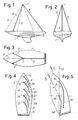
- Figs. 1 to 3 show a first application of the invention to a single-hull boat.
- three poles 3, 5, 5 are applied to the hull, the first pole of which being anchored abaft and the second ones in correspondence of point 7 wherein said poles meet to make up an ideal pyramid (with triangular base, in this case), of which the poles themselves form the corners, or afore with respect to said point 7.
- the masting comprises also a plurality of stays anchored, at one end, to the vertex 7 formed by poles 3, 5, 5, and at the other end, to suitable points of the bridge or deck of the boat.
- Figs. 1 to 3 show two of these stays indicated by 9 and 11, respectively.
- the stays may also be in number far greater than two.
- Fig. 4 in which the poles have been omitted for sake of clarity, five stays are provided, whose anchoring points indicated by 13, 15, 17, 19 and 21, respectively, are lined up along the longitudinal axis of the hull.
- sails 23, 25, 27, 29, 31 - shown by their profile - are applied, which can be maneuvered by means of sheets likewise the traditional jibs of the sailing boats of known type.
- Fig. 5 a solution is shown in which two stays are anchored at points 33 and 35, respectively, being not lined up along the hull axis. Said stays support sails 37, 39 indicated by their profile.
- This disposition is particularly advantageous as it allows a close-hauled sailing with an angle between the boat route - indicated by arrow fI - and the wind real direction - indicated by arrow fV - significantly small, and surely smaller than that allowed by the traditional mastings with central mast.
- the wind entry angle with respect to the leading edge of the sails that is, the angle between the direction of the apparent wind and the chord of same sails, cannot go below a predetermined minimum value, beyond which the fluid stream becomes detached from the sail with consequent turbulence or suppression of the aerodynamic force exerted on the sails.
- the sails (in particular the spanker and the jib, as used when the boat is close hauled) are necessarily applied along the longitudinal axis of the boat, as the spanker is held by the mast and the jib by the bow stay.
- the plane on which the attachment edges of the sails lie is indicated by its trace A on the horizontal, which corresponds to the straight line on which the tack points are lying and are coincident, in the plan view, with the trace of stays 33 and 35.
- the angle " ⁇ " between said trace and the wind real direction fV is again at least 45°, owing to the above stated reasons of fluid dynamics, but the angle between fV and fI is much smaller.
- Fig. 13 shows, in plan view and without poles for sake of drawing clarity, a possible disposition of the sails for sailing before the wind.
- sails 28, 30, 32, 34 may be disposed in a butterfly arrangement - by means of booms - that is, projecting very far with respect to the hull, which sails are supported by suitable stays 20, 22, 24, 26.
- the fore sails 28, 30 are larger than the rear sails 32, 34.
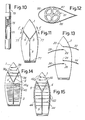
- the anchoring points of the stays on the deck or bridge of the boat may be predisposed in sufficient number, otherwise a set of rails 38, 40 may also be provided (Fig. 14), on each of which stays-anchoring means (38A, 40A) can be fixed in the desired location.
- On each rail a number of anchoring means may be provided, apt to be blocked at suitable positions along the relevant rail.
- the rails 40 are less spaced apart than rails 38.
- the rails 40 may be advantageously used also as sheet rails by providing blocks sliding on said rails for the movement of the sheets. By using openable blocks, it is possible to make the corresponding sheet shift from one to the other of rails 40 according to the navigation requirements.
- the operation of shifting the sheet from the block of one rail 40 to the block of a second rail 40, adjacent to the first one corresponds to the movement of the same sheet along a rail disposed lengthwise to the hull.
- Fig. 15 shows another possible disposition of rails 42 for the stays anchoring means 42A and of rails 44 for the sheets manoeuvring, said rails 44 being in this case longitudinal.
- the stays Under resting condition, that is, in absence of wind-caused stress, the stays result stressed by tension and the poles by compression, the poles 5 being, in particular, equally stressed.
- the leeward pole In case of stress of the sails due to the wind, the leeward pole is subject to a greater compression stress, while the windward pole may be subject to a lower compression stress or even to a tensile stress depending on the trim taken up by the stays bent by the aerodynamic force acting upon the corresponding sails.
- the stress transmitted to the hull results further reduced if compared to that of the traditional mastings in which, with the leeward shrouds in slack condition, the points of application of the load onto the hull are spaced by an amount equal to half the width of same hull.
- the structure formed by the poles indicated by 41, 43, 45 and 47 in case of a catamaran and by 49, 51, 53 in case of a trimaran, cooperates with the structure 55 respectively 57 for the connection of floats i.e. hulls 59, respectively 61, 63.
- the static stress on the connection structures is reduced due to the absence of a compressed mast in central position.
- connection structures between the floats are only stressed by the tension of the stays anchored thereto. Such stress is lower than the one a traditional mast is subject to.
- the elasticity of the stays allows the dampening of dynamic forces arising during the navigation.
- a further resistence to the dynamic forces can be achieved by adopting sufficiently elastic connection structures and, possibly, poles made up of more sections between which elastic members are disposed acting as shock absorbers for dampening the blows over the floats due to waves and/or floating objects which may be hit during the navigation.
- Fig. 10 shows a feasible embodiment of a pole with elastic, shock-absorbing members.
- the pole is made up of two telescopically mounted portions 71, 73 between which a spring 75 is interposed. In this case, means must be provided for the recovery of stays' tension.
- the remarkable width of the multihull boats has brought about the need - in order to ease access into harbours - of building multihull boats with closeable structure, as shown in Fig. 9, for a trimaran.
- the movable connection structures of this type of boats result however very weaks and not always capable of withstanding the strong dynamic stresses developing during the navigation.
- the use of a masting according to the invention allows a greater safety and resistance to be reached even in closeable multihull boats, as the poles assembly cooperates with the connection structure to withstand the stresses upon the floats.
- the masting according to the invention allows the boat's deck to be fully cleared when the boat is at anchor. In fact, it is sufficient to release the stays from the respective anchoring points and retain them along the poles to make the whole deck easily accessible.
- Fig. 11 shows a schematic plan view of a single-hull boat, in which the poles 5 are applied on guides 77 and can be moved according to arrow f thereby determining a displacement of the vertex 7 with respect to the hull along the axis thereof, and a lowering or lifting of said vertex to/from same hull.
- Poles 3, 5, 5 are suitably hinged both at the vertex and at the point where they are connected to the hull, to allow these movements.
- Fig. 12 shows a cross-section view of a pole 81 on which an aerodynamic profile developed in the shape of a cylindrical surface is fitted, having the cross-section shown in Fig. 12 and a height approximately equal to the whole longitudinal development of the corresponding pole.
- the profile 83 is rotatively mounted with respect to the pole axis, for example with the aid of ball-bearings, so as to allow the orientation according to the direction in which the wind is blowing.
- Fig. 12 shows a cross-section of a pole having a high resistance to combined compression and bending stress.
- Said pole in fact, has an outer cylindrical sheath with circular cross-section 85 and an internal cross-shaped portion 87.
- the masting according to the invention allows also to get rid of the boom which is a source of frequent accidents during navigation due to abrupt movements the boom is subject to as a consequence of the changes in the wind direction with respect to the boat.
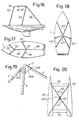
- Fig. 18 shows a modified embodiment of the masting according to the invention.
- a masting is combined, consisting of six poles 105 symmetrically disposed with respect to the central part of the boat and converging into a vertex 107.
- the function and the use of this masting are similar to those described for the other embodiments.
- Fig. 19 shows a feasible embodiment of the vertex 207 designed to provide relative angular positions between the poles converging thereto, such as those indicated by 3, 5, 5.
- the vertex consists, in this case, of a member made up of laminar gussets 206 which stiffen the seats 203, 205, 205 for said poles, relative to each other.
- two-hull boats may provide for moving the hulls close to each other in order to reduce the trasverse dimensions; this is useful on certain conditions.
- the masting according to the invention allows these closing movements of the hulls as can be seen by a comparison between Figs. 6 (or 7) and 20 or between Figs. 8 and 9.
- the pairs of poles 41 and 47 and the pair of poles 43 and 45 are articulated one to the other at the vertex 207 around an almost horizontal and longitudinal axis K-K.
- the two hulls 59 may be moved close to or away from one another, by a suitably adjustable conformation of the connection structures such as those indicated by 55 which, however, is not dealt with by the present invention.
- the two poles 41 and 47 as well as the two poles 43 and 45 may be rigidly connected one to the other.
- Figs. 21 and 22 show a possible embodiment wherein an articulated joint is provided jointing three poles (like those indicated by 49, 51, 53 of Figs. 8 and 9) at vertex 307, in order to allow for moving the two hulls 63 to and from the hull 61.
- a similar embodiment of the joint at the vertex may be adopted also for mounting the masting made up of poles 3, 5, 5 of Figs. 1 to 3 or 11 or 14 or 15 said poles being connected to the same hull in different points thereof or to hulls of different dimensions.
- the pole 51 is articulated at its lower part to the hull according to a trasverse axis along which a pivot pin 353 is provided.
- This pole 53 is articulated by means of a collar 357 to a trasverse axis of a cylindrical body 355.
- the body 355 makes up, at the two sides of the collar 357, the seats for two spherical joints 359, 359 for the upper ends of the two poles 49 and 51.
- the centres of said spherical joints lie on the trasverse axis defined by the cylindrical body 355. In this way, relative inclinations may be obtained between poles 49, 51 and 53, the poles 53 being able to move along the longitudinal vertical axis of symmetry of the boat.
- the rear pole 3, 98 may also be replaced by a pair of respectively aft and fore stays disposed along the plane of symmetry of the hull.
Landscapes
- Chemical & Material Sciences (AREA)
- Engineering & Computer Science (AREA)
- Combustion & Propulsion (AREA)
- Mechanical Engineering (AREA)
- Ocean & Marine Engineering (AREA)
- Wind Motors (AREA)
- Tents Or Canopies (AREA)
- Bridges Or Land Bridges (AREA)
Applications Claiming Priority (2)
| Application Number | Priority Date | Filing Date | Title |
|---|---|---|---|
| IT09580/87A IT1218790B (it) | 1987-12-17 | 1987-12-17 | Alberatura per imbarcazione a vela |
| IT958087 | 1987-12-17 |
Publications (2)
| Publication Number | Publication Date |
|---|---|
| EP0321425A1 true EP0321425A1 (de) | 1989-06-21 |
| EP0321425B1 EP0321425B1 (de) | 1992-07-22 |
Family
ID=11132446
Family Applications (1)
| Application Number | Title | Priority Date | Filing Date |
|---|---|---|---|
| EP88830540A Expired EP0321425B1 (de) | 1987-12-17 | 1988-12-16 | Mast für Segelboote |
Country Status (5)
| Country | Link |
|---|---|
| US (1) | US4922846A (de) |
| EP (1) | EP0321425B1 (de) |
| DE (1) | DE3873053T2 (de) |
| ES (1) | ES2034384T3 (de) |
| IT (1) | IT1218790B (de) |
Cited By (2)
| Publication number | Priority date | Publication date | Assignee | Title |
|---|---|---|---|---|
| WO1989011996A1 (fr) * | 1988-06-09 | 1989-12-14 | Claude Bonnet | Mat, notamment pour bateau a voile |
| FR2722469A1 (fr) * | 1994-07-18 | 1996-01-19 | Gache Alain | Greement tripode pour voilier notamment catamaran ou trimaran |
Families Citing this family (9)
| Publication number | Priority date | Publication date | Assignee | Title |
|---|---|---|---|---|
| US5392726A (en) * | 1992-05-11 | 1995-02-28 | Benze; Theodore A. | Sailboat |
| US5423274A (en) * | 1992-05-11 | 1995-06-13 | Benze; Theodore A. | Sailboat |
| US5873588A (en) * | 1996-01-19 | 1999-02-23 | Thomas R. Swetish | Assembled sail powered vehicle |
| DE19740872C2 (de) * | 1997-09-16 | 1999-07-15 | Rainer Dr Wieland | Rigg für eine Segelyacht |
| US6073233A (en) * | 1997-10-08 | 2000-06-06 | Cisco Technology, Inc. | Method and apparatus for distributing and accessing configuration registers |
| RU2137675C1 (ru) * | 1998-05-20 | 1999-09-20 | Плехов Герман Георгиевич | Парусное вооружение судна плехова г.г. |
| US6662738B2 (en) * | 2001-06-29 | 2003-12-16 | David Allen Estabrooks | Lifting-sail boat apparatus and method |
| IL165710A (en) * | 2004-12-12 | 2006-04-10 | Amos Lior | Sailboat |
| IT202100016346A1 (it) * | 2021-06-22 | 2022-12-22 | Marco Ravasi | Imbarcazione a vela con struttura di sostegno a più aste per il sostegno delle vele |
Citations (4)
| Publication number | Priority date | Publication date | Assignee | Title |
|---|---|---|---|---|
| FR2341480A1 (fr) * | 1976-02-23 | 1977-09-16 | Dalotel Michel | Bateau a flotteurs lateraux profiles |
| FR2540066A1 (fr) * | 1983-02-01 | 1984-08-03 | Froment Michel | Greement a traverses et potences |
| EP0126679A1 (de) * | 1983-05-09 | 1984-11-28 | Jacques Berge | Schiff mit mindestens zwei miteinander verbundenen Rümpfen und mehreren Masten |
| FR2560144A1 (fr) * | 1983-07-08 | 1985-08-30 | Dagorne Jean Pierre | Dispositif de mature pour amelioration voilure sur voilier |
Family Cites Families (11)
| Publication number | Priority date | Publication date | Assignee | Title |
|---|---|---|---|---|
| US372085A (en) * | 1887-10-25 | Sheet ring detacher for vessels | ||
| US2364578A (en) * | 1943-05-17 | 1944-12-05 | Leighton A Wilkie | Sailboat |
| US2756711A (en) * | 1954-10-29 | 1956-07-31 | Alden H Simpson | Sailing vessel stabilizing device |
| US2944505A (en) * | 1955-11-22 | 1960-07-12 | Berge Jacques Marie Al Charles | Catamaran sail boat |
| US3141435A (en) * | 1962-10-02 | 1964-07-21 | Jr Merritt L Moffitt | Sailing catamaran |
| US3395664A (en) * | 1966-09-12 | 1968-08-06 | Greenberg Lewis Anthony | Tetrahedron sailing vehicle |
| US3534700A (en) * | 1969-03-06 | 1970-10-20 | John K Marshall | Adjustable jib sheet block |
| US3902443A (en) * | 1974-04-30 | 1975-09-02 | Hugh Mcdougall | Combination boat stabiliser and sail kit |
| US4044702A (en) * | 1974-10-21 | 1977-08-30 | Jamieson Robert S | High efficiency aerodynamic sail system for boats, and method for sailing |
| US4273060A (en) * | 1980-03-26 | 1981-06-16 | Ivan Pavincic | Sailing vessel |
| DE3316139A1 (de) * | 1983-05-03 | 1984-11-08 | Hartmut Berthold 2000 Norderstedt Schwarz | Segelschiff |
-
1987
- 1987-12-17 IT IT09580/87A patent/IT1218790B/it active
-
1988
- 1988-12-14 US US07/284,319 patent/US4922846A/en not_active Expired - Fee Related
- 1988-12-16 DE DE8888830540T patent/DE3873053T2/de not_active Expired - Lifetime
- 1988-12-16 ES ES198888830540T patent/ES2034384T3/es not_active Expired - Lifetime
- 1988-12-16 EP EP88830540A patent/EP0321425B1/de not_active Expired
Patent Citations (4)
| Publication number | Priority date | Publication date | Assignee | Title |
|---|---|---|---|---|
| FR2341480A1 (fr) * | 1976-02-23 | 1977-09-16 | Dalotel Michel | Bateau a flotteurs lateraux profiles |
| FR2540066A1 (fr) * | 1983-02-01 | 1984-08-03 | Froment Michel | Greement a traverses et potences |
| EP0126679A1 (de) * | 1983-05-09 | 1984-11-28 | Jacques Berge | Schiff mit mindestens zwei miteinander verbundenen Rümpfen und mehreren Masten |
| FR2560144A1 (fr) * | 1983-07-08 | 1985-08-30 | Dagorne Jean Pierre | Dispositif de mature pour amelioration voilure sur voilier |
Cited By (2)
| Publication number | Priority date | Publication date | Assignee | Title |
|---|---|---|---|---|
| WO1989011996A1 (fr) * | 1988-06-09 | 1989-12-14 | Claude Bonnet | Mat, notamment pour bateau a voile |
| FR2722469A1 (fr) * | 1994-07-18 | 1996-01-19 | Gache Alain | Greement tripode pour voilier notamment catamaran ou trimaran |
Also Published As
| Publication number | Publication date |
|---|---|
| IT8709580A0 (it) | 1987-12-17 |
| DE3873053T2 (de) | 1992-12-03 |
| US4922846A (en) | 1990-05-08 |
| ES2034384T3 (es) | 1993-04-01 |
| EP0321425B1 (de) | 1992-07-22 |
| DE3873053D1 (de) | 1992-08-27 |
| IT1218790B (it) | 1990-04-19 |
Similar Documents
| Publication | Publication Date | Title |
|---|---|---|
| US5277142A (en) | Variable-beam catamaran | |
| US4582011A (en) | Hydrofoil vessel | |
| US4159006A (en) | Multihull vessels | |
| EP0321425A1 (de) | Mast für Segelboote | |
| US4392444A (en) | High stability trimaran | |
| JP2003503261A (ja) | セーリング・ボート | |
| US5848574A (en) | Multi-hull watercraft with self-righting capabilities | |
| US6089173A (en) | Multi-hull watercraft with self-righting capabilities | |
| US4653417A (en) | Wind propelled vessel | |
| JPS63500446A (ja) | 帆走ボ−ト | |
| EP0020121A1 (de) | Segelboot | |
| US4108100A (en) | Rigging base for plural-hull sailing craft and methods for sail control | |
| US4537145A (en) | Wind propelled vessel | |
| GB2151195A (en) | Pivoting mast for water-borne or land based vehicles | |
| US5884575A (en) | Nautical balance system | |
| US3820489A (en) | Safety rig for multi hull boats | |
| US7628115B2 (en) | Mechanism for collapsible catamaran | |
| RU2171195C1 (ru) | Парусное судно | |
| US6830003B2 (en) | Multihull boat | |
| US5216971A (en) | Catamaran righting apparatus | |
| US20250026446A1 (en) | Multihull Vessel Side Hull Retraction System | |
| RU2754699C1 (ru) | Многокорпусное судно | |
| AU758459B2 (en) | Multi-hull watercraft with self-righting capabilities | |
| GB2098137A (en) | A sailing craft | |
| FI74918B (fi) | Katamarananordning. |
Legal Events
| Date | Code | Title | Description |
|---|---|---|---|
| PUAI | Public reference made under article 153(3) epc to a published international application that has entered the european phase |
Free format text: ORIGINAL CODE: 0009012 |
|
| AK | Designated contracting states |
Kind code of ref document: A1 Designated state(s): DE ES FR GB NL SE |
|
| 17P | Request for examination filed |
Effective date: 19890728 |
|
| 17Q | First examination report despatched |
Effective date: 19900919 |
|
| GRAA | (expected) grant |
Free format text: ORIGINAL CODE: 0009210 |
|
| AK | Designated contracting states |
Kind code of ref document: B1 Designated state(s): DE ES FR GB NL SE |
|
| PG25 | Lapsed in a contracting state [announced via postgrant information from national office to epo] |
Ref country code: SE Effective date: 19920722 Ref country code: NL Effective date: 19920722 |
|
| REF | Corresponds to: |
Ref document number: 3873053 Country of ref document: DE Date of ref document: 19920827 |
|
| ET | Fr: translation filed | ||
| NLV1 | Nl: lapsed or annulled due to failure to fulfill the requirements of art. 29p and 29m of the patents act | ||
| REG | Reference to a national code |
Ref country code: ES Ref legal event code: FG2A Ref document number: 2034384 Country of ref document: ES Kind code of ref document: T3 |
|
| PLBE | No opposition filed within time limit |
Free format text: ORIGINAL CODE: 0009261 |
|
| STAA | Information on the status of an ep patent application or granted ep patent |
Free format text: STATUS: NO OPPOSITION FILED WITHIN TIME LIMIT |
|
| 26N | No opposition filed | ||
| PGFP | Annual fee paid to national office [announced via postgrant information from national office to epo] |
Ref country code: GB Payment date: 19961210 Year of fee payment: 9 |
|
| PGFP | Annual fee paid to national office [announced via postgrant information from national office to epo] |
Ref country code: DE Payment date: 19961211 Year of fee payment: 9 |
|
| PGFP | Annual fee paid to national office [announced via postgrant information from national office to epo] |
Ref country code: FR Payment date: 19961216 Year of fee payment: 9 |
|
| PGFP | Annual fee paid to national office [announced via postgrant information from national office to epo] |
Ref country code: ES Payment date: 19961218 Year of fee payment: 9 |
|
| PG25 | Lapsed in a contracting state [announced via postgrant information from national office to epo] |
Ref country code: GB Free format text: LAPSE BECAUSE OF NON-PAYMENT OF DUE FEES Effective date: 19971216 |
|
| PG25 | Lapsed in a contracting state [announced via postgrant information from national office to epo] |
Ref country code: FR Free format text: THE PATENT HAS BEEN ANNULLED BY A DECISION OF A NATIONAL AUTHORITY Effective date: 19971231 |
|
| GBPC | Gb: european patent ceased through non-payment of renewal fee |
Effective date: 19971216 |
|
| PG25 | Lapsed in a contracting state [announced via postgrant information from national office to epo] |
Ref country code: DE Free format text: LAPSE BECAUSE OF NON-PAYMENT OF DUE FEES Effective date: 19980901 |
|
| REG | Reference to a national code |
Ref country code: FR Ref legal event code: ST |
|
| PG25 | Lapsed in a contracting state [announced via postgrant information from national office to epo] |
Ref country code: ES Free format text: LAPSE BECAUSE OF NON-PAYMENT OF DUE FEES Effective date: 19981217 |
|
| REG | Reference to a national code |
Ref country code: ES Ref legal event code: FD2A Effective date: 19990114 |