EP0322039B1 - Verankerungsblock - Google Patents
Verankerungsblock Download PDFInfo
- Publication number
- EP0322039B1 EP0322039B1 EP88202893A EP88202893A EP0322039B1 EP 0322039 B1 EP0322039 B1 EP 0322039B1 EP 88202893 A EP88202893 A EP 88202893A EP 88202893 A EP88202893 A EP 88202893A EP 0322039 B1 EP0322039 B1 EP 0322039B1
- Authority
- EP
- European Patent Office
- Prior art keywords
- anchor base
- mounting slots
- junction box
- mounting
- anchor
- Prior art date
- Legal status (The legal status is an assumption and is not a legal conclusion. Google has not performed a legal analysis and makes no representation as to the accuracy of the status listed.)
- Expired - Lifetime
Links
- 238000010276 construction Methods 0.000 claims abstract description 23
- 238000009429 electrical wiring Methods 0.000 claims description 5
- 229920000728 polyester Polymers 0.000 claims description 3
- 239000002990 reinforced plastic Substances 0.000 claims description 2
- 239000002184 metal Substances 0.000 description 3
- 229910052751 metal Inorganic materials 0.000 description 3
- 238000004873 anchoring Methods 0.000 description 2
- 238000009434 installation Methods 0.000 description 2
- 229910001018 Cast iron Inorganic materials 0.000 description 1
- 230000000694 effects Effects 0.000 description 1
- 210000004907 gland Anatomy 0.000 description 1
- 238000007689 inspection Methods 0.000 description 1
- 239000000463 material Substances 0.000 description 1
- 238000005259 measurement Methods 0.000 description 1
- 238000000034 method Methods 0.000 description 1
- 238000012986 modification Methods 0.000 description 1
- 230000004048 modification Effects 0.000 description 1
- 230000002093 peripheral effect Effects 0.000 description 1
- 238000007789 sealing Methods 0.000 description 1
Images


Classifications
-
- E—FIXED CONSTRUCTIONS
- E04—BUILDING
- E04H—BUILDINGS OR LIKE STRUCTURES FOR PARTICULAR PURPOSES; SWIMMING OR SPLASH BATHS OR POOLS; MASTS; FENCING; TENTS OR CANOPIES, IN GENERAL
- E04H12/00—Towers; Masts or poles; Chimney stacks; Water-towers; Methods of erecting such structures
- E04H12/22—Sockets or holders for poles or posts
- E04H12/2253—Mounting poles or posts to the holder
- E04H12/2261—Mounting poles or posts to the holder on a flat base
Definitions
- the invention relates to an anchor base for the supporting of e.g. an exterior lighting fitting, a traffic sign of other construction, said anchor base comprising:
- Such an anchor base is known from EP-A-0101984. It is a purpose of the invention to design an anchor base in such a way that far most commercially available constructions, such as exterior lighting-fittings and the like, can be fixed on the anchor base without the necessity of changing the base or parts thereof in cases where it is necessary to replace a once fixed construction by another construction.
- the anchor base according to the invention is characterized by a second group of mounting slots which are arranged at angles of approximately 120° to each other, the two groups of mounting slots having one mounting slot in common.
- the anchor base is characterized in that the upper surface is substantially square and that a slot extends in a diagonal direction.
- Ease of mounting is ensured by an embodiment, in which the mounting slots narrow towards the top so that the head of a bolt can be accommodated and prevented from passing through a slot.
- the base may be characterized in that the mounting slots are open only towards the upper surface.
- the anchor base is characterized in that the upper surface forms part of a detachable plate.
- the plate can be located in a recessed position.
- the anchor base according to the invention is characterized in that the anchor base consists of optionally reinforced plastic, for example polyester.
- a great strength is ensured by an embodiment provided with struts extending between flat parts of the anchor base which are disposed approximately perpendicular to one another.
- a very secure anchoring in the ground is ensured by an embodiment provided with an outward-extending flange at the bottom.
- the anchor block has a through holed aperture present in the upper surface for the receiving of a junction box for electrical wiring.
- the anchor base according to the invention may advantageously be characterized by a flange member situated in the through holed aperture for defining the lowest position of the junction box in said aperture.
- a flange member situated in the through holed aperture for defining the lowest position of the junction box in said aperture.
- an embodiment can be adopted which is characterized in that the junction box can display a gripping co-action with the wall of the aperture.
- the invention further relates to an anchor base provided with a junction box comprising a casing with a cover cable passage means situated in the bottom of said casing for example at least one break-away port, and cable passage means situated in said cover for example a through hole with a rubber grommet.
- junction box can with advantage be provided with an external flange member for cooperation with the flange member situated in the through holed aperture of the anchor base.
- the anchor base according to the invention is not limited to a block-shaped massive construction, but also encompasses other supporting structures which are able to carry a mounting plate.
- other supporting structures which are able to carry a mounting plate.
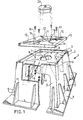
- Figure 1 shows an anchor block 1 made of reinforced polyester. It comprises four upright walls 2, a plate 3 situated between them, a circumferential flange 4 extending outwards around the bottom of the walls 2, struts 5 which are arranged externally between the upright walls 2 and the flange 4, and struts 6 which are arranged internally between the walls 2 and the plate 3.
- the plate 3 has a central polygonal aperture 7 in addition to four relatively small through holes 8.
- the plate 3 is mounted in a recessed position with respect to the upper edge 9 of the upright walls 2, which taper towards one another to a certain extent. An enclosed platform is thus obtained, upon which a separate cast-iron mounting plate 10 can be placed, in such manner that it can be held in a recessed position on the top of the block 1.
- This plate 10 has a hole 11 corresponding to the central hole 7, out from which a number of mounting slots extend.
- These mounting slots are arranged in a first group comprising the slots 12, 13, 14 and 15, which slots are disposed at a mutual angular interval of 90°, and a second group, consisting of the slots 12, 16, 17 which are disposed at a mutual angular interval of 120°. It will be apparent that the slot 12 is common to both groups.
- the plate 10 is square and the slots 12-15 are disposed in a diagonal direction, so that their length can be as great as possible. It will thus also be apparent that the slots 16 and 17 are somewhat shorter than the other slots.
- the plate 10 has four holes 18, which are placed such that they can be positioned in accurate register with the holes 8.
- the plate 10 can be fastened onto the plate 3 using bolts 19.
- the bolts 19 can be placed in a recessed situation with respect to the top surface of the plate 10. This is not shown in figure 1; reference is made to figure 2, to be discussed below.
- junction box 20 for electrical leads can be received therein.
- a junction box has been specially designed with a view to its use together with the anchor block according to the invention.
- the junction box together with the anchor block has been submitted to a Dutch government inspection institute. Official approval has in the meantime been obtained.
- the junction box functions as a replacement for the considerably more expensive and complicated known underground connector sleeves, with which electrical branching or connection is realized according to the known art.
- the junction box according to the invention has the advantage that it lends itself to installation by untrained personnel, while the known underground connector sleeves should preferably be installed by qualified technicians.
- figure 2 in which a number of details of figure 1 are shown on a somewhat enlarged scale.
- the slots 12-17 are made in a stepped form, such that they are wider on the underside facing towards the plate 3 than on the upper side open to the top.
- the dimensioning of the grooves is such that the heads of bolts 21, which heads have a hexagonal shape, fit into them, whereby locking against rotation is obtained.
- the bolts 21 serve for the mounting of a construction 23, for example a lamp post, by means of holes present in a flange 22. It will be apparent that correct positioning of each bolt with respect to a hole in the flange 22 can be obtained through the sliding of the bolts 21, which can enter the requisite slots from the hole 12. After the positioning of the construction 23, the nuts 24 can be tightened, so that the construction 23 is firmly mounted on the block 1.
- the electrical wiring is carried from a source through a previously dug trench in the ground to the place where the anchor block has to be placed. At that position the ground is also dug out to the required depth.
- the electrical wiring is now carried upward in such manner that the anchor block 1 can slide with the apertures 7 and 11 over the wiring, whereby the anchor block can be brought into its position.
- the junction box 20 is then coupled to the wiring, while if required wiring which continues to subsequent constructions can also be connected in the relevant box 20.
- the electrical wiring of the construction 23 can also be connected with the junction box 20.
- the junction box 20 is placed into the apertures 7, 11, whereafter the construction 23 can be mounted in the manner described with reference to figure 2.
- Figure 3 shows a concrete anchor block 25, in the top surface 26 of which metal groove members are embedded.
- these groove members are grouped in respectively a first group 27, 28, 29, 30 with a mutual angular interval of 90°, and a second group 27, 31, 32 with a mutual angular interval of 120°, in complete analogy with the embodiment according to figures 1 and 2.
- the groove members 27-32 are metal, more or less U-shaped sections which narrow towards the top, for the holding of bolt heads.
- the groove members 27-32 are held in the concrete.
- the disadvantage of the variant shown in figure 3 is that the concrete construction is relatively heavy and is thus also relatively more difficult to handle, particularly in the case of larger anchor blocks.
- the embodiment according to figures 1 and 2 is considerably lighter while nevertheless ensuring an excellent anchoring in the ground owing partly to the presence of the flange 4.
- anchor block 1 After the description of the manner in which anchor block 1 is placed, the installation of the anchor block 25 will not be discussed. This is substantially the same as that of anchor block 1.
- Figures 4 and 5 show the manner of placing the junction box 20 in, respectively, the aperture 34 in the top surface of the anchor block 25, and the aperture 7, 11 in the top surface of the anchor block 1.
- the junction box 20 is provided with a flange members 35 for cooperation with a corresponding flange member 36 ⁇ i.e. an edge on the aperture 34 in the case of figure 4, and the peripheral edge of the aperture 7 in the plate 3 in the case of figure 5.
- the flange member 35 can in both cases rest on a protruding edge.
- the measurements of the junction box 20 on the one hand and the aperture 34; 11,7 on the other are such that the junction box can be mounted with gripping effect in the aperture concerned.
- the junction box 20 comprises a casing 37 with a cover 38 which can be mounted by means of a gasket 39 for gripping and sealing on the casing.
- the bottom of the casing 37 has a cable passage means, in this case a hole 40, which is made by the puncturing of a break-away port.
- a gland nut 41 is arranged in the hole.
- the embodiment is such that the top of the grommet 42 lies in approximately the same plane as the top surface 26, or, respectively, the top surface of the plate 10.
Landscapes
- Engineering & Computer Science (AREA)
- Architecture (AREA)
- Civil Engineering (AREA)
- Structural Engineering (AREA)
- Road Signs Or Road Markings (AREA)
- Connection Or Junction Boxes (AREA)
- Hydrogenated Pyridines (AREA)
- Pharmaceuticals Containing Other Organic And Inorganic Compounds (AREA)
- Saccharide Compounds (AREA)
- Piles And Underground Anchors (AREA)
Claims (14)
Priority Applications (1)
| Application Number | Priority Date | Filing Date | Title |
|---|---|---|---|
| AT88202893T ATE66714T1 (de) | 1987-12-21 | 1988-12-14 | Verankerungsblock. |
Applications Claiming Priority (2)
| Application Number | Priority Date | Filing Date | Title |
|---|---|---|---|
| NL8703090 | 1987-12-21 | ||
| NL8703090A NL8703090A (nl) | 1987-12-21 | 1987-12-21 | Fundatiesokkel. |
Publications (2)
| Publication Number | Publication Date |
|---|---|
| EP0322039A1 EP0322039A1 (de) | 1989-06-28 |
| EP0322039B1 true EP0322039B1 (de) | 1991-08-28 |
Family
ID=19851127
Family Applications (1)
| Application Number | Title | Priority Date | Filing Date |
|---|---|---|---|
| EP88202893A Expired - Lifetime EP0322039B1 (de) | 1987-12-21 | 1988-12-14 | Verankerungsblock |
Country Status (5)
| Country | Link |
|---|---|
| EP (1) | EP0322039B1 (de) |
| AT (1) | ATE66714T1 (de) |
| DE (1) | DE3864504D1 (de) |
| ES (1) | ES2024631B3 (de) |
| NL (1) | NL8703090A (de) |
Families Citing this family (6)
| Publication number | Priority date | Publication date | Assignee | Title |
|---|---|---|---|---|
| US5743505A (en) * | 1995-10-19 | 1998-04-28 | Hms Mfg. Co. | Base extension for tree or display stand |
| US5706991A (en) * | 1996-02-27 | 1998-01-13 | Jay Nagengast | Portable tool holder with stabilizing base |
| FR2886663B1 (fr) * | 2005-06-03 | 2008-12-19 | Robert Thebault Sa Sa | Element d'ancrage pour poteau de support d'information, et notamment pour poteau de signalisation. |
| GB2489437A (en) * | 2011-03-28 | 2012-10-03 | Robert George Foreman | An adaptor plate for and an improved method of replacing pay and display machines |
| DE102019104107A1 (de) * | 2019-02-19 | 2020-08-20 | Innogy Se | Ladestationsmontageadapter, System mit einem solchen Adapter und Verfahren zur Montage einer Ladestation |
| WO2025158415A1 (en) * | 2024-01-27 | 2025-07-31 | Eaton Intelligent Power Limited | Base mount for electrical component |
Family Cites Families (6)
| Publication number | Priority date | Publication date | Assignee | Title |
|---|---|---|---|---|
| US3187175A (en) * | 1963-03-21 | 1965-06-01 | Mc Graw Edison Co | Power distribution system |
| US3563502A (en) * | 1968-12-04 | 1971-02-16 | Harsco Corp | Anchor base for lighting standards |
| CA888457A (en) * | 1969-07-11 | 1971-12-21 | Powerlite Devices Limited | Frangible coupling for standard mounted poles and the like |
| DE2228381B2 (de) * | 1972-06-10 | 1974-04-11 | Guenther 2390 Flensburg Zschage | Vorrichtung zum Befestigen von Schilderpfosten an einem Pfostenfuß |
| DE2264468A1 (de) * | 1972-06-10 | 1974-03-14 | Guenther Zschage | Fundament fuer schilderpfosten |
| DE3231685A1 (de) * | 1982-08-26 | 1984-03-01 | Rieth & Co GmbH, 2000 Hamburg | Einstellbare befestigungsvorrichtung fuer tragkonstruktionen |
-
1987
- 1987-12-21 NL NL8703090A patent/NL8703090A/nl not_active Application Discontinuation
-
1988
- 1988-12-14 ES ES88202893T patent/ES2024631B3/es not_active Expired - Lifetime
- 1988-12-14 DE DE8888202893T patent/DE3864504D1/de not_active Expired - Lifetime
- 1988-12-14 EP EP88202893A patent/EP0322039B1/de not_active Expired - Lifetime
- 1988-12-14 AT AT88202893T patent/ATE66714T1/de not_active IP Right Cessation
Also Published As
| Publication number | Publication date |
|---|---|
| ES2024631B3 (es) | 1992-03-01 |
| DE3864504D1 (de) | 1991-10-02 |
| NL8703090A (nl) | 1989-07-17 |
| EP0322039A1 (de) | 1989-06-28 |
| ATE66714T1 (de) | 1991-09-15 |
Similar Documents
| Publication | Publication Date | Title |
|---|---|---|
| US5266738A (en) | Universal fixture mount and method of assembly | |
| KR910002586B1 (ko) | 케이블 부설용 플로어링패널 | |
| US5142102A (en) | Multiple tier junction box | |
| CA1290127C (en) | Buildings for harsh environments | |
| US20010018978A1 (en) | Ballast box pole mounting system | |
| US4716508A (en) | Outdoor lighting pedestal | |
| US12420654B2 (en) | Mount for a charging station | |
| US20040040224A1 (en) | Mounting of tubular steel columns on concrete base | |
| EP0322039A1 (de) | Verankerungsblock | |
| US5833206A (en) | Universal foot for telecommunications switching cabinet | |
| US6118074A (en) | Curved lid junction box | |
| US6173935B1 (en) | Cathedral ceiling fixture mounting system | |
| JP3240959U (ja) | 杭頭キャップ | |
| US20240322577A1 (en) | Mount for a Charging Station | |
| US3093215A (en) | Rotatable base assembly | |
| JPH06284543A (ja) | 配線路 | |
| JP3012532B2 (ja) | 地上機器の受枠及びこの受枠におけるケーブル配線用のアダプタ | |
| WO2005093161A1 (en) | A multi-function pole | |
| JPH0743282Y2 (ja) | 廊下の床組み構造 | |
| JPH072701Y2 (ja) | マンホール用受枠ボルト | |
| JPH073974A (ja) | 屋上またはバルコニー用手摺固定構造 | |
| JP3225931B2 (ja) | 地下埋設設備の設置構造 | |
| RU203562U1 (ru) | Универсальная монтажная коробка | |
| JPH0113104Y2 (de) | ||
| JPS6220524Y2 (de) |
Legal Events
| Date | Code | Title | Description |
|---|---|---|---|
| PUAI | Public reference made under article 153(3) epc to a published international application that has entered the european phase |
Free format text: ORIGINAL CODE: 0009012 |
|
| AK | Designated contracting states |
Kind code of ref document: A1 Designated state(s): AT BE CH DE ES FR GB IT LI LU NL |
|
| 17P | Request for examination filed |
Effective date: 19891113 |
|
| 17Q | First examination report despatched |
Effective date: 19900406 |
|
| ITF | It: translation for a ep patent filed | ||
| GRAA | (expected) grant |
Free format text: ORIGINAL CODE: 0009210 |
|
| AK | Designated contracting states |
Kind code of ref document: B1 Designated state(s): AT BE CH DE ES FR GB IT LI LU NL |
|
| REF | Corresponds to: |
Ref document number: 66714 Country of ref document: AT Date of ref document: 19910915 Kind code of ref document: T |
|
| REF | Corresponds to: |
Ref document number: 3864504 Country of ref document: DE Date of ref document: 19911002 |
|
| ET | Fr: translation filed | ||
| REG | Reference to a national code |
Ref country code: ES Ref legal event code: FG2A Ref document number: 2024631 Country of ref document: ES Kind code of ref document: B3 |
|
| NLS | Nl: assignments of ep-patents |
Owner name: VAN RIJNSOEVER BEHEER B.V. TE UTRECHT. |
|
| PLBE | No opposition filed within time limit |
Free format text: ORIGINAL CODE: 0009261 |
|
| STAA | Information on the status of an ep patent application or granted ep patent |
Free format text: STATUS: NO OPPOSITION FILED WITHIN TIME LIMIT |
|
| 26N | No opposition filed | ||
| EPTA | Lu: last paid annual fee | ||
| PGFP | Annual fee paid to national office [announced via postgrant information from national office to epo] |
Ref country code: GB Payment date: 20000203 Year of fee payment: 12 |
|
| PG25 | Lapsed in a contracting state [announced via postgrant information from national office to epo] |
Ref country code: GB Free format text: LAPSE BECAUSE OF NON-PAYMENT OF DUE FEES Effective date: 20001214 |
|
| PGFP | Annual fee paid to national office [announced via postgrant information from national office to epo] |
Ref country code: AT Payment date: 20001228 Year of fee payment: 13 |
|
| PGFP | Annual fee paid to national office [announced via postgrant information from national office to epo] |
Ref country code: FR Payment date: 20001229 Year of fee payment: 13 |
|
| PGFP | Annual fee paid to national office [announced via postgrant information from national office to epo] |
Ref country code: ES Payment date: 20010103 Year of fee payment: 13 |
|
| PGFP | Annual fee paid to national office [announced via postgrant information from national office to epo] |
Ref country code: CH Payment date: 20010104 Year of fee payment: 13 |
|
| GBPC | Gb: european patent ceased through non-payment of renewal fee |
Effective date: 20001214 |
|
| PG25 | Lapsed in a contracting state [announced via postgrant information from national office to epo] |
Ref country code: AT Free format text: LAPSE BECAUSE OF NON-PAYMENT OF DUE FEES Effective date: 20011214 |
|
| PG25 | Lapsed in a contracting state [announced via postgrant information from national office to epo] |
Ref country code: CH Free format text: LAPSE BECAUSE OF NON-PAYMENT OF DUE FEES Effective date: 20011231 Ref country code: LI Free format text: LAPSE BECAUSE OF NON-PAYMENT OF DUE FEES Effective date: 20011231 |
|
| REG | Reference to a national code |
Ref country code: CH Ref legal event code: PL |
|
| PG25 | Lapsed in a contracting state [announced via postgrant information from national office to epo] |
Ref country code: FR Free format text: LAPSE BECAUSE OF NON-PAYMENT OF DUE FEES Effective date: 20020830 |
|
| REG | Reference to a national code |
Ref country code: FR Ref legal event code: ST |
|
| PG25 | Lapsed in a contracting state [announced via postgrant information from national office to epo] |
Ref country code: ES Free format text: LAPSE BECAUSE OF NON-PAYMENT OF DUE FEES Effective date: 20021215 |
|
| REG | Reference to a national code |
Ref country code: ES Ref legal event code: FD2A Effective date: 20030113 |
|
| PG25 | Lapsed in a contracting state [announced via postgrant information from national office to epo] |
Ref country code: IT Free format text: LAPSE BECAUSE OF NON-PAYMENT OF DUE FEES Effective date: 20051214 |
|
| PGFP | Annual fee paid to national office [announced via postgrant information from national office to epo] |
Ref country code: LU Payment date: 20071221 Year of fee payment: 20 Ref country code: NL Payment date: 20071231 Year of fee payment: 20 |
|
| PGFP | Annual fee paid to national office [announced via postgrant information from national office to epo] |
Ref country code: DE Payment date: 20071231 Year of fee payment: 20 |
|
| PGFP | Annual fee paid to national office [announced via postgrant information from national office to epo] |
Ref country code: BE Payment date: 20071231 Year of fee payment: 20 |
|
| BE20 | Be: patent expired |
Owner name: *WICHERS GELMER KARL Effective date: 20081214 |
|
| PG25 | Lapsed in a contracting state [announced via postgrant information from national office to epo] |
Ref country code: NL Free format text: LAPSE BECAUSE OF EXPIRATION OF PROTECTION Effective date: 20081214 |