EP0322220A2 - Procédé de préparation d'un produit alimentaire - Google Patents
Procédé de préparation d'un produit alimentaire Download PDFInfo
- Publication number
- EP0322220A2 EP0322220A2 EP19880312125 EP88312125A EP0322220A2 EP 0322220 A2 EP0322220 A2 EP 0322220A2 EP 19880312125 EP19880312125 EP 19880312125 EP 88312125 A EP88312125 A EP 88312125A EP 0322220 A2 EP0322220 A2 EP 0322220A2
- Authority
- EP
- European Patent Office
- Prior art keywords
- slice
- coiled
- food
- slicing
- product
- Prior art date
- Legal status (The legal status is an assumption and is not a legal conclusion. Google has not performed a legal analysis and makes no representation as to the accuracy of the status listed.)
- Granted
Links
Images

Classifications
-
- B—PERFORMING OPERATIONS; TRANSPORTING
- B26—HAND CUTTING TOOLS; CUTTING; SEVERING
- B26D—CUTTING; DETAILS COMMON TO MACHINES FOR PERFORATING, PUNCHING, CUTTING-OUT, STAMPING-OUT OR SEVERING
- B26D7/00—Details of apparatus for cutting, cutting-out, stamping-out, punching, perforating, or severing by means other than cutting
- B26D7/27—Means for performing other operations combined with cutting
-
- A—HUMAN NECESSITIES
- A21—BAKING; EDIBLE DOUGHS
- A21C—MACHINES OR EQUIPMENT FOR MAKING OR PROCESSING DOUGHS; HANDLING BAKED ARTICLES MADE FROM DOUGH
- A21C9/00—Other apparatus for handling dough or dough pieces
- A21C9/06—Apparatus for filling pieces of dough such as doughnuts
- A21C9/063—Applying a folding, wrapping, rolling action
-
- A—HUMAN NECESSITIES
- A23—FOODS OR FOODSTUFFS; TREATMENT THEREOF, NOT COVERED BY OTHER CLASSES
- A23B—PRESERVATION OF FOODS, FOODSTUFFS OR NON-ALCOHOLIC BEVERAGES; CHEMICAL RIPENING OF FRUIT OR VEGETABLES
- A23B2/00—Preservation of foods or foodstuffs, in general
- A23B2/80—Freezing; Subsequent thawing; Cooling
- A23B2/805—Materials not being transported through or in the apparatus with or without shaping, e.g. in the form of powders, granules or flakes
- A23B2/8055—Materials not being transported through or in the apparatus with or without shaping, e.g. in the form of powders, granules or flakes with packages or with shaping in the form of blocks or portions
-
- A—HUMAN NECESSITIES
- A23—FOODS OR FOODSTUFFS; TREATMENT THEREOF, NOT COVERED BY OTHER CLASSES
- A23G—COCOA; COCOA PRODUCTS, e.g. CHOCOLATE; SUBSTITUTES FOR COCOA OR COCOA PRODUCTS; CONFECTIONERY; CHEWING GUM; ICE-CREAM; PREPARATION THEREOF
- A23G3/00—Sweetmeats; Confectionery; Marzipan; Coated or filled products
- A23G3/02—Apparatus specially adapted for manufacture or treatment of sweetmeats or confectionery; Accessories therefor
- A23G3/0236—Shaping of liquid, paste, powder; Manufacture of moulded articles, e.g. modelling, moulding, calendering
-
- A—HUMAN NECESSITIES
- A23—FOODS OR FOODSTUFFS; TREATMENT THEREOF, NOT COVERED BY OTHER CLASSES
- A23G—COCOA; COCOA PRODUCTS, e.g. CHOCOLATE; SUBSTITUTES FOR COCOA OR COCOA PRODUCTS; CONFECTIONERY; CHEWING GUM; ICE-CREAM; PREPARATION THEREOF
- A23G3/00—Sweetmeats; Confectionery; Marzipan; Coated or filled products
- A23G3/02—Apparatus specially adapted for manufacture or treatment of sweetmeats or confectionery; Accessories therefor
- A23G3/20—Apparatus for coating or filling sweetmeats or confectionery
- A23G3/2007—Manufacture of filled articles, composite articles, multi-layered articles
-
- A—HUMAN NECESSITIES
- A23—FOODS OR FOODSTUFFS; TREATMENT THEREOF, NOT COVERED BY OTHER CLASSES
- A23G—COCOA; COCOA PRODUCTS, e.g. CHOCOLATE; SUBSTITUTES FOR COCOA OR COCOA PRODUCTS; CONFECTIONERY; CHEWING GUM; ICE-CREAM; PREPARATION THEREOF
- A23G9/00—Frozen sweets, e.g. ice confectionery, ice-cream; Mixtures therefor
- A23G9/04—Production of frozen sweets, e.g. ice-cream
- A23G9/22—Details, component parts or accessories of apparatus insofar as not peculiar to a single one of the preceding groups
- A23G9/28—Details, component parts or accessories of apparatus insofar as not peculiar to a single one of the preceding groups for portioning or dispensing
- A23G9/281—Details, component parts or accessories of apparatus insofar as not peculiar to a single one of the preceding groups for portioning or dispensing at the discharge end of freezing chambers
- A23G9/285—Details, component parts or accessories of apparatus insofar as not peculiar to a single one of the preceding groups for portioning or dispensing at the discharge end of freezing chambers for extruding strips, cutting blocks and manipulating cut blocks
-
- A—HUMAN NECESSITIES
- A23—FOODS OR FOODSTUFFS; TREATMENT THEREOF, NOT COVERED BY OTHER CLASSES
- A23L—FOODS, FOODSTUFFS OR NON-ALCOHOLIC BEVERAGES, NOT OTHERWISE PROVIDED FOR; PREPARATION OR TREATMENT THEREOF
- A23L13/00—Meat products; Meat meal; Preparation or treatment thereof
- A23L13/03—Coating with a layer; Stuffing, laminating, binding, or compressing of original meat pieces
-
- A—HUMAN NECESSITIES
- A23—FOODS OR FOODSTUFFS; TREATMENT THEREOF, NOT COVERED BY OTHER CLASSES
- A23L—FOODS, FOODSTUFFS OR NON-ALCOHOLIC BEVERAGES, NOT OTHERWISE PROVIDED FOR; PREPARATION OR TREATMENT THEREOF
- A23L17/00—Food-from-the-sea products; Fish products; Fish meal; Fish-egg substitutes; Preparation or treatment thereof
- A23L17/75—Coating with a layer, stuffing, laminating, binding or compressing of original fish pieces
-
- A—HUMAN NECESSITIES
- A23—FOODS OR FOODSTUFFS; TREATMENT THEREOF, NOT COVERED BY OTHER CLASSES
- A23P—SHAPING OR WORKING OF FOODSTUFFS, NOT FULLY COVERED BY A SINGLE OTHER SUBCLASS
- A23P20/00—Coating of foodstuffs; Coatings therefor; Making laminated, multi-layered, stuffed or hollow foodstuffs
- A23P20/20—Making of laminated, multi-layered, stuffed or hollow foodstuffs, e.g. by wrapping in preformed edible dough sheets or in edible food containers
-
- A—HUMAN NECESSITIES
- A23—FOODS OR FOODSTUFFS; TREATMENT THEREOF, NOT COVERED BY OTHER CLASSES
- A23P—SHAPING OR WORKING OF FOODSTUFFS, NOT FULLY COVERED BY A SINGLE OTHER SUBCLASS
- A23P30/00—Shaping or working of foodstuffs characterised by the process or apparatus
-
- A—HUMAN NECESSITIES
- A23—FOODS OR FOODSTUFFS; TREATMENT THEREOF, NOT COVERED BY OTHER CLASSES
- A23P—SHAPING OR WORKING OF FOODSTUFFS, NOT FULLY COVERED BY A SINGLE OTHER SUBCLASS
- A23P30/00—Shaping or working of foodstuffs characterised by the process or apparatus
- A23P30/10—Moulding
-
- B—PERFORMING OPERATIONS; TRANSPORTING
- B26—HAND CUTTING TOOLS; CUTTING; SEVERING
- B26D—CUTTING; DETAILS COMMON TO MACHINES FOR PERFORATING, PUNCHING, CUTTING-OUT, STAMPING-OUT OR SEVERING
- B26D1/00—Cutting through work characterised by the nature or movement of the cutting member or particular materials not otherwise provided for; Apparatus or machines therefor; Cutting members therefor
- B26D1/0006—Cutting members therefor
-
- B—PERFORMING OPERATIONS; TRANSPORTING
- B26—HAND CUTTING TOOLS; CUTTING; SEVERING
- B26D—CUTTING; DETAILS COMMON TO MACHINES FOR PERFORATING, PUNCHING, CUTTING-OUT, STAMPING-OUT OR SEVERING
- B26D1/00—Cutting through work characterised by the nature or movement of the cutting member or particular materials not otherwise provided for; Apparatus or machines therefor; Cutting members therefor
- B26D1/0006—Cutting members therefor
- B26D2001/0046—Cutting members therefor rotating continuously about an axis perpendicular to the edge
-
- B—PERFORMING OPERATIONS; TRANSPORTING
- B26—HAND CUTTING TOOLS; CUTTING; SEVERING
- B26D—CUTTING; DETAILS COMMON TO MACHINES FOR PERFORATING, PUNCHING, CUTTING-OUT, STAMPING-OUT OR SEVERING
- B26D1/00—Cutting through work characterised by the nature or movement of the cutting member or particular materials not otherwise provided for; Apparatus or machines therefor; Cutting members therefor
- B26D1/0006—Cutting members therefor
- B26D2001/0053—Cutting members therefor having a special cutting edge section or blade section
-
- Y—GENERAL TAGGING OF NEW TECHNOLOGICAL DEVELOPMENTS; GENERAL TAGGING OF CROSS-SECTIONAL TECHNOLOGIES SPANNING OVER SEVERAL SECTIONS OF THE IPC; TECHNICAL SUBJECTS COVERED BY FORMER USPC CROSS-REFERENCE ART COLLECTIONS [XRACs] AND DIGESTS
- Y10—TECHNICAL SUBJECTS COVERED BY FORMER USPC
- Y10S—TECHNICAL SUBJECTS COVERED BY FORMER USPC CROSS-REFERENCE ART COLLECTIONS [XRACs] AND DIGESTS
- Y10S83/00—Cutting
- Y10S83/929—Particular nature of work or product
- Y10S83/932—Edible
Definitions
- the invention relates to a method of producing a coiled food product.
- Coiled food products are generally produced by forming a slice of an edible food material, optionally applying a filling to the slice, and thereafter spirally winding the slice.
- Such methods are for instance disclosed in US 3 904 772, US 3 798 343, GB 1 596 271, GB 377 766 and EP 215 143. These methods are however less suitable for producing coiled products from brittle materials, as these materials tend to break during winding.
- the invention relates to a method of producing a coiled food product by slicing a body of brittle food material to form a curled slice and, if necessary, further coiling said slice to obtain the coiled food product.
- curled slice refers to a slice showing some form of curling and the expression coiled refers to a slice showing at least 360° of curling.
- a cross-section of the coiled product will show at least two, more preferably at least three, most preferably at least five wound layers of food material.
- Brittle food materials are materials which are relatively resistant to compression but substantially less resistant to extension.
- microfractures will be formed during slicing thereof, in the convex side of the slice which is subject to extension. This is the side of the slice which is in contact with the slicing device, which is preferably a knife. These microfractures are present over the entire outer surface of the slice and allow the formation of a curled slice. The curled slice will either be coiled or will require further coiling to form the final coiled product.
- the first of these parameters is the temperature of the food material.
- the resistance to extension will generally decrease as the temperature of the food material decreases and therefore slices formed at relatively high temperatures will generally show less initial curling than slices formed at lower temperatures. At extremely low temperatures too many microfractures can form and this may result in breakage of the product and unsatisfactory curling.
- the optimum temperature of the food material depends on the type of material. For a block of fish mince a temperature of -3 to -5°C results in a coiled food product upon slicing, whereas for comminuted meat in block form complete coiling upon slicing can be obtained when the meat is at a temperature of -5 to -7°C. For ice-cream and dough materials even lower temperatures are preferred to effect a coiled food product.
- the type of food material also affects the extent of initial curling. Fish products tend to be less resistant to coiling than meat products, whereas ice-cream products are more resistant to coiling than meat products but are about as resistant as dough products. The less resistant a food material is to coiling the greater extent of initial curling. The formation of a coiled ice-cream product will therefore generally require a low processing temperature eg. about -15°C.
- the slice is cut with the edge of the body of the food material parallel to the tangent of the blade at the cutting point.
- the slicing angle of the knife used in slice formation will also affect the initial extent of curling.
- the slicing angle will lie between 10° and 60° and most preferably between 15° and 45° to the plane of the material being sliced. This is either the angle of inclination of the blade to the food material, or, if a knife with a bevelled edge is used, the angle of inclination of the bevelled edge to the food material.
- An increase in the slicing angle will generally result in more curling.
- a serrated knife can be used or the blade of the knife can be provided with a curling plate, attached adjacent to the blade, which provides a receptacle into which the coiled food product forms.
- the thickness of the slice may also influence the extent of curling. Thin slices curl more than thick slices. Preferably the thickness of the slice is less than 10 mm, more preferably less than 5 mm, most preferably about 2.5 mm.
- the surface area of the coiled slice is preferably more than 25 cm2 , preferably more than 100 cm2 .
- Suitable food materials which can be used are for instance fish, meat, mashed potato, vegetables, ice-cream, water ice, dough or mixtures thereof etc.
- the food materials are isotropic. When an isotropic material is under stress, the material reacts uniformly and as a result the microfractures are evenly spread over the entire surface thus avoiding breakage. Frozen fish mince is therefore preferred over fish fillet. Variations in temperature, material, slice thickness, slicing angle etc. can result in products having specific shapes. It is believed that on the basis of the above given indications it is possible to vary the above-mentioned parameters to obtain initial curling as desired.
- the product, after slicing is, if necessary, eventually further coiled to form a coiled product.
- This further coiling can be effected by any conventional means.
- the occurrence of microfractures in the outer side of the slice will generally prevent breakage during this further coiling.
- Preferred methods of further coiling are by means of, for example, a stainless steel flexible chain mail, or two counter-rotating conveyor belts.
- the product may be filled prior to or after further coiling.
- the coiled food product may be subjected to further processing. It may be coated with a breading or batter mixture. Alternatively, it can be transversely sliced into smaller portions.
- the coiled food product may be packed, frozen and stored prior to consumption. In one embodiment the product is put on a stick for ease of consumption.
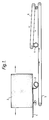
- the device comprises a rotating knife l with a bevelled edge, having a slicing angle of 20°, located above a conveyor belt 5.
- a rolling pressing belt 6 is located above the belt 5 at a position remote from the rotating knife 1.
- a cylindrical shaped block 2 of, for example, tempered fish, at a temperature of -4°C is located above the rotating knife.
- the block of food material is capable of being moved from a first position, where it is supported on a table (not shown) below the level of the knife, and a second position where it is supported on the knife.
- the rotating knife 1 slices a slice 3 having a thickness of 2.5 mm from the block 2.
- the final fish coil is hardened prior to further transverse slicing, for instance by freezing the outer surface thereof.
- After slicing the hole in the centre of the coiled food product can be filled with an edible material.
- the product can then be coated for example with breadcrumbs and packed ready for storage prior to consumption.
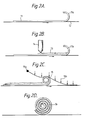
- Figure 2a shows a meat slice 11 on a conveyor belt 12.
- the meat slice 11 is formed by slicing a log-shaped body of comminuted meat, at a temperature of -5°C. Under these conditions only slight curling occurs. Nevertheless the entire surface lla which was extended during slicing is covered with microfractures which allows further coiling of the food material with that surface on the outside of the coil.
- Figure 2b shows the application of a filling 13, such as, for example, a savoury sauce, from a sauce dispenser 14 onto the curled slice 11.
- a filling 13 such as, for example, a savoury sauce
- a sauce dispenser 14 onto the curled slice 11.
- a cylindrical billet of frozen food material for example a sauce material, is placed in the area llb which will form the centre of the curled slice. This supports the slice during further coiling.
- Figure 2c shows a stainless steel flexible chain mail 15 in contact with the filled curled slice.
- the chain mail is fixed from a bar 15a transverse to the belt 12 so that the weight of the chain mail bears down on the food material in the direction of the arrows 15b so as to come into frictional contact with the coiled food.
- the belt 12 transports the curled slice to the chain mail.
- the slice passes under the chain mail and the leading edge of the chain mail picks up the slice and causes it to curl, as described in our copending European Patent Application No. 88 311235, to form a coiled filled product 16 as shown in Figure 2d.
- the product 16 shows 7-8 layers of meat and interleaving filling layers. The product may be further processed prior to consumption as described above.
- Figures 3-6 illustrate the influence of the orientation of the slicing knife with respect to the material to be sliced.
- Figure 3 shows a cylindrical body of food material 21 and a rotating knife 22 orientated perpendicular to the food body.
- the food material is passed over the rotating knife 22 as shown in Figure 3a and a slice of food material is cut from the cylindrical body 21.
- the slice forms the coiled product 23 shown in Figure 4.
- Figure 5 shows a cylindrical body of food material 31 and a rotating knife 32 orientated at an angle to the food body.
- the food material is passed over the rotating knife 32 as shown in Figure 5a and a slice of food material is cut from the cylindrical body 31.
- the slice forms the telescopically coiled food product 33 shown in Figure 6.
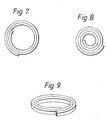
- Figures 7 and 8 illustrate the effect of the slicing angle of the slicing knife.
- Figure 7 shows a curl which is directly obtained by slicing with a knife having an angle of 15° to the plane of the material being sliced.
- Figure 8 shows a curl which is directly obtained by slicing with a knife having an angle of 20° to the plane of the material being sliced. Apparently the slice obtained using a knife having an increased slicing angle curls more.
- Figure 9 shows a product obtained by further transverse slicing a coiled product such as for instance shown in Figure 7.
Landscapes
- Life Sciences & Earth Sciences (AREA)
- Engineering & Computer Science (AREA)
- Food Science & Technology (AREA)
- Polymers & Plastics (AREA)
- Chemical & Material Sciences (AREA)
- Forests & Forestry (AREA)
- Zoology (AREA)
- Nutrition Science (AREA)
- Health & Medical Sciences (AREA)
- Mechanical Engineering (AREA)
- Wood Science & Technology (AREA)
- Marine Sciences & Fisheries (AREA)
- Manufacturing & Machinery (AREA)
- Meat, Egg Or Seafood Products (AREA)
- General Preparation And Processing Of Foods (AREA)
- Preparation Of Fruits And Vegetables (AREA)
- Confectionery (AREA)
- Formation And Processing Of Food Products (AREA)
- Noodles (AREA)
Applications Claiming Priority (2)
| Application Number | Priority Date | Filing Date | Title |
|---|---|---|---|
| GB878730034A GB8730034D0 (en) | 1987-12-23 | 1987-12-23 | Method for preparing coiled food product |
| GB8730034 | 1987-12-23 |
Publications (3)
| Publication Number | Publication Date |
|---|---|
| EP0322220A2 true EP0322220A2 (fr) | 1989-06-28 |
| EP0322220A3 EP0322220A3 (fr) | 1991-01-09 |
| EP0322220B1 EP0322220B1 (fr) | 1994-06-01 |
Family
ID=10628970
Family Applications (1)
| Application Number | Title | Priority Date | Filing Date |
|---|---|---|---|
| EP88312125A Expired - Lifetime EP0322220B1 (fr) | 1987-12-23 | 1988-12-21 | Procédé de préparation d'un produit alimentaire |
Country Status (8)
| Country | Link |
|---|---|
| US (1) | US4961949A (fr) |
| EP (1) | EP0322220B1 (fr) |
| JP (1) | JPH0616697B2 (fr) |
| AT (1) | ATE106196T1 (fr) |
| AU (1) | AU613689B2 (fr) |
| DE (1) | DE3889886T2 (fr) |
| ES (1) | ES2052749T3 (fr) |
| GB (1) | GB8730034D0 (fr) |
Cited By (7)
| Publication number | Priority date | Publication date | Assignee | Title |
|---|---|---|---|---|
| EP0450692A3 (en) * | 1990-03-28 | 1992-01-29 | Unilever Nv | Cutting process |
| WO1994002292A1 (fr) * | 1992-07-25 | 1994-02-03 | Dalgety Spillers Foods Limited | Methode et appareil pour couper/briser des blocs de viande congelee |
| EP0704170A1 (fr) * | 1994-09-30 | 1996-04-03 | G.W. Padley Holdings Limited | Méthode pour un procédé de viande |
| EP1691619A1 (fr) * | 2003-12-10 | 2006-08-23 | CFS Kempten GmbH | Dispositif et procede pour enrouler des denrees alimentaires en tranches |
| FR2899771A1 (fr) * | 2006-04-14 | 2007-10-19 | Stephane Gaborieau | Produit alimentaire consommable du type roule et son procede d'elaboration |
| US9943100B2 (en) | 2012-10-23 | 2018-04-17 | Fromageries Bel | Method for producing stuffed food and corresponding unit |
| CN116076757A (zh) * | 2023-03-06 | 2023-05-09 | 四川托璞勒科技有限公司 | 一种卷料总成、卷料输送装置及制卷机 |
Families Citing this family (14)
| Publication number | Priority date | Publication date | Assignee | Title |
|---|---|---|---|---|
| US5226353A (en) * | 1991-04-02 | 1993-07-13 | Bake Star, Inc. | Machine for forming chocolate shaving spirals |
| US5343790A (en) * | 1992-07-15 | 1994-09-06 | Food Service Products Company | Method and apparatus for slicing articles of food and the like |
| AU660774B2 (en) * | 1993-03-22 | 1995-07-06 | George Peter Mihnyak | Rolled meat product and method of producing same |
| EP0739586A1 (fr) * | 1995-04-28 | 1996-10-30 | Societe Des Produits Nestle S.A. | Dispositif pour enrouler |
| ZA962924B (en) * | 1995-05-24 | 1996-10-25 | Pillsbury Co | System for producing a filled rolled dough product |
| DE19534973C1 (de) * | 1995-09-20 | 1996-12-19 | Peter Broenner | Gefüllte Teigware in Schneckenform |
| JP3128770B2 (ja) * | 1997-02-18 | 2001-01-29 | レオン自動機株式会社 | シート状生地の巻き上げ方法及び装置 |
| US6783786B1 (en) | 2003-04-03 | 2004-08-31 | Conagra Foods, Inc. | Food winding method |
| DE10358881A1 (de) * | 2003-12-16 | 2005-07-14 | Ou-Young, Robert, Chung Ho | Verfahren und Einrichtung zum Formen von Rundstreifen-Nahrungsmitteln |
| US20060196444A1 (en) * | 2005-03-01 | 2006-09-07 | Dad's Products Company, Inc. | Animal treat and method of making same, and containers for holding an improved animal treat |
| JP6410524B2 (ja) * | 2014-08-25 | 2018-10-24 | 日清オイリオグループ株式会社 | 食品の製造方法及び食品製造装置 |
| JP6603385B1 (ja) * | 2018-10-10 | 2019-11-06 | 株式会社コバード | 渦巻状食品成形装置及び方法 |
| US11647755B1 (en) * | 2022-04-21 | 2023-05-16 | Rommel Santos | Egg roll rolling machine |
| JP7829232B2 (ja) * | 2023-03-30 | 2026-03-13 | 大英産業株式会社 | 巻物食品製造装置 |
Family Cites Families (9)
| Publication number | Priority date | Publication date | Assignee | Title |
|---|---|---|---|---|
| DE1988316U (de) * | 1968-01-30 | 1968-06-27 | Diogenes Werk Herder & Sohn | Messer, insbesondere haushaltsmesser. |
| US3704664A (en) * | 1971-08-10 | 1972-12-05 | Mckee Baking Co | Apparatus for forming swiss rolls |
| US3798343A (en) * | 1971-10-27 | 1974-03-19 | Vitale S Italian Foods Inc | Process for preparing frozen rolled lasagna |
| BE781261A (nl) * | 1972-03-27 | 1972-07-17 | Baeten Algemene Werktuigkunde | Machine voor het maken van chocoladeschilfertjes. |
| US3904772A (en) * | 1974-01-07 | 1975-09-09 | Vernon L Moegle | Method of preparing a meat roll |
| DE3025093C2 (de) * | 1980-07-02 | 1982-11-04 | Gernot 6973 Boxberg Müllender | Bandförmiges, aus knollenartigen Gewächsen geschnittenes Nahrungsmittel |
| JPS5966842A (ja) * | 1982-10-07 | 1984-04-16 | Meiji Seika Kaisha Ltd | 巻きチヨコレ−トの製造方法 |
| JPS59120060A (ja) * | 1982-12-28 | 1984-07-11 | Nippon Suisan Kaisha Ltd | 食品類の帯状連続シ−トの製造方法 |
| ATE74492T1 (de) * | 1985-09-14 | 1992-04-15 | Frisco Findus Ag | Verfahren zur herstellung eines tiefgekuehlten wickels von kabeljaufilet. |
-
1987
- 1987-12-23 GB GB878730034A patent/GB8730034D0/en active Pending
-
1988
- 1988-12-21 DE DE3889886T patent/DE3889886T2/de not_active Expired - Fee Related
- 1988-12-21 AT AT88312125T patent/ATE106196T1/de not_active IP Right Cessation
- 1988-12-21 AU AU27423/88A patent/AU613689B2/en not_active Ceased
- 1988-12-21 EP EP88312125A patent/EP0322220B1/fr not_active Expired - Lifetime
- 1988-12-21 ES ES88312125T patent/ES2052749T3/es not_active Expired - Lifetime
- 1988-12-23 JP JP63325751A patent/JPH0616697B2/ja not_active Expired - Lifetime
- 1988-12-23 US US07/288,864 patent/US4961949A/en not_active Expired - Fee Related
Cited By (10)
| Publication number | Priority date | Publication date | Assignee | Title |
|---|---|---|---|---|
| EP0450692A3 (en) * | 1990-03-28 | 1992-01-29 | Unilever Nv | Cutting process |
| US5437886A (en) * | 1990-03-28 | 1995-08-01 | Unilever Patent Holdings B.V. | Cutting process |
| WO1994002292A1 (fr) * | 1992-07-25 | 1994-02-03 | Dalgety Spillers Foods Limited | Methode et appareil pour couper/briser des blocs de viande congelee |
| EP0704170A1 (fr) * | 1994-09-30 | 1996-04-03 | G.W. Padley Holdings Limited | Méthode pour un procédé de viande |
| EP1691619A1 (fr) * | 2003-12-10 | 2006-08-23 | CFS Kempten GmbH | Dispositif et procede pour enrouler des denrees alimentaires en tranches |
| FR2899771A1 (fr) * | 2006-04-14 | 2007-10-19 | Stephane Gaborieau | Produit alimentaire consommable du type roule et son procede d'elaboration |
| US9943100B2 (en) | 2012-10-23 | 2018-04-17 | Fromageries Bel | Method for producing stuffed food and corresponding unit |
| EP3037006B1 (fr) * | 2012-10-23 | 2020-03-25 | Bel | Procédé de fabrication d'aliment(s) fourré(s), et installation correspondante |
| CN116076757A (zh) * | 2023-03-06 | 2023-05-09 | 四川托璞勒科技有限公司 | 一种卷料总成、卷料输送装置及制卷机 |
| CN116076757B (zh) * | 2023-03-06 | 2023-06-23 | 四川托璞勒科技有限公司 | 一种卷料总成、卷料输送装置及制卷机 |
Also Published As
| Publication number | Publication date |
|---|---|
| JPH01211478A (ja) | 1989-08-24 |
| AU2742388A (en) | 1989-06-29 |
| ES2052749T3 (es) | 1994-07-16 |
| ATE106196T1 (de) | 1994-06-15 |
| DE3889886T2 (de) | 1995-01-12 |
| GB8730034D0 (en) | 1988-02-03 |
| EP0322220B1 (fr) | 1994-06-01 |
| JPH0616697B2 (ja) | 1994-03-09 |
| DE3889886D1 (de) | 1994-07-07 |
| EP0322220A3 (fr) | 1991-01-09 |
| AU613689B2 (en) | 1991-08-08 |
| US4961949A (en) | 1990-10-09 |
Similar Documents
| Publication | Publication Date | Title |
|---|---|---|
| US4961949A (en) | Method of producing a coiled food product | |
| US6477943B2 (en) | Food product and apparatus for making the food product | |
| US5641527A (en) | Process of making filled boiled bagel product | |
| CA1081532A (fr) | Produits alimentaires en biscuits filamentes | |
| US4072763A (en) | Meat product and method of making same | |
| US4681000A (en) | Food preparation process | |
| US5010796A (en) | Helical split ring french fry and apparatus for making the same | |
| CA1323525C (fr) | Pate | |
| WO2007092714A2 (fr) | Procédé permettant de fabriquer un produit alimentaire segmenté formé à froid | |
| US20080134850A1 (en) | Machine and process for producing random shaped potato pieces | |
| US5035915A (en) | Helical split ring french fry | |
| US4282258A (en) | Method and apparatus for the manufacture of formed edible products and products resulting therefrom | |
| EP0307614A1 (fr) | Produit alimentaire du style de ravioli | |
| US4842879A (en) | Apparatus and process for rolling a sheet of pastry material | |
| US6267033B1 (en) | Close tolerance food slicing apparatus, blade and method | |
| EP2352380A1 (fr) | Processus de production automatisée à grande échelle de fines tranches de viande de kébab congelées et tranches produites par ce processus | |
| US4351850A (en) | Process of producing a batter-coated onion product | |
| EP0543628A1 (fr) | Traitement de produits alimentaires | |
| MXPA06005498A (es) | Metodos y aparatos para reducir mecanicamente productos alimenticios a formas y tamaños iregulares. | |
| US20100047425A1 (en) | Scoop Cutter and Method for Producing Shaped Food Products | |
| EP0278550B1 (fr) | Méthode et dispositif pour trancher du fromage et tranches obtenues | |
| EP0709170A1 (fr) | Dispositif de coupe à faible tolérance pour des produits alimentaires, ainsi que couteaux et procédé | |
| US20200047359A1 (en) | Strawberry knife | |
| EP0248753A2 (fr) | Procédé de congélation d'agrumes en morceaux | |
| US4365414A (en) | Vegetable slicer |
Legal Events
| Date | Code | Title | Description |
|---|---|---|---|
| PUAI | Public reference made under article 153(3) epc to a published international application that has entered the european phase |
Free format text: ORIGINAL CODE: 0009012 |
|
| AK | Designated contracting states |
Kind code of ref document: A2 Designated state(s): AT BE CH DE ES FR GB GR IT LI NL SE |
|
| PUAL | Search report despatched |
Free format text: ORIGINAL CODE: 0009013 |
|
| AK | Designated contracting states |
Kind code of ref document: A3 Designated state(s): AT BE CH DE ES FR GB GR IT LI NL SE |
|
| 17P | Request for examination filed |
Effective date: 19901217 |
|
| 17Q | First examination report despatched |
Effective date: 19911107 |
|
| RAP3 | Party data changed (applicant data changed or rights of an application transferred) |
Owner name: UNILEVER N.V. Owner name: UNILEVER PLC |
|
| GRAA | (expected) grant |
Free format text: ORIGINAL CODE: 0009210 |
|
| AK | Designated contracting states |
Kind code of ref document: B1 Designated state(s): AT BE CH DE ES FR GB GR IT LI NL SE |
|
| PG25 | Lapsed in a contracting state [announced via postgrant information from national office to epo] |
Ref country code: GR Free format text: LAPSE BECAUSE OF FAILURE TO SUBMIT A TRANSLATION OF THE DESCRIPTION OR TO PAY THE FEE WITHIN THE PRESCRIBED TIME-LIMIT Effective date: 19940601 |
|
| REF | Corresponds to: |
Ref document number: 106196 Country of ref document: AT Date of ref document: 19940615 Kind code of ref document: T |
|
| REF | Corresponds to: |
Ref document number: 3889886 Country of ref document: DE Date of ref document: 19940707 |
|
| REG | Reference to a national code |
Ref country code: ES Ref legal event code: FG2A Ref document number: 2052749 Country of ref document: ES Kind code of ref document: T3 |
|
| ITF | It: translation for a ep patent filed | ||
| ET | Fr: translation filed | ||
| REG | Reference to a national code |
Ref country code: GR Ref legal event code: FG4A Free format text: 3012363 |
|
| PGFP | Annual fee paid to national office [announced via postgrant information from national office to epo] |
Ref country code: CH Payment date: 19941114 Year of fee payment: 7 Ref country code: AT Payment date: 19941114 Year of fee payment: 7 |
|
| PGFP | Annual fee paid to national office [announced via postgrant information from national office to epo] |
Ref country code: SE Payment date: 19941115 Year of fee payment: 7 |
|
| PG25 | Lapsed in a contracting state [announced via postgrant information from national office to epo] |
Ref country code: GB Effective date: 19941221 |
|
| PG25 | Lapsed in a contracting state [announced via postgrant information from national office to epo] |
Ref country code: BE Effective date: 19941231 |
|
| EAL | Se: european patent in force in sweden |
Ref document number: 88312125.3 |
|
| PLBE | No opposition filed within time limit |
Free format text: ORIGINAL CODE: 0009261 |
|
| STAA | Information on the status of an ep patent application or granted ep patent |
Free format text: STATUS: NO OPPOSITION FILED WITHIN TIME LIMIT |
|
| 26N | No opposition filed | ||
| BERE | Be: lapsed |
Owner name: UNILEVER N.V. Effective date: 19941231 |
|
| PG25 | Lapsed in a contracting state [announced via postgrant information from national office to epo] |
Ref country code: NL Effective date: 19950701 |
|
| GBPC | Gb: european patent ceased through non-payment of renewal fee |
Effective date: 19941221 |
|
| PG25 | Lapsed in a contracting state [announced via postgrant information from national office to epo] |
Ref country code: FR Effective date: 19950831 |
|
| REG | Reference to a national code |
Ref country code: GR Ref legal event code: MM2A Free format text: 3012363 |
|
| NLV4 | Nl: lapsed or anulled due to non-payment of the annual fee |
Effective date: 19950701 |
|
| PG25 | Lapsed in a contracting state [announced via postgrant information from national office to epo] |
Ref country code: DE Effective date: 19950901 |
|
| REG | Reference to a national code |
Ref country code: FR Ref legal event code: ST |
|
| PG25 | Lapsed in a contracting state [announced via postgrant information from national office to epo] |
Ref country code: AT Effective date: 19951221 |
|
| PG25 | Lapsed in a contracting state [announced via postgrant information from national office to epo] |
Ref country code: SE Effective date: 19951222 Ref country code: ES Free format text: LAPSE BECAUSE OF NON-PAYMENT OF DUE FEES Effective date: 19951222 |
|
| PG25 | Lapsed in a contracting state [announced via postgrant information from national office to epo] |
Ref country code: LI Effective date: 19951231 Ref country code: CH Effective date: 19951231 |
|
| REG | Reference to a national code |
Ref country code: CH Ref legal event code: PL |
|
| REG | Reference to a national code |
Ref country code: ES Ref legal event code: FD2A Effective date: 19960113 |
|
| PG25 | Lapsed in a contracting state [announced via postgrant information from national office to epo] |
Ref country code: IT Free format text: LAPSE BECAUSE OF NON-PAYMENT OF DUE FEES;WARNING: LAPSES OF ITALIAN PATENTS WITH EFFECTIVE DATE BEFORE 2007 MAY HAVE OCCURRED AT ANY TIME BEFORE 2007. THE CORRECT EFFECTIVE DATE MAY BE DIFFERENT FROM THE ONE RECORDED. Effective date: 20051221 |