EP0322687A2 - Verfahren zur Herstellung einer mindestens einen Wirkstoff und einen Träger umfassenden Zubereitung - Google Patents
Verfahren zur Herstellung einer mindestens einen Wirkstoff und einen Träger umfassenden Zubereitung Download PDFInfo
- Publication number
- EP0322687A2 EP0322687A2 EP88121172A EP88121172A EP0322687A2 EP 0322687 A2 EP0322687 A2 EP 0322687A2 EP 88121172 A EP88121172 A EP 88121172A EP 88121172 A EP88121172 A EP 88121172A EP 0322687 A2 EP0322687 A2 EP 0322687A2
- Authority
- EP
- European Patent Office
- Prior art keywords
- carrier
- active ingredient
- fluid gas
- preparation
- liquid medium
- Prior art date
- Legal status (The legal status is an assumption and is not a legal conclusion. Google has not performed a legal analysis and makes no representation as to the accuracy of the status listed.)
- Granted
Links
- 238000000034 method Methods 0.000 title claims abstract description 32
- 238000004519 manufacturing process Methods 0.000 title abstract description 11
- 239000000126 substance Substances 0.000 title description 8
- 239000012530 fluid Substances 0.000 claims abstract description 29
- 238000002360 preparation method Methods 0.000 claims abstract description 28
- 239000013543 active substance Substances 0.000 claims abstract description 20
- 239000000969 carrier Substances 0.000 claims abstract description 4
- 239000007789 gas Substances 0.000 claims description 49
- 239000004480 active ingredient Substances 0.000 claims description 48
- 239000007788 liquid Substances 0.000 claims description 35
- 239000003814 drug Substances 0.000 claims description 13
- 229940079593 drug Drugs 0.000 claims description 13
- 229920000642 polymer Polymers 0.000 claims description 13
- 239000007921 spray Substances 0.000 claims description 7
- 244000052616 bacterial pathogen Species 0.000 claims description 5
- 239000000203 mixture Substances 0.000 claims description 5
- 241000700605 Viruses Species 0.000 claims description 3
- 235000010445 lecithin Nutrition 0.000 claims description 3
- 239000000787 lecithin Substances 0.000 claims description 3
- 150000002632 lipids Chemical class 0.000 claims description 2
- 239000004094 surface-active agent Substances 0.000 claims description 2
- 239000003053 toxin Substances 0.000 claims description 2
- 231100000765 toxin Toxicity 0.000 claims description 2
- 239000001993 wax Substances 0.000 claims description 2
- QGZKDVFQNNGYKY-UHFFFAOYSA-N Ammonia Chemical compound N QGZKDVFQNNGYKY-UHFFFAOYSA-N 0.000 claims 2
- IJGRMHOSHXDMSA-UHFFFAOYSA-N Atomic nitrogen Chemical compound N#N IJGRMHOSHXDMSA-UHFFFAOYSA-N 0.000 claims 2
- CURLTUGMZLYLDI-UHFFFAOYSA-N Carbon dioxide Chemical compound O=C=O CURLTUGMZLYLDI-UHFFFAOYSA-N 0.000 claims 2
- GQPLMRYTRLFLPF-UHFFFAOYSA-N Nitrous Oxide Chemical compound [O-][N+]#N GQPLMRYTRLFLPF-UHFFFAOYSA-N 0.000 claims 1
- 229910021529 ammonia Inorganic materials 0.000 claims 1
- 238000009835 boiling Methods 0.000 claims 1
- 229910002092 carbon dioxide Inorganic materials 0.000 claims 1
- 239000001569 carbon dioxide Substances 0.000 claims 1
- AZLYZRGJCVQKKK-UHFFFAOYSA-N dioxohydrazine Chemical compound O=NN=O AZLYZRGJCVQKKK-UHFFFAOYSA-N 0.000 claims 1
- 239000012634 fragment Substances 0.000 claims 1
- 150000008282 halocarbons Chemical class 0.000 claims 1
- 229930195733 hydrocarbon Natural products 0.000 claims 1
- 150000002430 hydrocarbons Chemical class 0.000 claims 1
- 229910052757 nitrogen Inorganic materials 0.000 claims 1
- 229960001730 nitrous oxide Drugs 0.000 claims 1
- 230000001850 reproductive effect Effects 0.000 claims 1
- 229920006395 saturated elastomer Polymers 0.000 claims 1
- 229920000747 poly(lactic acid) Polymers 0.000 description 8
- 238000000605 extraction Methods 0.000 description 7
- 239000004626 polylactic acid Substances 0.000 description 6
- 238000004659 sterilization and disinfection Methods 0.000 description 5
- 239000000284 extract Substances 0.000 description 4
- 239000011159 matrix material Substances 0.000 description 4
- 229940126601 medicinal product Drugs 0.000 description 4
- 230000001954 sterilising effect Effects 0.000 description 4
- GJSURZIOUXUGAL-UHFFFAOYSA-N Clonidine Chemical compound ClC1=CC=CC(Cl)=C1NC1=NCCN1 GJSURZIOUXUGAL-UHFFFAOYSA-N 0.000 description 3
- 229960002896 clonidine Drugs 0.000 description 3
- 238000004945 emulsification Methods 0.000 description 3
- 238000002347 injection Methods 0.000 description 3
- 239000007924 injection Substances 0.000 description 3
- 239000011859 microparticle Substances 0.000 description 3
- 239000003960 organic solvent Substances 0.000 description 3
- 239000002904 solvent Substances 0.000 description 3
- FIKFLLIUPUVONI-UHFFFAOYSA-N 8-(2-phenylethyl)-1-oxa-3,8-diazaspiro[4.5]decan-2-one;hydrochloride Chemical compound Cl.O1C(=O)NCC11CCN(CCC=2C=CC=CC=2)CC1 FIKFLLIUPUVONI-UHFFFAOYSA-N 0.000 description 2
- 241000228245 Aspergillus niger Species 0.000 description 2
- 244000063299 Bacillus subtilis Species 0.000 description 2
- 235000014469 Bacillus subtilis Nutrition 0.000 description 2
- 241000894006 Bacteria Species 0.000 description 2
- 241000222122 Candida albicans Species 0.000 description 2
- YMWUJEATGCHHMB-UHFFFAOYSA-N Dichloromethane Chemical compound ClCCl YMWUJEATGCHHMB-UHFFFAOYSA-N 0.000 description 2
- 241000588724 Escherichia coli Species 0.000 description 2
- 241000193385 Geobacillus stearothermophilus Species 0.000 description 2
- 238000012695 Interfacial polymerization Methods 0.000 description 2
- 241000589517 Pseudomonas aeruginosa Species 0.000 description 2
- 241000607142 Salmonella Species 0.000 description 2
- 241000191967 Staphylococcus aureus Species 0.000 description 2
- 229940095731 candida albicans Drugs 0.000 description 2
- 230000000694 effects Effects 0.000 description 2
- 238000005516 engineering process Methods 0.000 description 2
- 238000002513 implantation Methods 0.000 description 2
- 230000036512 infertility Effects 0.000 description 2
- 239000003999 initiator Substances 0.000 description 2
- 230000007774 longterm Effects 0.000 description 2
- 239000002088 nanocapsule Substances 0.000 description 2
- 239000002861 polymer material Substances 0.000 description 2
- 108090000765 processed proteins & peptides Proteins 0.000 description 2
- 239000013557 residual solvent Substances 0.000 description 2
- 238000001694 spray drying Methods 0.000 description 2
- WHBMMWSBFZVSSR-GSVOUGTGSA-N (R)-3-hydroxybutyric acid Chemical compound C[C@@H](O)CC(O)=O WHBMMWSBFZVSSR-GSVOUGTGSA-N 0.000 description 1
- IIZPXYDJLKNOIY-JXPKJXOSSA-N 1-palmitoyl-2-arachidonoyl-sn-glycero-3-phosphocholine Chemical compound CCCCCCCCCCCCCCCC(=O)OC[C@H](COP([O-])(=O)OCC[N+](C)(C)C)OC(=O)CCC\C=C/C\C=C/C\C=C/C\C=C/CCCCC IIZPXYDJLKNOIY-JXPKJXOSSA-N 0.000 description 1
- 101000904177 Clupea pallasii Gonadoliberin-1 Proteins 0.000 description 1
- 206010016352 Feeling of relaxation Diseases 0.000 description 1
- 241000233866 Fungi Species 0.000 description 1
- 239000000579 Gonadotropin-Releasing Hormone Substances 0.000 description 1
- 229920000954 Polyglycolide Polymers 0.000 description 1
- 240000004808 Saccharomyces cerevisiae Species 0.000 description 1
- 101000857870 Squalus acanthias Gonadoliberin Proteins 0.000 description 1
- 230000001133 acceleration Effects 0.000 description 1
- 239000002156 adsorbate Substances 0.000 description 1
- 125000003118 aryl group Chemical group 0.000 description 1
- 239000012752 auxiliary agent Substances 0.000 description 1
- 230000001580 bacterial effect Effects 0.000 description 1
- 238000005336 cracking Methods 0.000 description 1
- 230000003111 delayed effect Effects 0.000 description 1
- 239000002270 dispersing agent Substances 0.000 description 1
- 238000004090 dissolution Methods 0.000 description 1
- 239000002552 dosage form Substances 0.000 description 1
- 230000007613 environmental effect Effects 0.000 description 1
- 238000001125 extrusion Methods 0.000 description 1
- 235000013305 food Nutrition 0.000 description 1
- 238000009472 formulation Methods 0.000 description 1
- 230000002070 germicidal effect Effects 0.000 description 1
- XLXSAKCOAKORKW-AQJXLSMYSA-N gonadorelin Chemical compound C([C@@H](C(=O)NCC(=O)N[C@@H](CC(C)C)C(=O)N[C@@H](CCCNC(N)=N)C(=O)N1[C@@H](CCC1)C(=O)NCC(N)=O)NC(=O)[C@H](CO)NC(=O)[C@H](CC=1C2=CC=CC=C2NC=1)NC(=O)[C@H](CC=1N=CNC=1)NC(=O)[C@H]1NC(=O)CC1)C1=CC=C(O)C=C1 XLXSAKCOAKORKW-AQJXLSMYSA-N 0.000 description 1
- 238000004128 high performance liquid chromatography Methods 0.000 description 1
- 239000012052 hydrophilic carrier Substances 0.000 description 1
- 239000002917 insecticide Substances 0.000 description 1
- 229940067606 lecithin Drugs 0.000 description 1
- 238000011068 loading method Methods 0.000 description 1
- 239000012907 medicinal substance Substances 0.000 description 1
- 239000002184 metal Substances 0.000 description 1
- 244000005700 microbiome Species 0.000 description 1
- 239000004005 microsphere Substances 0.000 description 1
- 210000004400 mucous membrane Anatomy 0.000 description 1
- 230000037368 penetrate the skin Effects 0.000 description 1
- 239000008363 phosphate buffer Substances 0.000 description 1
- 239000004633 polyglycolic acid Substances 0.000 description 1
- 238000006116 polymerization reaction Methods 0.000 description 1
- 239000011148 porous material Substances 0.000 description 1
- 239000000843 powder Substances 0.000 description 1
- 102000004196 processed proteins & peptides Human genes 0.000 description 1
- 238000000746 purification Methods 0.000 description 1
- 238000011084 recovery Methods 0.000 description 1
- 230000001105 regulatory effect Effects 0.000 description 1
- 229920002545 silicone oil Polymers 0.000 description 1
- 239000000243 solution Substances 0.000 description 1
- 238000000935 solvent evaporation Methods 0.000 description 1
- 238000001179 sorption measurement Methods 0.000 description 1
- 238000010254 subcutaneous injection Methods 0.000 description 1
- 239000007929 subcutaneous injection Substances 0.000 description 1
- 238000013268 sustained release Methods 0.000 description 1
- 239000012730 sustained-release form Substances 0.000 description 1
- 231100000331 toxic Toxicity 0.000 description 1
- 230000002588 toxic effect Effects 0.000 description 1
- 230000002110 toxicologic effect Effects 0.000 description 1
- 231100000723 toxicological property Toxicity 0.000 description 1
- 108700012359 toxins Proteins 0.000 description 1
- 238000005406 washing Methods 0.000 description 1
Images

Classifications
-
- A—HUMAN NECESSITIES
- A61—MEDICAL OR VETERINARY SCIENCE; HYGIENE
- A61K—PREPARATIONS FOR MEDICAL, DENTAL OR TOILETRY PURPOSES
- A61K9/00—Medicinal preparations characterised by special physical form
- A61K9/14—Particulate form, e.g. powders, Processes for size reducing of pure drugs or the resulting products, Pure drug nanoparticles
- A61K9/16—Agglomerates; Granulates; Microbeadlets ; Microspheres; Pellets; Solid products obtained by spray drying, spray freeze drying, spray congealing,(multiple) emulsion solvent evaporation or extraction
- A61K9/1682—Processes
- A61K9/1694—Processes resulting in granules or microspheres of the matrix type containing more than 5% of excipient
-
- B—PERFORMING OPERATIONS; TRANSPORTING
- B01—PHYSICAL OR CHEMICAL PROCESSES OR APPARATUS IN GENERAL
- B01J—CHEMICAL OR PHYSICAL PROCESSES, e.g. CATALYSIS OR COLLOID CHEMISTRY; THEIR RELEVANT APPARATUS
- B01J13/00—Colloid chemistry, e.g. the production of colloidal materials or their solutions, not otherwise provided for; Making microcapsules or microballoons
- B01J13/02—Making microcapsules or microballoons
- B01J13/04—Making microcapsules or microballoons by physical processes, e.g. drying, spraying
- B01J13/043—Drying and spraying
Definitions
- the invention relates to a method for producing a preparation comprising an active ingredient and a carrier.
- Drugs that are absorbed to a small extent after oral administration or that can only poorly penetrate the skin or mucous membranes must be injected. With long-term use of the medication in question, repeated daily injections are unacceptable for the patient, since it is often painful.
- the embeddings slowly dissolve and release the active ingredient over several days or even months. With drug In this way, the injection frequency can be drastically reduced, thereby increasing the compliance and effectiveness of the drug.
- sustained-release medicinal products is carried out according to the following methods: - Microencapsulation with organic solvents (LM Sanders et al., J. Contr. Release, 2 (1985) 187 or PB Deasy, Microencapsulation and Related Drug Processes, M. Dekker Inc., New York, 1984); - Emulsification and subsequent solvent evaporation (TR Tice & RM Gilley, J. Contr.
- microparticles produced by polymerization for example nanocapsules
- the polymer matrix contains both mono-, di- and oligomers as well as frequently initiator molecules. All of these substances give the microparticles their toxicological properties, which are much worse to evaluate.
- interfacial polymerization and also the emulsion process have the major disadvantage that a transfer on an industrial scale has not been achieved to date or has been unsatisfactory, so that the introduction of appropriate preparations has so far failed to materialize; the so-called nanocapsule patent (Speiser DE 29 65 725) could not change anything.
- the sterility of the formulations is an indispensable requirement for the above-mentioned active substance embedding.
- the methods mentioned above do not result in sterile drugs per se neiform. Either the entire manufacturing process has to be carried out with great effort under sterile or aseptic conditions, or the pharmaceutical form has to be sterilized after its manufacture. Post-sterilization by irradiation with gamma rays is currently common. Apart from the official regulations that medicinal products that have been sterilized with gamma rays can only be marketed under very specific conditions, this type of sterilization involves damage to the medicinal product, especially if it is peptide medicinal products.
- the polymer matrix for example polylactic acid, can also be decomposed by gamma rays. As a result, the original release or dissolution behavior of the pharmaceutical form can change in an uncontrolled manner; see. (LT Sanders et al., J. Contr. Release, 2, (1985) 187.
- the object of the present invention is now to provide a method for producing a preparation comprising an active ingredient or active ingredients and a carrier or carrier which avoids residual solvent amounts or at least reduces them to toxicologically acceptable amounts.
- a further object of the invention is to provide a method for producing a preparation comprising an active ingredient or active ingredients and a carrier or carrier, in which the sterilization takes place during the method in a manner that is legally permitted without restrictions and is harmless for the product quality.
- the invention provides a method for producing a preparation comprising an active ingredient or active ingredients and a carrier or carrier, in which brings a liquid medium containing the active ingredient or ingredients and the carrier or carriers into contact with a fluid gas, - the fluid gas relaxes and - The active ingredient / carrier preparation freed from the liquid medium wins.
- This process can use a liquid medium in which - Both the active ingredient (s) and the carrier (s) are dissolved or dispersed, or - the active ingredient (s) are dissolved and the carrier (s) is / are dispersed or - The active ingredient (s) are dispersed and the carrier (s) is / are dissolved.
- the active substance (s) with the liquid medium on the one hand and the carrier (s) with the liquid medium on the other hand can be brought into contact separately with the fluid gas.
- the invention relates to a method for producing a preparation comprising an active ingredient and a carrier, in which - brings the active substance (s) and the carrier (s) into contact with a fluid gas in which the active substance (s) and / or the carrier (s) is / are soluble, - the fluid gas relaxes, - The active substance / carrier preparation freed from the fluid medium wins.
- supports which can be used according to the invention are polymer materials.
- active ingredient / carrier / auxiliary preparations can also be prepared by the process according to the invention if auxiliary agents, for example surfactants, are used in addition to the active ingredient and carrier.
- active ingredients are drugs, toxins, insecticides, viruses and diagnostics.
- active ingredients are drugs, toxins, insecticides, viruses and diagnostics.
- drug reference is made to US Pat. No. 3,773,919.
- the product obtained by the process according to the invention not only has an extended active ingredient release, but is also completely sterile. It is known that extracts obtained by extraction with supercritical gases are sterile. This effect is to be understood in such a way that the extract is separated from the extraction residue via the gas phase, so that no microorganisms can get into the extract via the gas phase.
- test germs namely bacteria, fungi and yeasts.
- a 30-minute exposure to a supercritical gas (CO2, 40 ° C / 140 bar) will kill the following test germs: Bacillus subtilis spores Bacillus stearothermophilus Escherichia coli Salmonella Edinburgh Staphylococcus aureus Pseudomonas aeruginosa Candida albicans Aspergillus niger
- a device for carrying out the method according to the invention is finally provided with a liquid gas pump, - a spray tower, - a separator for the active substance / carrier preparation, - if necessary, a separator for the optional liquid medium and - Provided a condenser for the liquid gas.
- Single or multi-component nozzles can be used as nozzles, in which the liquid medium is atomized either through a single opening or through a sintered disk.
- the nozzle opening can be less than 0.2 mm and in the case of sintered nozzles about 10 m. If two-component nozzles are used, it is possible to provide a liquid medium for the active ingredient and, separately, a liquid medium for the carrier, which can be sprayed together.
- a device can have, for example, a pressure-resistant spray tower (B3), a liquid gas pump (P1), a heat exchanger (W1), a separator (B2), a product pump (P2) and a condenser (K1).
- the liquid gas can be heated to supercritical conditions by the heat exchanger W1 and flow in the spray tower B3 towards the sprayed active substance and the sprayed carrier, take up the liquid medium and then get into the separator B2, where the extracted liquid medium is separated off.
- the fluid gas is then condensed in the condenser K1 and returned to the circuit via the liquid gas pump P1.
- the active substance / carrier preparation can be removed sterile at the bottom of the separator B2.
- a further embodiment of the device according to the invention can, for example, a pressure-resistant spray tower (B 3), a liquid gas pump (P 1), a heat exchanger (W 1), a separator (B 2), a product pump (P 2) and a condenser ( K 1) have.
- the liquefied gas can be heated to supercritical conditions by the heat exchanger W 1 and into the spray tower B 3 by means of a multi-component nozzle with the sprayed active substance and the sprayed carrier in cocurrent or by means of a further separate nozzle in parallel with the active substance and carrier sprayed from the multi-component nozzle are sprayed, take up the liquid medium and then get into the separator B 2, in which the extracted liquid medium is separated.
- the fluid gas is then condensed in the condenser K 1 and returned to the circuit via the liquid gas pump P 1.
- the active substance / carrier preparation can be removed sterile at the bottom of the separator B 2.
- fluid gases show solubility for polymers, lipids, lecithins or waxes Carrier; see. FP Schmitz, J. Chromatography, 356, (1986) 261.
- the device described above can be supplemented with a pressure-resistant extractor in the flow direction upstream of the spray tower B 3 and the fluid gas can be loaded with the carrier (s) and the active substance (s) and deposit together in the spray tower B 3 via a nozzle as an embedding.
- Germ type Concentration (germs / g) Bacillus subtilis (spores) 102, 103, 1o4 Bacillus stearothermophilus (spores) 102, 103, 104 E. coli 104 Salmonella Edinburgh 104 Staphylococcus aureus 104 Pseudomonas aeruginosa 104 Candida albicans 104 Aspergillus niger 104
- Samples of the contaminated polymers are treated statically with CO2 at 140 bar and 50 ° C and 140 bar / 40 ° C for 12 h or 0.5 h. Then the pressure is released in about 1 min; the samples are subjected to sterility tests. Result: all samples are sterile.
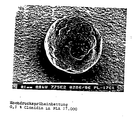
- Clonidine-HCl solution in CH2Cl2, which contains 20% PLA 17,000, is sprayed with 100 bar overpressure in the extraction column of the high pressure system. CO2 is passed into the column at 100 bar / 60 ° C in countercurrent. It is sprayed through a nozzle made of sintered metal (pore size approx. 5 to 10 m). After a few cm of fall, a dry powder is obtained which consists of hollow spheres (approx. 100 m) (Fig. 2). The hollow spheres are composed of subunits, which presumably represent the primary droplets up to 10 m in size. Shortly after leaving the nozzle, the primary droplets probably form the larger hollow spheres.
- An acceleration of the release can be achieved by increasing the degree of loading, reducing the molecular weight or using the surface properties, by using more hydrophilic carrier substances or by using hydrophilic auxiliary substances.
Landscapes
- Chemical & Material Sciences (AREA)
- Health & Medical Sciences (AREA)
- Bioinformatics & Cheminformatics (AREA)
- Organic Chemistry (AREA)
- Engineering & Computer Science (AREA)
- General Health & Medical Sciences (AREA)
- Veterinary Medicine (AREA)
- Medicinal Chemistry (AREA)
- Pharmacology & Pharmacy (AREA)
- Epidemiology (AREA)
- Life Sciences & Earth Sciences (AREA)
- Animal Behavior & Ethology (AREA)
- Dispersion Chemistry (AREA)
- Public Health (AREA)
- Chemical Kinetics & Catalysis (AREA)
- Medicinal Preparation (AREA)
- Medical Preparation Storing Or Oral Administration Devices (AREA)
- Manufacturing Of Micro-Capsules (AREA)
- Agricultural Chemicals And Associated Chemicals (AREA)
- Organic Low-Molecular-Weight Compounds And Preparation Thereof (AREA)
- Acyclic And Carbocyclic Compounds In Medicinal Compositions (AREA)
- Pharmaceuticals Containing Other Organic And Inorganic Compounds (AREA)
- Medicines That Contain Protein Lipid Enzymes And Other Medicines (AREA)
- Manufacture Of Macromolecular Shaped Articles (AREA)
- Solid-Sorbent Or Filter-Aiding Compositions (AREA)
Abstract
Description
- Die Erfindung betrifft ein Verfahren zur Herstellung einer einen Wirkstoff und einen Träger umfassenden Zubereitung.
- Die effektive Langzeitanwendung von Arzneistoffen wird u.a. durch eine häufige Applikation der Arzneiform und die sich hieraus ergebenden Complianceprobleme beim Patienten begrenzt. Eine sich über Monate oder Jahre erstreckende ein- oder mehrmalige tägliche Medikamenteneinnahme führt auf die Dauer zu einer unzuverlässigen Einnahme und damit unzuverlässigen Wirkung.
- Arzneistoffe, die nach oraler Applikation in geringem Ausmaß absorbiert werden oder die Haut oder Schleimhäute nur unzureichend penetrieren können, müssen injiziert werden. Bei einer Langzeitanwendung der betreffenden Medikamente ist eine mehrmalige tägliche Injektion für den Patienten unzumutbar, da sie häufig schmerzhaft ist.
- Ferner gibt es eine große Zahl von Arzneistoffen, die sich im Applikationsbereich zersetzen oder metabolisiert werden und deren pharmakokinetisches Profil nicht befriedigt.
- Literaturbekannt sind Arzneiformen, die aus einer Polymermatrix bestehen, in die ein Arzneistoff eingebracht worden ist, der aus dieser Arzneiform retardiert freigesetzt wird. Diese Polymereinbettungen können Injektionsarzneiformen oder Implantationsarzneiformen sein. So beschreibt beispielsweise die DE-OS 3 428 372 die Einbettung von regulatorischen Peptiden in Poly-D(-)-3-hydroxybuttersäure und die EP-OS 0 052 510 die Einbettung von LH-RH in Polymermaterialien, beispielsweise Polymilchsäure oder Polymilchsäure/Polyglykolsäurecopolymere.
- In den Körper als subcutane Injektion oder Implantation eingebracht, lösen sich die Einbettungen langsam auf und setzen den Wirkstoff über mehrere Tage oder sogar Monate frei. Mit Arzneifor men dieser Art kann die Injektionsfrequenz drastisch gesenkt und damit die Compliance und Effektivität des Arzneimittels erhöht werden.
- Die Herstellung solcher Retardarzneiformen geschieht nach folgenden Vefahren:
- Mikroverkapselung mit organischen Lösungsmitteln
(L.M. Sanders et al., J. Contr. Release, 2 (1985) 187 oder P.B. Deasy, Microencapsulation and Related Drug Processes, M. Dekker Inc., New York, 1984);
- Emulgierung und anschließende Lösungsmittelverdampfung
(T.R. Tice & R.M. Gilley, J. Contr. Release, 2, (1985) 343;
- Sprühtrocknung
(D.L. Wise et al., Life Sci., 19, (1976) 867;
- Extrusion
(A.J. Schwope et al., Life Sci., 17, (1975) 1877;
- Schmelzeinbettung
(A.J. Schwope et al., Life Sci., 17, (1975) 1877; und
- Grenzflächenpolymerisation
(G.Birrenbach & P. Speiser, J. Pharm. Sci., 65, (1976) 1763. - Die genannten Verfahren sind jedoch entweder mit dem Nachteil behaftet, daß sie mit großen Mengen toxischer organischer Lösungsmittel arbeiten, wobei die resultierenden Polymereinbettungen hohe Lösungsmittelrestkonzentrationen aufweisen; vgl. J.P. Benoit et al., Int. J. Pharmaceutics, 29 (1986) 95. Oder die genannten Verfahren arbeiten bei hohen Temperaturen oder Drucken, die insbesondere zu hohen lokalen Temperaturerhöhungen führen und die inkorporierten Arzneistoffe schädigen können; vgl. L.M. Sanders et al., J. Pharm. Sci., 75 (1986) 356. Wenn eine Arzneiform über längere Zeit unter der Haut oder im Gewebe verbleibt, sind von organischen Lösungsmitteln lokal toxische Gewebereaktionen zu erwarten. Aus diesem Grund müssen Lösungsmittelrestmengen soweit wie möglich aus den gewünschten Produkten entfernt werden.
- Neben den Lösungsmitteln in der Polymermatrix findet man bei durch Emulsionsverfahren hergestellten Mikropartikeln etwa 1 bis 2 % des Dispersionsmittels an der Oberfläche adsorbiert. Das Lösungsmittel kann durch Waschprozesse nicht entfernt werden. In der Regel wird Silikonöl oder eine andere lipophile Flüssigkeit verwendet, die den Nachteil aufweist, durch den Organismus nicht abbaubar zu sein; - EP-OS 81.305 426.9 -.
- Ferner enthalten alle durch Polymerisation hergestellten Mikropartikel (beispielsweise Nanokapseln) in der Polymermatrix sowohl Mono-, Di- und Oligomere als auch häufig Initiatormoleküle. Alle diese Substanzen verleihen den Mikropartikeln erheblich schlechter zu bewertende toxikologische Eigenschaften.
- Der Grenzflächenpolymerisation und auch dem Emulsionsverfahren haftet als wesentlicher Nachteil an, daß eine Überführung in technischem Maßstab bis zum heutigen Tage nicht oder nur unbefriedigend gelungen ist, so daß die Einführung entsprechender Präparate bisher ausgeblieben ist; daran konnte auch das sogenannte Nanokapselpatent (Speiser DE 29 65 725) nichts ändern.
- Schließlich arbeiten viele Verfahren, die sich organischer Lösungsmittel bedienen, nicht in geschlossenen Systemen. Die dadurch verursachte Umweltbelastung ist erheblich. Die erforderliche Reinigung der Luft durch Rückgewinnungsanlagen ist teuer und bei großen Durchsätzen, wie sie z.B. bei der Sprühtrocknung üblich sind, technisch problematisch.
- Eine unabdingbare Forderung, die an o.g. Wirkstoffeinbettungen zu stellen ist, ist die Sterilität der Formulierungen. Mit den vorstehend genannten Verfahren resultieren per se keine sterilen Arz neiformen. Entweder muß der gesamte Herstellungsprozeß mit großem Aufwand unter sterilen oder aseptischen Bedingungen durchgeführt werden oder die Arzneiform muß nach ihrer Herstellung sterilisiert werden. Zur Zeit ist eine Nachsterilisation durch Bestrahlen mit Gammastrahlen üblich. Abgesehen von den behördlichen Bestimmungen, die Arzneimittel, die mit Gammastrahlen sterilisiert worden sind, nur unter ganz bestimmten Bedingungen in den Handel gelangen zu lassen, sind mit dieser Sterilisationsart Schäden für das Arzneimittel verbunden, insbesondere wenn es sich um Peptidarzneistoffe handelt. Auch die Polymermatrix, beispielsweise Polymilchsäure, kann durch Gammastrahlen zersetzt werden. Hierdurch kann sich das ursprüngliche Freisetzungs- oder Auflöseverhalten der Arzneiform in unkontrollierter Weise ändern; vgl. (L.T. Sanders et al., J. Contr. Release, 2, (1985) 187.
- Aufgabe der vorliegenden Erfindung ist es nun, ein Verfahren zur Herstellung einer einen Wirkstoff oder Wirkstoffe und einen Träger oder Träger umfassenden Zubereitung vorzusehen, welches Lösungsmittelrestmengen vermeidet oder zumindest auf toxikologisch unbedenkliche Mengen reduziert.
- Ferner ist es Aufgabe der Erfindung, ein Verfahren zur Herstellung einer einen Wirkstoff oder Wirkstoffe und ein Polymeres oder Polymere als Träger umfassenden Zubereitung vorzusehen, die frei von Mono-, Di- und Oligomeren sowie von Initiatormolekülen ist.
- Weitere Aufgabe der Erfindung ist es, ein Verfahren zur Herstellung einer einen Wirkstoff oder Wirkstoffe und einen Träger oder Träger umfassenden Zubereitung vorzusehen, bei dem die Sterilisation während des Verfahrens in gesetzlich uneingeschränkt erlaubter und für die Produktqualität unbedenklicher Weise erfolgt.
- Schließlich ist es Aufgabe der Erfindung, eine Vorrichtung vorzusehen, mit der das erfindungsgemäße Verfahren durchgeführt werden kann.
- Gemäß einer Ausführungsform sieht die Erfindung ein Verfahren zur Herstellung einer einen Wirkstoff oder Wirkstoffe und einen Träger oder Träger umfassenden Zubereitung vor, bei dem man
- ein flüssiges Medium enthaltend den Wirkstoff oder Wirkstoffe und den Träger oder die Träger mit einem fluiden Gas in Berührung bringt,
- das fluide Gas entspannt und
- die vom flüssigen Medium befreite Wirkstoff/Träger-Zubereitung gewinnt. - Bei diesem Verfahren kann man ein flüssiges Medium verwenden, in dem
- sowohl der/die Wirkstoff/e als auch der/die Träger gelöst oder dispergiert sind oder
- der/die Wirkstoff/e gelöst und der/die Träger dispergiert ist/sind oder
- der/die Wirkstoff/e dispergiert und der/die Träger gelöst ist/sind. - Man kann den/die Wirkstoff/e mit dem flüssigen Medium einerseits und den/die Träger mit dem flüssigem Medium andererseits getrennt mit dem fluiden Gas in Berührung bringen.
- Gemäß einer weiteren Ausführungsform betrifft die Erfindung ein Verfahren zur Herstellung einer einen Wirkstoff und einen Träger umfassenden Zubereitung, bei dem man
- den/die Wirkstoff/e und den/die Träger mit einem fluiden Gas in Berührung bringt, in dem der/die Wirkstoff/e und/oder der/die Träger löslich ist/sind,
- das fluide Gas entspannt,
- die vom fluiden Medium befreite Wirkstoff/Träger-Zubereitung gewinnt. - Gemäß einer weiteren Ausführungsform betrifft die Erfindung ein Verfahren zur Herstellung einer einen Wirkstoff oder Wirkstoffe und einen Träger oder Träger umfassende Zubereitung, bei dem man
- (1) den/die Wirkstoff/e mit einem fluiden Gas in Berührung bringt, in dem der/die Wirkstoff/e löslich ist/sind, und danach das fluide Gas mit einem flüssigen Medium, enthaltend den/die Träger, in Berührung bringt, oder
- (2) den/die Träger mit einem fluiden Gas in Berührung bringt, in dem der/die Träger löslich ist/sind und danach das fluide Gas mit einem flüsigen Medium, enthaltend den Wirkstoff oder die Wirkstoffe, in Berührung bringt,
- das fluide Gas entspannt,
- die vom flüssigen Medium befreite Wirkstoff/Träger-Zubereitung gewinnt. - Beispiele für erfindungsgemäß verwendbare Träger sind Polymermaterialien. Selbstverständlich lassen sich nach dem erfindungsgemäßen Verfahren auch Wirkstoff/Träger/Hilfsmittel-Zubereitungen herstellen, wenn man zusätzlich zum Wirkstoff und Träger noch Hilfsmittel einsetzt, beispielsweise Tenside.
- Beispiele für Wirkstoffe sind Arzneimittel, Toxine, Insektizide, Viren und Diagnostika. Zum Begriff des Arzneistoffs wird auf die US-PS 3,773,919 verwiesen.
- Die Extraktion lipophiler Stoffe durch überkritische Gase ist ein seit langem in der Lebensmitteltechnologie und in der chemischen Technologie angewandtes Verfahren; vgl. G.M. Schneider, Extraction with Supercritical Gases, Verlag Chemie, Weinheim, 1980. Dieses Verfahren wird beispielsweise zur Entkoffeinierung von Kaffee, Extraktion von Aromastoffen aus Pflanzen, Entölung von Lecithin oder zur Reinigung von Polymeren eingesetzt; vgl. DE-OS 33 23 940. Zur Erhöhung der Extraktausbeute aus Pflanzenzellen werden die Zellen zuvor mit Hilfe eines überkritischen Gases nach Druckbehandlung durch plötzliche Entspannung aufgebrochen. Diesen Vorgang bezeichnet man als Cell-Cracking.
- Überraschenderweise wurde nun gefunden, daß das durch das erfindungsgemäße Verfahren erhaltene Produkt nicht nur eine verlängerte Wirkstofffreisetzung besitzt, sondern auch vollkommen steril vorliegt. Es ist zwar bekannt, daß durch Extraktion mit überkritischen Gasen gewonnene Extrakte steril sind. Dieser Effekt ist so zu verstehen, daß der Extrakt über die Gasphase vom Extraktionsrückstand getrennt wird, so daß keine Mikroorganismen über die Gasphase in den Extrakt gelangen können.
- Überraschend ist jedoch, daß beim erfindungsgemäßen Verfahren für die Wirkstoff/Träger-Zubereitung als Extraktionsrückstand eine vollständige Keimabtötung erreicht werden kann. Zumal nach dem derzeitigen Stand der Technik zwar eine Keimzahlreduktion und Entwesung, jedoch keine Sterilisation möglich erscheint (vgl. E. Stahl und G. Rau, Dtsch. Apoth. Ztg. 125, 1999 (1985); E. Stahl, G. Rau und H. Kaltwasser, Naturwissenschaften 72, 144 (1985)). Auch die Keimzahlreduktion wird ausdrücklich als zu unwirtschaftlich dargestellt, da man mit hohen Drucken (etwa 2500 bar) und entsprechend aufwendigen Maschinen arbeiten muß.
- Die keimtötende Wirkung des hier beanspruchten Verfahrens konnte an zahlreichen Testkeimen, und zwar sowohl an Bakterien als auch Pilzen und Hefen bestätigt werden. So führt eine 30-minütige Einwirkung eines überkritischen Gases (CO₂, 40° C / 140 bar) zu einer Abtötung folgender Testkeime:
Bacillus subtilis Sporen
Bacillus stearothermophilus
Escherichia coli
Salmonella edinburgh
Staphylococcus aureus
Pseudomonas aeruginosa
Candida albicans
Aspergillus niger
- Gemäß einer Ausführungsform der Erfindung wird schließlich eine Vorrichtung zur Durchführung des erfindungsgemäßen Verfahrens mit - einer Flüssiggaspumpe,
- einem Sprühturm,
- einem Separator für die Wirkstoff/Träger-Zubereitung,
- ggf. einem Separator für das fakultative flüssige Medium und
- einem Kondensator für das Flüssiggas vorgesehen. - Als Düsen können Ein- oder Mehrstoffdüsen verwendet werden, bei denen das flüssige Medium entweder durch eine einzelne Öffnung oder durch eine Sinterscheibe hindurch zerstäubt wird. Bei den Einstoff-Düsen kann die Düsenöffnung kleiner 0,2 mm und bei Sinterdüsen etwa 10 m sein. Wenn man Zweistoffdüsen verwendet, kann man ein flüssiges Medium für den Wirkstoff und - getrennt davon - ein flüssiges Medium für den Träger vorsehen, die gemeinsam versprüht werden können.
- Nachstehend wird die Erfindung durch zwei Abbildungen näher erläutert. Es zeigen:
- Abb. 1 eine Vorrichtung zur Durchführung des Verfahrens gemäß der Erfindung und
- Abb. 2 eine erfindungsgemäß erhaltene Wirkstoff/Träger-Zubereitung.
- Eine erfindungsgemäße Vorrichtung kann nach Abb. 1 beispielsweise einen druckfesten Sprühturm (B3), eine Flüssiggaspumpe (P1), einen Wärmeaustauscher (W1), einen Separator (B2), eine Produktpumpe (P2) und einen Kondensator (K1) aufweisen. Das Flüssiggas kann durch den Wärmeaustauscher W1 auf überkritische Bedingungen erhitzt werden und in dem Sprühturm B3 dem versprühten Wirkstoff und dem versprühten Träger entgegenströmen, das flüssige Medium aufnehmen und danach in den Separator B2 gelangen, wo das extrahierte flüssige Medium abgetrennt wird. Das fluide Gas wird danach in dem Kondensator K1 kondensiert und über die Flüssiggaspumpe P1 in den Kreislauf zurückgeführt. Die Wirkstoff/Träger-Zubereitung läßt sich am Boden des Separators B2 steril entnehmen.
- Eine weitere Ausführungsform der erfindungsgemäßen Vorrichtung kann nach Abbildung 1 beispielsweise einen druckfesten Sprühturm (B 3), eine Flüssiggaspumpe (P 1), einen Wärmeaustauscher (W 1), einen Separator (B 2), eine Produktpumpe (P 2) und einen Kondensator (K 1) aufweisen. Das Flüssiggas kann durch den Wärmeaustauscher W 1 auf überkritische Bedingungen erhitzt werden und in den Sprühturm B 3 mittels einer Mehrstoffdüse mit dem versprühten Wirkstoff und dem versprühten Träger im Gleichstrom oder mittels einer weiteren separaten Düse parallel zu dem aus der Mehrstoffdüse versprühten Wirkstoff und Träger im Gleichstrom versprüht werden, das flüssige Medium aufnehmen und danach in den Separator B 2 gelangen, in dem das extrahierte flüssige Medium abgetrennt wird. Das fluide Gas wird danach in dem Kondensator K 1 kondensiert und über die Flüssiggaspumpe P 1 in den Kreislauf zurückgeführt. Die Wirkstoff/Träger-Zubereitung läßt sich am Boden des Separators B 2 steril entnehmen.
- Fluide Gase zeigen bei bestimmten Druck/Temperatur-Kombinationen Lösungsvermögen für Polymere, Lipide, Lecithine oder Wachse als Träger; vgl. F.P. Schmitz, J. Chromatography, 356, (1986) 261. Dementsprechend kann man die vorstehend beschriebene Vorrichtung in Fließrichtung vor dem Sprühturm B 3 um einen druckfesten Extraktor ergänzen und das fluide Gas mit dem/die Träger und dem/die Wirkstoff/e beladen und im Sprühturm B 3 über eine Düse gemeinsam als Einbettung abscheiden.
- Selbstverständlich kann man auch das fluide Gas nur mit dem/den Wirkstoff/en oder nur mit dem/den Träger/Trägern beladen und den/die Träger bzw. den/die Wirkstoffe mit Hilfe der Produktpumpe P 2 dem Sprühturm B 3 zuführen. In diesem Fall erhält man eine Umhüllung oder ein Adsorbat.
- Nachstehend wird die Erfindung durch zwei Beispiele näher erläutert.
- Je 1 g d,l(+)-Polylactid werden mit definierten Mengen der folgenden Keime versetzt:
Keimart Konzentration (Keime/g) Bacillus subtilis (Sporen) 10², 10³, 1o⁴ Bacillus stearothermophilus (Sporen) 10², 10³, 10⁴ E. coli 10⁴ Salmonella edinburgh 10⁴ Staphylococcus aureus 10⁴ Pseudomonas aeruginosa 10⁴ Candida albicans 10⁴ Aspergillus niger 10⁴ - Proben der kontaminierten Polymere werden mit CO₂ bei 140 bar und 50° C und 140 bar/40° C, für 12 h bzw. 0,5 h statisch behandelt. Danach wird in ca. 1 min entspannt; die Proben werden Sterilitätstests unterworfen.
Ergebnis: alle Proben sind steril. - Parallel untersuchte, nicht mit CO₂ behandelte Proben zeigen, daß d,l(+)-Polylactid, MW 17.000 (PLA 17.000) selbst keine keimzahlreduzierenden Eigenschaften hat.
- Eine 0,02-proz. Clonidin-HCl-Lösung in CH₂Cl₂, das 20 % PLA 17.000 enthält, wird mit 100 bar Überdruck in der Extraktionskolonne der Hochdruckanlage versprüht. Dabei wird CO₂ mit 100 bar/60° C im Gegenstrom in die Kolonne geleitet. Versprüht wird durch eine Düse aus Sintermetall (Porengröße ca. 5 bis 10 m). Nach wenigen cm Fallstrecke wird ein trockenes Pulver erhalten, das aus Hohlkugeln (ca. 100 m) besteht (Abb. 2). Die Hohlkugeln sind aus Untereinheiten zusammengesetzt, die vermutlich die bis 10 m großen Primärtröpfchen darstellen. Kurz nach Verlassen der Düse formen die Primärtröpfchen vermutlich die größeren Hohlkugeln.
- Die Freisetzung des incorporierten Clonidin-HCl wurde über 24 h bei 37° C in Phosphatpuffer (pH = 7,5) verfolgt.
Zeit (h) Clonidin - HCl freigesetzt (%) 1,5 40,5 5 48,8 24 52,0 - Wie bei allen publizierten Wirkstofffreisetzungen aus PLA-Mikrokugeln wird oberflächlich adsorbiert bzw. in den oberen Schichten des Polymers eingelagerter Wirkstoff in der Initialphase schnell freigesetzt, während sich die Restdosis im Laufe mehrerer Tage (in diesem Fall ca. 10 Tage) aus der Einbettung herauslöst.
- Eine Freisetzungsbeschleunigung ist durch Erhöhung des Beladungsgrades, Reduktion des Molekulargewichts oder der Einsatz der Oberflächeneigenschaften, durch Einsatz hydrophilerer Trägersubstanzen oder Einsatz hydrophiler Hilfsstoffe zu erreichen.
Claims (11)
- ein flüssiges Medium, enthaltend den Wirkstoff oder Wirkstoffe und den Träger, oder die Träger mit einem fluiden Gas in Berührung bringt,
- die Flüssigkeit durch das fluide Gas entfernt,
- die vom flüssigen Medium befreite Wirkstoff/Träger-Zubereitung gewinnt.
- sowohl der/die Wirkstoff/e als auch der/die Träger gelöst oder dispergiert sind oder
- der/die Wirkstoff/e gelöst und der/die Träger dispergiert ist/sind oder
- der/die Wirkstoff/e dispergiert und der/die Träger gelöst sind.
- den/die Wirkstoff/e und den/die Träger mit einem fluiden Gas in Berührung bringt, in dem der/die Wirkstoff/e und/oder der/die Träger löslich ist/sind,
- das fluide Gas entspannt und
- die vom fluiden Gas befreite Wirkstoff/Träger-Zubereitung gewinnt.
- das fluide Gas entspannt,
- die vom flüssigen Medium befreite Wirkstoff/Träger-Zubereitung gewinnt.
- eine Flüssiggaspumpe,
- einen Verdampfer,
- einen Sprühturm,
- einen Separator für die Wirkstoff/Träger-Zubereitung,
- ggf. einen Separator für das fakultative flüssige Medium,
- einen Vorratsbehälter für das fakultative flüssige Medium
und
- einen Kondensator für das fluide Gas.
Priority Applications (1)
| Application Number | Priority Date | Filing Date | Title |
|---|---|---|---|
| AT88121172T ATE88887T1 (de) | 1987-12-28 | 1988-12-17 | Verfahren zur herstellung einer mindestens einen wirkstoff und einen traeger umfassenden zubereitung. |
Applications Claiming Priority (2)
| Application Number | Priority Date | Filing Date | Title |
|---|---|---|---|
| DE19873744329 DE3744329A1 (de) | 1987-12-28 | 1987-12-28 | Verfahren zur herstellung einer mindestens einen wirkstoff und einen traeger umfassenden zubereitung |
| DE3744329 | 1987-12-28 |
Publications (3)
| Publication Number | Publication Date |
|---|---|
| EP0322687A2 true EP0322687A2 (de) | 1989-07-05 |
| EP0322687A3 EP0322687A3 (en) | 1990-04-11 |
| EP0322687B1 EP0322687B1 (de) | 1993-05-05 |
Family
ID=6343750
Family Applications (1)
| Application Number | Title | Priority Date | Filing Date |
|---|---|---|---|
| EP88121172A Expired - Lifetime EP0322687B1 (de) | 1987-12-28 | 1988-12-17 | Verfahren zur Herstellung einer mindestens einen Wirkstoff und einen Träger umfassenden Zubereitung |
Country Status (6)
| Country | Link |
|---|---|
| US (1) | US5043280A (de) |
| EP (1) | EP0322687B1 (de) |
| JP (1) | JP2818174B2 (de) |
| AT (1) | ATE88887T1 (de) |
| DE (2) | DE3744329A1 (de) |
| ES (1) | ES2056890T3 (de) |
Cited By (20)
| Publication number | Priority date | Publication date | Assignee | Title |
|---|---|---|---|---|
| WO1992011000A1 (de) * | 1990-12-22 | 1992-07-09 | Schwarz Pharma Ag | Verfahren zur herstellung wirkstoffhaltiger mikropartikel aus hydrolytisch abbaubaren polymeren |
| WO1994003590A1 (fr) * | 1992-08-06 | 1994-02-17 | Association Pour L'essor De La Transfusion Sanguine Dans La Region Du Nord | Procede d'inactivation virale des produits plasmatiques par des fluides supercritiques ou subcritiques |
| WO1995001324A1 (en) * | 1993-07-01 | 1995-01-12 | Glaxo Group Limited | Salmeterol xinafoate with controlled particle size |
| WO1995001221A1 (en) * | 1993-07-01 | 1995-01-12 | University Of Bradford | Method and apparatus for the formation of particles |
| WO1995021688A1 (de) * | 1994-02-15 | 1995-08-17 | Eckhard Weidner | Verfahren zur herstellung von partikeln bzw. pulvern |
| EP0718035A2 (de) | 1994-12-19 | 1996-06-26 | Basf Aktiengesellschaft | Verfahren und Vorrichtung zur Herstellung wirkstoffhaltiger Dispersionen |
| EP0728037A1 (de) | 1993-11-08 | 1996-08-28 | The Gillette Company | Verfahren zur formung von partikeln unter verwendung einer überkritischen flüssigkeit so hergestellte aerogelpartikel und aerogelpartikel enthaltenden antiperspirantien |
| WO1997014407A1 (en) * | 1995-10-17 | 1997-04-24 | Research Triangle Pharmaceuticals | Insoluble drug delivery |
| WO2000015329A1 (de) * | 1998-09-15 | 2000-03-23 | Henkel Kommanditgesellschaft Auf Aktien | Verfahren zur herstellung von nanopartikeln |
| US6551532B1 (en) | 1999-05-07 | 2003-04-22 | Astrazeneca Ab | Method and device for forming particles |
| EP0930936B2 (de) † | 1996-09-25 | 2003-08-27 | Mainelab | Verfahren zur herstellung von aktive stoffe enthaltenden mikrokapseln und mit einem polymer umgehüllten |
| US6860907B1 (en) | 1999-07-07 | 2005-03-01 | Nektar Therapeutica | Method of particle formation |
| EP1588700A1 (de) * | 1997-05-10 | 2005-10-26 | The University Of Nottingham | Biofunktionelle Polymere im überkritischem Fluid hergestellt |
| US7087197B2 (en) | 2001-07-20 | 2006-08-08 | Nektar Therapeutics | Particle formation |
| US7354601B2 (en) | 2003-05-08 | 2008-04-08 | Walker Stephen E | Particulate materials |
| US7994197B2 (en) | 2007-02-11 | 2011-08-09 | Map Pharmaceuticals, Inc. | Method of therapeutic administration of DHE to enable rapid relief of migraine while minimizing side effect profile |
| US8080236B2 (en) | 2002-04-17 | 2011-12-20 | Nektar Therapeutics Uk, Ltd | Particulate materials |
| US9700529B2 (en) | 2002-05-03 | 2017-07-11 | Nektar Therapeutics | Particulate materials |
| US9808030B2 (en) | 2011-02-11 | 2017-11-07 | Grain Processing Corporation | Salt composition |
| US10798955B2 (en) | 2000-11-09 | 2020-10-13 | Nektar Therapeutics | Compositions of particulate coformulation |
Families Citing this family (75)
| Publication number | Priority date | Publication date | Assignee | Title |
|---|---|---|---|---|
| US5707634A (en) * | 1988-10-05 | 1998-01-13 | Pharmacia & Upjohn Company | Finely divided solid crystalline powders via precipitation into an anti-solvent |
| US6063910A (en) * | 1991-11-14 | 2000-05-16 | The Trustees Of Princeton University | Preparation of protein microparticles by supercritical fluid precipitation |
| US5639441A (en) * | 1992-03-06 | 1997-06-17 | Board Of Regents Of University Of Colorado | Methods for fine particle formation |
| AU5171293A (en) * | 1992-10-14 | 1994-05-09 | Regents Of The University Of Colorado, The | Ion-pairing of drugs for improved efficacy and delivery |
| US5340614A (en) | 1993-02-11 | 1994-08-23 | Minnesota Mining And Manufacturing Company | Methods of polymer impregnation |
| GB9413202D0 (en) * | 1994-06-30 | 1994-08-24 | Univ Bradford | Method and apparatus for the formation of particles |
| EP0706821A1 (de) * | 1994-10-06 | 1996-04-17 | Centre De Microencapsulation | Verfahren zum Beschichten von Partikeln |
| DE19510690A1 (de) * | 1995-03-14 | 1996-09-19 | Schering Ag | Polymere Nano- und/oder Mikropartikel, Verfahren zu deren Herstellung, sowie Verwendung in medizinischen Diagnostik und Therapie |
| US5803966A (en) * | 1995-11-01 | 1998-09-08 | Alcon Laboratories, Inc. | Process for sizing prednisolone acetate using a supercritical fluid anti-solvent |
| JP3042830B2 (ja) * | 1996-01-29 | 2000-05-22 | 日本炭酸株式会社 | 超臨界流体による連続処理装置 |
| AU709384B2 (en) * | 1996-03-01 | 1999-08-26 | University Of Kansas, The | Methods and apparatus for particle precipitation and coating using near-critical and supercritical antisolvents |
| US5874029A (en) * | 1996-10-09 | 1999-02-23 | The University Of Kansas | Methods for particle micronization and nanonization by recrystallization from organic solutions sprayed into a compressed antisolvent |
| US5833891A (en) * | 1996-10-09 | 1998-11-10 | The University Of Kansas | Methods for a particle precipitation and coating using near-critical and supercritical antisolvents |
| DE19617085A1 (de) * | 1996-04-29 | 1997-10-30 | Bayer Ag | Verfahren zur Herstellung von feinstteiligen Kristallisationsprodukten |
| CN1195299A (zh) * | 1996-05-18 | 1998-10-07 | 金振燮 | 艾灸器械 |
| US5766637A (en) * | 1996-10-08 | 1998-06-16 | University Of Delaware | Microencapsulation process using supercritical fluids |
| US6299937B1 (en) * | 1996-10-28 | 2001-10-09 | Douglas S. Richart | Methods and means for modifying the surfaces of polymeric solids |
| DE19651734C2 (de) * | 1996-12-12 | 1999-05-12 | Dds Drug Delivery Service Ges | Zubereitung in Form eines Polymer-Hilfsstoff-Compounds und/oder eines Polymer-Wirkstoff-Compounds und Verfahren zu dessen Herstellung sowie dessen Verwendung zur Herstellung von Tabletten und/oder anderen größeren Matrixeinheiten |
| GB9703673D0 (en) * | 1997-02-21 | 1997-04-09 | Bradford Particle Design Ltd | Method and apparatus for the formation of particles |
| US5989463A (en) | 1997-09-24 | 1999-11-23 | Alkermes Controlled Therapeutics, Inc. | Methods for fabricating polymer-based controlled release devices |
| US6613358B2 (en) | 1998-03-18 | 2003-09-02 | Theodore W. Randolph | Sustained-release composition including amorphous polymer |
| SE9801287D0 (sv) * | 1998-04-14 | 1998-04-14 | Astra Ab | Incorporation of active substances in carrier matrixes |
| US6190699B1 (en) | 1998-05-08 | 2001-02-20 | Nzl Corporation | Method of incorporating proteins or peptides into a matrix and administration thereof through mucosa |
| GB9810559D0 (en) * | 1998-05-15 | 1998-07-15 | Bradford Particle Design Ltd | Method and apparatus for particle formation |
| SE9804003D0 (sv) | 1998-11-23 | 1998-11-23 | Astra Ab | A method of producing drug particles |
| SE9804001D0 (sv) * | 1998-11-23 | 1998-11-23 | Astra Ab | New process |
| DE19860497A1 (de) | 1998-12-28 | 2000-07-06 | Basf Ag | Verfahren und Vorrichtung zur Herstellung stabil feinteiliger Pulver |
| DE19964085A1 (de) * | 1999-12-27 | 2001-07-12 | Pharmasol Gmbh | Arzneistoffträgr zur kontrollierten Wirkstoffapplikation hergestellt aus Lipidmatrix-Arzneistoffkonjugaten (LAK-Partikel) |
| JP2001010969A (ja) * | 1999-06-24 | 2001-01-16 | Kobe Steel Ltd | 人参エキスからの農薬成分除去法 |
| US6485735B1 (en) | 1999-08-31 | 2002-11-26 | Phelps Dodge High Performance Conductors Of Sc & Ga, Inc. | Multilayer thermoset polymer matrix and structures made therefrom |
| FR2803538B1 (fr) * | 1999-12-15 | 2002-06-07 | Separex Sa | Procede et dispositif de captage de fines particules par percolation dans un lit de granules |
| FR2802445B1 (fr) * | 1999-12-15 | 2002-02-15 | Separex Sa | Procede et dispositif de captage de fines particules par piegeage au sein d'un melange solide de type neige carbonique |
| US7029700B2 (en) * | 2000-01-14 | 2006-04-18 | Brown University Research Foundation | Micronized freeze-dried particles |
| WO2001052818A1 (en) | 2000-01-19 | 2001-07-26 | Pharmaceutical Discovery Corporation | Dry powder formulations of antihistamine for nasal administration |
| CH694686A5 (it) | 2000-03-04 | 2005-06-15 | Eco2 Sa | Prodotto di micronizzazione di sostanze farmaceutiche. |
| US6620351B2 (en) * | 2000-05-24 | 2003-09-16 | Auburn University | Method of forming nanoparticles and microparticles of controllable size using supercritical fluids with enhanced mass transfer |
| FR2811913B1 (fr) * | 2000-07-19 | 2003-09-19 | Separex Sa | Procede d'encapsulation sous forme de micro-capsules de fines particules solides |
| EP1334765B1 (de) * | 2000-10-13 | 2010-06-30 | National Institute of Advanced Industrial Science and Technology | Verfahren zur herstellung von liposomen |
| FR2815540B1 (fr) † | 2000-10-19 | 2005-06-10 | Separex Sa | Procede de fabrication de tres fines particules constituees d'un principe insere dans une molecule hote |
| US20020130430A1 (en) * | 2000-12-29 | 2002-09-19 | Castor Trevor Percival | Methods for making polymer microspheres/nanospheres and encapsulating therapeutic proteins and other products |
| US7708915B2 (en) * | 2004-05-06 | 2010-05-04 | Castor Trevor P | Polymer microspheres/nanospheres and encapsulating therapeutic proteins therein |
| DE60211004T2 (de) * | 2001-10-10 | 2006-08-31 | Boehringer Ingelheim Pharmaceuticals, Inc., Ridgefield | Pulververarbeitung mit unter druck stehenden gasförmigen fluids |
| FR2830760B1 (fr) * | 2001-10-12 | 2004-06-04 | Pf Medicament | Procede de preparation d'un compose d'interaction de substances actives avec un support poreux par fluide supercritique |
| GB0126716D0 (en) * | 2001-11-07 | 2002-01-02 | Advanced Phytonics Ltd | Method for the production of particles |
| US7557073B2 (en) * | 2001-12-31 | 2009-07-07 | Advanced Technology Materials, Inc. | Non-fluoride containing supercritical fluid composition for removal of ion-implant photoresist |
| US7326673B2 (en) * | 2001-12-31 | 2008-02-05 | Advanced Technology Materials, Inc. | Treatment of semiconductor substrates using long-chain organothiols or long-chain acetates |
| GB0205868D0 (en) * | 2002-03-13 | 2002-04-24 | Univ Nottingham | Polymer composite with internally distributed deposition matter |
| US7582284B2 (en) | 2002-04-17 | 2009-09-01 | Nektar Therapeutics | Particulate materials |
| GB0216562D0 (en) | 2002-04-25 | 2002-08-28 | Bradford Particle Design Ltd | Particulate materials |
| WO2004044281A2 (en) * | 2002-11-12 | 2004-05-27 | The Regents Of The University Of California | Nano-porous fibers and protein membranes |
| JP2006516958A (ja) * | 2002-12-19 | 2006-07-13 | バクスター・インターナショナル・インコーポレイテッド | 超臨界流体を用いた組み合わせ薬学的処方物を調製するためのプロセス |
| US7217750B2 (en) * | 2003-01-20 | 2007-05-15 | Northern Technologies International Corporation | Process for incorporating one or more materials into a polymer composition and products produced thereby |
| US7217749B2 (en) * | 2003-01-20 | 2007-05-15 | Northern Technologies International Corporation | Process for infusing an alkali metal nitrite into a synthetic resinous material |
| US7083748B2 (en) * | 2003-02-07 | 2006-08-01 | Ferro Corporation | Method and apparatus for continuous particle production using supercritical fluid |
| FR2854079B1 (fr) * | 2003-04-25 | 2007-11-30 | Pf Medicament | Procede de preparation de complexes moleculaires |
| US20060008531A1 (en) * | 2003-05-08 | 2006-01-12 | Ferro Corporation | Method for producing solid-lipid composite drug particles |
| WO2004110603A2 (en) * | 2003-06-03 | 2004-12-23 | Ferro Corporation | Method for preparation of particles from solution-in-supercritical fluid or compressed gas emulsions |
| US7767118B2 (en) * | 2003-06-03 | 2010-08-03 | Ferro Corporation | Nanoparticles from supercritical fluid antisolvent process using particle growth and agglomeration retardants |
| US20050181059A1 (en) * | 2003-09-30 | 2005-08-18 | Spherics, Inc. | Nanoparticulate therapeutic biologically active agents |
| ES2392433T3 (es) * | 2003-10-30 | 2012-12-10 | Merck Serono Sa | Procedimiento y aparato para enfriar y atomizar sustancias líquidas o pastosas |
| US20060041248A1 (en) * | 2004-08-23 | 2006-02-23 | Patton David L | Pharmaceutical compositions delivery system and methods |
| FR2874836B1 (fr) * | 2004-09-09 | 2007-04-27 | Pierre Fabre Medicament Sa | Procede d'enrobage de poudres |
| CN100389864C (zh) * | 2004-12-15 | 2008-05-28 | 上海现代中医药技术发展有限公司 | 超临界流体制备天然植物挥发油-高分子聚合物微胶囊 |
| WO2007011989A2 (en) * | 2005-07-15 | 2007-01-25 | Map Pharmaceuticals, Inc. | Multiple active pharmaceutical ingredients combined in discrete inhalation particles and formulations thereof |
| EP1904219A4 (de) * | 2005-07-15 | 2011-07-27 | Map Pharmaceuticals Inc | Teilchenbildungsverfahren |
| EP1757361A1 (de) | 2005-08-23 | 2007-02-28 | Feyecon Development & Implementation B.V. | Verfahren zur Herstellung von Kapseln durch Ausfällung |
| GB0602637D0 (en) * | 2006-02-09 | 2006-03-22 | Glaxo Group Ltd | Novel process |
| AU2007295178B2 (en) * | 2006-09-15 | 2013-04-18 | Echo Pharmaceuticals B.V. | Granulate containing a pharmaceutically active substance and anemulsifier and method for its manufacture |
| JP4705691B2 (ja) * | 2006-10-11 | 2011-06-22 | クリティテック・インコーポレイテッド | 使用のための容器に小さい医薬粒子を沈殿させるための方法 |
| US7772492B2 (en) * | 2007-10-23 | 2010-08-10 | Southwire Company | Anti-microbial/anti-fungal plastic jacketed/insulated electric power cords |
| GB0812742D0 (en) * | 2008-07-11 | 2008-08-20 | Critical Pharmaceuticals Ltd | Process |
| US20100291221A1 (en) * | 2009-05-15 | 2010-11-18 | Robert Owen Cook | Method of administering dose-sparing amounts of formoterol fumarate-budesonide combination particles by inhalation |
| US20100294986A1 (en) * | 2009-05-19 | 2010-11-25 | Massachusetts Institute Of Technology | Supercritical fluid facilitated particle formation in microfluidic systems |
| US20100298602A1 (en) * | 2009-05-19 | 2010-11-25 | Massachusetts Institute Of Technology | Systems and methods for microfluidic crystallization |
| US10975697B2 (en) * | 2019-09-05 | 2021-04-13 | Karl Peter Mulligan | Systems and methods for a piston engine including a recirculating system using supercritical carbon dioxide |
Family Cites Families (15)
| Publication number | Priority date | Publication date | Assignee | Title |
|---|---|---|---|---|
| US3773919A (en) * | 1969-10-23 | 1973-11-20 | Du Pont | Polylactide-drug mixtures |
| JPS4948832A (de) * | 1973-06-30 | 1974-05-11 | ||
| DE2450978A1 (de) * | 1974-10-26 | 1976-04-29 | Helmut Dallinga | Verfahren und vorrichtung zum entkoffeinieren von kaffee |
| SE7512179L (sv) * | 1974-11-07 | 1976-05-10 | Jacques Guiller | Forfaringssett for omvandling av en massa i flytande form till kulor granuler eller andra mindre kroppar i djupfryst form, samt anordning for utovande av forfaringssettet |
| US4489055A (en) * | 1978-07-19 | 1984-12-18 | N.V. Sopar S.A. | Process for preparing biodegradable submicroscopic particles containing a biologically active substance and their use |
| PH19942A (en) * | 1980-11-18 | 1986-08-14 | Sintex Inc | Microencapsulation of water soluble polypeptides |
| DE3207914A1 (de) * | 1982-03-04 | 1983-09-15 | Skw Trostberg Ag, 8223 Trostberg | Verfahren zur extraktiven gewinnung von hochwertigen natuerlichen wachsen |
| JPS5939635U (ja) * | 1982-09-06 | 1984-03-13 | 日本特殊陶業株式会社 | 造粒装置 |
| DE3323940A1 (de) * | 1983-07-02 | 1985-01-10 | Hoechst Ag, 6230 Frankfurt | Verfahren zur reinigung von polymeren |
| JPS6094987A (ja) * | 1983-10-31 | 1985-05-28 | Nisshin Oil Mills Ltd:The | レシチンの精製法 |
| FR2586938B1 (fr) * | 1985-09-06 | 1989-10-20 | Commissariat Energie Atomique | Procede et dispositif pour l'extraction de constituants par un fluide supercritique |
| DE3536622A1 (de) * | 1985-10-15 | 1987-04-16 | Krupp Gmbh | Verfahren und vorrichtung zur gewinnung fester stoffe aus fluessigen stoffgemischen |
| US4749522A (en) * | 1985-10-31 | 1988-06-07 | Angio-Medical Corporation | Supercritical fluid extraction of animal derived materials |
| JPH074511B2 (ja) * | 1985-11-14 | 1995-01-25 | 大陽酸素株式会社 | 微凍結粒の製造方法及びその装置 |
| US4820537A (en) * | 1987-03-13 | 1989-04-11 | General Foods Corporation | Method for decaffeinating coffee with a supercritical fluid |
-
1987
- 1987-12-28 DE DE19873744329 patent/DE3744329A1/de not_active Withdrawn
-
1988
- 1988-12-17 ES ES88121172T patent/ES2056890T3/es not_active Expired - Lifetime
- 1988-12-17 EP EP88121172A patent/EP0322687B1/de not_active Expired - Lifetime
- 1988-12-17 DE DE8888121172T patent/DE3880808D1/de not_active Expired - Fee Related
- 1988-12-17 AT AT88121172T patent/ATE88887T1/de not_active IP Right Cessation
- 1988-12-21 US US07/287,918 patent/US5043280A/en not_active Expired - Lifetime
- 1988-12-22 JP JP63324739A patent/JP2818174B2/ja not_active Expired - Fee Related
Cited By (40)
| Publication number | Priority date | Publication date | Assignee | Title |
|---|---|---|---|---|
| US5424076A (en) * | 1990-12-22 | 1995-06-13 | Schwarz Pharma Ag | Method of producing microscopic particles made of hydrolytically decomposable polymers and containing active substances |
| WO1992011000A1 (de) * | 1990-12-22 | 1992-07-09 | Schwarz Pharma Ag | Verfahren zur herstellung wirkstoffhaltiger mikropartikel aus hydrolytisch abbaubaren polymeren |
| WO1994003590A1 (fr) * | 1992-08-06 | 1994-02-17 | Association Pour L'essor De La Transfusion Sanguine Dans La Region Du Nord | Procede d'inactivation virale des produits plasmatiques par des fluides supercritiques ou subcritiques |
| AU684795B2 (en) * | 1993-07-01 | 1998-01-08 | Glaxo Group Limited | Salmeterol xinafoate with controlled particle size |
| WO1995001221A1 (en) * | 1993-07-01 | 1995-01-12 | University Of Bradford | Method and apparatus for the formation of particles |
| WO1995001324A1 (en) * | 1993-07-01 | 1995-01-12 | Glaxo Group Limited | Salmeterol xinafoate with controlled particle size |
| CN1062854C (zh) * | 1993-07-01 | 2001-03-07 | 格拉克索公司 | 具有控制的颗粒尺寸的沙美特罗新萘菲特 |
| EP0728037A1 (de) | 1993-11-08 | 1996-08-28 | The Gillette Company | Verfahren zur formung von partikeln unter verwendung einer überkritischen flüssigkeit so hergestellte aerogelpartikel und aerogelpartikel enthaltenden antiperspirantien |
| EP0868942A1 (de) * | 1993-11-08 | 1998-10-07 | The Gillette Company | Verfahren zur Formung von Partiklen unter Verwendung eine überkritischen Flüssigkeit und so hergestellte Aerogelpartikel |
| US5864923A (en) * | 1993-11-08 | 1999-02-02 | Cf Technologies, Inc. | Method of forming particles using a supercritical fluid |
| WO1995021688A1 (de) * | 1994-02-15 | 1995-08-17 | Eckhard Weidner | Verfahren zur herstellung von partikeln bzw. pulvern |
| EP0718035A2 (de) | 1994-12-19 | 1996-06-26 | Basf Aktiengesellschaft | Verfahren und Vorrichtung zur Herstellung wirkstoffhaltiger Dispersionen |
| US6384090B2 (en) * | 1994-12-19 | 2002-05-07 | Basf Aktiengesellschaft | Preparation of active ingredient dispersions and apparatus therefor |
| US6197836B1 (en) | 1994-12-19 | 2001-03-06 | Basf Aktiengesellschaft | Preparation of active ingredient dispersions and apparatus therefor |
| WO1997014407A1 (en) * | 1995-10-17 | 1997-04-24 | Research Triangle Pharmaceuticals | Insoluble drug delivery |
| US6974593B2 (en) | 1995-10-17 | 2005-12-13 | Jagotec Ag | Insoluble drug delivery |
| US6576264B1 (en) | 1995-10-17 | 2003-06-10 | Skyepharma Canada Inc. | Insoluble drug delivery |
| EP0930936B2 (de) † | 1996-09-25 | 2003-08-27 | Mainelab | Verfahren zur herstellung von aktive stoffe enthaltenden mikrokapseln und mit einem polymer umgehüllten |
| EP1588700A1 (de) * | 1997-05-10 | 2005-10-26 | The University Of Nottingham | Biofunktionelle Polymere im überkritischem Fluid hergestellt |
| WO2000015329A1 (de) * | 1998-09-15 | 2000-03-23 | Henkel Kommanditgesellschaft Auf Aktien | Verfahren zur herstellung von nanopartikeln |
| US6551532B1 (en) | 1999-05-07 | 2003-04-22 | Astrazeneca Ab | Method and device for forming particles |
| US7150766B2 (en) | 1999-07-07 | 2006-12-19 | Nektar Therapeutics Uk, Ltd. | Method of particle formation |
| US6860907B1 (en) | 1999-07-07 | 2005-03-01 | Nektar Therapeutica | Method of particle formation |
| US10798955B2 (en) | 2000-11-09 | 2020-10-13 | Nektar Therapeutics | Compositions of particulate coformulation |
| US7087197B2 (en) | 2001-07-20 | 2006-08-08 | Nektar Therapeutics | Particle formation |
| US10251881B2 (en) | 2002-04-17 | 2019-04-09 | Nektar Therapeutics | Particulate materials |
| US8080236B2 (en) | 2002-04-17 | 2011-12-20 | Nektar Therapeutics Uk, Ltd | Particulate materials |
| US8470301B2 (en) | 2002-04-17 | 2013-06-25 | Nektar Therapeutics | Particulate materials |
| US8828359B2 (en) | 2002-04-17 | 2014-09-09 | Nektar Therapeutics | Particulate materials |
| US9616060B2 (en) | 2002-04-17 | 2017-04-11 | Nektar Therapeutics | Particulate materials |
| US10945972B2 (en) | 2002-05-03 | 2021-03-16 | Nektar Therapeutics | Particulate materials |
| US10188614B2 (en) | 2002-05-03 | 2019-01-29 | Nektar Therapeutics | Particulate materials |
| US9700529B2 (en) | 2002-05-03 | 2017-07-11 | Nektar Therapeutics | Particulate materials |
| US7354601B2 (en) | 2003-05-08 | 2008-04-08 | Walker Stephen E | Particulate materials |
| US9833451B2 (en) | 2007-02-11 | 2017-12-05 | Map Pharmaceuticals, Inc. | Method of therapeutic administration of DHE to enable rapid relief of migraine while minimizing side effect profile |
| US10172853B2 (en) | 2007-02-11 | 2019-01-08 | Map Pharmaceuticals, Inc. | Method of therapeutic administration of DHE to enable rapid relief of migraine while minimizing side effect profile |
| US8148377B2 (en) | 2007-02-11 | 2012-04-03 | Map Pharmaceuticals, Inc. | Method of therapeutic administration of DHE to enable rapid relief of migraine while minimizing side effect profile |
| US8119639B2 (en) | 2007-02-11 | 2012-02-21 | Map Pharmaceuticals, Inc. | Method of therapeutic administration of DHE to enable rapid relief of migraine while minimizing side effect profile |
| US7994197B2 (en) | 2007-02-11 | 2011-08-09 | Map Pharmaceuticals, Inc. | Method of therapeutic administration of DHE to enable rapid relief of migraine while minimizing side effect profile |
| US9808030B2 (en) | 2011-02-11 | 2017-11-07 | Grain Processing Corporation | Salt composition |
Also Published As
| Publication number | Publication date |
|---|---|
| JPH024439A (ja) | 1990-01-09 |
| ES2056890T3 (es) | 1994-10-16 |
| DE3744329A1 (de) | 1989-07-06 |
| DE3880808D1 (de) | 1993-06-09 |
| EP0322687B1 (de) | 1993-05-05 |
| JP2818174B2 (ja) | 1998-10-30 |
| ATE88887T1 (de) | 1993-05-15 |
| US5043280A (en) | 1991-08-27 |
| EP0322687A3 (en) | 1990-04-11 |
Similar Documents
| Publication | Publication Date | Title |
|---|---|---|
| EP0322687B1 (de) | Verfahren zur Herstellung einer mindestens einen Wirkstoff und einen Träger umfassenden Zubereitung | |
| EP0563176B1 (de) | Verfahren zur herstellung wirkstoffhaltiger mikropartikel aus hydrolytisch abbaubaren polymeren | |
| AT397035B (de) | Bioerodierbare pharmazeutische zusammensetzung für anhaltende und kontrollierte polypeptid-wirkstofffreigabe | |
| DE69133136T2 (de) | Mikrokapseln mit gesteuerter freigabe sowie deren verwendung zur stimulierung des nervenfaserwachstums | |
| DE69728371T2 (de) | Verfahren zur herstellung von implantaten, die leuprolid enthalten | |
| DE19549852B4 (de) | Cyclosporin enthaltende Präparate | |
| EP1523303B1 (de) | Vardenafil hydrochlorid trihydrat enthaltende arzneimittel und deren herstellungsverfahren | |
| EP0008454B1 (de) | Verfahren zur Sterilisierung von pharmazeutischen Wirkstoffen | |
| EP0413171A1 (de) | Mittel zur Behandlung von schweren Schmerzzuständen und Verfahren zu ihrer Herstellung | |
| DE2832204A1 (de) | Mittel zur behandlung von nervenerkrankungen, verfahren zu seiner herstellung und seine verwendung | |
| CH639822A5 (de) | Verwendung von spreitenden oelen in pour-on-formulierungen. | |
| DE60101213T2 (de) | Pharmazeutische zusammensetzung enthaltend einen squalenepoxidasehemmer und einen makrolid-immunomodulator | |
| EP2328623B2 (de) | Verfahren zur verringerung der viralen und mikrobiellen belastung feststoffhaltiger aus dem pankreas von tieren gewonnener extrakte | |
| EP1054682A2 (de) | Verwendung von hyperforin und hyperforinhaltigen extrakten zur behandlung und prophylaxe von demenzerkrankungen | |
| DE2608079A1 (de) | Arzneipraeparat in form eines trockenpraeparats zur herstellung von injektionen | |
| EP1023079B1 (de) | Verfahren zur herstellung von heilpflanzenextrakten | |
| CH690355A5 (de) | Verwendung von Extrakt aus Petasites hybridus sowie Verfahren und Vorrichtung zur Gewinnung des Extraktes. | |
| WO2002030436A1 (de) | Verfahren zur herstellung von phyllanthusextrakten | |
| EP0480391A2 (de) | Emulgatorfreie Emulsionspolymere in pharmazeutischen Zubereitungen mit verzögerter Wirkstofffreigabe und ihre Herstellung | |
| EP0797445B1 (de) | Verwendung von bio-assimilierbaren wässrigen borverbindungen zur bekämpfung subviröser krankheitserreger | |
| DE3880498T2 (de) | Verwendung von 5-aminosalicylsaeure (5-asa) zur herstellung einer arzneimittelzubereitung zur verwendung bei einer reperfusionsbehandlung. | |
| DE2313599A1 (de) | Sterilisierung von bacitracin | |
| EP0683674A1 (de) | Die verwendung von thrombininhibitoren zur bekämpfung neurodegenerativer erkrankungen | |
| WO2004108147A1 (de) | Pharmazeutischer wirkstoff | |
| WO2006042662A1 (de) | Parenterale darreichungsformen von imexon sowie verfahren zu deren herstellung |
Legal Events
| Date | Code | Title | Description |
|---|---|---|---|
| PUAI | Public reference made under article 153(3) epc to a published international application that has entered the european phase |
Free format text: ORIGINAL CODE: 0009012 |
|
| 17P | Request for examination filed |
Effective date: 19881217 |
|
| AK | Designated contracting states |
Kind code of ref document: A2 Designated state(s): AT BE CH DE ES FR GB GR IT LI LU NL SE |
|
| PUAL | Search report despatched |
Free format text: ORIGINAL CODE: 0009013 |
|
| AK | Designated contracting states |
Kind code of ref document: A3 Designated state(s): AT BE CH DE ES FR GB GR IT LI LU NL SE |
|
| 17Q | First examination report despatched |
Effective date: 19910726 |
|
| GRAA | (expected) grant |
Free format text: ORIGINAL CODE: 0009210 |
|
| AK | Designated contracting states |
Kind code of ref document: B1 Designated state(s): AT BE CH DE ES FR GB GR IT LI LU NL SE |
|
| REF | Corresponds to: |
Ref document number: 88887 Country of ref document: AT Date of ref document: 19930515 Kind code of ref document: T |
|
| REF | Corresponds to: |
Ref document number: 3880808 Country of ref document: DE Date of ref document: 19930609 |
|
| ET | Fr: translation filed | ||
| ITF | It: translation for a ep patent filed | ||
| GBT | Gb: translation of ep patent filed (gb section 77(6)(a)/1977) |
Effective date: 19930804 |
|
| REG | Reference to a national code |
Ref country code: GR Ref legal event code: FG4A Free format text: 3008600 |
|
| EPTA | Lu: last paid annual fee | ||
| PLBE | No opposition filed within time limit |
Free format text: ORIGINAL CODE: 0009261 |
|
| STAA | Information on the status of an ep patent application or granted ep patent |
Free format text: STATUS: NO OPPOSITION FILED WITHIN TIME LIMIT |
|
| 26N | No opposition filed | ||
| REG | Reference to a national code |
Ref country code: ES Ref legal event code: FG2A Ref document number: 2056890 Country of ref document: ES Kind code of ref document: T3 |
|
| EAL | Se: european patent in force in sweden |
Ref document number: 88121172.6 |
|
| REG | Reference to a national code |
Ref country code: GB Ref legal event code: IF02 |
|
| REG | Reference to a national code |
Ref country code: CH Ref legal event code: PUE Owner name: SCHWARZ PHARMA AG TRANSFER- INHALE THERAPEUTIC SYS Ref country code: CH Ref legal event code: NV Representative=s name: MICHELI & CIE INGENIEURS-CONSEILS |
|
| NLS | Nl: assignments of ep-patents |
Owner name: INHALE THERAPEUTIC SYSTEMS |
|
| REG | Reference to a national code |
Ref country code: GB Ref legal event code: 732E |
|
| REG | Reference to a national code |
Ref country code: FR Ref legal event code: TP |
|
| BECA | Be: change of holder's address |
Free format text: 20020605 *INHALE THERAPEUTIC SYSTEMS INC.:150 INDUSTRIAL ROAD, SAN CARLOS, CALIFORNIA |
|
| PGFP | Annual fee paid to national office [announced via postgrant information from national office to epo] |
Ref country code: AT Payment date: 20061207 Year of fee payment: 19 |
|
| PGFP | Annual fee paid to national office [announced via postgrant information from national office to epo] |
Ref country code: FR Payment date: 20061211 Year of fee payment: 19 |
|
| PGFP | Annual fee paid to national office [announced via postgrant information from national office to epo] |
Ref country code: DE Payment date: 20061214 Year of fee payment: 19 |
|
| PGFP | Annual fee paid to national office [announced via postgrant information from national office to epo] |
Ref country code: CH Payment date: 20061215 Year of fee payment: 19 Ref country code: NL Payment date: 20061215 Year of fee payment: 19 Ref country code: GB Payment date: 20061215 Year of fee payment: 19 |
|
| PGFP | Annual fee paid to national office [announced via postgrant information from national office to epo] |
Ref country code: SE Payment date: 20061220 Year of fee payment: 19 |
|
| PGFP | Annual fee paid to national office [announced via postgrant information from national office to epo] |
Ref country code: GR Payment date: 20061229 Year of fee payment: 19 Ref country code: LU Payment date: 20061229 Year of fee payment: 19 |
|
| PGFP | Annual fee paid to national office [announced via postgrant information from national office to epo] |
Ref country code: IT Payment date: 20061231 Year of fee payment: 19 |
|
| PGFP | Annual fee paid to national office [announced via postgrant information from national office to epo] |
Ref country code: ES Payment date: 20070112 Year of fee payment: 19 |
|
| PGFP | Annual fee paid to national office [announced via postgrant information from national office to epo] |
Ref country code: BE Payment date: 20070118 Year of fee payment: 19 |
|
| BERE | Be: lapsed |
Owner name: *INHALE THERAPEUTIC SYSTEMS INC. Effective date: 20071231 |
|
| REG | Reference to a national code |
Ref country code: CH Ref legal event code: PL |
|
| EUG | Se: european patent has lapsed | ||
| GBPC | Gb: european patent ceased through non-payment of renewal fee |
Effective date: 20071217 |
|
| PG25 | Lapsed in a contracting state [announced via postgrant information from national office to epo] |
Ref country code: AT Free format text: LAPSE BECAUSE OF NON-PAYMENT OF DUE FEES Effective date: 20071217 |
|
| NLV4 | Nl: lapsed or anulled due to non-payment of the annual fee |
Effective date: 20080701 |
|
| PG25 | Lapsed in a contracting state [announced via postgrant information from national office to epo] |
Ref country code: BE Free format text: LAPSE BECAUSE OF NON-PAYMENT OF DUE FEES Effective date: 20071231 |
|
| PG25 | Lapsed in a contracting state [announced via postgrant information from national office to epo] |
Ref country code: SE Free format text: LAPSE BECAUSE OF NON-PAYMENT OF DUE FEES Effective date: 20071218 Ref country code: CH Free format text: LAPSE BECAUSE OF NON-PAYMENT OF DUE FEES Effective date: 20071231 Ref country code: DE Free format text: LAPSE BECAUSE OF NON-PAYMENT OF DUE FEES Effective date: 20080701 Ref country code: LI Free format text: LAPSE BECAUSE OF NON-PAYMENT OF DUE FEES Effective date: 20071231 |
|
| REG | Reference to a national code |
Ref country code: FR Ref legal event code: ST Effective date: 20081020 |
|
| PG25 | Lapsed in a contracting state [announced via postgrant information from national office to epo] |
Ref country code: NL Free format text: LAPSE BECAUSE OF NON-PAYMENT OF DUE FEES Effective date: 20080701 |
|
| PG25 | Lapsed in a contracting state [announced via postgrant information from national office to epo] |
Ref country code: GB Free format text: LAPSE BECAUSE OF NON-PAYMENT OF DUE FEES Effective date: 20071217 |
|
| REG | Reference to a national code |
Ref country code: ES Ref legal event code: FD2A Effective date: 20071218 |
|
| PG25 | Lapsed in a contracting state [announced via postgrant information from national office to epo] |
Ref country code: ES Free format text: LAPSE BECAUSE OF NON-PAYMENT OF DUE FEES Effective date: 20071218 Ref country code: FR Free format text: LAPSE BECAUSE OF NON-PAYMENT OF DUE FEES Effective date: 20071231 |
|
| PG25 | Lapsed in a contracting state [announced via postgrant information from national office to epo] |
Ref country code: GR Free format text: LAPSE BECAUSE OF NON-PAYMENT OF DUE FEES Effective date: 20080702 |
|
| PG25 | Lapsed in a contracting state [announced via postgrant information from national office to epo] |
Ref country code: LU Free format text: LAPSE BECAUSE OF NON-PAYMENT OF DUE FEES Effective date: 20071217 Ref country code: IT Free format text: LAPSE BECAUSE OF NON-PAYMENT OF DUE FEES Effective date: 20071217 |