EP0322720A2 - Corps transparent pour le blindage contre les ondes électromagnétiques - Google Patents
Corps transparent pour le blindage contre les ondes électromagnétiques Download PDFInfo
- Publication number
- EP0322720A2 EP0322720A2 EP88121331A EP88121331A EP0322720A2 EP 0322720 A2 EP0322720 A2 EP 0322720A2 EP 88121331 A EP88121331 A EP 88121331A EP 88121331 A EP88121331 A EP 88121331A EP 0322720 A2 EP0322720 A2 EP 0322720A2
- Authority
- EP
- European Patent Office
- Prior art keywords
- transparent
- electromagnetic wave
- wave shielding
- electric conductor
- conductive layer
- Prior art date
- Legal status (The legal status is an assumption and is not a legal conclusion. Google has not performed a legal analysis and makes no representation as to the accuracy of the status listed.)
- Withdrawn
Links
Images



Classifications
-
- B—PERFORMING OPERATIONS; TRANSPORTING
- B32—LAYERED PRODUCTS
- B32B—LAYERED PRODUCTS, i.e. PRODUCTS BUILT-UP OF STRATA OF FLAT OR NON-FLAT, e.g. CELLULAR OR HONEYCOMB, FORM
- B32B17/00—Layered products essentially comprising sheet glass, or glass, slag, or like fibres
- B32B17/06—Layered products essentially comprising sheet glass, or glass, slag, or like fibres comprising glass as the main or only constituent of a layer, next to another layer of a specific material
- B32B17/10—Layered products essentially comprising sheet glass, or glass, slag, or like fibres comprising glass as the main or only constituent of a layer, next to another layer of a specific material of synthetic resin
- B32B17/10005—Layered products essentially comprising sheet glass, or glass, slag, or like fibres comprising glass as the main or only constituent of a layer, next to another layer of a specific material of synthetic resin laminated safety glass or glazing
- B32B17/10009—Layered products essentially comprising sheet glass, or glass, slag, or like fibres comprising glass as the main or only constituent of a layer, next to another layer of a specific material of synthetic resin laminated safety glass or glazing characterized by the number, the constitution or treatment of glass sheets
- B32B17/10036—Layered products essentially comprising sheet glass, or glass, slag, or like fibres comprising glass as the main or only constituent of a layer, next to another layer of a specific material of synthetic resin laminated safety glass or glazing characterized by the number, the constitution or treatment of glass sheets comprising two outer glass sheets
-
- H—ELECTRICITY
- H05—ELECTRIC TECHNIQUES NOT OTHERWISE PROVIDED FOR
- H05K—PRINTED CIRCUITS; CASINGS OR CONSTRUCTIONAL DETAILS OF ELECTRIC APPARATUS; MANUFACTURE OF ASSEMBLAGES OF ELECTRICAL COMPONENTS
- H05K9/00—Screening of apparatus or components against electric or magnetic fields
Definitions
- the present invention relates to an electromagnetic wave shielding transparent body having excellent electromagnetic wave shielding properties, which is suitable for application to windows or doors.
- radio communications are ramified, for computer centers or for buildings, offices or hospitals wherein high precision electronic equipments are used, with a view to preventing the generation of noises, erroneous operations or leakage of information, or with a view to the prevention of tapping of information.
- the necessity for such techniques is expected to increase even more in the future.
- an electromagnetically shielded building is required to prevent the entrance of the electromagnetic waves.
- window glass having a high level of an electromagnetic shielding property and transmittance of lights in the visible light range of sunlight used to be such that a woven cloth made of fine filaments having a high level of an electromagnetic shielding property, such as a mesh cloth, was sandwiched by a pair of glass sheets, or such that a metal layer having a substantial thickness was bonded to a glass sheet.
- the former was unsatisfactory with respect to the electromagnetic shielding property and had a difficulty in the transmittance of lights in the visible light range of sunlight.
- the latter had a drawback that it had a serious problem in the transmittance of lights in the visible light range of sunlight.
- the present invention provides an electromagnetic wave shielding transparent body comprising one or more transparent sheets, a transparent conductive layer formed as a first electric conductor on at least one of said transparent sheets, and a second electric conductor separated from said transparent conductive layer.
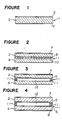
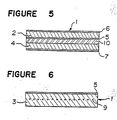
- Figures 1 to 5 are cross sectional views of various embodiments of the electromagnetic wave shielding transparent body of the present invention.
- reference numeral 1 indicates an electromagnetic wave shielding transparent body
- numerals 2 and 4 indicate transparent sheets
- numerals 5 and 6 indicate transparent conductive layers as the first electric conductor
- numerals 7 and 8 indicate the second electric conductors
- numeral 10 indicates an interlayer
- numeral 11 indicates a spacer for a multi-glazed assembly
- numeral 12 indicates an inner space.
- the transparent sheets may be transparent, translucent, colored transparent or colored translucent glass sheets, or various plastic sheets or films.
- glass sheets are preferred from the viewpoint of optical properties and durability.
- such a transparent sheet may be the one obtained by laminating one or more transparent sheets by means of an interlayer or an adhesive.
- the transparent body of the present invention may be composed of a single transparent sheet 2 as shown in Figure 1, or may be of a laminate type as shown in Figure 2 wherein two transparent sheets 2 and 4 are bonded by an interlayer 10. Further, it may be of a double-layered type as shown in Figure 3 or 4 wherein two transparent sheets 2 and 4 are spaced with a predetermined distance from each other by a spacer 11 so as to form an inner space 12, or of a double-sheet type as shown in Figure 12 wherein two transparent sheets 22 and 23 are spaced with a predetermined distance from each other by a frame 29 so as to form an inner space 24.
- the transparent body of the present invention may be of a laminate type wherein three or more transparent sheets are bonded by interlayers, or of a multi-layered type wherein three or more transparent sheets are spaced by spacers, or of a multiple-sheet type wherein three or more transparent sheets are spaced from one another by a frame.
- a "multi-glazed" assembly will be used as the word that includes both multi-layered type and multi-sheet type assembly.
- the electromagnetic wave shielding transparent body of the present invention comprises a transparent conductive layer formed as a first electric conductor on at least one of the above-mentioned transparent sheets, and a second electric conductor separated from the transparent conductive layer.
- the transparent conductive layer as the first electric conductor formed on a transparent sheet includes, for example, not only a transparent tin oxide conductive layer (a conductive layer of tin oxide doped with antimony or fluorine) and a transparent indium oxide conductive layer (a condutive layer of indium oxide doped with tin) but also a single-layered thin film type transparent layer of a metal or alloy of e.g. Cr, Ti, Ag, Au, Al, Cu or Ni, and a multi-layered thin film type layer having such a metal or alloy layer sandwiched between thin dielectric films of e.g.
- ZnO, SnO2, In2O3, TiO2, Bi2O3, Ta2O5, WO3 or ZnS for example, a three-layered type such as TiO2/Ag/TiO2, ZnO/Ag/ZnO, or SnO2/Ag/SnO2, and a five layered type such as TiO2/Ag/TiO2/Ag/TiO2, or ZnO/Ag/ZnO/Ag/ZnO, as well as other layers of appropriate constructions.
- Each of these transparent conductive layers is made of a film having high heat ray reflectivity. If necessary, however, it is possible to employ a film having relatively low heat ray reflectivity.
- the transparent conductive layer is made of a film having high heat ray reflectivity, it has a function to reduce the air conditioning load, and as such it can be used as a window material having good heat insulating properties.
- the transparent conductive layer having the above described construction can be formed by an appropriate layer-forming method such as a vacuum vapor deposition method, a sputtering method, a CVD method, a spray method, a CLD method or a printing method.
- the transparent conductive layer is preferably formed directly on a transparent sheet.
- a transparent conductive plastic film formed by laminating a transparent conductive layer on a plastic film such as a polyester film and to laminate such a transparent conductive plastic film on a transparent sheet.
- the transparent conductive layer to be used in the present invention preferably has a resistance of at most 20 ⁇ / ⁇ to obtain a high level of electromagnetic wave shielding effects. Most preferably, the resistance is at most 10 ⁇ / ⁇ so that the conductive layer is capable of effectively shielding electromagnetic waves within a wide frequency range of at least 40 MHz.
- the thickness of the transparent conductive layer is suitably selected so that the desired resistance and visible light transmittance as mentioned above will be obtained, or a desired color will be obtained.
- Such a transparent conductive layer may be divided into two or more films, so that it may be composed of a plurality of transparent conductive films.
- the distance between the respective transparent conductive films is preferably at most 1 cm to prevent leakage of electromagnetic waves.
- Such a transparent conductive layer may be formed on the exposed surface of the transparent sheet as shown in Figure 1, or in the case of a laminate type, it may be formed on the laminated surface of the transparent sheet as shown in Figure 2. In the case of the double-glazed type, it may be formed on the inner space side of the transparent sheet(s) as shown in Figures 3 and 4.
- the transparent conductive layer By forming the transparent conductive layer on the laminated surface or on the inner space side surface as mentioned above, it is possible to avoid exposure of the transparent conductive layer and to protect the transparent conductive layer, such being advantageous in the case of a transparent conductive layer having poor durability. It is of course possible to form the transparent conductive layer on the exposed surface even in the case of a laminate type, double- or multi-glazed type transparent sheet.
- the transparent conductive layer as the first electric conductor may be formed on one side of a transparent sheet. If necessary, however, it may be formed on two or more surfaces.
- a transparent conductive layer 5 is formed on one side of a transparent sheet 2.
- transparent conductive layers 5 and 6 are formed on both sides of a transparent sheet 2.
- Figure 4 shows an embodiment wherein transparent conductive layers 5 and 6 are formed on one side of the respective transparent sheets 2 and 4 of a double-layered assembly comprising two transparent sheets.
- the second electric conductor provided for the purpose of complementing the electromagnetic wave shielding property of the first electric conductor may be a transparent conductive layer or a conductive lattice pattern, or it may be a lattice made at least partially of an electrically highly conductive material.
- the transparent conductive layer or the conductive lattice pattern as the second conductor is preferably formed on at least one of 2n surfaces of one or plurality (n) transparent sheets constituting the transparent body of the present invention other than the surface(s) on which the above-mentioned transparent conductive layer as the first conductor is formed.
- the transparent conductive layer as the first conductor is formed on one of 2n surfaces of the transparent sheets, while the second electric conductor is formed on at least one of the rest of the 2n surfaces.
- such second electric conductors are shown by reference numerals 7 and 8.
- the lattice made at least partly of a highly conductive material may be provided as the second electric conductor in an inner space formed between transparent sheets disposed to face one another with a space. Such a structure is illustrated in Figures 11 to 16.
- a lattice pattern formed of a highly conductive material is employed so as to efficiently shield electromagnetic waves.
- a conductive lattice pattern may be the one formed by printing a conductive paste comprising a metal powder such as Ag, Al, Au or Cu and a binder, in a predetermined lattice pattern, followed by curing or baking, or the one formed by bonding an aluminum or nickel foil in a predetermined lattice pattern, or the one formed by bonding or sandwiching a plastic film on which or on an intermediate layer of which a lattice pattern made of a conductive metal is formed.
- a transparent sheet having such a conductive lattice pattern formed therein it is possible to use a glass sheet 3 in which a metal wire 9 is sealed in the form of a lattice pattern as shown in Figure 6, or a plastic sheet having a metal wire net sealed therein. It is also possible to employ a transparent laminate wherein a metal wire is sandwiched in a lattice pattern between a pair of transparent sheets.
- a lattice pattern described above may be formed on one surface of a transparent sheet. If necessary, it may be formed on two or more surfaces or inside of a transparent sheet.
- each unit of the conductive lattice pattern there is no particular restriction as to the shape in the front view of each unit of the conductive lattice pattern.
- a polygonal pattern such as a triangular, rectangular, pentagonal or hexagonal pattern, or a pattern of any other optional shape, may be employed.
- the length (inner size) of the longer diagonal line of each lattice unit is determined taking into consideration the desired light transmittance, electromagnetic wave shielding properties, design, etc. Usually, it is preferable the length of the diagonal line is from 1 to 30 cm. If it exceeds 30 cm, the electromagnetic wave shielding properties in a low frequency region tend to decrease, such being undesirable. On the other hand, if it is shorter than 1 cm, the lattice pattern tends to be dense, such being undesirable from the viewpoint of see-through and light transmitting properties.
- electromagnetic waves can effectively be shielded by repetition of reflection of electromagnetic waves at the respective lattices.
- Electromagnetic waves in a low frequency range such as electromagnetic waves of frequency of not more than 400 MHz can particularly effectively be shielded.
- a glass sheet was used as a transparent sheet, and a silver paste was printed on the surface of this glass plate in a lattice pattern with the shape of each lattice unit being square, followed by baking to form a conductive lattice pattern, whereby the length of the diagonal line of the rectangular lattice was adjusted to 10 cm, and the thickness of the lattice pattern was adjusted to 20 ⁇ m, and the width of the line was adjusted to 1 mm, so that electromagnetic waves of not higher than 400 MHz can effectively be shielded.
- a glass sheet was used as the transparent sheet, and a silver paste was printed on this glass sheet in a lattice pattern wherein the shape of the lattice unit was rectangular, followed by baking to form an conductive lattice pattern, whereby the diagonal line of the rectangular lattice was adjusted to 20 cm, the thickness of the lattice pattern was adjusted to 20 ⁇ m and the width of the line was adjusted to 1 mm, so that electromagnetic waves of not more than 300 MHz can effectively be shielded.
- a glass sheet was used as the transparent sheet, and a silver paste was printed on this glass sheet in a lattice pattern wherein the shape of the lattice unit was triangular, followed by baking to form an conductive lattice pattern, whereby the length of the height of the triangular lattice was adjusted to 10 cm, the thickness of the lattice pattern was adjusted to 20 ⁇ m and the width of the line was adjusted to 1 mm, so that electromagnetic waves of not more than 400 MHz can effectively be shielded.
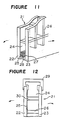
- Figure 11 is a partially omitted diagrammatical illustration of an electromagnetic wave shielding transparent body of the present invention, wherein a highly conductive lattice as the second electric conductor of the present invention is provided in an inner space of a double-glazed transparent assembly.
- reference numeral 21 indicates a double-layered transparent body
- numerals 22 and 23 indicate transparent sheets
- numeral 24 indicates an inner space
- numeral 25 indicates a transparent conductive layer
- numeral 26 indicates an electrically highly conductive lattice.
- the double-glazed transparent body 21 is prepared by disposing a pair of transparent sheets 22 and 23 in parallel to each other with a predetermined space by a drying agent-containing spacer 27 disposed along the periphery of the transparent sheets and sealing them with sealant 28 along the peripheral portion to form an inner space 24 between the two transparent sheets 22 and 23.
- an electrically high conductive lattice is employed in order to shield electromagneic waves.
- This electrically highly conductive lattice may be the one wherein the lattice is made of an electrically highly conductive metal or alloy (such as Al, Cu, stainless steel or brass), or other conductive material, or the one wherein the lattice is made of a plastic or insulating material and a coating layer of an electrically high conductive metal or alloy, or other conductive material, is formed on its surface, or the one in which a lattice is made of an electrically high conductive metal or alloy, or other conductive material, and a coating layer or an insulating layer is provided on its surface.
- an electrically highly conductive lattice may be the one wherein the lattice is made of an electrically highly conductive metal or alloy (such as Al, Cu, stainless steel or brass), or other conductive material, or the one wherein the lattice is made of a plastic or insulating material and a coating layer of an electrically
- each lattice unit of this lattice there is no particular restriction as to the shape in the front view of each lattice unit of this lattice.
- the shape may be triangular, rectangular, pentagonal, hexagonal or any other optional shape.
- the length (the inner size) of the longer diagonal line of each lattice unit is determined taking into consideration the desired light transmittance, electromagnetic wave shielding properties, design, etc.
- the length of the diagonal line is usually from 1 to 30 cm. If it exceeds 30 cm, the electromagnetic wave shielding properties in a low frequency region tend to be low, such being undesirable. On the other hand, if it is shorter than 1 cm, the lattice pattern tends to be dense, such being undesirable from the viewpoint of see-through and light transmitting properties.
- electromagnetic waves can effectively be shielded by repetition of reflectance of electromagnetic waves at the respective lattice surfaces.
- Electromagnetic waves in a low frequency range, such as electromagnetic waves of frequency of not more than 400 MHz can particularly effectively be shielded.
- Figure 11 illustrates an embodiment wherein an aluminum metal lattice is used wherein the shape of each lattice unit is square, whereby the length of the diagonal line is adjusted to from 5 to 15 cm so that electromagnetic waves of not more than 400 MHz can be shielded.
- the transparent conductive layer as the first electric conductor, and the second electric conductor can be in a conductive state.
- the second electric conductor is a conductive lattice pattern or an electrically highly conductive lattice
- the transparent conductive layer and the conductive lattice pattern or lattice are in a non-conductive state, so that the transparent conductive layer is capable of effectively shielding electromagnetic waves in a high frequency region (e.g. from 100 to 1,000 MHz), while the lattice pattern or lattice is capable of effectively shielding electromagnetic waves in a low frequency region (e.g. not more than 400 MHz).
- the transparent conductive layer and the conductive lattice pattern may be formed on different surfaces of a transparent sheet as mentioned above so that they are in a non-conductive state to each other. Otherwise, an electric insulating layer may be provided between the transparent conductive layer and the electrically highly conductive lattice at least at the portion where the two are otherwise in contact with each other, so that they are in a non-conductive state to each other.
- a transparent conductive layer and a conductive lattice pattern are separately provided on different surfaces of a transparent body.
- a high electromagnetic wave shielding effect can be obtained within a wide frequency range due to the synergistic effects of the electromagnetic wave shielding properties of the transparent conductive layer and the conductive lattice pattern.
- the transparent conductive layer and the electrically highly conductive lattice are made to be in a non-conductive state at least at the central portion of the transparent sheet on which the transparent conductive layer is formed.
- the transparent conductive layer and the electrically highly conductive lattice may be in a conductive state along the periphery of the transparent sheet.
- an electric insulating layer 30 may be formed at the portion where the two are otherwise in contact with each other, as shown in Figure 12, or the two may be disposed with a space so that they are in a non-conductive state. Otherwise, the two may be made to be non-conductive by selecting the surface on which the transparent conductive layer is formed so that such a surface is not in contact with the electrically highly conductive lattice.
- At least one of the transparent conductive layer as the first electric conductor and the electrically conductive lattice pattern or lattice as the second electric conductor may be provided with a terminal for earthing so that the electromagnetic waves thereby caught are earthed, whereby the electromagnetic wave shielding effect is obtained.
- a terminal for earthing is provided to each of them.
- the earthing terminal may be provided to one of them or each of them.
- a conductive paste containing a conductive metal powder such as Ag or Al is printed along an appropriate peripheral portion of the transparent conductive layer in a predetermined pattern, followed by baking or curing to form a busbar, or an aluminum foil or a copper foil in a predetermined pattern is bonded to form a busbar, and an earthing terminal is provided at an appropriate position of such a busbar.
- a terminal block may be attached to facilitate the connection with an earthing line, as the case requires.
- Such an earthing terminal may be provided at one position or at a plurality of positions.
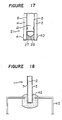
- Figure 17 illustrates an embodiment in which an electromagnetic wave shielding transparent body 21 of the present invention comprises transparent sheets 2 and 4 disposed with a predetermined space in parallel to each other by a spacer 27 to form an inner space 12 and sealed along their periphery with a sealant 28 and first and second electric conductors 5 and 6 formed on the inner space sides of the transparent sheets 2 and 4, wherein aluminum tapes 40 and 42 are provided to contact the electric conductors 5 and 6, respectively, and extend to the exterior of the transparent body, so that they may be earthed.
- the transparent conductive layer and/or the lattice pattern may not necessarily be provided with an earthing terminal.
- the transparent sheet is attached to a window frame, predetermined portions of the transparent conductive layer and/or the lattice pattern are exposed, and a conductive sealant is provided along the exposed portions of the transparent conductive layer and/or the lattice pattern, so that the conductive sealant is utilized for the condution with the window frame.
- Figure 18 illustrates an embodiment wherein the electromagnetic wave shielding transparent body 1 of the present invention comprises a transparent sheet 2 and the first and second electric conductors 5 and 7 provided on the opposite surfaces of the transparent sheet 2, wherein a conductive sealant 42 is provided to contact with the electric conductors 5 and 7 and with a window frame 45, and the electric conductors 5 and 7 are thereby earthed.
- an earthing terminal may be provided directly or by means of a terminal block at an appropriate position or positions along the lattice.
- the earthing terminal may be provided at one position or at a plurality of positions.
- Figures 13 to 16 are cross sectional views of double- glazed transparent bodies having a transparent conductive layer 25 and an electrically highly conductive lattice 26, as other embodiments of the present invention.
- Figure 13 illustrates an embodiment wherein a transparent conductive layer 25 is formed on the inner space 24 side of each of transparent sheets 22 and 23, and the two transparent conductive layers 25 and the lattice 26 are earthed respectively.
- Figure 14 illustrates an embodiment wherein a transparent conductive layer 25 is formed on each side of the exterior transparent sheet 22, and the two transparent conductive layers 25 and the lattice 26 are earthed respectively.
- Figure 15 is an embodiment wherein a transparent conductive layer 25 is formed in the inner space 24 side of the interior transparent sheet 23, and the transparent conductive layer 25 and the lattice 26 are earthed respectively.
- Figure 16 is an embodiment wherein a transparent conductive layer 25 is formed on the interior side of the interior transparent sheet 23, and the transparent conductive layer 25 and the lattice are earthed respectively.
- the electromagnetic wave shielding effect is inversely proportional to the electric resistance of the electromagnetic wave shielding layer. If the layer is made thick, the electromagnetic shileding effect can be increased, but the transmittance of sunlight tends to be low. In order to maintain the transmittance of sunlight to some extent, it is necessary to make the layer thin. Therefore, the transparent conductive layer as the first or second electric conductor may be composed of a thin transparent conductive layer and conductive filaments formed thereon or therebeneath in contact therewith, so that the overall resistance can be made low.
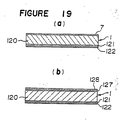
- Figure 19(a) illustrates the structure of an electromagnetic shielding transparent body of the present invention in which a transparent condutive layer 121 as the first electric conductor is formed on one side of a transparent sheet 120 and conductive filaments 122 are formed thereon to reduce the resistance of the transparent conductive layer 121, and the second electric conductor 7 is formed on the opposite side.
- Figure 19(b) illustrates an embodiment wherein transparent conductive layers 121 and 127 as the first and second electric conductors are formed on the opposite sides of a transparent sheet 120, and conductive filaments 122 and 128 are formed on the respective transparent conductive layers 121 and 127.
- the transparent conductive layer 121 is made thin to secure the light transmittance, and at the same time, conductive filaments 122 made of an electrically highly conductive material such as copper or silver are provided on the transparent conductive layer 121 in a fashion to divide the conductive layer surface, and each conductive filament 122 is connected to electrodes 123 and 124, whereby the surface resistance of the transparent conductive layer 121 can be made lower since the surface resistance is governed by the distance to the nearest filament, and thus, the electromagnetic shielding property can be improved.
- conductive filaments 122 made of an electrically highly conductive material such as copper or silver are provided on the transparent conductive layer 121 in a fashion to divide the conductive layer surface, and each conductive filament 122 is connected to electrodes 123 and 124, whereby the surface resistance of the transparent conductive layer 121 can be made lower since the surface resistance is governed by the distance to the nearest filament, and thus, the electromagnetic shielding property can be improved.
- Figure 20(b) illustrates an embodiment wherein in addition to conductive filaments 122 for longitudinal division, conductive filaments 125 for transverse division are provided to divide the surface of the transparent conductive layer 121 in a mesh pattern, and the filaments 122 and 125 are connected to electrodes 123 and 124 and electrodes 126 and 127, respectively.
- the conductive filaments 122 and 125 are intended to reduce the resistance of the transparent conductive layer rather than to perform a role of shielding electromagnetic waves as an electromagnetic wave shielding lattice. Therefore, they may not necessarily be disposed as densely as the electromagnetic wave shielding mesh or lattice, whereby the electromagnetic wave shielding property can be improved without reducing the transmittance of sunlight by the transparent conductive layer.
- the conductive filaments may be formed in a pattern similar to the conductive lattice pattern as the above-mentioned second electric conductor.
- the conductive filaments may be formed on or under the transparent conductive layer. However, if a transparent conductive layer is formed on the filaments, the properties of the transparent conductive layer at the overlapping portions are likely to deteriorate. Therefore, it is preferred that the filaments are formed on the transparent conductive layer. Further, a three or more layered laminate may be formed by laminating such filaments and transparent conductive layers.
- the conductive filaments and electrodes may be provided with the same compositions in the same manner as the above-mentioned conductive lattice pattern as the second electric conductor, or may be a foil, wire, rod or sheet of highly conductive metal such as silver, copper, aluminum or nickel. Otherwise, they may be conductive particles or conductive patterns which are electrically connected in the form of filaments.
- a plurality of such filaments provided to divide the transparent conductive layer surface preferably have a resistance lower than the transparent conductive layer so as to effectively reduce the resistance of the transparent conductive layer.
- the distance between the plurality of filaments is preferably from 1 to 20 cm, although there is no particular restriction as to such a distance.
- An electromagnetic wave shielding transparent body having a transparent conductive layer of a metal or a metal oxide, or a laminate thereof, coated on the surface of a transparent body made of e.g. glass may have various colors and reflecting colors depending upon the type and amount of the coating metal or metal oxide, or a laminate thereof, the thickness of the transparent conductive layer and the stabilizing treatment.
- the transparency, the light transmittance and the reflectance of the original transparent body substantially change. If it is used in such a state for windows of a building, the living environment in the interior may be poor and the appearance may not meet the intended design of the building, although the function as an electromagnetically shielded building may be obtained. In such a case, it is possible to adjust the color and the reflectivity to meet the desired design of the building.
- Figures 21(a) to (f) Such examples are illustrated in Figures 21(a) to (f).
- Figure 21(a) illustrates an embodiment in which an electric conductor 132 such as a transparent conductive layer is formed on a transparent glass 131, and a color or reflectivity-adjusting layer 133 is formed thereon.
- Figure 21(b) illustrates an embodiment wherein a color or reflectivity-adjusting layer 133 is provided on the opposite side of the electric conductor 132.
- Figures 21(c) and (d) illustrate embodiments wherein a heat ray absorbing glass 134 is used instead of the transparent glass 131 of Figures 21(a) and (b).
- Figures 21(e) and (f) illustrate embodiments in which a heat ray reflective glass comprising a glass 137 and a reflective layer 138 is employed instead of the transparent glass 131 of Figures 21(a ⁇ and (b).
- the heat ray absorbing glass 134 is the one obtained by adding a very small amount of a metal oxide of e.g. nickel, chromium, cobalt or iron, or selenium, etc. to a soda lime silicate glass and thus is a colored glass. Accordingly, in the embodiments of Figures 21(c) and (d), the color or reflectivity-adjusting layer 136 may be omitted.
- the heat ray reflective glass has a thin layer of a highly heat ray reflective metal or metal oxide coated by a special method on one side of a transparent body and thus has a special color due to a mirror effect. Accordingly, in the embodiments of Figures 21(e) and (f), the color or reflectivity-adjusting layer 140 may be omitted.
- An electromagnetic wave shielding transparent body having a desired color may be obtained by constructing the electromagnetic wave shielding transparent body of the present invention by using an appropriate transparent sheet as illustrated in one of Figures 21(a) to (f).
- a layer-forming material having a high chemical and physical durability and a refractive index higher than the transparent sheet such as a high refractive index layer of TiO2, ZnO, Al2O3 or ZrO2 may be used as the color or reflectivity-adjusting layer.
- a high refractive index and absorptive layer of e.g. Ag, SUS, Ni, Co, Au, or TiN x may be used.
- the above-mentioned high refractive index layer or high refractive index and absorptive layer is formed on the transparent sheet and an electric conductor is formed thereon, or an electric conductor is formed on the transparent sheet and the high refractive index layer or high refractive and absorptive layer is formed thereon, or the high refractive index layer or high refractive and absorptive layer is formed on the transparent sheet and a low refractive index layer having a refractive index lower than the transparent sheet, such as SiO2, is formed thereon and an electric conductor is formed on the low refractive index layer.
- a high refractive index layer may be formed on the electric conductor to obtain an electromagnetic wave shielding transparent body of the present invention.
- the layered construction is not limited to the above examples, and various other constructions may be employed.
- the electric conductor is provided with an earthing terminal or a terminal block for earthing the electromagnetic waves. Therefore, in a case where the color or reflectivity-adjusting layer is electrically insulating, it is preferred that the electric conductor is provided as the outermost layer i.e. the exposed surface to facilitate the provision of such a terminal or terminal block.
- a layer having other function such as a protective layer for improving the durability may be formed in combination with the electric conductor and the color or reflectivity-adjusting layer.
- first and second conductors may be formed by laminating the transparent conductive layers and the conductive lattice patterns in three or more layers.
- an electromagnetic wave shielding transparent body may be constructed by laminating and/or combining a plurality of the above described electromagnetic wave shielding transparent bodies.
- the first and second electric conductors are disposed with a distance.
- the electromagnetic wave shielding effect can be enhanced or complemented by another electric conductor.
- the transparent conductive layer as the first electric conductor is rather poor in the electromagnetic wave shielding performance in a low frequency range, but excellent in the high frequency range
- the lattice or lattice pattern as the second conductor is excellent in the electromagnetic shielding performance in a low frequency range, but rather poor in the high frequency range.
- the performance varies also depending upon the type of the materials used.
- the electromagnetic wave shielding performance can further be improved by disposing electric conductors having different electromagnetic wave shielding properties, or by adjusting the distance between the conductors depending upon their electromagnetic wave shielding properties or upon the frequency to be shielded so that the reflection, absorption and/or resonance can effectively be conducted between the electric conductors.
- the transparent conductive layer is highly effective for shielding high frequency electromagnetic waves of at least 300 MHz
- the electrically highly conductive lattice pattern and/or lattice is highly effective for shielding low frequency electromagnetic waves of not higher than 400 MHz.
- the transparent conductive layer and the lattice pattern and/or lattice it is possible to effectively shield a wide range of electromagnetic waves of e.g. from 10 to 1,000 MHz including electromagnetic waves in a frequency range emitted from computers, word processors, meters, robots or various other electronic equipments wherein digital technologies are used, and electromagnetic waves in a frequency range which cause erroneous operations or adverse effects to such various electronic equipments or information networks.
- An electromagnetic wave shielding multi-glazed transparent body of the present invention wherein the first and second conductors are formed on a transparent body which is multi-glazed with a plurality of transparent sheets, has transparency and is sealed along the periphery of the transparent sheets to form an inner space, whereby not only the sound insulating effect is high, but also the heat insulating effect is high, and during the winter time, it is possible to save the heating energy, and during the summer time, it is possible to prevent the entrance of heat from outdoors and the load for air conditioning can be reduced.
- the transparent conductive layer usually has an infrared reflectivity. By utilizing this property, it is possible to prevent the entrance of heat rays of sunlight into rooms during the summer time, and it is possible to prevent the flow out of the indoor heat during the winter time, thus being useful as a multi functional glass.
- the transparent conductive layer as the first or second electric conductor is composed of a transparent conductive layer and conductive filaments formed thereon or therebeneath, the resistance of the transparent conductive layer can be reduced, whereby it is possible to obtain a high electromagnetic wave shielding effect while the entire light transmittance can be improved by making the transparent conductive layer thin.
- the electromagnetic wave shielding transparent body of the present invention is useful as window glass for intelligent buildings or computer centers where transparency and light transmittance are required and a high level of electromagnetic wave shielding performance is required, or for buildings, offices, hospitals or various other structures wherein precision electronic equipments are used.
- the color of the electromagnetic wave shielding transparent body can be adjusted as desired, and it is possible to provide an electromagnetic wave shielding window having a color matched with the design of the building.
Landscapes
- Engineering & Computer Science (AREA)
- Microelectronics & Electronic Packaging (AREA)
- Shielding Devices Or Components To Electric Or Magnetic Fields (AREA)
- Laminated Bodies (AREA)
Applications Claiming Priority (10)
| Application Number | Priority Date | Filing Date | Title |
|---|---|---|---|
| JP62333514A JPH01171297A (ja) | 1987-12-25 | 1987-12-25 | 電磁波遮蔽透明体及び窓 |
| JP62333515A JPH0695598B2 (ja) | 1987-12-25 | 1987-12-25 | 電磁波遮蔽層 |
| JP333514/87 | 1987-12-25 | ||
| JP327398/87 | 1987-12-25 | ||
| JP62327398A JPH0719994B2 (ja) | 1987-12-25 | 1987-12-25 | 電磁波遮蔽透明板 |
| JP333516/87 | 1987-12-25 | ||
| JP62333516A JPH07115891B2 (ja) | 1987-12-25 | 1987-12-25 | 建物用電磁波遮蔽窓ガラス |
| JP327397/87 | 1987-12-25 | ||
| JP62327397A JPH0685473B2 (ja) | 1987-12-25 | 1987-12-25 | 電磁波遮蔽複層透明体 |
| JP333515/87 | 1987-12-25 |
Publications (2)
| Publication Number | Publication Date |
|---|---|
| EP0322720A2 true EP0322720A2 (fr) | 1989-07-05 |
| EP0322720A3 EP0322720A3 (fr) | 1990-01-17 |
Family
ID=27531167
Family Applications (1)
| Application Number | Title | Priority Date | Filing Date |
|---|---|---|---|
| EP88121331A Withdrawn EP0322720A3 (fr) | 1987-12-25 | 1988-12-20 | Corps transparent pour le blindage contre les ondes électromagnétiques |
Country Status (4)
| Country | Link |
|---|---|
| US (1) | US4978812A (fr) |
| EP (1) | EP0322720A3 (fr) |
| KR (1) | KR0130472B1 (fr) |
| CA (1) | CA1322398C (fr) |
Cited By (10)
| Publication number | Priority date | Publication date | Assignee | Title |
|---|---|---|---|---|
| EP0413580A1 (fr) * | 1989-08-18 | 1991-02-20 | Pilkington Plc | Panneau pour blindage électromagnétique |
| WO1991017533A1 (fr) * | 1990-05-01 | 1991-11-14 | N.V. Nederlandsche Apparatenfabriek Nedap | Systeme avec antennes partiellement blindees pour la detection du vol a l'etalage |
| WO1998044771A3 (fr) * | 1997-04-01 | 1999-02-11 | Koninkl Philips Electronics Nv | Dispositif d'affichage d'images dote d'un systeme de reduction des emissions |
| FR2781789A1 (fr) * | 1998-08-03 | 2000-02-04 | Saint Gobain Vitrage | Substrat transparent comportant un reseau de fils metalliques et utilisation de ce substrat |
| GB2370160B (en) * | 1999-07-19 | 2003-11-05 | Curran Co | A method for attenuating electromagnetic interference, an electromagnetic interference attenuation device |
| CN102149892A (zh) * | 2008-11-14 | 2011-08-10 | Nec东金株式会社 | 电磁屏蔽面板、窗构件、构造物、电磁屏蔽室及电磁屏蔽箱 |
| CN105070116A (zh) * | 2015-09-22 | 2015-11-18 | 愈先梅 | 便携式英语阅读填空学习机 |
| CN105271725A (zh) * | 2015-11-28 | 2016-01-27 | 李白 | 太阳能板反光装置的强化处理方法 |
| US10655209B2 (en) | 2013-03-21 | 2020-05-19 | Noritake Co., Limited | Electromagnetic shield |
| CN113677180A (zh) * | 2021-10-21 | 2021-11-19 | 深圳市云创精密医疗科技有限公司 | 高精密医疗设备电磁屏蔽外壳 |
Families Citing this family (38)
| Publication number | Priority date | Publication date | Assignee | Title |
|---|---|---|---|---|
| US5443900A (en) * | 1991-09-10 | 1995-08-22 | Kansai Paint Co., Ltd. | Electromagnetic wave absorber |
| CA2154156C (fr) * | 1993-02-02 | 2005-04-26 | Edward D. Suski | Carte de circuit a grilles de blindage et sa methode de fabrication |
| US5334800A (en) * | 1993-07-21 | 1994-08-02 | Parlex Corporation | Flexible shielded circuit board |
| US5373102A (en) * | 1993-08-19 | 1994-12-13 | The United States Of America As Represented By The Secretary Of The Army | Optically transmissive Faraday cage |
| US5510575A (en) * | 1993-11-26 | 1996-04-23 | The Curran Company | Window wall for shielded enclosures |
| US5621188A (en) * | 1994-05-06 | 1997-04-15 | Lee; Sang C. | Air permeable electromagnetic shielding medium |
| US5675299A (en) * | 1996-03-25 | 1997-10-07 | Ast Research, Inc. | Bidirectional non-solid impedance controlled reference plane requiring no conductor to grid alignment |
| US6855883B1 (en) * | 1997-02-11 | 2005-02-15 | Kazu Investment Co., Ltd. | Electromagnetic wave blocking material and electromagnetic wave blocking case |
| JP2000511708A (ja) * | 1997-04-01 | 2000-09-05 | コーニンクレッカ フィリップス エレクトロニクス エヌ ヴィ | エミッション低減手段が設けられた画像表示装置 |
| US6455770B2 (en) | 1997-07-03 | 2002-09-24 | Lee J. Pulver | Electromagnetic radiation shield for attenuating electromagnetic radiation from an active electronic device |
| US6476317B1 (en) | 1997-07-15 | 2002-11-05 | The United States Of America As Represented By The Secretary Of The Air Force | Radiation shield using electrical insulating materials and the spacecharge fields therein |
| KR100374222B1 (ko) * | 1997-12-24 | 2003-03-04 | 군제 가부시키가이샤 | 전자파 실드용 투명부재 및 그 제조방법 |
| US6188015B1 (en) * | 1998-06-02 | 2001-02-13 | The Curran Company | Electromagnetic interference attenuation device |
| KR100654114B1 (ko) | 1998-10-30 | 2006-12-05 | 스미또모 가가꾸 가부시끼가이샤 | 전자파 차단판 |
| JP2000306971A (ja) * | 1999-04-21 | 2000-11-02 | Canon Inc | 半導体製造装置、ポッド装着方法および半導体デバイス生産方法 |
| JP3351393B2 (ja) * | 1999-06-21 | 2002-11-25 | 日本電気株式会社 | Emiシールドフィルタ及びemiシールドフィルタを有する表示装置 |
| US6906257B2 (en) * | 2001-01-29 | 2005-06-14 | Honeywell International Inc. | Metallic coated dielectric substrates |
| US20020187350A1 (en) * | 2001-01-29 | 2002-12-12 | Honeywell International Inc. | Robust highly reflective optical construction |
| JP4668438B2 (ja) * | 2001-03-08 | 2011-04-13 | 住友ゴム工業株式会社 | 電磁波シールド板及びその製造方法 |
| KR100603259B1 (ko) * | 2001-10-24 | 2006-07-20 | 삼성코닝 주식회사 | 전자파 차폐용 필터 |
| WO2003100995A2 (fr) | 2002-05-28 | 2003-12-04 | Astic Signals Defenses L.L.C. | Systeme et procede permettant de filtrer la transmission d'ondes electromagnetiques et lumineuses et de reduire la transmission d'ondes sonores |
| WO2004039138A1 (fr) * | 2002-10-28 | 2004-05-06 | Bridgestone Corporation | Materiau filtrant transmettant la lumiere et protegeant contre les ondes electromagnetiques et procede de production |
| US20040149472A1 (en) * | 2003-02-03 | 2004-08-05 | Warner Benjamin P. | Radiofrequency attenuator and method |
| JP2005311199A (ja) * | 2004-04-23 | 2005-11-04 | Canon Inc | 基板の製造方法 |
| US20060081389A1 (en) * | 2004-10-14 | 2006-04-20 | Pille James D | Aesthetically colored EMI shields |
| US20060080825A1 (en) * | 2004-10-14 | 2006-04-20 | Pille James D | Methods related to electromagnetic interference shielding |
| JP5160865B2 (ja) * | 2007-11-19 | 2013-03-13 | 株式会社竹中工務店 | 磁気シールド体及び磁気シールドルーム |
| CN102203956A (zh) * | 2008-08-12 | 2011-09-28 | 戴索有限公司 | 用于柔性光电和显示设备中的集电器系统和制造方法 |
| CN102953660B (zh) * | 2012-10-25 | 2016-09-14 | 西安开容电子技术有限责任公司 | 钢制通风窗与铝制屏蔽腔体连接结构的安装方法 |
| CN103151408B (zh) * | 2013-02-17 | 2015-08-26 | 英利集团有限公司 | 一种全玻组件和一种全玻组件的封装工艺 |
| FR3029386A1 (fr) * | 2014-11-28 | 2016-06-03 | Commissariat Energie Atomique | Blindage magnetique ameliore |
| JP6278922B2 (ja) * | 2015-03-30 | 2018-02-14 | Jx金属株式会社 | 電磁波シールド材 |
| JP7117084B2 (ja) * | 2017-06-13 | 2022-08-12 | 日東電工株式会社 | 電磁波吸収体及び電磁波吸収体付成形品 |
| US11145598B2 (en) * | 2017-12-28 | 2021-10-12 | Texas Instruments Incorporated | Lattice bump interconnect |
| EP3740460A4 (fr) * | 2018-01-16 | 2021-01-20 | Central Glass Co., Ltd. | Enlèvement de revêtement pour connexion électrique sur une fenêtre de véhicule |
| CN108457568A (zh) * | 2018-02-13 | 2018-08-28 | 江苏奥蓝工程玻璃有限公司 | 一种玻璃窗 |
| USD939508S1 (en) * | 2018-11-19 | 2021-12-28 | Awb Company | Device performance enhancer |
| USD943542S1 (en) * | 2018-11-19 | 2022-02-15 | Amb Company | Combined mobile phone and device performance enhancer |
Family Cites Families (13)
| Publication number | Priority date | Publication date | Assignee | Title |
|---|---|---|---|---|
| US2920174A (en) * | 1957-06-28 | 1960-01-05 | Raytheon Co | Microwave ovens |
| US2958754A (en) * | 1958-12-15 | 1960-11-01 | Gen Electric | Electronic ovens |
| US3231663A (en) * | 1962-11-01 | 1966-01-25 | Schwartz Edward | Electromagnetic shield having multiple electroconductive passages |
| US3177334A (en) * | 1963-03-11 | 1965-04-06 | Gen Electric | Oven door window |
| US3265804A (en) * | 1965-10-27 | 1966-08-09 | Holophane Co Inc | Radiation shielding light transmitter |
| US3843859A (en) * | 1972-09-27 | 1974-10-22 | Litton Systems Inc | Microwave oven door assembly |
| FR2436472A1 (fr) * | 1978-09-15 | 1980-04-11 | Ternois Ste Indle | Perfectionnement aux ecrans electromagnetiques pour cages de faraday |
| DE2946519C2 (de) * | 1979-11-17 | 1983-05-11 | Leo 5000 Köln Wirtz | Fenster mit elektromagnetischer und akustischer Abschirmung |
| FR2484397A1 (fr) * | 1980-06-16 | 1981-12-18 | Trois Fontaines Verreries | Verre de securite pour appareil a micro-ondes |
| US4381421A (en) * | 1980-07-01 | 1983-04-26 | Tektronix, Inc. | Electromagnetic shield for electronic equipment |
| DE3430406A1 (de) * | 1983-08-20 | 1985-03-14 | Riken EMC Co., Ltd., Nagoya, Aichi | Transparente platte fuer optische zeichenwiedergabevorrichtung |
| US4613530A (en) * | 1984-11-01 | 1986-09-23 | Southwall Technologies, Inc. | Multiple pane glass unit with electrically conductive transparent film for use as radiation shield |
| US4721636A (en) * | 1984-11-01 | 1988-01-26 | Southwall Technologies, Inc. | Multiple pane glass unit with electrically conductive transparent film for use as radiation shield |
-
1988
- 1988-12-20 EP EP88121331A patent/EP0322720A3/fr not_active Withdrawn
- 1988-12-22 US US07/288,278 patent/US4978812A/en not_active Expired - Fee Related
- 1988-12-23 CA CA000586972A patent/CA1322398C/fr not_active Expired - Fee Related
- 1988-12-24 KR KR1019880017430A patent/KR0130472B1/ko not_active Expired - Fee Related
Cited By (15)
| Publication number | Priority date | Publication date | Assignee | Title |
|---|---|---|---|---|
| EP0413580A1 (fr) * | 1989-08-18 | 1991-02-20 | Pilkington Plc | Panneau pour blindage électromagnétique |
| US5147694A (en) * | 1989-08-18 | 1992-09-15 | Pilkington Plc | Electromagnetic shielding panel |
| AU633124B2 (en) * | 1989-08-18 | 1993-01-21 | Pilkington Plc | Electromagnetic shielding panel |
| WO1991017533A1 (fr) * | 1990-05-01 | 1991-11-14 | N.V. Nederlandsche Apparatenfabriek Nedap | Systeme avec antennes partiellement blindees pour la detection du vol a l'etalage |
| US5367291A (en) * | 1990-05-01 | 1994-11-22 | N.V. Nederlandsche Apparatenfabriek Nedap | Shoplifting detection system with partly screened antennas |
| WO1998044771A3 (fr) * | 1997-04-01 | 1999-02-11 | Koninkl Philips Electronics Nv | Dispositif d'affichage d'images dote d'un systeme de reduction des emissions |
| FR2781789A1 (fr) * | 1998-08-03 | 2000-02-04 | Saint Gobain Vitrage | Substrat transparent comportant un reseau de fils metalliques et utilisation de ce substrat |
| GB2370160B (en) * | 1999-07-19 | 2003-11-05 | Curran Co | A method for attenuating electromagnetic interference, an electromagnetic interference attenuation device |
| CN102149892A (zh) * | 2008-11-14 | 2011-08-10 | Nec东金株式会社 | 电磁屏蔽面板、窗构件、构造物、电磁屏蔽室及电磁屏蔽箱 |
| CN102149892B (zh) * | 2008-11-14 | 2014-07-16 | Nec东金株式会社 | 电磁屏蔽面板、窗构件、构造物、电磁屏蔽室及电磁屏蔽箱 |
| US10655209B2 (en) | 2013-03-21 | 2020-05-19 | Noritake Co., Limited | Electromagnetic shield |
| CN105070116A (zh) * | 2015-09-22 | 2015-11-18 | 愈先梅 | 便携式英语阅读填空学习机 |
| CN105271725A (zh) * | 2015-11-28 | 2016-01-27 | 李白 | 太阳能板反光装置的强化处理方法 |
| CN113677180A (zh) * | 2021-10-21 | 2021-11-19 | 深圳市云创精密医疗科技有限公司 | 高精密医疗设备电磁屏蔽外壳 |
| CN113677180B (zh) * | 2021-10-21 | 2022-02-08 | 深圳市云创精密医疗科技有限公司 | 高精密医疗设备电磁屏蔽外壳 |
Also Published As
| Publication number | Publication date |
|---|---|
| EP0322720A3 (fr) | 1990-01-17 |
| CA1322398C (fr) | 1993-09-21 |
| KR0130472B1 (ko) | 1998-04-09 |
| KR890011516A (ko) | 1989-08-14 |
| US4978812A (en) | 1990-12-18 |
Similar Documents
| Publication | Publication Date | Title |
|---|---|---|
| US4978812A (en) | Electromagnetic wave shielding transparent body | |
| US4874903A (en) | Shielding panel | |
| US5147694A (en) | Electromagnetic shielding panel | |
| JP3243789B2 (ja) | 電波吸収性パネル | |
| EP0531734B1 (fr) | Panneau stratifié à faible réflectivité pour voie hertzienne | |
| JP4800947B2 (ja) | 電磁遮蔽用薄膜積層体を備えた透明基板 | |
| JPH0719994B2 (ja) | 電磁波遮蔽透明板 | |
| CA2261080A1 (fr) | Panneau de verre translucide pare-lumiere solaire et ensemble de panneaux de verre multicouches translucides pare-lumiere solaire | |
| CA1310395C (fr) | Panneau servant d'ecran electromagnetique | |
| CZ20023552A3 (cs) | Průhledná deska obsahující kovové prvky a její použití | |
| WO2010055787A1 (fr) | Verre feuilleté de blindage électromagnétique | |
| JPH0537178A (ja) | 電磁波遮蔽透明体 | |
| JPH09148782A (ja) | 透明電磁波吸収シールド材 | |
| JPH0685473B2 (ja) | 電磁波遮蔽複層透明体 | |
| JPH0685474B2 (ja) | 改良された電磁波遮蔽複層体 | |
| WO2023032535A1 (fr) | Corps en verre | |
| JPH071837Y2 (ja) | 電磁シールド複層ガラス構造 | |
| JP2008182045A (ja) | 電波吸収体及びits/dsrc施設 | |
| JPH09321484A (ja) | 電磁遮蔽ガラス | |
| JPH01171297A (ja) | 電磁波遮蔽透明体及び窓 | |
| JPH01171299A (ja) | 色相制御型電磁波遮蔽透明体 | |
| JP4245884B2 (ja) | 電波吸収体 | |
| JP2009027126A (ja) | 電磁遮蔽パネル | |
| JPH0695598B2 (ja) | 電磁波遮蔽層 | |
| WO2025100388A1 (fr) | Film de réflexion d'ondes électromagnétiques |
Legal Events
| Date | Code | Title | Description |
|---|---|---|---|
| PUAI | Public reference made under article 153(3) epc to a published international application that has entered the european phase |
Free format text: ORIGINAL CODE: 0009012 |
|
| AK | Designated contracting states |
Kind code of ref document: A2 Designated state(s): BE DE FR GB IT |
|
| PUAL | Search report despatched |
Free format text: ORIGINAL CODE: 0009013 |
|
| AK | Designated contracting states |
Kind code of ref document: A3 Designated state(s): BE DE FR GB IT |
|
| 17P | Request for examination filed |
Effective date: 19900504 |
|
| 17Q | First examination report despatched |
Effective date: 19930125 |
|
| STAA | Information on the status of an ep patent application or granted ep patent |
Free format text: STATUS: THE APPLICATION IS DEEMED TO BE WITHDRAWN |
|
| 18D | Application deemed to be withdrawn |
Effective date: 19960227 |