EP0322945B1 - Modification de (co)polymères à l'aide de peroxydes organiques - Google Patents
Modification de (co)polymères à l'aide de peroxydes organiques Download PDFInfo
- Publication number
- EP0322945B1 EP0322945B1 EP88202797A EP88202797A EP0322945B1 EP 0322945 B1 EP0322945 B1 EP 0322945B1 EP 88202797 A EP88202797 A EP 88202797A EP 88202797 A EP88202797 A EP 88202797A EP 0322945 B1 EP0322945 B1 EP 0322945B1
- Authority
- EP
- European Patent Office
- Prior art keywords
- peroxy
- methyl
- peroxide
- allyl
- group
- Prior art date
- Legal status (The legal status is an assumption and is not a legal conclusion. Google has not performed a legal analysis and makes no representation as to the accuracy of the status listed.)
- Expired - Lifetime
Links
Classifications
-
- C—CHEMISTRY; METALLURGY
- C08—ORGANIC MACROMOLECULAR COMPOUNDS; THEIR PREPARATION OR CHEMICAL WORKING-UP; COMPOSITIONS BASED THEREON
- C08F—MACROMOLECULAR COMPOUNDS OBTAINED BY REACTIONS ONLY INVOLVING CARBON-TO-CARBON UNSATURATED BONDS
- C08F8/00—Chemical modification by after-treatment
Definitions
- the invention relates to a process of modifying (co)polymers employing organic peroxides and to shaped objects comprising the modified (co)polymers.
- EP-A-273 990 which is not prepublished relates to similar but different peroxides.
- epoxide groups are introduced into (co)polymers by so-called epoxidation reactions, in which an unsaturated (co)polymer in the form of a latex or dissolved in an organic solvent is brought into reaction with an epoxidizing reagent suitable for unsaturated double bonds, such as a lower aliphatic peroxy carboxylic acid.
- an epoxidizing reagent suitable for unsaturated double bonds such as a lower aliphatic peroxy carboxylic acid.
- the requirement that the (co)polymer should be unsaturated implies that only a very limited number of (co)polymers can be provided with epoxide groups. For instance, the entire group of saturated (co)polymers is excluded from being functionalized by that route.
- the invention has for its object to eliminate the above drawbacks to the well-known methods of introducing epoxide groups into (co)polymers and to that end it provides a process employing particular organic peroxides for modification of (co)polymers.
- alkyl groups, alkenyl groups and alkylene groups may be linear or branched, unless otherwise indicated.
- the above allyl compounds may be used as catalysts for the polymerization of conjugated or non-conjugated polyunsaturated compounds.
- the peroxides according to the invention correspond to the above-described formula (I) and are selected from the class of the dialkyl peroxides. They may be prepared in the usual manner. In preparing dialkyl peroxides use may be made of a primary or a secondary alkenyl derivative of the general formula wherein R1-R4 have the above-indicated meaning and x represents e.g. a Cl, Br, leaving group.
- dialkyl peroxides for use according to the invention may be mentioned:
- the peroxides can be prepared, transported, stored and applied as such or e.g. in the form of powders, granules, solutions, aqueous suspensions or emulsions or pastes.
- desensitizing may be mentioned solid carrier materials, such as silica, chalk and clay, inert plasticizers or solvents, such as mono- or dichloro benzene, and water.
- the present peroxides are excellently suitable for use in the preparation of epoxide groups-containing (co)polymers, in which process a "non-modified" (co)polymer is brought into contact with the peroxide, upon which the peroxide will be entirely or almost entirely decomposed.
- the peroxide may be brought into contact with the (co)polymer in various ways, depending on the object of the modification. If, for instance, epoxide groups are to be present on the surface of a (co)polymeric object, the peroxide may be applied to the surface of the material to be modified. It will often be desirable for epoxide groups to be homogeneously distributed in the (co)polymeric matrix.
- the peroxide may be mixed with the material to be modified, which material may either be in the molten state, solution or, in the case of an elastomer, in the plastic state; to this end use may be made of conventional mixers, such as kneaders, internal mixers and (mixing) extruding equipment. Should the mixing be impeded by a too high melting temperature of the (co)polymer -because of premature peroxide decomposition- it is recommended that first of all the (co)polymer in the solid state should be provided with epoxide groups by contacting with the present peroxides, after which the modified material is melted and the epoxide groups will be homogeneously distributed in the matrix. Alternatively the (co)polymer may be dissolved first, and the reaction with the present peroxides be carried out in solution.
- an important practical aspect of the invention is that the moment the peroxide and the (co)polymer are brought into contact with each other and also the moment the peroxide is to be decomposed can be chosen independently of other usual (co)polymer processing steps, such as introducing additives and shaping.
- epoxide groups may be introduced into a (co)polymer employing a peroxide and subsequently additives may be introduced, after which the product may be mould processed.
- the peroxide may be added to the (co)polymer along with other additives and to decompose the peroxide in a following shaping step at elevated temperature, such as extrusion, compression moulding, blow moulding or injection moulding.
- suitable (co)polymers which according to the invention can be modified by means of epoxide groups are saturated (co)polymers, such as polyethylene, e.g. LLDPE, MDPE, LDPE and HDPE, polypropylene, both isotactic and atactic, ethylene/vinylacetate copolymer, ethylene/ ethylacrylate copolymer, ethylene/methylacrylate copolymer, ethylene/methylmethacrylate copolymer, chlorinated polyethylene, fluororubber, silicone rubber, polyurethane, polysulphide, polyacrylate rubber, ethylene/propylene copolymer, polyphenylene oxides, nylon, polyesters, such as polyethylene terephthalate and polybutylene terephthalate, polycarbonates, copolyetheresters, poly(butene-1), poly(butene-2), poly(isobutene), poly(methylpentene), polyvinyl chloride, polyvinyl chloride/vinyla
- a coagent is generally understood to be a usually polyfunctional reactive additive e.g. a polyunsaturated compound for use in cross-linking of (co)polymers, which additive will react very rapidly with polymer radicals, will overcome steric hindrance effects and will minimize undesirable side reactions.
- a polyfunctional reactive additive e.g. a polyunsaturated compound for use in cross-linking of (co)polymers, which additive will react very rapidly with polymer radicals, will overcome steric hindrance effects and will minimize undesirable side reactions.
- coagents which are sometimes called coactivators, it is referred to Rubber Chemistry and Technology, Vol. 61, pp. 238-254 and W. Hofmann, Progress in Rubber and Plastics Technology, Vol. 1, No. 2, March 1985, pp. 18-50.
- the expression "co-agent” has the same meaning.
- a wide variety of coagents is commercially available such as di-and triallyl compounds, di-and tri(meth)acrylate compounds, bismaleimide compounds, divinyl benzene, vinyl toluene, vinyl pyridine, parachinone dioxime, 1,2-cis-polybutadiene and their derivatives.
- oligomers or polymers of aromatic compounds having at least two alkenyl substituents such as oligomers of 1,3-diisopropenyl benzene, 1,4-diisopropenyl benzene, 1,3,5-triisopropenyl/benzene.
- Such polymers generally being cross-linked under the action of peroxides are, for example, polyethylene, atactic polypropylene, polystryrene, polyacrylates, polyacrylamides, polyvinylchloride, polyamides, aliphatic polyesters, polyvinylpyrrolidone, unsaturated rubbers, polysiloxanes, ethylene propylene rubbers, ethylene propylene diene rubbers and their copolymers.
- the peroxide according to the invention is generally used in an amount of 0.01 to 15% by weight, preferably 0.1 to 10% by weight, and more particularly 1 to 5% by weight, calculated on the weight of the (co)polymer.
- Use also may be made of combinations of peroxides according to the invention.
- Also of advantage may be the presence of an auxiliary peroxide having a decomposition temperature lower than that of the peroxide according to the invention.
- the temperature at which the modification is carried out is generally in the range of 50° to 350°C, preferably 100° to 250°C, care being taken then that in order to obtain optimum results the duration of the modification step under the given conditions is at least five half-life periods of the peroxide.
- the (co)polymer may in addition also contain usual additives.
- additives such as antioxidants against oxidative, thermal and UV degradation, lubricants, extender oils and pH controlling substances, such as calcium carbonate, release agents, colorants, reinforcing or non-reinforcing fillers, such as silica, clay, chalk, carbon black and fibrous materials, nucleating agents, plasticizers, accelerators and crosslinking agents, such as peroxides and sulphur.
- stabilizers such as inhibitors against oxidative, thermal and UV degradation
- lubricants such as lubricants, extender oils and pH controlling substances, such as calcium carbonate, release agents, colorants, reinforcing or non-reinforcing fillers, such as silica, clay, chalk, carbon black and fibrous materials, nucleating agents, plasticizers, accelerators and crosslinking agents, such as peroxides and sulphur.
- pH controlling substances such as calcium carbonate, release agents, colorants, reinforcing or non-reinforcing fillers, such as silica, clay,
- the organic layer was washed three times with 15 ml of an aqueous solution of 10% by weight of potassium hydroxide and then with water to pH 7.
- the organic layer was dried with anhydrous sodium sulphate and concentrated by evaporation under reduced pressure. Obtained were 7.3 g of colourless liquid having a peroxide 1 content determined by G.L.C. of 95%.
- the peroxide 2 was prepared using the same procedure as described for peroxide 1, except that use was made of 1,1-dimethyl-2-propenyl hydroperoxide instead of tertiary-butyl hydroperoxide. Obtained after treatment were 11.0 g of colourless liquid having a peroxide 2 content determined by G.L.C. of 91%.
- peroxide 4 was carried out in a manner analogous to that for peroxide 1, use being made of 0.05 moles of 2,5-dimethyl-2,5-di-hydroperoxyhexane, 1.0 mole of allyl bromide, and 35 ml of tetrahydro-furan. Obtained after treatment were 8.4 g of colourless liquid having a peroxide 4 content determined by G.L.C. of 62% Prior to the modification tests the peroxides 1-4 were further purified by column chromatography. After treatment the content of each of the peroxides was determined by G.L.C. Of each of the peroxides 1-4 the structure was confirmed by NMR and IR spectroscopic analyses.
- Table I gives for each peroxide the peroxide content and the temperatures at which the half-life periods of decomposition are 10 hours, 1 hour, and 0.1 hour (0.1 M solution in chlorobenzene).
- the peroxide 6 was prepared using the same procedure as described for peroxide 5, except that use was made of crotyl bromide instead of methallyl bromide. Obtained were 19.9 g of pale yellow liquid having a peroxide 6 content dermined by G.L.C. of 89%.
- polyethylene (Lupolen® 1810H) was modified in a 50 ml-Brabender blender at a speed of 30 rotor revolutions per minute for 60 minutes.
- the amount of peroxide in each experiment and the reaction temperatures are listed in Table 1.
- Table 2 also gives the epoxide contents of the resulting polymers.
- the epoxide content was determined as follows: In a 250 ml-round bottomed flask about 1 g of product, which had been weighed out to the nearest 1 mg, was dissolved with refluxing in 100 ml of xylene. After the mixture had been cooled to 30°C, 10.00 ml of a solution in 1,4-dioxane of 4N HCl were added, after which the mixture was kept at 50°C for 48 hours.
- the peel strength of a bi-component lacquer (2 K-PUR Decklack®, ex Akzo Coatings, 2 K-PUR Hardener®, ex Akzo Coatings) was determined according to ASTM D 429-81.
- the two component coating was prepared by mixing the 2 K-PUR-Hardener® with 2 K-PUR-Decklack® in a mixing ratio 3:1 parts per weight (pot-life - 8h).
- Application to sample by dip coating. Stoving conditions were flash-off time (20°C) 10 min; object temperature 90°C; time 40 min. Test pieces of dimensions 130 mmx25 mm were used one end being covered with 1 cm adhesive tape, whereupon the coating was applied as described.
- a dip coated polyamide gasket was applied and the coating was dried as described.
- the 180° peel strength was determined according to ASTM-D 429-81 using a Zwick® tensile tester 1474 at 25 mm/min. Besides indicating the nature of failure the peel strength is reported as (average peel force)/(diameter test pieces). Also the lap shear strength (LSS) was measured using an epoxy resin having the following composition: 10 g of bisphenol A/F epoxy resins (Epikote® DX 235, ex Shell), 6 g of polyaminoamide (Epilink® 177; ex. Akzo Chemicals) and 0.08 g of Silan® A 174 (ex. Union Carbide).
- a thin film of resin was applied to the adhesion surface area (20x15 mm) of a modified polymer plate (40x20x1 mm). Another modified polymer plate was placed on the adhesion surface area and the two parts were firmly clamped together to avoid occlusion of air.
- This composition was kept in a stove for 72 hours at 30°C.
- the lap shear strength was determined in a Zwick® Tensile tester 1474 by measuring the force (kg/m2) needed to separate the plates from each other at a speed of 25 mm/min. In case the adhesion fails by shifting apart of the two pieces of polymer, the measured force is a measure for adhesion of the epoxy resin.
- peroxide 3 1.3-1.8 g/10 min, ex BASF
- Each resulting polymer was compressed into a plate 1 mm thick over a period of 15 min. and at a temperature of 160°C.
- the peel strength of a bi-component lacquer and the lap shear strength (LSS) using an epoxy resin was measured in the way described in Example 4, which also mentions the results of a comparative experiment conducted with unmodified LDPE.
Landscapes
- Chemical & Material Sciences (AREA)
- General Chemical & Material Sciences (AREA)
- Health & Medical Sciences (AREA)
- Chemical Kinetics & Catalysis (AREA)
- Medicinal Chemistry (AREA)
- Polymers & Plastics (AREA)
- Organic Chemistry (AREA)
- Addition Polymer Or Copolymer, Post-Treatments, Or Chemical Modifications (AREA)
- Adhesives Or Adhesive Processes (AREA)
Claims (18)
- Un procédé de modification de (co)polymères sélectionnés parmi polyéthylènes. copolymères éthylène/acétate de vinyle, copolymères éthylène/éthylacrylate, copolymères éthylène/méthylacryl ate, copolymères éthylène/méthylméthacrylate, polyéthylènes chlorés, caoutchoucs fluorés, caoutchoucs siliconés, polyuréthanes, polysulfures, caoutchoucs de polyacrylate, copolymères éthylène/propylène, polyphénylène oxydes, nylons, polyesters, polycarbonates, copolyétheresters, polybutènes, poly(méthylpentènes), chlorures de polyvinyle, copolymères greffés chlorure de polyvinyle/acétate de vinyle; copolymères greffés chlorure de polyvinyle/acrylonitrile, polybutadiènes, polyisoprènes, poly(cyclopentadiènes), poly(méthylcyclopentadiène), chlorures de polyvinyle partiellement déshydrochlorés. copolymères butadiène/styrène. terpolymère acrylonitrile/butadiène/styrène, copolymères isoprène/isobutylène, terpolymères isoprène/styrène/acrylonitrile, polychloroprènes, copolymères butadiène/acrylonitrile, caoutchoucs naturels, et leurs combinaisons utilisant un peroxyde organique, dans lequel le peroxyde est mis en contact avec le (co)polymère et le peroxyde est décomposé, caractérisé en ce que le peroxyde est un peroxyde organique de formule générale (I):

n = 1, 2 ou 3;
R¹ représente un atome d'hydrogène, un radical alkyle comportant de 1 à 4 atomes de carbone ou un radical alkényle comportant de 2 à 4 atomes de carbone;
R², R³ et R⁴ peuvent être identiques ou différents et représentent des atomes d'hydrogène, ou des radicaux alkyles comportant de 1 à 4 atomes de carbone; et/ou
R¹ et R², R¹ et R³, R¹ et R⁴, R² et R³, R² et R⁴, ou R³ et R⁴ forment ensemble un radical alkylène comportant de 3 à 12 atomes de carbone;
dans laquelle lorsque n = 1:
R représente un radical alkyle tertiaire substitué ou non par un groupe hydroxyle et contenant 4 à 18, de préférence 4 à 12, atomes de carbone : p-menth-8-yle; un radical alkényle tertiaire contenant 5 à 18, de préférence 5 à 12 atomes de carbone; 1-vinylcyclohexyle; ou un groupe représenté par la formule générale:
m = 0, 1 ou 2; et
R⁵ représente un radical isopropényle ou un radical 2-hydroxyisopropényle;
lorsque n = 2:
R représente un radical alkylène comportant 8 à 12 atomes de carbone qui, à ses deux extrémités, comporte une structure tertiaire, un radical alkynylène comportant de 8 à 12 atomes de carbone qui, à ses deux extrémités, comporte une tructure tertiaire, un groupe représenté par la formule générale:
X est égal à 0 ou 1; et
R⁵ est tel que défini ci-dessus; et
lorsque n = 3:
R représente un radical 1,2,4-triisopropylbenzène-α,α',α''-triyle ou 1,3,5-triisopropylbenzène-α,α',α''-triyle;
à condition que, lorsque n est égal à 1 ou 2, et lorsque R comprend un cycle aromatique, les substituants du cycle dans le cas d'une disubstitution, ne doivent pas être en position ortho l'un par rapport à l'autre et, dans le cas d'une trisubstitution, ne doivent pas être sur trois positions adjacentes. - Un procédé selon la revendication 1, caractérisé en ce que R¹ est un atome d'hydrogène ou un radical méthyle.
- Un procédé selon la revendication 1, caractérisé en ce que R¹, R², R³ et R⁴ sont des atomes d'hydrogène.
- Un procédé selon la revendication 1, caractérisé en ce que le peroxyde est:- 3-allylperoxy-3,3-diméthylpropène,- 3-(1-méthyl-2-propénylperoxy)-3,3-diméthylpropène,- 2-allylperoxy-2-méthylpropane,- 2-(1-méthyl-2-propénylperoxy)-2-méthylpropane,- 1-allylperoxy-1,1-diméthylbutane,- 1-allylperoxy-1,1,3,3-tétraméthylbutane,- 1-allylperoxy-1,1-diméthyl-3-hydroxybutane,- 1-allylperoxy-1,1-diméthylpropane,- 1-(1-méthyl-2-propénylperoxy)-1,1-diméthylpropane,- 1-(1-allylperoxy-1-méthyléthyl)-4-méthylcyclohexane,- (1-(2-méthyl-2-propénylperoxy)-1-méthyléthyl)benzène,- (1-allylperoxy-1-méthyléthyl)benzène,- (1-(1-méthyl-2-propénylperoxy)-1-méthyléthyl)benzène,- (1-(2-cyclohexénylperoxy)-1-méthyléthyl)benzène,- 1,3-di(1-allylperoxy-1-méthyléthyl)benzène.- 1,4-di(1-allylperoxy-1-méthyléthyl)benzène,- 1,3,5-tri(1-allylperoxy-1-méthyléthyl)benzène,- 2,5-di(allylperoxy)-2,5-diméthylhexane, ou- 2,5-di(allylperoxy)-2,5-diméthyl-3-hexyne.
- Un procédé selon l'une quelconque des revendications 1 à 4, caractérisé en ce que la quantité de peroxyde est de 0,01 à 15% en poids, par rapport au poids du (co)polymère, la température de la réaction est de 50°C à 250°C et la durée de l'étape de modification est d'au moins cinq fois la période de demi-vie du peroxyde.
- Un procédé selon la revendication 5, caractérisé en ce que la quantité de peroxyde est de 0,1 à 10% en poids par rapport au poids du (co)polymère et la température de la réaction est de 100°C à 200°C.
- Un procédé selon l'une quelconque des revendications 1 à 6, caractérisé en ce que le (co)polymère est mis en contact avec ledit peroxyde organique de formule (I) avec un coagent de réticulation polyinsaturé.
- Un procédé selon la revendication 7, dans lequel le coagent est sélectionné dans le groupe comprenant les dérivés de di- et triallyle, les dérivés de di- et tri-(meth)acrylate, les dérivés de bismaléide, les dérivés de divinyle, les polyalkénylbenzènes et leurs polymères, vinyltoluène, vinylpyridine, paraquinone dioxime, polybutadiène et leurs dérivés.
- Un procédé selon les revendications 1 à 7, caractérisé en ce que les peroxydes organiques sont utilisés pour la modification de polyéthylène, copolymère éthylène/propylène, copolymère éthylène/acétate de vinyle, terpolymère éthylène/propylène/diène ou poly-(2,6-diméthylphénylèneoxyde).
- Un procédé selon l'une quelconque des revendications 1 à 9, dans lequel le (co)polymère est réticulé durant la modification.
- Un objet façonné préparé par utilisation d'un copolymère préparé par le procédé selon les revendications 1 à 7.
- Un objet façonné préparé par utilisation de deux ou plusieurs (co)polymères dont au moins l'un est un (co)polymère prépare par le procédé selon les revendications 1 à 7.
- Un procédé de modification de (co)polymères sélectionnés parmi polyisobutylènes, poly(α-méthyl)styrènes, polyméthacrylates, polyméthacrylamides, chlorures de polyvinylidène, polypropylènes, alcools polyvinyliques et leurs combinaisons; utilisant un peroxyde organique, dans lequel ledit peroxyde est mis en contact avec le (co)polymère et le peroxyde est décomposé; à condition que, lorsque ledit procédé est mis en oeuvre en l'absence d'un coagent de réticulation polyinsaturé, ledit peroxyde comprenne au moins deux groupes insaturés, caractérisé en ce que le peroxyde est un peroxyde organique de formule générale (I):

n = 1, 2 ou 3;
R¹ représente un atome d' hydrogène, un radical alkyle comportant de 1 à 4 atomes de carbone ou un radical alkényle comportant de 2 à 4 atomes de carbone;
R², R³ et R⁴ peuvent être identiques ou différents et représentent des atomes d'hydrogène, ou des radicaux alkyle comportant de 1 à 4 atomes de carbone; et/ou
R¹ et R², R¹ et R³, R¹ et R⁴, R² et R³, R² et R⁴, ou R³ et R⁴ forment ensemble un radical alkylène comportant de 3 à 12 atomes de carbone;
dans laquelle, lorsque n = 1:
R représente un radical alkyle tertiaire substitué ou non par un groupe hydroxyle et contenant 4 à 18, de préférence 4 à 12 atomes de carbone; p-menth-8-yle; un radical alkényle tertiaire contenant 5 à 18, de préférence 5 à 12 atomes de carbone; 1-vinylcyclohexyle; ou un groupe représenté par la formule générale:
m = 0, 1 ou 2; et
R⁵ représente un radical isopropényle ou un radical 2-hydroxyisopropényle;
lorsque n = 2:
R représente un radical alkylène comportant 8 à 12 atomes de carbone qui, à ses deux extrémités, comporte une structure tertiaire, un radical alkynylène comportant de 8 à 12 atomes de carbone qui, à ses deux extrémités, comporte une structure tertiaire, un groupe représenté par la formule générale: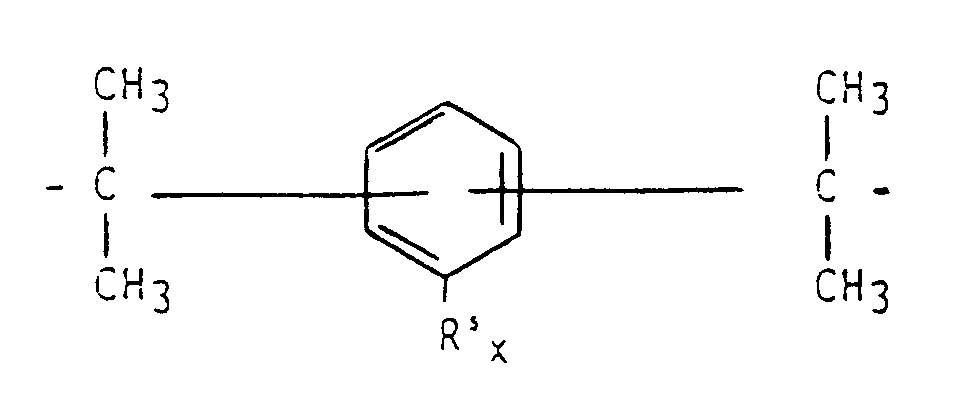
X est égal à 0 ou 1; et
R⁵ est tel que défini ci-dessus;
lorsque n = 3;
R représente un radical 1,2,4-triisopropylbenzène-α,α',α''-triyle ou 1,3,5-triisopropylbenzène-α,α',α''-triyle;
à condition que, lorsque n est égal à 1 ou 2 et lorsque R comprend un cycle aromatique, les substituants du cycle dans le cas d'une disubstitution, ne doivent pas être en position ortho l'un par rapport à l'autre et, dans le cas d'une trisubstitution, ne doivent pas être sur trois positions adjacentes. - Un procédé selon la revendication 13, caractérisé en ce que R¹, R², R³ et R⁴ sont des atomes d'hydrogène.
- Un procédé selon l'une quelconque des revendications 13-14. caractérisé en ce que le peroxyde est:- 3-allylperoxy-3,3-diméthylpropène,- 3-(1-méthyl-2-propénylperoxy)-3,3-diméthylpropène,- 2-allylperoxy-2-méthylpropane,- 2-(1-méthyl-2-propénylperoxy)-2-méthylpropane,- 1-allylperoxy-1,1-diméthylbutane,- 1-allylperoxy-1,1,3,3-tétraméthylbutane,- 1-allylperoxy-1,1-diméthyl-3-hydroxybutane,- 1-allylperoxy-1,1-diméthylpropane,- 1-(1-méthyl-2-propénylperoxy)-1,1-diméthylpropane,- 1-(1-allylperoxy-1-méthyléthyl)-4-méthylcyclohexane,- (1-(2-méthyl-2-propénylperoxy)-1-méthyléthyl)benzène,- (1-allylperoxy-1-méthyléthyl)benzène,- (1-(1-méthyl-2-propénylperoxy)-1-méthyléthyl)benzène,- (1-(2-cyclohexénylperoxy)-1-méthyléthyl)benzène,- 1,3-di(1-allylperoxy-1-méthyléthyl)benzène,- 1,4-di(1-allylperoxy-1-méthyléthyl)benzène,- 1,3,5-tri(1-allylperoxy-1-méthyléthyl)benzène,- 2,5-di(allylperoxy)-2,5-diméthylhexane, ou- 2,5-di(allylperoxy)-2,5-diméthyl-3-hexyne.
- Un procédé selon l'une quelconque des revendications 13 à 15, caractérisé en ce que la quantité de peroxyde est de 0,01 à 15% en poids, par rapport au poids du (co)polymère, la température de la réaction est de 50°C à 250°C et la durée de l'étape de modification est d'au moins cinq fois la période de demi-vie du peroxyde.
- Un procédé selon les revendications 13 à 16, caractérisé en ce que le (co)polymère est mis en contact avec ledit peroxyde organique de formule (I) avec un coagent de réticulation polyinsaturé.
- Un procédé selon la revendication 17, dans lequel le coagent est sélectionné dans le groupe comprenant les dérivés de di- et triallyle, les dérivés de di- et tri-(meth)acrylate, les dérivés de bismaléide, les dérivés de divinyle, les polyalkénylbenzènes et leurs polymères, vinyltoluène, vinylpyridine, paraquinone dioxime, polybutadiène et leurs dérivés.
Priority Applications (4)
| Application Number | Priority Date | Filing Date | Title |
|---|---|---|---|
| FI885748A FI92071C (fi) | 1987-12-14 | 1988-12-12 | Menetelmä (seka)polymeerien modifioimiseksi orgaanisia peroksideja käyttäen |
| NO885500A NO172497C (no) | 1987-12-14 | 1988-12-12 | Fremgangsmaate formodifikasjon av (ko)polymerer ved anvendelse av organiske peroksyder og anvendelse av disse |
| JP31308188A JP2640258B2 (ja) | 1987-12-14 | 1988-12-13 | 有機過酸化物を使用するポリマーの改質 |
| CA 585774 CA1326580C (fr) | 1987-12-14 | 1988-12-13 | Modification de (co)polymeres a l'aide de peroxydes organiques |
Applications Claiming Priority (2)
| Application Number | Priority Date | Filing Date | Title |
|---|---|---|---|
| NL8703014 | 1987-12-14 | ||
| NL8703014A NL8703014A (nl) | 1987-12-14 | 1987-12-14 | Bereiding van epoxidegroepen-bevattende (co)polymeren onder toepassing van organische peroxiden. |
Publications (2)
| Publication Number | Publication Date |
|---|---|
| EP0322945A1 EP0322945A1 (fr) | 1989-07-05 |
| EP0322945B1 true EP0322945B1 (fr) | 1994-11-02 |
Family
ID=19851086
Family Applications (1)
| Application Number | Title | Priority Date | Filing Date |
|---|---|---|---|
| EP88202797A Expired - Lifetime EP0322945B1 (fr) | 1987-12-14 | 1988-12-06 | Modification de (co)polymères à l'aide de peroxydes organiques |
Country Status (5)
| Country | Link |
|---|---|
| US (1) | US5037892A (fr) |
| EP (1) | EP0322945B1 (fr) |
| DE (1) | DE3852016T2 (fr) |
| ES (1) | ES2064342T3 (fr) |
| NL (1) | NL8703014A (fr) |
Families Citing this family (14)
| Publication number | Priority date | Publication date | Assignee | Title |
|---|---|---|---|---|
| US5157087A (en) * | 1986-12-04 | 1992-10-20 | Akzo N.V. | Organic peroxides and their use in the preparation of epoxide groups-containing (co)polymers |
| AU672298B2 (en) * | 1989-11-01 | 1996-09-26 | Commonwealth Scientific And Industrial Research Organisation | Control of molecular weight and end group functionality in polymers |
| US5698648A (en) * | 1989-11-01 | 1997-12-16 | The Commonwealth Of Australia Commonwealth Scientific And Industrial Research Organisation | Control of Molecular weight and end group functionality in polymers using unsaturated peroxy compounds as chain transfer agents |
| ATE154343T1 (de) * | 1989-11-01 | 1997-06-15 | Commw Scient Ind Res Org | Kontrolle des molekulargewichts und der endgruppenfunktionalität in polymeren unter verwendung ungesättigter peroxide als kettenübertragungsmittel |
| JPH05501573A (ja) * | 1989-11-15 | 1993-03-25 | アクゾ ナムローゼ フェンノートシャップ | アリルヒドロペルオキシド連鎖移動剤 |
| NO912922L (no) * | 1990-09-05 | 1992-03-06 | Atochem North America | Peroksyder for polymeriseringsreaksjoner. |
| US5292839A (en) * | 1990-10-16 | 1994-03-08 | Akzo N.V. | Allyl peroxyketal chain transfer agents |
| DE69304707T2 (de) * | 1992-08-27 | 1997-03-06 | Akzo Nobel Nv | Verfahren zur modifizierung von alfa-olefincopolymeren |
| US5443898A (en) * | 1993-06-29 | 1995-08-22 | Fiberweb North America, Inc. | Nonwoven webs and method of making same |
| US5447985A (en) * | 1993-10-28 | 1995-09-05 | Akzo Nobel N.V. | Modification of (CO)polymers with unsaturated peroxyacids |
| ATE177118T1 (de) * | 1994-07-21 | 1999-03-15 | Akzo Nobel Nv | Modifizierung von (co)polymeren mit cyclischen ketonperoxiden |
| ATE219782T1 (de) | 1997-09-18 | 2002-07-15 | Monsanto Co | Modifizierte polyhydroxyalkanoate zur herstellung von überzügen und filmen |
| JP3846029B2 (ja) * | 1998-05-14 | 2006-11-15 | ユニマテック株式会社 | 両末端cooh基含有フッ素化オリゴマーの製造法 |
| CN114316280B (zh) * | 2021-11-30 | 2023-07-14 | 金发科技股份有限公司 | 一种pc/pbt复合材料及其制备方法和应用 |
Citations (1)
| Publication number | Priority date | Publication date | Assignee | Title |
|---|---|---|---|---|
| EP0273990A1 (fr) * | 1986-12-05 | 1988-07-13 | Akzo N.V. | Péroxydes organiques et leur utilisation dans la préparation de (co)-polymères contenant des groupes époxydes |
Family Cites Families (8)
| Publication number | Priority date | Publication date | Assignee | Title |
|---|---|---|---|---|
| US2516649A (en) * | 1946-12-10 | 1950-07-25 | Shell Dev | Unsaturated organic peroxide and method of making same |
| DE1719111A1 (de) * | 1967-04-07 | 1971-06-03 | Akad Wissenschaften Ddr | Verfahren zur Herstellung von Verbunden zwischen Polyolefinen und Metallen |
| FR2123590A5 (en) * | 1971-01-14 | 1972-09-15 | Anvar | Peroxided polymers - for making graft or sequenced copolymers of controlled structure |
| SU690028A1 (ru) * | 1976-06-22 | 1979-10-05 | Предприятие П/Я А-7345 | Способ получени ударопрочного полистирола |
| US4131725A (en) * | 1977-08-08 | 1978-12-26 | Phillips Petroleum Company | Polymer epoxidation process |
| US4595632A (en) * | 1984-02-06 | 1986-06-17 | American Hospital Supply Corporation | Fluorocarbon grafting of polymeric substrates |
| US4774293A (en) * | 1985-06-26 | 1988-09-27 | Akzo N.V. | Process for cross-linking or degrading polymers and shaped articles obtained by this process |
| US4705888A (en) * | 1985-09-30 | 1987-11-10 | Akzo Nv | t-Alkenyl peroxy esters |
-
1987
- 1987-12-14 NL NL8703014A patent/NL8703014A/nl not_active Application Discontinuation
-
1988
- 1988-12-06 ES ES88202797T patent/ES2064342T3/es not_active Expired - Lifetime
- 1988-12-06 DE DE3852016T patent/DE3852016T2/de not_active Expired - Fee Related
- 1988-12-06 EP EP88202797A patent/EP0322945B1/fr not_active Expired - Lifetime
- 1988-12-13 US US07/283,676 patent/US5037892A/en not_active Expired - Fee Related
Patent Citations (1)
| Publication number | Priority date | Publication date | Assignee | Title |
|---|---|---|---|---|
| EP0273990A1 (fr) * | 1986-12-05 | 1988-07-13 | Akzo N.V. | Péroxydes organiques et leur utilisation dans la préparation de (co)-polymères contenant des groupes époxydes |
Also Published As
| Publication number | Publication date |
|---|---|
| NL8703014A (nl) | 1989-07-03 |
| DE3852016T2 (de) | 1995-05-18 |
| DE3852016D1 (de) | 1994-12-08 |
| EP0322945A1 (fr) | 1989-07-05 |
| ES2064342T3 (es) | 1995-02-01 |
| US5037892A (en) | 1991-08-06 |
Similar Documents
| Publication | Publication Date | Title |
|---|---|---|
| US5202386A (en) | Modification of (co)polymers employing organic peroxides | |
| EP0322945B1 (fr) | Modification de (co)polymères à l'aide de peroxydes organiques | |
| US4134927A (en) | Production of thermoplastic olefin elastomers | |
| AU1669399A (en) | Extrusion process for enhancing the melt strength of polypropylene | |
| US3678134A (en) | Blend of ethylene-butene copolymer with butadiene-styrene radial block copolymer | |
| CA2343032C (fr) | Materiau d'emballage polymerique fonctionnalise et regio-regulier | |
| EP1777237B1 (fr) | Composition de caoutchouc butyle modifiée | |
| CA1173988A (fr) | Agent de renforcement pour polymeres thermoplastiques charges | |
| WO1996003444A1 (fr) | Modification de copolymeres a l'aide de peroxydes de cetone cycliques | |
| CA1100509A (fr) | Co-agents insatures d'hydantoine | |
| EP0273990B1 (fr) | Péroxydes organiques et leur utilisation dans la préparation de (co)-polymères contenant des groupes époxydes | |
| FI96958C (fi) | Menetelmä (ko)polymeerien modifioimiseksi | |
| CA1326580C (fr) | Modification de (co)polymeres a l'aide de peroxydes organiques | |
| US4774266A (en) | N-substituted 5-phenyltetrazoles as high temperature blowing agents | |
| Bhattacharjee et al. | Properties and degradation of nitrile rubber | |
| EP0412832A2 (fr) | Substance modifiée par greffage, son procédé de préparation et composition de résine l'utilisant | |
| JPH04216808A (ja) | 重合可能なモノマーとオレフィン/一酸化炭素コポリマーとのグラフトコポリマー | |
| WO1991000301A1 (fr) | MODIFICATION DE (CO)POLYMERES AU MOYEN DE CARBONATES DE t-ALKYL PEROXYALKENYLES INSATURES | |
| WO1991000300A1 (fr) | MODIFICATION DE (CO)POLYMERES AU MOYEN DE t-ALKYLPEROXY ALKYLENES | |
| EP1658315B1 (fr) | Procede permettant d'ameliorer la resistance a la flamme du polypropylene | |
| US5157087A (en) | Organic peroxides and their use in the preparation of epoxide groups-containing (co)polymers | |
| EP0397276B1 (fr) | Polymères élastomères fonctionnalisés | |
| JPS598282B2 (ja) | ポリオレフインの変性方法 | |
| JPH0423812A (ja) | α―オレフィン共重合体およびその製造方法 | |
| JPS63128012A (ja) | 変性オレフイン系樹脂の製造法 |
Legal Events
| Date | Code | Title | Description |
|---|---|---|---|
| PUAI | Public reference made under article 153(3) epc to a published international application that has entered the european phase |
Free format text: ORIGINAL CODE: 0009012 |
|
| AK | Designated contracting states |
Kind code of ref document: A1 Designated state(s): BE DE ES FR GB IT NL SE |
|
| 17P | Request for examination filed |
Effective date: 19891213 |
|
| 17Q | First examination report despatched |
Effective date: 19910812 |
|
| RAP1 | Party data changed (applicant data changed or rights of an application transferred) |
Owner name: AKZO NOBEL N.V. |
|
| GRAA | (expected) grant |
Free format text: ORIGINAL CODE: 0009210 |
|
| AK | Designated contracting states |
Kind code of ref document: B1 Designated state(s): BE DE ES FR GB IT NL SE |
|
| REF | Corresponds to: |
Ref document number: 3852016 Country of ref document: DE Date of ref document: 19941208 |
|
| ET | Fr: translation filed | ||
| ITF | It: translation for a ep patent filed | ||
| REG | Reference to a national code |
Ref country code: ES Ref legal event code: FG2A Ref document number: 2064342 Country of ref document: ES Kind code of ref document: T3 |
|
| PLBE | No opposition filed within time limit |
Free format text: ORIGINAL CODE: 0009261 |
|
| STAA | Information on the status of an ep patent application or granted ep patent |
Free format text: STATUS: NO OPPOSITION FILED WITHIN TIME LIMIT |
|
| 26N | No opposition filed | ||
| PGFP | Annual fee paid to national office [announced via postgrant information from national office to epo] |
Ref country code: FR Payment date: 19961104 Year of fee payment: 9 |
|
| PGFP | Annual fee paid to national office [announced via postgrant information from national office to epo] |
Ref country code: SE Payment date: 19961105 Year of fee payment: 9 |
|
| PGFP | Annual fee paid to national office [announced via postgrant information from national office to epo] |
Ref country code: GB Payment date: 19961108 Year of fee payment: 9 |
|
| PGFP | Annual fee paid to national office [announced via postgrant information from national office to epo] |
Ref country code: DE Payment date: 19961118 Year of fee payment: 9 |
|
| PGFP | Annual fee paid to national office [announced via postgrant information from national office to epo] |
Ref country code: BE Payment date: 19961129 Year of fee payment: 9 |
|
| PGFP | Annual fee paid to national office [announced via postgrant information from national office to epo] |
Ref country code: NL Payment date: 19961230 Year of fee payment: 9 |
|
| PGFP | Annual fee paid to national office [announced via postgrant information from national office to epo] |
Ref country code: ES Payment date: 19970116 Year of fee payment: 9 |
|
| PG25 | Lapsed in a contracting state [announced via postgrant information from national office to epo] |
Ref country code: GB Free format text: LAPSE BECAUSE OF NON-PAYMENT OF DUE FEES Effective date: 19971206 |
|
| PG25 | Lapsed in a contracting state [announced via postgrant information from national office to epo] |
Ref country code: SE Free format text: LAPSE BECAUSE OF NON-PAYMENT OF DUE FEES Effective date: 19971207 |
|
| PG25 | Lapsed in a contracting state [announced via postgrant information from national office to epo] |
Ref country code: FR Free format text: THE PATENT HAS BEEN ANNULLED BY A DECISION OF A NATIONAL AUTHORITY Effective date: 19971231 Ref country code: BE Free format text: LAPSE BECAUSE OF NON-PAYMENT OF DUE FEES Effective date: 19971231 |
|
| BERE | Be: lapsed |
Owner name: AKZO NOBEL N.V. Effective date: 19971231 |
|
| PG25 | Lapsed in a contracting state [announced via postgrant information from national office to epo] |
Ref country code: NL Free format text: LAPSE BECAUSE OF NON-PAYMENT OF DUE FEES Effective date: 19980701 |
|
| GBPC | Gb: european patent ceased through non-payment of renewal fee |
Effective date: 19971206 |
|
| NLV4 | Nl: lapsed or anulled due to non-payment of the annual fee |
Effective date: 19980701 |
|
| PG25 | Lapsed in a contracting state [announced via postgrant information from national office to epo] |
Ref country code: DE Free format text: LAPSE BECAUSE OF NON-PAYMENT OF DUE FEES Effective date: 19980901 |
|
| EUG | Se: european patent has lapsed |
Ref document number: 88202797.2 |
|
| REG | Reference to a national code |
Ref country code: FR Ref legal event code: ST |
|
| PG25 | Lapsed in a contracting state [announced via postgrant information from national office to epo] |
Ref country code: ES Free format text: LAPSE BECAUSE OF NON-PAYMENT OF DUE FEES Effective date: 19981207 |
|
| REG | Reference to a national code |
Ref country code: ES Ref legal event code: FD2A Effective date: 19990114 |
|
| PG25 | Lapsed in a contracting state [announced via postgrant information from national office to epo] |
Ref country code: IT Free format text: LAPSE BECAUSE OF NON-PAYMENT OF DUE FEES;WARNING: LAPSES OF ITALIAN PATENTS WITH EFFECTIVE DATE BEFORE 2007 MAY HAVE OCCURRED AT ANY TIME BEFORE 2007. THE CORRECT EFFECTIVE DATE MAY BE DIFFERENT FROM THE ONE RECORDED. Effective date: 20051206 |