EP0325050B1 - Feuchtigkeitsmesser - Google Patents
Feuchtigkeitsmesser Download PDFInfo
- Publication number
- EP0325050B1 EP0325050B1 EP88312131A EP88312131A EP0325050B1 EP 0325050 B1 EP0325050 B1 EP 0325050B1 EP 88312131 A EP88312131 A EP 88312131A EP 88312131 A EP88312131 A EP 88312131A EP 0325050 B1 EP0325050 B1 EP 0325050B1
- Authority
- EP
- European Patent Office
- Prior art keywords
- hygrometer
- substrate
- accordance
- measuring zones
- zones
- Prior art date
- Legal status (The legal status is an assumption and is not a legal conclusion. Google has not performed a legal analysis and makes no representation as to the accuracy of the status listed.)
- Expired - Lifetime
Links
- 239000000758 substrate Substances 0.000 claims description 23
- XLYOFNOQVPJJNP-UHFFFAOYSA-N water Substances O XLYOFNOQVPJJNP-UHFFFAOYSA-N 0.000 claims description 5
- 230000001419 dependent effect Effects 0.000 claims description 2
- PNEYBMLMFCGWSK-UHFFFAOYSA-N Alumina Chemical compound [O-2].[O-2].[O-2].[Al+3].[Al+3] PNEYBMLMFCGWSK-UHFFFAOYSA-N 0.000 description 42
- 238000005259 measurement Methods 0.000 description 7
- XAGFODPZIPBFFR-UHFFFAOYSA-N aluminium Chemical compound [Al] XAGFODPZIPBFFR-UHFFFAOYSA-N 0.000 description 4
- 229910052782 aluminium Inorganic materials 0.000 description 4
- 239000004411 aluminium Substances 0.000 description 4
- 239000010408 film Substances 0.000 description 3
- 239000003990 capacitor Substances 0.000 description 2
- 238000010586 diagram Methods 0.000 description 2
- 239000000463 material Substances 0.000 description 2
- 230000003647 oxidation Effects 0.000 description 2
- 238000007254 oxidation reaction Methods 0.000 description 2
- -1 polytetrafluoroethylene Polymers 0.000 description 2
- 0 CC(**CC1)*C(CC2)=S[C@@]2[C@@]1S#C Chemical compound CC(**CC1)*C(CC2)=S[C@@]2[C@@]1S#C 0.000 description 1
- 239000000853 adhesive Substances 0.000 description 1
- 230000001070 adhesive effect Effects 0.000 description 1
- 230000032683 aging Effects 0.000 description 1
- 239000000919 ceramic Substances 0.000 description 1
- 230000007797 corrosion Effects 0.000 description 1
- 238000005260 corrosion Methods 0.000 description 1
- 238000000151 deposition Methods 0.000 description 1
- 238000001514 detection method Methods 0.000 description 1
- 238000005530 etching Methods 0.000 description 1
- 239000011521 glass Substances 0.000 description 1
- PCHJSUWPFVWCPO-UHFFFAOYSA-N gold Chemical compound [Au] PCHJSUWPFVWCPO-UHFFFAOYSA-N 0.000 description 1
- 239000010931 gold Substances 0.000 description 1
- 229910052737 gold Inorganic materials 0.000 description 1
- 239000000203 mixture Substances 0.000 description 1
- 229920001343 polytetrafluoroethylene Polymers 0.000 description 1
- 239000004810 polytetrafluoroethylene Substances 0.000 description 1
- 229910052710 silicon Inorganic materials 0.000 description 1
- 239000010703 silicon Substances 0.000 description 1
- 229920002379 silicone rubber Polymers 0.000 description 1
- 239000004945 silicone rubber Substances 0.000 description 1
- 239000010409 thin film Substances 0.000 description 1
Images

Classifications
-
- G—PHYSICS
- G01—MEASURING; TESTING
- G01N—INVESTIGATING OR ANALYSING MATERIALS BY DETERMINING THEIR CHEMICAL OR PHYSICAL PROPERTIES
- G01N33/00—Investigating or analysing materials by specific methods not covered by groups G01N1/00 - G01N31/00
- G01N33/0004—Gaseous mixtures, e.g. polluted air
- G01N33/0009—General constructional details of gas analysers, e.g. portable test equipment
- G01N33/0027—General constructional details of gas analysers, e.g. portable test equipment concerning the detector
- G01N33/0031—General constructional details of gas analysers, e.g. portable test equipment concerning the detector comprising two or more sensors, e.g. a sensor array
-
- G—PHYSICS
- G01—MEASURING; TESTING
- G01N—INVESTIGATING OR ANALYSING MATERIALS BY DETERMINING THEIR CHEMICAL OR PHYSICAL PROPERTIES
- G01N27/00—Investigating or analysing materials by the use of electric, electrochemical, or magnetic means
- G01N27/02—Investigating or analysing materials by the use of electric, electrochemical, or magnetic means by investigating impedance
- G01N27/04—Investigating or analysing materials by the use of electric, electrochemical, or magnetic means by investigating impedance by investigating resistance
- G01N27/12—Investigating or analysing materials by the use of electric, electrochemical, or magnetic means by investigating impedance by investigating resistance of a solid body in dependence upon absorption of a fluid; of a solid body in dependence upon reaction with a fluid, for detecting components in the fluid
- G01N27/121—Investigating or analysing materials by the use of electric, electrochemical, or magnetic means by investigating impedance by investigating resistance of a solid body in dependence upon absorption of a fluid; of a solid body in dependence upon reaction with a fluid, for detecting components in the fluid for determining moisture content, e.g. humidity, of the fluid
Definitions
- This invention relates to hygrometers or humidity sensors of the electrical impedance type which are used for measuring continuously the dewpoint of a gas or gas mixture.
- sensors are known from JP-A-6 111 648 and US-A-3 121 853.
- the sensing element of such a hygrometer typically comprises a substrate formed of aluminium on which a porous aluminium oxide film is formed by anodic oxidation. This porous aluminium oxide film is then covered by a porous conducting electrode. Water vapour from the atmosphere surrounding the sensor element is adsorbed onto the porous aluminium oxide layer and its electrical properties such as its dielectric constant and its resistance vary with the quantity of water vapour adsorbed onto it. As the electrical properties of the porous aluminium oxide layer vary so does the impedance of the sensing element.
- the hygrometer includes a sensing circuit which measures the electrical impedance of the sensing element and produces an output indicative of the absolute, or percentage humidity of the atmosphere surrounding the sensor element. It is also known to use other materials such as silicon for the substrate.
- any change in the electrical characteristics of the sensing element for example as a result of ageing or corrosion, which is not directly attributable to a change in the humidity will give rise to a false indication of the humidity.
- such a hygrometer has its conducting electrode divided into a number of separate measuring zones and the hygrometer includes a redundancy system circuit which receives separate outputs one from each of the respective measuring zones and only produces an output indicative of the humidity when the output from at least two of the separate measuring zones are in agreement.
- the conducting surface of the sensing element may be divided into only two separate measuring zones and the redundancy system circuit be arranged to provide an output only when the humidity measurement from the two zones are in agreement with one another but, preferably, the conducting electrode surface is divided into an odd number of measuring zones and the redundancy system circuit provides an output corresponding to the humidity measurement provided by the majority of the measuring zones.
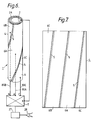
- the substrate of the sensing element may be generally cylindrical and, in this case its conducting electrode may be divided in the axially extending direction into a number of circumferentially separated measuring zones, may be divided helically into a number of helically extending measuring zones or may be divided into a number of circumferentially extending zones which are axially separated from one another along the length of the cylindrical substrate.
- the substrate may be substantially flat.
- the first example of electrical impedance type hygrometer comprises a generally cylindrical main body 1 having a substrate 2 formed of aluminium in the form of a hollow cylinder which constitutes a common electrode 2A.
- a porous dielectric moisture adsorbative layer 3 is provided on the outer surface of the substrate 2 and includes adsorbative recesses 3A.
- the adsorbative layer 3 is formed of highly insulating porous aluminium oxide formed by anodic oxidation of the surface of the substrate 2.
- the dielectric constant and resistance of the porous aluminium oxide layer 3 vary as water vapour molecules are adsorbed and desorbed from it. The quantity of water vapour adsorbed onto the porous aluminium oxide film depends upon the humidity of the atmosphere surrounding it.
- a porous conducting electrode 4 comprising a thin film of gold or other material is vapour coated onto the outside of the porous aluminium oxide layer 3.
- the sensing element of the hygrometer is constructed as an electrical capacitor with the substrate 2 and electrode 4 forming its electrodes and the porous aluminium oxide layer 3 which is sandwiched between the two electrodes forming the dielectric layer.
- the aluminium oxide layer 3 and the electrode 4 are each formed to have a thickness of the order of tens or several tens of microns. Longitudinally extending gaps 5 are equiangularly spaced around the sensing element and formed by regions in which the conducting electrode 4 is absent.
- the gaps 5 may be formed by depositing the conducting electrode 4 only on the region of the surface of the porous aluminium oxide layer 3 where it is required or, alternatively, the electrode 4 may be provided over the entire surface of the porous aluminium oxide layer and then the gaps 5 formed by an etching step to remove the conducting electrode 4 from the regions of the gap 5.
- the conducting electrode 4 is divided into three separate measuring zones 6A, 6B and 6C all having the same area. Typically the area of each of the zones 6A, 6B, and 6C is substantially the same as the area of a conventional hygrometer sensing element.
- the hygrometer also includes a redundancy system circuit 7 and the measuring zones 6A, 6B and 6C are connected to the redundancy system circuit 7 by connecting leads 8A, 8B and 8C having signal lines 80A, 80B and 80C.
- the substrate 2 forming the common electrode 2A is also connected to the redundancy circuit 7 by a lead 9.
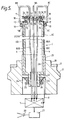
- Figures 4 and 5 illustrate the specific manner in which the insulated electrical leads 8A, 8B and 8C are connected to their respective measuring zones 6A, 6B and 6C. Bared end portions of the leads 11A are held in contact with the conducting electrode 4 of each of the zones 6A, 6B and 6C by an insulating band 10 of silicone rubber or polytetrafluoroethylene.
- the insulated leads 8A, 8B and 8C are connected to leadthroughs 13 which are hermetically sealed into a glass or ceramic plate 14 which is clamped to the upper end, as shown in Figures 4 and 8, of the sensing element.
- the upper end of the substrate 2 includes an inwardly directed flange 15 and the plate 14 is sandwiched between O-ring seals 17 and 18 and an annular plate 16 which is clamped to the flange 15 by screw threaded fastenings 18 (not shown in detail).
- the plate 14 may be connected by brasing or adhesive.
- an insulating sleeve 20 insulates the substrate 2 and conducting electrode 4 from a metallic mount 21.
- the main body 1 is also electrically insulated from the mount 21 by polytetrafluorethylene rings 22 and 23 and held in position by clamping nuts 24 and 25 which are secured to a screw threaded spiggot formed integrally with the aluminium sleeve 2.
- the connecting lead 9 is connected to the terminal ring 26 and clamped between the two clamping nuts 24 and 25.
- the redundancy system circuit 7 is preferably capable of operating in a number of separate modes such as a parallel mode, in which all three zones 6A, 6B and 6C are monitored in parallel, a two out of three mode in which the outputs of only two of the three zones 6A, 6B and 6C are used to provide an output signal and two/three decision by majority mode in which when there is a difference in the outputs from the zones 6A, 6B and 6C the redundancy circuit selects the two outputs that are similar and provides an output in accordance with them.
- An electrical impedance measuring device 27 provides an output (not shown) which is dependent upon the impedance of the capacitor formed by the substrate 2, electrode 4 and dielectric 3, and is calibrated to provide an indication of the humidity of the atmosphere surrounding the sensor element 1.
- An alarm indicator 28 provides a first indication in the event that the output of one of the zones 6A, 6B and 6C differs from that of the others so that the output of the device is given taking into account the output of only two of the three measuring zones 6A, 6B and 6C.
- the alarm device 28 has a second alarm indication when the outputs from all three zones 6A, 6B and 6C are different so that, no effective output indicative of the humidity is provided by the device.
- any pair of the measuring zones 6A, 6B and 6C indicate respective measurements which are substantially equal to each other, within an allowable tolerance, and the remaining one indicates a measurement difference from these two values
- an output signal from the redundancy system circuit 7 corresponding to the two equal values is displayed with an output of the electrical measuring device 27.
- all three measuring zones 6A, 6B and 6C indicate respective measurements which are different from one another no output signal is provided from the electrical impedance measuring device 27 and the second output of the alarm 28 will be activated.
- the alarm 28 may be implemented in the form of a red warning lamp, in the form of an audible alarm or one for each alarm state.
- the gaps 5 extend longitudinally to divide the electrode 4 into three separate longitudinally extending panels each of which subtends an equal angle at the axis of the substrate.
- the difference between the examples in accordance with this invention lies only in the form of their sensing elements 1 and in the way in which the conducting electrodes 4 of the sensing elements 1 are divided.
- the grooves 5 are helical and divide the conducting electrode 4 into three helically extending panels 6A, 6B and 6C.
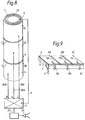
- the gaps 5 extend circumferentially and so divide the conducting electrode 4 into three longitudinally spaced rings.
- the aluminium substrate 2 is formed by a flat plate having porous aluminium oxide 3 deposited on one face and the conducting electrode 4 deposited on top of the porous aluminium oxide layer 3.
- the substrate 2 is generally rectangular and the gaps 5 divide the conducting electrode 4 into three zones 6A, 6B and 6C of substantially equal area.
- the surface of the conducting electrode 4 is divided into a number of separate measuring zones 6A, 6B and 6C the respective signals from which are input into the redundancy system circuit 7 it is possible to provide the number of separate sensing elements without substantially increasing the size or volume of the hygrometer. Additionally, by providing a number of different sensors at one and the same location it is possible to detect a fault in the hygrometer and average out the signal from more than one sensing element to provide a more reliable humidity measurement.
Landscapes
- Chemical & Material Sciences (AREA)
- Health & Medical Sciences (AREA)
- Life Sciences & Earth Sciences (AREA)
- Analytical Chemistry (AREA)
- General Health & Medical Sciences (AREA)
- Pathology (AREA)
- Immunology (AREA)
- Physics & Mathematics (AREA)
- Engineering & Computer Science (AREA)
- Biochemistry (AREA)
- General Physics & Mathematics (AREA)
- Combustion & Propulsion (AREA)
- Medicinal Chemistry (AREA)
- Food Science & Technology (AREA)
- Chemical Kinetics & Catalysis (AREA)
- Electrochemistry (AREA)
- Investigating Or Analyzing Materials By The Use Of Electric Means (AREA)
- Investigating Or Analyzing Materials By The Use Of Fluid Adsorption Or Reactions (AREA)
Claims (9)
- Feuchtigkeitsmesser des elektrischen Impedanz-Typs, umfassend ein Sensorelement (1), einschließlich einer porösen, feuchtigkeitsadsorbierenden Schicht (3) mit elektrischen Eigenschaften, die sich mit der Menge des darauf adsorbierten Wasserdampfes verändern kann und die zwischen einem elektrisch leitenden Substrat (2) und einer porösen leitenden Elektrode (4) sandwichartig angeordnet ist, dadurch gekennzeichnet, daß die poröse leitende Elektrode (4) in eine Anzahl getrennter Meßzonen (6A,6B,6C) unterteilt ist, und daß der Feuchtigkeitsmesser eine Redundanzsystem-Schaltung (7), die die getrennten Ausgangssignale bzw. -leistungen von jeder der entsprechenden Meßzonen (6A,6B,6C) empfängt und lediglich die Feuchtigkeit anzeigendes Ausgangssignal liefert, wenn die Ausgangsleistung von mindestens zwei der getrennten Zonen (6A,6B,6C) in Übereinstimmung sind.
- Feuchtigkeitsmesser nach Anspruch 1, bei dem die leitende Elektrode (4) in eine ungrade Anzahl von Meßzonen (6A,6B,6C) unterteilt ist, und wobei die Redundanzsystem-Schaltung (7) ein Feuchtigkeitsausgangssignal liefert, das von der Ausgangsleistung der Mehrzahl der Meßzonen (6A,6B,6C) abhängt.
- Feuchtigkeitsmesser nach Anspruch 1 oder Anspruch 2, der ebenfalls eine Alarmvorichtung (28) umfaßt, und in dem die Redundanzsystem-Schaltung (7) angeordnet ist, um die Alarmvorichtung (28) in dem Fall auszulösen, wo die Ausgangsleistungen von sämtlichen Meßzonen (6A,6B,6C) unterschiedlich sind.
- Feuchtigkeitsmesser nach irgendeinem der vorstehenden Ansprüche, bei dem die leitende Elektrode (4) in drei voneinander getrennte Meßzonen (6A,6B,6C) unterteilt ist, und bei dem die Redundanzsystem-Schaltung (7) eine Ausgangsleistung bzw. -signal liefert, das den zwei Signalen von den drei Meßzonen (6A,6B,6C) entspricht, die im wesentlichen gleich sind.
- Feuchtigkeitsmesser nach irgendeinem der vorstehenden Ansprüche, bei dem das Substrat (2) zylindrisch ist.
- Feuchtigkeitsmesser nach Anspruch 5, bei dem die Meßzonen (6A,6B,6C) sich längs der Außenfläche des zylindrischen Substrats (2) erstrecken und sich in einem gleichen Winkel zur Achse des Substrats (2) gegenüberliegen.
- Feuchtigkeitsmesser nach Anspruch 5, bei dem die Meßzonen (6A,6B,6C) sich schraubenförmig um die Außenseite des zylindrischen Substrats (2) erstrecken.
- Feuchtigkeitsmesser nach Anspruch 5, bei dem die Meßzonen (6A,6B,6C) die Form einer Anzahl sich in Längsrichtung voneinander getrennter Ringe bilden, die auf der Außenfläche des Substrats (2) ausgebildet sind.
- Feuchtigkeitsmesser nach irgendeinem der Ansprüche 1 bis 4, bei dem das Substrat (2) im wesentlichen eben ist.
Applications Claiming Priority (2)
| Application Number | Priority Date | Filing Date | Title |
|---|---|---|---|
| JP62325797A JPH01167646A (ja) | 1987-12-23 | 1987-12-23 | 電気容量型湿度計 |
| JP325797/87 | 1987-12-23 |
Publications (3)
| Publication Number | Publication Date |
|---|---|
| EP0325050A2 EP0325050A2 (de) | 1989-07-26 |
| EP0325050A3 EP0325050A3 (en) | 1990-05-09 |
| EP0325050B1 true EP0325050B1 (de) | 1993-08-11 |
Family
ID=18180704
Family Applications (1)
| Application Number | Title | Priority Date | Filing Date |
|---|---|---|---|
| EP88312131A Expired - Lifetime EP0325050B1 (de) | 1987-12-23 | 1988-12-21 | Feuchtigkeitsmesser |
Country Status (4)
| Country | Link |
|---|---|
| US (1) | US4891574A (de) |
| EP (1) | EP0325050B1 (de) |
| JP (1) | JPH01167646A (de) |
| DE (1) | DE3883200D1 (de) |
Families Citing this family (23)
| Publication number | Priority date | Publication date | Assignee | Title |
|---|---|---|---|---|
| DE4305934B4 (de) * | 1993-02-26 | 2004-09-30 | CiS Institut für Mikrosensorik gGmbH | Anordnung von Sensoren zur Messung der Luftfeuchte |
| FI98567C (fi) * | 1993-09-29 | 1997-07-10 | Vaisala Oy | Impedanssianturi, etenkin radiosondikäyttöön, sekä menetelmä anturin valmistamiseksi |
| AU3714700A (en) * | 1999-03-03 | 2000-09-21 | Alvin A. Snaper | Self-powered passive system to detect and remotely inform the presence of liquid |
| US6268094B1 (en) * | 2000-06-19 | 2001-07-31 | Eastman Kodak Company | Photosensitive media cartridge having an ambient condition sensor |
| US6450015B1 (en) * | 2000-12-08 | 2002-09-17 | Eastman Kodak Company | Ambient condition sensor for a photosensitive media cartridge |
| US6842018B2 (en) * | 2002-05-08 | 2005-01-11 | Mcintosh Robert B. | Planar capacitive transducer |
| WO2005062986A2 (en) * | 2003-12-31 | 2005-07-14 | The University Of South Carolina | Thin-layer porous optical sensors for gases and other fluids |
| US20070201136A1 (en) * | 2004-09-13 | 2007-08-30 | University Of South Carolina | Thin Film Interference Filter and Bootstrap Method for Interference Filter Thin Film Deposition Process Control |
| US20070166245A1 (en) * | 2005-11-28 | 2007-07-19 | Leonard Mackles | Propellant free foamable toothpaste composition |
| US8345234B2 (en) * | 2005-11-28 | 2013-01-01 | Halliburton Energy Services, Inc. | Self calibration methods for optical analysis system |
| EP1974201A1 (de) * | 2005-11-28 | 2008-10-01 | University of South Carolina | Optisches analysesystem zum dynamischen nachweis und messen in echtzeit |
| WO2007064575A1 (en) | 2005-11-28 | 2007-06-07 | Ometric Corporation | Optical analysis system and method for real time multivariate optical computing |
| WO2008002903A2 (en) | 2006-06-26 | 2008-01-03 | University Of South Carolina | Data validation and classification in optical analysis systems |
| EP2078187A2 (de) * | 2006-11-02 | 2009-07-15 | University of South Carolina | Optisches multianalyt-datenverarbeitungssystem |
| WO2008121692A1 (en) * | 2007-03-30 | 2008-10-09 | University Of South Carolina | Tablet analysis and measurement system |
| WO2008121715A1 (en) * | 2007-03-30 | 2008-10-09 | Ometric Corporation | In-line process measurement systems and methods |
| WO2008121684A1 (en) * | 2007-03-30 | 2008-10-09 | University Of South Carolina | Novel multi-analyte optical computing system |
| WO2009016594A2 (en) * | 2007-08-02 | 2009-02-05 | Nxp B.V. | Humidity sensor based on progressive corrosion of exposed material |
| US8283633B2 (en) * | 2007-11-30 | 2012-10-09 | Halliburton Energy Services, Inc. | Tuning D* with modified thermal detectors |
| US8212213B2 (en) * | 2008-04-07 | 2012-07-03 | Halliburton Energy Services, Inc. | Chemically-selective detector and methods relating thereto |
| US20110057672A1 (en) * | 2009-09-10 | 2011-03-10 | Soilmoisture Equipment Corp. | Coaxial sensor for time-domain reflectometry |
| JP2018132439A (ja) * | 2017-02-16 | 2018-08-23 | Tdk株式会社 | 磁気センサ装置 |
| EP3770593A1 (de) * | 2019-07-26 | 2021-01-27 | Université de Lorraine | Verwendung einer vorrichtung mit einer porösen elektrode und einer elektrisch isolierenden porösen schicht zur entfernung von sauerstoff in kontakt mit einer arbeitselektrode |
Family Cites Families (10)
| Publication number | Priority date | Publication date | Assignee | Title |
|---|---|---|---|---|
| US2834201A (en) * | 1948-11-03 | 1958-05-13 | American Instr Company | Apparatus for measuring humidity conditions in materials |
| US3121853A (en) * | 1958-08-29 | 1964-02-18 | Torry Res Station | Hygrometric elements |
| US3045198A (en) * | 1959-12-11 | 1962-07-17 | James P Dolan | Detection device |
| US3872419A (en) * | 1972-06-15 | 1975-03-18 | Alexander J Groves | Electrical elements operable as thermisters, varisters, smoke and moisture detectors, and methods for making the same |
| GB1550615A (en) * | 1976-07-16 | 1979-08-15 | Electrical Remote Control O Lt | Fail safe gas detector |
| US4092635A (en) * | 1976-09-20 | 1978-05-30 | Baxter Travenol Laboratories, Inc. | Humidity sensor alarm unit |
| DE3001452A1 (de) * | 1980-01-16 | 1981-07-23 | Hans-Günther 8100 Garmisch-Partenkirchen Stadelmayr | Alarm-, sicherungs- und ueberwachungsanlage |
| JPS6117945A (ja) * | 1984-07-04 | 1986-01-25 | Chino Works Ltd | 湿度素子 |
| JPS6118850A (ja) * | 1984-07-06 | 1986-01-27 | Chino Works Ltd | 湿度・結露検出素子 |
| US4662220A (en) * | 1985-06-20 | 1987-05-05 | The United States Of America As Represented By The Administrator Of The National Aeronautics And Space Administration | Water-absorbing capacitor system for measuring relative humidity |
-
1987
- 1987-12-23 JP JP62325797A patent/JPH01167646A/ja active Pending
-
1988
- 1988-12-20 US US07/287,099 patent/US4891574A/en not_active Expired - Fee Related
- 1988-12-21 EP EP88312131A patent/EP0325050B1/de not_active Expired - Lifetime
- 1988-12-21 DE DE8888312131T patent/DE3883200D1/de not_active Expired - Lifetime
Also Published As
| Publication number | Publication date |
|---|---|
| JPH01167646A (ja) | 1989-07-03 |
| EP0325050A3 (en) | 1990-05-09 |
| EP0325050A2 (de) | 1989-07-26 |
| US4891574A (en) | 1990-01-02 |
| DE3883200D1 (de) | 1993-09-16 |
Similar Documents
| Publication | Publication Date | Title |
|---|---|---|
| US4891574A (en) | Hygrometer with plural measuring bones and redundancy system circuit | |
| EP0164316B1 (de) | Elektrischer Inklinationssensor und Verfahren zu seiner Herstellung | |
| US6606911B2 (en) | Pressure sensors | |
| US7832254B2 (en) | Particulate sensor and method for operating a particulate sensor | |
| US20030057968A1 (en) | Liquid property sensor | |
| US4531415A (en) | Differential pressure transducer | |
| JP2001174353A (ja) | 圧力測定装置 | |
| KR910012709A (ko) | 습기 검출 장치 및 방법 | |
| SE469492B (sv) | Daggpunktskaennare | |
| US4651121A (en) | Moisture sensor and a method for the production of the same | |
| CN112710958A (zh) | 电池安全检测装置、电池管理芯片及电池管理系统 | |
| US4947131A (en) | Capacitance bar sensor | |
| JP3399688B2 (ja) | 圧力センサ | |
| US5479716A (en) | Capacitive based gravity sensor | |
| JPS61155931A (ja) | 電気的な圧力発生器 | |
| JPS58731A (ja) | 静電容量式圧力センサ | |
| CN112798662B (zh) | 电池安全检测装置及电池管理系统 | |
| CN214473815U (zh) | 电池安全检测装置、电池管理芯片及电池管理系统 | |
| JP3385392B2 (ja) | 真空センサ | |
| US6583631B2 (en) | Precise dielectric constant sensor | |
| JPS6273131A (ja) | 圧力検出器 | |
| KR20010067306A (ko) | 측정 공정 및 센서 배열 | |
| JPS62200260A (ja) | イオン選択性電極装置 | |
| JP3107441B2 (ja) | 静電容量形圧力センサ | |
| JPS60247129A (ja) | 高圧用圧力検出器 |
Legal Events
| Date | Code | Title | Description |
|---|---|---|---|
| PUAI | Public reference made under article 153(3) epc to a published international application that has entered the european phase |
Free format text: ORIGINAL CODE: 0009012 |
|
| AK | Designated contracting states |
Kind code of ref document: A2 Designated state(s): DE GB |
|
| RAP1 | Party data changed (applicant data changed or rights of an application transferred) |
Owner name: MICHELL INSTRUMENTS LTD |
|
| PUAL | Search report despatched |
Free format text: ORIGINAL CODE: 0009013 |
|
| AK | Designated contracting states |
Kind code of ref document: A3 Designated state(s): DE GB |
|
| 17P | Request for examination filed |
Effective date: 19901108 |
|
| 17Q | First examination report despatched |
Effective date: 19921012 |
|
| GRAA | (expected) grant |
Free format text: ORIGINAL CODE: 0009210 |
|
| AK | Designated contracting states |
Kind code of ref document: B1 Designated state(s): DE GB |
|
| PG25 | Lapsed in a contracting state [announced via postgrant information from national office to epo] |
Ref country code: DE Effective date: 19930811 |
|
| REF | Corresponds to: |
Ref document number: 3883200 Country of ref document: DE Date of ref document: 19930916 |
|
| PG25 | Lapsed in a contracting state [announced via postgrant information from national office to epo] |
Ref country code: GB Effective date: 19931221 |
|
| PLBE | No opposition filed within time limit |
Free format text: ORIGINAL CODE: 0009261 |
|
| STAA | Information on the status of an ep patent application or granted ep patent |
Free format text: STATUS: NO OPPOSITION FILED WITHIN TIME LIMIT |
|
| 26N | No opposition filed | ||
| GBPC | Gb: european patent ceased through non-payment of renewal fee |
Effective date: 19931221 |