EP0326181B1 - Verpackungsmaterial für lichtempfindliche Waren - Google Patents
Verpackungsmaterial für lichtempfindliche Waren Download PDFInfo
- Publication number
- EP0326181B1 EP0326181B1 EP19890101568 EP89101568A EP0326181B1 EP 0326181 B1 EP0326181 B1 EP 0326181B1 EP 19890101568 EP19890101568 EP 19890101568 EP 89101568 A EP89101568 A EP 89101568A EP 0326181 B1 EP0326181 B1 EP 0326181B1
- Authority
- EP
- European Patent Office
- Prior art keywords
- resin
- layer
- packaging material
- resin film
- film
- Prior art date
- Legal status (The legal status is an assumption and is not a legal conclusion. Google has not performed a legal analysis and makes no representation as to the accuracy of the status listed.)
- Expired - Lifetime
Links
- 239000000463 material Substances 0.000 title claims description 67
- 239000005022 packaging material Substances 0.000 title claims description 45
- 229920005989 resin Polymers 0.000 claims description 88
- 239000011347 resin Substances 0.000 claims description 88
- 239000000835 fiber Substances 0.000 claims description 41
- 229910052782 aluminium Inorganic materials 0.000 claims description 29
- XAGFODPZIPBFFR-UHFFFAOYSA-N aluminium Chemical compound [Al] XAGFODPZIPBFFR-UHFFFAOYSA-N 0.000 claims description 29
- 229920005992 thermoplastic resin Polymers 0.000 claims description 23
- 239000006229 carbon black Substances 0.000 claims description 17
- 229920005672 polyolefin resin Polymers 0.000 claims description 16
- 229920001684 low density polyethylene Polymers 0.000 claims description 15
- 239000004702 low-density polyethylene Substances 0.000 claims description 15
- 238000000034 method Methods 0.000 claims description 15
- 229920001038 ethylene copolymer Polymers 0.000 claims description 10
- XLYOFNOQVPJJNP-UHFFFAOYSA-N water Substances O XLYOFNOQVPJJNP-UHFFFAOYSA-N 0.000 claims description 9
- 239000002245 particle Substances 0.000 claims description 8
- 239000012744 reinforcing agent Substances 0.000 claims description 8
- 239000010408 film Substances 0.000 description 120
- 239000010410 layer Substances 0.000 description 98
- 239000000123 paper Substances 0.000 description 42
- 238000004806 packaging method and process Methods 0.000 description 24
- 230000001070 adhesive effect Effects 0.000 description 22
- 229920000092 linear low density polyethylene Polymers 0.000 description 22
- 239000004707 linear low-density polyethylene Substances 0.000 description 22
- 238000007789 sealing Methods 0.000 description 22
- 239000000853 adhesive Substances 0.000 description 21
- 239000011248 coating agent Substances 0.000 description 18
- 239000002655 kraft paper Substances 0.000 description 13
- 238000010030 laminating Methods 0.000 description 13
- 239000000126 substance Substances 0.000 description 13
- 238000001771 vacuum deposition Methods 0.000 description 13
- -1 fatty acid compound Chemical class 0.000 description 12
- 229920001903 high density polyethylene Polymers 0.000 description 11
- 239000004700 high-density polyethylene Substances 0.000 description 11
- 238000001125 extrusion Methods 0.000 description 10
- 239000007789 gas Substances 0.000 description 10
- WSFSSNUMVMOOMR-UHFFFAOYSA-N Formaldehyde Chemical compound O=C WSFSSNUMVMOOMR-UHFFFAOYSA-N 0.000 description 9
- 230000002411 adverse Effects 0.000 description 9
- 239000011888 foil Substances 0.000 description 9
- 239000012790 adhesive layer Substances 0.000 description 8
- 238000000576 coating method Methods 0.000 description 8
- 229920001577 copolymer Polymers 0.000 description 8
- 238000000465 moulding Methods 0.000 description 8
- 238000011282 treatment Methods 0.000 description 8
- 230000004888 barrier function Effects 0.000 description 7
- 230000007423 decrease Effects 0.000 description 7
- 229920000642 polymer Polymers 0.000 description 7
- 239000000839 emulsion Substances 0.000 description 6
- 239000000843 powder Substances 0.000 description 6
- XEEYBQQBJWHFJM-UHFFFAOYSA-N Iron Chemical compound [Fe] XEEYBQQBJWHFJM-UHFFFAOYSA-N 0.000 description 5
- 206010034972 Photosensitivity reaction Diseases 0.000 description 5
- 239000003795 chemical substances by application Substances 0.000 description 5
- 230000036211 photosensitivity Effects 0.000 description 5
- 239000002356 single layer Substances 0.000 description 5
- 239000004372 Polyvinyl alcohol Substances 0.000 description 4
- VYPSYNLAJGMNEJ-UHFFFAOYSA-N Silicium dioxide Chemical compound O=[Si]=O VYPSYNLAJGMNEJ-UHFFFAOYSA-N 0.000 description 4
- DIZPMCHEQGEION-UHFFFAOYSA-H aluminium sulfate (anhydrous) Chemical compound [Al+3].[Al+3].[O-]S([O-])(=O)=O.[O-]S([O-])(=O)=O.[O-]S([O-])(=O)=O DIZPMCHEQGEION-UHFFFAOYSA-H 0.000 description 4
- 230000015556 catabolic process Effects 0.000 description 4
- 230000003247 decreasing effect Effects 0.000 description 4
- 238000006731 degradation reaction Methods 0.000 description 4
- 235000014113 dietary fatty acids Nutrition 0.000 description 4
- 239000000194 fatty acid Substances 0.000 description 4
- 229930195729 fatty acid Natural products 0.000 description 4
- 238000010438 heat treatment Methods 0.000 description 4
- 238000002844 melting Methods 0.000 description 4
- 230000008018 melting Effects 0.000 description 4
- QSHDDOUJBYECFT-UHFFFAOYSA-N mercury Chemical compound [Hg] QSHDDOUJBYECFT-UHFFFAOYSA-N 0.000 description 4
- 229910052753 mercury Inorganic materials 0.000 description 4
- 229910052751 metal Chemical class 0.000 description 4
- 239000002184 metal Chemical class 0.000 description 4
- 239000011104 metalized film Substances 0.000 description 4
- 229920013716 polyethylene resin Polymers 0.000 description 4
- 229920002451 polyvinyl alcohol Polymers 0.000 description 4
- 238000007639 printing Methods 0.000 description 4
- 238000004381 surface treatment Methods 0.000 description 4
- XEKOWRVHYACXOJ-UHFFFAOYSA-N Ethyl acetate Chemical compound CCOC(C)=O XEKOWRVHYACXOJ-UHFFFAOYSA-N 0.000 description 3
- 239000004743 Polypropylene Substances 0.000 description 3
- YXFVVABEGXRONW-UHFFFAOYSA-N Toluene Chemical compound CC1=CC=CC=C1 YXFVVABEGXRONW-UHFFFAOYSA-N 0.000 description 3
- XSQUKJJJFZCRTK-UHFFFAOYSA-N Urea Chemical compound NC(N)=O XSQUKJJJFZCRTK-UHFFFAOYSA-N 0.000 description 3
- 229920006026 co-polymeric resin Polymers 0.000 description 3
- 230000000052 comparative effect Effects 0.000 description 3
- 238000003851 corona treatment Methods 0.000 description 3
- 239000000428 dust Substances 0.000 description 3
- 239000005038 ethylene vinyl acetate Substances 0.000 description 3
- 150000004665 fatty acids Chemical class 0.000 description 3
- 239000012943 hotmelt Substances 0.000 description 3
- 229920000126 latex Polymers 0.000 description 3
- 239000004816 latex Substances 0.000 description 3
- 229920001200 poly(ethylene-vinyl acetate) Polymers 0.000 description 3
- 229920002401 polyacrylamide Polymers 0.000 description 3
- 229920001225 polyester resin Polymers 0.000 description 3
- 239000004645 polyester resin Substances 0.000 description 3
- 229920000098 polyolefin Polymers 0.000 description 3
- 229920001155 polypropylene Polymers 0.000 description 3
- 150000003839 salts Chemical class 0.000 description 3
- 230000003068 static effect Effects 0.000 description 3
- 239000001993 wax Substances 0.000 description 3
- IKHGUXGNUITLKF-UHFFFAOYSA-N Acetaldehyde Chemical compound CC=O IKHGUXGNUITLKF-UHFFFAOYSA-N 0.000 description 2
- XKRFYHLGVUSROY-UHFFFAOYSA-N Argon Chemical compound [Ar] XKRFYHLGVUSROY-UHFFFAOYSA-N 0.000 description 2
- RYGMFSIKBFXOCR-UHFFFAOYSA-N Copper Chemical compound [Cu] RYGMFSIKBFXOCR-UHFFFAOYSA-N 0.000 description 2
- 239000005749 Copper compound Substances 0.000 description 2
- QPLDLSVMHZLSFG-UHFFFAOYSA-N Copper oxide Chemical compound [Cu]=O QPLDLSVMHZLSFG-UHFFFAOYSA-N 0.000 description 2
- ZHNUHDYFZUAESO-UHFFFAOYSA-N Formamide Chemical compound NC=O ZHNUHDYFZUAESO-UHFFFAOYSA-N 0.000 description 2
- 108010010803 Gelatin Proteins 0.000 description 2
- WTDHULULXKLSOZ-UHFFFAOYSA-N Hydroxylamine hydrochloride Chemical compound Cl.ON WTDHULULXKLSOZ-UHFFFAOYSA-N 0.000 description 2
- UQSXHKLRYXJYBZ-UHFFFAOYSA-N Iron oxide Chemical compound [Fe]=O UQSXHKLRYXJYBZ-UHFFFAOYSA-N 0.000 description 2
- 229920000881 Modified starch Polymers 0.000 description 2
- 239000004677 Nylon Substances 0.000 description 2
- CBENFWSGALASAD-UHFFFAOYSA-N Ozone Chemical compound [O-][O+]=O CBENFWSGALASAD-UHFFFAOYSA-N 0.000 description 2
- 229920002873 Polyethylenimine Polymers 0.000 description 2
- 229920001328 Polyvinylidene chloride Polymers 0.000 description 2
- NINIDFKCEFEMDL-UHFFFAOYSA-N Sulfur Chemical compound [S] NINIDFKCEFEMDL-UHFFFAOYSA-N 0.000 description 2
- 239000002253 acid Substances 0.000 description 2
- 239000000654 additive Substances 0.000 description 2
- 230000000996 additive effect Effects 0.000 description 2
- 150000001336 alkenes Chemical class 0.000 description 2
- 239000003963 antioxidant agent Substances 0.000 description 2
- 230000003078 antioxidant effect Effects 0.000 description 2
- 238000010009 beating Methods 0.000 description 2
- 230000000903 blocking effect Effects 0.000 description 2
- 239000013043 chemical agent Substances 0.000 description 2
- 238000006243 chemical reaction Methods 0.000 description 2
- 239000003638 chemical reducing agent Substances 0.000 description 2
- 238000011109 contamination Methods 0.000 description 2
- 238000001816 cooling Methods 0.000 description 2
- 150000001880 copper compounds Chemical class 0.000 description 2
- 239000000539 dimer Substances 0.000 description 2
- 238000009820 dry lamination Methods 0.000 description 2
- 230000000694 effects Effects 0.000 description 2
- 229920006244 ethylene-ethyl acrylate Polymers 0.000 description 2
- 229920000159 gelatin Polymers 0.000 description 2
- 239000008273 gelatin Substances 0.000 description 2
- 235000019322 gelatine Nutrition 0.000 description 2
- 235000011852 gelatine desserts Nutrition 0.000 description 2
- 229920000554 ionomer Polymers 0.000 description 2
- 229910052742 iron Inorganic materials 0.000 description 2
- 150000002506 iron compounds Chemical class 0.000 description 2
- IQPQWNKOIGAROB-UHFFFAOYSA-N isocyanate group Chemical group [N-]=C=O IQPQWNKOIGAROB-UHFFFAOYSA-N 0.000 description 2
- 238000005304 joining Methods 0.000 description 2
- 239000012939 laminating adhesive Substances 0.000 description 2
- 238000003475 lamination Methods 0.000 description 2
- 239000012528 membrane Substances 0.000 description 2
- 239000000203 mixture Substances 0.000 description 2
- 235000019426 modified starch Nutrition 0.000 description 2
- 230000007935 neutral effect Effects 0.000 description 2
- 229920001778 nylon Polymers 0.000 description 2
- 229920006284 nylon film Polymers 0.000 description 2
- FATBGEAMYMYZAF-KTKRTIGZSA-N oleamide Chemical compound CCCCCCCC\C=C/CCCCCCCC(N)=O FATBGEAMYMYZAF-KTKRTIGZSA-N 0.000 description 2
- JRZJOMJEPLMPRA-UHFFFAOYSA-N olefin Natural products CCCCCCCC=C JRZJOMJEPLMPRA-UHFFFAOYSA-N 0.000 description 2
- 239000007800 oxidant agent Substances 0.000 description 2
- 230000001590 oxidative effect Effects 0.000 description 2
- 238000012858 packaging process Methods 0.000 description 2
- 239000010893 paper waste Substances 0.000 description 2
- 239000012188 paraffin wax Chemical class 0.000 description 2
- 238000009832 plasma treatment Methods 0.000 description 2
- 229920000728 polyester Polymers 0.000 description 2
- 229920006267 polyester film Polymers 0.000 description 2
- 229920001296 polysiloxane Polymers 0.000 description 2
- 239000005033 polyvinylidene chloride Substances 0.000 description 2
- 239000000941 radioactive substance Substances 0.000 description 2
- 239000004576 sand Substances 0.000 description 2
- 229910052717 sulfur Inorganic materials 0.000 description 2
- 239000011593 sulfur Substances 0.000 description 2
- 229920002803 thermoplastic polyurethane Polymers 0.000 description 2
- UMGDCJDMYOKAJW-UHFFFAOYSA-N thiourea Chemical compound NC(N)=S UMGDCJDMYOKAJW-UHFFFAOYSA-N 0.000 description 2
- 238000003466 welding Methods 0.000 description 2
- 238000009816 wet lamination Methods 0.000 description 2
- 238000004804 winding Methods 0.000 description 2
- KEQXNNJHMWSZHK-UHFFFAOYSA-L 1,3,2,4$l^{2}-dioxathiaplumbetane 2,2-dioxide Chemical compound [Pb+2].[O-]S([O-])(=O)=O KEQXNNJHMWSZHK-UHFFFAOYSA-L 0.000 description 1
- QUVMSYUGOKEMPX-UHFFFAOYSA-N 2-methylpropan-1-olate;titanium(4+) Chemical compound [Ti+4].CC(C)C[O-].CC(C)C[O-].CC(C)C[O-].CC(C)C[O-] QUVMSYUGOKEMPX-UHFFFAOYSA-N 0.000 description 1
- ZNBNBTIDJSKEAM-UHFFFAOYSA-N 4-[7-hydroxy-2-[5-[5-[6-hydroxy-6-(hydroxymethyl)-3,5-dimethyloxan-2-yl]-3-methyloxolan-2-yl]-5-methyloxolan-2-yl]-2,8-dimethyl-1,10-dioxaspiro[4.5]decan-9-yl]-2-methyl-3-propanoyloxypentanoic acid Chemical compound C1C(O)C(C)C(C(C)C(OC(=O)CC)C(C)C(O)=O)OC11OC(C)(C2OC(C)(CC2)C2C(CC(O2)C2C(CC(C)C(O)(CO)O2)C)C)CC1 ZNBNBTIDJSKEAM-UHFFFAOYSA-N 0.000 description 1
- 229920000178 Acrylic resin Polymers 0.000 description 1
- 239000004925 Acrylic resin Substances 0.000 description 1
- 241000251468 Actinopterygii Species 0.000 description 1
- NOWKCMXCCJGMRR-UHFFFAOYSA-N Aziridine Chemical compound C1CN1 NOWKCMXCCJGMRR-UHFFFAOYSA-N 0.000 description 1
- 229910021592 Copper(II) chloride Inorganic materials 0.000 description 1
- RWSOTUBLDIXVET-UHFFFAOYSA-N Dihydrogen sulfide Chemical compound S RWSOTUBLDIXVET-UHFFFAOYSA-N 0.000 description 1
- JOYRKODLDBILNP-UHFFFAOYSA-N Ethyl urethane Chemical compound CCOC(N)=O JOYRKODLDBILNP-UHFFFAOYSA-N 0.000 description 1
- 229920000663 Hydroxyethyl cellulose Polymers 0.000 description 1
- AVXURJPOCDRRFD-UHFFFAOYSA-N Hydroxylamine Chemical class ON AVXURJPOCDRRFD-UHFFFAOYSA-N 0.000 description 1
- 229910021578 Iron(III) chloride Inorganic materials 0.000 description 1
- 229920000877 Melamine resin Polymers 0.000 description 1
- 239000004368 Modified starch Substances 0.000 description 1
- 229920000459 Nitrile rubber Polymers 0.000 description 1
- 239000004952 Polyamide Substances 0.000 description 1
- 239000005062 Polybutadiene Substances 0.000 description 1
- 239000004698 Polyethylene Substances 0.000 description 1
- 239000004820 Pressure-sensitive adhesive Substances 0.000 description 1
- 239000004115 Sodium Silicate Substances 0.000 description 1
- 229920003182 Surlyn® Polymers 0.000 description 1
- 239000004809 Teflon Substances 0.000 description 1
- 229920006362 Teflon® Polymers 0.000 description 1
- RTAQQCXQSZGOHL-UHFFFAOYSA-N Titanium Chemical compound [Ti] RTAQQCXQSZGOHL-UHFFFAOYSA-N 0.000 description 1
- 229920001807 Urea-formaldehyde Polymers 0.000 description 1
- 229920002978 Vinylon Polymers 0.000 description 1
- 238000005299 abrasion Methods 0.000 description 1
- 229920006243 acrylic copolymer Polymers 0.000 description 1
- 238000007754 air knife coating Methods 0.000 description 1
- 150000001299 aldehydes Chemical class 0.000 description 1
- 229910045601 alloy Inorganic materials 0.000 description 1
- 239000000956 alloy Substances 0.000 description 1
- 229910052924 anglesite Inorganic materials 0.000 description 1
- 239000002216 antistatic agent Substances 0.000 description 1
- 229910052786 argon Inorganic materials 0.000 description 1
- 238000012661 block copolymerization Methods 0.000 description 1
- 238000007664 blowing Methods 0.000 description 1
- 230000009172 bursting Effects 0.000 description 1
- 239000004202 carbamide Substances 0.000 description 1
- 239000005018 casein Substances 0.000 description 1
- BECPQYXYKAMYBN-UHFFFAOYSA-N casein, tech. Chemical compound NCCCCC(C(O)=O)N=C(O)C(CC(O)=O)N=C(O)C(CCC(O)=N)N=C(O)C(CC(C)C)N=C(O)C(CCC(O)=O)N=C(O)C(CC(O)=O)N=C(O)C(CCC(O)=O)N=C(O)C(C(C)O)N=C(O)C(CCC(O)=N)N=C(O)C(CCC(O)=N)N=C(O)C(CCC(O)=N)N=C(O)C(CCC(O)=O)N=C(O)C(CCC(O)=O)N=C(O)C(COP(O)(O)=O)N=C(O)C(CCC(O)=N)N=C(O)C(N)CC1=CC=CC=C1 BECPQYXYKAMYBN-UHFFFAOYSA-N 0.000 description 1
- 235000021240 caseins Nutrition 0.000 description 1
- 150000001768 cations Chemical class 0.000 description 1
- 229920002301 cellulose acetate Polymers 0.000 description 1
- 239000012461 cellulose resin Substances 0.000 description 1
- 239000002738 chelating agent Substances 0.000 description 1
- 235000019504 cigarettes Nutrition 0.000 description 1
- 239000000470 constituent Substances 0.000 description 1
- 238000007334 copolymerization reaction Methods 0.000 description 1
- 229910052802 copper Inorganic materials 0.000 description 1
- 239000010949 copper Substances 0.000 description 1
- ORTQZVOHEJQUHG-UHFFFAOYSA-L copper(II) chloride Chemical compound Cl[Cu]Cl ORTQZVOHEJQUHG-UHFFFAOYSA-L 0.000 description 1
- ARUVKPQLZAKDPS-UHFFFAOYSA-L copper(II) sulfate Chemical compound [Cu+2].[O-][S+2]([O-])([O-])[O-] ARUVKPQLZAKDPS-UHFFFAOYSA-L 0.000 description 1
- 229910000366 copper(II) sulfate Inorganic materials 0.000 description 1
- 238000004132 cross linking Methods 0.000 description 1
- 239000003431 cross linking reagent Substances 0.000 description 1
- 238000007766 curtain coating Methods 0.000 description 1
- 125000000664 diazo group Chemical group [N-]=[N+]=[*] 0.000 description 1
- SOCTUWSJJQCPFX-UHFFFAOYSA-N dichromate(2-) Chemical compound [O-][Cr](=O)(=O)O[Cr]([O-])(=O)=O SOCTUWSJJQCPFX-UHFFFAOYSA-N 0.000 description 1
- QGBSISYHAICWAH-UHFFFAOYSA-N dicyandiamide Chemical compound NC(N)=NC#N QGBSISYHAICWAH-UHFFFAOYSA-N 0.000 description 1
- VDQVEACBQKUUSU-UHFFFAOYSA-M disodium;sulfanide Chemical compound [Na+].[Na+].[SH-] VDQVEACBQKUUSU-UHFFFAOYSA-M 0.000 description 1
- 239000003814 drug Substances 0.000 description 1
- 229940079593 drug Drugs 0.000 description 1
- 230000005611 electricity Effects 0.000 description 1
- 238000000313 electron-beam-induced deposition Methods 0.000 description 1
- 239000003822 epoxy resin Substances 0.000 description 1
- HDERJYVLTPVNRI-UHFFFAOYSA-N ethene;ethenyl acetate Chemical group C=C.CC(=O)OC=C HDERJYVLTPVNRI-UHFFFAOYSA-N 0.000 description 1
- 229920006242 ethylene acrylic acid copolymer Polymers 0.000 description 1
- 229920006226 ethylene-acrylic acid Polymers 0.000 description 1
- 239000005042 ethylene-ethyl acrylate Substances 0.000 description 1
- 238000011156 evaluation Methods 0.000 description 1
- 238000007765 extrusion coating Methods 0.000 description 1
- 235000013305 food Nutrition 0.000 description 1
- 229910052949 galena Inorganic materials 0.000 description 1
- 229920000578 graft copolymer Polymers 0.000 description 1
- 239000004519 grease Substances 0.000 description 1
- 229920000591 gum Polymers 0.000 description 1
- 150000002366 halogen compounds Chemical class 0.000 description 1
- 229920001519 homopolymer Polymers 0.000 description 1
- OAKJQQAXSVQMHS-UHFFFAOYSA-N hydrazine Substances NN OAKJQQAXSVQMHS-UHFFFAOYSA-N 0.000 description 1
- 125000002887 hydroxy group Chemical group [H]O* 0.000 description 1
- 229910000378 hydroxylammonium sulfate Inorganic materials 0.000 description 1
- 239000012535 impurity Substances 0.000 description 1
- 238000007733 ion plating Methods 0.000 description 1
- RBTARNINKXHZNM-UHFFFAOYSA-K iron trichloride Chemical compound Cl[Fe](Cl)Cl RBTARNINKXHZNM-UHFFFAOYSA-K 0.000 description 1
- JEIPFZHSYJVQDO-UHFFFAOYSA-N iron(III) oxide Inorganic materials O=[Fe]O[Fe]=O JEIPFZHSYJVQDO-UHFFFAOYSA-N 0.000 description 1
- 238000004898 kneading Methods 0.000 description 1
- 150000002611 lead compounds Chemical class 0.000 description 1
- 150000002731 mercury compounds Chemical class 0.000 description 1
- 150000002736 metal compounds Chemical class 0.000 description 1
- 239000004200 microcrystalline wax Substances 0.000 description 1
- 235000019808 microcrystalline wax Nutrition 0.000 description 1
- 238000002156 mixing Methods 0.000 description 1
- 239000000178 monomer Substances 0.000 description 1
- 229920006173 natural rubber latex Polymers 0.000 description 1
- 238000006386 neutralization reaction Methods 0.000 description 1
- KQJBQMSCFSJABN-UHFFFAOYSA-N octadecan-1-olate;titanium(4+) Chemical compound [Ti+4].CCCCCCCCCCCCCCCCCC[O-].CCCCCCCCCCCCCCCCCC[O-].CCCCCCCCCCCCCCCCCC[O-].CCCCCCCCCCCCCCCCCC[O-] KQJBQMSCFSJABN-UHFFFAOYSA-N 0.000 description 1
- 239000008601 oleoresin Substances 0.000 description 1
- 230000003647 oxidation Effects 0.000 description 1
- 238000007254 oxidation reaction Methods 0.000 description 1
- 230000035515 penetration Effects 0.000 description 1
- 229920001084 poly(chloroprene) Polymers 0.000 description 1
- 229920001495 poly(sodium acrylate) polymer Polymers 0.000 description 1
- 229920002647 polyamide Polymers 0.000 description 1
- 229920002857 polybutadiene Polymers 0.000 description 1
- 229920001083 polybutene Polymers 0.000 description 1
- 229920000647 polyepoxide Polymers 0.000 description 1
- 229920000573 polyethylene Polymers 0.000 description 1
- 229920001228 polyisocyanate Polymers 0.000 description 1
- 239000005056 polyisocyanate Substances 0.000 description 1
- 229920006254 polymer film Polymers 0.000 description 1
- 229920005990 polystyrene resin Polymers 0.000 description 1
- 229920002635 polyurethane Polymers 0.000 description 1
- 239000004814 polyurethane Substances 0.000 description 1
- 239000011118 polyvinyl acetate Substances 0.000 description 1
- 229920002689 polyvinyl acetate Polymers 0.000 description 1
- 235000019422 polyvinyl alcohol Nutrition 0.000 description 1
- 229920000915 polyvinyl chloride Polymers 0.000 description 1
- 239000004800 polyvinyl chloride Substances 0.000 description 1
- HKJYVRJHDIPMQB-UHFFFAOYSA-N propan-1-olate;titanium(4+) Chemical compound CCCO[Ti](OCCC)(OCCC)OCCC HKJYVRJHDIPMQB-UHFFFAOYSA-N 0.000 description 1
- 230000001681 protective effect Effects 0.000 description 1
- 238000006479 redox reaction Methods 0.000 description 1
- 238000007763 reverse roll coating Methods 0.000 description 1
- 238000005488 sandblasting Methods 0.000 description 1
- 229920006395 saturated elastomer Polymers 0.000 description 1
- 238000000926 separation method Methods 0.000 description 1
- 239000000377 silicon dioxide Substances 0.000 description 1
- 229920002545 silicone oil Polymers 0.000 description 1
- 229920002050 silicone resin Polymers 0.000 description 1
- 229910052709 silver Inorganic materials 0.000 description 1
- 239000004332 silver Substances 0.000 description 1
- 230000000391 smoking effect Effects 0.000 description 1
- NNMHYFLPFNGQFZ-UHFFFAOYSA-M sodium polyacrylate Chemical compound [Na+].[O-]C(=O)C=C NNMHYFLPFNGQFZ-UHFFFAOYSA-M 0.000 description 1
- NTHWMYGWWRZVTN-UHFFFAOYSA-N sodium silicate Chemical compound [Na+].[Na+].[O-][Si]([O-])=O NTHWMYGWWRZVTN-UHFFFAOYSA-N 0.000 description 1
- 229910052911 sodium silicate Inorganic materials 0.000 description 1
- 229910052979 sodium sulfide Inorganic materials 0.000 description 1
- AKHNMLFCWUSKQB-UHFFFAOYSA-L sodium thiosulfate Chemical compound [Na+].[Na+].[O-]S([O-])(=O)=S AKHNMLFCWUSKQB-UHFFFAOYSA-L 0.000 description 1
- 235000019345 sodium thiosulphate Nutrition 0.000 description 1
- 239000002904 solvent Substances 0.000 description 1
- 238000001179 sorption measurement Methods 0.000 description 1
- 238000005507 spraying Methods 0.000 description 1
- 238000004544 sputter deposition Methods 0.000 description 1
- 229920003048 styrene butadiene rubber Polymers 0.000 description 1
- 229920001909 styrene-acrylic polymer Polymers 0.000 description 1
- 150000003464 sulfur compounds Chemical class 0.000 description 1
- 229920006174 synthetic rubber latex Polymers 0.000 description 1
Images

Classifications
-
- G—PHYSICS
- G03—PHOTOGRAPHY; CINEMATOGRAPHY; ANALOGOUS TECHNIQUES USING WAVES OTHER THAN OPTICAL WAVES; ELECTROGRAPHY; HOLOGRAPHY
- G03C—PHOTOSENSITIVE MATERIALS FOR PHOTOGRAPHIC PURPOSES; PHOTOGRAPHIC PROCESSES, e.g. CINE, X-RAY, COLOUR, STEREO-PHOTOGRAPHIC PROCESSES; AUXILIARY PROCESSES IN PHOTOGRAPHY
- G03C3/00—Packages of films for inserting into cameras, e.g. roll-films, film-packs; Wrapping materials for light-sensitive plates, films or papers, e.g. materials characterised by the use of special dyes, printing inks, adhesives
Definitions
- This invention relates to packaging materials for photosensitive materials.
- Packaging bags capable of shielding completely from light are used for packaging the articles or the materials which lose commercial values by exposing to light, such as photosensitive materials.
- the packaging bags are necessary to have sufficient physical strength, such as tensile strength, tear strength and impact puncture strength, according to the size and weight of the materials to be packaged, as well as the above light-shielding ability.
- suitable heat sealing properties are necessary, and in order to prevent static electrification due to the friction between the photosensitive materials and the packaging bag, antistatic property is also necessary.
- the packaging materials used for such a packaging bag there is a laminated film composed of a high pressure branched low density polyethylene (LDPE) resin film layer containing a light-shielding material, an aluminum foil layer and a breached kraft paper layer laminated successively each through an LDPE resin extrusion adhesive layer.
- LDPE high pressure branched low density polyethylene
- single layer films are difficult to satisfy the various properties required as the packaging material for photographic photosensitive materials, and only a thick light-shielding LDPE resin single layer film containing carbon black was used for packaging light low photosensitivity photographic photosensitive materials placed in protective pad papers and for packaging light photographic printing papers.
- the packaging material particularly the light-shielding heat seal bag, for packaging a roll of a photographic photosensitive material and sheets of a photosensitive material having a weight of heavier than 1 kg
- the inventor has already disclosed the laminated film composed of a cross laminated film using uniaxially stretched high density polyethylene (HDPE) resin films having a great physical strength and a LDPE resin film containing at least either a light-shielding material or an antistatic agent (US-A-4,147,291).
- the inventor has also disclosed an inexpensive cross laminated film where heat sealing properties and light-shielding ability are improved (US-A-4,258,848).
- the inventor has disclosed other packaging materials, composed of a laminated film containing a light-shielding film layer composed of linear low density polyethylene (L-LDPE) resin blended with carbon black, having a great physical strength, being excellent in heat sealing properties, and being inexpensive (US-A-4,701,359, Japanese Patent KOKAI No. 18547/1987).
- L-LDPE linear low density polyethylene
- the inventor has also disclosed a packaging material for photosensitive materials composed of a metallized film layer and two L-LDPE resin polymer layers containing more than 50 wt. % of L-LDPE resin laminated on both sides of the metallized film layer.
- One or both of the L-LDPE resin polymer layers contains 0.3 to 30 wt. % of a light-shielding material (US-A-4,663,218).
- the aforementioned conventional laminated film composed of the LDPE resin film layer, the aluminum foil layer and the bleached kraft paper layer is thick and stiff, and therefore, packaging workability is inferior. Physical strength, such as tear strength, is small, and curling is great. Moreover, heat sealing properties are inferior, and it is expensive. As a result, the packaging material was difficult to secure light-shielding, moistureproofness and gas barrier because of the generation of dust, puncture, tear or separation of heat sealed portion during packaging work or transportation. In the case of the thick light-shielding LDPE resin single layer film, physical strengh is small, and heat sealing properties are inferior. Therefore, it is difficult to secure the quality of the photosensitive materials completely.
- the packaging materials having a cross laminated film disclosed in US-A-4,147,291 and US-A-4,258,848 have a strong physical strength such as tear strength and tensile strength, and they were put to practical use for packaging weight materials up to recently.
- a uniaxially stretched HDPE resin film is used as the heat seal layer, they are stiff, and inferior in packaging workability and heat sealing properties.
- the physical strength and heat seal strength varies and curling occurs due to the uneven thickness of an adhesive layer, the uneven draw ratio of the uniaxially stretched HDPE resin films, or the like. Therefore, troubles occurred in processing or packaging process, and occasionally, they were punctured, or the heat sealed portion was separated during transportation.
- the cross laminated film where a longitudinally uniaxially stretched film was laminated to a laterally uniaxially stretched film so that their orientation axes were crossed each other was expensive, because two kinds of film molding machines were necessary.
- the packaging materials having a light-shielding L-LDPE resin single layer film disclosed in US-A-4,701,359 or Japanese Patent KOKAI No. 18547/1987 are inexpensive and excellent in heat sealing properties and physical strength such as tear strength and impact puncture strength, they are excellent as the packaging material for photosensitive materials.
- the light-shielding L-LDPE resin films were occasionally elongated and made thin due to their low Young's modulus, though they were not punctured nor torn. In this case, light-shielding and moistureproofness cannot be secured sufficiently.
- this packaging material was put to practical use as a laminated film laminated with an aluminum vacuum deposited nylon film or polyester film having a large Young's modulus and heat resistance.
- the curling of the laminated film was great, and the aluminum vacuum deposited nylon film and polyester film were expensive.
- the inventor has also developed a coextruded multilayer inflation film comprising an L-LDPE resin film layer and a polyolefin resin film layer, as a film improved in physical strength such as impact puncture strength (Japanese Patent KOKAI No. 62-18548).
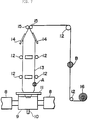
- a coextruded multilayer inflation film is formed by using an inflation film molding machine, such as shown in Figure 7.
- the inflation film molding machine is composed of extruders 8 heating and kneading the resin, ring die 9 extruding the molten resin from the slit (not indicated) into tube-shaped, blast tube 10 blowing compressed air, air ring 11 cooling the molten resin extruded in tube-shaped, guide rollers 12 guiding the tube-shaped resin film 13, guide plates 14 guiding the tube-shaped resin film 13 into flat, a pair of squeeze roll 15 (nip roll) nipping to attract the tube-shaped resin film 13, and winder 16 winding the film.
- L-LDPE resin and HDPE resin having prescribed compositions respectively are melted and kneaded by the extruders 8 and extruded from the circular slit of the ring die 9 so that the L-LDPE resin film layer is disposed on the inside, i.e. the HDPE resin film layer is disposed on the outside.
- compressed air is blown from the blast tube 10, and cooling air is blown from the air ring 11.
- the tube-shaped resin film 13 having a prescribed diameter thus formed ascends with the guide of the guide rollers 12, ⁇ , 12, and is led into flat by the guide plates 14.
- the film is made sheet shape by passing the squeeze roll 15, and wound with the winder 16.
- the white lumps rendered film rupture as well as pressure mark to the film.
- the L-LDPE resin film layer was disposed on the outside and the HDPE resin film was disposed on the inside, wrinkling and furrows occurred, and the yield of the film decreased.
- double-sheet bags were used as the packaging bag for relatively heavy large photographic photosensitive materials.
- a double-sheet bag was, for example, composed of an outer sheet consisting of a Clupak paper, Duostress paper or unbleached kraft paper coated with polyethylene resin by extrusion laminating and an inner sheet consisting of an aluminum foil and two uniform polyethylene resin films containing carbon black laminated on both sides of the aluminum foil.
- the kind of the packaged product, instructions and the like were printed on the outer surface of the outer sheet during the packaging process or another process.
- the double-sheet bag is excellent in physical strength, and when the paper of the outer sheet contains a substance harmful for photographic photosensitive materials, its affect can be shielded by the inner sheet being in contact with the photographic photosensitive materials.
- An example of the laminated film shown in Figure 6 is composed of an aluminum foil layer 27, a bleached kraft paper layer 26 mainly composed of bleached kraft pulp and an LDPE resin film layer 28a blended with a light-shielding material laminated on both sides of the aluminum foil layer 27 each through an adhesive layer 3.
- the bleached kraft paper layer 26 is disposed on the outside, i.e. the LDPE resin film layer 28a is disposed on the inside.
- the physical strength of the laminated film is sufficient in the case of light photographic photosensitive materials, but it is insufficient for packaging heavy photographic photosensitive materials. Moreover, fibers occasionally adhered to the packaged photographic photosensitive materials, and caused developing troubles. Photographic photosensitive materials are liable to deteriorate because of utilizing oxidation-reduction reaction and containing a dye liable to degrade by pH, moisture, heat or the like. Therefore, even in the case that it was necessary to use an oxidizing or reducing substance for the surface of the packaging material to touch photographic photosensitive materials, the oxidizing or reducing substance was restricted in the kind and the blending amount. Moreover, unless the quality of the light-shielding material was limited in the particle size, pH, the content of impurities and the like, photographic troubles, such as fogging, spotting trouble and photosensitivity variation, occurred.
- An object of the invention is to provide a packaging material for photographic photosensitive materials having sufficient physical strength for packaging heavy photographic photosensitive materials and little problem in developing trouble.
- Another object of the invention is to provide a packaging material for photographic photosensitive materials not affecting adversely the photographic photosensitive materials packaged therein and being inexpensive.
- a packaging material for photographic photosensitive materials which comprises an aluminum vacuum metallized biaxially stretched thermoplastic resin film layer, a long fiber paper layer, of which more than 50 % of the fibers have a fiber length of longer than 3 mm, containing a paper reinforcing agent and having a pH of 4 to 9 measured by cool water extracting method (JIS P-8133) laminated on one side of the above thermoplastic resin film layer, and a polyolefin resin film layer containing 0.1 to 15 wt. % of carbon black having a pH of 4 to 9 and a mean particle size of 15 to 80 m» and more than 5 wt. % of an ethylene copolymer resin laminated on the other side.
- JIS P-8133 cool water extracting method
- FIGS 1 to 4 are partially sectional views of preferred embodiment of the invention.
- Figure 5 is a partially sectional view of a comparative packaging material.
- Figure 6 is a partially sectional view of a conventional packaging material.
- Figure 7 is a schematic front view of an inflation molding machine.
- the aluminum vacuum metallized biaxially stretched thermoplastic resin film is a biaxially stretched thermoplastic resin film processed with the vacuum deposition method to form an aluminum vacuum deposition layer.
- the film improves tensile strength and bursting strength of the packaging material, and it prevents the generation of pinhole, bag rupture and thinning by the elongation of the packaging material, even when a heavy product is placed. It also improves moistureproofness, gas barrier, antistatic property and light-shielding.
- the stretched film has a high Young's modulus, and is excellent in moistureproofness and gas barrier, in spite that it is thin. Since the stretched film has heat stability, crazing hardly occurs at the time of forming the aluminum vacuum deposition layer.
- the crazing of the aluminum vacuum deposition layer is also prevented by the increased Young's modulus and the resistance to elongation.
- the resin suitable for the film includes polyester resin, polyamide (nylon) resin, polyethylene resin, polystyrene resin, polypropylene resin, polyvinyl chloride resin, polyvinylidene chloride resin, vinylon resin, copolymer resins of the above resins and other resins, including binary, ternary or more copolymers polymerized by random copolymerization or block copolymerization, modified or crosslinked resins, and blend resins of the above resins and other resins.
- Stretching may be carried out by a known biaxial drawing method such as simultaneously biaxial drawing or successively biaxial stretching, and both of the draw ratios in longitudinal direction (MD) and in lateral direction (CD) are 1.5 to 20 times, preferably 3 to 15 times, respectively.
- the drawing machine may be a known machine such as T die film molding machine or inflation film molding machine.
- a preferable thickness of the biaxially stretched thermoplastic resin film is 7 to 60 »m. When the thickness is less than 7 »m, wrinkling and cut occur in the laminating process. While, when the thickness is beyond 60 »m, the rigidity is too great. As a result, bag-making ability and handling are inferior, and the film is expensive.
- the biaxially stretched thermoplastic resin film may be a single layer film or a coextruded multilayer film. Moreover, another resin, such as polyvinylidene chloride resin, silicone resin or teflon resin, is coated or printed, or a metal membrane is provided on the stretched film.
- the metal membrane may be provided by vacuum deposition, sputtering, ion plating, electron beam deposition, or the like.
- a preferable thickness of the aluminum vacuum deposition layer is 55 to 1,200 ⁇ , particularly 100 to 600 ⁇ , in view of securing physical strength, light-shielding, antistatic property, moistureproofness and gas barrier, cost and quality.
- the thickness is less than 55 ⁇ , the static electrification generated around the aluminum vacuum deposition layer cannot be decreased. It is difficult to secure moistureproofness, gas barrier and light-shielding.
- the thickness is beyond 1,200 ⁇ , problems occur in the degradation of the stretched film, the wrinkling due to shrinkage the crazing of the vacuum deposition layer, caused by the heat of vacuum deposition, and the decrease of physical strength of the packaging bag, though antistatic property, moistureproofness, gas barrier and light-shielding are still secured.
- a protection layer may be provided on the aluminum vacuum deposition layer, if necessary.
- the usable resin for the protection layer includes acrylic resin, cellulose resins such as cellulose acetate resin, urethane resin, epoxy resin, polyester resin, ionomer resin, polyethylene resin, ethylene copolymer resin and polypropylene resin. Besides, wax, gelatin, polyvinyl alcohol or the like is also usable.
- the thickness of the protection layer is made extremely thin such as thinner than 50 »m, preferably thinner than 5 »m, in order to eliminate static electricity effectively.
- Such a protection layer may be formed by a known extrusion coating, solution coating or spray coating.
- More than 50 %, preferably more than 70 % of the fibers composing the long fiber paper have a fiber length of longer than 3 mm, usually 3 mm to 7 mm.
- the fiber length is shorter than 3 mm, the generation of paper powder and picking cannot be prevented effectively.
- the fibers having a fiber length of longer than 3 mm are less than 50 % of total fibers, the generation of paper powder and picking cannot be prevented effectively.
- the paper reinforcing agent is incoporated into the long fiber paper in order to prevent the generation of paper powder and picking effectively.
- the paper reinforcing agent usable for the invention includes cation-induced styrene-acrylic copolymer, aminoamidepichlorohydrin condensate, carboxylmethglcellulose, various polyacrylamides and copolymers thereof, carboxyl-modified polyacrylamide, polyethyleneimine, gum oleoresin, sodium silicate, synthetic rubber latex, unacetylated PVA fiber, various starched including modified starches, sulfomethylated resin, urea resin, alkylstyrene resin, alkylketene dimer, gelatin, PVA, casein, methacylamide, polyamidaminepichlorohydrin, sodium polyacrylate, carboxyl-modified polyvinyl alcohol, hydroxylethylcellulose and the like.
- a suitable content of the paper reinforcing agent is 0.05 to 8 wt. %, preferably 0.3 to 5 wt. %.
- a cool water-extracing pH (JIS P-8133) of the long fiber paper is in the range of 4 to 9, preferably 5 to 9. When the cool water-extracting pH is less than 4 or beyond 9, harmful substances for photographic photosensitive material are produced. Long fiber neutral papers are particularly preferable. The contents of all of harmful substances for photographic photosensitive materials should be less 1,000 ppm.
- the harmful substances are radioactive substances and the materials obtained using a radioactive substance, such as the paper made using the river water, the pulp, chip or waste paper exposed to the rain, after a nuclear test, mercury, alloys thereof, mercury compounds and agents containing mercury, such as mercury, organic mercury agents, broken fluoresent lamp and slime control agent used for paper-making, secondary processed products of silicone, such as silicone oil and silicone grease, sulfur compounds, such as Na2S, H2S and Na2S2O3, lead compounds, such as PbS and PbSO4, iron and iron compound, such as iron powder, Fe2O3, FeO and FeCl3, copper and copper compounds, such as copper compounds, such as copper powder, CuO, CuSO4 and CuCl2, and aldehydes, such as formaldehyde and acetaldehyde.
- a radioactive substance such as the paper made using the river water, the pulp, chip or waste paper exposed to the rain, after a nuclear test, mercury, alloys thereof, mercury compounds and agents containing mercury, such as mercury, organic
- the adverse affect of iron, iron compounds and other metal compounds can be removed by adding a chelating agent, and the adverse affect of formaldehyde can be removed by adding urea, thiourea, a hydrazine compound, dicyandiamide or an acid salt thereof, hydroxylamine or an acid salt thereof, such as hydroxylamine hydrochloride or hydroxylamine sulfate, or formamide.
- the adverse affect of the harmful substances can also be removed by selecting the equipments and materials so that the contamination amounts are minimized, using clean water such as spring water, and forbidding the use of the pulp, chip and waste paper exposed to rain.
- the surface of the long fiber paper is preferably processed by Yankee calender or supercalender, and the surface strength is preferably more than 6.
- beating is necessary. The beating is necessary to be carried out so that more than 50 % of the fibers have a fiber length of longer than 3 mm.
- the long fiber paper may be a combination paper, and white or colored.
- the polyolefin resin film layer contains 0.1 to 15 wt. % of carbon black having a pH of 4 to 9 and a mean particle size of 15 to 80 m».
- the carbon black adsorbs harmful substances for photographic photosensitive materials, when the long fiber paper is contaminated, and it prevents the degradation of photographic properties, such as fogging, the variation of photosensitivity and the decrease of concentration, when a photographic photosensitive material is placed in the packaging material of the invention for a long time, in addition to the light-shielding.
- the pH of the carbon black is less than 4 or beyond 9, the degradation of photographic properties, such as fogging, the variation of photosensitivity and the decrease of concentration occurs.
- the mean particle size is less than 15 m » carbon black particles aggregate to produce lumps and fish eye problem.
- the free sulfur content is less than 1,000 ppm, because the degradation of photographic properties, such as fogging, the variation of photosensitivity and the decrease of concentration occurs, when the content is beyond 1,000 ppm.
- the carbon black content is 0.1 to 15 wt. %. When the content is less than 0.1 wt. %, the effect of the carbon black, such as to secure light-shielding, to prevent electrification, and to prevent oxidation, is insufficient. While, when the content is beyond 15 wt. %, the physical strength of the film, particularly tear strength and impact puncture strength, decreases, and heat sealing properties are inferior. Furthermore, the surface strength decreases, and dust is liable to be generated. The dust adheres to photographic photosensitive materials, and causes developing trouble and contamination.
- the polyolefin resin film layer contains more than 5 wt. % of an ethylene copolymer resin.
- the ethylene copolymer resin improves heat sealing properties such as hot tack properties, sealability with other materials, elapsed heat seal strength, heat seal strength and heat seal tolerance, and the generation of pinhole at heat-sealed portion is prevented.
- the dispersibility of carbon black is also improved.
- the ethylene copolymer resin includes EVA resin, EEA resin, EMA resin, EAA resin and L-LDPE resin. L-LDPE resin is preferable in view of improving physical strength, heat sealing properties and the dispersibility of carbon black.
- the L-LDPE resin is similar to described previously except that the preferable MI is 0.4 to 20 g/10 minutes and the preferable density is 0.87 to 0.95 g/cm3.
- the content of the ethylene copolymer resin is more than 5 wt. %, preferably 15 to 95 wt. %. When the content is less than 5 wt. %, unless the width of heat seal is increased, heat sealing properties, particularly elapsed heat seal strength and sealability with other materials are inferior,and pinhole is liable to be generated. Moreover, heat-sealed portion is liable to separate.
- the ethylene copolymer resin is L-LDPE, the suitable content is 5 to 99.9 wt. %, preferably 10 to 97 wt. %.
- the polyolefin resin film layer may be oriented or stretched.
- the above flexible sheet layers may be laminated according to a known method such as a heat sealing (hot bar sealing, impulse heat sealing, supersonic welding, etc.) or a method using an adhesive (wet laminating, dry laminating, hot melt laminating, extrusion laminating, etc.).
- a heat sealing hot bar sealing, impulse heat sealing, supersonic welding, etc.
- a method using an adhesive wet laminating, dry laminating, hot melt laminating, extrusion laminating, etc.
- the adhesive is selected by considering both layers to be joined, and includes thermoplastic resin melt adhesives including a polyolefin adhesive, hot melt type gum adhesives and solution type adhesives.
- the polyolefin adhesives include a homopolymer and a copolymer of an olefin such as various polyethylenes, polypropylenes, polybutenes and ethylene-propylene copolymers and L-LDPE, a copolymer of an olefin and another monomer such as ethylene-vinyl acetate copolymer, ethylene-acrylate ester copolymer, various ionomers ("SURLYN” Dupont, "HIMIRAN” Mitsui Polychemicals Co., Ltd., etc.) and a graft copolymer.
- SURLYN Dupont
- HIMIRAN Mitsui Polychemicals Co., Ltd., etc.
- the solution type adhesives are divided into adheisves for wet lamination and adhesives for dry lamination.
- the adhesives for wet lamination are emulsion-type or latex-type.
- the emulsion-type adhesives are polyvinyl acetate emulsion, the emulsion of vinyl acetate-ethylene copolymer, the emulsion of vinyl acetate-acrylate ester copolymer, the emulsion of vinyl acetate-maleate ester copolymer, the emulsion of acrylic copolymer and the emulsion of ethylene-acrylic acid copolymer.
- latex-type adhesives examples include natural rubber latex, styrene-butadiene rubber latex, acrylonitrilebutadiene rubber latex and chloroprene rubber latex.
- An example of the adhesives for dry lamination is polyurethane adhesive.
- Adhesives for hot melt lamination containing paraffin wax, microcrystalline wax, ethylene-vinyl acetate copolymer and ethylene-ethylacrylate copolymer, pressure-sensitive adhesives and temperature-sensitive adhesives may also be employed.
- the melting point of the adhesive employed is preferably more than 5°C below the melting point of the flexible sheet in order to laminate without adverse influences upon the flexible sheet by a thermal melting adhesion.
- the thickness of the adhesive layer formed by extrusion laminating using a thermoplastic resin is usually 6 to 50 »m, preferably 10 to 20 »m. However, the thickness is determined based upon cost, rate of application, thickness of the total layers, and etc., and accordingly, the thickness is not limited to the above range.
- the adhesive strength of the adhesive layer may be improved by coating an anchor coating agent, physical surface treatment, chemical agent treatment, or etc.
- Anchor coating agent is a generic name of adhesive promoter and cross-linking agent used in the field of laminating, and it is also called primer. Representative examples of the anchor coating agent are as follows:
- Tetrapropyl titanate or tetraisobutyl titanate is used as the principal constituent, and tetrastearyl titanate is added as a hydrolysis-adjusting agent.
- a relatively high polymer of ethyleneimine ( ⁇ CH2-CH2-NH) ⁇ n is used. This agent is particularly preferable because its handling is easy and its pot life is long.
- a chemical reaction such as a crosslinking reaction occurs in both types, and an adhesive effect appears. Pot life is short, and this coating agent is expensive.
- Polyester and urethane anchor coating agent Polyester and urethane anchor coating agent
- Saturated polyester resin or urethane resin is dissolved in a solvent such as ethyl acetate or toluene.
- the anchor coat layer is preferably made extremely thin.
- the coating method may be gravure roll coating, kiss roll coating, curtain coating, bar coating, reverse roll coating, direct roll coating, air knife coating or the like.
- Two or more kinds of the physical surface treatment may be combined, or the physical surface treatment may be combined with the coating of an anchor coating agent.
- the packaging material of the invention may be used for packaging photosensitive materials such as photographic photosensitive materials, foods, medicines or chemical substances, and it is particularly suitable for packaging silver halide phtographic photosensitive materials, diazo photographic photosensitive materials, photofixing-type thermosensitive photosensitive materials, photosensitive resin photosensitive materials, ultraviolet curing-type photosensitive materials, transfer-type heat developing photosensitive materials, direct positive type photographic photosensitive materials, self-developing type photographic photosensitive materials, photosensitive materials for lithographic printing and other photographic materials which is degraded by little amount of moisture, light or gas.
- the package form may be conventional, and includes a single-sheet flat bag, a double-sheet flat bag, a self-standing bag, a single-sheet gusset bag, a double-sheet gusset bag, inner lining for a moisture proff box, inner lining for a light room-loading light-shielding box, wrapping paper and a leader paper.
- the bag-making form may also be conventional, and includes heat sealing, side welding (heat-cut sealing), impulse heat sealing, supersonic sealing and high frequency sealing. The methods of using an adhesive may also be utilized.
- the long fiber paper improves the Young's modulus, heat resistance and drawing ability by writing tools.
- the aluminum vacuum metallized biaxially stretched thermoplastic resin film layer imparts antistatic property, moistureproofness, gas barrier and light-shielding, and prevents the penetration of harmful substances.
- the polyolefin resin film layer secures sealing and the carbon black contained therein does not affect the photographic photosensitive materials adversely.
- the packaging bag formed of the packaging material may be a single sheet bag, and is excellent in bag-making ability and packaging workability.
- packaging material comprising an aluminum vacuum metallized biaxially stretched thermoplastic resin film layer, a long fiber layer and a polyolefin resin film layer are illustrated in Figures 1 to 4.
- the packaging material of Figure 1 is composed of an aluminum vacuum metallized biaxially stretched thermoplastic resin film layer 21 consisting of a biaxially stretched thermoplastic resin film layer 19 and an aluminum vacuum deposition layer 20, a long fiber paper layer 22 laminated on the aluminum vacuum deposition layer 20 as the outer layer, and a light-shielding polyolefin resin film layer 23a on the biaxially stretched thermoplastic resin film layer 19 as the inner layer, each through an adhesive layer 3.
- the packaging material of Figure 2 is similar to the packaging material of Figure 1, except that the light-shielding polyolefin resin film layer 23a is replaced by a coextruded multilayer film layer 25a consisting of a light-shielding thermoplastic resin film layer 24a and a light-shielding polyolefin resin film layer 23a.
- the packaging material of Figure 3 is similar to the packaging material of Figure 2, except that the aluminum vacuum metallized biaxially stretched thermoplastic resin film layer 21 is turned inside out.
- the packaging material of Figure 4 is similar to the packaging material of Figure 1, except that the light-shielding polyolefin resin film layer 23a is directly laminated by the extrusion laminating method.
- Figure 5 indicates a comparative packaging material I similar to the packaging material of Figure 2, except that the long fiber paper layer 22 is replaced by a conventional bleached kraft paper layer 26.
- Examples I and II are examples of the packaging material comprising an aluminum vacuum metallized biaxially stretched thermoplastic resin film layer, a long fiber paper layer and a polyolefin resin film layer.
- Example I The packaging material of Example I corresponds to illustrated in Figure 2.
- the long fiber paper layer 22 consisted of a bleached kraft paper composed of the fibers having a fiber length of about 4 mm, containing 2.5 wt. % of polyacrylamide resin ("Polystlon", Arakawa Rinsan Kagaku K.K.) as paper reinforcing agent and each less than 500 ppm of harmful substances for photographic photosensitive materials, and having a cool water extracting pH of 4.8, a surface strength of 9, an areal weight of 35 g/m2, and a glossy face by Yankee calender, made by using aluminum sulfate as a fixer.
- polyacrylamide resin Polystlon", Arakawa Rinsan Kagaku K.K.
- the biaxially stretched thermoplastic resin film 19 of the aluminum vacuum metallized biaxially stretched thermoplastic resin film layer 21 was a biaxially stretched nylon resin film 15 »m in thickness.
- the thickness of the aluminum vacuum deposition layer 20 was 400 ⁇ .
- the light-shielding polyolefin resin film layer 23a of the coextruded multilayer film layer 25a was composed of 91.75 wt. % of ethylene-4-methylpentene-1 copolymer resin, 5 wt. % of LDPE resin, 3 wt. % of oil furnace carbon black having a pH of 8.0, a mean particle size of 21 m» and a free sulfur content of 450 ppm and 0.2 wt. % of antioxidant, 0.05 wt. % of oleic acid amide, having a thickness of 40 »m.
- the light-shielding thermoplastic resin film layer 24a was composed of 71.75 wt. % of ethylene-4-methylpentene-1 copolymer resin, 20 wt. % of HDPE resin having a density of 0.954 g/cm3, 5 wt. % of LDPE resin, 3 wt. % of the same oil furnace carbon black as the light-shielding polyolefin resin film layer 23a, 0.2 wt. % of antioxidant and 0.05 wt. % of oleic acid amide having a thickness of 40 »m.
- the adhesive layers 3 were LDPE resin extrusion laminating adhesive layers 13 »m in thickness.
- the laminations of laminated film was carried out in the same process using a tandem laminator.
- Example II The packaging material of Example II corresponds to illustrated in Figure 2.
- the long fiber paper layer 22 consisted of an unbleached kraft neutral paper composed of the fibers having a fiber length of about 3.5 mm, containing 0.2 wt. % of alkylketene dimer ("Aquapell", Dick Hercules) and 0.5 wt. % of modified starch as paper reinforcing agent and each less than 1,000 ppm of harmful substances for photographic photosensitive materials, and having a cool water extracting pH of 6.8, a surface strength of 8, and an areal weight of 50 g/m2, made by using aluminum sulfate as a fixer.
- Alkylketene dimer alkylketene dimer
- Comparative packaging material I corresponds to illustrated in Figure 5.
- the beached kraft paper layer 26 consisted of a semibleached kraft paper composed of the fibers having a fiber length of 2.5 mm, containing 2.0 wt. % of melamine-formaldehyde resin as paper reinforcing agent and 1870 ppm of formaldehyde adversely affecting photographic photosensitive materials, and having a cool water extracting pH of 4.3, a surface strength of 6 and an areal weight of 50 g/m2, made by using aluminum sulfate as a fixer.
- the bleached kraft paper layer 26 consisted of a bleached kraft paper composed of the fibers having a fiber length of 2.5 mm, having a cool water extracting pH of 4.5, a surface strength of 5 and an areal weight of 30 g/m2, made by using aluminum sulfate as a fixer.
- the metal foil layer 27 was aluminum foil 7 »m in thickness.
- thermoplastic resin film layer 28a was a LDPE resin film 80 »m in thickness containing 3 wt. % of the same carbon black as Example I.
- the adhesive layers 3 were LDPE resin extrusion laminating adhesive layers 40 »m in thickness.
- the laminated film was formed by laminating through twice extrusion laminating processes successively.
- the packaging bag used was a single-sheet gusset bag, and 4 rolls of color printing paper of 8.9 cm in width x 180 m in length were placed in a corrugated board box in two layers through a corrugated board pad.
- Light-Shielding after Dropping Test After the dropping test of JIS Z-0202 level I, each packaging bag was exposed to 80,000 luxes light for 1 hour. The color printing paper was developed, and the light-shielding was judged.
- Hot Tack Properties Two sheets of each exemplified film having 15 mm in width were heat-sealed at 170°C, and just after, the open ends were pulled by the weight of 45 g at the releasing angle of 22.5 degree.
- Bag Rupture Strength Judged by the bag rupture state after the dropping test of JIS Z-0202 level I.
- Paper Powder Generation Judged by the amount of paper powder after the shaking test of JIS Z-0232 level I.
- Surface Strength Measured by the wax method of JIS P-8129, and it is expressed in wax number. Photographic Properties: According to a contact test with the uppermost layer. Teat Strength: According to JIS P-8116.
Landscapes
- Engineering & Computer Science (AREA)
- Microelectronics & Electronic Packaging (AREA)
- Physics & Mathematics (AREA)
- General Physics & Mathematics (AREA)
- Laminated Bodies (AREA)
- Packages (AREA)
Claims (3)
- Verpackungsmaterial für photographische lichtempfindliche Materialien, umfassend eine mit Aluminium vakuumbedampfte, biaxial gestreckte thermoplastische Harz-Filmschicht, eine Papierschicht mit langen Fasern, wobei mehr als 50% der Fasern eine Faserlänge von mehr als 3 mm besitzen, die ein Papierverstärkungsmittel enthält und einen pH von 4 bis 9 besitzt, gemessen mit dem Kaltwasser-Extraktionsverfahren (JIS P-8133), auflaminiert auf einer Seite der obengenannten thermoplastischen Harz-Filmschicht, und eine Polyolefinharz-Filmschicht, die 0,1 bis 15 Gew.-% Ruß mit einem pH von 4 bis 9 und einer mittleren Teilchengröße von 15 bis 80 »m und mehr als 5 Gew.-% eines Ethylen-Copolymer-Harzes enthält, auflaminiert auf der anderen Seite.
- Verpackungsmaterial nach Anspruch 1, worin das Papier mit langen Fasern eine Oberflächenfestigkeit von mehr als 6 besitzt, ausgedrückt als Wachszahl (entsprechend JIS P-8129).
- Verpackungsmaterial nach Anspruch 1, worin das Ethylen-Copolymer-Harz ein L-LDPE-Harz ist.
Priority Applications (1)
| Application Number | Priority Date | Filing Date | Title |
|---|---|---|---|
| EP93113105A EP0571000B1 (de) | 1988-01-29 | 1989-01-30 | Verpackungsmaterial für lichtempfindliche Materialien |
Applications Claiming Priority (6)
| Application Number | Priority Date | Filing Date | Title |
|---|---|---|---|
| JP63018767A JPH07110516B2 (ja) | 1988-01-29 | 1988-01-29 | 感光物質包装用多層共押出インフレーションフィルムの成形方法 |
| JP18767/88 | 1988-01-29 | ||
| JP8814288A JPH01260438A (ja) | 1988-04-12 | 1988-04-12 | 感光物質用包装材料 |
| JP88142/88 | 1988-04-12 | ||
| JP1988079536U JPH0643801Y2 (ja) | 1988-06-17 | 1988-06-17 | 写真感光材料用包装材料 |
| JP79536/88U | 1988-06-17 |
Related Child Applications (2)
| Application Number | Title | Priority Date | Filing Date |
|---|---|---|---|
| EP93113105A Division EP0571000B1 (de) | 1988-01-29 | 1989-01-30 | Verpackungsmaterial für lichtempfindliche Materialien |
| EP93113105.6 Division-Into | 1989-01-30 |
Publications (3)
| Publication Number | Publication Date |
|---|---|
| EP0326181A2 EP0326181A2 (de) | 1989-08-02 |
| EP0326181A3 EP0326181A3 (en) | 1989-11-02 |
| EP0326181B1 true EP0326181B1 (de) | 1995-04-05 |
Family
ID=27282353
Family Applications (2)
| Application Number | Title | Priority Date | Filing Date |
|---|---|---|---|
| EP93113105A Expired - Lifetime EP0571000B1 (de) | 1988-01-29 | 1989-01-30 | Verpackungsmaterial für lichtempfindliche Materialien |
| EP19890101568 Expired - Lifetime EP0326181B1 (de) | 1988-01-29 | 1989-01-30 | Verpackungsmaterial für lichtempfindliche Waren |
Family Applications Before (1)
| Application Number | Title | Priority Date | Filing Date |
|---|---|---|---|
| EP93113105A Expired - Lifetime EP0571000B1 (de) | 1988-01-29 | 1989-01-30 | Verpackungsmaterial für lichtempfindliche Materialien |
Country Status (2)
| Country | Link |
|---|---|
| EP (2) | EP0571000B1 (de) |
| DE (2) | DE68928890T2 (de) |
Families Citing this family (11)
| Publication number | Priority date | Publication date | Assignee | Title |
|---|---|---|---|---|
| JPH07101295B2 (ja) * | 1988-02-23 | 1995-11-01 | 富士写真フイルム株式会社 | 感光物質用包装材料 |
| US5540644A (en) * | 1991-10-09 | 1996-07-30 | Konica Corporation | Packing bag for light sensitive materials and manufacturing method therfore |
| JP3085330B2 (ja) * | 1992-08-17 | 2000-09-04 | 富士写真フイルム株式会社 | 写真感光材料用包装材料及び包装体 |
| GB2278363B (en) * | 1993-05-28 | 1996-10-30 | Chaloke Pungtrakul | A method for the prevention of blocking in linear low density polyethylene films |
| US6635701B2 (en) | 2001-08-09 | 2003-10-21 | Equistar Chemicals L.P. | Oriented high density polyethylene film, compositions and process suitable for preparation thereof |
| US20030196914A1 (en) † | 2002-04-18 | 2003-10-23 | 3M Innovative Properties Company | Containers for photocurable materials |
| US6887923B2 (en) | 2002-12-11 | 2005-05-03 | Equistar Chemicals, L.P. | Processing aids for enhanced machine direction orientation rates and property enhancement of polyolefin films using hydrocarbon waxes |
| CN106032065A (zh) * | 2015-03-17 | 2016-10-19 | 鼎基化学工业股份有限公司 | 薄膜贴合的制造方法及其装置 |
| CN109177128B (zh) * | 2018-08-29 | 2020-06-19 | 浙江龙诗工艺品股份有限公司 | 一种塑料薄膜加工成型装置 |
| CN109435218A (zh) * | 2018-11-13 | 2019-03-08 | 重庆瑞霆塑胶有限公司 | Cpp膜的自动化生产加工系统 |
| TW202140269A (zh) * | 2020-04-24 | 2021-11-01 | 南亞塑膠工業股份有限公司 | 可見光遮蔽結構 |
Family Cites Families (5)
| Publication number | Priority date | Publication date | Assignee | Title |
|---|---|---|---|---|
| JPS6029743A (ja) * | 1983-07-09 | 1985-02-15 | Fuji Photo Film Co Ltd | 写真感光材料包装用材料及び成形体 |
| JPS60196335A (ja) * | 1984-03-21 | 1985-10-04 | 富士写真フイルム株式会社 | 積層フイルム |
| US4701359A (en) * | 1985-01-28 | 1987-10-20 | Fuji Photo Film Co., Ltd. | Packaging material for photosensitive materials |
| JPS6218548A (ja) * | 1985-07-17 | 1987-01-27 | Fuji Photo Film Co Ltd | 写真感光材料用包装材料 |
| JPH0435890Y2 (de) * | 1985-09-11 | 1992-08-25 |
-
1989
- 1989-01-30 EP EP93113105A patent/EP0571000B1/de not_active Expired - Lifetime
- 1989-01-30 DE DE1989628890 patent/DE68928890T2/de not_active Expired - Fee Related
- 1989-01-30 EP EP19890101568 patent/EP0326181B1/de not_active Expired - Lifetime
- 1989-01-30 DE DE1989622001 patent/DE68922001T2/de not_active Expired - Fee Related
Also Published As
| Publication number | Publication date |
|---|---|
| DE68928890T2 (de) | 1999-05-27 |
| EP0571000A1 (de) | 1993-11-24 |
| DE68922001D1 (de) | 1995-05-11 |
| EP0326181A2 (de) | 1989-08-02 |
| EP0326181A3 (en) | 1989-11-02 |
| DE68922001T2 (de) | 1995-08-10 |
| EP0571000B1 (de) | 1998-12-30 |
| DE68928890D1 (de) | 1999-02-11 |
Similar Documents
| Publication | Publication Date | Title |
|---|---|---|
| US5017429A (en) | Packaging material for photosensitive materials | |
| EP0507351B1 (de) | Verpackungsmaterial für lichtempfindliches Material | |
| JPH0535396Y2 (de) | ||
| US4629640A (en) | Packaging materials for photosensitive materials | |
| US4663218A (en) | Packaging film for photosensitive materials for photographic purpose | |
| US5358785A (en) | Laminated film and process for producing the same | |
| US5023120A (en) | Packaging material for photosensitive materials | |
| US5492741A (en) | Packaging material for photographic photosensitive materials and light-shielding bag formed thereof | |
| US4894264A (en) | Gusset bag for photographic photosensitive materials | |
| US4661401A (en) | Laminated films | |
| US4708896A (en) | Easily openable packaging material for photographic photosensitive materials | |
| US4513050A (en) | Material for packaging light-sensitive materials | |
| US4876129A (en) | Packaging material for photographic photosensitive materials | |
| JPS6012228B2 (ja) | 包装材料 | |
| US5110643A (en) | Packaging material for photosensitive materials | |
| US5026594A (en) | Packaging material for photosensitive materials | |
| EP0571000A1 (de) | Verpackungsmaterial für lichtempfindliche Materialien | |
| US5075163A (en) | Packaging material for photographic photosensitive materials | |
| US5227255A (en) | Packaging material for photographic photosensitive materials | |
| JPS63286344A (ja) | 写真感光材料用包装材料 | |
| JPH0643801Y2 (ja) | 写真感光材料用包装材料 | |
| JPH01316741A (ja) | 写真感光材料用包装材料 | |
| JPS63247033A (ja) | 感光物質用包装材料 | |
| JP2731943B2 (ja) | 写真感光材料用包装材料 | |
| JPH02178652A (ja) | 写真感光材料用包装材料 |
Legal Events
| Date | Code | Title | Description |
|---|---|---|---|
| PUAI | Public reference made under article 153(3) epc to a published international application that has entered the european phase |
Free format text: ORIGINAL CODE: 0009012 |
|
| AK | Designated contracting states |
Kind code of ref document: A2 Designated state(s): DE NL |
|
| PUAL | Search report despatched |
Free format text: ORIGINAL CODE: 0009013 |
|
| AK | Designated contracting states |
Kind code of ref document: A3 Designated state(s): DE NL |
|
| 17P | Request for examination filed |
Effective date: 19900427 |
|
| 17Q | First examination report despatched |
Effective date: 19930305 |
|
| GRAA | (expected) grant |
Free format text: ORIGINAL CODE: 0009210 |
|
| AK | Designated contracting states |
Kind code of ref document: B1 Designated state(s): DE NL |
|
| PG25 | Lapsed in a contracting state [announced via postgrant information from national office to epo] |
Ref country code: NL Free format text: LAPSE BECAUSE OF FAILURE TO SUBMIT A TRANSLATION OF THE DESCRIPTION OR TO PAY THE FEE WITHIN THE PRESCRIBED TIME-LIMIT Effective date: 19950405 |
|
| XX | Miscellaneous (additional remarks) |
Free format text: TEILANMELDUNG 93113105.6 EINGEREICHT AM 30/01/89. |
|
| REF | Corresponds to: |
Ref document number: 68922001 Country of ref document: DE Date of ref document: 19950511 |
|
| NLV1 | Nl: lapsed or annulled due to failure to fulfill the requirements of art. 29p and 29m of the patents act | ||
| PLBE | No opposition filed within time limit |
Free format text: ORIGINAL CODE: 0009261 |
|
| STAA | Information on the status of an ep patent application or granted ep patent |
Free format text: STATUS: NO OPPOSITION FILED WITHIN TIME LIMIT |
|
| 26N | No opposition filed | ||
| PGFP | Annual fee paid to national office [announced via postgrant information from national office to epo] |
Ref country code: DE Payment date: 20040220 Year of fee payment: 16 |
|
| PG25 | Lapsed in a contracting state [announced via postgrant information from national office to epo] |
Ref country code: DE Free format text: LAPSE BECAUSE OF NON-PAYMENT OF DUE FEES Effective date: 20050802 |