EP0327128A2 - Système de communication de données ayant des moyens de commutation de canal - Google Patents
Système de communication de données ayant des moyens de commutation de canal Download PDFInfo
- Publication number
- EP0327128A2 EP0327128A2 EP89101959A EP89101959A EP0327128A2 EP 0327128 A2 EP0327128 A2 EP 0327128A2 EP 89101959 A EP89101959 A EP 89101959A EP 89101959 A EP89101959 A EP 89101959A EP 0327128 A2 EP0327128 A2 EP 0327128A2
- Authority
- EP
- European Patent Office
- Prior art keywords
- data
- channel
- main channel
- communication system
- protection
- Prior art date
- Legal status (The legal status is an assumption and is not a legal conclusion. Google has not performed a legal analysis and makes no representation as to the accuracy of the status listed.)
- Granted
Links
Images





Classifications
-
- H—ELECTRICITY
- H04—ELECTRIC COMMUNICATION TECHNIQUE
- H04B—TRANSMISSION
- H04B1/00—Details of transmission systems, not covered by a single one of groups H04B3/00 - H04B13/00; Details of transmission systems not characterised by the medium used for transmission
- H04B1/74—Details of transmission systems, not covered by a single one of groups H04B3/00 - H04B13/00; Details of transmission systems not characterised by the medium used for transmission for increasing reliability, e.g. using redundant or spare channels or apparatus
Definitions
- the present invention relates to a data communication system having a channel switching means, for example, a radio data communication system provided with channel switching equipment between a main channel and a protection channel.
- a channel switching means for example, a radio data communication system provided with channel switching equipment between a main channel and a protection channel.
- a channel switching means which is employed in a data communication system uses both a main channel and protection channel. That is, when the transmission quality of the main channel deteriorates, and accordingly a data error rate increases, a transmitting terminal station automatically switches the transmission line from the main channel, which is transmitting data to a receiving terminal station, to the protection channel, which is transmitting auxiliary data thereto. To cope with this, the receiving terminal station selects data received via the protection channel instead of the main channel, and outputs the same as main channel data.
- the above-mentioned channel switching can be performed without even an instantaneous interruption in the flow of data if the above-mentioned transmission quality deteriorates slowly.
- the transmission quality deteriorates quickly, it is very liable to result in an instantaneous interruption in the flow of data.
- the prior art channel switching means used in data communication systems produces a problem in that there is a high probability of a data error occurring when there is a rapid deterioration in transmission quality.
- an object of the present invention is to provide a data communication system having a channel switching means which can prevent an instantaneous interruption in data flow during channel switching even when there is a rapid deterioration in the transmission quality.
- the channel switching means is constructed using a delay means.
- the delay means is employed at least in a receiver positioned along a data transfer path of the main channel data.
- another delay means is employed in a transmitter along a data transfer path connected between a data source and the transmission line for the protection channel.
- the delay means is effective for recovering preceding data which was present just before the start of the related channel switching operation.
- FIG. 1 is a general block diagram of a prior art data communication system
- Figure 2 depicts timing charts for showing one example of a channel switching procedure when a fault occurs in the system of Fig. 1.
- the operation of the channel switching performed in the data communication system of Fig. 1 will be clarified with reference to the timing charts shown in Fig. 2.
- the numerals in parentheses in the leftmost column in Fig. 2 indicate that the respective timing charts correspond to the portions referenced by the numerals enclosed in quotation marks " " in Fig. 1.
- the following explanation will use as an example a system having a single protection channel and a single main channel.
- a plurality of channels exist, in the form of, for example, frequency division multiplex communication (FDM), used in the main channel.
- FDM frequency division multiplex communication
- Bipolar data is provided by a data source located in, for example, a transmitting terminal station 19.
- the data is branched in two directions by a hybrid circuit (H) 201 which is mounted in a transmitting channel switch unit (TSW) 20.
- TSW transmitting channel switch unit
- One of the data branches is transferred to a transmitting unit 21, and the other is applied to a switch circuit (SW) 202, but prevented from passing therethrough.
- the bipolar data is first transformed into unipolar data, and a carrier wave is then modulated by the thus transformed unipolar data.
- a local oscillator for producing the carrier wave is not shown in the figure.
- the modulated carrier wave is converted upward in frequency and energized to have enough transmission power to radiate from the transmitter to the receiver via a transmission line which includes a repeater or repeaters, more specifically, via a receiving and retransmitting unit or units 22 contained in each repeater.
- the data from the last repeater is received by a receiving unit 23 located in the receiver, wherein the unipolar data is provided to a synchronous switch circuit (SSW) 24.
- the synchronous switch circuit (SSW) 24 transforms unipolar data to bipolar data and outputs the bipolar data to a switch circuit 25.
- the switch circuit 25 supplies the bipolar data to a receiving terminal station 29 to reproduce the original data.
- the synchronous switch circuit (SSW) 24 is usually fabricated using a semiconductor integrated circuit (IC) which is able to achieve high speed synchronous switching from the main channel data to the protection channel data.
- the switch circuit (RSW) 25 is located after the switch circuit (SSW) 24 to back-up the latter switch circuit 24.
- the protection channel system In the normal state of the main channel system, it is theoretically not necessary to activate the protection channel system, but in practice, the protection channel system is activated so as to always supervise the condition of the protection channel system to maintain the normal state thereof.
- the protection channel system handles auxiliary data during activation of the main channel system.
- the auxiliary data is, for example, test data.
- the related test pulse is generated by a test pulse generator 30 and transmitted to a test pulse detector 33 located in the receiver, via the switch circuit 202, a protection channel transmitting unit 11, a receiving and retransmitting unit 12, a protection channel receiving unit 13 and the receiving channel switch circuit (RSW) 25. If the predetermined pattern of the test pulse is detected correctly by the detector 33, it is determined that the protection channel system is normal. In that case, the main channel can freely be switched to the protection channel when the transmission quality of the main channel data deteriorates.
- the original data is sent from the aforesaid data source in the transmitting terminal station 19 to the main channel transmitting unit 21, as shown by the first part of row (1) in Fig. 2.
- the characters T1, T2, and so on, above row (1) denotes a time scale, where T1 ⁇ T2 ⁇ T3 ⁇ T4, i.e., T1 occurs in time before T4.
- the data from the transmitting unit 21 is transmitted, as mentioned above, to the receiving terminal station 29, via the transmitting channel switch unit (TSW) 20, the main channel transmitting unit 21, the main channel receiving and retransmitting unit 22, the main channel receiving unit 23, the synchronous switch circuit (SSW) 24, and the receiving channel switch circuit (RSW) 25.
- TSW transmitting channel switch unit
- SSW synchronous switch circuit
- RSW receiving channel switch circuit
- a stoppage of data takes place in the main channel as shown in row (2) of Fig. 2.
- the stoppage of data is detected after a time t1 occurring from the stoppage of data, as shown in row (3).
- the time t1 is required by a data stoppage detector in order to detect the related data stoppage.
- This data stoppage detector (not shown) is usually mounted in the synchronous switch circuit (SSW) 24.
- the detection of data stoppage is reported by the data stoppage detector to a receiving control circuit 32, and the circuit 32 then transmits a command signal to a transmitting control circuit 31 via another transmission line 34, e.g., a downstream line instead of a upstream line through which the main channel data has been transmitted (refer to row (4)).
- the symbol t2 denotes the transmission time through the transmission line 34.
- the transmitting control circuit 31 issues a switching signal to the switch circuit (SW) 202 in the transmitting channel switch unit (TSW) 20.
- the switch circuit 202 changes its status from one state to the other state. Accordingly, the switch circuit 202 prevents the signal from the test pulse generator 30 from passing therethrough, while allowing the signal from the hybrid circuit (H) 201 to pass.
- the transmitting channel switch unit (TSW) 20 provides data, instead of the test pulse, which is the same as the data which had been provided to the main channel up to that point in time and had been transferred to the protection channel transmitting unit 11, so that the data from the aforesaid data source is also transferred to the receiver via the protection channel.
- t′2 (in row (6)) denotes the time for downstream transmission of data through the transmission line (protection channel).
- t′2 is, of course, the same as that of the upstream transmission time t2 (refer to row (4)).
- the data After a time t3 (refer to row (7)) occurring from the elapse of the time t2 , the data starts being applied via the protection channel to the receiving synchronous switch circuit (SSW) 24.
- the switch (SSW) 24 detects that the data, transmitted through the protection channel, has been received, the related detection signal from the switch (SSW) 24 is sent to the receiving control circuit 32 so that a switching signal (refer to row (7)) from the control circuit 32 can be sent to the switch circuit (SSW) 24.
- This switching signal changes the status of the switch circuit (SSW) 24 changes its status preventing the unipolar output signal from the main channel receiving unit 23, but allowing the unipolar output signal from the protection channel receiving unit 13 to pass through the switch circuit (SSW) 24.
- the inherent main channel data is transmitted from the transmitter to the receiving terminal station 29 via the protection channel system, i.e., the receiving unit 13, and also via the switch circuit (SSW) 24 and the switch circuit (RSW) 25.
- the aforesaid term t3 represents the time required to confirm the detection of the received data through the protection channel and to switch the switch circuit (SSW) 24.
- a response signal from the transmitter via the transmission line 34, and also a response signal from the switch circuit (SSW) 24, are omitted from Fig. 2 for brevity.
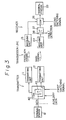
- FIG. 3 is a principle block diagram of a data communication system according to the present invention. Note that items identical to those explained before are represented by the same reference numerals or characters (this also applies to later figures).
- a synchronous switch circuit (SSW) 26, a delay means ( ⁇ ) 27, a transmitting channel switch unit (TSW) 40 and another delay means ( ⁇ ) 43 are newly recited items.
- the SSW 26 and the TSW 40 are functionally similar to the aforesaid SSW 24 and TSW 20, respectively.
- the delay means 27 delays the data in time by a period ⁇ .
- the delayed data is then received from the transmitter via the transmission line which usually includes a plurality of repeaters (not shown in Fig. 3 but indicated in Fig. 1 by reference numerals 12 and 22).
- the delay means 27 is located along a signal line through which the main channel is formed.
- the transmitter contains therein another delay means ( ⁇ ) 43.
- the delay means 43 delays the data in time by a period ⁇ , said data being received from the aforesaid data source which is usually located in the transmitting terminal station 19. This data is to be transmitted to the receiver not by way of the main channel but by the protection channel.
- the receiver contains therein a detection means 28 pereferably in the delay means 27 as illustrated.
- the detection means 28 detects an occurrence of a transmission fault in the main channel.
- the detection means 28 is located in a preceding stage relative to the delay means 27, or in a front stage thereof.
- the detection means 28 issues a fault detection signal if a related fault takes place.
- the fault detection signal induces two commands.
- the first command applies a first switching signal to the transmitting channel switch unit (TSW) 40 via the transmission line (shown as 34 in Fig. 1).
- the second command applied a second switching signal to the synchronous switch circuit (SSW) 26.
- the first switching signal activates the transmitter side (transmitting) channel switch unit 40 so as to transmit the original data from the aforesaid data source to the receiver by way of the transmitter side (transmitting) delay means 43 and through the protection channel.
- the second switching signal activates the receiver side (receiving) channel switching means, i.e., the synchronous switch circuit (SSW) 26, after a predetermined elapsed time from the detection of the transmission fault indicated by the fault detection signal.
- the data received via the protection channel overlaps with the data delayed by the delay means ( ⁇ ) 27.
- Each delay time ⁇ is defined as the aforesaid stoppage time (refer to "t4" in row (8) of Fig. 2) plus a predetermined time margin.
- the meanings of each of the symbols t1, t2 ..., except for t ⁇ have already been explained.
- the symbol t ⁇ denotes a predetermined time margin.
- the delay time ⁇ is created in the transmitter by the delay means 43 which is mounted in the transmitting channel switch unit (TSW) 40.
- the aforesaid delay means 27 is introduced between the main channel receiving unit 23 and the synchronous switching circuit 26.
- data is applied to both the main channel side input and the protection channel side input of the switch circuit 26, both blocks of data being the same as the data which had already been delayed by the time ( ⁇ ) before the occurrence of the related transmission fault.
- the aforesaid second switching signal is then supplied to the switch circuit (SSW) 26 by the end of the time t4 (refer to row (8) of Fig. 2).
- the delayed data i.e., previous data
- the delay means 27 is maintained so that channel switching by the switch circuit (SSW) 26 can be achieved without stopping the data flow. It is important to understand that this channel switching can be achieved with no loss of data due to deterioration of the transmission quality caused by sudden fading or even a sudden problem with the electronic communication apparatus.
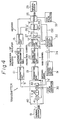
- FIG. 4 is a more detailed block diagram of a data communication system shown in Fig. 3, and Figure 5 depicts timing charts for illustrating one example of a channel switching procedure when a fault occurs in the system of Fig. 3.
- the procedure shown Fig. 5 assumes a case where a transmission fault has occurred due to some trouble in the main channel receiving and retransmitting unit 22 in the system of Fig. 4.
- the numerals in parentheses in the leftmost column in Fig. 5 indicate that the respective timing charts correspond to the portions referenced by the corresponding numerals given in quotation marks " " in Fig. 4. Therefore, Figs. 4 and 5 are read in the same manner as the previous Figs. 1 and 2.
- Fig. 4 and 5 are read in the same manner as the previous Figs. 1 and 2.
- the transmitting channel switch unit (TSW) 40 is comprised of the delay means 43, a hybrid circuit (H) 41 (similar to the corresponding circuit 201 in Fig. 1) and a switch circuit (SW) 42 (similar to the corresponding circuit 202 in Fig. 1).
- the original data is sent from the aforesaid data source in the transmitting terminal station 19, as shown in row (1) of Fig. 5, the structure of this data being schematically illustrated, e.g., as shown by ... D -1 , D0 , D1 , D2 ....
- the original data is transferred to the receiving terminal station 29 by way of the transmitting channel switch unit (TSW) 40, the main channel transmitting unit 21, the receiving and retransmitting unit 22, the receiving unit 23, the receiver side delay means 27, the synchronous switch circuit (SSW) 26, and the receiving channel switch circuit 25.
- TSW transmitting channel switch unit
- a stoppage of data occurs due to the aforesaid transmission fault, e.g., a problem in the receiving and retransmitting unit 22.
- the stoppage of data is schematically shown in row (2) of Fig. 5, where t2 denotes the transmission time of the data from the transmitter to the portion "2" in the receiver.
- the transmission fault i.e., the stoppage of data, is detected by the fault detection means 28 within the fault detection time t1 which is shown in row (3) of Fig. 4.
- the related fault detection signal is sent to the receiving control circuit 32, and the receiving control circuit 32 issues a command to the transmitting control circuit 31 in the transmitter via the upstream channel of the transmission line 34.
- the control circuit 31 in the transmitter then provides the switching signal ("FIRST SWITCHING SIGNAL") in Fig. 3 as shown in row (4) of Fig. 5.
- the symbol t′2 denotes the transmission time for the command to be sent via the aforesaid upstream channel of the transmission line 34.
- the transmitting control circuit 31 applies the first switching signal to the switch circuit (SW) 42 at a time t2 after the end of the time t1, in row (3) of Fig. 5, in response to the notification of the stoppage of data flow.
- the transmitting unit 11 switches the reception of the input signal. That is, the transmitting unit 11 stops transmitting the output from the test pulse generator 30 and starts transmitting the output from the delay means ( ⁇ ) 43, since in this situation the transmitting channel switch unit (TSW) 40 outputs the data, instead of the test pulse, as shown in row (5) of Fig. 5.
- the output data is delayed by a time ⁇ through the delay means 43 relative to the data which has been applied to the main channel transmitting unit 21, and the output data is then transmitted to the receiver via the protection channel, as shown in row (6) of Fig. 5.
- the symbol t′2 denotes the downstream transmission line forming the protection channel.
- the data at the portion "6" received via the protection channel has passed through the transmitter side delay means ( ⁇ ) 43, and therefore is delayed by a time ⁇ , as shown in row (6) of Fig. 5.
- the receiver starts receiving the data via the protection channel after a time t′2 from the end of t2 shown in row (4).
- the reception of data is detected in the synchronous switch circuit (SSW) 26 and the SSW 26 applies a signal reception detecting signal to the receiving control circuit 32 via a line 44.
- the circuit 32 returns a second switching signal to the switch circuit (SSW) 26, as shown in row (8) of Fig. 5, after the switching time t3.
- the data which is received at the main channel receiving unit 23 is delayed through the receiver side delay means 27 by the delay time ⁇ as shown in row (7) of Fig. 5.
- the thus maintained data prevents the data flow from being interrupted, and thus no stoppage of data flow occurs even when channel switching is triggered by a sudden occurrence of a transmission fault.
- the data area indicated as "DATA MARGIN" corresponds to the previously mentioned time t ⁇ , i.e., a predetermined time margin. This time margin is necessary to establish synchronization, performed in the synchronous switch circuit (SSW) 26, between the main channel data sent from the delay means 27 and the same data sent via the protection channel.
- FIG. 6 illustrates a detailed example of a transmitting unit.
- Both the main channel transmitting unit 21 and the protection channel transmitting unit 11 can be commonly realized by the construction shown in Fig. 6.
- Bipolar base band data BB sent from the hybrid circuit (H) 41 or the switch circuit (SW) 42 is transformed into unipolar data u by means of a bipolar to unipolar convertor (B/U) 61.
- the data u is further provided with supervisory information SV including, for example frame synchronization information, to form data u′, by means of a transmit code convertor (TCC) 62.
- TCC transmit code convertor
- the data u′ modulates a carrier wave provided from a local oscillator contained in a modulator (MOD) 63 using a standard modulation method, e.g., a 16 QAM method, to obtain an IF modulation signal ("IF").
- IF IF modula
- the IF modulation signal is then converted up in frequency by a radio transmitter (TX) 64 to produce a microwave transmission signal ⁇ to be radiated to the receiver.
- TX radio transmitter
- the TCC 62 further achieves speed conversion of the unipolar data by, e.g., a stuffing operation, and also adds a frame synchronization pulse and a parity bit, and scrambles the data.
- FIG. 7 illustrates a detailed example of a receiving unit.
- Both the main channel receiving unit 23 and the protection channel receiving unit 13 can be commonly realized by the construction shown in Fig. 7.
- the microwave transmission signal ⁇ is received by a radio receiver (RX) 71 and transformed into an IF signal ("IF").
- the IF signal is then applied to a demodulator (DEM) 72 to reproduce the unipolar data u′.
- the data u′ is applied to a receive code converter (RCC) 73 to extract therefrom the supervisory information SV.
- the original unipolar data u output from the RCC 73 is applied to a unipolar to bipolar convertor (U/B) 74 to reproduce the original base band data BB.
- the RCC 73 further carries out a frame synchronizing operation, supervises the transmission quality by using a parity check, and descrambles and destuffs the data.
- FIG. 8 illustrates a detailed example of a receiving and retransmitting unit.
- Both the main channel receiving and retransmitting unit 22 and the protection channel receiving and retransmitting unit 12 can be commonly realized by the construction shown in Fig. 8.
- the microwave transmission signal ⁇ from the transmitting unit (Fig. 6) is received at a radio receiver (RX) 81 and transformed into an IF signal ("IF").
- the IF signal is demodulated at a demodulator (DEM) 82 to obtain a reproduced unipolar data u′.
- the unipolar data u′ is applied to a receive code convertor (RCC) 83 from which the aforesaid supervisory information SV is extracted.
- RRC receive code convertor
- the data u output from the RCC 83 is then applied to a transmit code convertor (TCC) in which other supervisory information SV is inserted into the received unipolar data.
- TCC transmit code convertor
- the data u′ containing the information SV is modulated by a modulator (MOD) 85 using a standard method, e.g., a 16 QAM method, and an IF modulation signal ("IF") is obtained therefrom.
- the IF modulation signal is then converted up in frequency by a radio transmitter (TX) 86 to produce a microwave transmission signal ⁇ to be radiated to the receiving unit (Fig. 7).
- FIG. 9 illustrates a detailed example of a synchronous switch circuit.
- the synchronous switch circuit which is shown as SSW 26 in Fig. 4, receives the unipolar outputs from the protection channel receiver 13, the delay means 27, and the receiving control circuit 32.
- reference numerals in quotation marks i.e., "6", “7", “8", and “9"
- SSW synchronous switch circuit
- the synchronous switch circuit (SSW) 26 basically achieves a bit by bit phase synchronization between the main channel data ("DATA(M)”) sent from the delay means 27 via "7", and the protection channel data ("DATA(P)") sent from the protection channel receiver 13 via "6".
- the characters CLK(M) and CLK(P) denote the clocks which define the timing of the data "DATA(M)” and "DATA(P)", respectively.
- the main channel data "DATA(M)” is processed by a differential absolute delay equalizer (DADE) 116 which compensates the absolute difference time between the protection channel and the main channel, before entering into the SSW 26.
- DADE differential absolute delay equalizer
- the data "DATA(P)” and “DATA(M)” are first applied to respective sequence exchangers (SEQ EXCH) 91 and 107.
- sequence exchangers are not essential in understanding the SSW 26 per se. That is, if the data transmission is subjected to the aforesaid 16 QAM, i.e., 16 Quadrature Amplitude Modulation, method, four data groups are handled. Each of the sequence exchangers functions to rearrange the order of these data groups to conform to a prescribed order.
- the outputs of the main channel and protection channel from these sequence exchangers 91 and 107 are applied to elastic memories 92, 95 (only two of four are illustrated for brevity) and elastic memories 108, 111 (only two of four are illustrated for brevity).
- the elastic memories contain therein respective flip flops (FF's) 93, 96 and 109, 112, and also contain therein respective selectors (SLCT's) 94, 97 and 110, 113.
- the flip flops (FF's) momentarily store the respective input data, i.e., "DATA(P)” and "DATA(M)".
- the store operations are achieved under control of write clocks, i.e., "W-CLK(P)" and "W-CLK(M)", sent from a phase-lock loop circuit via a switch (SW2) 103.
- switches (SW1) 100, (SW2) 103 and (SW3) 115 assume the switch connections indicated by solid lines in the figure in the normal state of the main channel system.
- Figure 10 depicts timing charts for explaining the operation of the circuit in Fig. 9. The following explanation will refer to Fig. 9 and, if necessary, Fig. 10. The above-mentioned condition of the switch (SW1) 100 will be clarified by referring to row (2) of Fig. 10.
- the aforesaid second switching signal is applied to the SSW26 via the line indicated by "8" in Fig. 9.
- the second switching signal changes, in this case, from “L” (low) to “H” (high) as shown in row (1) of Fig. 10.
- the switch (SW1) changes its switch connection to the other side, indicated by a broken line in Fig. 9.
- the clock "CLK(P)” is controlled by means of an AND gate 98 which receives at its other inputs, a write inhibit signal "W-INH” which is issued from a pattern comparator (PTN COMP) 114.
- the output from the comparator 114 is depicted in row (3) of Fig. 10.
- the write inhibit signal "W-INH” is generated every time it is detected that the phase of the protection channel data "DATA(P)" does not coincide with that of the main channel data (M)", this comparison being effected on a bit pattern by bit pattern basis in the pattern comparator 114, until the phases of both the protection and main channel data coincide with each other. If the phases do not match each other, the signal "W-INH", which is actually a pulse of "L” level, is produced. Therefore, when there is a phase mismatch, the "L” pulse is applied to the input of the AND gate 98 to remove one clock pulse from the pulse train of the clock "CLK(P)".
- the thus adjusted clock "CLK(P)” is divided in frequency by a frequency divider (1/n) 99 to obtain the adjusted write clock "W-CLK(P)" which controls the store operation of the flip flops 93, 96.
- the write clock "W-CLK(M)” is not subjected to the write inhibit signal, and therefore continues the write operation uninterrupted.
- the read operations of the protection and main channel data are achieved under control of a read clock, i.e., "R-CLK", which is common to both channels and comes from the aforesaid phase-lock loop (PLL) circuit comprised of a phase detector (PD) 104, a frequency divider (1/n) 105, and a voltage controlled oscillator (VCO) 106.
- the aforesaid PLL circuit is useful, due to a so-called fly wheel effect, for achieving fine phase adjustment between the protection channel data and the main channel data on a bit by bit basis.
- the switch (SW2) 103 changes its switch connection when the above mentioned pattern matching is attained by the comparator 114, as shown in row (4) of Fig. 10. At the same time, the switch (SW3) 115 also changes its switch connection.
- the symbol t ⁇ represents the aforesaid time margin. That is, during the time t ⁇ , the protection channel system readied for the switch from the main channel system.
- FIG 11 illustrates a detailed example of a transmitter side delay means.
- the delay means 43 can be simply realized by a bipolar to unipolar convertor 118, a unipolar to bipolar convertor 119, and a shift register 117 which sequentially stores the data received from the aforesaid data source via the hybrid circuit (H) 41 (Fig. 4).
- the register 117 is supplied with a clock signal "CLK" used to shift the stored data given from B/U convertor 118.
- CLK clock signal
- Fig. 12 illustrates a detailed example of a receiver side delay means provided with a detection means.
- the receiver side delay means 27 in Fig. 4 can also be simply realized by a shift register 121.
- the shift register 121 is provided with an input from the detection means 28 shown in Fig. 4.
- the detection means 28 can be realized by a detection circuit, as illustrated, which is comprised of an integrating circuit 122, e.g., a CR integrating circuit, and a comparator 123.
- the detection circuit (28) is supplied with a clock "CLK(M)" and data "DATA(M)" transferred from the main channel receiving unit 23.
- the clock is usually generated with a mark ratio of 50%.
- the output of the integrating circuit 122 maintains a minimum voltage level as long as the clock exists.
- the clock is not supplied to the integrating circuit 122, so that the output voltage level decreases.
- the comparator 123 detects the transmission fault and outputs a fault detection signal which is then sent to the receiving control circuit 32 via the line marked "3" in Fig. 4.
- the reference voltage V r is adjustable by means of a variable resistor 124.
- the integrating circuit 122 can be supplied with the data "(DATA(M)", instead of the clock "CLK(M)".
- the data (M) is sent to the shift register 121 to obtain the delayed data "DATA(M)" which is then transferred to the synchronous switch circuit (SSW) 26 of Fig. 4.
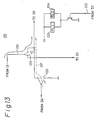
- FIG 13 illustrates a detailed example of a receiving channel switch circuit.
- the receiving channel switch circuit (RSW) 25 in Fig. 4 can be realized by relay coils (RL1) 133 and (RL2) 134.
- the relay coils 133 and 134 operate their respective relay contacts (r1) 135 and (r2) 136.
- the broken line 137 indicates the flow of the main channel data in a normal state of the main channel system.
- the solid line 138 indicates the flow of the protection channel data when a fault condition exists in the main channel system.
- the switching signal sent via a line 132 (refer also to Fig. 4) drives a transistor and energizes or de-energizes the relay coils 133 and 134.
- the remaining items, for example, items 13, 26, 29, 32, and 33 are identical to those items having the same numerals shown in Fig. 4.
- FIG 14 illustrates a detailed example of receiving and transmitting control circuits.
- the fault detection signal is applied, via the line "3" (refer to Fig. 4), from the detection means 28 and then transmitted to a radio receiver (RV) 141 in the transmitter side control circuit 31 by way of a radio driver (DV) 143 and the transmission line (upstream channel) 34.
- the thus transmitted fault detection signal is received by the transmitting channel switch unit (TSW) 40.
- TSW 40 In responding to the same, the TSW 40 returns a response signal to the receiving control circuit 32 by way of a radio driver (DV) 142, the transmission line (downstream channel) 34, and a radio receiver (RV) 144.
- the thus transmitted response signal is applied to two AND gates 145 and 146.
- the AND gate 145 also receives the fault detection signal from the detection means 28 and a signal reception detecting signal given from the SSW 26 via the line 44 (Fig. 4). Then the AND gate 145 produces an output as a switching signal, to be sent to the synchronous switch circuit (SSW) 26 via the line "8" (refer to Fig. 4).
- the inverter gate 147 receives a signal reception detecting signal given from the SSW 26 via the line 44 (Fig. 4) and outputs reversed signal to AND gate 146.
- the AND gate 146 receives, other than said response signal, the fault detection signal sent via the line "3" and a signal reverced reception detecting signal given from the gate 147, to produce an output, as a switching signal, to be sent to the receiving channel switch circuit (RSW) 25 via the line 132 (refer to 132 in Fig. 4).
- the above-mentioned signal reception detecting signal on the line 44 can be obtained, for example, as shown in Fig. 9, from the flip flops (FF) 93 and 96.
- FIG 15 illustrates a detailed example of a transmitting channel switch unit.
- the transmitting channel switch unit (TSW) 40 in Fig. 4 can be realized by relay coils (RL3) 153 and (RL4) 154.
- the relay coils 153 and 154 operate their respective relay contacts (r3) 155 and (r4) 156.
- the broken line 157 indicates the flow of the auxiliary data, e.g., the test pulse from the test pulse generator 30 in a normal state of the main channel system.
- the solid line 158 indicates the flow of the protection channel data supplied from the data source in the transmitting terminal station 19. When a fault condition exists in the main channel system.
- the first switching signal sent from the transmitting control circuit 31 via the line "4" (refer to Fig. 4) energizes the relay coils 153 and 154.
- Reference numerals 151 and 152 represent terminating resistors, the remaining items, such as 41 and 43, are identical to those shown in Fig. 15.
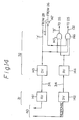
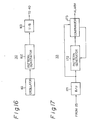
- Fig. 16 illustrates a specific block diagram of a test pulse generator.
- the test pulse generator 30 shown in Fig. 4 is comprised of a clock oscillator 161, a pattern generator 162, and a unipolar to bipolar convertor (U/B) 163.
- the output of the generator 30 is sent to the transmitting channel switch unit (TSW) 40 of Fig. 4.
- the oscillator 161 produces a clock having a frequency the same as that of the data supplied from the data source.
- the pattern generator 162 produces a pulse having a predetermined pulse pattern which is suitable as a supervisory test pattern.
- FIG. 17 illustrates a specific block diagram of a test pulse detector.
- the test pulse detector 33 shown in Fig. 4 is comprised of a bipolar to unipolar convertor (B/U) 171, a pattern generator 172, and a comparator 173.
- the test pulse is received from the receiving channel switch circuit (RSW) 25 and converted into a unipolar test pulse which is applied to the comparator 173 at its first input.
- the second input thereof is supplied with the output from the pattern generator 172.
- the comparator 173 compares its two input signals and produces a mismatch signal as long as the two input signals do not coincide with each other.
- the pattern generator 172 changes the phase of its output bit by bit every time the mismatch signal is applied thereto. During the sweep of the phase change, the two above-mentioned input signals will coincide with each other. If such coincidence cannot be detected even after a predetermined time, an alarm signal will be produced to alert an operator to repair the related fault which has occurred in the protection channel system.
- the data communication system contains therein a channel switching means which can switch a main channel to a protection channel, if a transmission fault takes place in the main channel system, with no data loss during the switch. That is, an instantaneous stoppage of data flow is prevented. This ability is remarkable when the transmission fault takes place quickly, due to, for example, sudden fading, sudden trouble in the electronic communication apparatus, and the like.
Landscapes
- Engineering & Computer Science (AREA)
- Computer Networks & Wireless Communication (AREA)
- Signal Processing (AREA)
- Detection And Prevention Of Errors In Transmission (AREA)
Applications Claiming Priority (2)
| Application Number | Priority Date | Filing Date | Title |
|---|---|---|---|
| JP63023226A JPH01198834A (ja) | 1988-02-03 | 1988-02-03 | 回線切替装置 |
| JP23226/88 | 1988-02-03 |
Publications (3)
| Publication Number | Publication Date |
|---|---|
| EP0327128A2 true EP0327128A2 (fr) | 1989-08-09 |
| EP0327128A3 EP0327128A3 (fr) | 1991-04-10 |
| EP0327128B1 EP0327128B1 (fr) | 1995-08-02 |
Family
ID=12104718
Family Applications (1)
| Application Number | Title | Priority Date | Filing Date |
|---|---|---|---|
| EP89101959A Expired - Lifetime EP0327128B1 (fr) | 1988-02-03 | 1989-02-03 | Système de communication de données ayant des moyens de commutation de canal |
Country Status (5)
| Country | Link |
|---|---|
| US (1) | US5414414A (fr) |
| EP (1) | EP0327128B1 (fr) |
| JP (1) | JPH01198834A (fr) |
| CA (1) | CA1338741C (fr) |
| DE (1) | DE68923626D1 (fr) |
Cited By (9)
| Publication number | Priority date | Publication date | Assignee | Title |
|---|---|---|---|---|
| EP0437198A1 (fr) * | 1990-01-10 | 1991-07-17 | Fujitsu Limited | Système de communication optique ayant un mécanisme de commutation amélioré |
| EP0463808A3 (en) * | 1990-06-28 | 1993-03-17 | American Telephone And Telegraph Company | Switching of a digital signal to an alternate channel transmitted via a different route |
| EP0488610A3 (fr) * | 1990-11-27 | 1994-01-05 | Fujitsu Ltd | |
| EP0744847A1 (fr) * | 1995-05-23 | 1996-11-27 | Philips Communication D'entreprise | Système de transmission d'information utilisant, en redondance, au moins deux canaux |
| EP0735770A3 (fr) * | 1995-03-31 | 1997-05-02 | Sony Corp | Appareil de traitement de signal |
| WO1997029556A1 (fr) * | 1996-02-07 | 1997-08-14 | Lutron Electronics, Co., Inc. | Repeteur de systeme de transmission pour commander et determiner a distance l'etat de dispositifs electriques |
| US5905442A (en) * | 1996-02-07 | 1999-05-18 | Lutron Electronics Co., Inc. | Method and apparatus for controlling and determining the status of electrical devices from remote locations |
| RU2153786C1 (ru) * | 1999-01-15 | 2000-07-27 | Военный университет связи | Дублированная система с динамической задержкой |
| KR100555643B1 (ko) * | 2001-07-30 | 2006-03-03 | 삼성전자주식회사 | 영상신호 송신 및 수신 장치 및 그 방법 |
Families Citing this family (20)
| Publication number | Priority date | Publication date | Assignee | Title |
|---|---|---|---|---|
| US5666653A (en) * | 1990-08-07 | 1997-09-09 | Inventahl Ab | Wide area radio communication system and method for communicating in a wide area through a wide area radio communication system |
| JP3434556B2 (ja) * | 1994-01-10 | 2003-08-11 | 富士通株式会社 | 信号線切替え回路 |
| EP0761049B1 (fr) * | 1994-05-27 | 2000-08-30 | BRITISH TELECOMMUNICATIONS public limited company | Systeme de transmission de donnees dote d'un dispositif de commutation de canaux |
| JP3319331B2 (ja) * | 1997-04-04 | 2002-08-26 | 日本電気株式会社 | 双方向通信システムにおける遅延量/送信レベル設定方式 |
| JPH11145996A (ja) * | 1997-11-12 | 1999-05-28 | Canon Inc | 通信ネットワーク及びそこで用いる伝送制御方法 |
| EP1073214B1 (fr) * | 1999-02-16 | 2008-12-17 | Mitsubishi Denki Kabushiki Kaisha | Systeme de communication radio, emetteur et recepteur |
| JP3671782B2 (ja) * | 1999-12-10 | 2005-07-13 | 富士通株式会社 | 信号位相調整回路 |
| US6660948B2 (en) | 2001-02-28 | 2003-12-09 | Vip Investments Ltd. | Switch matrix |
| US7307542B1 (en) | 2003-09-03 | 2007-12-11 | Vantage Controls, Inc. | System and method for commissioning addressable lighting systems |
| US7755506B1 (en) | 2003-09-03 | 2010-07-13 | Legrand Home Systems, Inc. | Automation and theater control system |
| US7394451B1 (en) | 2003-09-03 | 2008-07-01 | Vantage Controls, Inc. | Backlit display with motion sensor |
| US7889051B1 (en) | 2003-09-05 | 2011-02-15 | The Watt Stopper Inc | Location-based addressing lighting and environmental control system, device and method |
| US7274117B1 (en) | 2003-09-05 | 2007-09-25 | The Watt Stopper, Inc. | Radio wall switch |
| US7778262B2 (en) | 2005-09-07 | 2010-08-17 | Vantage Controls, Inc. | Radio frequency multiple protocol bridge |
| US7570713B2 (en) * | 2006-06-14 | 2009-08-04 | Harris Stratex Networks, Inc. | System and method for anticipatory receiver switching based on signal quality estimation |
| JP2008011123A (ja) * | 2006-06-28 | 2008-01-17 | Fujitsu Ltd | 冗長なデータ通信を行う通信装置 |
| TW200827797A (en) * | 2006-12-20 | 2008-07-01 | Inventec Multimedia & Telecom | Switching device of light-beam channel of optical fiber network |
| US9203522B2 (en) * | 2008-08-19 | 2015-12-01 | Finisar Corporation | Phase lock loop control for digital communication systems |
| CN102668678B (zh) * | 2009-11-03 | 2015-11-25 | 瑞典爱立信有限公司 | 补偿多径衰落的多链路调度 |
| FR3033220B1 (fr) * | 2015-02-27 | 2017-03-10 | Commissariat Energie Atomique | Recepteur d'horloge de liaison optique |
Family Cites Families (13)
| Publication number | Priority date | Publication date | Assignee | Title |
|---|---|---|---|---|
| NL6402192A (fr) * | 1964-03-05 | 1965-09-06 | ||
| NL145117B (nl) * | 1966-02-26 | 1975-02-17 | Philips Nv | Foutencorrigerend informatietransmissiesysteem. |
| US4047151A (en) * | 1974-12-24 | 1977-09-06 | Rydbeck Nils R C | Adaptive error correcting transmission system |
| FR2359553A1 (fr) * | 1976-07-22 | 1978-02-17 | France Etat | Systeme de doublement de canaux de transmission numerique |
| JPS5496313A (en) * | 1978-01-13 | 1979-07-30 | Hitachi Cable Ltd | Signal switching system |
| US4234956A (en) * | 1978-10-11 | 1980-11-18 | The General Electric Company Limited | Digital relay systems |
| JPS5698033A (en) * | 1979-12-30 | 1981-08-07 | Fujitsu Ltd | Switching system of standby transmission line |
| JPS5815341A (ja) * | 1981-07-22 | 1983-01-28 | Nec Corp | 送信ダイバーシティ信号の送信方法および装置 |
| DE3206749C2 (de) * | 1982-02-25 | 1984-12-13 | Siemens AG, 1000 Berlin und 8000 München | Ersatzschaltung zum Umschalten einer, ein Digitalsignal führende Betriebsstrecke auf einer Ersatzstrecke |
| US4646286A (en) * | 1985-07-30 | 1987-02-24 | Northern Telecom Limited | Communications system with protection switching and channel identities |
| JPH0624345B2 (ja) * | 1986-04-28 | 1994-03-30 | 日本電気株式会社 | 予備回線監視回路 |
| JPS62274946A (ja) * | 1986-05-23 | 1987-11-28 | Fujitsu Ltd | 無瞬断切替回路 |
| JPS6377235A (ja) * | 1986-09-20 | 1988-04-07 | Fujitsu Ltd | デイジタル通信システムの切替方式 |
-
1988
- 1988-02-03 JP JP63023226A patent/JPH01198834A/ja active Pending
-
1989
- 1989-01-31 CA CA000589702A patent/CA1338741C/fr not_active Expired - Fee Related
- 1989-02-03 DE DE68923626T patent/DE68923626D1/de not_active Expired - Lifetime
- 1989-02-03 EP EP89101959A patent/EP0327128B1/fr not_active Expired - Lifetime
-
1993
- 1993-01-08 US US08/002,103 patent/US5414414A/en not_active Expired - Fee Related
Cited By (13)
| Publication number | Priority date | Publication date | Assignee | Title |
|---|---|---|---|---|
| EP0437198A1 (fr) * | 1990-01-10 | 1991-07-17 | Fujitsu Limited | Système de communication optique ayant un mécanisme de commutation amélioré |
| EP0583798A1 (fr) * | 1990-01-10 | 1994-02-23 | Fujitsu Limited | Système de communication optique ayant un mécanisme de commutation amélioré |
| EP0463808A3 (en) * | 1990-06-28 | 1993-03-17 | American Telephone And Telegraph Company | Switching of a digital signal to an alternate channel transmitted via a different route |
| EP0488610A3 (fr) * | 1990-11-27 | 1994-01-05 | Fujitsu Ltd | |
| US5406564A (en) * | 1990-11-27 | 1995-04-11 | Fujitsu Limited | Communication line backup system |
| EP0735770A3 (fr) * | 1995-03-31 | 1997-05-02 | Sony Corp | Appareil de traitement de signal |
| EP0744847A1 (fr) * | 1995-05-23 | 1996-11-27 | Philips Communication D'entreprise | Système de transmission d'information utilisant, en redondance, au moins deux canaux |
| US5835483A (en) * | 1995-05-23 | 1998-11-10 | Bisson; Frederic | Information transmission system utilizing at least two channels in the redundancy mode |
| WO1997029556A1 (fr) * | 1996-02-07 | 1997-08-14 | Lutron Electronics, Co., Inc. | Repeteur de systeme de transmission pour commander et determiner a distance l'etat de dispositifs electriques |
| US5848054A (en) * | 1996-02-07 | 1998-12-08 | Lutron Electronics Co. Inc. | Repeater for transmission system for controlling and determining the status of electrical devices from remote locations |
| US5905442A (en) * | 1996-02-07 | 1999-05-18 | Lutron Electronics Co., Inc. | Method and apparatus for controlling and determining the status of electrical devices from remote locations |
| RU2153786C1 (ru) * | 1999-01-15 | 2000-07-27 | Военный университет связи | Дублированная система с динамической задержкой |
| KR100555643B1 (ko) * | 2001-07-30 | 2006-03-03 | 삼성전자주식회사 | 영상신호 송신 및 수신 장치 및 그 방법 |
Also Published As
| Publication number | Publication date |
|---|---|
| DE68923626D1 (de) | 1995-09-07 |
| EP0327128A3 (fr) | 1991-04-10 |
| EP0327128B1 (fr) | 1995-08-02 |
| US5414414A (en) | 1995-05-09 |
| CA1338741C (fr) | 1996-11-26 |
| JPH01198834A (ja) | 1989-08-10 |
Similar Documents
| Publication | Publication Date | Title |
|---|---|---|
| EP0327128B1 (fr) | Système de communication de données ayant des moyens de commutation de canal | |
| US5155483A (en) | Channel switching system | |
| US5172396A (en) | Public service trunking simulcast system | |
| US5708684A (en) | Radio equipment | |
| US4635274A (en) | Bidirectional digital signal communication system | |
| JPH0642663B2 (ja) | ディジタル通信方式の中間中継局 | |
| JP2595602B2 (ja) | 衛星通信地球局送受信方式 | |
| CA1254621A (fr) | Dispositif de commutation de canaux | |
| JPH08139642A (ja) | 無線装置 | |
| US6657953B1 (en) | Signal loopback device | |
| US3962646A (en) | Squelch circuit for a digital system | |
| GB2336074A (en) | Phase alignment of data in high speed parallel data buses using a multi-phase low frequency sampling clock | |
| JPH0746801B2 (ja) | 遅延補償方式 | |
| JP2637796B2 (ja) | 回線切替方式 | |
| KR0141641B1 (ko) | 데이타 통신시스템의 데이타 복원회로 | |
| JPH04267648A (ja) | 無線端局装置 | |
| JPS60102036A (ja) | 同期切替方式 | |
| JPH01154646A (ja) | 回線切替可能なディジタル通信方式 | |
| JP3485993B2 (ja) | 無線装置及び無線装置における切替え方法 | |
| JPS6243927A (ja) | 衛星搭載用リタイミング回路 | |
| JPH0150149B2 (fr) | ||
| JPS6055749A (ja) | 回線監視方式 | |
| JPS639331A (ja) | 回線切替方式 | |
| JPH02119445A (ja) | スタツフ同期多重変換装置 | |
| JPH05316097A (ja) | 回線切替装置 |
Legal Events
| Date | Code | Title | Description |
|---|---|---|---|
| PUAI | Public reference made under article 153(3) epc to a published international application that has entered the european phase |
Free format text: ORIGINAL CODE: 0009012 |
|
| AK | Designated contracting states |
Kind code of ref document: A2 Designated state(s): DE FR GB IT |
|
| PUAL | Search report despatched |
Free format text: ORIGINAL CODE: 0009013 |
|
| AK | Designated contracting states |
Kind code of ref document: A3 Designated state(s): DE FR GB IT |
|
| 17P | Request for examination filed |
Effective date: 19910522 |
|
| 17Q | First examination report despatched |
Effective date: 19930308 |
|
| GRAA | (expected) grant |
Free format text: ORIGINAL CODE: 0009210 |
|
| AK | Designated contracting states |
Kind code of ref document: B1 Designated state(s): DE FR GB IT |
|
| PG25 | Lapsed in a contracting state [announced via postgrant information from national office to epo] |
Ref country code: IT Free format text: LAPSE BECAUSE OF FAILURE TO SUBMIT A TRANSLATION OF THE DESCRIPTION OR TO PAY THE FEE WITHIN THE PRE;WARNING: LAPSES OF ITALIAN PATENTS WITH EFFECTIVE DATE BEFORE 2007 MAY HAVE OCCURRED AT ANY TIME BEFORE 2007. THE CORRECT EFFECTIVE DATE MAY BE DIFFERENT FROM THE ONE RECORDED.SCRIBED TIME-LIMIT Effective date: 19950802 Ref country code: FR Effective date: 19950802 |
|
| REF | Corresponds to: |
Ref document number: 68923626 Country of ref document: DE Date of ref document: 19950907 |
|
| PG25 | Lapsed in a contracting state [announced via postgrant information from national office to epo] |
Ref country code: DE Effective date: 19951103 |
|
| EN | Fr: translation not filed | ||
| PLBE | No opposition filed within time limit |
Free format text: ORIGINAL CODE: 0009261 |
|
| STAA | Information on the status of an ep patent application or granted ep patent |
Free format text: STATUS: NO OPPOSITION FILED WITHIN TIME LIMIT |
|
| 26N | No opposition filed | ||
| PGFP | Annual fee paid to national office [announced via postgrant information from national office to epo] |
Ref country code: GB Payment date: 19990204 Year of fee payment: 11 |
|
| PG25 | Lapsed in a contracting state [announced via postgrant information from national office to epo] |
Ref country code: GB Free format text: LAPSE BECAUSE OF NON-PAYMENT OF DUE FEES Effective date: 20000203 |
|
| GBPC | Gb: european patent ceased through non-payment of renewal fee |
Effective date: 20000203 |