EP0327183A2 - Steuerungssystem für hin -und hergehende lineare Bewegung oder intermittierende Bewegungseinrichtungen - Google Patents
Steuerungssystem für hin -und hergehende lineare Bewegung oder intermittierende Bewegungseinrichtungen Download PDFInfo
- Publication number
- EP0327183A2 EP0327183A2 EP89200236A EP89200236A EP0327183A2 EP 0327183 A2 EP0327183 A2 EP 0327183A2 EP 89200236 A EP89200236 A EP 89200236A EP 89200236 A EP89200236 A EP 89200236A EP 0327183 A2 EP0327183 A2 EP 0327183A2
- Authority
- EP
- European Patent Office
- Prior art keywords
- stroke
- amount
- velocity
- velocity data
- time
- Prior art date
- Legal status (The legal status is an assumption and is not a legal conclusion. Google has not performed a legal analysis and makes no representation as to the accuracy of the status listed.)
- Granted
Links
Images



Classifications
-
- G—PHYSICS
- G05—CONTROLLING; REGULATING
- G05B—CONTROL OR REGULATING SYSTEMS IN GENERAL; FUNCTIONAL ELEMENTS OF SUCH SYSTEMS; MONITORING OR TESTING ARRANGEMENTS FOR SUCH SYSTEMS OR ELEMENTS
- G05B19/00—Program-control systems
- G05B19/02—Program-control systems electric
- G05B19/18—Numerical control [NC], i.e. automatically operating machines, in particular machine tools, e.g. in a manufacturing environment, so as to execute positioning, movement or co-ordinated operations by means of program data in numerical form
- G05B19/416—Numerical control [NC], i.e. automatically operating machines, in particular machine tools, e.g. in a manufacturing environment, so as to execute positioning, movement or co-ordinated operations by means of program data in numerical form characterised by control of velocity, acceleration or deceleration
-
- G—PHYSICS
- G05—CONTROLLING; REGULATING
- G05B—CONTROL OR REGULATING SYSTEMS IN GENERAL; FUNCTIONAL ELEMENTS OF SUCH SYSTEMS; MONITORING OR TESTING ARRANGEMENTS FOR SUCH SYSTEMS OR ELEMENTS
- G05B2219/00—Program-control systems
- G05B2219/30—Nc systems
- G05B2219/49—Nc machine tool, till multiple
- G05B2219/49382—Movement reciprocating
Definitions
- the present invention relates to control systems for reciprocating linear motion devices or intermittent motion devices, for example, to systems for controlling the metering cylinder of a filling device in packaging machines, a lifting device for the containers to be filled with a liquid by the filling device, a transport device for intermittently transporting the liquid-filled containers, etc.
- the filling stroke of filling devices is controlled by a cam.
- a cam is also used for controlling the lift stroke of lifting devices to maintain a constant distance between the filling nozzle and the level of the liquid filled in containers during filling operation.
- a cam is also used for controlling the transport stroke of transport devices for intermittently transporting the liquid-filled containers to a specified work station, so as to diminish the movement of the liquid.
- the main object of the present invention is to overcome the above problem and to provide a control system for reciprocating linear motion or intermittent motion devices.
- the present invention provides a control system for a reciprocating linear motion or intermittent motion device, comprising: a servomotor for driving an operation member of the device; means for setting an amount of stroke for the operation member; means for setting a period of stroke time for the operation member; memory means for storing therein in the order of addresses items of velocity data at stroke positions at a specified spacing, the items of velocity data being obtained from a predetermined operation member velocity diagram; pulse generator means for generating a pulse signal having a period equal to a velocity data reading interval determined by the stroke time set by the stroke time setting means and the number of velocity data items stored in the memory means; means for counting the number of pulses produced by the pulse generating means; means for reading the velocity data from the address in the memory means corresponding to a renewed count obtained by the counting means every time the count is renewed; means for converting the read velocity data to a signal corresponding to a velocity obtained by multiplying the velocity data by a coefficient determined by the amount of stroke set by the stroke amount setting means, the stroke time set by the stroke time setting means
- the velocity of the operation member is determined from the set values and the velocity data stored in the memory means, and the operation member performs the specified amount of stroke for the specified time at the velocity thus determined.
- one of the amount of stroke and the stroke time or both can be easily altered merely by varying the value set by one of the stroke amount setting means and the stroke time setting means or the values set by both means.
- the velocity characteristics of the operation member can also be altered easily by varying the velocity data in the memory means.
- blanks each in the form of a tube with a closed end and to be made into containers are delivered from mandrels onto the transport device.
- the blanks are intermittently fed by the transport device to a prefolding station, filling station, forming station and top sealing station in succession.
- folds are formed in the open end portion of each blank for forming the top portion of a container.
- a fluid food or the like is filled into container blank.
- the open end portion of the blank is folded.
- the folded end portion is sealed, whereby the container is completed with the contents enclosed therein.
- the fluid food or like liquid is filled into the container (blank) by the filling device which has a metering cylinder and a filling nozzle.
- the container is lowered by the lifting device to maintain a constant distance between the filling nozzle and the level of the liquid filled in the container and thereby prevent the liquid from splashing.
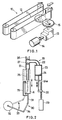
- Fig. 1 schematically shows the construction of the transport device 10, which comprises a pair of opposed belt conveyors 11, 12 extending in the direction of transport.
- Each of the conveyors 11, 12 comprises a pair of front and rear pulleys,and a belt reeved around the pulleys.
- One of the pulleys of the conveyor 11 has a drive shaft which is coupled by a reduction gear 13 to the output shaft of a servomotor 14 for driving the transport device 10.
- the rotation of this pulley is transmitted through a gear mechanism 15 to one of the pulleys of the other belt conveyor 12.
- the servomotor 14 is controlled by the control system shown in Fig. 10.
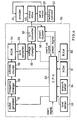
- Fig. 2 schematically shows the filling device and the container lifting device.
- the filling device 20 comprises a filling cylinder 21, a metering cylinder 23 having a piston 24 and connected by a pipe 22 to the filling cylinder 21 at an intermediate portion of its height, and a filling nozzle 25 connected to the lower end of the filling cylinder 21.
- the filling cylinder 21 is internally provided with check valves 26, 27 at its upper and lower ends, respectively.
- the upper end of the filling cylinder 21 is connected to a liquid tank by an unillustrated connecting pipe.
- the rod 24a of the metering cylinder piston 24 is connected by a ball screw 38 to the output shaft of a servomotor 29 for driving the piston for the cylinder 23.
- the servomotor 29 is controlled by the control system shown in Fig. 4.
- the container lifting device 30 comprises a lift member 31 for supporting the container K, a lever 33 reciprocatingly pivotally movable by a servomotor 32, and a link 34 pivoted at its one end to the lower end of the lift member 31 and the other end to the forward end of the lever 33.
- the lift member 31 has attached thereto a holder 35 for holding the container K with stability.
- the servomotor 32 is controlled by the control system shown in Fig. 9.
- Fig. 3 shows the operation of the transport device 10, the container lifting device 30 and the filling device 20 with time.
- the container K is raised from a bottom dead center indicated in a solid line in Fig. 2 to a top dead center indicated in a broken line in the drawing by the lifting device 30.
- the filling nozzle 25 is placed in the container K, with the nozzle end positioned at the bottom of the container K.
- the piston 24 of the metering cylinder 23 rises, thereby causing the liquid within the cylinder 23 to fill the container K through the connecting pipe 22, the filling cylinder 21 and the nozzle 25.
- the lifting device 30 lowers so as to maintain the end of the nozzle 25 at an approximately constant distance from the liquid level in the container K.
- the lifting device 30 stops descending.
- the transport device 10 is thereafter driven, while the piston 24 of the metering cylinder 23 moves down, allowing the liquid to flow out from the liquid tank into the metering cylinder 23 through the filling cylinder 21 and the connecting pipe 22.
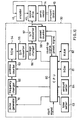
- Fig. 4 shows the electrical construction of the control system for the metering cylinder driving servomotor.
- the rotation angular position of the output shaft of the servomotor 29 is detected by an encoder 41, which feeds a detection signal back to a motor drive circuit 42.
- the servomotor 29 is subjected to feedback control by the drive circuit 42 so that the rotation angular position of its output shaft coincides with the position represented by the pulse signal.
- the motor control circuit 50 comprises a clock pulse generator 51, a frequency changer 52 for changing the pulses produced by the generator 51 to a pulse signal having a frequency f equal to A (first control coefficient) times the frequency fo of the pulses, an address counter 53 for counting the number of pulses produced by the frequency changer 52, a velocity function ROM 54 having stored therein in the order of addresses the desired velocity characteristics data relative to the filling stroke of the metering cylinder 23 or the time required for the filling stroke and delivering the stored data at a particular address specified by the address counter 53, a D/A converter 55 for converting the output data of the ROM 54 to a voltage, a voltage changer 56 for changing the output voltage of the D/A converter 55 to a voltage equal to B (second control coefficient) times the output voltage, a V/F converter 57 for converting the output voltage of the changer 56 to a pulse signal having a frequency in accordance with the voltage value and feeding the pulse signal to the drive circuit 42, a preset counter 58 for counting the number of
- the CPU 60 receives a setting signal from means 63 for setting a desired period of filling time for the metering cylinder 23, a setting signal from means 64 for setting the desired amount (stroke amount) to be filled by the metering cylinder 23, a count-up signal from the preset counter 58, a start signal forwarded from an unillustrated packaging machine control system at a specified time.
- the CPU 60 produces a drive initiation signal and drive termination signal for the clock pulse generator 51, a first control coefficient A setting signal for the frequency changer 52, a reset signal for the address counter 53, a second control coefficient B setting signal for the voltage changer 56, a preset signal for the preset counter 58, etc.
- Fig. 5 is a velocity diagram showing the relationship between the filling stroke S of the metering cylinder piston 24 and the velocity thereof. Although modified sine curves or the like are usually used for velocity diagrams, an inverted V-shaped line is herein used for the convenience of description.
- the.system is initialized first.
- the first control coefficient A is determined in the following manner based on the filling time Ts set by the filling time setting means 63 and the velocity data stored in the velocity function ROM 54.
- the interval ds at which the data is read from the ROM 54 is Ts/n. Accordingly the frequency f of reading pulses is n/Ts.
- the second control efficient B is determined in the following manner based on the filling time Ts set by the means 63, the filling amount Ws set by the filling amount setting means 64 and the velocity data stored in the ROM 54.
- the start signal is fed to the CPU 60, whereupon a value (preset value) corresponding to the filling amount Ws set by the setting means 64 is preset in the preset counter 58.
- the address counter 53 is reset, and the clock pulse generator 51 is thereafter initiated into operation.
- the pulses delivered from the frequency changer 52 are sent to the address counter 53 and counted by counter 53. Every time the count of the address counter 53 is renewed, the velocity data is read from the address of the ROM 54 corresponding to the renewed count and converted to a voltage by the D/A converter 55.
- the output voltage of the converter 55 is multiplied by B in the voltage changer 56 and then sent to the V/F converter 57, by which the voltage is converted to a pulse signal with a frequency corresponding to the voltage value.
- the pulse signal is fed to the motor drive circuit 42, which in turn drives the servomotor 29 at a speed corresponding to the frequency of the pulse signal, whereby the metering cylinder 23 is driven.
- the output pulses from the V/F converter 57 are fed also to the preset counter 58 and thereby counted.
- the preset counter 58 completes its operation to feed a count-up signal to the CPU 60, whereupon the CPU 60 feeds a drive termination signal to the pulse generator 51 to discontinue the operation of the generator 51 and stop the servomotor 29.
- the piston 24 of the metering cylinder 23 performs the specified amount of stroke corresponding to the specified filling amount for the specified filling time at the velocities determined from the velocity data stored in the ROM 54 and in accordance with the velocity diagram.
- the alteration shown in Fig. 6 is accomplished by varying the value set by the filling time setting means 63. In this case, both the control coefficients A and B are varied.
- the alteration of Fig. 7 is realized by varying only the value set by the filling amount setting means 64. In this case, the control coefficient B only is altered without changing the coefficient A.
- the alteration of Fig. 8 can be done by varying the control efficient A only.
- the speed of the servomotor 29 is controlled by the pulse signal as converted from the output voltage of the voltage changer 56 by the V/F converter 57 in the above embodiment, the motor speed may alternatively be controlled by the output voltage of the voltage changer 56.
- the detection signal of the encoder 41 is usable for recognizing that the piston of the metering cyinder 23 has moved by an amount corresponding to the set amount to be filled so as to deenergize the pulse generator 51 upon the recognition.
- ROM 61 In place of the velocity function ROM 54, it is possible to use other memory, such as ROM 61, having stored therein data as to different velocity diagrams, in combination with a memory adapted for writing and reading, such that the data as to the specified one of the velocity diagrams is transferred from the ROM 61 to the latter memory in the initiation step. This facilitates selective use of one of the different diagrams.
- the data read from the velocity function ROM 54 is first subjected to D/A conversion, and the resulting voltage value is multiplied by B, whereas the digital velocity data may be multiplied by B before the D/A conversion. Furthermore, the B-fold digital velocity data may be used without D/A conversion for controlling the servomotor 29 according to the B-fold digital value.
- Fig. 9 shows the electrical construction of the control system for the servomotor 32 for driving the container lifting device.
- like parts are designated by like reference numerals, and the difference of the system from the system of Fig. 4 only will be described.
- Stroke time setting means 63 sets the desired period of time required for the descending stroke of the lift member (hereinafter referred to as "stroke time").
- Stroke amount setting means 64 sets a value in accordance with the desired amount of descending stroke of the lift member 31.
- the velocity characteristics, stroke time and stroke amount of the lift member 31 involved in its descending stroke are so determined that the end of the filling nozzle 25 is maintained at an approximately constant distance from the liquid level in the container K during the operation of the filling device 20.
- a value (preset value) corresponding to the descending amount Ws set by the setting means 64 is preset in the preset counter 58.
- the address counter 53 is reset, and the clock pulse generator 51 is thereafter initiated into operation.
- the pulses delivered from the frequency changer 52 are sent to and counted by the address counter 53. Every time the count of the address counter 53 is renewed, the velocity data is read from the address of the ROM 54 corresponding to the renewed count and converted to a voltage by the D/A converter 55.
- the output voltage of the converter 55 is multiplied by B in the voltage changer 56 and then sent to the V/F converter 57, by which the voltage is converted to a pulse signal with a frequency corresponding to the voltage value.
- the pulse signal is fed to the motor drive circuit 42, which in turn drives the servomotor 32 at a speed corresponding to the frequency of the pulse signal, whereby the lifting device 30 is driven.
- the output pulses from the V/F converter 57 are fed also to the preset counter 58 and thereby counted.
- the preset counter 58 completes its operation to feed a count-up signal to the CPU 60, whereupon the CPU 60 feeds a drive termination signal to the pulse generator 51 to discontinue the operation of the generator 51 and stop the servomotor 32.
- the lift member 31 performs a descending stroke corresponding to the specified amount of descending stroke for the specified period of descending time at the velocities determined from the velocity data stored in the ROM 54.
- the control system described automatically controls the container lifting device 30 so that the lift member 31 descends with velocity characteristics in conformity with the predetermined velocity diagram, with the descending stroke time and amount made to equal to the respective set values.
- the end of the filling nozzle 25 is maintained at an approximately constant distance from the liquid level within the container K.
- the speed of the servomotor 32 is controlled by the pulse signal as converted from the output voltage of the voltage changer 56 by the V/F converter 57 in the above embodiment, the motor speed may alternatively be controlled by the output voltage of the voltage changer 56.
- the detection signal of the encoder 41 is usable for recognizing that the lift member 31 has moved by an amount corresponding to the set amount of descending stroke so as to deenergize the pulse generator 51 upon the recognition.
- ROM 61 In place of the velocity function ROM 54, it is possible to use other memory, such as ROM 61, having stored therein data as to different velocity diagrams, in combination with a memory adapted for writing and reading, such that the data as to the specified one of the velocity diagrams is transferred from the ROM 61 to the latter memory in the initialization step. This facilitates selective use of one of the different diagrams.
- the data read from the velocity function ROM 54 is first subjected to D/A conversion, and the resulting voltage value is multiplied by B, whereas the digital velocity data may be multiplied by B before the D/A conversion. Furthermore, the B-fold digital velocity data may be used without D/A conversion for controlling the servomotor 32 according to the B-fold digital value.
- Fig. 10 shows the electrical construction of the control system for the servomotor 14 for driving the transport device.
- like parts are designated by like reference numerals, and the difference of the system from the system of Fig. 4 only will be described.
- Stroke time setting means 63 sets the desired period of time required for the stroke of the transport device 10 (hereinafter referred to as "stroke time").
- Stroke amount setting means 64 sets a value in accordance with the desired amount of stroke of the transport device 10.
- the conveyor velocity diagram of the transport device 10 the stroke time and the stroke amount are so determined as to diminish the movement of the liquid in the container K when the container is transported.
- a value (preset value) corresponding to the stroke amount Ws set by the setting means 64 is preset in the preset counter 58.
- the address counter 53 is reset, and the clock pulse generator 51 is thereafter initiated into operation.
- the pulses delivered from the frequency changer 52 are sent to and counted by the address counter 53. Every time the count of the address counter 53 is renewed, the velocity data is read from the address of the ROM 54 corresponding to the renewed count and converted to a voltage by the D/A converter 55.
- the output voltage of the converter 55 is multiplied by B in the voltage changer 56 and then sent to the V/F converter 57, by which the voltage is converted to a pulse signal with a frequency corresponding to the voltage value.
- the pulse signal is fed to the motor drive circuit 42, which in turn drives the servomotor 14 at a speed corresponding to the frequency of the pulse signal, whereby the transport device 10 is driven.
- the output pulses from the V/F converter 57 are fed also to the preset counter 58 and thereby counted.
- the preset counter 58 completes its operation to feed a count-up signal to the CPU 60, whereupon the CPU 60 feeds a drive termination signal to the pulse generator 51 to discontinue the operation of the generator 51 and stop the servomotor 14.
- the transport device 10 moves by an amount corresponding to the specified amount of traveling stroke for the specified stroke time at the velocities determined from the velocity data strored in the ROM 54.
- the speed of the servomotor 14 is controlled by the pulse signal as converted from the output voltage of the voltage changer 56 by the V/F converter 57 in the above embodiment, the motor speed may alternatively be controlled by the output voltage of the voltage changer 56.
- the detection signal of the encoder 41 is usable for recognizing that the transport device 10 has moved by an amount corresponding to the set amount of traveling stroke so as to deenergize the pulse generator 51 upon the recognition.
- ROM 61 In place of the velocity function ROM 54, it is possible to use other memory, such as ROM 61, having stored therein data as to different velocity diagrams, in combination with a memory adapted for writing and reading, such that the data as to the specified one of the velocity diagrams is transferred from the ROM 61 to the latter memory in the initialization step. This facilitates selective use of one of the difference diagrams.
- the data read from the velocity function ROM 54 is first subjected to D/A conversion, and the resulting voltage value is multiplied by B, whereas the digital velocity data may be multplied by B before the D/A conversion. Furthermore, the B-fold digital velocity data may be used without D/A conversion for controlling the servomotor 14 according to the B-fold digital value.
Landscapes
- Engineering & Computer Science (AREA)
- Human Computer Interaction (AREA)
- Manufacturing & Machinery (AREA)
- Physics & Mathematics (AREA)
- General Physics & Mathematics (AREA)
- Automation & Control Theory (AREA)
- Basic Packing Technique (AREA)
- Reciprocating Conveyors (AREA)
- Vehicle Body Suspensions (AREA)
- Transmission Devices (AREA)
Applications Claiming Priority (2)
| Application Number | Priority Date | Filing Date | Title |
|---|---|---|---|
| JP26253/88 | 1988-02-05 | ||
| JP63026253A JPH01199801A (ja) | 1988-02-05 | 1988-02-05 | 往復直線運動または間欠運動装置の制御装置 |
Publications (3)
| Publication Number | Publication Date |
|---|---|
| EP0327183A2 true EP0327183A2 (de) | 1989-08-09 |
| EP0327183A3 EP0327183A3 (en) | 1989-12-06 |
| EP0327183B1 EP0327183B1 (de) | 1995-05-24 |
Family
ID=12188106
Family Applications (1)
| Application Number | Title | Priority Date | Filing Date |
|---|---|---|---|
| EP89200236A Expired - Lifetime EP0327183B1 (de) | 1988-02-05 | 1989-02-03 | Steuerungssystem für hin -und hergehende lineare Bewegung oder intermittierende Bewegungseinrichtungen |
Country Status (7)
| Country | Link |
|---|---|
| US (1) | US4900999A (de) |
| EP (1) | EP0327183B1 (de) |
| JP (1) | JPH01199801A (de) |
| AU (1) | AU601316B2 (de) |
| CA (1) | CA1294318C (de) |
| DE (1) | DE68922758T2 (de) |
| NO (1) | NO178246C (de) |
Cited By (1)
| Publication number | Priority date | Publication date | Assignee | Title |
|---|---|---|---|---|
| FR2760426A1 (fr) * | 1997-03-05 | 1998-09-11 | Kalix Sa | Procede de controle d'une machine de remplissage de conteneurs et machine de remplissage mettant en oeuvre le procede |
Families Citing this family (16)
| Publication number | Priority date | Publication date | Assignee | Title |
|---|---|---|---|---|
| JPH072481B2 (ja) * | 1989-11-14 | 1995-01-18 | 鐘紡株式会社 | 化粧料等の充填・包装装置 |
| JPH03275403A (ja) * | 1990-02-28 | 1991-12-06 | Isobe Tekko Kk | 液体・高粘度スラリーの連続充填装置 |
| JPH0719103U (ja) * | 1993-09-16 | 1995-04-07 | 株式会社メイワ | 充填機 |
| JP4334115B2 (ja) * | 2000-07-10 | 2009-09-30 | 大日本印刷株式会社 | ゲーベルトップ型紙容器の充填シール装置 |
| JP5032107B2 (ja) * | 2006-12-22 | 2012-09-26 | 四国化工機株式会社 | 充填タンクの洗浄方法 |
| JP4549357B2 (ja) * | 2007-02-15 | 2010-09-22 | 四国化工機株式会社 | 高速液体充填機械 |
| US9394153B2 (en) | 2007-03-15 | 2016-07-19 | The Coca-Cola Company | Multiple stream filling system |
| US8479784B2 (en) | 2007-03-15 | 2013-07-09 | The Coca-Cola Company | Multiple stream filling system |
| WO2009100123A2 (en) | 2008-02-04 | 2009-08-13 | The Coca-Cola Company | Methods of creating customized beverage products |
| ITBO20080256A1 (it) * | 2008-04-23 | 2009-10-24 | Tonazzi Vasquali S R L | Sistema e metodo per il riempimento di tubetti in una macchina intubettatrice |
| JP5250330B2 (ja) * | 2008-08-01 | 2013-07-31 | 株式会社ウイスト | 充填装置および充填方法 |
| JP2010195475A (ja) * | 2009-02-24 | 2010-09-09 | Ishizuka Glass Co Ltd | カートンリフトサーボ駆動装置 |
| US9381470B2 (en) * | 2013-10-25 | 2016-07-05 | Shanghai Honghao Enterprise Development CO., LTD | Coating equipment for a composite membrane without a diffusion pump and its thickness gauge for both thick and thin coatings |
| US20180127255A1 (en) * | 2016-11-09 | 2018-05-10 | Bsh Hausgeraete Gmbh | Drink producing apparatus with filling level and/or vessel recognition device, household refrigeration apparatus as well as method for producing and dispensing a drink |
| US20180127258A1 (en) * | 2016-11-09 | 2018-05-10 | Bsh Hausgeraete Gmbh | Drink producing apparatus with distance setting device, household refrigeration apparatus as well as method for producing and dispensing a drink |
| JP7609731B2 (ja) | 2021-07-26 | 2025-01-07 | Pacraft株式会社 | 袋処理システム |
Family Cites Families (13)
| Publication number | Priority date | Publication date | Assignee | Title |
|---|---|---|---|---|
| US3959703A (en) * | 1974-12-24 | 1976-05-25 | Sidney Rosen | Speed control for pump of filling machines |
| US4010594A (en) * | 1975-05-27 | 1977-03-08 | Stanley A. McClusky | Method for supplying boxes to a plurality of filling and weighing stations and removal of filled boxes thereof |
| US4291261A (en) * | 1979-11-21 | 1981-09-22 | S. J. Electro Systems, Inc. | Electrical load control circuit useful in liquid level control systems |
| EP0066673B1 (de) * | 1981-03-04 | 1987-09-09 | Hitachi, Ltd. | Verfahren zur Steuerung der Winkelposition und Vorrichtung dafür |
| JPS58216507A (ja) * | 1982-06-02 | 1983-12-16 | 東洋機材工業株式会社 | 流動状物質の充填方法 |
| JPS59175947A (ja) * | 1983-03-22 | 1984-10-05 | Toshiba Mach Co Ltd | トランスフア装置 |
| JPS6018237A (ja) * | 1983-07-08 | 1985-01-30 | Komatsu Ltd | トランスファプレスの制御装置 |
| DE3405419A1 (de) * | 1983-11-08 | 1985-05-15 | Rheinische Maschinenfabrik & Eisengiesserei Anton Röper GmbH & Co KG, 4060 Viersen | Vorrichtung zum automatischen fuellen eines behaelters |
| US4749925A (en) * | 1984-03-08 | 1988-06-07 | Wilkins Earle H | Well pump control |
| DE3443557A1 (de) * | 1984-11-29 | 1986-05-28 | Lieder Maschinenbau GmbH & Co KG, 3033 Schwarmstedt | Verfahren und vorrichtung zur abmessung eines fliessfaehigen produktes |
| JPH0684163B2 (ja) * | 1986-01-29 | 1994-10-26 | ポ−ラ化成工業株式会社 | 充填機 |
| JPH0414322Y2 (de) * | 1986-05-21 | 1992-03-31 | ||
| US4833384A (en) * | 1987-07-20 | 1989-05-23 | Syntex (U.S.A.) Inc. | Syringe drive assembly |
-
1988
- 1988-02-05 JP JP63026253A patent/JPH01199801A/ja active Granted
-
1989
- 1989-02-03 DE DE68922758T patent/DE68922758T2/de not_active Expired - Fee Related
- 1989-02-03 US US07/305,683 patent/US4900999A/en not_active Expired - Lifetime
- 1989-02-03 AU AU29647/89A patent/AU601316B2/en not_active Ceased
- 1989-02-03 CA CA000590010A patent/CA1294318C/en not_active Expired - Fee Related
- 1989-02-03 NO NO890445A patent/NO178246C/no not_active IP Right Cessation
- 1989-02-03 EP EP89200236A patent/EP0327183B1/de not_active Expired - Lifetime
Cited By (1)
| Publication number | Priority date | Publication date | Assignee | Title |
|---|---|---|---|---|
| FR2760426A1 (fr) * | 1997-03-05 | 1998-09-11 | Kalix Sa | Procede de controle d'une machine de remplissage de conteneurs et machine de remplissage mettant en oeuvre le procede |
Also Published As
| Publication number | Publication date |
|---|---|
| NO178246C (no) | 1996-02-14 |
| JPH01199801A (ja) | 1989-08-11 |
| DE68922758D1 (de) | 1995-06-29 |
| US4900999A (en) | 1990-02-13 |
| JPH0517082B2 (de) | 1993-03-08 |
| CA1294318C (en) | 1992-01-14 |
| EP0327183A3 (en) | 1989-12-06 |
| NO178246B (no) | 1995-11-06 |
| AU601316B2 (en) | 1990-09-06 |
| EP0327183B1 (de) | 1995-05-24 |
| DE68922758T2 (de) | 1995-11-09 |
| NO890445L (no) | 1989-08-07 |
| NO890445D0 (no) | 1989-02-03 |
| AU2964789A (en) | 1989-08-10 |
Similar Documents
| Publication | Publication Date | Title |
|---|---|---|
| US4900999A (en) | Control system for reciprocating linear motion or intermittent motion devices | |
| US6178726B1 (en) | Method of controlling end seal time in bag-making, filling and packaging machine | |
| US5177930A (en) | Carton forming apparatus with servo control | |
| US4358918A (en) | Cartoning apparatus | |
| US4449349A (en) | Packing machine with adjustable means for weakening selected portions of cardboard blanks or the like | |
| US5787687A (en) | Servo-controlled container filling and weighing system | |
| US6427422B2 (en) | Packaging method | |
| US5419099A (en) | Servo-drive container conveying system | |
| JP4989006B2 (ja) | 液体の充填方法 | |
| US4967931A (en) | Bottom-up filler | |
| US5865217A (en) | Fill system including a flexible nozzle for reducing the mixing of product and air during container filling | |
| WO1996041746A1 (en) | Control system having error correcting apparatus | |
| US3613331A (en) | Feeding mechanism for a container filling machine | |
| ATE76612T1 (de) | Vorrichtung auf verpackungsmaschinen. | |
| US3320721A (en) | Packaging apparatus | |
| NO321160B1 (no) | Transportsystem for transport av vaeskefylte beholdere og fremgangsmate for valg av dets bevegelsesprofil | |
| CN221397347U (zh) | 灌装机 | |
| US20040065048A1 (en) | Drive device for packaging machine | |
| US4352444A (en) | Controllable volume dosing device | |
| US4938271A (en) | Dosing apparatus | |
| CN114620289B (zh) | 饮料灌装机、其容器运动控制方法和容器运动控制机构 | |
| JPH071465B2 (ja) | サ−ボモ−タの位置決め制御装置 | |
| US3173394A (en) | Container closing machine |
Legal Events
| Date | Code | Title | Description |
|---|---|---|---|
| PUAI | Public reference made under article 153(3) epc to a published international application that has entered the european phase |
Free format text: ORIGINAL CODE: 0009012 |
|
| AK | Designated contracting states |
Kind code of ref document: A2 Designated state(s): CH DE FR GB IT LI NL SE |
|
| PUAL | Search report despatched |
Free format text: ORIGINAL CODE: 0009013 |
|
| AK | Designated contracting states |
Kind code of ref document: A3 Designated state(s): CH DE FR GB IT LI NL SE |
|
| RIN1 | Information on inventor provided before grant (corrected) |
Inventor name: YAMANE,YOSHITAKA C/O SHIKOKU KAKOKI CO.LTD. Inventor name: SHIBATA,MASATO C/O SHIKOKU KAKOKI CO.LTD. |
|
| 17P | Request for examination filed |
Effective date: 19900425 |
|
| 17Q | First examination report despatched |
Effective date: 19920820 |
|
| GRAA | (expected) grant |
Free format text: ORIGINAL CODE: 0009210 |
|
| AK | Designated contracting states |
Kind code of ref document: B1 Designated state(s): CH DE FR GB IT LI NL SE |
|
| REF | Corresponds to: |
Ref document number: 68922758 Country of ref document: DE Date of ref document: 19950629 |
|
| ET | Fr: translation filed | ||
| ITF | It: translation for a ep patent filed | ||
| PLBE | No opposition filed within time limit |
Free format text: ORIGINAL CODE: 0009261 |
|
| STAA | Information on the status of an ep patent application or granted ep patent |
Free format text: STATUS: NO OPPOSITION FILED WITHIN TIME LIMIT |
|
| 26N | No opposition filed | ||
| REG | Reference to a national code |
Ref country code: GB Ref legal event code: IF02 |
|
| PGFP | Annual fee paid to national office [announced via postgrant information from national office to epo] |
Ref country code: DE Payment date: 20020104 Year of fee payment: 14 |
|
| PGFP | Annual fee paid to national office [announced via postgrant information from national office to epo] |
Ref country code: GB Payment date: 20020130 Year of fee payment: 14 |
|
| PGFP | Annual fee paid to national office [announced via postgrant information from national office to epo] |
Ref country code: SE Payment date: 20020215 Year of fee payment: 14 |
|
| PGFP | Annual fee paid to national office [announced via postgrant information from national office to epo] |
Ref country code: FR Payment date: 20020225 Year of fee payment: 14 |
|
| PGFP | Annual fee paid to national office [announced via postgrant information from national office to epo] |
Ref country code: NL Payment date: 20020226 Year of fee payment: 14 |
|
| PGFP | Annual fee paid to national office [announced via postgrant information from national office to epo] |
Ref country code: CH Payment date: 20020304 Year of fee payment: 14 |
|
| PG25 | Lapsed in a contracting state [announced via postgrant information from national office to epo] |
Ref country code: GB Free format text: LAPSE BECAUSE OF NON-PAYMENT OF DUE FEES Effective date: 20030203 |
|
| PG25 | Lapsed in a contracting state [announced via postgrant information from national office to epo] |
Ref country code: SE Free format text: LAPSE BECAUSE OF NON-PAYMENT OF DUE FEES Effective date: 20030204 |
|
| PG25 | Lapsed in a contracting state [announced via postgrant information from national office to epo] |
Ref country code: LI Free format text: LAPSE BECAUSE OF NON-PAYMENT OF DUE FEES Effective date: 20030228 Ref country code: CH Free format text: LAPSE BECAUSE OF NON-PAYMENT OF DUE FEES Effective date: 20030228 |
|
| PG25 | Lapsed in a contracting state [announced via postgrant information from national office to epo] |
Ref country code: NL Free format text: LAPSE BECAUSE OF NON-PAYMENT OF DUE FEES Effective date: 20030901 |
|
| PG25 | Lapsed in a contracting state [announced via postgrant information from national office to epo] |
Ref country code: DE Free format text: LAPSE BECAUSE OF NON-PAYMENT OF DUE FEES Effective date: 20030902 |
|
| GBPC | Gb: european patent ceased through non-payment of renewal fee | ||
| EUG | Se: european patent has lapsed | ||
| REG | Reference to a national code |
Ref country code: CH Ref legal event code: PL |
|
| PG25 | Lapsed in a contracting state [announced via postgrant information from national office to epo] |
Ref country code: FR Free format text: LAPSE BECAUSE OF NON-PAYMENT OF DUE FEES Effective date: 20031031 |
|
| NLV4 | Nl: lapsed or anulled due to non-payment of the annual fee |
Effective date: 20030901 |
|
| REG | Reference to a national code |
Ref country code: FR Ref legal event code: ST |
|
| PG25 | Lapsed in a contracting state [announced via postgrant information from national office to epo] |
Ref country code: IT Free format text: LAPSE BECAUSE OF NON-PAYMENT OF DUE FEES;WARNING: LAPSES OF ITALIAN PATENTS WITH EFFECTIVE DATE BEFORE 2007 MAY HAVE OCCURRED AT ANY TIME BEFORE 2007. THE CORRECT EFFECTIVE DATE MAY BE DIFFERENT FROM THE ONE RECORDED. Effective date: 20050203 |