EP0328585B1 - Metabolisch verträgliche polyisocyanat-klebemittel - Google Patents
Metabolisch verträgliche polyisocyanat-klebemittel Download PDFInfo
- Publication number
- EP0328585B1 EP0328585B1 EP88906631A EP88906631A EP0328585B1 EP 0328585 B1 EP0328585 B1 EP 0328585B1 EP 88906631 A EP88906631 A EP 88906631A EP 88906631 A EP88906631 A EP 88906631A EP 0328585 B1 EP0328585 B1 EP 0328585B1
- Authority
- EP
- European Patent Office
- Prior art keywords
- sulfur
- polyisocyanate
- carbon
- carbon atoms
- adhesive
- Prior art date
- Legal status (The legal status is an assumption and is not a legal conclusion. Google has not performed a legal analysis and makes no representation as to the accuracy of the status listed.)
- Expired - Lifetime
Links
- 0 Cc1ccc(*)cc1 Chemical compound Cc1ccc(*)cc1 0.000 description 5
- JRLPEMVDPFPYPJ-UHFFFAOYSA-N CCc1ccc(C)cc1 Chemical compound CCc1ccc(C)cc1 JRLPEMVDPFPYPJ-UHFFFAOYSA-N 0.000 description 2
- YYJMDNLOJJCIAH-SSDOTTSWSA-N C[C@H](c(cc1)ccc1N=C=O)O Chemical compound C[C@H](c(cc1)ccc1N=C=O)O YYJMDNLOJJCIAH-SSDOTTSWSA-N 0.000 description 1
- RZXMPPFPUUCRFN-UHFFFAOYSA-N Cc(cc1)ccc1N Chemical compound Cc(cc1)ccc1N RZXMPPFPUUCRFN-UHFFFAOYSA-N 0.000 description 1
- OFEGMKFBTXESSZ-UHFFFAOYSA-N N[CH-]c(cc1)ccc1N=C=O Chemical compound N[CH-]c(cc1)ccc1N=C=O OFEGMKFBTXESSZ-UHFFFAOYSA-N 0.000 description 1
- VJQXTEWWCURPIP-UHFFFAOYSA-N O=C=NC1=CC=C(C2)C2=CC1 Chemical compound O=C=NC1=CC=C(C2)C2=CC1 VJQXTEWWCURPIP-UHFFFAOYSA-N 0.000 description 1
Classifications
-
- C—CHEMISTRY; METALLURGY
- C09—DYES; PAINTS; POLISHES; NATURAL RESINS; ADHESIVES; COMPOSITIONS NOT OTHERWISE PROVIDED FOR; APPLICATIONS OF MATERIALS NOT OTHERWISE PROVIDED FOR
- C09J—ADHESIVES; NON-MECHANICAL ASPECTS OF ADHESIVE PROCESSES IN GENERAL; ADHESIVE PROCESSES NOT PROVIDED FOR ELSEWHERE; USE OF MATERIALS AS ADHESIVES
- C09J175/00—Adhesives based on polyureas or polyurethanes; Adhesives based on derivatives of such polymers
-
- A—HUMAN NECESSITIES
- A61—MEDICAL OR VETERINARY SCIENCE; HYGIENE
- A61L—METHODS OR APPARATUS FOR STERILISING MATERIALS OR OBJECTS IN GENERAL; DISINFECTION, STERILISATION OR DEODORISATION OF AIR; CHEMICAL ASPECTS OF BANDAGES, DRESSINGS, ABSORBENT PADS OR SURGICAL ARTICLES; MATERIALS FOR BANDAGES, DRESSINGS, ABSORBENT PADS OR SURGICAL ARTICLES
- A61L24/00—Surgical adhesives or cements; Adhesives for colostomy devices
- A61L24/04—Surgical adhesives or cements; Adhesives for colostomy devices containing macromolecular materials
- A61L24/046—Surgical adhesives or cements; Adhesives for colostomy devices containing macromolecular materials obtained otherwise than by reactions only involving carbon-to-carbon unsaturated bonds
-
- C—CHEMISTRY; METALLURGY
- C08—ORGANIC MACROMOLECULAR COMPOUNDS; THEIR PREPARATION OR CHEMICAL WORKING-UP; COMPOSITIONS BASED THEREON
- C08G—MACROMOLECULAR COMPOUNDS OBTAINED OTHERWISE THAN BY REACTIONS ONLY INVOLVING UNSATURATED CARBON-TO-CARBON BONDS
- C08G18/00—Polymeric products of isocyanates or isothiocyanates
- C08G18/06—Polymeric products of isocyanates or isothiocyanates with compounds having active hydrogen
- C08G18/08—Processes
- C08G18/16—Catalysts
- C08G18/18—Catalysts containing secondary or tertiary amines or salts thereof
- C08G18/1833—Catalysts containing secondary or tertiary amines or salts thereof having ether, acetal, or orthoester groups
-
- C—CHEMISTRY; METALLURGY
- C08—ORGANIC MACROMOLECULAR COMPOUNDS; THEIR PREPARATION OR CHEMICAL WORKING-UP; COMPOSITIONS BASED THEREON
- C08G—MACROMOLECULAR COMPOUNDS OBTAINED OTHERWISE THAN BY REACTIONS ONLY INVOLVING UNSATURATED CARBON-TO-CARBON BONDS
- C08G18/00—Polymeric products of isocyanates or isothiocyanates
- C08G18/06—Polymeric products of isocyanates or isothiocyanates with compounds having active hydrogen
- C08G18/08—Processes
- C08G18/16—Catalysts
- C08G18/18—Catalysts containing secondary or tertiary amines or salts thereof
- C08G18/20—Heterocyclic amines; Salts thereof
- C08G18/2009—Heterocyclic amines; Salts thereof containing one heterocyclic ring
- C08G18/2018—Heterocyclic amines; Salts thereof containing one heterocyclic ring having one nitrogen atom in the ring
-
- C—CHEMISTRY; METALLURGY
- C08—ORGANIC MACROMOLECULAR COMPOUNDS; THEIR PREPARATION OR CHEMICAL WORKING-UP; COMPOSITIONS BASED THEREON
- C08G—MACROMOLECULAR COMPOUNDS OBTAINED OTHERWISE THAN BY REACTIONS ONLY INVOLVING UNSATURATED CARBON-TO-CARBON BONDS
- C08G18/00—Polymeric products of isocyanates or isothiocyanates
- C08G18/06—Polymeric products of isocyanates or isothiocyanates with compounds having active hydrogen
- C08G18/70—Polymeric products of isocyanates or isothiocyanates with compounds having active hydrogen characterised by the isocyanates or isothiocyanates used
- C08G18/72—Polyisocyanates or polyisothiocyanates
- C08G18/77—Polyisocyanates or polyisothiocyanates having heteroatoms in addition to the isocyanate or isothiocyanate nitrogen and oxygen or sulfur
- C08G18/771—Polyisocyanates or polyisothiocyanates having heteroatoms in addition to the isocyanate or isothiocyanate nitrogen and oxygen or sulfur oxygen
-
- C—CHEMISTRY; METALLURGY
- C08—ORGANIC MACROMOLECULAR COMPOUNDS; THEIR PREPARATION OR CHEMICAL WORKING-UP; COMPOSITIONS BASED THEREON
- C08G—MACROMOLECULAR COMPOUNDS OBTAINED OTHERWISE THAN BY REACTIONS ONLY INVOLVING UNSATURATED CARBON-TO-CARBON BONDS
- C08G2170/00—Compositions for adhesives
- C08G2170/60—Compositions for foaming; Foamed or intumescent adhesives
-
- C—CHEMISTRY; METALLURGY
- C08—ORGANIC MACROMOLECULAR COMPOUNDS; THEIR PREPARATION OR CHEMICAL WORKING-UP; COMPOSITIONS BASED THEREON
- C08G—MACROMOLECULAR COMPOUNDS OBTAINED OTHERWISE THAN BY REACTIONS ONLY INVOLVING UNSATURATED CARBON-TO-CARBON BONDS
- C08G2230/00—Compositions for preparing biodegradable polymers
Definitions
- This invention relates to adhesives prepared from metabolically-acceptable polyisocyanate or polyisothiocyanate monomers. More particularly, the present invention is concerned with surgical adhesive polymers derived from these polyisocyanate monomers which do not metabolize to toxic products.
- Yet another object of the invention is to provide metabolically-acceptable surgical adhesives which are biodegradable.
- An additional object of the invention is to provide metabolically-acceptable adhesives low in toxicity as a consequence of their physical properties.
- curable, surgical adhesive comprised of:
- polyisocyanates or polyisothiocyanates of the invention are found to be metabolically-acceptable, that is, incapable of breaking down into toxic materials such as aromatic or aliphatic diamines. Rather, the compounds of the invention are characterized by their metabolism into innocuous materials such as amino acids.
- R radicals are divalent or polyvalent aliphatic radicals, which may be straight-chain or branched, such as methylene, 1,2-ethylene, 1,2-propylene, 1,3-propylene, 1-2,butylene, 1,3-butylene, 1,4-butylene, 2,3-butylene, 1,4-pentylene, 1,5-pentylene, 2,4-pentylene, 1,6-hexylene, 1,7-heptylene, 1,8-octylene, 2,6-octylene, 1,9-nonylene, 1,10-decylene, vinylene, propenylene, 2-butenylene, 2-methyl-1-butenylene, 3-methyl-2-pentenylene, butadienylene, etc.; divalent or polyvalent cycloaliphatic radicals, such as 1,3-cyclopentylene, 1,3-cyclohexylene, 1,4-cycl
- the radical "X" in the novel polyisocyanates of the invention is the residue of any organic compound, which contains active hydrogen-containing groups as determined by the Zerewitinoff method.
- active hydrogen-containing compounds include, for example, compounds having at least hydroxyl groups or thiol groups.
- the radical "X" can be the residue of simple hydroxyl- or thiol-group terminated alkanes, which may be straight-chain or branched, aralkanes, etc., as well as polymeric radicals such as hydroxy or thiol-group terminated polyesters, polyethers, polythioethers, polyacetals, polycarbonates, polyanhydrides, polyphosphates, polyphosphazines, polypeptides, polydepsipeptides, polyamides, polyester-polyether block copolymers.
- the compounds and/or polymers will contain at least two functional groups, often up to 8 functional groups and will have a molecular weight of 50 to 10,000, more often about 100 to 1,000.
- the hydroxyl-group-containing polyesters may be, for example, reaction products of polyhydric alcohols, preferably dihydric alcohols and polybasic, preferably dibasic, carboxylic acids.
- the corresponding polycarboxylic acid anhydride or corresponding polycarboxylic acid esters of lower alcohols or their mixtures may be used instead of the free polycarboxylic acids for preparing the polyesters.
- the polycarboxylic acid may be aliphatic, cycloaliphatic, aromatic and/or heterocyclic and may be substituted, e.g. with halogen atoms or may be unsaturated.
- Examples include succinic acid, adipic acid, suberic acid, azelaic acid, sebacic acid, phthalic acid, terephthalic acid, isophthalic acid, trimellitic acid, tetrahydrophthalic acid, hexahydrophthalic acid, tetrachlorophthalic acid, glutaric acid, maleic acid, fumaric acid.
- Any suitable polyhydric alcohol may be used, such as, for example, ethylene glycol; propylene-1,2- and -1,3-glycol; butylene-1,4- and -2,3-glycol; hexane-1,6-diol; octane-1,8-diol; neopentyl glycol; cyclohexanedimenthol; 1,4-bis-hydroxymethylcyclohexane; 2-methyl-propane-1,3-diol; glycerol; trimethylolpropane; hexane-1,2,3-triol; butane-1,2,4-triol; trimethylolethane; pentaerythritol; ribose; erythose; quinitol, mannitol; sorbitol; glucose; starches; fructose; cane sugar; dextrans; castor oil; methylglycoside; diethylene glycol; triethylene
- the polyesters may also contain a proportion of carboxyl end groups.
- Polyesters of lactones such as caprolactone, or hydroxycarboxylic acids such as hydroxycaproic acid may also be used.
- the hydroxyl-terminated polyesters include hydroxyl-terminated polyorthoesters such as are prepared by the melt polymerization of 2,2-diethoxytetrahydrofuran with diols.
- Suitable polyhydric polyalkylene ethers include, for example, the polymerization product of an alkylene oxide beginning with any suitable initiator.
- the initiator may be a difunctional compound, including water, so that the resulting polyether is essentially a chain of repeating alkyleneoxy groups as in polyethylene glycol, polypropylene glycol, polybutylene glycol; or the initiator may be any suitable active hydrogen containing compound which may be a monomer or even a compound having a relatively high molecular weight including other active hydrogen containing compounds as disclosed herein.
- Any suitable alkylene oxide may be used such as, for example, ethylene oxide, propylene oxide, butylene oxide, amylene oxide, tetrahydrofuran, epihalohydrins such as epichlorohydrin, dioxalane, styrene oxide and the like.
- Suitable initiators include, for example, water, polyhydric alcohols, preferably having 2 to 8 hydroxyl groups, amines, preferably having 2 to 8 replaceable hydrogen atoms bonded to nitrogen atoms to which the alkylene oxides may be added.
- the resulting polyhydric polyalkylene ethers may have either primary or secondary hydroxyl groups or mixtures of primary and secondary hydroxyl groups.
- alkylene oxides which contain from 2 to 5 carbon atoms and, generally speaking, it is advantageous to condense from about 1 to about 30 equivalents of alkylene oxide per functional group of the initiator.
- initiators are water, ethylene glycol, propylene glycol, glycerol, trimethylolpropane, pentaerythritol, arabitol, sorbitol, maltose, sucrose, ammonia, diethanolamine, triethanolamine, dipropanolamine, tripropanolamine, diethanolpropanolamine, tributanolamine, 2,4-tolylenediamine, 4,4′-diphenylmethanediamine, 4,4′,4 ⁇ -triphenylmethanetriamine, ethylenediamine, propylenediamine, propylenetriamine, N,N,N′,N′-tetrakis-(2-hydroxy-propyl)-ethylene diamine, diethylene triamine.
- polythioethers are meant, in particular, the condensation products of dithioglycol with itself and/or with other glycols, dicarboxylic acids, formaldehyde, or analogous polymers synthesized from ethylene sulfide, etc.
- the products obtained are polythio-mixed ethers or polythioether esters, depending on the co-component.
- Hydroxyl-terminated polyester-polyether block copolymers can be derived from polyalkylene glycols and hydroxyacids such as glycolic, lactic and hydroxycaproic acid by the melt polymerization of the polyalkylene glycol with the corresponding hydroxyacid or its cyclic lactone (e.g. glycolide, lactide, caprolactone, etc.).
- the polyacetals may be, for example, the compounds which may be obtained from glycols, e.g. diethylene glycol, triethylene glycol, 4,4′-dihydroxydiphenyldimethylmethane, hexanediol, etc. and formaldehyde. Suitable polyacetals may also be prepared by the polymerization of cyclic acetals.
- the polycarbonates with hydroxyl groups may be of the known kind, e.g. those which may be prepared by reacting diols, such as propane-1,3-diol, butane-1,4-diol and/or hexane-1,6-diol or diethylene glycol, triethylene glycol or tetraethylene glycol, with diarylcarbonates such as diphenylcarbonate or with phosgene.
- diols such as propane-1,3-diol, butane-1,4-diol and/or hexane-1,6-diol or diethylene glycol, triethylene glycol or tetraethylene glycol
- diarylcarbonates such as diphenylcarbonate or with phosgene.
- any of the compounds of any of the classes set forth hereinbefore may be used and such compounds may also contain other substituents including halogen atoms such as, for example, chloro, bromo, iodo; nitro groups; alkoxy radicals such as, for example, methoxy, ethoxy, propoxy, butoxy; carboalkoxy groups such as, for example, carbomethoxy, carbethoxy; dialkylamino groups such as, for example, dimethylamino, dipropylamino, methylethylamino; carbonyl, thiocarbonyl, phosphoryl, phosphato groups.
- substituents including halogen atoms such as, for example, chloro, bromo, iodo; nitro groups; alkoxy radicals such as, for example, methoxy, ethoxy, propoxy, butoxy; carboalkoxy groups such as, for example, carbomethoxy, carbethoxy; dialkylamino groups such as, for example,
- R3, R4, R5 and R6 are aliphatic radicals of 1 to 12 carbon atoms, which may be straight-chain or branched, or aromatic radicals of 6 to 12 carbon atoms including oxygen-bridged aliphatic and aromatic radicals;
- R7 is a polyfunctional active hydrogen-containing aliphatic radical; a, b, c, d, f, g, h, i, j, k, m, p, and q are integers of at least 1 usually up to 10 or more; b, e, l, and s are integers of at least 2 usually 3 or more; and n is an integer of 0 or 1.
- novel polyisocyanates and polyisothiocyanates of the invention are film-forming materials that may be prepared in numerous ways as, for instance, by the phosgenation or thiophosgenation of polyamine compounds having the structure: wherein n, R, A, y, q, r, p, X, and X′ are as defined above.
- These polyamine precursors may be prepared by any one of many possible condensation methods, well-known to someone skilled in the art, of an appropriate carboxylic, phosphorus or sulfonic acid derivative with the active hydrogen containing radicals "X", as defined above.
- a convenient route when R is an aromatic group involves reacting one mole of a compound having 2 terminal active hydrogen-containing groups with 2 moles of a nitro-substituted compound having the structure: O2N-R-COCl or O2N-R-SO2Cl or wherein R is aromatic and defined as above and q is 0 or 1.
- These condensation reactions may be carried out "in the melt", i.e. by heating the mixture of the reactants in the absence of a solvent; or in an inert solvent such as toluene, tetrahydrofuran, benzene, dioxane, etc.
- the nitro compounds are then reduced to the corresponding amines which are subjected to phosgenation.
- These syntheses can be represented as follows, using for purposes of illustration hydroxy-terminated compounds as the organic compound having terminal active hydrogen atoms.
- the reduction and phosgenation or thiophosgenation steps in these syntheses can be carried out using any of the well-known techniques.
- the reduction can be effected by simple hydrogenation in the presence of a suitable hydrogenation catalyst such as palladium, or by transfer hydrogenation.
- the phosgenation or thiophosgenation can be carried out by either a cold phase-hot phase phosgenation or by the hydrochloride process wherein the corresponding amine hydrochloride is phosgenated.
- the phosgenation can be carried out continuously or intermittently and inert solvents such as dioxane, chlorobenzene, o-dichlorobenzene, tetrahydrofuran, etc., are preferably employed for the reaction. Phosgene is conveniently stored as a stable solution in most of the above-mentioned solvents.
- an amino acid may be condensed with an active hydrogen-terminated compound by suspending the reactants in an inert solvent, such as toluene, chlorobenzene or benzene.
- an inert solvent such as toluene, chlorobenzene or benzene.
- the mixture is heated under reflux and hydrogen chloride gas passed in a continuous stream through the mixture.
- the water of condensation is removed by azeotropic distillation from the reaction mixture in order to drive the reaction to completion, i.e.,
- the hydrochloride salt of the polyamine may be phosgenated or thiophosgenated in the usual manner to give the polyisocyanate or polyisothiocyanate.
- An alternative procedure for the synthesis of these polyamine precursors involves the condensation of suitably-protected amino acid derivatives with an active hydrogen-containing compound, i.e., Any suitable, selectively-cleavable amine-protecting group Y, well-known to someone skilled in the art, may be used for this purpose.
- Y may be benzyloxycarbonyl or t-butyloxycarbonyl.
- the protected amino acid derivative is condensed with the active hydrogen-containing compound through use of suitable activation techniques.
- the protected polyamine precursors may be deprotected by appropriate procedures.
- Y is benzyloxycarbonyl
- the compounds may be: deprotected by catalytic hydrogenolysis or under anhydrous, acidic conditions, for example using solutions of hydrogen bromide in glacial acetic acid.
- cleavage may be effected selectively using anhydrous acids, such as trifluoroacetic acid or solutions of hydrogen chloride in anhydrous dioxane.
- the resulting polyamines are phosgenated or thiophosgenated by the usual procedures, as outlined above.
- Exemplary of preferred metabolically-acceptable diisocyanates of the invention are those having the structure: wherein m and q are 1 to about 10 or more; p is 1 to 20; R3 and R6 are aliphatic or aromatic radicals having 1 to 12 carbon atoms and Z is oxygen or sulfur. Of these diisocyanates, particularly preferred are those having the structure: wherein m and q are 2 or 4 and p is 4 to 20. These monomers, for example, will degrade ultimately to the metabolically-acceptable products, p-aminobenzoic acid, polyethylene glycol, and glycolic acid, all of which are innocuous.
- Other preferred metabolically-acceptable polyisocyanates include those having the structure: wherein R6 is an aliphatic or aromatic radical having 1 to 12 carbon atoms; R7 is a polyfunctional active hydrogen-containing aliphatic radical; c, d, and h are integers of at least 1; and Z is oxygen or sulfur.
- R6 is an aliphatic or aromatic radical having 1 to 12 carbon atoms
- R7 is a polyfunctional active hydrogen-containing aliphatic radical
- c, d, and h are integers of at least 1
- Z oxygen or sulfur.
- Particular preferred are those having the structure: wherein a + b + c is at least 3; R is hydrogen or a lower alkyl; R′ is an alkylene of 1 to 4 carbon atoms; and n is an integer of 0 or 1.
- a preferred curable adhesive composition of the invention is comprised of a mixture of 5 to 95% by weight of polyisocyanate I and 95 to 5% by weight of polyisocyanate II.
- novel polyisocyanates of the invention have large variations in physical properties and may be used alone or in admixture with dissimilar polyisocyanates of the invention. Consequently, control over the physical properties of the polyisocyanate formulation and the polymer formed after set-up are achieved in three ways:
- the absorption rate of the bridge may be controlled, the flexibility of the bridge may be controlled (a flexible bridge being preferred) and the porosity of the bridge can be controlled.
- the polyisocyanates of the invention or mixtures thereof can be used as single component adhesive systems which cure rapidly upon exposure to surface moisture.
- two component adhesive systems can be formulated with the polyisocyanates of the invention. In the manufacture of two component adhesive systems the polyisocyanate or admixture of polyisocyanates and a curing agent are maintained separately until just prior to use.
- Suitable curing agents including conventional polyfunctional compounds such as glycerol, inositol, 1,4-butane diol, trimethylolpropane, neopentylglycol, methylene dianiline, phenyldiethanolamine, triisopropanolamine, pentaerythritol and the like.
- the active hydrogen-containing polymeric components, H-X-H, derived from the radical "X" discussed above may be used as curing agents.
- Also useful as curing agents are the amines described above.
- a catalyst so as to speed up the curing reaction.
- Any conventional catalyst used in urethane production can be used as, for example, tertiary amines such as 1,2,4-trimethyl piperazine, N-methylmorpholine, triethylamine, tri-n-butylamine N-(N,N-dimethylaminopropyl)-2-pyrrolidone, 2,4,6-collidine, pyridine, quinaldine, triethanolamine, 4-dimethylaminopyridine, tris-2,4,6-(dimethylaminomethyl)phenol and tin compounds such as tin hexanoate, tri-n-butyl tin acetonate, di-t-butyl tin dilaurate, stannous-2-ethyl hexanoate.
- Further preferred curing agents include diamines of the corresponding polyisocyanate, i.e., compounds of the same structure as the polyisocyanate but possessing amine groups instead of isocyanate groups. Mixtures of one or more amines, one or more tin compounds and admixtures of both tin compounds and amines can be used as catalysts for the reaction. In fact, in some cases a synergistic result is found when a combination of catalysts is employed. A preferred combination is 1,2,4-trimethylpiperazine/triethanolamine.
- Exemplary is 2-(N,N-dimethylamino)-ethyl acetate.
- catalyst is used in an amount sufficient to speed the reaction and generally in an amount of from about 0.05 to 30 parts by weight based on 100 parts by weight of the polyisocyanate.
- Adhesive solutions of the polyisocyanates of the present invention can be prepared, if desired, by dissolving the polyisocyanate in typical adhesive solvents including ethers having 4-6 carbon atoms such as tetrahydrofuran, dioxane, 1,2-dimethoxyethane and diisopropyl ether; ketones having 3-7 carbon atoms such as acetone, methyl ethyl ketone, methyl isobutyl ketone and diisopropyl ketone; N,N-dialkyl lower amides containing 3-6 carbon atoms such as dimethyl formamide dimethyl acetamide, diethylacetamide and N,N-diethyl formamide and sulfones and sulfoxides having 2-4 carbon atoms such as dimethyl sulfoxide and tetramethylene sulfone.
- typical adhesive solvents including ethers having 4-6 carbon atoms such as tetrahydrofuran, dio
- solvents are trifluoroethanol and trimethylphosphate.
- Alkyl substituted benzenes such as toluene and xylene can be used in admixture with the above solvents.
- Preferred solvents are methylene chloride and fluorinated halogenated hydrocarbons such as trichlorofluoromethane; dichlorodifluoromethane, chlorotrifluoromethane, chlorodifluoromethane, 1,1,2-trifluoroethane and sym-dichlorotetrafluoroethane. Particularly preferred is dichlorofluoromethane.
- the polyisocyanates of the invention can be reacted with any of the polyfunctional organic compounds normally used for polyurethane formation to form curable prepolymers and higher molecular weight adhesives.
- any compound having an active hydrogen atom which will react with an -NCO group may be used.
- Illustrative of such compounds are the simple and polymeric esters, ethers, esterethers, amides, esteramides, thioethers, acetals, carbonates, diamines, anhydrides, phosphates, phosphazines, peptides, including retroinversopeptides, and any combination or block copolymers of the above.
- any suitable aliphatic polyol may be used as, for example, alkane diols including, for example, ethylene glycol, butylene glycol, 1,3-butylene glycol, 1,5-pentane diol, 1,4-butane diol, 1,3-pentane diol, 1,6-hexane diol, 1,7-heptane diol, 2,2-dimethyl-1,3-propane diol, 1,8-octane diol, 1,20-eicosane diol and the like; alkene diols such as, for example, 1-butene-1,4-diol, 1,3-butadiene-1,4-diol, 2-pentene-1,5-diol, 2-hexene-1,6-diol, 2-heptene-1,7-diol and the like; alkyne diols such as, for example, 2-butyne-1,
- dioximes or polyoximes are also contemplated for use as curing agents. These compounds both act as conventional curing agents and also confer added hydrolytic instability on the adhesives because of the susceptibility of "oximinourethanes" to aqueous hydrolysis (see below). While the isocyanates of the invention normally result in adhesives which are metabolized in vivo in another embodiment of the invention, biodegradable polymers useful as absorbable surgical adhesives can be prepared by selecting for reaction with the metabolically-acceptable polyisocyanates a polyfunctional compound which contains hydrolyzable linkages and/or linkages susceptible to cleavage by enzymes such as endogenous proteolytic enzymes.
- block polyether-polyester copolymers (III) derived from polyethylene or propylene glycols or copolymers, copolymerized with ester monomers such as glycolide, lactide, caprolactone, etc. are useful for preparing urethane adhesives with a range of hydrolysis rates.
- the rate of hydrolysis of the resultant adhesive may be controlled through variation of the hydrophobic/hydrophilic balance in the diol monomers III.
- the diols may be simple, such as alkyl diols, or complex structures, such as the block copolymers III.
- a wide variety of structures are conceivable, leading to a broad range of hydrolysis rates for the adhesives.
- Diol monomers derived from peptides e.g. those containing serine
- depsipeptides copolymers of amino and hydroxy acids
- the peptide diol monomers (V) are susceptible to cleavage by proteolytic enzymes, as would be similar monomers of the depsipeptide type.
- Adhesives derived from such monomers are therefore susceptible to cleavage by endogenous proteolytic enzymes.
- the oximes are excellent nucleophiles which react extremely rapidly with isocyanates to produce "oximinourethanes" that are water-sensitive. The oximes, therefore, render polyisocyanate adhesives into which they are incorporated biodegradable because of the lability of the "oximinourethane” linkage.
- the polymers are water-sensitive and their rate of degradation may be controlled through the structure of the reactants.
- polymers which are derived from aliphatic dioxime monomers are more labile than those derived from aromatic monomers.
- Illustrative of simple oxime monomers are:
- Illustrative of complex dioxime monomers are those prepared by the condensation of a diol with the appropriate methyl keto acid, followed by reaction with hydroxylamine to form the oxime.
- the following oxime is exemplary:
- Another example of a complex oxime is the oxime- terminated polyethers synthesized by oxidation of low molecular weight polyethylene glycols, followed by condensation with hydroxylamine.
- the adhesives of the invention can be applied either as a single component system or as a two component system.
- the monomer, with or without catalyst is applied directly to the tissues to be bonded together.
- an excess of isocyanate is reacted with the polyfunctional active hydrogen-containing reactant, i.e. curing agent, to prepare an isocyanate-terminated prepolymer which may be mixed with a catalyst, if required, immediately prior to application to the tissues to be bonded.
- the molar ratio of NCO groups to active hydrogen functional groups is generally on the order of 2:1 to 4:1 but may be as great as 10:1 or more.
- the invention contemplates an article of manufacture comprised of a two container pack wherein the curable, sterile polyisocyanate (Component A) as described above, is placed in a first container and the polyfunctional organic compound (Component B) containing at least two reactive hydrogen atoms reactive with isocyanate groups of said Component A is placed in a second container.
- the amount of Component A in the first container will be in excess of Component B in the second container so that the two component system will be ready for mixing and application at the site of the wound-closing.
- catalysts such as described above for speeding up the curing reaction can be added to the components of either container, but preferably to the curing agent. It should be understood that the components in said first and second container are always maintained in a stable condition prior to admixture.
- the preferred adhesives of the invention are single component systems of the polyisocyanate monomer, preferably catalyzed, which react with water to form strong bonding, porous, adhesive bridges.
- the reaction mechanism is not understood in its entirety but in large part is believed to involve the following sequence of reactions:
- the water reacts with the isocyanate groups to form a carbamic acid which is unstable and immediately breaks down to an amine and carbon dioxide.
- the amine reacts with isocyanate to form polyurea which foams due to the simultaneous evolution of carbon dioxide thereby forming a porous, polymeric bridge.
- the adhesive is conveniently used as a solution in dichlorofluoromethane (either as a spray or as concentrated drops) and catalyzed as described above. A strong, porous, flexible bond is formed in one to two minutes after application of the adhesive on living tissue.
- the polyisocyanates and polyisothiocyanates of the present invention are preferably sterilized prior to use as surgical adhesives.
- the sterilization may be effected by use of conventional gaseous sterilizing agents such as ethylene oxide in the absence of moisture.
- the curable adhesives may be sealed in containers free of moisture and then sterilized by using heat and radiation including X-rays, gamma rays, electrons, neutrons, etc.
- the adhesive system of the invention may be applied in any convenient manner as by brushing, spraying, pouring and the like.
- a preferred method of application is spraying either as a two component system wherein the catalyst and monomer are kept separate until just before application or alternatively as a single component system wherein the catalyst and monomer are premixed and stored in a stable environment until spray application.
- Another preferred method of application is to deliver to the site drops of the catalyst and monomer, either premixed or separately.
- the adhesive composition of the invention may be provided with polymerization inhibitors such as sulfur dioxide.
- the polyisocyanates of the invention characterized by their lack of toxicity when used in vivo , but they also set up extremely rapidly to give stronger bonds than healthy living tissue. Consequently, the polyisocyanates and polyisothiocyanates form strong, useful bonds to all kinds of living tissues so that use of conventional sutures may be eliminated. Also the polyisocyanates of the invention react with moisture on tissue surfaces to form a carbamic acid which breaks down during curing to evolve carbon dioxide gas. The carbon dioxide gas evolution that occurs during the polymerization reaction results in a porous foam-like bridge which by its increased permeability and absorbability is not characterized by the toxicity normally associated with solid continuous adhesive films.
- the porous permeable nature of the resulting adhesive bridge facilitates transport of essential nutrients into and through the bridge permitting tissue ingrowth and thereby accelerating the wound healing process.
- the polyisocyanate of the invention may include as addenda conventional surface active agents to control foam or bubble size formation in the resulting adhesive bridge.
- the compounds of the invention also form very strong bonds to other substrates, providing traces of moisture are present. For this reason, model systems of hydrated cellulose membrane and rat skin were chosen for the purpose of obtaining comparative in vitro data on adhesive monomers and compositions, as set forth in the examples discussed below.
- Test strips were prepared by cutting regenerated cellulose dialysis membrane into strips (1.27 x 15.24 cm) which were boiled with aqueous EDTA (0.2 M) for 5 hours. On cooling, the strips were washed thoroughly with distilled water, excess water removed by mopping and the resulting hydrated cellulose samples stored in a 100% humidity chamber.
- Adhesive samples were prepared by thoroughly mixing the components (isocyanate monomer, curing agent, if used and catalyst) in the specified ratio. A thin film of the sample was spread on one side of the test strip, which had been folded in half, and the strip then clamped with a steel spring clip as shown in the accompanying drawing. Test samples were returned to the 100% humidity chamber and stored for the specified period before measuring adhesive strengths. Adhesive strength was measured as "peel strength" --the force required to pull the strip apart when the two ends of the strip were pulled apart in a straight line it a constant rate (30.48 cm/min)
- Tissue specimens were obtained by excising samples (approx. 10.16 x 10.16cm from the dorsal region of previously shaved rats. Samples were rinsed to remove animal hair, sealed in plastic bags and sterilized by 60cobalt irradiation. Immediately prior to use, the specimens were cut into strips (2.54 cm x 1.27 cm)
- Adhesive samples were prepared by thoroughly mixing the components in the specified ratio. A thin film of the mixture was applied to a 1 sq. cm. area on one strip of skin, and a second strip laid over the top to provide an area of overlap of 1.27 cm containing the adhesive. The strips were clamped under a constant load for the specified time before measuring tensile strengths using an Instron. The results of these studies using a variety of catalysts are summarized in Table 2.
- the monomer, prepared as described in Part C, was mixed in eqimolar proportions with bis-(4-isocyanatobenzoyl)-tetraethylene glycol, with gentle warming if necessary to achieve homogeneity.
- the isocyanate monomer bis-(4-isocyanatobenzoyl)-tetraethylene glycol, prepared as described in Example 1, was mixed thoroughly in various proportions with curing agents, such as glycerol or diethylene glycol.
- the results of these studies are summarized in Table 3. TABLE 3 Effect of Curing Agents Curing Agent C.A./NCO a (mole/mole) Adhesive Strength (g/1.27 cm) 1 min. 2 min.
- Adhesive samples were prepared by dissolving the isocyanate monomer (in this case, Bis-(isocyanatobenzyoyl-polyglycolyl)-diethylene glycol from Example 20) in dichlorofluoromethane (40-45% by weight), cooling to ⁇ -10°C and adding triethylamine (60 ⁇ l per gram of monomer). The pot life of this solution was about 30 minutes.
- a frozen "sandwich" of rat skin was removed from the freezer and immediately clamped on one edge with a ball clamp. The tissues were pulled apart and the fat was removed from both sides. The tissue was then re-clamped on the opposite edge and the rest of the fat removed.
- the tissues were folded back to the clamp and a few drops of the cold solution prepared above was applied to the interface of the two rat skins. As the solution warmed, the solvent evaporated and the moisture on the tissue started the polymerization. The two tissues were pressed together several times at the point of application, and then the clamp was moved to exert pressure at this point. After one minute, the clamp was removed and the force required to pull the tissues apart measured in g/1.27 cm ,
- the peel strength was obtained by averaging the values of from 2-6 of the above experiments.
- the peel strength of the monomer from Example 20 was 92 g/1.27 cm at 1 minute.
- This material was prepared exactly as per Example 20, except polyethylene glycol 600 (90.6 g.;0.151 mole) was substituted for diethylene glycol.
- Adhesive Testing The monomer was prepared and tested as described in Example 21. Adhesive strength was ⁇ 25 g/1.27 cm at 5 minutes.
- This material was prepared exactly as per Example 20, except polyethylene glycol 200 (30.2 g., 0.151 mole) was substituted for diethylene glycol.
- Adhesive Testing The monomer was prepared and tested as described in Example 21. Adhesive strength ⁇ 80 g/1.27 cm at 1 minute.
- This material was prepared exactly as described in Example 20, except polyethylene glycol 300 (45.3 g., 0.151 mole) was substituted for diethylene glycol.
- Adhesive Testing This monomer was prepared and tested as described in Example 21. Adhesive strength ⁇ 45 g/1.27 cm at 1 minute.
- This material was prepared exactly as per Example 20, except polyethylene glycol 400 (60.4 g., 0.151 mole) was substituted for diethylene glycol.
- Adhesive Testing This monomer was prepared and tested as described in Example 21. Adhesive strength ⁇ 30g/1.27 cm at 3 minutes.
- This material was prepared exactly as per Example 20, except the glycolide was increased to 5/grams, 0.440 mole.
- Adhesive Testing This monomer was prepared and tested as described in Example 21. Adhesive strength ⁇ 100 g/1.27 cm at 1 minute.
- This material was prepared as per Example 22, except the glycolide was increased by 50%.
- Adhesive Testing This monomer was prepared and tested as described in Example 21. Adhesive strength ⁇ 25 g/1.27 cm at 4 minutes.
- This material was prepared as per the procedure of Example 20, except that lactide was substituted for glycolide.
- Adhesive Testing This monomer was prepared and tested as described in Example 21. Adhesive strength ⁇ 40 g/1.27 cm inch after three minutes. With 50% more catalyst, adhesive strength was 100 g/1.27 cm at 2 minutes.
- This material was prepared according to the procedure of Example 20, except that etoylene glycol was substituted for diethylene glycol.
- Adhesive Testing This monomer was prepared and tested as described in Example 21. Adhesive strength ⁇ 159 grams/0.5 inch at 1 minute.
- This material was prepared according to the procedure of Example 20, except that a 50/50 mixture of lactide and glycolide was substituted for the glycolide.
- Adhesive Testing This monomer was prepared and tested as described in Example 21. Adhesive strength ⁇ 90 g/1.27 cm at 1 minute.
- This material was prepared according to the procedure of Example 20, except that glycolide (83.0 grams, 0.5 mole) and glycerol (7.5 g., 0.082mole) in place of diethylene glycol, were used in part A. This product was reacted via 4-nitrobenzoyl chloride (54.7 g., 0.295 mole) and 4-dimethylamino pyridine (43.2 g., 0.354 mole) in part B. The triisocyanate was obtained as in amber glass.
- Adhesive Testing This monomer was prepared and tested as described in Example 21. Adhesive strength ⁇ 85 grams/0.5 inch after one minute.
- This material was prepared as per Example 33, except double the amount of glycolide was used.
- Adhesive Testing This monomer was prepared and tested as described in Example 21. Adhesive strength ⁇ 80 g/1.27 cm at 1 minute.
- Adhesive Testing This monomer was prepared for testing as described in Example 21. Adhesive strength ⁇ 80/1.27 cm after one minute.
- This material was prepared by the procedure of Example 37, except oxalyl chloride was substituted for diglycolyl dichloride.
- This material was prepared according to Example 37, except propylene carbonate was substituted for ethylene carbonate and oxalyl chloride was substituted for diglyolyl dichloride.
- Tetraethylene glycol was oxidized to the corresponding diiacid, converted to the acid chloride by the action of thionyl chloride and condensed with 2-hydroxy-ethyl-4-nitrobenzoate. The latter was then converted to the diisocyanate according to the procedures of Example 37.
- An adhesive composition was prepared by mixing 85% by weight of the monomer of Example 20 with 15% by weight of the monomer of Example 33, and performing adhesive testing as described in Example 21. Adhesive strength > 200 g/1.27 cm at 1 minute.
- An adhesive composition was prepared by mixing 60% by weight of the monomer of Example 22 with 40% by weight of the monomer of Example 33, and performing adhesive testing as described in Example 21.
- Adhesive strength > 200 g/1.27 cm at 1 minute.
- An adhesive composition was prepared by mixing 70% by weight of the monomer of Example 24 with 30% by weight of the monomer of Example 33, and performing adhesive testing as described in Example 21.
- Adhesive strength > 200 g/1.27 cm at 1 minute.
- An adhesive composition was prepared by mixing 70% by weight of the monomer of Example 1 with 30% by weight of the monomer of Example 33, and performing adhesive testing as described in Example 21. Adhesive strength 200 g/1.27 cm at 1 minute.
- the monomers from Example 22 and 33 were mixed in a ratio of 60/40 (wt./wt.) and dissolved in cold dichlorofluoromethane at a concentration of 25% (wt./wt.).60 ⁇ l of triethylamine per gram of monomer was added and the solution placed in a pressure bottle equipped with an aerosol spray nozzle. The solution was allowed to warm to room temperature and the adhesive solution sprayed onto the substrate. An adhesive strength of greater than 200 g/1.27 cm at 1 minute (rat skin) was obtained.
- Example 20 The diol from part A of Example 20 was mixed with the adhesive composition of Example 46 in a molar ratio of 0.2/1 (diol/isocyanate) and tested as described in Example 21. Adhesive strength ⁇ 175 g/1.27 cm at 2 minutes.
- Example 20 Each monomer or monomer mixture was prepared as described in Example 20. Each solution was spread over the surface of a glass slide and allowed to polymerize in the presence of 90+% humidity for 24 hours. The resulting polymers are dried under vacuum and scraped off the slides. The polymers are incubated in 0.1 M phosphate buffer pH 7.4 (seal tubes) for various times and temperatures. After each time interval the polymer left unadsorbed was collected and weighed. The results are given as wt. % of polymer remaining as a function of time and temperature. The results are summarized in Table 4.
Landscapes
- Chemical & Material Sciences (AREA)
- Health & Medical Sciences (AREA)
- Chemical Kinetics & Catalysis (AREA)
- Organic Chemistry (AREA)
- Medicinal Chemistry (AREA)
- Polymers & Plastics (AREA)
- Life Sciences & Earth Sciences (AREA)
- Epidemiology (AREA)
- Surgery (AREA)
- Animal Behavior & Ethology (AREA)
- General Health & Medical Sciences (AREA)
- Public Health (AREA)
- Veterinary Medicine (AREA)
- Emergency Medicine (AREA)
- Polyurethanes Or Polyureas (AREA)
- Adhesives Or Adhesive Processes (AREA)
- Materials For Medical Uses (AREA)
Claims (18)
- Erzeugnisgegenstand enthaltend eine Zwei-Behälter-Packung zur Bereitstellung eines chirurgischen Klebmittels durch Mischen der zwei Komponenten der Packung, wobei die Zwei-Behälter-Packung umfaßt:
in einem ersten Behälter ein härtbares steriles Polyisocyanat mit der Struktur:
R ein mehrwertiger aliphatischer Rest von 1 bis 10 Kohlenstoffatomen oder ein mehrwertiger aromatischer Rest von 6 bis 24 Kohlenstoffatomen ist;
A Kohlenstoff Schwefel oder Phosphor ist;
Z Sauerstoff oder Schwefel ist;
y 1 ist, wenn A Kohlenstoff oder Phosphor und 2 ist, wenn A Schwefel ist,
n 1 oder 2 ist;
p mindestens 1 ist;
q 0 oder 1 ist, mit der Maßgabe, daß, wenn A Kohlenstoff oder Schwefel ist, q 0 ist;
r 0 oder 1 ist, mit der Maßgabe, daß, wenn A Kohlenstoff oder Schwefel ist, r 0 ist; und
X ein Rest einer organischen Verbindung mit Zerewitinoff aktiven Wasserstoff-enthaltenden Gruppen ist; und
X' ein Rest einer organischen Verbindung mit mindestens 1 aktiven Wasserstoff-enthaltenden Gruppe ist,
und in einem zweiten Behälter eine organische Verbindung enthaltend mindestens zwei aktive, mit Isocyanat-Gruppen des Polyisocyanats reaktionsfähige Wasserstoffatome, wobei die Menge des Polyisocyanats in dem ersten Behälter die der organischen Verbindung in dem zweiten Behälter übersteigt - Erzeugnisgegenstand nach Anspruch 1, worin die Komponenten in mindestens einem der Behälter einen oder mehrere Härtungskatalysatoren einschließen.
- Erzeugnisgegenstand enthaltend einen Behälter zur Abgabe eines chirurgischen Klebmittels des Einkomponenten-Typs, welcher eine Formulierung aus mindestens 1 härtbaren sterilen Polyisocyanat mit der Struktur enthält:
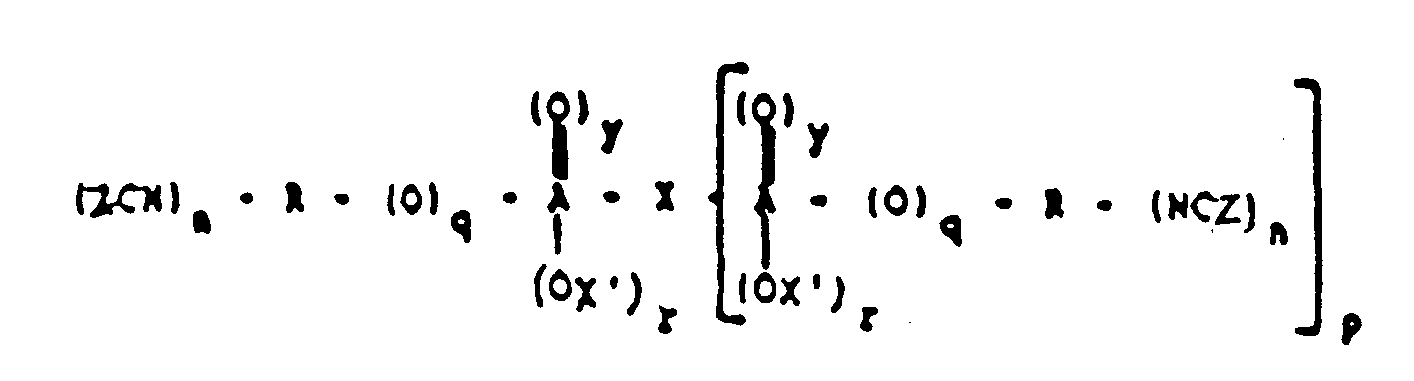
R ein mehrwertiger aliphatischer Rest von 1 bis 10 Kohlenstoffatomen oder ein mehrwertiger aromatischer Rest von 6 bis 24 Kohlenstoffatomen ist;
A Kohlenstoff, Schwefel oder Phosphor ist,
Z Sauerstoff oder Schwefel ist;
y 1 ist, wenn A Kohlenstoff oder Phosphor und 2 ist, wenn A Schwefel ist,
n 1 oder 2 ist;
p mindestens 1 ist;
q 0 oder 1 ist, mit der Maßgabe, daß, wenn A Kohlenstoff oder Schwefel ist, q 0 ist;
r 0 oder 1 ist, mit der Maßgabe, daß, wenn A Kohlenstoff oder Schwefel ist, r 0 ist; und
X ein Rest einer organischen Verbindung mit Zerewitinoff aktiven Wasserstoff-enthaltenden Gruppen ist; und
X' ein Rest einer organischen Verbindung mit mindestens 1 aktiven Wasserstoff-enthaltenden Gruppe ist. - Erzeugnisgegenstand nach Anspruch 3, worin der Behälter ein Sprühbehälter ist.
- Erzeugnisgegenstand enthaltend eine Zwei-Behälter-Packung zur Bereitstellung eines schnell härtenden chirurgischen Klebmittels durch Mischen der zwei Komponenten der Packung, wobei die Zwei-Behälter-Packung enthält:
in einem ersten Behälter eine Formulierung von mindestens 1 härbaren sterilen Polyisocyanat mit der Struktur
R ein mehrwertiger aliphatischer Rest von 1 bis 10 Kohlenstoffatomen oder ein mehrwertiger aromatischer Rest von 6 bis 24 Kohlenstoffatomen ist;
A Kohlenstoff Schwefel oder Phosphor ist;
Z Sauerstoff oder Schwefel ist;
y 1 ist, wenn A Kohlenstoff oder Phosphor ist, und 2 ist, wenn A Schwefel ist;
n 1 oder 2 ist;
p mindestens 1 ist;
q 0 oder 1 ist, mit der Maßgabe, daß, wenn A Kohlenstoff oder Schwefel ist, q 0 ist;
r 0 oder 1 ist, mit der Maßgabe, daß, wenn A Kohlenstoff oder Schwefel ist, r 0 ist; und
X ein Rest einer organischen Verbindung mit Zerewitinoff aktiven Wasserstoff-enthaltendenen Gruppen ist;
und X' ein Rest einer organischen Verbindung mit mindestens 1 aktiven Wasserstoff-enthaltenden Gruppe ist,
und in einem zweiten Behälter einen Härtungskatalysator für das Polyisocyanat. - Erzeugnisgegenstand nach Anspruch 5, worin die Zweikomponenten-Packung ein Zweikomponenten-Spray ist.
- Erzeugnisgegenstand nach einem der Ansprüche 1 bis 6, worin eine oder alle Komponenten in einem geeigneten Lösungsmittel gelöst sind.
- Herstellungsgegenstand nach Anspruch 7, worin das Lösungsmittel Dichlorfluormethan ist.
- Polyisocyanat mit der Strukturformel:

A Kohlenstoff, Schwefel oder Phosphor ist;
Z Sauerstoff oder Schwefel ist;
y 1 ist, wenn A Kohlenstoff oder Phosphor und 2 ist , wenn A Schwefel ist;
n 1 oder 2 ist ;
p mindestens 1 ist;
q 0 oder 1 ist, mit der Maßgabe, daß, wenn A Kohlenstoff oder Schwefel ist, ein q 0 ist;
r 0 oder 1 ist, mit der Maßgabe, daß wenn A Kohlenstoff oder Schwefel ist, r 0 ist;
X der Rest eines mit Hydroxy geendeten Polyesters oder Polyether/Polyesters ist; und
X' der Rest einer organischen Verbindung mit mindestens 1 aktiven Wasserstoff-enthaltenden Gruppe ist . - Polyisocyanat nach Anspruch 9, worin der Polyesterpolyol-Rest die Struktur hat:

- Polyisocyanat nach Anspruch 9, worin der Polyesterpolyol-Rest die Struktur hat:

- Polyisocyanat nach Anspruch 9, worin der Polyether/Polyesterpolyol-Copolymer-Rest die Struktur hat:


- Härtbares Polyisocyanat nach Anspruch 12, worin
R₃ -CH₂-CH₂- ist,
- Härtbares Polyisocyanat nach Anspruch 13, worin das Polyisocyanat die Struktur hat:

- Polyisocyanat nach Anspruch 11, worin R₆ -CH₂-, R₇ ein Triol ist, und n 1 ist.
- Härtbares Polyisocyanat nach Anspruch 15 mit der Struktur:
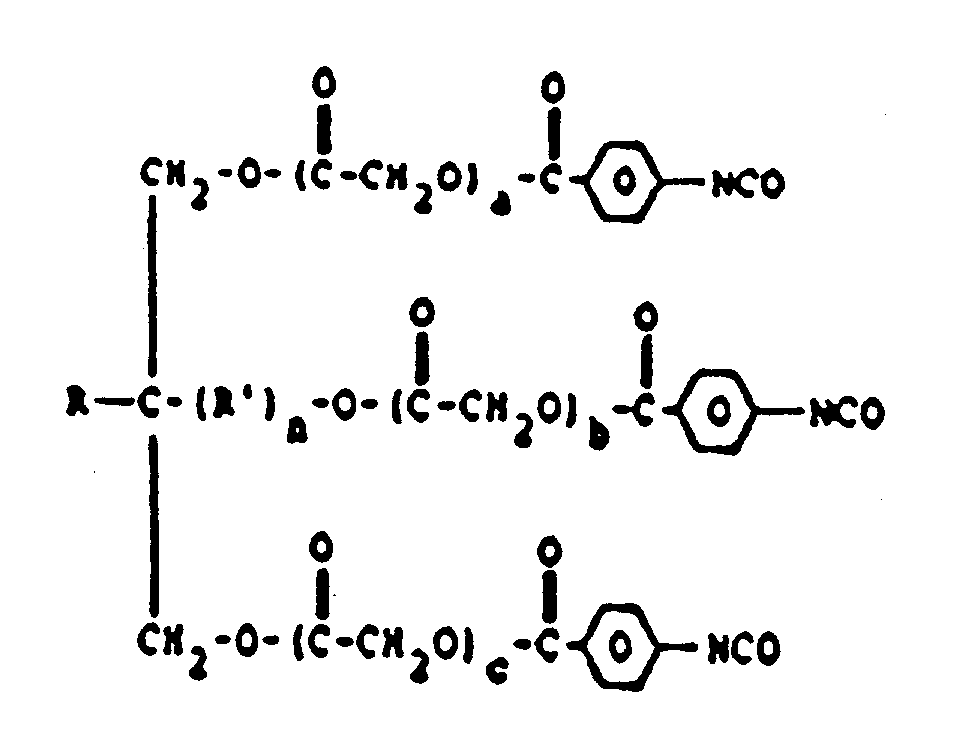
R' ein Alkylen von 1 bis 4 Kohlenstoffatomen ist;
n 0 oder 1 ist; und
a + b + c mindestens 3 ist. - Härtbare Polyisocyanat-Zusammensetzung enthaltend eine Mischung aus 5 bis 95 Gew.-% Polyisocyanat I mit der Struktur


- Härtbare Polyisocyanat-Zusammensetzung nach Anspruch 17 , worin Polyisocyanat I die Struktur hat:

Polyisocyanat II die Struktur hat:
Applications Claiming Priority (3)
| Application Number | Priority Date | Filing Date | Title |
|---|---|---|---|
| US74597 | 1987-07-17 | ||
| US07/074,597 US4829099A (en) | 1987-07-17 | 1987-07-17 | Metabolically acceptable polyisocyanate adhesives |
| PCT/US1988/002399 WO1989000589A1 (en) | 1987-07-17 | 1988-07-15 | Metabolically acceptable polyisocyanate adhesives |
Publications (3)
| Publication Number | Publication Date |
|---|---|
| EP0328585A1 EP0328585A1 (de) | 1989-08-23 |
| EP0328585A4 EP0328585A4 (en) | 1991-06-05 |
| EP0328585B1 true EP0328585B1 (de) | 1994-09-07 |
Family
ID=22120436
Family Applications (1)
| Application Number | Title | Priority Date | Filing Date |
|---|---|---|---|
| EP88906631A Expired - Lifetime EP0328585B1 (de) | 1987-07-17 | 1988-07-15 | Metabolisch verträgliche polyisocyanat-klebemittel |
Country Status (7)
| Country | Link |
|---|---|
| US (1) | US4829099A (de) |
| EP (1) | EP0328585B1 (de) |
| JP (1) | JPH02500815A (de) |
| AU (1) | AU601351B2 (de) |
| DE (1) | DE3851428T2 (de) |
| ES (1) | ES2018635A6 (de) |
| WO (1) | WO1989000589A1 (de) |
Cited By (1)
| Publication number | Priority date | Publication date | Assignee | Title |
|---|---|---|---|---|
| WO2009111230A3 (en) * | 2008-02-29 | 2010-06-17 | Ethicon, Inc. | A medically acceptable formulation of a diisocyanate terminated macromer for use as an internal adhesive or sealant |
Families Citing this family (85)
| Publication number | Priority date | Publication date | Assignee | Title |
|---|---|---|---|---|
| EP0351073B1 (de) * | 1988-07-14 | 1994-09-21 | MITSUI TOATSU CHEMICALS, Inc. | Linse, ein Kunstharz mit hohem Brechungsindex enthaltend und Verfahren zur Herstellung der Linse |
| EP0390481B1 (de) * | 1989-03-23 | 1996-02-28 | Sanyo Chemical Industries Ltd. | Chirurgische Heftfolie |
| DE3942465A1 (de) * | 1989-12-22 | 1991-06-27 | Bayer Ag | Neue isocyanatoalkylsulfonate und ein verfahren zu deren herstellung |
| JP2928892B2 (ja) * | 1990-11-27 | 1999-08-03 | 三洋化成工業株式会社 | 外科用接着剤 |
| US5371176A (en) * | 1993-02-05 | 1994-12-06 | Ethicon, Inc. | Castor oil polymers |
| DE69403966T3 (de) | 1993-07-19 | 2008-04-17 | Angiotech Pharmaceuticals, Inc., Vancouver | Anti-angiogene mittel und verfahren zu deren verwendung |
| US5843124A (en) | 1993-09-28 | 1998-12-01 | Hemodynamics, Inc. | Surface opening adhesive sealer |
| US5653730A (en) * | 1993-09-28 | 1997-08-05 | Hemodynamics, Inc. | Surface opening adhesive sealer |
| US5759194A (en) * | 1993-09-28 | 1998-06-02 | Hemodynamics, Inc. | Vascular patch applicator |
| US20020032298A1 (en) * | 1994-07-22 | 2002-03-14 | Bennett Steven L. | Bioabsorbable branched polymers containing units derived from dioxanone and medical/surgical devices manufactured therefrom |
| US6339130B1 (en) * | 1994-07-22 | 2002-01-15 | United States Surgical Corporation | Bioabsorbable branched polymers containing units derived from dioxanone and medical/surgical devices manufactured therefrom |
| US5578662A (en) * | 1994-07-22 | 1996-11-26 | United States Surgical Corporation | Bioabsorbable branched polymers containing units derived from dioxanone and medical/surgical devices manufactured therefrom |
| US5736178A (en) * | 1995-05-02 | 1998-04-07 | Opta Food Ingredients, Inc. | Colloidal dispersions of gluten, method of making and use therefor |
| US7883693B2 (en) * | 1995-12-18 | 2011-02-08 | Angiodevice International Gmbh | Compositions and systems for forming crosslinked biomaterials and methods of preparation of use |
| US6833408B2 (en) * | 1995-12-18 | 2004-12-21 | Cohesion Technologies, Inc. | Methods for tissue repair using adhesive materials |
| WO1997022371A1 (en) * | 1995-12-18 | 1997-06-26 | Collagen Corporation | Crosslinked polymer compositions and methods for their use |
| US5703271A (en) * | 1996-04-02 | 1997-12-30 | University Of South Florida | Method of utilizing isocyanate linkage for forming multi-tier cascade polymers |
| US5773551A (en) * | 1996-04-02 | 1998-06-30 | University Of South Florida | Method of utilizing isocyanate linkages for forming multi-tier cascade polymers |
| US5990214A (en) * | 1997-07-31 | 1999-11-23 | Velsicol Chemical Corporation | Liquid glycol benzoate compositions |
| US7129300B2 (en) | 2001-07-31 | 2006-10-31 | Tyco Healthcare Group Lp | Bioabsorbable adhesive compounds and compositions |
| US20040068078A1 (en) * | 2001-12-12 | 2004-04-08 | Milbocker Michael T. | In situ polymerizing medical compositions |
| US8501165B2 (en) * | 2001-12-12 | 2013-08-06 | Promethean Surgical Devices Llc | In situ bonds |
| WO2004021983A2 (en) * | 2002-09-03 | 2004-03-18 | Promethean Surgical Devices Llc | In situ polymerizing medical compositions |
| JP2004137422A (ja) * | 2002-10-21 | 2004-05-13 | Fuji Photo Film Co Ltd | ポリエーテル誘導体及びその製造方法 |
| US6894140B2 (en) * | 2002-10-28 | 2005-05-17 | Tyco Healthecare Gropu Lp | Fast curing compositions |
| EP1556430B1 (de) * | 2002-10-28 | 2009-06-24 | Tyco Healthcare Group Lp | Biologisch absorbierbare adhäsive verbindungen |
| NZ541535A (en) | 2003-02-04 | 2009-02-28 | Osteotech Inc | Biodegradable polyurethane composite for osteoimplants |
| US20050125033A1 (en) * | 2003-12-04 | 2005-06-09 | Mcnally-Heintzelman Karen M. | Wound closure apparatus |
| US20050125015A1 (en) * | 2003-12-04 | 2005-06-09 | Mcnally-Heintzelman Karen M. | Tissue-handling apparatus, system and method |
| US20050215748A1 (en) * | 2004-03-29 | 2005-09-29 | Milbocker Michael T | Surgical adhesive formulations and methods of preparation |
| NZ550964A (en) | 2004-04-28 | 2011-05-27 | Angiodevice Internat Gmbh | Compositions and systems for forming crosslinked biomaterials and associated methods of preparation and use |
| WO2006034128A2 (en) | 2004-09-17 | 2006-03-30 | Angiotech Biomaterials Corporation | Multifunctional compounds for forming crosslinked biomaterials and methods of preparation and use |
| US7968668B2 (en) * | 2005-01-10 | 2011-06-28 | Ethicon Inc. | Diisocyanate terminated macromer and formulation thereof for use as an internal adhesive or sealant |
| US20070167617A1 (en) * | 2006-01-17 | 2007-07-19 | Fitz Benjamin D | Method of making a diisocyanate terminated macromer |
| US20060153796A1 (en) * | 2005-01-10 | 2006-07-13 | Fitz Benjamin D | Diisocyanate terminated macromer and formulation thereof for use as an internal adhesive or sealant |
| US8470954B2 (en) * | 2005-01-10 | 2013-06-25 | Ethicon, Inc. | Diisocyanate terminated macromer and formulation thereof for use as an internal adhesive or sealant |
| US7728097B2 (en) * | 2005-01-10 | 2010-06-01 | Ethicon, Inc. | Method of making a diisocyanate terminated macromer |
| US8846845B2 (en) * | 2005-01-28 | 2014-09-30 | Bezwada Biomedical, Llc | Bioabsorbable and biocompatible polyurethanes and polyamides for medical devices |
| US7772352B2 (en) * | 2005-01-28 | 2010-08-10 | Bezwada Biomedical Llc | Bioabsorbable and biocompatible polyurethanes and polyamides for medical devices |
| AU2006213822B2 (en) | 2005-02-09 | 2011-05-26 | Covidien Lp | Synthetic sealants |
| US20100100124A1 (en) * | 2005-05-05 | 2010-04-22 | Tyco Healthcare Group Lp | Bioabsorbable surgical composition |
| US20100016888A1 (en) * | 2005-05-05 | 2010-01-21 | Allison Calabrese | Surgical Gasket |
| US20090177226A1 (en) * | 2005-05-05 | 2009-07-09 | Jon Reinprecht | Bioabsorbable Surgical Compositions |
| US20100012703A1 (en) * | 2005-05-05 | 2010-01-21 | Allison Calabrese | Surgical Gasket |
| US8044234B2 (en) * | 2005-05-05 | 2011-10-25 | Tyco Healthcare Group Lp | Bioabsorbable surgical composition |
| WO2007053794A2 (en) | 2005-10-21 | 2007-05-10 | Bezwada Biomedical Llc | Functionalized phenolic compounds and absorbable therefrom |
| US8007526B2 (en) * | 2005-12-01 | 2011-08-30 | Bezwada Biomedical, Llc | Difunctionalized aromatic compounds and polymers therefrom |
| EP2633834A1 (de) | 2005-12-06 | 2013-09-04 | Covidien LP | Bioabsorbierbare chirurgische Zusammensetzung |
| CA2628580C (en) | 2005-12-06 | 2014-07-08 | Tyco Healthcare Group Lp | Bioabsorbable compounds and compositions containing them |
| US7998466B2 (en) * | 2005-12-06 | 2011-08-16 | Tyco Healthcare Group Lp | Biocompatible tissue sealants and adhesives |
| US7910129B2 (en) * | 2005-12-06 | 2011-03-22 | Tyco Healthcare Group Lp | Carbodiimide crosslinking of functionalized polyethylene glycols |
| AU2006321911B2 (en) * | 2005-12-06 | 2012-05-17 | Covidien Lp | Biocompatible surgical compositions |
| AU2006321856B2 (en) * | 2005-12-08 | 2013-01-31 | Covidien Lp | Biocompatible surgical compositions |
| US20070135566A1 (en) * | 2005-12-08 | 2007-06-14 | Tyco Healthcare Group Lp | Viscosity-reduced sprayable compositions |
| CA2630327C (en) | 2005-12-08 | 2015-05-26 | Tyco Healthcare Group Lp | Biocompatible surgical compositons |
| US8129445B2 (en) * | 2006-08-09 | 2012-03-06 | Ethicon, Inc. | Moisture activated latent curing adhesive or sealant |
| US7947758B2 (en) * | 2006-08-09 | 2011-05-24 | Ethicon, Inc. | Moisture activated latent curing adhesive or sealant |
| US8182647B2 (en) * | 2007-07-23 | 2012-05-22 | Cohera Medical, Inc. | Hydrophilic biodegradable adhesives |
| US8217134B2 (en) | 2007-08-30 | 2012-07-10 | Bezwada Biomedical, Llc | Controlled release of biologically active compounds |
| US8026285B2 (en) * | 2007-09-04 | 2011-09-27 | Bezwada Biomedical, Llc | Control release of biologically active compounds from multi-armed oligomers |
| US8048980B2 (en) * | 2007-09-17 | 2011-11-01 | Bezwada Biomedical, Llc | Hydrolysable linkers and cross-linkers for absorbable polymers |
| US8053591B2 (en) | 2007-09-26 | 2011-11-08 | Bezwada Biomedical, Llc | Functionalized biodegradable triclosan monomers and oligomers for controlled release |
| US8500947B2 (en) | 2007-11-15 | 2013-08-06 | Covidien Lp | Speeding cure rate of bioadhesives |
| US8071663B2 (en) * | 2008-02-29 | 2011-12-06 | Ethicon, Inc. | Medically acceptable formulation of a diisocyanate terminated macromer for use as an internal adhesive or sealant |
| US8367747B2 (en) * | 2008-05-23 | 2013-02-05 | Bezwada Biomedical, Llc | Bioabsorbable polymers from bioabsorbable polyisocyanates and uses thereof |
| US8450529B2 (en) * | 2008-10-02 | 2013-05-28 | Covidien Lp | Branched polyamines and formulations thereof for use in medical devices |
| US11147722B2 (en) * | 2008-11-10 | 2021-10-19 | Kimberly-Clark Worldwide, Inc. | Absorbent article with a multifunctional acrylate skin-adhesive composition |
| US8962784B2 (en) * | 2008-12-19 | 2015-02-24 | Ethicon, Inc. | Isocyanate terminated macromer and formulation thereof for use as an internal adhesive or sealant |
| US8349987B2 (en) * | 2009-02-19 | 2013-01-08 | Covidien Lp | Adhesive formulations |
| US20110015672A1 (en) * | 2009-07-17 | 2011-01-20 | Tyco Healthcare Group Lp | Method for Coating a Medical Device |
| US8138236B2 (en) * | 2009-10-29 | 2012-03-20 | Ethicon, Inc. | Solvent-free moisture activated latent curing surgical adhesive or sealant |
| US8901347B1 (en) | 2010-12-13 | 2014-12-02 | Bezwada Biomedical, Llc | Absorbable polyurethanes and methods of use thereof |
| US8461372B2 (en) | 2011-02-11 | 2013-06-11 | Rao S. Bezwada | Amino acid derivatives and absorbable polymers therefrom |
| WO2013036525A2 (en) | 2011-09-09 | 2013-03-14 | Orthocon, Inc. | Absorbable multi-putty bone cements and hemostatic compositions and methods of use |
| US9827349B1 (en) | 2013-11-26 | 2017-11-28 | Abyrx Inc. | Settable surgical implants and their packaging |
| US9328192B2 (en) | 2014-03-12 | 2016-05-03 | Bezwada Biomedical, Llc | Bio-based monomers and polymers |
| EP3630210A1 (de) | 2017-05-30 | 2020-04-08 | Abyrx, Inc. | Therapeutische kitte mit zusätzen, einschliesslich verarbeitetem humanem blutplasma |
| US10822461B2 (en) | 2017-10-05 | 2020-11-03 | Fresenius Medical Care Holdings, Inc. | Polysulfone-urethane copolymer, membranes and products incorporating same, and methods for making and using same |
| EP3706815A1 (de) | 2017-11-07 | 2020-09-16 | Abyrx, Inc. | Intraoperative verwendung von härtbaren chirurgischen zusammensetzungen |
| CN107955571A (zh) * | 2017-12-11 | 2018-04-24 | 浙江工业大学 | 一种低粘度的硅烷改性聚醚基胶及其制备方法 |
| FR3097735B1 (fr) | 2019-06-25 | 2021-05-28 | Bertrand Jacquelot | Dispositif pour casser les coques des fruits à coque. |
| CN116568723A (zh) * | 2020-12-10 | 2023-08-08 | 科思创德国股份有限公司 | 制备多异氰酸酯的方法、多异氰酸酯、其用途和由其制成的加聚产物 |
| EP4259685A1 (de) * | 2020-12-10 | 2023-10-18 | Covestro Deutschland AG | Verfahren zur herstellung eines polyisocyanats, polyisocyanat, dessen verwendung und daraus hergestellte polyadditions¬produkte |
| WO2022165319A1 (en) | 2021-01-29 | 2022-08-04 | Abyrx, Inc. | Multi-putty bone hemostatic and adhesive compositions for use in methods of installing and securing surgical hardware in bones |
| CN117551042B (zh) * | 2022-08-04 | 2026-06-09 | 江苏中旗科技股份有限公司 | 一种在碱性条件下制备含羧酸酯片段的尿嘧啶类化合物的方法 |
Family Cites Families (4)
| Publication number | Priority date | Publication date | Assignee | Title |
|---|---|---|---|---|
| CA673757A (en) * | 1963-11-05 | Muller Erwin | Process for the production of polyisocyanates containing aromatic ester groups | |
| US3437680A (en) * | 1965-08-10 | 1969-04-08 | Upjohn Co | Trichloro-bromoalkyl isocyanates |
| CH547343A (de) * | 1967-05-15 | 1974-03-29 | Minnesota Mining & Mfg | Aerosol-spraybehaelter. |
| US4743632A (en) * | 1987-02-25 | 1988-05-10 | Pfizer Hospital Products Group, Inc. | Polyetherurethane urea polymers as space filling tissue adhesives |
-
1987
- 1987-07-17 US US07/074,597 patent/US4829099A/en not_active Expired - Fee Related
-
1988
- 1988-07-15 WO PCT/US1988/002399 patent/WO1989000589A1/en not_active Ceased
- 1988-07-15 AU AU21317/88A patent/AU601351B2/en not_active Ceased
- 1988-07-15 DE DE3851428T patent/DE3851428T2/de not_active Expired - Fee Related
- 1988-07-15 EP EP88906631A patent/EP0328585B1/de not_active Expired - Lifetime
- 1988-07-15 JP JP63506445A patent/JPH02500815A/ja active Pending
- 1988-07-17 ES ES8802297A patent/ES2018635A6/es not_active Expired - Lifetime
Cited By (1)
| Publication number | Priority date | Publication date | Assignee | Title |
|---|---|---|---|---|
| WO2009111230A3 (en) * | 2008-02-29 | 2010-06-17 | Ethicon, Inc. | A medically acceptable formulation of a diisocyanate terminated macromer for use as an internal adhesive or sealant |
Also Published As
| Publication number | Publication date |
|---|---|
| DE3851428T2 (de) | 1995-01-19 |
| EP0328585A4 (en) | 1991-06-05 |
| US4829099A (en) | 1989-05-09 |
| JPH02500815A (ja) | 1990-03-22 |
| ES2018635A6 (es) | 1991-04-16 |
| AU601351B2 (en) | 1990-09-06 |
| AU2131788A (en) | 1989-02-13 |
| DE3851428D1 (de) | 1994-10-13 |
| EP0328585A1 (de) | 1989-08-23 |
| WO1989000589A1 (en) | 1989-01-26 |
Similar Documents
| Publication | Publication Date | Title |
|---|---|---|
| US4829099A (en) | Metabolically acceptable polyisocyanate adhesives | |
| Marcos-Fernández et al. | Synthesis and characterization of biodegradable non-toxic poly (ester-urethane-urea) s based on poly (ε-caprolactone) and amino acid derivatives | |
| CN101687969B (zh) | 外科用的医学粘合剂 | |
| US4605729A (en) | Process for the production of polyetherester polyols and the products and use thereof | |
| JP2537499B2 (ja) | 水性ポリウレタン分散体 | |
| CA2628582C (en) | Biocompatible tissue sealants and adhesives | |
| EP1945690B1 (de) | Kettenverlängerungsmittel | |
| US20100126664A1 (en) | Polyester Polyols for Polyurethane Adhesives | |
| US9404026B2 (en) | Polyurea-based fabric glue | |
| JP2011527915A (ja) | 大量出血を停止および漏出を封止するための医療用接着剤 | |
| EP1962867B1 (de) | Biokompatible chirurgische zusammensetzungen | |
| CN101925625A (zh) | 用于外科手术的医用粘合剂 | |
| EP1556430B1 (de) | Biologisch absorbierbare adhäsive verbindungen | |
| GB2209758A (en) | Aqueous dispersions | |
| US9295750B2 (en) | Biodegradable compositions having pressure sensitive adhesive properties | |
| US4623416A (en) | Aqueous solutions or dispersions of polyisocyanate polyaddition products, a process for their production and their use as, or in the production of, adhesives | |
| JP6873102B2 (ja) | 開環重合生成物を製造する方法 | |
| US5574130A (en) | Functionalized polylactide | |
| CA1166395A (en) | Composition for polyurethane adhesives | |
| JPS63278924A (ja) | 生体内分解吸収性ウレタンプレポリマ− | |
| JP4147628B2 (ja) | 接着剤組成物 | |
| JP2000302833A (ja) | ウレタンプレポリマー湿気硬化用触媒および一液湿気硬化型ウレタン系ホットメルト接着剤組成物 | |
| Bezwada | Absorbable Polyurethanes | |
| HK1187635A (en) | Tissue adhesive based on trifunctional aspartates | |
| JPH1067930A (ja) | モルホリン基を含有する触媒及びポリウレタン組成物 |
Legal Events
| Date | Code | Title | Description |
|---|---|---|---|
| PUAI | Public reference made under article 153(3) epc to a published international application that has entered the european phase |
Free format text: ORIGINAL CODE: 0009012 |
|
| 17P | Request for examination filed |
Effective date: 19890316 |
|
| AK | Designated contracting states |
Kind code of ref document: A1 Designated state(s): DE FR GB IT |
|
| A4 | Supplementary search report drawn up and despatched |
Effective date: 19910415 |
|
| AK | Designated contracting states |
Kind code of ref document: A4 Designated state(s): DE FR GB IT |
|
| 17Q | First examination report despatched |
Effective date: 19921217 |
|
| GRAA | (expected) grant |
Free format text: ORIGINAL CODE: 0009210 |
|
| AK | Designated contracting states |
Kind code of ref document: B1 Designated state(s): DE FR GB IT |
|
| ITF | It: translation for a ep patent filed | ||
| REF | Corresponds to: |
Ref document number: 3851428 Country of ref document: DE Date of ref document: 19941013 |
|
| ET | Fr: translation filed | ||
| PLBE | No opposition filed within time limit |
Free format text: ORIGINAL CODE: 0009261 |
|
| STAA | Information on the status of an ep patent application or granted ep patent |
Free format text: STATUS: NO OPPOSITION FILED WITHIN TIME LIMIT |
|
| PG25 | Lapsed in a contracting state [announced via postgrant information from national office to epo] |
Ref country code: GB Effective date: 19950715 |
|
| 26N | No opposition filed | ||
| GBPC | Gb: european patent ceased through non-payment of renewal fee |
Effective date: 19950715 |
|
| PG25 | Lapsed in a contracting state [announced via postgrant information from national office to epo] |
Ref country code: DE Effective date: 19960402 |
|
| PG25 | Lapsed in a contracting state [announced via postgrant information from national office to epo] |
Ref country code: FR Effective date: 19960430 |
|
| REG | Reference to a national code |
Ref country code: FR Ref legal event code: ST |
|
| REG | Reference to a national code |
Ref country code: FR Ref legal event code: ST |
|
| REG | Reference to a national code |
Ref country code: FR Ref legal event code: ST |
|
| PG25 | Lapsed in a contracting state [announced via postgrant information from national office to epo] |
Ref country code: IT Free format text: LAPSE BECAUSE OF NON-PAYMENT OF DUE FEES Effective date: 20050715 |