EP1945690B1 - Kettenverlängerungsmittel - Google Patents
Kettenverlängerungsmittel Download PDFInfo
- Publication number
- EP1945690B1 EP1945690B1 EP06775006.7A EP06775006A EP1945690B1 EP 1945690 B1 EP1945690 B1 EP 1945690B1 EP 06775006 A EP06775006 A EP 06775006A EP 1945690 B1 EP1945690 B1 EP 1945690B1
- Authority
- EP
- European Patent Office
- Prior art keywords
- formula
- polyurethane
- chain extender
- scaffold
- compound
- Prior art date
- Legal status (The legal status is an assumption and is not a legal conclusion. Google has not performed a legal analysis and makes no representation as to the accuracy of the status listed.)
- Active
Links
- IGWTZHMYJZZIGC-UHFFFAOYSA-N CCOC(C(CCCCN=C=O)N=C=O)=O Chemical compound CCOC(C(CCCCN=C=O)N=C=O)=O IGWTZHMYJZZIGC-UHFFFAOYSA-N 0.000 description 1
- LFDUWKYMOUMGOY-UHFFFAOYSA-N S=C=NC1CCC(CC(CC2)CC=C2N=C=S)CC1 Chemical compound S=C=NC1CCC(CC(CC2)CC=C2N=C=S)CC1 LFDUWKYMOUMGOY-UHFFFAOYSA-N 0.000 description 1
Images


Classifications
-
- C—CHEMISTRY; METALLURGY
- C08—ORGANIC MACROMOLECULAR COMPOUNDS; THEIR PREPARATION OR CHEMICAL WORKING-UP; COMPOSITIONS BASED THEREON
- C08G—MACROMOLECULAR COMPOUNDS OBTAINED OTHERWISE THAN BY REACTIONS ONLY INVOLVING UNSATURATED CARBON-TO-CARBON BONDS
- C08G18/00—Polymeric products of isocyanates or isothiocyanates
- C08G18/06—Polymeric products of isocyanates or isothiocyanates with compounds having active hydrogen
- C08G18/28—Polymeric products of isocyanates or isothiocyanates with compounds having active hydrogen characterised by the compounds used containing active hydrogen
- C08G18/30—Low-molecular-weight compounds
- C08G18/32—Polyhydroxy compounds; Polyamines; Hydroxyamines
- C08G18/3203—Polyhydroxy compounds
- C08G18/3221—Polyhydroxy compounds hydroxylated esters of carboxylic acids other than higher fatty acids
-
- A—HUMAN NECESSITIES
- A61—MEDICAL OR VETERINARY SCIENCE; HYGIENE
- A61L—METHODS OR APPARATUS FOR STERILISING MATERIALS OR OBJECTS IN GENERAL; DISINFECTION, STERILISATION OR DEODORISATION OF AIR; CHEMICAL ASPECTS OF BANDAGES, DRESSINGS, ABSORBENT PADS OR SURGICAL ARTICLES; MATERIALS FOR BANDAGES, DRESSINGS, ABSORBENT PADS OR SURGICAL ARTICLES
- A61L27/00—Materials for grafts or prostheses or for coating grafts or prostheses
- A61L27/14—Macromolecular materials
- A61L27/18—Macromolecular materials obtained otherwise than by reactions only involving carbon-to-carbon unsaturated bonds
-
- A—HUMAN NECESSITIES
- A61—MEDICAL OR VETERINARY SCIENCE; HYGIENE
- A61L—METHODS OR APPARATUS FOR STERILISING MATERIALS OR OBJECTS IN GENERAL; DISINFECTION, STERILISATION OR DEODORISATION OF AIR; CHEMICAL ASPECTS OF BANDAGES, DRESSINGS, ABSORBENT PADS OR SURGICAL ARTICLES; MATERIALS FOR BANDAGES, DRESSINGS, ABSORBENT PADS OR SURGICAL ARTICLES
- A61L31/00—Materials for other surgical articles, e.g. stents, stent-grafts, shunts, surgical drapes, guide wires, materials for adhesion prevention, occluding devices, surgical gloves, tissue fixation devices
- A61L31/04—Macromolecular materials
- A61L31/06—Macromolecular materials obtained otherwise than by reactions only involving carbon-to-carbon unsaturated bonds
-
- A—HUMAN NECESSITIES
- A61—MEDICAL OR VETERINARY SCIENCE; HYGIENE
- A61P—SPECIFIC THERAPEUTIC ACTIVITY OF CHEMICAL COMPOUNDS OR MEDICINAL PREPARATIONS
- A61P43/00—Drugs for specific purposes, not provided for in groups A61P1/00-A61P41/00
-
- C—CHEMISTRY; METALLURGY
- C07—ORGANIC CHEMISTRY
- C07C—ACYCLIC OR CARBOCYCLIC COMPOUNDS
- C07C69/00—Esters of carboxylic acids; Esters of carbonic or haloformic acids
- C07C69/34—Esters of acyclic saturated polycarboxylic acids having an esterified carboxyl group bound to an acyclic carbon atom
- C07C69/40—Succinic acid esters
-
- C—CHEMISTRY; METALLURGY
- C07—ORGANIC CHEMISTRY
- C07C—ACYCLIC OR CARBOCYCLIC COMPOUNDS
- C07C69/00—Esters of carboxylic acids; Esters of carbonic or haloformic acids
- C07C69/52—Esters of acyclic unsaturated carboxylic acids having the esterified carboxyl group bound to an acyclic carbon atom
- C07C69/593—Dicarboxylic acid esters having only one carbon-to-carbon double bond
- C07C69/60—Maleic acid esters; Fumaric acid esters
-
- C—CHEMISTRY; METALLURGY
- C07—ORGANIC CHEMISTRY
- C07C—ACYCLIC OR CARBOCYCLIC COMPOUNDS
- C07C69/00—Esters of carboxylic acids; Esters of carbonic or haloformic acids
- C07C69/66—Esters of carboxylic acids having esterified carboxylic groups bound to acyclic carbon atoms and having any of the groups OH, O—metal, —CHO, keto, ether, acyloxy, groups, groups, or in the acid moiety
- C07C69/67—Esters of carboxylic acids having esterified carboxylic groups bound to acyclic carbon atoms and having any of the groups OH, O—metal, —CHO, keto, ether, acyloxy, groups, groups, or in the acid moiety of saturated acids
- C07C69/675—Esters of carboxylic acids having esterified carboxylic groups bound to acyclic carbon atoms and having any of the groups OH, O—metal, —CHO, keto, ether, acyloxy, groups, groups, or in the acid moiety of saturated acids of saturated hydroxy-carboxylic acids
-
- C—CHEMISTRY; METALLURGY
- C08—ORGANIC MACROMOLECULAR COMPOUNDS; THEIR PREPARATION OR CHEMICAL WORKING-UP; COMPOSITIONS BASED THEREON
- C08G—MACROMOLECULAR COMPOUNDS OBTAINED OTHERWISE THAN BY REACTIONS ONLY INVOLVING UNSATURATED CARBON-TO-CARBON BONDS
- C08G18/00—Polymeric products of isocyanates or isothiocyanates
- C08G18/06—Polymeric products of isocyanates or isothiocyanates with compounds having active hydrogen
- C08G18/08—Processes
- C08G18/10—Prepolymer processes involving reaction of isocyanates or isothiocyanates with compounds having active hydrogen in a first reaction step
-
- C—CHEMISTRY; METALLURGY
- C08—ORGANIC MACROMOLECULAR COMPOUNDS; THEIR PREPARATION OR CHEMICAL WORKING-UP; COMPOSITIONS BASED THEREON
- C08G—MACROMOLECULAR COMPOUNDS OBTAINED OTHERWISE THAN BY REACTIONS ONLY INVOLVING UNSATURATED CARBON-TO-CARBON BONDS
- C08G18/00—Polymeric products of isocyanates or isothiocyanates
- C08G18/06—Polymeric products of isocyanates or isothiocyanates with compounds having active hydrogen
- C08G18/28—Polymeric products of isocyanates or isothiocyanates with compounds having active hydrogen characterised by the compounds used containing active hydrogen
- C08G18/40—High-molecular-weight compounds
- C08G18/42—Polycondensates having carboxylic or carbonic ester groups in the main chain
- C08G18/4266—Polycondensates having carboxylic or carbonic ester groups in the main chain prepared from hydroxycarboxylic acids and/or lactones
- C08G18/4269—Lactones
- C08G18/4277—Caprolactone and/or substituted caprolactone
-
- C—CHEMISTRY; METALLURGY
- C08—ORGANIC MACROMOLECULAR COMPOUNDS; THEIR PREPARATION OR CHEMICAL WORKING-UP; COMPOSITIONS BASED THEREON
- C08G—MACROMOLECULAR COMPOUNDS OBTAINED OTHERWISE THAN BY REACTIONS ONLY INVOLVING UNSATURATED CARBON-TO-CARBON BONDS
- C08G18/00—Polymeric products of isocyanates or isothiocyanates
- C08G18/06—Polymeric products of isocyanates or isothiocyanates with compounds having active hydrogen
- C08G18/28—Polymeric products of isocyanates or isothiocyanates with compounds having active hydrogen characterised by the compounds used containing active hydrogen
- C08G18/65—Low-molecular-weight compounds having active hydrogen with high-molecular-weight compounds having active hydrogen
- C08G18/66—Compounds of groups C08G18/42, C08G18/48, or C08G18/52
- C08G18/6603—Compounds of groups C08G18/42, C08G18/48, or C08G18/52 with compounds of group C08G18/32 or polyamines of C08G18/38
-
- C—CHEMISTRY; METALLURGY
- C08—ORGANIC MACROMOLECULAR COMPOUNDS; THEIR PREPARATION OR CHEMICAL WORKING-UP; COMPOSITIONS BASED THEREON
- C08G—MACROMOLECULAR COMPOUNDS OBTAINED OTHERWISE THAN BY REACTIONS ONLY INVOLVING UNSATURATED CARBON-TO-CARBON BONDS
- C08G18/00—Polymeric products of isocyanates or isothiocyanates
- C08G18/06—Polymeric products of isocyanates or isothiocyanates with compounds having active hydrogen
- C08G18/28—Polymeric products of isocyanates or isothiocyanates with compounds having active hydrogen characterised by the compounds used containing active hydrogen
- C08G18/65—Low-molecular-weight compounds having active hydrogen with high-molecular-weight compounds having active hydrogen
- C08G18/66—Compounds of groups C08G18/42, C08G18/48, or C08G18/52
- C08G18/6633—Compounds of group C08G18/42
- C08G18/6637—Compounds of group C08G18/42 with compounds of group C08G18/32 or polyamines of C08G18/38
- C08G18/664—Compounds of group C08G18/42 with compounds of group C08G18/32 or polyamines of C08G18/38 with compounds of group C08G18/3203
-
- C—CHEMISTRY; METALLURGY
- C08—ORGANIC MACROMOLECULAR COMPOUNDS; THEIR PREPARATION OR CHEMICAL WORKING-UP; COMPOSITIONS BASED THEREON
- C08G—MACROMOLECULAR COMPOUNDS OBTAINED OTHERWISE THAN BY REACTIONS ONLY INVOLVING UNSATURATED CARBON-TO-CARBON BONDS
- C08G18/00—Polymeric products of isocyanates or isothiocyanates
- C08G18/06—Polymeric products of isocyanates or isothiocyanates with compounds having active hydrogen
- C08G18/28—Polymeric products of isocyanates or isothiocyanates with compounds having active hydrogen characterised by the compounds used containing active hydrogen
- C08G18/65—Low-molecular-weight compounds having active hydrogen with high-molecular-weight compounds having active hydrogen
- C08G18/66—Compounds of groups C08G18/42, C08G18/48, or C08G18/52
- C08G18/6666—Compounds of group C08G18/48 or C08G18/52
- C08G18/667—Compounds of group C08G18/48 or C08G18/52 with compounds of group C08G18/32 or polyamines of C08G18/38
- C08G18/6674—Compounds of group C08G18/48 or C08G18/52 with compounds of group C08G18/32 or polyamines of C08G18/38 with compounds of group C08G18/3203
-
- C—CHEMISTRY; METALLURGY
- C08—ORGANIC MACROMOLECULAR COMPOUNDS; THEIR PREPARATION OR CHEMICAL WORKING-UP; COMPOSITIONS BASED THEREON
- C08G—MACROMOLECULAR COMPOUNDS OBTAINED OTHERWISE THAN BY REACTIONS ONLY INVOLVING UNSATURATED CARBON-TO-CARBON BONDS
- C08G18/00—Polymeric products of isocyanates or isothiocyanates
- C08G18/06—Polymeric products of isocyanates or isothiocyanates with compounds having active hydrogen
- C08G18/70—Polymeric products of isocyanates or isothiocyanates with compounds having active hydrogen characterised by the isocyanates or isothiocyanates used
- C08G18/72—Polyisocyanates or polyisothiocyanates
- C08G18/73—Polyisocyanates or polyisothiocyanates acyclic
-
- C—CHEMISTRY; METALLURGY
- C08—ORGANIC MACROMOLECULAR COMPOUNDS; THEIR PREPARATION OR CHEMICAL WORKING-UP; COMPOSITIONS BASED THEREON
- C08G—MACROMOLECULAR COMPOUNDS OBTAINED OTHERWISE THAN BY REACTIONS ONLY INVOLVING UNSATURATED CARBON-TO-CARBON BONDS
- C08G18/00—Polymeric products of isocyanates or isothiocyanates
- C08G18/06—Polymeric products of isocyanates or isothiocyanates with compounds having active hydrogen
- C08G18/70—Polymeric products of isocyanates or isothiocyanates with compounds having active hydrogen characterised by the isocyanates or isothiocyanates used
- C08G18/72—Polyisocyanates or polyisothiocyanates
- C08G18/77—Polyisocyanates or polyisothiocyanates having heteroatoms in addition to the isocyanate or isothiocyanate nitrogen and oxygen or sulfur
- C08G18/771—Polyisocyanates or polyisothiocyanates having heteroatoms in addition to the isocyanate or isothiocyanate nitrogen and oxygen or sulfur oxygen
Definitions
- the present invention relates to chain extenders, processes for their preparation and their use in the preparation of biocompatible biodegradable polyurethanes and polyurethane ureas for biomedical applications such as stents, orthopaedic fixation scaffolds and scaffolds for tissue engineering.
- Biodegradable polyurethanes and polyurethane ureas are typically formulated using polyester polyols, aliphatic diisocyanates and diol or diamine chain extenders.
- the polyester polyol forms the 'soft' segment of the polymer while the diisocyanate and the chain extender form the hard segment.
- the hard segment forms ordered domains due to hydrogen bonding and imparts high mechanical strength to the material.
- the soft domains are formed largely by the polyester polyol and provides elastic properties to the polymer.
- Polyester polyols such as polycaprolactone, polyglycolide and polylactide are the most widely used polyols in biodegradable polyurethanes.
- the biodegradation of these polymers occur largely due to the hydrolytic degradation of the ester, urethane and urea linkages of the polymer.
- the soft segment of the polyurethane degrades significantly faster than the hard segment. This is largely due to the presence of relatively easily hydrolysable ester linkages and the amorphous nature of the soft segment.
- the hard segment of biodegradable polyurethanes is formed from diisocyanates such as hexamethylene diisocyanate (HDI), butane diisocyanate (BDI), lysine diisocyanate ethyl ester and lysine diisocyanate methyl ester.
- the chain extenders are low molecular weight (typically MW ⁇ 400) diols or diamines. Examples include 1,4-butanediol, ethylene glycol, ethylene diamine and water.
- the diols and diisocyanates react to form urethane linkages in the hard segment of the polyurethane.
- the diamine chain extenders and water react to form urea linkages.
- the urethane or urea linkages in the hard segment also degrade by hydrolysis but at a significantly slower rate than ester linkages.
- biodegradable polymers An important consideration in the design of biodegradable polymers is the choice of precursors that would lead to polyurethanes with backbone functional groups susceptible to one or more degradation pathways in the body, such as hydrolytic or enzymatic degradation. Such polyurethanes degrade to low molecular weight products which are either bioresorbed or released from the body through one of the waste disposal pathways in the body.
- diisocyanates and chain extenders such as ethylene glycol or ethylene diamine leads to polyurethane with hard segments with urethane, urea or a combination of such functional groups. Because of the relatively slow degradation rates of these linkages compared with ester linkages, the polymer degradation may lead to oligomers containing mainly hard segments.
- Chain extenders which break down to biocompatible compounds such as amino acids have been used for formulating biodegradable polyurethanes.
- the chain extenders are diamines based on cyclohexane dimethanol and phenyl alanine and are generally too high in molecular weight (MW 438) to be considered as chain extenders.
- MW 438 molecular weight
- the high molecular weight combined with the bulky benzyl pendant groups leads to polyurethanes with disrupted hard segments, limiting the range of properties that can be achieved using such chain extenders in polyurethanes.
- the present invention relates to the use of chain extenders with one or more hydrolysable (degradable) functional groups in the backbone.
- the chain extenders are based on ester diols of hydroxy acids or dicarboxylic acids which optionally contain a free radically polymerisable functional group(s) in the backbone.
- a compound of formula (Ia) or (lb) as a chain extender to produce a biocompatible, biodegradable polyurethane or polyurethane urea, wherein R 1 , R 2 and R 3 are independently selected from optionally substituted C 1-20 alkylene and optionally substituted C 2-20 alkenylene, both of which may be optionally interrupted by optionally substituted aryl or optionally substituted heterocyclyl and wherein in formula (Ia) when R 1 is (CH 2 ) 2 then R 2 is not CH 2 , CHCH 3 or(CH 2 ) 3 .
- the present invention also provides a process for the preparation of the compound of formula (Ia) or (Ib) defined above which comprises the step of transesterification of a compound of formula (II) or (III): in which R 2 and n are as defined above with a compound of formula (IV) HOR 1 OH (IV) in which R 1 is as defined above. It will be appreciated that the compound of formula (Ia) or (Ib) may be used in combination with a conventional chain extender.
- a chain extender composition may comprise the compound formula (Ia) or (Ib) defined above and a conventional chain extender.
- the chain extender and chain extender composition are particularly useful in preparing biocompatible biodegradable polyurethane or polyurethane ureas for biomedical applications.
- a biocompatible, biodegradable polymeric scaffold comprising a cross-linked or linear polyurethane or polyurethane urea, said polyurethane or polyurethane urea comprising a reaction product of an isocyanate and a chain extender as defined above, said scaffold being used in coronary, artery, blood vessels or cardiac tissue, wound repair, plastic or cosmetic surgery, nerve regeneration, spinal disc repair or augmentation or orthopaedic or tissue engineering applications.
- biocompatible biodegradable polyurethane or polyurethane urea comprises a reaction product of an isocyanate, polyol and the chain extender or chain extender composition defined above.
- biocompatible biodegradable polyurethane or polyurethane urea may also be prepared using only an isocyanate and a chain extender or chain extender composition defined above.
- the chain extender in this instance has a dual functionality as both a chain extender and a polyol.
- biocompatible biodegradable polyurethanes or polyurethane ureas are particularly useful as scaffolds for coronary artery, blood vessels or cardiac tissue, wound repair, plastic or cosmetic surgery, nerve regeneration, spinal disc repair or augmentation, orthopaedic ortissue engineering applications.
- the scaffold is a stent; stent coating; bone substitute; bone fille r ; bone cement; an orthopaedic fixation scaffold such as a screw, pin, plate or spinal cage or a dart arrow, pin or adhesive for soft tissue repair including meniscal and articular cartilage, tendons ligaments and connective tissue; or a filler for vertobroplasty or kyphoplasty.
- the present invention further provides a medical device or composition which is wholly or partly composed of the scaffold defined above.
- chain extender_ refers to a lower molecular weight compound having two or more functional groups that are reactive towards isocyanate and having a molecular weight of less than 400.
- the chain extenders of the present invention have one or more hydrolysable (degradable) functional groups in the backbone.
- hydrolysable (degradable) functional group refers to any molecular moiety which may be part of the chain extender and is preferably biocompatible and bioresorbable on in vivo degradation of the biocompatible biodegradable polyurethane or polyurethane urea which is formed from the chain extender.
- the chain extenders of the present invention are based on ester diols of ⁇ -hydroxy acids or dicarboxylic acids which optionally contain free radically polymerisable functional group(s) in the backbone.
- chain extenders are used either alone or in combination with conventional chain extenders to form polyurethanes or polyurethane ureas
- the polyurethanes degrade at faster rates than those based on conventional chain extenders.
- the polyurethanes or polyurethane ureas degrade to low molecular weight compounds due to the degradation of the hard segment which is formed from the chain extenders of the present invention at rates comparable to that of the soft segment which results in minimum levels of oligomeric hard segment species among the degradation products.
- the chain extenders based on ester diols of dicarboxylic acids provide two hydrolysable (degradable) functional groups within the chain extender backbone to facilitate even faster breakdown of the hard segment structure.
- the presence of a free radically polymerisable functional group in the backbone also facilitates cross linking of the hard segment.
- Polyurethanes or polyurethane ureas based on these chain extenders can be processed and subsequently cross linked to form network structures with improved mechanical properties.
- Chain extenders according to the present invention have the formula (Ia) and (Ib) shown below.
- R 1 , R 2 and R 3 are defined above, preferably optionally substituted C 1-6 alkylene or optionally substituted C 2-6 alkenylene.
- C 1-20 alkylene and C 2-20 alkenylene are the divalent radical equivalents of the terms “C 1-20 alkyl” and “C 2-20 alkenyl” respectively.
- the two bonds connecting the alkylene or alkenylene to the adjacent groups may come from the same carbon atom or different carbon atoms in the divalent radical.
- C 1-20 alkyl refers to linear, branched or cyclic hydrocarbon groups having from 1 to 20 carbon atoms, preferably from 1 to 6 carbon atoms. Illustrative of such alkyl groups are methyl, ethyl, propyl, isopropyl, butyl, sec-butyl, tert-butyl, pentyl, neopentyl, hexyl, cyclopropyl, cyclobutyl, cyclopentyl or cyclohexyl.
- alkenyl refers to linear or branched hydrocarbon groups having at least one carbon-carbon double bond of 2 to 20 carbon atoms, preferably from 2 to 6 carbon atoms.
- alkenyl include ethenyl, propenyl, allyl, propenyl, butenyl and 4-methylbutenyl.
- aryl refers to a carbocyclic aromatic system containing one, two or three rings wherein such rings may be attached together in a pendent manner or may be fused.
- aryl embraces aromatic radicals such as phenyl, naphthyl, tetrahydronaphthyl, indane and biphenyl.
- heterocyclyl refers to saturated or unsaturated, monocyclic or polycyclic hydrocarbon group containing at least one heteroatom selected from nitrogen, sulphur and oxygen
- Suitable heterocyclic groups include N-containing heterocyclic groups, such as, unsaturated 3 to 6-membered heteromonocyclic groups containing 1 to 4 nitrogen atoms, for example, pyrrolyl, pyrrolinyl, imidazolyl, pyrazolyl, pyridyl, pyrimidinyl, pyrazinyl, pyridazinyl, triazolyl or tetrazolyl; saturated 3 to 6-membered heteromonocyclic groups containing 1 to 4 nitrogen atoms, such as, pyrrolidinyl, imidazolidinyl, piperidino or piperazinyl; unsaturated condensed heterocyclic groups containing 1 to 5 nitrogen atoms, such as indolyl, isoindolyl, indolizinyl, benzimidazolyl, quinolyl, isoquinolyl, indazolyl, benzotriazolyl or tetrazolopyridaziny
- optionally substituted refers to a group may or may not be further substituted with one or more groups selected from C 1-6 alkyl, C 2-6 alkenyl, C 2-6 alkynyl, aryl, halo, halo C 1-6 alkyl, halo C 2-6 alkenyl, haloC 2-6 alkynyl, haloaryl, hydroxy, C 1-6 alkoxy, C 2-6 alkenyloxy, C 1-6 aryloxy, benzyloxy, halo C 1-6 alkoxy, haloalkenyloxy, haloaryloxy, nitro, nitroC 1-6 alkyl, nitroC 2-6 alkenyl, nitroC 2-6 alkynyl, nitroaryl, nitroheterocyclyl, amino, C 1-6 alkylamino, C 1-6 dialkylamino, C 2-6 alkenylamino, C 2-6 alkynylamino, arylamino, diaryla
- the chain extenders may be prepared by transesterification of an ⁇ -hydroxy acid or dicarboxylic acid polymer of formula (II) with an alkane diol of formula (III) which is preferably present in an excess amount.
- ⁇ -hydroxy acids include glycolic acid, L-Lactic acid, D,L-lactic acid, 3-hydroxy propionic acid, 4-hydroxy butyric acid, 3- hydroxy butyric acid and 5-hydroxy pentanoic acid.
- dicarboxylic acids include succinic acid, fumaric and maleic acid.
- alkane diols include ethylene glycol, propylene glycol, butane diol, pentane diol and hexane diol.
- the chain extender prepared by this process may then be purified. using any suitable known technique such as fractional distillation, solvent fractionation, chromatographic separation such as preparative gel permeation or high performance liquid chromatography.
- the conventional chain extender is preferably difunctional and may be diols, dithiols, diamines, amino acids or dicarboxylic acids.
- diols such as ethylene glycol, diethylene glycol, tetraethylene glycol, 1,3-propane diol, 1,4-butane diol and 1,6-hexane diol
- diamines such as butane diamine, ethanolamine, glycine and lysine
- dithiols such as alkyldithiols, i.e. ethane or propane dithiol.
- biocompatible biodegradable polyurethanes or polyurethane ureas of the present invention are preferably prepared by reacting an isocyanate, polyol and the chain extender or chain extender composition defined above.
- the polyurethanes or polyurethane ureas are thermoplastic and of the general formula: in which R x is from the isocyanate, R y is from the chain extender and R z is from the soft segment polyol.
- the pronumeral 'q' represents the average number of repeat units in the hard segment.
- the pronumeral 'r' represents the average number of repeat units in the soft segment.
- the pronumeral 's' is proportional to the molecular weight of the polymer and includes both the hard segments repeat units and the soft segment.
- 'q' is an integer between 1 and 100; 'r' is an integer between 0 and 100, and 's' is an integer between 1 and 500.
- Isocyanates suitable for preparation of the polyurethanes or polyurethane ureas of the invention are those which are selected from the group consisting of optionally substituted aliphatic, aromatic and hindered isocyanates or isothiocyanates.
- the isocyanate is a diisocyanate.
- Examples include isophorone diisocyanate, cyclohexane diisocyanate and the following:
- polyol refers to a molecule which has at least two or more functional hydroxyl groups that can react with isocyanate groups to form urethane groups.
- examples of polyols include but are not limited to diols, triols, and macromers such as macrodiols.
- the polyol has a molecular weight of 200-5000, more preferably 200-2000, and even more preferably 200-1000.
- the polyol may be terminated by, for example, a hydroxyl, thiol or carboxylic acid group.
- the molecular weight of the entire structure is preferably 120 to 400. Less preferably the molecular weight can be up to 2000 and much less preferably above 2000.
- suitable soft segments are as follows:
- R 6 and R 7 should preferably not contain groups such as OH and NH 2 which are likely to cause crosslinking.
- Suitable compounds include but are not limited to the following polyester polyols:
- polystyrene resin examples include poly-(4-hydroxybutyrate) diol (P4HB diol), poly-(3-hydroxybutyrate) diol (P3HB diol), polypropylene glycol and any copolymers thereof including PLGA diol, P(LA/CL) diol and P(3HB/4HB) diol.
- Polyols with hydroxyl functionalities greater than 2 can be used when preparing thermoset (cross linked) polymers.
- the polyurethanes or polyurethane ureas according to the invention form porous and non-porous cross-linked or linear polymers which can be used as tissue engineering scaffolds. It has also been found that certain of the biodegradable polyurethanes or polyurethane ureas according to the invention exhibit a glass transition between room temperature and 37°C. This property can be used to extrude hard materials on FDM apparatus (going in at 20°C) which will soften and even become elastomeric in vivo or while groups cells on scaffolds in a bioreactor at physiological temperatures of 37°C. This is also a very useful property for soft tissue applications.
- the polymers in both cross linked and linear form can be used to fabricate various types of scaffolds.
- the linear polymers can be fabricated to form fibres using techniques such as reactive extrusion.
- the fibres can be woven or knitted to fabricate membranes useful in applications such as wound repair.
- polymers in both form can be machined or lathed to form orthopaedic fixation scaffolds such as screws, pins, plates and spinal cages.
- Such devices are typically prepared by compression moulding the polymers as a solid or porous block and machined to form the appropriate scaffold structure.
- the polyurethanes or polyurethane ureas can be sterilized without risk to their physical and chemical characteristics, preferably using gamma radiation to ensure sterility.
- the polyurethanes or polyurethane ureas may incorporate biological and inorganic components selected for their ability to aid tissue repair in vivo .
- the polyurethanes or polyurethane ureas according to the invention form a biodegradable biocompatible scaffold which may be porous and contain interpenetrating polymer networks so as to enable the inclusion of biological and inorganic components.
- biological and inorganic components which are preferably selected from the groups consisting of cells, progenitor cells, growth factors, other components for supporting cell growth, drugs, calcium phosphate, hydroxyapatite, hyaluronic acid, nonparticulate tricalcium phosphate and hydroxyapatite type fillers, radio opaque substances including barium sulfate and barium carbonate, adhesives including fibrin, collagen and transglutaminase systems, surfactants including siloxane surfactants, silica particles, powdered silica, hollow fibres which may be used to seed cells in the polyurethanes, and other porogens including for example, gelatin beads.
- the biological and inorganic components may be present in quantities according to need, especially in the case of the living additives such as cells and progenitor cells. Amounts of up to a least 20%w/w may be acceptable.
- the scaffolds may preferably incorporate biological and inorganic components which are desirably selected from the group consisting of cells, progenitor cells, growth factors, other components for supporting cells growth, drugs, calcium phosphate, hydroxyapatite, hyaluronic acid, non particulate tricalcium phosphate and hydroxyapatite type fillers, adhesives including fibrin, collagen and transglutaminase systems, surfactants including siloxane surfactants, silica particles, powdered silica, hollow fibres which may be used to seed cells in the polyurethanes or polyurethane ureas, and other porogens including, for example, gelatin beads.
- the biological and inorganic components may be present in quantities according to need, especially in the case of the living additives such as cells and progenitor cells. Amounts of up to at least 20% w/w may be acceptable.
- the cured scaffolds according to this aspect of the invention have a compressive strength in the range of 0.05-200 MPa
- the compressive strength of the scaffold will vary according to its porosity and according to the biological components added.
- the scaffolds have pores in the size range of 100-500 micron, more preferably 150-300 micron.
- the porous scaffolds are seeded with living biological components or drugs selected so as to aid the tissue repair process in the patient being treated.
- the biological components so selected may be cells, progenitor cells, growth factors and other components for supporting cell growth.
- Suitable cells may include osteoblasts, chondrocytes, fibroblasts or other precursor cells.
- Suitable drugs are any which assist in the tissue engineering application of interest.
- the scaffold is a biodegradable stent useful in treatment of coronary heart disease.
- the biodegradable biocompatible polyurethanes or polyurethane ureas of the invention are used as stent coatings in the treatment of coronary heart disease.
- polyurethanes or polyurethane ureas according to the invention in tissue repair or engineering comprising inserting in a subject in need of such treatment a scaffold comprising a cross-linked or linear biocompatible biodegradable polyurethane or polyurethane urea according to the invention.
- Step one polycondensation or dehydration - 56.7g of glycolic acid was heated at 220°C to remove water for 5 hours under nitrogen out gassing in a large round-bottomed flask equipped with a magnetic stirrer bead, a still-head sidearm and condenser to collect the water runoff.
- the resulting product was polyglycolic acid (PGA), a white solid polymer.
- Step two transesterification -
- white solid PGA was added 283.6g of 1,3-propane diol (five to one mole ratio) and the temperature set at 200°C for a period of 17 hours and 30 minutes of transesterification.
- the glycolic acid ester diol was purified by fractional distillation as outlined below.
- Step three Purification by fractional distillation -
- the dimer-containing liquid was then heated on the Kugelrohr at 50°C under vacuum (0.01-0.001torr) to remove unreacted 1,3-propane diol and then the temperature was increased to 70°C to distil the dimer.
- the dimer fraction was collected and then distilled a second time to remove any 1,3-propane diol present.
- the GA-1.3-PD was a white somewhat slurry-like solid. In total there was 53g GA-1,3-PD dimer (53% yield).
- Step one Condensation - 23.6g of succinic acid (a diacid) was heated with 248g of ethylene glycol (1:10 mole ratio) to 170°C for 20 hours under nitrogen out gassing in a round-bottomed flask equipped with a magnetic stirrer bead, a still-head sidearm and condenser to collect the water runoff.
- Step two Purification by fractional distillation -
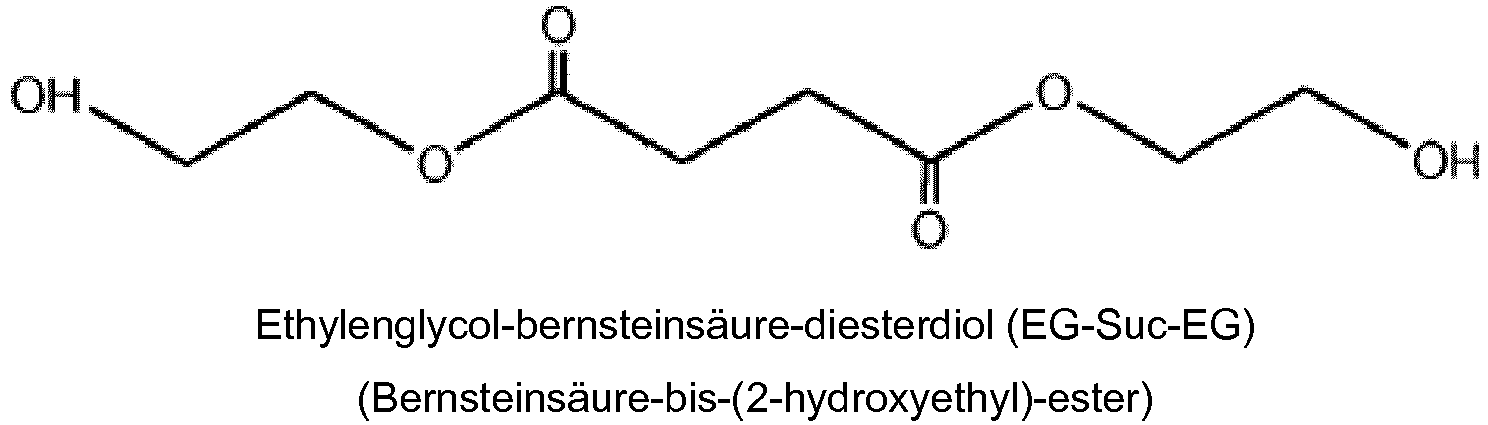
- the product from step one was then heated under vacuum (0.01 torr) on the Kugelrohr to remove ethylene glycol at 40-50°C and then increased to 120°C to distil the EG-Suc-EG trimer which came over as a colourless liquid. Yield was 22.7g, (55.1% yield).
- Table 2 Properties of dicarboxylic acid ester diols Chemical Structure Characterisation EG-Suc-EG IR, 1 HNMR, 13 CNMR EG-Fum-EG IR, 1 HNMR, 13 CNMR
- the method for degradation was as per ASTM International standard F 1635: Standard Test Method for In vitro Degradation Testing of Poly (L-lactic Acid) Resin and Fabricated Form for Surgical Implants.
- the conditions were: Polymers were meltpressed to 100-200 ⁇ m thick and strips were cut 5mm x 45mm, buffer was 0.1 M PBS pH 7.4, temperature was 37°C, solution:specimen ratio was between 100:1 and 300:1, 0.1% sodium azide was added as antimicrobial, samples were all placed in a 50rpm agitated incubator, 6 specimens per material and only one specimen per jar.
- Table 4 Mass loss and GPC molecular weights before and after degradation of the polyurethanes of Table 3 Pre Degradation Post Degradation PU % Mass Loss Mn Mw PD Mn Mw PD % ⁇ Mn 1 0.88 ⁇ 0.1 28,096 46,838 1.67 18,596 31,122 1.67 66.2 2 2.82 ⁇ 0.2 15,802 26,973 1.71 13,071 20,673 1.58 82.7 3 0.51 ⁇ 0.2 34,123 91,025 2.67 19,281 38,163 1.98 56.5 4* 0.42 ⁇ 0.2 121,842 443,397 3.64 118,803 531, 502 4.47 2.5 5* 1.91 ⁇ 0.2 16,953 29,660 1.75 16, 920 29,013 1.71 0.2
- ⁇ -caprolactone (114.14g) and ethylene glycol (310.35g) were added to a round-bottomed flask and heated to 190°C overnight with a vertical condenser to avoid loss of reagents.
- ⁇ -caprolactone (79.83g) and 1,4-butane diol (450.60g) were added to a round-bottomed flask and heated to 180°C over the weekend ( ⁇ 66 hours) with a vertical condenser to avoid loss of reagents.
- Two polymers from Table 3 can be compared for hydrolytic degradation at 100°C and measured by change in concentration of amine in solution (due to urethane hydrolysis). Approximately 5g of polymer is weighed out and placed in a round-bottomed flask. Distilled water is then added to the flask containing the sample such that the sample to water ratio is approximately 1:50 (to obtain concentrated degradation products). The round-bottomed flask is then placed in an oil bath set to 130°C and refluxed for 24 hours with a vertical condenser. The degradation products are collected and subjected to the Ninhydrin Assay. Ninhydrin Assay: Ninhydrin Reagent Solution is obtained from Sigma, product code number N 7285. The protocol on the product information sheet is followed with regard to the assay as well as the preparation of the standard curve.
- a prepolymer of pentaerythritol (PE) with ELDI (2.0g) is weighed into a glass vial. Degassed and dried dimer from Table 3 0.461 g (MW 120) is added to the prepolymer. The mixture is manually stirred using a spatula for 3 minutes with stannous 2-ethyl hexanoate catalyst (0.002g, 0.1% based on based on total weight of prepolymer) and is degassed under a vacuum for 5 min.
- the viscous mixture is taken into a 2.5 ml syringe and dispensed 0.33 g into each cylindrical cavity(6 mm D x 12 mm L) in a multi-cavity Teflon mould and cured overnight at 38°C to give cylindrical polymer test specimens.
- a second polymer is prepared by incorporating 5 wt-% of ⁇ -tricalcium phosphate (TCP, 5 micron particle size). TCP is added to the reactant mixture and stirred using a high speed mechanical stirrer for uniform distribution.
- the cured polymer samples is tested using Instron (Model 5568) for compressive strength and modulus according to ASTM method F451-756.
- the polymer is prepared using the method described in Example 3.
- a mixture of polyethylene glycol (10.000g), chain extender (1.713 g), EG (1.330 g) and stannous octoate (0.010g) are weighed into a 100 ml predried polypropylene beaker, covered with aluminium foil and heated to 70°C under nitrogen in a laboratory oven.
- HDI (7.862g) is weighed in a separate wettared predried polypropylene beaker and heated to 70°C.
- HDI is then added to the polyol/chain extender mixture in a beaker and stirred manually for 3 min.
- the viscous mixture is then poured onto a Teflon® coated metal tray and cured at 100°C for a period of about 18 hours in a nitrogen circulating oven.
Landscapes
- Chemical & Material Sciences (AREA)
- Organic Chemistry (AREA)
- Health & Medical Sciences (AREA)
- Chemical Kinetics & Catalysis (AREA)
- Medicinal Chemistry (AREA)
- Polymers & Plastics (AREA)
- General Health & Medical Sciences (AREA)
- Public Health (AREA)
- Veterinary Medicine (AREA)
- Life Sciences & Earth Sciences (AREA)
- Animal Behavior & Ethology (AREA)
- Epidemiology (AREA)
- Oral & Maxillofacial Surgery (AREA)
- Vascular Medicine (AREA)
- Transplantation (AREA)
- Dermatology (AREA)
- Emergency Medicine (AREA)
- Heart & Thoracic Surgery (AREA)
- Surgery (AREA)
- Engineering & Computer Science (AREA)
- General Chemical & Material Sciences (AREA)
- Bioinformatics & Cheminformatics (AREA)
- Nuclear Medicine, Radiotherapy & Molecular Imaging (AREA)
- Pharmacology & Pharmacy (AREA)
- Polyurethanes Or Polyureas (AREA)
- Materials For Medical Uses (AREA)
- Biological Depolymerization Polymers (AREA)
Claims (15)
- Verwendung einer Verbindung von Formel (la) oder (Ib) als einen Kettenverlängerer, um ein/einen biokompatibles/n, biologisch abbaubares/n Polyurethan oder Polyurethanharnstoff zu erzeugen,


- Verwendung nach Anspruch 1, wobei R1 bis R3 unabhängig ausgewählt sind aus optional substituiertem C1-6-Alkylen und optional substituiertem C2-6-Alkenylen.
- Verwendung nach Anspruch 1 oder 2, wobei die Verbindung von Formel (la) wie folgt lautet:


- Verwendung nach Anspruch 1 oder 2, wobei die Verbindung von Formel (Ib) wie folgt lautet:

- Verwendung nach einem der Ansprüche 1 bis 4, wobei der Kettenverlängerer eine Molekülmasse von weniger als 400 aufweist.
- Verwendung nach Anspruch 1, wobei die Verbindung von Formel (la) ein ε-Caprolacton-Ethylenglycol-Dimer (CL-EG) ist.
- Verwendung nach einem der Ansprüche 1 bis 5, wobei der Kettenverlängerer, der die Verbindung von Formel (la) oder (Ib) umfasst, einen weiteren Kettenverlängerer umfasst.
- Verwendung nach Anspruch 7, wobei der andere Kettenverlängerer ein Diol, ein Dithiol, ein Diamin, eine Aminosäure oder eine Dicarbonsäure ist.
- Verwendung nach einem der Ansprüche 1 bis 8, wobei das Herstellen der Verbindung von Formel (la) oder (Ib) Folgendes umfasst: den Schritt des Umesterns einer Verbindung von Formel (II) oder (III):

mit einer Verbindung aus Formel (IV)
HOR1OH (IV)
wobei R1 nach Anspruch 1 definiert ist. - Biokompatibles, biologisch abbaubares Polymergerüst, umfassend ein/en vernetztes/n oder lineares/n Polyurethan oder Polyurethanharnstoff, wobei das Polyurethan oder der Polyurethanharnstoff ein Reaktionsprodukt eines Isocyanats und eines Kettenverlängerers nach einem der Ansprüche 1 bis 8 umfasst, wobei das Gerüst in Koronar-, Arterien-, Blutgefäßen oder Herzgewebe, Wundheilung, plastischer oder kosmetischer Chirurgie, Nervenregeneration, Bandscheibenreparatur oder -augmentation oder orthopädischen oder Gewebezüchtungsanwendungen verwendet wird.
- Gerüst nach Anspruch 10, wobei es sich um einen Stent, eine Stentbeschichtung, ein Knochenersatzmaterial, einen Knochenfüllstoff, einen Knochenzement oder ein orthopädisches Fixationsgerüst oder einen Füllstoff für Vertebroplastie oder Kyphoplastie handelt.
- Gerüst nach Anspruch 11, wobei es sich bei dem orthopädischen Fixationsgerüst um eine Schraube, ein Stift, eine Platte oder einen Wirbelsäulenkäfig oder einen Ankerstift, einen Pfeil, einen Stift oder einen Klebstoff für Weichgewebereparatur handelt.
- Medizinprodukt oder Zusammensetzung, das/die ganz oder teilweise aus dem Gerüst nach Anspruch 10 besteht.
- Gerüst nach Anspruch 10, in dem das Polyurethan oder der Polyurethanharnstoff biologische und anorganische Bestandteile enthält.
- Gerüst nach Anspruch 10, das eine Druckfestigkeit von 0,05-200 MPa aufweist.
Applications Claiming Priority (2)
| Application Number | Priority Date | Filing Date | Title |
|---|---|---|---|
| AU2005905192A AU2005905192A0 (en) | 2005-09-20 | Chain Extenders | |
| PCT/AU2006/001380 WO2007033418A1 (en) | 2005-09-20 | 2006-09-20 | Chain extenders |
Publications (3)
| Publication Number | Publication Date |
|---|---|
| EP1945690A1 EP1945690A1 (de) | 2008-07-23 |
| EP1945690A4 EP1945690A4 (de) | 2009-11-25 |
| EP1945690B1 true EP1945690B1 (de) | 2016-07-27 |
Family
ID=37888453
Family Applications (1)
| Application Number | Title | Priority Date | Filing Date |
|---|---|---|---|
| EP06775006.7A Active EP1945690B1 (de) | 2005-09-20 | 2006-09-20 | Kettenverlängerungsmittel |
Country Status (5)
| Country | Link |
|---|---|
| US (4) | US7964696B2 (de) |
| EP (1) | EP1945690B1 (de) |
| JP (1) | JP5351516B2 (de) |
| CN (1) | CN101296958B (de) |
| WO (1) | WO2007033418A1 (de) |
Families Citing this family (33)
| Publication number | Priority date | Publication date | Assignee | Title |
|---|---|---|---|---|
| EP1978013A1 (de) * | 2007-04-04 | 2008-10-08 | Cognis IP Management GmbH | Diole und Polyole |
| US8357767B2 (en) * | 2007-10-03 | 2013-01-22 | Polynovo Biomaterials Limited | High modulus polyurethane and polyurethane/urea compositions |
| US8501290B2 (en) | 2008-01-15 | 2013-08-06 | Abbott Cardiovascular Systems Inc. | Implantable medical devices fabricated from polyurethanes with biodegradable hard and soft blocks and blends thereof |
| US9259515B2 (en) | 2008-04-10 | 2016-02-16 | Abbott Cardiovascular Systems Inc. | Implantable medical devices fabricated from polyurethanes with grafted radiopaque groups |
| US8450529B2 (en) | 2008-10-02 | 2013-05-28 | Covidien Lp | Branched polyamines and formulations thereof for use in medical devices |
| US20120095169A1 (en) * | 2009-06-30 | 2012-04-19 | Ryohei Ogawa | Polylactic acid-based resin, process for producing polylactic acid-based resin, polylactic acid resin composition, stereocomplex polylactic acid resin composition and process for producing stereocomplex polylactic acid resin composition |
| WO2011156506A2 (en) | 2010-06-08 | 2011-12-15 | Smith & Nephew, Inc. | Implant components and methods |
| CN106175991A (zh) | 2010-08-26 | 2016-12-07 | 史密夫和内修有限公司 | 用于股骨髋臼撞击手术的植入物、外科手术方法和器械 |
| US10426867B2 (en) * | 2011-04-08 | 2019-10-01 | Mayo Foundation For Medical Education And Research | Biocompatible polycaprolactone fumarate formulations |
| TWI641396B (zh) | 2011-09-23 | 2018-11-21 | Bvw控股公司 | 醫療共聚物 |
| US9808556B2 (en) * | 2013-01-02 | 2017-11-07 | National Taiwan University | Biocompatible and biodegradable elastomer |
| CN105452213B (zh) | 2013-03-14 | 2017-09-22 | 阿尔克梅斯制药爱尔兰有限公司 | 富马酸酯前体药物及其在治疗多种疾病中的应用 |
| US8669281B1 (en) | 2013-03-14 | 2014-03-11 | Alkermes Pharma Ireland Limited | Prodrugs of fumarates and their use in treating various diseases |
| CN103495203B (zh) * | 2013-09-09 | 2014-11-05 | 西安交通大学 | 一种可生物还原降解型蜂窝状聚氨酯支架及其制备方法和应用 |
| CA2940845C (en) | 2014-02-24 | 2019-09-24 | Alkermes Pharma Ireland Limited | Sulfonamide and sulfinamide prodrugs of fumarates and their use in treating various diseases |
| CN107108833B (zh) | 2014-11-24 | 2022-06-14 | Ppg工业俄亥俄公司 | 通过挤出用于反应性三维打印的方法 |
| US10259940B2 (en) | 2015-01-13 | 2019-04-16 | Advanced Softmaterials Inc. | Thermoplastic elastomer composition, thermoplastic elastomer, and method for producing thermoplastic elastomer |
| US11267965B2 (en) * | 2015-11-30 | 2022-03-08 | Aleo Bme, Inc. | Polymeric materials for biomedical applications |
| CN106890359B (zh) * | 2015-12-17 | 2020-11-06 | 四川大学 | 用于中枢神经损伤修复的三维多孔聚氨酯支架及制备方法 |
| US10040894B2 (en) | 2016-03-28 | 2018-08-07 | International Business Machines Corporation | Polymeric materials formed from polyhydroxyalkanoate materials |
| US10072120B2 (en) | 2016-12-02 | 2018-09-11 | International Business Machines Corporation | Functionalized polyhydroxyalkanoate materials formed from an unsaturated polyhydroxyalkanoate material |
| WO2019119060A1 (en) * | 2017-12-22 | 2019-06-27 | Polynovo Biomaterials Pty Limited | Soft tissue implant pocket |
| ES2868850T3 (es) * | 2016-12-23 | 2021-10-22 | Basf Se | Método para la fabricación de poliuretanos termoplásticos duros transparentes |
| US10081706B2 (en) | 2017-01-03 | 2018-09-25 | International Business Machines Corporation | Side-chain-functionalized polyhydroxyalkanoate materials |
| EP3727486B1 (de) | 2017-12-22 | 2025-12-24 | Polynovo Biomaterials Pty Limited | Gewebereparaturlaminate |
| CA3086350A1 (en) * | 2017-12-22 | 2019-06-27 | Polynovo Biomaterials Pty Limited | Tissue repair laminates |
| US12129333B2 (en) | 2018-12-21 | 2024-10-29 | Polynovo Biomaterials Pty Limited | Oriented biodegradable polyurethanes |
| CN109776809B (zh) * | 2019-02-18 | 2022-01-18 | 江苏金聚合金材料有限公司 | 易交联生物降解树脂及其制备方法 |
| US12006442B2 (en) * | 2019-09-11 | 2024-06-11 | Applied Materials, Inc. | Additive manufacturing of polishing pads |
| CN114746463A (zh) * | 2019-10-02 | 2022-07-12 | 拉特格斯,新泽西州立大学 | 用于根管填充的组合物和方法 |
| CN110894399A (zh) * | 2019-12-19 | 2020-03-20 | 山东一航新材料科技有限公司 | 一种双组份聚氨酯防水涂料及其制备方法 |
| EP4363483A1 (de) * | 2021-06-29 | 2024-05-08 | Bostik SA | Poly (3-hydroxysäure)polymere aus langkettigen epoxiden und ihre verwendungen in zusammenhang mit schmelzklebstoffen |
| CN116139327B (zh) * | 2023-04-18 | 2023-06-27 | 北京艾方德科技有限公司 | 一种改善依从性腔体止血用医用聚氨酯泡沫材料 |
Family Cites Families (58)
| Publication number | Priority date | Publication date | Assignee | Title |
|---|---|---|---|---|
| US3007899A (en) | 1958-07-16 | 1961-11-07 | Union Carbide Corp | Polyurethane (ester glycol) compositions |
| DE1155905B (de) * | 1960-08-25 | 1963-10-17 | Albert Ag Chem Werke | Verfahren zur Herstellung von Formkoerpern oder UEberzuegen |
| US3281378A (en) | 1963-06-06 | 1966-10-25 | Merck & Co Inc | Diisocyanato substituted aliphatic carboxylic acid ester urethane reaction products |
| US3360546A (en) | 1963-09-16 | 1967-12-26 | Monsanto Co | Purification of hydroxyalkyl fumarate esters |
| DE2402799C3 (de) | 1974-01-22 | 1978-11-30 | Bayer Ag, 5090 Leverkusen | Verfahren zur Textilbeschichtung mit Polyurethanen nach dem Umkehrverfahren |
| US4192827A (en) | 1974-06-27 | 1980-03-11 | Ciba-Geigy Corporation | Water-insoluble hydrophilic copolymers |
| US4035274A (en) | 1976-05-24 | 1977-07-12 | Scm Corporation | Dual cure cathodic electrocoating |
| CA1155591A (en) * | 1977-06-23 | 1983-10-18 | Francis E. Gould | Polyurethane polymers characterized by lactone groups and hydroxyl groups in the polymer backbone |
| DE2842805A1 (de) * | 1978-09-30 | 1980-04-10 | Bayer Ag | Beschichtungsmassen |
| US4293679A (en) | 1979-06-13 | 1981-10-06 | W. R. Grace & Co. | Composition and method of controlling solid polyurethane particle size with water reactant |
| DE2937330A1 (de) * | 1979-09-14 | 1981-04-02 | Bayer Ag, 5090 Leverkusen | Verfahren zur herstellung von elastischen, flammkaschierbaren und hochfrequenzverschweissbaren polyurethanschaumstoffen |
| US4273690A (en) | 1979-10-09 | 1981-06-16 | E. I. Du Pont De Nemours And Company | Coating compositions of an alkyd-acrylic graft copolymer |
| US4284506A (en) | 1979-12-26 | 1981-08-18 | Nl Industries, Inc. | Biomedical devices |
| US4412033A (en) | 1980-10-24 | 1983-10-25 | H. B. Fuller Company | One-part, curable polyurethane |
| US4451523A (en) | 1982-11-12 | 1984-05-29 | Loctite Corporation | Conformal coating systems |
| US4424252A (en) | 1982-11-12 | 1984-01-03 | Loctite Corporation | Conformal coating systems |
| DE3318730A1 (de) * | 1983-05-21 | 1984-11-22 | Akzo Gmbh, 5600 Wuppertal | Biokompatible polyurethane |
| US5276068A (en) | 1985-03-29 | 1994-01-04 | Jeneric/Pentron, Inc. | Dental resin materials |
| US4792576A (en) * | 1987-07-23 | 1988-12-20 | Mobay Corporation | Production of polyurethane moldings by the reaction injection molding process |
| US4908406A (en) | 1988-01-14 | 1990-03-13 | Ciba-Geigy Corporation | Curable mixture |
| US4935480A (en) | 1988-03-28 | 1990-06-19 | Becton, Dickinson And Company | Fluorinated polyetherurethanes and medical devices therefrom |
| DE3831681A1 (de) * | 1988-09-17 | 1990-03-22 | Basf Ag | Neue estergruppen gebunden enthaltende dihydroxyverbindungen, verfahren zu ihrer herstellung und ihre verwendung |
| US5041516A (en) | 1989-06-21 | 1991-08-20 | Cornell Research Foundation, Inc. | Dendritic molecules and method of production |
| DE4225045A1 (de) * | 1992-07-29 | 1994-02-03 | Basf Ag | Verwendung von wasserlöslichen oder in Wasser dispergierbaren Polyurethanen als Hilfsmittel in kosmetischen und pharmazeutischen Zubereitungen und Polyurethane, die Polymilchsäurepolyole einpolymerisiert enthalten |
| JP2670006B2 (ja) | 1993-09-07 | 1997-10-29 | 昭和高分子株式会社 | 生分解性高分子量ポリエステルの製造方法 |
| DE4406444A1 (de) * | 1994-02-28 | 1995-08-31 | Huels Chemische Werke Ag | Hydroxyl- und uretdiongruppenhaltige Polyadditionsprodukte und Verfahren zu ihrer Herstellung sowie deren Verwendung zur Herstellung abspaltfreier Polyurethan-Pulverlacke hoher Reaktivität und die danach hergestellten Polyurethan-Pulverlacke |
| JP3360920B2 (ja) * | 1994-03-24 | 2003-01-07 | サカタインクス株式会社 | ポリウレタン樹脂、その製造方法およびそれを用いたラミネート用印刷インキ組成物 |
| JPH07278249A (ja) * | 1994-04-12 | 1995-10-24 | Sekisui Chem Co Ltd | 熱可塑性ポリウレタン |
| US5578662A (en) | 1994-07-22 | 1996-11-26 | United States Surgical Corporation | Bioabsorbable branched polymers containing units derived from dioxanone and medical/surgical devices manufactured therefrom |
| DE19519335A1 (de) * | 1995-05-26 | 1996-11-28 | Basf Ag | Verfahren zur Herstellung von Ester- und Urethangruppen enthaltenden Formkörpern, estergruppenhaltige Isocyanat-Semipräpolymere hierfür und ihre Verwendung |
| DE19524045A1 (de) | 1995-07-01 | 1997-01-02 | Basf Ag | Hochfunktionalisierte Polyurethane |
| US5886127A (en) | 1996-08-28 | 1999-03-23 | University Of South Florida | Combinatorial method of forming cascade polymer surfaces |
| CA2218447C (en) | 1996-10-17 | 2009-01-20 | United States Surgical Corporation | Bioabsorbable branched polymers containing units derived from dioxanone and medical/surgical devices manufactured therefrom |
| US6211249B1 (en) | 1997-07-11 | 2001-04-03 | Life Medical Sciences, Inc. | Polyester polyether block copolymers |
| US6124384A (en) | 1997-08-19 | 2000-09-26 | Mitsui Chemicals, Inc. | Composite resin composition |
| US6319988B1 (en) | 1998-08-31 | 2001-11-20 | Ppg Industries Ohio, Inc. | Thermosetting compositions containing hydroxy functional polymers prepared by atom transfer radical polymerization |
| JP2000128955A (ja) * | 1998-10-29 | 2000-05-09 | Nippon Miractran Co Ltd | 熱可塑性ポリウレタン樹脂の製造方法 |
| DE19904444A1 (de) | 1999-02-04 | 2000-08-10 | Basf Ag | Dendrimere und hochverzweigte Polyurethane |
| US6376742B1 (en) | 1999-02-17 | 2002-04-23 | Richard J. Zdrahala | In vivo tissue engineering with biodegradable polymers |
| DK1168934T3 (da) | 1999-04-12 | 2008-05-13 | Cornell Res Foundation Inc | Hydrogeldannende system med hydrofobe og hydrofile komponenter |
| WO2000067815A1 (en) * | 1999-05-07 | 2000-11-16 | Salviac Limited | A tissue engineering scaffold |
| US6124370A (en) | 1999-06-14 | 2000-09-26 | The Dow Chemical Company | Crosslinked polyolefinic foams with enhanced physical properties and a dual cure process of producing such foams |
| DE19962272A1 (de) | 1999-12-23 | 2001-06-28 | Basf Ag | Isocyanatgruppen aufweisende Bausteine sowie ihre Verwendung zur Funktionalisierung oder Modifizierung von Verbindungen oder Oberflächen |
| DE10031258A1 (de) | 2000-06-27 | 2002-01-10 | Basf Ag | Härtbare wässrige Polyurethandispersionen |
| WO2002006368A2 (en) * | 2000-07-14 | 2002-01-24 | Metabolix, Inc. | Polyurethanes obtained from hydroxyalkanoates and isocyanates |
| US6613314B1 (en) | 2000-07-27 | 2003-09-02 | L'oreal | Reshapable hair styling composition comprising polyurethane dispersions |
| EP1248809B1 (de) | 2000-07-28 | 2010-03-10 | Woodbridge Foam Corporation | Verbesserte härteeigenschaften aufweisendes geschäumtes auf isocyanat basierendes polymer und verfahren zur herstellung |
| AU2000263930B2 (en) | 2000-07-31 | 2005-03-10 | Ppg Industries Ohio, Inc. | Dual cure coating compositions having improved scratch resistance, coated substrates and methods related thereto |
| ES2554105T3 (es) | 2000-10-31 | 2015-12-16 | Basf Se | Uso de poliuretanos hiperramificados para la preparación de tintas de impresión |
| KR20020063098A (ko) | 2001-01-26 | 2002-08-01 | 히다찌 플랜트 겐세쓰 가부시키가이샤 | 수중의 외인성 내분비교란화학물질의 제거방법 |
| WO2004065450A2 (en) * | 2003-01-16 | 2004-08-05 | Carnegie Mellon University | Biodegradable polyurethanes and use thereof |
| US7985414B2 (en) * | 2003-02-04 | 2011-07-26 | Warsaw Orthopedic, Inc. | Polyurethanes for osteoimplants |
| US7179874B2 (en) * | 2003-11-21 | 2007-02-20 | Chia Nan University Of Pharmacy And Science | Biodegradable cationic polymer |
| JP5496457B2 (ja) * | 2004-03-24 | 2014-05-21 | ポリィノボ バイオマテリアルズ ピーティワイ リミテッド | 生分解性ポリウレタン及びポリウレタン尿素 |
| EP1602676A1 (de) * | 2004-06-01 | 2005-12-07 | SOLVAY (Société Anonyme) | Katalysatorzusammensetzungen |
| CA2574933C (en) * | 2004-07-26 | 2015-05-19 | Synthes (U.S.A.) | Biocompatible, biodegradable polyurethane materials with controlled hydrophobic to hydrophilic ratio |
| US7247692B2 (en) | 2004-09-30 | 2007-07-24 | Johnson & Johnson Vision Care, Inc. | Biomedical devices containing amphiphilic block copolymers |
| US8357767B2 (en) * | 2007-10-03 | 2013-01-22 | Polynovo Biomaterials Limited | High modulus polyurethane and polyurethane/urea compositions |
-
2006
- 2006-09-20 EP EP06775006.7A patent/EP1945690B1/de active Active
- 2006-09-20 JP JP2008531485A patent/JP5351516B2/ja active Active
- 2006-09-20 CN CN200680039476XA patent/CN101296958B/zh active Active
- 2006-09-20 US US11/992,340 patent/US7964696B2/en active Active
- 2006-09-20 WO PCT/AU2006/001380 patent/WO2007033418A1/en not_active Ceased
-
2011
- 2011-06-20 US US13/164,316 patent/US8962786B2/en active Active
-
2014
- 2014-12-17 US US14/573,733 patent/US9695268B2/en active Active
-
2017
- 2017-06-01 US US15/611,426 patent/US10844158B2/en active Active
Also Published As
| Publication number | Publication date |
|---|---|
| US9695268B2 (en) | 2017-07-04 |
| US20090175921A1 (en) | 2009-07-09 |
| US20150105530A1 (en) | 2015-04-16 |
| US20170267803A1 (en) | 2017-09-21 |
| CN101296958B (zh) | 2012-07-18 |
| WO2007033418A1 (en) | 2007-03-29 |
| EP1945690A1 (de) | 2008-07-23 |
| EP1945690A4 (de) | 2009-11-25 |
| JP2009508598A (ja) | 2009-03-05 |
| CN101296958A (zh) | 2008-10-29 |
| US20110287102A1 (en) | 2011-11-24 |
| US8962786B2 (en) | 2015-02-24 |
| US7964696B2 (en) | 2011-06-21 |
| JP5351516B2 (ja) | 2013-11-27 |
| US10844158B2 (en) | 2020-11-24 |
Similar Documents
| Publication | Publication Date | Title |
|---|---|---|
| US10844158B2 (en) | Chain extenders | |
| JP5600062B2 (ja) | 高弾性率ポリウレタン及びポリウレタン/尿素組成物 | |
| JP5496457B2 (ja) | 生分解性ポリウレタン及びポリウレタン尿素 | |
| JP4335448B2 (ja) | 生体医用ポリウレタン、その調製方法及び使用方法 | |
| AU2006321915B2 (en) | Bioabsorbable surgical composition | |
| US20200223973A1 (en) | Polyurea systems, processes for preparing the same and use thereof for postoperative adhesion barriers | |
| Park et al. | Catalyst-free synthesis of high elongation degradable polyurethanes containing varying ratios of isosorbide and polycaprolactone: physical properties and biocompatibility | |
| Guelcher et al. | Synthesis of biocompatible segmented polyurethanes from aliphatic diisocyanates and diurea diol chain extenders | |
| WO2013155173A2 (en) | Methods and compositions relating to biodegradable epoxy elastomers | |
| AU2006294414B2 (en) | Chain extenders | |
| AU2012204042B2 (en) | Bioabsorbable surgical composition | |
| US20110105633A1 (en) | Functionalized stilbene-polyalkylene oxide prepolymers | |
| Herath | Synthesis and characterization of novel biodegradable crosslinked polyesters |
Legal Events
| Date | Code | Title | Description |
|---|---|---|---|
| PUAI | Public reference made under article 153(3) epc to a published international application that has entered the european phase |
Free format text: ORIGINAL CODE: 0009012 |
|
| 17P | Request for examination filed |
Effective date: 20080327 |
|
| AK | Designated contracting states |
Kind code of ref document: A1 Designated state(s): AT BE BG CH CY CZ DE DK EE ES FI FR GB GR HU IE IS IT LI LT LU LV MC NL PL PT RO SE SI SK TR |
|
| A4 | Supplementary search report drawn up and despatched |
Effective date: 20091023 |
|
| 17Q | First examination report despatched |
Effective date: 20100202 |
|
| DAX | Request for extension of the european patent (deleted) | ||
| REG | Reference to a national code |
Ref country code: DE Ref legal event code: R079 Ref document number: 602006049731 Country of ref document: DE Free format text: PREVIOUS MAIN CLASS: C08G0018320000 Ipc: A61L0027180000 |
|
| GRAP | Despatch of communication of intention to grant a patent |
Free format text: ORIGINAL CODE: EPIDOSNIGR1 |
|
| RIC1 | Information provided on ipc code assigned before grant |
Ipc: C08G 18/10 20060101ALI20160411BHEP Ipc: C08G 18/66 20060101ALI20160411BHEP Ipc: C08G 18/32 20060101ALI20160411BHEP Ipc: C07C 69/675 20060101ALI20160411BHEP Ipc: C08G 18/42 20060101ALI20160411BHEP Ipc: C07C 69/60 20060101ALI20160411BHEP Ipc: C07C 69/40 20060101ALI20160411BHEP Ipc: A61L 31/06 20060101ALI20160411BHEP Ipc: C08G 18/73 20060101ALI20160411BHEP Ipc: A61L 27/18 20060101AFI20160411BHEP Ipc: C08G 18/77 20060101ALI20160411BHEP |
|
| INTG | Intention to grant announced |
Effective date: 20160426 |
|
| GRAS | Grant fee paid |
Free format text: ORIGINAL CODE: EPIDOSNIGR3 |
|
| GRAA | (expected) grant |
Free format text: ORIGINAL CODE: 0009210 |
|
| AK | Designated contracting states |
Kind code of ref document: B1 Designated state(s): AT BE BG CH CY CZ DE DK EE ES FI FR GB GR HU IE IS IT LI LT LU LV MC NL PL PT RO SE SI SK TR |
|
| REG | Reference to a national code |
Ref country code: GB Ref legal event code: FG4D |
|
| REG | Reference to a national code |
Ref country code: CH Ref legal event code: EP |
|
| REG | Reference to a national code |
Ref country code: AT Ref legal event code: REF Ref document number: 815270 Country of ref document: AT Kind code of ref document: T Effective date: 20160815 |
|
| REG | Reference to a national code |
Ref country code: IE Ref legal event code: FG4D |
|
| REG | Reference to a national code |
Ref country code: DE Ref legal event code: R096 Ref document number: 602006049731 Country of ref document: DE |
|
| RAP2 | Party data changed (patent owner data changed or rights of a patent transferred) |
Owner name: POLYNOVO BIOMATERIALS PTY LIMITED |
|
| REG | Reference to a national code |
Ref country code: FR Ref legal event code: PLFP Year of fee payment: 11 |
|
| REG | Reference to a national code |
Ref country code: NL Ref legal event code: FP |
|
| REG | Reference to a national code |
Ref country code: LT Ref legal event code: MG4D |
|
| REG | Reference to a national code |
Ref country code: AT Ref legal event code: MK05 Ref document number: 815270 Country of ref document: AT Kind code of ref document: T Effective date: 20160727 |
|
| PG25 | Lapsed in a contracting state [announced via postgrant information from national office to epo] |
Ref country code: IT Free format text: LAPSE BECAUSE OF FAILURE TO SUBMIT A TRANSLATION OF THE DESCRIPTION OR TO PAY THE FEE WITHIN THE PRESCRIBED TIME-LIMIT Effective date: 20160727 Ref country code: IS Free format text: LAPSE BECAUSE OF FAILURE TO SUBMIT A TRANSLATION OF THE DESCRIPTION OR TO PAY THE FEE WITHIN THE PRESCRIBED TIME-LIMIT Effective date: 20161127 Ref country code: LT Free format text: LAPSE BECAUSE OF FAILURE TO SUBMIT A TRANSLATION OF THE DESCRIPTION OR TO PAY THE FEE WITHIN THE PRESCRIBED TIME-LIMIT Effective date: 20160727 Ref country code: FI Free format text: LAPSE BECAUSE OF FAILURE TO SUBMIT A TRANSLATION OF THE DESCRIPTION OR TO PAY THE FEE WITHIN THE PRESCRIBED TIME-LIMIT Effective date: 20160727 |
|
| PG25 | Lapsed in a contracting state [announced via postgrant information from national office to epo] |
Ref country code: BE Free format text: LAPSE BECAUSE OF NON-PAYMENT OF DUE FEES Effective date: 20160727 Ref country code: SE Free format text: LAPSE BECAUSE OF FAILURE TO SUBMIT A TRANSLATION OF THE DESCRIPTION OR TO PAY THE FEE WITHIN THE PRESCRIBED TIME-LIMIT Effective date: 20160727 Ref country code: LV Free format text: LAPSE BECAUSE OF FAILURE TO SUBMIT A TRANSLATION OF THE DESCRIPTION OR TO PAY THE FEE WITHIN THE PRESCRIBED TIME-LIMIT Effective date: 20160727 Ref country code: ES Free format text: LAPSE BECAUSE OF FAILURE TO SUBMIT A TRANSLATION OF THE DESCRIPTION OR TO PAY THE FEE WITHIN THE PRESCRIBED TIME-LIMIT Effective date: 20160727 Ref country code: AT Free format text: LAPSE BECAUSE OF FAILURE TO SUBMIT A TRANSLATION OF THE DESCRIPTION OR TO PAY THE FEE WITHIN THE PRESCRIBED TIME-LIMIT Effective date: 20160727 Ref country code: PT Free format text: LAPSE BECAUSE OF FAILURE TO SUBMIT A TRANSLATION OF THE DESCRIPTION OR TO PAY THE FEE WITHIN THE PRESCRIBED TIME-LIMIT Effective date: 20161128 Ref country code: GR Free format text: LAPSE BECAUSE OF FAILURE TO SUBMIT A TRANSLATION OF THE DESCRIPTION OR TO PAY THE FEE WITHIN THE PRESCRIBED TIME-LIMIT Effective date: 20161028 Ref country code: PL Free format text: LAPSE BECAUSE OF FAILURE TO SUBMIT A TRANSLATION OF THE DESCRIPTION OR TO PAY THE FEE WITHIN THE PRESCRIBED TIME-LIMIT Effective date: 20160727 |
|
| PG25 | Lapsed in a contracting state [announced via postgrant information from national office to epo] |
Ref country code: EE Free format text: LAPSE BECAUSE OF FAILURE TO SUBMIT A TRANSLATION OF THE DESCRIPTION OR TO PAY THE FEE WITHIN THE PRESCRIBED TIME-LIMIT Effective date: 20160727 Ref country code: MC Free format text: LAPSE BECAUSE OF FAILURE TO SUBMIT A TRANSLATION OF THE DESCRIPTION OR TO PAY THE FEE WITHIN THE PRESCRIBED TIME-LIMIT Effective date: 20160727 Ref country code: RO Free format text: LAPSE BECAUSE OF FAILURE TO SUBMIT A TRANSLATION OF THE DESCRIPTION OR TO PAY THE FEE WITHIN THE PRESCRIBED TIME-LIMIT Effective date: 20160727 |
|
| REG | Reference to a national code |
Ref country code: CH Ref legal event code: PL |
|
| REG | Reference to a national code |
Ref country code: DE Ref legal event code: R097 Ref document number: 602006049731 Country of ref document: DE |
|
| PG25 | Lapsed in a contracting state [announced via postgrant information from national office to epo] |
Ref country code: SK Free format text: LAPSE BECAUSE OF FAILURE TO SUBMIT A TRANSLATION OF THE DESCRIPTION OR TO PAY THE FEE WITHIN THE PRESCRIBED TIME-LIMIT Effective date: 20160727 Ref country code: DK Free format text: LAPSE BECAUSE OF FAILURE TO SUBMIT A TRANSLATION OF THE DESCRIPTION OR TO PAY THE FEE WITHIN THE PRESCRIBED TIME-LIMIT Effective date: 20160727 Ref country code: CZ Free format text: LAPSE BECAUSE OF FAILURE TO SUBMIT A TRANSLATION OF THE DESCRIPTION OR TO PAY THE FEE WITHIN THE PRESCRIBED TIME-LIMIT Effective date: 20160727 Ref country code: BG Free format text: LAPSE BECAUSE OF FAILURE TO SUBMIT A TRANSLATION OF THE DESCRIPTION OR TO PAY THE FEE WITHIN THE PRESCRIBED TIME-LIMIT Effective date: 20161027 |
|
| PLBE | No opposition filed within time limit |
Free format text: ORIGINAL CODE: 0009261 |
|
| STAA | Information on the status of an ep patent application or granted ep patent |
Free format text: STATUS: NO OPPOSITION FILED WITHIN TIME LIMIT |
|
| REG | Reference to a national code |
Ref country code: IE Ref legal event code: MM4A |
|
| 26N | No opposition filed |
Effective date: 20170502 |
|
| PG25 | Lapsed in a contracting state [announced via postgrant information from national office to epo] |
Ref country code: LI Free format text: LAPSE BECAUSE OF NON-PAYMENT OF DUE FEES Effective date: 20160930 Ref country code: IE Free format text: LAPSE BECAUSE OF NON-PAYMENT OF DUE FEES Effective date: 20160920 Ref country code: CH Free format text: LAPSE BECAUSE OF NON-PAYMENT OF DUE FEES Effective date: 20160930 |
|
| REG | Reference to a national code |
Ref country code: FR Ref legal event code: PLFP Year of fee payment: 12 |
|
| PG25 | Lapsed in a contracting state [announced via postgrant information from national office to epo] |
Ref country code: SI Free format text: LAPSE BECAUSE OF FAILURE TO SUBMIT A TRANSLATION OF THE DESCRIPTION OR TO PAY THE FEE WITHIN THE PRESCRIBED TIME-LIMIT Effective date: 20160727 Ref country code: LU Free format text: LAPSE BECAUSE OF NON-PAYMENT OF DUE FEES Effective date: 20160920 |
|
| PG25 | Lapsed in a contracting state [announced via postgrant information from national office to epo] |
Ref country code: HU Free format text: LAPSE BECAUSE OF FAILURE TO SUBMIT A TRANSLATION OF THE DESCRIPTION OR TO PAY THE FEE WITHIN THE PRESCRIBED TIME-LIMIT; INVALID AB INITIO Effective date: 20060920 Ref country code: CY Free format text: LAPSE BECAUSE OF FAILURE TO SUBMIT A TRANSLATION OF THE DESCRIPTION OR TO PAY THE FEE WITHIN THE PRESCRIBED TIME-LIMIT Effective date: 20160727 |
|
| PG25 | Lapsed in a contracting state [announced via postgrant information from national office to epo] |
Ref country code: TR Free format text: LAPSE BECAUSE OF FAILURE TO SUBMIT A TRANSLATION OF THE DESCRIPTION OR TO PAY THE FEE WITHIN THE PRESCRIBED TIME-LIMIT Effective date: 20160727 |
|
| REG | Reference to a national code |
Ref country code: FR Ref legal event code: PLFP Year of fee payment: 13 |
|
| P01 | Opt-out of the competence of the unified patent court (upc) registered |
Effective date: 20230523 |
|
| PGFP | Annual fee paid to national office [announced via postgrant information from national office to epo] |
Ref country code: NL Payment date: 20250704 Year of fee payment: 20 |
|
| PGFP | Annual fee paid to national office [announced via postgrant information from national office to epo] |
Ref country code: DE Payment date: 20250702 Year of fee payment: 20 |
|
| PGFP | Annual fee paid to national office [announced via postgrant information from national office to epo] |
Ref country code: GB Payment date: 20250703 Year of fee payment: 20 |
|
| PGFP | Annual fee paid to national office [announced via postgrant information from national office to epo] |
Ref country code: FR Payment date: 20250708 Year of fee payment: 20 |