EP0328639B1 - Rahmen zur verlegung von holzernen blöcken - Google Patents
Rahmen zur verlegung von holzernen blöcken Download PDFInfo
- Publication number
- EP0328639B1 EP0328639B1 EP87904934A EP87904934A EP0328639B1 EP 0328639 B1 EP0328639 B1 EP 0328639B1 EP 87904934 A EP87904934 A EP 87904934A EP 87904934 A EP87904934 A EP 87904934A EP 0328639 B1 EP0328639 B1 EP 0328639B1
- Authority
- EP
- European Patent Office
- Prior art keywords
- wooden bricks
- wooden
- bricks
- frame
- section
- Prior art date
- Legal status (The legal status is an assumption and is not a legal conclusion. Google has not performed a legal analysis and makes no representation as to the accuracy of the status listed.)
- Expired - Lifetime
Links
- 239000011449 brick Substances 0.000 title claims abstract description 193
- 239000000463 material Substances 0.000 claims description 14
- -1 polypropylene Polymers 0.000 claims description 8
- 239000004743 Polypropylene Substances 0.000 claims description 7
- 239000004033 plastic Substances 0.000 claims description 7
- 229920003023 plastic Polymers 0.000 claims description 7
- 229920001155 polypropylene Polymers 0.000 claims description 7
- 239000003795 chemical substances by application Substances 0.000 claims description 5
- XLYOFNOQVPJJNP-UHFFFAOYSA-N water Substances O XLYOFNOQVPJJNP-UHFFFAOYSA-N 0.000 description 20
- 238000000034 method Methods 0.000 description 14
- 239000010426 asphalt Substances 0.000 description 11
- 238000010276 construction Methods 0.000 description 9
- 230000035699 permeability Effects 0.000 description 8
- 238000003825 pressing Methods 0.000 description 8
- 230000000149 penetrating effect Effects 0.000 description 6
- 239000011230 binding agent Substances 0.000 description 5
- 230000008602 contraction Effects 0.000 description 5
- 239000002184 metal Substances 0.000 description 5
- 239000004570 mortar (masonry) Substances 0.000 description 5
- 230000000694 effects Effects 0.000 description 4
- 238000009434 installation Methods 0.000 description 4
- 238000002156 mixing Methods 0.000 description 4
- 230000002421 anti-septic effect Effects 0.000 description 3
- 239000000945 filler Substances 0.000 description 3
- 238000003780 insertion Methods 0.000 description 3
- 230000037431 insertion Effects 0.000 description 3
- 230000035515 penetration Effects 0.000 description 3
- 239000011248 coating agent Substances 0.000 description 2
- 238000000576 coating method Methods 0.000 description 2
- 230000007797 corrosion Effects 0.000 description 2
- 238000005260 corrosion Methods 0.000 description 2
- 230000002093 peripheral effect Effects 0.000 description 2
- 239000012466 permeate Substances 0.000 description 2
- 239000004576 sand Substances 0.000 description 2
- 230000035939 shock Effects 0.000 description 2
- JOYRKODLDBILNP-UHFFFAOYSA-N Ethyl urethane Chemical compound CCOC(N)=O JOYRKODLDBILNP-UHFFFAOYSA-N 0.000 description 1
- 238000011161 development Methods 0.000 description 1
- 238000007429 general method Methods 0.000 description 1
- 238000004898 kneading Methods 0.000 description 1
- 238000005259 measurement Methods 0.000 description 1
- 239000011347 resin Substances 0.000 description 1
- 229920005989 resin Polymers 0.000 description 1
- 239000011800 void material Substances 0.000 description 1
Images




Classifications
-
- E—FIXED CONSTRUCTIONS
- E01—CONSTRUCTION OF ROADS, RAILWAYS, OR BRIDGES
- E01C—CONSTRUCTION OF, OR SURFACES FOR, ROADS, SPORTS GROUNDS, OR THE LIKE; MACHINES OR AUXILIARY TOOLS FOR CONSTRUCTION OR REPAIR
- E01C13/00—Pavings or foundations specially adapted for playgrounds or sports grounds; Drainage, irrigation or heating of sports grounds
-
- E—FIXED CONSTRUCTIONS
- E01—CONSTRUCTION OF ROADS, RAILWAYS, OR BRIDGES
- E01C—CONSTRUCTION OF, OR SURFACES FOR, ROADS, SPORTS GROUNDS, OR THE LIKE; MACHINES OR AUXILIARY TOOLS FOR CONSTRUCTION OR REPAIR
- E01C11/00—Details of pavings
- E01C11/22—Gutters; Kerbs ; Surface drainage of streets, roads or like traffic areas
- E01C11/224—Surface drainage of streets
- E01C11/225—Paving specially adapted for through-the-surfacing drainage, e.g. perforated, porous; Preformed paving elements comprising, or adapted to form, passageways for carrying off drainage
-
- E—FIXED CONSTRUCTIONS
- E01—CONSTRUCTION OF ROADS, RAILWAYS, OR BRIDGES
- E01C—CONSTRUCTION OF, OR SURFACES FOR, ROADS, SPORTS GROUNDS, OR THE LIKE; MACHINES OR AUXILIARY TOOLS FOR CONSTRUCTION OR REPAIR
- E01C15/00—Pavings specially adapted for footpaths, sidewalks or cycle tracks
-
- E—FIXED CONSTRUCTIONS
- E01—CONSTRUCTION OF ROADS, RAILWAYS, OR BRIDGES
- E01C—CONSTRUCTION OF, OR SURFACES FOR, ROADS, SPORTS GROUNDS, OR THE LIKE; MACHINES OR AUXILIARY TOOLS FOR CONSTRUCTION OR REPAIR
- E01C5/00—Pavings made of prefabricated single units
- E01C5/001—Pavings made of prefabricated single units on prefabricated supporting structures or prefabricated foundation elements except coverings made of layers of similar elements
-
- E—FIXED CONSTRUCTIONS
- E01—CONSTRUCTION OF ROADS, RAILWAYS, OR BRIDGES
- E01C—CONSTRUCTION OF, OR SURFACES FOR, ROADS, SPORTS GROUNDS, OR THE LIKE; MACHINES OR AUXILIARY TOOLS FOR CONSTRUCTION OR REPAIR
- E01C5/00—Pavings made of prefabricated single units
- E01C5/14—Pavings made of prefabricated single units made of wooden units
-
- E—FIXED CONSTRUCTIONS
- E01—CONSTRUCTION OF ROADS, RAILWAYS, OR BRIDGES
- E01C—CONSTRUCTION OF, OR SURFACES FOR, ROADS, SPORTS GROUNDS, OR THE LIKE; MACHINES OR AUXILIARY TOOLS FOR CONSTRUCTION OR REPAIR
- E01C5/00—Pavings made of prefabricated single units
- E01C5/22—Pavings made of prefabricated single units made of units composed of a mixture of materials covered by two or more of groups E01C5/008, E01C5/02 - E01C5/20 except embedded reinforcing materials
- E01C5/223—Pavings made of prefabricated single units made of units composed of a mixture of materials covered by two or more of groups E01C5/008, E01C5/02 - E01C5/20 except embedded reinforcing materials on prefabricated supporting or prefabricated foundation units, except coverings made of layers of similar elements
-
- E—FIXED CONSTRUCTIONS
- E01—CONSTRUCTION OF ROADS, RAILWAYS, OR BRIDGES
- E01C—CONSTRUCTION OF, OR SURFACES FOR, ROADS, SPORTS GROUNDS, OR THE LIKE; MACHINES OR AUXILIARY TOOLS FOR CONSTRUCTION OR REPAIR
- E01C2201/00—Paving elements
- E01C2201/16—Elements joined together
-
- Y—GENERAL TAGGING OF NEW TECHNOLOGICAL DEVELOPMENTS; GENERAL TAGGING OF CROSS-SECTIONAL TECHNOLOGIES SPANNING OVER SEVERAL SECTIONS OF THE IPC; TECHNICAL SUBJECTS COVERED BY FORMER USPC CROSS-REFERENCE ART COLLECTIONS [XRACs] AND DIGESTS
- Y02—TECHNOLOGIES OR APPLICATIONS FOR MITIGATION OR ADAPTATION AGAINST CLIMATE CHANGE
- Y02A—TECHNOLOGIES FOR ADAPTATION TO CLIMATE CHANGE
- Y02A30/00—Adapting or protecting infrastructure or their operation
- Y02A30/30—Adapting or protecting infrastructure or their operation in transportation, e.g. on roads, waterways or railways
-
- Y—GENERAL TAGGING OF NEW TECHNOLOGICAL DEVELOPMENTS; GENERAL TAGGING OF CROSS-SECTIONAL TECHNOLOGIES SPANNING OVER SEVERAL SECTIONS OF THE IPC; TECHNICAL SUBJECTS COVERED BY FORMER USPC CROSS-REFERENCE ART COLLECTIONS [XRACs] AND DIGESTS
- Y02—TECHNOLOGIES OR APPLICATIONS FOR MITIGATION OR ADAPTATION AGAINST CLIMATE CHANGE
- Y02A—TECHNOLOGIES FOR ADAPTATION TO CLIMATE CHANGE
- Y02A30/00—Adapting or protecting infrastructure or their operation
- Y02A30/60—Planning or developing urban green infrastructure
Definitions
- the present invention relates to frames for installing wooden bricks with which roads through parks, pavements along public roads, road surfaces of parking places, roads used in meeting places to be held entertainment temporarily, and other roads are paved.
- the wooden bricks are installed on the ground of the said roads and held with the frames, and pavement of wooden bricks is built.
- pavements used wooden bricks are sometimes observed in malls where pedestrians can freely walk on roadways at special time, in parks, in gardens and the like.
- Such pavement of wooden bricks are installed by the following methods.
- the ground is almost leveled by coating void kneading mortar, wooden bricks are placed on the ground at suitable spaces, and the wooden bricks are evenly knocked with a wooden hammer and the like to level the surface of the wooden bricks and to cover some of the lower part of the wooden bricks with the mortar.
- Molten asphalt is then poured into each joint of the wooden bricks, the asphalt is hardened, and sand is put on the asphalt.
- asphalt primer is applied on the concrete ground which is evenly finished by coating with leveling mortar
- a solution of blown asphalt is applied on the ground before a plurality of wooden bricks are placed on the ground at suitable spaces in good order one by one
- the solution of blown asphalt is then poured into each joint of the wooden bricks, the asphalt is hardened to obtain joint completion.
- problems of the former method are that the joint materials have no water permeability when roads and the like are paved by this method, rainwater and the like cannot permeate to the underground, and pools are easily formed on the wooden brick pavement, with the result that the wooden bricks are corroded. Further, as the joint materials cannot keep sufficient pliability, the method cannot cope sufficiently with the expansion and contraction of wooden bricks caused by humidity changes. There is also a very important problem in that the process for attaching the wooden bricks to the joint materials is difficult.
- the latter method is aimed to settle the problem of water permeability, however, so far as the above construction is concerned, it will be practically difficult to keep the water permeability, and the joint process of wooden bricks with joint materials is difficult like in the former method.
- Document FR-A-654 648 describes a frame for installing wooden bricks wherein a plurality of sections for holding the wooden bricks are arranged in such a manner that they correspond to the finished arrangement of the wooden bricks.
- the holding sections consist of metal containers, the side edges of which form a peripheral wall for holding the wooden bricks inserted therein.
- the peripheral edges of the metal container are lower in height than the wooden bricks received therein.
- the metal containers holding the wooden bricks are supported by support elements positioned thereunder, wherein a fixed connection is made by screw bolts which are inserted through corresponding borings in the wooden bricks and screwed through holes in the bottom of the metal containers into the support members.
- no means are provided which are capable of absorbing any changes of expansion of the wooden bricks held in the holding sections of the frame, rather stiff holding means consisting of metal walls are used for holding and fixing the respective wooden bricks.
- an object of the present invention is to provide a frame for installing wooden bricks which is separated from the wooden bricks and can easily fit to the wooden bricks.
- Another object of the present invention is to provide a frame for installing wooden bricks which can cope sufficiently with the expansion and contraction of wooden bricks caused by humidity change when the wooden bricks are held by the frame and installed on a sidewalk and the like.
- Another object of the present invention is to provide a frame for installing wooden bricks which can keep water permeability when the wooden bricks are held by the frame and installed on a pavement and the like.
- the other object of the present invention is to provide a frame for installing wooden bricks in which splits of the wooden bricks can be prevented by flexibly fixing the bricks so as to admit their deformation in a certain extent, when the wooden bricks are held by the frame and installed on a road and the like, even though pressure is exerted on the road by pedestrians or cars.
- Another object of the present invention is to provide a frame for installing wooden bricks having a means which can fil up wide joint gaps between the wooden bricks, because the gaps are produced by uneven plane configuration of the wooden bricks to be held.
- the invention relates to a frame for pavements including wooden bricks held in a plurality of holding sections, which holding sections are arranged so as to correspond to the finished arrangement of the wooden bricks, and means for fixing the wooden bricks which are provided in each holding section.
- the frame is characterized in that a piece of an elastic protrusion protrudes from each section wall of each holding section into an oblique downward direction in the respective holding section to absorb changes of expansion of the wooden bricks.
- a further development of the frame according to the invention is characterized in that a wide connection plate is provided between the respective holding sections provided with a plurality of elastic projections having the same upper level as the upper surface of the wooden bricks held in the respective holding sections, wherein the upper ends of the elastic projections protrude upwardly with respect to the elastic protrusions.
- the holding sections having the elastic protrusions are made of plastics and comprise a polypropylene material and a weathering agent.
- the above mentioned holding sections can be constituted in several kinds of size and configuration corresponding to the wooden bricks to be held.
- a quadrangle such as a square and a rectangle, a circle and the like are common, so that the holding sections can be constituted so as to hold the wooden bricks having any kind of configuration or combination of a plurality of kinds of configuration in appropriate arrangement.
- the holding sections when the plane configuration of the aimed wooden bricks are a square, plurality of holding sections, such as nine holding sections are constituted in three perpendicular and three lateral lines, respectively.
- the holding sections can be constituted in the perpendicular and lateral arrangement as described above.
- each corresponding part of the above section plate is a section wall of each holding section, the section wall is used jointly at the adjacent holding sections. This is a fundamental arrangement of the wooden bricks.
- an installing frame in which holding sections of wooden bricks having plane circular configuration are arranged in perpendicular and lateral lines as described above can be constituted.
- the section wall is constituted in a plane ring-shaped surrounding wall.
- the outer circumference of the wall is connected with the outer circumference of an adjacent section wall by using a suitable connection means.
- the suitable connection means is a connection plate which is integrally molded with the section wall.
- an installing frame can be constituted by arranging about three lines of holding sections which hold wooden bricks having a plane rectangular form so as to contact at the longitudinal side.
- the above means for fixing the wooden bricks also can be mainly constituted by a holder on which the wooden bricks are placed.
- This holder is constituted as a stand which is partly standing up from the lowest part of the holding section. Further, the holder is constituted so as to have a little high edge on the upper surface.
- the inside of the holder has a relatively little low plane part. One or about two screw holes passing through two sides of the inside plane part are made. Furthermore, preferably, one or more small holes are made around the hole.
- a holder is suitably constituted in the center.
- the holding section has a plane configuration of a rectangle or the like
- a plurality of holders are suitably arranged at proper interval in proportion to the length. Then, the above holder is constituted so as to be held by plural arms which extend near the lower part of the section walls of the holding section.
- plates for preventing sinking of wooden bricks may be horizontally projected at the lower inside of the above section walls, around the lower part or the holder and at the lower sides of the above arms.
- the above elastic protrusions are constituted, for example, in the downward direction from the top of section walls to the section inside and, as described above, into an oblique downward direction.
- the angle between the elastic protrusions and the section wall is not particularly limited, suitably it is about 25-35°.
- the width of the elastic protrusions is not particularly limited, suitably it is 1/3-1/4 of the thickness of the wooden brick. Commonly, the thickness is about 9-13mm.
- the above elastic protrusions are aimed to hold and elastically bind the wooden brick by contacting the lower edge of the elastic protrusions to the outer circumference of the wooden brick which is inserted in the holding section.
- the above elastic protrusion has, if necessary, a notch for penetrating water at suitable intervals.
- the notch can act to flow the water on the ground, and the water can be penetrated to the underground by constituting the ground of water penetration. As the rainwater and the like cannot stay around the wooden bricks by such constitution, their corrosion and the like can be prevented.
- elastic projections are especially prepared on the wide connection means between the holding sections.
- the projections are especially used for the installing frames which hold wooden bricks having plane circular configuration. In this case, it is inevitable to form, at least in part, a wide gap between the holding sections.
- the connection means for connecting the adjacent holding sections for example the connecting plate, is constituted, and a plurality of elastic projections are prepared on the connection means.
- These elastic projections are constituted in pipe form passing through the plate, and the form is suitable from the point of view of water penetration.
- male and female joining means are, if necessary, constituted for joining the adjacent objects when the bricks are installed.
- these installing frames are suitably formed by using plastic materials having enough strength.
- plastic materials having enough strength.
- polypropylene and the like are suitable.
- the installing frames of this invention are constituted as described above and can be used for pavements such as sidewalks by holding wooden bricks as follows.
- the wooden bricks are previously subject to antiseptic treatment.
- the wooden bricks having plane configuration are inserted into each of the holding sections as expected.
- the wooden bricks are inserted by pressing from the top in the installing frame which is placed upward.
- the elastic protrusions are constituted obliquely downward at the surrounding walls of the holding sections and elastically, when the wooden bricks are pressed into the holding sections as described above, with the bricks descending, the elastic protrusions go back to the section walls and the wooden bricks are smoothly inserted into the holding sections.
- dimensions of the wooden bricks are slightly larger or smaller, some difference of the dimensions are absorbed by the above elastic protrusions. For example, even if the dimensions of the wooden bricks are slightly larger and the wooden bricks cannot be easily pressed, the bricks are struck with a wooden hammer and the like.
- the installing frame After the wooden bricks are inserted in the whole holding sections of the installing frame, for example, when a fixing means is constituted as a holder having a screw hole as described above, the installing frame is turned inside out, a screw is inserted in the screw hole and screwed on the lower part of the wooden brick. This operation can be efficiently conducted by using an electric driver and the like.
- each wooden brick By repeating such insertion work of the wooden bricks, the necessary number of each wooden brick can be inserted in each holding section of the installing frame and fixed.
- a necessary installing zone such as a sidewalk and the others begins by building a suitable groundwork of gravel, concrete and the like.
- the above gravel ground is smoothly finished by digging the necessary zone about 300mm deep, graveling and pressing the zone sufficiently. Further, the digging depth is not limited to the above value.
- the concrete ground can be obtained by digging the necessary zone similarly, concreting the zone by a general method and smoothly finishing the surface.
- the installing frames holding the above wooden bricks are provided perpendicularly and laterally.
- joining means are constituted around the installing frames, the adjacent installing frames are mutually joined by these joining means. By conducting such operations throughout the necessary zone, the installation is finished.
- the smooth pavement of wooden bricks can very easily and efficiently be conducted by a non-professional by continuously joining the installing frames.
- the wooden bricks installed as described above are inserted in the holding sections of installing frames and the surrounding sides are held by the elastic protrusions which protrude from the section walls, the wooden bricks can advantageously act in many ways even after the installation.
- these protrusions can absorb expansion and contraction of wooden bricks caused by humidity change.
- Figs.1 to 7 show the first working example of one of the present inventions
- Fig.1 is a plan view thereof
- Fig.2 is a section taken on line A-A in Fig.1
- Fig.3 is a plan view which showing a condition in which wooden bricks are held
- Fig.4 is a section taken on line B-B in Fig.3
- Fig.5 is a portion broken sectional view showing a condition in which installing frames holding the wooden bricks are joined by a joining means each other
- Fig.6 is a portion broken and enlarged sectional view showing a condition in which the installing frames holding the wooden bricks are provided on a gravel ground
- Fig.7 is a portion broken and enlarged sectional view showing a condition in which adjacent installing frames are joined by a joining means, and the installing frames hold the wooden bricks and are provided on a gravel ground.
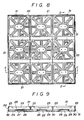
- Figs.8 to 13 show the second working example of one of the present inventions
- Fig.8 is a plan view thereof
- Fig.9 is a section taken of line C-C in Fig.8
- Fig.10 is a section taken on line D-D in Fig.8
- Fig.11 is a plan view showing a condition in which wooden bricks are held by installing frames
- Fig.12 is a section taken on line E-E in Fig.11
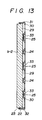
- Fig.13 is a section taken on line F-F in Fig.11.
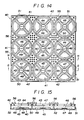
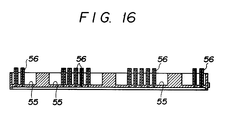
- Figs. 14 to 18 show a working example of the second invention of the present inventions
- Fig.14 is a plan view thereof
- Fig.15 is a section taken on line G-G in Fig.14
- Fig.16 is a section taken on line H-H in Fig.14
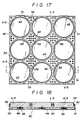
- Fig. 17 is a plan view showing a condition in which wooden bricks are held by installing frames
- Fig.18 is a section taken on line I-I in Fig.17.
- an installing frame in which nine holding sections 1, 1 ... having plane squares are arranged in three perpendicular and three lateral lines is constituted.
- the above holding sections 1, 1 ... are surrounded by section walls 2, 2, 2, 2, these section walls 2, 2 ... are constituted in common with those of mutual adjacent holding sections 1, 1, respectively, and the section walls 2, 2 ... which are situated so as to form the outer walls of the installing frame are constituted in common with the outer walls of the installing frame. Accordingly, the holding sections 1, 1 ... are constituted in lattice sections which are constituted by a group of three section walls 2, 2, 2 which are arranged in four perpendicular lines and a group of three section walls 2, 2, 2 which are arranged in four lateral lines.
- the walls in common with the outer walls of the installing frame are formed in 2mm thick and the other walls are formed in 4mm thick.
- the distance between the wooden bricks b-1, b-1 which are contacted at the mutual adjacent outer wall of the installing frame becomes equal to the distance between the wooden bricks b-1, b-1 in the installing frame.
- the above installing frame as shown in Fig.1 and Fig.3, is constituted in a plane square having a side of 330mm and a height of 40mm.
- the sides of the above holding sections 1, 1 ... are 110mm long. Further, the latter length shows a distance between the central points of the section walls 2, 2 on both sides. Concerning the distance from the section wall 2 in common with the outer wall of the installing frame to the inside section wall 2, the distance from the side in common with the outer wall does not show the distance from the central point but shows the distance from the outside.
- elastic protrusions 3, 3 are protruding from the upper end of the section walls 2, 2 ... of four sides of the above holding sections 1, 1 ... into oblique inside and downward directions of the sections by having little openings at the both sides.
- the angle between the elastic protrusions 3 and the section walls 2, 2 ... is about 30°.
- the above elastic protrusions 3, 3 ... have a protruding width of 10mm.
- the above elastic protrusions 3, 3 ... extend to the inside of the holding sections 1, 1 ... in 5mm wide.
- the above elastic protrusions 3, 3 ... have notches 4, 4 for penetrating water at two places, respectively.
- a holder 5 of each wooden brick is arranged, respectively.
- the above holders 5, 5 ... are formed in a circle stand by standing up from the bottom of the holding sections 1, 1 ... and are 10mm high. Then, the top of the holders 5, 5 ... has a circular plane part 6 inside of the surrounding edge being 1mm high, respectively.
- a screw hole 7 is formed so as to pass through two sides of the plane part. Further, around the screw hole 7, two little binding holes 8, 8 are made in a straight line with the above screw hole 7.
- the above holder 5, as shown in Fig.1, is held by extending each arm 9 from four inner corners of the holding section 1.
- a protrusion 10 for preventing sinking of wooden bricks is horizontally projected, respectively.
- joining projections 11, 11 are protruded, respectively, and on the other two sides, joining holes 12, 12 corresponding to the above joining projections 11, 11 are constituted, respectively.
- the joining projections 11, 11 of the side are formed on the section walls 2, 2 of the holding sections 1, 1 which are situated at corners of the installing frame. They are naturally constituted on the section walls 2, 2 in common with the same outer wall of the installing frame.
- the joining projections 11, 11 are projected from the outer walls of the installing frame so as to be situated slightly above the thickness of the protrusions 10, 10 ...
- the projection width is about 4mm, slightly wider than the thickness of the outer wall, namely 2mm.
- the thickness in a height direction is about 6mm.
- the length of the direction along the outer walls of the above joining projections 11, 11 ... is determined to be almost the same as the length between the notches 4, 4 for penetrating water of the elastic protrusions 3, 3 ..., namely about 45mm.
- the above joining holes 12, 12 of the side of the outer wall of the installing frame correspond to the above joining projections 11, 11, and they are constituted on the section walls 2, 2 of the holding sections 1, 1 which are situated at corners of the installing frame.
- the joining holes 12, 12 are made at the outer walls of the installing frame so as to be situated above the thickness of the protrusions 10, 10 ... for preventing sinking of wooden bricks.
- the height from the hole bottom of the joining holes 12, 12 is slightly above 6mm.
- the length of the direction along the outer walls of the above joining holes 12, 12 is almost the same as the length between the notches 4, 4 for penetrating water of the protrusion pieces 4, 4, namely slightly above 45mm.
- the whole construction elements described above are a integrally molded out of plastics which are obtained by mixing a main polypropylene material, and a weathering agent and the like.
- the frame can be used for the pavement of sidewalks and the like by holding the wooden bricks b1, b-1 ... having plane square configuration to the holding sections 1, 1 ... .
- the wooden bricks b-1, b-1 which are formed in plane square shape having a side of 100mm and a height of 40mm are suitable for the holding object.
- the above wooden bricks b-1, b-1 are naturally applied antiseptic treatment by permeating an antiseptic or by the other method.
- the wooden bricks b-1, b-1 ... are inserted and held in the holding sections 1, 1 ..., respectively.
- the wooden bricks b-1, b-1 ..., as shown in Fig.1, are placed upward, and successively pressed in the holding sections 1, 1 ... from the top.
- the elastic protrusions 3, 3 ... of the section walls 2, 2 ..., especially as shown in Fig.2, Fig.4, Fig.5, Fig.6 and Fig.7 are constituted obliquely downward and they are molded out of plastics of which a main material is elastic polypropylene, with the pressing action of the wooden brick b-1 as described above, the lower edge goes back to the section walls 2, 2 ..., and the wooden brick b-1 is smoothly inserted.
- the insertion is a little hard, the brick can be struck with a wooden hammer and the like.
- Fig.3 shows the installing frame in which the wooden bricks b-1, b-1 ... are held in the holding sections 1, 1 ..., as described above.
- Fig.4 shows a condition in which the wooden bricks b-1, b-1 ... are fixed on the holder 5, 5 ... by the screw 13, 13 ... .
- the gravel ground is built and the frames are installed on a sidewalk in a park.
- This gravel ground 14 is smoothly finished by digging down a certain zone in a depth of about 30cm, graveling and pressing the zone sufficiently.
- the installing frames in which the above wooden bricks b-1, b-1 ... are held are arranged perpendicularly and laterally.
- This work is conducted by arranging the installing frames on the gravel ground 14 while the adjacent installing frames are connecting each other.
- the adjacent installing frames are mutually connected, for example, as shown in Fig.5, by advancing one of the installing frames to the other installing frame as shown by an arrow, and by fixing the joining projections 11, 11 of the outer wall of one of the installing frames in the joining holes 12, 12 of the other installing frame.
- Fig.6 shows a part of the installing frame provided on the gravel ground 14 wherein the wooden bricks b-1, b-1 are held. Further, Fig.7 shows a mutually connected part of the adjacent installing frames which are laid on the gravel ground 14.
- notches 4, 4 for penetrating water are formed on the elastic protrusions 3, 3 ... which are provided on the section walls 2, 2 ... of the installing frame, rainwater and the like can flow on the gravel ground 14 through these notches.
- the gravel ground 14 is naturally water penetration, rainwater and the like can be penetrated to the underground.
- the damaged wooden brick b-1 can be exchanged as follows.
- a bar tip, a chisel tip, an edged tool and the like are thrust on the surface of the damaged wooden brick b-1, the wooden brick b-1 is cracked by striking its back with a hammer and the like, the screw 13 is loosened and the brick is taken out from the holding section 1. Then, the above screw 13 which is exposed on the surface of the holder 5 is struck down on the side of the gravel ground 14. After that, a binding agent is applied on a plane circular part 6 of the holder 5, and a new wooden brick b-1 is inserted in the said holding section 1. Thus, the binding agent adheres to the back of the wooden brick b-1, the wooden brick b-1 and the holder 5 are adhered and fixed in the holding section 1.
- the adherence of the binding agent to the plane circular part 6 is strengthened by overflowing excess binding agent from the back of the holder 5 through the little binding holes 8, 8, and by solidifying the overflowed binding agent in a globular shape having a longer diameter than the inside diameter of the little binding holes 8, 8.
- an installing frame having a plane square is constituted by arranging three lines of holding sections 21, 21, 21 having plane rectangular forms.
- the above holding sections 21, 21, 21 are surrounded by section walls 22, 22 ..., the section wall 22 between the mutual adjacent holding sections 21, 21 is constituted in common, and the section walls 22, 22 ... which are situated so as to form the outer walls of the installing frame are constituted in common with the outer walls of the installing frame.
- the above section walls 22, 22 which are constituted in common with the outer walls of the installing frame have a thickness of 2mm and the other section walls 22, 22 have a thickness of 4mm which is twice of the above thickness.
- the distance between the wooden bricks b-2, b-2 which are contacted at the mutual adjacent outer wall of the installing frame becomes equal to the distance between the wooden bricks b-2, b-2 in the installing frame.
- the above installing frame as shown in Fig.8 and Fig.11, is constituted in a plane square having a side of 330mm and a height of 40mm.
- the length of short sides of the above holding sections 21, 21 ... is 110mm and the length of their long sides is 330mm.
- the short sides show the distance from the center of one side of the section wall 22 to the center of the other side of the section wall 22.
- Concerning the long sides it shows the distance from the outside of outer wall to the outside of the other outer wall. Namely, this size is equal to the size of a side of the installing frame.
- an elastic protrusions 23 protrudes downward in the section from the short side and three elastic protrusions 23, 23, 23 protrude from the long side of four section walls 22, 22 ... of the above holding sections 21, 21 ..., respectively.
- the length of the elastic protrusions 23, 23 ... is 70mm in the direction of walls and the width is 10mm in the protrusion direction.
- the angle between the elastic protrusions and the section walls 22, 22 ... is 30°. Accordingly, the length of protruded lower part is usually about 5mm in the section.
- the elastic protrusion piece 23 of the short side is situated in the center of the section wall 22. Openings of 20mm are left at the both sides.
- one elastic protrusion 23 is arranged in the center of the section wall 22 and each elastic protrusion 23 is arranged at the both sides in the distance of 40mm, respectively.
- plate frames 24, 24 are arranged at the positions dividing the space into three equal parts in the section. As shown in Fig.8, Fig.10 and Fig.13, these plate frames 24, 24 are constituted in a frame form by connecting the both edges to the long sides of the section walls 22, 22. The height of the plate frames is 10mm and the width is 10mm.
- a holder 25 of each wooden brick b-2 is arranged so as to be situated at the center lower part of three square zones which are divided by the above plate frames 24, 24.
- the above holders 25, 25 ... are pedestals having a height of 10mm and standing up from the bottom of the holding sections 21, 21. Namely, the height of the pedestals is equal to the height of the above plate frames 24, 24. Further, the upper surface of the above holders 25, 25 ... have plane hollows 26, 26 ... of which surrounding edges are left and the height is about 1mm.
- the configuration of the above plane hollows 26, 26 ... is similar to the plane configuration of the holders 25, 25 ... .
- eight arms 29, 29 ... are protruded from the outer surroundings of each of the above holders 25, 25 at regular angles of 45° in radial directions, and these arms are joined to the lower parts of the section walls 22, 22 ... or the above plate frames 24, 24, respectively.
- each plate or protrusion 30 for preventing sinking is horizontally projected at the lower inside of the above section walls 22, 22 ..., at both lower sides of the plate frames 24, 24 ..., around the lower part of the holder and at both lower sides of the above arms 29, 29 ... .
- two joining projections 31, 31 are made on each of two adjacent sides which contain an angle and belong to four sides of the outer walls of the installing frame, respectively, and joining holes 32, 32 corresponding to the above joining projections 31, 31 are consistituted on the other two sides, respectively.
- the above joining projections 31, 31 on one side are constituted on the section wall 22 (long side) or the section walls 22, 22 (short sides) of the above two square zones which are situated at the corners of the installing frame. Concerning the short sides of the holding section 21, these projections are naturally constituted on the section walls 22, 22 which are in common with the same outer wall of the installing frame.
- the joining projections 31, 31 are projected from the outer walls of the installing frame so as to be situated slightly above the thickness of the protrusions 30, 30 ... for preventing sinking.
- the projection width is about 4mm, slightly widen than the thickness of the outer wall, namely 2mm.
- the thickness of a height direction is about 6mm.
- the length of the direction along the outer walls of the above joining projections 31, 31 ... is determined to be about 45mm. The position of the direction is centered on the center point of the corresponding protrusion piece 23.
- the above joining holes 32, 32 of the side of the outer wall of the installing frame corresponding to the above joining projections 31, 31 are consistituted on the other two sides, respectively.
- the above joining projections 31, 31 on the side are constituted on the section wall 22 (long side) or the section walls 22, 22 (short sides) of the above square zones which are situated at the corners of the installing frame.
- the joining holes 32, 32 are made at the outer wall of the installing frame so as to be situated above the thickness of the protrusions 30, 30 ... for preventing sinking.
- the height from the hole bottom of the joining holes 32, 32 is slightly above 6mm.
- the length of the direction along the outer walls of the above joining holes 32, 32 ... is slightly above the length of the corresponding direction of the above joining projections, namely slightly above 45mm.
- the whole construction elements described above are integrally molded out of plastics which are obtained by mixing a main polypropylene material, and a weathering agent and the like.
- the frame is used as described in the above first example and has the same action and effect except that the wooden bricks b-2, b-2 ... having the plane rectangular configuration are held by the holding sections 21, 21 ... .
- the wooden bricks b-2, b-2 which are formed in plane rectangular configuration having a short side of 100mm, a long side of 320mm and a height of 40mm are suitable for the holding object.
- the wooden bricks b-2, b-2 are inserted and held in the holding sections 21, 21, respectively.
- Fig.11 shows that the plane rectangular wooden brick b-2 is held on each of the holding sections 21, 21, 21 of the installing frame in the same steps described in the first example.
- Fig.13 shows that the wooden bricks b-2, b-2, b-2 which are placed on the holder 25, 25 ... are fixed by screwing the screws 33, 33 inserted through the screw holes 27, 27 ... . Further, in this example, as shown in Fig.13, both of the plate frames 24, 24... and the holders 25, 25, 25 act as pedestals which place the wooden brick b-2.
- the building of the above ground is conducted as described in the first example.
- an installing frame in which nine holding sections 41, 41 ... having plane round shapes are arranged in three perpendicular and three lateral lines is constituted in a frame 40.
- the above holding sections 41, 41 ... are held in the frame 40 by the surrounding connection plates 55, 55 ... .
- the frame 40 is constituted by the above connection plates 55, 55 ... and the outer walls of outer edges, and the holding sections 41, 41 ... are arranged in the frame as described above.
- the frame 40 of the installing frame is also constituted in a plane square having a side of 330mm, the thickness of the outer wall is 2mm, and the height is 40mm. Further, the inside diameter of the above holding sections 41, 41 ... is 106mm, respectively.
- Each of the above holding sections 41, 41 ... is surrounded by a section surrounding wall 42 having a ring shape.
- the thickness of the section surrounding walls 42, 42 ... is 2mm.
- an elastic protrusion 43 is protruded from the top into an obligue downward direction of the section, respectively.
- the width of the protruded direction of the above elastic protrusions 43, 43 ... is 10mm, and the angles between the elastic protrusions and the section surrounding walls 42, 42 ... are about 30°.
- a holder 45 of each wooden brick b-3 is arranged so as to stand up.
- the above holders 45, 45 are circular pedestals which stands up in a height of about 10mm from the bottom of the holding sections 41, 41 ... .
- the upper surface of the holders 45, 45 ... have round hollows 46, 46 ... of which surrounding edges are left and the height is about 1mm.
- a screw hole 47 is made at the center of each of the above round hollows 46, 46 ... so as to pass through the upper surface and the under surface.
- two small joining holes 48, 48 which are arranged on a straight line with the above screw hole 47 are made around the screw hole 47.
- four arms 49, 49 ... are protruded from the surrounding of the above holder 45 at regular angles of 90°, and these arms are joined to the inside of the section surrounding wall 42 of the holding section 41.
- a protrusion 50 for preventing sinking of the wooden bricks is horizontally projected around the lower part of the above holders 45, 45 ..., at both lower sides of the above arms 49, 49 ... and at the lower inside of the above section surrounding walls 42, 42 ..., respectively.
- connection plate 55 for connecting each of the holding sections 41, 41 to the above arrangement.
- the top of the tube 56, 56 ... for stepping and pressing is determined so as to have almost the same height as the top of the wooden bricks b-3, b-3 ... which are inserted and held in the holding sections 41, 41 ... .
- the height of the tube 56, 56 ... is 50mm from the top to the bottom of the installing frame.
- two joining projections 51, 51 are projected on each of two adjacent sides which contain an angle and belong to four sides of the outer walls of the above frame 40, respectively, and corresponding joining holes 52, 52 are made on the other two sides.
- the above joining projections 51, 51 on one side are formed on the outer wall which partly overlaps on the section surrounding walls 42, 42 of the holding sections 41, 41 situated at the corner of the frame 40.
- the joining projections 51, 51 are projected from the outer wall of the frame 40 so as to be situated slightly above the thickness of the protrusions 50, 50 ... for preventing sinking.
- the projection width is about 4mm, slightly wider than the thickness of the outer wall, namely 2mm.
- the thickness in a height direction is about 6mm.
- the length of the direction along the outer walls of the above joining projections 51, 51 ... is determined to be about 45mm.
- the above joining holes 52, 52 of the side of the outer wall of the frame 40 are arranged so as to correspond to the above joining projections 51, 51, and these holes 52 are made on the outer wall which overlaps on the section walls 42, 42 of the holding sections 41, 41 situated at the corner of the frame 40.
- the joining holes 52, 52 are made at the outer wall of the frame 40 so as to be situated above the thickness of the protrusions 50, 50 for preventing sinking.
- the height from the lower part of the joining holes 52, 52 is slightly above 6mm.
- the length of the direction along the outer walls of the above joining holes 52, 52 ... is slightly above 45mm.
- the whole construction elements described above are integrally molded out of plastics and are obtained by mixing a main polypropylene material, and a weathering agent and the like.
- the frame can be used by holding for the pavement of sidewalks and the like, the wooden bricks b-3, b-3 ... having the plane round configuration in the holding sections 41, 41 ... .
- the plane round wooden bricks b-3, b-3 ... having a diameter of 100mm and a thickness of 40mm are suitable for the holding object.
- the wooden bricks b-3, b-3 ... are inserted and held in the holding sections 41, 41 of the installing frames, respectively.
- the steps and the action and effect which are caused by each constitution element of the installing frame are the same as those of two examples of the first invention.
- Fig.17 shows the installing frame in which the wooden bricks b-3, b-3 ... are installed.
- Fig.18 shows a condition in which the wooden bricks b-3, b-3 ... are inserted in the holding sections 41, 41 ... and fixed on the holder 45, 45 ... with the screw 53, 53 ... .
- ground constitution of the necessary installing zone of sidewalks and the like is the same as that of two examples as described above.
- the tubes 56, 56 ... for stepping and pressing are provided on the connection plates 55, 55 between the holding sections 41, 41 ..., pedestrians can walk and cars can run on the plates, and in particular it is unnecessary to fill up the gaps which exist between the plane round holding sections 41, 41 ... . Further, as the tubes 56, 56 ... for stepping and pressing are passed through the plates, rainwater and the like can be allowed to flow on the ground.
- the pavement of wooden bricks can be simply and efficiently finished by holding the wooden bricks in the frames and then by installing the frames on the sidewalks to be built in parks, common roads, parking places and the like. Furthermore, the pavement by using the wooden bricks which are finished by such a way, can be obtained as a smooth road surface, can permit the expansion and construction of wooden bricks, and can have a good water permeability.
Landscapes
- Engineering & Computer Science (AREA)
- Architecture (AREA)
- Civil Engineering (AREA)
- Structural Engineering (AREA)
- Road Paving Structures (AREA)
- Chemical And Physical Treatments For Wood And The Like (AREA)
- Artificial Fish Reefs (AREA)
- Slot Machines And Peripheral Devices (AREA)
- Packaging Of Annular Or Rod-Shaped Articles, Wearing Apparel, Cassettes, Or The Like (AREA)
- Body Structure For Vehicles (AREA)
- Pit Excavations, Shoring, Fill Or Stabilisation Of Slopes (AREA)
- Revetment (AREA)
- Floor Finish (AREA)
Claims (3)
- Rahmen für Pflaster, der folgendes aufweist:- Holzklötze (b-1, b-2, b-3), die in einer Vielzahl von Halteabschnitten (1, 21, 41) gehalten sind, wobei die Halteabschnitte (1, 21, 41) so angeordnet sind, daß sie der fertigen Anordnung der Holzklötze (b-1, b-2, b-3) entsprechen, und- Einrichtungen (5, 25, 45), um die Holzklötze (b-1, b-2, b-3), die in jedem Halteabschnitt (1, 21, 41) vorgesehen sind, zu befestigen,dadurch gekennzeichnet, daß ein Stück eines elastischen Vorsprungs (3, 23, 43) von jeder Abschnittswand (2, 22, 42) jedes Halteabschnitts (1, 21, 41) in einer schräg nach unten verlaufenden Richtung in den jeweiligen Halteabschnitt (1, 21, 41) vorsteht, um Änderungen der Ausdehnung der Holzklötze (b-1, b-2, b-3) zu absorbieren.
- Rahmen nach Anspruch 1,
dadurch gekennzeichnet, daß eine breite Verbindungsplatte (55) zwischen den jeweiligen Halteabschnitten (1, 21, 41) vorgesehen ist, die mit einer Vielzahl von elastischen Vorsprüngen (56) versehen ist, die das gleiche obere Niveau wie die Oberfläche der Holzklötze (b-1, b-2, b-3) haben, die in den jeweiligen Halteabschnitten (1, 21, 41) gehalten sind, wobei die oberen Enden der elastischen Vorsprünge (56) relativ zu den elastischen Vorsprüngen (3, 23, 43) nach oben ragen. - Rahmen nach Anspruch 1 oder 2,
dadurch gekennzeichnet, daß die Halteabschnitte (1, 21, 41), die die elastischen Vorsprünge (3, 23, 43) haben, aus Kunststoff hergestellt sind und ein Polypropylenmaterial sowie ein Verwitterungsschutzmittel aufweisen.
Priority Applications (1)
| Application Number | Priority Date | Filing Date | Title |
|---|---|---|---|
| AT87904934T ATE85818T1 (de) | 1987-07-22 | 1987-07-22 | Rahmen zur verlegung von holzernen bloecken. |
Applications Claiming Priority (1)
| Application Number | Priority Date | Filing Date | Title |
|---|---|---|---|
| PCT/JP1987/000534 WO1989000625A1 (fr) | 1987-07-22 | 1987-07-22 | Cadre pour la pose de paves en bois |
Publications (3)
| Publication Number | Publication Date |
|---|---|
| EP0328639A1 EP0328639A1 (de) | 1989-08-23 |
| EP0328639A4 EP0328639A4 (de) | 1990-04-10 |
| EP0328639B1 true EP0328639B1 (de) | 1993-02-17 |
Family
ID=13902777
Family Applications (1)
| Application Number | Title | Priority Date | Filing Date |
|---|---|---|---|
| EP87904934A Expired - Lifetime EP0328639B1 (de) | 1987-07-22 | 1987-07-22 | Rahmen zur verlegung von holzernen blöcken |
Country Status (11)
| Country | Link |
|---|---|
| EP (1) | EP0328639B1 (de) |
| JP (1) | JPH081042B2 (de) |
| KR (1) | KR940003726B1 (de) |
| CN (2) | CN1016722B (de) |
| AT (1) | ATE85818T1 (de) |
| AU (1) | AU608240B2 (de) |
| CA (1) | CA1288270C (de) |
| DE (1) | DE3784252T2 (de) |
| DK (1) | DK170409B1 (de) |
| NZ (1) | NZ225293A (de) |
| WO (1) | WO1989000625A1 (de) |
Families Citing this family (20)
| Publication number | Priority date | Publication date | Assignee | Title |
|---|---|---|---|---|
| JPH0333304A (ja) * | 1989-06-28 | 1991-02-13 | Hayashi Bussan:Kk | 路面用敷設枠 |
| FR2658225A1 (fr) * | 1990-02-09 | 1991-08-16 | Soprema Sa | Dallette de matiere plastique destinee au recouvrement des terrasses de batiments. |
| DE29710241U1 (de) * | 1996-07-05 | 1997-08-14 | BKN Karl Bögl GmbH & Co. Baustoffwerke, 92318 Neumarkt | Befestigung von Verkehrsflächen im Freien mit Pflastersteinen oder Platten |
| DE19746549C2 (de) * | 1997-10-22 | 2001-05-23 | Hermann Fendt | Belagelement |
| AU746602B2 (en) * | 1998-01-16 | 2002-05-02 | Ezydeck Pty Ltd | Support for paving or decking |
| AUPP137798A0 (en) | 1998-01-16 | 1998-02-05 | Ezydeck Pty Ltd | Decking tile |
| GB2358426A (en) * | 2000-01-13 | 2001-07-25 | Roderick Walter Sterling | Paving template for laying paving in geometrical shapes |
| US6601360B2 (en) * | 2001-03-20 | 2003-08-05 | Barry Spiers | Modular deck tiles |
| USD499189S1 (en) | 2003-08-29 | 2004-11-30 | Alan B. Collison | Decking support |
| NL1030517C2 (nl) * | 2005-11-25 | 2007-05-29 | Las Pers B V | Vlonderrooster alsmede een daaruit samengestelde vloer. |
| EP1845194B1 (de) * | 2006-04-12 | 2012-06-27 | Forniture Industriali B.M.G. | Modulares Element zur Herstellung von Gehwegen oder Strassen und Verfahren für die Verlegung solcher Elemente |
| NL1034231C2 (nl) * | 2007-08-06 | 2009-02-16 | Daan Herman Kuik Hoogenboom Cc | Werkwijze voor het uitneembaar in een omgeving aanbrengen van een of meer bedekkingselementen, samenstel, gestel en bedekkingselement daarvoor. |
| IT1390597B1 (it) * | 2008-07-29 | 2011-09-09 | Gio' Speedy Di Giovanni Iovene | Sistema per la realizzazione di pavimentazioni in legno, a quadri o rettangoli, prive di chiodi, viti e colla. |
| JP4635104B1 (ja) * | 2010-03-03 | 2011-02-16 | 日本興業株式会社 | 舗装用ブロック連結部材 |
| JP2015055029A (ja) * | 2013-09-10 | 2015-03-23 | 株式会社 林物産発明研究所 | 敷材 |
| CN106381796B (zh) * | 2016-11-22 | 2019-08-02 | 中国建筑材料科学研究总院 | 一种混凝土透水路面、其铺设方法及其保养修复方法 |
| CN109423942A (zh) * | 2017-08-30 | 2019-03-05 | 上海质优新型建材有限公司 | 一种透水钢渣混凝土复合式人行道 |
| JP7104410B2 (ja) * | 2018-10-29 | 2022-07-21 | 株式会社津田ペイブトンテクニック | ブロック舗装方法、ブロック舗装構造及びブロック舗装用強化板 |
| RU199580U1 (ru) * | 2020-06-03 | 2020-09-08 | Рустам Зефярович Салахудинов | Модульный блок для садовой дорожки |
| CN112626966A (zh) * | 2021-01-12 | 2021-04-09 | 南通天承光电科技有限公司 | 一种用于道路的装配式发光装置 |
Family Cites Families (8)
| Publication number | Priority date | Publication date | Assignee | Title |
|---|---|---|---|---|
| DE64140C (de) * | J. MARKMANN in Hamburg-Hohenfelde II, Alsterstrafse 29pt | Strafsenpflaster aus in eiserne Rahmen gespannten Holzklötzen | ||
| FR654648A (fr) * | 1928-12-17 | 1929-04-09 | Procédé et dispositif de construction et revêtement de chaussées | |
| JPS5719396Y2 (de) * | 1978-01-17 | 1982-04-23 | ||
| JPS6231106U (de) * | 1985-08-06 | 1987-02-24 | ||
| JPH0310161Y2 (de) * | 1986-02-19 | 1991-03-13 | ||
| JPH0310162Y2 (de) * | 1986-03-26 | 1991-03-13 | ||
| AU7108587A (en) * | 1986-12-04 | 1988-06-09 | T.A. Taylor & Son Pty Ltd | Rubber paving support pad |
| JPS63236801A (ja) * | 1987-03-26 | 1988-10-03 | 白鳥 香 | ブロツクタイルの保持枠 |
-
1987
- 1987-07-22 DE DE8787904934T patent/DE3784252T2/de not_active Expired - Fee Related
- 1987-07-22 WO PCT/JP1987/000534 patent/WO1989000625A1/ja not_active Ceased
- 1987-07-22 KR KR1019880701645A patent/KR940003726B1/ko not_active Expired - Fee Related
- 1987-07-22 EP EP87904934A patent/EP0328639B1/de not_active Expired - Lifetime
- 1987-07-22 AT AT87904934T patent/ATE85818T1/de not_active IP Right Cessation
- 1987-07-22 AU AU78051/87A patent/AU608240B2/en not_active Ceased
-
1988
- 1988-07-05 NZ NZ225293A patent/NZ225293A/xx unknown
- 1988-07-12 JP JP63173614A patent/JPH081042B2/ja not_active Expired - Lifetime
- 1988-07-21 CA CA000572679A patent/CA1288270C/en not_active Expired - Lifetime
- 1988-07-22 CN CN88104465A patent/CN1016722B/zh not_active Expired
-
1989
- 1989-03-15 DK DK124889A patent/DK170409B1/da not_active IP Right Cessation
-
1991
- 1991-11-09 CN CN91110540A patent/CN1020773C/zh not_active Expired - Fee Related
Also Published As
| Publication number | Publication date |
|---|---|
| JPH081042B2 (ja) | 1996-01-10 |
| AU7805187A (en) | 1989-02-13 |
| EP0328639A1 (de) | 1989-08-23 |
| WO1989000625A1 (fr) | 1989-01-26 |
| CN1060324A (zh) | 1992-04-15 |
| KR890701847A (ko) | 1989-12-21 |
| AU608240B2 (en) | 1991-03-28 |
| DK170409B1 (da) | 1995-08-21 |
| DK124889A (da) | 1989-03-15 |
| DK124889D0 (da) | 1989-03-15 |
| ATE85818T1 (de) | 1993-03-15 |
| CN1016722B (zh) | 1992-05-20 |
| KR940003726B1 (ko) | 1994-04-28 |
| JPS6433301A (en) | 1989-02-03 |
| EP0328639A4 (de) | 1990-04-10 |
| CN1030806A (zh) | 1989-02-01 |
| NZ225293A (en) | 1991-10-25 |
| CA1288270C (en) | 1991-09-03 |
| DE3784252D1 (de) | 1993-03-25 |
| CN1020773C (zh) | 1993-05-19 |
| DE3784252T2 (de) | 1993-06-03 |
Similar Documents
| Publication | Publication Date | Title |
|---|---|---|
| US5006011A (en) | Frames for installing wooden bricks | |
| EP0328639B1 (de) | Rahmen zur verlegung von holzernen blöcken | |
| CN108547195B (zh) | 一种排水沥青路面结构及施工方法 | |
| US20060045619A1 (en) | Paving system using arrays of vertically interlocking paving blocks | |
| RU2667396C1 (ru) | Способ устройства дорожного покрытия повышенной долговечности | |
| KR100834516B1 (ko) | 연성을 갖는 보도블록 | |
| JP2011106208A (ja) | 平板ブロック及び平板ブロック用枠体 | |
| US4727690A (en) | Screed rail | |
| CN101228320B (zh) | 铺路石、用铺路石铺设路面的方法及生产铺路石的方法 | |
| JPS63236801A (ja) | ブロツクタイルの保持枠 | |
| JP3581534B2 (ja) | プレキャストコンクリート版及びその製造方法 | |
| CN214423570U (zh) | 一种预制阳台板 | |
| CN213267374U (zh) | 建筑工地用装配式道路 | |
| CN211815303U (zh) | 一种提高排水性的缝隙透水砖 | |
| KR101231153B1 (ko) | 도로 경계석의 연결고정 구조 | |
| KR100561748B1 (ko) | 토목 및 도로 교통 시설물 설치용 기둥의 매설형 하부 기초 | |
| WO2006080042A1 (en) | Draining laying system | |
| JPH0310162Y2 (de) | ||
| RU2185472C1 (ru) | Плита сборного покрытия | |
| JPH0310161Y2 (de) | ||
| JP2001348802A (ja) | ブロック舗装およびその施工方法 | |
| JPH0327042Y2 (de) | ||
| JPH078561Y2 (ja) | 天然石敷石 | |
| JPH047204Y2 (de) | ||
| RU2008387C1 (ru) | Плита сборного покрытия |
Legal Events
| Date | Code | Title | Description |
|---|---|---|---|
| PUAI | Public reference made under article 153(3) epc to a published international application that has entered the european phase |
Free format text: ORIGINAL CODE: 0009012 |
|
| 17P | Request for examination filed |
Effective date: 19890301 |
|
| AK | Designated contracting states |
Kind code of ref document: A1 Designated state(s): AT BE CH DE FR GB LI NL SE |
|
| A4 | Supplementary search report drawn up and despatched |
Effective date: 19900410 |
|
| 17Q | First examination report despatched |
Effective date: 19910510 |
|
| GRAA | (expected) grant |
Free format text: ORIGINAL CODE: 0009210 |
|
| AK | Designated contracting states |
Kind code of ref document: B1 Designated state(s): AT BE CH DE FR GB LI NL SE |
|
| REF | Corresponds to: |
Ref document number: 85818 Country of ref document: AT Date of ref document: 19930315 Kind code of ref document: T |
|
| ET | Fr: translation filed | ||
| REF | Corresponds to: |
Ref document number: 3784252 Country of ref document: DE Date of ref document: 19930325 |
|
| PLBE | No opposition filed within time limit |
Free format text: ORIGINAL CODE: 0009261 |
|
| STAA | Information on the status of an ep patent application or granted ep patent |
Free format text: STATUS: NO OPPOSITION FILED WITHIN TIME LIMIT |
|
| 26N | No opposition filed | ||
| EAL | Se: european patent in force in sweden |
Ref document number: 87904934.4 |
|
| PGFP | Annual fee paid to national office [announced via postgrant information from national office to epo] |
Ref country code: BE Payment date: 19950630 Year of fee payment: 9 |
|
| PGFP | Annual fee paid to national office [announced via postgrant information from national office to epo] |
Ref country code: GB Payment date: 19950711 Year of fee payment: 9 |
|
| PGFP | Annual fee paid to national office [announced via postgrant information from national office to epo] |
Ref country code: FR Payment date: 19950724 Year of fee payment: 9 |
|
| PGFP | Annual fee paid to national office [announced via postgrant information from national office to epo] |
Ref country code: SE Payment date: 19950726 Year of fee payment: 9 |
|
| PGFP | Annual fee paid to national office [announced via postgrant information from national office to epo] |
Ref country code: NL Payment date: 19950728 Year of fee payment: 9 Ref country code: AT Payment date: 19950728 Year of fee payment: 9 |
|
| PGFP | Annual fee paid to national office [announced via postgrant information from national office to epo] |
Ref country code: DE Payment date: 19950825 Year of fee payment: 9 |
|
| PGFP | Annual fee paid to national office [announced via postgrant information from national office to epo] |
Ref country code: CH Payment date: 19950927 Year of fee payment: 9 |
|
| PG25 | Lapsed in a contracting state [announced via postgrant information from national office to epo] |
Ref country code: GB Effective date: 19960722 Ref country code: AT Effective date: 19960722 |
|
| PG25 | Lapsed in a contracting state [announced via postgrant information from national office to epo] |
Ref country code: SE Effective date: 19960723 |
|
| PG25 | Lapsed in a contracting state [announced via postgrant information from national office to epo] |
Ref country code: LI Effective date: 19960731 Ref country code: CH Effective date: 19960731 Ref country code: BE Effective date: 19960731 |
|
| BERE | Be: lapsed |
Owner name: HAYASHI ISAO Effective date: 19960731 |
|
| PG25 | Lapsed in a contracting state [announced via postgrant information from national office to epo] |
Ref country code: NL Effective date: 19970201 |
|
| GBPC | Gb: european patent ceased through non-payment of renewal fee |
Effective date: 19960722 |
|
| REG | Reference to a national code |
Ref country code: CH Ref legal event code: PL |
|
| PG25 | Lapsed in a contracting state [announced via postgrant information from national office to epo] |
Ref country code: FR Effective date: 19970328 |
|
| NLV4 | Nl: lapsed or anulled due to non-payment of the annual fee |
Effective date: 19970201 |
|
| PG25 | Lapsed in a contracting state [announced via postgrant information from national office to epo] |
Ref country code: DE Effective date: 19970402 |
|
| EUG | Se: european patent has lapsed |
Ref document number: 87904934.4 |
|
| REG | Reference to a national code |
Ref country code: FR Ref legal event code: ST |