EP0329174A2 - Matériau réfractaire composite - Google Patents
Matériau réfractaire composite Download PDFInfo
- Publication number
- EP0329174A2 EP0329174A2 EP89102794A EP89102794A EP0329174A2 EP 0329174 A2 EP0329174 A2 EP 0329174A2 EP 89102794 A EP89102794 A EP 89102794A EP 89102794 A EP89102794 A EP 89102794A EP 0329174 A2 EP0329174 A2 EP 0329174A2
- Authority
- EP
- European Patent Office
- Prior art keywords
- substrate
- matrix
- refractory
- hafnium
- zirconium
- Prior art date
- Legal status (The legal status is an assumption and is not a legal conclusion. Google has not performed a legal analysis and makes no representation as to the accuracy of the status listed.)
- Granted
Links
- 239000011819 refractory material Substances 0.000 title claims abstract description 32
- 239000002131 composite material Substances 0.000 title claims description 17
- 239000000758 substrate Substances 0.000 claims abstract description 124
- 239000011159 matrix material Substances 0.000 claims abstract description 83
- 239000007789 gas Substances 0.000 claims abstract description 63
- 229910026551 ZrC Inorganic materials 0.000 claims abstract description 40
- OTCHGXYCWNXDOA-UHFFFAOYSA-N [C].[Zr] Chemical compound [C].[Zr] OTCHGXYCWNXDOA-UHFFFAOYSA-N 0.000 claims abstract description 40
- WHJFNYXPKGDKBB-UHFFFAOYSA-N hafnium;methane Chemical compound C.[Hf] WHJFNYXPKGDKBB-UHFFFAOYSA-N 0.000 claims abstract description 39
- 229910052735 hafnium Inorganic materials 0.000 claims abstract description 30
- VBJZVLUMGGDVMO-UHFFFAOYSA-N hafnium atom Chemical compound [Hf] VBJZVLUMGGDVMO-UHFFFAOYSA-N 0.000 claims abstract description 30
- WUAPFZMCVAUBPE-UHFFFAOYSA-N rhenium atom Chemical compound [Re] WUAPFZMCVAUBPE-UHFFFAOYSA-N 0.000 claims abstract description 28
- 229910052702 rhenium Inorganic materials 0.000 claims abstract description 27
- QCWXUUIWCKQGHC-UHFFFAOYSA-N Zirconium Chemical compound [Zr] QCWXUUIWCKQGHC-UHFFFAOYSA-N 0.000 claims abstract description 26
- 229910052726 zirconium Inorganic materials 0.000 claims abstract description 26
- 230000008021 deposition Effects 0.000 claims abstract description 17
- 239000000203 mixture Substances 0.000 claims abstract description 16
- 239000000126 substance Substances 0.000 claims abstract description 16
- WFKWXMTUELFFGS-UHFFFAOYSA-N tungsten Chemical compound [W] WFKWXMTUELFFGS-UHFFFAOYSA-N 0.000 claims abstract description 15
- 229910052721 tungsten Inorganic materials 0.000 claims abstract description 15
- 239000010937 tungsten Substances 0.000 claims abstract description 15
- 229910052715 tantalum Inorganic materials 0.000 claims abstract description 14
- GUVRBAGPIYLISA-UHFFFAOYSA-N tantalum atom Chemical compound [Ta] GUVRBAGPIYLISA-UHFFFAOYSA-N 0.000 claims abstract description 14
- ZOKXTWBITQBERF-UHFFFAOYSA-N Molybdenum Chemical compound [Mo] ZOKXTWBITQBERF-UHFFFAOYSA-N 0.000 claims abstract description 13
- 229910052750 molybdenum Inorganic materials 0.000 claims abstract description 13
- 239000011733 molybdenum Substances 0.000 claims abstract description 13
- 239000011148 porous material Substances 0.000 claims abstract description 9
- 229920000049 Carbon (fiber) Polymers 0.000 claims abstract description 8
- 239000004917 carbon fiber Substances 0.000 claims abstract description 8
- 230000035939 shock Effects 0.000 claims abstract description 6
- 238000006073 displacement reaction Methods 0.000 claims abstract description 3
- 238000000034 method Methods 0.000 claims description 33
- 239000000835 fiber Substances 0.000 claims description 26
- 230000007797 corrosion Effects 0.000 claims description 9
- 238000005260 corrosion Methods 0.000 claims description 9
- 239000001257 hydrogen Substances 0.000 claims description 8
- 229910052739 hydrogen Inorganic materials 0.000 claims description 8
- DUNKXUFBGCUVQW-UHFFFAOYSA-J zirconium tetrachloride Chemical compound Cl[Zr](Cl)(Cl)Cl DUNKXUFBGCUVQW-UHFFFAOYSA-J 0.000 claims description 8
- UFHFLCQGNIYNRP-UHFFFAOYSA-N Hydrogen Chemical compound [H][H] UFHFLCQGNIYNRP-UHFFFAOYSA-N 0.000 claims description 7
- PDPJQWYGJJBYLF-UHFFFAOYSA-J hafnium tetrachloride Chemical compound Cl[Hf](Cl)(Cl)Cl PDPJQWYGJJBYLF-UHFFFAOYSA-J 0.000 claims description 6
- 230000010349 pulsation Effects 0.000 claims description 4
- OKTJSMMVPCPJKN-UHFFFAOYSA-N Carbon Chemical compound [C] OKTJSMMVPCPJKN-UHFFFAOYSA-N 0.000 description 32
- 239000000463 material Substances 0.000 description 31
- 229910052799 carbon Inorganic materials 0.000 description 28
- 238000006243 chemical reaction Methods 0.000 description 21
- VNWKTOKETHGBQD-UHFFFAOYSA-N methane Chemical compound C VNWKTOKETHGBQD-UHFFFAOYSA-N 0.000 description 20
- 229910052751 metal Inorganic materials 0.000 description 14
- 239000002184 metal Substances 0.000 description 14
- 238000000151 deposition Methods 0.000 description 13
- 238000001764 infiltration Methods 0.000 description 13
- 230000008595 infiltration Effects 0.000 description 13
- 230000008569 process Effects 0.000 description 12
- -1 pyrolyzed wool Substances 0.000 description 9
- 239000011230 binding agent Substances 0.000 description 8
- ZAMOUSCENKQFHK-UHFFFAOYSA-N Chlorine atom Chemical compound [Cl] ZAMOUSCENKQFHK-UHFFFAOYSA-N 0.000 description 7
- VEXZGXHMUGYJMC-UHFFFAOYSA-N Hydrochloric acid Chemical compound Cl VEXZGXHMUGYJMC-UHFFFAOYSA-N 0.000 description 7
- 239000000460 chlorine Substances 0.000 description 7
- 229910052801 chlorine Inorganic materials 0.000 description 7
- 239000002245 particle Substances 0.000 description 7
- ISWSIDIOOBJBQZ-UHFFFAOYSA-N phenol group Chemical group C1(=CC=CC=C1)O ISWSIDIOOBJBQZ-UHFFFAOYSA-N 0.000 description 7
- 239000007787 solid Substances 0.000 description 7
- ZWEHNKRNPOVVGH-UHFFFAOYSA-N 2-Butanone Chemical compound CCC(C)=O ZWEHNKRNPOVVGH-UHFFFAOYSA-N 0.000 description 6
- KZBUYRJDOAKODT-UHFFFAOYSA-N Chlorine Chemical compound ClCl KZBUYRJDOAKODT-UHFFFAOYSA-N 0.000 description 6
- HBMJWWWQQXIZIP-UHFFFAOYSA-N silicon carbide Chemical compound [Si+]#[C-] HBMJWWWQQXIZIP-UHFFFAOYSA-N 0.000 description 6
- 239000000919 ceramic Substances 0.000 description 5
- 229910000041 hydrogen chloride Inorganic materials 0.000 description 5
- IXCSERBJSXMMFS-UHFFFAOYSA-N hydrogen chloride Substances Cl.Cl IXCSERBJSXMMFS-UHFFFAOYSA-N 0.000 description 5
- 229920002239 polyacrylonitrile Polymers 0.000 description 5
- 229910010271 silicon carbide Inorganic materials 0.000 description 5
- XKRFYHLGVUSROY-UHFFFAOYSA-N Argon Chemical compound [Ar] XKRFYHLGVUSROY-UHFFFAOYSA-N 0.000 description 4
- PXHVJJICTQNCMI-UHFFFAOYSA-N Nickel Chemical compound [Ni] PXHVJJICTQNCMI-UHFFFAOYSA-N 0.000 description 4
- 229920000297 Rayon Polymers 0.000 description 4
- 239000011248 coating agent Substances 0.000 description 4
- 238000000576 coating method Methods 0.000 description 4
- 238000009792 diffusion process Methods 0.000 description 4
- 229910002804 graphite Inorganic materials 0.000 description 4
- 239000010439 graphite Substances 0.000 description 4
- 238000001000 micrograph Methods 0.000 description 4
- 239000002964 rayon Substances 0.000 description 4
- 239000000376 reactant Substances 0.000 description 4
- XZQYTGKSBZGQMO-UHFFFAOYSA-I Rhenium(V) chloride Inorganic materials Cl[Re](Cl)(Cl)(Cl)Cl XZQYTGKSBZGQMO-UHFFFAOYSA-I 0.000 description 3
- 239000004115 Sodium Silicate Substances 0.000 description 3
- 230000008859 change Effects 0.000 description 3
- 125000004122 cyclic group Chemical group 0.000 description 3
- 230000003628 erosive effect Effects 0.000 description 3
- 230000004992 fission Effects 0.000 description 3
- 150000004820 halides Chemical class 0.000 description 3
- 230000001965 increasing effect Effects 0.000 description 3
- 239000007788 liquid Substances 0.000 description 3
- 238000005192 partition Methods 0.000 description 3
- 239000011295 pitch Substances 0.000 description 3
- 230000009467 reduction Effects 0.000 description 3
- 239000002002 slurry Substances 0.000 description 3
- NTHWMYGWWRZVTN-UHFFFAOYSA-N sodium silicate Chemical compound [Na+].[Na+].[O-][Si]([O-])=O NTHWMYGWWRZVTN-UHFFFAOYSA-N 0.000 description 3
- 229910052911 sodium silicate Inorganic materials 0.000 description 3
- UXMRNSHDSCDMLG-UHFFFAOYSA-J tetrachlororhenium Chemical compound Cl[Re](Cl)(Cl)Cl UXMRNSHDSCDMLG-UHFFFAOYSA-J 0.000 description 3
- 210000002268 wool Anatomy 0.000 description 3
- IJGRMHOSHXDMSA-UHFFFAOYSA-N Atomic nitrogen Chemical compound N#N IJGRMHOSHXDMSA-UHFFFAOYSA-N 0.000 description 2
- 239000004215 Carbon black (E152) Substances 0.000 description 2
- VEXZGXHMUGYJMC-UHFFFAOYSA-M Chloride anion Chemical compound [Cl-] VEXZGXHMUGYJMC-UHFFFAOYSA-M 0.000 description 2
- 239000004698 Polyethylene Substances 0.000 description 2
- 229910052786 argon Inorganic materials 0.000 description 2
- 230000008901 benefit Effects 0.000 description 2
- 230000015572 biosynthetic process Effects 0.000 description 2
- 238000005229 chemical vapour deposition Methods 0.000 description 2
- 150000001875 compounds Chemical class 0.000 description 2
- 238000010586 diagram Methods 0.000 description 2
- LIKFHECYJZWXFJ-UHFFFAOYSA-N dimethyldichlorosilane Chemical compound C[Si](C)(Cl)Cl LIKFHECYJZWXFJ-UHFFFAOYSA-N 0.000 description 2
- 239000012530 fluid Substances 0.000 description 2
- 239000008187 granular material Substances 0.000 description 2
- 229930195733 hydrocarbon Natural products 0.000 description 2
- 150000002430 hydrocarbons Chemical class 0.000 description 2
- 238000004519 manufacturing process Methods 0.000 description 2
- 101150003203 mec gene Proteins 0.000 description 2
- 230000008018 melting Effects 0.000 description 2
- 238000002844 melting Methods 0.000 description 2
- 239000005055 methyl trichlorosilane Substances 0.000 description 2
- JLUFWMXJHAVVNN-UHFFFAOYSA-N methyltrichlorosilane Chemical compound C[Si](Cl)(Cl)Cl JLUFWMXJHAVVNN-UHFFFAOYSA-N 0.000 description 2
- 230000007935 neutral effect Effects 0.000 description 2
- 229910052759 nickel Inorganic materials 0.000 description 2
- 125000002524 organometallic group Chemical group 0.000 description 2
- 230000000704 physical effect Effects 0.000 description 2
- 229920000573 polyethylene Polymers 0.000 description 2
- 229920002635 polyurethane Polymers 0.000 description 2
- 239000004814 polyurethane Substances 0.000 description 2
- 238000002360 preparation method Methods 0.000 description 2
- 229920005989 resin Polymers 0.000 description 2
- 239000011347 resin Substances 0.000 description 2
- 230000004044 response Effects 0.000 description 2
- 230000000717 retained effect Effects 0.000 description 2
- 229910052710 silicon Inorganic materials 0.000 description 2
- 239000010703 silicon Substances 0.000 description 2
- 239000002904 solvent Substances 0.000 description 2
- VYZAMTAEIAYCRO-UHFFFAOYSA-N Chromium Chemical compound [Cr] VYZAMTAEIAYCRO-UHFFFAOYSA-N 0.000 description 1
- 229910003910 SiCl4 Inorganic materials 0.000 description 1
- 229910052770 Uranium Inorganic materials 0.000 description 1
- 229910007932 ZrCl4 Inorganic materials 0.000 description 1
- 239000002253 acid Substances 0.000 description 1
- 150000007513 acids Chemical class 0.000 description 1
- 229910045601 alloy Inorganic materials 0.000 description 1
- 239000000956 alloy Substances 0.000 description 1
- PNEYBMLMFCGWSK-UHFFFAOYSA-N aluminium oxide Inorganic materials [O-2].[O-2].[O-2].[Al+3].[Al+3] PNEYBMLMFCGWSK-UHFFFAOYSA-N 0.000 description 1
- QVGXLLKOCUKJST-UHFFFAOYSA-N atomic oxygen Chemical compound [O] QVGXLLKOCUKJST-UHFFFAOYSA-N 0.000 description 1
- 239000011233 carbonaceous binding agent Substances 0.000 description 1
- 229910052804 chromium Inorganic materials 0.000 description 1
- 239000011651 chromium Substances 0.000 description 1
- 239000011294 coal tar pitch Substances 0.000 description 1
- 229910017052 cobalt Inorganic materials 0.000 description 1
- 239000010941 cobalt Substances 0.000 description 1
- GUTLYIVDDKVIGB-UHFFFAOYSA-N cobalt atom Chemical compound [Co] GUTLYIVDDKVIGB-UHFFFAOYSA-N 0.000 description 1
- 238000010276 construction Methods 0.000 description 1
- 230000001351 cycling effect Effects 0.000 description 1
- 238000000354 decomposition reaction Methods 0.000 description 1
- 238000013461 design Methods 0.000 description 1
- 238000011161 development Methods 0.000 description 1
- BUMGIEFFCMBQDG-UHFFFAOYSA-N dichlorosilicon Chemical compound Cl[Si]Cl BUMGIEFFCMBQDG-UHFFFAOYSA-N 0.000 description 1
- 238000010790 dilution Methods 0.000 description 1
- 239000012895 dilution Substances 0.000 description 1
- 239000002706 dry binder Substances 0.000 description 1
- 230000005611 electricity Effects 0.000 description 1
- 230000002708 enhancing effect Effects 0.000 description 1
- 125000001495 ethyl group Chemical group [H]C([H])([H])C([H])([H])* 0.000 description 1
- 230000001747 exhibiting effect Effects 0.000 description 1
- 239000004744 fabric Substances 0.000 description 1
- 239000007849 furan resin Substances 0.000 description 1
- 239000001307 helium Substances 0.000 description 1
- 229910052734 helium Inorganic materials 0.000 description 1
- SWQJXJOGLNCZEY-UHFFFAOYSA-N helium atom Chemical compound [He] SWQJXJOGLNCZEY-UHFFFAOYSA-N 0.000 description 1
- 150000002431 hydrogen Chemical class 0.000 description 1
- 239000011261 inert gas Substances 0.000 description 1
- 150000002500 ions Chemical class 0.000 description 1
- 229910001338 liquidmetal Inorganic materials 0.000 description 1
- 230000014759 maintenance of location Effects 0.000 description 1
- QSHDDOUJBYECFT-UHFFFAOYSA-N mercury Chemical compound [Hg] QSHDDOUJBYECFT-UHFFFAOYSA-N 0.000 description 1
- 229910052753 mercury Inorganic materials 0.000 description 1
- 229910052757 nitrogen Inorganic materials 0.000 description 1
- 239000003758 nuclear fuel Substances 0.000 description 1
- 230000003647 oxidation Effects 0.000 description 1
- 238000007254 oxidation reaction Methods 0.000 description 1
- 229910052760 oxygen Inorganic materials 0.000 description 1
- 239000001301 oxygen Substances 0.000 description 1
- 230000035515 penetration Effects 0.000 description 1
- 230000000737 periodic effect Effects 0.000 description 1
- 239000011301 petroleum pitch Substances 0.000 description 1
- 238000010587 phase diagram Methods 0.000 description 1
- 239000005011 phenolic resin Substances 0.000 description 1
- 229920001568 phenolic resin Polymers 0.000 description 1
- 230000000750 progressive effect Effects 0.000 description 1
- 238000000197 pyrolysis Methods 0.000 description 1
- 238000012552 review Methods 0.000 description 1
- 230000035945 sensitivity Effects 0.000 description 1
- 150000004756 silanes Chemical class 0.000 description 1
- FDNAPBUWERUEDA-UHFFFAOYSA-N silicon tetrachloride Chemical compound Cl[Si](Cl)(Cl)Cl FDNAPBUWERUEDA-UHFFFAOYSA-N 0.000 description 1
- 239000010935 stainless steel Substances 0.000 description 1
- 229910001220 stainless steel Inorganic materials 0.000 description 1
- 238000012546 transfer Methods 0.000 description 1
- PPDADIYYMSXQJK-UHFFFAOYSA-N trichlorosilicon Chemical compound Cl[Si](Cl)Cl PPDADIYYMSXQJK-UHFFFAOYSA-N 0.000 description 1
- JFALSRSLKYAFGM-UHFFFAOYSA-N uranium(0) Chemical compound [U] JFALSRSLKYAFGM-UHFFFAOYSA-N 0.000 description 1
Images

Classifications
-
- C—CHEMISTRY; METALLURGY
- C04—CEMENTS; CONCRETE; ARTIFICIAL STONE; CERAMICS; REFRACTORIES
- C04B—LIME, MAGNESIA; SLAG; CEMENTS; COMPOSITIONS THEREOF, e.g. MORTARS, CONCRETE OR LIKE BUILDING MATERIALS; ARTIFICIAL STONE; CERAMICS; REFRACTORIES; TREATMENT OF NATURAL STONE
- C04B41/00—After-treatment of mortars, concrete, artificial stone or ceramics; Treatment of natural stone
- C04B41/009—After-treatment of mortars, concrete, artificial stone or ceramics; Treatment of natural stone characterised by the material treated
-
- C—CHEMISTRY; METALLURGY
- C04—CEMENTS; CONCRETE; ARTIFICIAL STONE; CERAMICS; REFRACTORIES
- C04B—LIME, MAGNESIA; SLAG; CEMENTS; COMPOSITIONS THEREOF, e.g. MORTARS, CONCRETE OR LIKE BUILDING MATERIALS; ARTIFICIAL STONE; CERAMICS; REFRACTORIES; TREATMENT OF NATURAL STONE
- C04B35/00—Shaped ceramic products characterised by their composition; Ceramics compositions; Processing powders of inorganic compounds preparatory to the manufacturing of ceramic products
- C04B35/71—Ceramic products containing macroscopic reinforcing agents
- C04B35/78—Ceramic products containing macroscopic reinforcing agents containing non-metallic materials
- C04B35/80—Fibres, filaments, whiskers, platelets, or the like
-
- C—CHEMISTRY; METALLURGY
- C04—CEMENTS; CONCRETE; ARTIFICIAL STONE; CERAMICS; REFRACTORIES
- C04B—LIME, MAGNESIA; SLAG; CEMENTS; COMPOSITIONS THEREOF, e.g. MORTARS, CONCRETE OR LIKE BUILDING MATERIALS; ARTIFICIAL STONE; CERAMICS; REFRACTORIES; TREATMENT OF NATURAL STONE
- C04B41/00—After-treatment of mortars, concrete, artificial stone or ceramics; Treatment of natural stone
- C04B41/45—Coating or impregnating, e.g. injection in masonry, partial coating of green or fired ceramics, organic coating compositions for adhering together two concrete elements
-
- C—CHEMISTRY; METALLURGY
- C04—CEMENTS; CONCRETE; ARTIFICIAL STONE; CERAMICS; REFRACTORIES
- C04B—LIME, MAGNESIA; SLAG; CEMENTS; COMPOSITIONS THEREOF, e.g. MORTARS, CONCRETE OR LIKE BUILDING MATERIALS; ARTIFICIAL STONE; CERAMICS; REFRACTORIES; TREATMENT OF NATURAL STONE
- C04B41/00—After-treatment of mortars, concrete, artificial stone or ceramics; Treatment of natural stone
- C04B41/45—Coating or impregnating, e.g. injection in masonry, partial coating of green or fired ceramics, organic coating compositions for adhering together two concrete elements
- C04B41/50—Coating or impregnating, e.g. injection in masonry, partial coating of green or fired ceramics, organic coating compositions for adhering together two concrete elements with inorganic materials
- C04B41/51—Metallising, e.g. infiltration of sintered ceramic preforms with molten metal
- C04B41/515—Other specific metals
-
- C—CHEMISTRY; METALLURGY
- C23—COATING METALLIC MATERIAL; COATING MATERIAL WITH METALLIC MATERIAL; CHEMICAL SURFACE TREATMENT; DIFFUSION TREATMENT OF METALLIC MATERIAL; COATING BY VACUUM EVAPORATION, BY SPUTTERING, BY ION IMPLANTATION OR BY CHEMICAL VAPOUR DEPOSITION, IN GENERAL; INHIBITING CORROSION OF METALLIC MATERIAL OR INCRUSTATION IN GENERAL
- C23C—COATING METALLIC MATERIAL; COATING MATERIAL WITH METALLIC MATERIAL; SURFACE TREATMENT OF METALLIC MATERIAL BY DIFFUSION INTO THE SURFACE, BY CHEMICAL CONVERSION OR SUBSTITUTION; COATING BY VACUUM EVAPORATION, BY SPUTTERING, BY ION IMPLANTATION OR BY CHEMICAL VAPOUR DEPOSITION, IN GENERAL
- C23C16/00—Chemical coating by decomposition of gaseous compounds, without leaving reaction products of surface material in the coating, i.e. chemical vapour deposition [CVD] processes
- C23C16/06—Chemical coating by decomposition of gaseous compounds, without leaving reaction products of surface material in the coating, i.e. chemical vapour deposition [CVD] processes characterised by the deposition of metallic material
- C23C16/08—Chemical coating by decomposition of gaseous compounds, without leaving reaction products of surface material in the coating, i.e. chemical vapour deposition [CVD] processes characterised by the deposition of metallic material from metal halides
- C23C16/14—Deposition of only one other metal element
-
- C—CHEMISTRY; METALLURGY
- C23—COATING METALLIC MATERIAL; COATING MATERIAL WITH METALLIC MATERIAL; CHEMICAL SURFACE TREATMENT; DIFFUSION TREATMENT OF METALLIC MATERIAL; COATING BY VACUUM EVAPORATION, BY SPUTTERING, BY ION IMPLANTATION OR BY CHEMICAL VAPOUR DEPOSITION, IN GENERAL; INHIBITING CORROSION OF METALLIC MATERIAL OR INCRUSTATION IN GENERAL
- C23C—COATING METALLIC MATERIAL; COATING MATERIAL WITH METALLIC MATERIAL; SURFACE TREATMENT OF METALLIC MATERIAL BY DIFFUSION INTO THE SURFACE, BY CHEMICAL CONVERSION OR SUBSTITUTION; COATING BY VACUUM EVAPORATION, BY SPUTTERING, BY ION IMPLANTATION OR BY CHEMICAL VAPOUR DEPOSITION, IN GENERAL
- C23C16/00—Chemical coating by decomposition of gaseous compounds, without leaving reaction products of surface material in the coating, i.e. chemical vapour deposition [CVD] processes
- C23C16/22—Chemical coating by decomposition of gaseous compounds, without leaving reaction products of surface material in the coating, i.e. chemical vapour deposition [CVD] processes characterised by the deposition of inorganic material, other than metallic material
- C23C16/30—Deposition of compounds, mixtures or solid solutions, e.g. borides, carbides, nitrides
-
- Y—GENERAL TAGGING OF NEW TECHNOLOGICAL DEVELOPMENTS; GENERAL TAGGING OF CROSS-SECTIONAL TECHNOLOGIES SPANNING OVER SEVERAL SECTIONS OF THE IPC; TECHNICAL SUBJECTS COVERED BY FORMER USPC CROSS-REFERENCE ART COLLECTIONS [XRACs] AND DIGESTS
- Y10—TECHNICAL SUBJECTS COVERED BY FORMER USPC
- Y10T—TECHNICAL SUBJECTS COVERED BY FORMER US CLASSIFICATION
- Y10T428/00—Stock material or miscellaneous articles
- Y10T428/29—Coated or structually defined flake, particle, cell, strand, strand portion, rod, filament, macroscopic fiber or mass thereof
- Y10T428/2913—Rod, strand, filament or fiber
- Y10T428/2918—Rod, strand, filament or fiber including free carbon or carbide or therewith [not as steel]
- Y10T428/292—In coating or impregnation
-
- Y—GENERAL TAGGING OF NEW TECHNOLOGICAL DEVELOPMENTS; GENERAL TAGGING OF CROSS-SECTIONAL TECHNOLOGIES SPANNING OVER SEVERAL SECTIONS OF THE IPC; TECHNICAL SUBJECTS COVERED BY FORMER USPC CROSS-REFERENCE ART COLLECTIONS [XRACs] AND DIGESTS
- Y10—TECHNICAL SUBJECTS COVERED BY FORMER USPC
- Y10T—TECHNICAL SUBJECTS COVERED BY FORMER US CLASSIFICATION
- Y10T428/00—Stock material or miscellaneous articles
- Y10T428/29—Coated or structually defined flake, particle, cell, strand, strand portion, rod, filament, macroscopic fiber or mass thereof
- Y10T428/2913—Rod, strand, filament or fiber
- Y10T428/2933—Coated or with bond, impregnation or core
- Y10T428/2938—Coating on discrete and individual rods, strands or filaments
-
- Y—GENERAL TAGGING OF NEW TECHNOLOGICAL DEVELOPMENTS; GENERAL TAGGING OF CROSS-SECTIONAL TECHNOLOGIES SPANNING OVER SEVERAL SECTIONS OF THE IPC; TECHNICAL SUBJECTS COVERED BY FORMER USPC CROSS-REFERENCE ART COLLECTIONS [XRACs] AND DIGESTS
- Y10—TECHNICAL SUBJECTS COVERED BY FORMER USPC
- Y10T—TECHNICAL SUBJECTS COVERED BY FORMER US CLASSIFICATION
- Y10T428/00—Stock material or miscellaneous articles
- Y10T428/29—Coated or structually defined flake, particle, cell, strand, strand portion, rod, filament, macroscopic fiber or mass thereof
- Y10T428/2913—Rod, strand, filament or fiber
- Y10T428/2933—Coated or with bond, impregnation or core
- Y10T428/294—Coated or with bond, impregnation or core including metal or compound thereof [excluding glass, ceramic and asbestos]
-
- Y—GENERAL TAGGING OF NEW TECHNOLOGICAL DEVELOPMENTS; GENERAL TAGGING OF CROSS-SECTIONAL TECHNOLOGIES SPANNING OVER SEVERAL SECTIONS OF THE IPC; TECHNICAL SUBJECTS COVERED BY FORMER USPC CROSS-REFERENCE ART COLLECTIONS [XRACs] AND DIGESTS
- Y10—TECHNICAL SUBJECTS COVERED BY FORMER USPC
- Y10T—TECHNICAL SUBJECTS COVERED BY FORMER US CLASSIFICATION
- Y10T428/00—Stock material or miscellaneous articles
- Y10T428/29—Coated or structually defined flake, particle, cell, strand, strand portion, rod, filament, macroscopic fiber or mass thereof
- Y10T428/2913—Rod, strand, filament or fiber
- Y10T428/2933—Coated or with bond, impregnation or core
- Y10T428/294—Coated or with bond, impregnation or core including metal or compound thereof [excluding glass, ceramic and asbestos]
- Y10T428/2942—Plural coatings
-
- Y—GENERAL TAGGING OF NEW TECHNOLOGICAL DEVELOPMENTS; GENERAL TAGGING OF CROSS-SECTIONAL TECHNOLOGIES SPANNING OVER SEVERAL SECTIONS OF THE IPC; TECHNICAL SUBJECTS COVERED BY FORMER USPC CROSS-REFERENCE ART COLLECTIONS [XRACs] AND DIGESTS
- Y10—TECHNICAL SUBJECTS COVERED BY FORMER USPC
- Y10T—TECHNICAL SUBJECTS COVERED BY FORMER US CLASSIFICATION
- Y10T428/00—Stock material or miscellaneous articles
- Y10T428/29—Coated or structually defined flake, particle, cell, strand, strand portion, rod, filament, macroscopic fiber or mass thereof
- Y10T428/2913—Rod, strand, filament or fiber
- Y10T428/2933—Coated or with bond, impregnation or core
- Y10T428/294—Coated or with bond, impregnation or core including metal or compound thereof [excluding glass, ceramic and asbestos]
- Y10T428/2942—Plural coatings
- Y10T428/2944—Free metal in coating
Definitions
- This invention relates to refractory composite materials and to methods of producing such materials. More particularly, the invention relates to refractory composite materials which are hard, tough, dimensionally stable, resistant to corrosion and erosion and capable of operating satisfactorily through extended ranges of temperatures and which are formed from a refractory element selected from the group consisting of hafnium, zirconium, tantalum, tungsten and molybdenum. The method also relates to methods of producing such materials. The invention additionally relates to articles, particularly for use in the nuclear industry, made from such materials and to methods of producing such articles.
- the articles have been desired to be hard, tough, dimensionally stable and wear-resistant.
- the articles have also been desired to be resistant to corrosion and erosion and to acids and bases normally encountered in commercial and industrial environments.
- the articles have also been desired to provide these characteristics through ranges of temperatures of several thousands of degrees fahrenheit.
- Articles impervious to a nuclear environment have also been desired with the characteristics discussed above.
- patent No. 4,397,901 to James W. Warren on August 9, 1983, for "Composite Article and Method of Making Same" and assigned of record to the assignee of record of this application, a refractory composite material is disclosed and claimed which fulfills the parameters specified above.
- the material disclosed and claimed in patent 4,397,901 is hard, tough, dimensionally stable, resistant to corrosion and corrosion and capable of operating satisfactorily through extended ranges of temperatures in excess of 2000°F.
- the material disclosed and claimed in patent 4,397,901 is also relatively light and is able to provide the characteristics discussed above even when produced in relatively thin layers.
- This invention provides a combination of a matrix and a substrate, this combination having all of the characteristics specified above but having enhanced characteristics, particularly for certain uses, relative the materials of patent 4,397,901.
- the characteristics of the matrix may be harder and tougher, more resistant to corrosion and erosion and capable of operating through higher ranges of temperature than in the materials disclosed and claimed in patent 4,397,901.
- Combinations of the substrate and matrix of this invention are also capable of operating in a nuclear environment without losing any of the characteristics discussed above. This is particularly true when one of the materials in the matrix is zirconium carbide since zirconium carbide does not periodically absorb neutrons needed to continue the chain reaction.
- a fibrous substrate having a first coefficient of thermal expansion and having porous characteristics is formed from discrete elements, such as carbon fibers, having anisotropic properties.
- a matrix formed from a refractory material encases the discrete elements and has a second coefficient of thermal expansion different from the first coefficient.
- the matrix has minimal chemical or mechanical bonding to the discrete elements to provide for a displacement of the matrix relative to the substrate with mechanical shock or changes in temperature.
- the refractory material includes a first element having refractory properties and selected from the group consisting of hafnium, zirconium, tantalum, tungsten and molybdenum and also includes a second element bond to the first element.
- the matrix is preferably formed by providing a mixture of a first gas containing the refractory element and a second gas containing the second element and by introducing the gases into a chamber containing the substrate.
- the gases are introduced into the chamber at an elevated temperature and with a pressure pulsating at a particular rate between first and second pressure limits to obtain the deposition of the refractory material on the discrete elements.
- the gases are periodically exhausted from the chamber and fresh gases are introduced into the chamber.
- the matrix may consist of first and second layers respectively having hafnium (e.g. hafnium carbide) and zirconium (e.g. zirconium carbide) as the refractory materials.
- the matrix defines pores with the substrate and further defines an external surface.
- a layer of rhenium may cover the matrix in the pores and in the external surface.
- the layer of hafnium carbide may be included in the matrix because hafnium carbide minimizes any reaction between the graphite fibers in the substrate and the zirconium carbide in the matrix.
- hafnium carbide is resistant to the diffusion of carbon from the fibers into the matrix at temperatures approaching 2000°F.
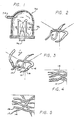
- a substrate generally indicated at 10 may be provided with porous, permeable properties.
- the substrate 10 may be included in an article generally indicated at 11.
- the substrate 10 may be formed from discrete elements 12 such as fiber or grains or a mixture of fibers and grains.
- the discrete elements may have a carbon or ceramic base.
- the discrete elements may be formed from a suitable material such as pyrolyzed wool, rayon, polyacrylonitrile and pitch fibers.
- Carbonized rayon felt, chopped fibers of carbonized polyacrylonitrile, carbonized rayon cloth made from interwoven carbon fibers, a tape material made of closely woven, carbonized PAN fibers, a macerated material comprising a multiplicity of randomly oriented pyrolyzed wool fibers and a macerated material having a multiplicity of chopped pitch fibers are specifically capable of being used.
- the substrate can also advantageously be formed from a slurry comprising granular material such as silicon carbide or graphite. Such granular material can also be mixed with short lengths of high temperature resistant fibers selected from the group consisting of ceramic, pyrolyzed wool, rayon, polyacrylonitrile and pitch.
- the slurry may also include a suitable carbonaceous binder such as petroleum pitch, coal tar pitch, furan resins and phenolic resins.
- the slurry used to form the substrate may also comprise short lengths of polyacrylonitrile fibers intermixed with silicon carbide in granular form.
- the different substrates described above may be formed on a continuous basis or may be formed by cyclic or pulsing techiques. When cyclic or pulsing techniques are used, a sequence of steps is provided under controlled conditions for limited periods of time and the sequence is repeated more than once.
- the substrate described in the previous paragraph may be directly coated with a matrix 14 as shown in Figure 2.
- the substrate 10 in order to coat the matrix 14 directly on the substrate 10, the substrate 10 is initially shaped preferably to a configuration corresponding to that desired for a finished article. The substrate 10 is then preferably retained in the desired configuration while the matrix 14 is being deposited on the substrate 12. This retention may be provided by a tool or fixture (not shown) which is constructed to retain the substrate 10 in the desired configuration while still providing for the coating of the matrix at every desired position on the substrate.
- Coating of the matrix on the substrate in this manner is advantageous in that it is direct and does not require any intermediate preparation of the substrate. However, it generally requires the preparation of special tools and fixtures. Furthermore, it increases the space requirements for the coating operation because of the use of the tools or fixtures. It also tends to slow the rate at which the matrix 14 is coated on the substrate 10.
- pyrolyzed carbon 16 may be deposited on the substrate 10, as shown in Figure 3, before the deposition of the matrix on the substrate.
- the pyrolyzed carbon 16 facilitates the promotion of a good load transfer between fibers, particularly when the article is stressed.
- the pyrolyzed carbon 16 also helps to strengthen and stabilize the substrate 10, particularly when the article is subjected to stress. It also enhances the mechanical interface for increasing the surface fracture energy of the composite structure defining the article 11, thus enhancing the toughness and flow resistance of the refractory composite article 11.
- the substrate may be disposed in a furnace of conventional design.
- the temperature of the substrate may then be raised to a suitable temperature such as approximately 1800°F, and a vacuum in the order of 15 mm mercury (ng) may be maintained within the deposition chamber.
- Pyrolyzed carbon may then be deposited about each of the discrete elements 12 in the substrate 10 by flowing methane gas through the porous substrate for an extended period of time such as about fifty (50) hours. As will be subsequently appreciated, this extended period is preferably not be continuous but is obtained by successive pulsings of the methane gas through the porous substrate.
- the pyrolyzed carbon When the pyrolyzed carbon is deposited on the substrate 10 in the manner discussed in the previous paragraph, it encases the discrete elements defining the substrate. This is illustrated schematically at 16 in Figure 3.
- the layer of pyrolyzed carbon 16 is porous and permeable. With a density of the substrate in the order of 0.7 gm/cc and a fiber volume of about forty percent (40%) before the deposition of the pyrolyzed carbon 16, the substrate encased with the pyrolyzed carbon may have a density in the order of 0.9 gm/cm3.
- the pyrolyzed carbon 16 serves to position the discrete elements 12 in the substrate 10 and the strengthen the substrate for handling purposes. In this way, the matrix 14 can be deposited on the substrate 10 without requiring any tools or fixtures to be used.
- the pyrolyzed carbon 16 can be deposited on the substrate by other techniques than those discussed above.
- the substrate 10 can be coated with any suitable and conventional type of resin such as a phenolic designated by Monsanto Chemical Company as Monsanto 1008.
- the phenolic may be dissolved in a solvent such that it is fluid.
- the solvent may illustratively be methylethylketone.
- the substrate 10 may then be coated with the phenolic and partially polymerized so that it is dry to the touch.
- Patterns of the desired shape can then be cut from the substrate 10 or the substrate can be heated to a temperature of at least 160°F. compressed and then cut to the desired shape.
- the patterns in the desired shape may then be placed in a mold and heated to a suitable temperature such as approximately 350°F. to cure the phenolic.
- the patterns may then be cured at a temperature above 350°F. to stabilize the system.
- the phenolic is then pyrolyzed at a temperature of approximately 1600°F. to decompose it to carbon, its elemental form.
- One reason for the pyrolysis is to prevent the substrate from thereafter emitting gases when it is heated.
- the discrete elements 12 may be retained in position by the pyrolyzed carbon 16 which is disposed in the interstices between the discrete elements, as shown in Figure 6.
- the deposition of the pyrolyzed carbon 16 in the interstices between the discrete elements 12 is illustrated schematically at 22 in Figure 5.
- the combination of the discrete elements 12 and the pyrolyzed carbon 16 in the interstices 22 is porous and permeable.
- the matrix 14 is disposed in the interstices 22 without the inclusion of the pyrolized carbon 16.
- the binder constituting the phenolic When the binder constituting the phenolic is pyrolyzed as discussed in the previous paragraphs, it loses approximately half of its mass and it shrinks and cracks. In spite of this, the pyrolyzed carbon is able to hold the discrete elements 12 in position in the substrate and to impart strength to the substrate. The substance 10 is then heated to a temperature of approximately 2200°F. for a relatively short period of time to impart a final shrink and pyrolyzation to the binder.
- Polyurethane or polyethylene can be included in the phenolic binder before the binder is cured and pyrolyzed as discussed in the previous paragraphs.
- the polyurethane or polyethylene vaporizes and facilitates the formation of tunnels in the substrate.
- the tunnels are effective in providing paths for depositing the matrix 14 on the substrate 10 as by chemical vapor deposition.
- a dry binder may be used.
- Dow Corning Plycarbosilane 6-2330 is illustrative. This is a dry resin which may be mixed with methylethylketone to provide a fluid mixture with which to work. This material has properties of becoming partially polymerized at room temperatures. The material is mixed with the substrate and is then heated to a temperature of approximately 1600°F. to pyrolyze the binder. The material is subsequently heated to a temperature of approximately 2200°F. to provide it with a final pyrolyzation and shrink.
- Sodium silicate or colloidal alumina can also be used as binders.
- the substrate 10 may be dipped into sodium silicate in liquid form and may then be heated.
- the sodium silicate flows along the lengths of the discrete elements 10 and tends to congregate or agglomerate at the interstices between the discrete elements.
- the formation of layers of material at the interstices between the fibers of the substrate 10 is shown in Figure 4 and 5.
- the characteristics of the substrate can be considerably varied without departing from the scope of the invention.
- the relative numbers of threads in warp and woof can be varied in great proportions and the spacings between the threads can also be varied considerably.
- the matrix 14 When the matrix 14 is deposited on the substrate 10, it does not have any significant chemical bond with the substrate. Furthermore, any mechanical bond between the matrix 14 and the substrate 10 is relatively weak. Since a strong bond between the matrix 14 and the substrate 10 does not exist, increased surface fracture energy (toughness) is produced between the substrate and the matrix. Flaw sensitivity in the material is also reduced.
- the matrix 14 also has a significantly different coefficient of thermal expansion than the substrate 10. As a result, the matrix 14 is free to move relative to the substrate 10 with mechanical shocks or changes in temperatures. This is particularly important because of the considerable range of temperatures (in thousands of degrees fahrenheit) in which the articles formed from the refractory materials of this invention are expected to work.
- the matrix 14 may be disposed on the substrate 10 to encase the discrete elements 12 (see Figures 2 and 3).
- the matrix 14 may also be disposed in the interstices ( Figures 4 and 5) between the discrete elements 12 when the pyrolized carbon 16 is disposed in such interstices.
- the matrix 14 may be formed from a suitable material consisting of a refractory element and an element providing negatively charged ions.
- the refractory element may be selected from the group consisting of hafnium, zirconium, tantalum, tungsten and molybdenum.
- the negatively charged element may be selected from the group consisting of nitrogen, carbon and oxygen. Refractory materials such as hafnium carbide and zirconium carbide are preferred.
- tantulum and tungsten are harder than hafnium and zirconium and although tantalum, tungsten and molybdenum have higher melting temperatures than hafnium and zirconium, hafnium and zirconium are more resistant to oxidation than tantalum, tungsten and molybdenum. Furthermore, hafnium and zirconium are higher in weight than tantalum, tungsten and molybdenum.
- a metallic carbide preferably constitutes the matrix 14.
- the metallic carbide may be preferably formed by reducing a halide salt which may be a chloride.
- the chemical reaction for producing a halide salt of hafnium is as follows: HfC14 + CH4 ⁇ HfC (s) + 4HCl (1)
- hafnium chloride (HfCl4), methane (CH4) and hydrogen chloride (HCl) are gases and hafnium carbide (HfC) is a solid.
- zirconium carbide may be obtained from zirconium chloride in the following manner: ZrC14 + CH4 ⁇ ZrC + 4HCl (2)
- zirconium chloride (ZrC14), methane (CH4) and hydrogen chloride (HCl) are gasses and zirconium carbide is a solid.
- hafnium (HfCl4) and zirconium (ZrCl4) are preferably formed in a pre-reactor in which the metal is burned in a chlorine gas at a temperature of approximately 700°C to 900°C.
- the chemical reaction is as follows for hafnium: Hf + 2Cl2 ⁇ HfCl4 (3)
- hafnium (Hf) and hafnium chloride (HfCl4) are solids and chlorine (Cl2) is a gas.
- Zirconium chloride can be produced from zirconium in a similar reaction.
- organometallics may be used.
- hafnium chloride (HfCl4) to hafnium carbide (HfC) preferably occurs in a chemical vapor infiltration (CVI) reactor at a temperature in the range of approximately 1180°F. to 1250°F. at a total pressure ranging from approximately ten (10) Torr to approximately one hundred (100) Torr.
- the total pressure is cycled between these values at a rate of approximately eighty three (83) seconds.
- a backfill pressure of approximately ten (10) Torr is produced for approximately twenty three (23) seconds and a pressure of approximately one hundred (100) Torr is produced for approximately sixty (60) seconds including several seconds to change from 10 to 100 torr.
- the vacuum can be produced in such a cyclic manner through the inclusion of timer circuits and variable area exhaust valves between the chemical vapor infiltration (lCVI) reactor and the vacuum pumps.
- Reactant ratios in the above equations are nominally on a molar basis. For example, 2.7 moles of chlorine (Cl2) are included for each mole of hafnium (Hf) and 0.55 moles of methane (CH4) are included for each mole of hafnium chloride (HfCl4). As will be seen, a slight excess of chlorine (Cl2) is provided in the above molar ratios. This slight excess of chlorine (Cl2) indicates that the chlorine burn is not completely efficient. Furthermore, the molar ratio between the methane (CH4) and the halide salt (e.g. HfC) demonstrates that a relatively low carbon potential is required to drive the process to a stoichiometric deposit of the halide salt (e.g. HfC).
- Steady state reactor conditions are typically utilized for pyrolitic carbon infiltration of a substrate such as the substrate 10 and for some chemical vapor infiltration (CVI) processes such as the production of a silicon carbide (SiC) matrix on the substrate.
- CVI chemical vapor infiltration
- SiC silicon carbide
- HfC hafnium carbide
- ZrC zirconium carbide
- the increased infiltration of the hafnium carbide or zirconium carbide into the substrate 10 to form the matrix 14 may be seen from the following analysis.
- the pressure of the gases in the chemical vapor infiltration (CVI) process increases, the pressure external to the substrate 10 increases on a corresponding basis.
- the pressure of the gases within the substrate 10 does not increase as fast as the pressure of the gases outside of the substrate. This may result in part from the fact that the pores in the substrate 10 are relatively small so that the pressure of the gases within the substrate 10 cannot follow the pressure of the gases outside of the substrate as the pressure of the gases increases.
- This differential of pressure acts upon the hafnium carbide (HfC) or zirconium carbide (ZrC) gaseous reactants to produce a flow of such material into the innermost reaches of the substrate 10 and to produce a deposit of the hafnium carbide or zirconium carbide there.
- This provides for a substantially uniform deposition of the hafnium carbide (HfC) and zirconium carbide (ZrC) not only on the surface of the substrate 10 but also within the interior of the substrate.
- the gases may be withdrawn from the furnace by producing a mild vacuum.
- Fresh gases containing silicon and carbon may be then introduced into the furnace.
- the fresh gases may then be pulsed in a manner similar to that described above. This process may be repeated through a number of cycles until the matrix has been formed with the desired thickness.
- the periodic introduction of gases into the furnace and subsequent exhaustion of these gases from the furnace provide certain important advantages.
- the composition of the gases introduced to the furnace changes with time because of the chemical reactions in the gases and because of the exhaustion of the gases as the gases are chemically reacted to produce the matrix 14.
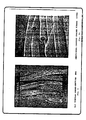
- Figures 7-10 constitute microphotographs of the fibers in the embodiment shown in Figure 2.
- the magnifications of these microphotographs are as follows: Figure Magnification 7 20X 8 80X 9 200X 10 1250
- "X" represents the magnification from actual size.
- All of these Figures show the deposition of zirconium carbide as the matrix 14 on carbon fibers in the substrate 10.
- the zirconium carbide in the matrix 14 encases the carbon fibers in the substrate 10.
- Figure 10 at a magnification of eighty (80) shows the disposition of bundles of fibers.
- Figures 10 and 11 are sufficiently magnified so that individual fibers are shown and these individual fibers are shown as being encased.
- the material disclosed can be used in a number of different equipments including nuclear reactors.
- the material is particularly adapted to be used in nuclear fission reactors.
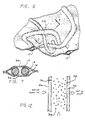
- Key elements in such a reactor are shown schematically in Figure 12.
- These key elements include a wall 30 made from a material which is known in the art.
- the wall 30 may be made from stainless steel or a nickel-based alloy containing nickel, cobalt and chromium.
- the wall 30 may also be made from a material which is ceramic-based if the temperature of the wall 30 is elevated. Since the wall 30 does not receive any heat, it does not have to have refractory properties.
- the wall 30 may be provided with spaced bores 32 extending longitudinally through the wall at periodically spaced positions.
- the bores 32 may have suitable dimensions such as a heighth of approximately twenty four thousandths of an inch (0.024”) and a width such as approximately twelve thousandths of an inch (0.012").
- Particles 34 of a nuclear fuel may be disposed adjacent the wall 30.
- the particles 34 may be made from a suitable material such as uranium carbide coated with zirconium carbide. This material provides a nuclear fission.
- the particles 34 may be packed to a density approaching sixty percent (60%) and may be provided with a suitable diameter such as approximately twenty thousandths of an inch (0.020").
- the particles 34 may be disposed in a column to a height of approximately two feet (2').
- a wall 36 made from the material of this invention is disposed in abutting relationship to the particles 34 on the other side of the particles from the wall 30.
- the wall 36 may be provided with bores 38 at periodically spaced positions in the bores.
- the bores 38 may have suitable dimensions such as a height of approximately twenty four thousandths of an inch (0.024") and a width such as approximately twelve thousandths of an inch (0.012").
- the walls 30 and 36 are preferably cylindrical and concentric.
- the wall 36 is disposed internally of the wall 30 but the positions of the walls 30 and 36 can be reversed so that the wall 36 is external to the wall 30.
- the wall 36 is preferably internal to the wall 30 because the wall 36 is difficult and expensive to make and because it is difficult to make the wall 36 compatible with the gases passing through the wall.
- a cold gas such as hydrogen, xenony argon or helium is passed through the bores 32 in the wall 30.
- the cold gas receives heat from the nuclear fission which is occurring in the particles 34.
- the heated gas then passes through the bores 36 in the wall 34.
- the gas is then drawn downwardly in the space within the wall 34 to another position where the heat in such gas is extracted to perform work such as to generate electricity.
- the wall 34 can become degraded as by hydrogen corrosion if it is not constructed properly.
- hydrogen corrosion can occur through the following chemical reaction: MeC + H2 ⁇ Me + CH X (4)
- Me is intended to designate a metal on a general basis
- X is intended to indicate any suitable integer such as 4.
- the metal carbide is a solid
- the hydrogen and the hydrocarbon is a gas
- the metal may be a liquid.
- liquid metal will clog the pores in the refractory composite material and also clog the holes 36 in the wall 34 and inhibit the passage of the not gases through the wall.
- hafnium carbide has a better response than zirconium carbide.
- rhenium has an even better response than hafnium carbide.
- the wall 34 can also become degraded by metalorcarbon diffusion at temperatures in excess of approximately 2500°K. to 3000°K.
- metal diffusion can occur through the following chemical reaction: MeC + C ⁇ MeC 1.X (8)
- MeC + C ⁇ MeC 1.X (8)
- MeC + C ⁇ MeC 1.X (8)
- the metal carbide is a solid
- the carbon is a solid
- the hydrocarbon is a gas
- the metal is a liquid.
- the carbon in the chemical reaction may be obtained form the fibers in the substrate 10. The result or such a reaction is damage to graphite fibers which weaken the composite structure drastically and also, as the ceramic matrix composition changes, its physical properties change.
- the attached phase diagram shows a drastic drop in melting point for HfC if it is either very metal rich or metal poor.
- hafnium carbide is better than zirconium carbide, and both hafnium carbide and zirconium are better than rhenium.
- Metal diffusion is undesirable for the same reasons as discussed in the previous paragraph. It is also undesirable because it robs the substrate of the carbon in the substrate and accordingly weakens the wall 34.
- reaction (8) The result of a reaction such as reaction (8) is to damage the graphite fibers in the substrate. This weakens the composite structure significantly. Furthermore, as the ceramic matrix composition changes, the physical properties of the matrix changes. For example, the meeting temperature of the hafnium carbide may change significantly if it is either substantially metal rich or metal poor.
- the matrix 14 in the refractory composite material constituting the wall 34 be formed from a combination of different materials.
- the wall 34 it would be advantageous for the wall 34 to be formed from a combination of different materials.
- the matrix 14 in the refractory composite material constituting the wall 34 it would be advantageous for the matrix 14 in the refractory composite material constituting the wall 34 to be formed form successive layers of hafnium carbide, zirconium carbide and rhenium. This is particularly true since zirconium carbide has the further advantage that it is neutral to the neutrons passing through the nuclear reactor.
- the inclusion of a layer of zirconium carbide in the matrix 14 is accordingly desirable because otherwise some of the neutrons passing through the wall 34 would be absorbed. This would tend to decrease the efficiency of the nuclear reactor.
- the matrix 14 may be formed by a layer 50 of hafnium carbide, a layer 52 of zirconium carbide and a layer 54 of rhenium.
- the thickness of the layer 50 of hafnium carbide may be in order of approximately two tenths of a micron (0.2 ⁇ ) to four tenths of a micron (0.4 ⁇ ).
- the thickness of the zirconium carbide layer 52 may be in the order of approximately two microns (2 ⁇ ).
- the thickness of the rhenium layer 54 may be in the order of approximately are half of a micron (0.5 ⁇ ). As will be seen, most of the thickness of the matrix 14 is in the zirconium carbide because the zirconium carbide is neutral to the neutrons passing through the wall 34.
- the rhenium layer 54 may be formed on the matrix 14 by a pyrolitic process.
- a halide of rhenium such as rhenium chloride may be decomposed to form rhenium and the halide gas such as chlorine.
- rhenium chloride for the pyrolitic reaction rhenium is "burned" in chlorine at a suitable temperature such as a temperature in the range of approximately 750°F. to approximately 850°F.
- the "burning" may be obtained by using compacted rhenium pellets since solid rhenium has so little surface area that an exothermic chlorinization process will not sustain itself.
- the range of the temperature to produce this decomposition reaction may be in the order of approximately 2250°F. to approximately 2450°F.
- hydrogen reduction of rhenium chloride may be used at temperatures in a range of approximately 1150°C-1200°C. to produce a rhenium layer in the matrix.
- the reaction to form the rhenium layer may occur in a chemical vapor infiltration (CVI) process as described above for hafnium carbide and zirconium carbide.
- CVI chemical vapor infiltration
- the reaction is not pulsed as described above for zirconium carbide and hafnium carbide since deep penetration of the rhenium into the micropores of the article is not necessary to obtain a suitable performance of the article.
- the rhenium does not encase the fibers such as occurs in the deposition of the hafnium carbide and the zirconium carbide and the substrate. Instead, the rhenium is deposited on the external surface of the substrate 10 and along the internal surfaces defining the pores of the substrate. This is illustrated in Figures 6 and 7.
- Absolute pressure ranges from less than one (1) torr to twenty five (25) torr are preferably utilized.
- an inert gas such as argon preferably comprises approximately eighty percent (80%) to ninety percent (90%) of the total reactant flow on the basis of mass per unit of time.
- the effective concentration of rhenium in the gas phase is roughly an order of magnitude lower than the concentration of gases in the infiltration of compounds of tungsten, tantalum or molybdemum by the hydrogen reduction of the metal.
- FIG. 1 illustrates a schematic diagram of a furnace, generally indicated at 70, which may be used to produce the composite materials described above.
- the furnace 70 includes an enclosure 72 having an inlet 74 and an outlet 76. Gases, such as those used to produce a chemical vapor deposition of the matrix 14 on the substrate 10, are introduced into the furnace 70 through the inlet 74. The gases flow downwardly along the walls defining the enclosures as indicated by arrows 78. The gases then flow upwardly along a partition 80, as indicated by arrows 82. Since the path defined by the arrows 78 and 82 within the furnace 80 is relatively long, the gases have a considerable opportunity to become heated to the temperature of the furnace 80.
- the gases then flow downwardly within the space defined by the partition 80 and flow from the furnace 70 through the outlet 76. During the flow of the gases within the partition 80, the gases have an opportunity to become deposited on the article, such as the substrate 10, on which a deposition is to be provided.
Landscapes
- Chemical & Material Sciences (AREA)
- Engineering & Computer Science (AREA)
- Ceramic Engineering (AREA)
- Organic Chemistry (AREA)
- Materials Engineering (AREA)
- Structural Engineering (AREA)
- Chemical Kinetics & Catalysis (AREA)
- Inorganic Chemistry (AREA)
- General Chemical & Material Sciences (AREA)
- Mechanical Engineering (AREA)
- Metallurgy (AREA)
- Manufacturing & Machinery (AREA)
- Ceramic Products (AREA)
- Chemical Vapour Deposition (AREA)
- Compositions Of Oxide Ceramics (AREA)
- Catalysts (AREA)
- Laminated Bodies (AREA)
- Glass Compositions (AREA)
Applications Claiming Priority (2)
| Application Number | Priority Date | Filing Date | Title |
|---|---|---|---|
| US157907 | 1988-02-19 | ||
| US07/157,907 US4960640A (en) | 1988-02-19 | 1988-02-19 | Composite refractory material |
Publications (3)
| Publication Number | Publication Date |
|---|---|
| EP0329174A2 true EP0329174A2 (fr) | 1989-08-23 |
| EP0329174A3 EP0329174A3 (en) | 1990-11-07 |
| EP0329174B1 EP0329174B1 (fr) | 1994-07-13 |
Family
ID=22565826
Family Applications (1)
| Application Number | Title | Priority Date | Filing Date |
|---|---|---|---|
| EP89102794A Expired - Lifetime EP0329174B1 (fr) | 1988-02-19 | 1989-02-17 | Matériau réfractaire composite |
Country Status (6)
| Country | Link |
|---|---|
| US (1) | US4960640A (fr) |
| EP (1) | EP0329174B1 (fr) |
| JP (1) | JPH01308875A (fr) |
| AT (1) | ATE108426T1 (fr) |
| CA (1) | CA1336558C (fr) |
| DE (1) | DE68916665T2 (fr) |
Families Citing this family (5)
| Publication number | Priority date | Publication date | Assignee | Title |
|---|---|---|---|---|
| US5230925A (en) * | 1990-06-25 | 1993-07-27 | Kabushiki Kaisha Toshiba | Gas-phase growing method and apparatus for the method |
| US5441762A (en) * | 1991-03-22 | 1995-08-15 | E. I. Du Pont De Nemours And Company | Coating a composite article by applying a porous particulate layer and densifying the layer by subsequently applying a ceramic layer |
| US5238710A (en) * | 1992-03-30 | 1993-08-24 | Technology Assessment & Transfer, Inc. | Microwave energy-assisted chemical vapor infiltration |
| US5780157A (en) * | 1994-06-06 | 1998-07-14 | Ultramet | Composite structure |
| US6846516B2 (en) * | 2002-04-08 | 2005-01-25 | Applied Materials, Inc. | Multiple precursor cyclical deposition system |
Family Cites Families (12)
| Publication number | Priority date | Publication date | Assignee | Title |
|---|---|---|---|---|
| JPS4943200B1 (fr) * | 1970-09-24 | 1974-11-19 | ||
| US3982148A (en) * | 1975-05-07 | 1976-09-21 | Ultramet | Heat radiating coating and method of manufacture thereof |
| US4397901A (en) * | 1979-07-31 | 1983-08-09 | Warren James W | Composite article and method of making same |
| JPS59106572A (ja) * | 1982-12-06 | 1984-06-20 | 信越化学工業株式会社 | 炭素繊維の表面処理方法 |
| US4500328A (en) * | 1983-02-22 | 1985-02-19 | Gilbert W. Brassell | Bonded carbon or ceramic fiber composite filter vent for radioactive waste |
| ATE49586T1 (de) * | 1983-03-15 | 1990-02-15 | Refractory Composites Inc | Kohlenstoffverbundwerkstoff und verfahren zu seiner herstellung. |
| US4580524A (en) * | 1984-09-07 | 1986-04-08 | The United States Of America As Represented By The United States Department Of Energy | Process for the preparation of fiber-reinforced ceramic composites by chemical vapor deposition |
| US4663230A (en) * | 1984-12-06 | 1987-05-05 | Hyperion Catalysis International, Inc. | Carbon fibrils, method for producing same and compositions containing same |
| US4725345A (en) * | 1985-04-22 | 1988-02-16 | Kabushiki Kaisha Kenwood | Method for forming a hard carbon thin film on article and applications thereof |
| CA1286549C (fr) * | 1985-05-02 | 1991-07-23 | James W. Warren | Materiau refractaire composite, et sa production |
| US4735850A (en) * | 1985-10-31 | 1988-04-05 | Science Applications International Corporation | Refractory composite articles |
| US4772524A (en) * | 1986-04-14 | 1988-09-20 | The United States Of America As Represented By The Secretary Of Commerce | Fibrous monolithic ceramic and method for production |
-
1988
- 1988-02-19 US US07/157,907 patent/US4960640A/en not_active Expired - Lifetime
-
1989
- 1989-02-16 CA CA000593437A patent/CA1336558C/fr not_active Expired - Fee Related
- 1989-02-17 DE DE68916665T patent/DE68916665T2/de not_active Expired - Fee Related
- 1989-02-17 AT AT89102794T patent/ATE108426T1/de not_active IP Right Cessation
- 1989-02-17 EP EP89102794A patent/EP0329174B1/fr not_active Expired - Lifetime
- 1989-02-20 JP JP1038488A patent/JPH01308875A/ja active Pending
Also Published As
| Publication number | Publication date |
|---|---|
| EP0329174A3 (en) | 1990-11-07 |
| JPH01308875A (ja) | 1989-12-13 |
| ATE108426T1 (de) | 1994-07-15 |
| EP0329174B1 (fr) | 1994-07-13 |
| CA1336558C (fr) | 1995-08-08 |
| US4960640A (en) | 1990-10-02 |
| DE68916665D1 (de) | 1994-08-18 |
| DE68916665T2 (de) | 1994-11-17 |
Similar Documents
| Publication | Publication Date | Title |
|---|---|---|
| CA1336559C (fr) | Materiau refractaire composite et methode de fabrication | |
| US4397901A (en) | Composite article and method of making same | |
| US4275095A (en) | Composite article and method of making same | |
| US5837081A (en) | Method for making a carbon-carbon composite | |
| EP0200568A2 (fr) | Matériau composite réfractaire et procédé pour sa fabrication | |
| Naslain et al. | CVD-processing of ceramic-ceramic composite materials | |
| US4824711A (en) | Ceramic honeycomb structures and method thereof | |
| US5350545A (en) | Method of fabrication of composites | |
| EP1936006B1 (fr) | CVI/CVD avec variation de pression | |
| EP0121797A2 (fr) | Produit composite en carbone et son procédé de fabrication | |
| US4979019A (en) | Printed circuit board with inorganic insulating matrix | |
| EP0329174B1 (fr) | Matériau réfractaire composite | |
| EP0410781A1 (fr) | Procédé de préparation d'un matériau en carbone | |
| US4716064A (en) | Composite stiff lightweight structure and method for making same | |
| KR20200048314A (ko) | 화학기상증착을 이용한 SiC 나노와이어 균일 성장에 의한 고밀도의 탄화규소 복합체 제조 방법 및 이의 의해 제조된 탄화규소 복합체 | |
| Emig et al. | The coating of continuous carbon fiber bundles with sic by chemical vapor deposition: A mathematical model for the CVD-process | |
| KR100285168B1 (ko) | 고온,고압연소합성을이용한탄화물,붕화물또는질화물이도포된핵연료의제조방법 | |
| Kim et al. | Effects of process parameters for the preparation of C/SiC composites in the F-chemical vapor infiltration reactor | |
| USRE34825E (en) | Composite article and method of making same | |
| JPH0657433A (ja) | パルスcvi装置 | |
| US5076982A (en) | Composite stiff lightweight structure and method for making same | |
| Lackey et al. | Composites by Chemical Vapor Infiltration: Processing, Structure and Properties | |
| Besmann et al. | Chemical vapor infiltration process modeling and optimization | |
| KR100198152B1 (ko) | 공정가스개선에 의한 화학기상침투법을 이용한 탄소/탄소 복합재료의 제조방법 | |
| Cho et al. | Manufacturing of ceramic composites reinforced with layered woven fabrics by CVI of SiC from dichlorodimethylsilane |
Legal Events
| Date | Code | Title | Description |
|---|---|---|---|
| PUAI | Public reference made under article 153(3) epc to a published international application that has entered the european phase |
Free format text: ORIGINAL CODE: 0009012 |
|
| AK | Designated contracting states |
Kind code of ref document: A2 Designated state(s): AT BE CH DE FR GB IT LI LU NL SE |
|
| PUAL | Search report despatched |
Free format text: ORIGINAL CODE: 0009013 |
|
| AK | Designated contracting states |
Kind code of ref document: A3 Designated state(s): AT BE CH DE FR GB IT LI LU NL SE |
|
| 17P | Request for examination filed |
Effective date: 19910429 |
|
| 17Q | First examination report despatched |
Effective date: 19920226 |
|
| GRAA | (expected) grant |
Free format text: ORIGINAL CODE: 0009210 |
|
| RAP1 | Party data changed (applicant data changed or rights of an application transferred) |
Owner name: MINNESOTA MINING AND MANUFACTURING COMPANY |
|
| AK | Designated contracting states |
Kind code of ref document: B1 Designated state(s): AT BE CH DE FR GB IT LI LU NL SE |
|
| PG25 | Lapsed in a contracting state [announced via postgrant information from national office to epo] |
Ref country code: IT Free format text: LAPSE BECAUSE OF FAILURE TO SUBMIT A TRANSLATION OF THE DESCRIPTION OR TO PAY THE FEE WITHIN THE PRESCRIBED TIME-LIMIT;WARNING: LAPSES OF ITALIAN PATENTS WITH EFFECTIVE DATE BEFORE 2007 MAY HAVE OCCURRED AT ANY TIME BEFORE 2007. THE CORRECT EFFECTIVE DATE MAY BE DIFFERENT FROM THE ONE RECORDED. Effective date: 19940713 Ref country code: LI Effective date: 19940713 Ref country code: NL Effective date: 19940713 Ref country code: BE Effective date: 19940713 Ref country code: CH Effective date: 19940713 Ref country code: AT Effective date: 19940713 |
|
| REF | Corresponds to: |
Ref document number: 108426 Country of ref document: AT Date of ref document: 19940715 Kind code of ref document: T |
|
| REF | Corresponds to: |
Ref document number: 68916665 Country of ref document: DE Date of ref document: 19940818 |
|
| PG25 | Lapsed in a contracting state [announced via postgrant information from national office to epo] |
Ref country code: SE Effective date: 19941013 |
|
| ET | Fr: translation filed | ||
| REG | Reference to a national code |
Ref country code: CH Ref legal event code: PL |
|
| NLV1 | Nl: lapsed or annulled due to failure to fulfill the requirements of art. 29p and 29m of the patents act | ||
| PGFP | Annual fee paid to national office [announced via postgrant information from national office to epo] |
Ref country code: LU Payment date: 19950101 Year of fee payment: 7 |
|
| PLBE | No opposition filed within time limit |
Free format text: ORIGINAL CODE: 0009261 |
|
| STAA | Information on the status of an ep patent application or granted ep patent |
Free format text: STATUS: NO OPPOSITION FILED WITHIN TIME LIMIT |
|
| 26N | No opposition filed | ||
| PG25 | Lapsed in a contracting state [announced via postgrant information from national office to epo] |
Ref country code: LU Free format text: LAPSE BECAUSE OF NON-PAYMENT OF DUE FEES Effective date: 19960217 |
|
| REG | Reference to a national code |
Ref country code: GB Ref legal event code: IF02 |
|
| PGFP | Annual fee paid to national office [announced via postgrant information from national office to epo] |
Ref country code: DE Payment date: 20020131 Year of fee payment: 14 |
|
| PGFP | Annual fee paid to national office [announced via postgrant information from national office to epo] |
Ref country code: GB Payment date: 20020201 Year of fee payment: 14 |
|
| PGFP | Annual fee paid to national office [announced via postgrant information from national office to epo] |
Ref country code: FR Payment date: 20030131 Year of fee payment: 15 |
|
| PG25 | Lapsed in a contracting state [announced via postgrant information from national office to epo] |
Ref country code: GB Free format text: LAPSE BECAUSE OF NON-PAYMENT OF DUE FEES Effective date: 20030217 |
|
| PG25 | Lapsed in a contracting state [announced via postgrant information from national office to epo] |
Ref country code: DE Free format text: LAPSE BECAUSE OF NON-PAYMENT OF DUE FEES Effective date: 20030902 |
|
| GBPC | Gb: european patent ceased through non-payment of renewal fee | ||
| PG25 | Lapsed in a contracting state [announced via postgrant information from national office to epo] |
Ref country code: FR Free format text: LAPSE BECAUSE OF NON-PAYMENT OF DUE FEES Effective date: 20041029 |
|
| REG | Reference to a national code |
Ref country code: FR Ref legal event code: ST |