EP0329444A2 - Verfahren zur Herstellung von festem Brennstoff, ausgehend von agglomerierter subbituminöser Kohle - Google Patents
Verfahren zur Herstellung von festem Brennstoff, ausgehend von agglomerierter subbituminöser Kohle Download PDFInfo
- Publication number
- EP0329444A2 EP0329444A2 EP89301505A EP89301505A EP0329444A2 EP 0329444 A2 EP0329444 A2 EP 0329444A2 EP 89301505 A EP89301505 A EP 89301505A EP 89301505 A EP89301505 A EP 89301505A EP 0329444 A2 EP0329444 A2 EP 0329444A2
- Authority
- EP
- European Patent Office
- Prior art keywords
- agglomerates
- coal
- oil
- bridging
- subbituminous
- Prior art date
- Legal status (The legal status is an assumption and is not a legal conclusion. Google has not performed a legal analysis and makes no representation as to the accuracy of the status listed.)
- Granted
Links
Images

Classifications
-
- C—CHEMISTRY; METALLURGY
- C10—PETROLEUM, GAS OR COKE INDUSTRIES; TECHNICAL GASES CONTAINING CARBON MONOXIDE; FUELS; LUBRICANTS; PEAT
- C10L—FUELS NOT OTHERWISE PROVIDED FOR; NATURAL GAS; SYNTHETIC NATURAL GAS OBTAINED BY PROCESSES NOT COVERED BY SUBCLASSES C10G OR C10K; LIQUIFIED PETROLEUM GAS; USE OF ADDITIVES TO FUELS OR FIRES; FIRE-LIGHTERS
- C10L9/00—Treating solid fuels to improve their combustion
Definitions
- the present invention relates to an improved method of separating subbituminous coal (agglomerates) into solid fuel made of de-oiled agglomerates and distillable liquid hydrocarbon fuel.
- the process of agglomeration provides a method of collecting and retaining the finely divided carbonaceous part of an aqueous coal slurry in a form which can be readily separated from water and ash-forming impurities in the coal.
- a hydrocarbon liquid known as the bridging oil
- the oil preferentially wets the carbonaceous coal fraction, which is substantially hydrophobic, and causes it to agglomerate.
- US-A- 4,415,335 there is disclosed a method for separating an agglomerated mixture of finely divided coal particles from the bridging liquid hydrocarbon comprising contacting the agglomerates with steam at temperatures in excess of 200°C to separate the liquid hydrocarbon from the coal particles.
- an agglomerating oil which is a light gas oil with a boiling range of 240 to 340°C.
- the particular type of feed coal is not disclosed.
- such a light oil is not suitable to serve as a bridging oil for a subbituminous coal.
- Subbituminous coals may be agglomerated using bridging liquids incorporating heavy oils or mixtures of heavy and light oils, however the consumption of the bridging liquid is relatively high i . e . from 12 to 25%, which precludes the application of such a process for commercial applications because of the cost of the oil.
- a method for separating coal agglomerates generated from finely divided raw subbituminous coal by using low quality bridging liquids to form a solid made of de-oiled agglomerates and a liquid made of distillable hydrocarbons comprising the step of contacting said agglomerates with steam or an inert gas at a temperature in the range of 250 to 350°C at substantially atmospheric pressure, whereby the resultant separated solid contains less than about 7% by weight residual bridging liquid and has a moisture capacity reduced by at least 5% at a relative humidity of 96% compared to the moisture capacity of said agglomerates.
- a preferred embodiment of the invention for separating an agglomerated mixture of finely divided subbituminous coal and the heavy oil used in agglomeration process, to recover distillable oil and an improved solid fuel comprises the step of contacting the agglomerates with steam or an inert gas at a temperature in the range of 250 to 350°C at near atmospheric pressure, whereby the separated solid fuel contains less than about 7% by weight, and usually 3% and above, residual heavy oil and has significantly reduced moisture capacity. Recovery of the heavy oil will usually be about 45-80%.
- the process of the present invention utilizes agglomerated subbituminous coal made by agglomerating such coal with a bridging liquid consisting essentially of from 20 to 50% of a light hydrocarbon diluent and from 50 to 80% of a low quality heavy oil.
- a bridging liquid consisting essentially of from 20 to 50% of a light hydrocarbon diluent and from 50 to 80% of a low quality heavy oil.
- the ratio of heavy oil to light hydrocarbon diluent will be in the range of about 4:1-1:1.
- light hydrocarbon diluent oils such as naphtha, kerosene, diesel oil and the like.
- heavy oil bitumen, heavy crude, and other oils recognized in the art as heavy oils.
- bridging oil as low as 2 to 5% by weight of coal
- a substantially larger amount of bridging oil is utilized, and may be in the range of from 12 to 25% by weight of coal.
- Lcw rank subbituminous coals are defined as coals having a carbon content ranging from about 74 to 78% by weight (daf), (3.5 to 5.5% hydrogen (daf)) and a relatively high oxygen content, ranging from about 16 to 25% by weight (daf).
- Other characteristics of low rank subbituminous coals are a relatively high moisture content (about 10 to 30%), a high dry ash content (12 to 40%), volatile materials greater than 38% (daf), fixed carbon less than 62% (daf), 1 to 10% of oxygen in form of carboxyl group.
- the subbituminous coal agglomerates will have a size of from about 0.6-30 mm.
- a particularly preferred composition of bridging oil is an approximately 1:1 blend of heavy oil (such as Mayan oil) having a gravity in the range of 10-20°API and diesel oil.
- heavy oil such as Mayan oil
- a bitumen may be utilized having a gravity in the range of 5.5-10°API.
- heavy oil, bitumen or any other low quality oil may be utilized as the bridging liquid.
- low quality oils it is generally meant to include those oils having the following characteristics: API gravity from 7 to about 20; specific gravity (at 20°C) of about 0.900 to 1.100; sulfur content from 2% to 5.0%, total solids (mg/l) in the range of 1 to 15; viscosity (cst at 40°C) in the range of 3 to 500; and further characterized as being marginally distillable and generally having a high heteroatom and contaminant contents.
- the bridging oil may also be an emulsified product. When the bridging liquid is such an emulsion, the use of a light hydrocarbon diluent is usually not required.
- the agglomerates may then be introduced into a heating zone in any convenient manner known in the art at atmospheric pressure or under a slight vacuum (such as about 800 mbar).
- the agglomerates will be heated directly (by carrier gas) or indirectly, or both.
- the heating will result in generation of distillable oil and hardened agglomerates.
- the temperature within the heating zone will be in the range of 250 to 350°C. Utilizing a temperature higher than 350°C usually results in lowering the volatile matter contents of the hardened agglomerates below acceptable level.
- the moisture capacity of the resultant agglomerated particles is reduced at least by 5% (at a relative humidity of 96%), whereas by thermal treatment of agglomerates of bituminous coal, moisture capacity of the resultant agglomerate is reduced only by about 3%.
- the resultant solid fuel made in accordance with the present invention contains less than 3 to 7% oil by weight (dry coal basis) and usually from 45-80% of the initially used bridging oil is recovered.
- This particular aspect renders the agglomeration process according to the present invention commercially feasible for subbituminous coals.
- a test unit comprising a steam generator, inert gas supply, heating system and condensation and recovery section was constructed to test samples of agglomerates with various inert carriers at various temperatures.
- the steam generation is accomplished with a heating coil, immersed in a fluidized sand bath with a maximum operating temperature of 450°C. Water is pumped through this coil using a metering pump.
- the heating unit consists of a rotating glass reactor with baffles, heated by infrared radiation, under reduced pressure or positive pressure of inert gas carriers.
- a clamshell infrared oven with a water cooled jacket is utilized which may attain temperatures in the range of 200 to 900°C in 1/2 to 3 minutes.
- the control is accomplished by a thermocouple placed in the sample bed formed by the bottom of the reactor.
- the glass reactor is rotated at various rates connected to multi-bulb cooler/condensor which rotates with it, being cooled by liquid nitrogen from the outside. Evolved gases are condensed in the glass cooler section, and the remaining gases are passed through a second condensor, active carbon trap and cold trap before being released or pumped into the vacuum pump.
- Weighed samples of agglomerates or raw coal samples (200 to 500 gms) are placed in the glass reactor and the whole assembly is placed into the oven reactor and attached to a Rotevap® rotary evaporator. While rotating, the reactor is purged with inert gas, and then oven fired. The heating rate is adjusted and maintained in comparative tests. The flowrate of carrier gas (or vacuum) is adjusted appropriately.
- the treatment is carried out at the desired temperature for a predetermined time and the contents of the reactor are quenched with cold carbon dioxide gas. After completion of the treatment both reactor and condensor contents are weighed. The condensor is then placed into the recovery section which is in the form of a distillation setup and the water content of the condensate is determined by distillation with toluene. The amount of recovered oil is determined and % recovery is calculated by checking against the amount of oil taken for agglomeration.
- the test unit described above was used to produce the de-oiled agglomerates in the following examples.
- a moisture capacity test was conducted utilizing two subbituminous coals and a bituminous coal by measuring the moisture capacity in each case of the raw coal, agglomerated coal, and de-oiled agglomerated coal according to the present invention.
- the results are shown in Fig. 1.
- the raw coals were tested for moisture capacity, then were tested as agglomerates, then as de-oiled coal made in the process in accordance with the present invention.
- the combined effect of agglomeration and de-oiling according to the present invention results, for subbituminous coal I and II, respectively, of a suppression of moisture capacity of 15.6% (i.e. a drop from 29.3% moisture capacity to 13.7%) and 13.3% units relative to the raw coal.
- the moisture capacity suppression is 2.3% units (i.e. a drop from 5.2% moisture capacity to 2.9%).
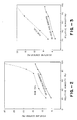
- Fig. 2 there is shown a graph showing the moisture content (%) versus relative humidity at 30°C in a raw coal (subbituminous coal I referred to above) and in a de-oiled agglomerate of that same coal.
- the moisture content for the de-oiled agglomerate was consistently over 2% units lower than that of the raw coal in the relative humidity range from 20% to about 70%. Due to rapid increase in moisture capacity of the raw coal after this point the difference between coal and deashed agglomerates is very significant.
- Fig. 3 there is shown the moisture content versus relative humidity at 30°C in a subbituminous coal II (referred to above) and in a de-oiled agglomerate made from that coal in accordance with the present invention.
- the moisture content of the de-oiled agglomerate was consistently lower than the moisture content of the corresponding raw coal. The difference increased significantly from 3% units up to 13% units with relative humidity from 20%-96%.
Landscapes
- Chemical & Material Sciences (AREA)
- Engineering & Computer Science (AREA)
- Combustion & Propulsion (AREA)
- Oil, Petroleum & Natural Gas (AREA)
- Organic Chemistry (AREA)
- Solid Fuels And Fuel-Associated Substances (AREA)
- Production Of Liquid Hydrocarbon Mixture For Refining Petroleum (AREA)
- Liquid Carbonaceous Fuels (AREA)
Priority Applications (1)
| Application Number | Priority Date | Filing Date | Title |
|---|---|---|---|
| AT89301505T ATE95557T1 (de) | 1988-02-16 | 1989-02-16 | Verfahren zur herstellung von festem brennstoff, ausgehend von agglomerierter subbituminoeser kohle. |
Applications Claiming Priority (2)
| Application Number | Priority Date | Filing Date | Title |
|---|---|---|---|
| US07/156,541 US4854940A (en) | 1988-02-16 | 1988-02-16 | Method for providing improved solid fuels from agglomerated subbituminous coal |
| US156541 | 1988-02-16 |
Publications (3)
| Publication Number | Publication Date |
|---|---|
| EP0329444A2 true EP0329444A2 (de) | 1989-08-23 |
| EP0329444A3 EP0329444A3 (en) | 1989-10-04 |
| EP0329444B1 EP0329444B1 (de) | 1993-10-06 |
Family
ID=22559988
Family Applications (1)
| Application Number | Title | Priority Date | Filing Date |
|---|---|---|---|
| EP89301505A Expired - Lifetime EP0329444B1 (de) | 1988-02-16 | 1989-02-16 | Verfahren zur Herstellung von festem Brennstoff, ausgehend von agglomerierter subbituminöser Kohle |
Country Status (7)
| Country | Link |
|---|---|
| US (1) | US4854940A (de) |
| EP (1) | EP0329444B1 (de) |
| JP (1) | JPH0662972B2 (de) |
| CN (1) | CN1025869C (de) |
| AT (1) | ATE95557T1 (de) |
| DE (1) | DE68909639T2 (de) |
| ES (1) | ES2045405T3 (de) |
Cited By (1)
| Publication number | Priority date | Publication date | Assignee | Title |
|---|---|---|---|---|
| EP0469917A1 (de) * | 1990-08-03 | 1992-02-05 | Teresa Ignasiak | Verfahren zur Umwandlung von abgelagertem Schweröl auf Kohle zu destillierbarem Öl durch ein unter milden Bedingungen durchgeführtes Verfahren |
Families Citing this family (9)
| Publication number | Priority date | Publication date | Assignee | Title |
|---|---|---|---|---|
| US5032146A (en) * | 1989-09-28 | 1991-07-16 | The University Of North Dakota School Of Engineering & Mines Foundation (Undsem Foundation) | Low-rank coal oil agglomeration |
| US5162050A (en) * | 1989-09-28 | 1992-11-10 | University Of North Dakota School Of Engineering & Mines Foundation (Und-Sem Foundation) | Low-rank coal oil agglomeration product and process |
| CA2008470A1 (en) * | 1990-01-24 | 1991-07-24 | Alberta Research Council | Coal and oil upgrading by micro-agglomeration and thermopelletizing process ("comat" process) |
| US5066310A (en) * | 1990-08-13 | 1991-11-19 | Bechtel Group, Inc. | Method for recovering light hydrocarbons from coal agglomerates |
| IT1270964B (it) * | 1993-08-19 | 1997-05-26 | Eniricerche Spa | Procedimento per la preparazione di miscele di carbone in acqua a partire da carbone a basso rango |
| US5503646A (en) * | 1994-06-30 | 1996-04-02 | Fording Coal Limited | Process for coal - heavy oil upgrading |
| CN104043482B (zh) * | 2013-03-12 | 2017-05-24 | 中国石油化工股份有限公司 | 一种加氢催化剂及其制备方法 |
| CN107684929B (zh) * | 2016-08-05 | 2020-12-22 | 中国石油化工股份有限公司 | 一种提高苯加氢均相催化剂性能的方法 |
| CN110180593A (zh) * | 2019-06-14 | 2019-08-30 | 昆明理工大学 | 一种提高苯加氢催化剂催化性能和稳定性的方法 |
Family Cites Families (23)
| Publication number | Priority date | Publication date | Assignee | Title |
|---|---|---|---|---|
| US1574174A (en) * | 1924-08-18 | 1926-02-23 | Eugene P Schoch | Dehydrated lignite and process of producing same |
| US3754876A (en) * | 1971-12-10 | 1973-08-28 | Exxon Research Engineering Co | Upgrading low rank coals as fuel |
| GB1450805A (en) * | 1973-10-23 | 1976-09-29 | Shell Int Research | Preparation of a wet load of coal for transport and storage |
| GB1472810A (en) * | 1974-11-19 | 1977-05-11 | Coal Ind | Extraction of coal |
| US3985516A (en) * | 1975-08-20 | 1976-10-12 | Hydrocarbon Research, Inc. | Coal drying and passivation process |
| AU517024B2 (en) * | 1976-09-20 | 1981-07-02 | Kobe Steel Limited | Coking low ranking coals |
| GB1575413A (en) * | 1976-12-03 | 1980-09-24 | Shell Int Research | Method for agglomeration of coal fines |
| CA1119106A (en) * | 1977-05-10 | 1982-03-02 | Broken Hill Proprietary Company Limited (The) | Coal agglomeration by nonintensive mixing with hydrocarbons |
| US4295858A (en) * | 1978-09-21 | 1981-10-20 | Atlantic Richfield Company | Process for removing sulfur from coal |
| US4249910A (en) * | 1978-09-21 | 1981-02-10 | Atlantic Richfield Company | Process for removing sulfur from coal |
| AU529342B2 (en) * | 1979-02-23 | 1983-06-02 | Bp Australia Limited | Removing liquid hydrocarbons from carbonaceous solids |
| JPS55127489A (en) * | 1979-03-23 | 1980-10-02 | Sumitomo Sekitan Kogyo Kk | Production of caking agent for blast furnace coke from coal |
| US4234320A (en) * | 1979-04-23 | 1980-11-18 | Shell Oil Company | Process for the agglomeration of solids |
| US4261699A (en) * | 1979-04-23 | 1981-04-14 | Atlantic Richfield Company | Process for removal of sulfur and ash from coal |
| US4412839A (en) * | 1979-11-13 | 1983-11-01 | Ergon, Inc. | Coal treatment process |
| AT366405B (de) * | 1980-01-21 | 1981-04-13 | Voest Alpine Ag | Verfahren zum trocknen und umwandeln von organischen feststoffen, insbesondere braunkohlen mit dampf |
| JPS5738891A (en) * | 1980-08-18 | 1982-03-03 | Idemitsu Kosan Co Ltd | Selective agglomeration of coal particle |
| JPS57143395A (en) * | 1981-02-28 | 1982-09-04 | Hitachi Zosen Corp | Preparation of oil-containing pelletized coal |
| US4415335A (en) * | 1981-05-13 | 1983-11-15 | B. P. Australia Ltd. | Coal preparation |
| CA1188517A (en) * | 1983-10-12 | 1985-06-11 | C. Edward Capes | Aqueous phase continuous, coal fuel slurry and a method of its production |
| CA1216551A (en) * | 1984-05-23 | 1987-01-13 | Her Majesty The Queen In Right Of The Province Of Alberta As Represented By The Minister Of Energy And Natural Resources | Process for the selective agglomeration of sub- bituminous coal fines |
| US4575418A (en) * | 1984-10-03 | 1986-03-11 | The Dow Chemical Company | Coal cleaning and the removal of ash from coal |
| US4705533A (en) * | 1986-04-04 | 1987-11-10 | Simmons John J | Utilization of low rank coal and peat |
-
1988
- 1988-02-16 US US07/156,541 patent/US4854940A/en not_active Expired - Fee Related
-
1989
- 1989-02-16 AT AT89301505T patent/ATE95557T1/de not_active IP Right Cessation
- 1989-02-16 DE DE89301505T patent/DE68909639T2/de not_active Expired - Fee Related
- 1989-02-16 CN CN89101843A patent/CN1025869C/zh not_active Expired - Fee Related
- 1989-02-16 EP EP89301505A patent/EP0329444B1/de not_active Expired - Lifetime
- 1989-02-16 ES ES89301505T patent/ES2045405T3/es not_active Expired - Lifetime
- 1989-02-16 JP JP1037304A patent/JPH0662972B2/ja not_active Expired - Lifetime
Cited By (1)
| Publication number | Priority date | Publication date | Assignee | Title |
|---|---|---|---|---|
| EP0469917A1 (de) * | 1990-08-03 | 1992-02-05 | Teresa Ignasiak | Verfahren zur Umwandlung von abgelagertem Schweröl auf Kohle zu destillierbarem Öl durch ein unter milden Bedingungen durchgeführtes Verfahren |
Also Published As
| Publication number | Publication date |
|---|---|
| JPH0662972B2 (ja) | 1994-08-17 |
| US4854940A (en) | 1989-08-08 |
| DE68909639T2 (de) | 1994-05-11 |
| CN1025869C (zh) | 1994-09-07 |
| CN1037919A (zh) | 1989-12-13 |
| ES2045405T3 (es) | 1994-01-16 |
| EP0329444A3 (en) | 1989-10-04 |
| DE68909639D1 (de) | 1993-11-11 |
| ATE95557T1 (de) | 1993-10-15 |
| JPH024894A (ja) | 1990-01-09 |
| EP0329444B1 (de) | 1993-10-06 |
Similar Documents
| Publication | Publication Date | Title |
|---|---|---|
| US2131702A (en) | Coal processing | |
| CA2151792C (en) | Process for coal - heavy oil upgrading | |
| EP0184372B1 (de) | Vorrichtung und Verfahren zur Trocknung von niederwertiger Kohle | |
| US4481101A (en) | Production of low-metal and low-sulfur coke from high-metal and high-sulfur resids | |
| EP0329444B1 (de) | Verfahren zur Herstellung von festem Brennstoff, ausgehend von agglomerierter subbituminöser Kohle | |
| CA2721744C (en) | Process and system for recovering oil from tar sands using microwave energy | |
| EP0330314A1 (de) | Wiederverwertung von ölhaltigen Raffinierrückständen | |
| CA1149303A (en) | Coal extraction process | |
| US4449586A (en) | Process for the recovery of hydrocarbons from oil shale | |
| US3375188A (en) | Process for deashing coal in the absence of added hydrogen | |
| US5145489A (en) | Method for coprocessing coal and oil | |
| US4523927A (en) | Method of coal upgrading | |
| US7008459B1 (en) | Pretreatment process to remove oxygen from coal en route to a coal pyolysis process as a means of improving the quality of the hydrocarbon liquid product | |
| US5547548A (en) | Pyrolysis process water utilization | |
| US4428821A (en) | Oil shale extraction process | |
| US4569682A (en) | Process for removing solids from a gas containing the same | |
| US5554201A (en) | Thermal treated coal, and process and apparatus for preparing the same | |
| US4504274A (en) | Enrichment of low grade coals | |
| AU2006218346B2 (en) | Method and apparatus for manufacturing solid fuel from raw material coal | |
| EP0082470B1 (de) | Verfahren zur Aufbereitung von Kohle minderer Qualität | |
| US4552725A (en) | Apparatus for co-processing of oil and coal | |
| EP0469917A1 (de) | Verfahren zur Umwandlung von abgelagertem Schweröl auf Kohle zu destillierbarem Öl durch ein unter milden Bedingungen durchgeführtes Verfahren | |
| US4521299A (en) | Removal of basic nitrogen compounds from hydrocarbon liquids | |
| CA1331572C (en) | Method of providing improved solid fuels for agglomerated subbituminous coal | |
| US4390409A (en) | Co-processing of residual oil and coal |
Legal Events
| Date | Code | Title | Description |
|---|---|---|---|
| PUAI | Public reference made under article 153(3) epc to a published international application that has entered the european phase |
Free format text: ORIGINAL CODE: 0009012 |
|
| PUAL | Search report despatched |
Free format text: ORIGINAL CODE: 0009013 |
|
| AK | Designated contracting states |
Kind code of ref document: A2 Designated state(s): AT BE CH DE ES FR GB GR IT LI LU NL SE |
|
| AK | Designated contracting states |
Kind code of ref document: A3 Designated state(s): AT BE CH DE ES FR GB GR IT LI LU NL SE |
|
| 17P | Request for examination filed |
Effective date: 19900404 |
|
| 17Q | First examination report despatched |
Effective date: 19910221 |
|
| GRAA | (expected) grant |
Free format text: ORIGINAL CODE: 0009210 |
|
| AK | Designated contracting states |
Kind code of ref document: B1 Designated state(s): AT BE CH DE ES FR GB GR IT LI LU NL SE |
|
| PG25 | Lapsed in a contracting state [announced via postgrant information from national office to epo] |
Ref country code: GR Free format text: LAPSE BECAUSE OF FAILURE TO SUBMIT A TRANSLATION OF THE DESCRIPTION OR TO PAY THE FEE WITHIN THE PRESCRIBED TIME-LIMIT Effective date: 19931006 Ref country code: FR Effective date: 19931006 Ref country code: CH Effective date: 19931006 Ref country code: BE Effective date: 19931006 Ref country code: AT Effective date: 19931006 Ref country code: IT Free format text: LAPSE BECAUSE OF FAILURE TO SUBMIT A TRANSLATION OF THE DESCRIPTION OR TO PAY THE FEE WITHIN THE PRE;WARNING: LAPSES OF ITALIAN PATENTS WITH EFFECTIVE DATE BEFORE 2007 MAY HAVE OCCURRED AT ANY TIME BEFORE 2007. THE CORRECT EFFECTIVE DATE MAY BE DIFFERENT FROM THE ONE RECORDED.SCRIBED TIME-LIMIT Effective date: 19931006 Ref country code: SE Effective date: 19931006 Ref country code: LI Effective date: 19931006 |
|
| REF | Corresponds to: |
Ref document number: 95557 Country of ref document: AT Date of ref document: 19931015 Kind code of ref document: T |
|
| REF | Corresponds to: |
Ref document number: 68909639 Country of ref document: DE Date of ref document: 19931111 |
|
| REG | Reference to a national code |
Ref country code: CH Ref legal event code: PL |
|
| REG | Reference to a national code |
Ref country code: ES Ref legal event code: FG2A Ref document number: 2045405 Country of ref document: ES Kind code of ref document: T3 |
|
| PG25 | Lapsed in a contracting state [announced via postgrant information from national office to epo] |
Ref country code: GB Effective date: 19940216 |
|
| EN | Fr: translation not filed | ||
| PG25 | Lapsed in a contracting state [announced via postgrant information from national office to epo] |
Ref country code: LU Free format text: LAPSE BECAUSE OF NON-PAYMENT OF DUE FEES Effective date: 19940228 |
|
| PLBE | No opposition filed within time limit |
Free format text: ORIGINAL CODE: 0009261 |
|
| STAA | Information on the status of an ep patent application or granted ep patent |
Free format text: STATUS: NO OPPOSITION FILED WITHIN TIME LIMIT |
|
| 26N | No opposition filed | ||
| GBPC | Gb: european patent ceased through non-payment of renewal fee |
Effective date: 19940216 |
|
| PGFP | Annual fee paid to national office [announced via postgrant information from national office to epo] |
Ref country code: NL Payment date: 19980320 Year of fee payment: 10 |
|
| PGFP | Annual fee paid to national office [announced via postgrant information from national office to epo] |
Ref country code: DE Payment date: 19980326 Year of fee payment: 10 |
|
| PGFP | Annual fee paid to national office [announced via postgrant information from national office to epo] |
Ref country code: ES Payment date: 19980331 Year of fee payment: 10 |
|
| PG25 | Lapsed in a contracting state [announced via postgrant information from national office to epo] |
Ref country code: ES Free format text: LAPSE BECAUSE OF NON-PAYMENT OF DUE FEES Effective date: 19990217 |
|
| PG25 | Lapsed in a contracting state [announced via postgrant information from national office to epo] |
Ref country code: NL Free format text: LAPSE BECAUSE OF NON-PAYMENT OF DUE FEES Effective date: 19990901 |
|
| PG25 | Lapsed in a contracting state [announced via postgrant information from national office to epo] |
Ref country code: DE Free format text: LAPSE BECAUSE OF NON-PAYMENT OF DUE FEES Effective date: 19991201 |
|
| REG | Reference to a national code |
Ref country code: ES Ref legal event code: FD2A Effective date: 20010503 |