EP0330954B1 - Passivfrequenzstandard - Google Patents
Passivfrequenzstandard Download PDFInfo
- Publication number
- EP0330954B1 EP0330954B1 EP89102885A EP89102885A EP0330954B1 EP 0330954 B1 EP0330954 B1 EP 0330954B1 EP 89102885 A EP89102885 A EP 89102885A EP 89102885 A EP89102885 A EP 89102885A EP 0330954 B1 EP0330954 B1 EP 0330954B1
- Authority
- EP
- European Patent Office
- Prior art keywords
- frequency standard
- standard according
- cell
- passive
- passive frequency
- Prior art date
- Legal status (The legal status is an assumption and is not a legal conclusion. Google has not performed a legal analysis and makes no representation as to the accuracy of the status listed.)
- Expired - Lifetime
Links
- 239000007789 gas Substances 0.000 claims description 23
- 230000007704 transition Effects 0.000 claims description 15
- 241000931526 Acer campestre Species 0.000 claims description 10
- 230000003287 optical effect Effects 0.000 claims description 8
- 238000005086 pumping Methods 0.000 claims description 8
- 230000005855 radiation Effects 0.000 claims description 7
- 230000003595 spectral effect Effects 0.000 claims description 6
- 229910052783 alkali metal Inorganic materials 0.000 claims description 5
- 150000001340 alkali metals Chemical class 0.000 claims description 5
- YZCKVEUIGOORGS-UHFFFAOYSA-N Hydrogen atom Chemical compound [H] YZCKVEUIGOORGS-UHFFFAOYSA-N 0.000 claims description 4
- 230000000155 isotopic effect Effects 0.000 claims description 3
- 230000004936 stimulating effect Effects 0.000 claims description 3
- 230000008878 coupling Effects 0.000 claims description 2
- 238000010168 coupling process Methods 0.000 claims description 2
- 238000005859 coupling reaction Methods 0.000 claims description 2
- 239000000203 mixture Substances 0.000 claims description 2
- 230000000737 periodic effect Effects 0.000 claims 2
- 230000003068 static effect Effects 0.000 claims 1
- 238000010521 absorption reaction Methods 0.000 description 4
- 238000010438 heat treatment Methods 0.000 description 4
- 230000008901 benefit Effects 0.000 description 3
- 229910052701 rubidium Inorganic materials 0.000 description 3
- IGLNJRXAVVLDKE-UHFFFAOYSA-N rubidium atom Chemical compound [Rb] IGLNJRXAVVLDKE-UHFFFAOYSA-N 0.000 description 3
- XKRFYHLGVUSROY-UHFFFAOYSA-N Argon Chemical compound [Ar] XKRFYHLGVUSROY-UHFFFAOYSA-N 0.000 description 2
- IJGRMHOSHXDMSA-UHFFFAOYSA-N Atomic nitrogen Chemical compound N#N IJGRMHOSHXDMSA-UHFFFAOYSA-N 0.000 description 2
- 230000001419 dependent effect Effects 0.000 description 2
- 238000001514 detection method Methods 0.000 description 2
- 230000005284 excitation Effects 0.000 description 2
- VNWKTOKETHGBQD-UHFFFAOYSA-N methane Chemical compound C VNWKTOKETHGBQD-UHFFFAOYSA-N 0.000 description 2
- 239000002245 particle Substances 0.000 description 2
- 239000010453 quartz Substances 0.000 description 2
- 230000009467 reduction Effects 0.000 description 2
- VYPSYNLAJGMNEJ-UHFFFAOYSA-N silicon dioxide Inorganic materials O=[Si]=O VYPSYNLAJGMNEJ-UHFFFAOYSA-N 0.000 description 2
- 238000001228 spectrum Methods 0.000 description 2
- BYHQTRFJOGIQAO-GOSISDBHSA-N 3-(4-bromophenyl)-8-[(2R)-2-hydroxypropyl]-1-[(3-methoxyphenyl)methyl]-1,3,8-triazaspiro[4.5]decan-2-one Chemical compound C[C@H](CN1CCC2(CC1)CN(C(=O)N2CC3=CC(=CC=C3)OC)C4=CC=C(C=C4)Br)O BYHQTRFJOGIQAO-GOSISDBHSA-N 0.000 description 1
- DGAQECJNVWCQMB-PUAWFVPOSA-M Ilexoside XXIX Chemical compound C[C@@H]1CC[C@@]2(CC[C@@]3(C(=CC[C@H]4[C@]3(CC[C@@H]5[C@@]4(CC[C@@H](C5(C)C)OS(=O)(=O)[O-])C)C)[C@@H]2[C@]1(C)O)C)C(=O)O[C@H]6[C@@H]([C@H]([C@@H]([C@H](O6)CO)O)O)O.[Na+] DGAQECJNVWCQMB-PUAWFVPOSA-M 0.000 description 1
- ZLMJMSJWJFRBEC-UHFFFAOYSA-N Potassium Chemical compound [K] ZLMJMSJWJFRBEC-UHFFFAOYSA-N 0.000 description 1
- IGLNJRXAVVLDKE-NJFSPNSNSA-N Rubidium-87 Chemical compound [87Rb] IGLNJRXAVVLDKE-NJFSPNSNSA-N 0.000 description 1
- 238000000862 absorption spectrum Methods 0.000 description 1
- 229910052786 argon Inorganic materials 0.000 description 1
- 239000013078 crystal Substances 0.000 description 1
- 230000005670 electromagnetic radiation Effects 0.000 description 1
- 238000000295 emission spectrum Methods 0.000 description 1
- 238000001704 evaporation Methods 0.000 description 1
- 230000008020 evaporation Effects 0.000 description 1
- 230000005281 excited state Effects 0.000 description 1
- 238000001914 filtration Methods 0.000 description 1
- 230000004907 flux Effects 0.000 description 1
- 230000005283 ground state Effects 0.000 description 1
- 230000007774 longterm Effects 0.000 description 1
- 229910052751 metal Inorganic materials 0.000 description 1
- 239000002184 metal Substances 0.000 description 1
- 229910052757 nitrogen Inorganic materials 0.000 description 1
- 229910052700 potassium Inorganic materials 0.000 description 1
- 239000011591 potassium Substances 0.000 description 1
- 238000011084 recovery Methods 0.000 description 1
- 238000000926 separation method Methods 0.000 description 1
- 229910052708 sodium Inorganic materials 0.000 description 1
- 239000011734 sodium Substances 0.000 description 1
- 230000002269 spontaneous effect Effects 0.000 description 1
- 230000001360 synchronised effect Effects 0.000 description 1
- 230000001960 triggered effect Effects 0.000 description 1
Images


Classifications
-
- G—PHYSICS
- G04—HOROLOGY
- G04F—TIME-INTERVAL MEASURING
- G04F5/00—Apparatus for producing preselected time intervals for use as timing standards
- G04F5/14—Apparatus for producing preselected time intervals for use as timing standards using atomic clocks
-
- H—ELECTRICITY
- H01—ELECTRIC ELEMENTS
- H01S—DEVICES USING THE PROCESS OF LIGHT AMPLIFICATION BY STIMULATED EMISSION OF RADIATION [LASER] TO AMPLIFY OR GENERATE LIGHT; DEVICES USING STIMULATED EMISSION OF ELECTROMAGNETIC RADIATION IN WAVE RANGES OTHER THAN OPTICAL
- H01S1/00—Masers, i.e. devices using stimulated emission of electromagnetic radiation in the microwave range
- H01S1/06—Gaseous, i.e. beam masers
-
- H—ELECTRICITY
- H03—ELECTRONIC CIRCUITRY
- H03L—AUTOMATIC CONTROL, STARTING, SYNCHRONISATION OR STABILISATION OF GENERATORS OF ELECTRONIC OSCILLATIONS OR PULSES
- H03L7/00—Automatic control of frequency or phase; Synchronisation
- H03L7/26—Automatic control of frequency or phase; Synchronisation using energy levels of molecules, atoms, or subatomic particles as a frequency reference
Definitions
- the present invention relates to a passive frequency standard, such as gas cell type or passive maser type frequency standards.
- It relates more particularly to a structure of the means for interrogating the frequency standard which makes it possible to reduce the volume of this frequency standard.
- Passive frequency standards comprise, in known manner, a storage means, subjected to a constant magnetic field, for storing atomic or molecular elements in the form of gas, a means for producing a population inversion by putting these elements in a level of determined energy, an interrogation means for stimulating at a determined frequency an energy level transition of these elements, and a servo means for controlling the frequency of the interrogation means as a function of a signal dependent on the radiation emitted by the stimulated transition.
- Embodiments of a passive gas atomic frequency standard and a passive maser are described in documents CH-A-640 370 and US-A-4 316 153 respectively.
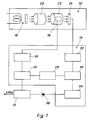
- This frequency standard essentially comprises an optical pumping device 10, a quartz oscillator 12 and an electronic circuit 14 comparing the resonance frequency of the atomic system with that of the oscillator for the servo of the latter.
- a population inversion is produced by optical pumping between the hyperfine levels of the ground state of atoms which are generally alkali metals such than potassium, sodium or rubidium.
- alkali metals such than potassium, sodium or rubidium.
- a conventional optical pumping arrangement is as follows.
- a cell 16 contains the Rb 87 isotope, the spectrum of which comprises the two hyperfine components A and B.
- the cell is illuminated by a lamp 18 with rubidium 87 through a filter 20 which contains the Rb 85 isotope, the absorption spectrum of which contains the hyperfine components a and b. Components A and a are practically coincidental, while components B and b are completely separate.
- This photoelectric current passes through a minimum when the frequency of the cavity excitation signal is exactly equal to the transition frequency.
- the crystal oscillator 12 produces a signal at 5 MHz. This signal is modulated in a phase modulator 26, at a relatively low frequency (typically of the order of 100 Hz) produced by a LF generator 28.
- the modulated signal is applied to a multiplier-synthesizer 30 to obtain a signal having the frequency of the stimulated emission of 6835 MHz. It is this signal which is used to excite the microwave cavity 22.
- the signal delivered by the photoelectric cell 24 is received in an amplifier 32, then applied to a phase comparator 34 which also receives a reference signal from the LF generator 28 so as to carry out a synchronous detection making it possible to detect whether the carrier frequency of the signal applied to cavity 22 is well centered on the frequency of the hyperfine transition (6835 MHz). Any offset results in an error signal at the output of the phase comparator 34.
- This signal is brought to an integrator 36, then used to control a variable capacitance 38 coupled to the oscillator 12 and which modifies the frequency of the latter. ci so as to maintain the multiplied frequency of quartz centered on the frequency of the hyperfine transition of rubidium.
- the standard frequency standard shown in Figure 1 has a cylindrical resonant cavity 22. This constitutes a limitation to the miniaturization of the frequency standard.
- the resonant cavity must have dimensions much greater than those of the cell so that the latter is subjected to an essentially axial field. Furthermore, the dimensions of the resonant cavity cannot be freely chosen, but on the contrary depend on the desired resonance frequency.
- FIG. 1 illustrates the general structure of a passive frequency standard of the gas cell type.
- Passive masers have the same type of limitation with regard to miniaturization.
- the optical pumping device 10 is replaced in passive masers by a device comprising a storage flask pierced with an opening and placed in a resonant cavity, a source of gas, such as atomic hydrogen, emitting a beam particles towards the opening of the storage tank, and a means of state selection placed on the path of the beam and which deflects particles which are not in a determined energy state. A population inversion is thus obtained in the storage flask.
- the device also includes a coupling loop for detecting the radiation emitted by the stimulated emission.
- Passive masers and gas cells therefore both have a resonant cavity, which limits the possibilities of miniaturization of these frequency standards.
- the invention aims to make the passive frequency standards more compact. This goal is achieved by a new structure of resonance means.
- the invention relates to a passive frequency standard comprising a storage means, subjected to a constant magnetic field, for storing atomic or molecular elements in the form of gas, an inversion means for producing in said means for storage of the elements having a first energy state, an interrogation means for stimulating at a determined frequency an energy level transition of the elements having the first energy level and a servo means for controlling the determined frequency interrogation means as a function of a signal dependent on the radiation emitted by said stimulated transition, this frequency standard being characterized in that the interrogation means comprises a helical resonator in which the storage means is placed.
- the resonant frequency of the propeller depends on its pitch p (or on its angle of attack ⁇ ), its diameter D and its length L. The same resonant frequency can thus be obtained with different propellers. This allows you to choose the most suitable propeller format in each case.
- the device according to the invention shown in FIG. 2 essentially comprises a lamp 40, a gas cell 42, a helical resonator 44 and a photoelectric cell 46.
- the lamp 40 contains mainly Rb 87, as well as argon at the pressure of 2 Torr serving as a starting gas. It is placed in an excitation coil 48 connected to a coaxial cable 50 which receives from a radiofrequency oscillator a signal with a frequency between about 100 and 150 MHz. A grid 52 is arranged around the assembly to prevent the radiation of this signal towards the gas cell and the photoelectric cell.
- a conventional heating circuit (not shown) comprising a heating resistor and a temperature sensor is used to maintain the lamp at its normal operating temperature.
- the gas cell 42 is placed opposite the lamp 40.
- this cell contains Rb 85 and Rb 87, as well as a buffer gas which can be a mixture of nitrogen at partial pressure of 8 Torr and methane at partial pressure of 5 Torr. It has a diameter of 16 mm and a length of 25 mm, giving a volume of approximately 5 cm 3.
- This cell constitutes both the isotopic filter and the absorption cell of the optical pumping device of FIG. 1.
- the atoms of Rb 85 located in the part of the cell 42 closest to the lamp 40 absorb the spectral component A of this, which carries out the filtering, and the atoms of Rb 87 located in the part of the cell 42 the farthest from the lamp 40 absorb the spectral component 8 thereof, which achieves optical pumping.
- the cell 42 is provided with conventional means (not shown) of heating and temperature control to maintain its temperature at its normal operating value.
- An alternative embodiment also advantageous for its reduced size consists in replacing the lamp 40 by a laser diode. Indeed, this one has a sufficiently narrow spectrum to contain only the spectral component 8. The isotopic filter which is used to absorb the component A is then no longer necessary. It is thus possible to reduce the size of cell 42.
- the cell 42 is protected from external magnetic fields by a magnetic screen 54.
- the cell 42 is subjected to a constant magnetic field created by a coil 56 and to a radiofrequency magnetic field created by an interrogation means which, according to the invention , comprises a helical resonator 44.
- This radiofrequency magnetic field is confined by a conductive screen 58.
- the resonant frequency is a function of the geometry of the propeller ⁇ .
- the distribution of the magnetic field in the helical resonator is shown diagrammatically in FIG. 3. It can be seen that this field is essentially axial. The filling factor of the resonator is therefore high because the cell can effectively occupy the entire volume of the resonator.
- the resonator can be applied to cell 42 as shown in Figure 2; this can be done for example by evaporation under vacuum of a metal.
- the resonator can also be placed around the cell without contacting it.
- the helical resonator 44 is excited by a microwave loop 62, arranged in a plane perpendicular to the axis of the propeller, and powered by an external oscillator via a connector 64 and a coaxial cable 66
- the loop 62 can include a step recovery diode (SRD) which multiplies the frequency of the signal delivered by the oscillator and which thus makes it possible to use a relatively low frequency oscillator.
- SRD step recovery diode
- the absorption of the spectral component B by the Rb atoms 87 of the cell 42 is detected by the photoelectric cell 46.
- the device according to the invention shown in Figure 2 has a volume of approximately 35 cm3 (diameter of 3 cm and length of 5 cm). This makes it possible to reduce the initial heating time (in English "warm up time") to approximately 1 min to reach a frequency error less than 5.10 ⁇ 10.
- the container formed by the envelope 60 and the cover 68 can advantageously be placed under vacuum. This provides several advantages over the prior art in which the lamp and the cell are not under vacuum.
- the heat flux due to convection between the lamp 40 and the cell 42 (the respective temperatures of which are for example 140 ° C. and 80 ° C.) is eliminated, which allows precise adjustment of the two temperatures.
- the vacuuming of the container allows the lamp and the cell to be brought closer without damage, which leads to a further reduction in volume of the container.
- the device according to the invention has a temperature range of - 55 ° C to + 75 ° C, with a frequency stability of 3.10 ⁇ 10 over this range, ie 2.3 10 ⁇ 12 / ° C.
- FIG. 2 shows a frequency standard with a gas cell comprising, in accordance with the invention, a helical resonator.
- This resonator can also be used in other passive frequency standards, such as a passive maser as shown diagrammatically in FIG. 4.
- This essentially comprises, in a vacuum container 70, a gas source 72, a state selector 74, a storage tank 76, a detection loop 78 and an interrogation loop 80.
- the storage tank 76 is isolated from external magnetic fields by a magnetic screen 82; it is subjected to a constant magnetic field generated by a coil 86 and to a magnetic field at the resonance frequency produced by a helical resonator 88 according to the invention and confined by a conductive screen 84.
- the loop 78 is connected outside the container 70 to a servo means 90 which slaves the frequency of an oscillator 92 whose signal is applied to the loop 80.
- the gas source 72 emits in the direction of the opening of the storage tank 76 a jet of atoms or molecules which are generally atomic hydrogen or an alkali metal.
- the state selector 74 generates a very inhomogeneous magnetic field which eliminates by divergence the atoms or molecules which are not in the desired energy state.
- the resonance frequency is adjusted to 1420 MHz by choosing suitable values for the pitch p, the diameter D and the length L of the propeller.
- the passive maser shown in Figure 4 operates on the same principle as the gas cell frequency standard shown in Figure 2. The only differences lie in the embodiment of the population inversion and in the nature of the means used.
Landscapes
- Physics & Mathematics (AREA)
- Electromagnetism (AREA)
- Spectroscopy & Molecular Physics (AREA)
- General Physics & Mathematics (AREA)
- Engineering & Computer Science (AREA)
- Plasma & Fusion (AREA)
- Optics & Photonics (AREA)
- Stabilization Of Oscillater, Synchronisation, Frequency Synthesizers (AREA)
Claims (14)
- Passives Frequenznormal, umfassend ein einem konstanten Magnetfeld ausgesetztes Speichermittel (42, 76) zum Speichern von atomaren oder molekularen gasförmigen Elementen, ein Inversionsmittel (72, 74) zum Erzeugen, in dem Speichermittel, von Elementen mit einem ersten Energiezustand, ein Abfragemittel (92) zum Stimulieren, mit einer bestimmten Frequenz, eines Energieniveauübergangs von Elementen, die das erste Energieniveau aufweisen, und ein Regelungsmittel (90) zum Steuern der bestimmten Frequenz des Abfragemittels in Funktion eines Signals, das abhängt von der durch den stimulierten Übergang ausgehenden Strahlung, welches passive Frequenznormal dadurch gekennzeichnet ist, daß das Abfragemittel einen helikoidalen Resonator (44, 88) umfaßt, in dessen Innerem das Speichermittel plaziert ist.
- Passives Frequenznormal nach Anspruch 1, dadurch gekennzeichnet, daß das Abfragemittel eine leitende Schleife (62, 80) umfaßt, durchflossen von einem periodischen elektrischen Signal, dessen Frequenz gleich der bestimmten Frequenz ist.
- Passives Frequenznormal nach Anspruch 1, dadurch gekennzeichnet, daß das Abfragemittel eine leitende Schleife und eine SRD-Diode in Serie umfaßt, durchflossen von einem periodischen elektrischen Signal, dessen Frequenz gleich der bestimmten Frequenz oder einem ganzzahligen Bruchteil der bestimmten Frequenz ist.
- Passives Frequenznormal nach einem der Ansprüche 1 bis 3 vom Gaszellentyp, dadurch gekennzeichnet, daß das Speichermittel eine Zelle (42) ist, die ein alkalisches Metall in Gasform enthält, und daß das Inversionsmittel eine Lichtquelle (40) umfaßt mit bestimmten spektralen Komponenten, die durch optisches Pumpen eine Inversion der Population in der Zelle erzeugt.
- Passives Frequenznormal nach Anspruch 4, dadurch gekennzeichnet, daß die Lichtquelle eine Laserdiode umfaßt.
- Passives Frequenznormal nach Anspruch 5, dadurch gekennzeichnet, daß das Speichermittel Rb 87 und ein Puffergas enthält.
- Passives Frequenznormal nach Anspruch 4, dadurch gekennzeichnet, daß die Lichtquelle eine Alkalimetalldampflampe und ein isotopisches Filter umfaßt.
- Passives Frequenznormal nach Anspruch 7, dadurch gekennzeichent, daß die Alkalimetalldampflampe eine Rb 87-Lampe ist, das Filter eine Rb 85-Zelle umfaßt und die das Speichermittel bildende Zelle Rb 87 enthält.
- Passives Frequenznormal nach Anspruch 8, dadurch gekennzeichnet, daß sie eine einzige Rb 85, Rb 87 und ein Puffergas enthaltende Zelle (42) umfaßt.
- Passives Frequenznormal nach einem der Ansprüche 4 bis 9, dadurch gekennzeichnet, daß die Lichtquelle, das Speichermittel und der helikoidale Resonator des Abfragemittels sich in einem Behältnis (56, 58) unter Vakuum befinden.
- Passives Frequenznormal nach einem der Ansprüche 4 bis 10, dadurch gekennzeichnet, daß das Regelungsmittel eine fotoelektrische Zelle (46) umfaßt, welche das Licht der bestimmten Spektralkomponente erfaßt, die das Speichermittel durchlaufen hat.
- Passives Frequenznormal nach einem der Ansprüche 1 bis 3 vom Typ des passiven Maser, dadurch gekennzeichnet, daß das Speichermittel (76) eine Öffnung umfaßt, und daß das Inversionsmittel eine Gasquelle (72) und einen Zustandsselektor (74) umfaßt zum Dirigieren der Elemente, welche das erste Energieniveau aufweisen in das Speichermittel.
- Passives Frequenznormal nach Anspruch 12, dadurch gekennzeichnet, daß die Gasquelle atomaren Wasserstoff imitiert.
- Passives Frequenznormal nach Anspruch 13, dadurch gekennzeichnet, daß das Regelungsmittel eine leitende Kopplungsschleife (78) zum Erfassen der Strahlung umfaßt, die von dem stimulierten Übergang ausgeht.
Applications Claiming Priority (2)
| Application Number | Priority Date | Filing Date | Title |
|---|---|---|---|
| FR8802593A FR2627909A1 (fr) | 1988-02-29 | 1988-02-29 | Etalon de frequence passif |
| FR8802593 | 1988-02-29 |
Publications (2)
| Publication Number | Publication Date |
|---|---|
| EP0330954A1 EP0330954A1 (de) | 1989-09-06 |
| EP0330954B1 true EP0330954B1 (de) | 1992-11-25 |
Family
ID=9363807
Family Applications (1)
| Application Number | Title | Priority Date | Filing Date |
|---|---|---|---|
| EP89102885A Expired - Lifetime EP0330954B1 (de) | 1988-02-29 | 1989-02-20 | Passivfrequenzstandard |
Country Status (6)
| Country | Link |
|---|---|
| US (1) | US4947137A (de) |
| EP (1) | EP0330954B1 (de) |
| JP (1) | JPH029228A (de) |
| DE (1) | DE68903578D1 (de) |
| FR (1) | FR2627909A1 (de) |
| IL (1) | IL89073A (de) |
Families Citing this family (17)
| Publication number | Priority date | Publication date | Assignee | Title |
|---|---|---|---|---|
| US5327105A (en) * | 1991-12-31 | 1994-07-05 | Westinghouse Electric Corp. | Gas cell for a miniaturized atomic frequency standard |
| FR2688640B1 (fr) * | 1992-03-16 | 1994-07-01 | Tekelec Neuchatel Time Sa | Etalon de frequence atomique. |
| US5517157A (en) * | 1993-04-27 | 1996-05-14 | Ball Corporation | Evanescent-field interrogator for atomic frequency standards |
| JP2725590B2 (ja) * | 1994-03-07 | 1998-03-11 | 日本電気株式会社 | ルビジウム原子発振器用光マイクロ波ユニット |
| WO1997023050A1 (en) * | 1994-11-17 | 1997-06-26 | Efratom Time And Frequency Products, Inc. | Method and apparatus for reduction of atomic frequency standard phase noise |
| US5491451A (en) * | 1994-11-17 | 1996-02-13 | Ball Corporation | Method and apparatus for reduction of atomic frequency standard phase noise |
| US5656189A (en) * | 1994-12-02 | 1997-08-12 | Efratom Time And Frequency Products, Inc. | Heater controller for atomic frequency standards |
| US5489821A (en) * | 1994-12-27 | 1996-02-06 | Ball Corporation | Lamp oscillator for atomic frequency standards |
| US5627497A (en) * | 1996-02-16 | 1997-05-06 | Efratom Time And Frequency Products, Inc. | Resonator package for atomic frequency standard |
| US6133800A (en) * | 1999-08-02 | 2000-10-17 | Datum Inc. | Subminiature microwave cavity |
| US6172570B1 (en) | 1999-08-23 | 2001-01-09 | Datum, Inc. | Laser light quantum system |
| RU2208906C1 (ru) * | 2002-04-17 | 2003-07-20 | Федеральное государственное унитарное предприятие "Российский институт радионавигации и времени" | Квантовый стандарт частоты (варианты) |
| RU2208905C1 (ru) * | 2002-04-17 | 2003-07-20 | Федеральное государственное унитарное предприятие "Российский институт радионавигации и времени" | Квантовый стандарт частоты |
| RU2312457C1 (ru) * | 2006-04-03 | 2007-12-10 | Институт лазерной физики СО РАН | Способ формирования опорного резонанса на сверхтонких переходах основного состояния атома щелочного металла |
| JP4240051B2 (ja) * | 2006-04-14 | 2009-03-18 | エプソントヨコム株式会社 | 原子発振器、温度検知手段の封止方法、及びルビジウム原子発振器 |
| RU2613566C1 (ru) * | 2016-03-14 | 2017-03-17 | Николай Александрович Демидов | Пассивный водородный стандарт частоты |
| US10364144B2 (en) * | 2017-11-17 | 2019-07-30 | Texas Instruments Incorporated | Hermetically sealed package for mm-wave molecular spectroscopy cell |
Family Cites Families (3)
| Publication number | Priority date | Publication date | Assignee | Title |
|---|---|---|---|---|
| US3071721A (en) * | 1957-02-13 | 1963-01-01 | Varian Associates | Optical absorption monitoring of oriented or aligned quantum systems |
| FR2477766A1 (fr) * | 1980-03-05 | 1981-09-11 | Anvar | Cellule d'absorption destinee a recevoir un gaz ou une vapeur rarefie, utilisable pour la stabilisation en frequence d'un oscillateur electrique et la spectrometrie |
| FR2506531A1 (fr) * | 1980-12-24 | 1982-11-26 | Ebauches Sa | Etalon atomique de frequence a pompage optique |
-
1988
- 1988-02-29 FR FR8802593A patent/FR2627909A1/fr not_active Withdrawn
-
1989
- 1989-01-25 IL IL89073A patent/IL89073A/xx unknown
- 1989-02-20 EP EP89102885A patent/EP0330954B1/de not_active Expired - Lifetime
- 1989-02-20 DE DE8989102885T patent/DE68903578D1/de not_active Expired - Lifetime
- 1989-02-27 JP JP1043378A patent/JPH029228A/ja active Pending
- 1989-02-28 US US07/316,835 patent/US4947137A/en not_active Expired - Fee Related
Also Published As
| Publication number | Publication date |
|---|---|
| FR2627909A1 (fr) | 1989-09-01 |
| IL89073A0 (en) | 1989-08-15 |
| US4947137A (en) | 1990-08-07 |
| IL89073A (en) | 1992-02-16 |
| EP0330954A1 (de) | 1989-09-06 |
| DE68903578D1 (de) | 1993-01-07 |
| JPH029228A (ja) | 1990-01-12 |
Similar Documents
| Publication | Publication Date | Title |
|---|---|---|
| EP0330954B1 (de) | Passivfrequenzstandard | |
| EP0561261B1 (de) | Atomfrequenzstandard | |
| EP2473885B1 (de) | Vorrichtung für atomuhr | |
| EP2473886B1 (de) | Vorrichtung für atomuhr | |
| CA1156840A (fr) | Etalon atomique de frequence a pompage optique | |
| Vernooy et al. | Cavity QED with high-Q whispering gallery modes | |
| EP1075651B1 (de) | Verfahren zur anregung eines optischen resonators zum nachweis von gasspuren | |
| EP2261758B1 (de) | Mit Helium-3 angetriebene Atomuhr | |
| EP0246146B1 (de) | Helium-Magnetometer, gepumpt durch einen Laser | |
| EP3338330B1 (de) | Terahertzlaser, terahertzquelle und verwendung solch eines terahertzlasers | |
| EP2498151B1 (de) | Armbanduhr mit Atomoszillator | |
| EP2498150A1 (de) | Atomuhr | |
| CH703111A1 (fr) | Dispositif pour horloge atomique. | |
| EP0732811A1 (de) | Atomfrequenzstandard | |
| CH703410A1 (fr) | Dispositif pour horloge atomique. | |
| WO1996025835A1 (fr) | Configuration de refroidissement radiatif d'atomes neutres a l'aide d'un rayonnement isotrope | |
| EP3227976B1 (de) | Bi-frequenz-laseremissionssystem | |
| FR2633389A1 (fr) | Gyroscope a laser a anneau | |
| EP1691242B1 (de) | Verfahren und Vorrichtung zum optischen Pumpen | |
| FR2506531A1 (fr) | Etalon atomique de frequence a pompage optique | |
| Bagayev et al. | A radiation source at 457 nm for high-resolution spectroscopy of a magnesium atom | |
| WO2013092811A1 (fr) | Procede de quantification d'atomes de gaz rare, notamment de xenon, et dispositif pour la mise en oeuvre d'un tel procede | |
| FR2604317A1 (fr) | Dephaseur commande optiquement | |
| FR2477766A1 (fr) | Cellule d'absorption destinee a recevoir un gaz ou une vapeur rarefie, utilisable pour la stabilisation en frequence d'un oscillateur electrique et la spectrometrie | |
| Djeu et al. | Dual-gas microcavity Raman sensor and method of use |
Legal Events
| Date | Code | Title | Description |
|---|---|---|---|
| PUAI | Public reference made under article 153(3) epc to a published international application that has entered the european phase |
Free format text: ORIGINAL CODE: 0009012 |
|
| AK | Designated contracting states |
Kind code of ref document: A1 Designated state(s): CH DE ES GB IT LI |
|
| 17P | Request for examination filed |
Effective date: 19900117 |
|
| 17Q | First examination report despatched |
Effective date: 19920427 |
|
| GRAA | (expected) grant |
Free format text: ORIGINAL CODE: 0009210 |
|
| AK | Designated contracting states |
Kind code of ref document: B1 Designated state(s): CH DE ES GB IT LI |
|
| PG25 | Lapsed in a contracting state [announced via postgrant information from national office to epo] |
Ref country code: IT Free format text: LAPSE BECAUSE OF FAILURE TO SUBMIT A TRANSLATION OF THE DESCRIPTION OR TO PAY THE FEE WITHIN THE PRE;WARNING: LAPSES OF ITALIAN PATENTS WITH EFFECTIVE DATE BEFORE 2007 MAY HAVE OCCURRED AT ANY TIME BEFORE 2007. THE CORRECT EFFECTIVE DATE MAY BE DIFFERENT FROM THE ONE RECORDED.SCRIBED TIME-LIMIT Effective date: 19921125 Ref country code: ES Free format text: THE PATENT HAS BEEN ANNULLED BY A DECISION OF A NATIONAL AUTHORITY Effective date: 19921125 Ref country code: DE Effective date: 19921125 Ref country code: GB Effective date: 19921125 |
|
| REF | Corresponds to: |
Ref document number: 68903578 Country of ref document: DE Date of ref document: 19930107 |
|
| PG25 | Lapsed in a contracting state [announced via postgrant information from national office to epo] |
Ref country code: LI Effective date: 19930228 Ref country code: CH Effective date: 19930228 |
|
| GBV | Gb: ep patent (uk) treated as always having been void in accordance with gb section 77(7)/1977 [no translation filed] |
Effective date: 19921125 |
|
| PLBE | No opposition filed within time limit |
Free format text: ORIGINAL CODE: 0009261 |
|
| STAA | Information on the status of an ep patent application or granted ep patent |
Free format text: STATUS: NO OPPOSITION FILED WITHIN TIME LIMIT |
|
| REG | Reference to a national code |
Ref country code: CH Ref legal event code: PL |
|
| 26N | No opposition filed |