EP0332331B1 - Thiazolidine diones comme agents hypoglycémiques - Google Patents
Thiazolidine diones comme agents hypoglycémiques Download PDFInfo
- Publication number
- EP0332331B1 EP0332331B1 EP89302012A EP89302012A EP0332331B1 EP 0332331 B1 EP0332331 B1 EP 0332331B1 EP 89302012 A EP89302012 A EP 89302012A EP 89302012 A EP89302012 A EP 89302012A EP 0332331 B1 EP0332331 B1 EP 0332331B1
- Authority
- EP
- European Patent Office
- Prior art keywords
- title product
- mmol
- compound
- hydrogen
- thiazolidine
- Prior art date
- Legal status (The legal status is an assumption and is not a legal conclusion. Google has not performed a legal analysis and makes no representation as to the accuracy of the status listed.)
- Expired - Lifetime
Links
- 0 *C(C(C(N1)=O)SC1=O)c1s*c(*)cc1 Chemical compound *C(C(C(N1)=O)SC1=O)c1s*c(*)cc1 0.000 description 5
- SBYYYVAMWBVIIX-UHFFFAOYSA-N O=C(C(c1ccccc1)O1)NC1=O Chemical compound O=C(C(c1ccccc1)O1)NC1=O SBYYYVAMWBVIIX-UHFFFAOYSA-N 0.000 description 1
Classifications
-
- C—CHEMISTRY; METALLURGY
- C07—ORGANIC CHEMISTRY
- C07D—HETEROCYCLIC COMPOUNDS
- C07D417/00—Heterocyclic compounds containing two or more hetero rings, at least one ring having nitrogen and sulfur atoms as the only ring hetero atoms, not provided for by group C07D415/00
- C07D417/02—Heterocyclic compounds containing two or more hetero rings, at least one ring having nitrogen and sulfur atoms as the only ring hetero atoms, not provided for by group C07D415/00 containing two hetero rings
- C07D417/06—Heterocyclic compounds containing two or more hetero rings, at least one ring having nitrogen and sulfur atoms as the only ring hetero atoms, not provided for by group C07D415/00 containing two hetero rings linked by a carbon chain containing only aliphatic carbon atoms
-
- A—HUMAN NECESSITIES
- A61—MEDICAL OR VETERINARY SCIENCE; HYGIENE
- A61P—SPECIFIC THERAPEUTIC ACTIVITY OF CHEMICAL COMPOUNDS OR MEDICINAL PREPARATIONS
- A61P3/00—Drugs for disorders of the metabolism
- A61P3/06—Antihyperlipidemics
-
- A—HUMAN NECESSITIES
- A61—MEDICAL OR VETERINARY SCIENCE; HYGIENE
- A61P—SPECIFIC THERAPEUTIC ACTIVITY OF CHEMICAL COMPOUNDS OR MEDICINAL PREPARATIONS
- A61P3/00—Drugs for disorders of the metabolism
- A61P3/08—Drugs for disorders of the metabolism for glucose homeostasis
-
- C—CHEMISTRY; METALLURGY
- C07—ORGANIC CHEMISTRY
- C07C—ACYCLIC OR CARBOCYCLIC COMPOUNDS
- C07C311/00—Amides of sulfonic acids, i.e. compounds having singly-bound oxygen atoms of sulfo groups replaced by nitrogen atoms, not being part of nitro or nitroso groups
- C07C311/15—Sulfonamides having sulfur atoms of sulfonamide groups bound to carbon atoms of six-membered aromatic rings
- C07C311/21—Sulfonamides having sulfur atoms of sulfonamide groups bound to carbon atoms of six-membered aromatic rings having the nitrogen atom of at least one of the sulfonamide groups bound to a carbon atom of a six-membered aromatic ring
-
- C—CHEMISTRY; METALLURGY
- C07—ORGANIC CHEMISTRY
- C07C—ACYCLIC OR CARBOCYCLIC COMPOUNDS
- C07C323/00—Thiols, sulfides, hydropolysulfides or polysulfides substituted by halogen, oxygen or nitrogen atoms, or by sulfur atoms not being part of thio groups
- C07C323/22—Thiols, sulfides, hydropolysulfides or polysulfides substituted by halogen, oxygen or nitrogen atoms, or by sulfur atoms not being part of thio groups containing thio groups and doubly-bound oxygen atoms bound to the same carbon skeleton
-
- C—CHEMISTRY; METALLURGY
- C07—ORGANIC CHEMISTRY
- C07D—HETEROCYCLIC COMPOUNDS
- C07D213/00—Heterocyclic compounds containing six-membered rings, not condensed with other rings, with one nitrogen atom as the only ring hetero atom and three or more double bonds between ring members or between ring members and non-ring members
- C07D213/02—Heterocyclic compounds containing six-membered rings, not condensed with other rings, with one nitrogen atom as the only ring hetero atom and three or more double bonds between ring members or between ring members and non-ring members having three double bonds between ring members or between ring members and non-ring members
- C07D213/04—Heterocyclic compounds containing six-membered rings, not condensed with other rings, with one nitrogen atom as the only ring hetero atom and three or more double bonds between ring members or between ring members and non-ring members having three double bonds between ring members or between ring members and non-ring members having no bond between the ring nitrogen atom and a non-ring member or having only hydrogen or carbon atoms directly attached to the ring nitrogen atom
- C07D213/24—Heterocyclic compounds containing six-membered rings, not condensed with other rings, with one nitrogen atom as the only ring hetero atom and three or more double bonds between ring members or between ring members and non-ring members having three double bonds between ring members or between ring members and non-ring members having no bond between the ring nitrogen atom and a non-ring member or having only hydrogen or carbon atoms directly attached to the ring nitrogen atom with substituted hydrocarbon radicals attached to ring carbon atoms
- C07D213/44—Radicals substituted by doubly-bound oxygen, sulfur, or nitrogen atoms, or by two such atoms singly-bound to the same carbon atom
- C07D213/46—Oxygen atoms
- C07D213/50—Ketonic radicals
-
- C—CHEMISTRY; METALLURGY
- C07—ORGANIC CHEMISTRY
- C07D—HETEROCYCLIC COMPOUNDS
- C07D277/00—Heterocyclic compounds containing 1,3-thiazole or hydrogenated 1,3-thiazole rings
- C07D277/02—Heterocyclic compounds containing 1,3-thiazole or hydrogenated 1,3-thiazole rings not condensed with other rings
- C07D277/20—Heterocyclic compounds containing 1,3-thiazole or hydrogenated 1,3-thiazole rings not condensed with other rings having two or three double bonds between ring members or between ring members and non-ring members
- C07D277/32—Heterocyclic compounds containing 1,3-thiazole or hydrogenated 1,3-thiazole rings not condensed with other rings having two or three double bonds between ring members or between ring members and non-ring members with hetero atoms or with carbon atoms having three bonds to hetero atoms with at the most one bond to halogen, e.g. ester or nitrile radicals, directly attached to ring carbon atoms
- C07D277/34—Oxygen atoms
-
- C—CHEMISTRY; METALLURGY
- C07—ORGANIC CHEMISTRY
- C07D—HETEROCYCLIC COMPOUNDS
- C07D417/00—Heterocyclic compounds containing two or more hetero rings, at least one ring having nitrogen and sulfur atoms as the only ring hetero atoms, not provided for by group C07D415/00
- C07D417/02—Heterocyclic compounds containing two or more hetero rings, at least one ring having nitrogen and sulfur atoms as the only ring hetero atoms, not provided for by group C07D415/00 containing two hetero rings
- C07D417/10—Heterocyclic compounds containing two or more hetero rings, at least one ring having nitrogen and sulfur atoms as the only ring hetero atoms, not provided for by group C07D415/00 containing two hetero rings linked by a carbon chain containing aromatic rings
Definitions
- the present invention relates to certain compounds of the formula (I), depicted below, having utility as hypoglycemic and hypocholesterolemic agents, methods for their use and pharmaceutical compositions containing them.
- hypoglycemia causes hypoglycemia, with effects ranging from mild abnormalities in blood glucose or coma, or even death.
- Treatment of non-insulin dependent diabetes mellitus usually consists of a combination of diet, exercise, oral agents, e.g., sulfonylureas, and in more severe cases, insulin.
- oral agents e.g., sulfonylureas
- insulin in more severe cases, insulin.
- hypoglycemics are unfortunately fraught with other toxic manifestations which limit their use. In any event, where one of these agents may fail in an individual case, another may succeed.
- Atherosclerosis a disease of the arteries, is recognized to be the leading cause of death in the United States and Western Europe.
- the pathological sequence leading to atherosclerosis and occlusive heart disease has been described in detail by Ross and Glomset in New England Journal of Medicine 295 , 369-377 (1976).
- the earliest stage in this sequence is the formation of "fatty streaks" in the carotid, coronary and cerebral arteries and in the aorta. These lesions are yellow in color due to the presence of lipid deposits found principally within smooth-muscle cells and in macrophages of the intima layer of the arteries and aorta. Cholesterol and cholesteryl ester account for most of this lipid.
- fibrous plaque which consists of accumulated intimal smooth muscle cells laden with lipid and surrounded by extra cellular lipid, collagen, elastin and proteoglycans. The cells plus matrix form a fibrous cap that covers a deeper deposit of cell debris and more extracellular lipid.
- the lipid is primarily free and esterified cholesterol.
- the fibrous plaque forms slowly, and is likely in time to become calcified and necrotic, advancing to the "complicated lesion" which accounts for the arterial occlusion and tendence toward mural thrombosis and arterial muscular spasm that characterize advanced atherosclerosis.
- CVD cardiovascular disease
- leaders of the medical profession have placed renewed emphasis on lowering plasma cholesterol levels, and low density lipoprotein cholesterol in particular, as an essential step in prevention of CVD.
- the upper limits of "normal” are now known to be significantly lower than heretofore appreciated.
- large segments of Western populations are now realized to be at high risk for development or progression of CVD because of this factor.
- Individuals who possess independent risk factors in addition to hyperlipidemia are at particularly high risk.
- independent risk factors include glucose intolerance, left ventricular hypertrophy hypertension, and being of the male sex.
- Cardiovascular disease is especially prevalent among diabetic subjects, at least in part because of the existence of multiple independent risk factors.
- Successful treatment of hyperlipidemia in the general population, and in diabetic subjects in particular is therefore of exceptional medical importance.
- the first step in recommended therapeutic regimens for hyperlipidemia is dietary intervention. While diet alone produces adequate response in some individuals, many others remain at high risk and must be treated further by pharmacological means. New drugs for the treatment of hyperlipidemia are, therefore, of great potential benefit for large numbers of individuals at high risk of developing CVD. Further, successful treatment of both the hyperlipidemia and hyperglycemia associated with the diabetic state with a single therapeutic agent is particularly desirable.
- U.S. Patent 4,367,234 discloses hypoglycemic oxazolidinediones of the formula in which the phenyl ring is generally mono- or multi-substituted in the ortho/meta positions. Notably, with the exception of the 4-fluorophenyl analog, the para-substituted derivatives are either inactive or possess a low level of hypoglycemic activity.
- U.S. Patent 4,342,771 discloses oxazolidinedione hypoglycemic agents of the formula limited to compounds in which Y is hydrogen or alkoxy, Y′ is hydrogen or alkyl and Y ⁇ is hydrogen or halo.
- U.S. Patent 4,617,312 discloses hypoglycemic thiazolidinediones of the formula where R c is lower alkyl, X a is F, Cl or Br, and Y a is hydrogen, chloro, lower alkyl or lower alkoxy. Notably, the compounds require ortho-substitution with an alkoxy group, and para-substitution is limited to hydrogen or halogen.
- Kawamatsu et al., U.S. Patent 4,340,605 disclose hypoglycemic compounds, also having plasma triglyceride lowering activity, of the formula wherein R e is a bond or lower alkylene and when R d is optionally substituted phenyl, L1 and L2 may each be defined as hydrogen.
- the boxed portion of the structural formula, which includes the ether oxygen represents an essential feature for useful activity in this series of compounds; Sohda et al., Chem. Pharm. Bull, Japan, vol. 30, pp. 3580-3600 (1982).
- the present invention is directed to compounds having the formula wherein the dotted line represents a bond or no bond;
- a and B are each independently CH or N, with the proviso that when A or B is N, the other is CH;
- X is S, SO, SO2, CH2, CHOH or CO;
- n is 0 or 1;
- Y is CHR1 or NR2, with the proviso that when n is 1 and Y is NR2, X is SO2 or CO;
- R, R1, R2 and R3 are each independently hydrogen or methyl;
- X1 and X2 are each independently hydrogen, methyl, trifluoromethyl, phenyl, benzyl, hydroxy, methoxy, phenoxy, benzyloxy, bromo, chloro or fluoro; a pharmaceutically-acceptable cationic salt thereof; or a pharmaceutically-acceptable acid addition salt
- the preferred compounds are:
- salts as the alkali metal salts, (e.g. sodium and potassium), alkaline earth metal salts (e.g. calcium and magnesium), aluminum salts, ammonium salts, and salts with organic amines such as benzathine (N,N'-dibenzylethylenediamine), choline, diethanolamine, ethylenediamine, meglumine (N-methylglucamine), benethamine (N-benzylphenethylamine) diethylamine, piperazine, tromethamine (2-amino-2-hydroxymethyl-1,3-propanediol) and procaine.
- An especially preferred such salt is the sodium salt.
- salts are intended to define but not limited to such salts as the hydrochloride, hydrobromide, sulfate, hydrogen sulfate, phosphate, hydrogen. phosphate, dihydrogenphosphate, acetate, succinate, citrate, methanesulfonate (mesylate) and p-toluenesulfonate (tosylate) salts.
- compositions for use in treating a hyperglycemic mammal or a hypercholesterolemic mammal which comprises a blood glucose lowering amount or a blood cholesterol lowering amount of a compound of formula (I) and a pharmaceutically-acceptable carrier.
- the invention further comprises a method of lowering blood glucose in a hyperglycemic mammal which comprises administering to said mammal a blood glucose lowering effective amount of a compound of formula (I); and a method of lowering blood cholesterol in a hypercholesterolemic mammal which comprises administering to said mammal a blood cholesterol lowering amount of a compound of the formula (I).
- the compounds of the formula (I) of the present invention are readily prepared.
- the compounds of the formula (I) wherein the dotted line represents a bond are prepared by reaction of thiazolidine-2,4-dione with an aldehyde or ketone of the formula wherein A, B, R, X, X1, X2, Y, Z and n are as defined above.
- approximately equimolar amounts of the reactants are heated in the presence of a mild base to provide the olefin of formula (I) wherein the dotted line represents a bond.
- the carbonyl group is preferably in protected form, e.g., as a ketal, preferably a C1-C4 dialkyl ketal, and most preferably as the cyclic ketal formed with ethylene glycol.
- suitable mild bases for the above reaction include the alkali metal and alkaline earth salts of weak acids such as the (C1-C12)alkyl carboxylic acids and benzoic acid; alkali metal and alkaline earth carbonates and bicarbonates such as calcium carbonate, magnesium carbonate, potassium bicarbonate; and tertiary amines such as pyridine, N-methylmorpholine, N-ethylpiperidine and the like.
- An especially preferred mild base is sodium acetate for reasons of economy and efficiency.
- this step may be carried out in the presence of a reaction-inert solvent, it is preferably carried out in the absence of solvent with excess sodium acetate as the base at a temperature which is sufficiently high to cause at least partial melting of the reaction mixture.
- a preferred such temperature is in the range of from 100 to 250°C, and especially preferred is a temperature of from 140 to 180°C.
- a 10-25% molar excess of one of the two reactants is employed, in order to force the reaction to completion within a reasonable period of time, generally less than 1 or 2 hours. In the present instance, it is generally preferred to use the readily available thiazolidine-2,4-dione in excess.
- reaction inert solvent refers to a solvent which does not interact with starting materials, reagents, intermediates or products in a manner which adversely affects the yield of the desired product.
- the aldehyde or ketone starting material (II) and thiazolidinedione are intimately mixed with a molar excess, preferably a 2-4 fold molar excess, of anhydrous sodium acetate and the mixture is heated at a temperature high enough to effect melting, generally about 140-170° C., at which temperature the reaction is substantially complete in from about 5 to 60 minutes.
- the desired olefin of formula (I) wherein the dotted line represents a bond is then isolated, for example, by mixing with water and filtration, to obtain the crude product, which is purified, if desired, e.g., by crystallization or by standard chromatographic methods.
- an alternative preferred method is to couple a compound of the formula (II) with thiazolidine-2,4-dione in the presence of a catalytic amount of a secondary amine, preferably pyrrolidine or piperidine, usually about 0.05 to 0.20 molar equivalents, in a reaction-inert solvent such as a lower alkanol (e.g., methanol, ethanol, n-propanol, isopropanol).
- a reaction-inert solvent such as a lower alkanol (e.g., methanol, ethanol, n-propanol, isopropanol).
- a reaction-inert solvent such as a lower alkanol (e.g., methanol, ethanol, n-propanol, isopropanol).
- a reaction-inert solvent such as a lower alkanol (e.g., methanol, ethanol, n-propanol, isopropanol).
- olefinic products are active hypoglycemic agents, but also serve as intermediates for preparation of the corresponding reduced compounds of formula (I) wherein the dotted line represents no bond.
- reduction of the above olefins may be carried out by employing a wide variety of reducing agents which are known to reduce carbon-to-carbon double bonds, the preferred methods employ hydrogen in the presence of a noble metal catalyst, zinc in acetic acid, or sodium amalgam or magnesium metal in methanol.
- X is CO
- hydrogenation over Pd/C in tetrahydrofuran under mild conditions is preferred.
- a convenient method for carrying out this transformation is to stir or shake a solution of the olefinic compound of the formula (I) wherein the dotted line represents a bond in a reaction-inert solvent under an atmosphere of hydrogen, or hydrogen mixed with an inert diluent such as nitrogen, in the presence of a noble metal hydrogenation catalyst.
- Suitable solvents for this reaction are those which substantially dissolve the starting compound but which do not themselves suffer hydrogenation or hydrogenolysis.
- solvents examples include ethers such as diethyl ether, tetrahydrofuran, dioxane and 1,2-dimethoxyethane; low molecular weight amides such an N , N -dimethylformamide, N - N -dimethylacetamide and N-methylpyrrolidone; and lower alkyl carboxylic acids such as formic, acetic, propionic and isobutyric acid.
- ethers such as diethyl ether, tetrahydrofuran, dioxane and 1,2-dimethoxyethane
- low molecular weight amides such an N , N -dimethylformamide, N - N -dimethylacetamide and N-methylpyrrolidone
- lower alkyl carboxylic acids such as formic, acetic, propionic and isobutyric acid.
- Especially preferred such solvents are tetrahydrofuran and glacial acetic acid.
- the hydrogen gas into the reaction medium is usually accomplished by carrying out the reaction in a sealed vessel containing the olefinic compound, solvent, catalyst and hydrogen.
- the pressure inside the reaction vessel can vary from about 1 to about 100 kg/cm2.
- the preferred pressure range, when the atmosphere inside the reaction vessel is substantially pure hydrogen, is from about 2 to about 5 kg/cm2.
- the hydrogenation is generally run at a temperature of from about 0° to about 60° C., and preferably from about 25° to about 50° C. Utilizing the preferred temperature and pressure values, hydrogenation generally takes place in a few hours, e.g., from about 2 hours to about 20 hours.
- the preferred noble metal catalysts used in this hydrogenation reaction are the type of agents known in the art for this kind of transformation; for example, palladium, platinum and rhodium.
- a palladium catalyst is preferred because such catalysts are not readily poisoned by sulfur.
- the catalyst is usually present in an amount from about 0.01 to about 25 weight-percent, and preferably from about 0.1 to about 10 weight-percent, based on the olefinic compound. It is often convenient to suspend the catalyst on an inert support; a particularly convenient catalyst is palladium suspended on an inert support such as carbon.
- the desired product of formula (I) wherein the dotted line is no bond is then isolated by standard methods, e.g., the catalyst is recovered by filtration, the solvent evaporated and the product purified, if desired, by well known methods such as crystallization or by chromatography.
- Another preferred method for reduction of the olefinic compounds of the formula (I) wherein the dotted line represents a bond is conventional sodium amalgam, usually at or about ambient temperature, as exemplified below.
- sodium amalgam will generally also reduce this group to CHOH.
- Another preferred method for reducing the olefinic double bond when present in the compound of the formula (I) is zinc in acetic acid, particularly valuable when the side chain contains no group (e.g. ketonic carbonyl, sulfonyl or sulfonyl [other than sulfonamides]) which are generally susceptible to reduction with this reagent.
- Suitable conditions are an excess of zinc dust, e.g., up to a 10-fold molar excess in glacial acetic acid at about 80-130° C., conveniently the reflux temperature of the reaction mixture at ambient pressure, as exemplified below.
- compounds wherein X is CO are also conveniently prepared by oxidation of those compounds wherein X is CHOH by means of the Jones oxidation.
- Those compounds wherein X is SO or SO2 (with Y as other than NR) or Z is CH2SO or CH2SO2 are preferably formed by suitable oxidation of the corresponding compounds where X is S or Z is CH2S.
- the sulfoxide is desired, the sulfide is preferably oxidized with at least one molar equivalent (usually a 2-3 fold molar excess) of sodium periodate in a reaction inert solvent such as aqueous methanol, generally at room temperature or below so as to avoid over oxidation.
- m-chloroperbenzoic acid can be used for this purpose, in a reaction-inert solvent such as methylene chloride or toluene, generally at a reduced temperature such as -10 to 10° C.
- a convenient oxidant is at least two molar equivalents of said m -chloroperbenzoic acid, otherwise in the same solvents and under the same mild conditions specified in the preceding sentence.
- a less expensive oxidant for formation of the sulfone is H2O2 in a reaction inert solvent such as acetic acid.
- an alternative synthetic route is to react thiazolidine-2,4-dione with a compound of the formula wherein A, B, R, X, X1, x2, Y, Z and n are as defined above, and X3 is a nucleophilic leaving group such as chloride, bromide, iodide or mesylate.
- reactants are generally used in substantially equimolar quantities, although 10-25% excess of readily available thiazolidine-2,4-dione is preferred in order to force the reaction to completion within a reasonable period of time.
- reaction-inert solvent such as tetrahydrofuran
- thiazolidine-2,4-dione prereacted with two molar equivalents of a strong base such as butyl lithium in order to preform the dianion.
- Salt formation is generally carried out at reduced temperature (e.g. -50 to -80°C.), the reactants mixed at an intermediate temperature, and reaction carried to completion at an elevated temperature (e.g. the reflux temperature of the reaction mixture). It will be evident to those skilled in the art that this method will be preferred only when there are no other reactive groups (e.g., unprotected OH or ketonic carbonyl) present in the compound of the formula (III).
- a synthetic route is to react a compound of the formula with a compound of the formula
- the pharmaceutically-acceptable cationic salts of the compounds of the present invention are readily prepared by reacting the acid forms with an appropriate base, usually one equivalent, in a co-solvent.
- Typical bases are sodium hydroxide, sodium methoxide sodium ethoxide, sodium hydride, potassium methoxide, magnesium hydroxide, calcium hydroxide, benzathine, choline, diethanolamine, piperazine and tromethamine.
- the salt is isolated by concentration to dryness or by addition of a non-solvent.
- salts are preferably prepared by mixing a solution of the acid with a solution of a different salt of the cation (sodium or potassium ethylhexanoate, magnesium oleate), employing a solvent (e.g., ethyl acetate) from which the desired cationic salt precipitates, or can be otherwise isolated by concentration and/or addition of a non-solvent.
- a solvent e.g., ethyl acetate
- the acid addition salts of the compounds of the present invention are readily prepared by reacting the base forms with the appropriate acid.
- the salt is of a monobasic acid (e.g., the hydrochloride, the hydrobromide, p-toluenesulfonate, acetate)
- the hydrogen form of dibasic acid e.g., the hydrogen sulfate, the succinate
- the dihydrogen form of a tribasic acid e.g., the dihydrogen phosphate, the citrate
- at least one molar equivalent and usually a molar excess of the acid is employed.
- salts as the sulfate, the hemisuccinate, the hydrogen phosphate or the phosphate
- the appropriate and exact chemical equivalents of acid will generally be used.
- the free base and the acid are usually combined in a co-solvent from which the desired salt precipitates, or can be otherwise isolated by concentration and/or addition of a non-solvent.
- the aldehydes and ketones of formula (II) are prepared by a variety of conventional methods; for example, by mild oxidation of the corresponding primary or secondary alcohol with reagents such as manganese dioxide or chromic acid under conditions known to produce aldehydes from primary alcohols and ketones from secondary alcohols; reaction of the corresponding aralkyl bromides with n-butyl lithium followed by N,N-dimethylformamide at -80° to -70° C.
- halides/mesylates of the formula (III) are also available by conventional methods, such as by the action of a suitable reagent (e.g., PBr3, CH3SO2Cl or the corresponding alcohol), halogenation of a corresponding methyl derivative, and so forth.
- a suitable reagent e.g., PBr3, CH3SO2Cl or the corresponding alcohol
- the present compounds of the formula (I) are readily adapted to clinical use as hypoglycemic agents.
- the activity required for this clinical use is defined by the test for hypoglycemic effect in ob/ob mice by the following procedure: Five to eight week old C57 BL/6J-ob/ob mice (obtained from Jackson Laboratory, Bar Harbor, Maine) were housed five per cage under standard animal care practices. After a one week acclimation period, the animals were weighed and 25 microliters of blood was collected via an ocular bleed prior to any treatment. The blood sample was immediately diluted 1:5 with saline containing 2.5 mg/ml sodium fluoride and 2% sodium heparin, and held on ice for metabolite analysis.
- mice were then dosed daily for five days with drug (5-50 mg/kg), a positive control (50 mg/kg) of ciglitazone; U.S. Patent 4,467,902; Sohda et al., Chem. Pharm. Bull., vol. 32, pp. 4460-4465, 1984), or vehicle. All drugs were administered in a vehicle consisting of 0.25% w/v methyl cellulose.
- the animals were weighed again and bled (via the ocular route) for blood metabolite levels. The freshly collected samples were centrifuged for two minutes at 10,000 xg at room temperature.
- the animals dosed with vehicle maintain substantially unchanged hyperglycemic glucose levels (e.g., 250 mg/dl), while positive control animals have depressed glucose levels (e.g., 130 mg/dl).
- Test compounds are reported in terms of % glucose normalization. For example, a glucose level which is the same as the positive control is reported as 100%.
- mice Female mice (strain C57Br/cd J), obtained from Jackson Laboratories, Bar Harbor, Maine, are used at age 8-12 weeks, following 2-4 weeks acclimation having free access to water and standard laboratory chow. Animals are divided randomly into three groups of 6-7 animals. All three groups are placed on a diet containing 0.75% cholesterol, 31% sucrose, 15.5% starch, 20% casein, 17% cellulose, 4.5% corn oil, 5% coconut oil, 0.25% cholic acid, 4% salts and 2% vitamin; permitted to feed ad lib for 18 days; and dosed daily at 9-11 a.m.
- the control group with 5 ml/kg of vehicle (0.1% aqueous methyl cellulose) and the test groups with the compound under study at a dose in the range of 0.1 to 20 mg/kg/day in vehicle.
- the animals are fasted overnight, starting at 5 p.m.
- a fifth and final dose of the compound is administered to the test groups and, three hours later, the animals are sacrificed by decapitation.
- Blood from the body trunk is collected and allowed to clot, and the serum assayed enzymatically, using an Abbott VP automated analyzer, for HDL cholesterol, LDL and VLDL cholesterol, and total cholesterol.
- the compounds of the formula (I) show favorable results in lowering cholesterol levels.
- the present compounds of the formula (I) are clinically administered to mammals, including man, via either the oral or the parenteral route. Administration by the oral route is preferred, being more convenient and avoiding the possible pain and irritation of injection. However, in circumstances where the patient cannot swallow the medication, or absorption following oral administration is impaired, as by disease or other abnormality, it is essential that the drug be administered parenterally.
- the dosage is in the range of about 0.10 to about 50 mg/kg body weight of the subject per day, preferably about 0.10 to about 10 mg/kg body weight per day administered singly or as a divided dose.
- the optimum dosage for the individual subject being treated will be determined by the person responsible for treatment, generally smaller doses being administered initially and thereafter increments made to determine the most suitable dosage. This will vary according to the particular compound employed and with the subject being treated.
- the compounds can be used in pharmaceutical preparations containing the compound, or pharmaceutically-acceptable acid salt thereof, in combination with a pharmaceutically-acceptable carrier or diluent.
- suitable pharmaceutically-acceptable carriers include inert solid fillers or diluents and sterile aqueous or organic solutions.
- the active compound will be present in such pharmaceutical compositions in amounts sufficient to provide the desired dosage amount in the range described above.
- the compounds can be combined with a suitable solid or liquid carrier or diluent to form capsules, tablets, powders, syrups, solutions, suspensions and the like.
- the pharmaceutical compositions may, if desired, contain additional components such as flavorants, sweeteners, excipients and the like.
- the compounds can be combined with sterile aqueous or organic media to form injectable solutions or suspensions.
- injectable solutions or suspensions For example, solutions in sesame or peanut oil, aqueous propylene glycol and the like can be used, as well as aqueous solutions of water-soluble pharmaceutically-acceptable acid addition salts of the compounds.
- the injectable solutions prepared in this manner can then be administered intravenously, intraperitoneally, subcutaneously, or intramuscularly, with intramuscular administration being preferred in man.
- 2,4-Thiazolidinedione (11 mmol, 1.3 g) was dissolved in tetrahydrofuran (50 ml) and cooled to -78° C.
- N-Butyllithium (22 mmol, 13.8 ml of 1.6M in hexane) was added over 15 minutes. The cooling bath was removed and the reaction mixture was stirred for 20 minutes.
- N-Benzyl-N-methyl-4-(bromomethyl)benzenesulfonamide (10 mmol, 3.5 g) dissolved in tetrahydrofuran (50 ml) was added over 20 minutes.
- the reaction mixture was heated to reflux for 15 hours, cooled and diluted with water (50 ml) and 6N HCl (10 ml). The mixture was extracted with ethyl acetate (75 ml) and the organic layer was dried (Na2SO4) and removed in vacuo . The residue was purified on silica gel using 1:1 hexane:ethyl acetate to afford 3.0 g of title product as a gum; MS 390 (m+), 269, 205.
- Example 2 By the method of Example 2, the product of the preceding Example (3.7 mmol, 1.5 g) was converted, without recrystallization, to present title product, 0.74 g; m.p. 279° C. (dec.). Analysis calculated for C19H19O4N2S2Na ⁇ 0.33H2O: C, 52.77; H, 4.58; N, 6.48%. Found: C, 52.67; H, 4.52; N, 6.39%.
- Example 2 By the method of Example 2, the product of the preceding Example (0.15 mmol, 50 mg) was converted to present title product, 40 mg; m.p. 236° C. (dec.). Analysis calculated for C18H14O2NS2Na: C, 59.48; H, 3.88; N, 3.85%. Found: C, 59.95; H, 4.16; N, 3.79%.
- Example 5 Title product of Example 5 (4.1 mmol, 1.4 g) and zinc dust (40 mmol, 2.6 g) were heated to reflux in acetic acid (50 ml) for 15 minutes. The reaction mixture was filtered and the solvent was removed in vauco . The residue was purified on silica gel using hexane:ethyl acetate (2:1) plus 5% acetic acid as eluant to afford 230 mg of present title product; m.p. 58-65° C. Analysis calculated for C18H17NO2S2: C, 62.97; H, 4.99; N, 4.08%. Found: C, 62.94; H, 5.13; N, 3.91%.
- the corresponding sodium salt was prepared according to the method of Example 2; 215 mg from 230 mg; m.p. greater than 250° C.
- Example 2 By the method of Example 2, the title product of the preceding Example (3.6 mmol, 1.3 g) was converted, without recrystallization, to 1.14 g of present title product; m.p. 205° C. (dec.). Analysis calculated for C18H16O3NS2Na: C, 56.67; H, 4.23; N, 3.67%. Found: C, 56.40; H, 4.25; N, 3.61%.
- Example 2 By the method of Example 2, without recrystallization, the product of the preceding Example (1.33 mmol, 500 mg) was converted to 380 mg of present title product; m.p. 288° C. (dec.). Analysis calculated for C18H16O4NS2Na: C, 54.39; H, 4.06; N, 3.52%. Found: C, 53.53; H, 4.19; N, 3.36%.
- the corresponding sodium salt was prepared according to the method of Example 2.
- Example 7 By the method of Example 7, the title product of the previous Example was converted to present chromatographically purified title product as an oil. Analysis calculated for C19H19O2NS2: C, 63.86; H, 5.36; N, 3.92%. Found: C, 63.67; H, 5.42; N, 3.94%.
- the corresponding sodium salt was prepared according to the method of Example 2, without recrystallization; m.p. 260-265° C.
- the corresponding sodium salt was prepared according to the method of Example 2.
- Example 13 Title product of Example 13 (1.41 mmol, 500 mg) was added to a solution of m -chloroperbenzoic acid (3.10 mmol, 535 mg) slurried in methylene chloride (15 ml) at 0° C. The reaction mixture was stirred for 1 hour at room temperature. The mixture was diluted with CHCl3 (60 ml), washed with 10% Na2SO4 (20 ml), saturated NaHCO3 (2 x 20 ml) and saturated NaCl (20 ml), dried (Na2SO4), and solvent removed in vacuo . The crude solid was recrystallized from acetic acid to afford present title product as yellow crystals; m.p. 201-202° C. Analysis calculated for C19H17O4NS2: C, 58.89; H, 4.42; N, 3.62%. Found: C, 58.65; H, 4.63; N, 3.46%.
- the corresponding sodium salt was prepared, without recrystallization, according to the method of Example 2; m.p. 269° C. (dec.).
- Example 2 By the method of Example 2, without recrystallization, the title product of the preceding Example was converted to present title product in similar yield; m.p. greater than 240° C. Analysis calculated for C18H13ClNO2S2Na: C, 54.33; H, 3.29; N, 3.52%. Found: C, 54.34; H, 3.45; N, 3.31%.
- Example 7 By the method of Example 7, the title product of Example 17 (9.84 mmol, 3.7 g) was reduced to present title product, chromatographed on silica gel using 4:1 hexane:ethyl acetate as eluant, initially isolating the free acid form of title product as an oil (1.3 g) which solidified on pumping under vacuum; m.p. 100° C.
- the free acid was converted to title sodium salt by dissolving the free acid (2.14 mmol, 0.875 g) in 10 ml CH3OH and 10 ml of ethyl acetate with warming, adding 2.14 ml of 1M NaOC2H5 in ethanol (2.14 mmol), stirring 30 minutes, stripping away solvent and triturating the residue with ether to yield 0.8 g of title product; m.p. greater than 250° C. Analysis calculated for C18H15ClNO2S2Na: C, 54.06; H, 3.78; N, 3.50%. Found: C, 53.79; H, 3.76; N, 3.39%.
- Example 10 By the method of Example 10, the title product of Example 17 (23.2 mmol, 5 g) was oxidized to 2.4 g of present title product following recrystallization from ethyl acetate; m.p. 242-243° C.
- Free acid (1.3 g) was converted to 1.36 g of the corresponding sodium salt by the method used in the preceding Example; m.p. greater than 250° C.
- Example 11 By the method of Example 11, the title product of the preceding Example (1.7 g) was hydrogenated to produce present title product, purified by chromatography on silica gel using gradient elution with 4:1, 3:1 and finally 2:1 hexane:ethyl acetate to yield 0.93 g of the purified free acid form title product as a white solid; m.p. 168-171° C.
- Example 2 By the method of Example 2, without recrystallization, the title product of the preceding Example was converted to present title product in similar yield; m.p. greater than 250° C.
- Example 7 By the method of Example 7, the title product of Example 22 (1.31 g) gave, after recrystallization from ether:hexane, 0.35 g of present title product; m.p. 102-103° C. Analysis calculated for C17H15NO2S2: C, 61.97; H, 4.59; N, 4.25%. Found: C, 62.24; H, 4.51; N, 4.16%.
- the corresponding sodium salt was prepared according to Example 2; m.p. greater than 250° C.
- Example 10 By the method of Example 10, the title product of the preceding Example (2.0 g) was converted, after recrystallization from ethyl acetate, to 1.14 g of the free acid form of present title product; m.p. 175° C.
- the sodium salt was prepared according to Example 19 in similar yield; m.p. greater than 250° C. Analysis calculated for C17H14NO4S2Na: C, 53.25; H, 3.68; N, 3.65%. Found: C, 55.36; H, 3.74; N, 3.58%.
- Example 7 By the method of Example 7, the title product of Example 26 (1.8 g) was reduced to 0.49 g of present title product, recrystallized from 1:1 hexane:isopropyl ether; m.p. 88-89° C. Analysis calculated for C19H19O2NS2: C, 63.83; H, 5.36; N, 3.92%. Found: C, 64.27; H, 5.43; N, 3.87%.
- Example 2 By the method of Example 2, without recrystallization, the title product of the preceding Example (1.5 g) was converted to 1.09 g of present title product; m.p. 286° C. (dec.).
- Example 8 By the method of Example 8, the title product of Example 28 (3.9 mmol, 1.4 g) was converted to 1.2 g of chromatographed free acid form title product as a gum; tlc Rf 0.3 (ethyl acetate). The latter was converted to 1.29 g of sodium salt according to the method of Example 2 (without recrystallization); m.p. 210° C. (dec.). Analysis calculated for C19H18O3NS2Na: C, 57.70; H, 4.59; N, 3.54%. Found: C, 57.31; H, 4.57; N, 3.42%.
- Example 10 By the method of Example 10, the title product of Example 26 (4.0 mmol, 1.42 g) was converted to 1.1 g of present title product recrystallized from acetic acid; m.p. 224-225° C. Analysis calculated for C19H17O4NS2: C, 58.89; H, 4.42; N, 3.62%. Found: C, 59.16; H, 4.24; N, 3.55%.
- Example 11 By the method of Example 11, the title product of Example 31 (1.0 g) was converted to 0.85 g of present title product purified by silica gel chromatography using 1:1 hexane:ethyl acetate as eluant, initially isolated as an oil which crystallized on standing; m.p. 126-127° C. Analysis calculated for C19H19O4NS2: C, 58.59; H, 4.92; N, 3.60%. Found: C, 58.86; H, 5.00; N, 3.45%.
- Example 2 By the method of Example 2, without recrystallization, the title product of the preceding Example (1.54 mmol, 0.60 g) was converted to 0.52 g of present title product; m.p. 288° C. (dec.). Analysis calculated for C19H18O4NS2Na: C, 55.46; H, 4.41; N, 3.40%. Found: C, 55.53; H, 4.38; N, 3.13%.
- Example 2 By the method of Example 2, without recrystallization, the title product of the preceding Example (1.54 mmol, 0.525 g) was converted to 0.50 g of present title product; m.p. 270° C. (dec.). Analysis calculated for C18H14O2NS2Na: C, 59.48; H, 3.88; N, 3.85%. Found: C, 59.24; H, 3.85; N, 3.72%.
- Example 7 title product of Example 35 (2.9 mmol, 1.0 g) was converted to 0.26 g of the purified free acid form of present title product, isolated from the chromatography as a gum. Analysis calculated for C18H17O2NS2: C, 62.94; H, 4.99; N, 4.08%. Found: C, 62.73; H, 5.01; N, 3.95%.
- the sodium salt was formed according to the method of Example 2; m.p. 285° C. (dec.). Analysis calculated for C18H16O4NS2Na: C, 54.39; H, 4.06; N, 3.52%. Found: C, 54.11; H, 4.20; N, 3.40%.
- Example 44 The product of Example 44 (310 mg, 0.78 mmol) was dissolved in THF (5 ml) and 3M sulfuric acid (3 ml). After 2 hours the solution was diluted with water (75 ml) and extracted with ethyl acetate (2 x 75 ml). The combined extracts were washed with water (2 x 50 ml), brine (50 ml), dried over sodium sulfate and concentrated in vacuo , leaving present title product as a yellow gummy foam (247 mg, 90%).
- the sodium salt was prepared as described for Example 42 and obtained as an orange solid; m.p. 108° C. (dec.). Analysis calculated for C19H14NO3SNa ⁇ 1 ⁇ 2H2O: C, 59.36; H, 3.93; N, 3.64%. Found: C, 59.07; H, 4.12; N, 3.43%.
- Example 52 By the same method, the product of Example 52 is converted to (E)-5-[4-(3-(4-hydroxyphenyl)-2-propenoyl)benzyl]thiazolidine-2,4-dione.
- the sodium salt was prepared as described for Example 42 and obtained as a yellow solid; m.p. 198-200° C.
- the sodium salt was prepared as described in Example 42; m.p. 275-280° C.
- the sodium salt was prepared as described in Example 42; m.p. 250° C. (dec.).
- the sodium salt was prepared as described in Example 42; m.p. greater than 230° C.
- the sodium salt was prepared as described in Example 2; m.p. 274° C. (dec.).
- the sodium salt was prepared in 77% yield as described in Example 42; m.p. 249-254° C.
- the sodium salt was prepared as described in Example 42; m.p. 286° C.
- the sodium salt was prepared as described in Example 42; m.p. 207-209° C.
- title product of Preparation 21 was converted to present title product in 96% yield; m.p. greater than 250° C.
- Example 66 To the title product of Example 66 (2.80 g, 8.3 mmol) in methanol (100 ml) was added 3% sodium amalgam (100 g) and the reaction mixture was stirred for 4 hours at ambient temperature. The organic solution was then decanted, concentrated, diluted with water (100 ml) and acidified to pH 2 with 2N HCl. The aqueous was extracted with CH2Cl2 (3 x 50 ml), dried and concentrated to give 796 mg of a colorless oil. Purification via radial chromatography (2% CH3OH in CH2Cl2 gave the free acid form of present title product (178 mg, 6%) isolated as an oil.
- Example 69 By the method of Example 69, the title product of Example 68 was converted to present chromatographed title product as an oil in 34% yield.
- Benzaldehyde (0.78 mol, 82.8 g) and 2,4-thiazolidinedione (0.85 mol, 100 g) were heated to reflux in a mixture of pyridine (215 ml) and dimethylformamide (400 ml) for 18 hours.
- the reaction mixture was cooled to 55° C. and diluted with hexane (360 ml) and water (900 ml) and stirred for 1 hour after cooling to room temperature.
- the product was collected to afford 175 g of pale yellow solid; m.p. 246-248° C.
- the ether was washed with water (2 x 75 ml, 1N NaOH (2 x 50 ml), water (2 x 50 ml), and saturated NaCl (50 ml), dried (Na2SO4) and removed in vacuo .
- the crude oil was purified on silica gel using hexane:ethyl acetate (9:1) to afford 5.1 g of title product as a yellow oil; tlc Rf 0.33 (1:5 ethyl acetate:hexane).
- Phenol (15.0 mmol, 1.41 g), alpha,4-dibromoacetophenone (15.0 mmol, 4.2 g) and potassium carbonate (30.0 mmol, 4.15 g) were heated to reflux in acetone (50 ml) for 8 hours. The solution was cooled, concentrated, diluted with water (50 ml) and extracted with ether (2 x 100 ml).
Landscapes
- Chemical & Material Sciences (AREA)
- Organic Chemistry (AREA)
- Health & Medical Sciences (AREA)
- Diabetes (AREA)
- Pharmacology & Pharmacy (AREA)
- General Health & Medical Sciences (AREA)
- Hematology (AREA)
- Chemical Kinetics & Catalysis (AREA)
- General Chemical & Material Sciences (AREA)
- Medicinal Chemistry (AREA)
- Nuclear Medicine, Radiotherapy & Molecular Imaging (AREA)
- Bioinformatics & Cheminformatics (AREA)
- Engineering & Computer Science (AREA)
- Life Sciences & Earth Sciences (AREA)
- Animal Behavior & Ethology (AREA)
- Obesity (AREA)
- Public Health (AREA)
- Veterinary Medicine (AREA)
- Emergency Medicine (AREA)
- Endocrinology (AREA)
- Pharmaceuticals Containing Other Organic And Inorganic Compounds (AREA)
- Plural Heterocyclic Compounds (AREA)
- Thiazole And Isothizaole Compounds (AREA)
- Organic Low-Molecular-Weight Compounds And Preparation Thereof (AREA)
- Treatments For Attaching Organic Compounds To Fibrous Goods (AREA)
- Detergent Compositions (AREA)
- Developing Agents For Electrophotography (AREA)
Claims (13)
- Procédé de production d'un composé répondant à la formule

A et B représentent chacun indépendamment un groupe CH ou N, sous réserve que, lorsque A ou B représente N, l'autre représente un groupe CH ;
X représente S, un groupe SO, SO₂, CH₂, CHOH ou CO ;
n est égal à 0 ou 1 ;
Y représente un groupe CHR¹ ou NR², sous réserve que, lorsque n est égal à 1 et Y représente un groupe NR², X représente un groupe SO₂ ou CO ;
Z représente un groupe CHR, CH₂CH₂, CH=CH,
R, R¹, R², et R³ représentent chacun indépendamment l'hydrogène ou un groupe méthyle ; et
X¹ et X² représentent chacun indépendamment l'hydrogène, un groupe méthyle trifluorométhyle, phényle, benzyle, hydroxy, méthoxy, phénoxy, benzyloxy, bromo, chloro ou fluoro ;
d'un de ses sels cationiques pharmaceutiquement acceptables ;
ou
d'un de ses sels d'addition d'acides pharmaceutiquement acceptables lorsque A ou B représente N ;
qui comprend(a) lorsque la ligne discontinue représente une liaison, la condensation de la thiazolidine-2,4-dione avec un aldéhyde ou une cétone de formule (b) lorsque la ligne discontinue représente une absence de liaison, la réduction d'un composé préformé de formule (I) dans laquelle la ligne discontinue représente une liaison ;(c) lorsque la ligne discontinue représente une absence de liaison, la réaction de la thiazolidine-2,4-dione avec un composé de formule
 (d) lorsque n est égal à 1, Y représente un groupe NR² et X représente un groupe SO₂ ou CO, la réaction d'un composé de formule
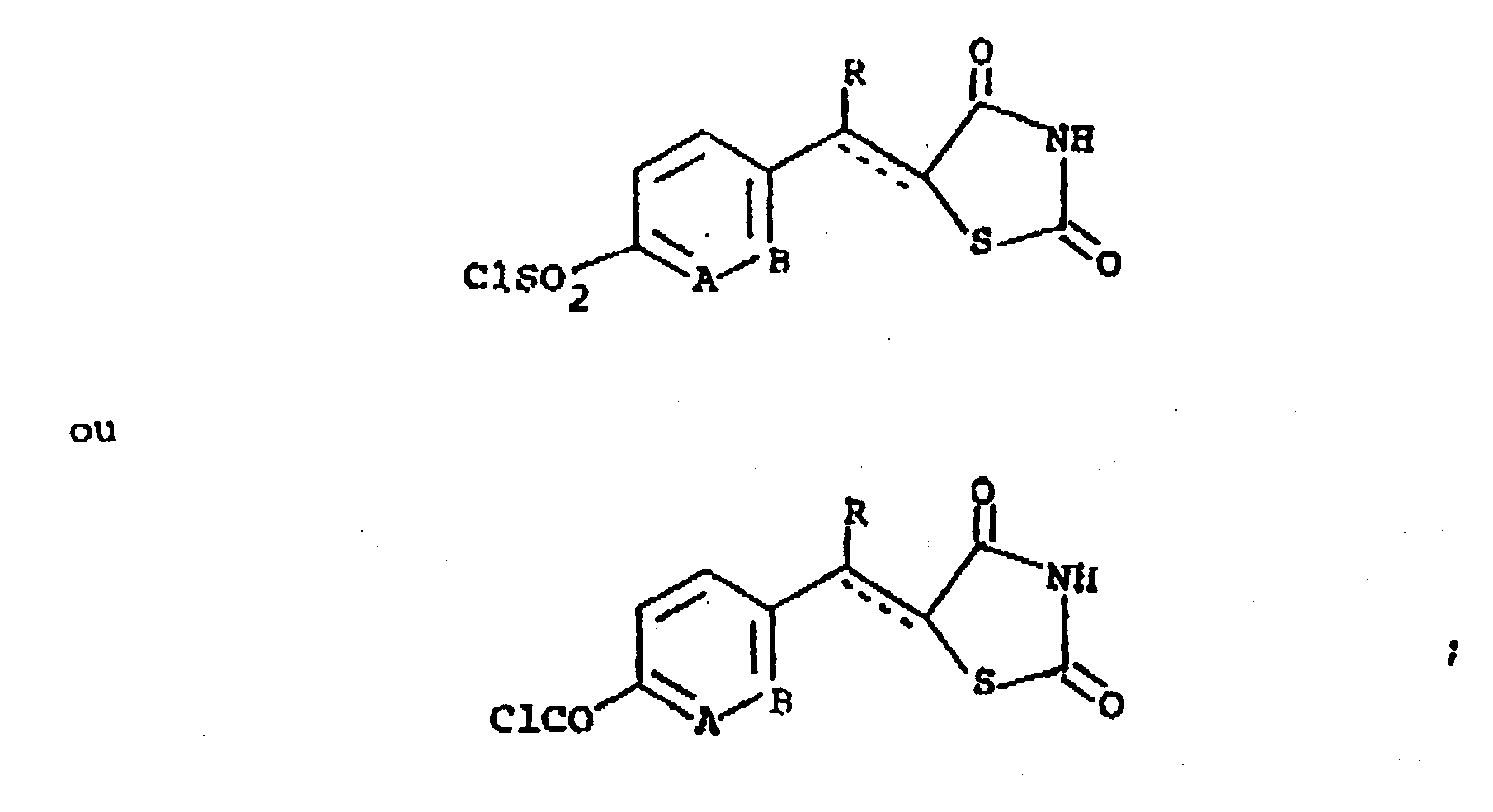 (e) lorsque Z représente un groupe CH=CH, n est égal à 0 et X représente un groupe CO, la réaction d'un composé de formule
 (f) la transformation d'un composé préformé de formule (I) en un sel cationique pharmaceutiquement acceptable ;(g) la transformation d'un composé préformé de formule (I) dans laquelle A ou B représente N en un sel d'addition d'acides pharmaceutiquement acceptable ;(h) la réduction d'un composé préformé de formule (I) dans laquelle X représente un groupe CO cétonique ou CHOH pour former un composé de formule (I) dans laquelle X représente un groupe CHOH ou CH₂ ;(i) la réduction d'un composé préformé de formule (I) dans laquelle Z représente CH=CH pour former un composé de formule (I) dans laquelle Z représente un groupe CH₂CH₂ ;(j) l'oxydation d'un composé préformé de formule (I) dans laquelle X représente une groupe CHOH pour former un composé de formule (I) dans laquelle X représente un groupe CO ; ou(k) l'oxydation d'un composé préformé de formule (I) dans laquelle X représente S ou Z représente un groupe SCH₂ pour former un composé de formule (I) dans laquelle X représente un groupe SO ou SO₂ ou bien Z représente un groupe SOCH₂ ou SO₂CH₂.
 - Procédé suivant la revendication 1, dans lequel la ligne discontinue représente une absence de liaison, A et B représentent chacun un groupe CH, X représente un groupe CO, n est égal a 0 et R représente l'hydrogène.
- Procédé suivant la revendication 2, dans lequel Z représente un groupe CH₂CH₂, X² représente l'hydrogène et X¹ représente l'hydrogène, un groupe 4-benzyloxy ou 4-phényle.
- Procédé suivant la revendication 2, dans lequel X² représente l'hydrogène, Z représente un groupe CH=CH ayant la géométrie trans autour de la double liaison, et X¹ représente l'hydrogène, un groupe 2-méthoxy, 4-benzyloxy ou 4-méthoxy.
- Procédé suivant la revendication 1, dans lequel la ligne discontinue représente une absence de liaison, A et B représentent chacun un groupe CH, X représente S, n est égal à 0, Z représente un groupe CH₂CH₂, X¹ et X² représentent chacun l'hydrogène et R représente un groupe méthyle ou l'hydrogène.
- Procédé suivant la revendication 1, dans lequel A et B représentent chacun un groupe CH, X représente un groupe SO₂, n est égal à 0, Z représente un groupe CH₂CH₂ et R, X¹ et X² représentent chacun l'hydrogène.
- Procédé suivant la revendication 1, dans lequel la ligne discontinue représente une absence de liaison, A et B représentent chacun un groupe CH, X représente SO₂, n est égal à 0, Z représente un groupe CH₂CH₂, R et X² représentent chacun l'hydrogène et X¹ représente un groupe 4-chloro.
Priority Applications (1)
| Application Number | Priority Date | Filing Date | Title |
|---|---|---|---|
| AT89302012T ATE101394T1 (de) | 1988-03-08 | 1989-02-28 | Hypoglykaemische thiazolidindion-derivate. |
Applications Claiming Priority (2)
| Application Number | Priority Date | Filing Date | Title |
|---|---|---|---|
| WOPCT/US88/00744 | 1988-03-08 | ||
| PCT/US1988/000744 WO1989008650A1 (fr) | 1988-03-08 | 1988-03-08 | Agents hypoglycemiques de thiazolidinedione |
Publications (3)
| Publication Number | Publication Date |
|---|---|
| EP0332331A2 EP0332331A2 (fr) | 1989-09-13 |
| EP0332331A3 EP0332331A3 (en) | 1989-11-29 |
| EP0332331B1 true EP0332331B1 (fr) | 1994-02-09 |
Family
ID=22208590
Family Applications (1)
| Application Number | Title | Priority Date | Filing Date |
|---|---|---|---|
| EP89302012A Expired - Lifetime EP0332331B1 (fr) | 1988-03-08 | 1989-02-28 | Thiazolidine diones comme agents hypoglycémiques |
Country Status (17)
| Country | Link |
|---|---|
| US (1) | US5061717A (fr) |
| EP (1) | EP0332331B1 (fr) |
| JP (1) | JP2569167B2 (fr) |
| KR (1) | KR910005415B1 (fr) |
| AT (1) | ATE101394T1 (fr) |
| AU (1) | AU593758B2 (fr) |
| CA (1) | CA1328872C (fr) |
| DE (1) | DE68912952T2 (fr) |
| DK (1) | DK108289A (fr) |
| FI (1) | FI904414A7 (fr) |
| IL (1) | IL89478A0 (fr) |
| MY (1) | MY104958A (fr) |
| NO (1) | NO903862D0 (fr) |
| NZ (1) | NZ228248A (fr) |
| PT (1) | PT89913B (fr) |
| WO (1) | WO1989008650A1 (fr) |
| ZA (1) | ZA891682B (fr) |
Cited By (1)
| Publication number | Priority date | Publication date | Assignee | Title |
|---|---|---|---|---|
| US6258832B1 (en) | 1997-03-20 | 2001-07-10 | Roche Diagnostics Gmbh | Method for producing thiazolidinediones, and new thiazolidinediones |
Families Citing this family (70)
| Publication number | Priority date | Publication date | Assignee | Title |
|---|---|---|---|---|
| MX15171A (es) * | 1988-03-08 | 1993-05-01 | Pfizer | Derivados de tiazolidinodiona hipoglicemicos |
| GB8910639D0 (en) * | 1989-05-09 | 1989-06-21 | Beecham Group Plc | Novel compounds |
| GB8919434D0 (en) * | 1989-08-25 | 1989-10-11 | Beecham Group Plc | Novel compounds |
| US5143930A (en) * | 1990-02-07 | 1992-09-01 | Sankyo Company, Limited | Thiazolidine derivatives with anti-diabetic activity, their preparation and their use |
| US5037842A (en) * | 1990-06-05 | 1991-08-06 | Pfizer Inc. | Oxa- and thiazolidinedione hypoglycemic and hypocholesterolemic agents |
| US5089514A (en) * | 1990-06-14 | 1992-02-18 | Pfizer Inc. | 3-coxazolyl [phenyl, chromanyl or benzofuranyl]-2-hydroxypropionic acid derivatives and analogs as hypoglycemic agents |
| FI930772A0 (fi) * | 1990-08-23 | 1993-02-22 | Pfizer | Hydroxiureaderivat som saenker glugosnivao i blodet |
| GB9023584D0 (en) * | 1990-10-30 | 1990-12-12 | Beecham Group Plc | Novel compounds |
| JPH04210683A (ja) * | 1990-12-06 | 1992-07-31 | Terumo Corp | チアゾリジン−2,4−ジオン誘導体およびこれを含有する糖尿病合併症治療薬 |
| US5585495A (en) * | 1991-12-20 | 1996-12-17 | The Upjohn Company | Reduction method for substituted 5-methylene-thiazolidinediones |
| US5236941A (en) * | 1992-06-30 | 1993-08-17 | American Home Products Corporation | 5-(2-hydroxy-1-arylethylidene)- and 5-(2-oxo-1-arylethylidene)-2,4-thiazolidinediones and derivatives thereof |
| CA2139442A1 (fr) * | 1992-07-03 | 1994-01-20 | David Haigh | Composes heterocycliques pour utilisation en pharmacie |
| FR2696743B1 (fr) * | 1992-10-12 | 1994-12-23 | Adir | Nouveaux composés de thiazolidine dione, leur procédé de préparation et les compositions pharmaceutiques les contenant. |
| TW268952B (fr) * | 1993-02-26 | 1996-01-21 | Takeda Pharm Industry Co Ltd | |
| US5614544A (en) * | 1993-09-14 | 1997-03-25 | Takeda Chemical Industries, Ltd. | Oxazolidinedione derivatives and their use |
| US5457109A (en) * | 1993-09-15 | 1995-10-10 | Warner-Lambert Company | Use of thiazolidinedione derivatives and related antihyperglycemic agents in the treatment of disease states at risk for progressing to noninsulin-dependent diabetes mellitus |
| US6046222A (en) * | 1993-09-15 | 2000-04-04 | Warner-Lambert Company | Use of thiazolidinedione derivatives in the treatment of polycystic ovary syndrome, gestational diabetes and disease states at risk for progressing to noninsulin-dependent diabetes mellitus |
| US5874454A (en) * | 1993-09-15 | 1999-02-23 | Warner-Lambert Company | Use of thiazolidinedione derivatives in the treatment of polycystic ovary syndrome, gestational diabetes and disease states at risk for progressing to noninsulin-dependent diabetes mellitus |
| AU679572B2 (en) * | 1993-09-15 | 1997-07-03 | Daiichi Sankyo Company, Limited | Use of thiazolidinediones to prevent or delay onset of NIDDM |
| IL113112A (en) * | 1994-03-28 | 2000-06-01 | Nissan Chemical Ind Ltd | Pyridine substituted thiazolidinediones and pharmaceutical compositions comprising them |
| US5965589A (en) * | 1994-08-10 | 1999-10-12 | Takeda Chemical Industries, Ltd. | Thiazolidinedione derivatives, their production and use |
| JPH08157473A (ja) * | 1994-10-06 | 1996-06-18 | Nissan Chem Ind Ltd | ピラゾール系チアゾリジン類 |
| US5708012A (en) * | 1995-04-28 | 1998-01-13 | Sankyo Company, Limited | Use of thiazolidinedione derivatives and related antihyperglycemic agents in the treatment of insulin resistant subjects with normal glucose tolerance in order to prevent or delay the onset of noninsulin-dependent mellitus |
| US6147101A (en) * | 1995-06-02 | 2000-11-14 | Kyorin Pharmaceutical Co., Ltd. | N-benzyldioxothiazolidylbenzamide derivatives and process for producing the same |
| JP3144624B2 (ja) * | 1995-06-02 | 2001-03-12 | 杏林製薬株式会社 | N−ベンジルジオキソチアゾリジルベンズアミド誘導体及びその製造法 |
| US6001862A (en) * | 1995-06-02 | 1999-12-14 | Kyorin Pharameuticals Co., Ltd. | N-benzyldioxothiazolidylbenzamide derivatives and processes for preparing the same |
| US5798375A (en) * | 1995-07-03 | 1998-08-25 | Sankyo Company, Limited | Treatment of arteriosclerosis and xanthoma |
| JP3906935B2 (ja) * | 1995-12-18 | 2007-04-18 | 杏林製薬株式会社 | N−置換ジオキソチアゾリジルベンズアミド誘導体及びその製造法 |
| US5919782A (en) * | 1996-05-06 | 1999-07-06 | Dr. Reddy's Research Foundation | Heterocyclic compounds having antidiabetic, hypolipidaemic, antihypertensive properties, process for their preparation and pharmaceutical compositions containing them |
| US5801173A (en) * | 1996-05-06 | 1998-09-01 | Dr. Reddy's Research Foundation | Heterocyclic compounds having antidiabetic, hypolipidaemic, antihypertensive properties, process for their preparation and pharmaceutical compositions containing them |
| ZA973848B (en) * | 1996-05-06 | 1997-12-02 | Reddy Research Foundation | Novel heterocyclic compounds having antidiabetic, hypolipidaemic, antihypertensive properties, process for their preparation and pharmaceutical compositions containing them. |
| ZA973850B (en) * | 1996-05-06 | 1997-12-02 | Reddy Research Foundation | Novel antidiabetic compounds having hypolipidaemic, anti-hypertensive properties, process for their preparation and pharmaceutical compositions containing them. |
| CA2257284C (fr) * | 1996-05-31 | 2005-10-04 | Sankyo Company Limited | Remede pour maladies auto-immunes |
| US5885997A (en) * | 1996-07-01 | 1999-03-23 | Dr. Reddy's Research Foundation | Heterocyclic compounds, process for their preparation and pharmaceutical compositions containing them and their use in the treatment of diabetes and related diseases |
| USRE39266E1 (en) * | 1996-07-01 | 2006-09-05 | Dr. Reddy's Laboratories, Limited | Heterocyclic compounds, process for their preparation and pharmaceutical compositions containing them and their use in the treatment of diabetes and related diseases |
| US6114526A (en) | 1996-07-01 | 2000-09-05 | Dr. Reddy's Research Foundation | Heterocyclic compounds, process for their preparation and pharmaceutical compositions containing them and their use in the treatment of diabetes and related diseases |
| CZ298812B6 (cs) * | 1996-07-01 | 2008-02-13 | Dr. Reddy's Laboratories Limited | Azolidindionové deriváty, způsob jejich přípravy, farmaceutické kompozice s jejich obsahem a jejich použití v léčbě diabetu a příbuzných nemocí |
| US6372750B2 (en) | 1996-07-01 | 2002-04-16 | Dr. Reddy's Research Foundation | Heterocyclic compounds, process for their preparation and pharmaceutical compounds containing them and their use in the treatment of diabetes and related diseases |
| JPH10316650A (ja) * | 1997-05-13 | 1998-12-02 | Dev Center For Biotechnol | 新規な抗アテローム性動脈硬化薬 |
| EP1006794B1 (fr) * | 1997-03-12 | 2007-11-28 | Robert W. Esmond | Procede de traitement ou de prevention de la maladie d'alzheimer |
| KR20070011651A (ko) | 1997-06-18 | 2007-01-24 | 스미스클라인비이참피이엘시이 | 티아졸리딘디온 및 술포닐우레아를 사용한 당뇨병의 치료 |
| GB9715306D0 (en) * | 1997-07-18 | 1997-09-24 | Smithkline Beecham Plc | Novel method of treatment |
| GB9715295D0 (en) * | 1997-07-18 | 1997-09-24 | Smithkline Beecham Plc | Novel method of treatment |
| HUP9902721A2 (hu) | 1997-11-25 | 1999-12-28 | The Procter & Gamble Co. | Tömény textillágyító készítmény és ehhez alkalmazható magas telítetlenségű textillágyító vegyület |
| US6331633B1 (en) * | 1998-05-08 | 2001-12-18 | Calyx Therapeutics Inc. | Heterocyclic analogs of diphenylethylene compounds |
| HK1040910B (en) | 1998-11-12 | 2009-06-26 | Smithkline Beecham Plc | Pharmaceutical composition for modified release of an insulin sensitiser and metformin |
| AR023700A1 (es) * | 1998-11-12 | 2002-09-04 | Smithkline Beecham Plc | Un procedimiento para preparar una composicion farmaceutica que comprende un sensibilizador de insulina |
| GB9824893D0 (en) * | 1998-11-12 | 1999-01-06 | Smithkline Beckman Corp | Novel method of treatment |
| WO2000030628A2 (fr) * | 1998-11-20 | 2000-06-02 | Genentech, Inc. | Methode d'inhibition de l'angiogenese |
| US6191154B1 (en) | 1998-11-27 | 2001-02-20 | Case Western Reserve University | Compositions and methods for the treatment of Alzheimer's disease, central nervous system injury, and inflammatory diseases |
| EP1109796A1 (fr) * | 1999-07-01 | 2001-06-27 | Geron Corporation | Inhibiteurs de telomerase et leurs procedes d'utilisation |
| JP2001072592A (ja) | 1999-07-01 | 2001-03-21 | Kyowa Hakko Kogyo Co Ltd | テロメラーゼ阻害剤 |
| AU781076B2 (en) | 1999-08-23 | 2005-05-05 | Kyorin Pharmaceutical Co. Ltd. | Substituted benzylthiazolidine-2,4-dione derivatives |
| HUP0202520A3 (en) * | 1999-08-23 | 2004-11-29 | Kyorin Seiyaku Kk | Substituted benzylthiazolidine-2,4-dione derivatives and pharmaceutical compositions containing them |
| WO2001014351A1 (fr) * | 1999-08-23 | 2001-03-01 | Kyorin Pharmaceutical Co., Ltd. | Derives de benzylthiazolidine-2,4-dione substitues |
| US7323496B2 (en) | 1999-11-08 | 2008-01-29 | Theracos, Inc. | Compounds for treatment of inflammation, diabetes and related disorders |
| US6680387B2 (en) * | 2000-04-24 | 2004-01-20 | Aryx Therapeutics | Materials and methods for the treatment of diabetes, hyperlipidemia, hypercholesterolemia, and atherosclerosis |
| US6958355B2 (en) * | 2000-04-24 | 2005-10-25 | Aryx Therapeutics, Inc. | Materials and methods for the treatment of diabetes, hyperlipidemia, hypercholesterolemia, and atherosclerosis |
| GB0014969D0 (en) | 2000-06-19 | 2000-08-09 | Smithkline Beecham Plc | Novel method of treatment |
| AU2001294673A1 (en) | 2000-09-21 | 2002-04-02 | Aryx Therapeutics | Isoxazolidine compounds useful in the treatment of diabetes, hyperlipidemia, andatherosclerosis |
| US6452014B1 (en) | 2000-12-22 | 2002-09-17 | Geron Corporation | Telomerase inhibitors and methods of their use |
| US20060047000A1 (en) * | 2001-04-24 | 2006-03-02 | Aryx Therapeutics, Inc. | Materials and methods for the treatment of diabetes, hyperlipidemia, hypercholesterolemia, and atherosclerosis |
| US8216609B2 (en) * | 2002-08-05 | 2012-07-10 | Torrent Pharmaceuticals Limited | Modified release composition of highly soluble drugs |
| US8268352B2 (en) * | 2002-08-05 | 2012-09-18 | Torrent Pharmaceuticals Limited | Modified release composition for highly soluble drugs |
| US20070269486A1 (en) * | 2005-03-14 | 2007-11-22 | Conor Medsystems, Llc. | Methods and Devices for Reducing Tissue Damage After Ischemic Injury |
| CA2682147C (fr) | 2007-03-30 | 2017-08-08 | Ambrx, Inc. | Polypeptides fgf-21 modifies, et leurs utilisations |
| US20120094959A1 (en) | 2010-10-19 | 2012-04-19 | Bonnie Blazer-Yost | Treatment of cystic diseases |
| ES2668310T3 (es) | 2012-11-05 | 2018-05-17 | Commissariat à l'énergie atomique et aux énergies alternatives | Combinación de un agente anticanceroso tal como un inhibidor de la tirosina cinasa y un antagonista STAT5, preferiblemente una tiazolidindiona, para eliminar las células madre de cáncer hematológico in vivo y para prevenir la recidiva de cáncer hematológico |
| SMT202100388T1 (it) | 2014-10-24 | 2021-09-14 | Bristol Myers Squibb Co | Polipeptidi fgf-21 modificati e loro usi |
| WO2016071727A1 (fr) | 2014-11-04 | 2016-05-12 | INSERM (Institut National de la Santé et de la Recherche Médicale) | Méthodes pour la prévention et le traitement de la glomérulonéphrite rapidement progressive |
Family Cites Families (7)
| Publication number | Priority date | Publication date | Assignee | Title |
|---|---|---|---|---|
| JPS5522636A (en) * | 1978-08-04 | 1980-02-18 | Takeda Chem Ind Ltd | Thiazoliding derivative |
| JPS5564586A (en) * | 1978-11-09 | 1980-05-15 | Takeda Chem Ind Ltd | Thiazolidine derivative |
| US4617312A (en) * | 1983-01-17 | 1986-10-14 | Pfizer Inc. | Aldose reductase inhibiting 5-(2-alkoxyphenyl) thiazolidinediones |
| CN1003445B (zh) * | 1984-10-03 | 1989-03-01 | 武田药品工业株式会社 | 噻唑烷二酮衍生物,其制备方法和用途 |
| WO1986007056A1 (fr) * | 1985-05-21 | 1986-12-04 | Pfizer Inc. | Diones de thiazolidine hypoglycemique |
| JPH06779B2 (ja) * | 1985-06-10 | 1994-01-05 | 武田薬品工業株式会社 | チアゾリジオン誘導体およびそれを含んでなる医薬組成物 |
| GB8528633D0 (en) * | 1985-11-21 | 1985-12-24 | Beecham Group Plc | Compounds |
-
1988
- 1988-03-08 WO PCT/US1988/000744 patent/WO1989008650A1/fr not_active Ceased
- 1988-03-08 FI FI904414A patent/FI904414A7/fi not_active IP Right Cessation
- 1988-03-08 US US07/566,436 patent/US5061717A/en not_active Expired - Lifetime
-
1989
- 1989-02-28 DE DE89302012T patent/DE68912952T2/de not_active Expired - Fee Related
- 1989-02-28 EP EP89302012A patent/EP0332331B1/fr not_active Expired - Lifetime
- 1989-02-28 AT AT89302012T patent/ATE101394T1/de active
- 1989-03-03 IL IL89478A patent/IL89478A0/xx unknown
- 1989-03-06 CA CA000592854A patent/CA1328872C/fr not_active Expired - Fee Related
- 1989-03-06 PT PT89913A patent/PT89913B/pt not_active IP Right Cessation
- 1989-03-06 MY MYPI89000273A patent/MY104958A/en unknown
- 1989-03-06 ZA ZA891682A patent/ZA891682B/xx unknown
- 1989-03-07 DK DK108289A patent/DK108289A/da not_active Application Discontinuation
- 1989-03-07 JP JP1054841A patent/JP2569167B2/ja not_active Expired - Lifetime
- 1989-03-07 NZ NZ228248A patent/NZ228248A/xx unknown
- 1989-03-07 KR KR1019890002783A patent/KR910005415B1/ko not_active Expired
- 1989-03-07 AU AU31075/89A patent/AU593758B2/en not_active Ceased
-
1990
- 1990-09-05 NO NO1990903862A patent/NO903862D0/no unknown
Non-Patent Citations (1)
| Title |
|---|
| BURGER, 3rd. Ed., vol. 3, pages 64, 72-76 * |
Cited By (1)
| Publication number | Priority date | Publication date | Assignee | Title |
|---|---|---|---|---|
| US6258832B1 (en) | 1997-03-20 | 2001-07-10 | Roche Diagnostics Gmbh | Method for producing thiazolidinediones, and new thiazolidinediones |
Also Published As
| Publication number | Publication date |
|---|---|
| KR890014507A (ko) | 1989-10-24 |
| DK108289D0 (da) | 1989-03-07 |
| AU3107589A (en) | 1989-09-14 |
| FI904414A0 (fi) | 1990-09-07 |
| NO903862L (no) | 1990-09-05 |
| ATE101394T1 (de) | 1994-02-15 |
| WO1989008650A1 (fr) | 1989-09-21 |
| US5061717A (en) | 1991-10-29 |
| DE68912952T2 (de) | 1994-05-11 |
| NZ228248A (en) | 1990-05-28 |
| DK108289A (da) | 1989-09-11 |
| JP2569167B2 (ja) | 1997-01-08 |
| EP0332331A3 (en) | 1989-11-29 |
| ZA891682B (en) | 1990-10-31 |
| PT89913B (pt) | 1994-05-31 |
| MY104958A (en) | 1994-07-30 |
| PT89913A (pt) | 1989-11-10 |
| NO903862D0 (no) | 1990-09-05 |
| KR910005415B1 (ko) | 1991-07-29 |
| IL89478A0 (en) | 1989-09-10 |
| AU593758B2 (en) | 1990-02-15 |
| DE68912952D1 (de) | 1994-03-24 |
| CA1328872C (fr) | 1994-04-26 |
| FI904414A7 (fi) | 1990-09-07 |
| JPH01272573A (ja) | 1989-10-31 |
| EP0332331A2 (fr) | 1989-09-13 |
Similar Documents
| Publication | Publication Date | Title |
|---|---|---|
| EP0332331B1 (fr) | Thiazolidine diones comme agents hypoglycémiques | |
| US5223522A (en) | Thiazolidinedione hypoglycemic agents | |
| US5120754A (en) | Thiazolidinedione hypoglycemic agents | |
| EP0332332B1 (fr) | Thiazolidinediones à activité hypoglycémique | |
| EP0428312B1 (fr) | Oxazolidinedione comme agents hypoglycémiques | |
| US5089514A (en) | 3-coxazolyl [phenyl, chromanyl or benzofuranyl]-2-hydroxypropionic acid derivatives and analogs as hypoglycemic agents | |
| US5330998A (en) | Thiazolidinedione derivatives as hypoglycemic agents | |
| EP0389699B1 (fr) | Thiazolidinediones comme agents hypoglycémiques | |
| US4791125A (en) | Thiazolidinediones as hypoglycemic and anti-atherosclerosis agents | |
| US5036079A (en) | Hypoglycemic thiazolidinedione derivatives | |
| US5498621A (en) | Oxazolidinedione hypoglycemic agents | |
| US5130379A (en) | Hypoglycemic thiazolidinedione derivatives | |
| EP0591252B1 (fr) | Agents hypoglycemiques thiazolidinedione | |
| US5401761A (en) | Thiazolidinedione hypoglycemic agents | |
| IE63187B1 (en) | Thiazolidinedione derivatives as hypoglycemic agents | |
| WO1991003474A1 (fr) | Derives de thiazolidinedione a action hypoglycemiante |
Legal Events
| Date | Code | Title | Description |
|---|---|---|---|
| PUAI | Public reference made under article 153(3) epc to a published international application that has entered the european phase |
Free format text: ORIGINAL CODE: 0009012 |
|
| 17P | Request for examination filed |
Effective date: 19890306 |
|
| AK | Designated contracting states |
Kind code of ref document: A2 Designated state(s): AT BE CH DE ES FR GB GR IT LI LU NL SE |
|
| PUAL | Search report despatched |
Free format text: ORIGINAL CODE: 0009013 |
|
| AK | Designated contracting states |
Kind code of ref document: A3 Designated state(s): AT BE CH DE ES FR GB GR IT LI LU NL SE |
|
| 17Q | First examination report despatched |
Effective date: 19910722 |
|
| GRAA | (expected) grant |
Free format text: ORIGINAL CODE: 0009210 |
|
| AK | Designated contracting states |
Kind code of ref document: B1 Designated state(s): AT BE CH DE ES FR GB GR IT LI LU NL SE |
|
| PG25 | Lapsed in a contracting state [announced via postgrant information from national office to epo] |
Ref country code: IT Free format text: LAPSE BECAUSE OF FAILURE TO SUBMIT A TRANSLATION OF THE DESCRIPTION OR TO PAY THE FEE WITHIN THE PRE;WARNING: LAPSES OF ITALIAN PATENTS WITH EFFECTIVE DATE BEFORE 2007 MAY HAVE OCCURRED AT ANY TIME BEFORE 2007. THE CORRECT EFFECTIVE DATE MAY BE DIFFERENT FROM THE ONE RECORDED.SCRIBED TIME-LIMIT Effective date: 19940209 Ref country code: ES Free format text: THE PATENT HAS BEEN ANNULLED BY A DECISION OF A NATIONAL AUTHORITY Effective date: 19940209 Ref country code: AT Effective date: 19940209 Ref country code: BE Effective date: 19940209 Ref country code: NL Effective date: 19940209 Ref country code: GR Free format text: LAPSE BECAUSE OF FAILURE TO SUBMIT A TRANSLATION OF THE DESCRIPTION OR TO PAY THE FEE WITHIN THE PRESCRIBED TIME-LIMIT Effective date: 19940209 Ref country code: FR Free format text: THE PATENT HAS BEEN ANNULLED BY A DECISION OF A NATIONAL AUTHORITY Effective date: 19940209 |
|
| REF | Corresponds to: |
Ref document number: 101394 Country of ref document: AT Date of ref document: 19940215 Kind code of ref document: T |
|
| PG25 | Lapsed in a contracting state [announced via postgrant information from national office to epo] |
Ref country code: LU Free format text: LAPSE BECAUSE OF NON-PAYMENT OF DUE FEES Effective date: 19940228 Ref country code: LI Effective date: 19940228 Ref country code: CH Effective date: 19940228 |
|
| PG25 | Lapsed in a contracting state [announced via postgrant information from national office to epo] |
Ref country code: SE Effective date: 19940301 |
|
| REF | Corresponds to: |
Ref document number: 68912952 Country of ref document: DE Date of ref document: 19940324 |
|
| PG25 | Lapsed in a contracting state [announced via postgrant information from national office to epo] |
Ref country code: GB Effective date: 19940509 |
|
| EN | Fr: translation not filed | ||
| NLV1 | Nl: lapsed or annulled due to failure to fulfill the requirements of art. 29p and 29m of the patents act | ||
| REG | Reference to a national code |
Ref country code: CH Ref legal event code: PL |
|
| PG25 | Lapsed in a contracting state [announced via postgrant information from national office to epo] |
Ref country code: DE Effective date: 19941101 |
|
| PLBE | No opposition filed within time limit |
Free format text: ORIGINAL CODE: 0009261 |
|
| STAA | Information on the status of an ep patent application or granted ep patent |
Free format text: STATUS: NO OPPOSITION FILED WITHIN TIME LIMIT |
|
| GBPC | Gb: european patent ceased through non-payment of renewal fee |
Effective date: 19940509 |
|
| EUG | Se: european patent has lapsed |
Ref document number: 89302012.3 Effective date: 19941110 |
|
| 26N | No opposition filed |