EP0333423B1 - Wärmeentwickelnder Behälter für Mikrowellenöfen - Google Patents
Wärmeentwickelnder Behälter für Mikrowellenöfen Download PDFInfo
- Publication number
- EP0333423B1 EP0333423B1 EP89302476A EP89302476A EP0333423B1 EP 0333423 B1 EP0333423 B1 EP 0333423B1 EP 89302476 A EP89302476 A EP 89302476A EP 89302476 A EP89302476 A EP 89302476A EP 0333423 B1 EP0333423 B1 EP 0333423B1
- Authority
- EP
- European Patent Office
- Prior art keywords
- heat generating
- cover
- bread
- container
- microwave
- Prior art date
- Legal status (The legal status is an assumption and is not a legal conclusion. Google has not performed a legal analysis and makes no representation as to the accuracy of the status listed.)
- Expired - Lifetime
Links
Images


Classifications
-
- H—ELECTRICITY
- H05—ELECTRIC TECHNIQUES NOT OTHERWISE PROVIDED FOR
- H05B—ELECTRIC HEATING; ELECTRIC LIGHT SOURCES NOT OTHERWISE PROVIDED FOR; CIRCUIT ARRANGEMENTS FOR ELECTRIC LIGHT SOURCES, IN GENERAL
- H05B6/00—Heating by electric, magnetic or electromagnetic fields
- H05B6/64—Heating using microwaves
-
- H—ELECTRICITY
- H05—ELECTRIC TECHNIQUES NOT OTHERWISE PROVIDED FOR
- H05B—ELECTRIC HEATING; ELECTRIC LIGHT SOURCES NOT OTHERWISE PROVIDED FOR; CIRCUIT ARRANGEMENTS FOR ELECTRIC LIGHT SOURCES, IN GENERAL
- H05B6/00—Heating by electric, magnetic or electromagnetic fields
- H05B6/64—Heating using microwaves
- H05B6/647—Aspects related to microwave heating combined with other heating techniques
- H05B6/6491—Aspects related to microwave heating combined with other heating techniques combined with the use of susceptors
- H05B6/6494—Aspects related to microwave heating combined with other heating techniques combined with the use of susceptors for cooking
-
- A—HUMAN NECESSITIES
- A21—BAKING; EDIBLE DOUGHS
- A21B—BAKERS' OVENS; MACHINES OR EQUIPMENT FOR BAKING
- A21B2/00—Baking apparatus employing high-frequency or infrared heating
-
- A—HUMAN NECESSITIES
- A21—BAKING; EDIBLE DOUGHS
- A21B—BAKERS' OVENS; MACHINES OR EQUIPMENT FOR BAKING
- A21B7/00—Baking plants
-
- A—HUMAN NECESSITIES
- A21—BAKING; EDIBLE DOUGHS
- A21B—BAKERS' OVENS; MACHINES OR EQUIPMENT FOR BAKING
- A21B7/00—Baking plants
- A21B7/005—Baking plants in combination with mixing or kneading devices
-
- Y—GENERAL TAGGING OF NEW TECHNOLOGICAL DEVELOPMENTS; GENERAL TAGGING OF CROSS-SECTIONAL TECHNOLOGIES SPANNING OVER SEVERAL SECTIONS OF THE IPC; TECHNICAL SUBJECTS COVERED BY FORMER USPC CROSS-REFERENCE ART COLLECTIONS [XRACs] AND DIGESTS
- Y10—TECHNICAL SUBJECTS COVERED BY FORMER USPC
- Y10S—TECHNICAL SUBJECTS COVERED BY FORMER USPC CROSS-REFERENCE ART COLLECTIONS [XRACs] AND DIGESTS
- Y10S99/00—Foods and beverages: apparatus
- Y10S99/14—Induction heating
Definitions
- the present invention generally relates to high frequency heating arrangements and more particularly, to heat generating vessels or containers for use in types of high frequency heating apparatus, for example microwave ovens in which heat is generated through irradiation with microwaves from a high frequency generating source (e.g. a magnetron) for heating and baking an object to be cooked.
- a high frequency generating source e.g. a magnetron
- a microwave oven is a cooking apparatus arranged to irradiate an object to be cooked, located in the interior of an oven or heating chamber, with microwaves emitted from a magnetron so as to effect cooking by causing the object to generate heat itself.
- a microwave oven further provided with a sheathed heater in the heating chamber has been proposed in the prior art in order to irradiate the item to be cooked with heat from the sheathed heater as well as encouraging self heat generation through irradiation with the microwaves.
- Such microwave ovens must provide two heat sources, i.e., a magnetron and a sheathed heater. This not only involves an increase in cost, but also requires the construction of the microwave oven to be undesirably complicated, because of the consequent increase in the size of the apparatus as a whole.
- a heat generating member comprised of a double layered plate formed by laminating a substance which generates heat through irradiation of microwaves (e.g., silicon carbide, ferrite or the like) and an inorganic heat insulating base material (e.g., glass, ceramic or the like) has recently been developed in the prior art.
- a heat generating member made of a silicon carbide group ceramic moulded plate has also been proposed in the prior art.
- Microwave ovens employing the types of heat generating member described above are capable of effecting both dielectric heating and heating through heat radiation, through irradiation with microwaves alone. Such microwave ovens are referred to as multi-function microwave ovens.
- microwave ovens provided with a bread baking function have been studied and manufactured and are commercially available.
- Bread baking containers or hoppers for placing in the interior of an oven or in the heating chamber of a microwave oven are generally heated indirectly. This requires there to be parts which subject heated air to convection for the efficient conduction of heat to the hopper. Accordingly, not only are costs increased, but power consumption is also raised undesirably due to the poor heating efficiency possible, even when the heat is conducted in an efficient manner.
- Some conventional multi-function microwave ovens use microwave irradiation alone for both microwave heating and the heating through heat radiation. As heating through heat radiation does not kill yeast as does microwave heating, such ovens can be used in bread baking devices widely employed recently and for composite cooking.
- Known bread baking devices include a hopper for accommodating materials such as flour and the like, which has an outer face coated with a microwave absorbing heat generating material. The hopper is placed on a bottom plate of the heating chamber of a microwave oven.
- the bread baking devices also include a kneading device comprising a stirring blade, and a metallic open-close lid that provides the upper portion of the hopper and is attached to the lower part by way of a clip fixture for shielding microwaves is also provided.
- An outer cover made of a heat-resistance glass or the like encloses the above arrangement.
- the known bread baking devices described above have disadvantages.
- One such disadvantage is that as the entire outer surface of the hopper is coated with microwave absorbing heat generating material and the upper portion of the hopper is shielded by the metallic open/close lid, if no turntable or stirrer fan is provided, heating may be uneven resulting in uneven browning or perhaps scorching. This is because microwave radiation that passes through the outer cover, onto the microwave absorbing heat generating material has an uneven distribution. There is also a possibility that the heat generating material will be subjected to local overheating and portions of it will melt.
- the heat generating material coating is directly on the outer surface of the hopper, the material tends to deteriorate due, for example, to separation or cracking by sintering, that may arise through handling when grasping the hopper when bread is taken out, careless collision with other utensils, or washing of the hopper. This presents problems with durability. Furthermore, since clip fixtures are used to secure the open/close lid in position there is the possibility that as bread swells during the final stage of baking it will be compressed by the open/close lid and burst when the clip fixture is released.
- Prior art document US-A-4-663-506 discloses a microwave cooking vessel which utilises a microwave absorbing material which absorbs microwave energy to produce heat.
- the present invention aims to provide a heat generating container for a microwave oven or the like, which is not readily damaged during cooking or washing, thereby improving its durability and which has a simple construction for reduction of cost.
- the invention provides a cooking apparatus for use in a microwave oven, comprising: a microwave absorbing heat generating material having a high dielectric loss for generating heat by absorbing microwaves; a container for accommodating foodstuffs to be cooked; and a cover; characterised by said microwave absorbing heat generating material being located on a surface of said cover, said cover being adapted to substantially enclose said container and to be supported by an open rim of said cover placed around said container and said cover being supported by said rim.
- the microwave absorbing heat generating film layer referred to above is prepared by coating with a paint including 10 to 60% of resin such as silicon, epoxy, urethane, polyester resin, etc. having a heat-resistance over 150°C, ferrite powder, and a sealing material.
- the microwave absorbing heat generating film layer could also be formed by plasma spray coating or flame coating with ferrite and SiC.
- the outer surface of the microwave absorbing heat generating film layer can be further covered by a microwave transmitting and heat-resistant paint for example, a paint containing methylphenylsilicone resin, and ethylene tetrafluoride resin, polyether sulfone resin, polyphenyl sulfone resin or the like.
- microwave irradiation causes the cover to generate heat itself by self-heat generation utilising microwaves and the microwave absorbing heat generating film layer, making it possible to achieve high heating efficiency.
- the cover can be made of a metallic material which is a good heat conductor to reduce uneven heating, while advantageously preventing microwaves from penetrating the cover.
- the microwave transmitting and heat-resistant coating protects the microwave absorbing heat generating film layer, while improving the appearance of the product.
- a preferred embodiment of the present invention aims to provide an improved bread baking device for a microwave oven in which the microwave absorbing heat generating material is arranged not to be locally overheated even by uneven irradiation of microwaves, and also not to be readily damaged during cooking or washing, thereby to present a bread baking device capable of effecting uniform and favourable bread baking, with a superior durability.
- a bread baking device comprising cooking apparatus according to an afore-mentioned aspect of the invention, in which bread baking device the container accommodates bread ingredients, and comprises a stirring device for kneading the bread ingredients contained in the container, and the cover is made of, or has its inner surface made of, metal.
- the cover is mounted on the bottom plate in the heating chamber so as to cover the container and the stirring device. Then, upon irradiation of microwaves onto the outer cover from above, the microwave absorbing heat generating material on the surface of the outer cover, generates heat through absorption of the microwaves, and this generated heat is conducted to the cover with a high heat conductivity for rapid diffusion, while the microwave absorbing heat generating material at a low temperature obtains heat from the cover for temperature rise.
- the above heat generating material rises in its temperature generally uniformly even when it is subjected to uneven microwave irradiation, without being fused or melted by local overheating, and thus, the container within the cover is generally uniformly heated from its entire peripheral portion, thereby to provide good bread having a uniformly scorched portion over its surface. Furthermore, since the heat generating material and the container are provided in a separated construction, there is no possibility that the heat generating member is damaged during insertion or withdrawal, or washing of the hopper.
- the present invention aims to provide an improved bread making device for accommodating bread materials wherein there is provided a lid for the container.
- the lid is adapted to make a sliding fit with the container such that the walls of the lid and of the container overlap.
- the lid of the container can slide upwards as the bread in the container swells during cooking or fermentation, thereby inhibiting compression of the bread.
- the walls of the lid must be of sufficient length such that upon swelling of the bread and the lid rising upwards, the walls of the lid remain in sliding contact with the walls of the container.
- the present invention aims to provide a microwave absorbing heat generating member which is free from fusion or melting by local overheating even when subjected to uneven irradiation of microwaves.
- a microwave absorbing heat generating member which includes a base member made of a metallic plate having a high heat conductivity and formed with a large number of through-holes, and a ceramic layer containing a microwave absorbing heat generating material with a high dielectric loss to generate heat by absorbing microwaves, and covering said base member to be integrally formed therewith.
- the microwave absorbing heat generating material constituted by the metallic base member having many through-holes and the ceramic layer containing the microwave absorbing heat generating material and covering said base member to be integral therewith, the microwaves are absorbed into the microwave absorbing heat generating material in the ceramics at the reverse face side of the base member via the many through-holes as well as into the ceramics at the front face side of said base member, and thus, the ceramic material generates heat comparatively uniformly at the front and reverse face sides thereof.
- the heat generated by the ceramic material is conducted to the base member with a high heat conductivity for rapid diffusion through said base member, while the ceramic material at a low temperature is raised in its temperature by the heat obtained from said base material. Accordingly, the microwave absorbing heat generating material having the construction as described above is raised in temperature generally uniformly even when subjected to uneven microwave irradiation, without any possibility of fusing or melting by the undesirable local overheating.
- FIG. 2 there is schematically shown a microwave oven M2 in which a bread baking device 15 according to a second embodiment of the present invention is adopted.
- the microwave oven M2 in Fig. 2 includes the housing H in which the heating chamber 4 is defined, the magnetron 1, the waveguide 2, the waveguide cover 3 provided at the microwave energy feed opening O, and the bread baking device 15 provided on the bottom plate 4a in the heating chamber 4 as illustrated.
- the bread baking device 15 referred to above includes a circular pan 16 of heat-resistant plastics (glass fiber containing polyphenylene sulfide resin) fixed on the bottom plate 4a, a gear case 17 of a stirring device mounted on the bottom plate 4a to extend upwardly through a central opening 16a of said pan 16, a cylindrical hopper 18 of stainless steel for accommodating bread material 19 such as flour or the like, fixed on the upper face of said gear case 17, with an upper end of a driving shaft 17a which projects upwardly from said gear case 17 extending through a central opening 18b formed in a bottom portion 18a of said hopper 18, a stirring blade 10 fixed at the forward end of said driving shaft 17a, a cup-shaped outer cover 11 of copper detachably fitted over said plan 16 so as to cover said hopper 18 and gear case 17 from above, and ceramic layers 12 and 12' containing SiC (silicon carbide) as the microwave absorbing heat generating material and formed on the inner surface of said outer cover 11.
- SiC silicon carbide
- the ceramic layers 12 and 12' are provided respectively to fill up a recess 13 formed by drawing on a ceiling portion of the outer cover 11, and another recess 13' formed by drawing on the cylindrical portion of the outer cover 11 approximately from its central portion downwardly in a width equal to 1/3 to 1/2 of its total height to extend around the entire periphery of said cylindrical portion.
- SiN (silicon nitride) powder containing 40 to 70% of Sic is applied into the recess 13, while SiN powder containing 70 to 85% of SiC is applied into the recess 13' respectively, and these painted layers are held in a calcinating or sintering furnace at temperatures of 800 to 900°C together with the outer cover 11, and thus, ceramic layers 12 and 12' of 3 to 5 mm in thickness, with a porosity of about 30% are formed.
- the layers 12 and 12' may be formed in such a manner that after flame spray coating of alumina into the recesses 13 and 13', the ceramic layers 12 and 12' having the above compositions and separately prepared by sintering are bonded thereto by a ceramic bonding agent, silicon sealer of a heat-resistant organic material, etc. Then, after forming the face of the outer cover 11 into a smooth surface without any stepped portions by sealing boundary portions between the ceramic layers 12 and 12', and the outer cover 11, etc. with a sealing material, a close adhering non-adhesive and high temperature resistant organic resin such as fluorine, silicon, polyethersulfone, or polyphenylene sulfide resin, etc.
- a close adhering non-adhesive and high temperature resistant organic resin such as fluorine, silicon, polyethersulfone, or polyphenylene sulfide resin, etc.
- the ceramic layers 12 and 12' as the microwave absorbing heat generating material thus formed generate heat and rise in the temperature upon receipt of continuous irradiation of microwaves within the heating chamber 4, and heat the interior of the outer cover 11 up to temperatures in the range of 150 to 170°C through convection, and similarly, heat the interior of the outer cover 11 up to a proper fermentation temperature of the bread material by yeast through reception of intermittent microwave radiation following the ON/OFF control based on a sensor and an electronic circuit (not shown).
- the outer cover 11 of the bread baking device 15 disposed in the heating chamber 4 of the microwave oven M2 in Fig. 2 is detached to place the bread material 19 such as flour or the like into the hopper 18, and then, a stirring blade 10 fixed at the upper end of the driving shaft 17a is rotated to knead the bread material.
- the outer cover 11 is fitted onto the pan 16 to cover the hopper 18 from above to complete the setting. Subsequently, the microwaves generated by the magnetron 1 are irradiated onto the outer cover 11 from above.
- the ceramic layers 12 and 12' as the microwave absorbing heat generating material on the surface of the outer cover 11 generate heat through absorption of the microwaves, and the heat thus produced is rapidly diffused as it is conducted through the outer cover 11 of copper having high heat conductivity, while the ceramic layer 12' subjected to less microwave irradiation as compared with the ceramic layer 12 receives heat from the outer cover 11 for temperature rise and heat generation. Accordingly, even when subjected to such non-uniform microwave irradiation, the ceramic layers 12 and 12' are raised in the temperature generally evenly, and uniformly heat the hopper 18 in the outer cover 11 from the entire periphery through convection without being fused or melted by local overheating. In other words, they heat the hopper 18 up to the optimum fermenting temperature during fermentation by yeast, and the temperatures in the range of 150 to 170°C during bread baking period respectively.
- the bread material 19 swells up so as to overflow the hopper 18, but even in such a case, the bread is allowed to swell in the natural state due to absence of any lid or the like which obstructs the swelling, and there is no possibility of bursting of bread during withdrawal of baked bread by removing the lid as in the conventional practice.
- the ceramic layers 12 and 12' as the microwave absorbing heat generating material are not coated onto the hopper 18 itself, they are not damaged by insertion or withdrawal of the hopper during baking of bread or by washing of the hopper after baking, thus providing a remarkable durability.
- the present invention is not limited in its application to the foregoing embodiment alone, but may be modified, for example, in such a manner that, with the outer cover 11 of copper replaced by an outer cover of aluminum, the top coat 14 of high temperature resistant organic resin is replaced by a top coat of ceramic material, while the ceramic layer 12' for the outer cover 11 may be formed only at four directions instead of the entire periphery of the cylindrical portion as in the foregoing embodiment.
- the microwave absorbing heat generating material besides the ceramic layers 12 and 12' in the foregoing embodiment, it may be possible to employ a painted film containing ferrite powder properly selected according to the magnetic characteristics at high concentration (e.g., 80%) (for example, a painted film prepared by methylphenylsilicone resin paint baked at 280°C for 20 minutes so as to be in the thickness of 200 to 500 »m).
- a painted film containing ferrite powder properly selected according to the magnetic characteristics at high concentration (e.g., 80%) (for example, a painted film prepared by methylphenylsilicone resin paint baked at 280°C for 20 minutes so as to be in the thickness of 200 to 500 »m).
- the recesses 13 and 13' described as formed on the outer cover 11 are not necessarily required, and it may be so arranged to modify the film thickness at the ceiling portion to 100 to 200 »m or to change the film thickness on the cylindrical face to 300 to 500 »m, or further, to alter the film thickness at the ceiling portion to 300 to 500 »m, thereby to form the scorching to a larger extent over the supper surface of the bread.
- the bread baking device for the microwave oven is provided with the hopper placed on the bottom plate of the heating chamber for the electronic oven for accommodating therein materials for bread such as flour and the like, the stirring device for kneading the bread materials contained in the hopper, and the outer cover in the cup-shape detachably disposed on the bottom plate of the heating chamber so as to cover the hopper and the stirring device, and formed on its inner surface, with the microwave absorbing heat generating material layers which have a high dielectric loss to generate heat by absorbing the microwave.
- the device is capable of rising temperature of the heat generating material for heat generation generally uniformly by the outer cover, thus enabling the bread material within the hopper to be uniformly heated by the heat convection, etc.
- the heat generating material is separated from the hopper, such heat generating material is free from damages during cooking or cleaning for use in favourable conditions for long periods.
- the microwave absorbing heat generating member F in Fig. 4 generally includes a base member 41 made of a copper plate or aluminium plate (in this embodiment, it is made of a copper plate) formed with many square through-holes 41a, a porous ceramic (alumina, titania, zirconia or the like) layer 42 formed over the entire surface of said base member 41 by plasma flame spray coating, and another ceramic material 43 made of SiN (silicon nitride) containing SiC (silicon carbide) which is the microwave absorbing heat generating material for generating heat through absorption of microwaves and integrally molded to cover said base member 41 as illustrated.
- a base member 41 made of a copper plate or aluminium plate (in this embodiment, it is made of a copper plate) formed with many square through-holes 41a, a porous ceramic (alumina, titania, zirconia or the like) layer 42 formed over the entire surface of said base member 41 by plasma flame spray coating, and another ceramic material 43 made of SiN (silicon nitrid
- the through-holes 41a are formed in the base member 41 in a lattice-like pattern through punching by press work, and each of the through-holes 41a is set to be larger than 3 mm2 for permitting the microwaves to be effectively transmitted therethrough, and to be smaller than 10 mm2 so as not to deteriorate the heat conductivity of the base member 41.
- the ceramic layer 42 formed over the surface of the base member 41 is intended to improve close adhesion of the ceramic material 40 to be formed thereover and to prevent deformation, crack formation and separation during use for long periods through absorption of thermal expansion difference.
- the ceramic material 43 referred to above is prepared in such a manner that after homogenous mixing by a ball mill, of a mixture prepared by 60 to 90% of SiC particles, 10 to 30% of SiN fine powder, and a small amount of bentonite, with addition thereto of a trace quantity of polyvinyl alcohol aqueous solution, the resulting mixture is dehydrated and granulated by a spray dryer. Then, the base member 41 is buried in the ceramic particles thus prepared, and charged into a metal mold for molding by press work into a plate-like shape, and subsequently, the molded member thus prepared is sintered by holding in a sintering furnace at temperatures of 800 to 900°C for integral molding into the configuration as shown in Fig. 9.
- the base member 41 made of, for example, copper or the like is not adversely affected.
- the microwave absorbing heat generating member F for the microwave oven, with outputs, for example of 500 to 1000 W, prepared in the above described manner has such dimensions that, in Fig. 7, the thickness Y of the base member 41 is set to be 30 to 40% of the total thickness X of said heat generating member for preventing local overheating and achieving proper heat generating temperatures, with the thicknesses x1 and x2 of the ceramic material 43 at the upper and reverse sides of the heat generating member F being set to be generally equal to each other.
- the microwaves are absorbed not only into the ceramic material 43a at the upper face side of the base member 41, but also into SiC as the microwave absorbing heat generating material in the ceramic material 43b at the reverse face side of the base member 41 through the many square through-holes 41a, and thus, the ceramic material 43 generates heat comparatively uniformly on the upper and reverse face sides at high heat generating efficiency.
- the heat generated by the ceramic material 43 is conducted to the base member 41 having a large thermal capacity, with high heat conductivity for rapid diffusion through said base member 41, while the ceramic portion at low temperatures is raised in its temperature by obtaining heat from the base member 41.
- the through-holes 41a are provided by the dimensions described earlier at a proper density, with the base member 41 and the plastic materials 43a and 43b at both sides having the thickness as stated earlier and the entire surface of the microwave absorbing heat generating member F is covered by the ceramic material 43 containing SiC, said heat generating member generates heat and is raised in its temperature even when subjected to uneven microwave irradiation, without any possibility of local overheating for being melted.
- the intermediate layer 42 durability is markedly improved. Accordingly, it becomes possible to uniformly heat the baking container by the microwave oven in which such microwave absorbing heat generating member F is properly provided within the heating chamber, and thus, said heat generating member F of the present invention may be said to have a particularly wide application.
- a bread baking device 35 employing the microwave absorbing heat generating member as described so far may be applied to the microwave oven having the same construction as that described earlier with reference to Fig. 2.
- the microwaves generated by the magnetron 1 are led into the heating chamber 4 via the waveguide 2 through the feed opening O provided with the waveguide cover 3 so as to be irradiated onto the replaced bread baking device 35 disposed on the bottom plate 4a of the heating chamber 4.
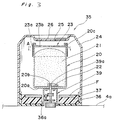
- the bread baking device 35 referred to above includes a circular pan 36 of a heat-resistant plastic material (glass fiber containing polyphenylene sulfide resin) in which a heat insulating material 37 made of an expandable fibrous ceramics and the microwave absorbing heat generating member F as described earlier with reference to Fig.
- a heat-resistant plastic material glass fiber containing polyphenylene sulfide resin
- a recess 25 is formed to provide scorching on the upper surface of the based bread, and over the surface of said recess 25, a silicone resin film 26 containing 60 to 80% of ferrite as the microwave absorbing heat generating material is applied in thickness in the range of 200 to 300 »m.
- the outer cover 11 of the bread baking device 35 disposed in the heating chamber 4 of the microwave oven in Fig. 2 is detached to charge the bread material 21 such as flour or the like into the hopper 20, and then, the stirring blade 22 fixed at the upper end of the driving shaft 39a is rotated to knead the bread material.
- the cylindrical lid 23 is applied onto the hopper 20, and the outer cover 24 is fitted onto the pan 36 to cover the hopper 20 from above to complete the setting. Subsequently, the microwaves generated by the magnetron 1 are irradiated onto the outer cover 24 from above.
- the microwaves thus projected are absorbed into the microwave absorbing heat generating member F on the pan 36 through the outer cover 24, and the heat generating member F is raised in its temperature to generate heat generally uniformly so as to heat the hopper 20 from its entire peripheral portion through convection. Meanwhile, the above microwaves are also absorbed by ferrite in the silicone resin film 26 on the surface at the ceiling portion of the outer cover 24, and the heat generated thereby heats the upper surface of the bread material 21 through the cylindrical lid 23.
- the yeast contained in the bread material and shielded from the microwaves by the hopper 20 of stainless steel and the cylindrical lid 23 effects the fermentation of flour without being damaged, and thus, the bread material is finished for baking by the above heating, with the surface of the baked bread being uniformly formed with the brown scorching.
- the bread material swells up so as to overflow the hopper 20, but even in such a case, the bread is allowed to swell in the natural state owing to upward sliding movement of the cylindrical lid 23 without compressing the bread material, and there is no possibility of bursting of bread during withdrawal of baked bread by removing the cylindrical lid as in the conventional practice.
- the above microwave absorbing heat generating member F is located partly behind the hopper 20, whereby the irradiation of the microwaves tends to be non-uniform, owing to the construction as described with reference to Fig. 4, it generates heat generally uniformly, without any possibility of melting by the local overheating as in the conventional arrangement.
- the function of the heat generating member F as described above makes it possible to effect an ideal bread baking.
- the above microwave absorbing heat generating member F and the silicone resin film 26 containing ferrite are not directly coated on the hopper itself as in the know arrangements, they are not damaged during insertion and withdrawal of the hopper in the baking of bread or during washing of the hopper after baking, and thus, in co-operation with the function of the intermediate ceramic layer 42 as described earlier with reference to Fig. 4, a remarkable durability may be achieved.
- the material of the pan is not limited to the above, but may be replaced, for example, by a microwave transmitting material containing an inorganic filling agent or heat-resistant and impact resistant ceramic or glass material.
- the heat-resistant plastic material employed for the outer cover 24 may be replaced by heat-resistant glass or metallic material, and in the case where metallic material is used, it is necessary to employ a lath sheet in the form of wire mesh or a metallic sheet formed with many holes by punching operation for permitting microwaves to be transmitted therethrough.
- the base member 41 for the microwave absorbing heat generating member F in the embodiment of Fig. 4 may be formed by aluminum instead of copper.
- the microwave absorbing heat generating member F is constituted by the base member made of a metallic plate having a high heat conductivity and formed with many through-holes, and the ceramics layer containing the microwave absorbing heat generating material with a high dielectric loss to generate heat by absorbing the microwaves, and covering the base member to be integrally formed therewith, and therefore, it is raised in its temperature for heat generation generally uniformly through rapid heat diffusion by the base member, even when subjected to non-uniform microwave irradiation, whereby the heat generating member of the present invention is capable of uniformly heating cooking containers and the like through simple and inexpensive construction for wide applications to replace conventional electric heaters.
Landscapes
- Life Sciences & Earth Sciences (AREA)
- Engineering & Computer Science (AREA)
- Food Science & Technology (AREA)
- Physics & Mathematics (AREA)
- Electromagnetism (AREA)
- Electric Ovens (AREA)
- Cookers (AREA)
Claims (10)
- Kochgerät zur Verwendung in einem Mikrowellenofen, mit:- einem mikrowellenabsorbierenden, wärmeerzeugenden Material (12, 12'; 26; 43) mit hohem dielektrischem Verlust zum Erzeugen von Wärme durch Absorbieren von Mikrowellen;- einem Behälter (18; 20) zum Aufnehmen zuzubereitender Speisezutaten (19; 21); und- einem Mantel (11; 24);dadurch gekennzeichnet, daß das mikrowellenabsorbierende, wärmeerzeugende Material (12, 12'; 26) an der Oberfläche des Deckels (11; 24) angeordnet ist, und der Mantel (11; 24) so ausgebildet ist, daß er über dem Behälter (18; 20) angeordnet ist und diesen im wesentlichen einschließt, und er von einem offenen Rand des Deckels gehalten wird, welcher Rand um den Behälter (18; 20) herum angeordnet ist.
- Kochgerät nach Anspruch 1, bei dem das mikrowellenabsorbierende, wärmeerzeugende Material (12, 12'; 26) in einer Vertiefung oder mehreren (13, 13'; 25) angeordnet ist, die an einer Oberfläche des Mantels (11; 24) ausgebildet sind.
- Kochgerät nach Anspruch 2, bei dem der Mantel (11; 24) eine Umfangswand und eine obere Wand oder Deckenwand aufweist, und bei dem eine erste der Vertiefungen (13, 25) in der oberen Wand und eine zweite der Vertiefungen (13') als kontinuierliche Umfangsvertiefung in der Seitenwand ausgebildet ist.
- Kochgerät nach einem der Ansprüche 1 bis 3, bei dem der Mantel (11; 24) ferner einen äußeren, wärmebeständigen Überzug (14) aufweist.
- Kochgerät nach einem der vorstehenden Ansprüche, bei dem die Innenseite des Mantels (11; 24) aus Metall besteht.
- Kochgerät nach einem der Ansprüche 1 bis 4, bei dem der Behälter aus Metall besteht.
- Brotbackgerät mit einem Kochgerät nach Anspruch 5 oder Anspruch 6 zur Verwendung in einem Mikrowellenofen, bei dem:- der Behälter (18; 20) Brotzutaten (19; 21) aufnimmt, und er eine Rührvorrichtung (10; 22) zum Kneten der Brotzutaten (19; 21) im Behälter (18; 20) aufweist; und- der Mantel (11; 24) so ausgebildet ist, daß er den Behälter (18; 20) und die Rührvorrichtung (10; 22) im wesentlichen umschließt.
- Brotbackgerät oder Kochgerät nach einem der vorstehenden Ansprüche, bei dem der Behälter (18; 20) über einen Dekkel (23) verfügt, der von den Speisezutaten (19; 21) nach oben geschoben werden kann, wenn diese während des Zubereitungsvorgangs gehen, um ein Zusammendrücken der Speisezutaten (19; 21) zu verhindern.
- Brotbackgerät oder Kochgerät nach einem der vorstehenden Ansprüche, mit einem Trägerteil (41) in Form einer Metallplatte mit hohem Wärmeleitvermögen, in der eine Anzahl Durchgangslöcher (41a) ausgebildet sind, wobei das Trägerteil (41) mit einem das mikrowellenabsorbierende, wärmeerzeugende Material (43) enthaltenden Material (43) beschichtet ist.
- Brotbackgerät oder Kochgerät nach einem der vorstehenden Ansprüche, bei dem der Mantel (11; 24) aus einem Material mit hohem Wärmeleitvermögen besteht.
Applications Claiming Priority (6)
| Application Number | Priority Date | Filing Date | Title |
|---|---|---|---|
| JP63061590A JPH01234719A (ja) | 1988-03-14 | 1988-03-14 | 電子レンジ用発熱容器 |
| JP61590/88 | 1988-03-14 | ||
| JP79757/88 | 1988-06-16 | ||
| JP63149095A JPH0673313B2 (ja) | 1988-06-16 | 1988-06-16 | マイクロ波吸収発熱体 |
| JP149095/88 | 1988-06-16 | ||
| JP1988079757U JPH024110U (de) | 1988-06-16 | 1988-06-16 |
Publications (2)
| Publication Number | Publication Date |
|---|---|
| EP0333423A1 EP0333423A1 (de) | 1989-09-20 |
| EP0333423B1 true EP0333423B1 (de) | 1994-07-13 |
Family
ID=27297558
Family Applications (1)
| Application Number | Title | Priority Date | Filing Date |
|---|---|---|---|
| EP89302476A Expired - Lifetime EP0333423B1 (de) | 1988-03-14 | 1989-03-14 | Wärmeentwickelnder Behälter für Mikrowellenöfen |
Country Status (6)
| Country | Link |
|---|---|
| US (1) | US5280150A (de) |
| EP (1) | EP0333423B1 (de) |
| KR (1) | KR920002093B1 (de) |
| AU (1) | AU611267B2 (de) |
| CA (1) | CA1328909C (de) |
| DE (1) | DE68916670T2 (de) |
Cited By (1)
| Publication number | Priority date | Publication date | Assignee | Title |
|---|---|---|---|---|
| EP2269964A1 (de) * | 2009-06-22 | 2011-01-05 | Karl Ahlborn Maschinenfabrik KG | Backofen zur Herstellung von Brot, Brötchen usw. |
Families Citing this family (29)
| Publication number | Priority date | Publication date | Assignee | Title |
|---|---|---|---|---|
| CA1333194C (en) * | 1988-06-14 | 1994-11-22 | Taisuke Morino | High-frequency heating apparatus |
| DE4103455A1 (de) * | 1991-02-06 | 1992-08-13 | Krauss Maffei Ag | Mischertrockner |
| US5392695A (en) * | 1994-04-05 | 1995-02-28 | Circulair, Inc. | Automatic breadmaking machine |
| US5967021A (en) * | 1994-11-29 | 1999-10-19 | Yung; Simon K. C. | Food appliance and a coding system therefor |
| US5704277A (en) * | 1994-11-29 | 1998-01-06 | Yung; Simon K. C. | Breadmaker and a coding system therefor |
| US5513557A (en) * | 1995-08-07 | 1996-05-07 | Chiang; Ming-Shan | Hot-air circulation unit and a shaking blade of a baking apparatus |
| US5736726A (en) * | 1996-03-29 | 1998-04-07 | Telxon Corporation | Portable data collection device having removable handle and battery |
| US5935477A (en) * | 1996-07-22 | 1999-08-10 | Kontract Product Supply Inc. | Continuous microwave cooking grill having a plurality of spaced segments |
| US6229131B1 (en) | 1996-07-22 | 2001-05-08 | Kontract Product Supply, Inc. | Microwave cooking grill and steamer |
| JP3234911B2 (ja) * | 1997-01-31 | 2001-12-04 | シャープ株式会社 | 高周波加熱調理装置 |
| US6177663B1 (en) * | 1999-04-29 | 2001-01-23 | Gregory Michael Kula | Food mold for microwave oven use |
| GB0228548D0 (en) * | 2002-12-06 | 2003-01-15 | Unilever Plc | Microwavable food product |
| KR20050122673A (ko) * | 2004-06-25 | 2005-12-29 | 삼성전자주식회사 | 스탠바이 모드에서 디지털 셋탑박스의 전력을 절감하는방법 및 장치 |
| JP5336176B2 (ja) * | 2006-03-29 | 2013-11-06 | 株式会社トクヤマ | 窒化アルミニウム焼結体の接合方法および窒化アルミニウム接合体 |
| US20070235450A1 (en) * | 2006-03-30 | 2007-10-11 | Advanced Composite Materials Corporation | Composite materials and devices comprising single crystal silicon carbide heated by electromagnetic radiation |
| US8596189B2 (en) | 2008-08-11 | 2013-12-03 | Kedem Llc. | Assembly for cooking elongated food products |
| US20100077615A1 (en) * | 2008-09-26 | 2010-04-01 | Foxconn Technology Co., Ltd. | Method for manufacturing a plate-type heat pipe |
| US20100269708A1 (en) * | 2009-04-27 | 2010-10-28 | Feng-Hsin Huang | Cooking Utensil that is Cleaned Easily and Quickly |
| US9565970B2 (en) * | 2011-04-14 | 2017-02-14 | Electrodomesticos Taurus Sl | Cooking system including a cooking hob and a cooking vessel |
| US9074763B2 (en) * | 2011-09-29 | 2015-07-07 | Scott Begg | Spill proof alcohol burner |
| USD686869S1 (en) | 2012-12-19 | 2013-07-30 | Kedem Llc | Assembly for cooking elongated food products |
| CN104970709A (zh) * | 2014-04-01 | 2015-10-14 | 漳州灿坤实业有限公司 | 面包制作机及其原料储存单元 |
| EP2854478B1 (de) * | 2013-09-27 | 2016-04-06 | Anton Paar GmbH | Mikrowellenheizsystem |
| US10791871B2 (en) * | 2014-03-17 | 2020-10-06 | Jong Peter Park | Travel mug for microwave oven |
| US10722070B2 (en) * | 2015-06-14 | 2020-07-28 | Jong Peter Park | Multi-layered exothermic microwave cookware |
| US20170142785A1 (en) * | 2015-11-13 | 2017-05-18 | Bottle-Top Development Co. | Microwave heating system |
| US10080458B2 (en) * | 2016-01-08 | 2018-09-25 | Nostalgia Products Llc | Single and multi-level stirrer and dispenser |
| CN115646400B (zh) * | 2022-10-31 | 2025-08-01 | 西安建筑科技大学 | 一种屏蔽微波非热效应的控温热解装置及方法 |
| CN116175859B (zh) * | 2023-03-03 | 2023-10-20 | 东莞海瑞斯新材料科技有限公司 | 一种超临界流体一次性发泡成型产品用的热烘机箱 |
Family Cites Families (20)
| Publication number | Priority date | Publication date | Assignee | Title |
|---|---|---|---|---|
| US3539751A (en) * | 1966-10-26 | 1970-11-10 | Melvin L Levinson | Insulating implement for use in a microwave oven |
| US3845266A (en) * | 1973-07-09 | 1974-10-29 | Raytheon Co | Microwave cooking utensil |
| US3941967A (en) * | 1973-09-28 | 1976-03-02 | Asahi Kasei Kogyo Kabushiki Kaisha | Microwave cooking apparatus |
| US4015085A (en) * | 1975-04-30 | 1977-03-29 | Larry Lakey | Container for the microwave heating of frozen sandwiches |
| US4266108A (en) * | 1979-03-28 | 1981-05-05 | The Pillsbury Company | Microwave heating device and method |
| US4398077A (en) * | 1980-10-06 | 1983-08-09 | Raytheon Company | Microwave cooking utensil |
| US4450334A (en) * | 1981-04-24 | 1984-05-22 | Raytheon Company | Microwave pizza maker |
| JPS58175725A (ja) * | 1982-04-07 | 1983-10-15 | Matsushita Electric Ind Co Ltd | 高周波加熱装置 |
| US4538509A (en) * | 1983-08-22 | 1985-09-03 | Hosiden Electronics Co., Ltd. | Automatic bread baking machine |
| US4728762A (en) * | 1984-03-22 | 1988-03-01 | Howard Roth | Microwave heating apparatus and method |
| GB2159027B (en) * | 1984-05-15 | 1987-09-09 | Thorn Emi Domestic Applicances | Improvements in or relating to microwave ovens |
| FR2588063B1 (fr) * | 1985-10-01 | 1987-12-18 | Boulard Michel | Four a micro-ondes a equipement mobile et accessoire pour ce four |
| US4762057A (en) * | 1985-10-11 | 1988-08-09 | Matsushita Electric Industrial Co., Ltd. | Automatic bread producing machine |
| CA1277548C (en) * | 1985-10-12 | 1990-12-11 | Ojima, Tadasu | Method of and an apparatus for making bread at home |
| CA1325917C (en) * | 1986-06-20 | 1994-01-11 | Hirofumi Nakakura | Method of and apparatus for making bread |
| US4663506A (en) * | 1986-07-30 | 1987-05-05 | Raytheon Company | Microwave cake and bread maker |
| JPH0415158Y2 (de) * | 1987-03-11 | 1992-04-06 | ||
| JPH0162727U (de) * | 1987-10-15 | 1989-04-21 | ||
| US5019680A (en) * | 1988-06-14 | 1991-05-28 | Sharp Kabushiki Kaisha | Heat generating container for microwave oven |
| US4845327A (en) * | 1988-11-15 | 1989-07-04 | Hitachi Heating Appliances Co., Ltd. | Microwave oven having automatic bread making function |
-
1989
- 1989-03-06 CA CA000592825A patent/CA1328909C/en not_active Expired - Fee Related
- 1989-03-08 AU AU31110/89A patent/AU611267B2/en not_active Ceased
- 1989-03-13 US US07/322,718 patent/US5280150A/en not_active Expired - Fee Related
- 1989-03-14 DE DE68916670T patent/DE68916670T2/de not_active Expired - Fee Related
- 1989-03-14 KR KR1019890003114A patent/KR920002093B1/ko not_active Expired
- 1989-03-14 EP EP89302476A patent/EP0333423B1/de not_active Expired - Lifetime
Cited By (1)
| Publication number | Priority date | Publication date | Assignee | Title |
|---|---|---|---|---|
| EP2269964A1 (de) * | 2009-06-22 | 2011-01-05 | Karl Ahlborn Maschinenfabrik KG | Backofen zur Herstellung von Brot, Brötchen usw. |
Also Published As
| Publication number | Publication date |
|---|---|
| KR920002093B1 (ko) | 1992-03-10 |
| KR890015638A (ko) | 1989-10-30 |
| CA1328909C (en) | 1994-04-26 |
| AU3111089A (en) | 1989-09-14 |
| DE68916670T2 (de) | 1994-12-22 |
| EP0333423A1 (de) | 1989-09-20 |
| AU611267B2 (en) | 1991-06-06 |
| DE68916670D1 (de) | 1994-08-18 |
| US5280150A (en) | 1994-01-18 |
Similar Documents
| Publication | Publication Date | Title |
|---|---|---|
| EP0333423B1 (de) | Wärmeentwickelnder Behälter für Mikrowellenöfen | |
| US4663506A (en) | Microwave cake and bread maker | |
| EP0438471B1 (de) | Durch mikrowellen angetriebene heizvorrichtung | |
| US4822966A (en) | Method of producing heat with microwaves | |
| CA1323909C (en) | Heat generating container for microwave oven | |
| US4486640A (en) | Cooker/baker utensil for microwave oven | |
| US5233144A (en) | Heat generating container for microwave oven | |
| EP1377130A2 (de) | Mikrowellenofen, und Führungsrolle, Kochplatte, Geschirr die in Mikrowellenofen benützen sind | |
| JPS63108122A (ja) | 電子レンジ用オ−ブン調理具 | |
| JPH07318262A (ja) | マイクロ波焼成炉及び焼成釜 | |
| KR100823837B1 (ko) | 발열판 및 이를 포함하는 전자렌지용 용기 | |
| KR100937232B1 (ko) | 전자레인지용 발열판 및 그 제조 방법 | |
| JP2002286229A5 (de) | ||
| JPH0673313B2 (ja) | マイクロ波吸収発熱体 | |
| JPS5852916A (ja) | 電子レンジ用調理器 | |
| JPH01164319A (ja) | 高周波加熱装置用発熱体 | |
| KR940001467B1 (ko) | 마이크로파에 의한 발열방법 | |
| JP2012011017A (ja) | 調理器具およびそれを用いた加熱装置 | |
| JPH01167532A (ja) | 電子レンジ用発熱体 | |
| JP2013144056A (ja) | 高周波加熱調理用器具及び高周波加熱調理器 | |
| JP3227437B2 (ja) | 高周波加熱装置用発熱体 | |
| KR0135642B1 (ko) | 전자렌지의 발열용기 | |
| KR200255212Y1 (ko) | 초고주파 가열 압력밥솥용 조리용기의 구조 | |
| CA1273682A (en) | Method of producing heat with microwaves | |
| JPH01166723A (ja) | マイクロ波吸収発熱材料 |
Legal Events
| Date | Code | Title | Description |
|---|---|---|---|
| PUAI | Public reference made under article 153(3) epc to a published international application that has entered the european phase |
Free format text: ORIGINAL CODE: 0009012 |
|
| AK | Designated contracting states |
Kind code of ref document: A1 Designated state(s): DE FR GB |
|
| 17P | Request for examination filed |
Effective date: 19891227 |
|
| 17Q | First examination report despatched |
Effective date: 19910813 |
|
| GRAA | (expected) grant |
Free format text: ORIGINAL CODE: 0009210 |
|
| AK | Designated contracting states |
Kind code of ref document: B1 Designated state(s): DE FR GB |
|
| REF | Corresponds to: |
Ref document number: 68916670 Country of ref document: DE Date of ref document: 19940818 |
|
| ET | Fr: translation filed | ||
| PLBE | No opposition filed within time limit |
Free format text: ORIGINAL CODE: 0009261 |
|
| STAA | Information on the status of an ep patent application or granted ep patent |
Free format text: STATUS: NO OPPOSITION FILED WITHIN TIME LIMIT |
|
| 26N | No opposition filed | ||
| PGFP | Annual fee paid to national office [announced via postgrant information from national office to epo] |
Ref country code: GB Payment date: 19980305 Year of fee payment: 10 |
|
| PGFP | Annual fee paid to national office [announced via postgrant information from national office to epo] |
Ref country code: FR Payment date: 19980325 Year of fee payment: 10 |
|
| PGFP | Annual fee paid to national office [announced via postgrant information from national office to epo] |
Ref country code: DE Payment date: 19980401 Year of fee payment: 10 |
|
| PG25 | Lapsed in a contracting state [announced via postgrant information from national office to epo] |
Ref country code: GB Free format text: LAPSE BECAUSE OF NON-PAYMENT OF DUE FEES Effective date: 19990314 |
|
| GBPC | Gb: european patent ceased through non-payment of renewal fee |
Effective date: 19990314 |
|
| PG25 | Lapsed in a contracting state [announced via postgrant information from national office to epo] |
Ref country code: FR Free format text: LAPSE BECAUSE OF NON-PAYMENT OF DUE FEES Effective date: 19991130 |
|
| REG | Reference to a national code |
Ref country code: FR Ref legal event code: ST |
|
| PG25 | Lapsed in a contracting state [announced via postgrant information from national office to epo] |
Ref country code: DE Free format text: LAPSE BECAUSE OF NON-PAYMENT OF DUE FEES Effective date: 20000101 |