EP0333560B1 - Procédé de détermination quantitative de micro-organismes - Google Patents
Procédé de détermination quantitative de micro-organismes Download PDFInfo
- Publication number
- EP0333560B1 EP0333560B1 EP89400655A EP89400655A EP0333560B1 EP 0333560 B1 EP0333560 B1 EP 0333560B1 EP 89400655 A EP89400655 A EP 89400655A EP 89400655 A EP89400655 A EP 89400655A EP 0333560 B1 EP0333560 B1 EP 0333560B1
- Authority
- EP
- European Patent Office
- Prior art keywords
- microorganisms
- sample
- fluorescent
- antibodies
- process according
- Prior art date
- Legal status (The legal status is an assumption and is not a legal conclusion. Google has not performed a legal analysis and makes no representation as to the accuracy of the status listed.)
- Revoked
Links
- 244000005700 microbiome Species 0.000 title claims abstract description 60
- 238000000034 method Methods 0.000 title claims abstract description 44
- 230000008569 process Effects 0.000 title claims abstract description 21
- 239000000523 sample Substances 0.000 claims abstract description 31
- 230000035899 viability Effects 0.000 claims abstract description 24
- 239000000126 substance Substances 0.000 claims abstract description 13
- 239000007788 liquid Substances 0.000 claims abstract description 11
- 235000011837 pasties Nutrition 0.000 claims abstract description 6
- 239000003550 marker Substances 0.000 claims description 11
- 230000000656 anti-yeast Effects 0.000 claims description 7
- 239000000725 suspension Substances 0.000 claims description 7
- 108090000790 Enzymes Proteins 0.000 claims description 5
- 102000004190 Enzymes Human genes 0.000 claims description 5
- 239000000872 buffer Substances 0.000 claims description 5
- 235000013305 food Nutrition 0.000 claims description 5
- 230000000844 anti-bacterial effect Effects 0.000 claims description 4
- 230000002141 anti-parasite Effects 0.000 claims description 4
- 230000003834 intracellular effect Effects 0.000 claims description 4
- 230000009471 action Effects 0.000 claims description 3
- 239000013060 biological fluid Substances 0.000 claims description 3
- 239000000356 contaminant Substances 0.000 claims description 3
- BFMYDTVEBKDAKJ-UHFFFAOYSA-L disodium;(2',7'-dibromo-3',6'-dioxido-3-oxospiro[2-benzofuran-1,9'-xanthene]-4'-yl)mercury;hydrate Chemical compound O.[Na+].[Na+].O1C(=O)C2=CC=CC=C2C21C1=CC(Br)=C([O-])C([Hg])=C1OC1=C2C=C(Br)C([O-])=C1 BFMYDTVEBKDAKJ-UHFFFAOYSA-L 0.000 claims description 3
- 238000001914 filtration Methods 0.000 claims description 3
- 238000002604 ultrasonography Methods 0.000 claims description 3
- 230000000843 anti-fungal effect Effects 0.000 claims 2
- 239000003096 antiparasitic agent Substances 0.000 claims 2
- 230000003381 solubilizing effect Effects 0.000 claims 1
- 238000005259 measurement Methods 0.000 abstract description 8
- 238000009434 installation Methods 0.000 abstract description 5
- 230000002503 metabolic effect Effects 0.000 abstract description 4
- 239000012530 fluid Substances 0.000 abstract description 3
- 238000002955 isolation Methods 0.000 abstract 1
- 239000007787 solid Substances 0.000 abstract 1
- 240000004808 Saccharomyces cerevisiae Species 0.000 description 29
- 235000014680 Saccharomyces cerevisiae Nutrition 0.000 description 29
- 210000004027 cell Anatomy 0.000 description 22
- 241000894006 Bacteria Species 0.000 description 16
- 239000000975 dye Substances 0.000 description 11
- 241000894007 species Species 0.000 description 9
- 238000001514 detection method Methods 0.000 description 8
- 235000013618 yogurt Nutrition 0.000 description 8
- CHADEQDQBURGHL-UHFFFAOYSA-N (6'-acetyloxy-3-oxospiro[2-benzofuran-1,9'-xanthene]-3'-yl) acetate Chemical compound O1C(=O)C2=CC=CC=C2C21C1=CC=C(OC(C)=O)C=C1OC1=CC(OC(=O)C)=CC=C21 CHADEQDQBURGHL-UHFFFAOYSA-N 0.000 description 7
- 238000011534 incubation Methods 0.000 description 7
- 235000013405 beer Nutrition 0.000 description 6
- FAPWRFPIFSIZLT-UHFFFAOYSA-M Sodium chloride Chemical compound [Na+].[Cl-] FAPWRFPIFSIZLT-UHFFFAOYSA-M 0.000 description 5
- 238000000855 fermentation Methods 0.000 description 5
- 230000004151 fermentation Effects 0.000 description 5
- 239000008188 pellet Substances 0.000 description 5
- 238000004458 analytical method Methods 0.000 description 4
- 238000005119 centrifugation Methods 0.000 description 4
- 230000000694 effects Effects 0.000 description 4
- 238000002372 labelling Methods 0.000 description 4
- 239000002245 particle Substances 0.000 description 4
- 239000003086 colorant Substances 0.000 description 3
- 238000007796 conventional method Methods 0.000 description 3
- 235000013399 edible fruits Nutrition 0.000 description 3
- GNBHRKFJIUUOQI-UHFFFAOYSA-N fluorescein Chemical class O1C(=O)C2=CC=CC=C2C21C1=CC=C(O)C=C1OC1=CC(O)=CC=C21 GNBHRKFJIUUOQI-UHFFFAOYSA-N 0.000 description 3
- 230000035784 germination Effects 0.000 description 3
- 239000002609 medium Substances 0.000 description 3
- 238000012544 monitoring process Methods 0.000 description 3
- 108020004707 nucleic acids Proteins 0.000 description 3
- 102000039446 nucleic acids Human genes 0.000 description 3
- 150000007523 nucleic acids Chemical class 0.000 description 3
- 244000045947 parasite Species 0.000 description 3
- 230000004044 response Effects 0.000 description 3
- 238000005063 solubilization Methods 0.000 description 3
- 230000007928 solubilization Effects 0.000 description 3
- 210000002700 urine Anatomy 0.000 description 3
- QMOGCCYGOPYYNT-UHFFFAOYSA-N 3',6'-diacetyloxy-1-oxospiro[2-benzofuran-3,9'-xanthene]-5-carboxylic acid Chemical compound O1C(=O)C2=CC=C(C(O)=O)C=C2C21C1=CC=C(OC(C)=O)C=C1OC1=CC(OC(=O)C)=CC=C21 QMOGCCYGOPYYNT-UHFFFAOYSA-N 0.000 description 2
- HXVZGASCDAGAPS-UHFFFAOYSA-N 4-methylumbelliferyl acetate Chemical compound CC1=CC(=O)OC2=CC(OC(=O)C)=CC=C21 HXVZGASCDAGAPS-UHFFFAOYSA-N 0.000 description 2
- 108010004729 Phycoerythrin Chemical class 0.000 description 2
- 239000012556 adjustment buffer Substances 0.000 description 2
- 210000001175 cerebrospinal fluid Anatomy 0.000 description 2
- 238000004040 coloring Methods 0.000 description 2
- 238000012136 culture method Methods 0.000 description 2
- 230000007423 decrease Effects 0.000 description 2
- 150000002148 esters Chemical class 0.000 description 2
- ZMMJGEGLRURXTF-UHFFFAOYSA-N ethidium bromide Chemical compound [Br-].C12=CC(N)=CC=C2C2=CC=C(N)C=C2[N+](CC)=C1C1=CC=CC=C1 ZMMJGEGLRURXTF-UHFFFAOYSA-N 0.000 description 2
- 239000007850 fluorescent dye Substances 0.000 description 2
- 230000004907 flux Effects 0.000 description 2
- 238000010438 heat treatment Methods 0.000 description 2
- 229960000907 methylthioninium chloride Drugs 0.000 description 2
- 230000000813 microbial effect Effects 0.000 description 2
- 235000015205 orange juice Nutrition 0.000 description 2
- 238000010979 pH adjustment Methods 0.000 description 2
- 235000020185 raw untreated milk Nutrition 0.000 description 2
- 238000011160 research Methods 0.000 description 2
- 235000015067 sauces Nutrition 0.000 description 2
- 230000035945 sensitivity Effects 0.000 description 2
- 239000011780 sodium chloride Substances 0.000 description 2
- 239000002689 soil Substances 0.000 description 2
- 239000000243 solution Substances 0.000 description 2
- 210000001082 somatic cell Anatomy 0.000 description 2
- 230000008961 swelling Effects 0.000 description 2
- NXIABCNYUKDBQI-UHFFFAOYSA-N (3-oxo-6'-propanoyloxyspiro[2-benzofuran-1,9'-xanthene]-3'-yl) propanoate Chemical compound O1C(=O)C2=CC=CC=C2C21C1=CC=C(OC(=O)CC)C=C1OC1=CC(OC(=O)CC)=CC=C21 NXIABCNYUKDBQI-UHFFFAOYSA-N 0.000 description 1
- VXDCGBVAZDYTFK-UHFFFAOYSA-N (4-acetyloxy-2,3-dicyanophenyl) acetate Chemical compound CC(=O)OC1=CC=C(OC(C)=O)C(C#N)=C1C#N VXDCGBVAZDYTFK-UHFFFAOYSA-N 0.000 description 1
- BCHIXGBGRHLSBE-UHFFFAOYSA-N (4-methyl-2-oxochromen-7-yl) dihydrogen phosphate Chemical compound C1=C(OP(O)(O)=O)C=CC2=C1OC(=O)C=C2C BCHIXGBGRHLSBE-UHFFFAOYSA-N 0.000 description 1
- KJKLQXMWCOZORW-UHFFFAOYSA-N (6'-acetyloxy-5-azido-3-oxospiro[2-benzofuran-1,9'-xanthene]-3'-yl) acetate Chemical compound O1C(=O)C2=CC(N=[N+]=[N-])=CC=C2C21C1=CC=C(OC(C)=O)C=C1OC1=CC(OC(=O)C)=CC=C21 KJKLQXMWCOZORW-UHFFFAOYSA-N 0.000 description 1
- MYTRGBGGRICZGN-UHFFFAOYSA-N (6'-dodecanoyloxy-3-oxospiro[2-benzofuran-1,9'-xanthene]-3'-yl) dodecanoate Chemical compound O1C(=O)C2=CC=CC=C2C21C1=CC=C(OC(=O)CCCCCCCCCCC)C=C1OC1=CC(OC(=O)CCCCCCCCCCC)=CC=C21 MYTRGBGGRICZGN-UHFFFAOYSA-N 0.000 description 1
- UJWKHDKBOVPINX-UHFFFAOYSA-N (7-oxophenoxazin-3-yl) acetate Chemical compound C1=CC(=O)C=C2OC3=CC(OC(=O)C)=CC=C3N=C21 UJWKHDKBOVPINX-UHFFFAOYSA-N 0.000 description 1
- PRDFBSVERLRRMY-UHFFFAOYSA-N 2'-(4-ethoxyphenyl)-5-(4-methylpiperazin-1-yl)-2,5'-bibenzimidazole Chemical compound C1=CC(OCC)=CC=C1C1=NC2=CC=C(C=3NC4=CC(=CC=C4N=3)N3CCN(C)CC3)C=C2N1 PRDFBSVERLRRMY-UHFFFAOYSA-N 0.000 description 1
- BRVXAJOLSYHWJI-UHFFFAOYSA-N 2-aminoacetic acid;7-amino-4-methylchromen-2-one Chemical compound NCC(O)=O.C1=C(N)C=CC2=C1OC(=O)C=C2C BRVXAJOLSYHWJI-UHFFFAOYSA-N 0.000 description 1
- WPUZGNPQMIWOHE-UHFFFAOYSA-N 3',6'-diacetyloxy-3-oxospiro[2-benzofuran-1,9'-xanthene]-5-carboxylic acid Chemical compound O1C(=O)C2=CC(C(O)=O)=CC=C2C21C1=CC=C(OC(C)=O)C=C1OC1=CC(OC(=O)C)=CC=C21 WPUZGNPQMIWOHE-UHFFFAOYSA-N 0.000 description 1
- RBTBFTRPCNLSDE-UHFFFAOYSA-N 3,7-bis(dimethylamino)phenothiazin-5-ium Chemical compound C1=CC(N(C)C)=CC2=[S+]C3=CC(N(C)C)=CC=C3N=C21 RBTBFTRPCNLSDE-UHFFFAOYSA-N 0.000 description 1
- QWBZNOKUBXSLRE-UHFFFAOYSA-N 3-O-methylfluorescein 6-phosphate Chemical compound O1C(=O)C2=CC=CC=C2C21C1=CC=C(OP(O)(O)=O)C=C1OC1=CC(OC)=CC=C21 QWBZNOKUBXSLRE-UHFFFAOYSA-N 0.000 description 1
- FWBHETKCLVMNFS-UHFFFAOYSA-N 4',6-Diamino-2-phenylindol Chemical compound C1=CC(C(=N)N)=CC=C1C1=CC2=CC=C(C(N)=N)C=C2N1 FWBHETKCLVMNFS-UHFFFAOYSA-N 0.000 description 1
- YUDPTGPSBJVHCN-VMMWWAARSA-N 4-methyl-7-[(2r,3s,4s,5s,6r)-3,4,5-trihydroxy-6-(hydroxymethyl)oxan-2-yl]oxychromen-2-one Chemical compound C1=CC=2C(C)=CC(=O)OC=2C=C1O[C@H]1O[C@H](CO)[C@@H](O)[C@H](O)[C@@H]1O YUDPTGPSBJVHCN-VMMWWAARSA-N 0.000 description 1
- YUDPTGPSBJVHCN-DZQJYWQESA-N 4-methylumbelliferyl beta-D-galactoside Chemical compound C1=CC=2C(C)=CC(=O)OC=2C=C1O[C@@H]1O[C@H](CO)[C@H](O)[C@H](O)[C@H]1O YUDPTGPSBJVHCN-DZQJYWQESA-N 0.000 description 1
- XYJODUBPWNZLML-UHFFFAOYSA-N 5-ethyl-6-phenyl-6h-phenanthridine-3,8-diamine Chemical compound C12=CC(N)=CC=C2C2=CC=C(N)C=C2N(CC)C1C1=CC=CC=C1 XYJODUBPWNZLML-UHFFFAOYSA-N 0.000 description 1
- BZTDTCNHAFUJOG-UHFFFAOYSA-N 6-carboxyfluorescein Chemical compound C12=CC=C(O)C=C2OC2=CC(O)=CC=C2C11OC(=O)C2=CC=C(C(=O)O)C=C21 BZTDTCNHAFUJOG-UHFFFAOYSA-N 0.000 description 1
- 208000031729 Bacteremia Diseases 0.000 description 1
- 241000222173 Candida parapsilosis Species 0.000 description 1
- BVKZGUZCCUSVTD-UHFFFAOYSA-L Carbonate Chemical compound [O-]C([O-])=O BVKZGUZCCUSVTD-UHFFFAOYSA-L 0.000 description 1
- 241000235036 Debaryomyces hansenii Species 0.000 description 1
- KCXVZYZYPLLWCC-UHFFFAOYSA-N EDTA Chemical compound OC(=O)CN(CC(O)=O)CCN(CC(O)=O)CC(O)=O KCXVZYZYPLLWCC-UHFFFAOYSA-N 0.000 description 1
- 229930091371 Fructose Natural products 0.000 description 1
- 239000005715 Fructose Substances 0.000 description 1
- RFSUNEUAIZKAJO-ARQDHWQXSA-N Fructose Chemical compound OC[C@H]1O[C@](O)(CO)[C@@H](O)[C@@H]1O RFSUNEUAIZKAJO-ARQDHWQXSA-N 0.000 description 1
- WQZGKKKJIJFFOK-GASJEMHNSA-N Glucose Natural products OC[C@H]1OC(O)[C@H](O)[C@@H](O)[C@@H]1O WQZGKKKJIJFFOK-GASJEMHNSA-N 0.000 description 1
- 241000186660 Lactobacillus Species 0.000 description 1
- 206010027249 Meningitis meningococcal Diseases 0.000 description 1
- 201000010924 Meningococcal meningitis Diseases 0.000 description 1
- NQTADLQHYWFPDB-UHFFFAOYSA-N N-Hydroxysuccinimide Chemical compound ON1C(=O)CCC1=O NQTADLQHYWFPDB-UHFFFAOYSA-N 0.000 description 1
- 108020004711 Nucleic Acid Probes Proteins 0.000 description 1
- 229910019142 PO4 Inorganic materials 0.000 description 1
- 108010059820 Polygalacturonase Proteins 0.000 description 1
- 241000223252 Rhodotorula Species 0.000 description 1
- 241000235070 Saccharomyces Species 0.000 description 1
- CZMRCDWAGMRECN-UGDNZRGBSA-N Sucrose Chemical compound O[C@H]1[C@H](O)[C@@H](CO)O[C@@]1(CO)O[C@@H]1[C@H](O)[C@@H](O)[C@H](O)[C@@H](CO)O1 CZMRCDWAGMRECN-UGDNZRGBSA-N 0.000 description 1
- 229930006000 Sucrose Natural products 0.000 description 1
- 239000000980 acid dye Substances 0.000 description 1
- FTNJWQUOZFUQQJ-NDAWSKJSSA-N azadirachtin A Chemical compound C([C@@H]([C@]1(C=CO[C@H]1O1)O)[C@]2(C)O3)[C@H]1[C@]23[C@]1(C)[C@H](O)[C@H](OC[C@@]2([C@@H](C[C@@H]3OC(=O)C(\C)=C\C)OC(C)=O)C(=O)OC)[C@@H]2[C@]32CO[C@@](C(=O)OC)(O)[C@@H]12 FTNJWQUOZFUQQJ-NDAWSKJSSA-N 0.000 description 1
- 230000001580 bacterial effect Effects 0.000 description 1
- 244000052616 bacterial pathogen Species 0.000 description 1
- 230000008901 benefit Effects 0.000 description 1
- WQZGKKKJIJFFOK-VFUOTHLCSA-N beta-D-glucose Chemical compound OC[C@H]1O[C@@H](O)[C@H](O)[C@@H](O)[C@@H]1O WQZGKKKJIJFFOK-VFUOTHLCSA-N 0.000 description 1
- 229940055022 candida parapsilosis Drugs 0.000 description 1
- -1 carboxyethyl Chemical group 0.000 description 1
- 239000005018 casein Substances 0.000 description 1
- BECPQYXYKAMYBN-UHFFFAOYSA-N casein, tech. Chemical compound NCCCCC(C(O)=O)N=C(O)C(CC(O)=O)N=C(O)C(CCC(O)=N)N=C(O)C(CC(C)C)N=C(O)C(CCC(O)=O)N=C(O)C(CC(O)=O)N=C(O)C(CCC(O)=O)N=C(O)C(C(C)O)N=C(O)C(CCC(O)=N)N=C(O)C(CCC(O)=N)N=C(O)C(CCC(O)=N)N=C(O)C(CCC(O)=O)N=C(O)C(CCC(O)=O)N=C(O)C(COP(O)(O)=O)N=C(O)C(CCC(O)=N)N=C(O)C(N)CC1=CC=CC=C1 BECPQYXYKAMYBN-UHFFFAOYSA-N 0.000 description 1
- 235000021240 caseins Nutrition 0.000 description 1
- 239000006285 cell suspension Substances 0.000 description 1
- 235000013351 cheese Nutrition 0.000 description 1
- 238000006243 chemical reaction Methods 0.000 description 1
- 239000003153 chemical reaction reagent Substances 0.000 description 1
- 239000003795 chemical substances by application Substances 0.000 description 1
- 238000003776 cleavage reaction Methods 0.000 description 1
- 230000000052 comparative effect Effects 0.000 description 1
- 238000011109 contamination Methods 0.000 description 1
- 239000002537 cosmetic Substances 0.000 description 1
- 230000008878 coupling Effects 0.000 description 1
- 238000010168 coupling process Methods 0.000 description 1
- 238000005859 coupling reaction Methods 0.000 description 1
- 238000012258 culturing Methods 0.000 description 1
- CFCUWKMKBJTWLW-UHFFFAOYSA-N deoliosyl-3C-alpha-L-digitoxosyl-MTM Natural products CC=1C(O)=C2C(O)=C3C(=O)C(OC4OC(C)C(O)C(OC5OC(C)C(O)C(OC6OC(C)C(O)C(C)(O)C6)C5)C4)C(C(OC)C(=O)C(O)C(C)O)CC3=CC2=CC=1OC(OC(C)C1O)CC1OC1CC(O)C(O)C(C)O1 CFCUWKMKBJTWLW-UHFFFAOYSA-N 0.000 description 1
- 230000014670 detection of bacterium Effects 0.000 description 1
- 239000003599 detergent Substances 0.000 description 1
- 238000010586 diagram Methods 0.000 description 1
- 238000010790 dilution Methods 0.000 description 1
- 239000012895 dilution Substances 0.000 description 1
- 229940079593 drug Drugs 0.000 description 1
- 239000003814 drug Substances 0.000 description 1
- 238000006911 enzymatic reaction Methods 0.000 description 1
- 229960005542 ethidium bromide Drugs 0.000 description 1
- 108010093305 exopolygalacturonase Proteins 0.000 description 1
- 238000000605 extraction Methods 0.000 description 1
- 230000002349 favourable effect Effects 0.000 description 1
- 238000005206 flow analysis Methods 0.000 description 1
- 238000000684 flow cytometry Methods 0.000 description 1
- 229940043045 fluorescein dilaurate Drugs 0.000 description 1
- 239000013505 freshwater Substances 0.000 description 1
- 239000008103 glucose Substances 0.000 description 1
- 239000001963 growth medium Substances 0.000 description 1
- XMBWDFGMSWQBCA-UHFFFAOYSA-N hydrogen iodide Chemical compound I XMBWDFGMSWQBCA-UHFFFAOYSA-N 0.000 description 1
- 230000007062 hydrolysis Effects 0.000 description 1
- 238000006460 hydrolysis reaction Methods 0.000 description 1
- 238000010191 image analysis Methods 0.000 description 1
- 230000006698 induction Effects 0.000 description 1
- 229940039696 lactobacillus Drugs 0.000 description 1
- 238000004519 manufacturing process Methods 0.000 description 1
- 235000010746 mayonnaise Nutrition 0.000 description 1
- 239000008268 mayonnaise Substances 0.000 description 1
- 230000007246 mechanism Effects 0.000 description 1
- 230000004060 metabolic process Effects 0.000 description 1
- 239000000693 micelle Substances 0.000 description 1
- 235000013336 milk Nutrition 0.000 description 1
- 239000008267 milk Substances 0.000 description 1
- 210000004080 milk Anatomy 0.000 description 1
- FBUKVWPVBMHYJY-UHFFFAOYSA-N nonanoic acid Chemical compound CCCCCCCCC(O)=O FBUKVWPVBMHYJY-UHFFFAOYSA-N 0.000 description 1
- 239000002853 nucleic acid probe Substances 0.000 description 1
- NBIIXXVUZAFLBC-UHFFFAOYSA-K phosphate Chemical compound [O-]P([O-])([O-])=O NBIIXXVUZAFLBC-UHFFFAOYSA-K 0.000 description 1
- 239000010452 phosphate Substances 0.000 description 1
- INAAIJLSXJJHOZ-UHFFFAOYSA-N pibenzimol Chemical compound C1CN(C)CCN1C1=CC=C(N=C(N2)C=3C=C4NC(=NC4=CC=3)C=3C=CC(O)=CC=3)C2=C1 INAAIJLSXJJHOZ-UHFFFAOYSA-N 0.000 description 1
- 229920000136 polysorbate Polymers 0.000 description 1
- 108090000623 proteins and genes Proteins 0.000 description 1
- 102000004169 proteins and genes Human genes 0.000 description 1
- 238000004451 qualitative analysis Methods 0.000 description 1
- 238000004445 quantitative analysis Methods 0.000 description 1
- 238000005070 sampling Methods 0.000 description 1
- 230000007017 scission Effects 0.000 description 1
- 238000011896 sensitive detection Methods 0.000 description 1
- 238000000926 separation method Methods 0.000 description 1
- 230000035939 shock Effects 0.000 description 1
- 238000010186 staining Methods 0.000 description 1
- 239000005720 sucrose Substances 0.000 description 1
- 238000012360 testing method Methods 0.000 description 1
- 235000015113 tomato pastes and purées Nutrition 0.000 description 1
Images



Classifications
-
- C—CHEMISTRY; METALLURGY
- C12—BIOCHEMISTRY; BEER; SPIRITS; WINE; VINEGAR; MICROBIOLOGY; ENZYMOLOGY; MUTATION OR GENETIC ENGINEERING
- C12Q—MEASURING OR TESTING PROCESSES INVOLVING ENZYMES, NUCLEIC ACIDS OR MICROORGANISMS; COMPOSITIONS OR TEST PAPERS THEREFOR; PROCESSES OF PREPARING SUCH COMPOSITIONS; CONDITION-RESPONSIVE CONTROL IN MICROBIOLOGICAL OR ENZYMOLOGICAL PROCESSES
- C12Q1/00—Measuring or testing processes involving enzymes, nucleic acids or microorganisms; Compositions therefor; Processes of preparing such compositions
- C12Q1/02—Measuring or testing processes involving enzymes, nucleic acids or microorganisms; Compositions therefor; Processes of preparing such compositions involving viable microorganisms
-
- C—CHEMISTRY; METALLURGY
- C12—BIOCHEMISTRY; BEER; SPIRITS; WINE; VINEGAR; MICROBIOLOGY; ENZYMOLOGY; MUTATION OR GENETIC ENGINEERING
- C12M—APPARATUS FOR ENZYMOLOGY OR MICROBIOLOGY; APPARATUS FOR CULTURING MICROORGANISMS FOR PRODUCING BIOMASS, FOR GROWING CELLS OR FOR OBTAINING FERMENTATION OR METABOLIC PRODUCTS, i.e. BIOREACTORS OR FERMENTERS
- C12M41/00—Means for regulation, monitoring, measurement or control, e.g. flow regulation
- C12M41/30—Means for regulation, monitoring, measurement or control, e.g. flow regulation of concentration
- C12M41/36—Means for regulation, monitoring, measurement or control, e.g. flow regulation of concentration of biomass, e.g. colony counters or by turbidity measurements
-
- C—CHEMISTRY; METALLURGY
- C12—BIOCHEMISTRY; BEER; SPIRITS; WINE; VINEGAR; MICROBIOLOGY; ENZYMOLOGY; MUTATION OR GENETIC ENGINEERING
- C12Q—MEASURING OR TESTING PROCESSES INVOLVING ENZYMES, NUCLEIC ACIDS OR MICROORGANISMS; COMPOSITIONS OR TEST PAPERS THEREFOR; PROCESSES OF PREPARING SUCH COMPOSITIONS; CONDITION-RESPONSIVE CONTROL IN MICROBIOLOGICAL OR ENZYMOLOGICAL PROCESSES
- C12Q1/00—Measuring or testing processes involving enzymes, nucleic acids or microorganisms; Compositions therefor; Processes of preparing such compositions
- C12Q1/68—Measuring or testing processes involving enzymes, nucleic acids or microorganisms; Compositions therefor; Processes of preparing such compositions involving nucleic acids
- C12Q1/6876—Nucleic acid products used in the analysis of nucleic acids, e.g. primers or probes
- C12Q1/6888—Nucleic acid products used in the analysis of nucleic acids, e.g. primers or probes for detection or identification of organisms
-
- G—PHYSICS
- G01—MEASURING; TESTING
- G01N—INVESTIGATING OR ANALYSING MATERIALS BY DETERMINING THEIR CHEMICAL OR PHYSICAL PROPERTIES
- G01N33/00—Investigating or analysing materials by specific methods not covered by groups G01N1/00 - G01N31/00
- G01N33/48—Biological material, e.g. blood, urine; Haemocytometers
- G01N33/50—Chemical analysis of biological material, e.g. blood, urine; Testing involving biospecific ligand binding methods; Immunological testing
- G01N33/53—Immunoassay; Biospecific binding assay; Materials therefor
- G01N33/569—Immunoassay; Biospecific binding assay; Materials therefor for microorganisms, e.g. protozoa, bacteria, viruses
Definitions
- the present invention relates to a method for quantitative research, in a medium in the liquid, semi-liquid, gelled or pasty state, of microorganisms, even present in extremely small quantities.
- Another detection technique is also known, by image analysis, but this, as carried out until now, is expensive and difficult to implement; indeed, to arrive at a correct count or a sensitive detection of micro-organisms present in the sample, it is necessary to analyze all the fields of the sample, which makes this research very long.
- the detection techniques according to the prior art do not allow the selective detection of living microorganisms, especially present in very small quantities.
- WO-A-8 605 206 describes, for example, a method for evaluating the concentration of microorganisms present in a sample compared to a standard population: involving the induction of fluorescence by cleavage, using an enzyme specific to microorganisms, a non-fluorescent dye added beforehand and the measurement of the total fluorescence emitted by all of the microorganisms, this method does not make it possible to detect concentrations below 102 cells / ml.
- the object of the invention is to provide a method for searching, detecting and counting microorganisms, which is very quick and easy to implement, sensitive, specific and inexpensive, allowing counting at unity near said microorganisms.
- microorganisms is understood to mean in particular bacteria, yeasts, molds and parasites.
- positive viability marker is intended to mean a substance which colors only living cells and not dead cells and the intensity of coloring of the cells of which is proportional to their metabolic activity.
- Vital dyes within the meaning of the present invention, are nucleic acid dyes and combine with the genetic material of both living and dead cells.
- the combination of means according to the invention has the advantage of making it possible to carry out dosages in series, quick to implement, reliable as well as counting to the nearest unit. It is not a method of assessing concentration against a standard population, so there is no need to know the species or genus of the microorganism before analysis.
- the pH adjustment buffer is used as a solubilization medium.
- the preliminary treatment further comprises the action of appropriate enzymes.
- the treatment (before and after the labeling) allows the individualization of the cells, forming at the origin of the colonies, and thus increases the sensitivity of the detection.
- the positive viability marker is chosen from non-fluorescent or weakly fluorescent substances which penetrate the microorganism, said substances then being cleaved or modified so as to provide a fluorescent product, said product being trapped for the most part or totally inside said microorganism.
- the viability markers are chosen from the group which comprises FDA, 6-CFDA, 5-CFDA, fluorescein dilaurate, the ester of 5,6-CFDA N-hydroxy succinimide, fluorescein dipropionate, di-beta-D-galactoside fluorescein, 3-O-methylfluorescein phosphate, 2 'pentaacetoxy ester, 7'-bis (carboxyethyl) -5 (6) -carboxyfluorescein (BCECF / AM) , azidofluorescein diacetate, 4-methylumbelliferyl acetate, 4-methylumbelliferyl beta-D-galactoside, 4-methylumbelliferyl alpha-D-mannopyranoside, 4-methyllumbelliferyl nonanoate, 4-methylumbelliferyl phosphate alanine-7-amino-4-methylcoumarine, glycine-7-amino-4-methylcoumarine, proline-7-amino
- said microorganisms are also subjected to additional labeling with at least one substance chosen from the group consisting of other markers of positive viability, vital dyes, antibodies made fluorescent and nucleic acid probes made fluorescent.
- the antibodies are chosen from polyclonal and / or monoclonal antibodies, mono or polyspecific, anti-yeast and / or anti-bacteria and / or anti-mold and / or anti- parasites and polyclonal and / or monoclonal antibodies mono or polygeneric anti-yeast and / or anti-bacteria and / or anti-mold and / or anti-parasites.
- the antibodies used are made fluorescent by an appropriate fluorochrome agent.
- the role of viability markers is to selectively mark living microorganisms.
- the role of antibodies is to specifically mark a species or a genus of micro-organism, whether it is alive or dead.
- the determination method according to the invention can advantageously be implemented in an installation comprising a flow cytometer with measurement cell comprising a flow measurement chamber through which the sample of product or fluid to be analyzed passes through and a device for recording of the fluorescence signals emitted by said microorganisms, the measurement being provided with a device for rinsing the measurement chamber, which comes into action under the effect of the withdrawal of the sample from the sample holder or under the effect of an appropriate external electronic control.
- the invention also comprises other provisions, which will emerge from the description which follows, which refers to examples of implementation of the method according to the invention, with reference to FIGS. 1 to 12 are diagrams.
- Example 1 Search for yeasts contaminating the yogurt.
- the yogurt is dissolved using suitable reagents, such as EDTA carbonate buffer pH 9.0.
- suitable reagents such as EDTA carbonate buffer pH 9.0.
- the product is centrifuged for 5 minutes at 1500 g.
- the pellet is taken up in sodium chloride at 9 g / l.
- Fluorescein diacetate optionally combined with appropriate fluorescent anti-yeast antibodies, is added.
- a 5-10 minute incubation at 37 ° C allows chemical reactions to occur; the suspension is subjected to ultrasound for 10 seconds.
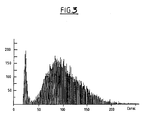
- the resulting suspension is then passed directly into the particle counter for continuous flow analysis, in a volume varying from 0.2 to 2 ml. It is possible to count or enumerate significantly to the nearest unit, the micro-organisms made fluorescent ( Figures 1, 2 and 3).
- Figures 1, 2 and 3 show population histograms of yeasts grown in yogurt.
- yeasts of the genus Saccharomyces in the case of FIG. 2, it is yeasts of the genus Rhodotorula and in the case of FIG. 3, it is Debaryomyces hansenii .
- Example 2 Search for yeasts contaminating fruit pulp yogurt: In the case where the sample is made up of fruit pulp yogurts, enzymes are added to promote the solubilization of said sample.
- the sample is treated as in Example 1, except that prior to the addition of the dye and / or the antibody, pectinase is added to promote solubilization; the enzymatic reaction is carried out by incubating at 37 ° C and for 5 minutes the yogurt sample in the presence of the enzyme.
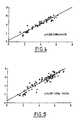
- Figures 4 (plain yogurt) and 5 (fruit yogurt) show comparative results between the process according to the invention and the conventional method of culture in Petri dishes.
- Example 3 Search for bacteria in beer or in culture media used for the fermentation of recombinant organisms (production of drugs for example).
- Example 1 Typically, 50 ml of cell suspension are centrifuged. The pellet is resuspended as indicated in Example 1. The rest of the process is similar, the viability markers or the antibodies being however adapted to the specific problem. However, the viability marker having a fluorescence in the green, the antibodies are marked by means of a fluorochrome with emission in the red, phycoerythrin for example; it is then possible, in this case, to carry out a count of the doubly labeled microorganisms, which makes it possible to identify the microorganism and to simultaneously determine its viability and its vitality.
- the viability marker having a fluorescence in the green
- the antibodies are marked by means of a fluorochrome with emission in the red, phycoerythrin for example; it is then possible, in this case, to carry out a count of the doubly labeled microorganisms, which makes it possible to identify the microorganism and to simultaneously determine its viability and its vitality.
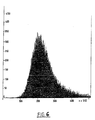
- FIG. 6 represents a population histogram of bacteria of the genus Lactobacillus detected in a sample of naturally contaminated beer. On the abscissa we have the fluorescence channel, and on the ordinate the number of particles per channel. The most fluorescent particles are those which have a very active metabolism.
- Example 4 Search for bacteria and / or yeasts in prepared products (example tomato paste, mayonnaise, béarnaise sauce, etc.) After an aqueous extraction of these products, the resulting suspension is coarsely filtered through a 15 ⁇ m filter for example. The filtered product is centrifuged as indicated in Example 1 above. The rest of the process is similar, with the option of using two viability markers with green fluorescence and two monoclonal antibodies with red fluorescence at different wavelengths, for example.
- the device will then include a measurement of the 3 parameters, making it possible to distinguish and to count or count in a precise unit, simultaneously, living yeasts of a given species, dead yeasts of the same species, living bacteria of a given species, dead bacteria of the same species, the total of live yeast from other species and the total of live bacteria from other species.
- FIG. 7 represents a histogram of a population of Candida parapsilosis contaminating a béarnaise sauce. On the abscissa, we have the fluorescence channel, and on the ordinate the number of microorganisms per channel.
- Example 5 Search for total bacteria in raw milk.
- Raw milk is processed to destroy the casein micelles and is then centrifuged; the pellet is taken up in a buffer as described in Example 1, adding in addition a few drops of an appropriate detergent such as Tween® 20. The rest of the process is similar. However, the somatic cells in milk can become colored. A simultaneous measurement and counting of the fluorescence and the size of the particles is then carried out by impedancemetry, which makes it possible to differentiate bacteria (less than 1 mm in size) from somatic cells (approximately 10 ⁇ m or more in size).
- Example 6 Search for pathogenic bacteria in human biological fluids, such as cerebrospinal fluid or urine.
- meningococcal meningitis can be carried out directly from the cerebrospinal fluid by centrifugation, and staining of the pellet by specific monoclonal antibodies commercially available.
- the culture of the specific microorganism is no longer necessary, the sensitivity of the apparatus being sufficient.
- the positive viability marker is used simultaneously to ascertain the metabolic state of the cells.
- the bacteria (bacteremia) or parasites can be found in the urine, for example.
- Figure 8 illustrates the detection and count of enterococci in a urine sample.
- Example 7 Rapid numbering of yeasts in a brew: The yeast suspension constituting the brew is diluted in NaCl at 9 g / l so as to obtain a cell density of between 5,000 and 50,000 / ml. A solution of the appropriate viability marker is added at a concentration of 1%. An incubation of 5 min at 45 ° C. colors the yeasts, which can then be counted or counted precisely to the nearest unit, by means of the installation according to the invention, in less than a minute.
- Example 8 Rapid numbering of yeasts in a leaven: The procedure is as in Example 7.
- Example 9 Germination test for mold spores and rapid count of germinated spores: Useful molds are generally supplied freeze-dried to the cheese industries. Their germination and the time to obtain it can be determined by placing them in a germination buffer favorable to the swelling of their wall, in particular saline solution buffered with phosphate and added with an energetic substance such as glucose, sucrose, fructose. , etc ... or, possibly, food environment.
- a germination buffer favorable to the swelling of their wall, in particular saline solution buffered with phosphate and added with an energetic substance such as glucose, sucrose, fructose. , etc ... or, possibly, food environment.
- Analysis of the sample in the installation according to the invention allows, after adequate dilution, within a period of the order of one minute, to determine the percentage of germinated spores and their total number.
- Example 10 Monitoring of a culture of a population of yeasts, and of the fermentation which results therefrom.
- a population of yeasts is inoculated into a beer wort at a concentration of 106 cells / ml.
- a viability marker solution specifically marking yeasts is added at a concentration of 1%.
- a 5 min incubation at 45 ° C colors the yeasts which can then be counted, using an appropriate flow cytometer.
- the average metabolic activity of the population increases (average intensity of fluorescence on the histograms): the overall activity of the population increases (successful fermentation) even if the number of cells does not increase (figure given by conventional methods) (Figure 9).
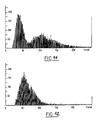
- Figure 9 shows the evolution of the viability and vitality of a yeast population ( Sacchoromyces cerevisiae ) in a beer wort at 10 ° -12 ° C over time.
- FIG. 9a is a curve of evolution of the number of cells over time. Sampling and counting are performed at time 0 ( Figure 9b), after 20 h ( Figure 9c), after 60 h ( Figure 9d) and after 160 h ( Figure 9e). We see that the number of cells decreases over time, while the histograms are moved to the right, which shows an increase in the vitality of the cells present.
- Example 11 Monitoring the effect of heat treatment on a growing yeast population in a beer wort.
- FIG. 10 A population of yeasts is subjected to a thermal shock at 60 ° C for 5 minutes (Figure 10).
- This figure 10 comprises, on the abscissa different strains of Saccharomyces cerevisiae (A, B, C, D), I and II representing two different beer musts, and on the ordinate, the cell concentration / ml.
- the populations are analyzed before and after the treatment: process in accordance with the invention: before treatment: column 1; after treatment: column 2 (response in 15 minutes); the methylene blue method: before treatment: column 3; after treatment: column 4 (response in approximately 30 minutes) and culture method on Petri dishes: column 5 (response in 3 days). It is found that the correspondence process according to the invention-methylene blue is satisfactory before heat treatment but not after this treatment, the reference used being the culture method on dishes. The result is obtained in a considerably reduced time.
- Example 12 Search for yeasts and bacteria in orange juice.
- the specific viability markers for bacteria and yeast respectively are added simultaneously to the centrifugation pellet of 10 ml of pulpy orange juice.
- Figure 11 illustrates the result of an analysis in which the peak on the left represents the population of bacteria and the peak on the right the population of yeasts.
- the apparatus makes it possible to determine the total numbers of cells in each peak (FIG. 11).
- Example 13 Search for a bacterial contamination in a cosmetic product.
- Figure 12 illustrates the result obtained with a contaminated product, whereas when the product is not contaminated, we obtain no fluorescence signal, therefore a negative result.
Landscapes
- Chemical & Material Sciences (AREA)
- Life Sciences & Earth Sciences (AREA)
- Health & Medical Sciences (AREA)
- Engineering & Computer Science (AREA)
- Organic Chemistry (AREA)
- Wood Science & Technology (AREA)
- Analytical Chemistry (AREA)
- Zoology (AREA)
- Immunology (AREA)
- Proteomics, Peptides & Aminoacids (AREA)
- Microbiology (AREA)
- Biochemistry (AREA)
- General Health & Medical Sciences (AREA)
- Biotechnology (AREA)
- Bioinformatics & Cheminformatics (AREA)
- Molecular Biology (AREA)
- General Engineering & Computer Science (AREA)
- Genetics & Genomics (AREA)
- Physics & Mathematics (AREA)
- Biomedical Technology (AREA)
- Hematology (AREA)
- Biophysics (AREA)
- Urology & Nephrology (AREA)
- Virology (AREA)
- Cell Biology (AREA)
- Sustainable Development (AREA)
- Tropical Medicine & Parasitology (AREA)
- Food Science & Technology (AREA)
- Medicinal Chemistry (AREA)
- General Physics & Mathematics (AREA)
- Pathology (AREA)
- Measuring Or Testing Involving Enzymes Or Micro-Organisms (AREA)
- Investigating Or Analyzing Materials By The Use Of Electric Means (AREA)
- Geophysics And Detection Of Objects (AREA)
- Apparatus Associated With Microorganisms And Enzymes (AREA)
Description
- La présente invention est relative à un procédé de recherche quantitatif, dans un milieu à l'état liquide, semi-liquide, gélifié ou pâteux, de micro-organismes, même présents en quantité extrêmement faible.
- Par quantité extrêmement faible, on entend au sens de la présente invention, un nombre de micro-organismes qui peut être égal à un.
- L'analyse qualitative et quantitative rapide de la présence de micro-organismes tels que bactéries, levures, moisissures et parasites dans des produits alimentaires, des produits d'hygiène ou des fluides, ainsi que la surveillance d'un processus de fermentation au cours de sa réalisation, s'avèrent très utiles et importants dans les différentes industries concernées.
- On utilise habituellement, comme technique de détection, la mise en culture d'un échantillon du produit à tester. Cette méthode de détection a l'inconvénient d'être longue à mettre en oeuvre, les micro-organismes éventuellement présents se développant dans un délai de 2 à 30 jours. De plus, la numération de micro-organismes par cette méthode n'est absolument pas précise et ne permet qu'une évaluation approximative du nombre de micro-organismes présents au départ ; l'identification des micro-organismes, par cette méthode, reste partielle.
- On connaît également une autre technique de détection, par analyse d'images, mais celle-ci, telle que réalisée jusqu'à présent, est coûteuse et difficile à mettre en oeuvre ; en effet, pour arriver à une numération correcte ou une détection sensible de micro-organismes présents dans l'échantillon, il faut analyser tous les champs de l'échantillon, ce qui rend cette recherche très longue.
- Il est également connu de marquer des cellules, en particulier des micro-organismes au moyen de colorants chimiques ou biologiques, notamment les colorants des acides nucléiques, qui marquent le plus souvent les cellules mortes et non les cellules vivantes ou les fluorochromes tels que les dérivés de la fluorescéine et de la phycoérythrine, qui sont utilisés depuis de nombreuses années, à travers leur couplage à des anticorps.
- L'utilisation d'anticorps polyspécifiques ou monospécifiques rendus fluorescents ont été décrits dans l'Art antérieur, notamment par la Demanderesse dans FR-A-2 598 513 qui vise des anticorps polyspécifiques anti-levures et antimoisissures.
- Toutefois, ces anticorps fluorescents rendent fluorescentes toutes les cellules, qu'elles soient vivantes ou mortes, ce qui représente un inconvénient important, soit pour déterminer sélectivement la présence d'un contaminant vivant dans un produit alimentaire ou d'hygiène, soit pour déterminer l'évolution ou la bonne marche d'un processus de fermentation.
- D'autres colorants ont également été décrits dans la littérature, en particulier le diacétate de carboxyfluorescéine (CFDA) et le diacétate de fluorescéine (FDA), ce dernier étant utilisé pour la détection des bactéries comme décrit dans un certain nombre d'articles (T.H. CHRZANOWSKI et al., "Applicability of the fluorescein diacetate method of detecting active bacteria in fresh water", paru en 1984 dans Microbial Ecology (10 : 179 - 185), B. Lundgren "Fluorescein diacetate as a stain of metabolically active bacteria in soil", paru dans OIKOS, 1981 (36 : 17 - 22), JARNAGIN et al. "The use of fluorescein diacetate and ethidium bromide as a stain for evaluating viability of mycobacteria" paru dans Stain Technol., 1980, (55, 4, 253 - 258), SCHNURER J. et al. "Fluorescein diactetate hydrolysis as a measure of total microbial activity in soil and litter", paru dans Applied Environm. Microbiol., 1982, (43, 6, 1256 - 1261), SONTAG qui décrivent ces colorants et leur mécanisme d'action. Toutefois, il s'agit en général de méthodes d'estimation, ou bien, lorsque la méthode est quantitative, elle utilise en association un colorant chimique des acides nucléiques ; ce sont des méthodes peu appropriées à l'analyse en série.
- Les techniques de détection selon l'Art antérieur ne permettent pas la détection sélective de micro-organismes vivants, surtout présents en très petite quantité.
- WO-A-8 605 206 décrit par exemple une méthode d'évaluation de la concentration de microorganismes présents dans un échantillon par rapport à une population standard : impliquant l'induction d'une fluorescence par clivage, à l'aide d'une enzyme propre aux microorganismes, d'un colorant non fluorescent ajouté préalablement et la mesure de la fluorescence totale émise par l'emsemble des microorganismes, cette méthode ne permet pas de détecter des concentrations inférieures à 10² cellules/ml.
- En conséquence, l'invention s'est donnée pour but de pourvoir à un procédé de recherche, de détection et de numération de micro-organismes, très rapide et facile à mettre en oeuvre, sensible, spécifique et peu coûteux, permettant le comptage à l'unité près desdits micro-organismes.
- La présente invention a pour objet un procédé de détermination quantitative de microorganismes, présents normalement, ou éventuellement contenus en tant que contaminants dans un milieu complexe à l'état liquide, semi-liquide, gélifié ou pâteux, notamment des produits alimentaires, des produits d'hygiène ou des fluides biologiques, lequel procédé comprend des étapes d'obtention d'échantillon et d'addition d'un marqueur de viabilité positive apte à marquer des microorganismes vivants, choisi parmi les substances non fluorescentes ou peu fluorescentes, qui pénètrent dans le microorganisme, lesdites substances étant alors clivées ou modifiées de manière à fournir un produit fluorescent, ledit produit étant piégé dans sa majeure partie ou totalement à l'intérieur dudit micro-organisme, lequel procédé est caractérisé en ce qu'il comprend :
- A. pour le marquage spécifique et sélectif des microorganismes:
- a) la séparation desdits microorganismes par filtration et/ou centrifugation d'une suspension d'échantillon, obtenue directement lorsque l'échantillon de départ est liquide, ou obtenue par la mise en contact de l'échantillon avec un tampon d'ajustement du pH du milieu à un pH alcalin, dans le cas où l'échantillon de départ est semi-liquide ou pâteux ;
- b) le marquage intracellulaire desdits microorganismes par incubation avec au moins un marqueur de viabilité positive pendant 5 à 10 min à 37°C,
- c) le traitement de l'échantillon obtenu en b) aux ultrasons, pendant 10 s, pour individualiser les microorganismes, et
- B. pour le dénombrement desdits microorganismes rendus fluorescents :
- d) le passage de l'échantillon obtenu en c) dans un cytomètre en flux, et
- e) le comptage à l'aide dudit cytomètre en flux de chaque microorganisme marqué par la mesure de la/les fluorescences intracellulaires émises par chacun desdits microorganismes.
- On entend par micro-organismes, au sens de la présente invention, notamment des bactéries, des levures, des moisissures et des parasites.
- On entend par marqueur de viabilité positive, une substance qui ne colore que les cellules vivantes et non les cellules mortes et dont l'intensité de coloration des cellules est proportionnelle à leur activité métabolique.
- Les colorants vitaux, au sens de la présente invention, sont des colorants des acides nucléiques et se combinent avec le matériel génétique des cellules aussi bien vivantes que mortes.
- On peut citer, à titre d'exemple non limitatif de colorants vitaux, le bromure d'éthydium, l'iodure du propydium, la mythramycine A, le DAPI, le colorant commercialisé sous le nom Hoechst 33258, le colorant commercialisé sous le nom Hoechst 33342.
- La cytomètrie en flux, en soi connue est décrite dans de nombreux documents en particulier dans EP-A-177 718.
- La combinaison de moyens selon l'invention, a l'avantage de permettre la réalisation de dosages en série, rapides à mettre en oeuvre, fiables ainsi que des comptages à l'unité près. Il ne s'agit pas d'une méthode d'évaluation de concentration par rapport à une population standard, il n'est donc pas nécessaire de connaître l'espèce ou le genre du microorganisme avant l'analyse.
- Selon un mode de mise en oeuvre avantageux dudit procédé, le tampon d'ajustement du pH est utilisé en tant que milieu de solubilisation.
- Selon encore un autre mode de mise en oeuvre avantageux dudit procédé, le traitement préalable comprend en outre l'action d'enzymes appropriées.
- Le traitement (avant et après le marquage) permet l'individualisation des cellules, formant à l'origine des colonies, et augmente ainsi la sensibilité de la détection.
- Le marqueur de viabilité positive est choisi parmi les substances non fluorescentes ou peu fluorescentes, qui pénètrent dans le micro-organisme, lesdites substances étant alors clivées ou modifiées de manière à fournir un produit fluorescent, ledit produit étant piégé dans sa majeure partie ou totalement à l'intérieur dudit micro-organisme.
- Les marqueurs de viabilité, conformes à l'invention, sont choisis dans le groupe qui comprend le FDA, le 6-CFDA, le 5-CFDA, le dilaurate de fluorescéine, l'ester de 5,6-CFDA N-hydroxy succinimide, le dipropionate de fluorescéine, la di-bêta-D-galactoside fluorescéine, le phosphate de 3-O-méthylfluorescéine, le pentaacétoxy ester de 2',7'-bis(carboxyéthyl)-5(6)-carboxyfluorescéine (BCECF/AM), le diacétate d'azidofluorescéine, l'acétate de 4-méthylumbelliferyl, le 4-méthylumbelliferyl bêta-D-galactoside, le 4-méthylumbelliferyl alpha-D-mannopyranoside, le nonanoate de 4-méthyllumbelliferyl, le phosphate de 4-méthylumbelliferyl, l'alanine-7-amino-4-méthylcoumarine, la glycine-7-amino-4-méthylcoumarine, la proline-7-amino-4-méthylcoumarine, la valine-7-amino-4-méthylcoumarine, la glycyl-L-proline-7-amino-4-méthylcoumarine, le 1,4-diacétoxy-2,3-dicyanobenzène (ABD), l'hydroéthidine, l'acétate de résorufine.
- Selon un autre mode de mise en oeuvre avantageux dudit procédé, lesdits microorganismes sont en outre soumis à un marquage additionnel avec au moins une substance choisie dans le groupe constitué par d'autres marqueurs de viabilité positive, des colorants vitaux, des anticorps rendus fluorescents et des sondes nucléiques rendues fluorescentes.
- Conformément à ce dernier mode de mise en oeuvre avantageux dudit procédé, les anticorps sont choisis parmi les anticorps polyclonaux et/ou monoclonaux, mono ou polyspécifiques, anti-levures et/ou anti-bactéries et/ou anti-moisissures et/ou anti-parasites et les anticorps polyclonaux et/ou monoclonaux mono ou polygénériques anti-levures et/ou anti-bactéries et/ou anti-moisissures et/ou anti-parasites.
- Conformément à l'invention, les anticorps mis en oeuvre sont rendus fluorescents par un agent fluorochrome approprié.
- Les marqueurs de viabilité ont pour rôle de marquer sélectivement les micro-organismes vivants.
- Les anticorps ont pour rôle de marquer spécifiquement une espèce ou un genre de micro-organisme, que celui-ci soit vivant ou mort.
- Le procédé de détermination conforme à l'invention peut avantageusement être mis en oeuvre dans une installation comprenant un cytomètre en flux à cellule de mesure comprenant une chambre de mesure en flux que traverse l'échantillon de produit ou de fluide à analyser et un dispositif d'enregistrement des signaux de fluorescence émis par lesdits micro-organismes, la cellule de mesure étant pourvue d'un dispositif de rinçage de la chambre de mesure, lequel entre en action sous l'effet du retrait de l'échantillon du porte-échantillon ou sous l'effet d'une commande électronique externe appropriée.
- Outre les dispositions qui précèdent, l'invention comprend encore d'autres dispositions, qui ressortiront de la description qui va suivre, qui se réfère à des exemples de mise en oeuvre du procédé conforme à l'invention, avec référence aux figures 1 à 12 sont des diagrammes.
- Il doit être bien entendu, toutefois, que les exemples, les dessins et les parties descriptives correspondantes sont donnés uniquement à titre d'illustration de l'objet de l'invention, dont ils ne constituent en aucune manière une limitation.
- Exemple 1 : Recherche de levures contaminant le yaourt.
- Il est possible, selon la/les espèce(s) de levure à rechercher, de choisir le marqueur de viabilité et/ou les anticorps anti-levures les plus appropriés à ladite levure.
- Le yaourt est solubilisé au moyen de réactifs appropriés, tel que le tampon carbonate EDTA pH 9,0. Le produit est centrifugé 5 minutes à 1 500 g. Le culot est repris dans du chlorure de sodium à 9 g/l. Le diacétate de fluorescéine, éventuellement associé aux anticorps fluorescents anti-levures appropriés sont rajoutés. Une incubation de 5 à 10 minutes à 37°C permet aux réactions chimiques de se produire ; la suspension est soumise aux ultra-sons pendant 10 secondes. La suspension résultante est ensuite passée directement dans le compteur de particules pour une analyse continue en flux, sous un volume variant de 0,2 à 2 ml. Il est possible de compter ou dénombrer significativement à l'unité près, les micro-organismes rendus fluorescents (figures 1, 2 et 3).
- Les figures 1, 2 et 3 représentent des histogrammes de population de levures cultivées dans le yaourt.
- On a en abscisse le canal de fluorescence représentant l'intensité de lumière et en ordonnée le nombre de cellules par canal.
- Dans le cas de la figure 1, il s'agit de levures du genre Saccharomyces ; dans le cas de la figure 2, il s'agit de levures du genre Rhodotorula et dans le cas de la figure 3, il s'agit de Debaryomyces hansenii.
- Exemple 2 : Recherche de levures contaminant le yaourt à pulpe de fruits :
Dans le cas où l'échantillon est consitué de yaourts à pulpe de fruits, des enzymes sont ajoutées pour favoriser la solubilisation dudit échantillon. - L'échantillon est traité comme dans l'exemple 1, sauf que préalablement à l'addition du colorant et/ou de l'anticorps, de la pectinase est rajoutée pour favoriser la solubilisation ; la réaction enzymatique s'effectue en incubant à 37°C et pendant 5 minutes l'échantillon de yaourt en présence de l'enzyme.
- Les figures 4 (yaourt nature) et 5 (yaourt aux fruits) montrent des résultats comparatifs entre le procédé conforme à l'invention et la méthode classique de culture en boîtes de Pétri.
- Ces figures comportent en abscisses les résultats obtenus par le procédé conforme à l'invention (log (coups/ml)) et en ordonnées les résultats obtenus par la méthode classique (log (levures/ml)). On observe une très bonne corrélation entre les deux méthodes.
- Exemple 3 : Recherche de bactéries dans la bière ou dans des milieux de culture servant à la fermentation d'organismes recombinés (production de médicaments par exemple).
- Typiquement, 50 ml de suspension cellulaire sont centrifugés. Le culot est remis en suspension tel qu'indiqué dans l'exemple 1. La suite du procédé est similaire, les marqueurs de viabilité ou les anticorps étant toutefois adaptés au problème spécifique. Cependant, le marqueur de viabilité ayant une fluorescence dans le vert, les anticorps sont marqués au moyen d'un fluorochrome à émission dans le rouge, la phycoérythrine par exemple ; il est alors possible, dans ce cas, d'effectuer un comptage des micro-organismes doublement marqués, ce qui permet d'identifier le micro-organisme et de déterminer simultanément sa viabilité et sa vitalité.
- La figure 6 représente un histogramme de population de bactéries du genre Lactobacillus détecté dans un échantillon de bière naturellement contaminé. En abscisse on a le canal de fluorescence, et en ordonnée le nombre de particules par canal. Les particules les plus fluorescentes sont celles qui présentent un métabolisme très actif.
- Exemple 4 : Recherche de bactéries et/ou de levures dans des produits préparés (exemple pâte de tomates, mayonnaise, sauce béarnaise, etc...)
Après une extraction aqueuse de ces produits, la suspension résultante est filtrée grossièrement à travers un filtre de 15 µm par exemple. Le produit filtré est centrifugé ainsi qu'indiqué dans l'exemple 1 ci-dessus. Le reste du processus est similaire, ayant toutefois la possibilité d'utiliser en mélange deux marqueurs de viabilité ayant une fluorescence dans le vert et deux anticorps monoclonaux ayant une fluorescence dans le rouge à des longueurs d'onde différentes, par exemple. L'appareil comprendra alors une mesure des 3 paramètres, permettant de distinguer et de compter ou dénombrer de façon précise à l'unité prés, simultanément les levures vivantes d'une espèce donnée, les levures mortes de même espèce, les bactéries vivantes d'une espèce donnée, les bactéries mortes de même espèce, le total des levures vivantes d'autres espèces et le total des bactéries vivantes d'autres espèces. - La figure 7 représente un histogramme d'une population de Candida parapsilosis contaminant une sauce béarnaise. En abscisse, on a le canal de fluorescence, et en ordonnée le nombre de micro-organismes par canal.
- Exemple 5 : Recherche de bactéries totales dans le lait cru.
- Le lait cru est traité pour détruire les micelles de caséine et est ensuite centrifugé ; le culot est repris dans un tampon tel que décrit dans l'exemple 1, en ajoutant en plus quelques gouttes d'un détergent approprié tel que Tween® 20. La suite du processus est similaire. Toutefois, les cellules somatiques du lait peuvent se colorer. On procède alors à une mesure et un comptage simultanés de la fluorescence et de la taille des particules par impédancemétrie, ce qui permet de différencier les bactéries (moins de 1 mm en taille) des cellules somatiques (environ 10 µm ou plus en taille).
- Exemple 6 : Recherche de bactéries pathogènes dans les liquides biologiques humains, tel le liquide céphalo-rachidien ou l'urine.
- La détection précoce d'une méningite à méningocoques peut être réalisée directement à partir du fluide cérébro-spinal par centrifugation, et coloration du culot par anticorps monoclonaux spécifiques disponibles commercialement. La culture du micro-organisme spécifique n'est plus nécessaire, la sensibilité de l'appareil étant suffisante. Le marqueur de viabilité positive est utilisé simultanément pour s'assurer de l'état métabolique des cellules. Similairement, les bactéries (bactériémie) ou les parasites peuvent être recherchés dans les urines, par exemple.
- La figure 8 illustre la détection et la numération d'entérocoques dans un échantillon d'urine.
- Exemple 7 : Numération rapide de levures dans un brassin :
La suspension de levures constituant le brassin est diluée dans du NaCl à 9 g/l de manière à obtenir une densité de cellules comprise entre 5 000 et 50 000/ml. Une solution du marqueur de viabilité adéquat est ajoutée à une concentration de 1 %. Une incubation de 5 mn à 45°C colore les levures, que l'on peut ensuite compter ou dénombrer de façon précise à l'unité près, au moyen de l'installation conforme à l'invention, en moins d'une minute. - Exemple 8 : Numération rapide de levures dans un levain :
On procède comme dans l'exemple 7. - Exemple 9 : Test de germination de spores de moisissures et numération rapide des spores ayant germé :
Les moisissures utiles sont généralement fournies lyophilisées aux industries fromagères. Leur germination et le délai d'obtention de celle-ci peuvent être déterminés en les plaçant dans un tampon de germination favorable au gonflement de leur paroi, notamment solution saline tamponnée au phosphate et additionnée d'une substance énergétique telle que glucose, saccharose, fructose, etc... ou, éventuellement, milieu alimentaire. - Après 4 à 6 heures d'incubation, le gonflement de la paroi des spores rend celles-ci perméables aux marqueurs de viabilité, utilisé de la même manière que dans l'exemple 7.
- L'analyse de l'échantillon dans l'installation conforme à l'invention, permet, après dilution adéquate, dans un délai de l'ordre d'une minute, de déterminer le pourcentage de spores germées et leur nombre total.
- Exemple 10 : Suivi d'une mise en culture d'une population de levures, et de la fermentation qui en résulte.
- Une population de levures est inoculée dans un moût de bière à une concentration de 10⁶ cellules/ml. Une solution de marqueur de viabilité, marquant spécifiquement les levures est ajoutée à une concentration de 1 %. Une incubation de 5 min à 45°C colore les levures que l'on peut ensuite compter, à l'aide d'un cytomètre en flux approprié. Dans ce cas, on peut déterminer d'une part, que le nombre de cellules vivantes diminue, et que d'autre part l'activité métabolique moyenne de la population augmente (intensité moyenne de fluorescence sur les histogrammes) : l'activité globale de la population augmente (fermentation réussie) même si le nombre de cellules n'augmente pas (chiffre donné par les méthodes classiques) (figure 9).
- La figure 9 montre l'évolution de la viabilité et de la vitalité d'une population de levures (Sacchoromyces cerevisiae) dans un moût de bière à 10°-12°C au cours du temps.
- La figure 9a est une courbe d'évolution du nombre de cellules au cours du temps. Un prélèvement et un comptage sont réalisé au temps 0 (figure 9b), au bout de 20 h (figure 9c), au bout de 60 h (figure 9d) et au bout de 160 h (figure 9e). On voit que le nombre de cellules diminue au cours du temps, alors que les histogrammes sont déplacés vers la droite, ce qui montre un accroissement de la vitalité des cellules présentes.
- Exemple 11 : Suivi de l'effet d'un traitement thermique sur une population de levures en croissance dans un moût de bière.
- Une population de levures est soumise à un choc thermique à 60°C pendant 5 minutes (figure 10). Cette figure 10 comporte, en abscisse différentes souches de Saccharomyces cerevisiae (A, B, C, D), I et II représentant deux moûts de bière différents, et en ordonnée, la concentration cellulaire/ml.
- Les populations sont analysées avant et après le traitement : procédé conforme à l'invention : avant traitement : colonne 1 ; après traitement : colonne 2 (réponse en 15 minutes) ; la méthode au bleu de méthylène : avant traitement : colonne 3 ; après traitement : colonne 4 (réponse en environ 30 minutes) et méthode de culture sur boîtes de Pétri : colonne 5 (réponse en 3 jours). On constate que la correspondance procédé selon l'invention-bleu de méthylène est satisfaisante avant traitement thermique mais pas après ce traitement, la référence utilisée étant la méthode de culture sur boîtes. Le résultat est obtenu dans un délai considérablement réduit.
- Exemple 12 : Recherches de levures et de bactéries dans le jus d'orange.
- Les marqueurs de viabilité spécifiques respectivement des bactéries et des levures sont ajoutés simultanément au culot de centrifugation de 10 ml de jus d'orange pulpeux.
- Après une incubation de 10 minutes à 40°C, l'échantillon est passé dans le cytomètre conforme à l'invention. La figure 11 illustre le résultat d'une analyse dans laquelle le pic de gauche représente la population de bactéries et le pic de droite la population de levures. L'appareil permet de déterminer les nombres totaux de cellules dans chaque pic (figure 11).
- Exemple 13 : Recherche d'une contamination bactérienne dans un produit cosmétique.
- L'on procède à un traitement et une coloration similaires à ce qui est décrit précédemment. La figure 12 illustre le résultat obtenu avec un produit contaminé, alors que lorsque le produit n'est pas contaminé, on obtient aucun signal de fluorescence, donc un résultat négatif.
Claims (6)
- Procédé de détermination quantitative de microorganismes, présents normalement, ou éventuellement contenus en tant que contaminants dans un milieu complexe à l'état liquide, semi-liquide, gélifié ou pâteux, notamment des produits alimentaires, des produits d'hygiène ou des fluides biologiques, lequel procédé comprend des étapes d'obtention d'échantillon et d'addition d'un marqueur de viabilité positive apte à marquer des microorganismes vivants, choisi parmi les substances non fluorescentes ou peu fluorescentes, qui pénètrent dans le microorganisme, lesdites substances étant alors clivées ou modifiées de manière à fournir un produit fluorescent, ledit produit étant piégé dans sa majeure partie ou totalement à l'intérieur dudit micro-organisme, lequel procédé est caractérisé en ce qu'il comprend :A. pour le marquage spécifique et sélectif des microorganismes:a) la séparation desdits microorganismes par filtration et/ou centrifugation d'une suspension d'échantillon, obtenue directement, lorsque l'échantillon de départ est liquide, ou obtenue par la mise en contact de l'échantillon avec un tampon d'ajustement du pH du milieu à un pH alcalin, dans le cas où l'échantillon de départ est semi-liquide ou pâteux ;b) le marquage intracellulaire desdits microorganismes par incubation avec au moins un marqueur de viabilité positive pendant 5 à 10 min à 37°C,c) le traitement de l'échantillon obtenu en b) aux ultrasons, pendant 10 s, pour individualiser les microorganismes, etB. pour le dénombrement desdits microorganismes rendus fluorescents :d) le passage de l'échantillon obtenu en c) dans un cytomètre en flux, ete) le comptage à l'aide dudit cytomètre en flux de chaque microorganisme marqué par la mesure de la/les fluorescences intracellulaires émises par chacun desdits microorganismes.
- Procédé selon la revendication 1, caractérisé en ce que le tampon d'ajustement du pH est utilisé en tant que milieu de solubilisation.
- Procédé selon la revendication 1, caractérisé en ce que le traitement préalable comprend en outre l'action d'enzymes appropriées.
- Procédé selon la revendication 1, caractérisé en ce que lesdits microorganismes sont en outre soumis à un marquage additionnel avec au moins une substance choisie dans le groupe constitué par d'autres marqueurs de viabilité positive, des colorants vitaux, des anticorps rendus fluorescents et des sondes nucléiques rendues fluorescentes.
- Procédé selon la revendication 4, caractérisé en ce que les anticorps sont choisis parmi les anticorps polyclonaux et/ou monoclonaux, mono ou polyspécifiques, anti-levures et/ou anti-bactéries et/ou anti-moisissures et/ou anti-parasites et les anticorps polyclonaux et/ou monoclonaux mono ou polygénériques anti-levures et/ou anti-bactéries et/ou anti-moisissures et/ou anti-parasites.
- Procédé selon la revendication 5, caractérisé en ce que les anticorps mis en oeuvre sont rendus fluorescents par un agent fluorochrome approprié.
Priority Applications (1)
| Application Number | Priority Date | Filing Date | Title |
|---|---|---|---|
| AT8989400655T ATE105023T1 (de) | 1988-03-08 | 1989-03-08 | Verfahren zur bestimmung von mikro-organismen. |
Applications Claiming Priority (2)
| Application Number | Priority Date | Filing Date | Title |
|---|---|---|---|
| FR8802937A FR2628531B1 (fr) | 1988-03-08 | 1988-03-08 | Procede de recherche, de detection specifique et de numeration de micro-organismes, installation pour la mise en oeuvre dudit procede |
| FR8802937 | 1988-03-08 |
Publications (2)
| Publication Number | Publication Date |
|---|---|
| EP0333560A1 EP0333560A1 (fr) | 1989-09-20 |
| EP0333560B1 true EP0333560B1 (fr) | 1994-04-27 |
Family
ID=9364022
Family Applications (1)
| Application Number | Title | Priority Date | Filing Date |
|---|---|---|---|
| EP89400655A Revoked EP0333560B1 (fr) | 1988-03-08 | 1989-03-08 | Procédé de détermination quantitative de micro-organismes |
Country Status (7)
| Country | Link |
|---|---|
| EP (1) | EP0333560B1 (fr) |
| JP (1) | JPH02503747A (fr) |
| AT (1) | ATE105023T1 (fr) |
| DE (1) | DE68914871T2 (fr) |
| ES (1) | ES2055801T3 (fr) |
| FR (1) | FR2628531B1 (fr) |
| WO (1) | WO1989008714A1 (fr) |
Cited By (1)
| Publication number | Priority date | Publication date | Assignee | Title |
|---|---|---|---|---|
| US6803208B2 (en) | 2001-07-30 | 2004-10-12 | The United States Of America As Represented By The Secretary Of The Navy | Automated epifluorescence microscopy for detection of bacterial contamination in platelets |
Families Citing this family (16)
| Publication number | Priority date | Publication date | Assignee | Title |
|---|---|---|---|---|
| JP2735901B2 (ja) * | 1989-10-18 | 1998-04-02 | 三菱重工業株式会社 | 微生物の生細胞,死細胞および微生物細胞以外の粒子の数の測定方法 |
| EP0443700A3 (en) * | 1990-02-21 | 1991-10-16 | Mitsubishi Jukogyo Kabushiki Kaisha | Method for counting living cells of microbes and apparatus therefor |
| JP3070968B2 (ja) * | 1991-05-14 | 2000-07-31 | シスメックス株式会社 | 尿中の細胞分析用試薬及び方法 |
| FR2707665A1 (fr) * | 1993-06-28 | 1995-01-20 | Chemunex | Procédé de mesure et d'évaluation de la vitalité des microorganismes et ses applications. |
| FR2719602B1 (fr) * | 1994-05-05 | 1996-07-26 | Biocom Sa | Procédé et installation pour la numérisation de cellules et micro-organismes, notamment des produits alimentaires ou des fluides biologiques. |
| ES2156927T3 (es) * | 1994-10-20 | 2001-08-01 | Sysmex Corp | Reactivo y metodo para analizar componentes solidos en orina. |
| AUPN214095A0 (en) * | 1995-04-03 | 1995-04-27 | Australian Water Technologies Pty Ltd | Method for detecting microorganisms using flow cytometry |
| WO1998047999A1 (fr) * | 1997-04-18 | 1998-10-29 | Centro Nacional De Investigaciones Cientificas (Cnic) | Equipement, jeu et procede de diagnostic microbiologique |
| AU2002364580A1 (en) | 2001-12-18 | 2003-06-30 | University Of Wyoming | Apparatus and methods for high throughput analysis of particles in a translucent flowing liquid |
| FR2845097B1 (fr) | 2002-10-01 | 2006-06-16 | Metis Biotechnologies | Procede de detection et de comptage de microorganismes dans un echantillon |
| US7161665B2 (en) * | 2002-12-18 | 2007-01-09 | University Of Wyoming | High resolution imaging fountain flow cytometry |
| DE10329539A1 (de) * | 2003-06-30 | 2005-01-20 | Innovatis Ag | Verfahren und Vorrichtung zur Charakterisierung einer Kulturflüssigkeit |
| SI21661A (sl) * | 2003-12-30 | 2005-06-30 | Celica, D.O.O. | Postopek za evaluacijo deleža hibridnih celic in celičnih izdelkov s konfokalno mikroskopijo in avtoklavabilna elektrofuzijska kamrica |
| EP2089723A2 (fr) * | 2006-11-13 | 2009-08-19 | University of Wyoming | Appareil et procédé pour mesurer la fluorescence de grands organismes multicellulaires |
| CN109423508B (zh) * | 2017-08-22 | 2021-02-12 | 厦门大学 | 一种对果蔬汁中的细菌进行计数检测的方法 |
| US10871439B2 (en) | 2018-10-29 | 2020-12-22 | University Of Wyoming | Enhancement of sensitivity of fountain flow cytometry by background attenuation |
Family Cites Families (6)
| Publication number | Priority date | Publication date | Assignee | Title |
|---|---|---|---|---|
| JPS59192099A (ja) * | 1983-04-12 | 1984-10-31 | Ajinomoto Co Inc | 微生物菌数の測定法 |
| JPS6027398A (ja) * | 1983-07-26 | 1985-02-12 | Hitachi Ltd | 微生物検査方法 |
| DE3420018A1 (de) * | 1984-05-29 | 1985-12-05 | Max-Planck-Gesellschaft zur Förderung der Wissenschaften e.V., 3400 Göttingen | Vorrichtung zur messung bestimmter eigenschaften in einem traegermedium suspendierter partikel |
| EP0177718B1 (fr) * | 1984-09-11 | 1989-12-06 | Partec AG | Procédé et dispositif pour le triage de particules microscopiques |
| EP0215066A1 (fr) * | 1985-02-27 | 1987-03-25 | University Of Cincinnati | Detection de microorganismes viables par induction de fluorescence |
| JP3181381B2 (ja) * | 1992-07-13 | 2001-07-03 | 富士通株式会社 | 半導体レーザモジュール |
-
1988
- 1988-03-08 FR FR8802937A patent/FR2628531B1/fr not_active Expired - Lifetime
-
1989
- 1989-03-08 ES ES89400655T patent/ES2055801T3/es not_active Expired - Lifetime
- 1989-03-08 EP EP89400655A patent/EP0333560B1/fr not_active Revoked
- 1989-03-08 DE DE68914871T patent/DE68914871T2/de not_active Revoked
- 1989-03-08 AT AT8989400655T patent/ATE105023T1/de not_active IP Right Cessation
- 1989-03-08 JP JP1503205A patent/JPH02503747A/ja active Pending
- 1989-03-08 WO PCT/FR1989/000096 patent/WO1989008714A1/fr not_active Ceased
Non-Patent Citations (5)
| Title |
|---|
| APPLIED OPTICS, vol. 26, no. 16, 15 August 1987, New York, NY (US); J.W. BACUS et al.; pp. 3280-3293# * |
| BIOTECHNOLOGY, vol. 3, 1985; pp. 337-356# * |
| CYTOMETRY, vol. 4; 1983; pp. 222-227# * |
| JOURNAL OF HISTOCHEMISTRY & CYTOCHEMISTRY, vol. 34, no. 2, February 1986, New York, NY (US); K.D. BAUER et al., pp. 245-250# * |
| PATENT ABSTRACTS OF JAPAN, vol. 9, no. 145 (C-287)(1868), 20 June1985# * |
Cited By (1)
| Publication number | Priority date | Publication date | Assignee | Title |
|---|---|---|---|---|
| US6803208B2 (en) | 2001-07-30 | 2004-10-12 | The United States Of America As Represented By The Secretary Of The Navy | Automated epifluorescence microscopy for detection of bacterial contamination in platelets |
Also Published As
| Publication number | Publication date |
|---|---|
| JPH02503747A (ja) | 1990-11-08 |
| FR2628531B1 (fr) | 1992-10-02 |
| ES2055801T3 (es) | 1994-09-01 |
| WO1989008714A1 (fr) | 1989-09-21 |
| FR2628531A1 (fr) | 1989-09-15 |
| EP0333560A1 (fr) | 1989-09-20 |
| DE68914871T2 (de) | 1994-08-11 |
| ATE105023T1 (de) | 1994-05-15 |
| DE68914871D1 (de) | 1994-06-01 |
Similar Documents
| Publication | Publication Date | Title |
|---|---|---|
| EP0333560B1 (fr) | Procédé de détermination quantitative de micro-organismes | |
| Caron et al. | Assessment of bacterial viability status by flow cytometry and single cell sorting | |
| EP0758400B1 (fr) | Procede et installation pour la numeration de cellules et micro-organismes, notamment des produits alimentaires ou des fluides biologiques | |
| US20010006783A1 (en) | Method and apparatus for detecting bacteria | |
| RU2517618C2 (ru) | Способ и система для определения количества культивируемых клеток | |
| FR2928656A1 (fr) | Procede de detection en temps reel de microorganismes dans un milieu de culture liquide par agglutination. | |
| EP0054001B1 (fr) | Méthode pour observer le développement de micro-organismes | |
| AU2005217026B2 (en) | Measuring contamination | |
| EP2478112B1 (fr) | Procede d'identification de bacteries du groupe bacillus cereus | |
| FR2707665A1 (fr) | Procédé de mesure et d'évaluation de la vitalité des microorganismes et ses applications. | |
| EP0311541B1 (fr) | Procédé de numération, de dépistage et d'identification des mycoplasmes en général et urogénitaux en particulier | |
| EP3650551A1 (fr) | Procédé d'isolement et d'analyse de microorganismes contenus dans un échantillon | |
| FR2638849A1 (fr) | Procede d'amplification d'un signal fluorescent pour la recherche specifique de la presence eventuelle de particules et application a la detection et a la numeration desdites particules | |
| EP2252700B1 (fr) | Procede de detection en temps reel de microorganismes dans un milieu de culture liquide par lyse cellulaire | |
| FR2764305A1 (fr) | Procede de detection et de numeration de cellules viables dans un echantillon biologique et kit pour sa mise en oeuvre | |
| US20230295682A1 (en) | Method and system for rapid detection of low level bacteria in a growth medium | |
| FR2908786A1 (fr) | Kit de detection de brettanomyces pour l'oenologie | |
| FR2902110A1 (fr) | Kit de detection de brettanomyces pour l'oenologie | |
| EP4735619A1 (fr) | Milieu réactionnel et méthode permettant la détection d'une e. coli productrice de shigatoxine et/ou d'une e. coli entérohémorragique | |
| FR2683907A1 (fr) | Dispositif portable d'analyse pour le controle des procedes agro-alimentaires et biotechnologiques par biochimiluminescence. | |
| WO2008006985A1 (fr) | Kit de détection de brettanomyces pour l'oenologie | |
| AU2014240348A1 (en) | Method, kit and system for culturable cell count |
Legal Events
| Date | Code | Title | Description |
|---|---|---|---|
| PUAI | Public reference made under article 153(3) epc to a published international application that has entered the european phase |
Free format text: ORIGINAL CODE: 0009012 |
|
| AK | Designated contracting states |
Kind code of ref document: A1 Designated state(s): AT BE CH DE ES FR GB GR IT LI LU NL SE |
|
| 17P | Request for examination filed |
Effective date: 19900208 |
|
| 17Q | First examination report despatched |
Effective date: 19911203 |
|
| RTI1 | Title (correction) | ||
| GRAA | (expected) grant |
Free format text: ORIGINAL CODE: 0009210 |
|
| AK | Designated contracting states |
Kind code of ref document: B1 Designated state(s): AT BE CH DE ES FR GB GR IT LI LU NL SE |
|
| PG25 | Lapsed in a contracting state [announced via postgrant information from national office to epo] |
Ref country code: SE Free format text: LAPSE BECAUSE OF FAILURE TO SUBMIT A TRANSLATION OF THE DESCRIPTION OR TO PAY THE FEE WITHIN THE PRESCRIBED TIME-LIMIT Effective date: 19940427 Ref country code: AT Effective date: 19940427 |
|
| REF | Corresponds to: |
Ref document number: 105023 Country of ref document: AT Date of ref document: 19940515 Kind code of ref document: T |
|
| REF | Corresponds to: |
Ref document number: 68914871 Country of ref document: DE Date of ref document: 19940601 |
|
| ITF | It: translation for a ep patent filed | ||
| GBT | Gb: translation of ep patent filed (gb section 77(6)(a)/1977) |
Effective date: 19940622 |
|
| PG25 | Lapsed in a contracting state [announced via postgrant information from national office to epo] |
Ref country code: GR Free format text: LAPSE BECAUSE OF FAILURE TO SUBMIT A TRANSLATION OF THE DESCRIPTION OR TO PAY THE FEE WITHIN THE PRESCRIBED TIME-LIMIT Effective date: 19940729 |
|
| REG | Reference to a national code |
Ref country code: ES Ref legal event code: FG2A Ref document number: 2055801 Country of ref document: ES Kind code of ref document: T3 |
|
| PLBI | Opposition filed |
Free format text: ORIGINAL CODE: 0009260 |
|
| PG25 | Lapsed in a contracting state [announced via postgrant information from national office to epo] |
Ref country code: ES Free format text: LAPSE BECAUSE OF NON-PAYMENT OF DUE FEES Effective date: 19950309 |
|
| PG25 | Lapsed in a contracting state [announced via postgrant information from national office to epo] |
Ref country code: LU Free format text: LAPSE BECAUSE OF NON-PAYMENT OF DUE FEES Effective date: 19950331 Ref country code: LI Free format text: LAPSE BECAUSE OF NON-PAYMENT OF DUE FEES Effective date: 19950331 Ref country code: CH Free format text: LAPSE BECAUSE OF NON-PAYMENT OF DUE FEES Effective date: 19950331 Ref country code: BE Effective date: 19950331 |
|
| 26 | Opposition filed |
Opponent name: BIOCOM SA Effective date: 19950127 |
|
| NLR1 | Nl: opposition has been filed with the epo |
Opponent name: BIOCOM SA |
|
| BERE | Be: lapsed |
Owner name: CHEMUNEX Effective date: 19950331 |
|
| PG25 | Lapsed in a contracting state [announced via postgrant information from national office to epo] |
Ref country code: NL Effective date: 19951001 |
|
| REG | Reference to a national code |
Ref country code: CH Ref legal event code: PL |
|
| NLV4 | Nl: lapsed or anulled due to non-payment of the annual fee |
Effective date: 19951001 |
|
| PGFP | Annual fee paid to national office [announced via postgrant information from national office to epo] |
Ref country code: FR Payment date: 19971223 Year of fee payment: 10 |
|
| PGFP | Annual fee paid to national office [announced via postgrant information from national office to epo] |
Ref country code: DE Payment date: 19980216 Year of fee payment: 10 |
|
| PGFP | Annual fee paid to national office [announced via postgrant information from national office to epo] |
Ref country code: GB Payment date: 19980227 Year of fee payment: 10 |
|
| RDAH | Patent revoked |
Free format text: ORIGINAL CODE: EPIDOS REVO |
|
| RDAG | Patent revoked |
Free format text: ORIGINAL CODE: 0009271 |
|
| STAA | Information on the status of an ep patent application or granted ep patent |
Free format text: STATUS: PATENT REVOKED |
|
| 27W | Patent revoked |
Effective date: 19980903 |
|
| GBPR | Gb: patent revoked under art. 102 of the ep convention designating the uk as contracting state |
Free format text: 980903 |
|
| PLAB | Opposition data, opponent's data or that of the opponent's representative modified |
Free format text: ORIGINAL CODE: 0009299OPPO |