EP0333701A2 - Verfahren zum Steuern und Regeln einer Brennkraftmaschine eines Fahrzeuges - Google Patents
Verfahren zum Steuern und Regeln einer Brennkraftmaschine eines Fahrzeuges Download PDFInfo
- Publication number
- EP0333701A2 EP0333701A2 EP89890078A EP89890078A EP0333701A2 EP 0333701 A2 EP0333701 A2 EP 0333701A2 EP 89890078 A EP89890078 A EP 89890078A EP 89890078 A EP89890078 A EP 89890078A EP 0333701 A2 EP0333701 A2 EP 0333701A2
- Authority
- EP
- European Patent Office
- Prior art keywords
- speed
- memory
- component
- sum
- components
- Prior art date
- Legal status (The legal status is an assumption and is not a legal conclusion. Google has not performed a legal analysis and makes no representation as to the accuracy of the status listed.)
- Granted
Links
- 238000000034 method Methods 0.000 title claims abstract description 18
- 230000001276 controlling effect Effects 0.000 title claims abstract description 5
- 230000001105 regulatory effect Effects 0.000 title claims abstract description 5
- 230000015654 memory Effects 0.000 claims abstract description 23
- 238000004364 calculation method Methods 0.000 claims abstract description 17
- 238000002485 combustion reaction Methods 0.000 claims abstract description 13
- 238000002347 injection Methods 0.000 claims abstract description 5
- 239000007924 injection Substances 0.000 claims abstract description 5
- 239000000446 fuel Substances 0.000 claims abstract description 4
- 230000006870 function Effects 0.000 claims abstract description 3
- 238000005259 measurement Methods 0.000 claims description 11
- 238000010586 diagram Methods 0.000 description 3
- 230000006399 behavior Effects 0.000 description 2
- 230000008859 change Effects 0.000 description 2
- 238000012935 Averaging Methods 0.000 description 1
- 230000001133 acceleration Effects 0.000 description 1
- 230000033228 biological regulation Effects 0.000 description 1
- 238000006243 chemical reaction Methods 0.000 description 1
- 230000008878 coupling Effects 0.000 description 1
- 238000010168 coupling process Methods 0.000 description 1
- 238000005859 coupling reaction Methods 0.000 description 1
- 238000005516 engineering process Methods 0.000 description 1
- 230000006872 improvement Effects 0.000 description 1
- 230000008569 process Effects 0.000 description 1
- 230000009467 reduction Effects 0.000 description 1
- 239000004065 semiconductor Substances 0.000 description 1
- 238000000926 separation method Methods 0.000 description 1
- 230000006641 stabilisation Effects 0.000 description 1
- 238000011105 stabilization Methods 0.000 description 1
- 230000002123 temporal effect Effects 0.000 description 1
Images
Classifications
-
- F—MECHANICAL ENGINEERING; LIGHTING; HEATING; WEAPONS; BLASTING
- F02—COMBUSTION ENGINES; HOT-GAS OR COMBUSTION-PRODUCT ENGINE PLANTS
- F02D—CONTROLLING COMBUSTION ENGINES
- F02D31/00—Use of speed-sensing governors to control combustion engines, not otherwise provided for
- F02D31/001—Electric control of rotation speed
- F02D31/007—Electric control of rotation speed controlling fuel supply
- F02D31/009—Electric control of rotation speed controlling fuel supply for maximum speed control
-
- F—MECHANICAL ENGINEERING; LIGHTING; HEATING; WEAPONS; BLASTING
- F02—COMBUSTION ENGINES; HOT-GAS OR COMBUSTION-PRODUCT ENGINE PLANTS
- F02D—CONTROLLING COMBUSTION ENGINES
- F02D41/00—Electrical control of supply of combustible mixture or its constituents
- F02D41/30—Controlling fuel injection
- F02D41/38—Controlling fuel injection of the high pressure type
- F02D41/40—Controlling fuel injection of the high pressure type with means for controlling injection timing or duration
- F02D41/406—Electrically controlling a diesel injection pump
- F02D41/407—Electrically controlling a diesel injection pump of the in-line type
-
- F—MECHANICAL ENGINEERING; LIGHTING; HEATING; WEAPONS; BLASTING
- F02—COMBUSTION ENGINES; HOT-GAS OR COMBUSTION-PRODUCT ENGINE PLANTS
- F02B—INTERNAL-COMBUSTION PISTON ENGINES; COMBUSTION ENGINES IN GENERAL
- F02B3/00—Engines characterised by air compression and subsequent fuel addition
- F02B3/06—Engines characterised by air compression and subsequent fuel addition with compression ignition
-
- F—MECHANICAL ENGINEERING; LIGHTING; HEATING; WEAPONS; BLASTING
- F02—COMBUSTION ENGINES; HOT-GAS OR COMBUSTION-PRODUCT ENGINE PLANTS
- F02D—CONTROLLING COMBUSTION ENGINES
- F02D41/00—Electrical control of supply of combustible mixture or its constituents
- F02D41/02—Circuit arrangements for generating control signals
- F02D41/14—Introducing closed-loop corrections
- F02D41/1401—Introducing closed-loop corrections characterised by the control or regulation method
- F02D2041/1409—Introducing closed-loop corrections characterised by the control or regulation method using at least a proportional, integral or derivative controller
-
- F—MECHANICAL ENGINEERING; LIGHTING; HEATING; WEAPONS; BLASTING
- F02—COMBUSTION ENGINES; HOT-GAS OR COMBUSTION-PRODUCT ENGINE PLANTS
- F02D—CONTROLLING COMBUSTION ENGINES
- F02D41/00—Electrical control of supply of combustible mixture or its constituents
- F02D41/02—Circuit arrangements for generating control signals
- F02D41/14—Introducing closed-loop corrections
- F02D41/1401—Introducing closed-loop corrections characterised by the control or regulation method
- F02D2041/1413—Controller structures or design
- F02D2041/1422—Variable gain or coefficients
-
- F—MECHANICAL ENGINEERING; LIGHTING; HEATING; WEAPONS; BLASTING
- F02—COMBUSTION ENGINES; HOT-GAS OR COMBUSTION-PRODUCT ENGINE PLANTS
- F02D—CONTROLLING COMBUSTION ENGINES
- F02D2250/00—Engine control related to specific problems or objectives
- F02D2250/12—Timing of calculation, i.e. specific timing aspects when calculation or updating of engine parameter is performed
-
- Y—GENERAL TAGGING OF NEW TECHNOLOGICAL DEVELOPMENTS; GENERAL TAGGING OF CROSS-SECTIONAL TECHNOLOGIES SPANNING OVER SEVERAL SECTIONS OF THE IPC; TECHNICAL SUBJECTS COVERED BY FORMER USPC CROSS-REFERENCE ART COLLECTIONS [XRACs] AND DIGESTS
- Y02—TECHNOLOGIES OR APPLICATIONS FOR MITIGATION OR ADAPTATION AGAINST CLIMATE CHANGE
- Y02T—CLIMATE CHANGE MITIGATION TECHNOLOGIES RELATED TO TRANSPORTATION
- Y02T10/00—Road transport of goods or passengers
- Y02T10/10—Internal combustion engine [ICE] based vehicles
- Y02T10/40—Engine management systems
Definitions
- the invention relates to a method for controlling and regulating an internal combustion engine of a vehicle, in which an output signal is calculated in a computing device as a function of operating variable signals, such as the speed, the accelerator pedal position, the engine temperature, and this is used to control an electromechanical actuator for the fuel - and / or air volume, in particular for an injection pump or pump nozzles of a diesel engine, the P, I and D components of a speed control signal being determined separately and then added and the sum signal obtained, after any correction and / or limitation, being fed to the actuator is, as well as an apparatus for performing this method.
- an output signal is calculated in a computing device as a function of operating variable signals, such as the speed, the accelerator pedal position, the engine temperature, and this is used to control an electromechanical actuator for the fuel - and / or air volume, in particular for an injection pump or pump nozzles of a diesel engine, the P, I and D components of a speed control signal being determined separately and then added and the sum signal obtained, after any correction and / or limitation
- Electronic controllers of motor vehicle internal combustion engines are supplied with the engine speed in the form of a speed signal as the most important control variable, in addition to other variables.
- an output signal is calculated, usually taking into account stored characteristic curve fields, which is electromechanically applied to an adjusting slide in a diesel engine, e.g. the control rod of the injection pump or the quantity actuator of pump nozzles acts.
- such a controller generally has a PID characteristic with a proportional, integral and differential component (hereinafter only briefly called P, I and D component) (eg DE-A-27 35 596), the influences of these components on the behavior of a controlled system are known to the person skilled in the art and need not be discussed here in detail.
- P, I and D component eg DE-A-27 35 596
- the D component which is proportional to the change in speed over time, ie the angular acceleration, has a particular influence on the stabilization lity of the dynamic engine-vehicle system, whereby the dead times occurring during the control easily lead to instabilities, for example to jerky vibrations (see DE-A 29 06 782).
- the calculation of the P-component does not mean simply the multiplication of a value proportional to the speed deviation by a constant factor, but that the P-component is usually calculated with the help of two-dimensional or multi-dimensional characteristic fields by interpolation - a process , which requires relatively long computing times.
- the departure from a strictly linear D component under certain operating conditions has become known, for example, from DE-A-33 29 800.
- the P, I and D components are calculated one after the other and then, if necessary after correction and / or limitation, fed to the actuator.
- the next measurement interrupt with reading in new measurement values can usefully only be carried out after the calculation and output of the sum signal have ended.
- the dead time given by entering the measured values, calculating the P, I and D components, summing these components and outputting the sum signal means that rapid changes in the measured data (speed) are not detected quickly enough, which is an effective regulation in certain Operating situations such as rapid load change reactions etc.
- the aim of the invention is to achieve shorter measuring intervals by reducing the dead time, the key finding being that a rapid calculation of the D component is primarily decisive for improving the stability of the system.
- the desired goal can be achieved with a method of the type mentioned, which has the features mentioned in the characterizing part of claim 1.
- the term used "at the beginning of the speed-synchronous measuring interval" is to be understood to mean that the determination of the speed values takes place as soon as possible after the end of a measuring interval, the conclusion of a measuring interval corresponding to the beginning of the next measuring interval.
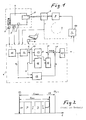
- FIG. 1 shows a schematic representation of an apparatus for carrying out the method according to the invention
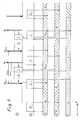
- FIG. 2 shows a method according to the prior art on the basis of a time flow diagram
- FIG. 3 shows the method according to the invention in a similar
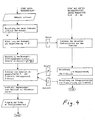
- Fig. 4 is a simplified flow diagram for the method according to the invention.
- an engine 2 in the present case a diesel engine, or the associated vehicle
- an electronic arithmetic circuit 1 various operating variables of an engine 2, in the present case a diesel engine, or the associated vehicle are supplied to an electronic arithmetic circuit 1.
- These are primarily signals from a speed sensor 3 and an accelerator position sensor 4, furthermore, for example, an engine temperature sensor 5, a boost pressure sensor 6, etc.
- the actuator 7 is controlled via a driver stage 10 by the output signal s of the computing circuit 1.
- a Servo circuit not shown here, only indicated by dashed lines, can be provided for the actuator control (cf. DE patent application P 37 40 443).
- the signal from the speed sensor 3 is processed in a speed measuring block 11 to a speed signal n j , which is preferably measured over one combustion stroke each.
- a subsequent averaging stage 12 an integral measurement takes place, for example, via a combustion cycle, known recursive or transverse methods being used.
- Filter algorithms that can be used belong to the state of the art (eg "semiconductor circuit technology", U. Tietze, Ch. Schenk, Springer Verlag, 6th edition 1983 or “Digitale Regelsysteme", R. Isermann, Springer Verlag 1977).
- the measurement does not have to take place over a complete combustion cycle, but should be carried out over the duration of a combustion cycle, ie it can take place, for example, over the second half of the combustion cycle of a first cylinder and over the second half of the combustion cycle (stroke) of a second cylinder.
- the measuring block 11 can contain pulse formers, frequency dividers or multipliers in a known manner, taking into account the type of speed sensor 3 and the number of pulses occurring per engine revolution. Likewise, if the speed sensor 3 fails, the signal from a further speed sensor, for example the alternator of the vehicle, can be supplied to the measuring block 11, reference being made to DE-A 35 01 435 in this connection.
- the average speed signal n can be stored in a memory 13 and can be supplied on the one hand to a computer area 14 for calculating the D component of the controlled system and on the other hand to a computer area 15 for calculating the P and I components.
- a memory 16 can store the P and I components calculated in the area 15 separately or temporarily as a sum.
- a first summation point 17 serves for summing the negative D component D with the P and I components, which after a via a control line 18 from the region 14 command given to the memory 16 can be read out. Furthermore, a correction unit 19 is provided, which the speed signals n j and n are fed.
- a correction signal k is calculated from various operating parameters, with readjustment relating to individual cylinders also being possible, for which purpose the speed signal n j , which is decisive for a single combustion stroke, is required in any case.
- the correction signal k is combined with the P + I + D signal in a second summation point 20 and fed to a limiter unit 21, which is provided primarily for safety reasons (full load limitation) and to comply with specified exhaust gas values. Your output signal s is led to driver stage 10.
- a measurement interrupt is carried out, the measured speed value is read in ("IN"), then the P, I and D components are calculated, summed up and output to control the actuator (Arrow St).
- the total time between the input of the measured value and the output of the calculated value is denoted by t TOT , it actually determines the dead time of the controlled system and determines the time t MEAS between successive measurements, meaning that t MEAS > t DEAD should apply. If the measuring time is shorter than the dead time, individual measurements are pointless and the arithmetic circuit often uses "outdated" measured values.
- the invention provides a method in which the determination of the D component with higher priority is carried out separately from the determination of the P and I components. To explain this method, reference is made not only to FIG. 1 but also to FIGS. 3 and 4 below.
- a measurement interrupt is carried out at a certain point in time (arrow M j + 1 in FIG. 3a) n j + 1 is read in and stored in a memory, where it has the previous value n j replaced (Fig. 3c and memory 13 in Fig. 1).
- the calculation of the D component follows (FIG. 3a).
- P components P i-1 (FIG. 3d) or I components I i-1 (FIG. 3e) calculated beforehand and stored in memories (cf. memory 16, FIG. 1) are called up (FIG. see control line 18 of FIG. 1) and added to the calculated D component.
- the sum signal is output to control the actuator (arrow St; Fig. 3a).
- the boxes P i , I i schematically indicate the calculation of the P and I components. This calculation is carried out without temporal coupling to the D-share calculation, either when computing capacity is free, or at certain, predetermined time intervals, for example every 20 ms.
- the speed values n retrieved from the associated memory (memory 13 in FIG. 1; FIG. 3c).
- the calculated P and I components are temporarily stored (FIG. 3d, e; memory 16 in FIG. 1), so that they are available for summation with the D component at the given time.
- Fig. 3 shows that the calculation of the D component to the measurement intervals t MESS is attached, which is made possible by the separate therefrom, time-consuming calculation of the P and I components.
- the measuring time t MESS is inversely proportional to the engine speed within at least speed ranges. This means that, for example, from a certain speed, only every second pulse and at even higher speeds only every third or fourth pulse of the speed sensor can be used for the calculation, etc.
- the indices j relate to successive measuring intervals, whereas the indices i refer to the recurring P and I share calculations. 3 provides for the separate storage of the calculated P and I components. However, it is equally possible to store the sum P + I and then add it to the D component.
Landscapes
- Engineering & Computer Science (AREA)
- Chemical & Material Sciences (AREA)
- Combustion & Propulsion (AREA)
- Mechanical Engineering (AREA)
- General Engineering & Computer Science (AREA)
- Electrical Control Of Air Or Fuel Supplied To Internal-Combustion Engine (AREA)
- Combined Controls Of Internal Combustion Engines (AREA)
- Output Control And Ontrol Of Special Type Engine (AREA)
- Control Of Velocity Or Acceleration (AREA)
- Control Of Throttle Valves Provided In The Intake System Or In The Exhaust System (AREA)
Abstract
Description
- Die Erfindung bezieht sich auf ein Verfahren zum Steuern und Regeln einer Brennkraftmaschine eines Fahrzeuges, bei welchem in Abhängigkeit von Betriebsgrößensignalen, wie der Drehzahl, der Fahrpedalstellung, der Motortemperatur etc. in einer Recheneinrichtung ein Ausgangssignal errechnet und dieses zur Steuerung eines elektromechanischen Stellgliedes für die Kraftstoff- und/oder Luftmenge, insbesondere für eine Einspritzpumpe oder Pumpedüsen eines Dieselmotors herangezogen wird, wobei die P-, I-und D-Anteile eines Drehzahlregelsignales getrennt ermittelt und sodann addiert werden und das erhaltene Summensignal nach allfälliger Korrektur und/oder Begrenzung dem Stellglied zugeführt wird, sowie auf eine Vorrichtung zur Durchführung dieses Verfahrens.
- Elektronischen Reglern von Kraftfahrzeug-Brennkraftmaschinen, insbesondere von Dieselmotoren, wird neben anderen Größen als wichtigste Regelgröße die Motordrehzahl in Form eines Drehzahlsignals zugeführt. In Abhängigkeit von den zugeführten Größen wird, meist unter Berücksichtigung abgespeicherter Kennlinienfelder, ein Ausgangssignal berechnet, welches elektromechanisch auf ein Stellgleid, bei einem Dieselmotor, z.B. die Regelstange der Einspritzpumpe oder das Mengenstellglied von Pumpedüsen einwirkt.
- Ein solcher Regler weist im allgemeinen bezüglich der Drehzahlregelung eine PID-Charakteristik mit einem Proportional-, Integral- und Differentialanteil (im folgenden nur kurz P-, I- und D-Anteil genannt) auf (z.B. DE-A-27 35 596), wobei die Einflüsse dieser Anteile auf das Verhalten einer Regelstrecke dem Fachmann bekannt sich und hier nicht im Detail erörtert werden müssen.
- Es sei jedoch angeführt, daß der D-Anteil, welcher der Änderung der Drehzahl mit der Zeit, d.h. der Winkelbeschleunigung proportional ist, von besonderem Einfluß auf die Stabi lität des dynamischen Systems Motor-Fahrzeug ist, wobei die bei der Regelung auftretenden Totzeiten leicht zu Instabilitäten, z.B. zu Ruckelschwingungen, führen (vgl.DE-A 29 06 782). Weiters sei erwähnt, daß hier unter der Berechnung des P-Anteils nicht bloß die einfache Multiplikation eines drehzahlabweichungsproportionalen Wertes mit einem konstanten Faktor zu verstehen ist, sondern daß der P-Anteil üblicherweise unter Zuhilfenahme zwei- oder mehrdimensionaler kennlinienfelder durch Interpolation berechnet wird - ein Vorgang, der verhältnismäßig lange Rechenzeiten erfordert. Das Abgehen von einem streng linearen D-Anteil bei gewissen Betriebsbedingungen ist z.B. aus der DE-A-33 29 800 bekannt geworden.
- Bei Reglern nach dem Stand der Technik werden nach dem Einlesen der Meßwerte, insbesondere der Drehzahlwerte, der P-, I- und D-Anteil nacheinander berechnet und sodann, gegebenenfalls nach Korrektur und/oder Begrenzung dem Stellglied zugeführt. Der nächste Meßinterrupt mit dem Einlesen neuer Meßwerte kann sinnvollerweise erst nach Beendigung der Berechnung und Ausgabe des Summensignals durchgeführt werden. Die durch Eingabe der Meßwerte, Berechnung der P-, I- und D-Anteile, Summieren dieser Anteile und Ausgabe des Summensignals gegebene Totzeit führt dazu, daß rasche Änderungen der Meßdaten (Drehzahl) nicht schnell genug erfaßt werden, was einer wirksamen Regelung in gewissen Betriebssituationen, wie schnellen Lastwechselreaktionen etc. entgegensteht.
- Die Erfindung hat es sich zum Ziel gesetzt, durch Verringerung der Totzeit zu kürzeren Meßintervallen zu gelange, wobei die Erkenntnis maßgebend ist, daß für eine Verbesserung der Stabilität des Systems in erster Linie eine rasche Berechnung des D-Anteils maßgeblich ist. Das angestrebte Ziel läßt sich mit einem Verfahren der eingangs genannten Art erreichen, welches die im Kennzeichen des Patentanspruches 1 genannten Merkmale besitzt.
- Die konsequente Trennung der Berechnung des D-Anteils von der Berechnung der P- und I-Anteile, wobei die D-Anteil-Berechnung mit höherer Priorität erfolgt, führt zu einer merklich erhöhten Stabilität der Regelung.
- Der verwendete Begriff "je zu Beginn des drehzahlsynchronen Meßintervalles" ist dahingehend zu verstehen, daß die Ermittlung der Drehzahlwerte möglichst bald nach Abschluß eines Meßinvervalls erfolgt, wobei der Abschluß eines Meßintervalles dem Beginn des nächsten Meßintervalles entspricht.
- Weitere Merkmale der Erfindung sind in den Unteransprüchen gekennzeichnet.
- Die Erfindung samt ihren weiteren Vorteilen ist im folgenden an Hand eines Beispiels unter Bezugnahme auf die Zeichnung näher erläutert. In dieser zeigen Fig. 1 in schematischer Darstellung eine Vorrichtung zur Durchführung des Verfahrens nach der Erfindung, Fig. 2 an Hand eines zeitlichen Ablaufdiagramms ein Verfahren nach dem Stand der Technik, Fig. 3 in einem ähnlichen, ausführlicheren Diagramm das Verfahren nach der Erfindung und Fig. 4 ein vereinfachtes Flußdiagramm zum Verfahren nach der Erfindung.
- Gemäß Fig. 1 werden einer elektronischen Rechenschaltung 1 verschiedene Betriebsgrößen eines Motors 2, im vorliegenden Fall eines Dieselmotors, bzw. des zugehörigen Fahrzeuges zugeführt. Es handelt sich dabei in erster Linie um Signale eines Drehzahlgebers 3 und eines Gaspedalstellungssensors 4, weiters z.B. eines Motortemperatursensors 5, eines Ladedrucksensors 6 usw. Ein elektromechanisches Stellglied 7, beispielsweise ein auf das Mengenstellglied einer Verteilereinspritzpumpe 8 wirkender Stellmagnet, ist mechanisch mit einem Rückmelder 9 verbunden, dessen für die Stellung des Stellgliedes 7 repräsentatives Ausgangssignal r an die Rechenschaltung 1 zurückgeführt wird. Das Stellglied 7 wird über eine Treiberstufe 10 von dem Ausgangssignal s der Rechenschaltung 1 angesteuert. In bekannter Weise kann ein hier nicht gezeigter, nur strichliert angedeuteter Servokreis für die Stellgliedansteuerung vorgesehen sein (vgl. DE-Patentanmeldung P 37 40 443).
- In der Rechenschaltung 1 wird das Signal des Drehzahlgebers 3 in einem Drehzahlmeßblock 11 zu einem Drehzahlsignal nj verarbeitet, das bevorzugt über je einen Verbrennungshub gemessen wird. In einer darauffolgenden Mittelungsstufe 12 erfolgt eine integrale Messung z.B. über einen Verbrennungszyklus, wobei bekannte rekursive oder transversale Verfahren Verwendung finden. Hiezu verwendbare Filteralgorithmen gehören dem Stand der Technik an (z.B. "Halbleiterschaltungstechnik", U. Tietze, Ch. Schenk, Springer Verlag, 6. Auflage 1983 oder "Digitale Regelsysteme", R. Isermann, Springer Verlag 1977). Die Messung muß nicht über einen vollständigen Verbrennungszyklus erfolgen, sondern soll über die Dauer eines Verbrennungszyklus durchgeführt werden, d.h. sie kann beispielsweise über die zweite Hälfte des Verbrennungszyklus eines ersten Zylinders und über die zweite Hälfte des Verbrennungszyklus (Hubes) eines zweiten Zylinders erfolgen. Der Meßblock 11 kann in bekannter Weise Impulsformer, Frequenzteiler oder -vervielfacher enthalten, wobei auf die Art des Drehzahlgebers 3 und die Anzahl der pro Motorumdrehung anfallenden Impulse Rücksicht zu nehmen ist. Ebenso kann bei Ausfall des Drehzahlgebers 3 dem Meßblock 11 das Signal eines weiteren Drehzahlgebers, z.B. der Lichtmaschine des Fahrzeuges, zugeführt werden, wobei in diesem Zusammenhang auf die DE-A 35 01 435 verwiesen wird.
- Das gemittelte Drehzahlsignal
n kann in einem Speicher 13 abgelegt und kann einerseits einem Rechnerbereich 14 zur Berechnung des D-Anteils der Regelstrecke und andererseits einem Rechnerbereich 15 zur Berechnung der P- und I-Anteile zugeführt werden. Ein Speicher 16 kann die im Bereich 15 errechneten P- und I-Anteile getrennt oder als Summe vorübergehend aufnehmen. Ein erster Summenpunkt 17 dient zum Summieren des negativen D-Anteils D mit den P- und I-Anteilen, die nach einem über eine Steuerleitung 18 von dem Bereich 14 an den Speicher 16 gegebenen Befehl ausgelesen werden. Es ist weiters eine Korrektureinheit 19 vorgesehen, welcher die Drehzahlsignale nj undn zugeführt werden. In dieser Einheit wird aus verschiedenen Betriebsparametern ein Korrektursignal k errechnet, wobei gegebenenfalls auch eine auf einzelne Zylinder bezogene Nachregelung erfolgen kann, wofür aus jeden Fall das für einen einzigen Verbrennungshub maßgebliche Drehzahlsignal nj benötigt wird. Das Korrektursignal k wird mit dem P+I+D-Signal in einem zweiten Summenpunkt 20 vereinigt und einer Begrenzereinheit 21 zugeführt, die vor allem aus Sicherheitsgründen (Vollastbegrenzung) und zur Einhaltung vorgegebener Abgaswerte vorgesehen ist. Ihr Ausgangssignal s wird zur Treiberstufe 10 geführt. - Bevor auf den genaueren Funktionsablauf eingegangen wird, soll an Hand der Fig. 2 die Ermittlung des Regelsignales nach dem Stand der Technik erläutert werden. Zu einem bestimmten Zeitpunkt wird, mit dem Pfeil Mj angedeutet, ein Meßinterrupt durchgeführt, der gemessene Drehzahlwert wird eingelesen ("IN"), daraufhin werden der P-, der I- und der D-Anteil errechnet, summiert und zur Ansteuerung des Stellgliedes ausgegeben (Pfeil St). Die gesamte Zeit zwischen Eingabe des Meßwertes und Ausgabe des errechneten Wertes wird mit tTOT bezeichnet, sie bestimmt tatsächlich die Totzeit der Regelstrecke und bestimmt die Zeit tMESS zwischen aufeinanderfolgenden Messungen, wobei sinnvollerweise tMESS > tTOT gelten sollte. Wird die Meßzeit kleiner als die Totzeit, so sind einzelne Messungen sinnlos und die Rechenschaltung greift oft auf "veraltete" Meßwerte zurück.
- Wie bereits eingangs erwähnt, sieht die Erfindung ein Verfahren vor, bei dem die Ermittlung des D-Anteils mit höherer Priorität, getrennt von der Ermittlung der P- und I-Anteile erfolgt. Zur Erläuterung dieses Verfahrens wird nachstehend nicht nur auf Fig. 1 sondern auch auf Fig. 3 und 4 Bezug genommen.
- Zu einem bestimmten Zeitpunkt wird ein Meßinterrupt durchgeführt (Pfeil Mj+1 in Fig. 3a) Der Meßwert
n j+1 wird eingelesen und in einem Speicher abgelegt, wo er den bisherigen Wertn j ersetzt (Fig. 3c und Speicher 13 in Fig. 1). Es folgt (Fig. 3a) die Berechnung des D-Anteils. Sobald diese beendet ist, werden zuvor berechnete und in Speichern (vgl. Speicher 16, Fig. 1) vorhandene P-Anteile Pi-1 (Fig. 3d) bzw. I-Anteile Ii-1 (Fig. 3e) abgerufen (siehe Steuerleitung 18 der Fig. 1) und zu dem errechneten D-Anteil addiert. Das Summensignal wird zur Ansteuerung des Stellgliedes ausgegeben (Pfeil St; Fig. 3a). - In Fig. 3b ist schematisch mit den Kästchen Pi, Ii die Berechnung der P- und I-Anteile angedeutet. Diese Berechnung erfolgt ohne zeitliche Kopplung an die D-Anteilsberechnung entweder kann, wenn Rechenkapazität frei ist, oder in bestimmten, vorgegebenen Zeitintervallen, z.B. alle 20 ms. Hiezu werden die Drehzahlwerte
n aus dem zugehörigen Speicher (Speicher 13 in Fig. 1; Fig. 3c) abgerufen. Die errechneten P- und I-Anteile werden vorübergehend abgelegt (Fig. 3d, e; Speicher 16 in Fig. 1), sodaß sie zum gegebenen Zeitpunkt zur Summierung mit dem D-Anteil bereitstehen. - Man erkennt aus Fig. 3 deutlich, daß die Berechnung des D-Anteils an die Meßintervalle tMESS gebunden ist, was erst durch die davon getrennte, zeitaufwendige Berechnung der P- und I-Anteile möglich ist. Die Meßzeit tMESS ist innerhalb zumindest von Drehzahlbereichen der Motordrehzahl verkehrt proportional. Dies bedeutet, daß man z.B. ab einer gewissen Drehzahl nur jeden zweiten Impuls und bei noch höheren Drehzahlen bloß jeden dritten oder vierten Impuls des Drehzahlgebers zur Berechnung verwenden kann etc. In Fig. 3 beziehen sich die Indices j auf aufeinanderfolgende Meßintervalle, wogegen die Indices i auf die wiederkehrenden P- und I-Anteilsberechnungen bezug nehmen. Das Schema nach Fig. 3 sieht die getrennte Abspeicherung der errechneten P- und I-Anteile vor. Es ist jedoch ebensogut möglich, die Summe P + I abzuspeichern und sodann zu dem D-Anteil hinzu zu addieren.
- Nach der Erfindung werden somit stets "aktuelle" Drehzahlwerte
n zur Berechnung des besonders wesentlichen D-Anteils herangezogen, wogegen die verwendeten P- und I-Anteile bei kürzeren Meßintervallen auch "veraltet" sein können. Wegen der Verringerung der Totzeit kann somit auch die Meßzeit entsprechend verringert werden, was zu einer Verbesserung des Regelverhaltens führt. - Fig. 4 veranschaulicht in übersichtlicher Weise den Ablauf des oben beschriebenen Verfahrens zur Ermittlung des Stellgliedsignales, wobei sich eine zusätzliche Erläuterung erübrigt.
Claims (5)
Priority Applications (1)
| Application Number | Priority Date | Filing Date | Title |
|---|---|---|---|
| AT89890078T ATE67278T1 (de) | 1988-03-16 | 1989-03-16 | Verfahren zum steuern und regeln einer brennkraftmaschine eines fahrzeuges. |
Applications Claiming Priority (2)
| Application Number | Priority Date | Filing Date | Title |
|---|---|---|---|
| DE3808819A DE3808819A1 (de) | 1988-03-16 | 1988-03-16 | Verfahren zum steuern und regeln einer brennkraftmaschine eines fahrzeuges |
| DE3808819 | 1988-03-16 |
Publications (3)
| Publication Number | Publication Date |
|---|---|
| EP0333701A2 true EP0333701A2 (de) | 1989-09-20 |
| EP0333701A3 EP0333701A3 (en) | 1990-04-11 |
| EP0333701B1 EP0333701B1 (de) | 1991-09-11 |
Family
ID=6349893
Family Applications (1)
| Application Number | Title | Priority Date | Filing Date |
|---|---|---|---|
| EP89890078A Expired - Lifetime EP0333701B1 (de) | 1988-03-16 | 1989-03-16 | Verfahren zum Steuern und Regeln einer Brennkraftmaschine eines Fahrzeuges |
Country Status (4)
| Country | Link |
|---|---|
| EP (1) | EP0333701B1 (de) |
| AT (1) | ATE67278T1 (de) |
| DE (2) | DE3808819A1 (de) |
| ES (1) | ES2025856T3 (de) |
Families Citing this family (1)
| Publication number | Priority date | Publication date | Assignee | Title |
|---|---|---|---|---|
| DE102020201845A1 (de) | 2020-02-14 | 2021-08-19 | Volkswagen Aktiengesellschaft | Verfahren zur Steuerung eines Verbrennungsmotors bei einem Motorstart |
Family Cites Families (6)
| Publication number | Priority date | Publication date | Assignee | Title |
|---|---|---|---|---|
| JPS5340105A (en) * | 1976-09-24 | 1978-04-12 | Nippon Denso Co Ltd | Automobile control unit |
| DE2735596C2 (de) * | 1977-08-06 | 1986-09-18 | Robert Bosch Gmbh, 7000 Stuttgart | Einrichtung zur elektronischen Einspritzmengenregelung bei Brennkraftmaschinen mit Selbstzündung |
| DE2906782A1 (de) * | 1979-02-22 | 1980-09-04 | Bosch Gmbh Robert | Einrichtung zum daempfen von ruckelschwingungen bei einer brennkraftmaschine |
| DE3329800A1 (de) * | 1983-08-18 | 1985-02-28 | Robert Bosch Gmbh, 7000 Stuttgart | Drehzahlregelsystem fuer eine brennkraftmaschine mit selbstzuendung |
| DE3501435A1 (de) * | 1985-01-17 | 1986-07-17 | Voest-Alpine Friedmann GmbH, Linz | Anordnung zum steuern und regeln einer brennkraftmaschine |
| DE3536034A1 (de) * | 1985-10-09 | 1987-04-09 | Bosch Gmbh Robert | Eingebersystem fuer einspritzduesen |
-
1988
- 1988-03-16 DE DE3808819A patent/DE3808819A1/de active Granted
-
1989
- 1989-03-16 DE DE8989890078T patent/DE58900269D1/de not_active Expired - Fee Related
- 1989-03-16 AT AT89890078T patent/ATE67278T1/de not_active IP Right Cessation
- 1989-03-16 EP EP89890078A patent/EP0333701B1/de not_active Expired - Lifetime
- 1989-03-16 ES ES198989890078T patent/ES2025856T3/es not_active Expired - Lifetime
Also Published As
| Publication number | Publication date |
|---|---|
| ES2025856T3 (es) | 1992-04-01 |
| DE58900269D1 (de) | 1991-10-17 |
| ATE67278T1 (de) | 1991-09-15 |
| DE3808819A1 (de) | 1989-09-28 |
| DE3808819C2 (de) | 1990-06-07 |
| EP0333701B1 (de) | 1991-09-11 |
| EP0333701A3 (en) | 1990-04-11 |
Similar Documents
| Publication | Publication Date | Title |
|---|---|---|
| EP0416270B1 (de) | Verfahren und Einrichtung zum Steuern und Regeln einer selbstzündenden Brennkraftmaschine | |
| DE102008057092B4 (de) | Steuervorrichtung für einen Verbrennungsmotor | |
| DE3924923C2 (de) | ||
| DE3015832A1 (de) | Verfahren und vorrichtung zum steuern und/oder regeln der luftmengenzufuhr bei verbrennungskraftmaschinen | |
| DE102006057922A1 (de) | Steuervorrichtung für einen Verbrennungsmotor | |
| EP1254310B1 (de) | Regelsystem für eine brennkraftmaschine | |
| DE69127030T2 (de) | Methode und Vorrichtung zur Kraftstoffeinspritzungssteuerung für eine Brennkraftmaschine | |
| DE102012100622A1 (de) | Kraftstoffeinspritzungssteuerung | |
| DE3835113A1 (de) | Elektronisches ueberwachungssystem fuer eine brennkraftmaschine mit innerer verbrennung | |
| DE69200442T2 (de) | Verfahren zur Korrektur von Steuerparametern einer Brennkraftmaschine und Vorrichtung zur Durchführung des Verfahrens. | |
| EP0347446B1 (de) | Verfahren und einrichtung zur beeinflussung der luftzumessung bei einer brennkraftmaschine, insbesondere im leerlauf und schubbetrieb | |
| EP0449851B1 (de) | Verfahren zur kraftstoffmengenbestimmung | |
| DE112023004467T5 (de) | Systeme für gasförmige kraftstoffe und steuerungen | |
| EP0385969B1 (de) | Einrichtung zum Steuern und Regeln einer Dieselbrennkraftmaschine | |
| DE3421640A1 (de) | Einrichtung zum feststellen des aenderungswertes in der drehzahl eines verbrennungsmotors | |
| DE3423110C2 (de) | ||
| DE10333773A1 (de) | System und Verfahren zur Drucksteuerung einer gemeinsamen Zuführung | |
| WO2007141099A1 (de) | Verfahren und vorrichtung zur steuerung der kraftstoffzumessung in wenigstens einen brennraum einer brennkraftmaschine | |
| EP0502849A1 (de) | Elektronisches steuersystem für die kraftstoffzumessung bei einer brennkraftmaschine. | |
| EP1117930A1 (de) | Verfahren zum elektronischen trimmen einer einspritzvorrichtung | |
| EP0333701B1 (de) | Verfahren zum Steuern und Regeln einer Brennkraftmaschine eines Fahrzeuges | |
| DE3009627A1 (de) | Einrichtung zum ermitteln von steuer- und regelgroessen einer brennkraftmaschine | |
| DE102008005154A1 (de) | Verfahren und Vorrichtung zur Überwachung einer Motorsteuereinheit | |
| EP2019195B1 (de) | Verfahren zur Bestimmung der eingespritzten Kraftstoffmenge | |
| EP0333702B1 (de) | Verfahren zum Steuern und Regeln der Brennkraftmaschine eines Kraftfahrzeuges |
Legal Events
| Date | Code | Title | Description |
|---|---|---|---|
| PUAI | Public reference made under article 153(3) epc to a published international application that has entered the european phase |
Free format text: ORIGINAL CODE: 0009012 |
|
| AK | Designated contracting states |
Kind code of ref document: A2 Designated state(s): AT CH DE ES FR GB IT LI SE |
|
| PUAL | Search report despatched |
Free format text: ORIGINAL CODE: 0009013 |
|
| AK | Designated contracting states |
Kind code of ref document: A3 Designated state(s): AT CH DE ES FR GB IT LI SE |
|
| 17P | Request for examination filed |
Effective date: 19901004 |
|
| 17Q | First examination report despatched |
Effective date: 19910225 |
|
| RAP1 | Party data changed (applicant data changed or rights of an application transferred) |
Owner name: AUTOMOTIVE DIESEL GESELLSCHAFT M.B.H. |
|
| GRAA | (expected) grant |
Free format text: ORIGINAL CODE: 0009210 |
|
| AK | Designated contracting states |
Kind code of ref document: B1 Designated state(s): AT CH DE ES FR GB IT LI SE |
|
| REF | Corresponds to: |
Ref document number: 67278 Country of ref document: AT Date of ref document: 19910915 Kind code of ref document: T |
|
| REF | Corresponds to: |
Ref document number: 58900269 Country of ref document: DE Date of ref document: 19911017 |
|
| GBT | Gb: translation of ep patent filed (gb section 77(6)(a)/1977) | ||
| ITF | It: translation for a ep patent filed | ||
| ET | Fr: translation filed | ||
| REG | Reference to a national code |
Ref country code: ES Ref legal event code: FG2A Ref document number: 2025856 Country of ref document: ES Kind code of ref document: T3 |
|
| PLBE | No opposition filed within time limit |
Free format text: ORIGINAL CODE: 0009261 |
|
| STAA | Information on the status of an ep patent application or granted ep patent |
Free format text: STATUS: NO OPPOSITION FILED WITHIN TIME LIMIT |
|
| 26N | No opposition filed | ||
| EAL | Se: european patent in force in sweden |
Ref document number: 89890078.2 |
|
| PGFP | Annual fee paid to national office [announced via postgrant information from national office to epo] |
Ref country code: GB Payment date: 19970213 Year of fee payment: 9 |
|
| PGFP | Annual fee paid to national office [announced via postgrant information from national office to epo] |
Ref country code: FR Payment date: 19970214 Year of fee payment: 9 |
|
| PGFP | Annual fee paid to national office [announced via postgrant information from national office to epo] |
Ref country code: DE Payment date: 19970220 Year of fee payment: 9 Ref country code: AT Payment date: 19970220 Year of fee payment: 9 |
|
| PGFP | Annual fee paid to national office [announced via postgrant information from national office to epo] |
Ref country code: SE Payment date: 19970221 Year of fee payment: 9 |
|
| PGFP | Annual fee paid to national office [announced via postgrant information from national office to epo] |
Ref country code: CH Payment date: 19970226 Year of fee payment: 9 |
|
| PGFP | Annual fee paid to national office [announced via postgrant information from national office to epo] |
Ref country code: ES Payment date: 19970321 Year of fee payment: 9 |
|
| PG25 | Lapsed in a contracting state [announced via postgrant information from national office to epo] |
Ref country code: GB Free format text: LAPSE BECAUSE OF NON-PAYMENT OF DUE FEES Effective date: 19980316 Ref country code: AT Free format text: LAPSE BECAUSE OF NON-PAYMENT OF DUE FEES Effective date: 19980316 |
|
| PG25 | Lapsed in a contracting state [announced via postgrant information from national office to epo] |
Ref country code: SE Free format text: LAPSE BECAUSE OF NON-PAYMENT OF DUE FEES Effective date: 19980317 Ref country code: ES Free format text: LAPSE BECAUSE OF EXPIRATION OF PROTECTION Effective date: 19980317 |
|
| PG25 | Lapsed in a contracting state [announced via postgrant information from national office to epo] |
Ref country code: LI Free format text: LAPSE BECAUSE OF NON-PAYMENT OF DUE FEES Effective date: 19980331 Ref country code: FR Free format text: THE PATENT HAS BEEN ANNULLED BY A DECISION OF A NATIONAL AUTHORITY Effective date: 19980331 Ref country code: CH Free format text: LAPSE BECAUSE OF NON-PAYMENT OF DUE FEES Effective date: 19980331 |
|
| GBPC | Gb: european patent ceased through non-payment of renewal fee |
Effective date: 19980316 |
|
| REG | Reference to a national code |
Ref country code: CH Ref legal event code: PL |
|
| PG25 | Lapsed in a contracting state [announced via postgrant information from national office to epo] |
Ref country code: DE Free format text: LAPSE BECAUSE OF NON-PAYMENT OF DUE FEES Effective date: 19981201 |
|
| EUG | Se: european patent has lapsed |
Ref document number: 89890078.2 |
|
| REG | Reference to a national code |
Ref country code: FR Ref legal event code: ST |
|
| REG | Reference to a national code |
Ref country code: ES Ref legal event code: FD2A Effective date: 20000601 |
|
| PG25 | Lapsed in a contracting state [announced via postgrant information from national office to epo] |
Ref country code: IT Free format text: LAPSE BECAUSE OF NON-PAYMENT OF DUE FEES;WARNING: LAPSES OF ITALIAN PATENTS WITH EFFECTIVE DATE BEFORE 2007 MAY HAVE OCCURRED AT ANY TIME BEFORE 2007. THE CORRECT EFFECTIVE DATE MAY BE DIFFERENT FROM THE ONE RECORDED. Effective date: 20050316 |